
Estimation of Individual Claim Liabilities A








Description: Estimation of Individual Claim Liabilities A comparison of Traditional and Machine Learning Methodologies CAGNY SPRING MEETING May 12, 2021 Marco De Virgilis Presenters Marco De Virgilis, Senior Actuarial Data Scientist, Allstate Agenda
Related Topics
Download Presentation
"Estimation of Individual Claim Liabilities A" is the property of its rightful owner. Permission is granted to download and print the materials on this website for personal, non-commercial use only, and to display it on your personal computer provided you do not modify the materials and that you retain all copyright notices contained in the materials. By downloading content from our website, you accept the terms of this agreement.
Presentation Transcript
slide1. Estimation of Individual Claim Liabilities
A comparison of Traditional and Machine Learning Methodologies CAGNY SPRING MEETING
May 12, 2021
Marco De Virgilis<br>
slide2. Presenters Marco De Virgilis,
Senior Actuarial Data Scientist, Allstate<br>
slide3. Agenda Traditional Claim Reserving
Machine Learning in Claim Reserving
Model Comparison<br>
slide4. Traditional Claim Reserving<br>
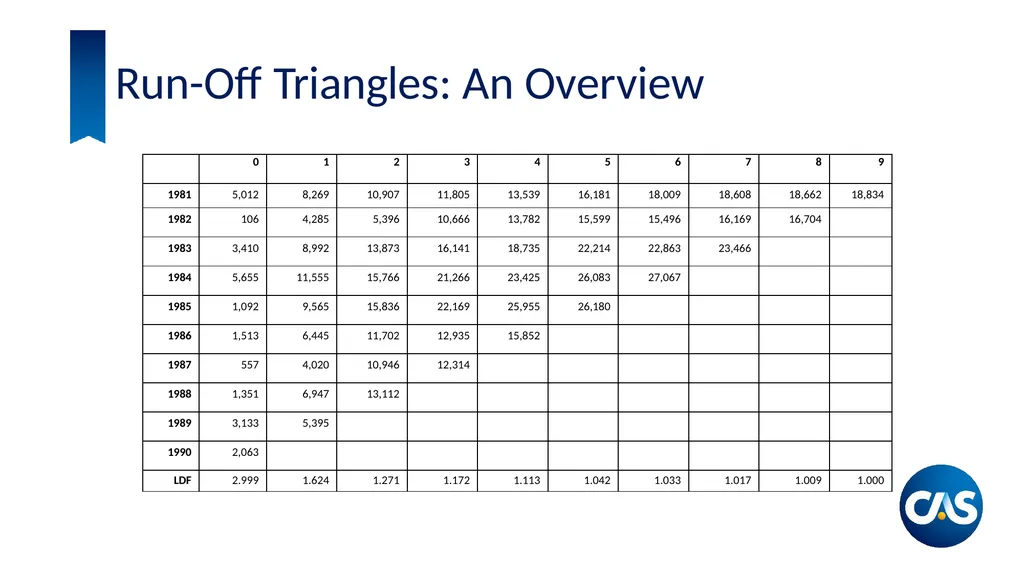
slide5. Run-Off Triangles: An Overview<br>
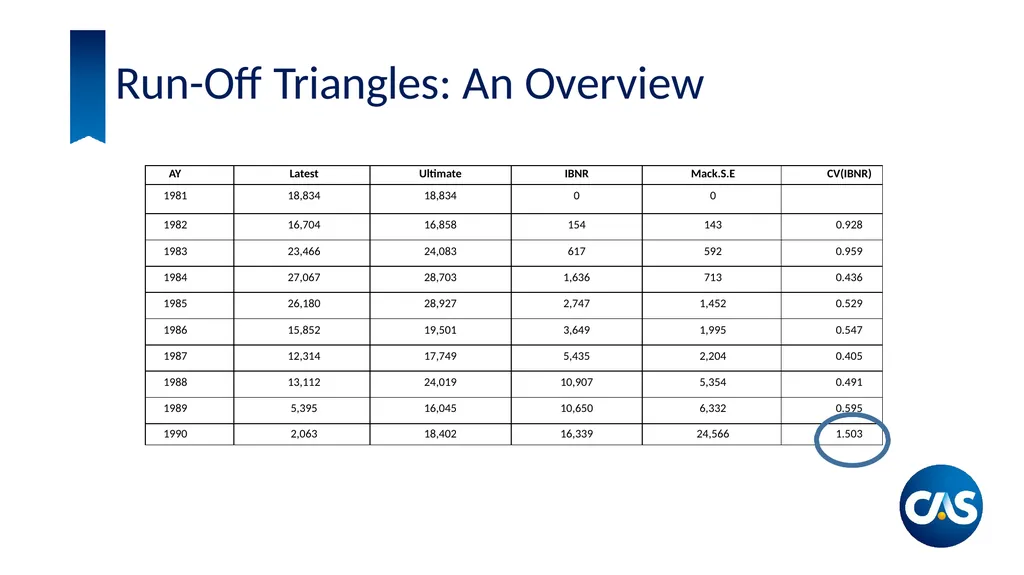
slide6. Run-Off Triangles: An Overview<br>
slide7. Run-Off Triangles: Advantages and Disadvantages Advantages:
Easy Implementation
Stabilizes Experience
Intuitive and Interpretable
Disadvantages:
Information compression, e.g. 10 years worth of data to 55 data points
Unreliable recent results
Loss of information<br>
slide8. Machine Learning in Claim Reserving<br>
slide9. Individual Claim Reserving Looking at claim data at the individual level can overcome the main drawback of standard triangle techniques, bringing these advantages:
Timely Estimates:
There is no need to wait for each AY year to sufficiently develop
Extensive Use of Data:
Data is usually recorded anyway, it would be clever to actually use it.<br>
slide10. Predicting Ultimate Cost Target: To predict the ultimate cost of the claims when they are initially reported.
At this stage, there is no paid amount and an initial case reserve is established.
In one case they will be settled and paid. This is the amount that needs to be estimated.
On the other hand, claims could be closed with no payment (CNP), and therefore there will not be any payment.<br>
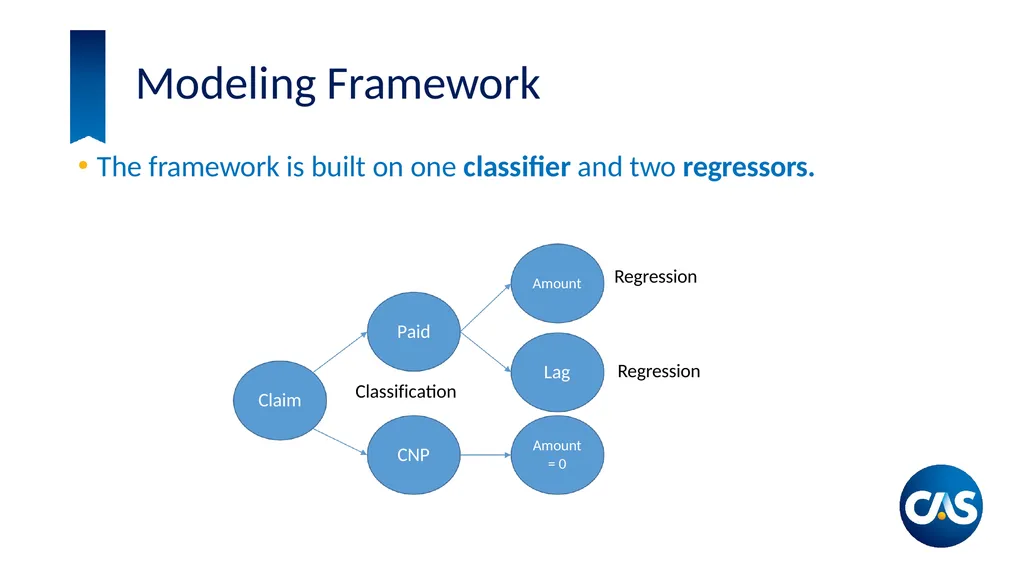
slide11. Predicting Ultimate Costs We will have three stacked models:
First, each claim will be classified if it will be paid or closed with no payment.
If the claim will be paid, a second model will estimate the final claim amount, ie. ultimate cost.
A third model will also estimate the timing of such payment.<br>
slide12. Modeling Framework Claim Paid CNP Amount Lag Amount
= 0 Classification Regression Regression The framework is built on one classifier and two regressors.<br>
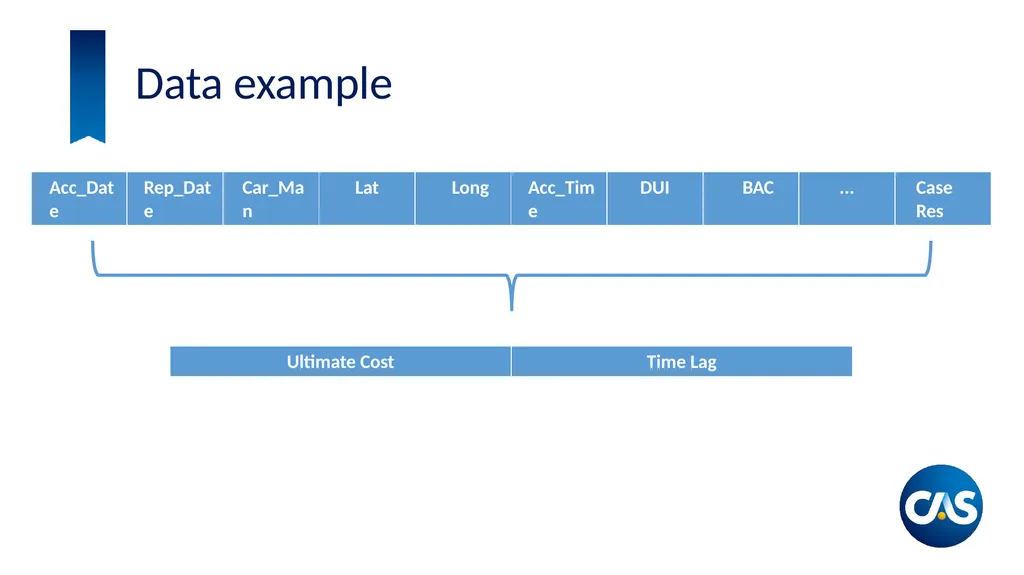
slide13. Data example<br>
slide14. Model Comparison<br>
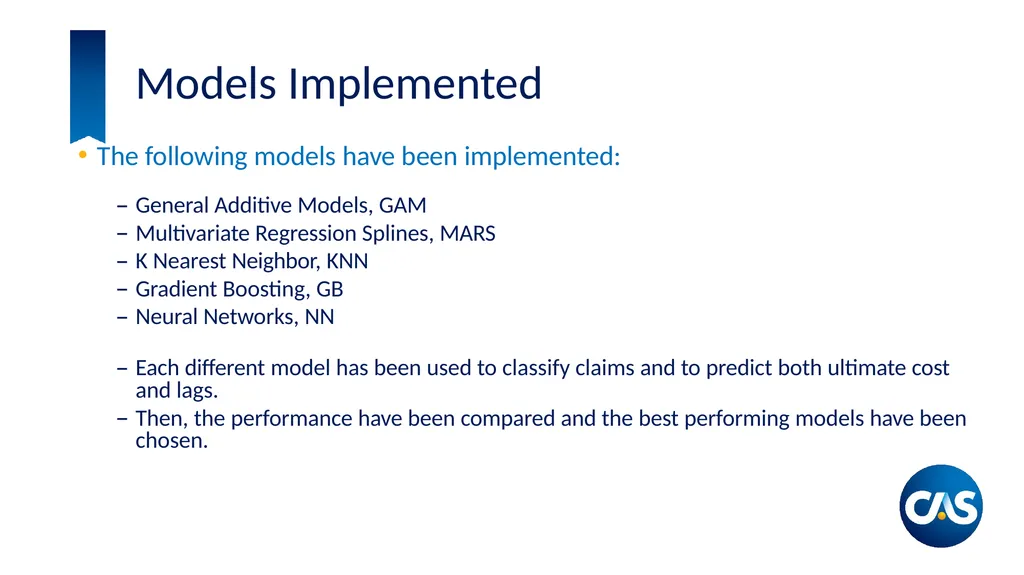
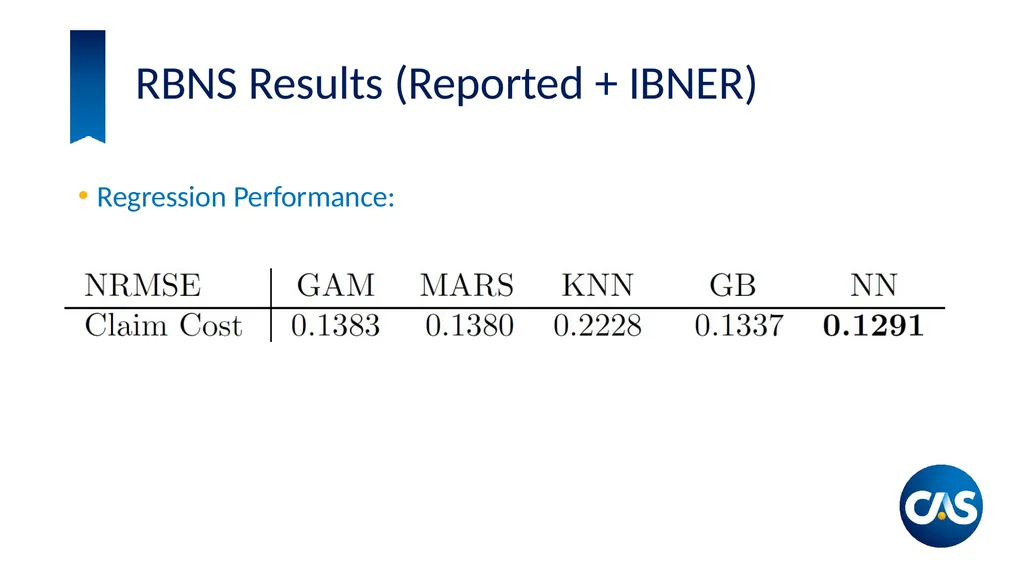
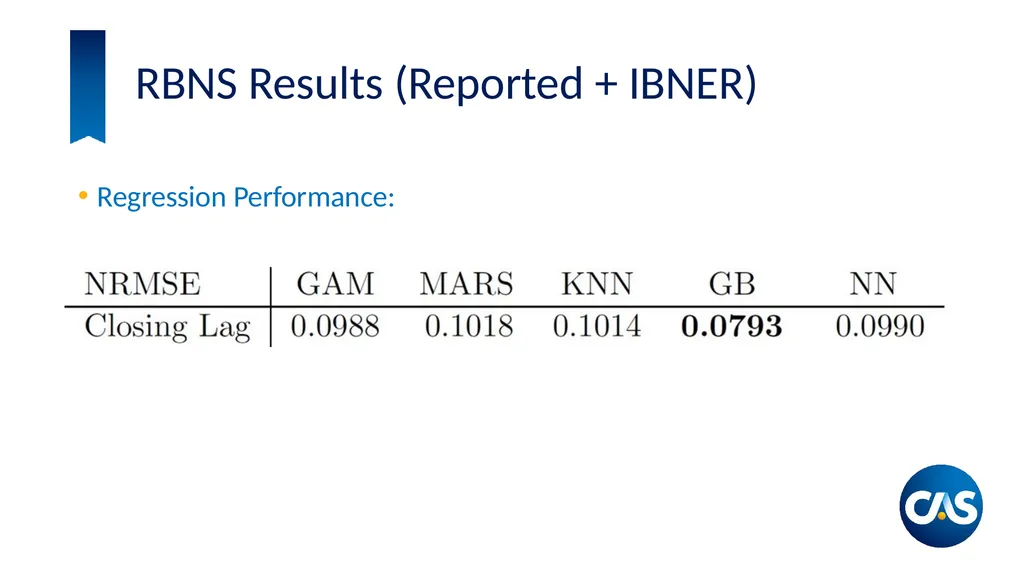
slide15. Models Implemented The following models have been implemented:
General Additive Models, GAM
Multivariate Regression Splines, MARS
K Nearest Neighbor, KNN
Gradient Boosting, GB
Neural Networks, NN
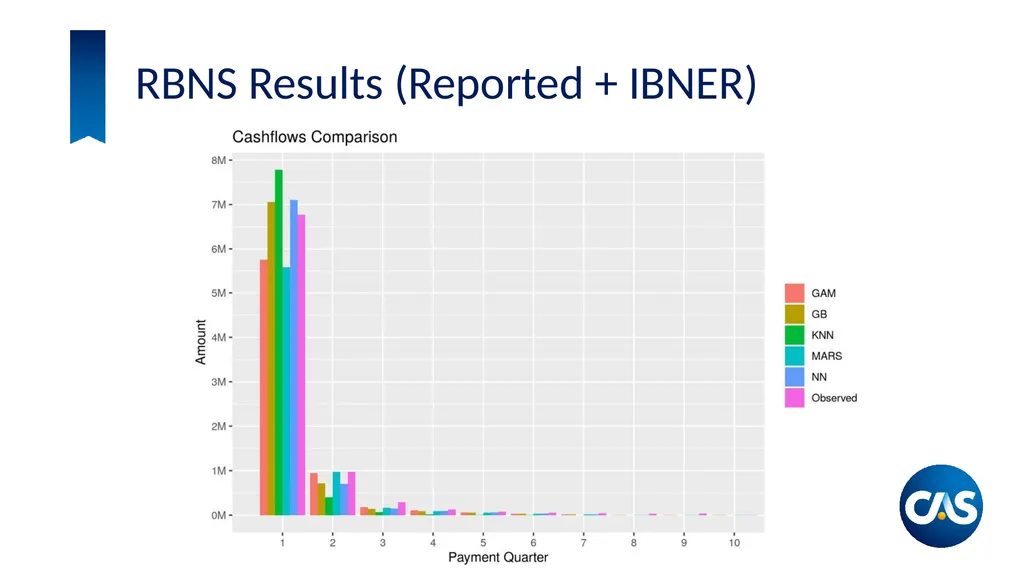
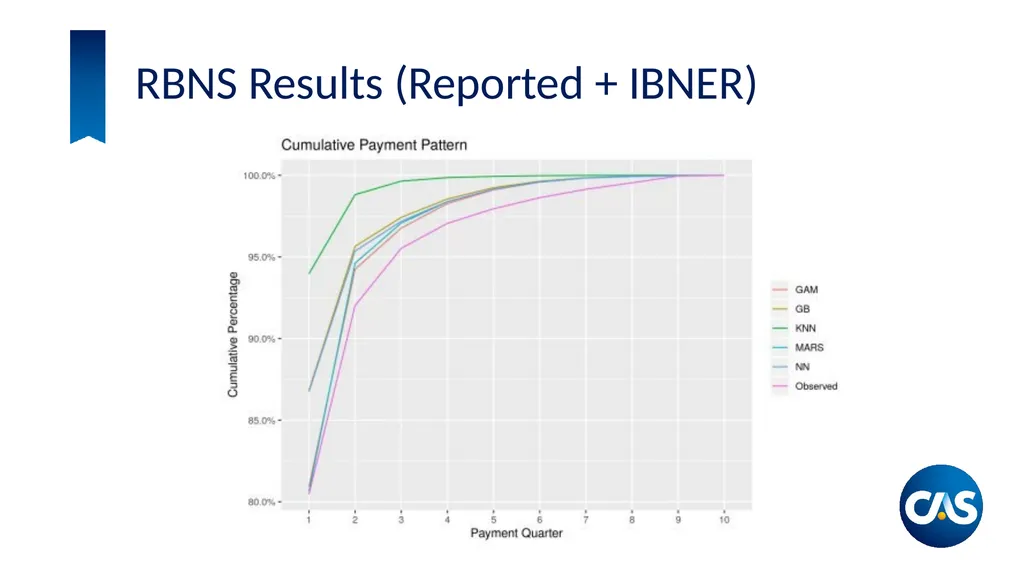
Each different model has been used to classify claims and to predict both ultimate cost and lags.
Then, the performance have been compared and the best performing models have been chosen.<br>
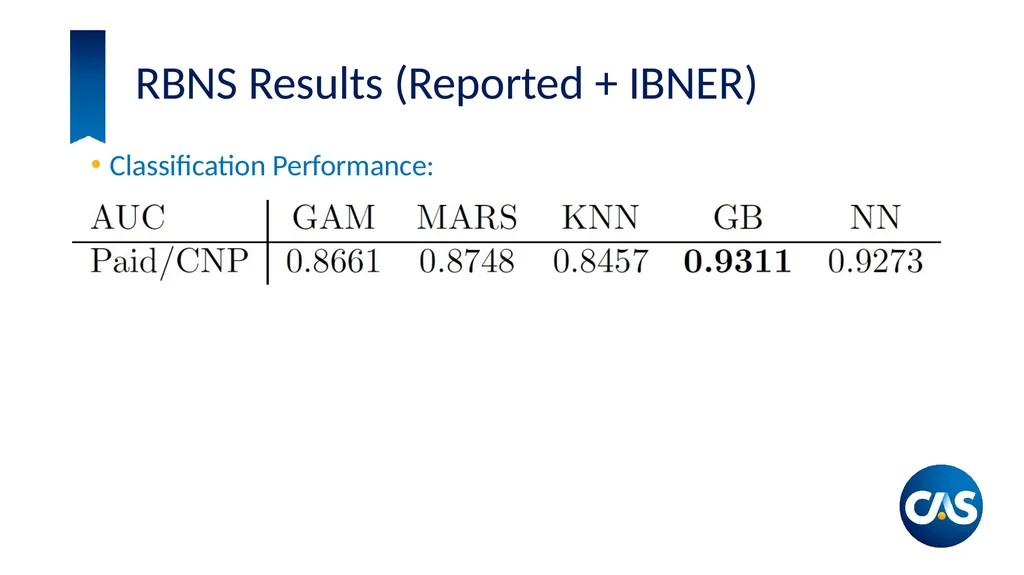
slide16. RBNS Results (Reported + IBNER) Classification Performance:<br>
slide17. RBNS Results (Reported + IBNER) Regression Performance:<br>
slide18. RBNS Results (Reported + IBNER) Regression Performance:<br>
slide19. RBNS Results (Reported + IBNER)<br>
slide20. RBNS Results (Reported + IBNER)<br>
slide21. IBNYR Estimates At this point we have obtained estimates for claims that have been reported to the company.
This includes RBNS (Reported but not settled) and IBNER (Incurred but not enough reported).
We still have to produce estimates for IBNYR, (Incurred but not yet reported).
Since the company does not have any records of these claims we have to follow a different approach.<br>
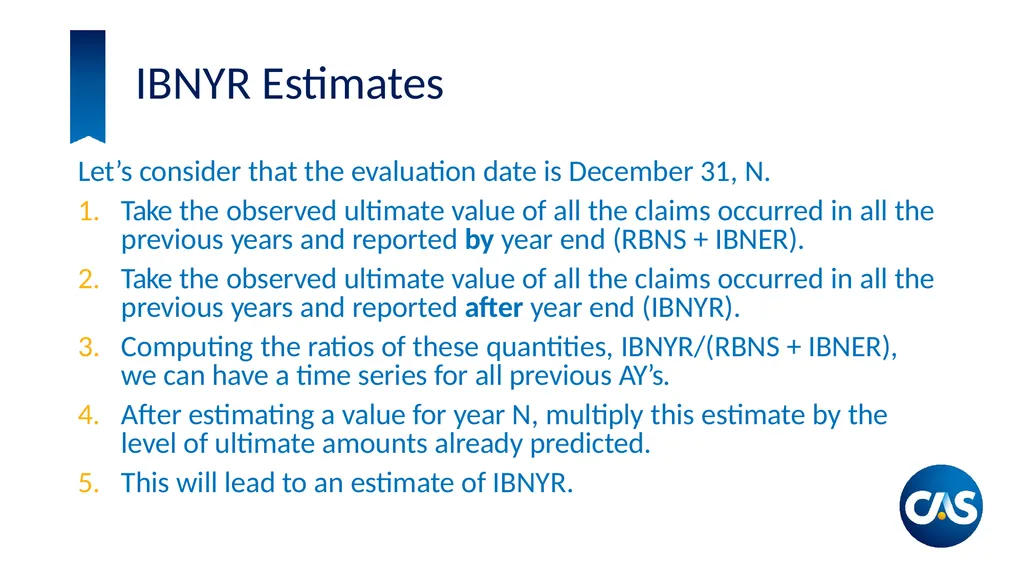
slide22. IBNYR Estimates Let’s consider that the evaluation date is December 31, N.
Take the observed ultimate value of all the claims occurred in all the previous years and reported by year end (RBNS + IBNER).
Take the observed ultimate value of all the claims occurred in all the previous years and reported after year end (IBNYR).
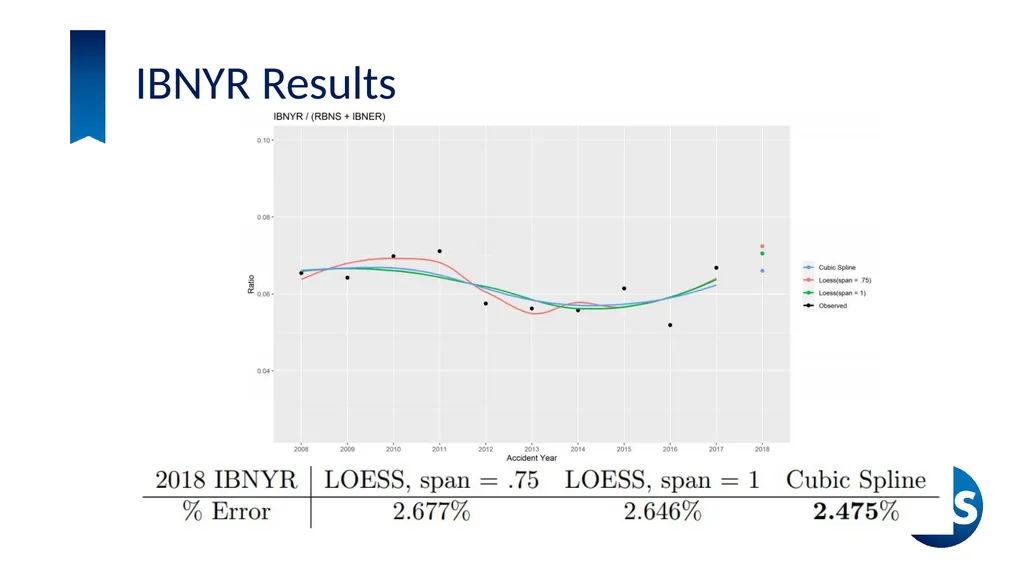
Computing the ratios of these quantities, IBNYR/(RBNS + IBNER), we can have a time series for all previous AY’s.
After estimating a value for year N, multiply this estimate by the level of ultimate amounts already predicted.
This will lead to an estimate of IBNYR.<br>
slide23. IBNYR Results<br>
slide24. Conclusions Results have a high level of accuracy.
No reliance on individual point estimates.
Early evaluation
– Allows early decisions from management
Future studies could explore the possibilities of predicting individual claim development.<br>
slide25. Final Remarks We showed the potential of ML in estimation of policyholders’ liabilities.
It’s not a one-fits-all recipe but it gives a framework of actions.
Recent advances in computer power have allowed more extensive use of data in a wide variety of areas.
We believe that it is very beneficial to explore these capabilities in the context of actuarial science.<br>
slide26. Thank you for your attention
Further information available at
De Virgilis, M., Pierluigi C., Estimation of Individual Claim Liabilities. Casualty Actuarial Society, 2020.
https://www.casact.org/research/wp/papers/working- paper-Virgilis-Cerqueti-2020-01.pdf<br>
slide27. Contacts:
Marco De Virgilis: devirgilis.marco@gmail.com<br>
slide28. Casualty Actuarial Society 4350 North Fairfax Drive, Suite 250
Arlington, Virginia 22203
www.casact.org<br>
May 12, 2021
Marco De Virgilis<br>
slide2. Presenters Marco De Virgilis,
Senior Actuarial Data Scientist, Allstate<br>
slide3. Agenda Traditional Claim Reserving
Machine Learning in Claim Reserving
Model Comparison<br>
slide4. Traditional Claim Reserving<br>
slide5. Run-Off Triangles: An Overview<br>
slide6. Run-Off Triangles: An Overview<br>
slide7. Run-Off Triangles: Advantages and Disadvantages Advantages:
Easy Implementation
Stabilizes Experience
Intuitive and Interpretable
Disadvantages:
Information compression, e.g. 10 years worth of data to 55 data points
Unreliable recent results
Loss of information<br>
slide8. Machine Learning in Claim Reserving<br>
slide9. Individual Claim Reserving Looking at claim data at the individual level can overcome the main drawback of standard triangle techniques, bringing these advantages:
Timely Estimates:
There is no need to wait for each AY year to sufficiently develop
Extensive Use of Data:
Data is usually recorded anyway, it would be clever to actually use it.<br>
slide10. Predicting Ultimate Cost Target: To predict the ultimate cost of the claims when they are initially reported.
At this stage, there is no paid amount and an initial case reserve is established.
In one case they will be settled and paid. This is the amount that needs to be estimated.
On the other hand, claims could be closed with no payment (CNP), and therefore there will not be any payment.<br>
slide11. Predicting Ultimate Costs We will have three stacked models:
First, each claim will be classified if it will be paid or closed with no payment.
If the claim will be paid, a second model will estimate the final claim amount, ie. ultimate cost.
A third model will also estimate the timing of such payment.<br>
slide12. Modeling Framework Claim Paid CNP Amount Lag Amount
= 0 Classification Regression Regression The framework is built on one classifier and two regressors.<br>
slide13. Data example<br>
slide14. Model Comparison<br>
slide15. Models Implemented The following models have been implemented:
General Additive Models, GAM
Multivariate Regression Splines, MARS
K Nearest Neighbor, KNN
Gradient Boosting, GB
Neural Networks, NN
Each different model has been used to classify claims and to predict both ultimate cost and lags.
Then, the performance have been compared and the best performing models have been chosen.<br>
slide16. RBNS Results (Reported + IBNER) Classification Performance:<br>
slide17. RBNS Results (Reported + IBNER) Regression Performance:<br>
slide18. RBNS Results (Reported + IBNER) Regression Performance:<br>
slide19. RBNS Results (Reported + IBNER)<br>
slide20. RBNS Results (Reported + IBNER)<br>
slide21. IBNYR Estimates At this point we have obtained estimates for claims that have been reported to the company.
This includes RBNS (Reported but not settled) and IBNER (Incurred but not enough reported).
We still have to produce estimates for IBNYR, (Incurred but not yet reported).
Since the company does not have any records of these claims we have to follow a different approach.<br>
slide22. IBNYR Estimates Let’s consider that the evaluation date is December 31, N.
Take the observed ultimate value of all the claims occurred in all the previous years and reported by year end (RBNS + IBNER).
Take the observed ultimate value of all the claims occurred in all the previous years and reported after year end (IBNYR).
Computing the ratios of these quantities, IBNYR/(RBNS + IBNER), we can have a time series for all previous AY’s.
After estimating a value for year N, multiply this estimate by the level of ultimate amounts already predicted.
This will lead to an estimate of IBNYR.<br>
slide23. IBNYR Results<br>
slide24. Conclusions Results have a high level of accuracy.
No reliance on individual point estimates.
Early evaluation
– Allows early decisions from management
Future studies could explore the possibilities of predicting individual claim development.<br>
slide25. Final Remarks We showed the potential of ML in estimation of policyholders’ liabilities.
It’s not a one-fits-all recipe but it gives a framework of actions.
Recent advances in computer power have allowed more extensive use of data in a wide variety of areas.
We believe that it is very beneficial to explore these capabilities in the context of actuarial science.<br>
slide26. Thank you for your attention
Further information available at
De Virgilis, M., Pierluigi C., Estimation of Individual Claim Liabilities. Casualty Actuarial Society, 2020.
https://www.casact.org/research/wp/papers/working- paper-Virgilis-Cerqueti-2020-01.pdf<br>
slide27. Contacts:
Marco De Virgilis: devirgilis.marco@gmail.com<br>
slide28. Casualty Actuarial Society 4350 North Fairfax Drive, Suite 250
Arlington, Virginia 22203
www.casact.org<br>