01
ETHICAL AND SOCIAL ISSUES IN INFORMATION SYSTEMS Chapter 4 VIDEO CASES
Case 1: Big Brother is Copying Everything on the Internet
Case 2: Delete: The Virtue of Forgetting in a Digital Age<br>
02
Recent cases of failed ethical judgment in business
Lehman Brothers, Minerals Management Service, Pfizer
In many, information systems used to bury decisions from public scrutiny
Ethics
Principles of right and wrong that individuals, acting as free moral agents, use to make choices to guide their behaviors Understanding Ethical and Social Issues Related to Systems CHAPTER 4: ETHICAL AND SOCIAL ISSUES IN INFORMATION SYSTEMS © Prentice Hall 2011 2<br>
03
Information systems and ethics
Information systems raise new ethical questions because they create opportunities for:
Intense social change, threatening existing distributions of power, money, rights, and obligations
New kinds of crime Understanding Ethical and Social Issues Related to Systems CHAPTER 4: ETHICAL AND SOCIAL ISSUES IN INFORMATION SYSTEMS © Prentice Hall 2011 3<br>
04
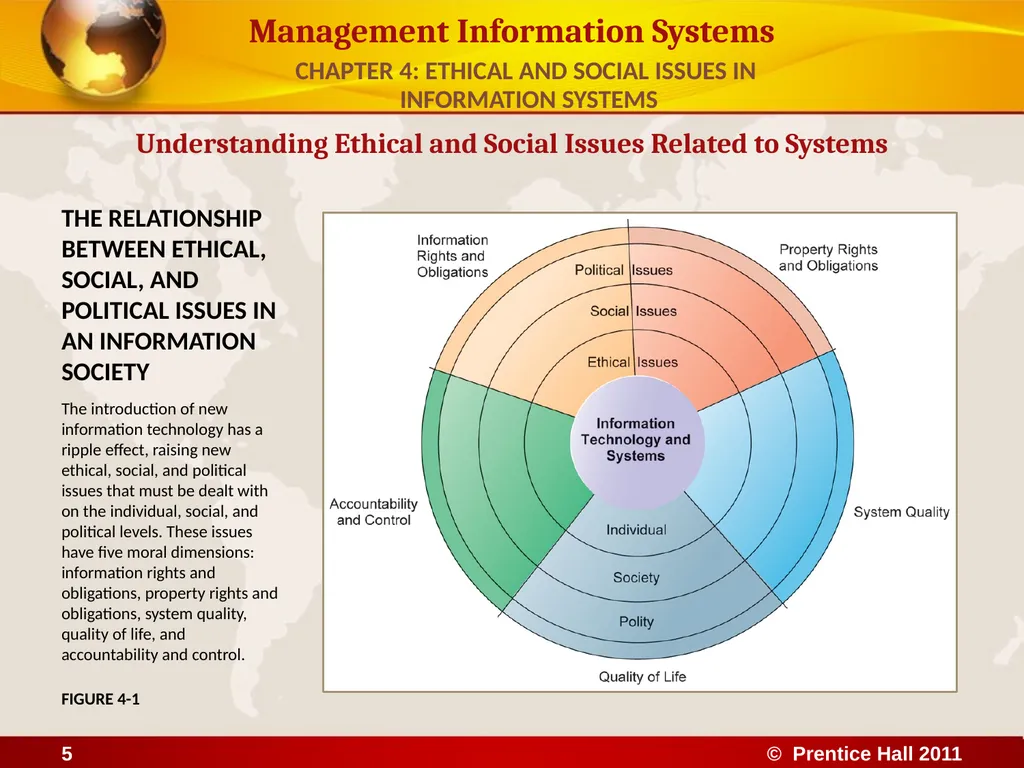
Model for thinking about ethical, social, political issues:
Society as a calm pond
IT as rock dropped in pond, creating ripples of new situations not covered by old rules
Social and political institutions cannot respond overnight to these ripples—it may take years to develop etiquette, expectations, laws
Requires understanding of ethics to make choices in legally gray areas Understanding Ethical and Social Issues Related to Systems CHAPTER 4: ETHICAL AND SOCIAL ISSUES IN INFORMATION SYSTEMS © Prentice Hall 2011 4<br>
05
Understanding Ethical and Social Issues Related to Systems THE RELATIONSHIP BETWEEN ETHICAL, SOCIAL, AND POLITICAL ISSUES IN AN INFORMATION SOCIETY The introduction of new information technology has a ripple effect, raising new ethical, social, and political issues that must be dealt with on the individual, social, and political levels. These issues have five moral dimensions: information rights and obligations, property rights and obligations, system quality, quality of life, and accountability and control. FIGURE 4-1 CHAPTER 4: ETHICAL AND SOCIAL ISSUES IN INFORMATION SYSTEMS © Prentice Hall 2011 5<br>
06
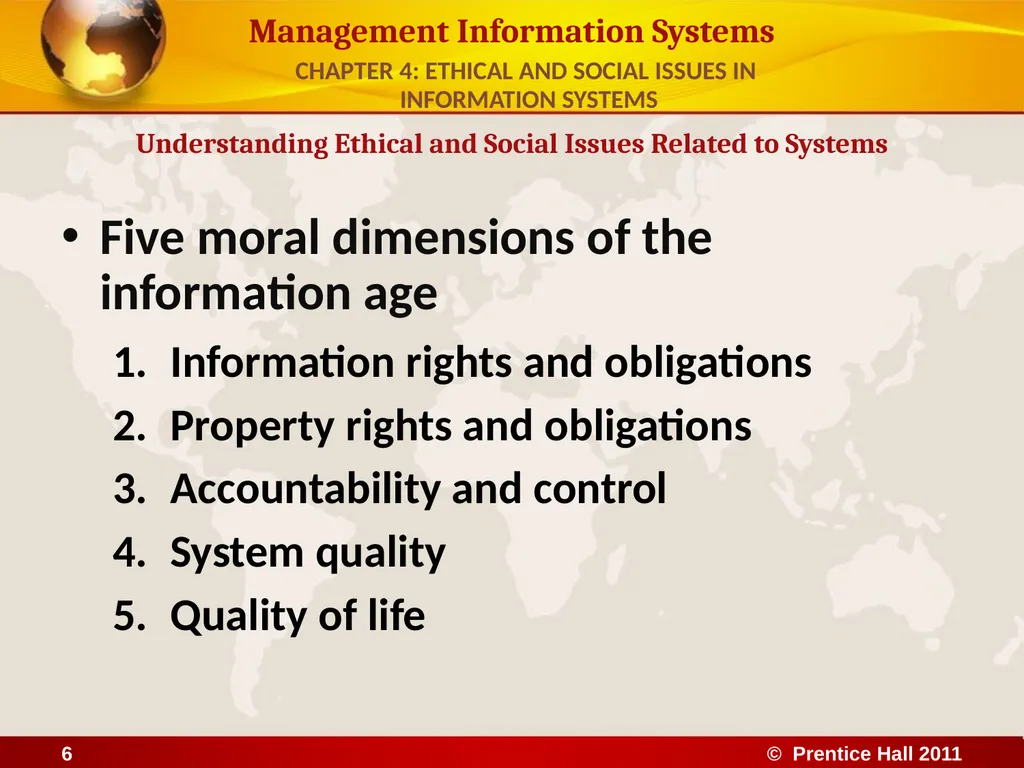
Five moral dimensions of the information age
Information rights and obligations
Property rights and obligations
Accountability and control
System quality
Quality of life Understanding Ethical and Social Issues Related to Systems CHAPTER 4: ETHICAL AND SOCIAL ISSUES IN INFORMATION SYSTEMS © Prentice Hall 2011 6<br>
07
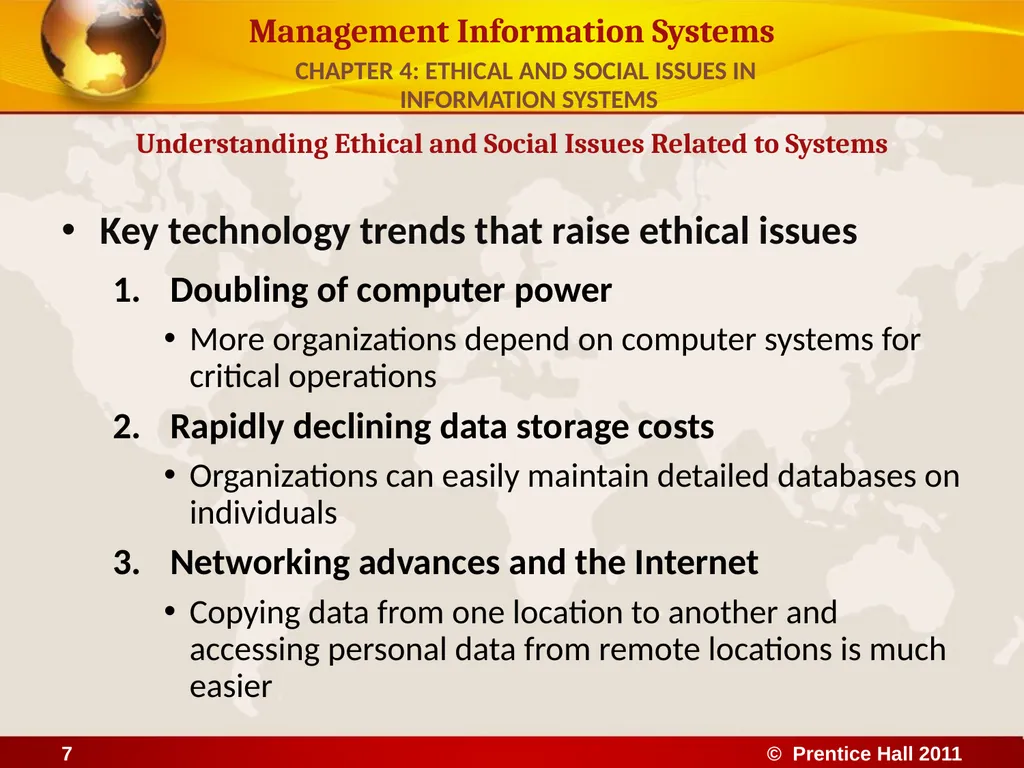
Key technology trends that raise ethical issues
Doubling of computer power
More organizations depend on computer systems for critical operations
Rapidly declining data storage costs
Organizations can easily maintain detailed databases on individuals
Networking advances and the Internet
Copying data from one location to another and accessing personal data from remote locations is much easier Understanding Ethical and Social Issues Related to Systems CHAPTER 4: ETHICAL AND SOCIAL ISSUES IN INFORMATION SYSTEMS © Prentice Hall 2011 7<br>
08
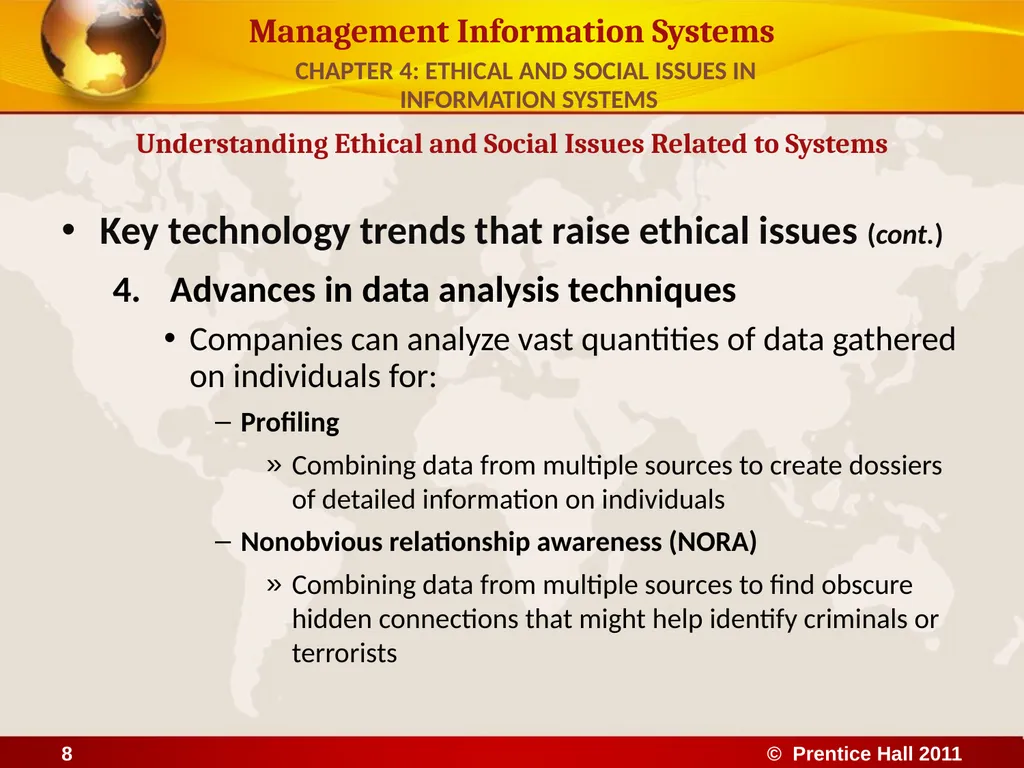
Key technology trends that raise ethical issues (cont.)
Advances in data analysis techniques
Companies can analyze vast quantities of data gathered on individuals for:
Profiling
Combining data from multiple sources to create dossiers of detailed information on individuals
Nonobvious relationship awareness (NORA)
Combining data from multiple sources to find obscure hidden connections that might help identify criminals or terrorists Understanding Ethical and Social Issues Related to Systems CHAPTER 4: ETHICAL AND SOCIAL ISSUES IN INFORMATION SYSTEMS © Prentice Hall 2011 8<br>
09
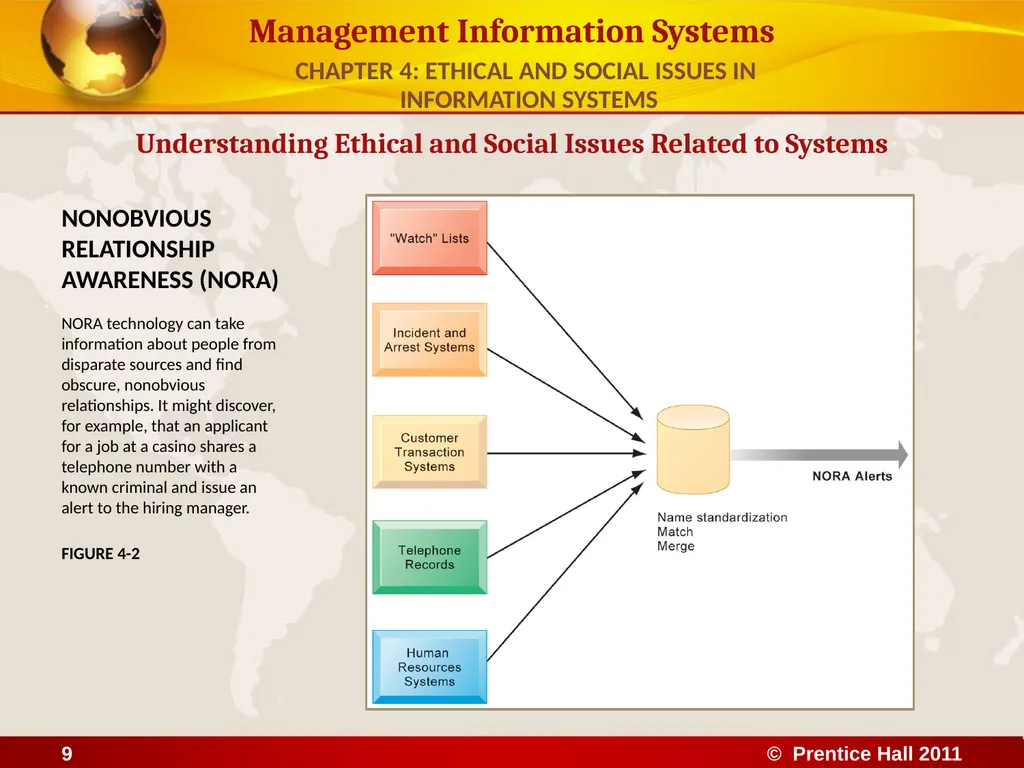
Understanding Ethical and Social Issues Related to Systems NONOBVIOUS RELATIONSHIP AWARENESS (NORA) NORA technology can take information about people from disparate sources and find obscure, nonobvious relationships. It might discover, for example, that an applicant for a job at a casino shares a telephone number with a known criminal and issue an alert to the hiring manager. FIGURE 4-2 CHAPTER 4: ETHICAL AND SOCIAL ISSUES IN INFORMATION SYSTEMS © Prentice Hall 2011 9<br>
10
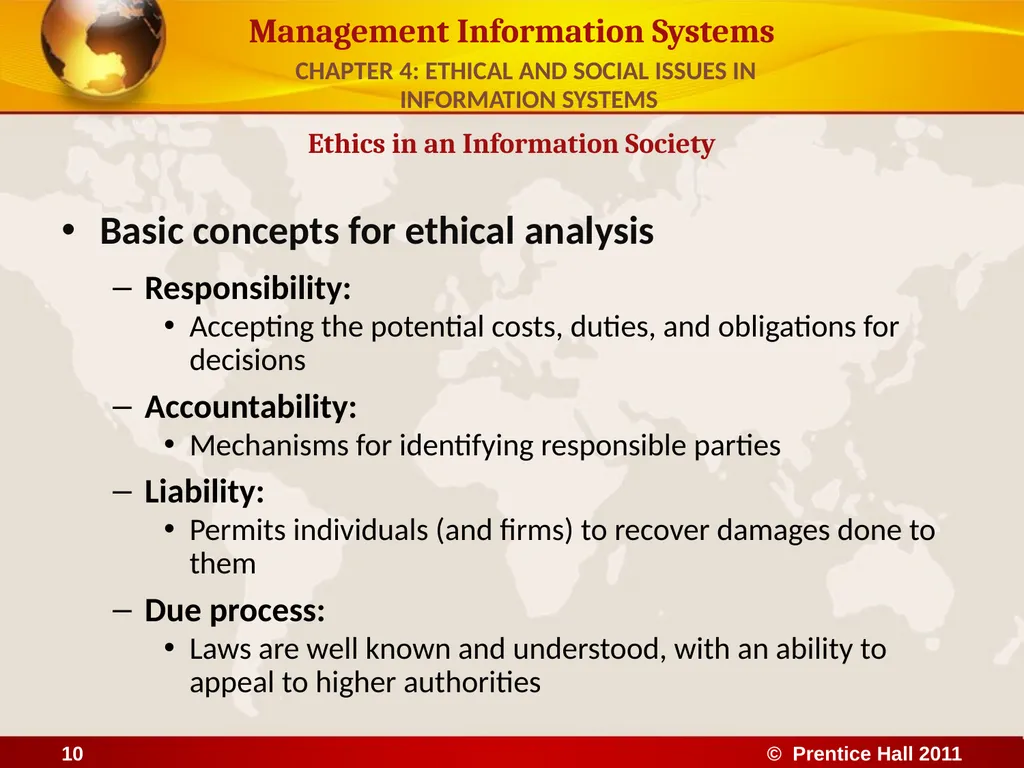
Basic concepts for ethical analysis
Responsibility:
Accepting the potential costs, duties, and obligations for decisions
Accountability:
Mechanisms for identifying responsible parties
Liability:
Permits individuals (and firms) to recover damages done to them
Due process:
Laws are well known and understood, with an ability to appeal to higher authorities Ethics in an Information Society CHAPTER 4: ETHICAL AND SOCIAL ISSUES IN INFORMATION SYSTEMS © Prentice Hall 2011 10<br>
11
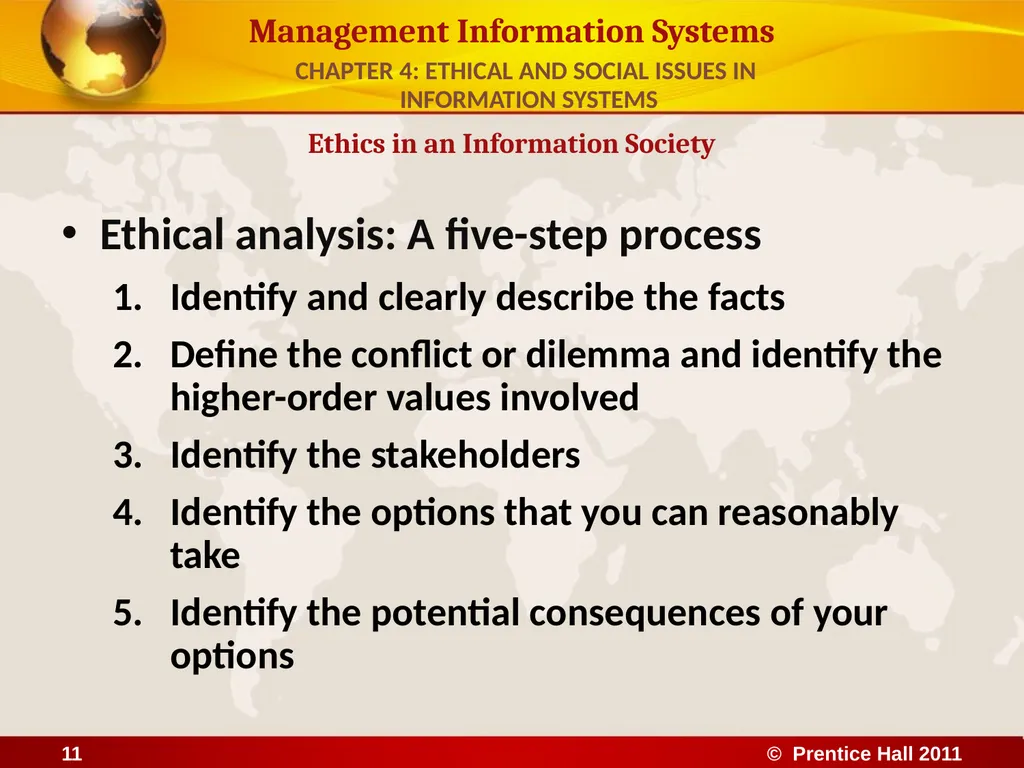
Ethical analysis: A five-step process
Identify and clearly describe the facts
Define the conflict or dilemma and identify the higher-order values involved
Identify the stakeholders
Identify the options that you can reasonably take
Identify the potential consequences of your options Ethics in an Information Society CHAPTER 4: ETHICAL AND SOCIAL ISSUES IN INFORMATION SYSTEMS © Prentice Hall 2011 11<br>
12
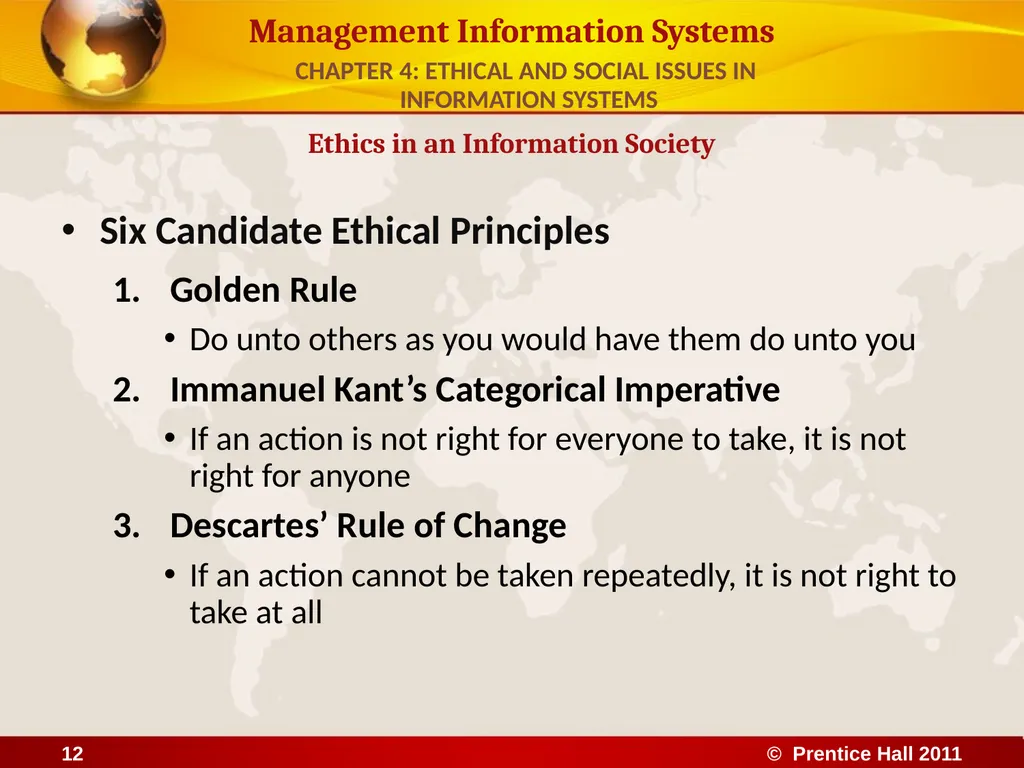
Six Candidate Ethical Principles
Golden Rule
Do unto others as you would have them do unto you
Immanuel Kant’s Categorical Imperative
If an action is not right for everyone to take, it is not right for anyone
Descartes’ Rule of Change
If an action cannot be taken repeatedly, it is not right to take at all Ethics in an Information Society CHAPTER 4: ETHICAL AND SOCIAL ISSUES IN INFORMATION SYSTEMS © Prentice Hall 2011 12<br>
13
Six Candidate Ethical Principles (cont.)
Utilitarian Principle
Take the action that achieves the higher or greater value
Risk Aversion Principle
Take the action that produces the least harm or least potential cost
Ethical “no free lunch” Rule
Assume that virtually all tangible and intangible objects are owned by someone unless there is a specific declaration otherwise Ethics in an Information Society CHAPTER 4: ETHICAL AND SOCIAL ISSUES IN INFORMATION SYSTEMS © Prentice Hall 2011 13<br>
14
Internet Challenges to Privacy:
Cookies
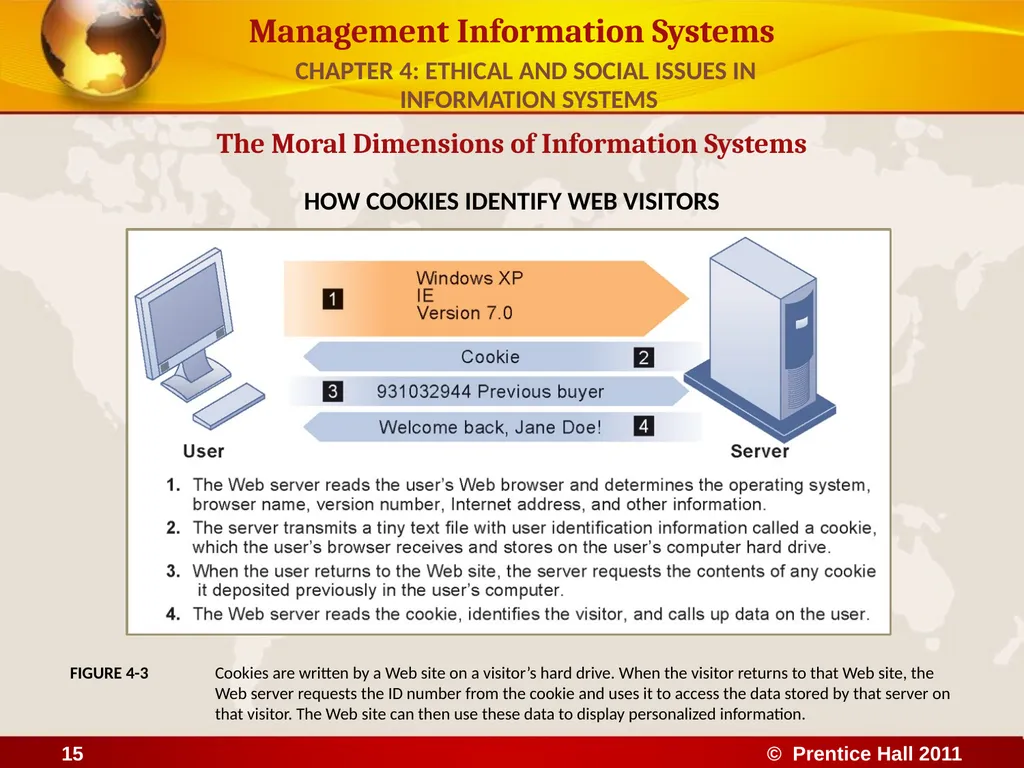
Tiny files downloaded by Web site to visitor’s hard drive to help identify visitor’s browser and track visits to site
Allow Web sites to develop profiles on visitors
Web beacons/bugs
Tiny graphics embedded in e-mail and Web pages to monitor who is reading message
Spyware
Surreptitiously installed on user’s computer
May transmit user’s keystrokes or display unwanted ads
Google’s collection of private data; behavioral targeting The Moral Dimensions of Information Systems CHAPTER 4: ETHICAL AND SOCIAL ISSUES IN INFORMATION SYSTEMS © Prentice Hall 2011 14<br>
15
The Moral Dimensions of Information Systems HOW COOKIES IDENTIFY WEB VISITORS Cookies are written by a Web site on a visitor’s hard drive. When the visitor returns to that Web site, the Web server requests the ID number from the cookie and uses it to access the data stored by that server on that visitor. The Web site can then use these data to display personalized information. FIGURE 4-3 CHAPTER 4: ETHICAL AND SOCIAL ISSUES IN INFORMATION SYSTEMS © Prentice Hall 2011 15<br>
16
System Quality: Data Quality and System Errors
What is an acceptable, technologically feasible level of system quality?
Flawless software is economically unfeasible
Three principal sources of poor system performance:
Software bugs, errors
Hardware or facility failures
Poor input data quality (most common source of business system failure) The Moral Dimensions of Information Systems CHAPTER 4: ETHICAL AND SOCIAL ISSUES IN INFORMATION SYSTEMS © Prentice Hall 2011 16<br>
Show all 16 slides