
Ethical Review Committee (ERC) Prof. Dr. Md.
MY
Published · 26 slides · 0 views

1 / 1


Description
Ethical Review Committee (ERC) Prof. Dr. Md. Jawadul Haque Professor of Community Medicine, RMC Dean, Faculty of Preventive Social Medicine (PSM), RMU JawadERCRMU 10 Ethics Ethics: Ethics is derived from a Greek word -ETHOS which
Related Topics
Share
Embed code
Download this presentation From Below
"Ethical Review Committee (ERC) Prof. Dr. Md." is the property of its rightful owner. Permission is granted to download and print the materials on this website for personal, non-commercial use only, and to display it on your personal computer provided you do not modify the materials and that you retain all copyright notices contained in the materials. By downloading content from our website, you accept the terms of this agreement.
Presentation Transcript
01
Ethical Review Committee (ERC) Prof. Dr. Md. Jawadul Haque Professor of Community Medicine, RMC &
Dean, Faculty of Preventive & Social Medicine (PSM), RMU<br>
Dean, Faculty of Preventive & Social Medicine (PSM), RMU<br>
02
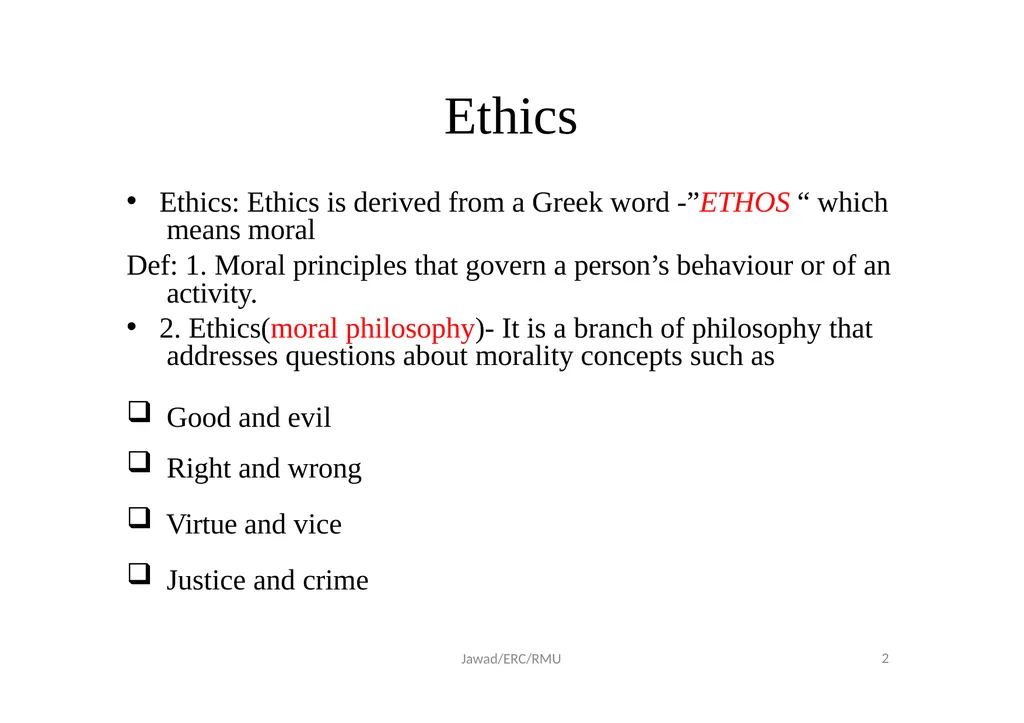
Jawad/ERC/RMU 10 Ethics Ethics: Ethics is derived from a Greek word -”ETHOS “ which means moral
Def: 1. Moral principles that govern a person’s behaviour or of an activity.
2. Ethics(moral philosophy)- It is a branch of philosophy that addresses questions about morality concepts such as
Good and evil
Right and wrong
Virtue and vice
Justice and crime<br>
Def: 1. Moral principles that govern a person’s behaviour or of an activity.
2. Ethics(moral philosophy)- It is a branch of philosophy that addresses questions about morality concepts such as
Good and evil
Right and wrong
Virtue and vice
Justice and crime<br>
03
Jawad/ERC/RMU 10 Ethics (contd.) Ethics is a branch of philosophy that deals with morality, standards or values; in fact the whole science of moral principles.
Ethics – a system of norms, standards or values (Websters New World Dictionary).<br>
Ethics – a system of norms, standards or values (Websters New World Dictionary).<br>
04
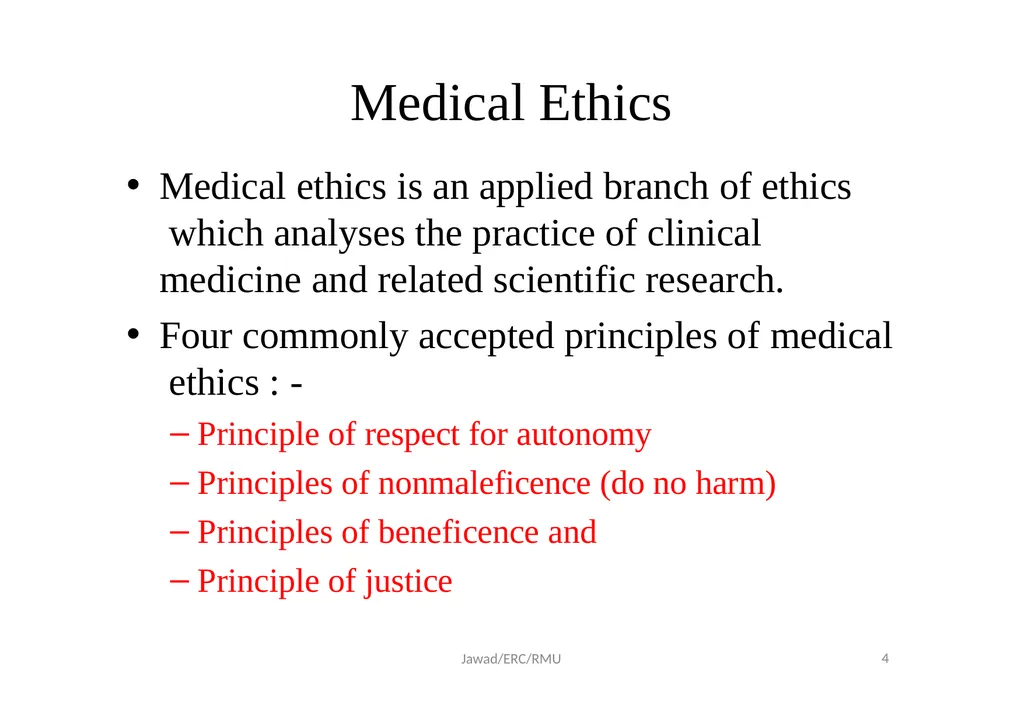
Jawad/ERC/RMU 10 Medical Ethics Medical ethics is an applied branch of ethics which analyses the practice of clinical medicine and related scientific research.
Four commonly accepted principles of medical ethics : -
Principle of respect for autonomy
Principles of nonmaleficence (do no harm)
Principles of beneficence and
Principle of justice<br>
Four commonly accepted principles of medical ethics : -
Principle of respect for autonomy
Principles of nonmaleficence (do no harm)
Principles of beneficence and
Principle of justice<br>
05
Jawad/ERC/RMU 10 Bioethics The study of the ethical and moral implications of new biological discoveries and biomedical advances, as in the fields of genetic engineering and drug research is bioethics.
The term “bioethics” was introduced in the 70’s by Van Rensselaer Potter for a study aiming at ensuring the preservation of the biosphere.
It was later used to refer a study of the ethical issues arising from health care, biological and medical sciences.<br>
The term “bioethics” was introduced in the 70’s by Van Rensselaer Potter for a study aiming at ensuring the preservation of the biosphere.
It was later used to refer a study of the ethical issues arising from health care, biological and medical sciences.<br>
06
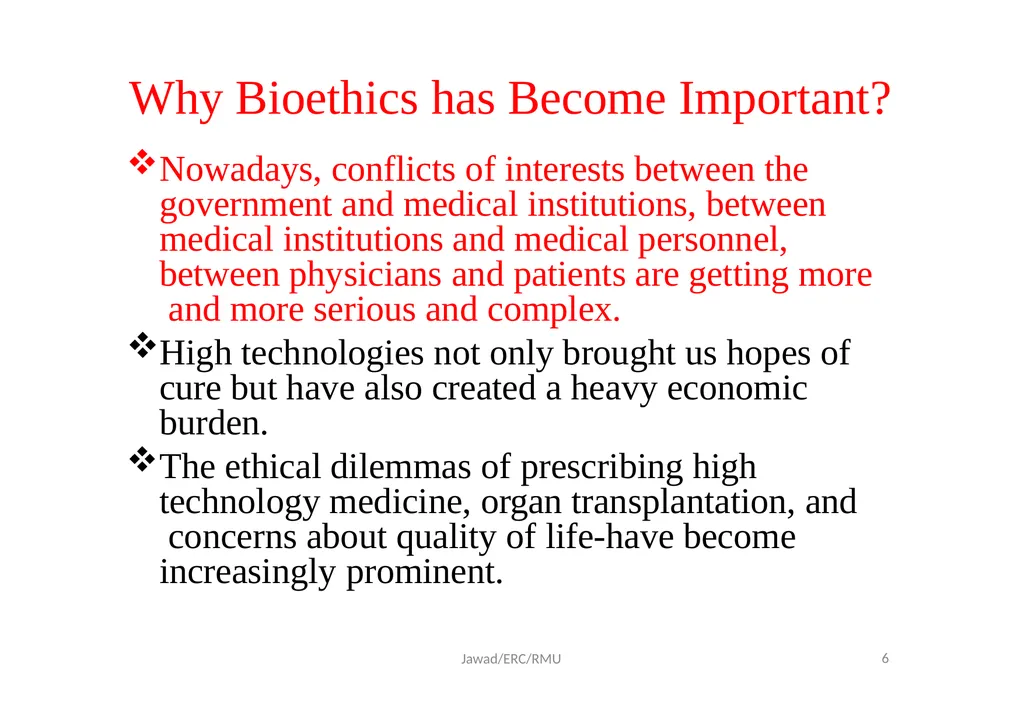
Jawad/ERC/RMU 10 Why Bioethics has Become Important? Nowadays, conflicts of interests between the government and medical institutions, between medical institutions and medical personnel, between physicians and patients are getting more and more serious and complex.
High technologies not only brought us hopes of cure but have also created a heavy economic burden.
The ethical dilemmas of prescribing high technology medicine, organ transplantation, and concerns about quality of life-have become increasingly prominent.<br>
High technologies not only brought us hopes of cure but have also created a heavy economic burden.
The ethical dilemmas of prescribing high technology medicine, organ transplantation, and concerns about quality of life-have become increasingly prominent.<br>
07
Jawad/ERC/RMU 10<br>
08
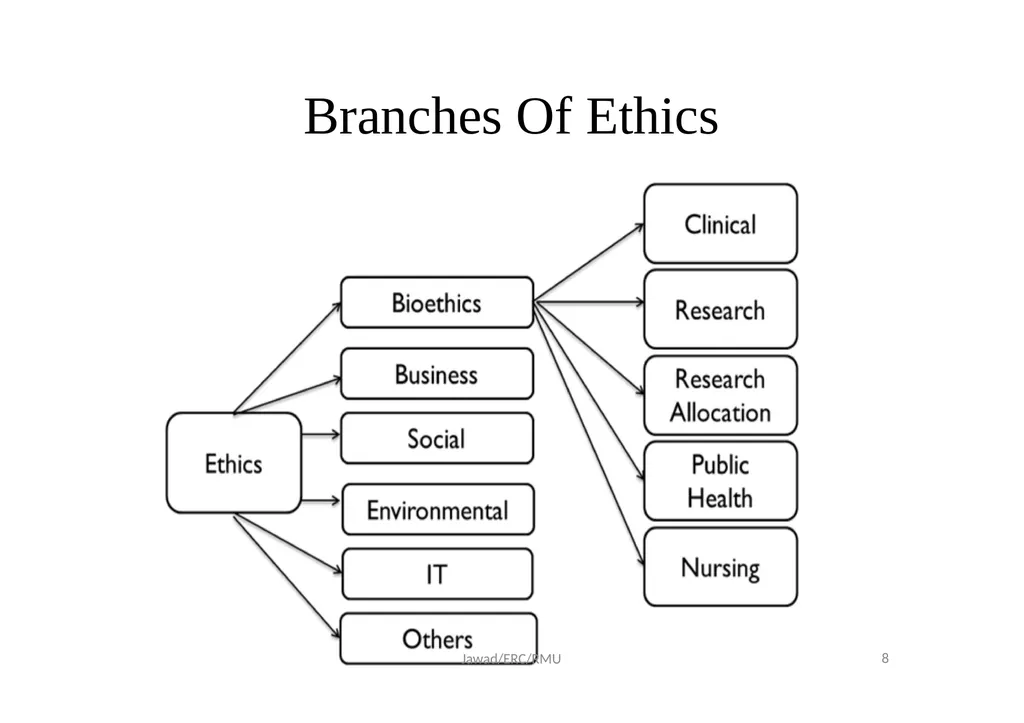
Branches Of Ethics Jawad/ERC/RMU 10<br>
09
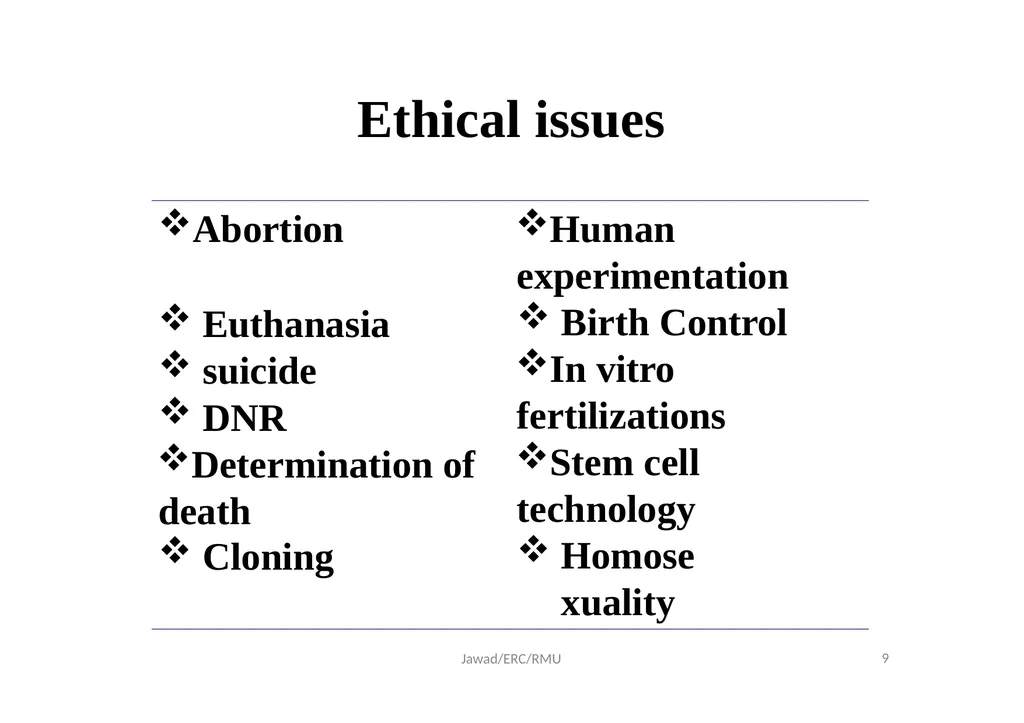
Ethical issues Abortion
Euthanasia
suicide
DNR
Determination of death
Cloning Jawad/ERC/RMU 10 Human experimentation
Birth Control
In vitro fertilizations
Stem cell technology
Homosexuality<br>
Euthanasia
suicide
DNR
Determination of death
Cloning Jawad/ERC/RMU 10 Human experimentation
Birth Control
In vitro fertilizations
Stem cell technology
Homosexuality<br>
10
Jawad/ERC/RMU 10 Why we need Bioethics in research? In order to achieve smooth progress of research, while preventing exploitation of human subjects
It is mandatory that every proposal on biomedical research involving human subjects be cleared by an appropriately constituted institutional ethical committee.
The ethics committee is also responsible for regular monitoring of the compliance of the ethical guidelines of the approved protocols, till the same are completed<br>
It is mandatory that every proposal on biomedical research involving human subjects be cleared by an appropriately constituted institutional ethical committee.
The ethics committee is also responsible for regular monitoring of the compliance of the ethical guidelines of the approved protocols, till the same are completed<br>
11
Jawad/ERC/RMU 10 Why we need Bioethics in research (contd)? Field medical research and health care is rapidly expanding.
Most medical research is not complete, unless experimentation on human subjects, including children is undertaken.
Experimentation on human being is subject to ethical standards that promote respect for all and protect their health and rights.
With the rapidly progressing world of biomedical research, there are newer challenges to ethical standards;<br>
Most medical research is not complete, unless experimentation on human subjects, including children is undertaken.
Experimentation on human being is subject to ethical standards that promote respect for all and protect their health and rights.
With the rapidly progressing world of biomedical research, there are newer challenges to ethical standards;<br>
12
Jawad/ERC/RMU 10 Why we need Bioethics in research (contd.)? As a result the ethical guidelines are frequently revised.
It is widely expected that any new therapeutic, diagnostic or preventive product, that is likely to be used in humans, should undergo adequate safety and efficacy investigations.
In order that every research on human subject is planned with a view to cause maximum benefit to the mankind while causing least damage to the research subject, it is essential that an appropriately constituted ethics committee approve all the research proposals.<br>
It is widely expected that any new therapeutic, diagnostic or preventive product, that is likely to be used in humans, should undergo adequate safety and efficacy investigations.
In order that every research on human subject is planned with a view to cause maximum benefit to the mankind while causing least damage to the research subject, it is essential that an appropriately constituted ethics committee approve all the research proposals.<br>
13
Jawad/ERC/RMU 10<br>
14
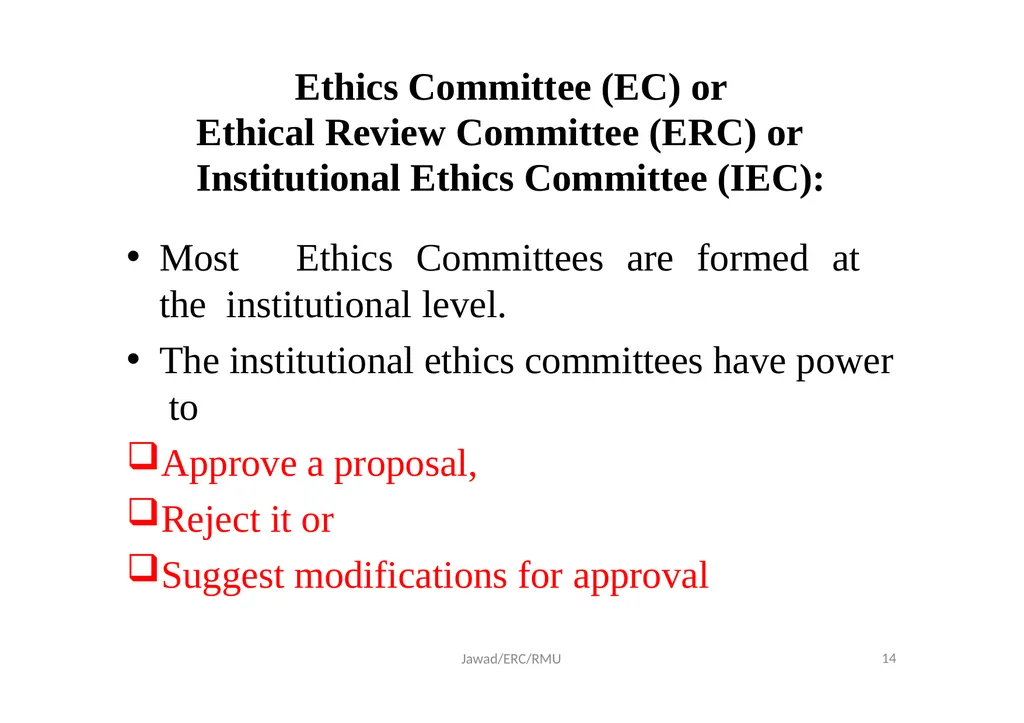
Jawad/ERC/RMU 10 Ethics Committee (EC) or Ethical Review Committee (ERC) or Institutional Ethics Committee (IEC):
Most Ethics Committees are formed at the institutional level.
The institutional ethics committees have power to
Approve a proposal,
Reject it or
Suggest modifications for approval<br>
Most Ethics Committees are formed at the institutional level.
The institutional ethics committees have power to
Approve a proposal,
Reject it or
Suggest modifications for approval<br>
15
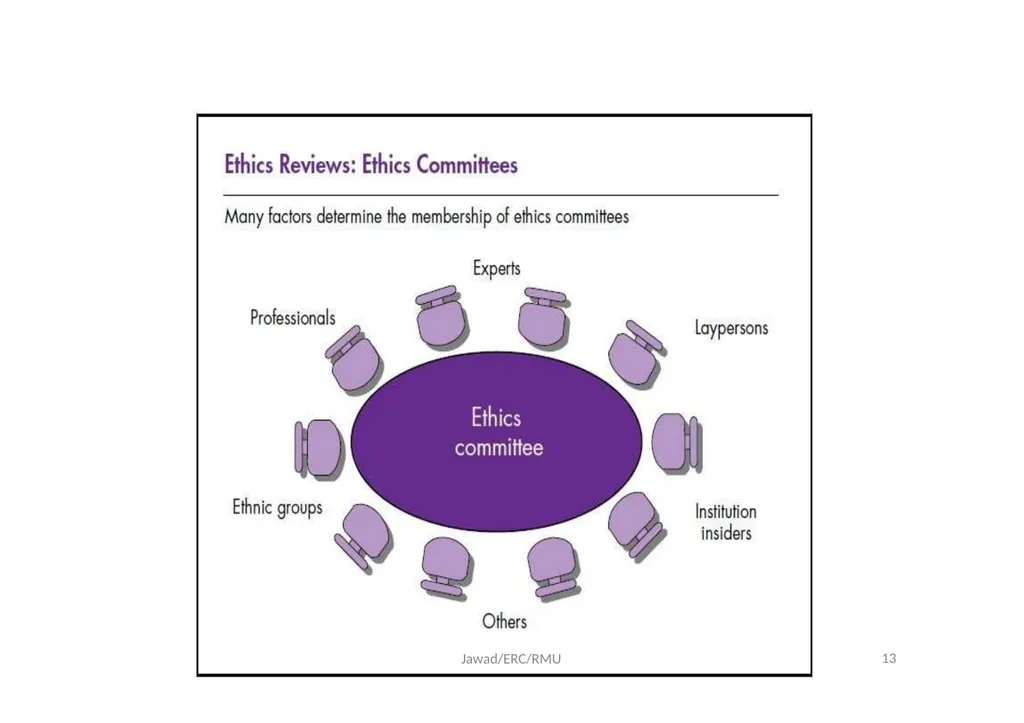
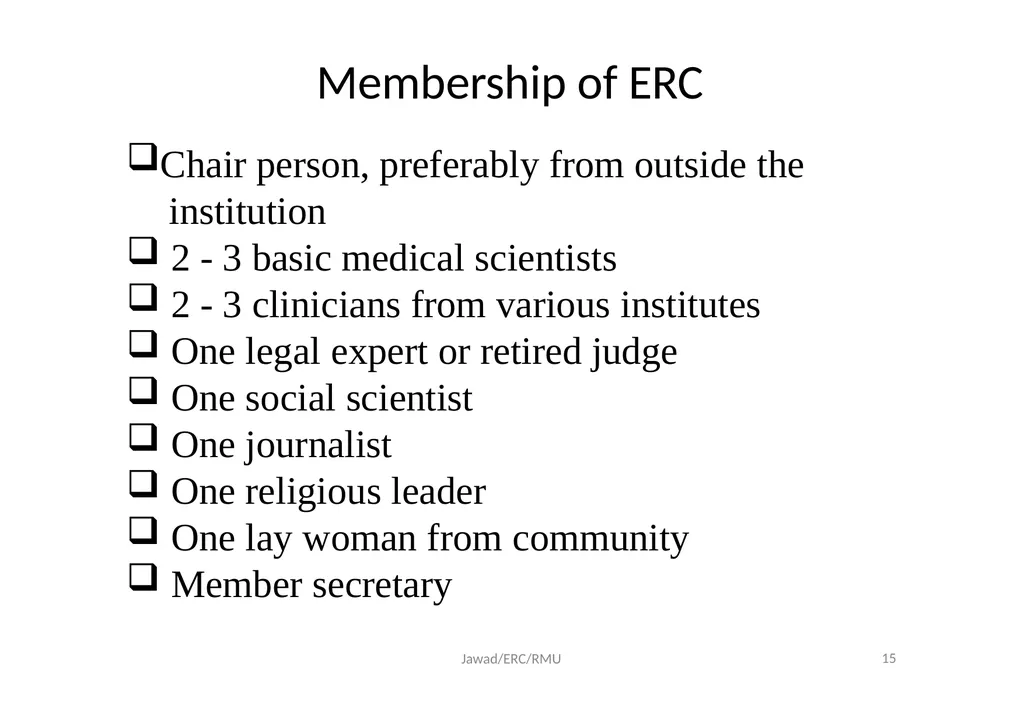
Jawad/ERC/RMU 10 Membership of ERC Chair person, preferably from outside the institution
2 - 3 basic medical scientists
2 - 3 clinicians from various institutes
One legal expert or retired judge
One social scientist
One journalist
One religious leader
One lay woman from community
Member secretary<br>
2 - 3 basic medical scientists
2 - 3 clinicians from various institutes
One legal expert or retired judge
One social scientist
One journalist
One religious leader
One lay woman from community
Member secretary<br>
16
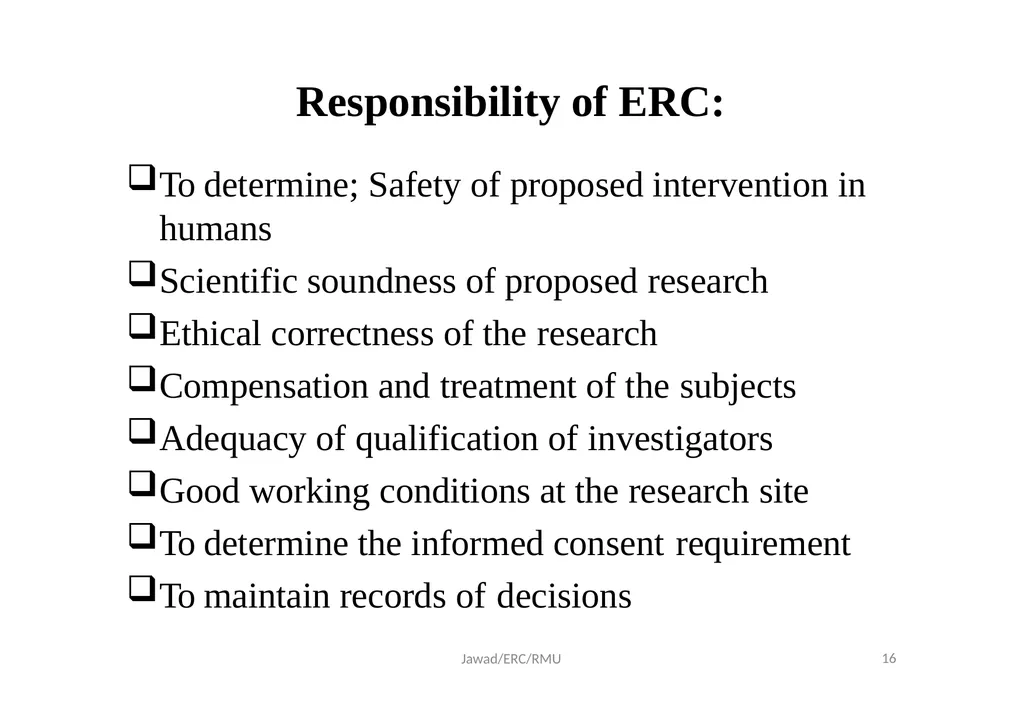
Jawad/ERC/RMU 10 Responsibility of ERC: To determine; Safety of proposed intervention in humans
Scientific soundness of proposed research
Ethical correctness of the research
Compensation and treatment of the subjects
Adequacy of qualification of investigators
Good working conditions at the research site
To determine the informed consent requirement
To maintain records of decisions<br>
Scientific soundness of proposed research
Ethical correctness of the research
Compensation and treatment of the subjects
Adequacy of qualification of investigators
Good working conditions at the research site
To determine the informed consent requirement
To maintain records of decisions<br>
17
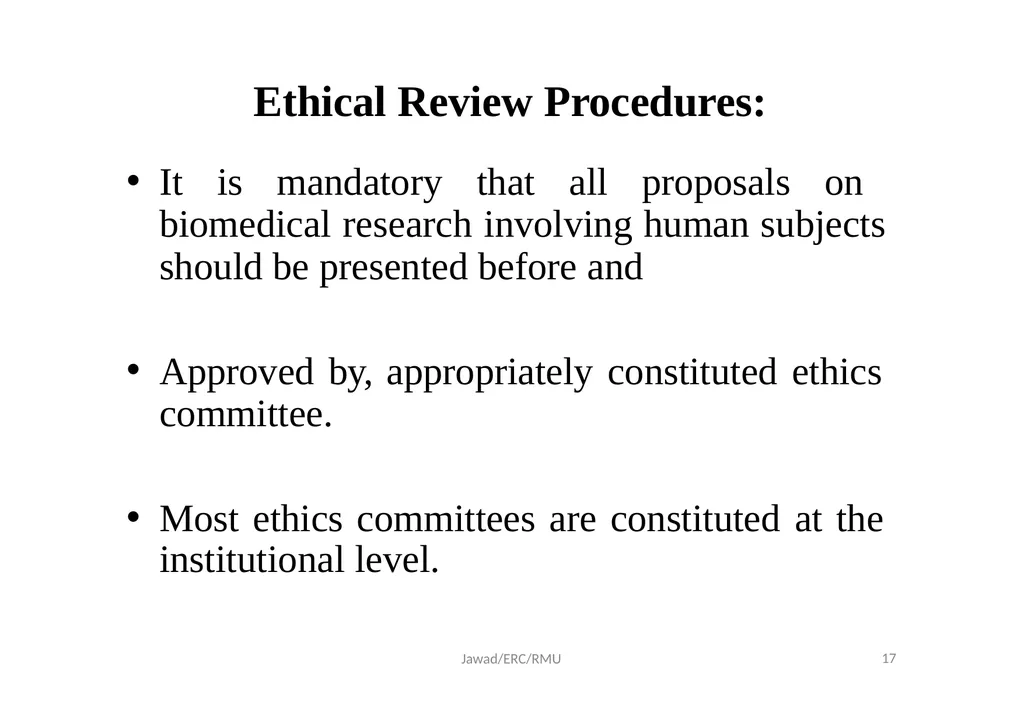
Jawad/ERC/RMU 10 Ethical Review Procedures: It is mandatory that all proposals on biomedical research involving human subjects should be presented before and
Approved by, appropriately constituted ethics committee.
Most ethics committees are constituted at the institutional level.<br>
Approved by, appropriately constituted ethics committee.
Most ethics committees are constituted at the institutional level.<br>
18
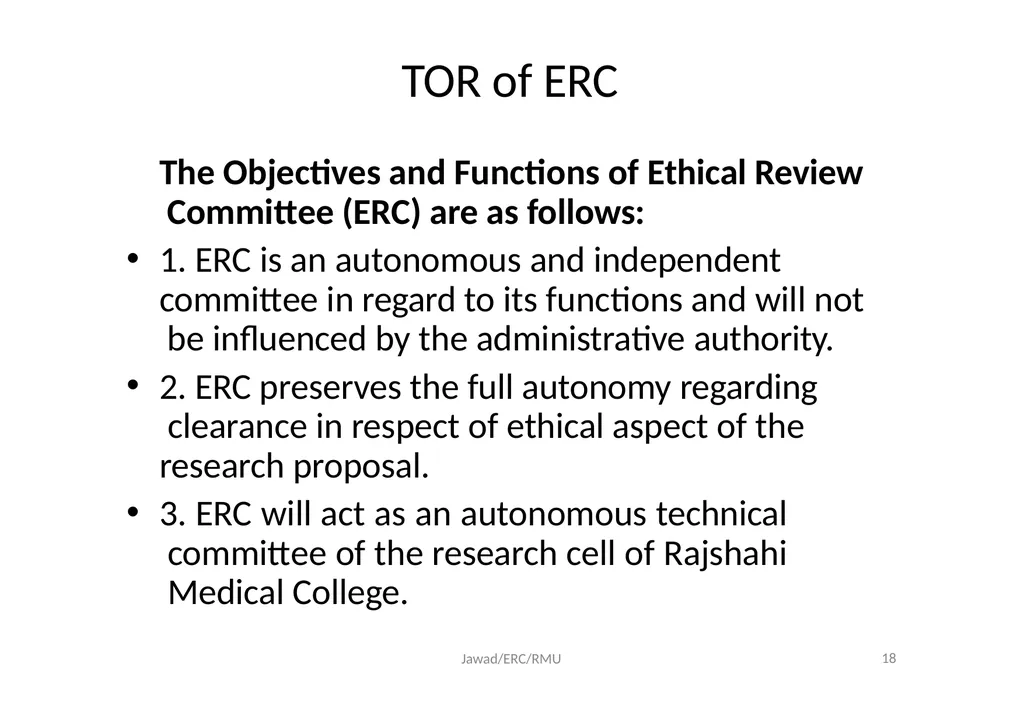
Jawad/ERC/RMU 10 TOR of ERC The Objectives and Functions of Ethical Review Committee (ERC) are as follows:
1. ERC is an autonomous and independent committee in regard to its functions and will not be influenced by the administrative authority.
2. ERC preserves the full autonomy regarding clearance in respect of ethical aspect of the research proposal.
3. ERC will act as an autonomous technical committee of the research cell of Rajshahi Medical College.<br>
1. ERC is an autonomous and independent committee in regard to its functions and will not be influenced by the administrative authority.
2. ERC preserves the full autonomy regarding clearance in respect of ethical aspect of the research proposal.
3. ERC will act as an autonomous technical committee of the research cell of Rajshahi Medical College.<br>
19
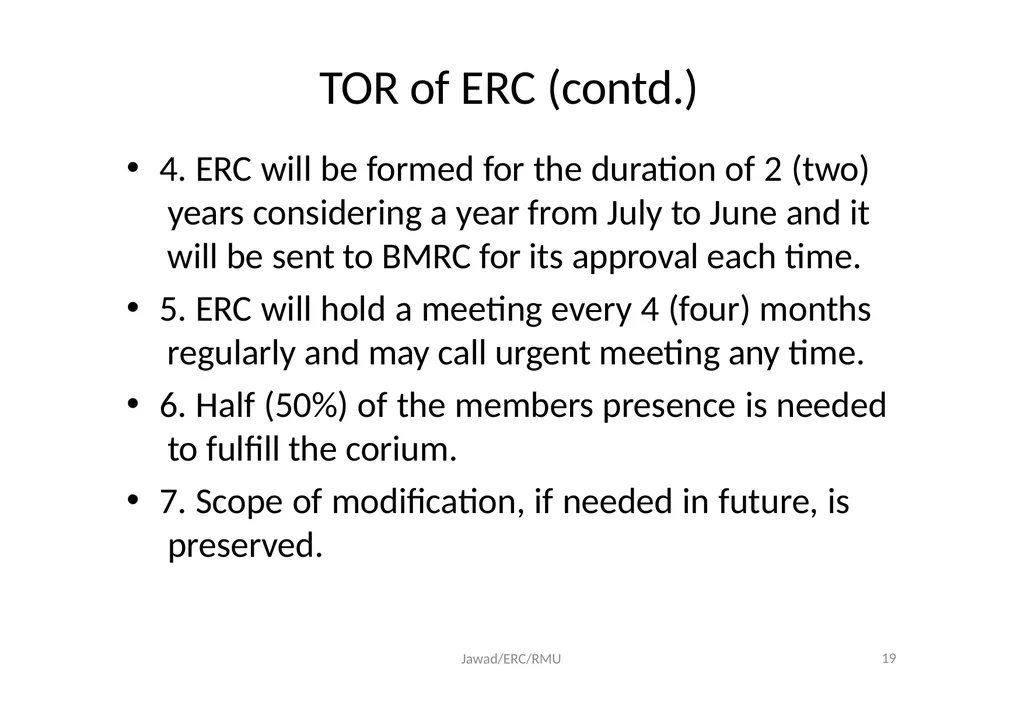
Jawad/ERC/RMU 10 TOR of ERC (contd.) 4. ERC will be formed for the duration of 2 (two) years considering a year from July to June and it will be sent to BMRC for its approval each time.
5. ERC will hold a meeting every 4 (four) months regularly and may call urgent meeting any time.
6. Half (50%) of the members presence is needed to fulfill the corium.
7. Scope of modification, if needed in future, is preserved.<br>
5. ERC will hold a meeting every 4 (four) months regularly and may call urgent meeting any time.
6. Half (50%) of the members presence is needed to fulfill the corium.
7. Scope of modification, if needed in future, is preserved.<br>
20
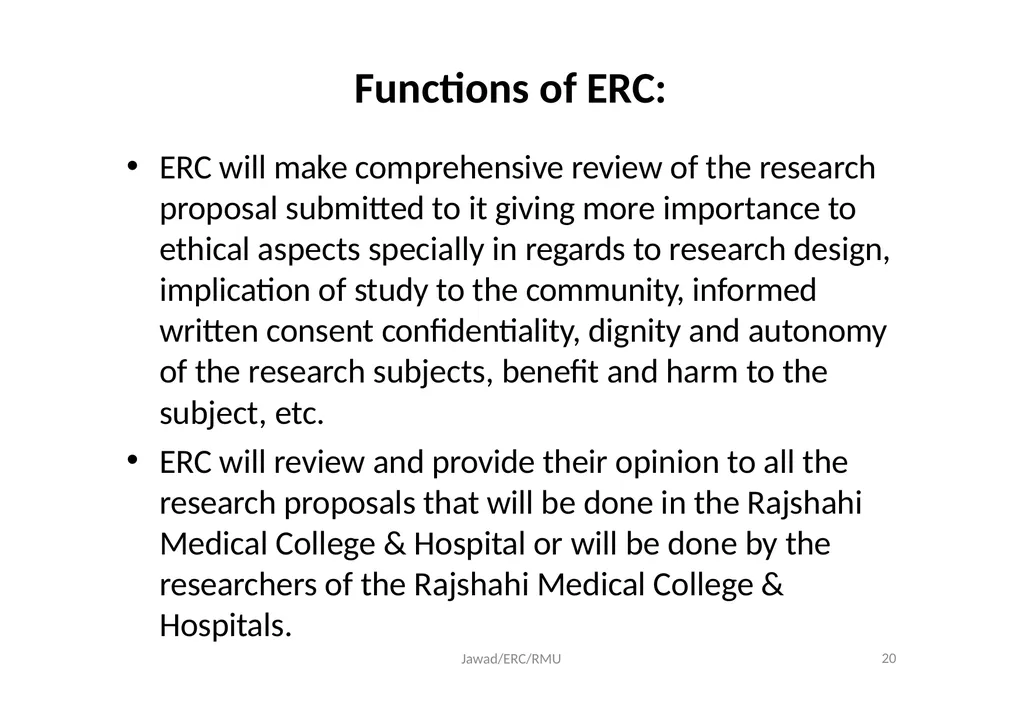
Jawad/ERC/RMU 10 Functions of ERC: ERC will make comprehensive review of the research proposal submitted to it giving more importance to ethical aspects specially in regards to research design, implication of study to the community, informed written consent confidentiality, dignity and autonomy of the research subjects, benefit and harm to the subject, etc.
ERC will review and provide their opinion to all the research proposals that will be done in the Rajshahi Medical College & Hospital or will be done by the researchers of the Rajshahi Medical College & Hospitals.<br>
ERC will review and provide their opinion to all the research proposals that will be done in the Rajshahi Medical College & Hospital or will be done by the researchers of the Rajshahi Medical College & Hospitals.<br>
21
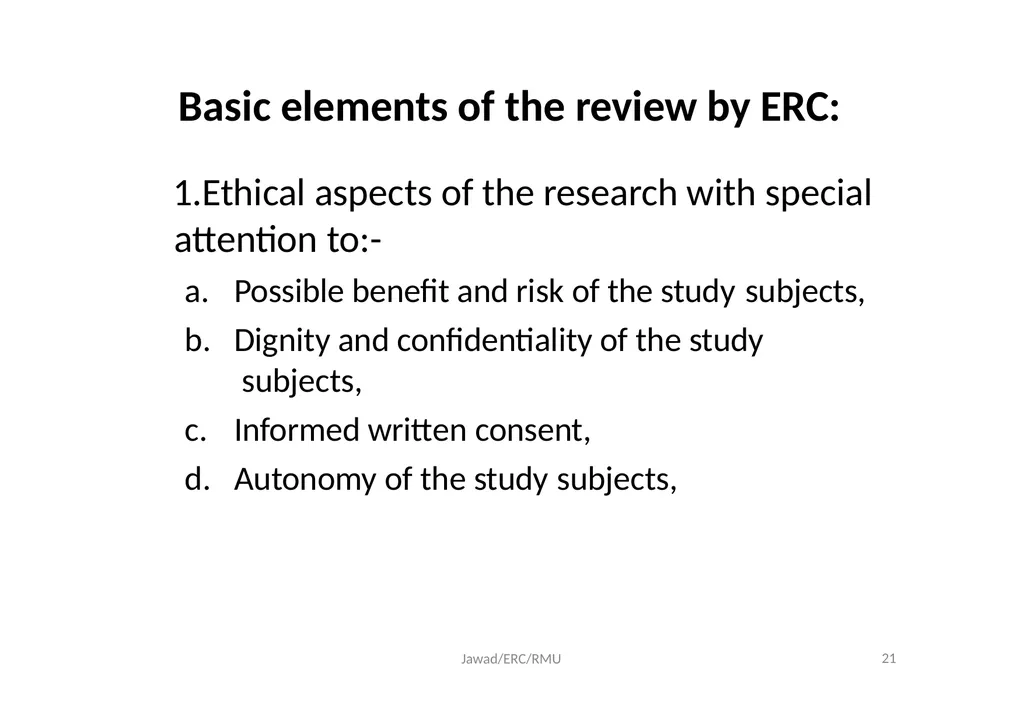
Jawad/ERC/RMU 10 Basic elements of the review by ERC: Ethical aspects of the research with special attention to:-
Possible benefit and risk of the study subjects,
Dignity and confidentiality of the study subjects,
Informed written consent,
Autonomy of the study subjects,<br>
Possible benefit and risk of the study subjects,
Dignity and confidentiality of the study subjects,
Informed written consent,
Autonomy of the study subjects,<br>
22
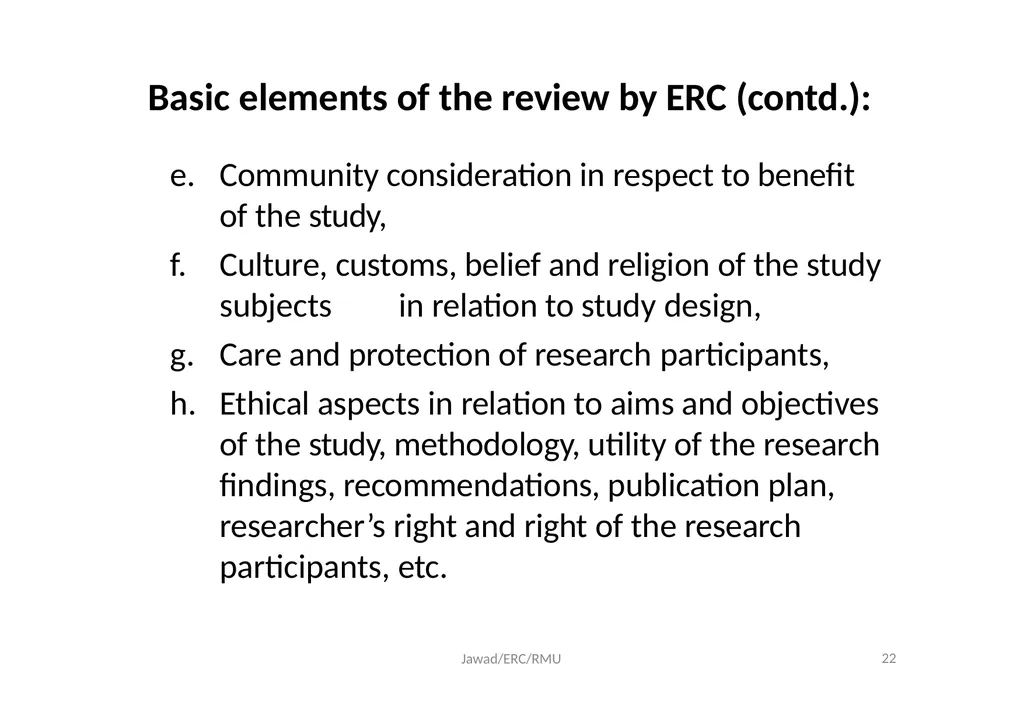
Jawad/ERC/RMU 10 Basic elements of the review by ERC (contd.): Community consideration in respect to benefit of the study,
Culture, customs, belief and religion of the study subjects in relation to study design,
Care and protection of research participants,
Ethical aspects in relation to aims and objectives of the study, methodology, utility of the research findings, recommendations, publication plan, researcher’s right and right of the research participants, etc.<br>
Culture, customs, belief and religion of the study subjects in relation to study design,
Care and protection of research participants,
Ethical aspects in relation to aims and objectives of the study, methodology, utility of the research findings, recommendations, publication plan, researcher’s right and right of the research participants, etc.<br>
23
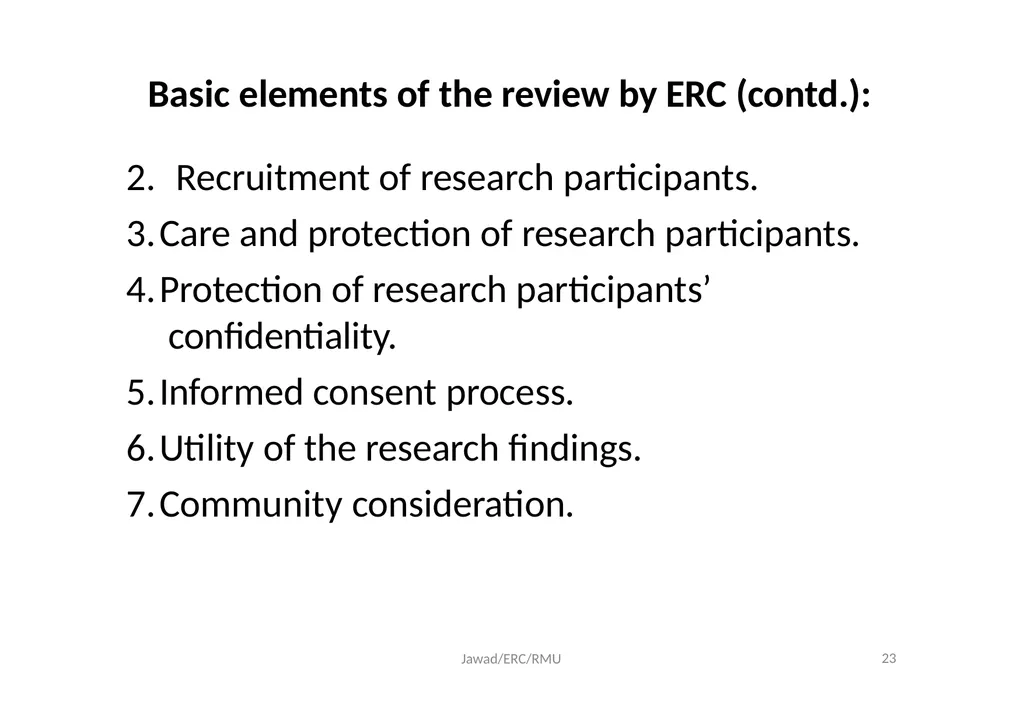
Jawad/ERC/RMU 10 Basic elements of the review by ERC (contd.):
Recruitment of research participants.
Care and protection of research participants.
Protection of research participants’ confidentiality.
Informed consent process.
Utility of the research findings.
Community consideration.<br>
Recruitment of research participants.
Care and protection of research participants.
Protection of research participants’ confidentiality.
Informed consent process.
Utility of the research findings.
Community consideration.<br>
24
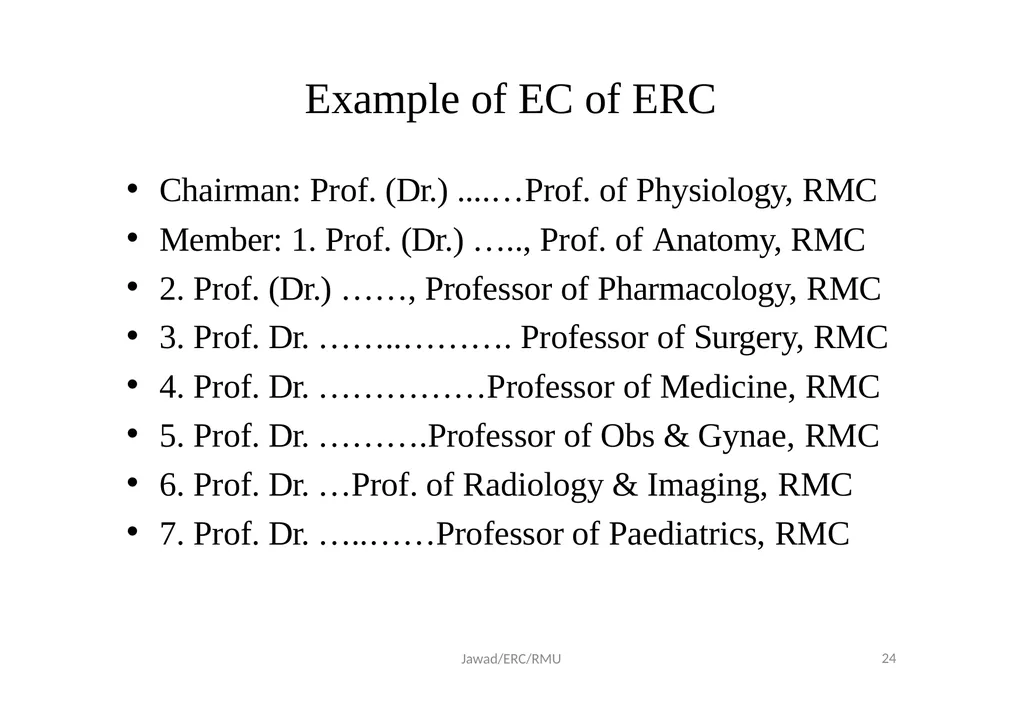
Jawad/ERC/RMU 10 Example of EC of ERC Chairman: Prof. (Dr.) ....…Prof. of Physiology, RMC
Member: 1. Prof. (Dr.) ….., Prof. of Anatomy, RMC
2. Prof. (Dr.) ……, Professor of Pharmacology, RMC
3. Prof. Dr. ……..………. Professor of Surgery, RMC
4. Prof. Dr. ……………Professor of Medicine, RMC
5. Prof. Dr. ……….Professor of Obs & Gynae, RMC
6. Prof. Dr. …Prof. of Radiology & Imaging, RMC
7. Prof. Dr. …..……Professor of Paediatrics, RMC<br>
Member: 1. Prof. (Dr.) ….., Prof. of Anatomy, RMC
2. Prof. (Dr.) ……, Professor of Pharmacology, RMC
3. Prof. Dr. ……..………. Professor of Surgery, RMC
4. Prof. Dr. ……………Professor of Medicine, RMC
5. Prof. Dr. ……….Professor of Obs & Gynae, RMC
6. Prof. Dr. …Prof. of Radiology & Imaging, RMC
7. Prof. Dr. …..……Professor of Paediatrics, RMC<br>
25
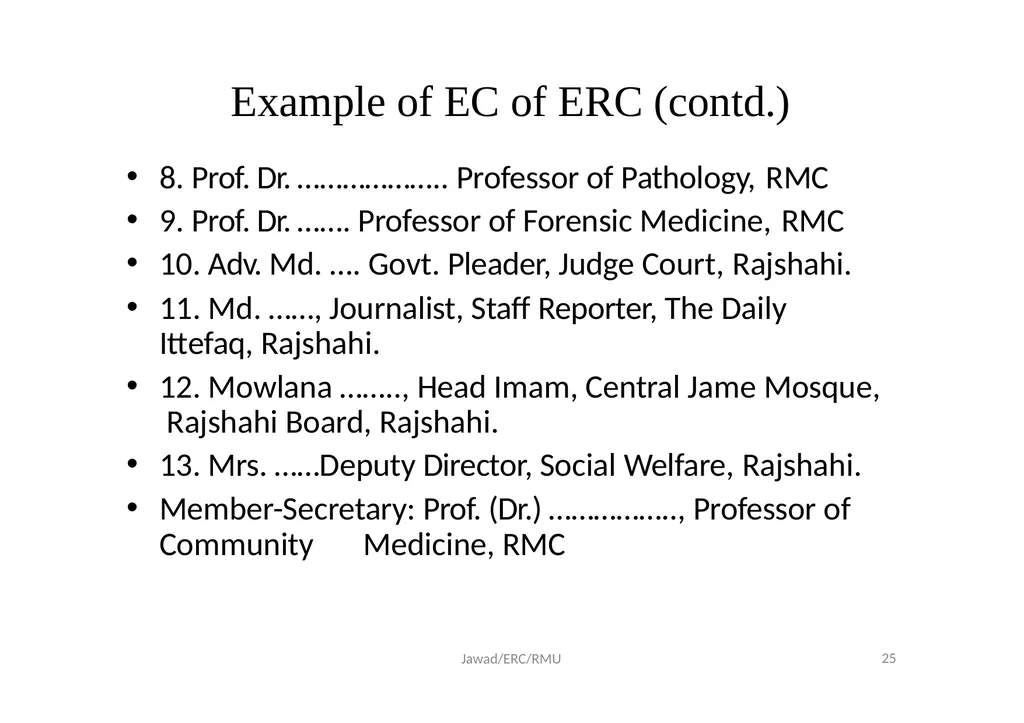
Jawad/ERC/RMU 10 Example of EC of ERC (contd.) 8. Prof. Dr. ……………….. Professor of Pathology, RMC
9. Prof. Dr. ……. Professor of Forensic Medicine, RMC
10. Adv. Md. …. Govt. Pleader, Judge Court, Rajshahi.
11. Md. ……, Journalist, Staff Reporter, The Daily Ittefaq, Rajshahi.
12. Mowlana …….., Head Imam, Central Jame Mosque, Rajshahi Board, Rajshahi.
13. Mrs. ……Deputy Director, Social Welfare, Rajshahi.
Member-Secretary: Prof. (Dr.) …………….., Professor of Community Medicine, RMC<br>
9. Prof. Dr. ……. Professor of Forensic Medicine, RMC
10. Adv. Md. …. Govt. Pleader, Judge Court, Rajshahi.
11. Md. ……, Journalist, Staff Reporter, The Daily Ittefaq, Rajshahi.
12. Mowlana …….., Head Imam, Central Jame Mosque, Rajshahi Board, Rajshahi.
13. Mrs. ……Deputy Director, Social Welfare, Rajshahi.
Member-Secretary: Prof. (Dr.) …………….., Professor of Community Medicine, RMC<br>
26
Jawad/ERC/RMU 10<br>