Ethics and Boundaries in helping professions What are Ethics? Law vs. Ethics Law legal justice; following the norms established by society through the political process. Ethics focus is on social justice; doing what is right. Ethics may
"Ethics and Boundaries in helping professions What" is the property of its rightful owner. Permission is granted to
download and print the materials on this website for personal, non-commercial use only, and to display it
on your personal computer provided you do not modify the materials and that you retain all copyright
notices contained in the materials. By downloading content from our website, you accept the terms of this
agreement.
Presentation Transcript
01
Ethics and Boundaries in helping professions<br>
02
What are Ethics? Law vs. Ethics
Law – legal justice; following the norms established by society through the political process.
Ethics – focus is on social justice; doing what is right. Ethics may be in conflict with unjust laws.<br>
03
Definitions Ethics: the “rightness” or “wrongness” of an action. Moral standards by which people judge and behave.
Code: a “set” of personal ethical principles which guide an individual’s decision making.
Professional code: a set of guidelines for performance and evaluation based on core values and principles of a profession.<br>
04
NASW Code of Ethics Accepted Standard of Practice for Social Work even if you are not a licensed Social Worker
Ethical Standards and Responsibilities
To Clients
To Colleagues
In Practice Settings
To the Profession
To Broader Society<br>
05
NASW Core Values Service – helping people in need
Social Justice – challenge injustice
Dignity & Worth of the Person – respect for each individual
Importance of Human Relationships – recognition and support
Integrity – act honestly and responsibly
Competence – increase knowledge<br>
06
What are Boundaries? Clearly established limits that allow for safe connections between service providers and their clients
Understanding of the limits and responsibilities of your role as a service provider<br>
07
Importance of Boundaries Role modeling healthy communication and professional relationships
Avoiding “rescuer” role
Staying focused on your responsibilities to the client & provision of appropriate services to the client
Avoiding compassion fatigue (burn-out)
Maintaining healthy, functioning team (if working with other providers)
Maintaining physical and emotional health and safety<br>
08
Awareness Understanding your own needs
Understanding your role as a professional
Staying focused on the job at hand
Taking care of your emotional and physical health
Establishing clear limits<br>
09
Boundary Crossings and Violations Intimate Relationships
Personal Benefit
Emotional and Dependency Needs
Altruism
Unavoidable Circumstances<br>
10
Consequences of Poor Boundaries Compassion fatigue – service provider’s role may not feel sustainable
Client may not receive appropriate or helpful services, which could affect his/her willingness or ability to accept future services
Client may feel betrayed, abandoned, or poorly served
Teamwork with other agencies may fall apart
Service provider may act unethically
Reputation of agency/profession may be compromised
Client and/or service provider may be emotionally traumatized and/or put in physical danger<br>
11
Why is it difficult to establish/maintain boundaries? Dual relationships – service provider & client know each other from another setting
Values conflicts – client and service provider do not share similar viewpoints on choices, relationships, lifestyle, etc.
Vicarious trauma – service provider may experience trauma symptoms due to hearing about client’s experiences
Playing the “hero” – service provider feels the need to “save” the client
Service provider does not trust other team members, believes they can provide services better, believes they are the only ones who can help client<br>
12
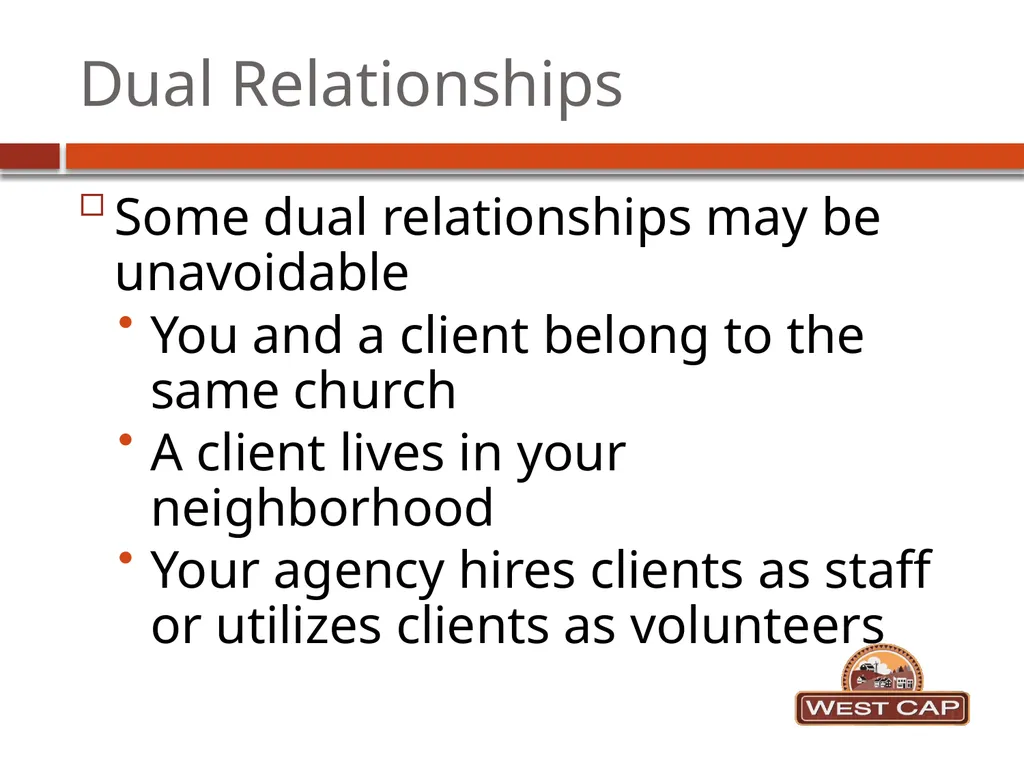
Dual Relationships Some dual relationships may be unavoidable
You and a client belong to the same church
A client lives in your neighborhood
Your agency hires clients as staff or utilizes clients as volunteers<br>
13
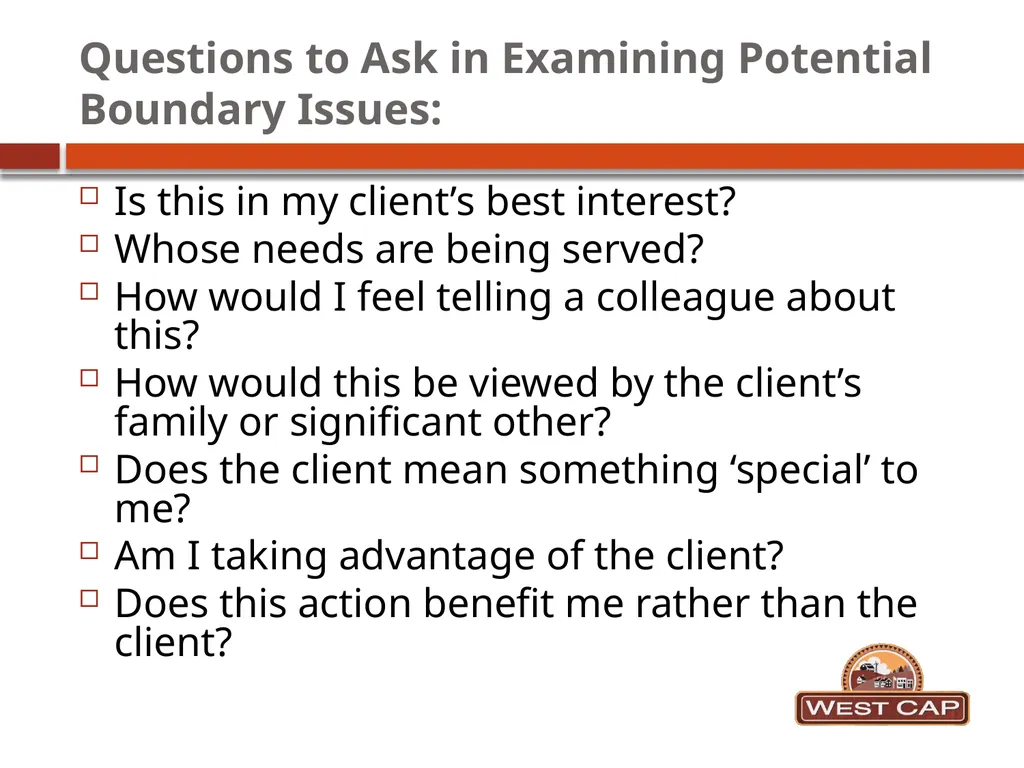
Questions to Ask in Examining Potential Boundary Issues: Is this in my client’s best interest?
Whose needs are being served?
How would I feel telling a colleague about this?
How would this be viewed by the client’s family or significant other?
Does the client mean something ‘special’ to me?
Am I taking advantage of the client?
Does this action benefit me rather than the client?<br>
14
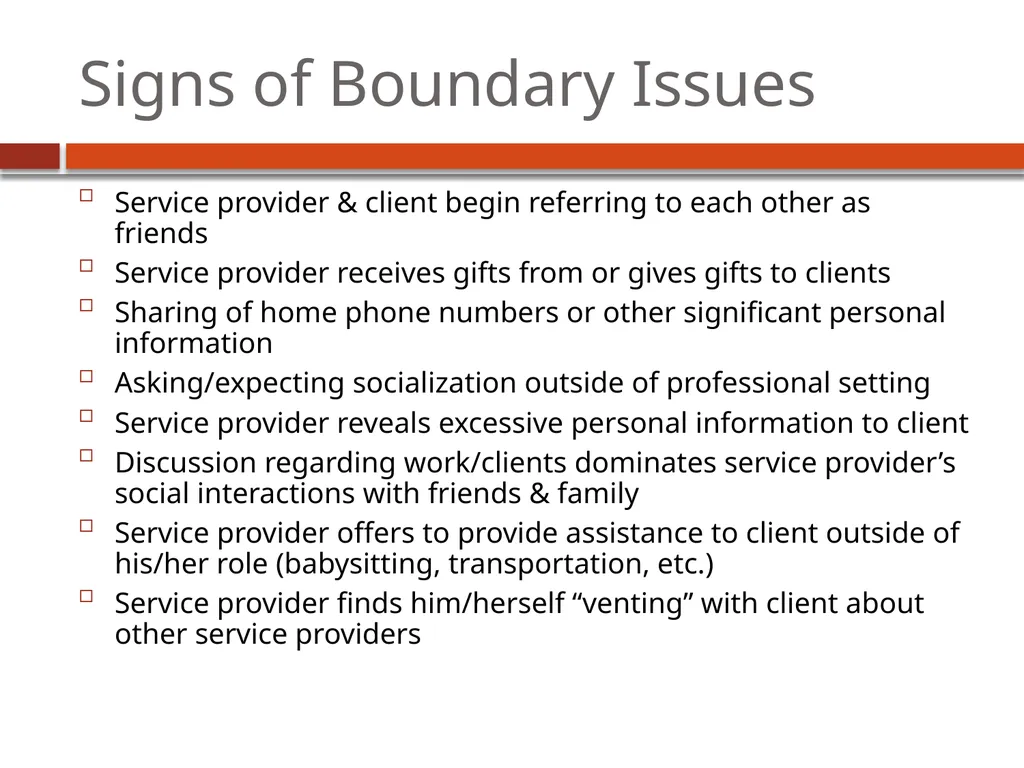
Signs of Boundary Issues Service provider & client begin referring to each other as friends
Service provider receives gifts from or gives gifts to clients
Sharing of home phone numbers or other significant personal information
Asking/expecting socialization outside of professional setting
Service provider reveals excessive personal information to client
Discussion regarding work/clients dominates service provider’s social interactions with friends & family
Service provider offers to provide assistance to client outside of his/her role (babysitting, transportation, etc.)
Service provider finds him/herself “venting” with client about other service providers<br>
15
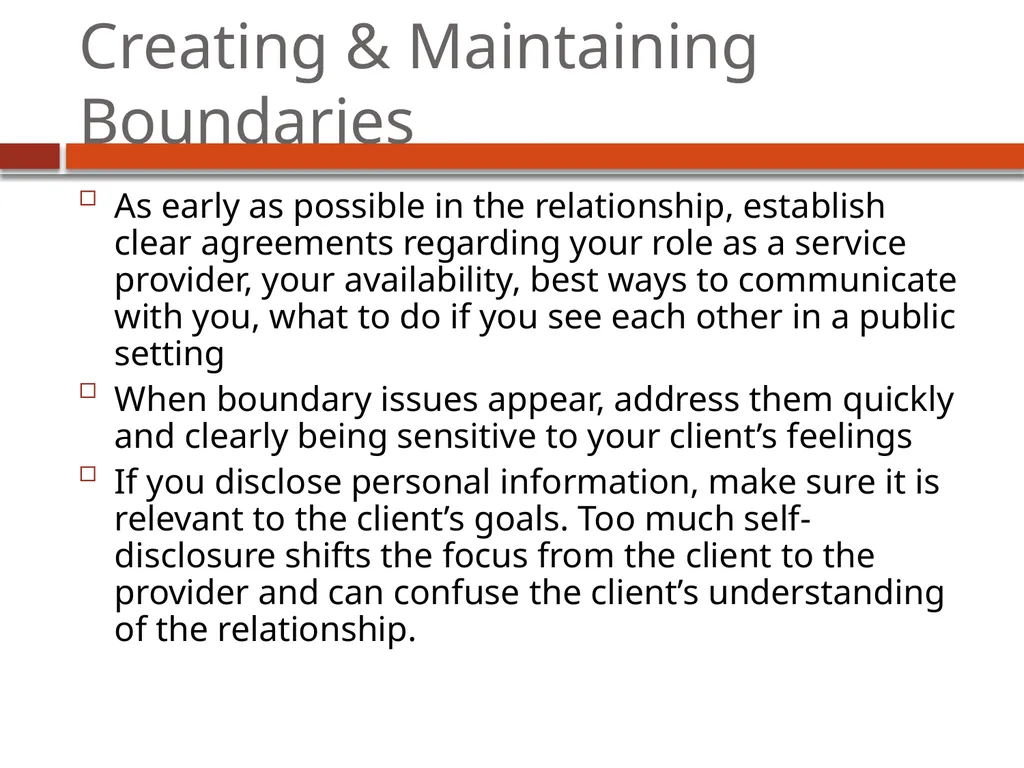
Creating & Maintaining Boundaries As early as possible in the relationship, establish clear agreements regarding your role as a service provider, your availability, best ways to communicate with you, what to do if you see each other in a public setting
When boundary issues appear, address them quickly and clearly being sensitive to your client’s feelings
If you disclose personal information, make sure it is relevant to the client’s goals. Too much self-disclosure shifts the focus from the client to the provider and can confuse the client’s understanding of the relationship.<br>
16
Creating & Maintaining Boundaries You may need to frequently clarify your role and boundaries to ensure understanding.
Use your supervisor or professional colleagues as a sounding board if you have questions or concerns.
Dual relationships – if you had a social relationship with a client prior becoming a service provider you must consider how future interactions impact a client’s confidentiality, and physical and emotional security.<br>
17
Creating & Maintaining Boundaries Working with a team of providers: Promote positive, open communication and respectful sharing of information. Build trust and recognize that you can’t and shouldn’t be the only help your client receives.
Take care of yourself! Make sure you are getting enough sleep, eat well, have healthy relationships, exercise and “leave work at work”.<br>
18
Scenario A tenant, who is a mother of three children, is facing the breakup of her marriage. She is very concerned about how her children will respond, what steps she can take to minimize the disruption to their lives, and how she will manage financially with the reduced income. You decide to relate your own experience of divorce and the parenting issues which followed.<br>
19
Scenario One of your favorite tenants moves out of your housing units. After several years you see the tenant at a shopping mall. She offers to take you to the food court for lunch to show appreciation for all the help provided during the time she lived in your housing project.<br>
20
Scenario You have a tenant who recently started his own small tax accounting business. He has shared with you that the business is struggling and he does not know what he will do if the business fails. The client asks to prepare your taxes this year.<br>
21
Resources & Contact Info http://www.naswdc.org/ (National Association of Social Workers)
http://www.zurinstitute.com/
rthibado@wcap.org
Carrie.poser@icalliances.org<br>