
ETHICS Theme 2: Deontological Ethics B: Aquinas’
GB
Published · 60 slides · 0 views
1 / 1

Description
ETHICS Theme 2: Deontological Ethics B: Aquinas Natural Law Virtues and Goods ETHICS - Theme 2: Deontological Ethics B: Aquinas Natural Law the role of virtues and goods in supporting moral behaviour By the end of todays lesson you
Related Topics
Share
Embed code
Download this presentation From Below
"ETHICS Theme 2: Deontological Ethics B: Aquinas’" is the property of its rightful owner. Permission is granted to download and print the materials on this website for personal, non-commercial use only, and to display it on your personal computer provided you do not modify the materials and that you retain all copyright notices contained in the materials. By downloading content from our website, you accept the terms of this agreement.
Presentation Transcript
01
ETHICS
Theme 2: Deontological Ethics
B: Aquinas’ Natural Law – Virtues and Goods<br>
Theme 2: Deontological Ethics
B: Aquinas’ Natural Law – Virtues and Goods<br>
02
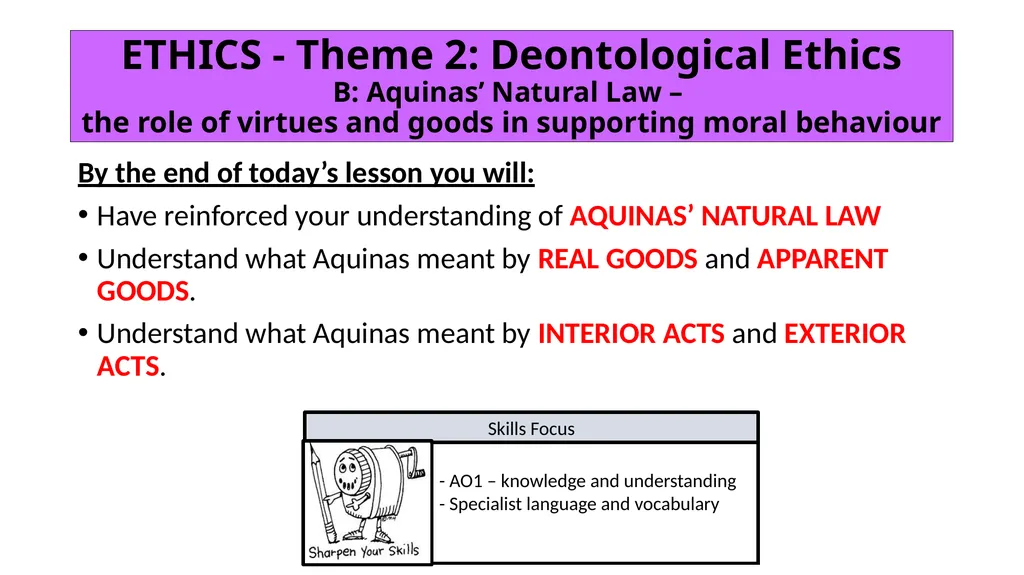
ETHICS - Theme 2: Deontological Ethics
B: Aquinas’ Natural Law –
the role of virtues and goods in supporting moral behaviour By the end of today’s lesson you will:
Have reinforced your understanding of AQUINAS’ NATURAL LAW
Understand what Aquinas meant by REAL GOODS and APPARENT GOODS.
Understand what Aquinas meant by INTERIOR ACTS and EXTERIOR ACTS.<br>
Have reinforced your understanding of AQUINAS’ NATURAL LAW
Understand what Aquinas meant by REAL GOODS and APPARENT GOODS.
Understand what Aquinas meant by INTERIOR ACTS and EXTERIOR ACTS.<br>
03
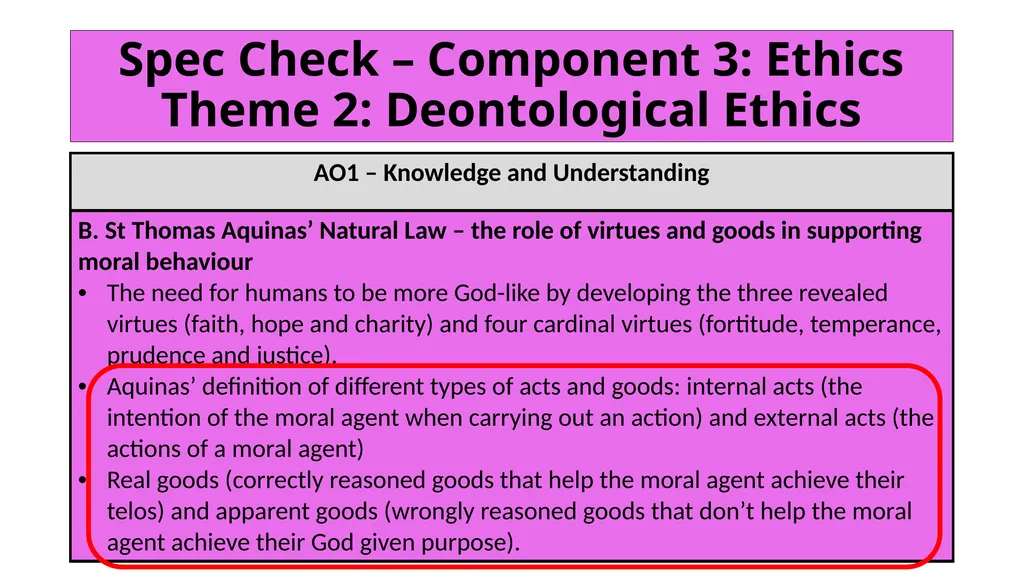
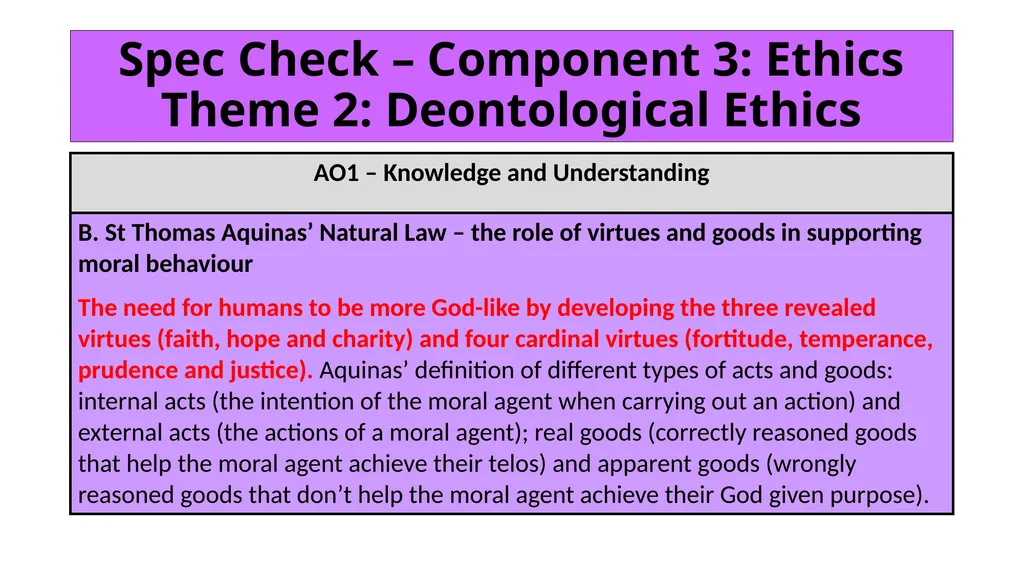
Spec Check – Component 3: Ethics
Theme 2: Deontological Ethics<br>
04
Starter True
or
False?<br>
or
False?<br>
05
True or False? Aquinas lived in the 15th century.<br>
06
True or False? Aquinas influenced Aristotle’s ideas on Natural Law.<br>
07
True or False? Aquinas agreed with Aristotle that everything in the world had a purpose.<br>
08
True or False? Aquinas believed that the purpose of human life is eudaimonia.<br>
09
True or False? Aquinas wrote about Natural Law in his book Summa Theologica.<br>
10
True or False? Aquinas stated that there are four levels of law.<br>
11
True or False? Natural law maintains that everything has a purpose and in fulfilling its purpose something is ‘good’.<br>
12
True or False? Only Christians can follow Natural Law.<br>
13
True or False? Human law is the innate human ability to know what is naturally right.<br>
14
True or False? Natural Law is a form of moral absolutism.<br>
15
True or False? There are four primary precepts.<br>
16
True or False? A follower of Natural Law would believe abortion to be moral.<br>
17
True or False? Natural Law is an deontological ethical theory with teleological aspects.<br>
18
True or False? The fundamental principle that underpins the primary precepts is to ‘do evil and avoid good’.<br>
19
True or False? One of the primary precepts is, “do not kill”.<br>
20
Learning check .... By the end of today’s lesson you will:
Have reinforced your understanding of AQUINAS’ NATURAL LAW
Understand what Aquinas meant by REAL GOODS and APPARENT GOODS.
Understand what Aquinas meant by INTERIOR ACTS and EXTERIOR ACTS.<br>
Have reinforced your understanding of AQUINAS’ NATURAL LAW
Understand what Aquinas meant by REAL GOODS and APPARENT GOODS.
Understand what Aquinas meant by INTERIOR ACTS and EXTERIOR ACTS.<br>
21
How might these people’s actions be seen as ‘good’?<br>
22
Real and Apparent Goods Human nature is essentially good because there is Natural Law in everyone.
Q: Why does Aquinas argue that we would never knowingly pursue evil?
A: We are naturally inclined to ‘do good and avoid evil’ in order to reach the highest good and fulfil our purpose.
Q: How do we know what is ‘good’ / how to act?
A: REASON<br>
Q: Why does Aquinas argue that we would never knowingly pursue evil?
A: We are naturally inclined to ‘do good and avoid evil’ in order to reach the highest good and fulfil our purpose.
Q: How do we know what is ‘good’ / how to act?
A: REASON<br>
23
Real and Apparent Goods Apparent good = Thinking something is good when it isn’t really! Taking us further away from what God intended for us.
How might this happen?
Misguided reason.
E.g. The adulterer thinks s/he’s in love and it is a good thing to do!
E.g. The student thinks that cheating in the exam will enable him/her to achieve an A*.
Real good = the right use of reason, leading to action that lead us towards perfection.<br>
How might this happen?
Misguided reason.
E.g. The adulterer thinks s/he’s in love and it is a good thing to do!
E.g. The student thinks that cheating in the exam will enable him/her to achieve an A*.
Real good = the right use of reason, leading to action that lead us towards perfection.<br>
24
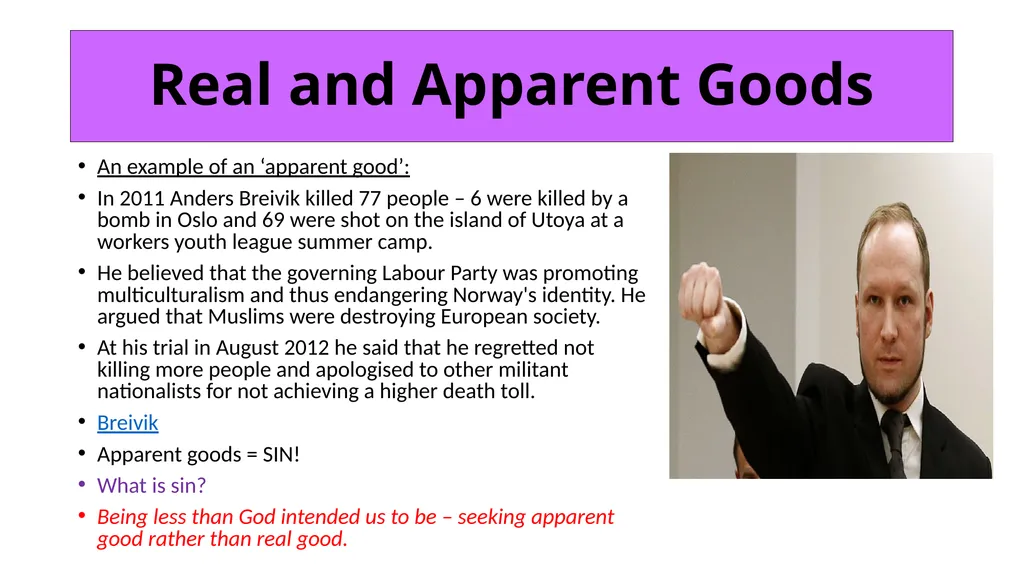
Real and Apparent Goods An example of an ‘apparent good’:
In 2011 Anders Breivik killed 77 people – 6 were killed by a bomb in Oslo and 69 were shot on the island of Utoya at a workers youth league summer camp.
He believed that the governing Labour Party was promoting multiculturalism and thus endangering Norway's identity. He argued that Muslims were destroying European society.
At his trial in August 2012 he said that he regretted not killing more people and apologised to other militant nationalists for not achieving a higher death toll.
Breivik
Apparent goods = SIN!
What is sin?
Being less than God intended us to be – seeking apparent good rather than real good.<br>
In 2011 Anders Breivik killed 77 people – 6 were killed by a bomb in Oslo and 69 were shot on the island of Utoya at a workers youth league summer camp.
He believed that the governing Labour Party was promoting multiculturalism and thus endangering Norway's identity. He argued that Muslims were destroying European society.
At his trial in August 2012 he said that he regretted not killing more people and apologised to other militant nationalists for not achieving a higher death toll.
Breivik
Apparent goods = SIN!
What is sin?
Being less than God intended us to be – seeking apparent good rather than real good.<br>
25
Learning check ... By the end of today’s lesson you will:
Have reinforced your understanding of AQUINAS’ NATURAL LAW
Understand what Aquinas meant by REAL GOODS and APPARENT GOODS.
Understand what Aquinas meant by INTERIOR ACTS and EXTERIOR ACTS.<br>
Have reinforced your understanding of AQUINAS’ NATURAL LAW
Understand what Aquinas meant by REAL GOODS and APPARENT GOODS.
Understand what Aquinas meant by INTERIOR ACTS and EXTERIOR ACTS.<br>
26
Interior and Exterior Acts Interior acts = Intention of the moral agent when carrying out an action.
Exterior acts = the actions of the moral agent.
Aquinas believed BOTH the intention and the act itself were important.<br>
Exterior acts = the actions of the moral agent.
Aquinas believed BOTH the intention and the act itself were important.<br>
27
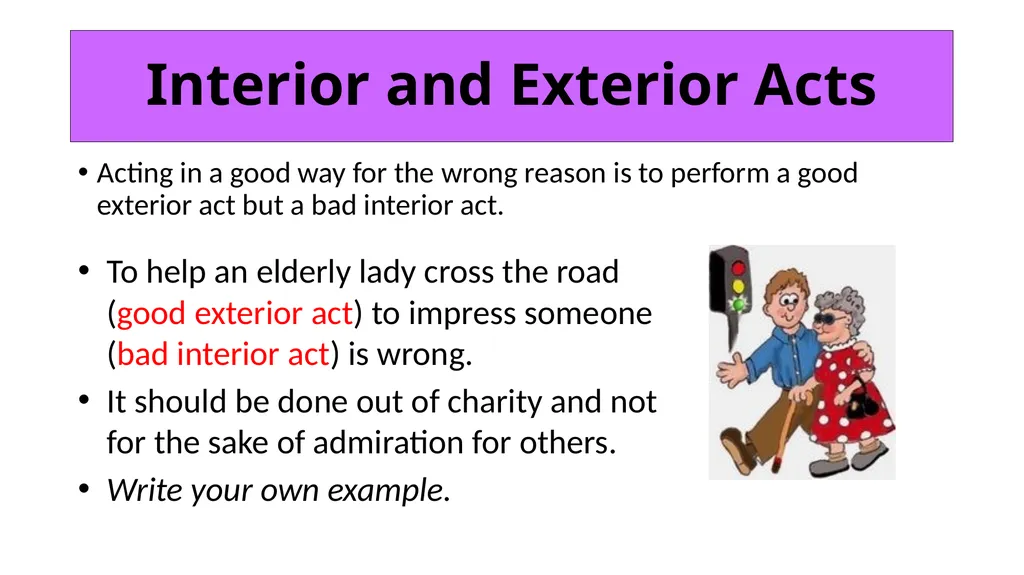
Interior and Exterior Acts Acting in a good way for the wrong reason is to perform a good exterior act but a bad interior act. To help an elderly lady cross the road (good exterior act) to impress someone (bad interior act) is wrong.
It should be done out of charity and not for the sake of admiration for others.
Write your own example.<br>
It should be done out of charity and not for the sake of admiration for others.
Write your own example.<br>
28
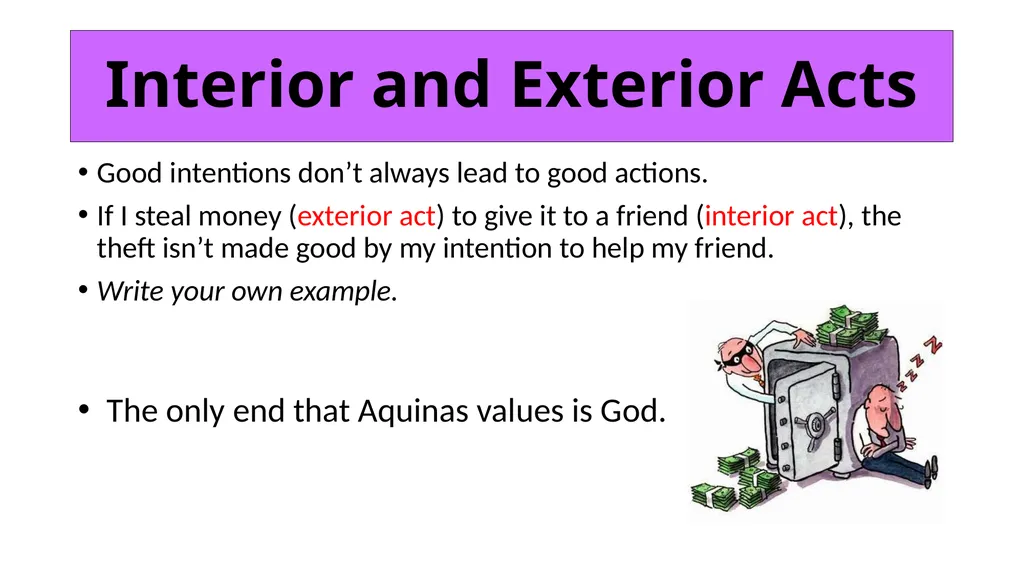
Interior and Exterior Acts Good intentions don’t always lead to good actions.
If I steal money (exterior act) to give it to a friend (interior act), the theft isn’t made good by my intention to help my friend.
Write your own example. The only end that Aquinas values is God.<br>
If I steal money (exterior act) to give it to a friend (interior act), the theft isn’t made good by my intention to help my friend.
Write your own example. The only end that Aquinas values is God.<br>
29
Interior and Exterior Acts Aquinas believes that acts are intrinsically good or bad (good or bad in themselves) because when human beings act in accordance with their ultimate purpose, God is glorified.
The act of helping the elderly lady across the road is good in and of itself, because it accords with the true human nature and in accordance with their final purpose, and that glorifies God.
This demonstrates Aquinas’ deontological approach to Natural Law. Explain how<br>
The act of helping the elderly lady across the road is good in and of itself, because it accords with the true human nature and in accordance with their final purpose, and that glorifies God.
This demonstrates Aquinas’ deontological approach to Natural Law. Explain how<br>
30
Double Effect Situations in which there is an intended outcome and another significant but unintended outcome.
Natural Law is a deontological approach to ethics, therefore it is the act itself, the intention, that is important and not the consequences.<br>
Natural Law is a deontological approach to ethics, therefore it is the act itself, the intention, that is important and not the consequences.<br>
31
Double Effect It is always wrong to do a bad act intentionally in order to bring about good consequences.
It is sometimes right to a good act despite knowing it will bring about bad consequences.
These bad consequences must only be unintended side-effects.<br>
It is sometimes right to a good act despite knowing it will bring about bad consequences.
These bad consequences must only be unintended side-effects.<br>
32
Double Effect - Example A pregnant woman has a cancerous uterus.
She has a hysterectomy.
The intention is good – to remove the cancerous uterus.
The other effect = the foetus dies.
This would be accepted in Natural Law because it is not killing the foetus that saves the woman’s life, but rather the hysterectomy.<br>
She has a hysterectomy.
The intention is good – to remove the cancerous uterus.
The other effect = the foetus dies.
This would be accepted in Natural Law because it is not killing the foetus that saves the woman’s life, but rather the hysterectomy.<br>
33
Learning check ... By the end of today’s lesson you will:
Have reinforced your understanding of AQUINAS’ NATURAL LAW
Understand what Aquinas meant by REAL GOODS and APPARENT GOODS.
Understand what Aquinas meant by INTERIOR ACTS and EXTERIOR ACTS.<br>
Have reinforced your understanding of AQUINAS’ NATURAL LAW
Understand what Aquinas meant by REAL GOODS and APPARENT GOODS.
Understand what Aquinas meant by INTERIOR ACTS and EXTERIOR ACTS.<br>
34
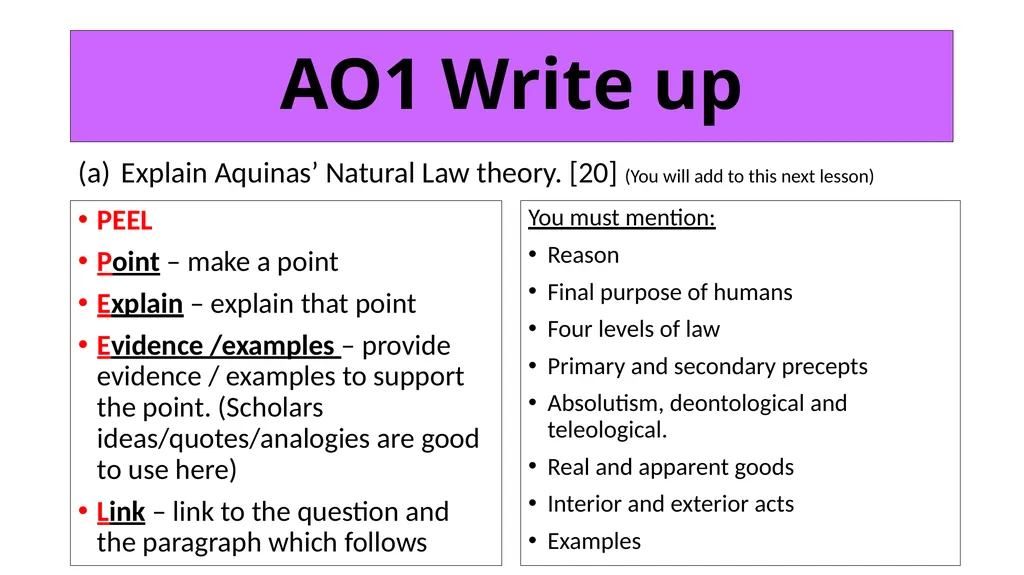
AO1 Write up Explain Aquinas’ Natural Law theory. [20] (You will add to this next lesson) PEEL
Point – make a point
Explain – explain that point
Evidence /examples – provide evidence / examples to support the point. (Scholars ideas/quotes/analogies are good to use here)
Link – link to the question and the paragraph which follows You must mention:
Reason
Final purpose of humans
Four levels of law
Primary and secondary precepts
Absolutism, deontological and teleological.
Real and apparent goods
Interior and exterior acts
Examples<br>
Point – make a point
Explain – explain that point
Evidence /examples – provide evidence / examples to support the point. (Scholars ideas/quotes/analogies are good to use here)
Link – link to the question and the paragraph which follows You must mention:
Reason
Final purpose of humans
Four levels of law
Primary and secondary precepts
Absolutism, deontological and teleological.
Real and apparent goods
Interior and exterior acts
Examples<br>
35
Learning check ... By the end of today’s lesson you will:
Have reinforced your understanding of AQUINAS’ NATURAL LAW
Understand what Aquinas meant by REAL GOODS and APPARENT GOODS.
Understand what Aquinas meant by INTERIOR ACTS and EXTERIOR ACTS.<br>
Have reinforced your understanding of AQUINAS’ NATURAL LAW
Understand what Aquinas meant by REAL GOODS and APPARENT GOODS.
Understand what Aquinas meant by INTERIOR ACTS and EXTERIOR ACTS.<br>
36
ETHICS - Theme 2: Deontological Ethics
B: Aquinas’ Natural Law –
the role of virtues and goods in supporting moral behaviour By the end of today’s lesson you will:
Understand how the development of VIRTUES enables humans fulfil their natural purpose.
Know the FOUR CARDINAL VIRTUES.
Know the THREE REVEALVED VIRTUES.<br>
Understand how the development of VIRTUES enables humans fulfil their natural purpose.
Know the FOUR CARDINAL VIRTUES.
Know the THREE REVEALVED VIRTUES.<br>
37
Spec Check – Component 3: Ethics
Theme 2: Deontological Ethics<br>
38
Starter – Mini Test What are the five primary precepts?
Bonus point if you can state the fundamental rule that forms the foundation of all the primary precepts.<br>
Bonus point if you can state the fundamental rule that forms the foundation of all the primary precepts.<br>
39
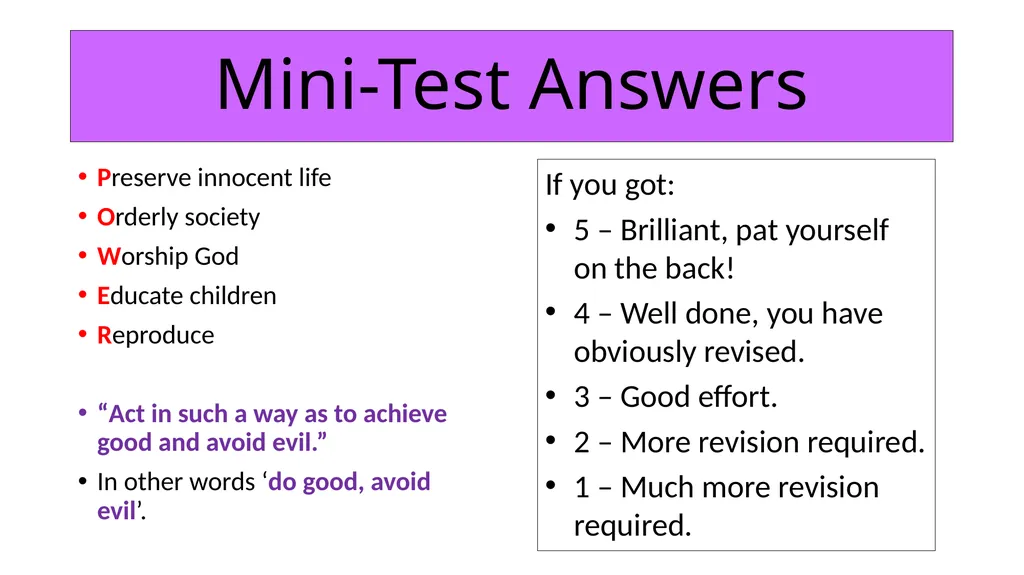
Mini-Test Answers Preserve innocent life
Orderly society
Worship God
Educate children
Reproduce
“Act in such a way as to achieve good and avoid evil.”
In other words ‘do good, avoid evil’. If you got:
5 – Brilliant, pat yourself on the back!
4 – Well done, you have obviously revised.
3 – Good effort.
2 – More revision required.
1 – Much more revision required.<br>
Orderly society
Worship God
Educate children
Reproduce
“Act in such a way as to achieve good and avoid evil.”
In other words ‘do good, avoid evil’. If you got:
5 – Brilliant, pat yourself on the back!
4 – Well done, you have obviously revised.
3 – Good effort.
2 – More revision required.
1 – Much more revision required.<br>
40
Virtues
Think - Pair - Share What traits of character are admired in the modern world?
What do/can these traits lead to for those who possess them?<br>
What do/can these traits lead to for those who possess them?<br>
41
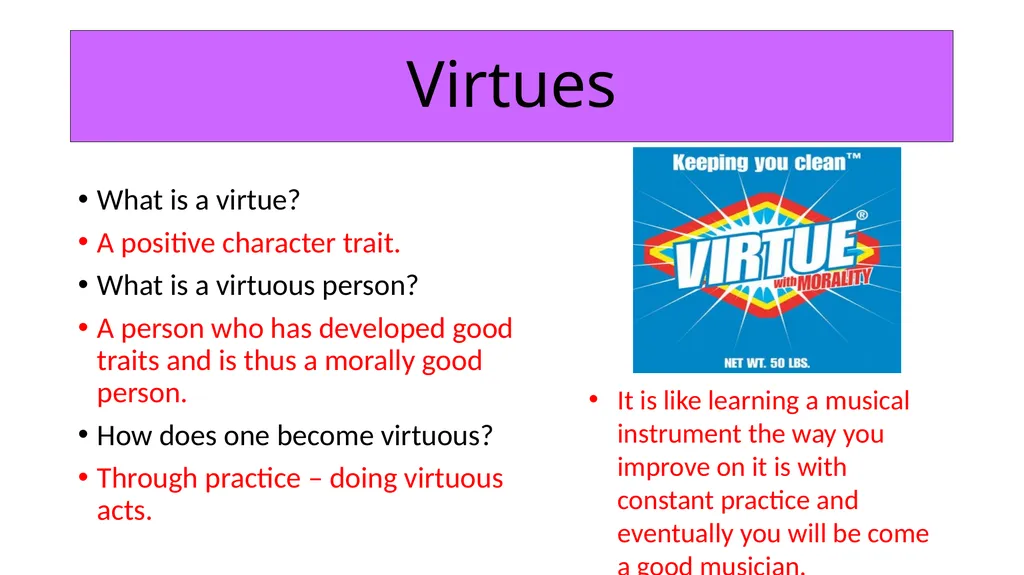
Virtues What is a virtue?
A positive character trait.
What is a virtuous person?
A person who has developed good traits and is thus a morally good person.
How does one become virtuous?
Through practice – doing virtuous acts. It is like learning a musical instrument the way you improve on it is with constant practice and eventually you will be come a good musician.<br>
A positive character trait.
What is a virtuous person?
A person who has developed good traits and is thus a morally good person.
How does one become virtuous?
Through practice – doing virtuous acts. It is like learning a musical instrument the way you improve on it is with constant practice and eventually you will be come a good musician.<br>
42
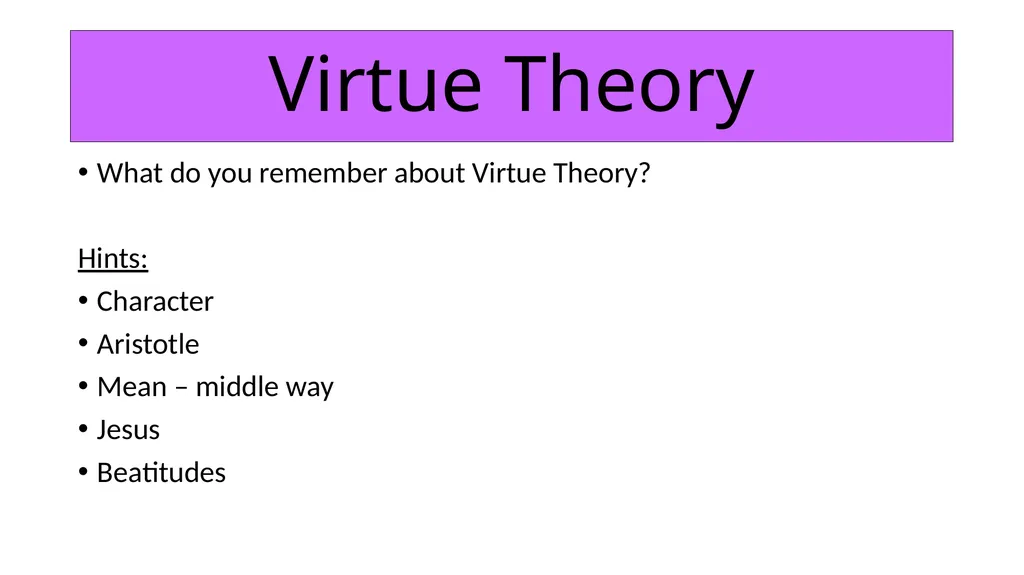
Virtue Theory What do you remember about Virtue Theory?
Hints:
Character
Aristotle
Mean – middle way
Jesus
Beatitudes<br>
Hints:
Character
Aristotle
Mean – middle way
Jesus
Beatitudes<br>
43
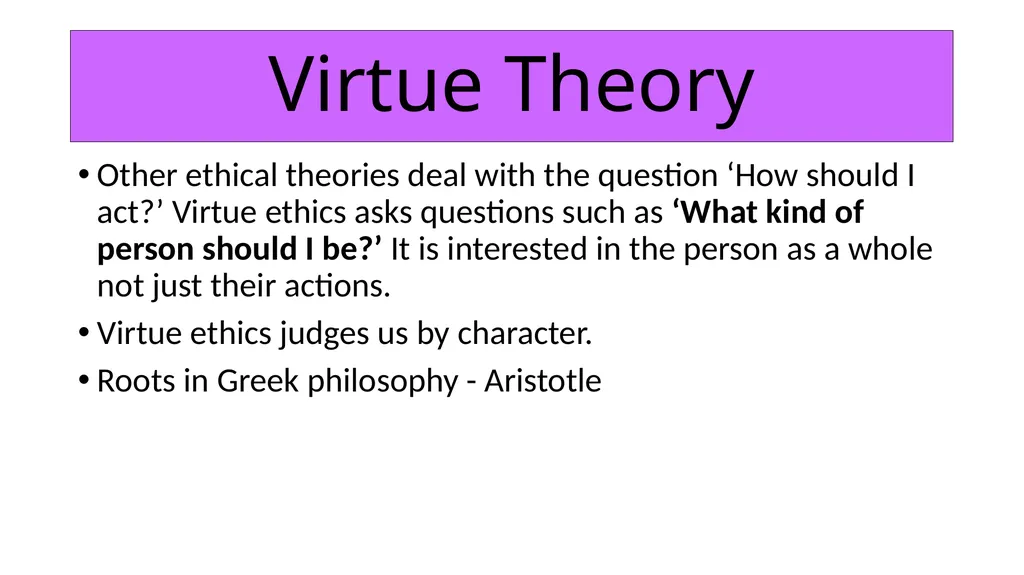
Virtue Theory Other ethical theories deal with the question ‘How should I act?’ Virtue ethics asks questions such as ‘What kind of person should I be?’ It is interested in the person as a whole not just their actions.
Virtue ethics judges us by character.
Roots in Greek philosophy - Aristotle<br>
Virtue ethics judges us by character.
Roots in Greek philosophy - Aristotle<br>
44
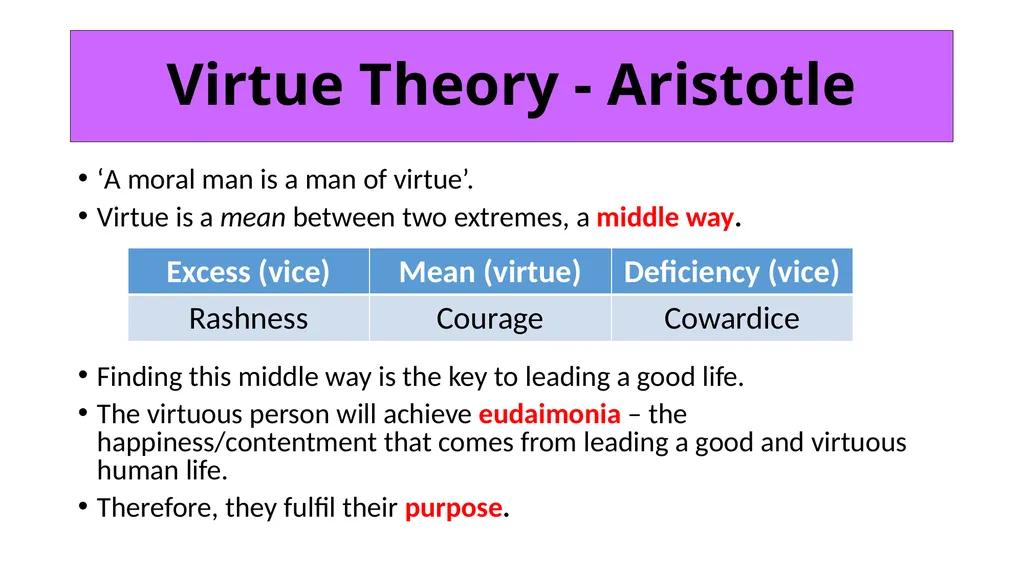
Virtue Theory - Aristotle ‘A moral man is a man of virtue’.
Virtue is a mean between two extremes, a middle way.
Finding this middle way is the key to leading a good life.
The virtuous person will achieve eudaimonia – the happiness/contentment that comes from leading a good and virtuous human life.
Therefore, they fulfil their purpose.<br>
Virtue is a mean between two extremes, a middle way.
Finding this middle way is the key to leading a good life.
The virtuous person will achieve eudaimonia – the happiness/contentment that comes from leading a good and virtuous human life.
Therefore, they fulfil their purpose.<br>
45
What do virtues have to do with Aquinas’ Natural Law? Like Aristotle, Aquinas believed that to achieve their purpose, to flourish and to live well, humans have to be virtuous.
In Summa Theologica Aquinas set out four human virtues (known as the cardinal virtues) which reflect the moral life.
To adhere to Natural Law, an individual should seek to develop these virtues.
They represent the human qualities that reason suggests are required in order to live a moral life, to do good and avoid evil, and to achieve the ‘final cause’ that reason sees as the overall purpose of life.<br>
In Summa Theologica Aquinas set out four human virtues (known as the cardinal virtues) which reflect the moral life.
To adhere to Natural Law, an individual should seek to develop these virtues.
They represent the human qualities that reason suggests are required in order to live a moral life, to do good and avoid evil, and to achieve the ‘final cause’ that reason sees as the overall purpose of life.<br>
46
What do virtues have to do with Aquinas’ Natural Law? By cultivating certain virtues, people will do ‘real goods’ as their ability to correctly use their God-given reason is developed.
These cardinal virtues can be practiced by anyone; thus, they represent the foundation of Natural Law.
They are natural and revealed in nature, and they are binding on everyone.<br>
These cardinal virtues can be practiced by anyone; thus, they represent the foundation of Natural Law.
They are natural and revealed in nature, and they are binding on everyone.<br>
47
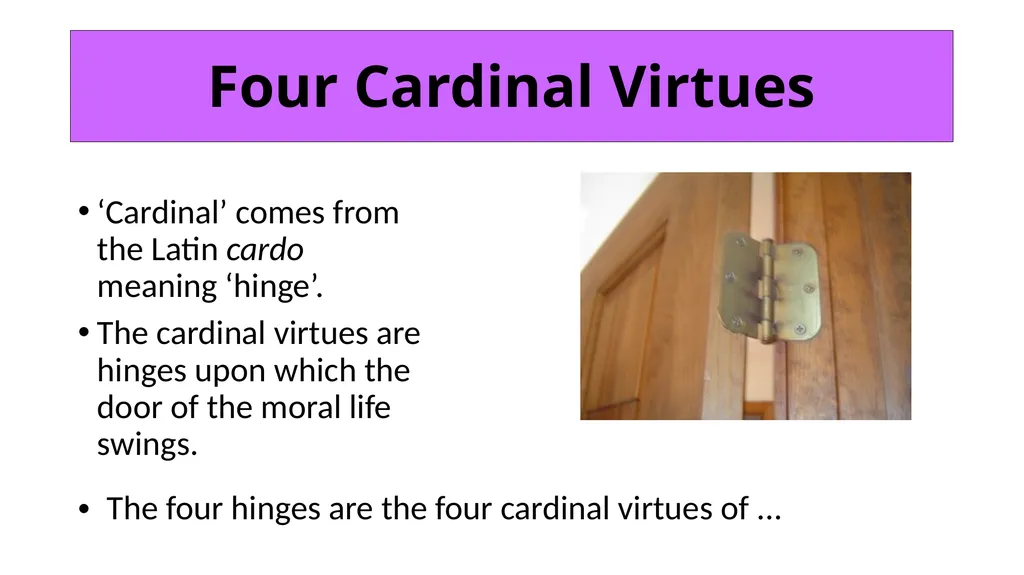
Four Cardinal Virtues ‘Cardinal’ comes from the Latin cardo meaning ‘hinge’.
The cardinal virtues are hinges upon which the door of the moral life swings. The four hinges are the four cardinal virtues of ...<br>
The cardinal virtues are hinges upon which the door of the moral life swings. The four hinges are the four cardinal virtues of ...<br>
48
Four Cardinal Virtues Prudence
Justice
Fortitude
Temperance Card sort:
Match each cardinal virtue with the correct definition.<br>
Justice
Fortitude
Temperance Card sort:
Match each cardinal virtue with the correct definition.<br>
49
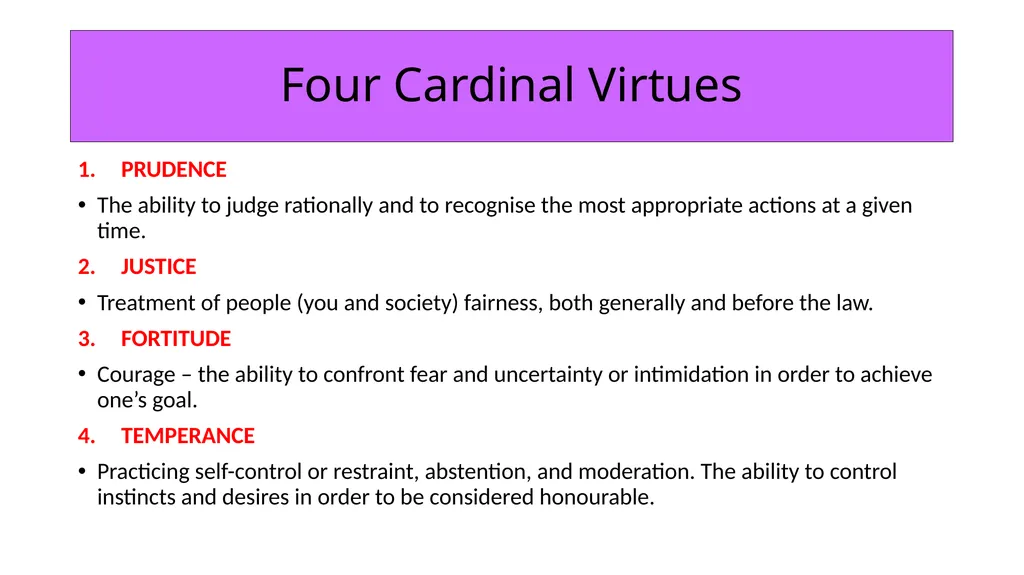
Four Cardinal Virtues PRUDENCE
The ability to judge rationally and to recognise the most appropriate actions at a given time.
JUSTICE
Treatment of people (you and society) fairness, both generally and before the law.
FORTITUDE
Courage – the ability to confront fear and uncertainty or intimidation in order to achieve one’s goal.
TEMPERANCE
Practicing self-control or restraint, abstention, and moderation. The ability to control instincts and desires in order to be considered honourable.<br>
The ability to judge rationally and to recognise the most appropriate actions at a given time.
JUSTICE
Treatment of people (you and society) fairness, both generally and before the law.
FORTITUDE
Courage – the ability to confront fear and uncertainty or intimidation in order to achieve one’s goal.
TEMPERANCE
Practicing self-control or restraint, abstention, and moderation. The ability to control instincts and desires in order to be considered honourable.<br>
50
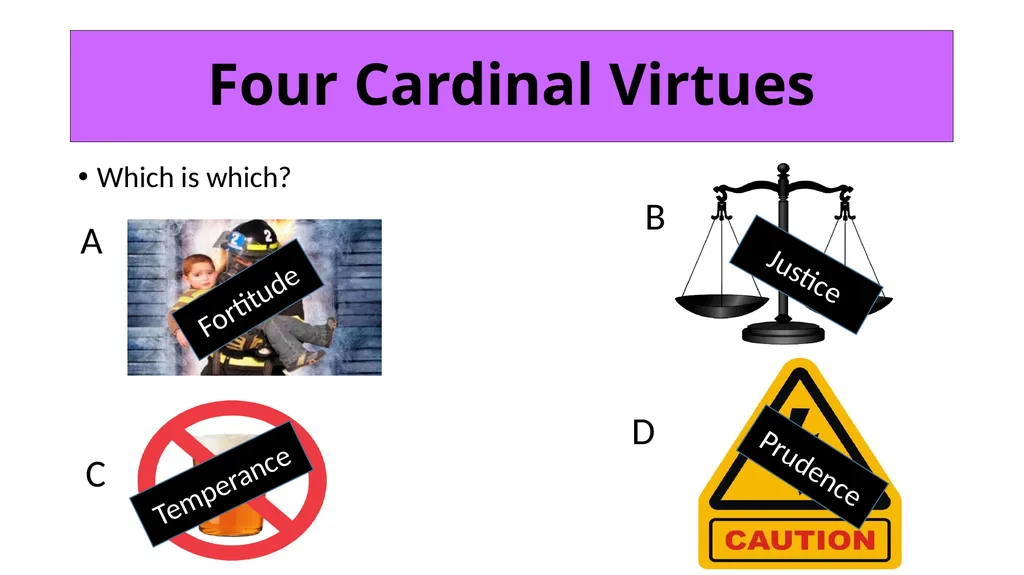
Four Cardinal Virtues Which is which? A D C B Fortitude Justice Temperance Prudence<br>
51
Four Cardinal Virtues
Carousel activity At each ‘Virtue Station’ you will need to:
Explain the virtue.
Show how that virtue can be applied to life.
Determine which primary precept(s) the virtue can be related to and how.
You will have 5 minutes at each station<br>
Explain the virtue.
Show how that virtue can be applied to life.
Determine which primary precept(s) the virtue can be related to and how.
You will have 5 minutes at each station<br>
52
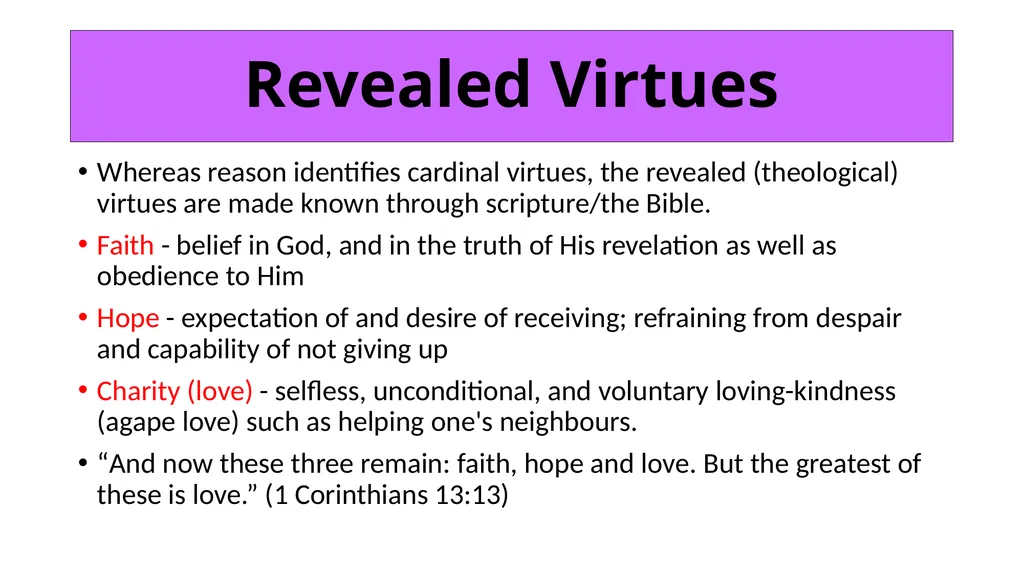
Revealed Virtues Whereas reason identifies cardinal virtues, the revealed (theological) virtues are made known through scripture/the Bible.
Faith - belief in God, and in the truth of His revelation as well as obedience to Him
Hope - expectation of and desire of receiving; refraining from despair and capability of not giving up
Charity (love) - selfless, unconditional, and voluntary loving-kindness (agape love) such as helping one's neighbours.
“And now these three remain: faith, hope and love. But the greatest of these is love.” (1 Corinthians 13:13)<br>
Faith - belief in God, and in the truth of His revelation as well as obedience to Him
Hope - expectation of and desire of receiving; refraining from despair and capability of not giving up
Charity (love) - selfless, unconditional, and voluntary loving-kindness (agape love) such as helping one's neighbours.
“And now these three remain: faith, hope and love. But the greatest of these is love.” (1 Corinthians 13:13)<br>
53
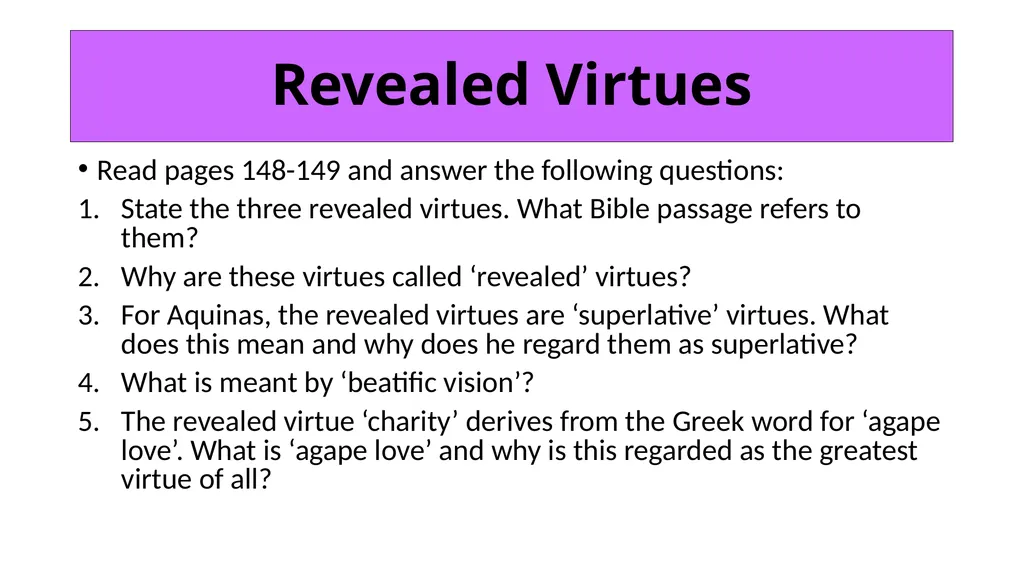
Revealed Virtues Read pages 148-149 and answer the following questions:
State the three revealed virtues. What Bible passage refers to them?
Why are these virtues called ‘revealed’ virtues?
For Aquinas, the revealed virtues are ‘superlative’ virtues. What does this mean and why does he regard them as superlative?
What is meant by ‘beatific vision’?
The revealed virtue ‘charity’ derives from the Greek word for ‘agape love’. What is ‘agape love’ and why is this regarded as the greatest virtue of all?<br>
State the three revealed virtues. What Bible passage refers to them?
Why are these virtues called ‘revealed’ virtues?
For Aquinas, the revealed virtues are ‘superlative’ virtues. What does this mean and why does he regard them as superlative?
What is meant by ‘beatific vision’?
The revealed virtue ‘charity’ derives from the Greek word for ‘agape love’. What is ‘agape love’ and why is this regarded as the greatest virtue of all?<br>
54
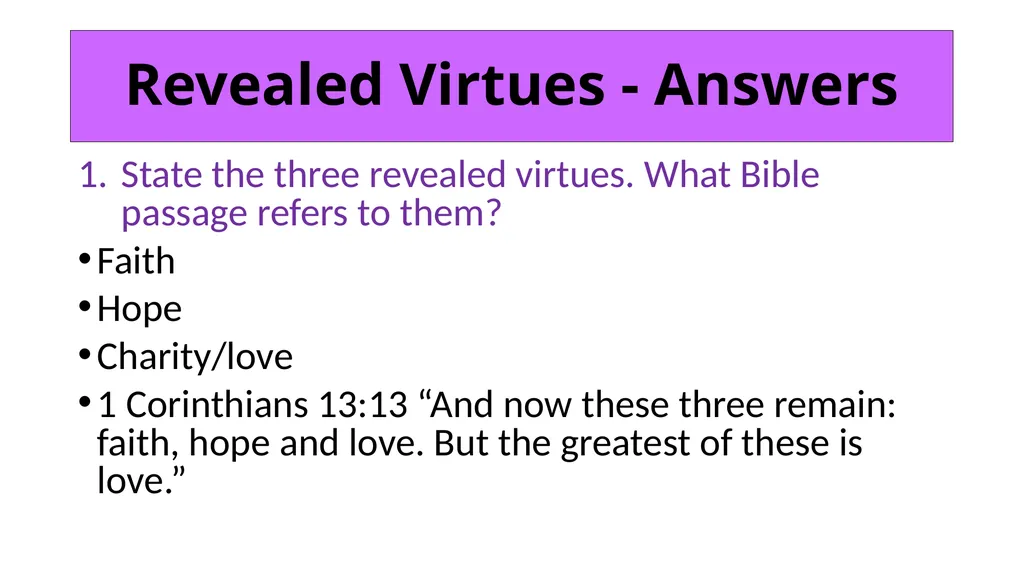
Revealed Virtues - Answers State the three revealed virtues. What Bible passage refers to them?
Faith
Hope
Charity/love
1 Corinthians 13:13 “And now these three remain: faith, hope and love. But the greatest of these is love.”<br>
Faith
Hope
Charity/love
1 Corinthians 13:13 “And now these three remain: faith, hope and love. But the greatest of these is love.”<br>
55
Revealed Virtues - Answers Why are these virtues called ‘revealed’ virtues?
God reveals them to humans through the Bible.<br>
God reveals them to humans through the Bible.<br>
56
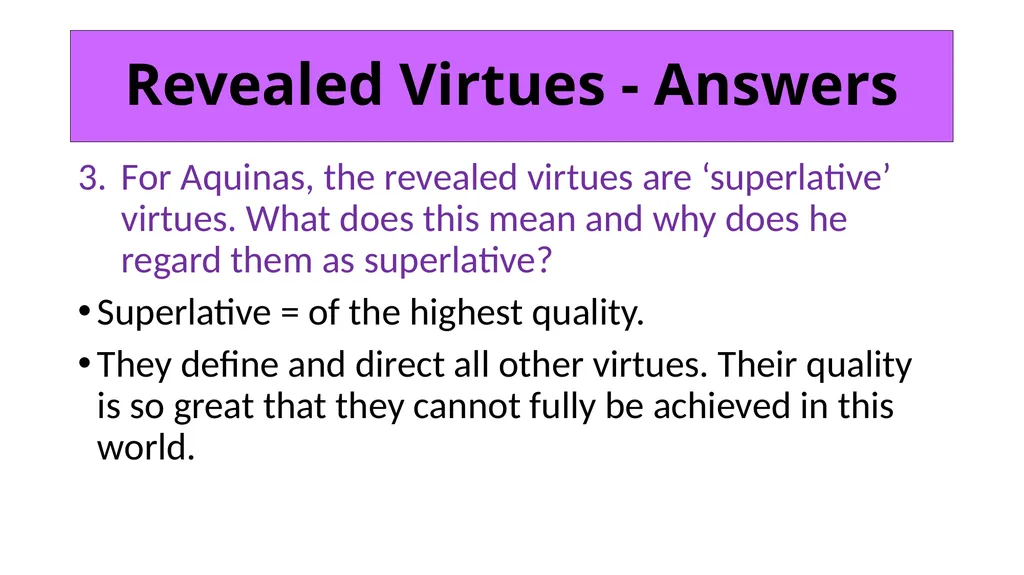
Revealed Virtues - Answers For Aquinas, the revealed virtues are ‘superlative’ virtues. What does this mean and why does he regard them as superlative?
Superlative = of the highest quality.
They define and direct all other virtues. Their quality is so great that they cannot fully be achieved in this world.<br>
Superlative = of the highest quality.
They define and direct all other virtues. Their quality is so great that they cannot fully be achieved in this world.<br>
57
Revealed Virtues - Answers What is meant by ‘beatific vision’?
The state of perfect happiness through supernatural union with God.<br>
The state of perfect happiness through supernatural union with God.<br>
58
Revealed Virtues - Answers The revealed virtue ‘charity’ derives from the Greek word for ‘agape love’. What is ‘agape love’ and why is this regarded as the greatest virtue of all?
Agape love = unconditional love.
Love actively directs all other virtues towards God.<br>
Agape love = unconditional love.
Love actively directs all other virtues towards God.<br>
59
AO1 Write up Explain Aquinas’ Natural Law theory. [20] PEEL
Point – make a point
Explain – explain that point
Evidence /examples – provide evidence / examples to support the point. (Scholars ideas/quotes/analogies are good to use here)
Link – link to the question and the paragraph which follows You must mention:
Reason
Final purpose of humans
Four levels of law
Primary and secondary precepts
Absolutism, deontological and teleological.
Virtues – revealed and cardinal
Examples<br>
Point – make a point
Explain – explain that point
Evidence /examples – provide evidence / examples to support the point. (Scholars ideas/quotes/analogies are good to use here)
Link – link to the question and the paragraph which follows You must mention:
Reason
Final purpose of humans
Four levels of law
Primary and secondary precepts
Absolutism, deontological and teleological.
Virtues – revealed and cardinal
Examples<br>
60
Learning check ... By the end of today’s lesson you will:
Understand how the development of VIRTUES enables humans fulfil their natural purpose.
Know the FOUR CARDINAL VIRTUES.
Know the THREE REVEALVED VIRTUES.<br>
Understand how the development of VIRTUES enables humans fulfil their natural purpose.
Know the FOUR CARDINAL VIRTUES.
Know the THREE REVEALVED VIRTUES.<br>