04
Fundamental problem in his plays – relation of the human being to something outside himself to which he can belong and in which he can ground himself and find purpose
‘something that saves him from being lonely, lost, an existential exile - or as his characters put it ‘a stranger in a strange land’<br>
05
Beyond the Horizon (1920) - acknowledged as the leading American playwright of his day
Other plays:
Anna Christie, 1920 - Pulitzer Prize, 1922
The Hairy Ape, 1922
Desire Under the Elms, 1924<br>
06
Devoted to experimental writing style
in The Great God Brown, 1926 - use of symbolic masks
in Strange Interlude, 1928 (Pulitzer Prize) – a dramatic form of stream-of-consciousness
In Mourning Becomes Electra, 1931 - Oresteia of Aeschylus retold as a story of the Civil War<br>
07
after Days Without End (1934) - theatrical silence
The Iceman Cometh (1946) - the last play produced during his lifetime
died in 1953
the critical consensus his best work plays from the 1920s
view transformed in 1956 with the premiere of Long Day’s Journey into Night<br>
08
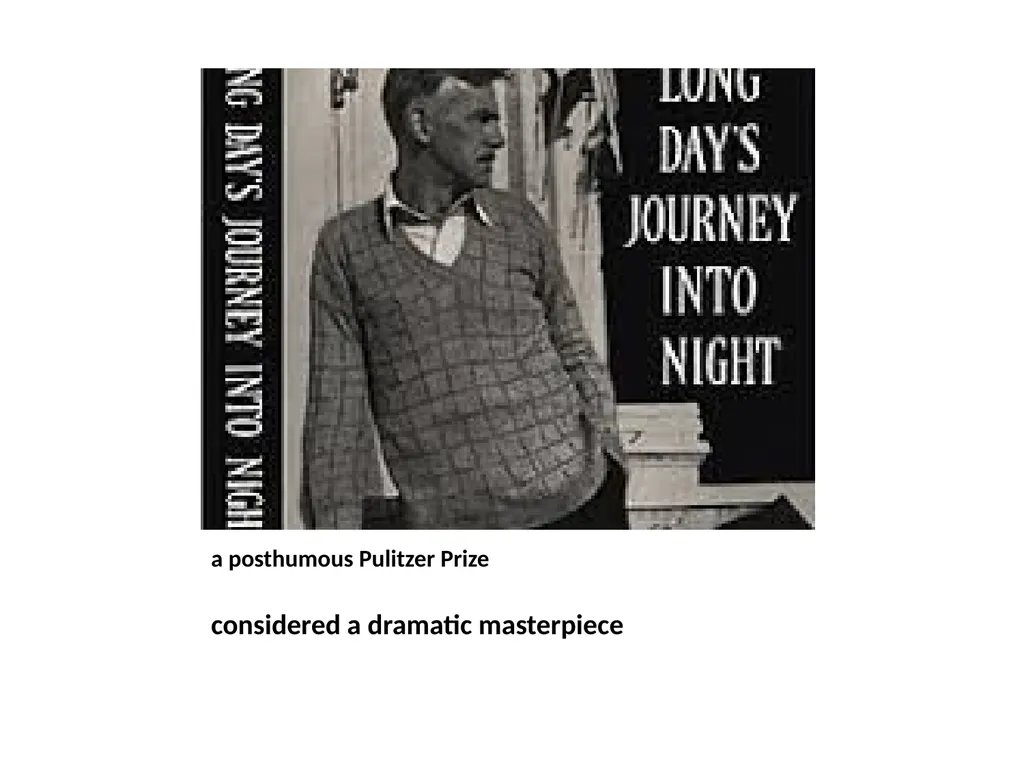
a posthumous Pulitzer Prize considered a dramatic masterpiece<br>
09
the title - the importance of time
one long day in August in 1912
descent into darkness
the symbolism of the fog<br>
10
directly autobiographical
‘a play of sorrow, written in tears and blood’
coming to terms with his present by confronting the past<br>
11
the Tyrone family:
James Tyrone, a former matinee idol,
Mary Tyrone, a nervous sickly woman addicted to morphine,
older son Jamie, a hard-drinking cynic,
younger son Edmund, who has literary aspirations and suffers from tuberculosis<br>
12
obvious from the start that something has happened in the past that haunts the Tyrones, communicated indirectly, i.e.
when Mary teases her husband for snoring, Jamie quickly picks up on the fact that she couldn’t sleep - at his ‘uneasy, probing look’, Mary becomes anxious and asks him ‘Why are you staring Jamie? Is my hair coming down? It’s hard for me to do it up properly now. My eyes are getting so bad and I never can find my glasses.’ At this, Jamie looks away guiltily and says, ‘Your hair’s all right, Mama. I was only thinking how well you look’<br>
13
Jeremy Irons and Lesley Manville 2018.<br>
14
What are they hiding?
clues to this mystery revealed gradually
Act 3: Mary a dope addict
‘The past is the present, isn’t it?’ ... ‘It’s the future too. We all try to lie out of that but life won’t let us.’<br>
15
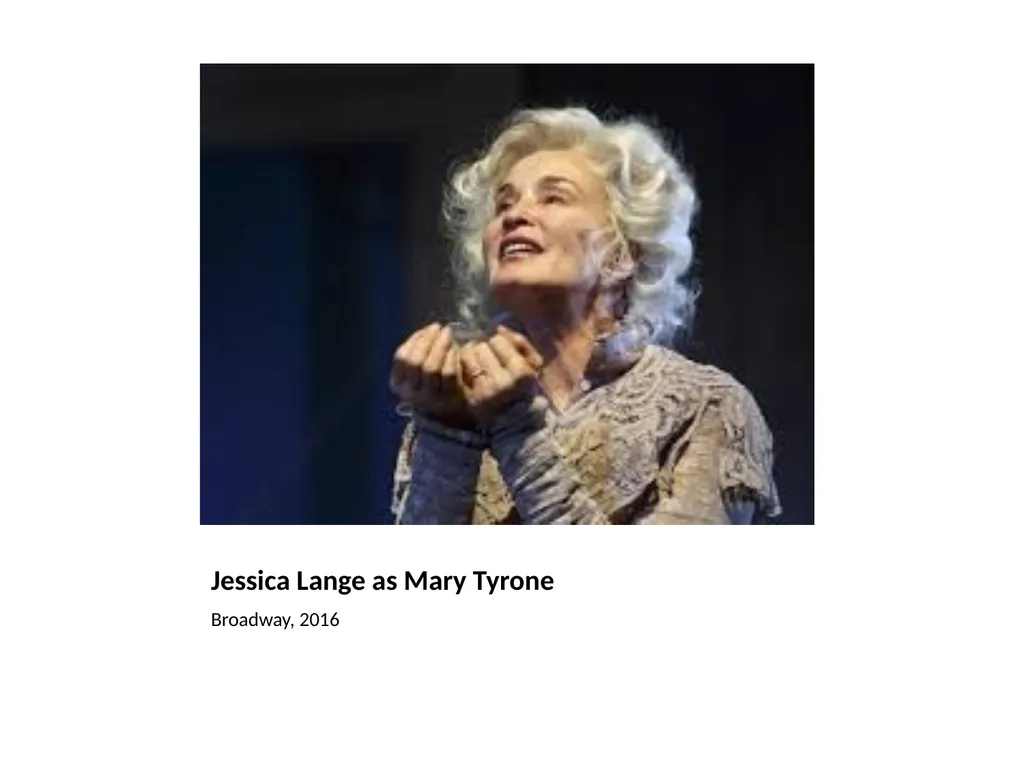
Jessica Lange as Mary Tyrone Broadway, 2016<br>
16
to escape the pain she cannot bear, she withdraws into a happier past
her disheveled appearance parallels the disintegration: firstly dressed elegantly, hair arranged with ‘fastidious care’, her voice ‘soft and attractive’
by the final scene, her regression is complete - elegant dress replaced by a dressing gown worn over her nightdress, hair is in pigtails, she is paler than ever, and her eyes, now enormous, ‘glisten like polished black jewels’<br>
17
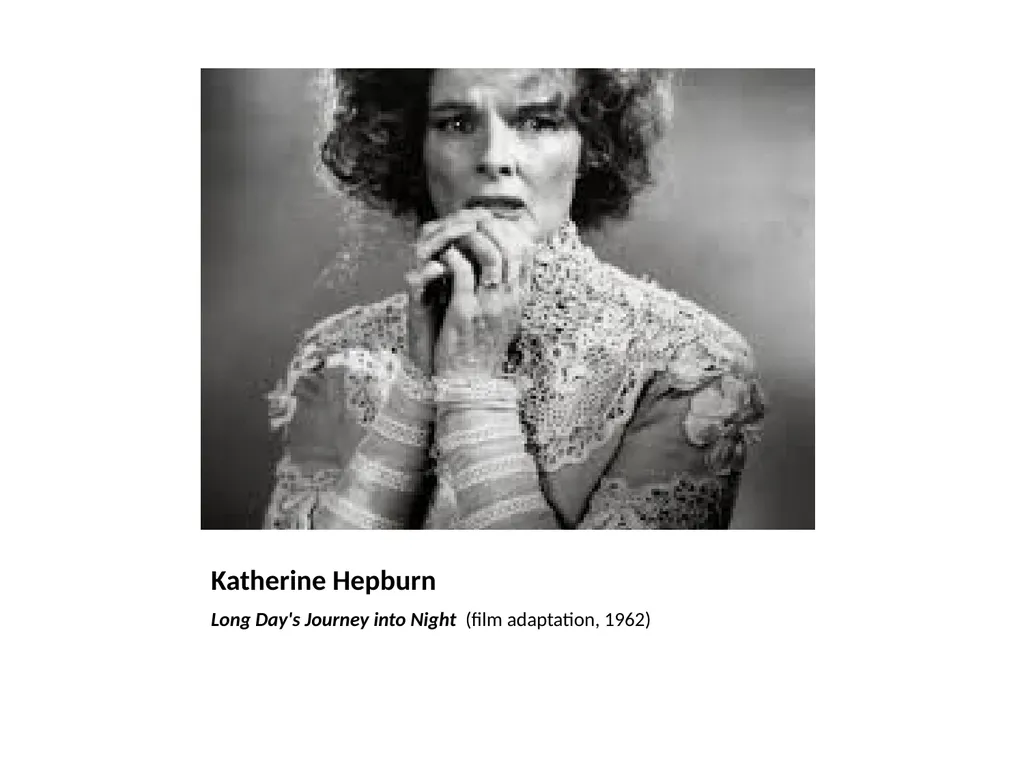
Katherine Hepburn Long Day's Journey into Night (film adaptation, 1962)<br>
18
the isolation of others members of the family and disintegration of the family unit
a study of lives in disintegration, people without something to give shape and significance to their lives<br>
19
their ideal moments as the play builds to its climax:
for James, its apex in 1874 - ‘That young man is playing Othello better than I ever did!’
for Mary, her own lost innocence, associated with her convent days and her desire to be a nun
for Jamie, not ideal realized but lost - the time when he discovered his mother ‘in the act with a hypo’<br>
20
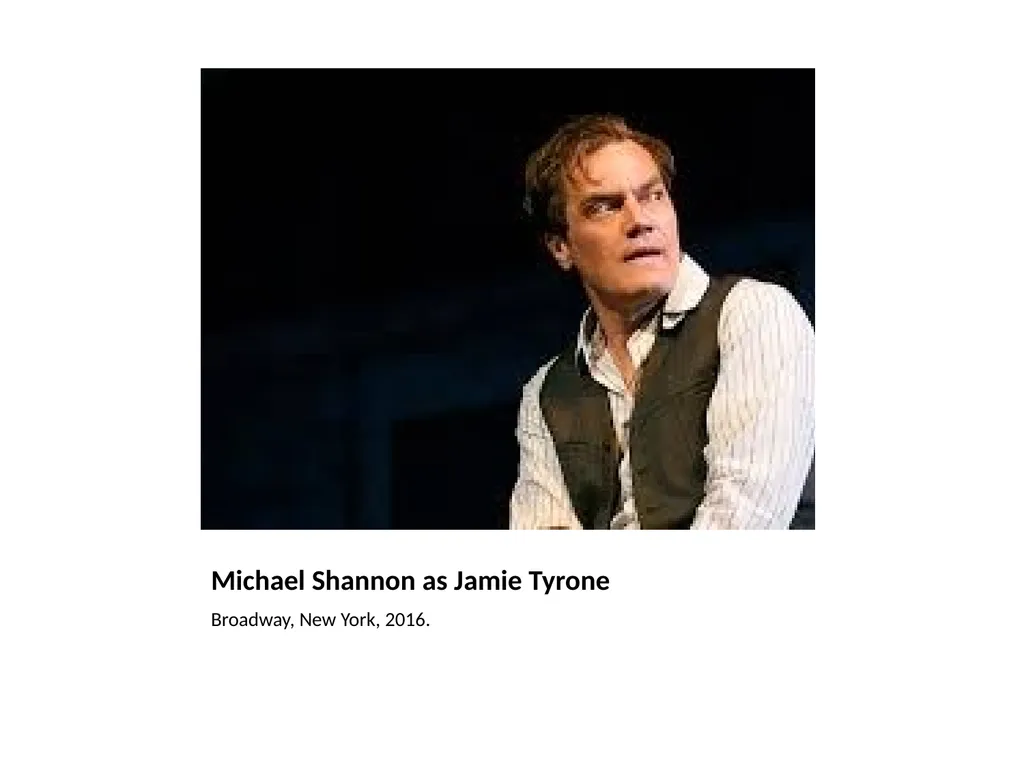
Michael Shannon as Jamie Tyrone Broadway, New York, 2016.<br>
21
Ideal time for Edmund:
I became drunk with the beauty and singing rhythm of it, and for a moment I lost myself -- actually lost my life. I was set free! I dissolved in the sea, became white sails and flying spray, became beauty and rhythm, became moonlight and the ship and the high dim-starred sky! I belonged, without past or future, within peace and unity and a wild joy, within something greater than my own life, or the life of Man, to Life itself! To God, if you want to put it that way.<br>
22
Edmund is an exercise in self-portraiture – life tormented and alienated from family:
‘It was a great mistake, my being born a man. I would have been much more successful as a sea-gull or a fish’, Edmund observes’, ‘As it is I will always be a stranger who never feels at home, who must always be a little in love with death!’<br>
23
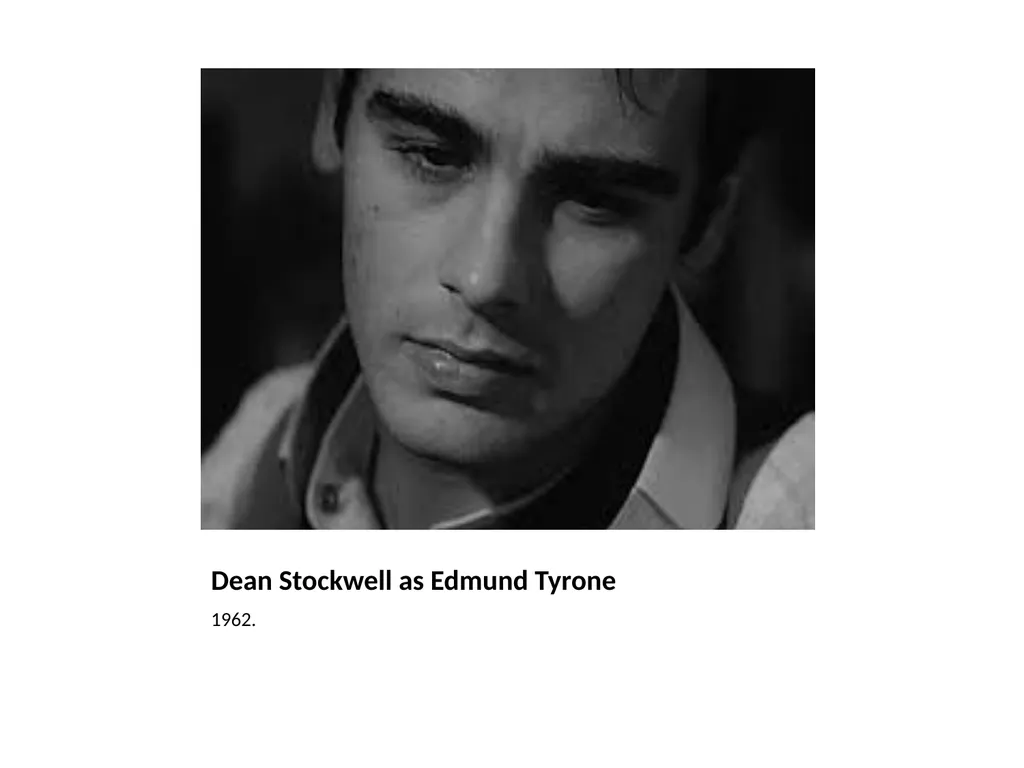
Dean Stockwell as Edmund Tyrone 1962.<br>
24
divided, disintegrated people - they are at odds with themselves, with each other
expressed in the words they use and their conversations - lash out at each other in an endless round of guilt-accusation-remorse-forgiveness-and-counterattack<br>
25
the condition of the Tyrones and human condition in O’Neil’s plays
the secret of joy, professed only for a moment, before and after there is only waste and exile
in act 4 the possibility of hope
potential breakthrough unrealized after Mary’s entrance
nothing has changed<br>
26
Like Faulkner, O’Neill believed that ‘the past is the present’
like Faulkner, the family as an elaborate web of blame and dependence - the Tyrones constantly accusing each other, but also relying on each other to bolster the image of themselves through sharing their memories and illusions<br>
27
Sources:
From Puritanism to Postmodernism
Norton Anthology: Eugene O’Neil
Radojka Vukčević, Perspectives on American Literature
https://www.youtube.com/watch?v=ADtcMi2Wwg0<br>