Europe Code Week 6-21 October 2018 A celebration of creating with code What is the aim of Europe Code Week? To bring basic programming skills and digital literacy to everybody in a fun and engaging way Since the beginning of times, humans
Related Topics
Share
Embed code
Download this presentation From Below
"Europe Code Week 6-21 October 2018 A celebration" is the property of its rightful owner. Permission is granted to
download and print the materials on this website for personal, non-commercial use only, and to display it
on your personal computer provided you do not modify the materials and that you retain all copyright
notices contained in the materials. By downloading content from our website, you accept the terms of this
agreement.
Presentation Transcript
01
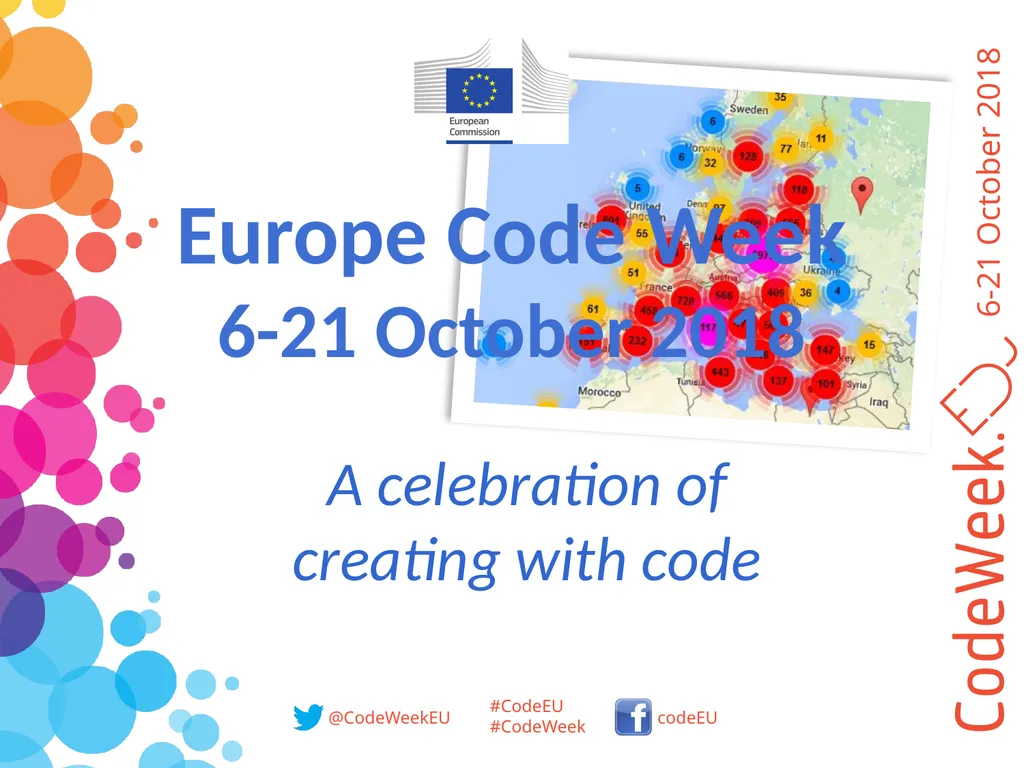
Europe Code Week 6-21 October 2018 A celebration of
creating with code<br>
02
What is the aim of Europe Code Week? To bring basic programming skills and digital literacy to everybody in a fun and engaging way
"Since the beginning of times, humans have created with stone, iron, paper and pencil. Now we live in a different era where we mould our world in code. During Code Week we want to give everyone the opportunity to discover coding and have fun with it. Let’s learn coding to shape our future!"
Alessandro Bogliolo, EU Code Week coordinator<br>
03
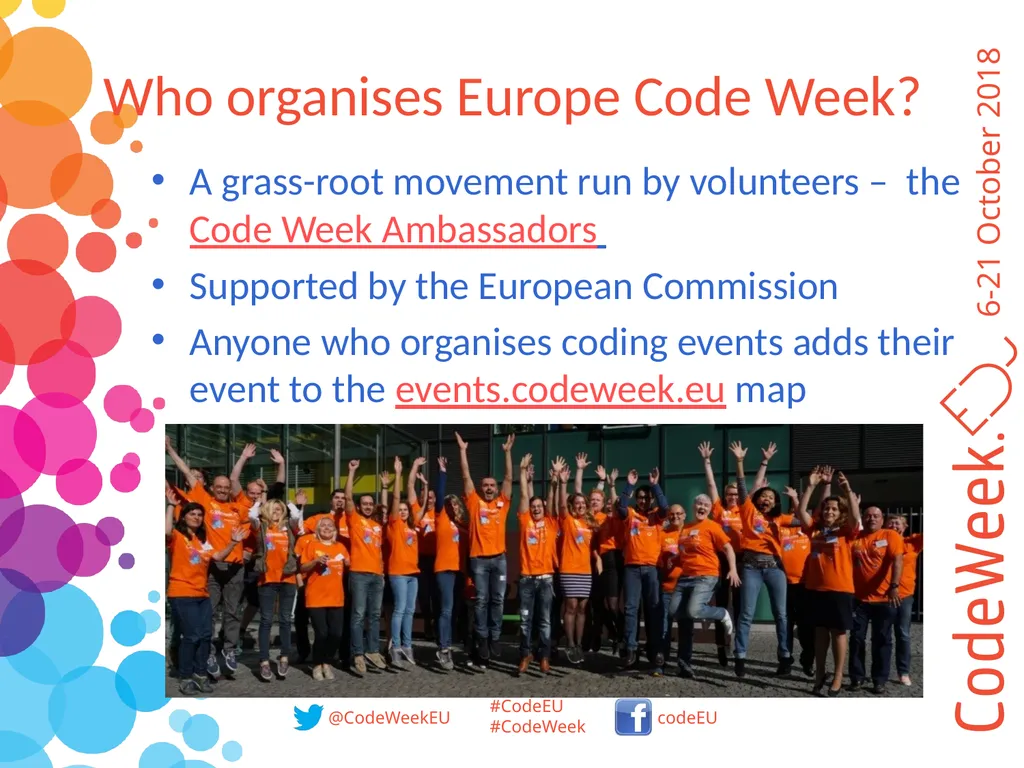
Who organises Europe Code Week? A grass-root movement run by volunteers – the Code Week Ambassadors
Supported by the European Commission
Anyone who organises coding events adds their event to the events.codeweek.eu map<br>
04
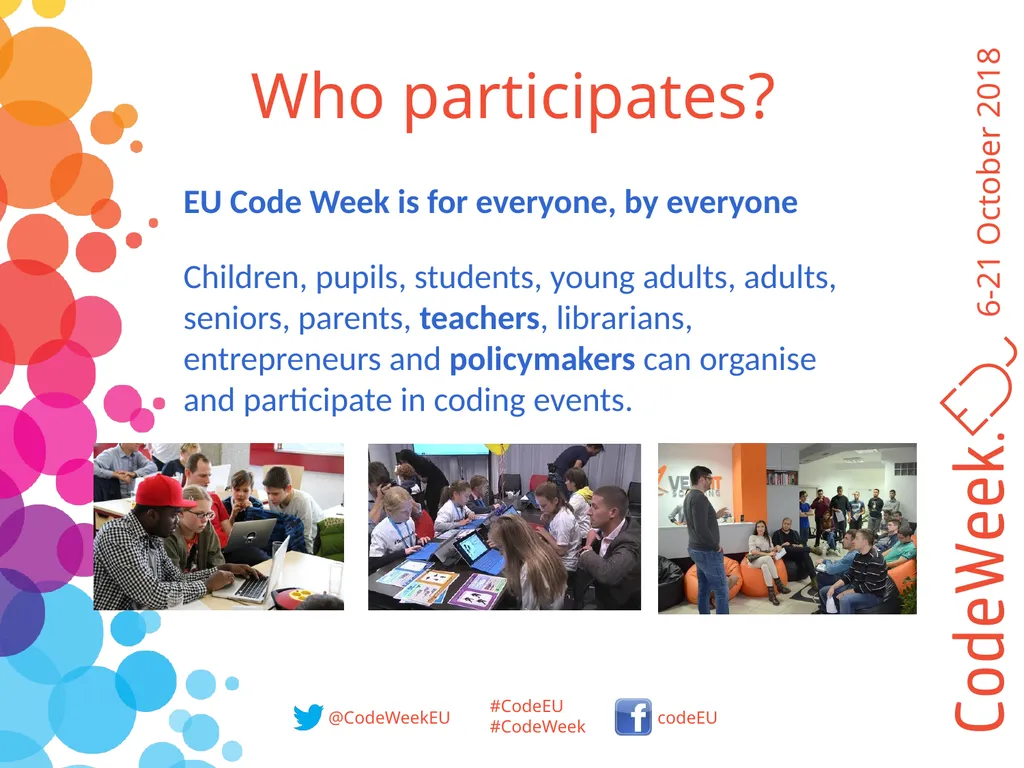
Who participates? EU Code Week is for everyone, by everyone
Children, pupils, students, young adults, adults, seniors, parents, teachers, librarians, entrepreneurs and policymakers can organise and participate in coding events.<br>
05
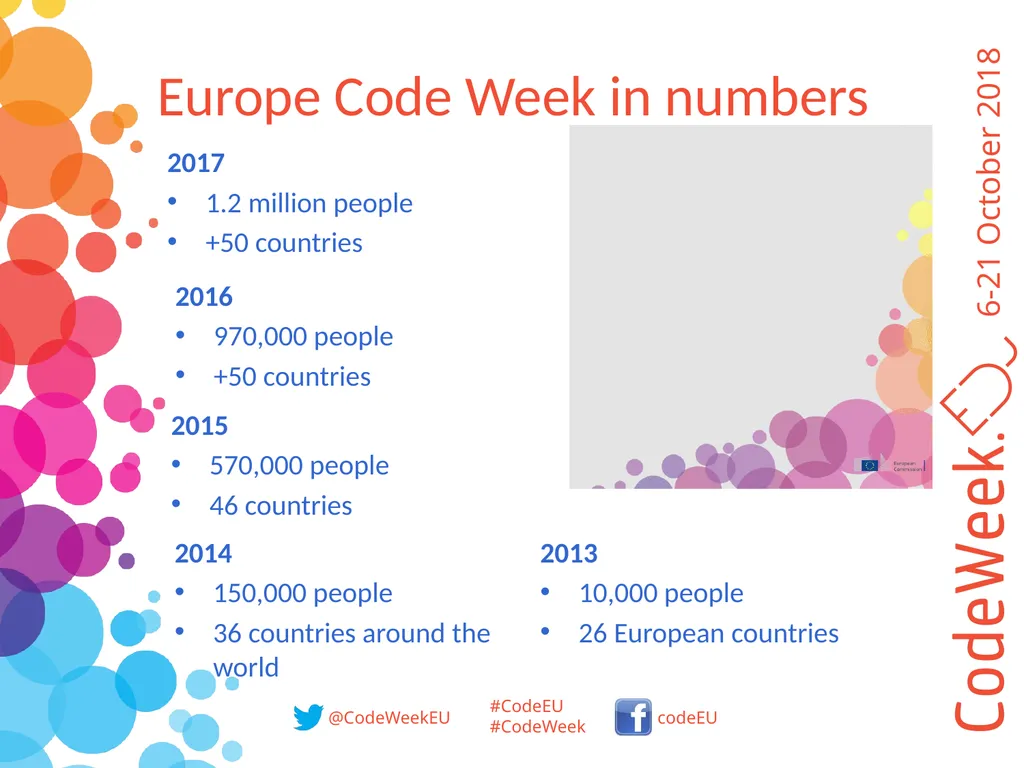
Europe Code Week in numbers 2014
150,000 people
36 countries around the world
2013
10,000 people
26 European countries 2015
570,000 people
46 countries 2017
1.2 million people
+50 countries 2016
970,000 people
+50 countries<br>
06
Digital Education Action Plan Actions to help education systems to adapt to the digital transformation.
EU Code Week to spark school leaders and teachers interest in digital education.
Help speed up innovation in education systems and improving teaching and learning.
Target: reach 50% of primary and secondary schools in Europe by 2020.<br>
07
Get involved Organise your own coding event or coding corner.
Check out the Code Week map and take part in a coding event.
Contact your Code Week ambassador.
Spread the word – on Facebook and Twitter
CodeWeek4All challenge - Challenge your school to engage all its students in coding events and get a Certificate of Excellence in Coding Literacy from the European Commission.
Ode to Code video contest - Dance the Ode to Code and share your video on Youtube<br>
08
What can teachers do? Teachers
Check our 7-step guide and tutorials – some in local languages
No computers? Do off-line activity e.g. CodyRoby
Invite coaches, parents, the university or local companies to share their experience
Take part in the CodeWeek4All challenge.
Add your event to the map!<br>
09
Website
CodeWeek.eu
Blog
http://blog.codeweek.eu/
Twitter
@CodeWeekEU
#codeEU
Facebook
CodeEU<br>