04
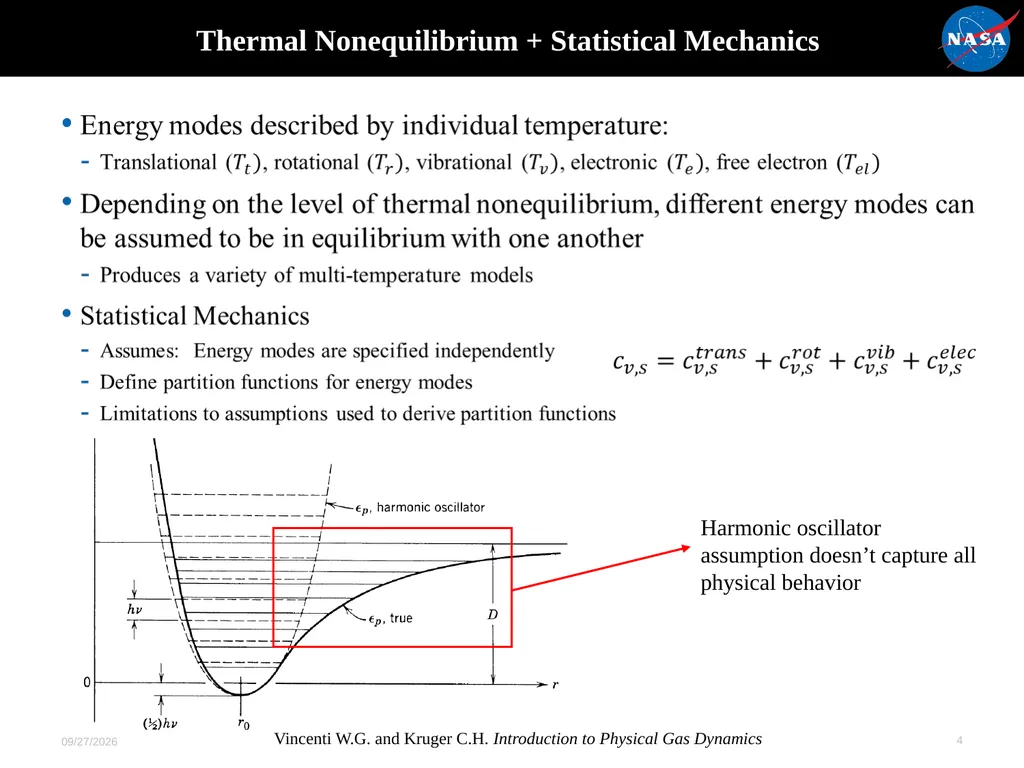
Thermal Nonequilibrium + Statistical Mechanics 8/10/2021 4 Vincenti W.G. and Kruger C.H. Introduction to Physical Gas Dynamics Harmonic oscillator assumption doesn’t capture all physical behavior<br>
05
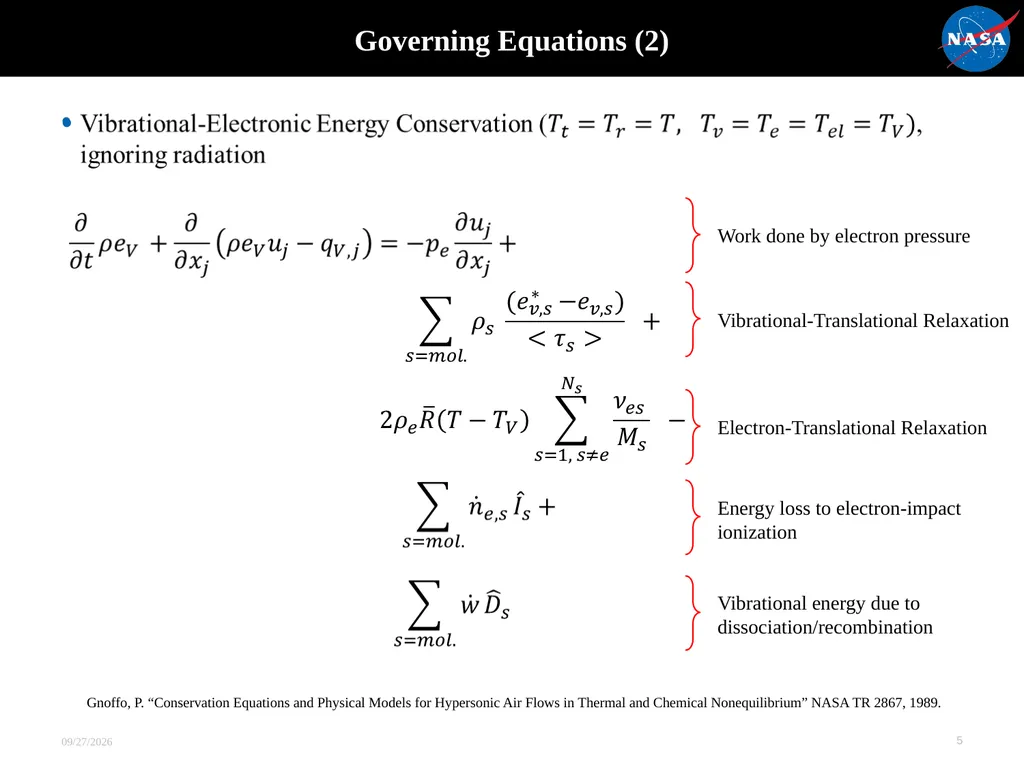
Governing Equations (2) 8/10/2021 Vibrational-Translational Relaxation Gnoffo, P. “Conservation Equations and Physical Models for Hypersonic Air Flows in Thermal and Chemical Nonequilibrium” NASA TR 2867, 1989. Electron-Translational Relaxation Energy loss to electron-impact ionization Vibrational energy due to dissociation/recombination Work done by electron pressure 5<br>
06
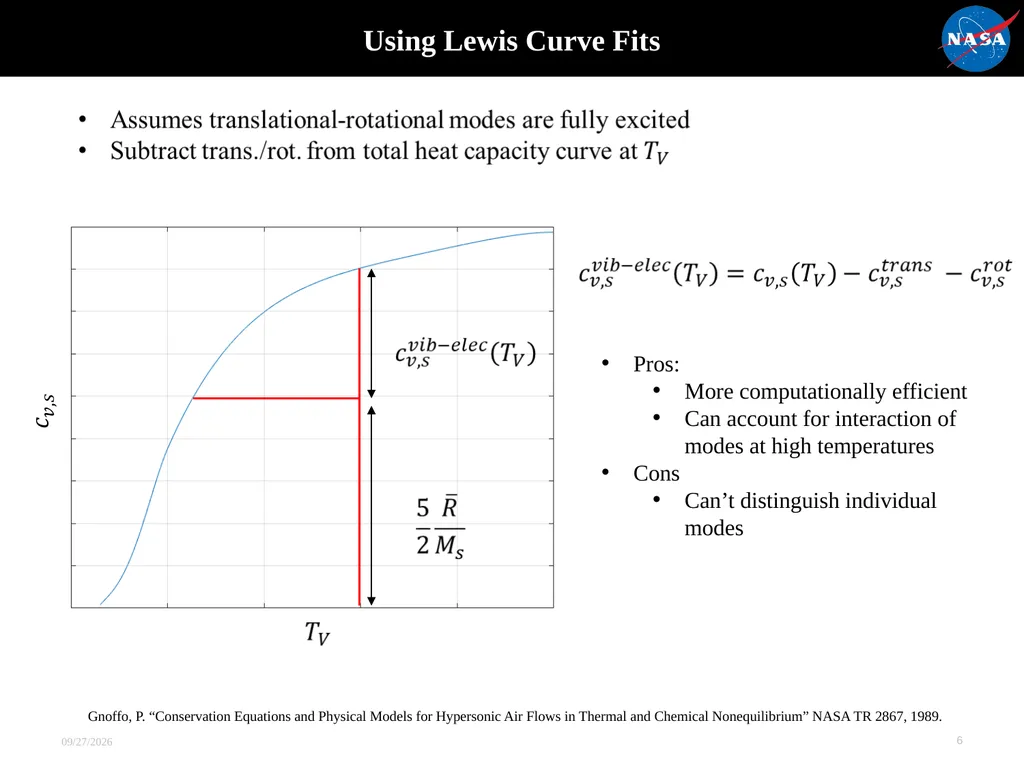
Using Lewis Curve Fits 8/10/2021 Gnoffo, P. “Conservation Equations and Physical Models for Hypersonic Air Flows in Thermal and Chemical Nonequilibrium” NASA TR 2867, 1989. 6 Pros:
More computationally efficient
Can account for interaction of modes at high temperatures
Cons
Can’t distinguish individual modes<br>
07
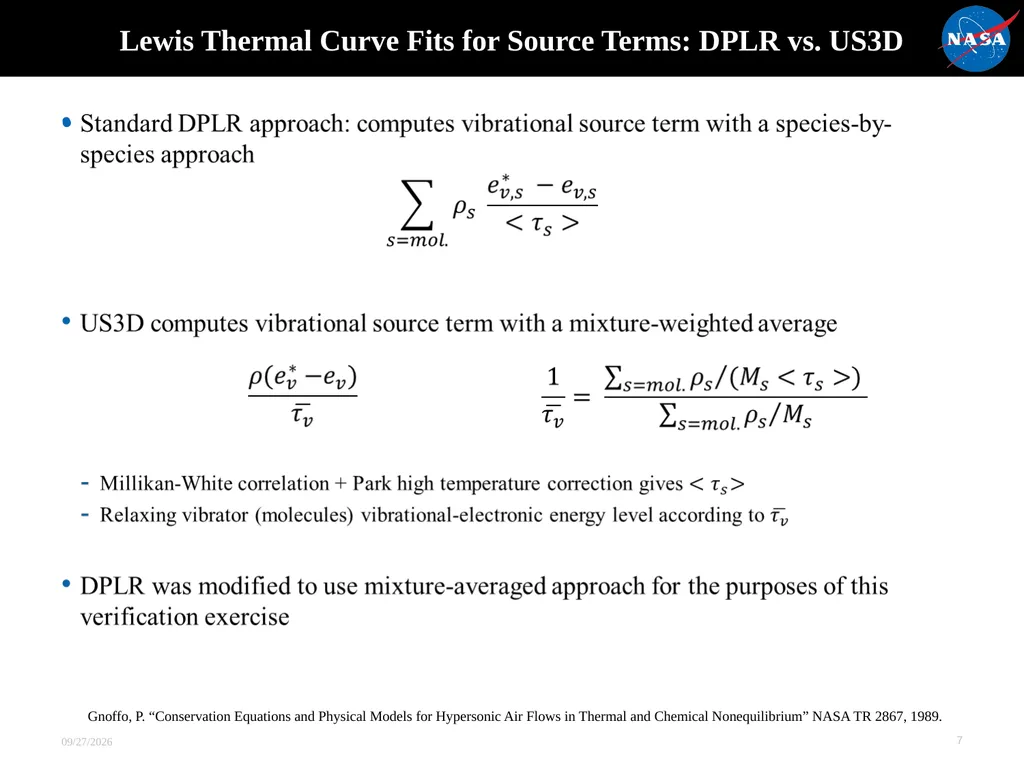
Lewis Thermal Curve Fits for Source Terms: DPLR vs. US3D 8/10/2021 Gnoffo, P. “Conservation Equations and Physical Models for Hypersonic Air Flows in Thermal and Chemical Nonequilibrium” NASA TR 2867, 1989. 7<br>
08
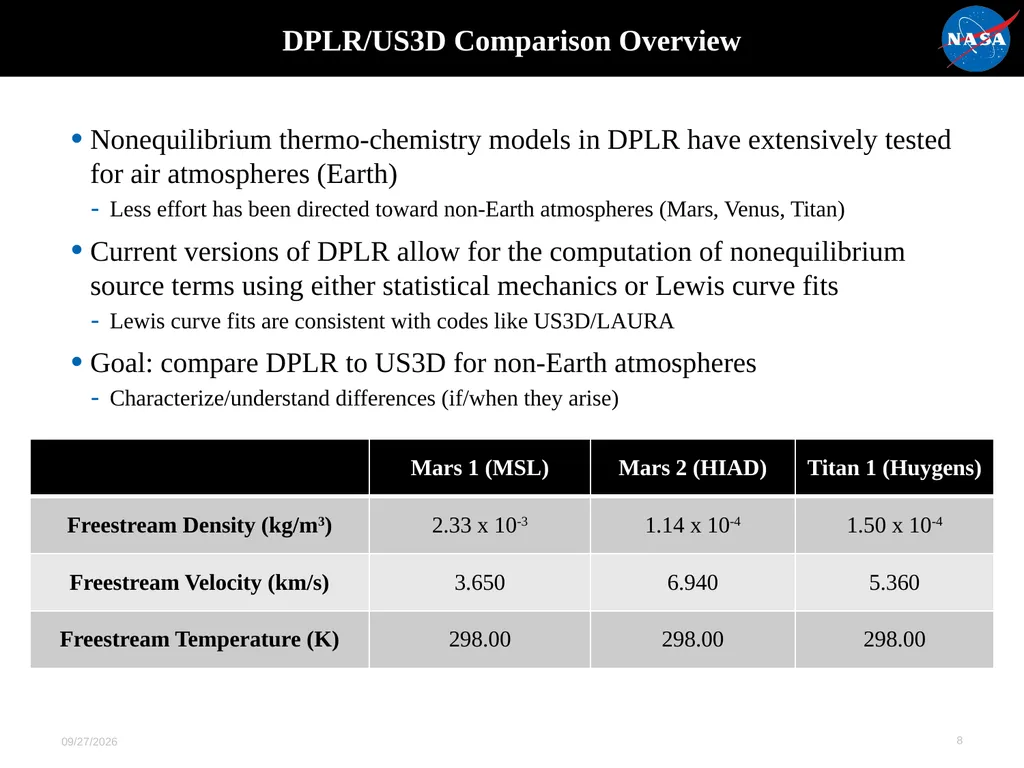
DPLR/US3D Comparison Overview Nonequilibrium thermo-chemistry models in DPLR have extensively tested for air atmospheres (Earth)
Less effort has been directed toward non-Earth atmospheres (Mars, Venus, Titan)
Current versions of DPLR allow for the computation of nonequilibrium source terms using either statistical mechanics or Lewis curve fits
Lewis curve fits are consistent with codes like US3D/LAURA
Goal: compare DPLR to US3D for non-Earth atmospheres
Characterize/understand differences (if/when they arise) 8/10/2021 8<br>
09
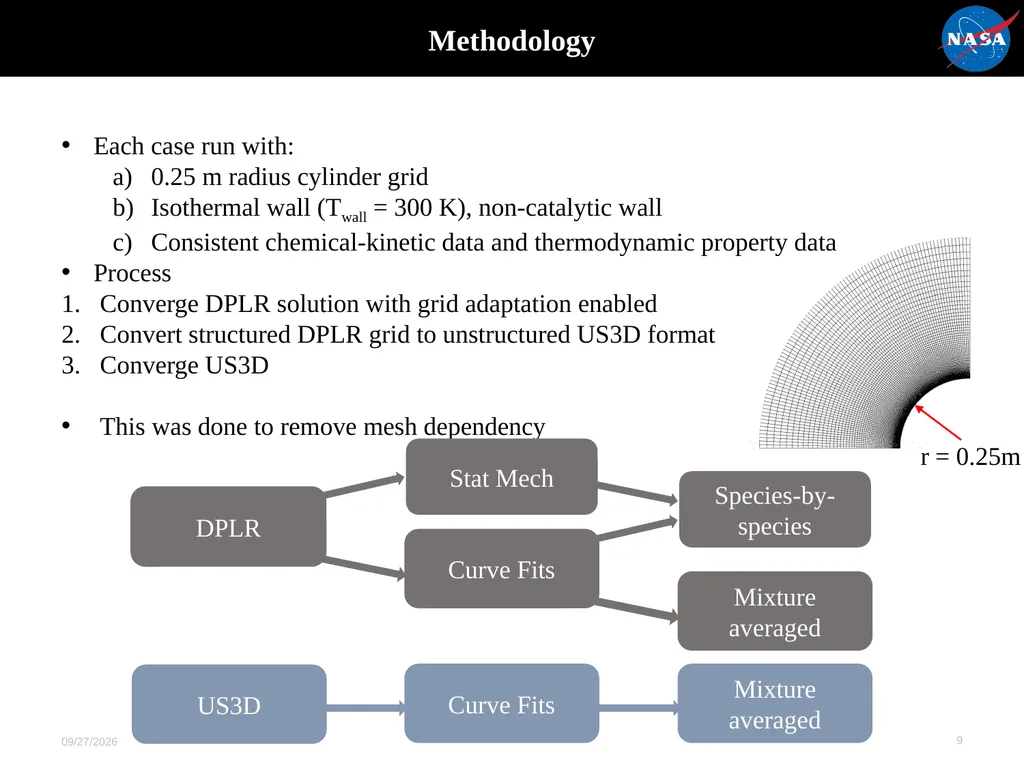
Methodology 8/11/2021 Each case run with:
0.25 m radius cylinder grid
Isothermal wall (Twall = 300 K), non-catalytic wall
Consistent chemical-kinetic data and thermodynamic property data
Process
Converge DPLR solution with grid adaptation enabled
Convert structured DPLR grid to unstructured US3D format
Converge US3D
This was done to remove mesh dependency r = 0.25m 9 DPLR US3D Stat Mech Curve Fits Species-by-species Mixture averaged Curve Fits Mixture averaged<br>
10
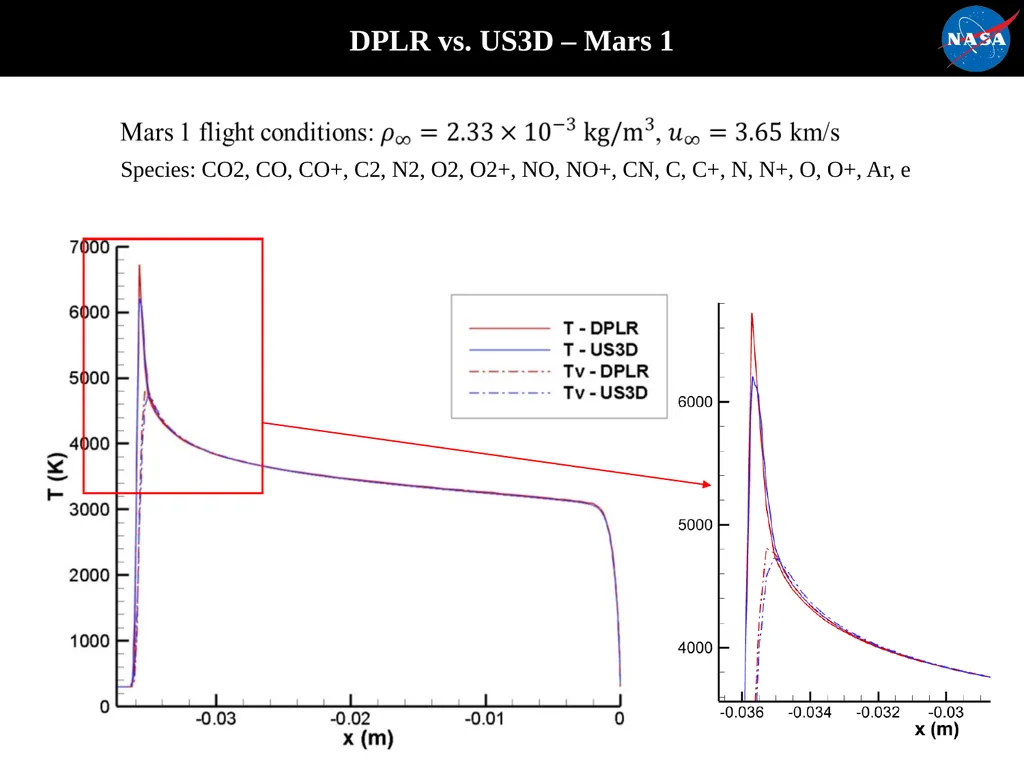
8/11/2021 DPLR vs. US3D – Mars 1 10 Species: CO2, CO, CO+, C2, N2, O2, O2+, NO, NO+, CN, C, C+, N, N+, O, O+, Ar, e<br>
11
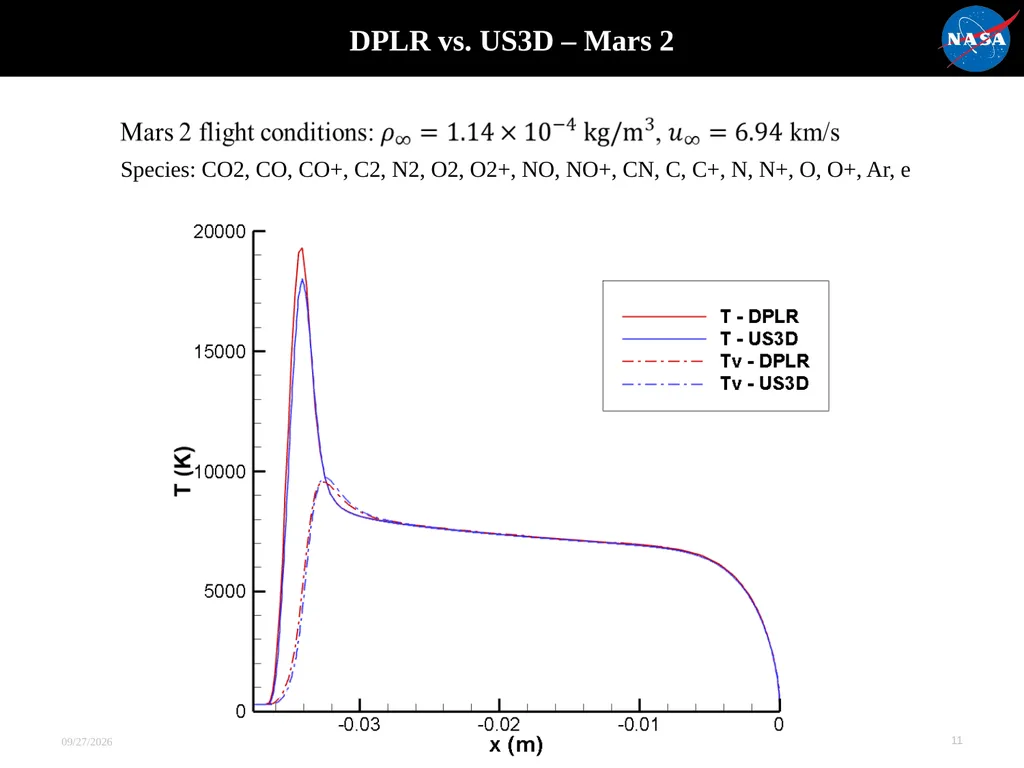
8/10/2021 DPLR vs. US3D – Mars 2 11 Species: CO2, CO, CO+, C2, N2, O2, O2+, NO, NO+, CN, C, C+, N, N+, O, O+, Ar, e<br>
12
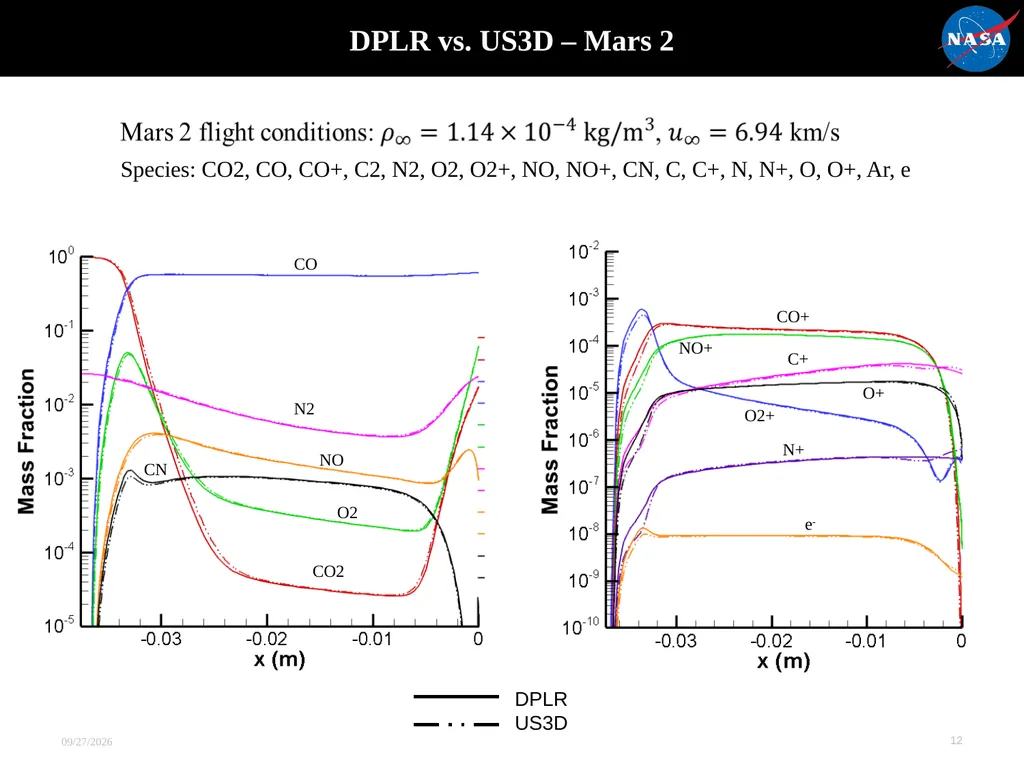
8/12/2021 DPLR vs. US3D – Mars 2 CO2 CO N2 NO CN O2 CO+ NO+ C+ O+ O2+ N+ e- 12 Species: CO2, CO, CO+, C2, N2, O2, O2+, NO, NO+, CN, C, C+, N, N+, O, O+, Ar, e DPLR
US3D<br>
13
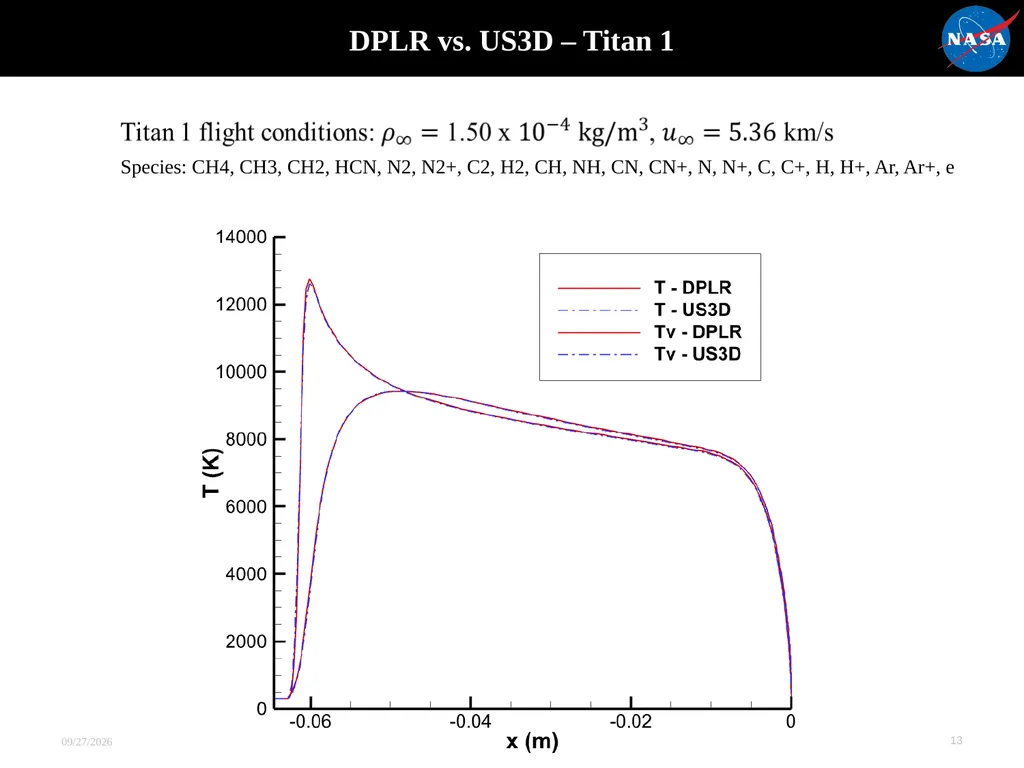
8/10/2021 DPLR vs. US3D – Titan 1 13 Species: CH4, CH3, CH2, HCN, N2, N2+, C2, H2, CH, NH, CN, CN+, N, N+, C, C+, H, H+, Ar, Ar+, e<br>
14
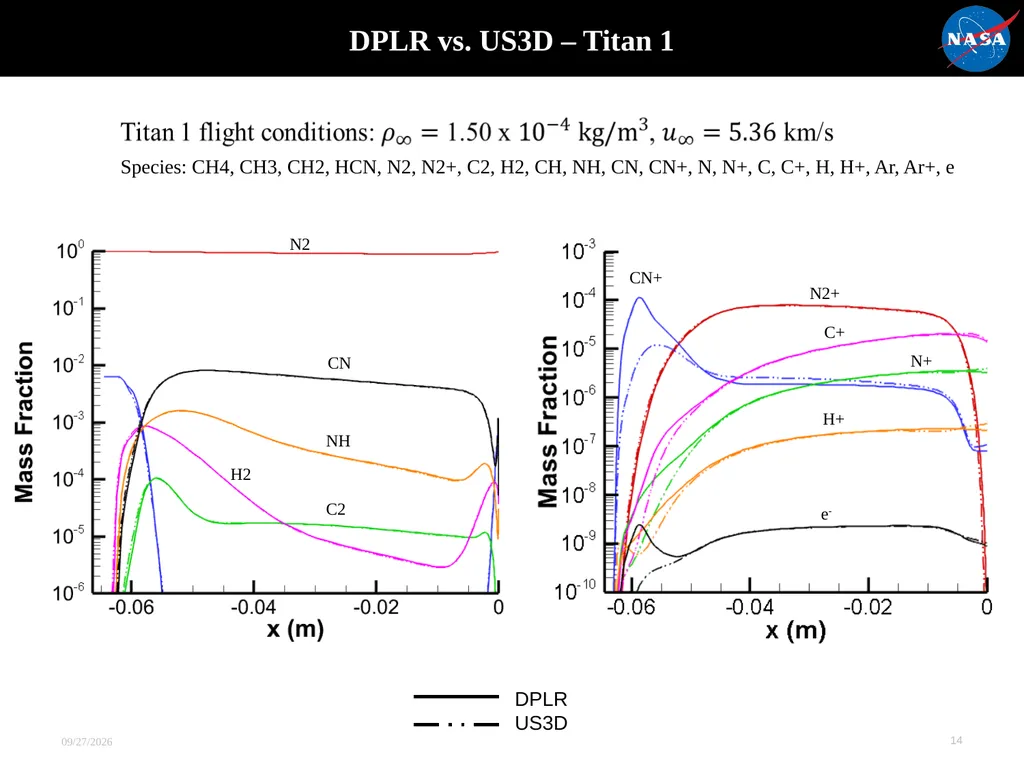
8/12/2021 DPLR vs. US3D – Titan 1 N2+ C+ N+ CN+ H+ e- N2 CN NH C2 H2 14 Species: CH4, CH3, CH2, HCN, N2, N2+, C2, H2, CH, NH, CN, CN+, N, N+, C, C+, H, H+, Ar, Ar+, e DPLR
US3D<br>
15
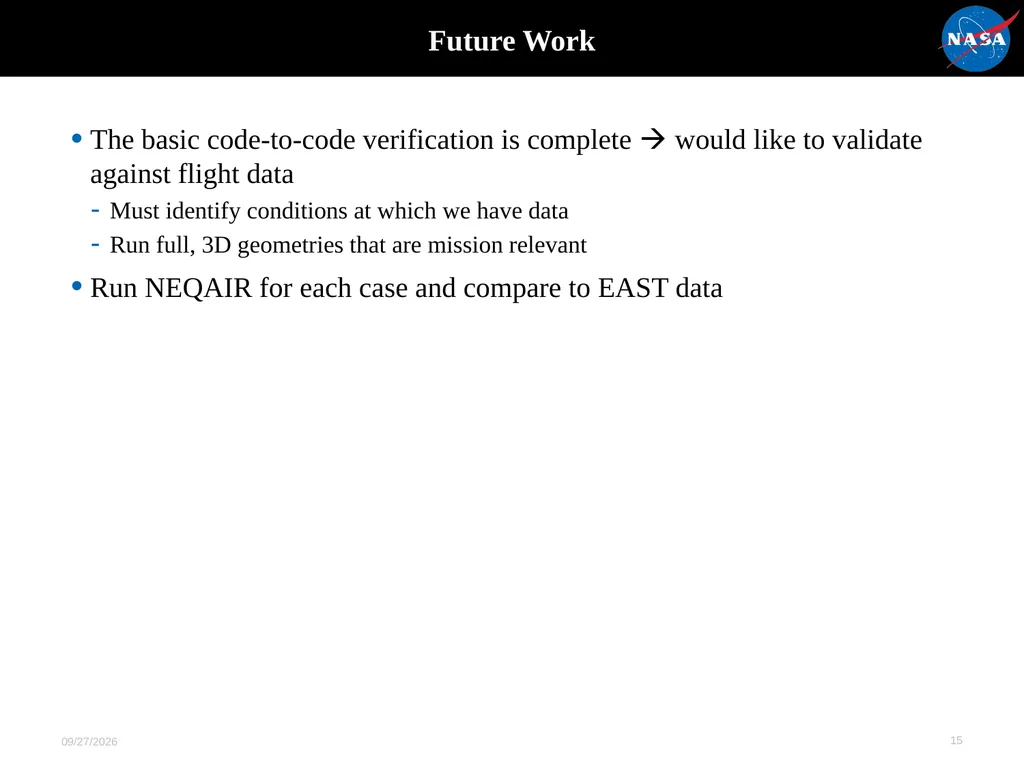
Future Work The basic code-to-code verification is complete would like to validate against flight data
Must identify conditions at which we have data
Run full, 3D geometries that are mission relevant
Run NEQAIR for each case and compare to EAST data 8/10/2021 15<br>
16
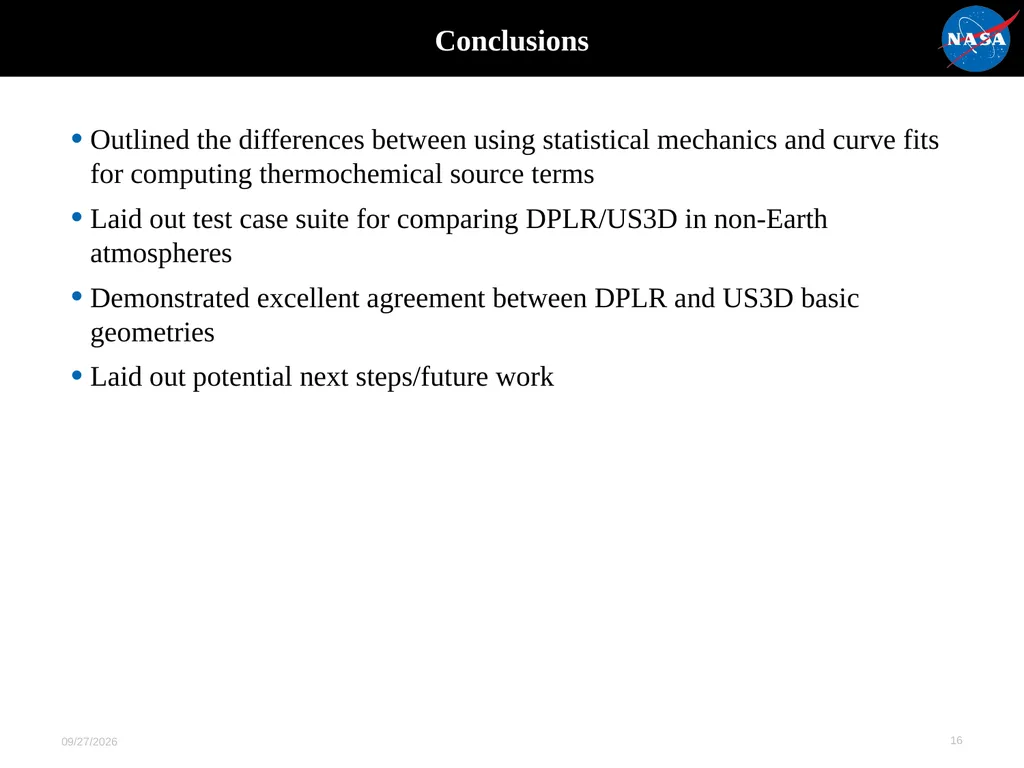
Conclusions Outlined the differences between using statistical mechanics and curve fits for computing thermochemical source terms
Laid out test case suite for comparing DPLR/US3D in non-Earth atmospheres
Demonstrated excellent agreement between DPLR and US3D basic geometries
Laid out potential next steps/future work 8/10/2021 16<br>
17
Thank you!��Questions? 8/10/2021 17<br>
18
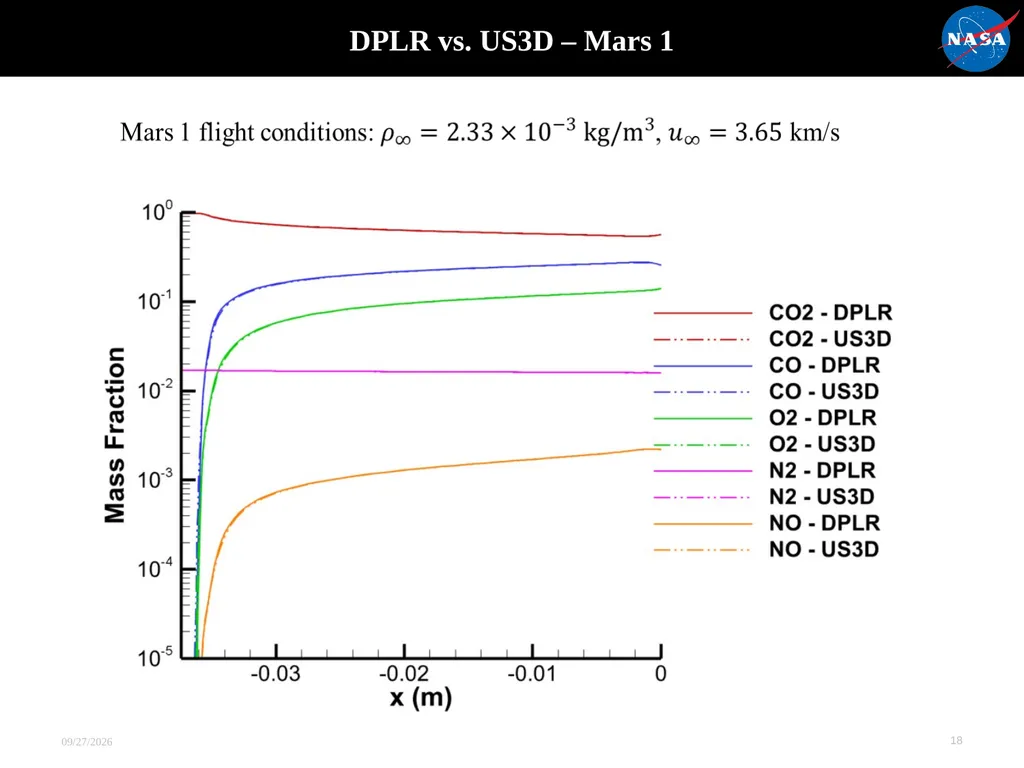
8/10/2021 DPLR vs. US3D – Mars 1 18<br>
19
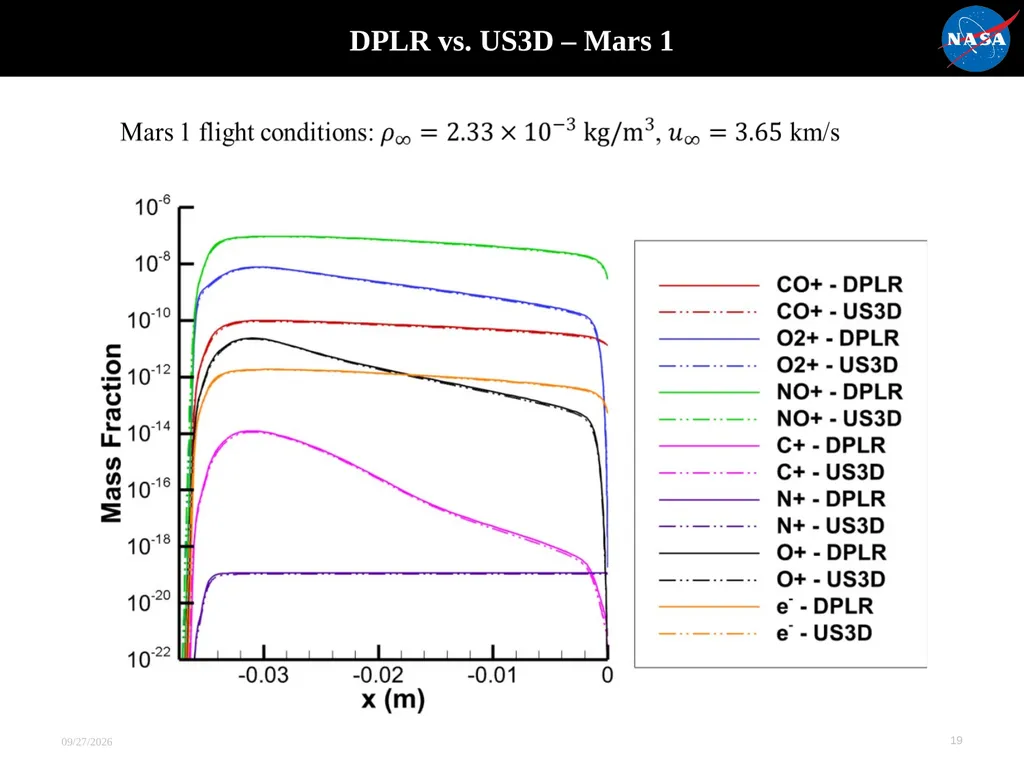
8/10/2021 DPLR vs. US3D – Mars 1 19<br>
20
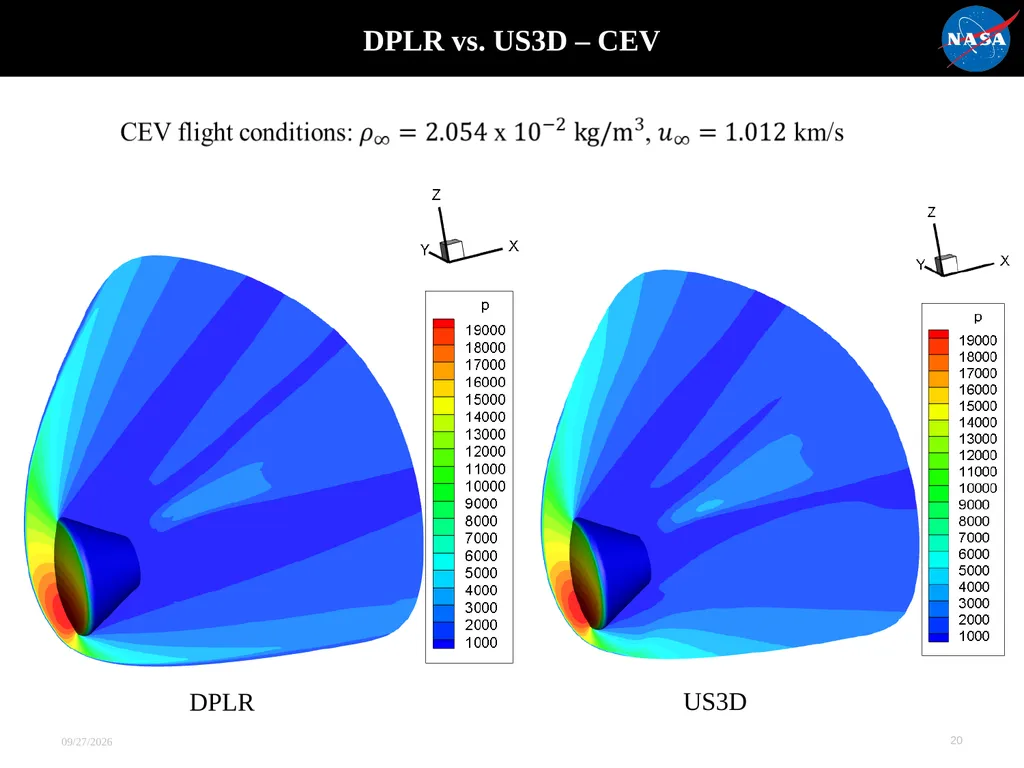
DPLR vs. US3D – CEV 8/10/2021 DPLR US3D 20<br>
21
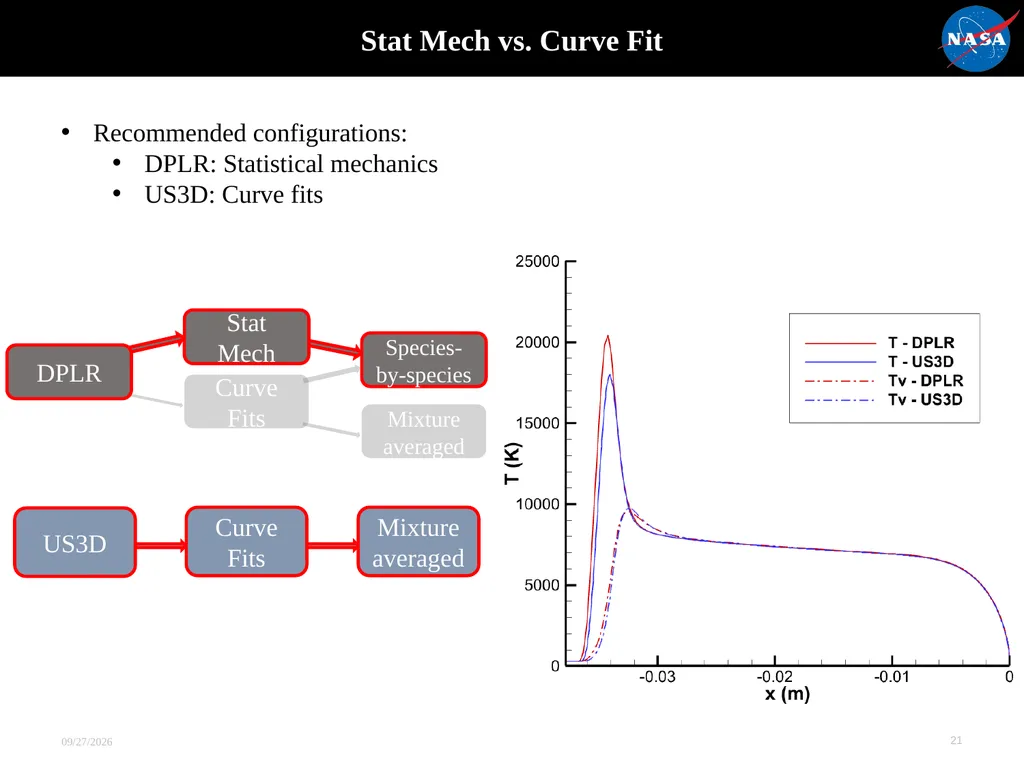
8/12/2021 Stat Mech vs. Curve Fit 21 US3D Curve Fits Mixture averaged DPLR Stat Mech Curve Fits Species-by-species Mixture averaged Recommended configurations:
DPLR: Statistical mechanics
US3D: Curve fits<br>