Evaporation and Transpiration Evapotranspiration or ET 62 of precipitation that falls on the continents is evaporated Understanding and predicting climate change QP-ET. P-ET is the water available for use ET loss supports ecosystems and
"Evaporation and Transpiration Evapotranspiration" is the property of its rightful owner. Permission is granted to
download and print the materials on this website for personal, non-commercial use only, and to display it
on your personal computer provided you do not modify the materials and that you retain all copyright
notices contained in the materials. By downloading content from our website, you accept the terms of this
agreement.
Presentation Transcript
01
Evaporation and Transpiration Evapotranspiration or ET 62% of precipitation that falls on the continents is evaporated
Understanding and predicting climate change
Q=P-ET. P-ET is the water available for use
ET "loss" supports ecosystems and agriculture
Reservoir losses
The antecedent "wetness" that determines what happens to runoff depends on ET
Even during a single storm ET may exceed runoff<br>
02
Learning Objectives Be able to calculate incoming solar radiation as a driver of evaporation and snowmelt based on of geographic location (latitude and longitude), date, time of day and atmospheric conditions
Be able to calculate evaporation from open water surfaces and transpiration from vegetation, using a method appropriate for the information available.<br>
03
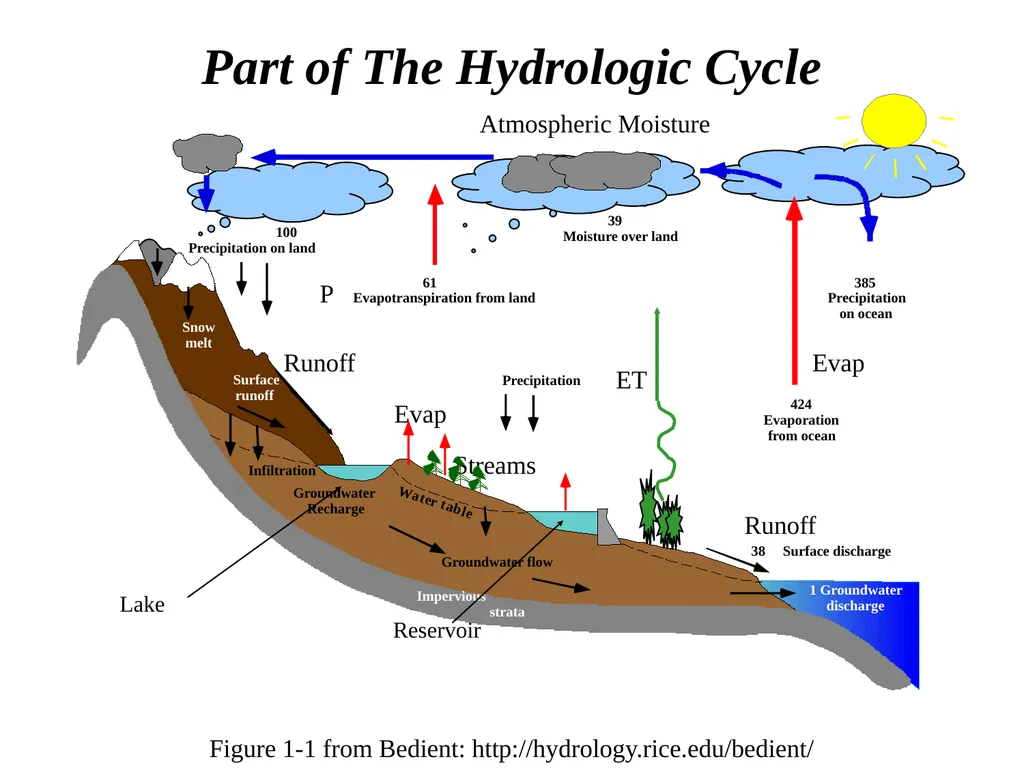
Part of The Hydrologic Cycle P Runoff Runoff Evap ET Evap Streams Lake Reservoir GW Atmospheric Moisture Snow melt Figure 1-1 from Bedient: http://hydrology.rice.edu/bedient/<br>
04
Physical principles used Conservation of mass
Conservation of energy
Ideal gas law as it pertains to water vapor
Latent heat of phase change (vaporization)
Turbulent transfer near the ground<br>
05
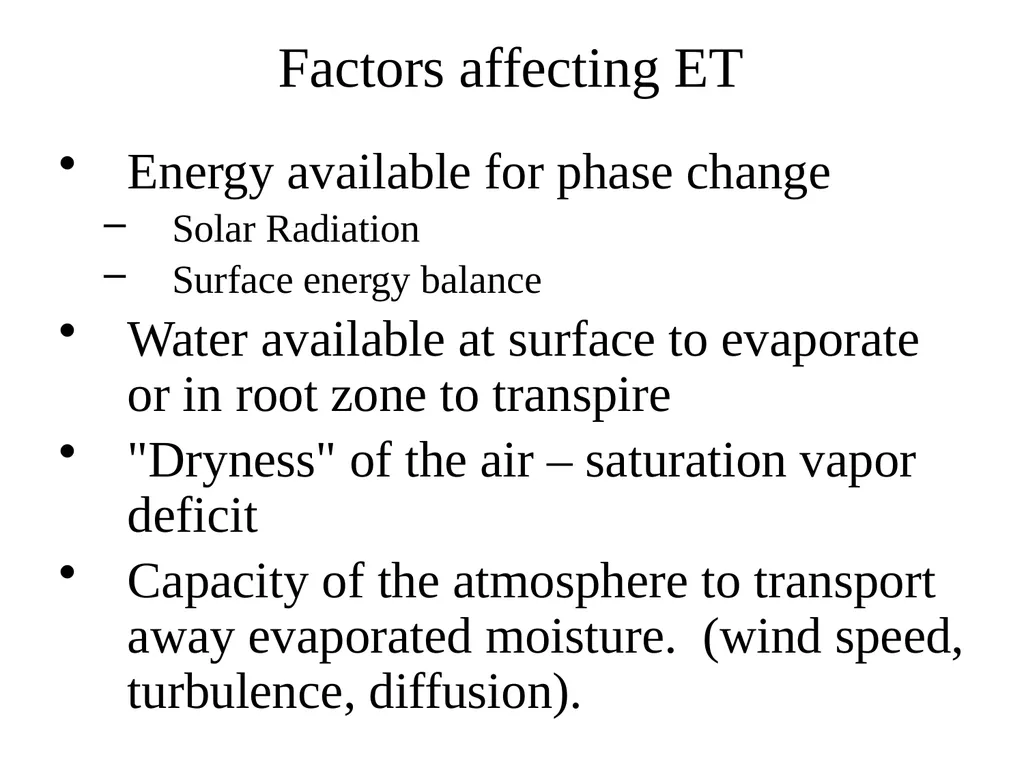
Factors affecting ET Energy available for phase change
Solar Radiation
Surface energy balance
Water available at surface to evaporate or in root zone to transpire
"Dryness" of the air – saturation vapor deficit
Capacity of the atmosphere to transport away evaporated moisture. (wind speed, turbulence, diffusion).<br>
06
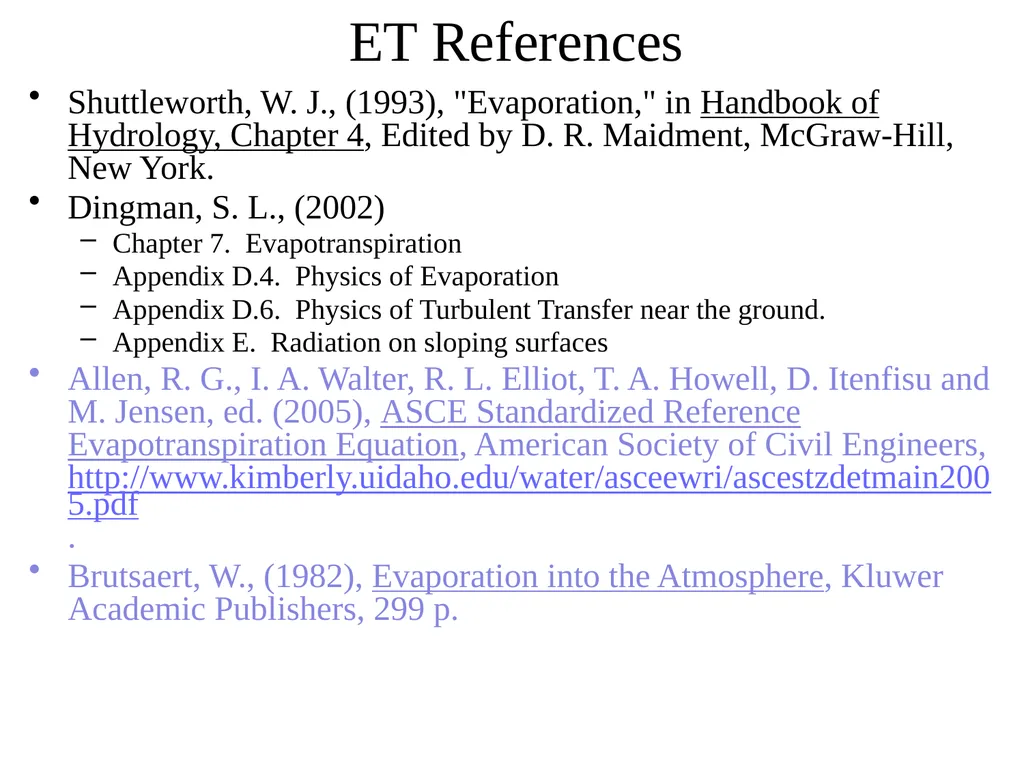
ET References Shuttleworth, W. J., (1993), "Evaporation," in Handbook of Hydrology, Chapter 4, Edited by D. R. Maidment, McGraw-Hill, New York.
Dingman, S. L., (2002)
Chapter 7. Evapotranspiration
Appendix D.4. Physics of Evaporation
Appendix D.6. Physics of Turbulent Transfer near the ground.
Appendix E. Radiation on sloping surfaces
Allen, R. G., I. A. Walter, R. L. Elliot, T. A. Howell, D. Itenfisu and M. Jensen, ed. (2005), ASCE Standardized Reference Evapotranspiration Equation, American Society of Civil Engineers, http://www.kimberly.uidaho.edu/water/asceewri/ascestzdetmain2005.pdf.
Brutsaert, W., (1982), Evaporation into the Atmosphere, Kluwer Academic Publishers, 299 p.<br>
07
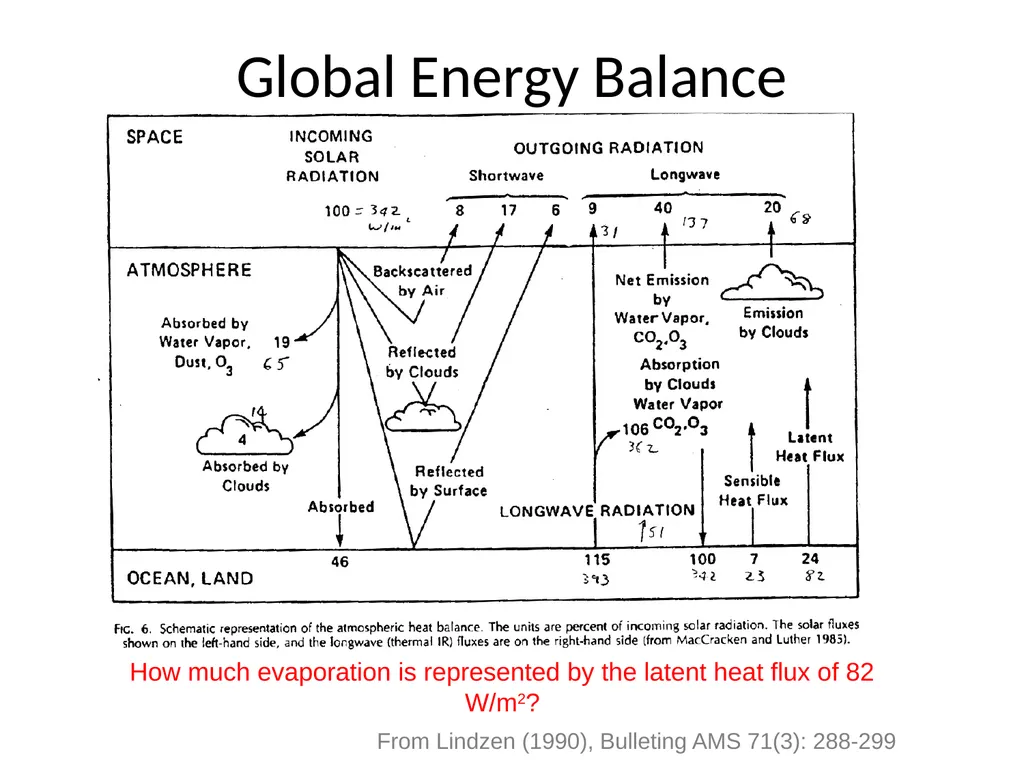
From Lindzen (1990), Bulleting AMS 71(3): 288-299 Global Energy Balance How much evaporation is represented by the latent heat flux of 82 W/m2?<br>
08
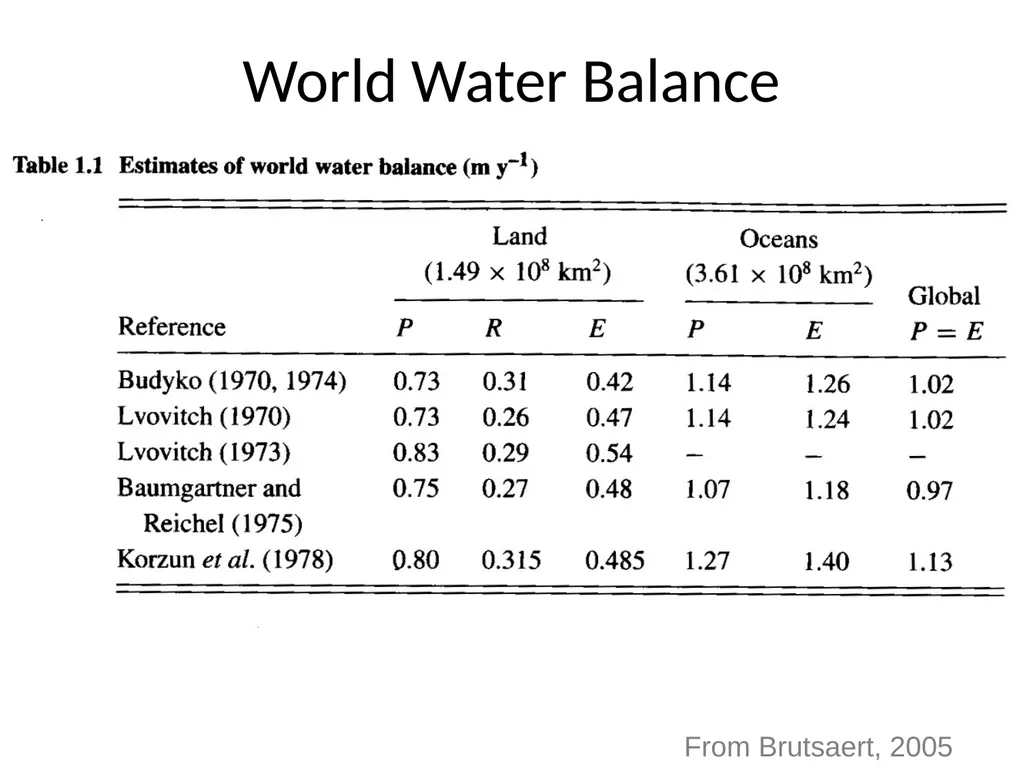
World Water Balance From Brutsaert, 2005<br>
09
Solar Radiation Be able to calculate incoming solar radiation as a driver of evaporation and snowmelt based on of geographic location (latitude and longitude), date, time of day and atmospheric conditions<br>
10
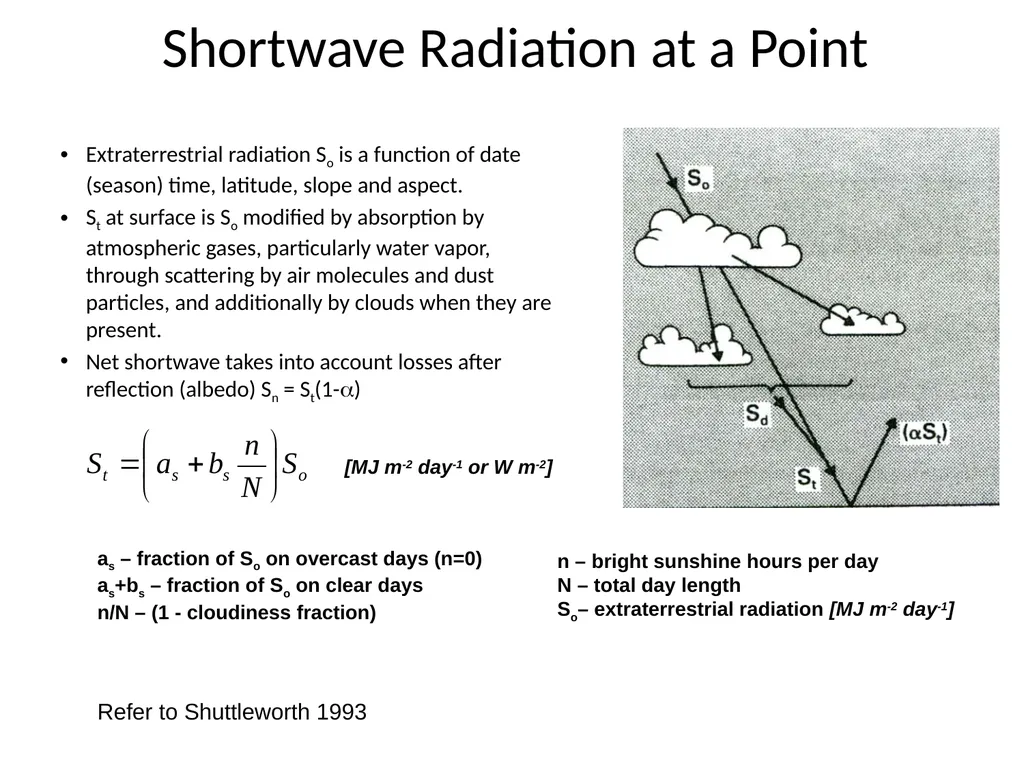
Shortwave Radiation at a Point Extraterrestrial radiation So is a function of date (season) time, latitude, slope and aspect.
St at surface is So modified by absorption by atmospheric gases, particularly water vapor, through scattering by air molecules and dust particles, and additionally by clouds when they are present.
Net shortwave takes into account losses after reflection (albedo) Sn = St(1-) as – fraction of So on overcast days (n=0)
as+bs – fraction of So on clear days
n/N – (1 - cloudiness fraction) n – bright sunshine hours per day
N – total day length
So– extraterrestrial radiation [MJ m-2 day-1] [MJ m-2 day-1 or W m-2] Refer to Shuttleworth 1993<br>
11
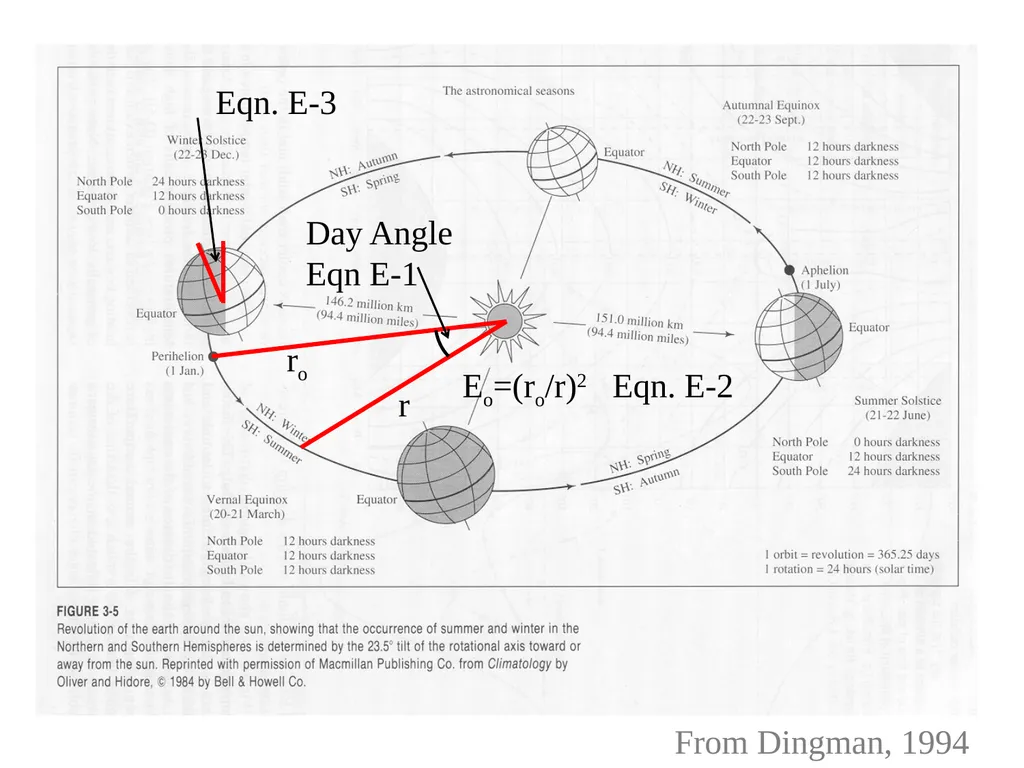
From Dingman, 1994 Day Angle
Eqn E-1 ro r Eo=(ro/r)2 Eqn. E-2 Eqn. E-3<br>
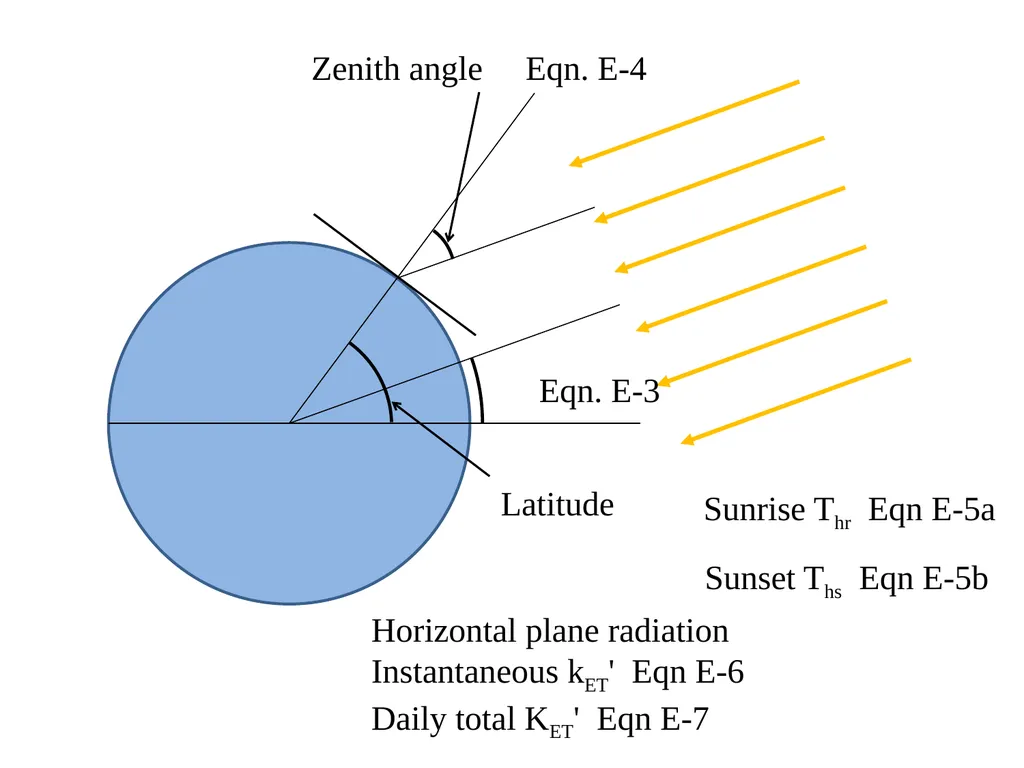
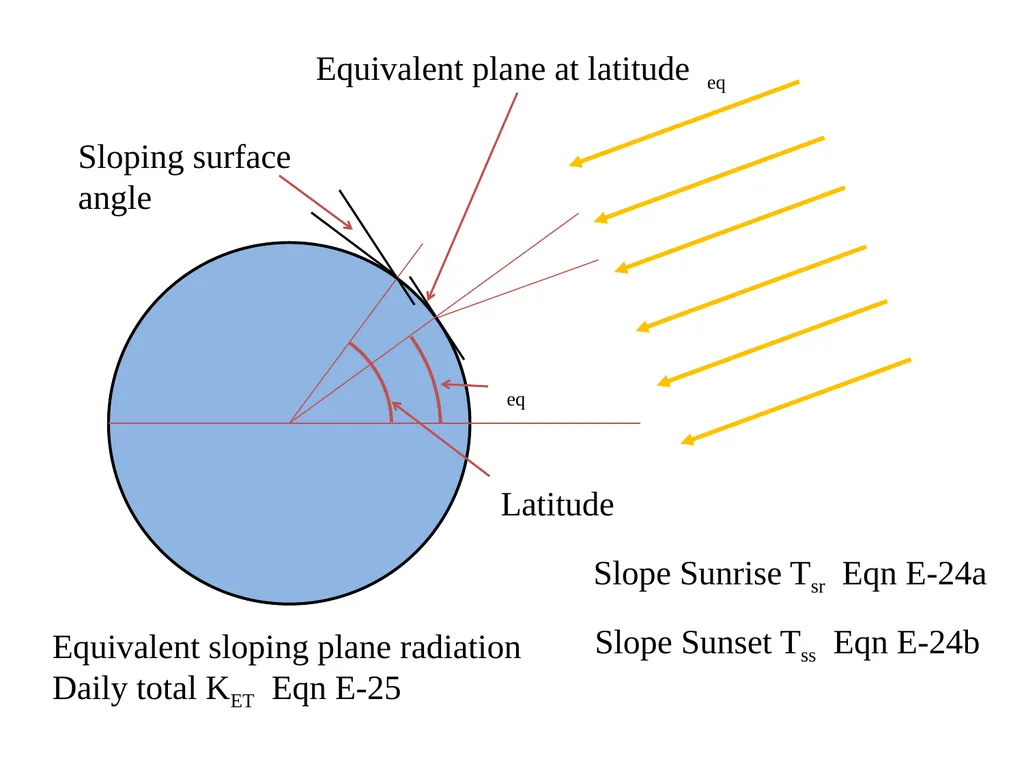
Equivalent plane at latitude eq Latitude Slope Sunrise Tsr Eqn E-24a Slope Sunset Tss Eqn E-24b Equivalent sloping plane radiation
Daily total KET Eqn E-25 Sloping surface
angle eq<br>
14
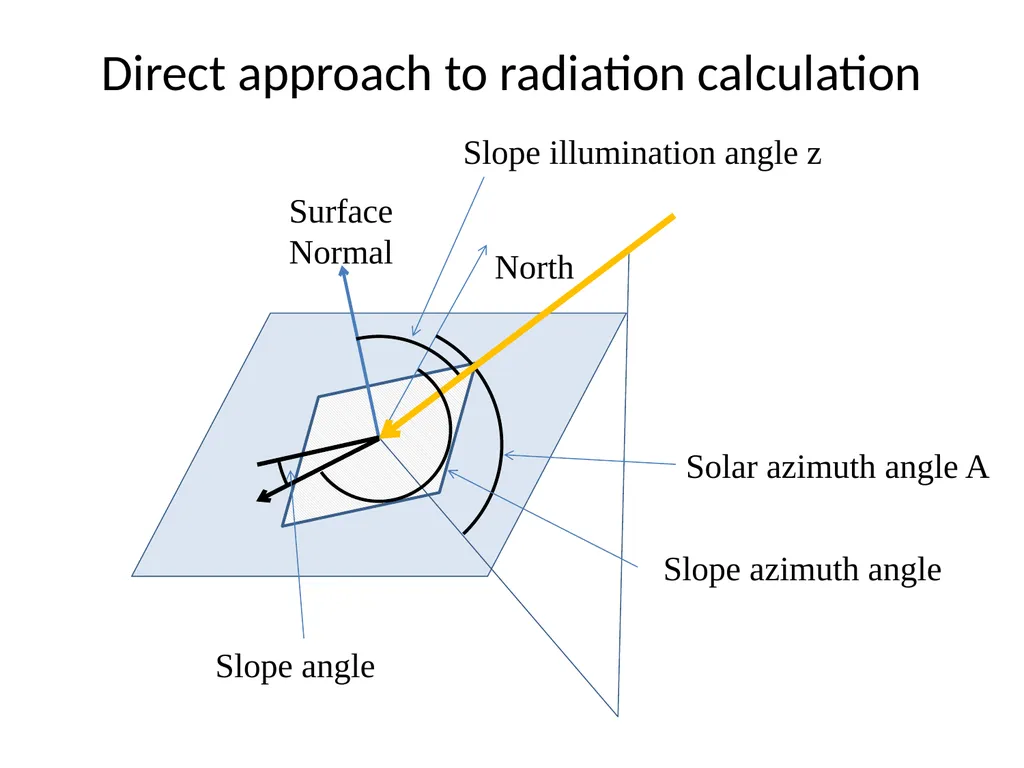
North Surface
Normal Direct approach to radiation calculation Solar azimuth angle A Slope illumination angle z Slope azimuth angle Slope angle <br>
15
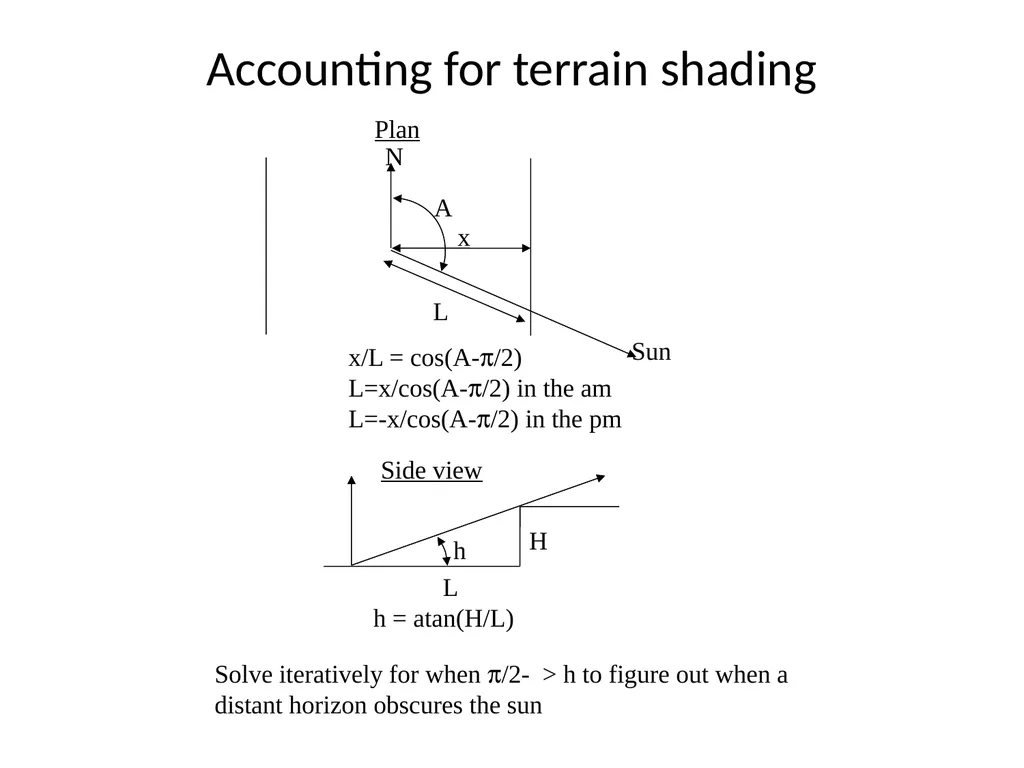
Accounting for terrain shading N Plan x Sun A x/L = cos(A-p/2)
L=x/cos(A-p/2) in the am
L=-x/cos(A-p/2) in the pm L L H h Side view h = atan(H/L) Solve iteratively for when p/2- > h to figure out when a distant horizon obscures the sun<br>
16
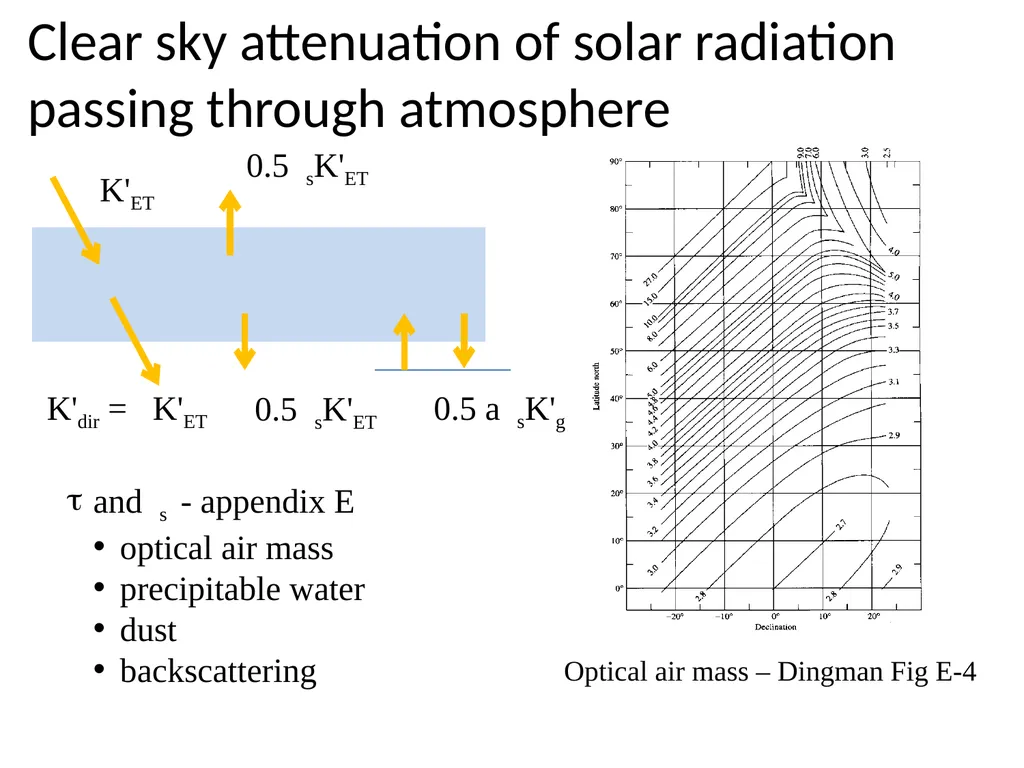
Clear sky attenuation of solar radiation passing through atmosphere K'ET K'dir = K'ET 0.5 sK'ET 0.5 sK'ET and s - appendix E
optical air mass
precipitable water
dust
backscattering Optical air mass – Dingman Fig E-4 0.5 a sK'g<br>
17
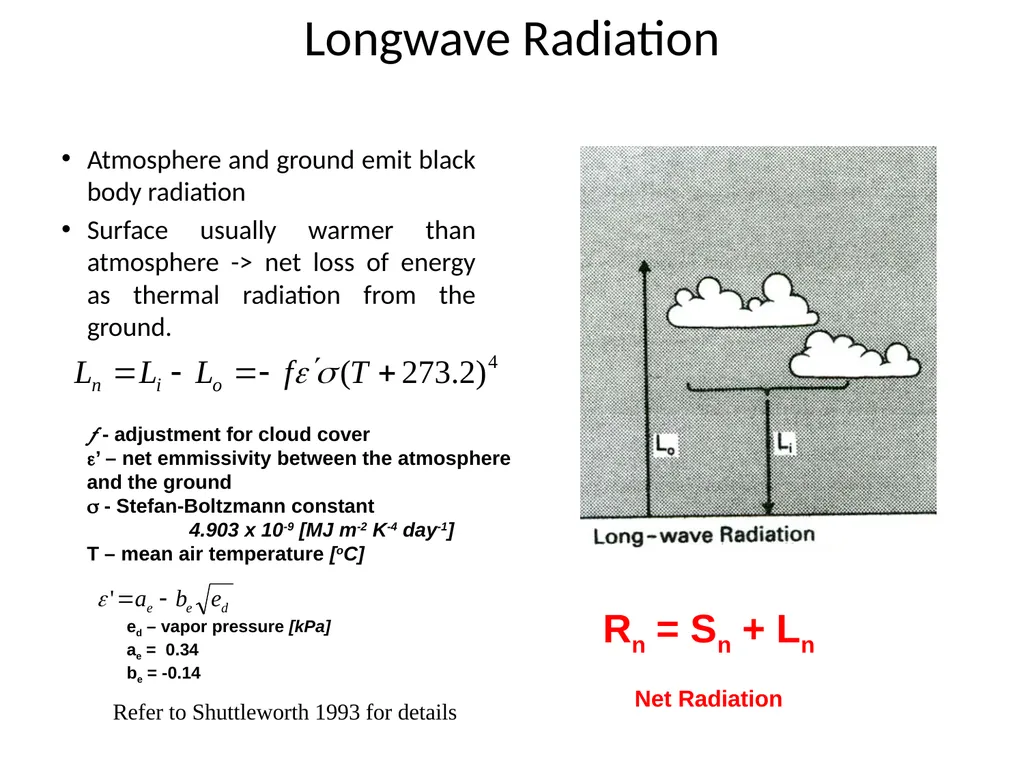
Longwave Radiation Atmosphere and ground emit black body radiation
Surface usually warmer than atmosphere -> net loss of energy as thermal radiation from the ground. - adjustment for cloud cover
’ – net emmissivity between the atmosphere and the ground
- Stefan-Boltzmann constant
4.903 x 10⁻⁹ [MJ m-2 K-4 day-1]
T – mean air temperature [oC] ed – vapor pressure [kPa]
ae = 0.34
be = -0.14 Rn = Sn + Ln
Net Radiation Refer to Shuttleworth 1993 for details<br>
18
Solar Radiation Review Questions Write a definition of and use a diagram or diagrams as necessary to depict
Solar declination
Day angle
Eccentricity (in the context of solar radiation)
Equivalent latitude in the equivalent plane concept
Longitude difference in the equivalent plane concept
Zenith angle
Illumination angle for a sloping surface
Explain the difference between results from equation E-6 with equivalent latitude and equation E-25 as evaluated in Cell C42 in SolarRad spreadsheet. (on the day we evaluated values were 54 MJ/m2/day vs 13.4 MJ/m2/day
Explain the difference between the extra terrestrial radiation evaluated for a sloping surface using the SOLARRAD spreadsheet (Cell C42) and the direct approach (CELL E126).
Explain the difference between the extra terrestrial radiation evaluated for a sloping surface using the SOLARRAD spreadsheet (Cell C42) and the clear sky radiation (CELL C47).<br>