
Everything there is to know about colorectal
PM
Published · 73 slides · 0 views

1 / 1





Description
Everything there is to know about colorectal disease and hernia Sushil Maslekar and Ian Botterill Spire Leeds Hospital, Leeds St Jamess University Hospital, Leeds Altered bowel habit Bleeding Diarrhoea constipation Mucous Straining
Related Topics
Share
Embed code
Download this presentation From Below
"Everything there is to know about colorectal" is the property of its rightful owner. Permission is granted to download and print the materials on this website for personal, non-commercial use only, and to display it on your personal computer provided you do not modify the materials and that you retain all copyright notices contained in the materials. By downloading content from our website, you accept the terms of this agreement.
Presentation Transcript
01
Everything there is to know about colorectal disease and hernia Sushil Maslekar and Ian Botterill
Spire Leeds Hospital, Leeds
St James’s University Hospital, Leeds<br>
Spire Leeds Hospital, Leeds
St James’s University Hospital, Leeds<br>
02
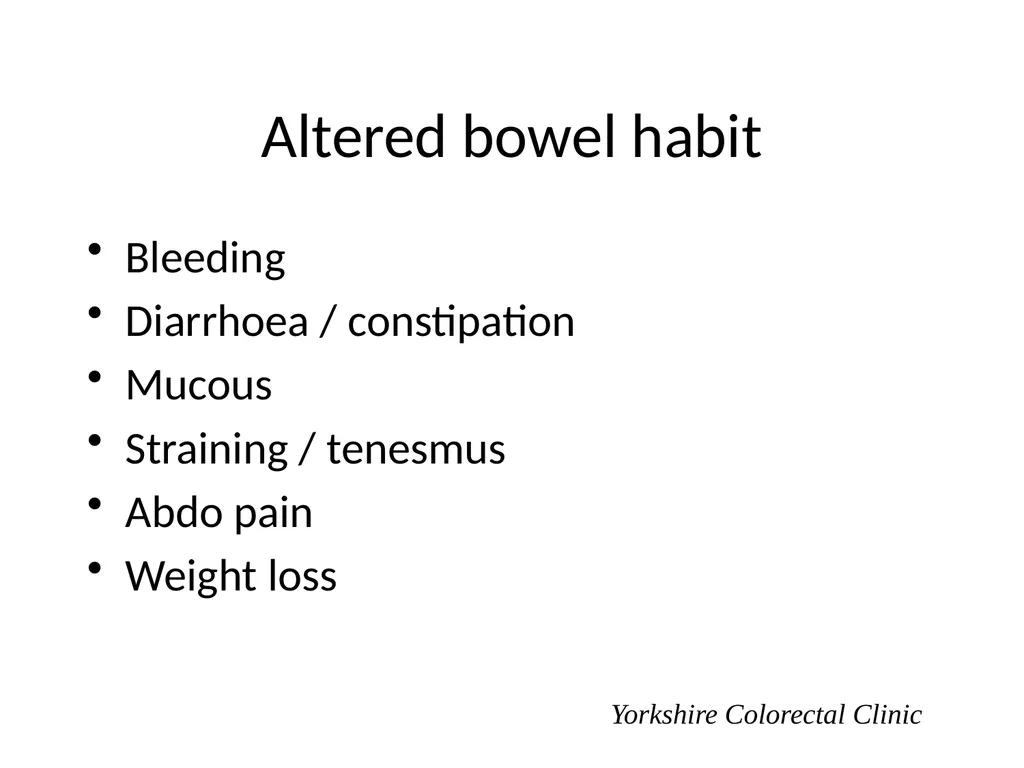
Altered bowel habit Bleeding
Diarrhoea / constipation
Mucous
Straining / tenesmus
Abdo pain
Weight loss<br>
Diarrhoea / constipation
Mucous
Straining / tenesmus
Abdo pain
Weight loss<br>
03
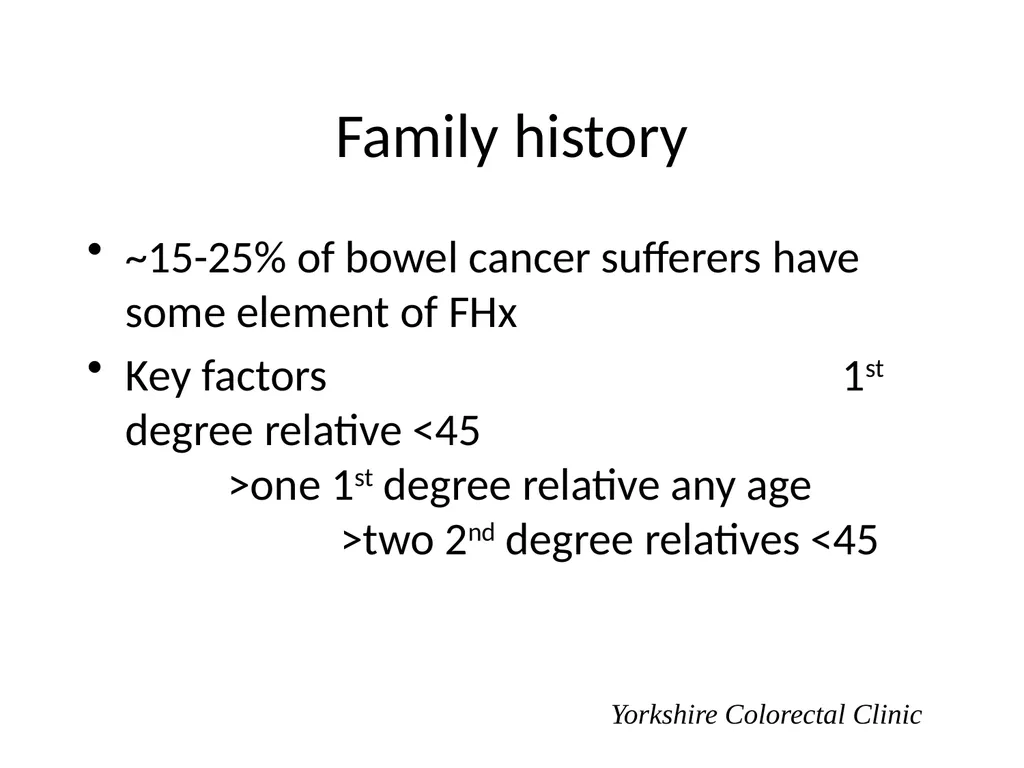
Family history ~15-25% of bowel cancer sufferers have some element of FHx
Key factors 1st degree relative <45 >one 1st degree relative any age >two 2nd degree relatives <45<br>
Key factors 1st degree relative <45 >one 1st degree relative any age >two 2nd degree relatives <45<br>
04
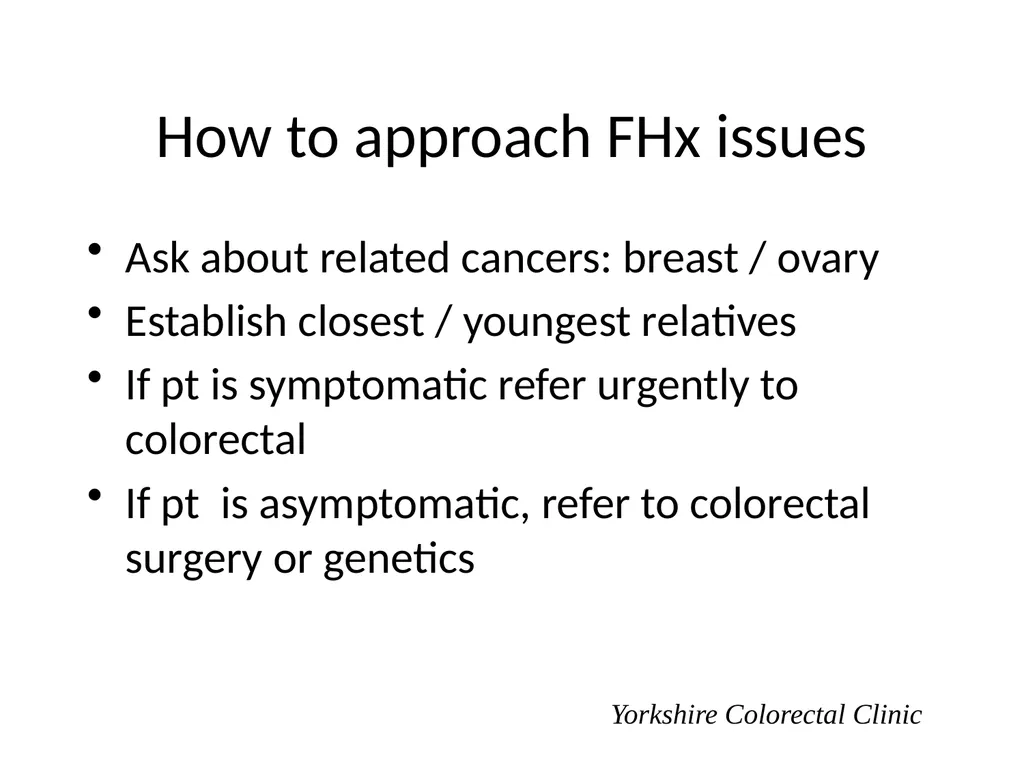
How to approach FHx issues Ask about related cancers: breast / ovary
Establish closest / youngest relatives
If pt is symptomatic refer urgently to colorectal
If pt is asymptomatic, refer to colorectal surgery or genetics<br>
Establish closest / youngest relatives
If pt is symptomatic refer urgently to colorectal
If pt is asymptomatic, refer to colorectal surgery or genetics<br>
05
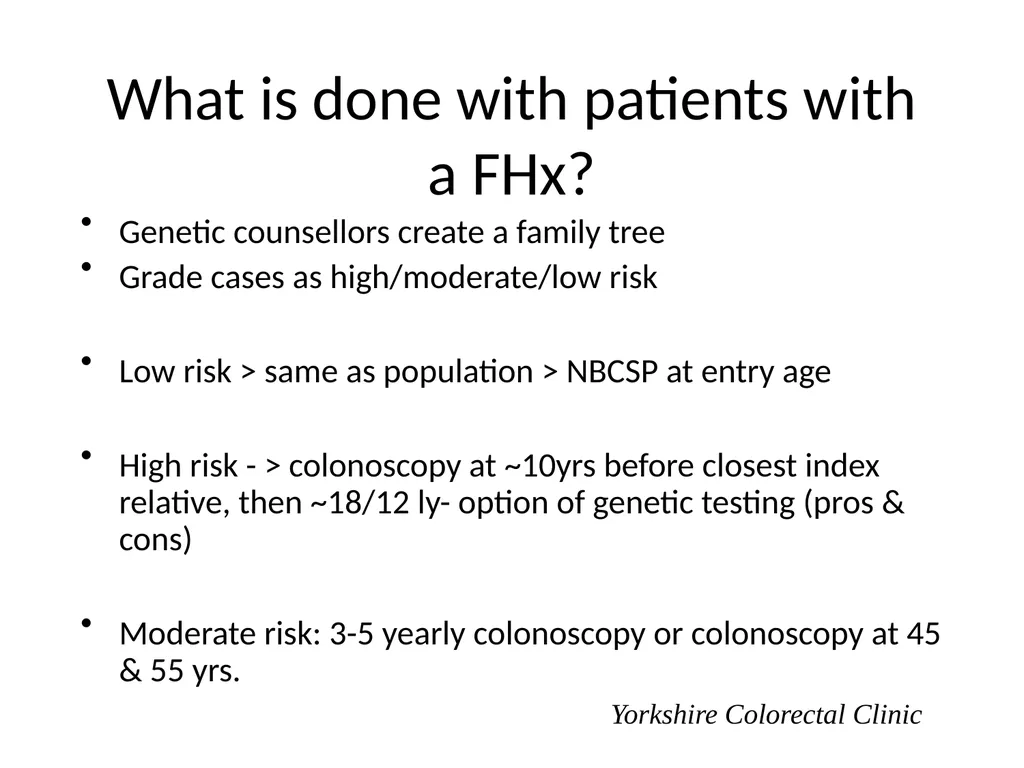
What is done with patients with a FHx? Genetic counsellors create a family tree
Grade cases as high/moderate/low risk
Low risk > same as population > NBCSP at entry age
High risk - > colonoscopy at ~10yrs before closest index relative, then ~18/12 ly- option of genetic testing (pros & cons)
Moderate risk: 3-5 yearly colonoscopy or colonoscopy at 45 & 55 yrs.<br>
Grade cases as high/moderate/low risk
Low risk > same as population > NBCSP at entry age
High risk - > colonoscopy at ~10yrs before closest index relative, then ~18/12 ly- option of genetic testing (pros & cons)
Moderate risk: 3-5 yearly colonoscopy or colonoscopy at 45 & 55 yrs.<br>
06
New 2WW bowel cancer referral guidelines BRRB flexi sig
Loose stool colonoscopy
Loose stool with blood colonoscopy
Rectal mass clinic
Iron def anaemia OGD/colonoscopy or CTC
Abdominal mass CT or clinic -any of the above in an unfit patient > clinic first
Major future differences: -less emphasis on duration of symptoms and / or age
Impact: more testing, more infrastructure needed<br>
Loose stool colonoscopy
Loose stool with blood colonoscopy
Rectal mass clinic
Iron def anaemia OGD/colonoscopy or CTC
Abdominal mass CT or clinic -any of the above in an unfit patient > clinic first
Major future differences: -less emphasis on duration of symptoms and / or age
Impact: more testing, more infrastructure needed<br>
07
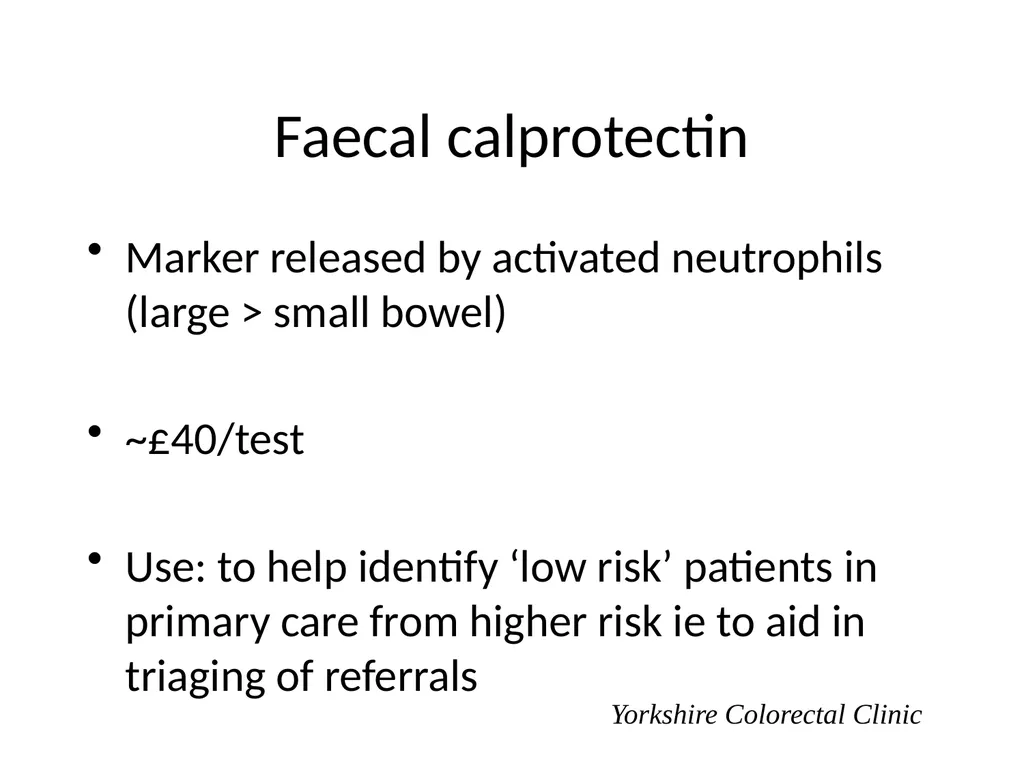
Faecal calprotectin Marker released by activated neutrophils (large > small bowel)
~£40/test
Use: to help identify ‘low risk’ patients in primary care from higher risk ie to aid in triaging of referrals
Not a diagnostic test for IBD<br>
~£40/test
Use: to help identify ‘low risk’ patients in primary care from higher risk ie to aid in triaging of referrals
Not a diagnostic test for IBD<br>
08
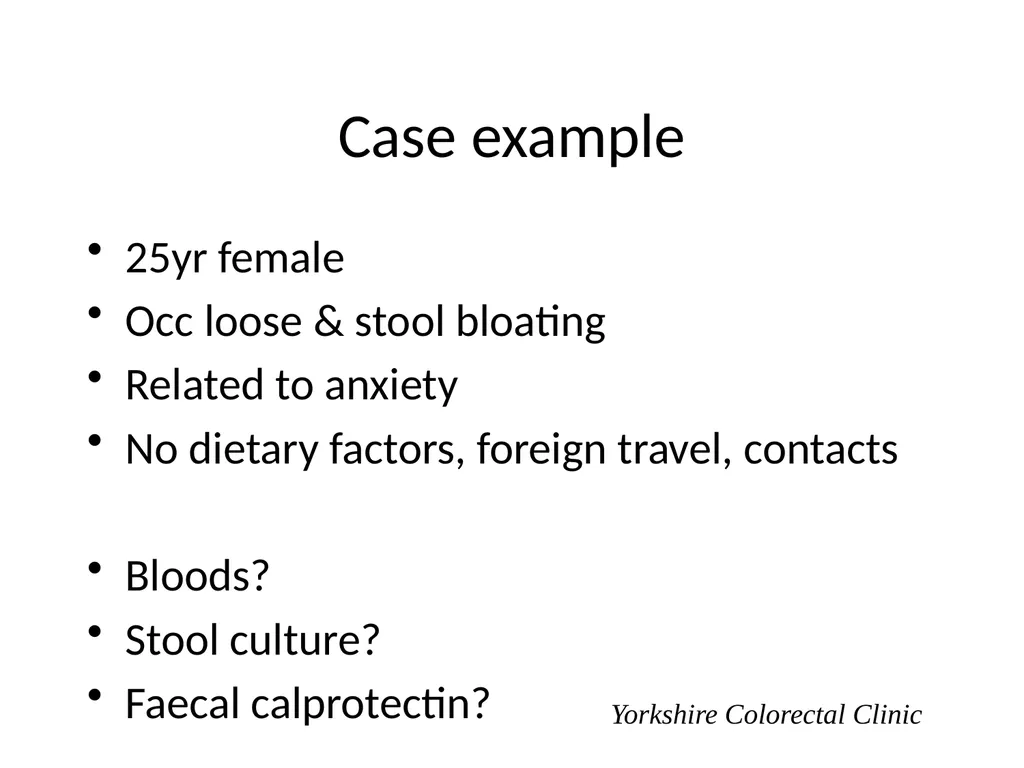
Case example 25yr female
Occ loose & stool bloating
Related to anxiety
No dietary factors, foreign travel, contacts
Bloods?
Stool culture?
Faecal calprotectin?<br>
Occ loose & stool bloating
Related to anxiety
No dietary factors, foreign travel, contacts
Bloods?
Stool culture?
Faecal calprotectin?<br>
09
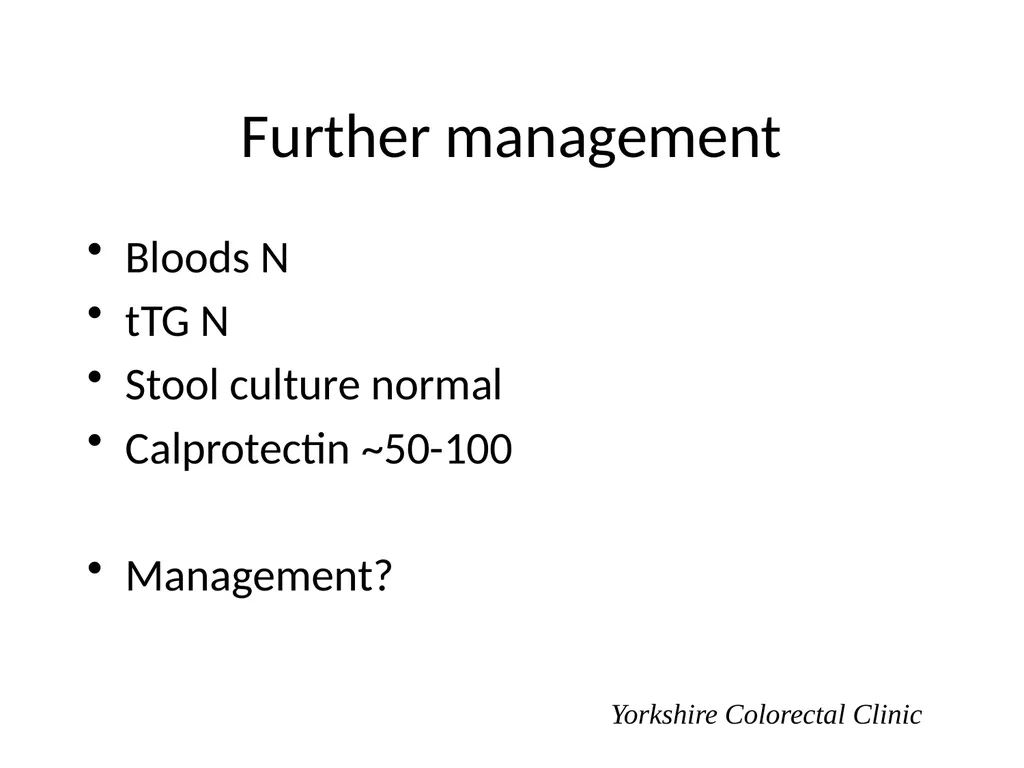
Further management Bloods N
tTG N
Stool culture normal
Calprotectin ~50-100
Management?<br>
tTG N
Stool culture normal
Calprotectin ~50-100
Management?<br>
10
Bowel cancer screening (for population) Bowel scope ie one off flexible sigmoidoscopy - ~ 55yrs
Faecal occult blood testing - 60-69 (age extension, now > 75 yrs) - standard exclusions: certain foods, iron tabs, red wine etc
Screening if positive > colonoscopy or CT colon
No role for CEA testing ‘the undiagnosed case’ in primary care Yorkshire Colorectal Clinic<br>
Faecal occult blood testing - 60-69 (age extension, now > 75 yrs) - standard exclusions: certain foods, iron tabs, red wine etc
Screening if positive > colonoscopy or CT colon
No role for CEA testing ‘the undiagnosed case’ in primary care Yorkshire Colorectal Clinic<br>
11
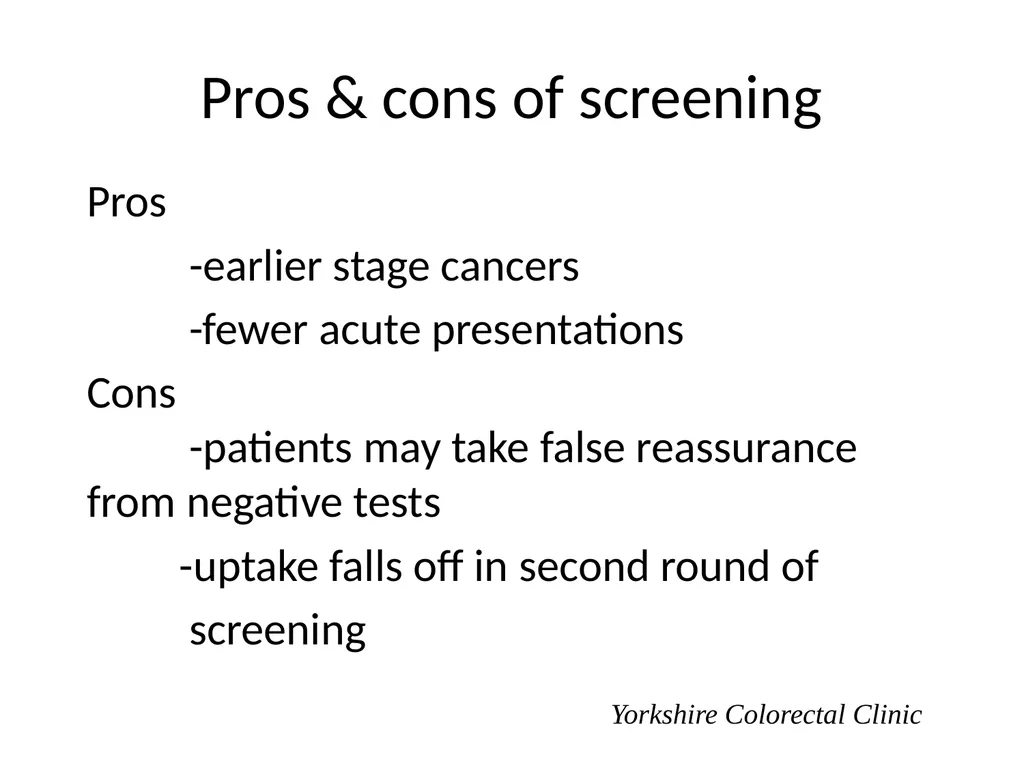
Pros & cons of screening Pros
-earlier stage cancers
-fewer acute presentations
Cons -patients may take false reassurance from negative tests
-uptake falls off in second round of
screening<br>
-earlier stage cancers
-fewer acute presentations
Cons -patients may take false reassurance from negative tests
-uptake falls off in second round of
screening<br>
12
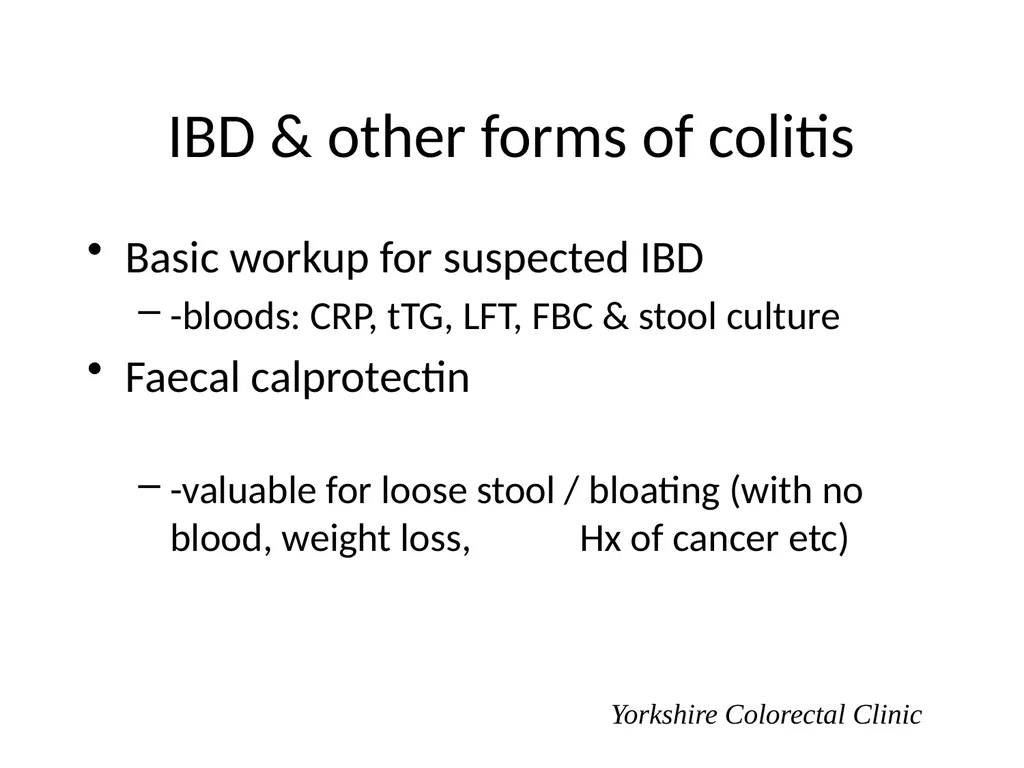
IBD & other forms of colitis Basic workup for suspected IBD
-bloods: CRP, tTG, LFT, FBC & stool culture
Faecal calprotectin
-valuable for loose stool / bloating (with no blood, weight loss, Hx of cancer etc)<br>
-bloods: CRP, tTG, LFT, FBC & stool culture
Faecal calprotectin
-valuable for loose stool / bloating (with no blood, weight loss, Hx of cancer etc)<br>
13
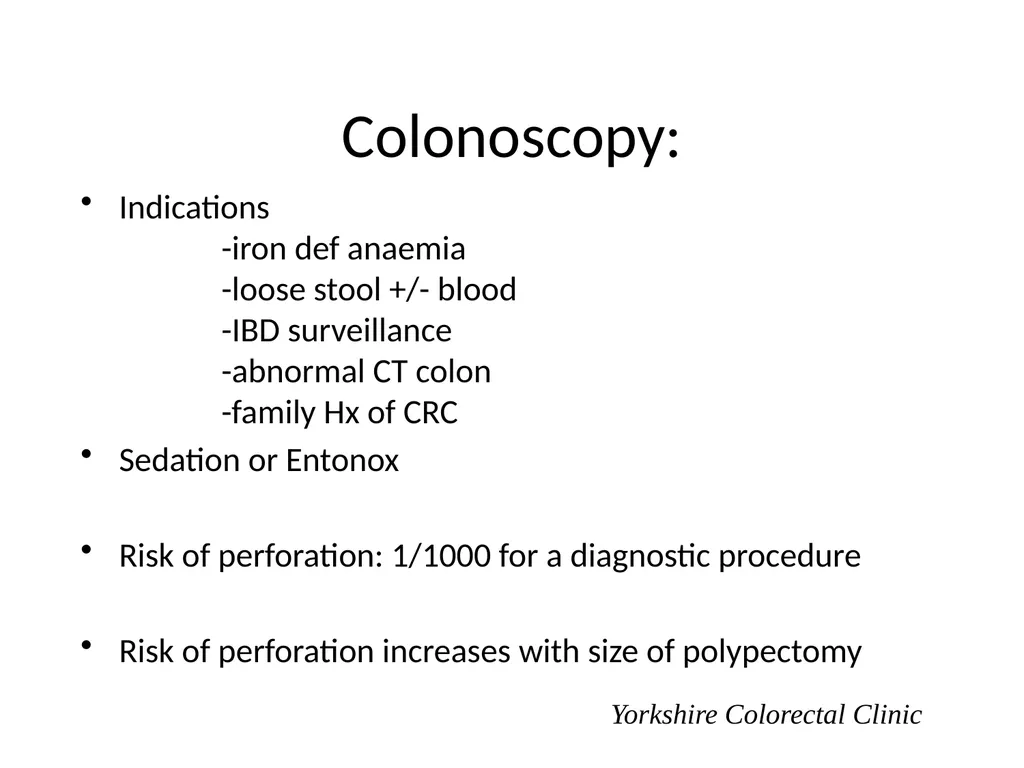
Colonoscopy: Indications -iron def anaemia -loose stool +/- blood -IBD surveillance -abnormal CT colon -family Hx of CRC
Sedation or Entonox
Risk of perforation: 1/1000 for a diagnostic procedure
Risk of perforation increases with size of polypectomy<br>
Sedation or Entonox
Risk of perforation: 1/1000 for a diagnostic procedure
Risk of perforation increases with size of polypectomy<br>
14
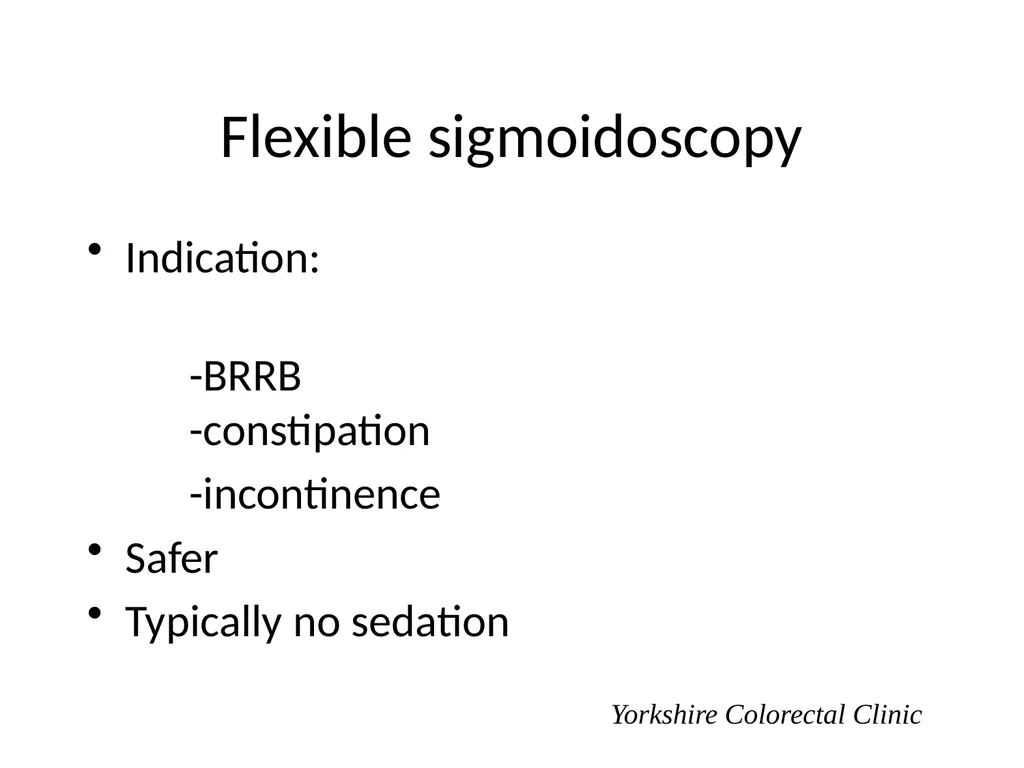
Flexible sigmoidoscopy Indication:
-BRRB -constipation
-incontinence
Safer
Typically no sedation<br>
-BRRB -constipation
-incontinence
Safer
Typically no sedation<br>
15
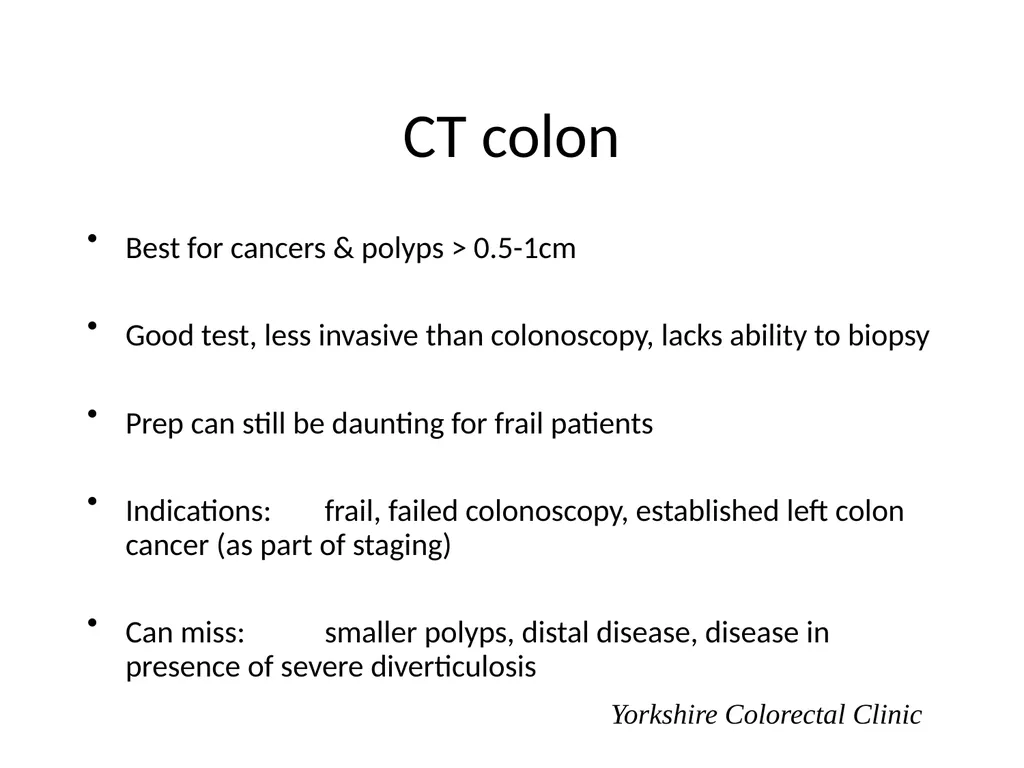
CT colon Best for cancers & polyps > 0.5-1cm
Good test, less invasive than colonoscopy, lacks ability to biopsy
Prep can still be daunting for frail patients
Indications: frail, failed colonoscopy, established left colon cancer (as part of staging)
Can miss: smaller polyps, distal disease, disease in presence of severe diverticulosis<br>
Good test, less invasive than colonoscopy, lacks ability to biopsy
Prep can still be daunting for frail patients
Indications: frail, failed colonoscopy, established left colon cancer (as part of staging)
Can miss: smaller polyps, distal disease, disease in presence of severe diverticulosis<br>
16
Drugs for acute UC in primary care Exclude infective gastroenteritis -stool culture
Acute flare: -prednisolone 40mg/d, decreasing by 5mg/week -concomitant Calceos / Calcichew D3 forte -maximal dose of mesalazine 4.8g/d
IBD helpline available for early phone call returned by nurse specialist Yorkshire Colorectal Clinic<br>
Acute flare: -prednisolone 40mg/d, decreasing by 5mg/week -concomitant Calceos / Calcichew D3 forte -maximal dose of mesalazine 4.8g/d
IBD helpline available for early phone call returned by nurse specialist Yorkshire Colorectal Clinic<br>
17
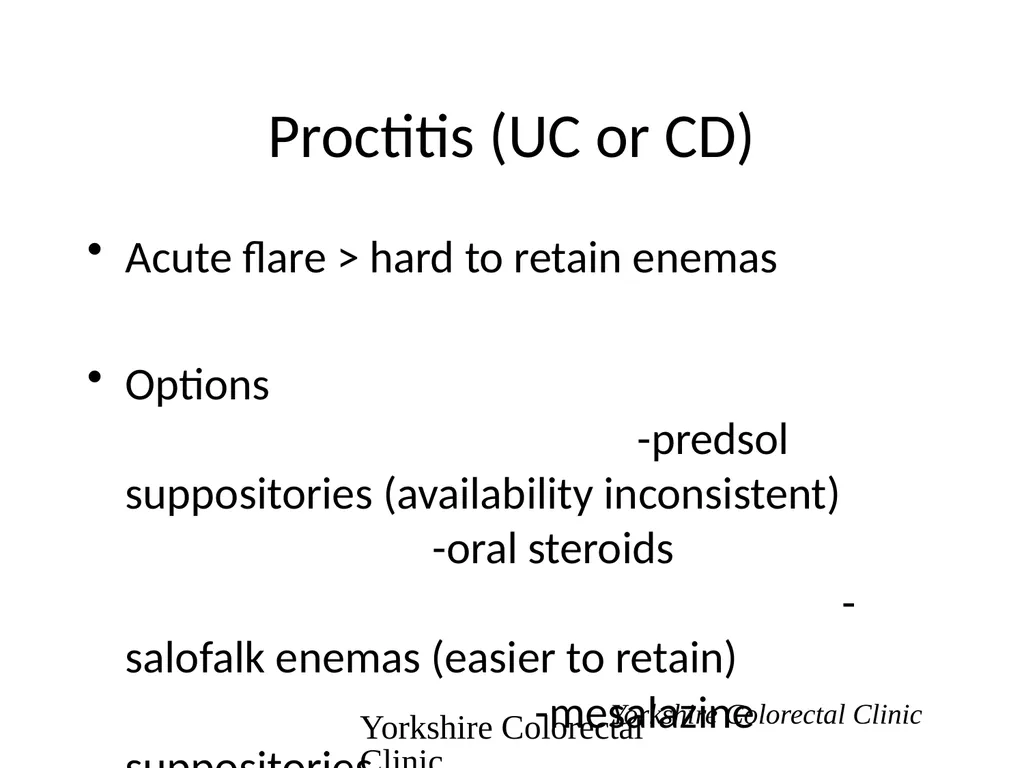
Proctitis (UC or CD) Acute flare > hard to retain enemas
Options -predsol suppositories (availability inconsistent) -oral steroids -salofalk enemas (easier to retain) -mesalazine suppositories Yorkshire Colorectal Clinic<br>
Options -predsol suppositories (availability inconsistent) -oral steroids -salofalk enemas (easier to retain) -mesalazine suppositories Yorkshire Colorectal Clinic<br>
18
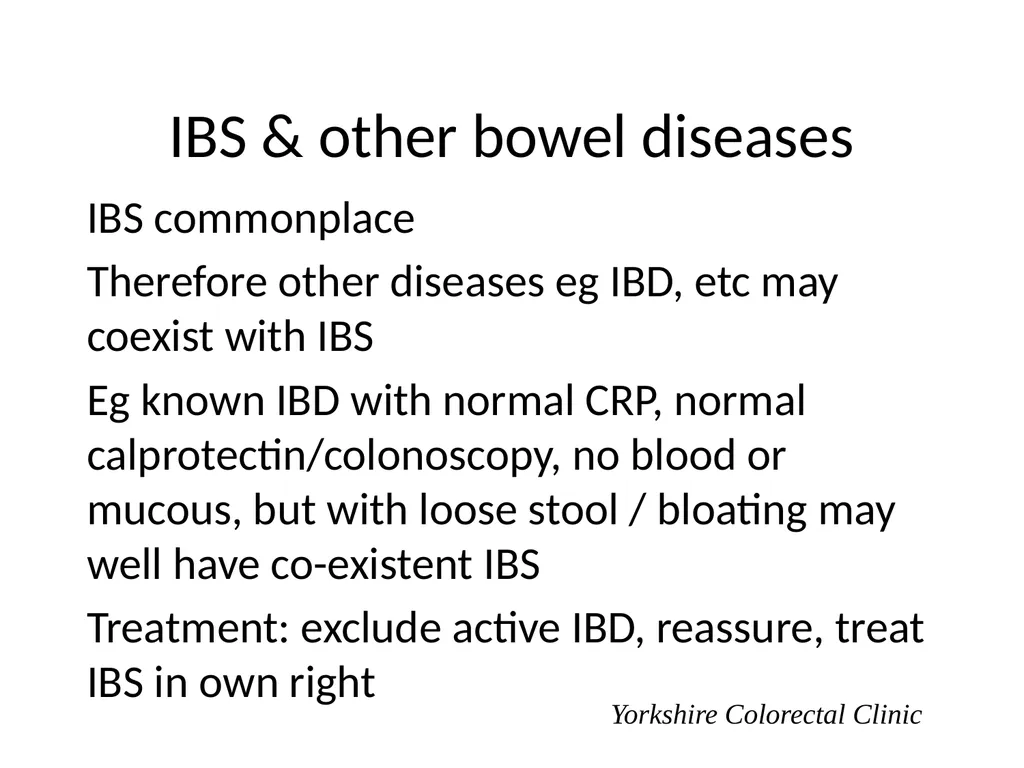
IBS & other bowel diseases IBS commonplace
Therefore other diseases eg IBD, etc may coexist with IBS
Eg known IBD with normal CRP, normal calprotectin/colonoscopy, no blood or mucous, but with loose stool / bloating may well have co-existent IBS
Treatment: exclude active IBD, reassure, treat IBS in own right<br>
Therefore other diseases eg IBD, etc may coexist with IBS
Eg known IBD with normal CRP, normal calprotectin/colonoscopy, no blood or mucous, but with loose stool / bloating may well have co-existent IBS
Treatment: exclude active IBD, reassure, treat IBS in own right<br>
19
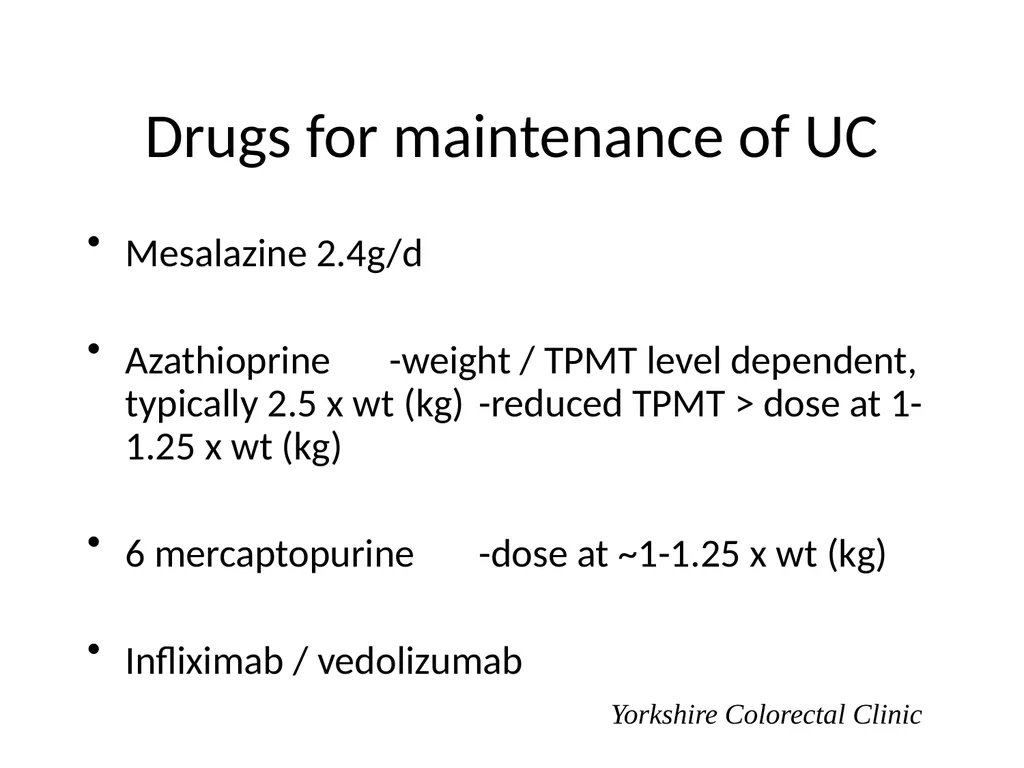
Drugs for maintenance of UC Mesalazine 2.4g/d
Azathioprine -weight / TPMT level dependent, typically 2.5 x wt (kg) -reduced TPMT > dose at 1-1.25 x wt (kg)
6 mercaptopurine -dose at ~1-1.25 x wt (kg)
Infliximab / vedolizumab<br>
Azathioprine -weight / TPMT level dependent, typically 2.5 x wt (kg) -reduced TPMT > dose at 1-1.25 x wt (kg)
6 mercaptopurine -dose at ~1-1.25 x wt (kg)
Infliximab / vedolizumab<br>
20
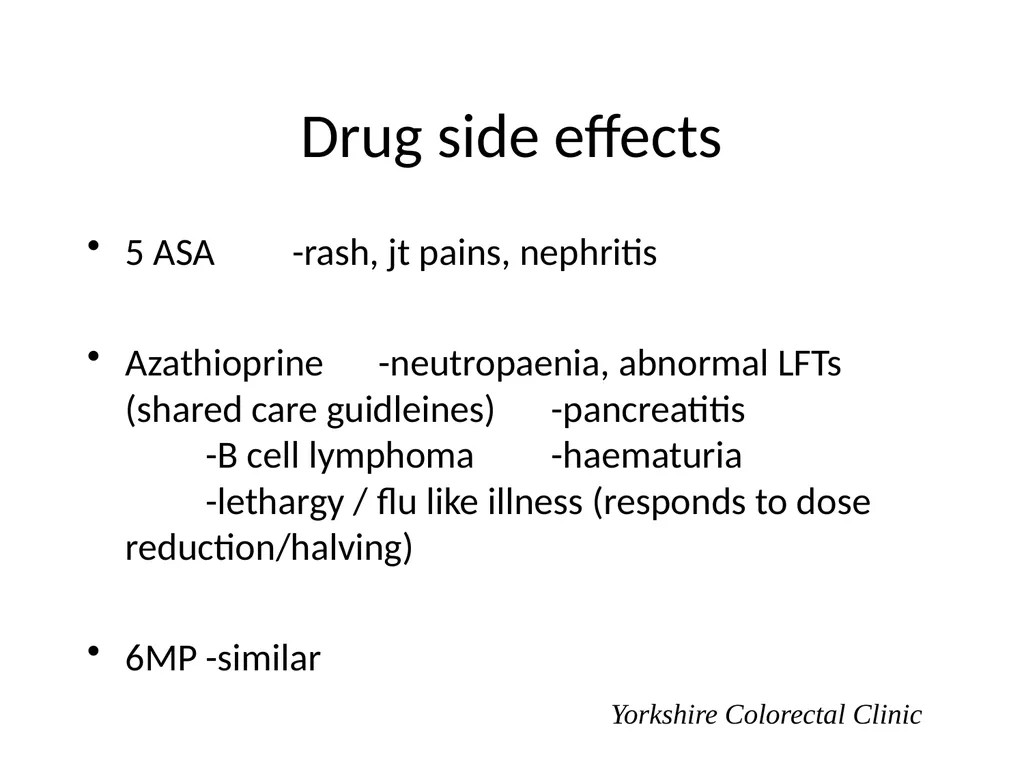
Drug side effects 5 ASA -rash, jt pains, nephritis
Azathioprine -neutropaenia, abnormal LFTs (shared care guidleines) -pancreatitis -B cell lymphoma -haematuria -lethargy / flu like illness (responds to dose reduction/halving)
6MP -similar<br>
Azathioprine -neutropaenia, abnormal LFTs (shared care guidleines) -pancreatitis -B cell lymphoma -haematuria -lethargy / flu like illness (responds to dose reduction/halving)
6MP -similar<br>
21
Enhanced recovery after surgery ‘ERAS’ Target discharge ~ day 4/5 after GI resection
Resultant risk of developing complication in community
Anastomotic leak: HR↑, RR↑, temp↑, BP ↔ /↓
Obstruction
High output ileostomy
Wound infection<br>
Resultant risk of developing complication in community
Anastomotic leak: HR↑, RR↑, temp↑, BP ↔ /↓
Obstruction
High output ileostomy
Wound infection<br>
22
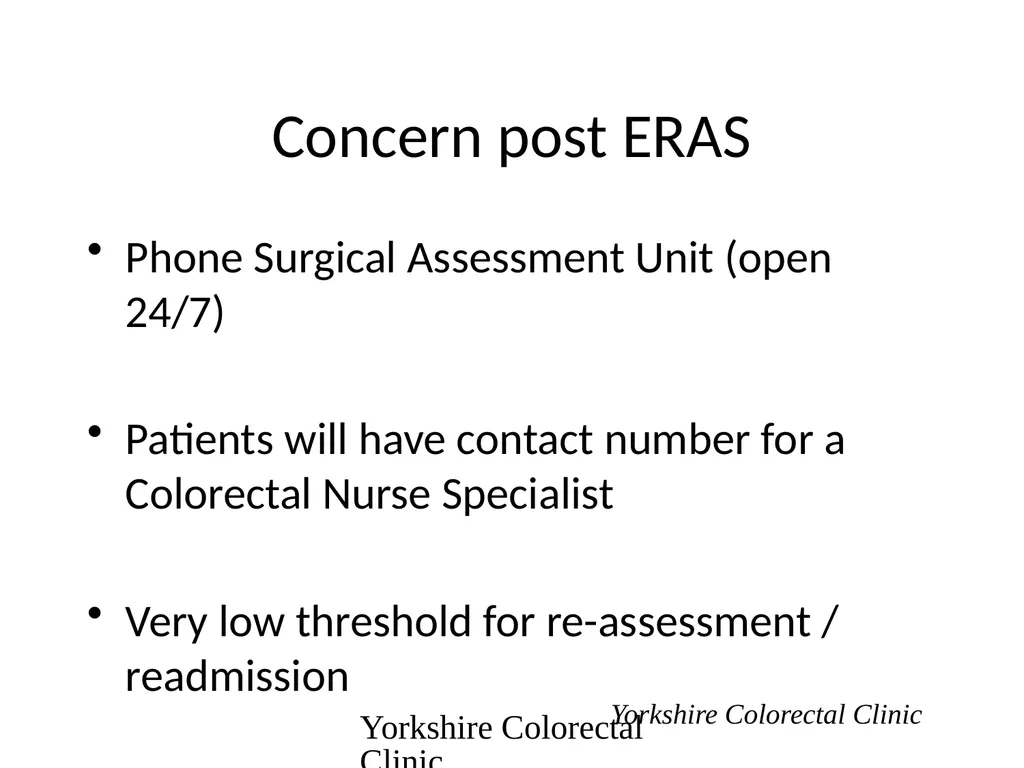
Concern post ERAS Phone Surgical Assessment Unit (open 24/7)
Patients will have contact number for a Colorectal Nurse Specialist
Very low threshold for re-assessment / readmission Yorkshire Colorectal Clinic<br>
Patients will have contact number for a Colorectal Nurse Specialist
Very low threshold for re-assessment / readmission Yorkshire Colorectal Clinic<br>
23
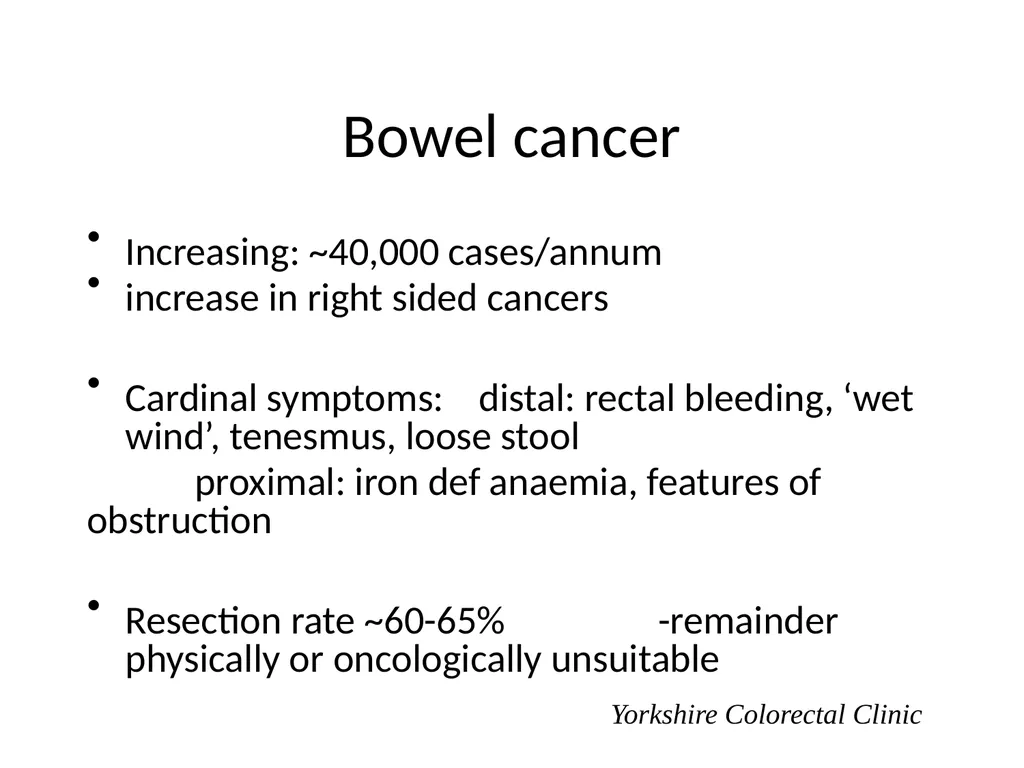
Bowel cancer Increasing: ~40,000 cases/annum
increase in right sided cancers
Cardinal symptoms: distal: rectal bleeding, ‘wet wind’, tenesmus, loose stool
proximal: iron def anaemia, features of obstruction
Resection rate ~60-65% -remainder physically or oncologically unsuitable<br>
increase in right sided cancers
Cardinal symptoms: distal: rectal bleeding, ‘wet wind’, tenesmus, loose stool
proximal: iron def anaemia, features of obstruction
Resection rate ~60-65% -remainder physically or oncologically unsuitable<br>
24
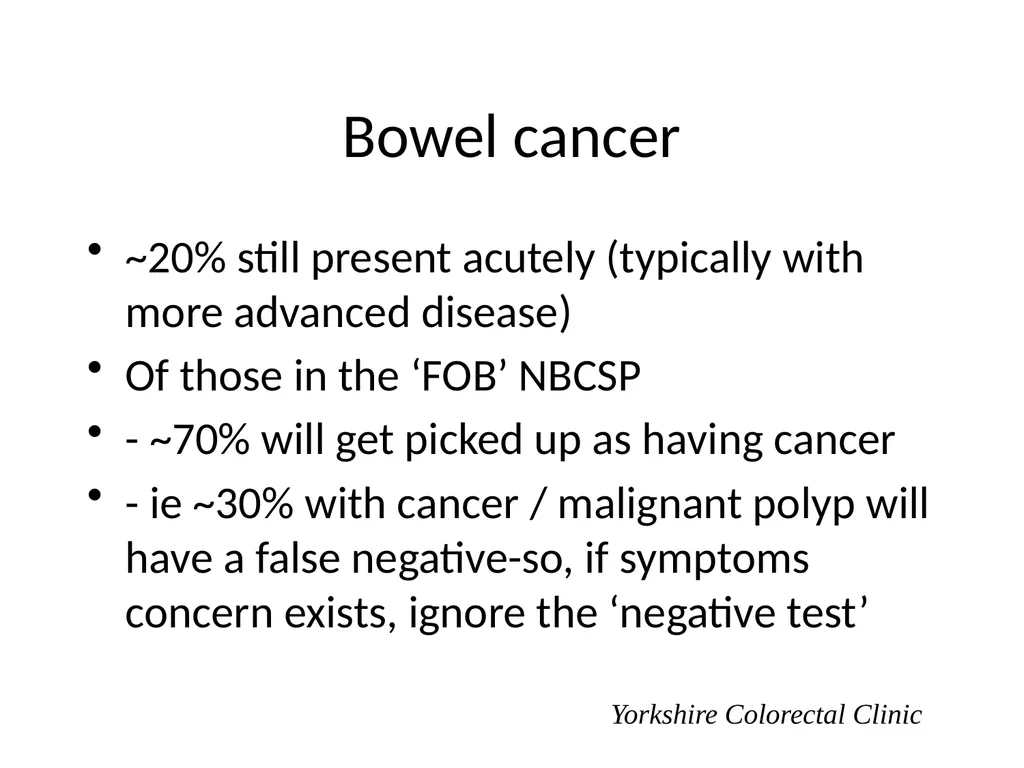
Bowel cancer ~20% still present acutely (typically with more advanced disease)
Of those in the ‘FOB’ NBCSP
- ~70% will get picked up as having cancer
- ie ~30% with cancer / malignant polyp will have a false negative-so, if symptoms concern exists, ignore the ‘negative test’<br>
Of those in the ‘FOB’ NBCSP
- ~70% will get picked up as having cancer
- ie ~30% with cancer / malignant polyp will have a false negative-so, if symptoms concern exists, ignore the ‘negative test’<br>
25
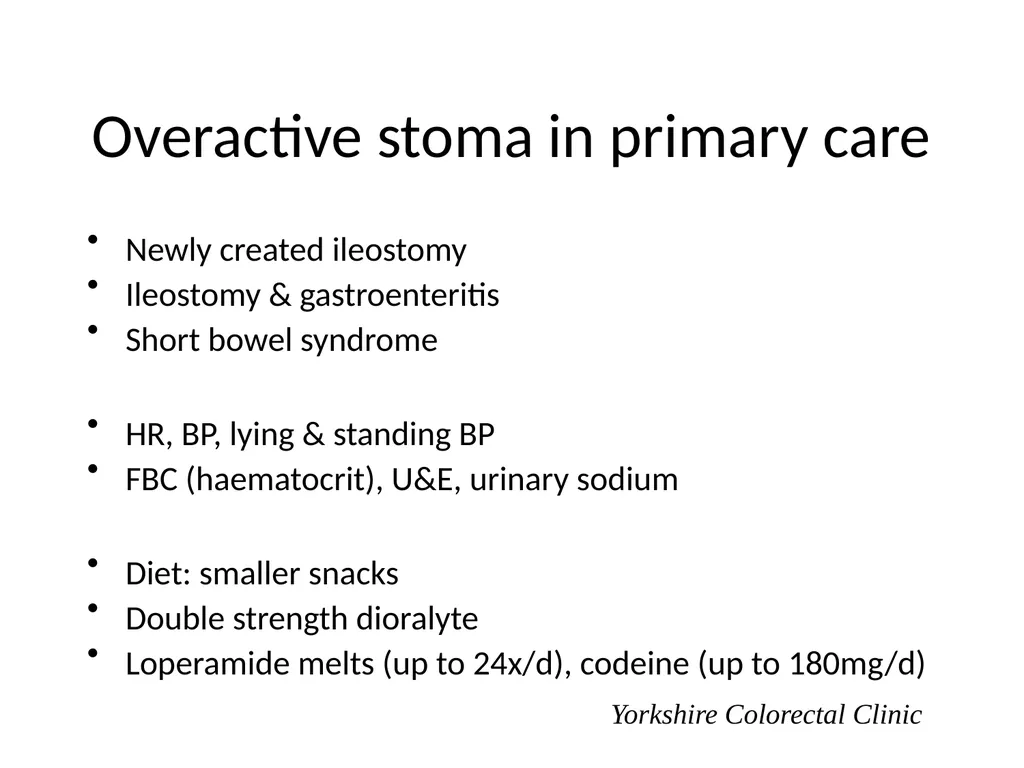
Overactive stoma in primary care Newly created ileostomy
Ileostomy & gastroenteritis
Short bowel syndrome
HR, BP, lying & standing BP
FBC (haematocrit), U&E, urinary sodium
Diet: smaller snacks
Double strength dioralyte
Loperamide melts (up to 24x/d), codeine (up to 180mg/d)<br>
Ileostomy & gastroenteritis
Short bowel syndrome
HR, BP, lying & standing BP
FBC (haematocrit), U&E, urinary sodium
Diet: smaller snacks
Double strength dioralyte
Loperamide melts (up to 24x/d), codeine (up to 180mg/d)<br>
26
Bowel cancer follow up CT
Colonoscopy
CEA
Annual wellbeing visit to nurse specialists
5 years -unless ‘young’ and undergoing colonoscopy surveillance
Aim: detection recurrence, management of late side effects eg 2y RT<br>
Colonoscopy
CEA
Annual wellbeing visit to nurse specialists
5 years -unless ‘young’ and undergoing colonoscopy surveillance
Aim: detection recurrence, management of late side effects eg 2y RT<br>
27
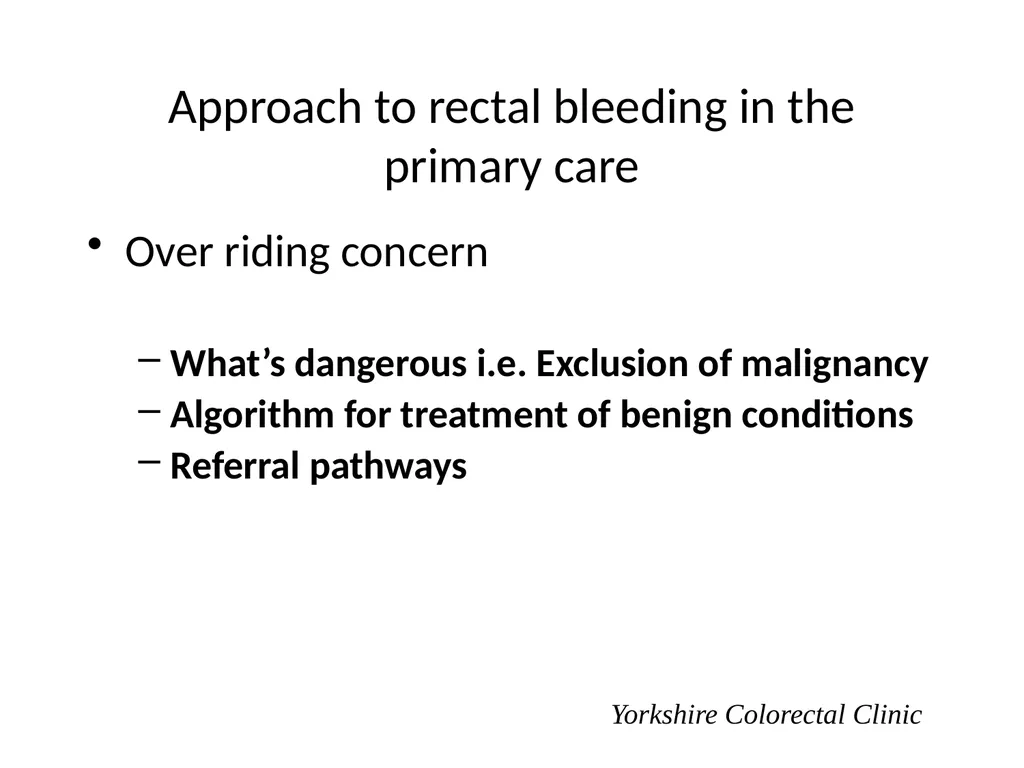
Approach to rectal bleeding in the primary care Over riding concern
What’s dangerous i.e. Exclusion of malignancy
Algorithm for treatment of benign conditions
Referral pathways<br>
What’s dangerous i.e. Exclusion of malignancy
Algorithm for treatment of benign conditions
Referral pathways<br>
28
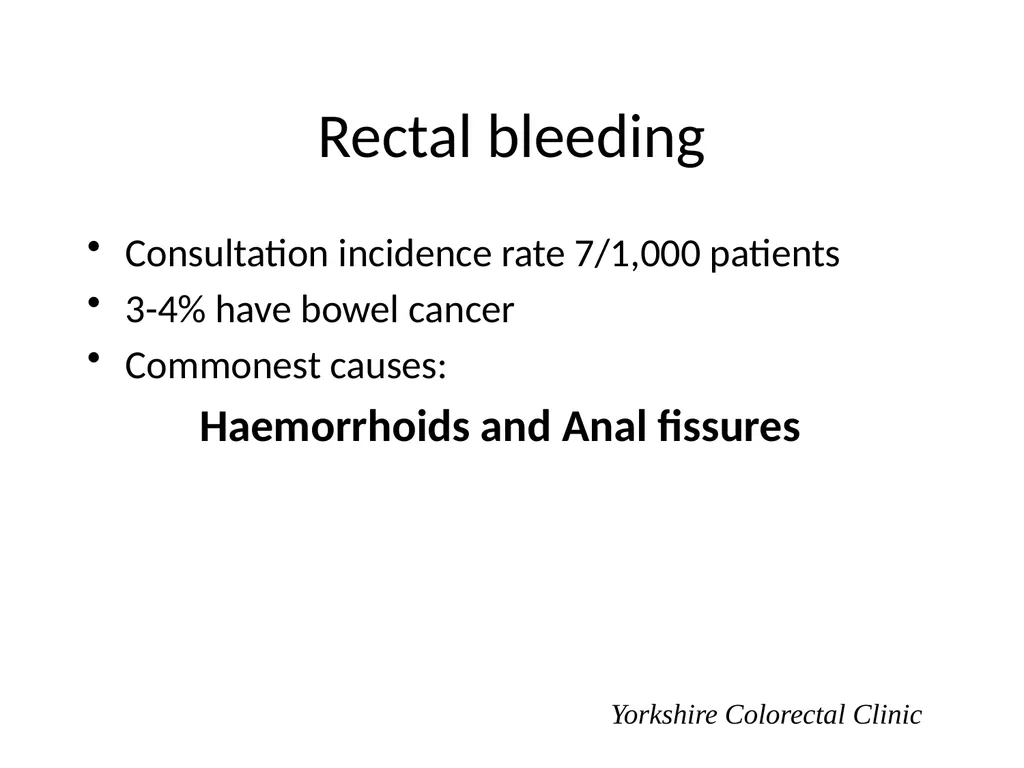
Rectal bleeding Consultation incidence rate 7/1,000 patients
3-4% have bowel cancer
Commonest causes:
Haemorrhoids and Anal fissures<br>
3-4% have bowel cancer
Commonest causes:
Haemorrhoids and Anal fissures<br>
29
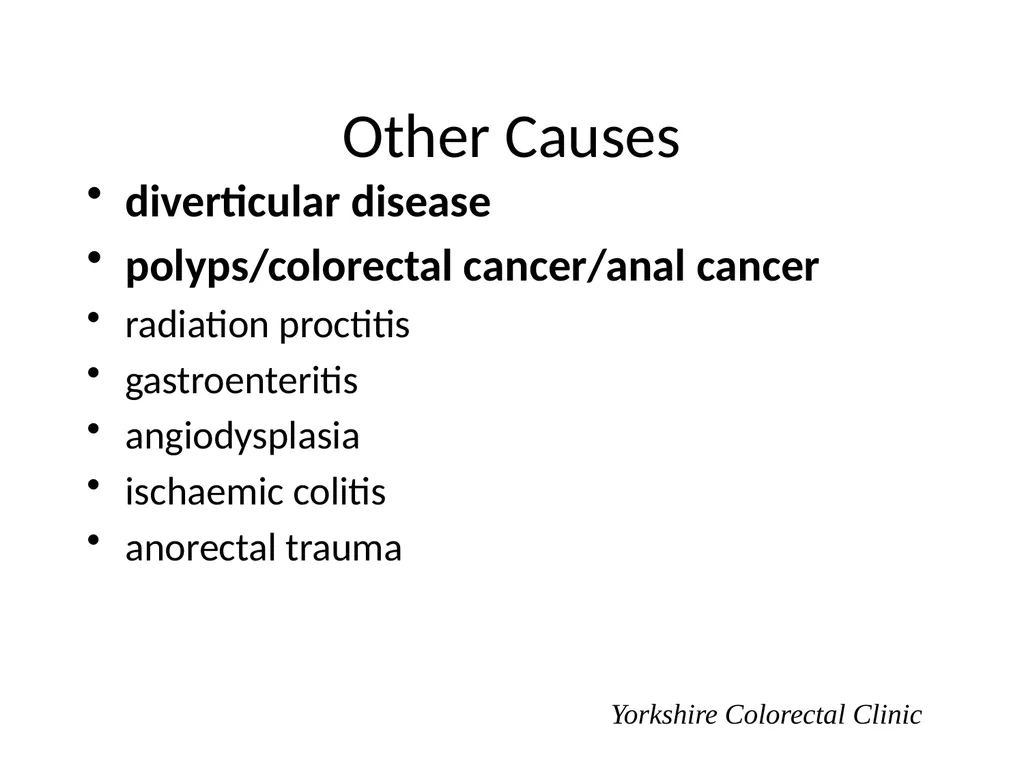
Other Causes diverticular disease
polyps/colorectal cancer/anal cancer
radiation proctitis
gastroenteritis
angiodysplasia
ischaemic colitis
anorectal trauma<br>
polyps/colorectal cancer/anal cancer
radiation proctitis
gastroenteritis
angiodysplasia
ischaemic colitis
anorectal trauma<br>
30
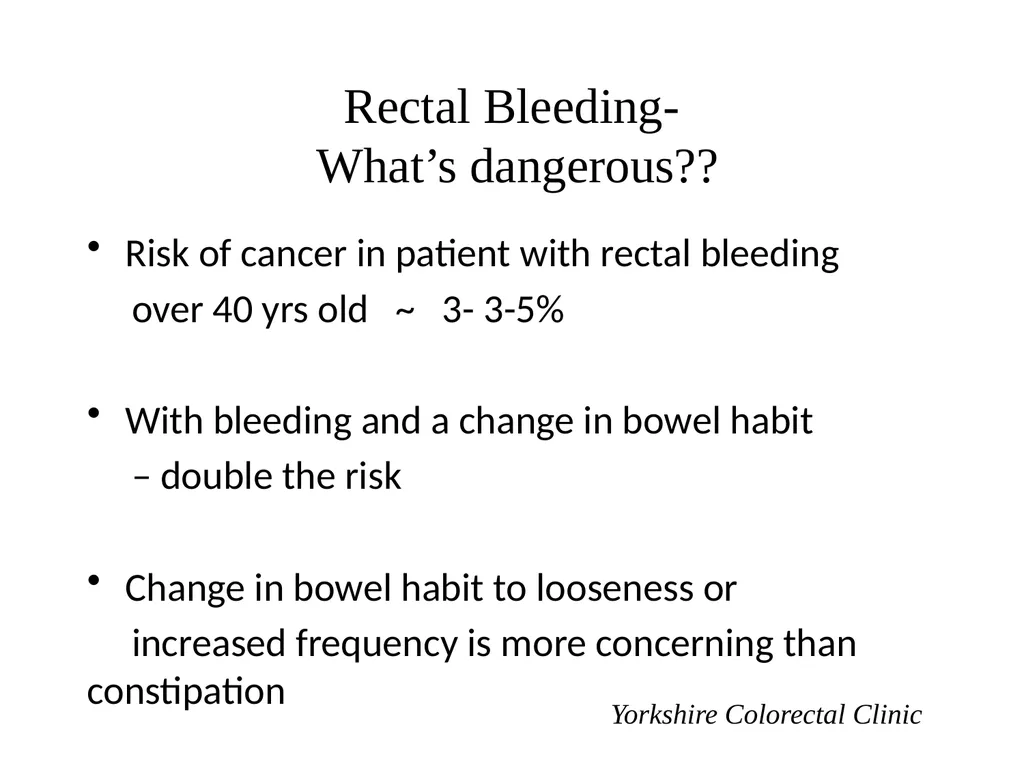
Rectal Bleeding-
What’s dangerous?? Risk of cancer in patient with rectal bleeding
over 40 yrs old ~ 3- 3-5%
With bleeding and a change in bowel habit
– double the risk
Change in bowel habit to looseness or
increased frequency is more concerning than constipation<br>
over 40 yrs old ~ 3- 3-5%
With bleeding and a change in bowel habit
– double the risk
Change in bowel habit to looseness or
increased frequency is more concerning than constipation<br>
31
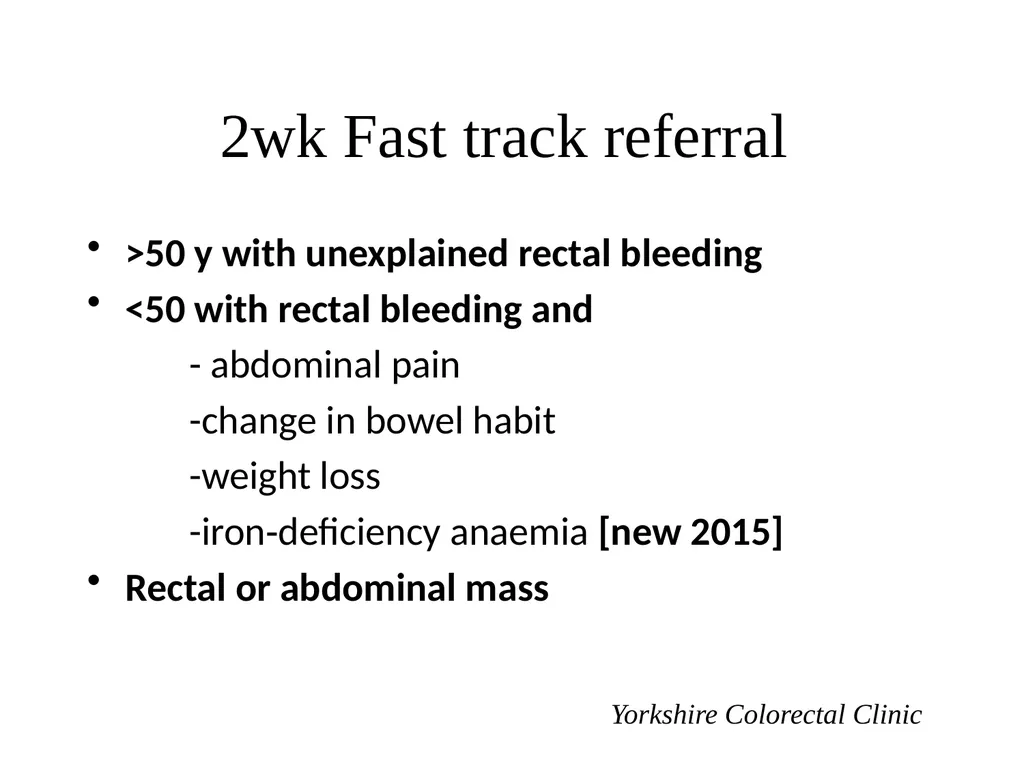
2wk Fast track referral >50 y with unexplained rectal bleeding
<50 with rectal bleeding and
- abdominal pain
-change in bowel habit
-weight loss
-iron‑deficiency anaemia [new 2015]
Rectal or abdominal mass<br>
<50 with rectal bleeding and
- abdominal pain
-change in bowel habit
-weight loss
-iron‑deficiency anaemia [new 2015]
Rectal or abdominal mass<br>
32
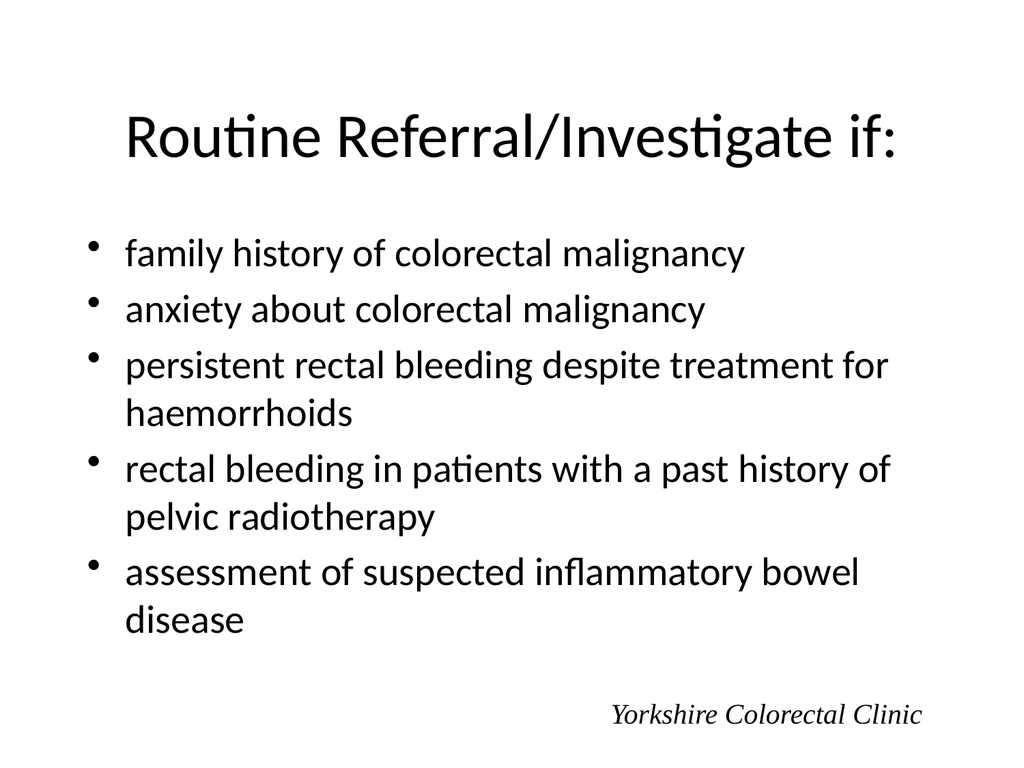
Routine Referral/Investigate if: family history of colorectal malignancy
anxiety about colorectal malignancy
persistent rectal bleeding despite treatment for haemorrhoids
rectal bleeding in patients with a past history of pelvic radiotherapy
assessment of suspected inflammatory bowel disease<br>
anxiety about colorectal malignancy
persistent rectal bleeding despite treatment for haemorrhoids
rectal bleeding in patients with a past history of pelvic radiotherapy
assessment of suspected inflammatory bowel disease<br>
33
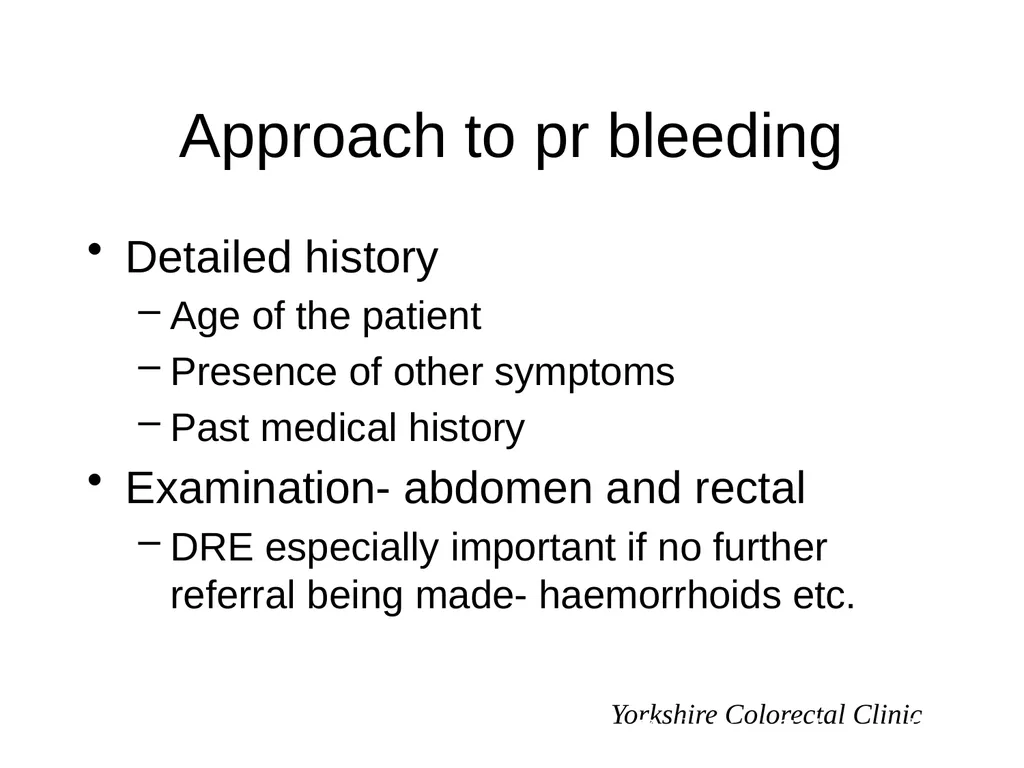
Approach to pr bleeding Detailed history
Age of the patient
Presence of other symptoms
Past medical history
Examination- abdomen and rectal
DRE especially important if no further referral being made- haemorrhoids etc.
/ The Yorkshire Colorectal Clinic<br>
Age of the patient
Presence of other symptoms
Past medical history
Examination- abdomen and rectal
DRE especially important if no further referral being made- haemorrhoids etc.
/ The Yorkshire Colorectal Clinic<br>
34
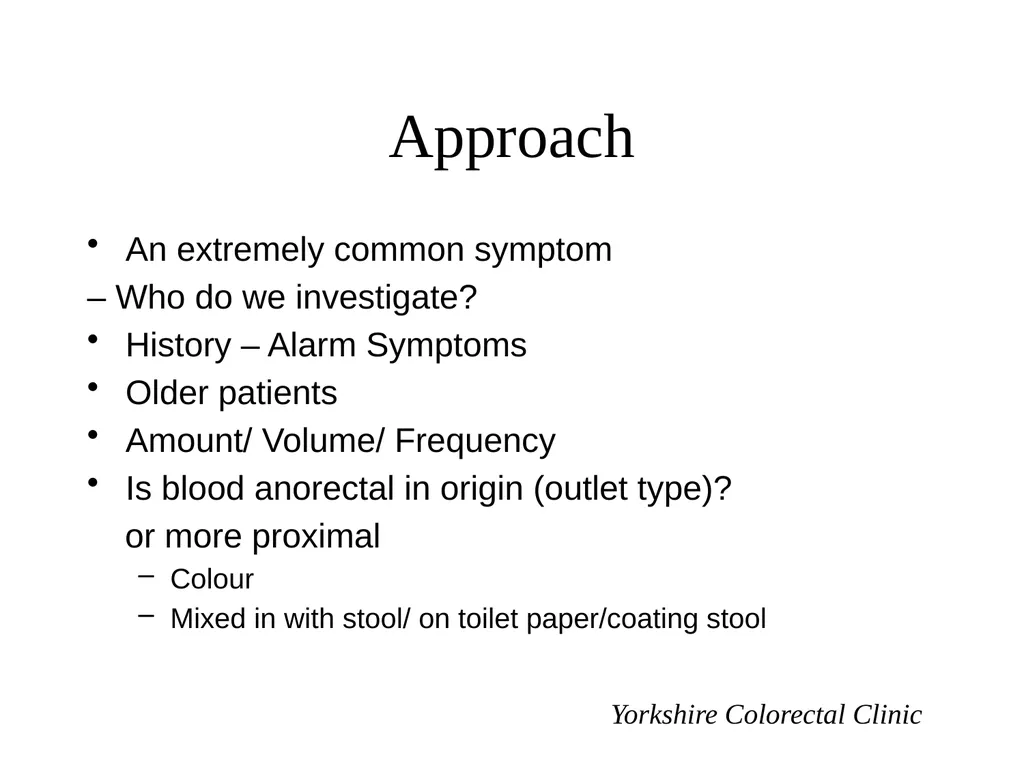
Approach An extremely common symptom
– Who do we investigate?
History – Alarm Symptoms
Older patients
Amount/ Volume/ Frequency
Is blood anorectal in origin (outlet type)?
or more proximal
Colour
Mixed in with stool/ on toilet paper/coating stool<br>
– Who do we investigate?
History – Alarm Symptoms
Older patients
Amount/ Volume/ Frequency
Is blood anorectal in origin (outlet type)?
or more proximal
Colour
Mixed in with stool/ on toilet paper/coating stool<br>
35
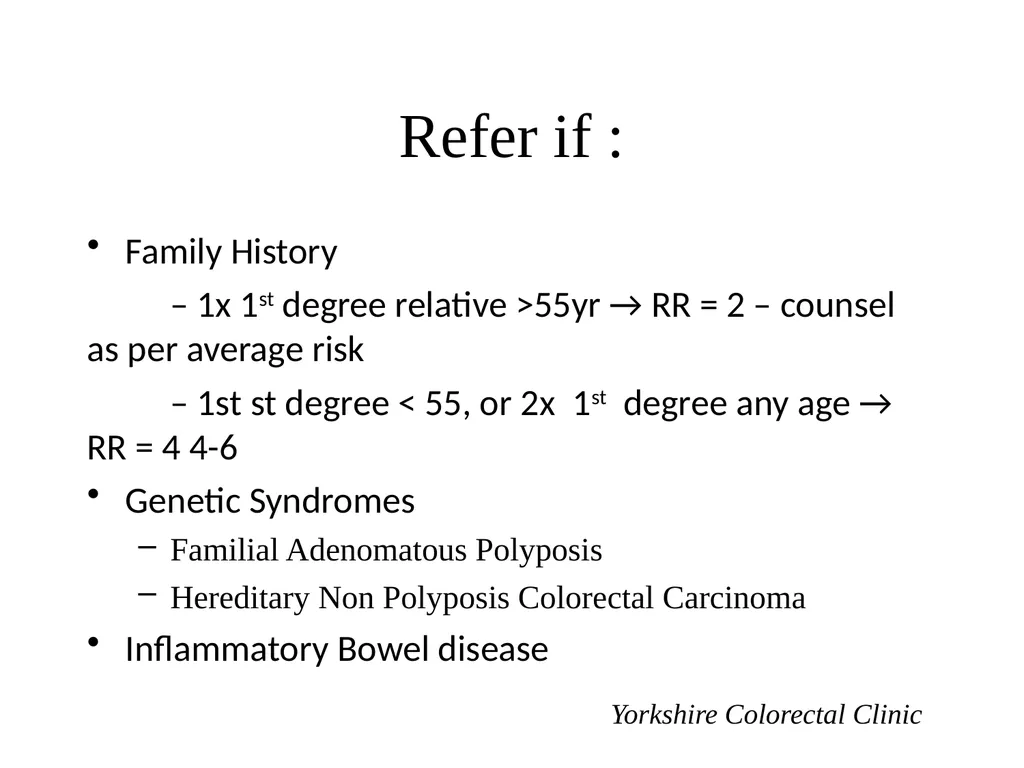
Refer if : Family History
– 1x 1st degree relative >55yr → RR = 2 – counsel as per average risk
– 1st st degree < 55, or 2x 1st degree any age → RR = 4 4-6
Genetic Syndromes
Familial Adenomatous Polyposis
Hereditary Non Polyposis Colorectal Carcinoma
Inflammatory Bowel disease<br>
– 1x 1st degree relative >55yr → RR = 2 – counsel as per average risk
– 1st st degree < 55, or 2x 1st degree any age → RR = 4 4-6
Genetic Syndromes
Familial Adenomatous Polyposis
Hereditary Non Polyposis Colorectal Carcinoma
Inflammatory Bowel disease<br>
36
What else is dangerous?
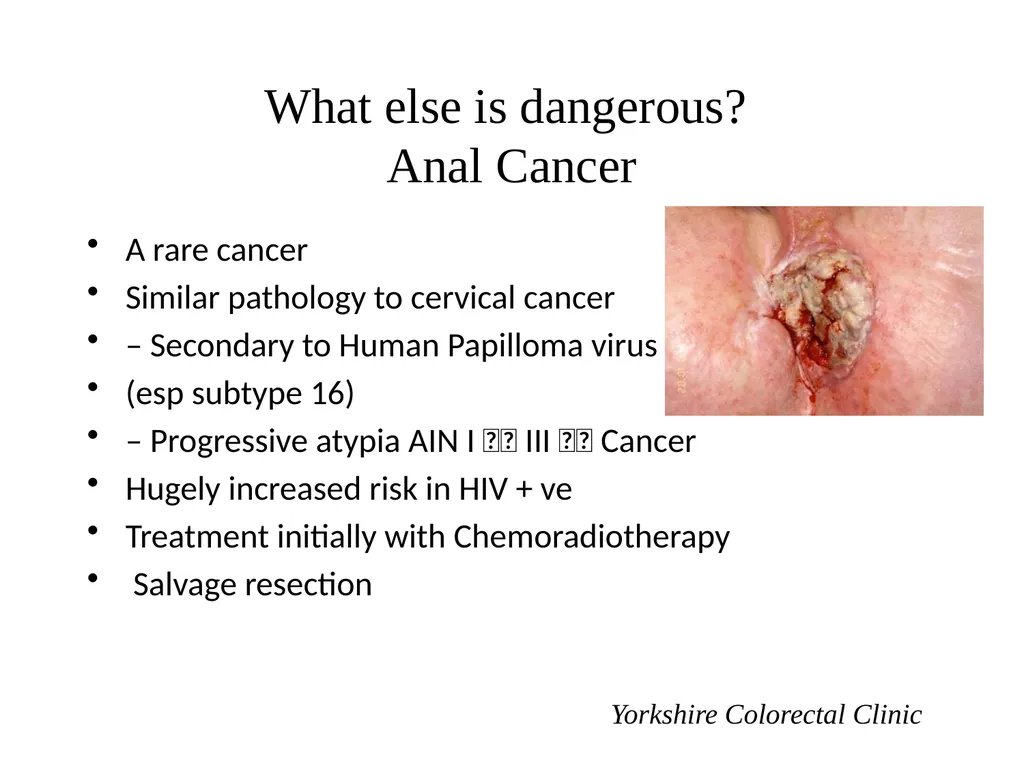
Anal Cancer A rare cancer
Similar pathology to cervical cancer
– Secondary to Human Papilloma virus
(esp subtype 16)
– Progressive atypia AIN I III Cancer
Hugely increased risk in HIV + ve
Treatment initially with Chemoradiotherapy
Salvage resection<br>
Similar pathology to cervical cancer
– Secondary to Human Papilloma virus
(esp subtype 16)
– Progressive atypia AIN I III Cancer
Hugely increased risk in HIV + ve
Treatment initially with Chemoradiotherapy
Salvage resection<br>
37
What’s not dangerous?
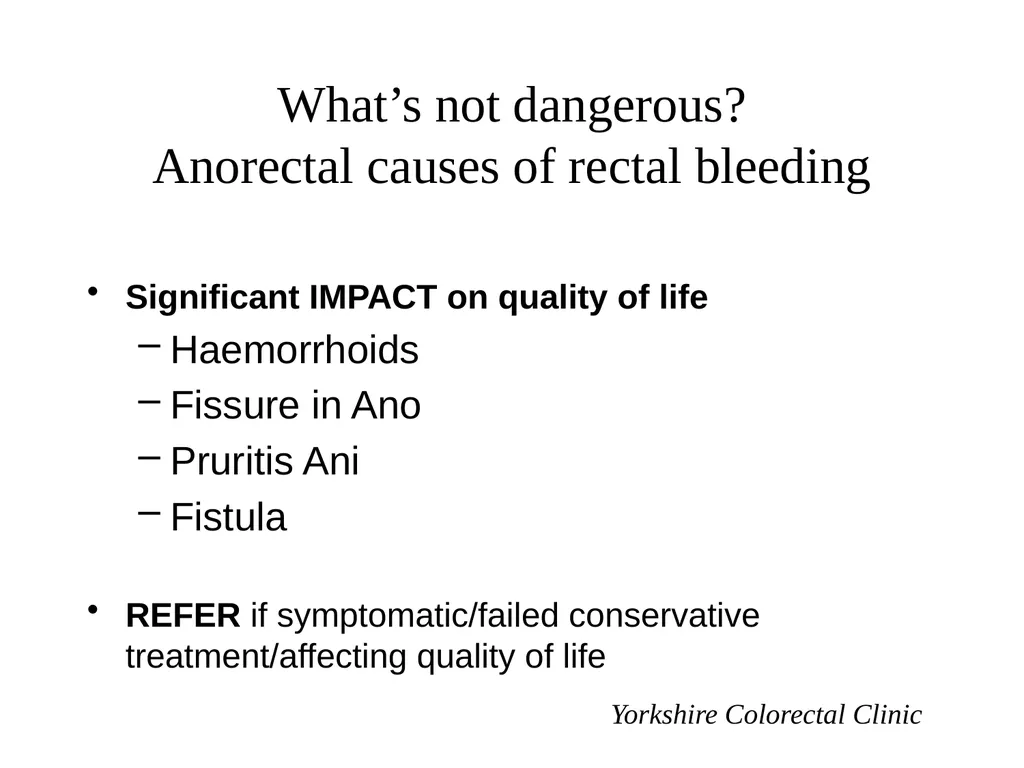
Anorectal causes of rectal bleeding Significant IMPACT on quality of life
Haemorrhoids
Fissure in Ano
Pruritis Ani
Fistula
REFER if symptomatic/failed conservative treatment/affecting quality of life<br>
Haemorrhoids
Fissure in Ano
Pruritis Ani
Fistula
REFER if symptomatic/failed conservative treatment/affecting quality of life<br>
38
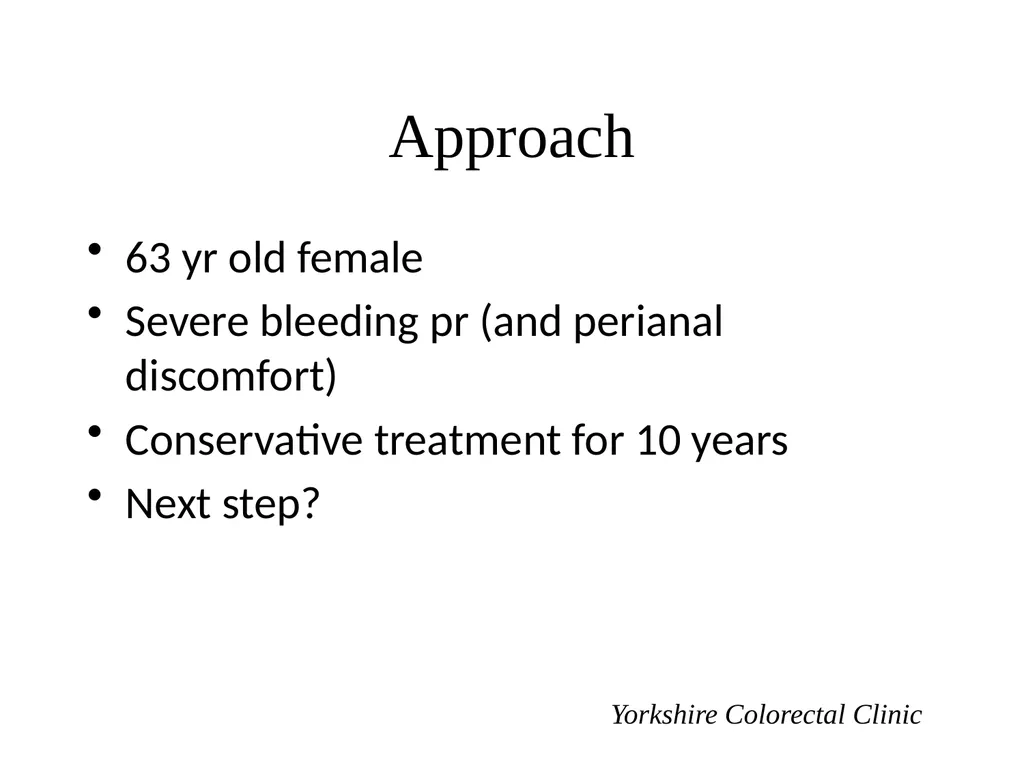
Approach 63 yr old female
Severe bleeding pr (and perianal discomfort)
Conservative treatment for 10 years
Next step?<br>
Severe bleeding pr (and perianal discomfort)
Conservative treatment for 10 years
Next step?<br>
39
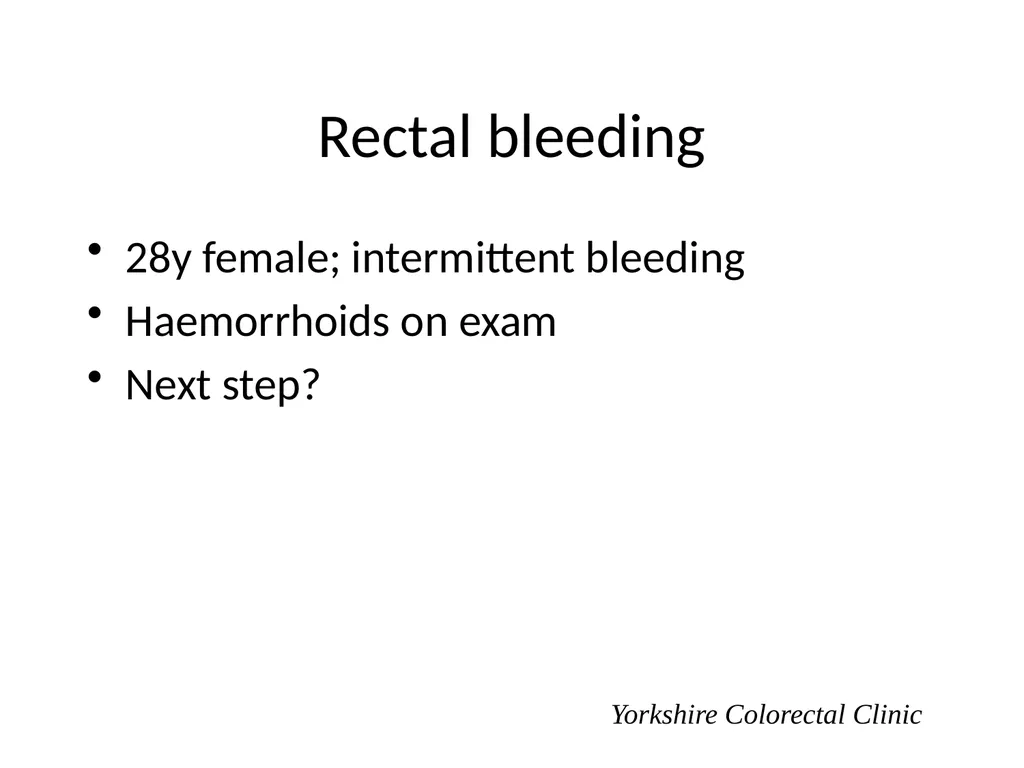
Rectal bleeding 28y female; intermittent bleeding
Haemorrhoids on exam
Next step?<br>
Haemorrhoids on exam
Next step?<br>
40
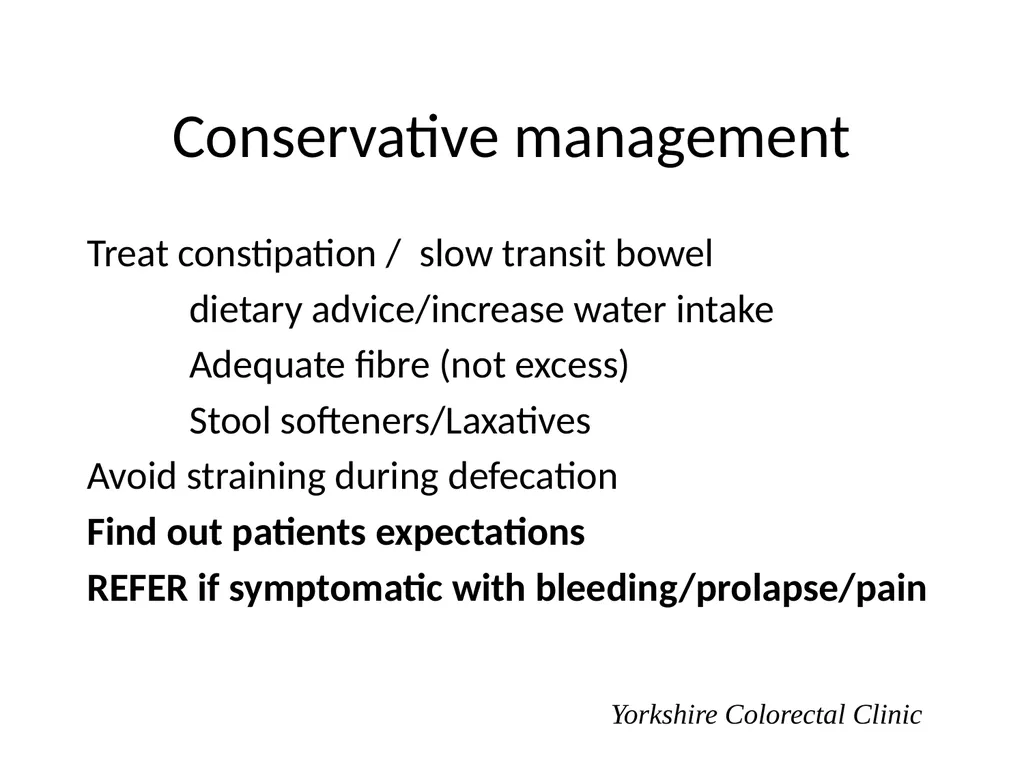
Conservative management Treat constipation / slow transit bowel
dietary advice/increase water intake
Adequate fibre (not excess)
Stool softeners/Laxatives
Avoid straining during defecation
Find out patients expectations
REFER if symptomatic with bleeding/prolapse/pain<br>
dietary advice/increase water intake
Adequate fibre (not excess)
Stool softeners/Laxatives
Avoid straining during defecation
Find out patients expectations
REFER if symptomatic with bleeding/prolapse/pain<br>
41
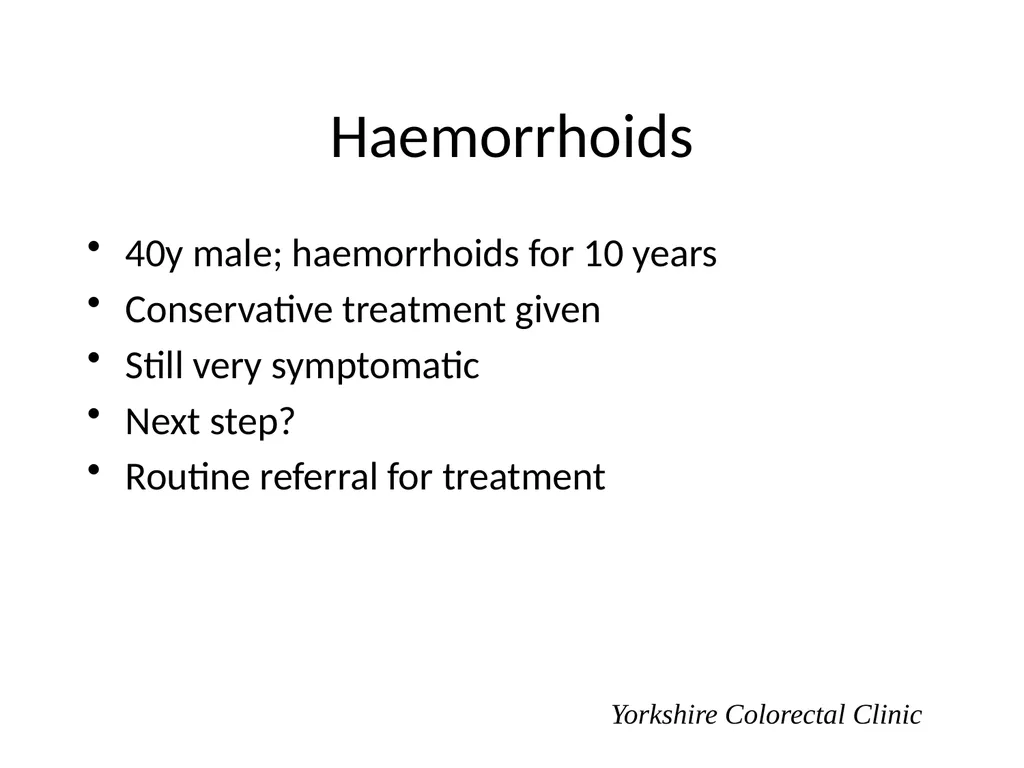
Haemorrhoids 40y male; haemorrhoids for 10 years
Conservative treatment given
Still very symptomatic
Next step?
Routine referral for treatment<br>
Conservative treatment given
Still very symptomatic
Next step?
Routine referral for treatment<br>
42
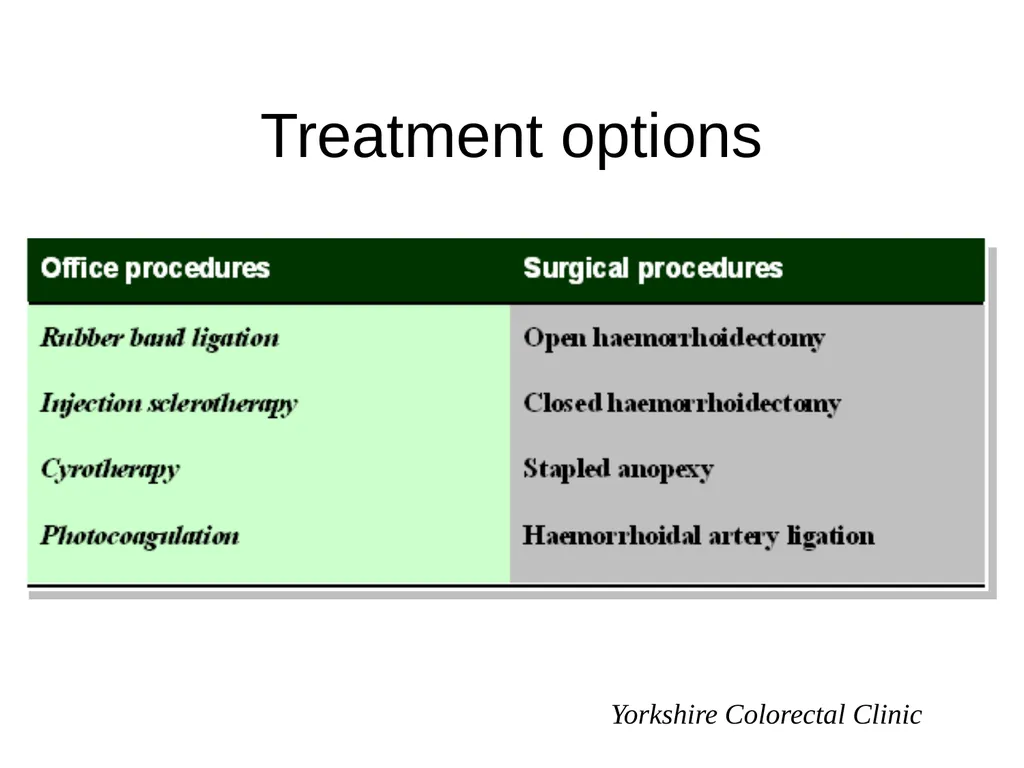
Treatment options<br>
43
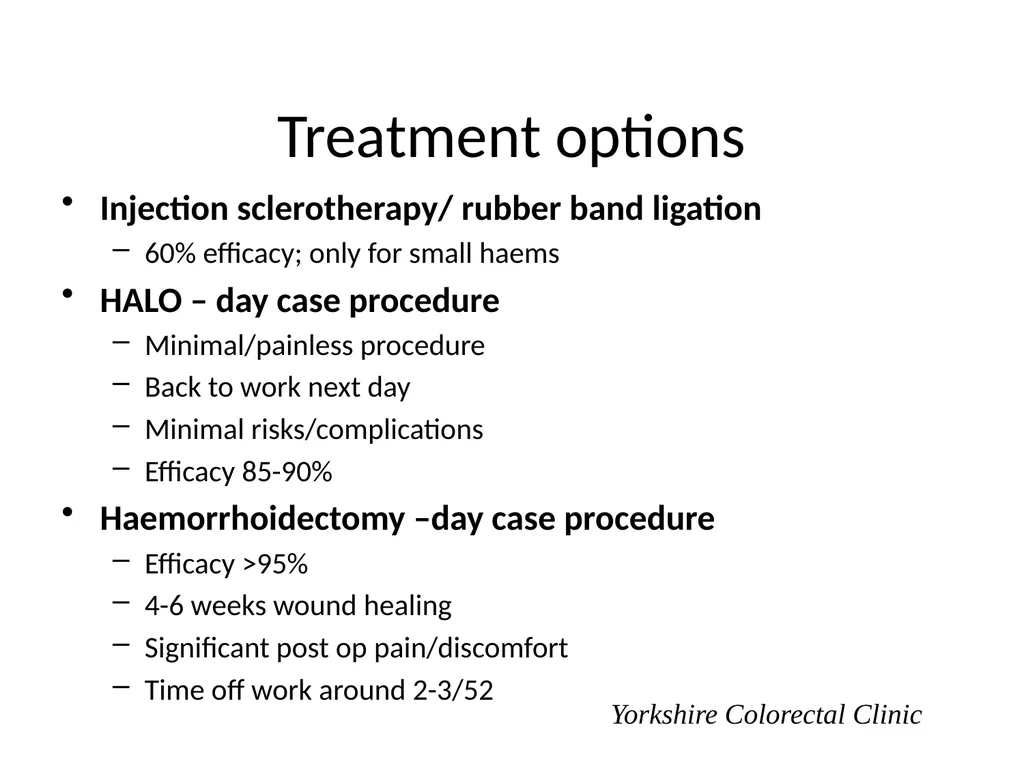
Treatment options Injection sclerotherapy/ rubber band ligation
60% efficacy; only for small haems
HALO – day case procedure
Minimal/painless procedure
Back to work next day
Minimal risks/complications
Efficacy 85-90%
Haemorrhoidectomy –day case procedure
Efficacy >95%
4-6 weeks wound healing
Significant post op pain/discomfort
Time off work around 2-3/52<br>
60% efficacy; only for small haems
HALO – day case procedure
Minimal/painless procedure
Back to work next day
Minimal risks/complications
Efficacy 85-90%
Haemorrhoidectomy –day case procedure
Efficacy >95%
4-6 weeks wound healing
Significant post op pain/discomfort
Time off work around 2-3/52<br>
44
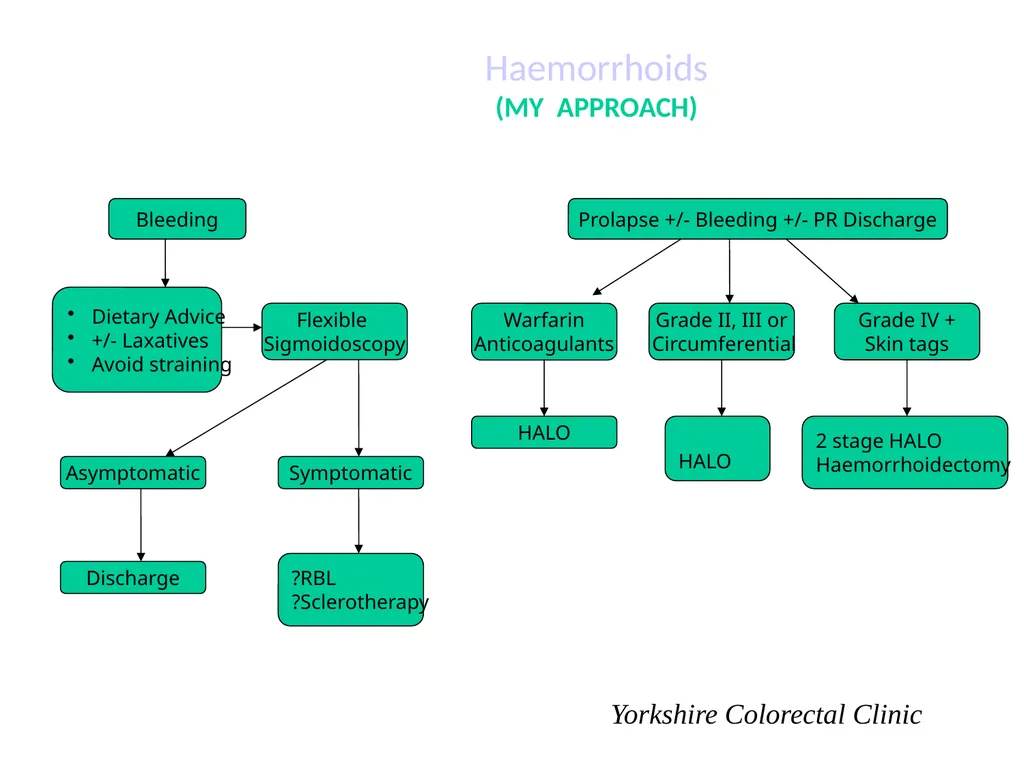
Haemorrhoids
(MY APPROACH) Bleeding Prolapse +/- Bleeding +/- PR Discharge Dietary Advice
+/- Laxatives
Avoid straining Flexible
Sigmoidoscopy Asymptomatic Symptomatic Discharge ?RBL
?Sclerotherapy Warfarin
Anticoagulants Grade II, III or
Circumferential HALO Grade IV +
Skin tags HALO 2 stage HALO
Haemorrhoidectomy<br>
+/- Laxatives
Avoid straining Flexible
Sigmoidoscopy Asymptomatic Symptomatic Discharge ?RBL
?Sclerotherapy Warfarin
Anticoagulants Grade II, III or
Circumferential HALO Grade IV +
Skin tags HALO 2 stage HALO
Haemorrhoidectomy<br>
45
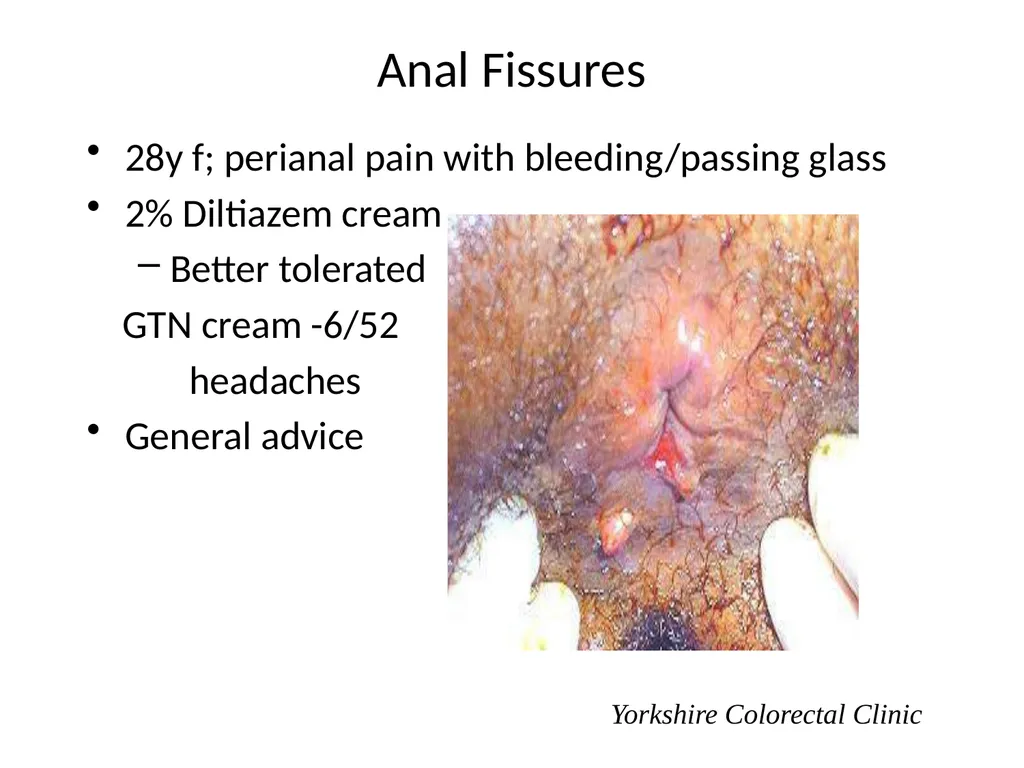
Anal Fissures 28y f; perianal pain with bleeding/passing glass
2% Diltiazem cream
Better tolerated
GTN cream -6/52
headaches
General advice<br>
2% Diltiazem cream
Better tolerated
GTN cream -6/52
headaches
General advice<br>
46
Refer if: if no response/persistent symptoms
Unusual position of fissure eg. Anterior/lateral
Multiple fissures
Associated pathologies- Crohns, HIV, carcinoma etc.
Other symptoms/family history of iBD
Need evaluation of bowel
Options:
Botox injection (70%)
Sphincterotomy (>95% success rate)
Advancement flap<br>
Unusual position of fissure eg. Anterior/lateral
Multiple fissures
Associated pathologies- Crohns, HIV, carcinoma etc.
Other symptoms/family history of iBD
Need evaluation of bowel
Options:
Botox injection (70%)
Sphincterotomy (>95% success rate)
Advancement flap<br>
47
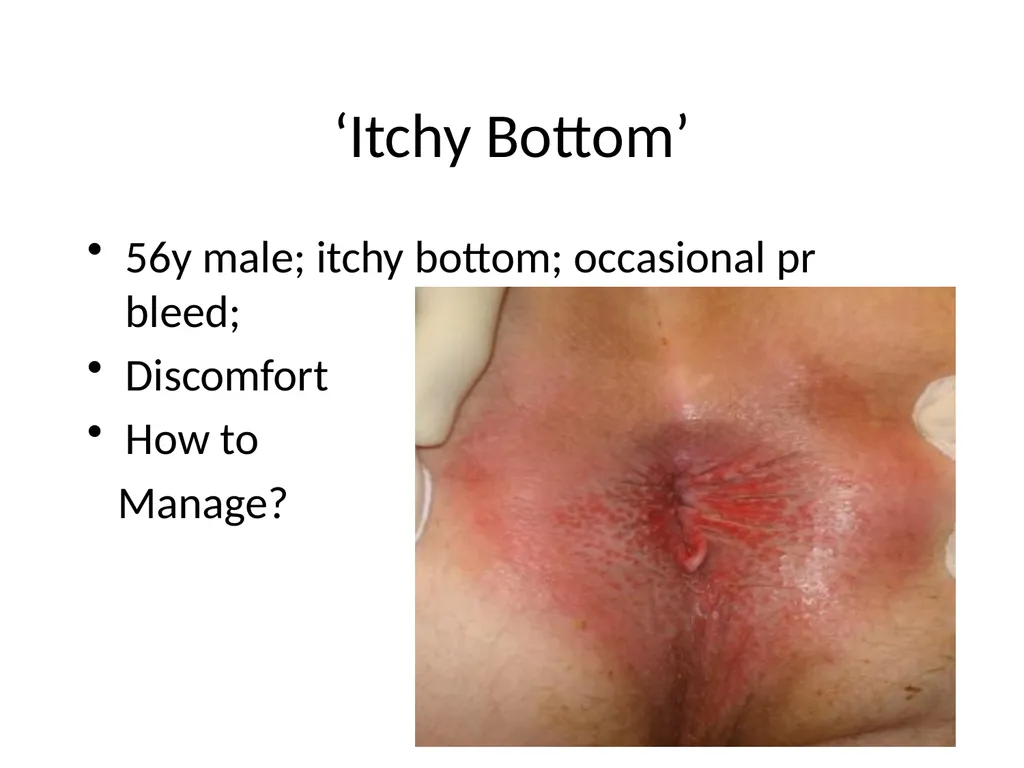
‘Itchy Bottom’ 56y male; itchy bottom; occasional pr bleed;
Discomfort
How to
Manage?<br>
Discomfort
How to
Manage?<br>
48
Itchy Bottom Causes:
Haemorrhoids/skin tags
Incontinence
anal fistulae/fissures/warts
Dietary- excess coffee/tea/beer/citrus fruits/ tomatoes/spicy foods
Infections
Skin conditions-psoriasis, dermatitis etc.
diabetes mellitus, leukemia, kidney failure, liver diseases<br>
Haemorrhoids/skin tags
Incontinence
anal fistulae/fissures/warts
Dietary- excess coffee/tea/beer/citrus fruits/ tomatoes/spicy foods
Infections
Skin conditions-psoriasis, dermatitis etc.
diabetes mellitus, leukemia, kidney failure, liver diseases<br>
49
Treatment Patient advice
Refer for treatment of haemorrhoids/other causes
Soothing creams<br>
Refer for treatment of haemorrhoids/other causes
Soothing creams<br>
50
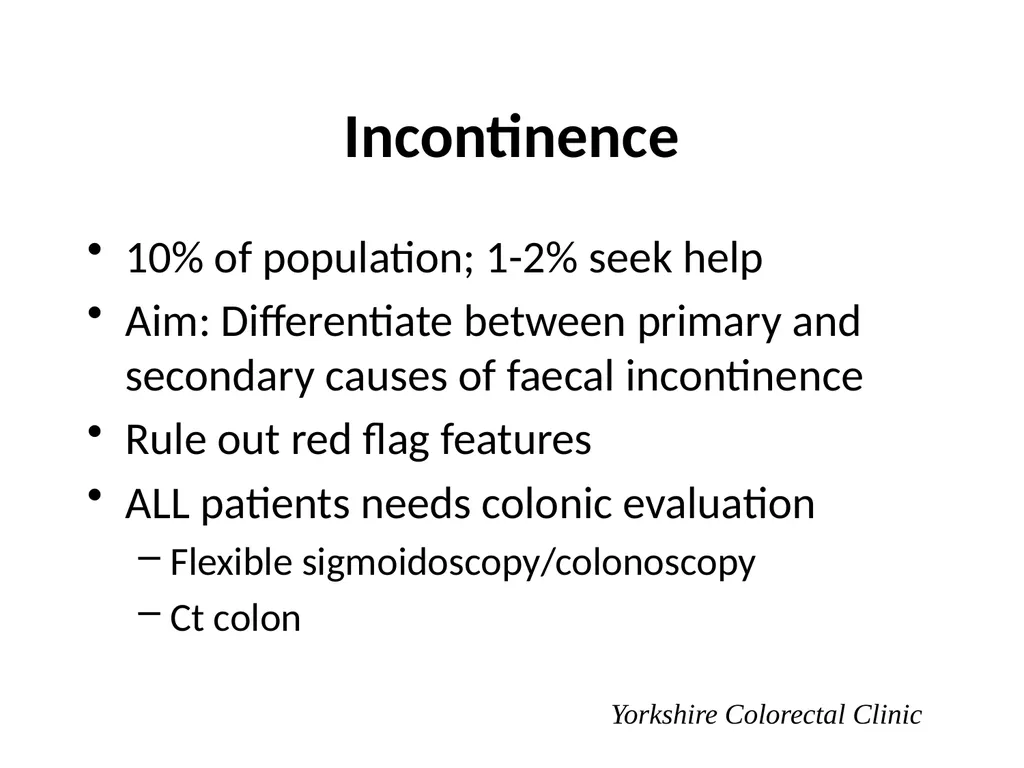
Incontinence 10% of population; 1-2% seek help
Aim: Differentiate between primary and secondary causes of faecal incontinence
Rule out red flag features
ALL patients needs colonic evaluation
Flexible sigmoidoscopy/colonoscopy
Ct colon<br>
Aim: Differentiate between primary and secondary causes of faecal incontinence
Rule out red flag features
ALL patients needs colonic evaluation
Flexible sigmoidoscopy/colonoscopy
Ct colon<br>
51
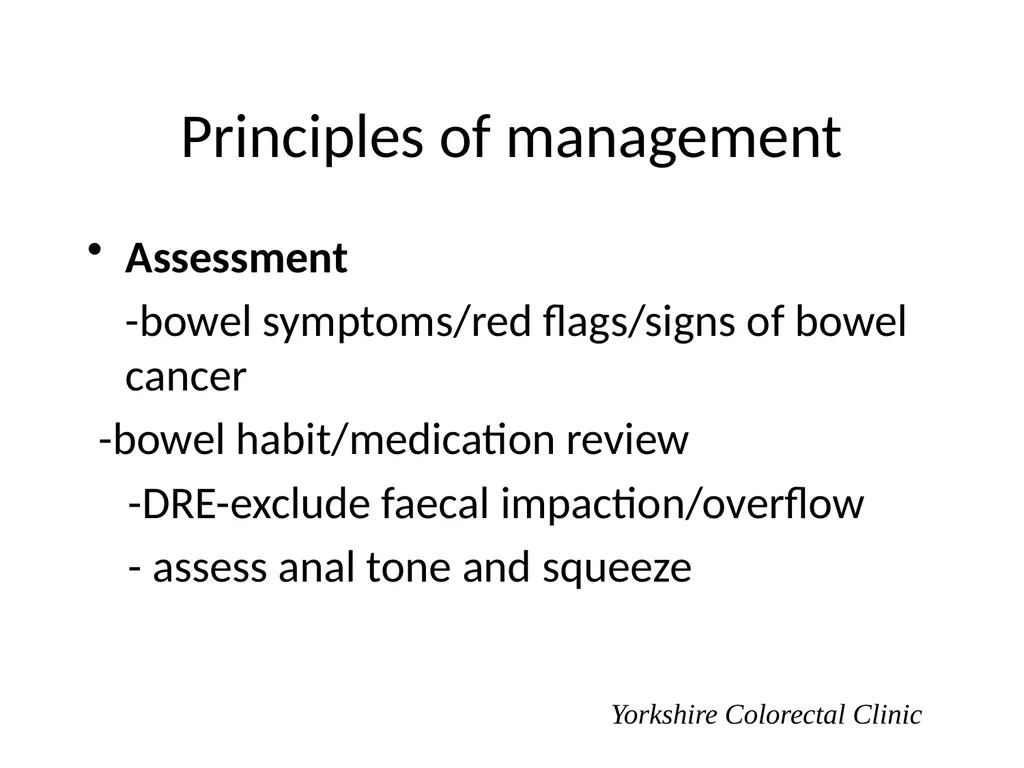
Principles of management Assessment
-bowel symptoms/red flags/signs of bowel cancer
-bowel habit/medication review
-DRE-exclude faecal impaction/overflow
- assess anal tone and squeeze<br>
-bowel symptoms/red flags/signs of bowel cancer
-bowel habit/medication review
-DRE-exclude faecal impaction/overflow
- assess anal tone and squeeze<br>
52
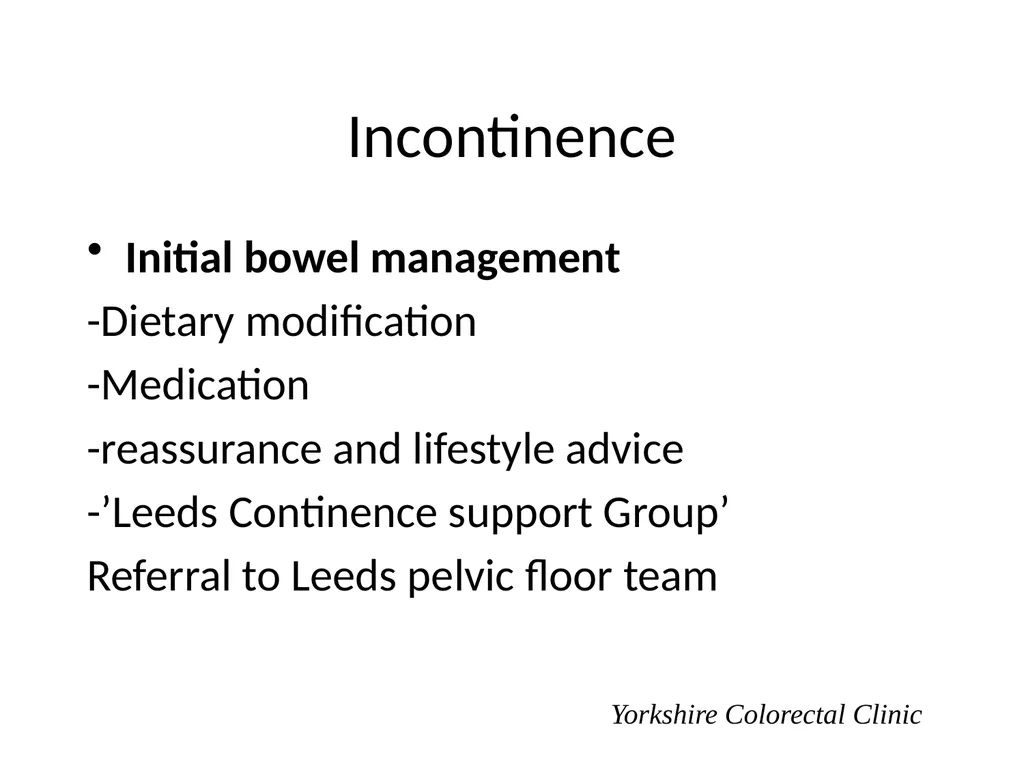
Incontinence Initial bowel management
-Dietary modification
-Medication
-reassurance and lifestyle advice
-’Leeds Continence support Group’
Referral to Leeds pelvic floor team<br>
-Dietary modification
-Medication
-reassurance and lifestyle advice
-’Leeds Continence support Group’
Referral to Leeds pelvic floor team<br>
53
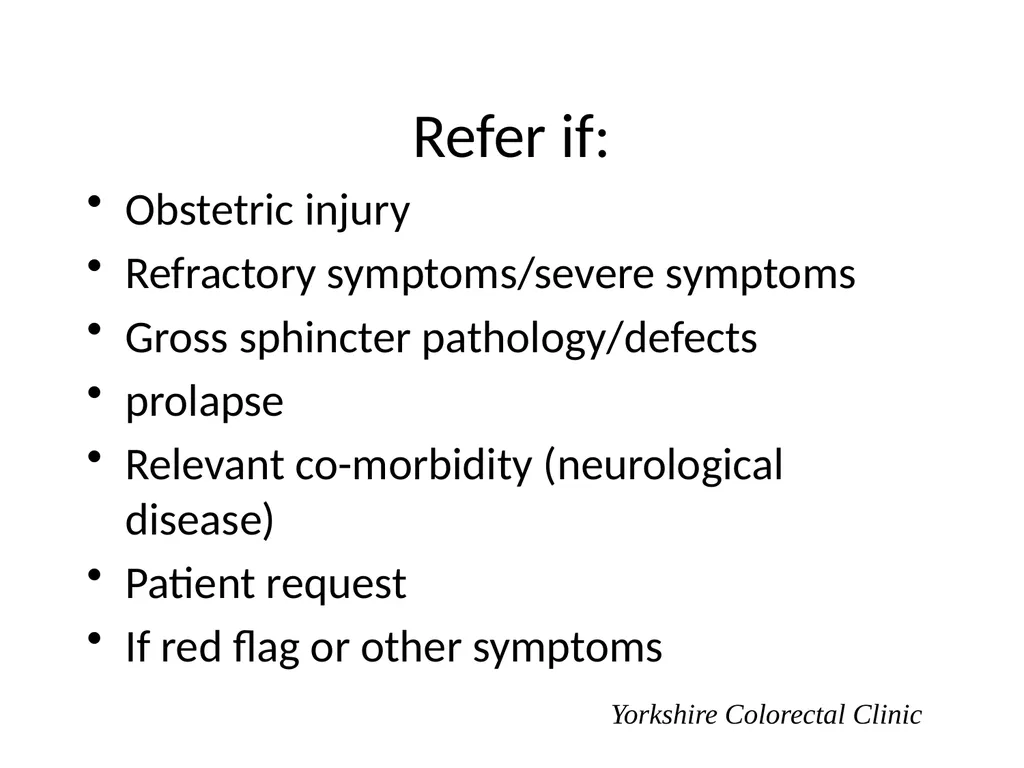
Refer if: Obstetric injury
Refractory symptoms/severe symptoms
Gross sphincter pathology/defects
prolapse
Relevant co-morbidity (neurological disease)
Patient request
If red flag or other symptoms<br>
Refractory symptoms/severe symptoms
Gross sphincter pathology/defects
prolapse
Relevant co-morbidity (neurological disease)
Patient request
If red flag or other symptoms<br>
54
Investigations Anorectal physiology
Resting & squeeze pressures
Endoanal ultrasound
ASSESS MULTICOMPARTMENT INVOLVEMENT
Leeds Pelvic floor MDT
Conservative treatment (nurse led)
Success rates: 20-30%<br>
Resting & squeeze pressures
Endoanal ultrasound
ASSESS MULTICOMPARTMENT INVOLVEMENT
Leeds Pelvic floor MDT
Conservative treatment (nurse led)
Success rates: 20-30%<br>
55
Surgical options Sphincter repair
Sacral Neuromodulation
Gold standard of treatment
Success rates: 80%; (60% fully continent)
FENIX magnetic sphincter
ACE procedure
Colostomy<br>
Sacral Neuromodulation
Gold standard of treatment
Success rates: 80%; (60% fully continent)
FENIX magnetic sphincter
ACE procedure
Colostomy<br>
56
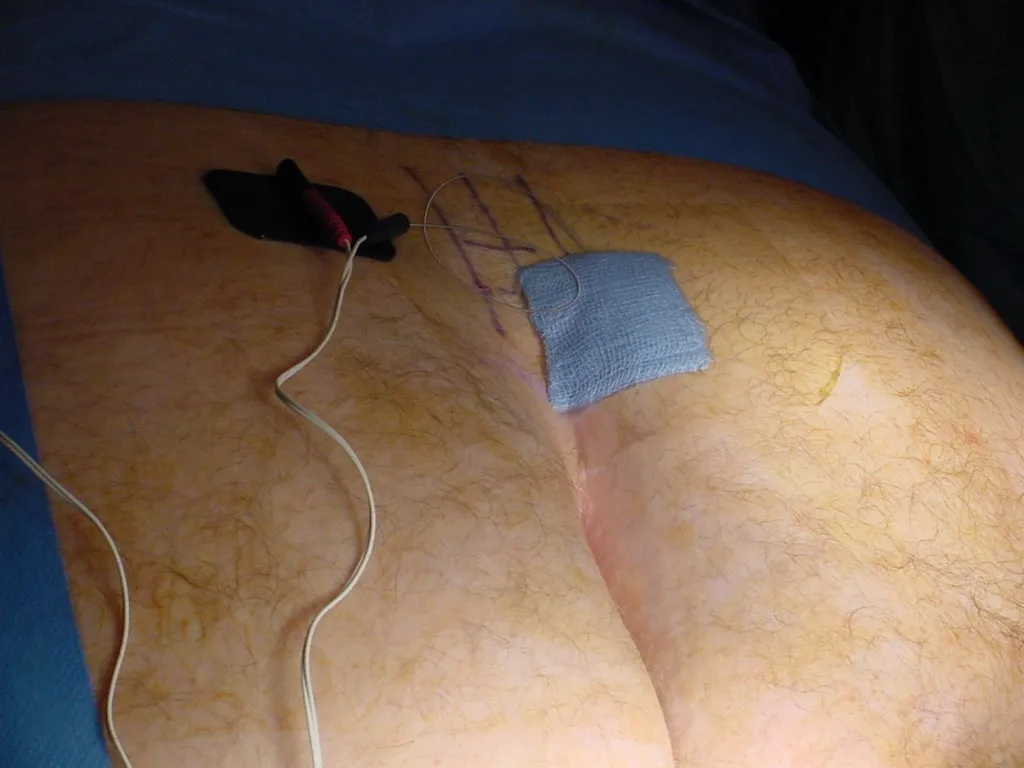
GATEKEEPER PROCEDURE<br>
57
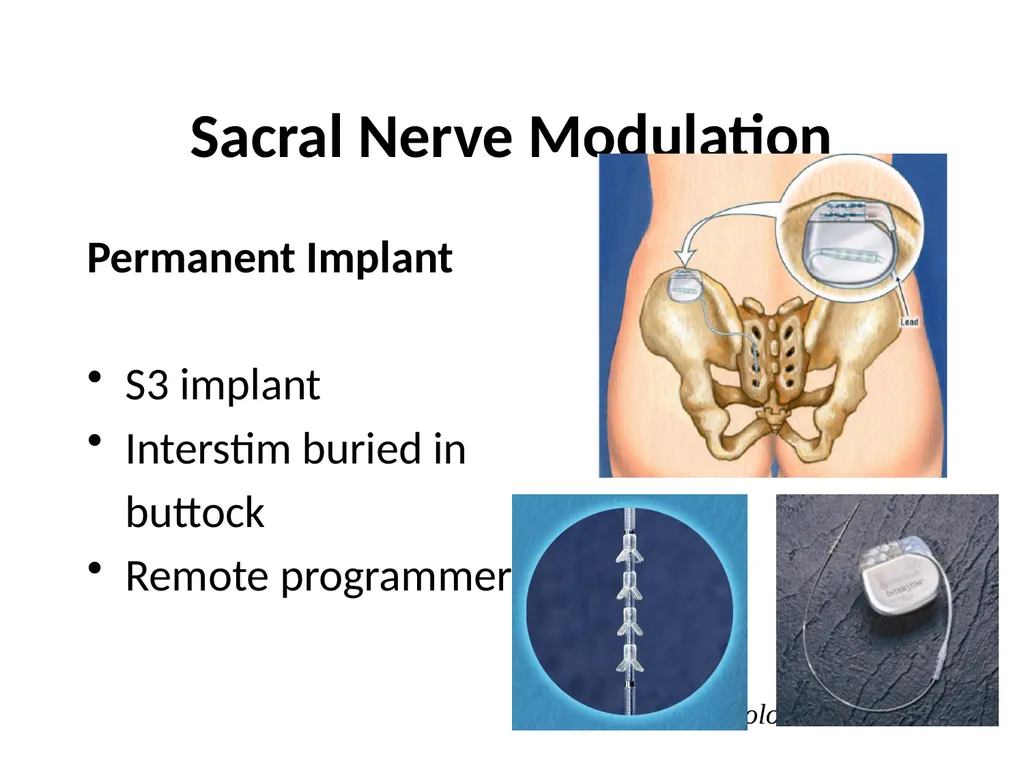
Sacral Nerve Modulation Permanent Implant
S3 implant
Interstim buried in
buttock
Remote programmer<br>
S3 implant
Interstim buried in
buttock
Remote programmer<br>
58
Obstructed defecation syndrome Difficulty in evacuation; long time on toilet/digitation to evacuate
Internal rectal prolapse/rectocoele/descent
Treatable:
Conservative treatment
Lap ventral mesh rectopexy
STARR procedure<br>
Internal rectal prolapse/rectocoele/descent
Treatable:
Conservative treatment
Lap ventral mesh rectopexy
STARR procedure<br>
59
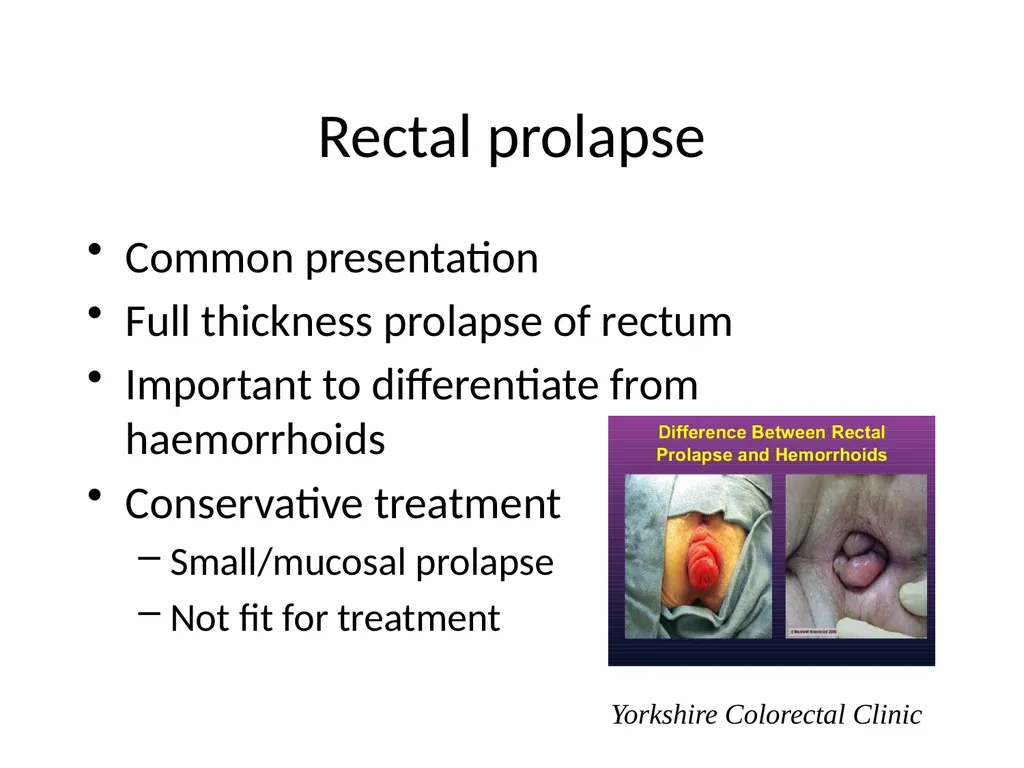
Rectal prolapse Common presentation
Full thickness prolapse of rectum
Important to differentiate from haemorrhoids
Conservative treatment
Small/mucosal prolapse
Not fit for treatment<br>
Full thickness prolapse of rectum
Important to differentiate from haemorrhoids
Conservative treatment
Small/mucosal prolapse
Not fit for treatment<br>
60
What we can do? Perineal procedures:
Adv: for less fit pts; short procedures;
Disadv: high recurrence rates (upto 50%)
Abdominal procedure:
Laparoscopic ventral mesh rectopexy
Success rates around 95%
Very low morbidity
Usually 23 hour stay
Gold standard of treatment<br>
Adv: for less fit pts; short procedures;
Disadv: high recurrence rates (upto 50%)
Abdominal procedure:
Laparoscopic ventral mesh rectopexy
Success rates around 95%
Very low morbidity
Usually 23 hour stay
Gold standard of treatment<br>
61
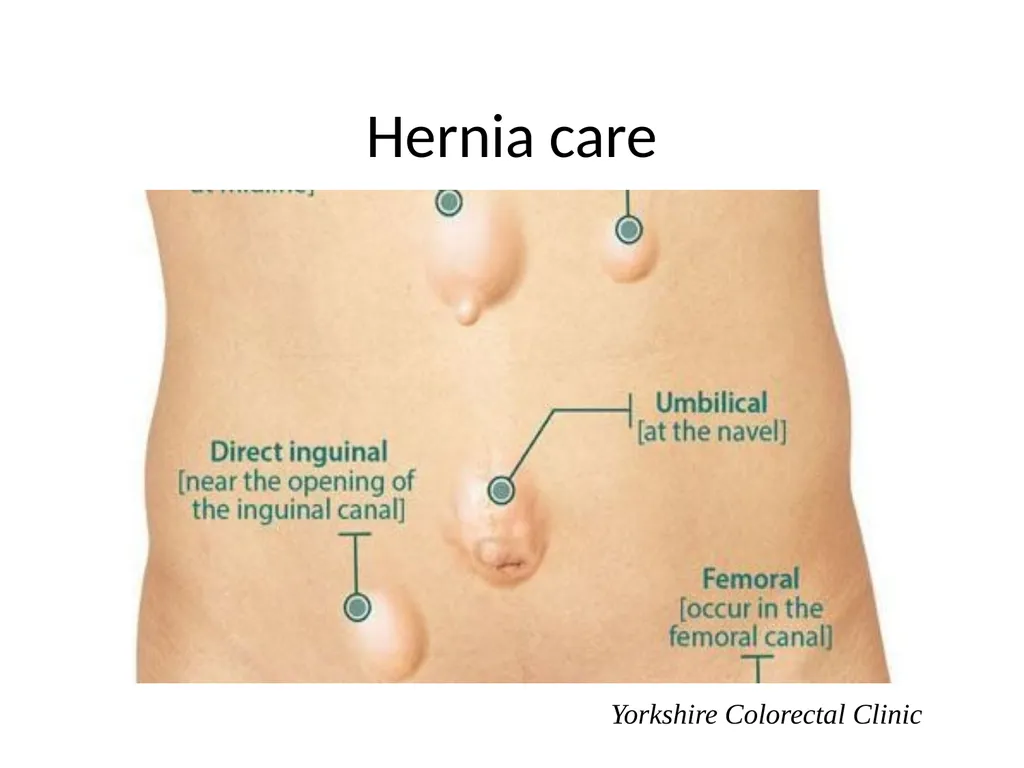
Hernia care<br>
62
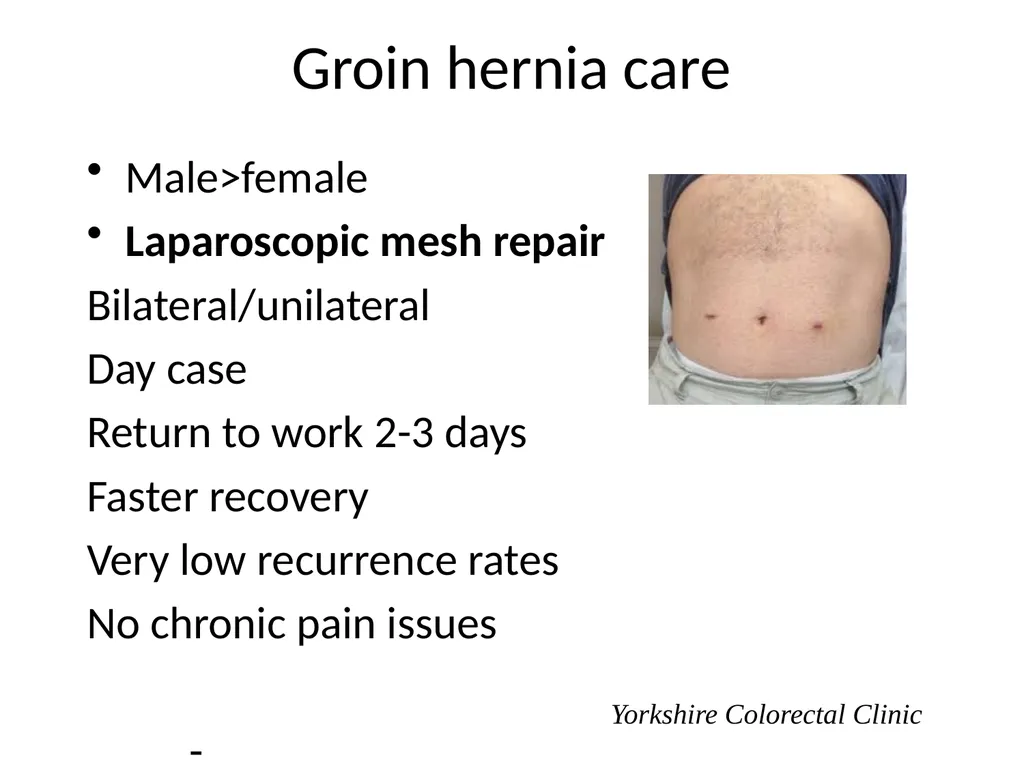
Groin hernia care Male>female
Laparoscopic mesh repair
Bilateral/unilateral
Day case
Return to work 2-3 days
Faster recovery
Very low recurrence rates
No chronic pain issues
-<br>
Laparoscopic mesh repair
Bilateral/unilateral
Day case
Return to work 2-3 days
Faster recovery
Very low recurrence rates
No chronic pain issues
-<br>
63
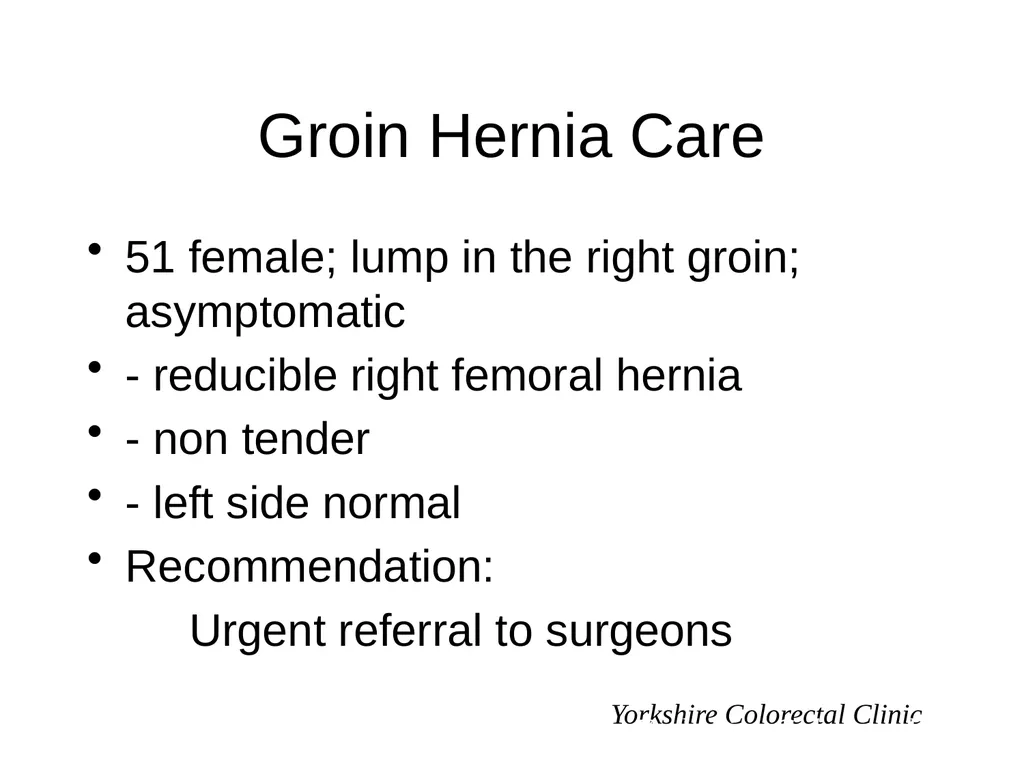
Groin Hernia Care 51 female; lump in the right groin; asymptomatic
- reducible right femoral hernia
- non tender
- left side normal
Recommendation:
Urgent referral to surgeons
/ The Yorkshire Colorectal Clinic<br>
- reducible right femoral hernia
- non tender
- left side normal
Recommendation:
Urgent referral to surgeons
/ The Yorkshire Colorectal Clinic<br>
64
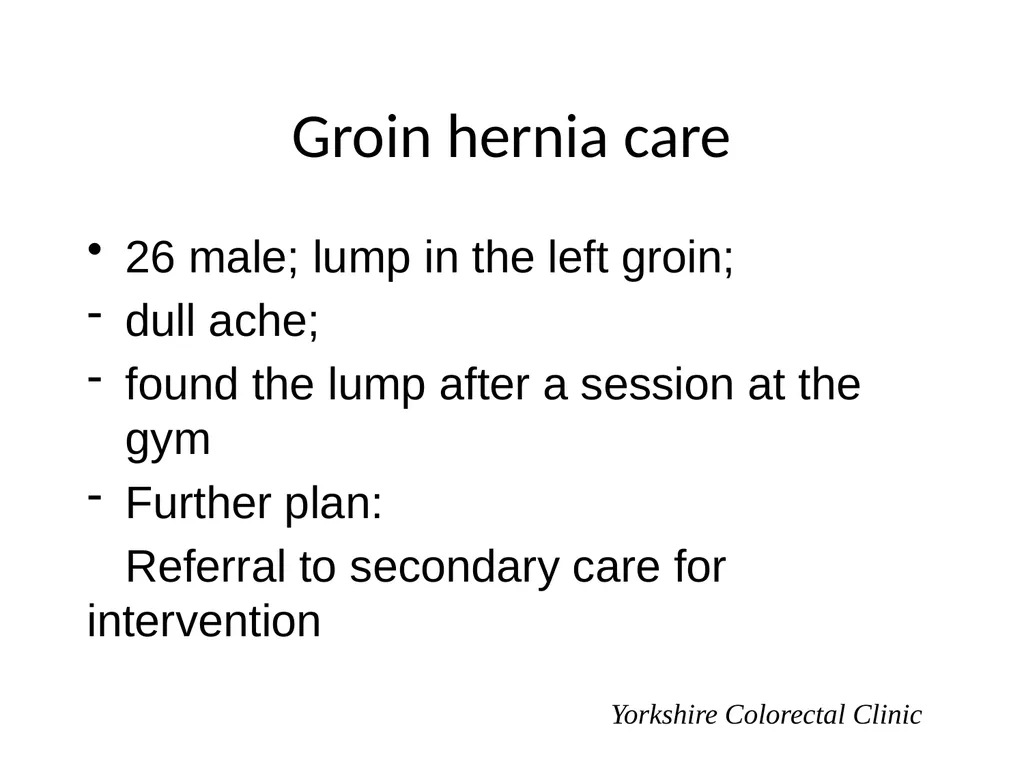
Groin hernia care 26 male; lump in the left groin;
dull ache;
found the lump after a session at the gym
Further plan:
Referral to secondary care for intervention<br>
dull ache;
found the lump after a session at the gym
Further plan:
Referral to secondary care for intervention<br>
65
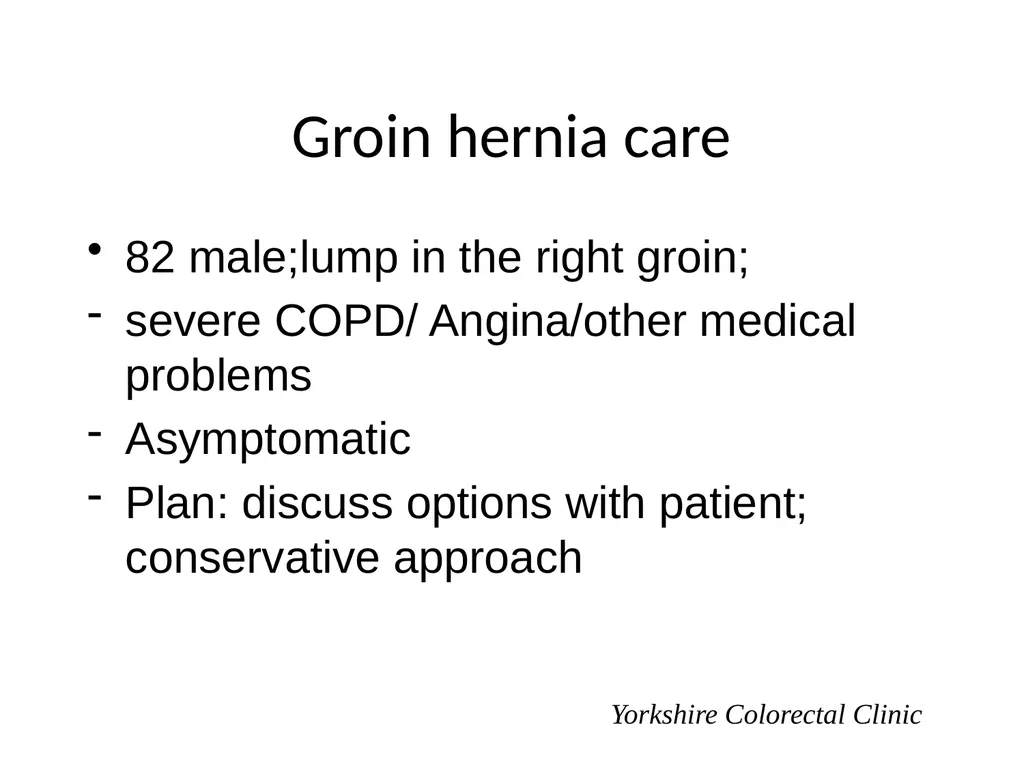
Groin hernia care 82 male;lump in the right groin;
severe COPD/ Angina/other medical problems
Asymptomatic
Plan: discuss options with patient; conservative approach<br>
severe COPD/ Angina/other medical problems
Asymptomatic
Plan: discuss options with patient; conservative approach<br>
66
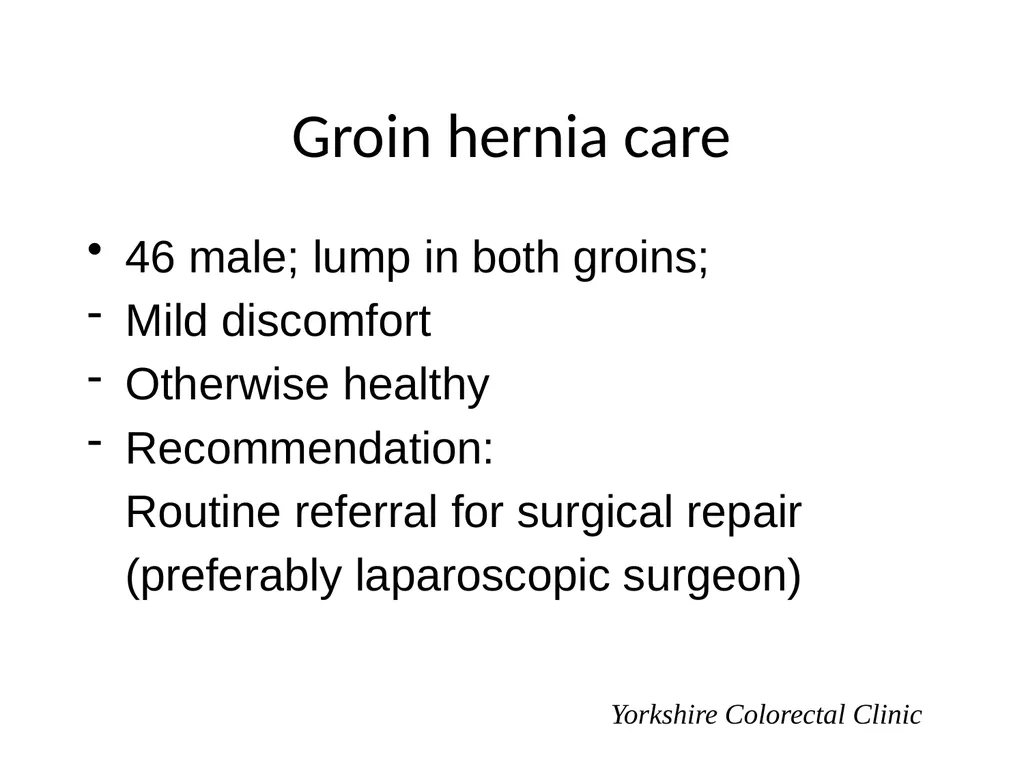
Groin hernia care 46 male; lump in both groins;
Mild discomfort
Otherwise healthy
Recommendation:
Routine referral for surgical repair
(preferably laparoscopic surgeon)ur<br>
Mild discomfort
Otherwise healthy
Recommendation:
Routine referral for surgical repair
(preferably laparoscopic surgeon)ur<br>
67
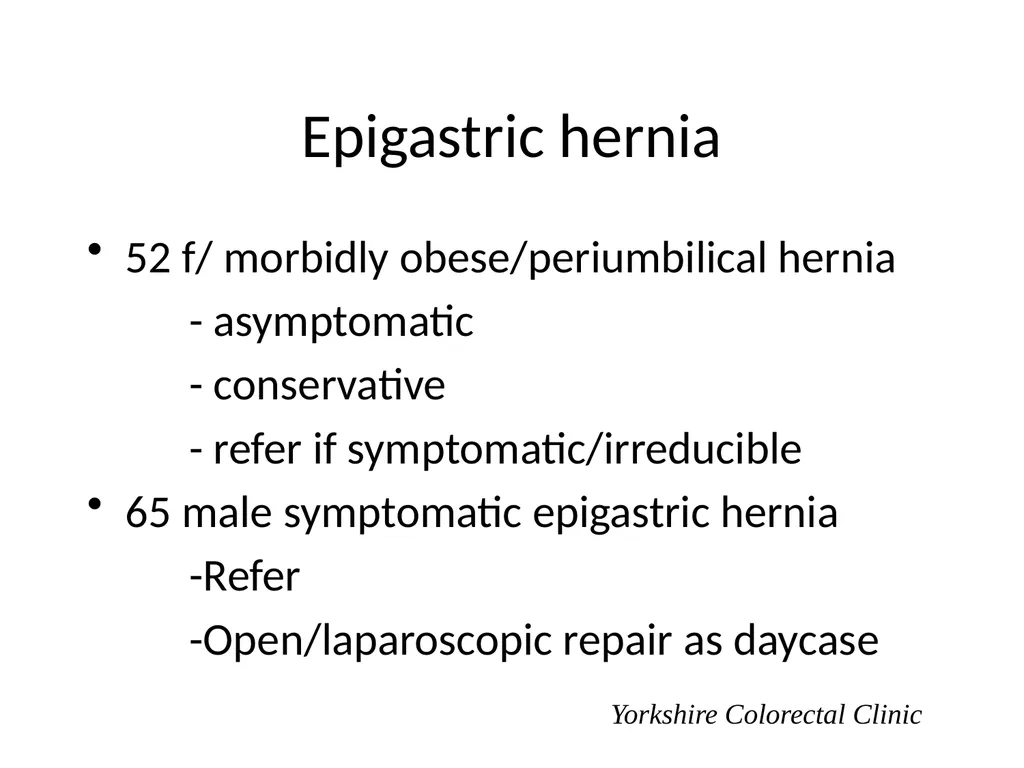
Epigastric hernia 52 f/ morbidly obese/periumbilical hernia
- asymptomatic
- conservative
- refer if symptomatic/irreducible
65 male symptomatic epigastric hernia
-Refer
-Open/laparoscopic repair as daycase<br>
- asymptomatic
- conservative
- refer if symptomatic/irreducible
65 male symptomatic epigastric hernia
-Refer
-Open/laparoscopic repair as daycase<br>
68
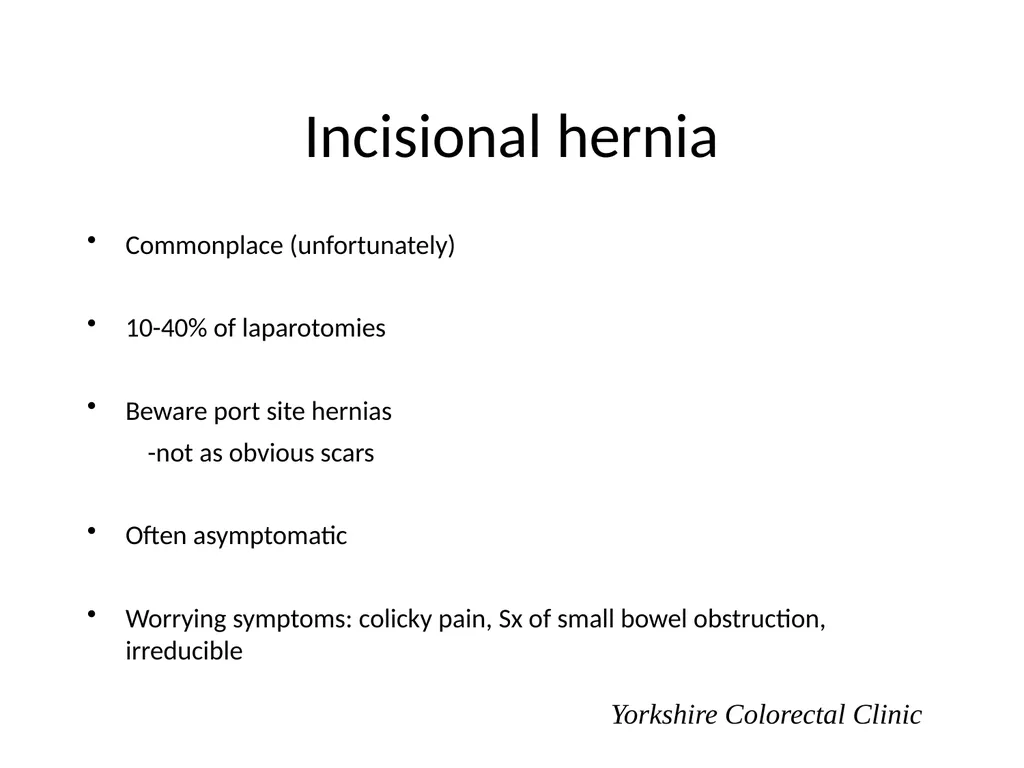
Incisional hernia Commonplace (unfortunately)
10-40% of laparotomies
Beware port site hernias
-not as obvious scars
Often asymptomatic
Worrying symptoms: colicky pain, Sx of small bowel obstruction, irreducible<br>
10-40% of laparotomies
Beware port site hernias
-not as obvious scars
Often asymptomatic
Worrying symptoms: colicky pain, Sx of small bowel obstruction, irreducible<br>
69
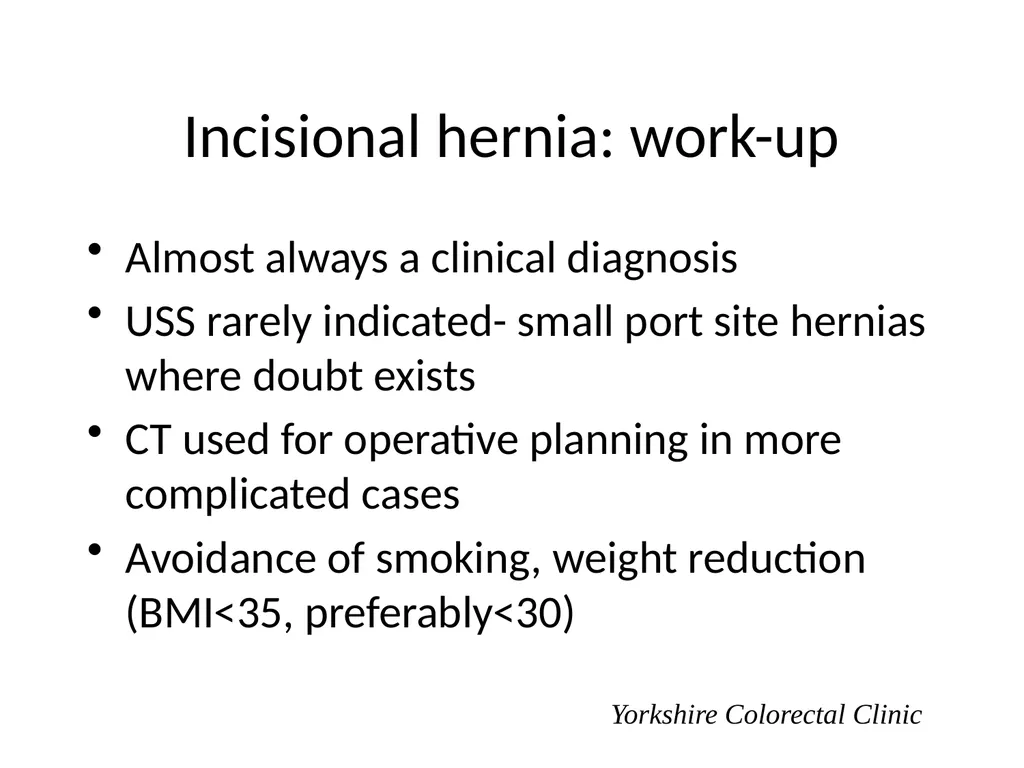
Incisional hernia: work-up Almost always a clinical diagnosis
USS rarely indicated- small port site hernias where doubt exists
CT used for operative planning in more complicated cases
Avoidance of smoking, weight reduction (BMI<35, preferably<30)<br>
USS rarely indicated- small port site hernias where doubt exists
CT used for operative planning in more complicated cases
Avoidance of smoking, weight reduction (BMI<35, preferably<30)<br>
70
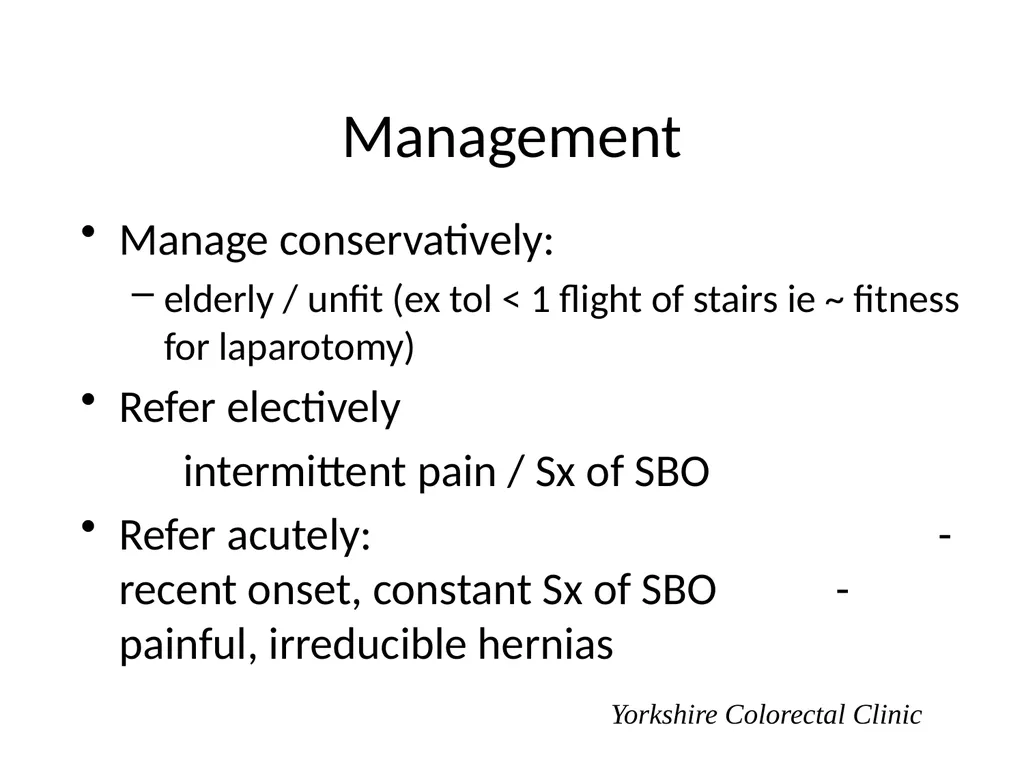
Management Manage conservatively:
elderly / unfit (ex tol < 1 flight of stairs ie ~ fitness for laparotomy)
Refer electively
intermittent pain / Sx of SBO
Refer acutely: -recent onset, constant Sx of SBO -painful, irreducible hernias<br>
elderly / unfit (ex tol < 1 flight of stairs ie ~ fitness for laparotomy)
Refer electively
intermittent pain / Sx of SBO
Refer acutely: -recent onset, constant Sx of SBO -painful, irreducible hernias<br>
71
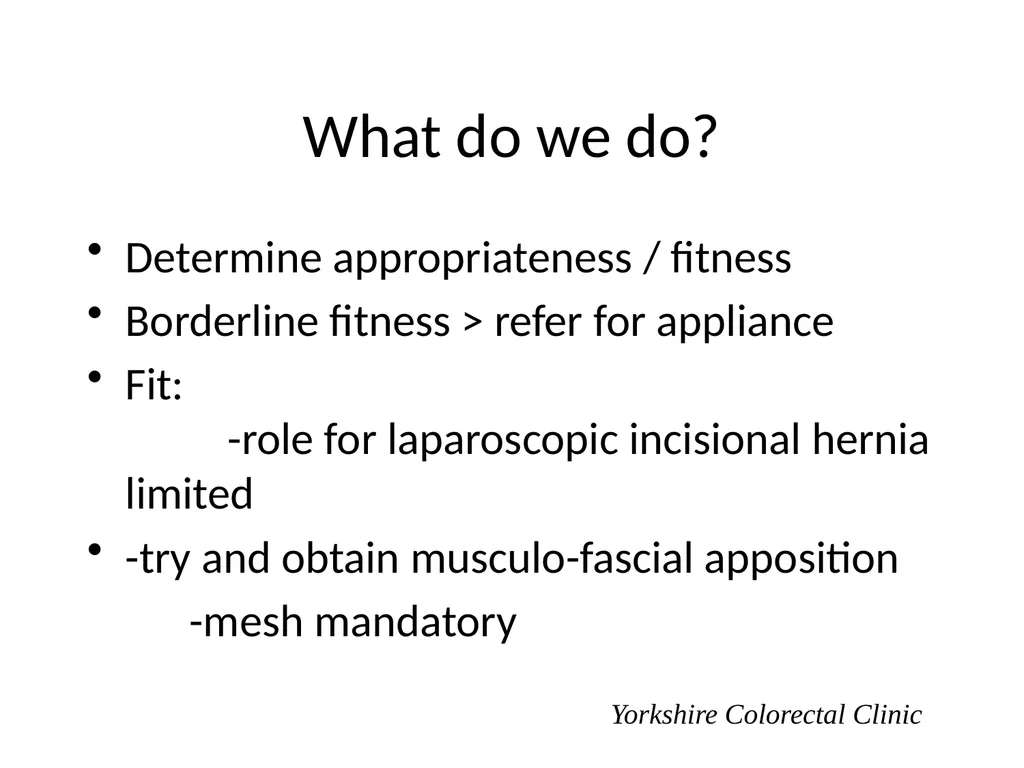
What do we do? Determine appropriateness / fitness
Borderline fitness > refer for appliance
Fit: -role for laparoscopic incisional hernia limited
-try and obtain musculo-fascial apposition
-mesh mandatory<br>
Borderline fitness > refer for appliance
Fit: -role for laparoscopic incisional hernia limited
-try and obtain musculo-fascial apposition
-mesh mandatory<br>
72
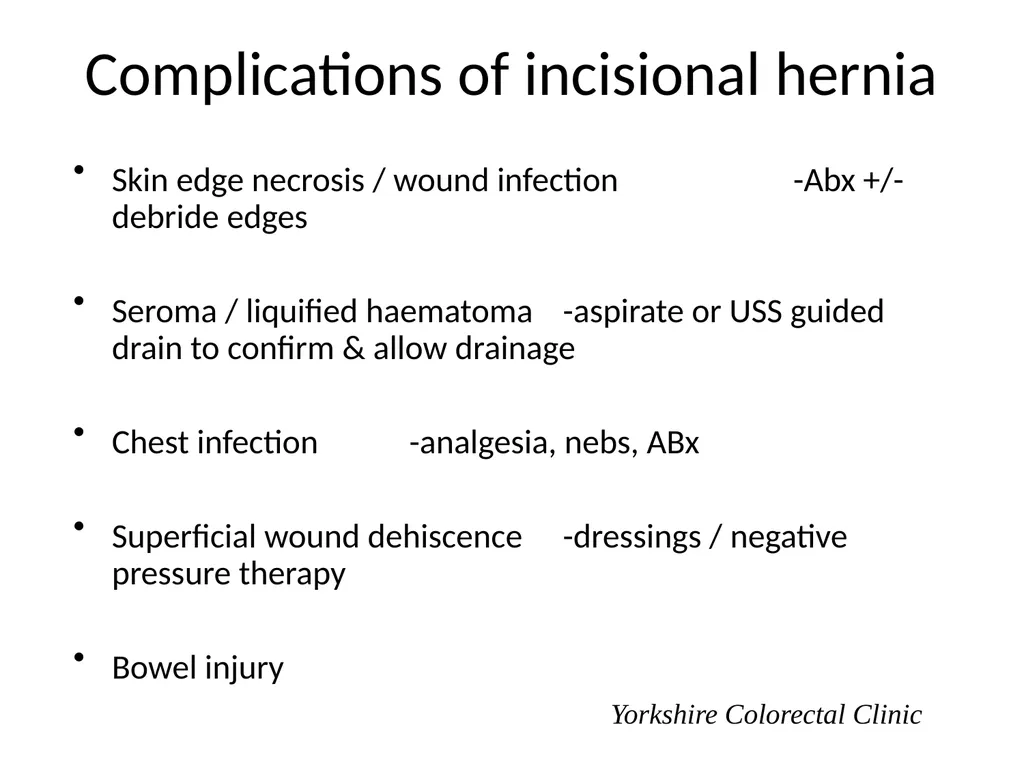
Complications of incisional hernia Skin edge necrosis / wound infection -Abx +/- debride edges
Seroma / liquified haematoma -aspirate or USS guided drain to confirm & allow drainage
Chest infection -analgesia, nebs, ABx
Superficial wound dehiscence -dressings / negative pressure therapy
Bowel injury<br>
Seroma / liquified haematoma -aspirate or USS guided drain to confirm & allow drainage
Chest infection -analgesia, nebs, ABx
Superficial wound dehiscence -dressings / negative pressure therapy
Bowel injury<br>
73
Yorkshire Colorectal Clinic
Spire Leeds Hospital Mr Sushil Maslekar
Phone: 07879068274
Liz Power 0113 2185931
Mr Ian Botterill
Phone: 07786250670
Kelley Hartley 0113 2185668<br>
Phone: 07879068274
Liz Power 0113 2185931
Mr Ian Botterill
Phone: 07786250670
Kelley Hartley 0113 2185668<br>