
Evidence Based Treatment to Improve Client, Staff,
FD
Published · 47 slides · 0 views
1 / 1












Description
Evidence Based Treatment to Improve Client, Staff, and Community Recovery Rain Carei, Ph.D. Psychologist 4 Washington corrections center for women What best describes the work you do? The Slido app must be installed on every computer youre
Related Topics
Share
Embed code
Download this presentation From Below
"Evidence Based Treatment to Improve Client, Staff," is the property of its rightful owner. Permission is granted to download and print the materials on this website for personal, non-commercial use only, and to display it on your personal computer provided you do not modify the materials and that you retain all copyright notices contained in the materials. By downloading content from our website, you accept the terms of this agreement.
Presentation Transcript
01
Evidence Based Treatment to Improve Client, Staff, and Community Recovery Rain Carei, Ph.D.
Psychologist 4
Washington corrections center for women<br>
Psychologist 4
Washington corrections center for women<br>
02
What best describes the work you do? The Slido app must be installed on every computer you’re presenting from Do not edit
How to change the design<br>
How to change the design<br>
03
Presentation Objectives Discuss the bridge between quality indicators, service provision, client recovery, and reduction of staff burnout
Identify key steps in creating correctional health care quality indicators, including client voice and choice
Analyze positive outcomes when tailored services are provided<br>
Identify key steps in creating correctional health care quality indicators, including client voice and choice
Analyze positive outcomes when tailored services are provided<br>
04
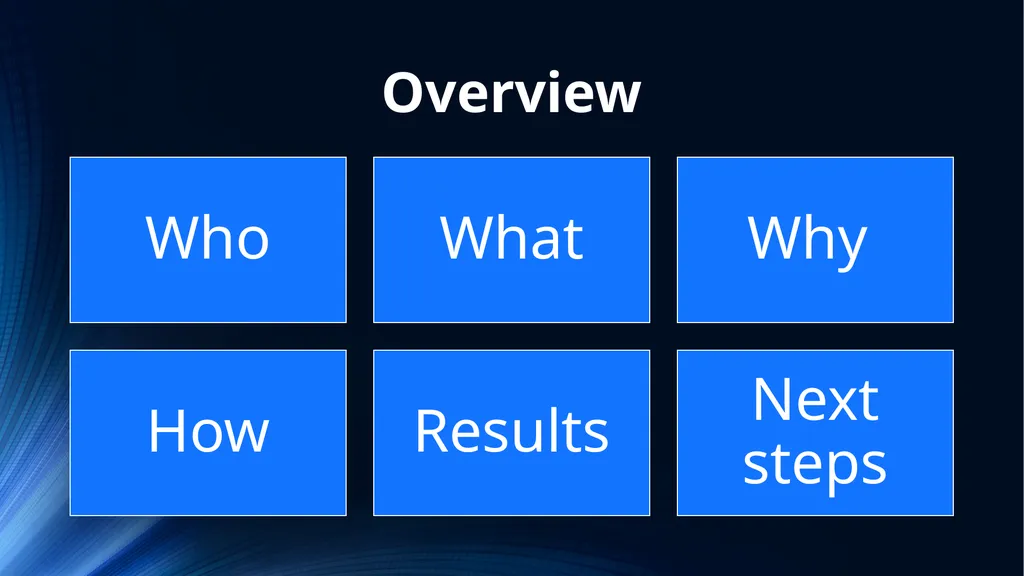
Overview<br>
05
The Who
Starting With a Story….<br>
06
What types of experiences do you think might contribute to women coming to prison? The Slido app must be installed on every computer you’re presenting from Do not edit
How to change the design<br>
How to change the design<br>
07
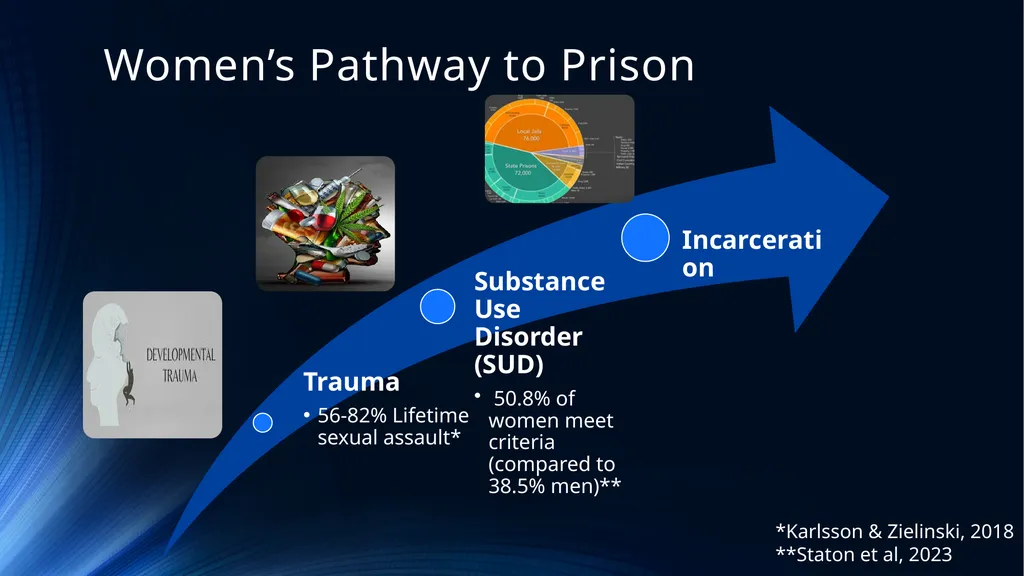
Women’s Pathway to Prison *Karlsson & Zielinski, 2018
**Staton et al, 2023<br>
**Staton et al, 2023<br>
08
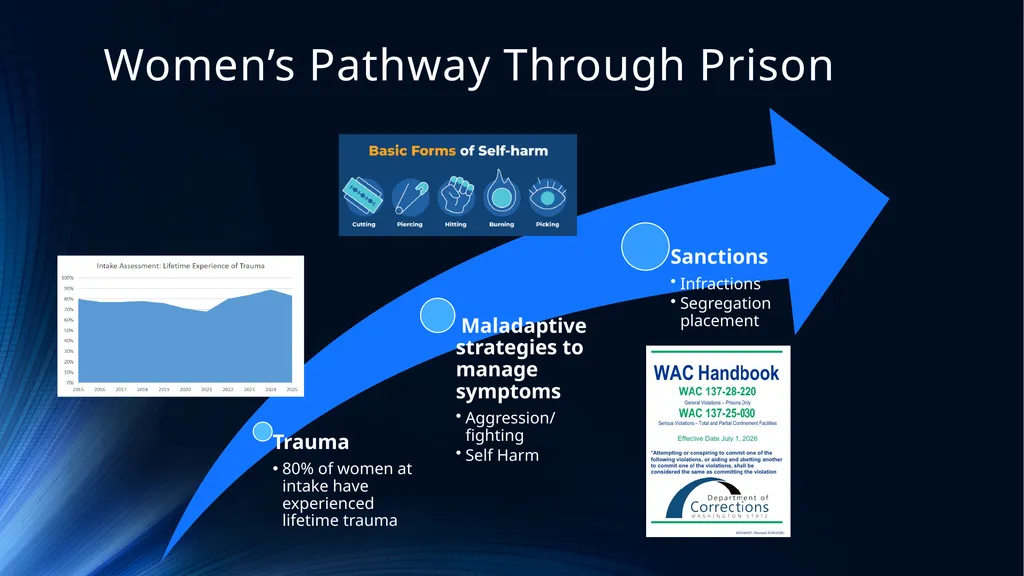
Women’s Pathway Through Prison<br>
09
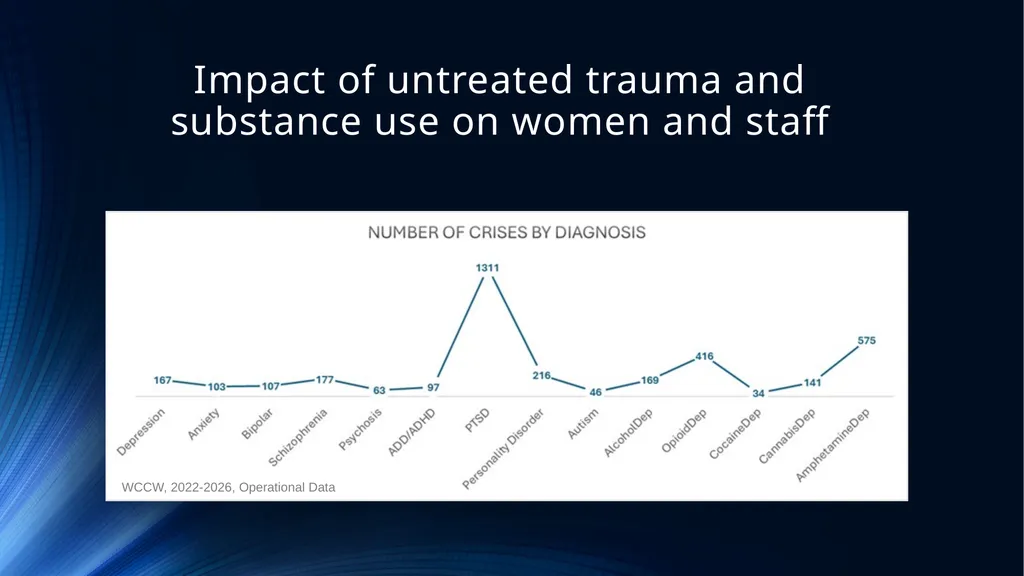
Impact of untreated trauma and substance use on women and staff WCCW, 2022-2026, Operational Data<br>
10
The Why Evidence Based Care and Measurement<br>
11
...because of global public health policy Reducing health inequalities is a fundamental principle of global public health policies (Stürup-Toft et al., 2018).
Statutory responsibilities towards the human rights of prisoners are outlined in the United Nations’ Standard Minimum Rules for Treatment of Prisoners (known as the Nelson Mandela Rules).People living in prison ‘should enjoy the same standards of health care that are available in the community’ (Rule 24.1)
Prison healthcare services are responsible for ‘evaluating, promoting, protecting and improving’ the health of incarcerated people (Rule 25.1) (United Nations General Assembly, 2015).<br>
12
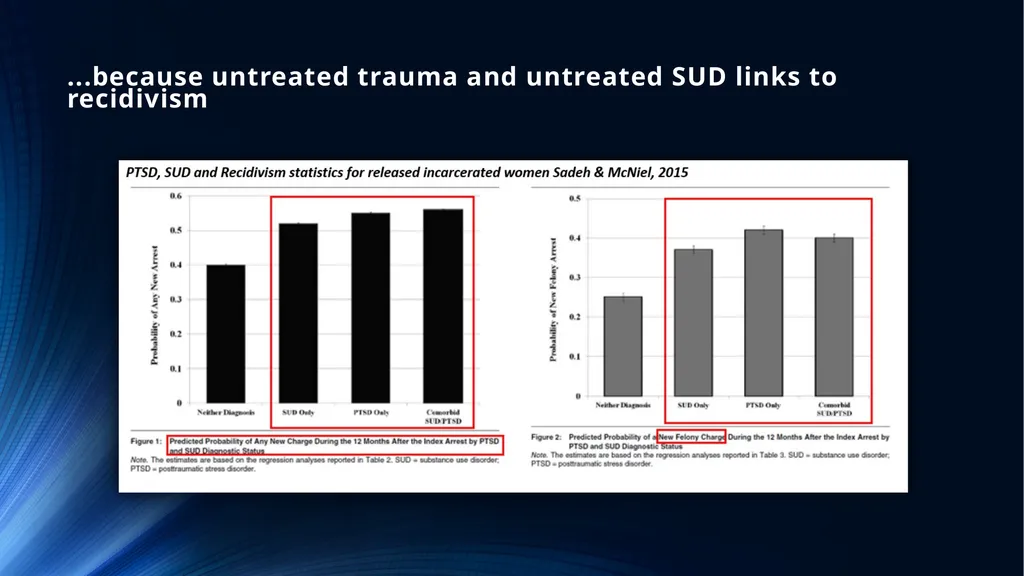
...because untreated trauma and untreated SUD links to recidivism<br>
13
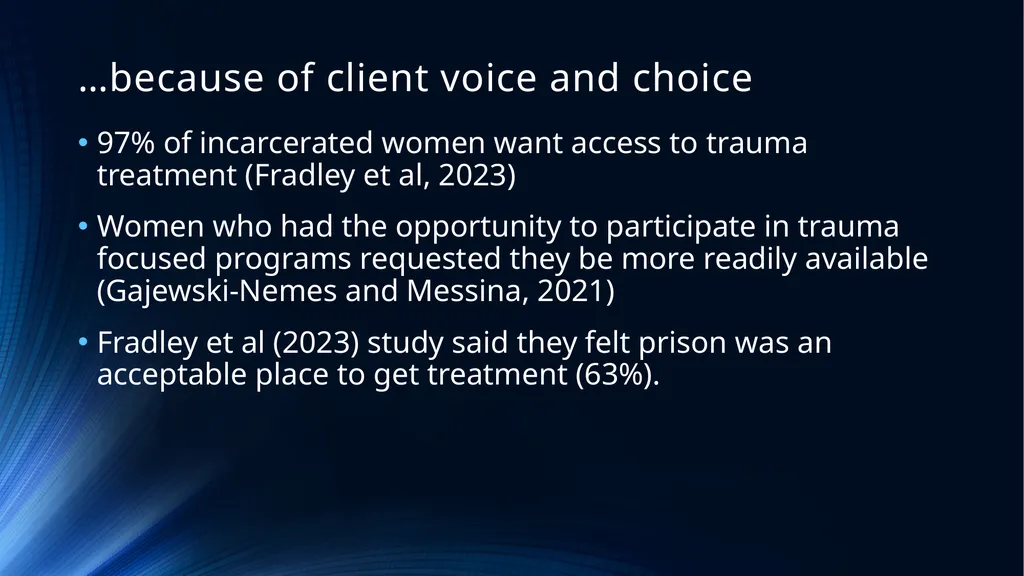
…because of client voice and choice 97% of incarcerated women want access to trauma treatment (Fradley et al, 2023)
Women who had the opportunity to participate in trauma focused programs requested they be more readily available (Gajewski-Nemes and Messina, 2021)
Fradley et al (2023) study said they felt prison was an acceptable place to get treatment (63%).<br>
Women who had the opportunity to participate in trauma focused programs requested they be more readily available (Gajewski-Nemes and Messina, 2021)
Fradley et al (2023) study said they felt prison was an acceptable place to get treatment (63%).<br>
14
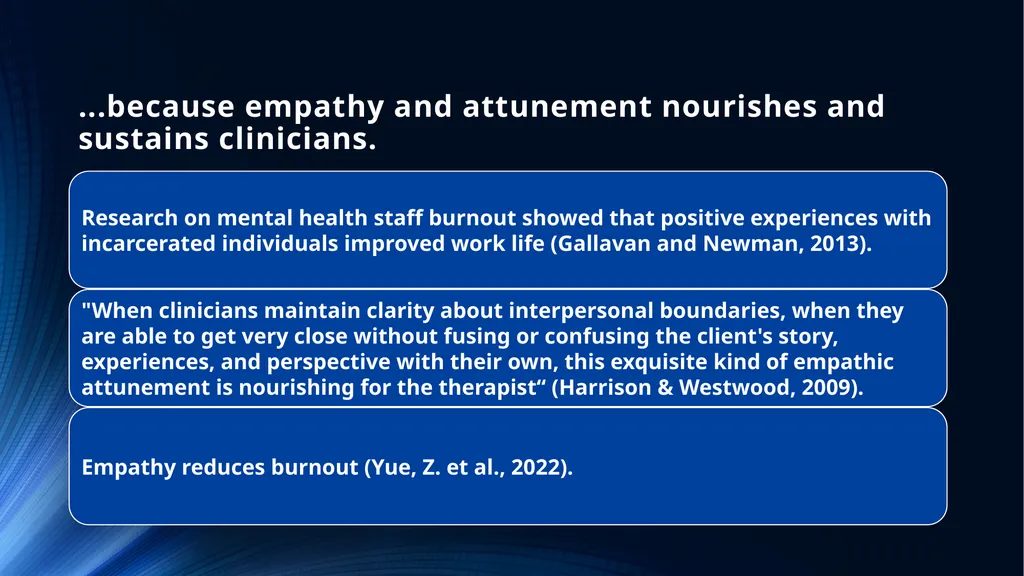
...because empathy and attunement nourishes and sustains clinicians.<br>
15
The What Evidence Based Treatment and quality indicators<br>
16
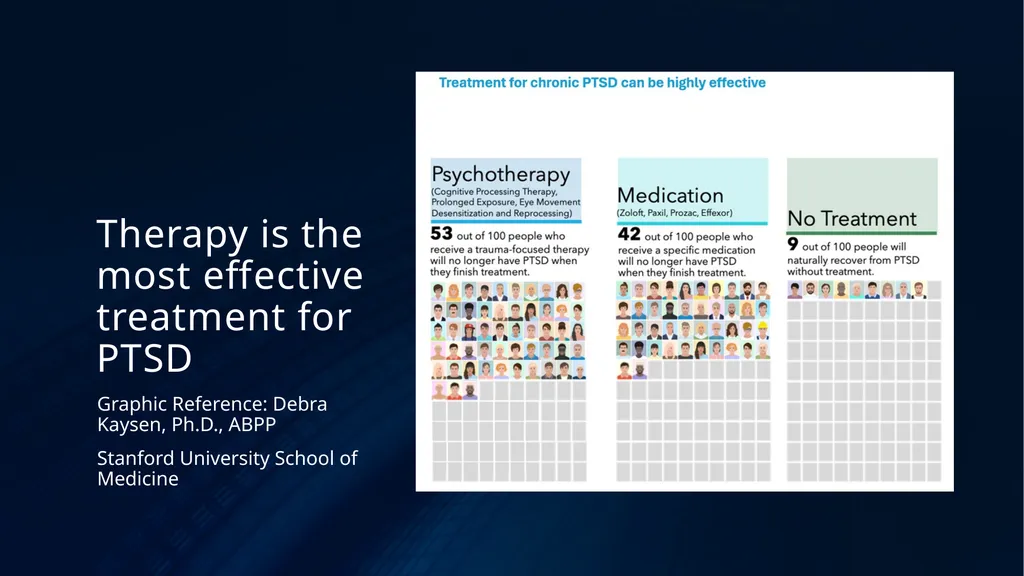
Therapy is the most effective treatment for PTSD Graphic Reference: Debra Kaysen, Ph.D., ABPP
Stanford University School of Medicine<br>
Stanford University School of Medicine<br>
17
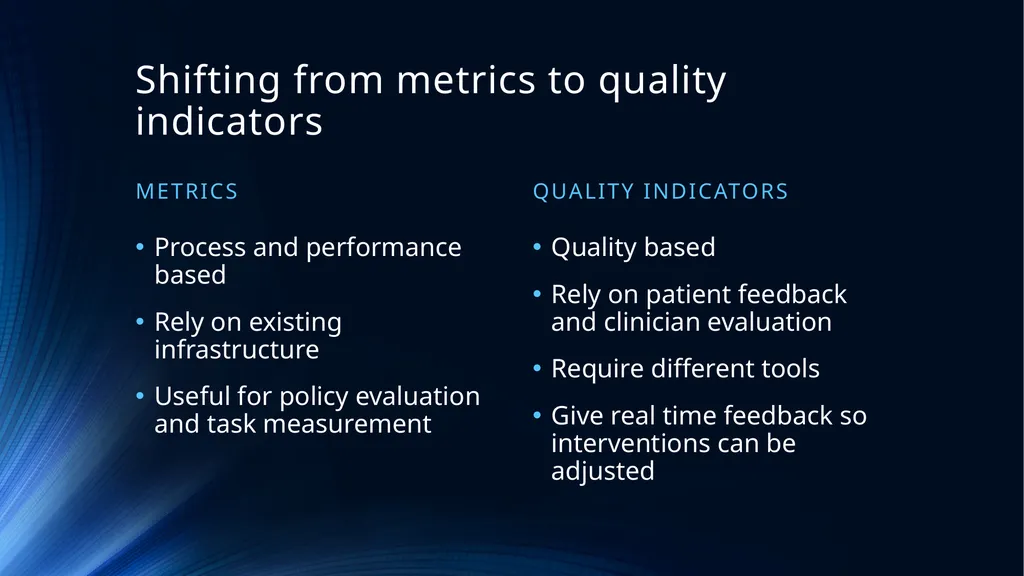
Shifting from metrics to quality indicators METRICS Process and performance based
Rely on existing infrastructure
Useful for policy evaluation and task measurement QUALITY INDICATORS Quality based
Rely on patient feedback and clinician evaluation
Require different tools
Give real time feedback so interventions can be adjusted<br>
Rely on existing infrastructure
Useful for policy evaluation and task measurement QUALITY INDICATORS Quality based
Rely on patient feedback and clinician evaluation
Require different tools
Give real time feedback so interventions can be adjusted<br>
18
Our Story...
The How<br>
19
What are the biggest barriers you face at your job? The Slido app must be installed on every computer you’re presenting from Do not edit
How to change the design<br>
How to change the design<br>
20
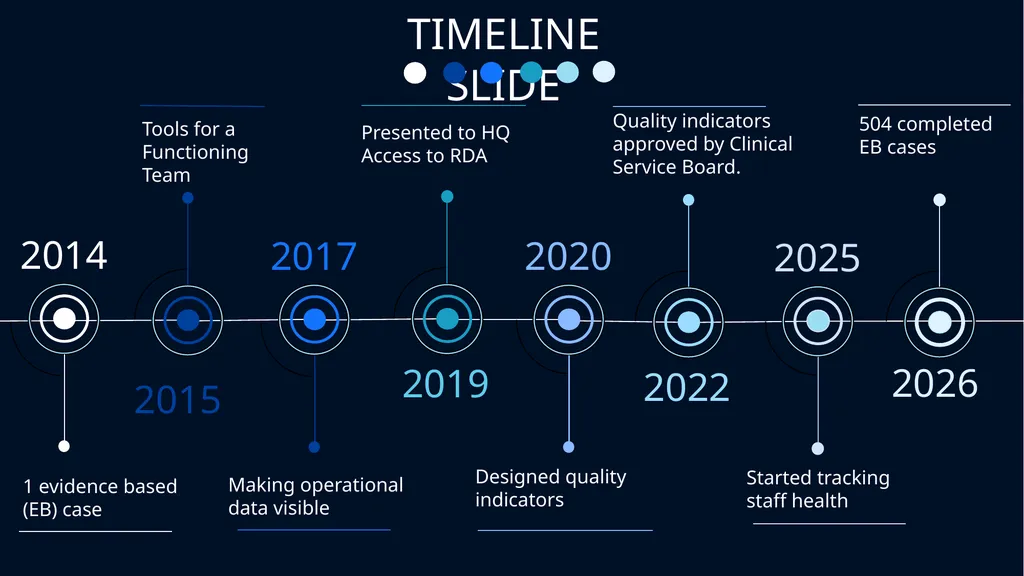
TIMELINE SLIDE 2014 1 evidence based (EB) case 2015 Tools for a Functioning Team 2017 Making operational data visible 2019 Presented to HQ
Access to RDA 2020 Designed quality indicators 2022 Quality indicators approved by Clinical Service Board. 2025 Started tracking staff health 2026 504 completed EB cases<br>
Access to RDA 2020 Designed quality indicators 2022 Quality indicators approved by Clinical Service Board. 2025 Started tracking staff health 2026 504 completed EB cases<br>
21
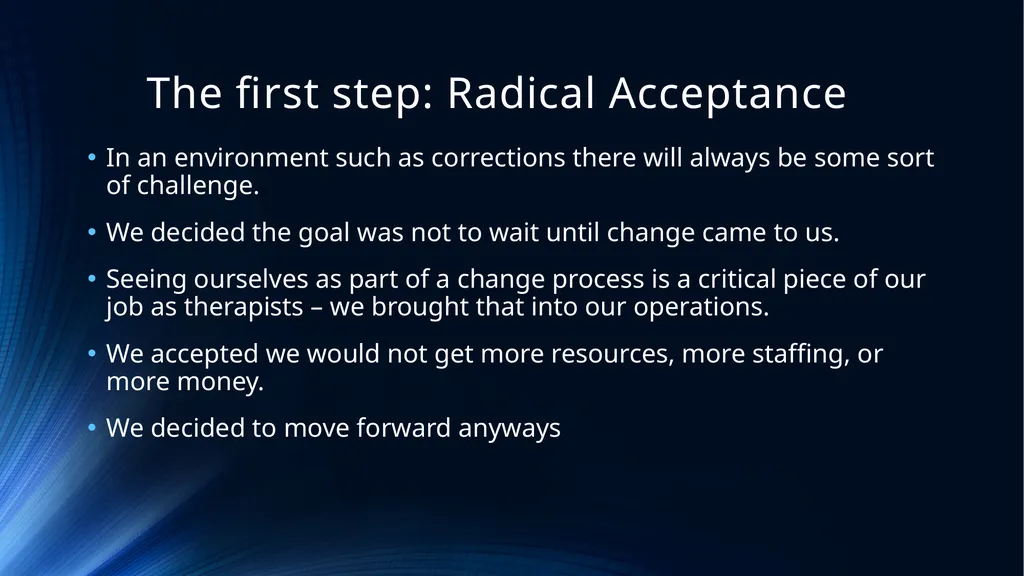
The first step: Radical Acceptance In an environment such as corrections there will always be some sort of challenge.
We decided the goal was not to wait until change came to us.
Seeing ourselves as part of a change process is a critical piece of our job as therapists – we brought that into our operations.
We accepted we would not get more resources, more staffing, or more money.
We decided to move forward anyways<br>
22
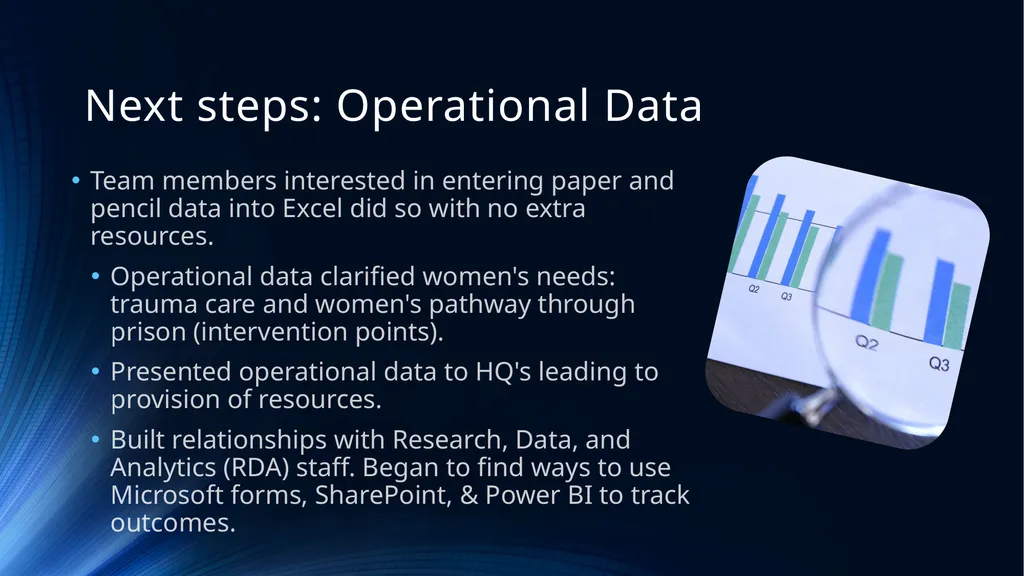
Next steps: Operational Data Team members interested in entering paper and pencil data into Excel did so with no extra resources.
Operational data clarified women's needs: trauma care and women's pathway through prison (intervention points).
Presented operational data to HQ's leading to provision of resources.
Built relationships with Research, Data, and Analytics (RDA) staff. Began to find ways to use Microsoft forms, SharePoint, & Power BI to track outcomes.<br>
23
Next steps:
Client (Customer) Feedback We focused on feedback from clients.
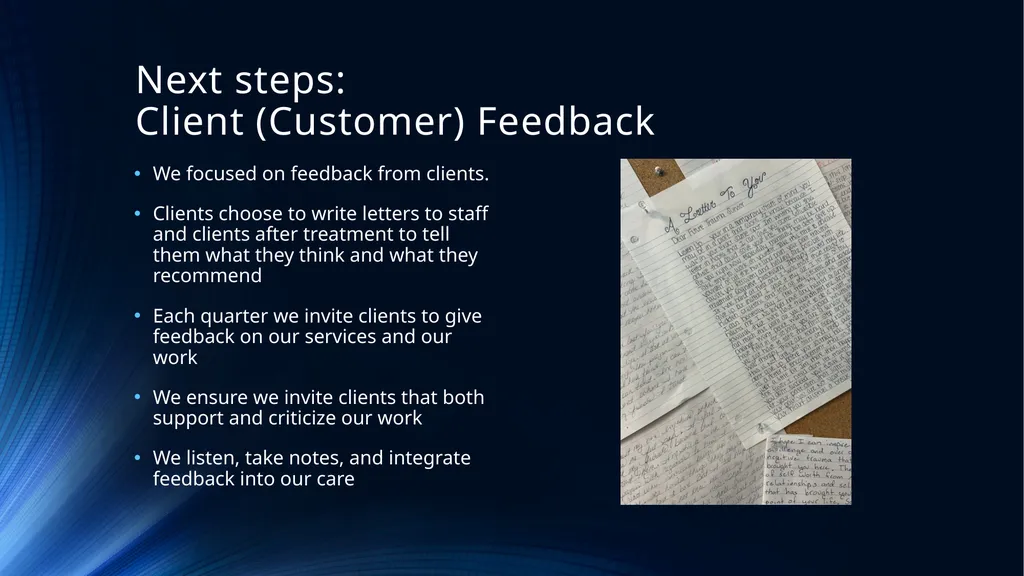
Clients choose to write letters to staff and clients after treatment to tell them what they think and what they recommend
Each quarter we invite clients to give feedback on our services and our work
We ensure we invite clients that both support and criticize our work
We listen, take notes, and integrate feedback into our care<br>
24
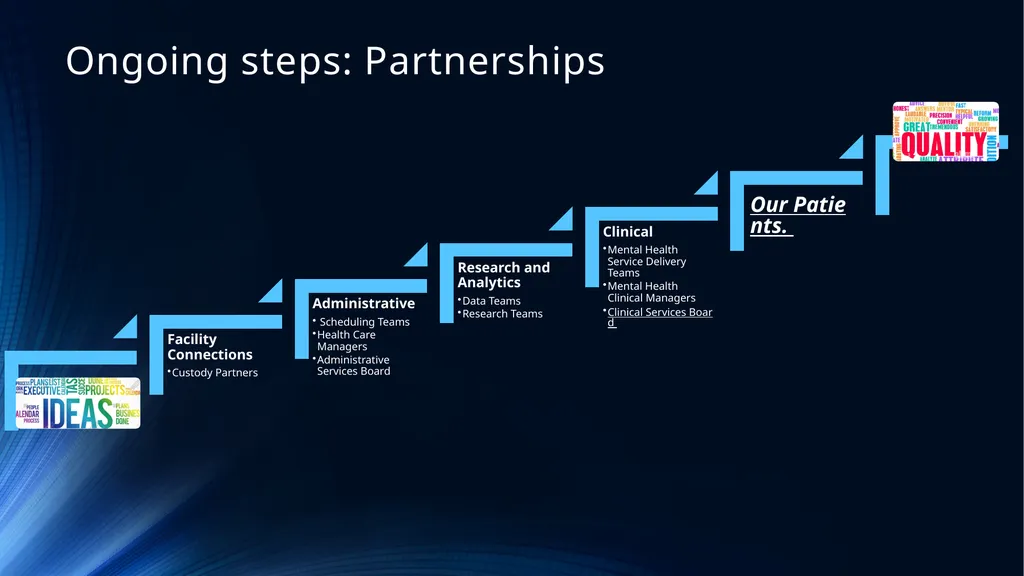
Ongoing steps: Partnerships<br>
25
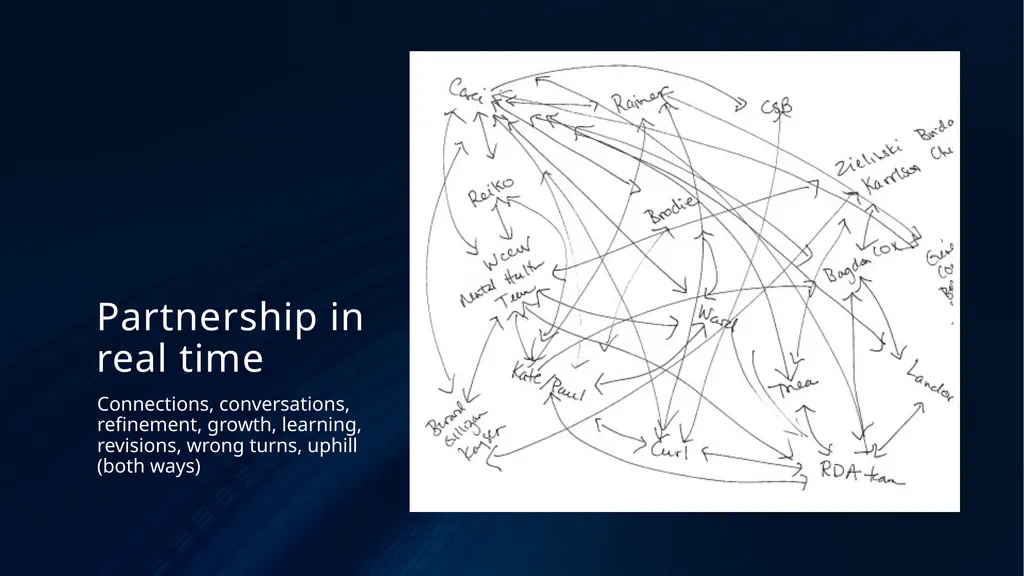
Partnership in real time Connections, conversations, refinement, growth, learning, revisions, wrong turns, uphill (both ways)<br>
26
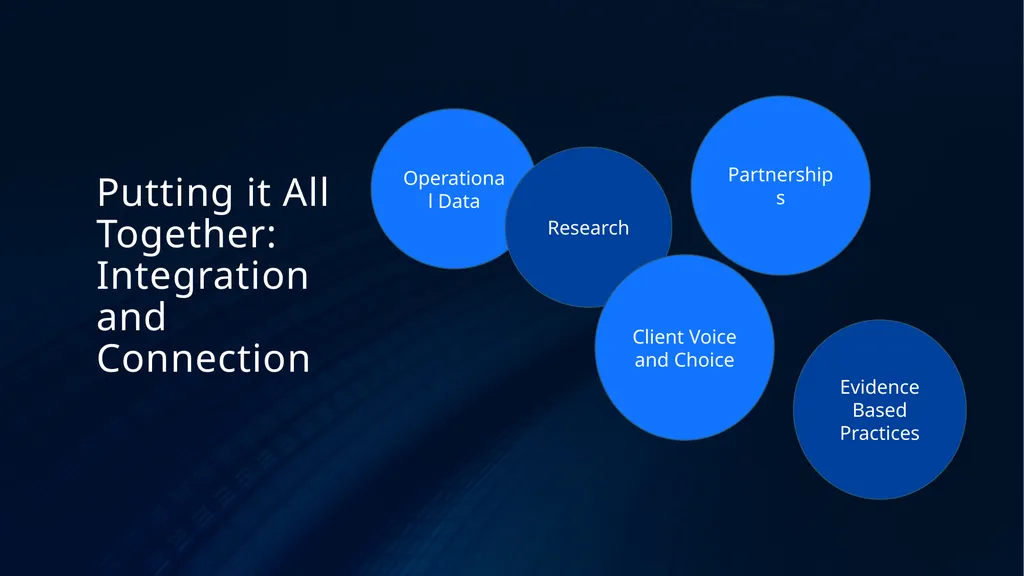
Putting it All Together:
Integration and Connection Operational Data Research Client Voice and Choice Partnerships Evidence Based Practices<br>
27
How is the pace of this presentation so far? The Slido app must be installed on every computer you’re presenting from Do not edit
How to change the design<br>
How to change the design<br>
28
Quality Indicators Trauma treatment client improvement
Facility safety<br>
Facility safety<br>
29
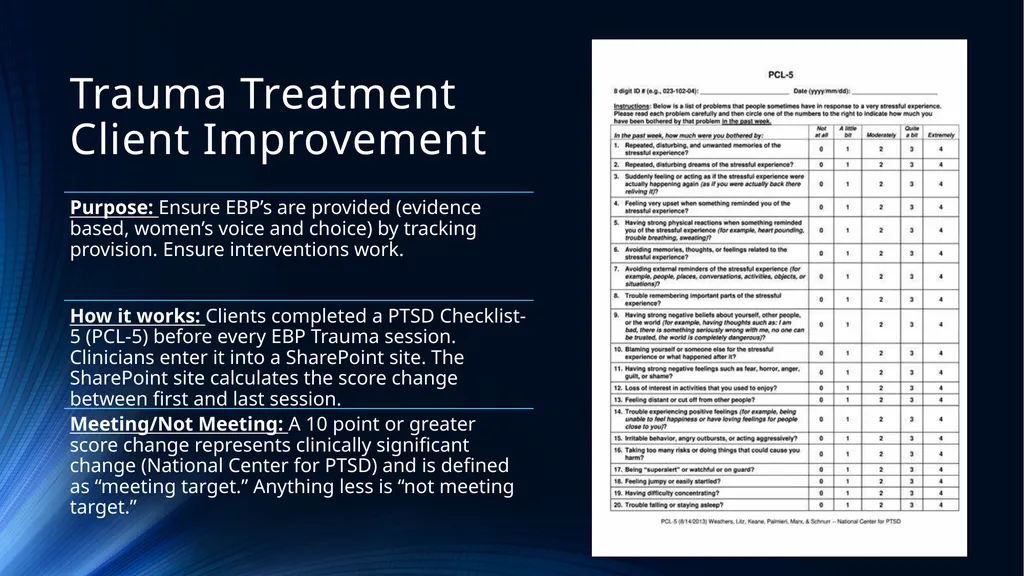
Trauma Treatment Client Improvement<br>
30
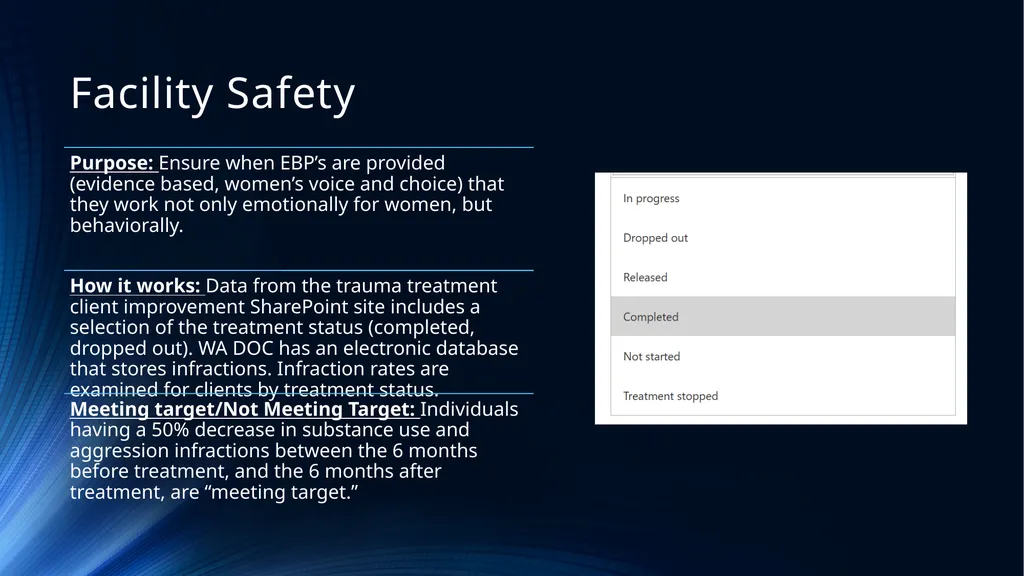
Facility Safety<br>
31
Results Trauma Treatment Client Improvement
Facility Safety<br>
Facility Safety<br>
32
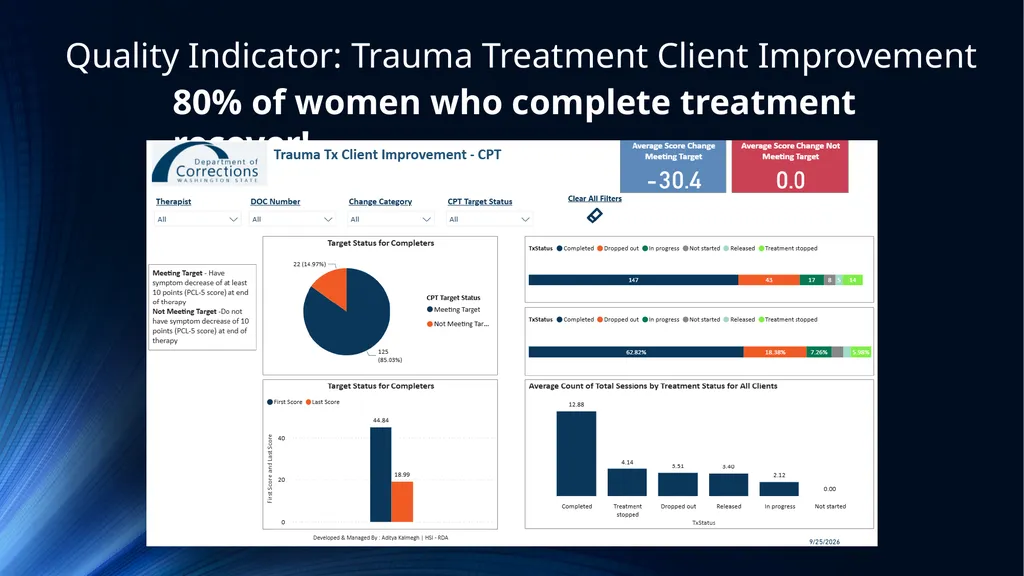
Quality Indicator: Trauma Treatment Client Improvement 80% of women who complete treatment recover!<br>
33
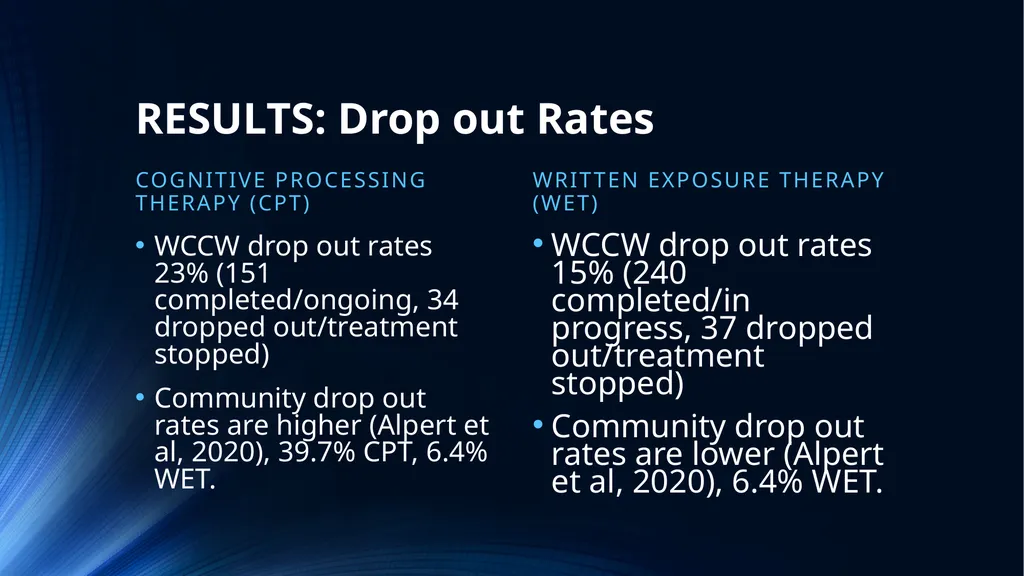
RESULTS: Drop out Rates Cognitive processing therapy (CPT) WCCW drop out rates 23% (151 completed/ongoing, 34 dropped out/treatment stopped)
Community drop out rates are higher (Alpert et al, 2020), 39.7% CPT, 6.4% WET. Written exposure therapy (WET) WCCW drop out rates 15% (240 completed/in progress, 37 dropped out/treatment stopped)
Community drop out rates are lower (Alpert et al, 2020), 6.4% WET.<br>
Community drop out rates are higher (Alpert et al, 2020), 39.7% CPT, 6.4% WET. Written exposure therapy (WET) WCCW drop out rates 15% (240 completed/in progress, 37 dropped out/treatment stopped)
Community drop out rates are lower (Alpert et al, 2020), 6.4% WET.<br>
34
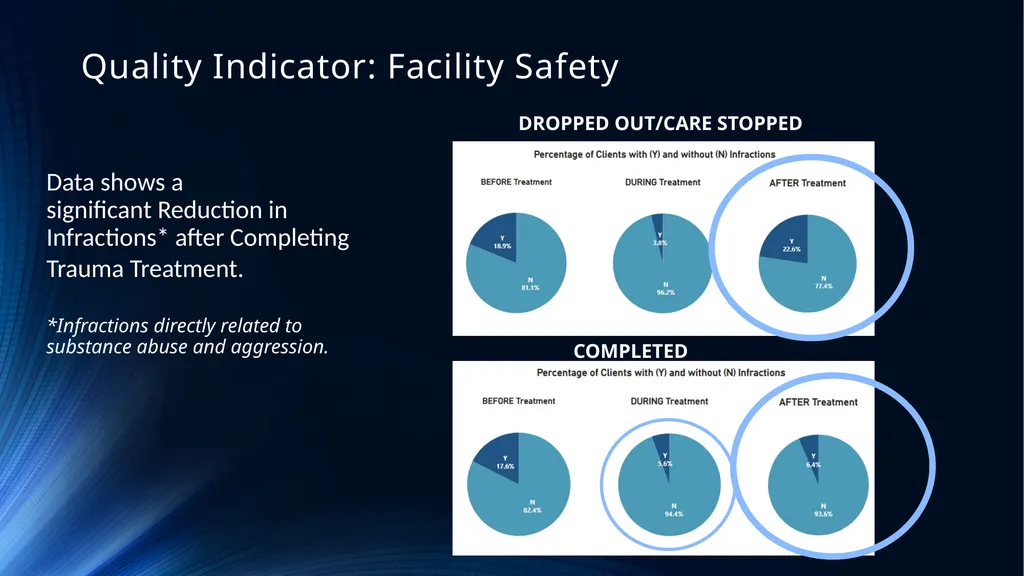
Quality Indicator: Facility Safety Data shows a significant Reduction in Infractions* after Completing Trauma Treatment.
*Infractions directly related to substance abuse and aggression. DROPPED OUT/CARE STOPPED COMPLETED CARE<br>
35
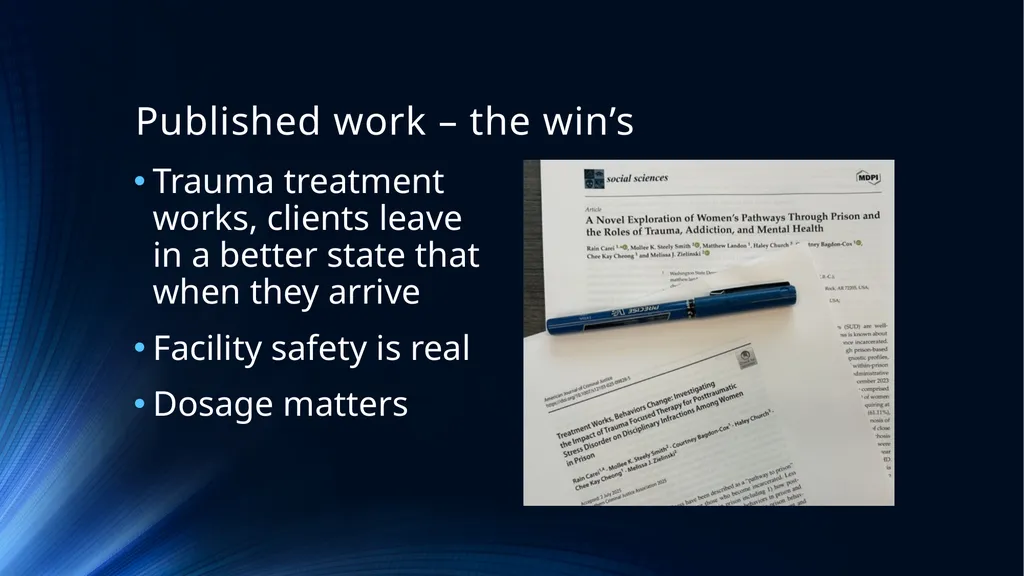
Published work – the win’s Trauma treatment works, clients leave in a better state that when they arrive
Facility safety is real
Dosage matters<br>
Facility safety is real
Dosage matters<br>
36
Published Work – the challenges We’re not reaching enough people – in the retrospective sample, our reach for evidence-based trauma care was under 5% of our population in those eight years.
High caseloads
Challenges in perspectives
Slow build of capacity for services
Recidivism appears potentially disrupted but appears too complicated a concept to directly tie to treatment.<br>
High caseloads
Challenges in perspectives
Slow build of capacity for services
Recidivism appears potentially disrupted but appears too complicated a concept to directly tie to treatment.<br>
37
Reflections and future directions A collaborative story<br>
38
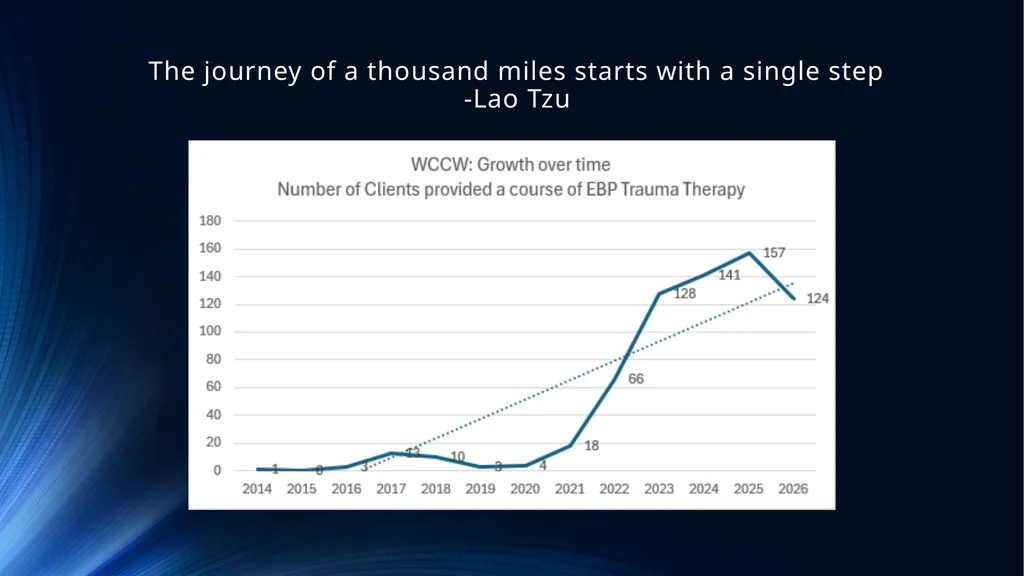
The journey of a thousand miles starts with a single step
-Lao Tzu<br>
39
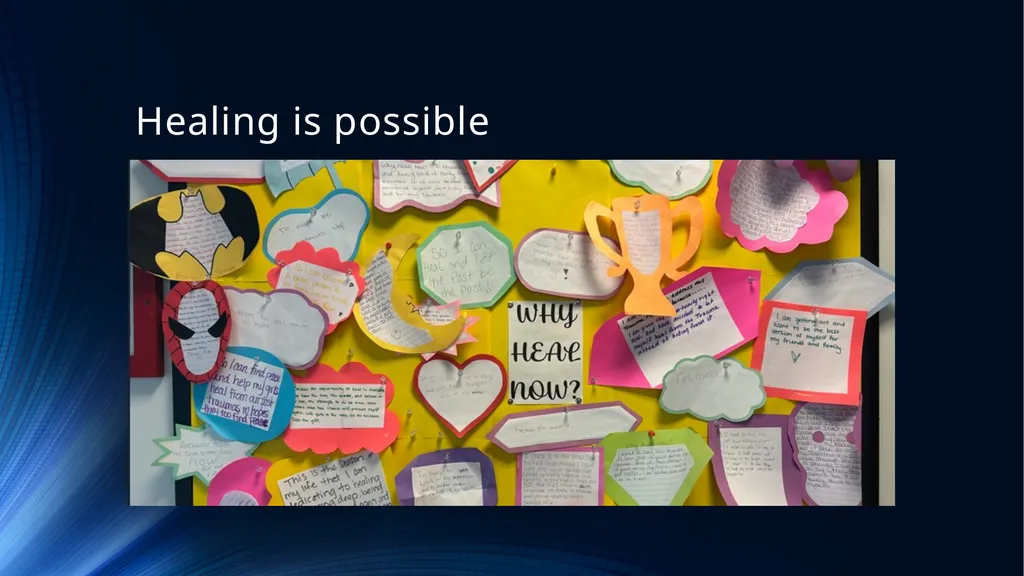
Healing is possible<br>
40
Staff experience: Providing Treatment “When I offer evidence-based written exposure therapy to patients, I’m confident in it because I know it works.
It feels wonderful to provide treatment that works to people who have suffered so long and haven’t had access to proven methods.”
– S. Hoag, Psychologist 3, WA DOC<br>
It feels wonderful to provide treatment that works to people who have suffered so long and haven’t had access to proven methods.”
– S. Hoag, Psychologist 3, WA DOC<br>
41
Staff Experience: Reducing Burnout “Providing evidence-based trauma therapy helps reduce burnout and get to the root cause of the issues.
Case management work often feels like we put out fires that inevitably pop up elsewhere. By treating trauma, we see the global change that prevents fires in the first place!
Helping my clients recognize their ability to grow and heal through trauma treatment feels incredibly fulfilling and worthwhile. They take back the reins in their healing journey, and I get to use my energy more effectively.”
– R. Gardner, Psychology Associate, WA DOC<br>
42
…Next Steps of our journey.<br>
43
What feedback or ideas do you have to help guide our future work? The Slido app must be installed on every computer you’re presenting from Do not edit
How to change the design<br>
How to change the design<br>
44
Thank you WCCW Mental Health is recognized by the Council of State Governments (CSG) as a Criminal Justice-Mental Health Learning Sites - CSG Justice Center .
Peer support and consultation is part of work. Please reach out if we can be of support.<br>
Peer support and consultation is part of work. Please reach out if we can be of support.<br>
45
References Alpert, E., Hayes, A. M., Barnes, J. B., & Sloan, D. M. (2020). Predictors of dropout in cognitive processing therapy for PTSD: An examination of trauma narrative content. Behavior Therapy, 51(5), 774–788. doi:10.1016/j.beth.2019.11.003
Carei, R., Smith, M.K.S., Bagdon-Cox, C., Church, H., Cheong, C.K., & Zielinski, M (2025). Treatment Works, Behaviors Change: Investigating the Impact of Trauma Focused Therapy for Posttraumatic Stress Disorder on Disciplinary Infractions Among Women in Prison. Am J Crim Just 50, 940–965 (2025). https://doi.org/10.1007/s12103-025-09828-5
Carei, R., Smith, M.K.S., Bagdon-Cox, C., Church, H., Cheong, C.K., & Zielinski, M (2025). Treatment Works, Behaviors Change: Investigating the Impact of Trauma Focused Therapy for Posttraumatic Stress Disorder on Disciplinary Infractions Among Women in Prison. Am J Crim Just 50, 940–965 (2025). https://doi.org/10.1007/s12103-025-09828-5
Fradley, M. F., Kathryn Allison, M., Steely Smith, M. K., Bossard, M., & Zielinski, M. J. (2023). Justice-Involved, Sexually Victimized Women’s Perspectives on the Acceptability of Receiving Trauma-Focused Therapy in Prison. Violence Against Women, 29(14), 2964-2985. https://doi.org/10.1177/10778012231200480<br>
Carei, R., Smith, M.K.S., Bagdon-Cox, C., Church, H., Cheong, C.K., & Zielinski, M (2025). Treatment Works, Behaviors Change: Investigating the Impact of Trauma Focused Therapy for Posttraumatic Stress Disorder on Disciplinary Infractions Among Women in Prison. Am J Crim Just 50, 940–965 (2025). https://doi.org/10.1007/s12103-025-09828-5
Carei, R., Smith, M.K.S., Bagdon-Cox, C., Church, H., Cheong, C.K., & Zielinski, M (2025). Treatment Works, Behaviors Change: Investigating the Impact of Trauma Focused Therapy for Posttraumatic Stress Disorder on Disciplinary Infractions Among Women in Prison. Am J Crim Just 50, 940–965 (2025). https://doi.org/10.1007/s12103-025-09828-5
Fradley, M. F., Kathryn Allison, M., Steely Smith, M. K., Bossard, M., & Zielinski, M. J. (2023). Justice-Involved, Sexually Victimized Women’s Perspectives on the Acceptability of Receiving Trauma-Focused Therapy in Prison. Violence Against Women, 29(14), 2964-2985. https://doi.org/10.1177/10778012231200480<br>
46
References part 2 Gajewski-Nemes, Julia, and Nena Messina. 2021. Exploring and Healing Invisible Wounds: Perceptions of Trauma-Specific Treatment from Incarcerated Men and Women. Journal of Trauma & Treatment 10: 1–8.
Gallavan, D. B., & Newman, J. L. (2013). Predictors of Burnout Among Correctional Mental Health Professionals. Psychological Services, 10 (1), 115-122.
https://www.prisonpolicy.org/
Harrison RL, Westwood MJ. Preventing vicarious traumatization of mental health therapists: Identifying protective practices. Psychotherapy (Chic). 2009 Jun;46(2):203-19. doi: 10.1037/a0016081. PMID: 22122619.
National Center for PTSD: PTSD: National Center for PTSD Home (va.gov)
Sadeh, N., & McNiel, D. E. (2015). Posttraumatic Stress Disorder Increases Risk of Criminal Recidivism Among Justice-Involved Persons With Mental Disorders. Criminal Justice and Behavior, 42(6), 573–586. https://doi.org/10.1177/0093854814556880<br>
47
References part 3 Staton M, Tillson M, Levi MM, Dickson M, Webster M, Leukefeld C. Identifying and Treating Incarcerated Women Experiencing Substance Use Disorders: A Review. Subst Abuse Rehabil. 2023 Nov 13;14:131-145. doi: 10.2147/SAR.S409944. PMID: 38026785; PMCID: PMC10655602.
Stürup-Toft S, O'Moore EJ, Plugge EH. Looking behind the bars: emerging health issues for people in prison. Br Med Bull. 2018 Mar 1;125(1):15-23. doi: 10.1093/bmb/ldx052. PMID: 29394343.
United Nations General Assembly (2015).
Yue, Z., Qin, Y., Li, Y. et al. Empathy and burnout in medical staff: mediating role of job satisfaction and job commitment. BMC Public Health 22, 1033 (2022). https://doi.org/10.1186/s12889-022-13405-4<br>