EVIS Informed Consent EVIS Training Video Version 3.0 23rd January 2025 Warning: This training video is version controlled. Printed or download copies may not be the current version. See www.evis.scot.nhs.uk What is consent? GCP definition
"EVIS Informed Consent EVIS Training Video Version" is the property of its rightful owner. Permission is granted to
download and print the materials on this website for personal, non-commercial use only, and to display it
on your personal computer provided you do not modify the materials and that you retain all copyright
notices contained in the materials. By downloading content from our website, you accept the terms of this
agreement.
Presentation Transcript
01
EVIS Informed Consent EVIS Training Video
Version 3.0 23rd January 2025 Warning: This training video is version controlled. Printed or download copies may not be the current version. See www.evis.scot.nhs.uk<br>
02
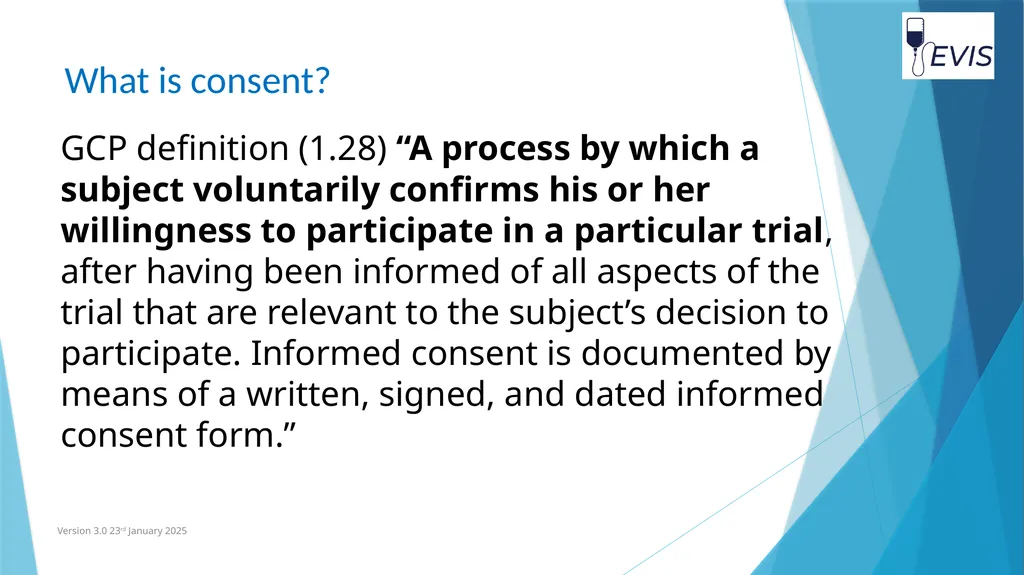
What is consent? GCP definition (1.28) “A process by which a subject voluntarily confirms his or her willingness to participate in a particular trial, after having been informed of all aspects of the trial that are relevant to the subject’s decision to participate. Informed consent is documented by means of a written, signed, and dated informed consent form.” Version 3.0 23rd January 2025<br>
03
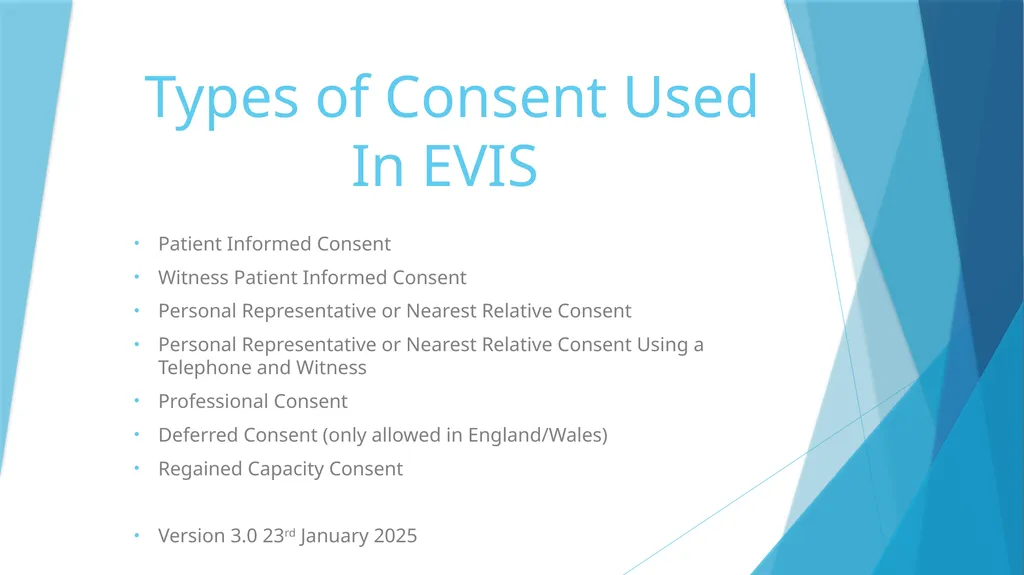
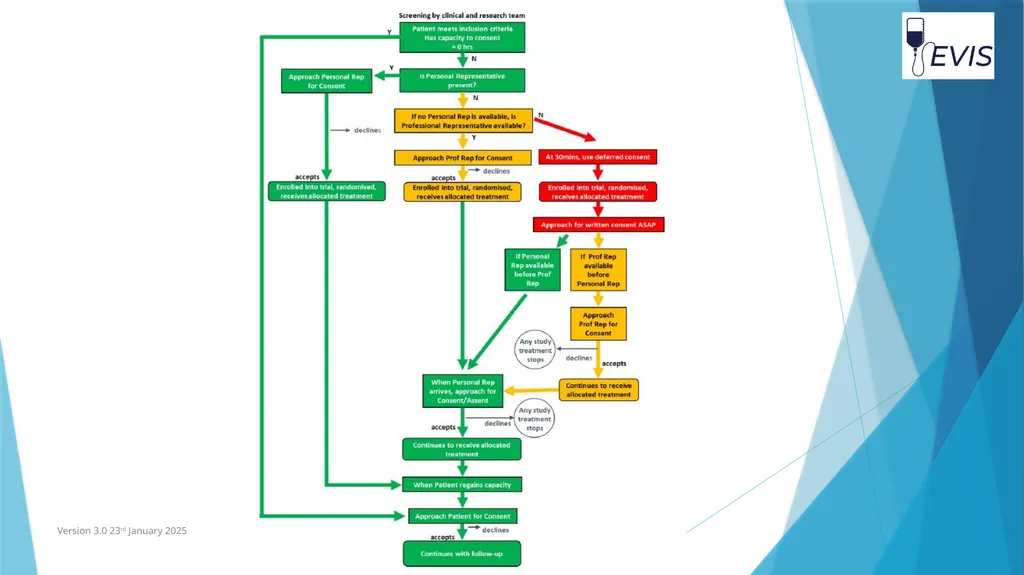
Types of Consent Used In EVIS Patient Informed Consent
Witness Patient Informed Consent
Personal Representative or Nearest Relative Consent
Personal Representative or Nearest Relative Consent Using a Telephone and Witness
Professional Consent
Deferred Consent (only allowed in England/Wales)
Regained Capacity Consent
Version 3.0 23rd January 2025<br>
04
Version 3.0 23rd January 2025<br>
05
Hierarchy of Consent As per the diagram on slide 4, the patient should always be the first to be assessed and the question asked, do they have capacity.
However, if the Investigator or delegated person taking consent feels that the patient is too unwell or the relative too distressed to truly give informed consent the decision to move to next appropriate consent can be made and documented within the patient notes. Version 3.0 23rd January 2025<br>
06
Who can take Consent in the EVIS study? Consent can only be obtained by appropriately trained members of the clinical and research team who have been delegated this responsibility by the principal investigator on the local site delegation log.
GCP trained.
Eligibility remains a medical responsibility.
Capacity of the patient can be assessed by any medic as per routine clinical practice, documented within the medical notes.
Nurses can take consent, please ensure your local trust/board allows this, you have had consent training and the PI is happy for you to be delegated this task. Version 3.0 23rd January 2025<br>
07
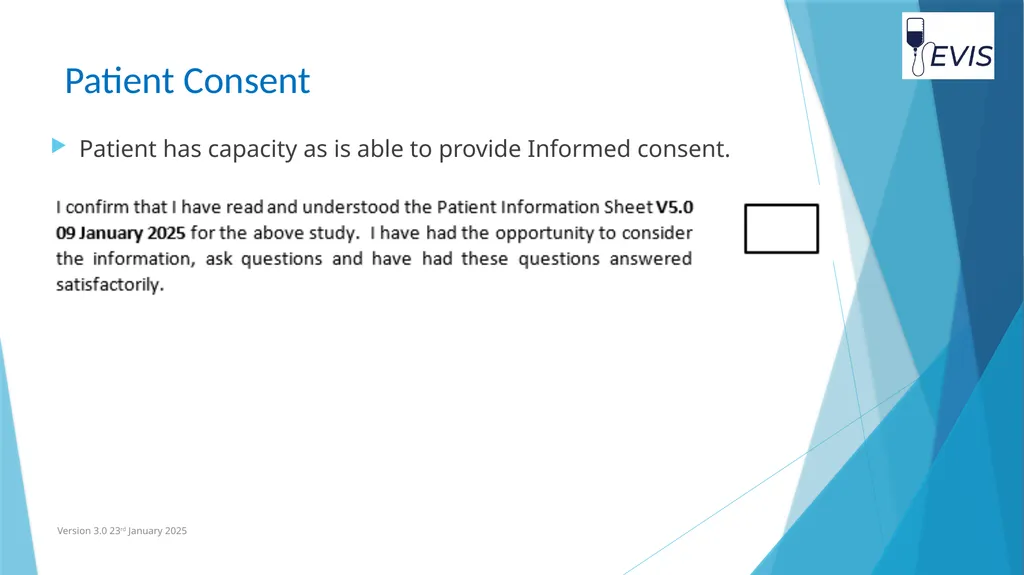
Patient Consent Patient has capacity as is able to provide Informed consent. Version 3.0 23rd January 2025<br>
08
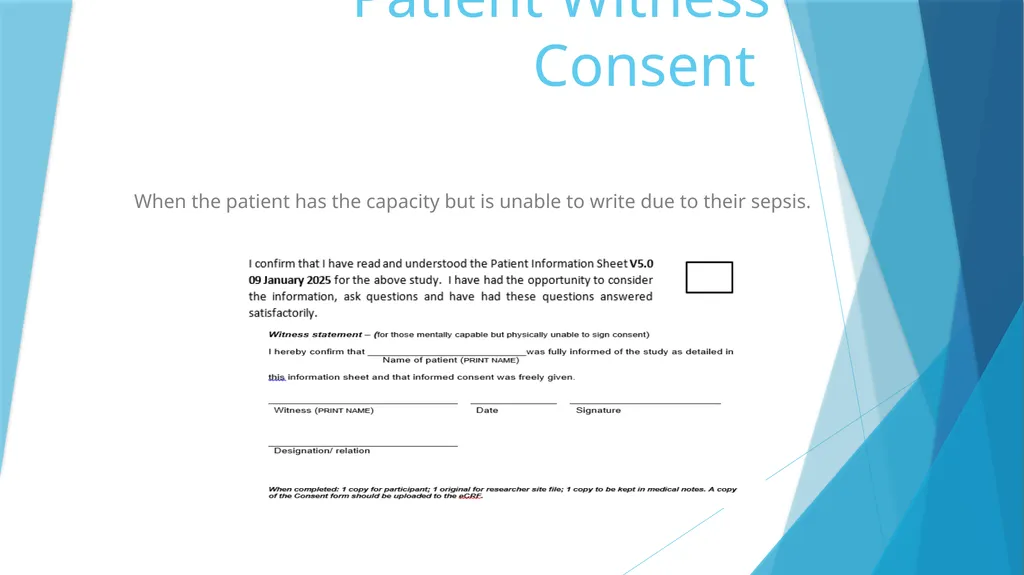
Patient Witness Consent When the patient has the capacity but is unable to write due to their sepsis.<br>
09
Personal Legal Consent or Welfare Guardian, Nearest Relative If the patient does not have capacity, a relative can be approached.
The personal representative is confirming they have read the PIS, had the opportunity to ask questions and freely gives informed consent on behalf of the patient.
The relative/personal representative initials the boxes on the ICF, prints their name, signature and the date. Version 3.0 23rd January 2025<br>
10
Witness Involvement in Personal Legal/Nearest Relative Consent If the relative is not available they can be contacted by telephone ensuring a witness is available.
The witness need to be impartial, ie not on the delegation log.
The witness should confirm the investigator has sent the PIS to the relative electronically, the relative understands had time to ask questions and answer freely.
The witness initials the boxes on the ICF, prints their name, signature and designation.
Version 3.0 23rd January 205<br>
11
Professional Consent Someone who is involved in the patients care can be a Professional Representative
A professional person for example a Doctor or nurse, who is impartial to the study (not on the delegation log)
The Professional Initials the boxes and prints their name, signature and date on the Informed consent.
A physio or an allied health care professional may take on this role however they should be aware of what it involves.
The Professional is acting as a legal representative and stating they understand the EVIS patient information sheet, they agree that this is the best for the patient and they provide written informed consent on that patients behalf.
Good idea for you as the research team to explain to the wider team about EVIS and what it involves being a professional legal representative. Version 3.0 23rd January 2025<br>
12
Deferred Consent (England and Wales Only) If this is used please use Deferred Consent form and document on the deferred consent ICF, so that treatment can be commenced. Consent from Personal or professional should be so sought post deferred consent.
On the EVIS eCRF, please ensure if this is used in England/Wales that we capture this on the eCrf, the history of the consenting process is vital. Version 3.0 23rd January 2025<br>
13
Recovered Capacity Consent If a patient has been consented by a welfare guardian/nearest relative, personal or professional consent this needs to be followed up by Regained capacity.
Witness statement added to the Recovered capacity Consent to ensure if the patient cannot write for any reason then a Witness can step. Version 3.0 23rd January 2025<br>
14
Documentation of ICF and Uploads. The Informed consent process should be documented within the patients notes with the version of the PIS/ICF clearly documented, the type of consent used. This should be done by the Delegated Investigator or delegated person who took the Informed consent. A copy of the ICF will also be filed with the patient notes and a copy to the patient.
Investigators or person taking consent should also ensure they use a black pen, (no red, blue or a pencil is allowed), the Investigator signature and printed name needs to match the delegation log and be printed in full.
We ask you to upload a copy of the ICF to the EVIS eCRF, only myself will be able to see this, please ensure this is in a timely fashion. Version 3.0 23rd January 2025<br>
15
Common Mistakes. In the EVIS study, due to the emergency nature we predict mistakes will happen, this is why if a mistake happens before the patient is discharged it can be corrected.
If a mistake happens during the consenting process, the person who made the error should strike one line through and initial/date the error.
The Investigator taking consent is not delegated
The patient has not initialled the boxes, the person acting on the patients behalf has not initialled the boxes.
The dates are not the same
The version of the PIS or ICF is incorrect at the time of consent. Version 3.0 23rd January 2025<br>
16
Monitoring Contact Emma Moody; emma.moody@nhs.scot
OR ggc.randd@monitoringgroup@nhs.scot Version 3.0 23rd January 2025<br>