
EX-SlAves Surviving and Thriving in Central
MJ
Published · 29 slides · 0 views

1 / 1








Description
EX-SlAves Surviving and Thriving in Central PeNNsylvania Logan House engraving featured in the book A History of the Pennsylvania railroad: Its origin, construction, condition, and connections by William B. Sipes. Published in 1875.
Related Topics
Share
Embed code
Download this presentation From Below
"EX-SlAves Surviving and Thriving in Central" is the property of its rightful owner. Permission is granted to download and print the materials on this website for personal, non-commercial use only, and to display it on your personal computer provided you do not modify the materials and that you retain all copyright notices contained in the materials. By downloading content from our website, you accept the terms of this agreement.
Presentation Transcript
01
EX-SlAves Surviving and Thriving in
Central PeNNsylvania Logan House engraving featured in the book "A History of the Pennsylvania railroad: Its origin, construction, condition, and connections" by William B. Sipes. Published in 1875.<br>
02
Presentation Outline<br>
03
Slaves in Huntingdon/
Bedford/Blair County From “A History of Blair County”, 1896 by Charles B. Clark, this information was shared with it readers: “In Blair County, since its organization of 1846, slavery never existed, but in the territory of which it is composed it was not unknown as late as 1800, the assessment lists of the county disclose the fact that a few negro slaves were held in bondage here. In 1794 there were three slave owners in Allegheny township.”
Blair County was incorporated on February 26, 1846. Prior to 1846, the residents of “Blair County” called Bedford or Huntingdon Counties as home.
Tax listings of that time:
William Holliday Sr., owned 500 acres and one slave between 1768 and 1786 in Frankstown Township and Blair Township (Hollidaysburg/Gaysport area) (pg. 48 and pg. 102)
Captain Thomas Blair owned 1 slave in Allegheny Township in 1787 (now located in Frankston Township), Bedford County in 1787. (pg. 27 and 101)
Samuel Davis, Lazarus Lowry and John Torrance in 1788 each owned 1 slave in Frankstown, Huntingdon County. (pg. 102)
Joseph Chapman, owned 1 slave in 1788 in Woodbury Township, Huntingdon County and a gristmill (aka as a sawmill) (pg. 239)
History of Huntingdon and Blair Counties. J. Simpson African, 1883 Philadelphia: Louis H. Evarts<br>
Blair County was incorporated on February 26, 1846. Prior to 1846, the residents of “Blair County” called Bedford or Huntingdon Counties as home.
Tax listings of that time:
William Holliday Sr., owned 500 acres and one slave between 1768 and 1786 in Frankstown Township and Blair Township (Hollidaysburg/Gaysport area) (pg. 48 and pg. 102)
Captain Thomas Blair owned 1 slave in Allegheny Township in 1787 (now located in Frankston Township), Bedford County in 1787. (pg. 27 and 101)
Samuel Davis, Lazarus Lowry and John Torrance in 1788 each owned 1 slave in Frankstown, Huntingdon County. (pg. 102)
Joseph Chapman, owned 1 slave in 1788 in Woodbury Township, Huntingdon County and a gristmill (aka as a sawmill) (pg. 239)
History of Huntingdon and Blair Counties. J. Simpson African, 1883 Philadelphia: Louis H. Evarts<br>
04
More Blair County area slaveowners According to the tax assessment in 1789, Robert Morrow, who lived in Ty-Toona (Sinking Valley area) owned two slaves, in 1791 he again owned two slaves and in 1799 one slave. (pg. 100 and 101)
John Martin of Williamsburg owned an inn, a distillery and one slave in 1820.
Brief History of Blair County. Sylvia Emerson
(Blair County Genealogical Society)
James H. Lyons was appointed postmaster in Salemville, PA in 1882. His father, Benjamin Lyons was brought to Martinsburg in 1810 as a slave and was given his freedom in 1824.
Historical Sketches of Morrisons Cove, by Rev. C. W. Karns, Mirror Press 1933, pg. 3. (Blair County Genealogical Society)<br>
John Martin of Williamsburg owned an inn, a distillery and one slave in 1820.
Brief History of Blair County. Sylvia Emerson
(Blair County Genealogical Society)
James H. Lyons was appointed postmaster in Salemville, PA in 1882. His father, Benjamin Lyons was brought to Martinsburg in 1810 as a slave and was given his freedom in 1824.
Historical Sketches of Morrisons Cove, by Rev. C. W. Karns, Mirror Press 1933, pg. 3. (Blair County Genealogical Society)<br>
05
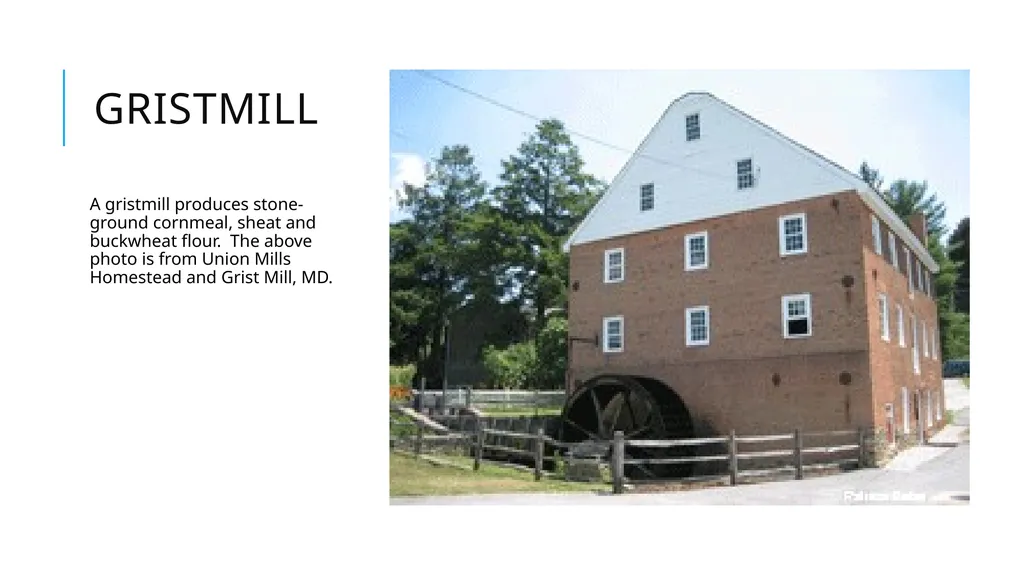
GristMill A gristmill produces stone-ground cornmeal, sheat and buckwheat flour. The above photo is from Union Mills Homestead and Grist Mill, MD.<br>
06
Abolishment of Slavery in Pennsylvania “An Act for the Gradual Abolition of Slavery, passed by the Fifth Pennsylvania General Assembly on 1 March 1780, prescribed an end for slavery in Pennsylvania. It was the first act abolishing slavery in the course of human history to be adopted by a democracy. The Act prohibited further importation of slaves into the state, required Pennsylvania slaveholders to annually register their slaves (with forfeiture for noncompliance, and manumission for the enslaved), and established that all children born in Pennsylvania were free persons regardless of the condition or race of their parents. Those enslaved in Pennsylvania before the 1780 law was enacted were in effect enslaved for life. Another act of the Pennsylvania legislature freed those who were enslave for life in 1847. Pennsylvania's "gradual abolition"—rather than Massachusetts's 1783 "instant abolition"—became a model for freeing slaves in other Northern states.”
https://en.wikipedia.org/wiki/An_Act_for_the_Gradual_Abolition_of_Slavery<br>
https://en.wikipedia.org/wiki/An_Act_for_the_Gradual_Abolition_of_Slavery<br>
07
Loss of Voting Rights for Pennsylvania’s Black Men Citizens The 1838 Pennsylvania Constitutional Convention
“The 1838 convention was held with the original primary goal of reforming the tax and ownership restrictions placed on suffrage in order to enable the impoverished citizens of Pennsylvania to vote. However, due to the intense political turmoil target towards Black Philadelphians, thousands of white citizens petitioned the convention to restrict suffrage to whites, and on 20 January 1838 their wish was granted as the constitution was amended to be restricted to "white freemen." John Z. Ross tried to justify the convention's actions in an official statement by proposing that although "all men are free and equal" this does not apply to black citizens in a political sense, "only in a sense of nature". He argued that this was what was best for the communities’ "security and happiness" and further added that Black men should not be able to vote as he did not believe that they have any "conceptions of civil liberty".
https://en.wikipedia.org/wiki/Black_suffrage_in_Pennsylvania
Black men in Pennsylvania did not gain the right to vote until the passage of the 15th Amendment on February 3, 1870.
https://en.wikipedia.org/wiki/Fifteenth_Amendment_to_the_United_States_Constitution<br>
“The 1838 convention was held with the original primary goal of reforming the tax and ownership restrictions placed on suffrage in order to enable the impoverished citizens of Pennsylvania to vote. However, due to the intense political turmoil target towards Black Philadelphians, thousands of white citizens petitioned the convention to restrict suffrage to whites, and on 20 January 1838 their wish was granted as the constitution was amended to be restricted to "white freemen." John Z. Ross tried to justify the convention's actions in an official statement by proposing that although "all men are free and equal" this does not apply to black citizens in a political sense, "only in a sense of nature". He argued that this was what was best for the communities’ "security and happiness" and further added that Black men should not be able to vote as he did not believe that they have any "conceptions of civil liberty".
https://en.wikipedia.org/wiki/Black_suffrage_in_Pennsylvania
Black men in Pennsylvania did not gain the right to vote until the passage of the 15th Amendment on February 3, 1870.
https://en.wikipedia.org/wiki/Fifteenth_Amendment_to_the_United_States_Constitution<br>
08
Bedford and Blair County ex-slaves' birthplace Fauquier County, Virginia (“Faw-keer”)
Approximately 86 slaves were set free by the plantation owner, Thomas Ottaway B. Carter in 1851 to 1853.
Thomas Carter is listed in Elizabeth Hollinger’s obituary of Monday, December 30, 1895, pg. 5 Altoona Tribune and Nimrod Warren’s obituary of Thursday, July 19, 1917, pg.12 Altoona Tribune
Before the start of the Civil War, some of these emancipated slaves moved into Bedford County, (towns and townships like Woodbury, Cumberland Valley, Bloomfield, Bedford, Loysburg, Everett, Yellow Creek) from Virginia. One former slave’s obituary stated an emancipated Fauquier slave and her family moved to Shavers’ Creek Valley in Huntingdon county. A number of these ex-slaves moved to Altoona; others moved to Ohio to start their new life.<br>
Approximately 86 slaves were set free by the plantation owner, Thomas Ottaway B. Carter in 1851 to 1853.
Thomas Carter is listed in Elizabeth Hollinger’s obituary of Monday, December 30, 1895, pg. 5 Altoona Tribune and Nimrod Warren’s obituary of Thursday, July 19, 1917, pg.12 Altoona Tribune
Before the start of the Civil War, some of these emancipated slaves moved into Bedford County, (towns and townships like Woodbury, Cumberland Valley, Bloomfield, Bedford, Loysburg, Everett, Yellow Creek) from Virginia. One former slave’s obituary stated an emancipated Fauquier slave and her family moved to Shavers’ Creek Valley in Huntingdon county. A number of these ex-slaves moved to Altoona; others moved to Ohio to start their new life.<br>
09
Birthplace of other Blair County ex-Slaves Jacob Green’s obituary informs the readers that “Colonel” Green was born in Warington, NC in 1843 and moved to Altoona after the end of the Civil War.
Altoona Times, Tuesday, February 25, 1908, pg. 2 and Altoona Tribune, Tuesday, February 25, 1908, pg. 5
George Allen, Sr.’s obituary informs the Tyrone and Altoona communities that Mr. Allen was born in Kentucky and was a manservant to a Kentuckian who fought for the Confederates. George Allen, Sr. joined the Union. George, Sr. lived in Tyrone for approximately 5 years.
Altoona Tribune, Tuesday, June 27, 1916, pg. 16, Tyrone Daily Herald, Monday, June 26, 1916, pg.2<br>
Altoona Times, Tuesday, February 25, 1908, pg. 2 and Altoona Tribune, Tuesday, February 25, 1908, pg. 5
George Allen, Sr.’s obituary informs the Tyrone and Altoona communities that Mr. Allen was born in Kentucky and was a manservant to a Kentuckian who fought for the Confederates. George Allen, Sr. joined the Union. George, Sr. lived in Tyrone for approximately 5 years.
Altoona Tribune, Tuesday, June 27, 1916, pg. 16, Tyrone Daily Herald, Monday, June 26, 1916, pg.2<br>
10
Birthplace of Blair County ex-slaves, continued The Thursday, August 8, 1878 Altoona Tribune informed the readers of Sallie Brotherline’s death. She was born in Maryland and was named Venus Ann Gusta Simpson. She lived in Maryland until the age of 14. When the Maryland slave owner died, she was sold to a Huntsville, Alabama slave owner. When the Civil War came to Huntsville on April 11, 1862, Sallie escaped from the plantation and sought refuge with the Union soldiers. After the end of the Civil War, she stayed in Huntsville, AL, because she did not understand what emancipation meant to her. She met a John Brotherline in Alabama and based upon that interaction with him, she consented to travel with Mr. Brotherline to his hometown of Hollidaysburg, PA. She stayed for a short time in Hollidaysburg with the family of Mr. Brotherline and this family gave her the name of “Sallie Brotherline”. Sallie eventually moved to Altoona and was taken care of by several members of the Altoona black community until her death. She was buried in Altoona’s Eastern Light Cemetery. (pg. 2)<br>
11
The Shelors of Warriors Mark, Huntingdon Mr. John and Sarah Shelor moved to the Warriors Mark valley sometime in the 1880s from the Christianburg, VA area. This valley in Huntingdon County was also called Dungarvin. John was born about 1849 and Sarah was born about 1848. John was a farmer and a music teacher. Sarah was a mid-wife. They were well known for their hospitality and hosted parties at their home for the black community of Tyrone. The black community of Tyrone rode the Lewisburg and Tyrone RR from Tyrone to Dungarvin. Their activities were covered by the Tyrone Daily Herald, the Altoona Tribune and the Pittsburgh Courier. Mr. Shelor died on April 7th, 1921. Mrs. Shelor moved in with her daughter, Glenna Jones, who lived in Tyrone. Mrs. Shelor died on June 11, 1930 and both are buried in the Warriors Mark Baptist Church cemetery.<br>
12
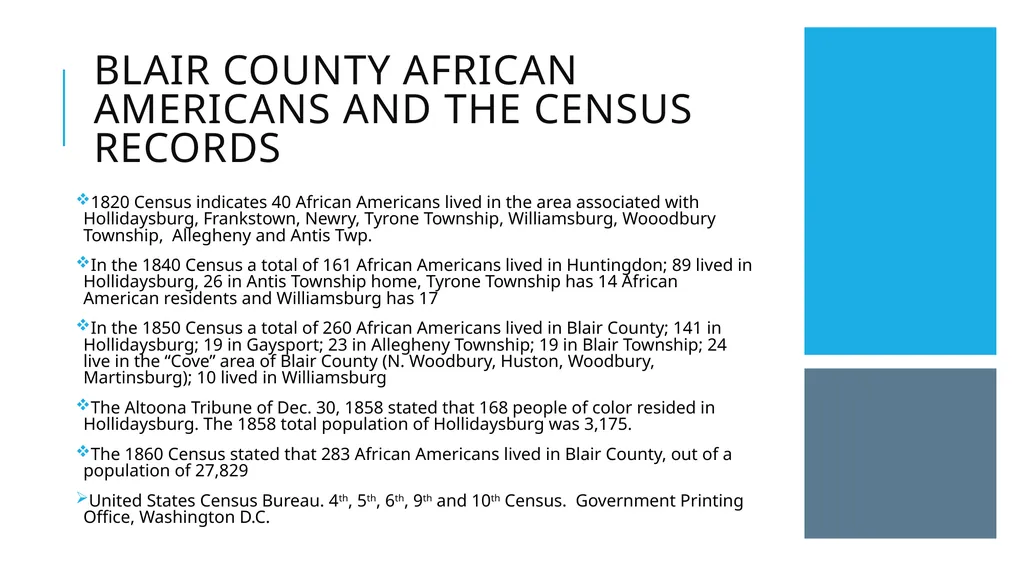
Blair County African Americans and the Census Records 1820 Census indicates 40 African Americans lived in the area associated with Hollidaysburg, Frankstown, Newry, Tyrone Township, Williamsburg, Wooodbury Township, Allegheny and Antis Twp.
In the 1840 Census a total of 161 African Americans lived in Huntingdon; 89 lived in Hollidaysburg, 26 in Antis Township home, Tyrone Township has 14 African American residents and Williamsburg has 17
In the 1850 Census a total of 260 African Americans lived in Blair County; 141 in Hollidaysburg; 19 in Gaysport; 23 in Allegheny Township; 19 in Blair Township; 24 live in the “Cove” area of Blair County (N. Woodbury, Huston, Woodbury, Martinsburg); 10 lived in Williamsburg
The Altoona Tribune of Dec. 30, 1858 stated that 168 people of color resided in Hollidaysburg. The 1858 total population of Hollidaysburg was 3,175.
The 1860 Census stated that 283 African Americans lived in Blair County, out of a population of 27,829
United States Census Bureau. 4th, 5th, 6th, 9th and 10th Census. Government Printing Office, Washington D.C.<br>
In the 1840 Census a total of 161 African Americans lived in Huntingdon; 89 lived in Hollidaysburg, 26 in Antis Township home, Tyrone Township has 14 African American residents and Williamsburg has 17
In the 1850 Census a total of 260 African Americans lived in Blair County; 141 in Hollidaysburg; 19 in Gaysport; 23 in Allegheny Township; 19 in Blair Township; 24 live in the “Cove” area of Blair County (N. Woodbury, Huston, Woodbury, Martinsburg); 10 lived in Williamsburg
The Altoona Tribune of Dec. 30, 1858 stated that 168 people of color resided in Hollidaysburg. The 1858 total population of Hollidaysburg was 3,175.
The 1860 Census stated that 283 African Americans lived in Blair County, out of a population of 27,829
United States Census Bureau. 4th, 5th, 6th, 9th and 10th Census. Government Printing Office, Washington D.C.<br>
13
Free African Americans Living in Central PA 1830 Bedford County Census stated that 5 free blacks lived in the Woodbury Twp (2 adult males, 1 adult female, 1 male child and 1 female child)
1840 Bedford County Census stated that 6 free blacks lived in Woodbury Twp (1 adult male, 3 adult females and 2 male children.
“Add to the above thirty-one colored persons for Hollidaysburg and one for Gaysport, and we have a total of twelve hundred and nine.” (1835 enumeration, pg. 63)
Levi Gates (colored) listed in Hollidaysburg 1846 tax roll. He is assessed as owing $200 worth of property. (pg.65)
History of Huntingdon and Blair Counties. J. Simpson African, 1883. Philadelphia: Louis H. Evarts
According to Sylvia Shorter Lee’s account of “Black History and Heritage of Hollidaysburg” pg. 64 and pg. 65 of the Hollidaysburg’s Women Society book on the history of Hollidaysburg, African Americans also came to the area from Dauphin County and were employed to work on the old Allegheny Portage Canal and Railroad in the late 1700s and early 1800s.<br>
1840 Bedford County Census stated that 6 free blacks lived in Woodbury Twp (1 adult male, 3 adult females and 2 male children.
“Add to the above thirty-one colored persons for Hollidaysburg and one for Gaysport, and we have a total of twelve hundred and nine.” (1835 enumeration, pg. 63)
Levi Gates (colored) listed in Hollidaysburg 1846 tax roll. He is assessed as owing $200 worth of property. (pg.65)
History of Huntingdon and Blair Counties. J. Simpson African, 1883. Philadelphia: Louis H. Evarts
According to Sylvia Shorter Lee’s account of “Black History and Heritage of Hollidaysburg” pg. 64 and pg. 65 of the Hollidaysburg’s Women Society book on the history of Hollidaysburg, African Americans also came to the area from Dauphin County and were employed to work on the old Allegheny Portage Canal and Railroad in the late 1700s and early 1800s.<br>
14
The Underground Railroad in Central PA The Bedford Gazette of Friday, March 16, 1900, pg. 1 informed the readers that Orange H. Dorman died in Morrellville (Cambria County) on March 8, 1900. Mr. Dorman had lived in Morrison’s Cove and served in the Union Army during the Civil War. The article informed its readers that his wife, Jane Dorman, was born into slavery in Virginia and managed to escape from slavery using the “Underground Railway”. Her travels brought her to Morrison Cove, where she met Orange Dorman and married him. Both of their sons (Jacob and George) also fought in the Civil War. Jacob was killed in 1864 and George continued with his enlistment in the Army and his troop was sent to the American Southwest to fight the Indians.<br>
15
Hollidaysburg/
Gaysport and the Underground Railroad (UGRR) In August of 1855, Jacob Green, a runaway slave, was tracked by his owner, Parsons and a couple of Parsons’ family member. Jacob Green had come back to the plantation in Romney County in Virginia to aid in rescuing several other slaves and he had also stolen a couple of horses from the slaveowner. The Parsons were informed by the slaves that they had caught in Bedford, PA that Jacob was in Blair County. The owner went to Altoona, the brother of Parsons traveled to Johnstown and the nephew (James Parsons, Jr.) traveled to Hollidaysburg. It was in Hollidaysburg that James Parson, Jr. found Jacob Green. Parsons and Green were riding a railroad car heading toward Johnstown and Jacob recognized James and jumped off the railroad car. The nephew also jumped off the moving car and he apprehended Jacob Green. At first Jacob Green verbally admitted to James that he was Jacob Green from the Romney plantation. Before James, Jr., could take Jacob to the local law officials, James, Jr. was set upon by several of the residents of the Hollidaysburg/Gaysport black community in order to rescue Jacob Green. (These actions were deemed as a “riot” later in the court cases.) James Jr., was arrested and charged with kidnapping Jacob Green and Jacob informed the arresting officer that his name was not Jacob Green. James, Jr. was released to his family but by that time, Jacob had been sent further north through the UGRR. The nephew came back later in October 1855 to Hollidaysburg and he was represented by the Va. State Attorney General, J. Randolph Tucker. The presence of the State Attorney General was to remind the Pennsylvania court officials that the 1850 Fugitive Slave Act had to be enforced. Since Jacob Green no longer was living in Hollidaysburg/Gaysport, the kidnapping charge was dropped against James, Jr.
The Altoona Tribune, Thursday April 12th, 1883, pg.3
Richmond Dispatch, Monday, October 29, 1855, pg. 1
The Allegheny Portage Railroad has been designated as part of the Underground Railroad with a Network to Freedom Star (April 20, 2011) https://www.nps.gov/alpo/learn/news/index.htm<br>
The Altoona Tribune, Thursday April 12th, 1883, pg.3
Richmond Dispatch, Monday, October 29, 1855, pg. 1
The Allegheny Portage Railroad has been designated as part of the Underground Railroad with a Network to Freedom Star (April 20, 2011) https://www.nps.gov/alpo/learn/news/index.htm<br>
16
The Underground Railroad in Central PA Edgar Custer born in 1861 in Altoona, PA. He worked for the Pennsylvania Railroad (PRR) and near the end of his life, he writes an article and a book that shared information about his upbringing in Altoona. He informed his readers in both the article and the book that his home was a way station for the Underground Railroad. The domestic servant, Elizabeth (Betsy) Hollinger, was brought into Altoona through this way station according to the article and the book. Festus, Elizabeth’s son, was born in Altoona in 1861 according to his written accounts. Elizabeth Hollinger’s obituary of Monday, December 30, 1895 does not collaborate with Mr. Custer’s written account of the Custer’s family involvement in the UGRR. (Altoona Tribune, pg. 5) Also, Festus Hollinger’s birthyear is earlier than what Edgar states in his article and the book. Festus was born in 1851 or 1853. Elizabeth Hollinger and her family were one of the former slaves set free by Thomas O.B. Carter in Fauquier County, VA.
“No Royal Road” by Edgar A. Custer, H.C. Kinsey & Company, Inc. New York, 1937
“When I was Very Young” by Edgar A. Custer, Cosmopolitan, May 1936<br>
“No Royal Road” by Edgar A. Custer, H.C. Kinsey & Company, Inc. New York, 1937
“When I was Very Young” by Edgar A. Custer, Cosmopolitan, May 1936<br>
17
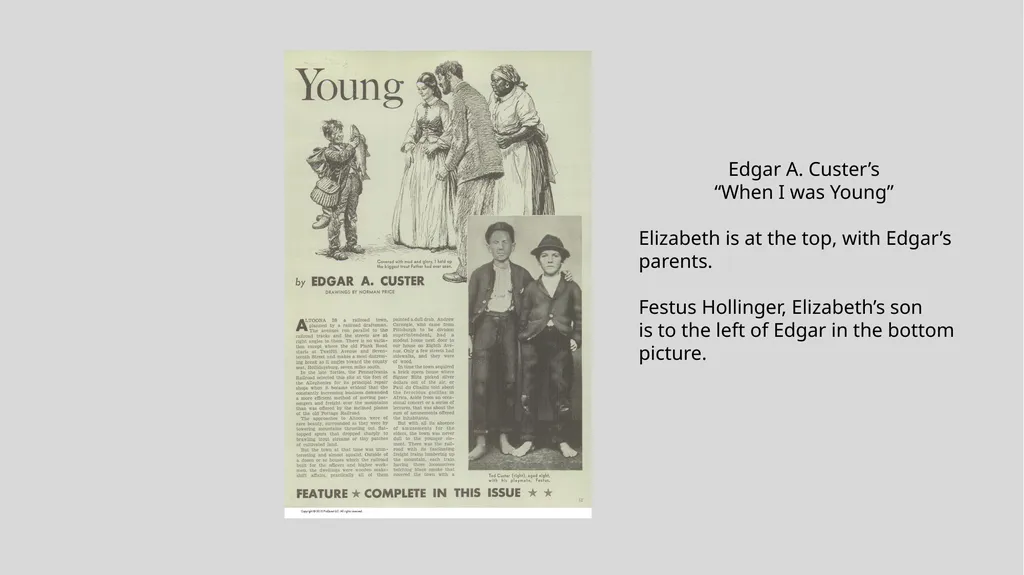
Edgar A. Custer’s
“When I was Young”
Elizabeth is at the top, with Edgar’s parents.
Festus Hollinger, Elizabeth’s son
is to the left of Edgar in the bottom
picture.<br>
“When I was Young”
Elizabeth is at the top, with Edgar’s parents.
Festus Hollinger, Elizabeth’s son
is to the left of Edgar in the bottom
picture.<br>
18
Enlistment of African American men and the Civil War 1792 Federal law prohibited the enlistment of African American men, although history shows that African American men have fought in every US war.
“On July 17, 1862, Congress passed the Second Confiscation and Militia Act. This law allowed the enlistment of African American men who were freed by the Union troops, but official enrollment occurred only after the September 1862 issuing of the Emancipation Proclamation.”
https://www.archives.gov/education/lessons/blacks-civil-war
“The history of African Americans in the U.S. Civil War is marked by 186,097 (7,122 officers, 178,975 enlisted) African-American men, comprising 163 units, who served in the Union Army during the Civil War, and many more African Americans served in the Union Navy. Both free African Americans and escaped slaves joined the fight.
Herbert Aptheker "Negro Casualties in the Civil War" The Journal of Negro History, Vol. 32, No. 1 (January 1947), p. 12.
“On the Confederate side, blacks, both free and slave, were used for labor. In the final months of the war, the Confederate Army was desperate for additional soldiers, so the Confederate Congress voted to recruit black troops for combat; they were to be promised their freedom. Units were in training when the war ended, and none served in combat.”
Bruce Levine, Confederate Emancipation: Southern Plans to Free and Arm Slaves during the Civil War (2005).<br>
“On July 17, 1862, Congress passed the Second Confiscation and Militia Act. This law allowed the enlistment of African American men who were freed by the Union troops, but official enrollment occurred only after the September 1862 issuing of the Emancipation Proclamation.”
https://www.archives.gov/education/lessons/blacks-civil-war
“The history of African Americans in the U.S. Civil War is marked by 186,097 (7,122 officers, 178,975 enlisted) African-American men, comprising 163 units, who served in the Union Army during the Civil War, and many more African Americans served in the Union Navy. Both free African Americans and escaped slaves joined the fight.
Herbert Aptheker "Negro Casualties in the Civil War" The Journal of Negro History, Vol. 32, No. 1 (January 1947), p. 12.
“On the Confederate side, blacks, both free and slave, were used for labor. In the final months of the war, the Confederate Army was desperate for additional soldiers, so the Confederate Congress voted to recruit black troops for combat; they were to be promised their freedom. Units were in training when the war ended, and none served in combat.”
Bruce Levine, Confederate Emancipation: Southern Plans to Free and Arm Slaves during the Civil War (2005).<br>
19
Ex-Slaves who enlisted and fought in the Union Army during the Civil War A sampling of former slaves who fought in the USCT (United State Colored Troops) units and called Blair County home:
Milton Lane, Altoona (born 1832 in Maryland, died January 23, 1917 in Altoona) 54th Massachusetts, buried in Oak Ridge Cemetery
John Phillip Thomas, Tyrone (born October 10, 1835 in Macon Georgia, died Sunday, November 21, 1915 in Tyrone), 6th Regiment USCT Heavy Artillery, buried in Bellfonte, PA
William Whysong, Altoona (born in 1838 unknown southern state, died August 30, 1917 in Pittsburgh) Obituary states that he was assumed to be a Union Spy and was imprisoned for 6 months. Buried in Altoona according to Ancestry.com.<br>
Milton Lane, Altoona (born 1832 in Maryland, died January 23, 1917 in Altoona) 54th Massachusetts, buried in Oak Ridge Cemetery
John Phillip Thomas, Tyrone (born October 10, 1835 in Macon Georgia, died Sunday, November 21, 1915 in Tyrone), 6th Regiment USCT Heavy Artillery, buried in Bellfonte, PA
William Whysong, Altoona (born in 1838 unknown southern state, died August 30, 1917 in Pittsburgh) Obituary states that he was assumed to be a Union Spy and was imprisoned for 6 months. Buried in Altoona according to Ancestry.com.<br>
20
Community Organizations that were founded, supportive of and supported by Blair County Free Blacks and Ex-Slaves Religious organizations: The Allen/Bethel/16th Street AME Church in Altoona and Bethel AME Church in Tyrone, Mount Zion Missionary Baptist Church (aka Second Baptist Church) in Altoona, Hollidaysburg AMEZ Church, John Wesley/Bell Avenue AME Zion Church in Altoona (Mt. Zion in Altoona and Bethel AME Church in Tyrone were founded by former slaves.)
Masonic organization: Purity Lodge, No. 41, F&A.M. est. 1853 in Altoona. In early March of 1855, the lodge was destroyed by fire. This incident was noted in Frederick Douglass’ paper, the North Star and the local Huntingdon newspaper. Other predominately black masonic organizations in Blair County were Wendell Phillips Lodge of Odd Fellows, the Royal Arch Masons which was established in 1894 and the Household of Ruth (Wendell Phillips was an abolitionist.)
Literary Societies formed by the AME, AMEZ and Baptist Churches that involved the black communities of Altoona, Hollidaysburg and Tyrone
Political Organizations: PA State Equal Right League, Afro-American League, Lincoln Republican Club, the Blair county Republican organization
GAR (Grand Army of the Republic) organization (Fraternal organization composed of veterans of the Union Army, 1866-1956) Locally, all armed servicemen were eligible to join the local GAR posts.<br>
Masonic organization: Purity Lodge, No. 41, F&A.M. est. 1853 in Altoona. In early March of 1855, the lodge was destroyed by fire. This incident was noted in Frederick Douglass’ paper, the North Star and the local Huntingdon newspaper. Other predominately black masonic organizations in Blair County were Wendell Phillips Lodge of Odd Fellows, the Royal Arch Masons which was established in 1894 and the Household of Ruth (Wendell Phillips was an abolitionist.)
Literary Societies formed by the AME, AMEZ and Baptist Churches that involved the black communities of Altoona, Hollidaysburg and Tyrone
Political Organizations: PA State Equal Right League, Afro-American League, Lincoln Republican Club, the Blair county Republican organization
GAR (Grand Army of the Republic) organization (Fraternal organization composed of veterans of the Union Army, 1866-1956) Locally, all armed servicemen were eligible to join the local GAR posts.<br>
21
Work/Occupation of ex-slaves in Blair County John Alexander (b.1819 or 1821 to d.1893) came from Fauquier County, VA and began his career in Altoona as a barber, a drayman, a grocery keeper and restaurant owner and ice cream seller. John was also the Sunday School Superintendent of the Allen/Bethel/16th Street AME Church. The land that is now called Eastern Light Cemetery (1st Avenue and 10th Street) in Altoona was purchased by Mr. Alexander, George Hooper and John Ferguson in order to have a place to bury the black citizenry of Altoona.
Eastern Light Cemetery in Altoona was created in 1864 and the land which fronts 10th Street and Oak Ridge Cemetery was purchased by John Ferguson, George Hooper and John Alexander for the burial of African American citizens of Altoona. In addition, to these men, George M. Jackson, Henry Johnson, George Payne (Paine) and Allan (or Allen) Hurley were its first stockholders.
J. Simpson Africa’s History of Blair County, pg. 180<br>
Eastern Light Cemetery in Altoona was created in 1864 and the land which fronts 10th Street and Oak Ridge Cemetery was purchased by John Ferguson, George Hooper and John Alexander for the burial of African American citizens of Altoona. In addition, to these men, George M. Jackson, Henry Johnson, George Payne (Paine) and Allan (or Allen) Hurley were its first stockholders.
J. Simpson Africa’s History of Blair County, pg. 180<br>
22
Work/Occupation of ex-Slaves in Blair County Jacob Jefferson Green was founder and president of the Lincoln Republican club and the Senator Matt Quay club. AKA “Colonel” Green was born in slavery approximately in 1843 in Warington, North Carolina and moved to Altoona after the Civil War. His obituary and news articles written in the Tribune indicated that he was the most prominent black politician in the city during his life. On Dec 20, 1904, he was attacked while stumping for an election. He died February 23, 1908 from the effects of a stroke, asthma and Bright’s disease (kidney disease).
Other ex-slaves/free blacks held jobs as farmers, barbers, porters for hotels, store porters for Gable store (Altoona downtown store) located on 11th Avenue between 12th and 13th Street, elevator operators, restaurants waiters, scavenger/garbage haulers, draymen (driver of a low flat-bed wagon pulled by horses, which transported all kinds of goods), hostlers (employed to look after the horses of people staying at an inn/hotel), laborers, “furnished rooms”, grocer, domestic servant/ domestic worker/nanny (keeping house), school janitor, church sexton, store matron, cooks, midwife, passenger car cleaner for the Pennsylvania Railroad (PRR), canal worker, music teacher, hod carrier (lays bricks, plasters, carries stone to a stonemasons).<br>
Other ex-slaves/free blacks held jobs as farmers, barbers, porters for hotels, store porters for Gable store (Altoona downtown store) located on 11th Avenue between 12th and 13th Street, elevator operators, restaurants waiters, scavenger/garbage haulers, draymen (driver of a low flat-bed wagon pulled by horses, which transported all kinds of goods), hostlers (employed to look after the horses of people staying at an inn/hotel), laborers, “furnished rooms”, grocer, domestic servant/ domestic worker/nanny (keeping house), school janitor, church sexton, store matron, cooks, midwife, passenger car cleaner for the Pennsylvania Railroad (PRR), canal worker, music teacher, hod carrier (lays bricks, plasters, carries stone to a stonemasons).<br>
23
Civic Engagement In Blair County, several community black leaders were selected to be jurors for the County and city trials after being granted the right to vote. (all men)
When a suspicious death occurred in the Altoona black community, the local coroner worked with community leaders to investigate. Those community leaders were typically John Alexander, James Burris, Rev. Reverdy Cassius Ransom (1861-1959), William Nesbit, John Shorter, Thomas Shorter and Charles Nesbit to examine the evidence surrounding the death.
These men attended local and county party conventions and showed their support for Maine’s Senator James G. Blaine and Illinois’ Senator John A. Logan Presidential and Vice-Presidential run in 1884. Senator Blaine lost the 1888 election to Grover Cleveland.
Most Blair County black men supported Pennsylvania’s Senator Matthew Quay in his elections and his chairmanship of the Republican Party in the 1888 Presidential election.
These men were also members of the PA State Equal Rights League (1864-1877), which was created to help bring about full citizenship rights to African American men who lived in the North and the South.
The Pennsylvania State Equal Rights League and the Northern Black Struggle for Legal Equality, 1864-1877 Hugh Davis The Pennsylvania Magazine of History and Biography Vol. 126, No. 4 (Oct. 2002), pp. 611-634, University of Pennsylvania<br>
When a suspicious death occurred in the Altoona black community, the local coroner worked with community leaders to investigate. Those community leaders were typically John Alexander, James Burris, Rev. Reverdy Cassius Ransom (1861-1959), William Nesbit, John Shorter, Thomas Shorter and Charles Nesbit to examine the evidence surrounding the death.
These men attended local and county party conventions and showed their support for Maine’s Senator James G. Blaine and Illinois’ Senator John A. Logan Presidential and Vice-Presidential run in 1884. Senator Blaine lost the 1888 election to Grover Cleveland.
Most Blair County black men supported Pennsylvania’s Senator Matthew Quay in his elections and his chairmanship of the Republican Party in the 1888 Presidential election.
These men were also members of the PA State Equal Rights League (1864-1877), which was created to help bring about full citizenship rights to African American men who lived in the North and the South.
The Pennsylvania State Equal Rights League and the Northern Black Struggle for Legal Equality, 1864-1877 Hugh Davis The Pennsylvania Magazine of History and Biography Vol. 126, No. 4 (Oct. 2002), pp. 611-634, University of Pennsylvania<br>
24
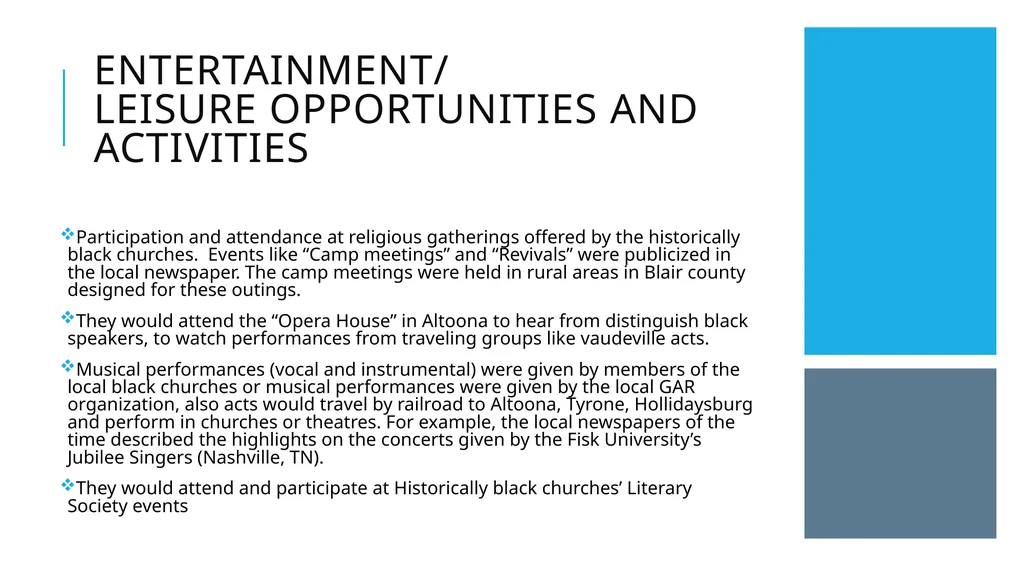
Entertainment/
Leisure Opportunities and Activities Participation and attendance at religious gatherings offered by the historically black churches. Events like “Camp meetings” and “Revivals” were publicized in the local newspaper. The camp meetings were held in rural areas in Blair county designed for these outings.
They would attend the “Opera House” in Altoona to hear from distinguish black speakers, to watch performances from traveling groups like vaudeville acts.
Musical performances (vocal and instrumental) were given by members of the local black churches or musical performances were given by the local GAR organization, also acts would travel by railroad to Altoona, Tyrone, Hollidaysburg and perform in churches or theatres. For example, the local newspapers of the time described the highlights on the concerts given by the Fisk University’s Jubilee Singers (Nashville, TN).
They would attend and participate at Historically black churches’ Literary Society events<br>
They would attend the “Opera House” in Altoona to hear from distinguish black speakers, to watch performances from traveling groups like vaudeville acts.
Musical performances (vocal and instrumental) were given by members of the local black churches or musical performances were given by the local GAR organization, also acts would travel by railroad to Altoona, Tyrone, Hollidaysburg and perform in churches or theatres. For example, the local newspapers of the time described the highlights on the concerts given by the Fisk University’s Jubilee Singers (Nashville, TN).
They would attend and participate at Historically black churches’ Literary Society events<br>
25
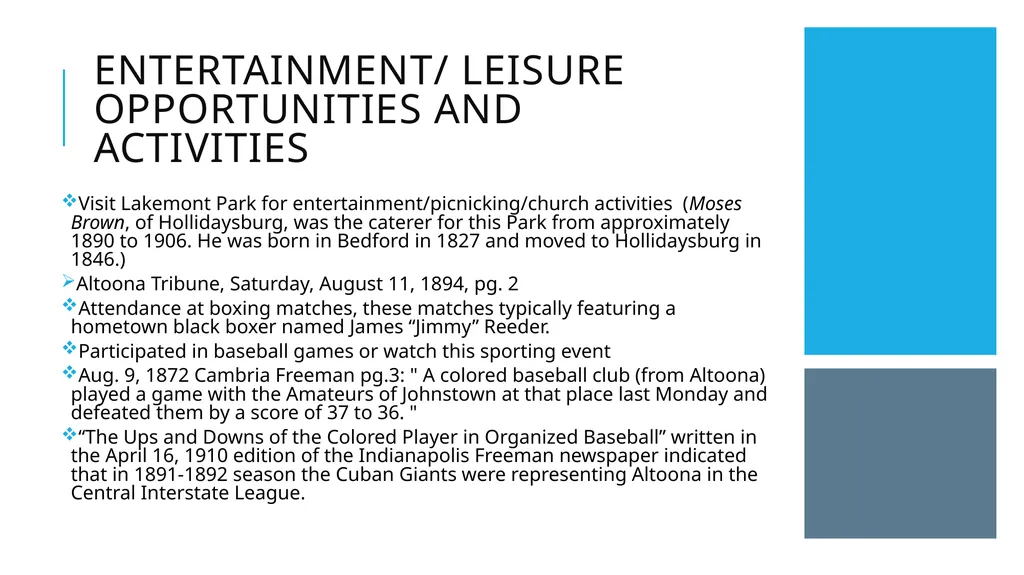
Entertainment/ Leisure Opportunities and Activities Visit Lakemont Park for entertainment/picnicking/church activities (Moses Brown, of Hollidaysburg, was the caterer for this Park from approximately 1890 to 1906. He was born in Bedford in 1827 and moved to Hollidaysburg in 1846.)
Altoona Tribune, Saturday, August 11, 1894, pg. 2
Attendance at boxing matches, these matches typically featuring a hometown black boxer named James “Jimmy” Reeder.
Participated in baseball games or watch this sporting event
Aug. 9, 1872 Cambria Freeman pg.3: " A colored baseball club (from Altoona) played a game with the Amateurs of Johnstown at that place last Monday and defeated them by a score of 37 to 36. "
“The Ups and Downs of the Colored Player in Organized Baseball” written in the April 16, 1910 edition of the Indianapolis Freeman newspaper indicated that in 1891-1892 season the Cuban Giants were representing Altoona in the Central Interstate League.<br>
Altoona Tribune, Saturday, August 11, 1894, pg. 2
Attendance at boxing matches, these matches typically featuring a hometown black boxer named James “Jimmy” Reeder.
Participated in baseball games or watch this sporting event
Aug. 9, 1872 Cambria Freeman pg.3: " A colored baseball club (from Altoona) played a game with the Amateurs of Johnstown at that place last Monday and defeated them by a score of 37 to 36. "
“The Ups and Downs of the Colored Player in Organized Baseball” written in the April 16, 1910 edition of the Indianapolis Freeman newspaper indicated that in 1891-1892 season the Cuban Giants were representing Altoona in the Central Interstate League.<br>
26
Bibliography http://www.usgwarchives.net/pa/blair/1picts/gables/gables30souvenir.htm Gable’s 30th Anniversary Souvenir: A Brief History of Altoona and the People’s Store, Blair County PA USGenWeb Archive
Altoona Tribune, Altoona Times, Altoona Mirror archives (newspaper.com/browse)
Accessible Archives: The Christian Recorder
Pittsburgh Courier
Ancestry.com
https://access.newspaperarchive.com/
Pg. 86 “History of the City of Altoona and Blair County” ed. By Jas. H. Ewing & Harry Slep
http://woodburyonline.org/images/woodbury_1877.jpg (Woodbury History)<br>
Altoona Tribune, Altoona Times, Altoona Mirror archives (newspaper.com/browse)
Accessible Archives: The Christian Recorder
Pittsburgh Courier
Ancestry.com
https://access.newspaperarchive.com/
Pg. 86 “History of the City of Altoona and Blair County” ed. By Jas. H. Ewing & Harry Slep
http://woodburyonline.org/images/woodbury_1877.jpg (Woodbury History)<br>
27
Acknowledgements<br>
28
Logo/Artwork Created by Keith Mallet
Est. 1992 with the assistance of
the Altoona Railroaders Memorial Museum
https://sites.psu.edu/harriettgaston5/<br>
Est. 1992 with the assistance of
the Altoona Railroaders Memorial Museum
https://sites.psu.edu/harriettgaston5/<br>
29
Questions?<br>