
Examining Functional Claim Limitations: Focus on
JO
Published · 33 slides · 0 views

1 / 1



Description
Examining Functional Claim Limitations: Focus on ComputerSoftware-related Claims May 2015 Goals Providing a clear prosecution record by explaining the claim interpretation of functional claim limitations Ensuring claim scope is properly
Related Topics
Share
Embed code
Download this presentation From Below
"Examining Functional Claim Limitations: Focus on" is the property of its rightful owner. Permission is granted to download and print the materials on this website for personal, non-commercial use only, and to display it on your personal computer provided you do not modify the materials and that you retain all copyright notices contained in the materials. By downloading content from our website, you accept the terms of this agreement.
Presentation Transcript
01
Examining Functional Claim Limitations:
Focus on Computer/Software-related Claims May 2015<br>
02
Goals Providing a clear prosecution record by explaining the claim interpretation of functional claim limitations
Ensuring claim scope is properly determined when construing/ examining functional claim limitations that are not governed by 35 USC 112(f)
Ensuring claims that use functional limitations have clear boundaries 3<br>
Ensuring claim scope is properly determined when construing/ examining functional claim limitations that are not governed by 35 USC 112(f)
Ensuring claims that use functional limitations have clear boundaries 3<br>
03
Clarity Clarity of claim limitations in granted patents is improved when the interpretation is explained in Office actions
Early clarification by the examiner of claim limitations will help applicant clarify the meaning, amend the claim, or provide a more effective response to any prior art rejections, as well as lead to more efficient prosecution
The prosecution record will provide a map for the public to understand the boundaries of the patent protection and provide clear notice of patent rights
The PTAB and courts will be informed as to what the examiner and the applicant understood the claims to mean 4<br>
Early clarification by the examiner of claim limitations will help applicant clarify the meaning, amend the claim, or provide a more effective response to any prior art rejections, as well as lead to more efficient prosecution
The prosecution record will provide a map for the public to understand the boundaries of the patent protection and provide clear notice of patent rights
The PTAB and courts will be informed as to what the examiner and the applicant understood the claims to mean 4<br>
04
Examining Functional Claim Limitations Part I: Interpreting Functional Claim Limitations
Determine the broadest reasonable interpretation (BRI) of the claim, including identifying and construing functional claim limitations
Understand difference between functional limitations and:
Intended use or result, and
Non-functional descriptive material
Part II: Determining Patentability of Claims including Functional Claim Limitations
Definiteness
Written Description and Enablement
Prior Art
It is important to note that every claim must be analyzed based on its own facts and that there are no bright line rules in claim construction 5<br>
Determine the broadest reasonable interpretation (BRI) of the claim, including identifying and construing functional claim limitations
Understand difference between functional limitations and:
Intended use or result, and
Non-functional descriptive material
Part II: Determining Patentability of Claims including Functional Claim Limitations
Definiteness
Written Description and Enablement
Prior Art
It is important to note that every claim must be analyzed based on its own facts and that there are no bright line rules in claim construction 5<br>
05
Interpreting Functional Claim Limitations 6<br>
06
Identify Functional Claim Limitations A claim limitation is functional when it recites a feature by what it does rather than by what it is
The use of functional language does not, by itself, render a claim improper
Often functional language is used to tie claim elements together or to provide context
A functional limitation must be evaluated like any other limitation for what it conveys to one of ordinary skill in the art 7<br>
The use of functional language does not, by itself, render a claim improper
Often functional language is used to tie claim elements together or to provide context
A functional limitation must be evaluated like any other limitation for what it conveys to one of ordinary skill in the art 7<br>
07
Use of Functional Claim Limitations Typically, functional language is used in a claim limitation as follows:
“Means-plus-function” limitations, which are functional limitations authorized by 35 USC 112(f) (or pre-AIA 35 USC 112, sixth paragraph)
OR
Recited with some structure, material or action to define a particular capability or purpose served by the recited structure, material or action
MPEP 2181 & 2111 8<br>
“Means-plus-function” limitations, which are functional limitations authorized by 35 USC 112(f) (or pre-AIA 35 USC 112, sixth paragraph)
OR
Recited with some structure, material or action to define a particular capability or purpose served by the recited structure, material or action
MPEP 2181 & 2111 8<br>
08
Construing Functional Claim Limitations During examination claims are given their broadest reasonable interpretation (BRI) in light of the specification as it would be interpreted by one of ordinary skill in the art
An examiner’s determination regarding the interpretation of functional claim language will be highly dependent upon the limitation’s contextual use, therefore it is critical to look to the words of the claim and the specification for a proper interpretation
All words in a claim must be considered in judging the patentability of the claim language - including functional claim limitations
No claim limitations can be ignored, but not all limitations will provide a patentable distinction
Explaining claim interpretation on the record will make the claim scope afforded during prosecution clear, for example by clarifying how prior art is applied or why claims define over the prior art
MPEP 2111 9<br>
An examiner’s determination regarding the interpretation of functional claim language will be highly dependent upon the limitation’s contextual use, therefore it is critical to look to the words of the claim and the specification for a proper interpretation
All words in a claim must be considered in judging the patentability of the claim language - including functional claim limitations
No claim limitations can be ignored, but not all limitations will provide a patentable distinction
Explaining claim interpretation on the record will make the claim scope afforded during prosecution clear, for example by clarifying how prior art is applied or why claims define over the prior art
MPEP 2111 9<br>
09
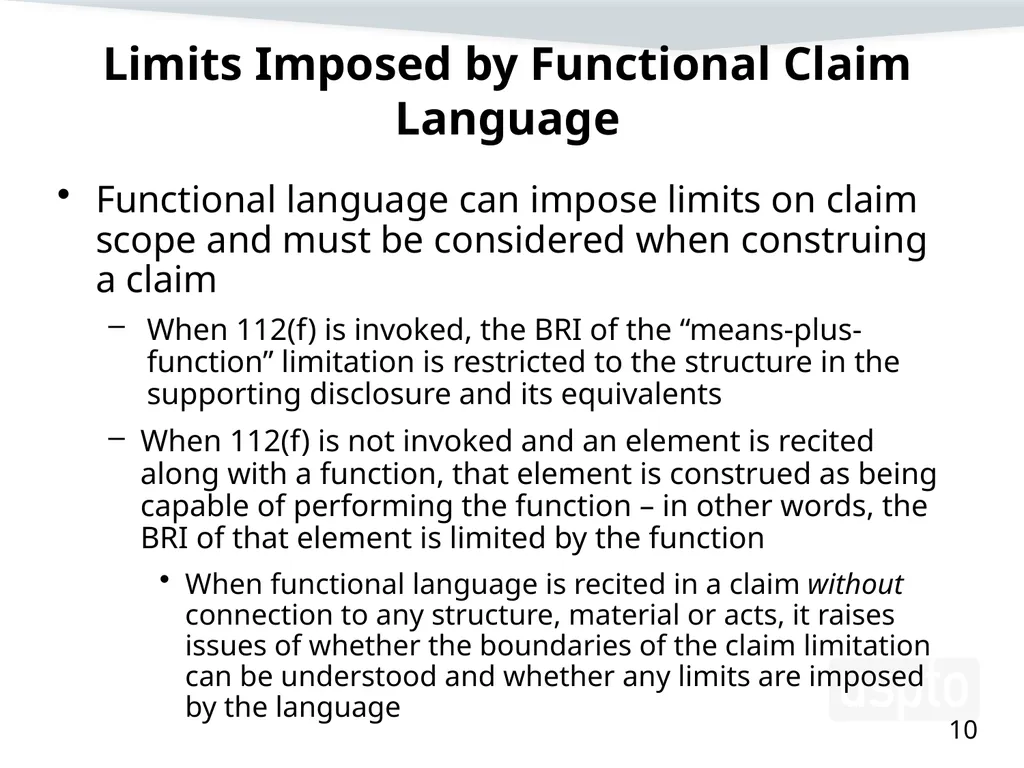
Limits Imposed by Functional Claim Language Functional language can impose limits on claim scope and must be considered when construing a claim
When 112(f) is invoked, the BRI of the “means-plus-function” limitation is restricted to the structure in the supporting disclosure and its equivalents
When 112(f) is not invoked and an element is recited along with a function, that element is construed as being capable of performing the function – in other words, the BRI of that element is limited by the function
When functional language is recited in a claim without connection to any structure, material or acts, it raises issues of whether the boundaries of the claim limitation can be understood and whether any limits are imposed by the language 10<br>
When 112(f) is invoked, the BRI of the “means-plus-function” limitation is restricted to the structure in the supporting disclosure and its equivalents
When 112(f) is not invoked and an element is recited along with a function, that element is construed as being capable of performing the function – in other words, the BRI of that element is limited by the function
When functional language is recited in a claim without connection to any structure, material or acts, it raises issues of whether the boundaries of the claim limitation can be understood and whether any limits are imposed by the language 10<br>
10
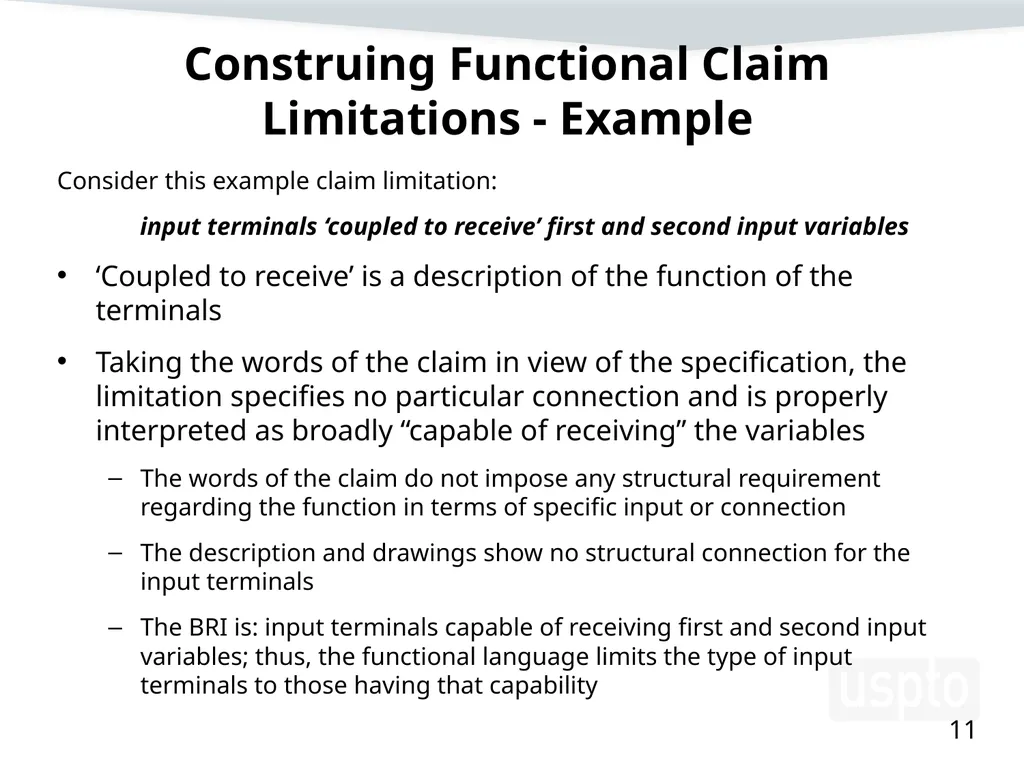
Construing Functional Claim Limitations - Example Consider this example claim limitation:
input terminals ‘coupled to receive’ first and second input variables
‘Coupled to receive’ is a description of the function of the terminals
Taking the words of the claim in view of the specification, the limitation specifies no particular connection and is properly interpreted as broadly “capable of receiving” the variables
The words of the claim do not impose any structural requirement regarding the function in terms of specific input or connection
The description and drawings show no structural connection for the input terminals
The BRI is: input terminals capable of receiving first and second input variables; thus, the functional language limits the type of input terminals to those having that capability 11<br>
input terminals ‘coupled to receive’ first and second input variables
‘Coupled to receive’ is a description of the function of the terminals
Taking the words of the claim in view of the specification, the limitation specifies no particular connection and is properly interpreted as broadly “capable of receiving” the variables
The words of the claim do not impose any structural requirement regarding the function in terms of specific input or connection
The description and drawings show no structural connection for the input terminals
The BRI is: input terminals capable of receiving first and second input variables; thus, the functional language limits the type of input terminals to those having that capability 11<br>
11
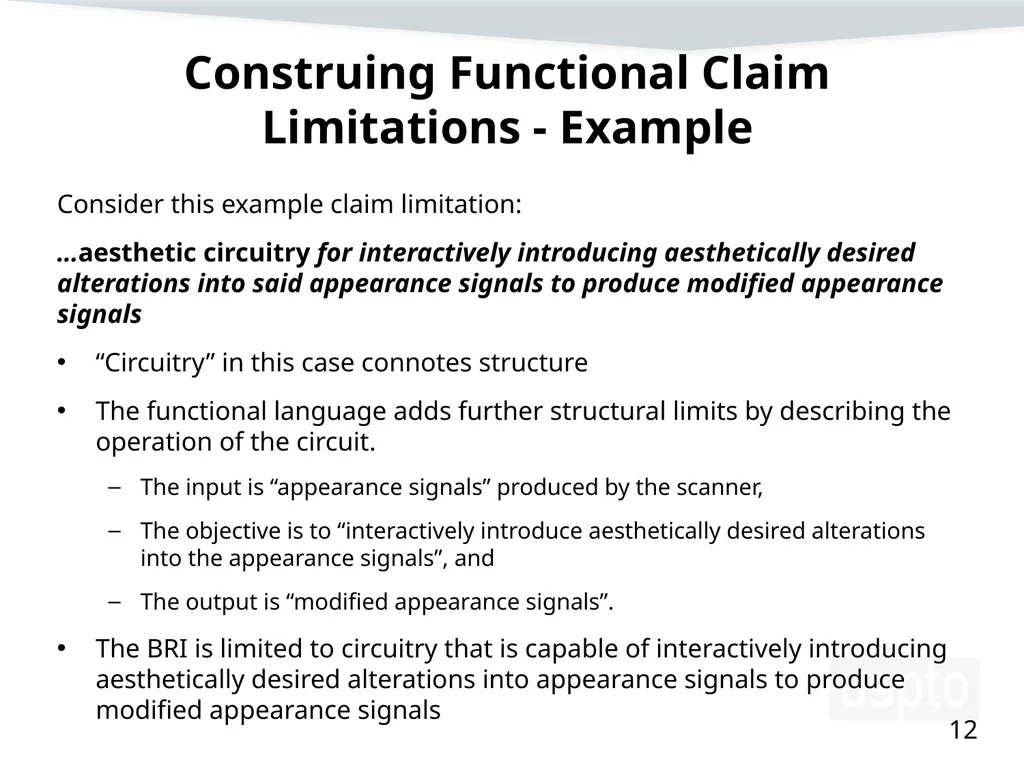
Construing Functional Claim Limitations - Example Consider this example claim limitation:
…aesthetic circuitry for interactively introducing aesthetically desired alterations into said appearance signals to produce modified appearance signals
“Circuitry” in this case connotes structure
The functional language adds further structural limits by describing the operation of the circuit.
The input is “appearance signals” produced by the scanner,
The objective is to “interactively introduce aesthetically desired alterations into the appearance signals”, and
The output is “modified appearance signals”.
The BRI is limited to circuitry that is capable of interactively introducing aesthetically desired alterations into appearance signals to produce modified appearance signals 12<br>
…aesthetic circuitry for interactively introducing aesthetically desired alterations into said appearance signals to produce modified appearance signals
“Circuitry” in this case connotes structure
The functional language adds further structural limits by describing the operation of the circuit.
The input is “appearance signals” produced by the scanner,
The objective is to “interactively introduce aesthetically desired alterations into the appearance signals”, and
The output is “modified appearance signals”.
The BRI is limited to circuitry that is capable of interactively introducing aesthetically desired alterations into appearance signals to produce modified appearance signals 12<br>
12
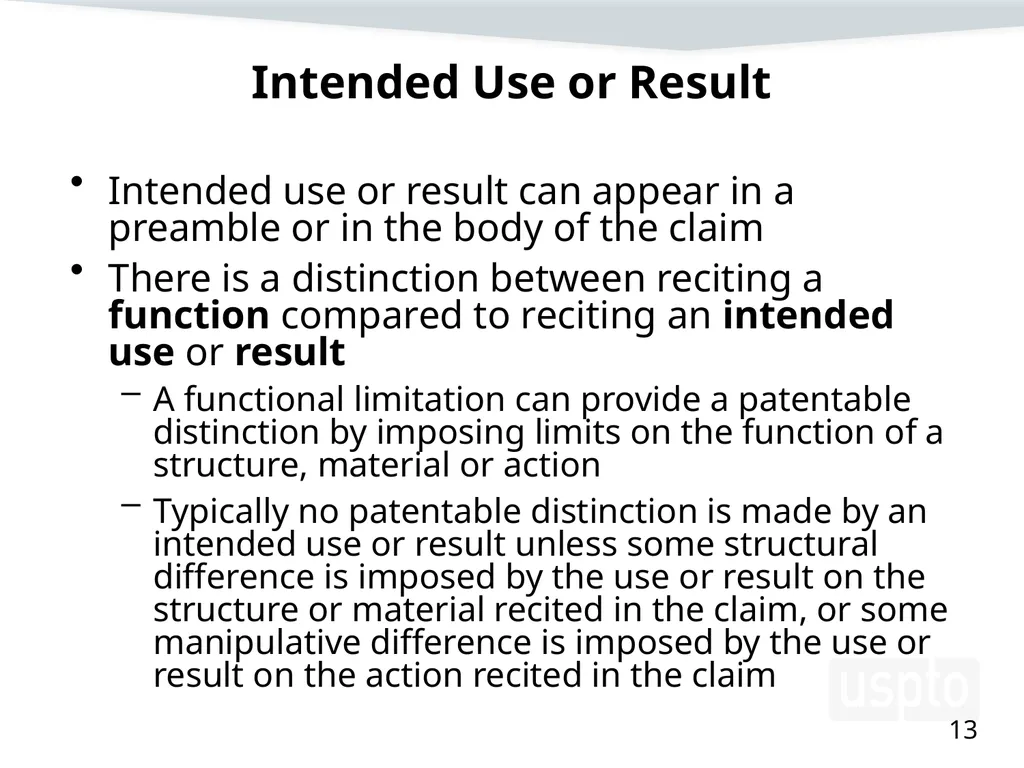
Intended Use or Result Intended use or result can appear in a preamble or in the body of the claim
There is a distinction between reciting a function compared to reciting an intended use or result
A functional limitation can provide a patentable distinction by imposing limits on the function of a structure, material or action
Typically no patentable distinction is made by an intended use or result unless some structural difference is imposed by the use or result on the structure or material recited in the claim, or some manipulative difference is imposed by the use or result on the action recited in the claim 13<br>
There is a distinction between reciting a function compared to reciting an intended use or result
A functional limitation can provide a patentable distinction by imposing limits on the function of a structure, material or action
Typically no patentable distinction is made by an intended use or result unless some structural difference is imposed by the use or result on the structure or material recited in the claim, or some manipulative difference is imposed by the use or result on the action recited in the claim 13<br>
13
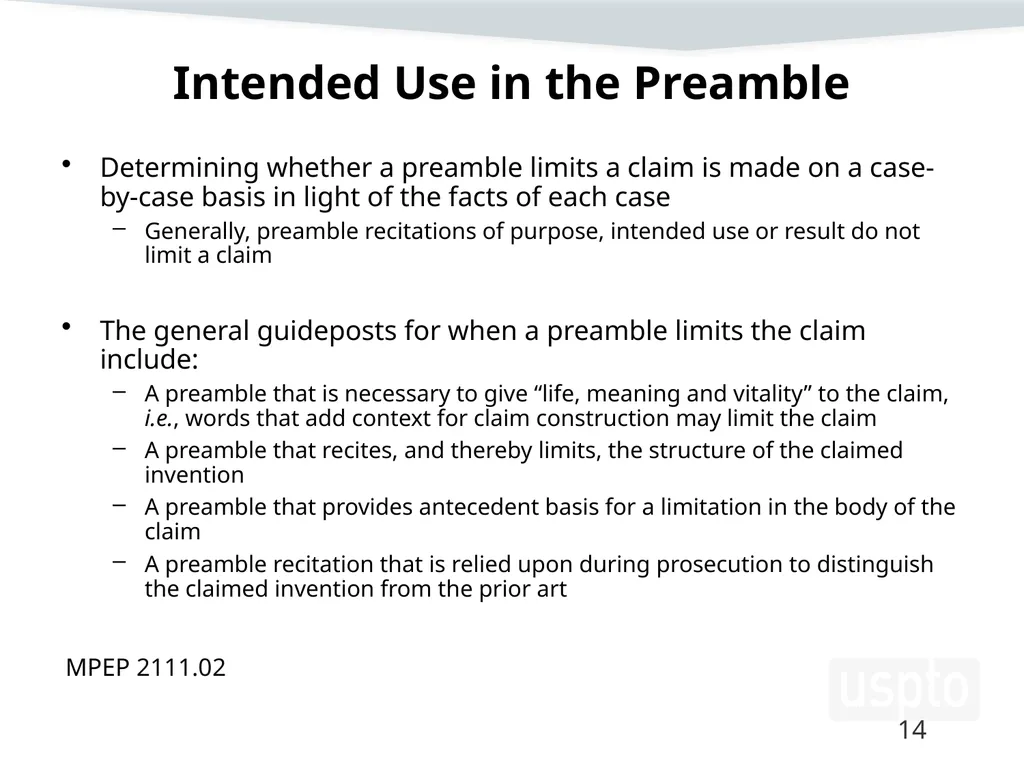
Intended Use in the Preamble Determining whether a preamble limits a claim is made on a case-by-case basis in light of the facts of each case
Generally, preamble recitations of purpose, intended use or result do not limit a claim
The general guideposts for when a preamble limits the claim include:
A preamble that is necessary to give “life, meaning and vitality” to the claim, i.e., words that add context for claim construction may limit the claim
A preamble that recites, and thereby limits, the structure of the claimed invention
A preamble that provides antecedent basis for a limitation in the body of the claim
A preamble recitation that is relied upon during prosecution to distinguish the claimed invention from the prior art
MPEP 2111.02 14<br>
Generally, preamble recitations of purpose, intended use or result do not limit a claim
The general guideposts for when a preamble limits the claim include:
A preamble that is necessary to give “life, meaning and vitality” to the claim, i.e., words that add context for claim construction may limit the claim
A preamble that recites, and thereby limits, the structure of the claimed invention
A preamble that provides antecedent basis for a limitation in the body of the claim
A preamble recitation that is relied upon during prosecution to distinguish the claimed invention from the prior art
MPEP 2111.02 14<br>
14
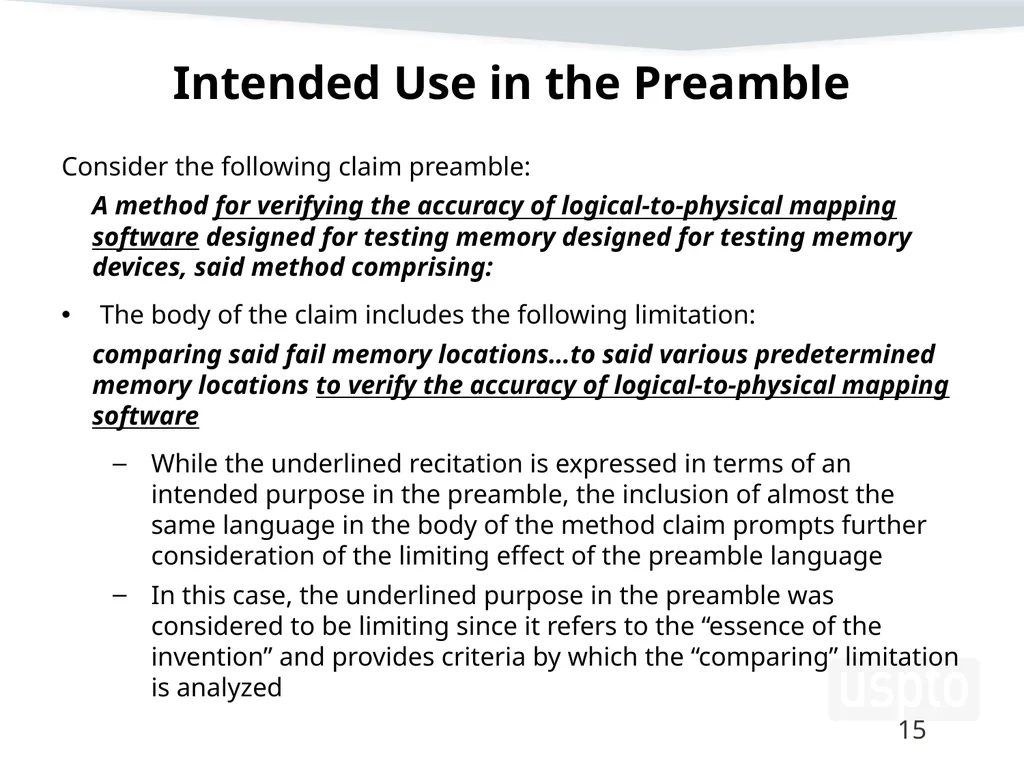
Intended Use in the Preamble Consider the following claim preamble:
A method for verifying the accuracy of logical-to-physical mapping software designed for testing memory designed for testing memory devices, said method comprising:
The body of the claim includes the following limitation:
comparing said fail memory locations…to said various predetermined memory locations to verify the accuracy of logical-to-physical mapping software
While the underlined recitation is expressed in terms of an intended purpose in the preamble, the inclusion of almost the same language in the body of the method claim prompts further consideration of the limiting effect of the preamble language
In this case, the underlined purpose in the preamble was considered to be limiting since it refers to the “essence of the invention” and provides criteria by which the “comparing” limitation is analyzed 15<br>
A method for verifying the accuracy of logical-to-physical mapping software designed for testing memory designed for testing memory devices, said method comprising:
The body of the claim includes the following limitation:
comparing said fail memory locations…to said various predetermined memory locations to verify the accuracy of logical-to-physical mapping software
While the underlined recitation is expressed in terms of an intended purpose in the preamble, the inclusion of almost the same language in the body of the method claim prompts further consideration of the limiting effect of the preamble language
In this case, the underlined purpose in the preamble was considered to be limiting since it refers to the “essence of the invention” and provides criteria by which the “comparing” limitation is analyzed 15<br>
15
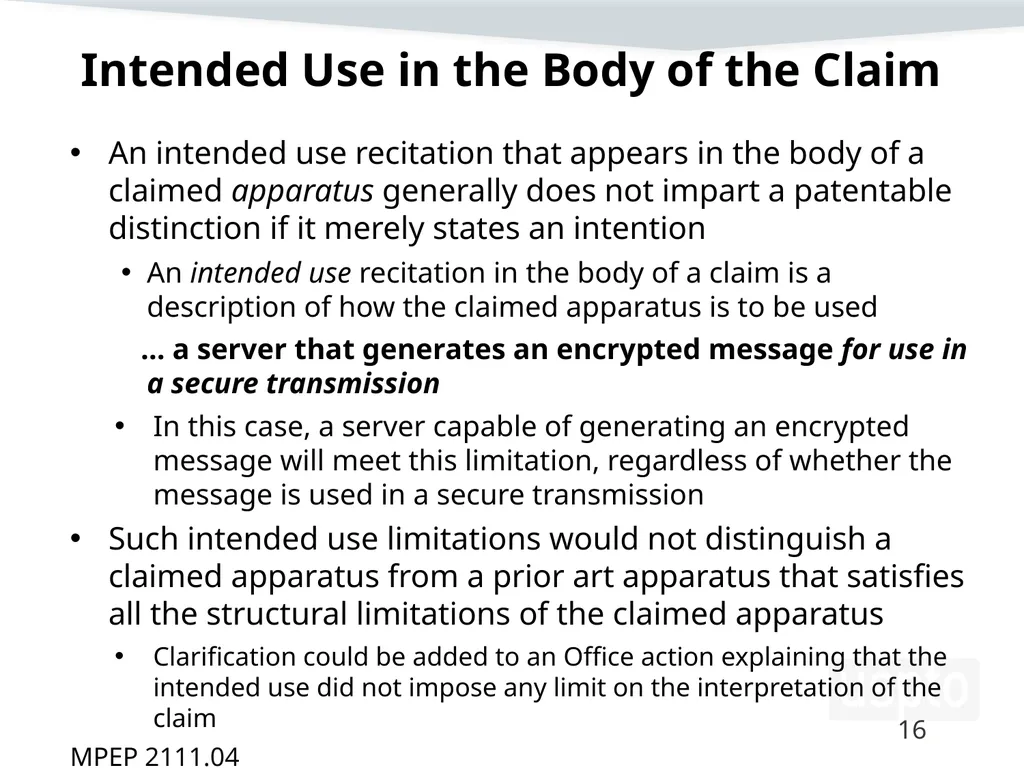
Intended Use in the Body of the Claim An intended use recitation that appears in the body of a claimed apparatus generally does not impart a patentable distinction if it merely states an intention
An intended use recitation in the body of a claim is a description of how the claimed apparatus is to be used
… a server that generates an encrypted message for use in a secure transmission
In this case, a server capable of generating an encrypted message will meet this limitation, regardless of whether the message is used in a secure transmission
Such intended use limitations would not distinguish a claimed apparatus from a prior art apparatus that satisfies all the structural limitations of the claimed apparatus
Clarification could be added to an Office action explaining that the intended use did not impose any limit on the interpretation of the claim
MPEP 2111.04 16<br>
An intended use recitation in the body of a claim is a description of how the claimed apparatus is to be used
… a server that generates an encrypted message for use in a secure transmission
In this case, a server capable of generating an encrypted message will meet this limitation, regardless of whether the message is used in a secure transmission
Such intended use limitations would not distinguish a claimed apparatus from a prior art apparatus that satisfies all the structural limitations of the claimed apparatus
Clarification could be added to an Office action explaining that the intended use did not impose any limit on the interpretation of the claim
MPEP 2111.04 16<br>
16
Intended Result in the Body of the Claim An intended result recitation in a claim is a description of what necessarily happens as a result of the structure or actions recited in the claim
Its limiting effect must be determined on a case-by-case basis
The following scenarios recite the intended result of preventing data theft:
If the recited structure or actions are recited with sufficient detail to achieve the claimed result, the recitation of the intended result adds no further limits on the claim
… a server that generates an encrypted message whereby data theft is prevented
The server is recited along with the function of generating an encrypted message. As a result of that function, data theft is prevented. The whereby clause in this case does not add a further limitation to the recited server.
If the recited structure or actions are recited with some detail to achieve the claimed result, the claim element would be construed as an element capable of obtaining the result (through any means)
…a server programmed so that data theft is prevented
The only limitation on the server is that it be programmed (in any way) to be capable of obtaining the result of preventing data theft.
If the recited structure or actions are not recited with sufficient detail to achieve the claimed result, the claim element would not be limited by a mere expression of intended result
…a server whereby data theft is prevented
There are no limits recited on how the server is structured or how it functions to prevent data theft. Therefore, the whereby clause does not add a further limitation to the claim and would not provide a patentable distinction.
If it is argued that the result should be given patentable weight, the boundaries of the limitation would need to be clearly defined. If the intended result limitation is necessary to understand the claim and the boundaries are not clear, the claim would be indefinite. 17<br>
Its limiting effect must be determined on a case-by-case basis
The following scenarios recite the intended result of preventing data theft:
If the recited structure or actions are recited with sufficient detail to achieve the claimed result, the recitation of the intended result adds no further limits on the claim
… a server that generates an encrypted message whereby data theft is prevented
The server is recited along with the function of generating an encrypted message. As a result of that function, data theft is prevented. The whereby clause in this case does not add a further limitation to the recited server.
If the recited structure or actions are recited with some detail to achieve the claimed result, the claim element would be construed as an element capable of obtaining the result (through any means)
…a server programmed so that data theft is prevented
The only limitation on the server is that it be programmed (in any way) to be capable of obtaining the result of preventing data theft.
If the recited structure or actions are not recited with sufficient detail to achieve the claimed result, the claim element would not be limited by a mere expression of intended result
…a server whereby data theft is prevented
There are no limits recited on how the server is structured or how it functions to prevent data theft. Therefore, the whereby clause does not add a further limitation to the claim and would not provide a patentable distinction.
If it is argued that the result should be given patentable weight, the boundaries of the limitation would need to be clearly defined. If the intended result limitation is necessary to understand the claim and the boundaries are not clear, the claim would be indefinite. 17<br>
17
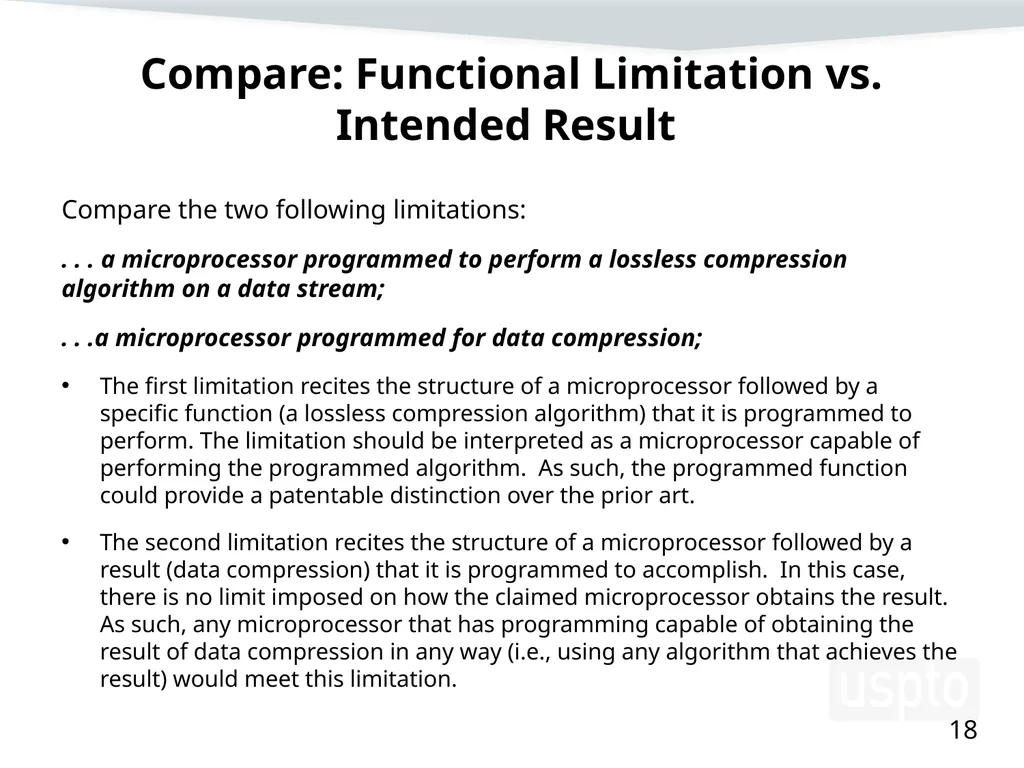
Compare: Functional Limitation vs. Intended Result Compare the two following limitations:
. . . a microprocessor programmed to perform a lossless compression algorithm on a data stream;
. . .a microprocessor programmed for data compression;
The first limitation recites the structure of a microprocessor followed by a specific function (a lossless compression algorithm) that it is programmed to perform. The limitation should be interpreted as a microprocessor capable of performing the programmed algorithm. As such, the programmed function could provide a patentable distinction over the prior art.
The second limitation recites the structure of a microprocessor followed by a result (data compression) that it is programmed to accomplish. In this case, there is no limit imposed on how the claimed microprocessor obtains the result. As such, any microprocessor that has programming capable of obtaining the result of data compression in any way (i.e., using any algorithm that achieves the result) would meet this limitation. 18<br>
. . . a microprocessor programmed to perform a lossless compression algorithm on a data stream;
. . .a microprocessor programmed for data compression;
The first limitation recites the structure of a microprocessor followed by a specific function (a lossless compression algorithm) that it is programmed to perform. The limitation should be interpreted as a microprocessor capable of performing the programmed algorithm. As such, the programmed function could provide a patentable distinction over the prior art.
The second limitation recites the structure of a microprocessor followed by a result (data compression) that it is programmed to accomplish. In this case, there is no limit imposed on how the claimed microprocessor obtains the result. As such, any microprocessor that has programming capable of obtaining the result of data compression in any way (i.e., using any algorithm that achieves the result) would meet this limitation. 18<br>
18
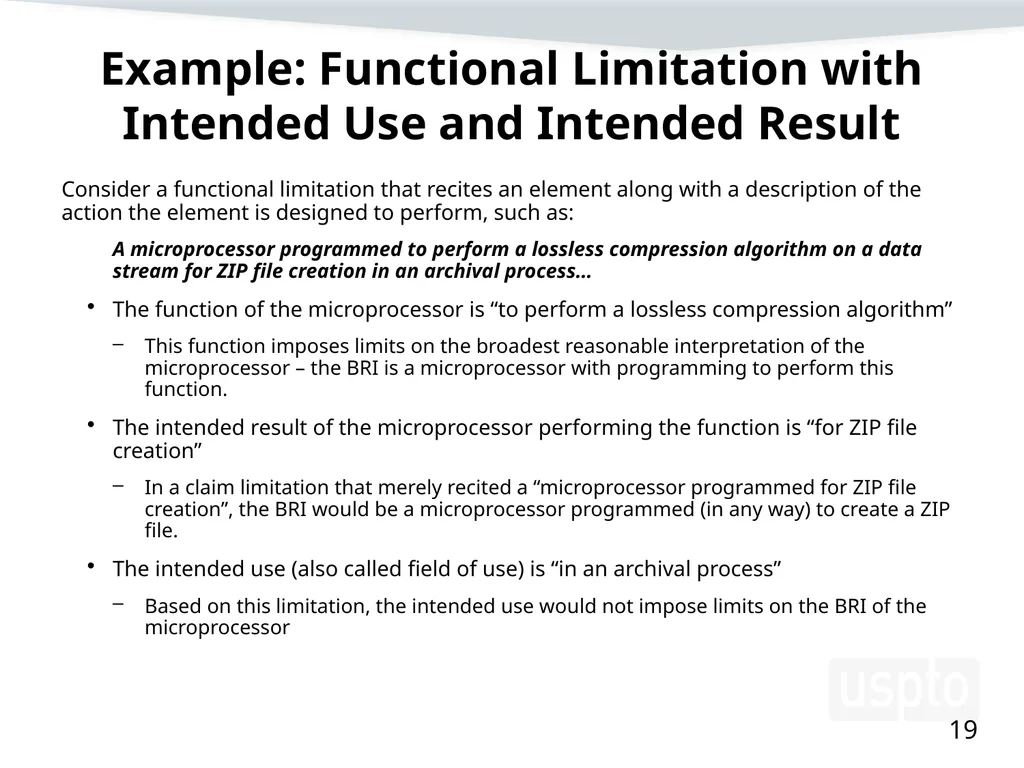
Example: Functional Limitation with Intended Use and Intended Result Consider a functional limitation that recites an element along with a description of the action the element is designed to perform, such as:
A microprocessor programmed to perform a lossless compression algorithm on a data stream for ZIP file creation in an archival process…
The function of the microprocessor is “to perform a lossless compression algorithm”
This function imposes limits on the broadest reasonable interpretation of the microprocessor – the BRI is a microprocessor with programming to perform this function.
The intended result of the microprocessor performing the function is “for ZIP file creation”
In a claim limitation that merely recited a “microprocessor programmed for ZIP file creation”, the BRI would be a microprocessor programmed (in any way) to create a ZIP file.
The intended use (also called field of use) is “in an archival process”
Based on this limitation, the intended use would not impose limits on the BRI of the microprocessor 19<br>
A microprocessor programmed to perform a lossless compression algorithm on a data stream for ZIP file creation in an archival process…
The function of the microprocessor is “to perform a lossless compression algorithm”
This function imposes limits on the broadest reasonable interpretation of the microprocessor – the BRI is a microprocessor with programming to perform this function.
The intended result of the microprocessor performing the function is “for ZIP file creation”
In a claim limitation that merely recited a “microprocessor programmed for ZIP file creation”, the BRI would be a microprocessor programmed (in any way) to create a ZIP file.
The intended use (also called field of use) is “in an archival process”
Based on this limitation, the intended use would not impose limits on the BRI of the microprocessor 19<br>
19
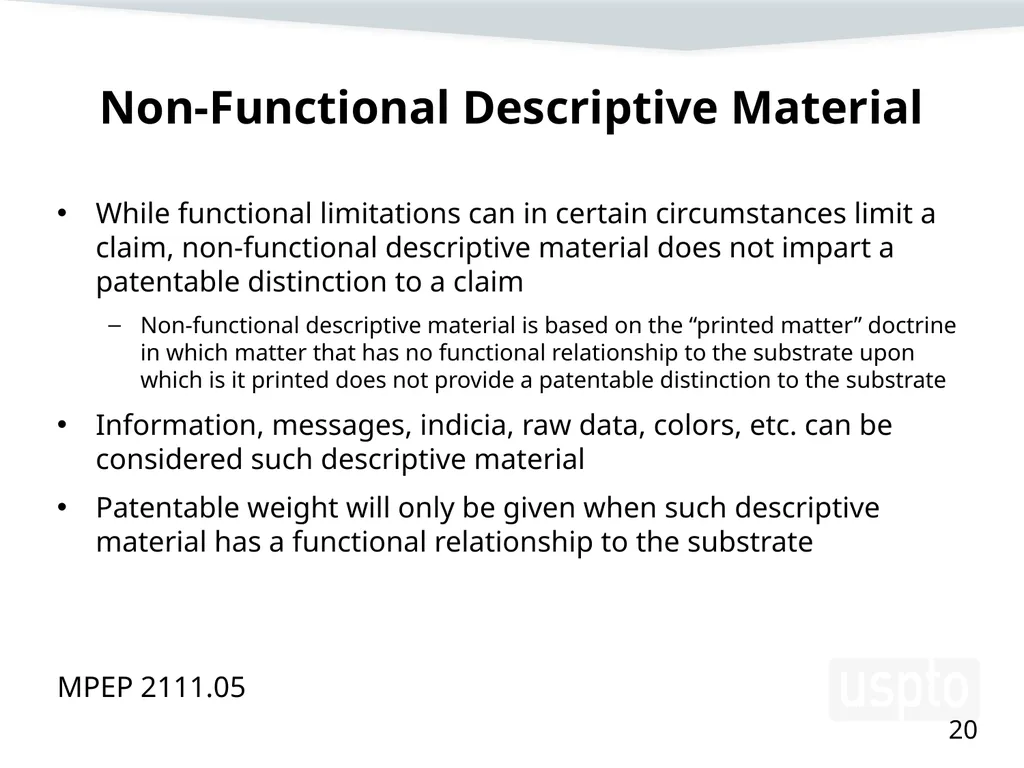
Non-Functional Descriptive Material While functional limitations can in certain circumstances limit a claim, non-functional descriptive material does not impart a patentable distinction to a claim
Non-functional descriptive material is based on the “printed matter” doctrine in which matter that has no functional relationship to the substrate upon which is it printed does not provide a patentable distinction to the substrate
Information, messages, indicia, raw data, colors, etc. can be considered such descriptive material
Patentable weight will only be given when such descriptive material has a functional relationship to the substrate
MPEP 2111.05 20<br>
Non-functional descriptive material is based on the “printed matter” doctrine in which matter that has no functional relationship to the substrate upon which is it printed does not provide a patentable distinction to the substrate
Information, messages, indicia, raw data, colors, etc. can be considered such descriptive material
Patentable weight will only be given when such descriptive material has a functional relationship to the substrate
MPEP 2111.05 20<br>
20
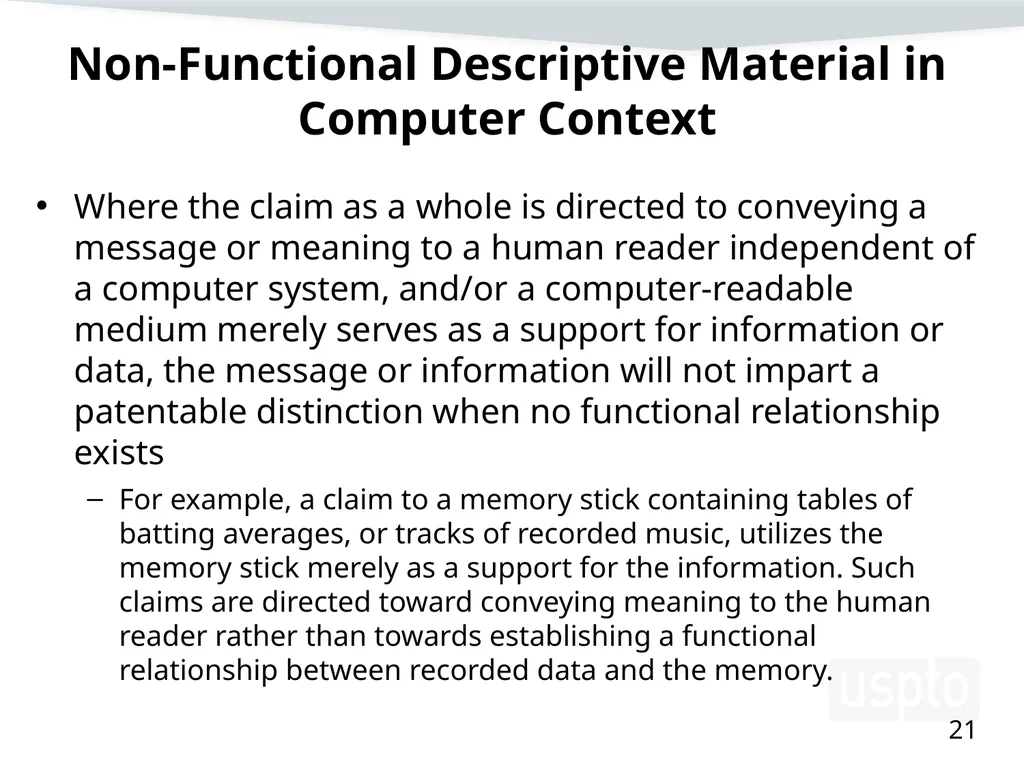
Non-Functional Descriptive Material in Computer Context Where the claim as a whole is directed to conveying a message or meaning to a human reader independent of a computer system, and/or a computer-readable medium merely serves as a support for information or data, the message or information will not impart a patentable distinction when no functional relationship exists
For example, a claim to a memory stick containing tables of batting averages, or tracks of recorded music, utilizes the memory stick merely as a support for the information. Such claims are directed toward conveying meaning to the human reader rather than towards establishing a functional relationship between recorded data and the memory. 21<br>
For example, a claim to a memory stick containing tables of batting averages, or tracks of recorded music, utilizes the memory stick merely as a support for the information. Such claims are directed toward conveying meaning to the human reader rather than towards establishing a functional relationship between recorded data and the memory. 21<br>
21
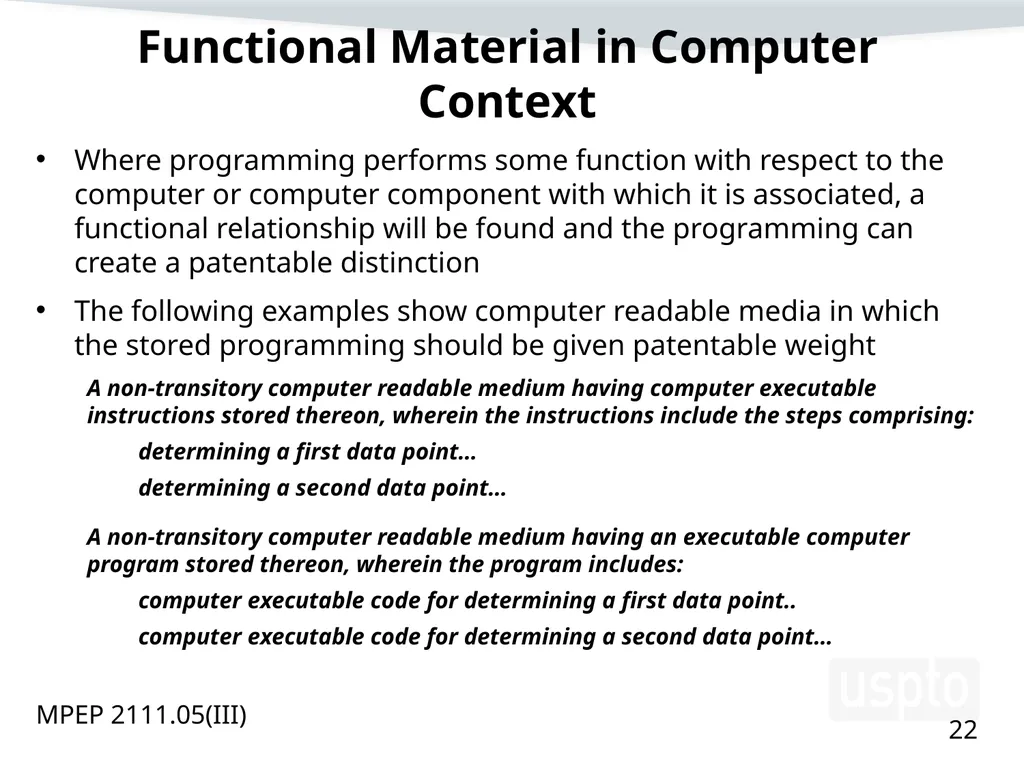
Functional Material in Computer Context Where programming performs some function with respect to the computer or computer component with which it is associated, a functional relationship will be found and the programming can create a patentable distinction
The following examples show computer readable media in which the stored programming should be given patentable weight
A non-transitory computer readable medium having computer executable instructions stored thereon, wherein the instructions include the steps comprising:
determining a first data point…
determining a second data point…
A non-transitory computer readable medium having an executable computer program stored thereon, wherein the program includes:
computer executable code for determining a first data point..
computer executable code for determining a second data point…
MPEP 2111.05(III) 22<br>
The following examples show computer readable media in which the stored programming should be given patentable weight
A non-transitory computer readable medium having computer executable instructions stored thereon, wherein the instructions include the steps comprising:
determining a first data point…
determining a second data point…
A non-transitory computer readable medium having an executable computer program stored thereon, wherein the program includes:
computer executable code for determining a first data point..
computer executable code for determining a second data point…
MPEP 2111.05(III) 22<br>
22
Proper Claim Interpretation on the Record Leads to Clarity A detailed and informative claim interpretation that addresses all functional limitations and other claim language, such as intended use, will clearly set forth the claim scope and benefit the applicant and the public by:
reducing guesswork in responding to the Examiner’s action;
clearly setting forth the protection afforded the applicant;
providing a clear file history that would prevent or reduce unnecessary litigation, interferences, reissues, ex parte reexaminations, inter partes reviews, supplemental examinations, and post-grant proceedings; and
providing public notice as to how the claim was interpreted during examination. 23<br>
reducing guesswork in responding to the Examiner’s action;
clearly setting forth the protection afforded the applicant;
providing a clear file history that would prevent or reduce unnecessary litigation, interferences, reissues, ex parte reexaminations, inter partes reviews, supplemental examinations, and post-grant proceedings; and
providing public notice as to how the claim was interpreted during examination. 23<br>
23
Determining Patentability of Claims including Functional Claim Limitations 24<br>
24
Patentability Issues Relating to Use of Functional Claim Language As previously noted, functional language can be limiting when (i) invoking 112(f) or (ii) recited with a structure, material or action
However, when the claim language imposes no limits on how the claimed function is performed in terms of structure, material or actions, a functional limitation can raise the following issues:
Indefiniteness under 112(b): Failure to provide a clear-cut indication of claim scope because the functional language is not sufficiently precise and definite resulting in no boundaries on the claim limitation
Lack of written description under 112(a): Failure to explain how the inventor envisioned the function to be performed such that the written description does not show that the inventor had possession of the claimed invention
Lack of enablement under 112(a): Failure to provide an enabling disclosure commensurate with the scope of the claims when the claim language covers all ways of performing a function
Application of prior art: Uncertainty as to the scope of the claim leading to broad application of prior art 25<br>
However, when the claim language imposes no limits on how the claimed function is performed in terms of structure, material or actions, a functional limitation can raise the following issues:
Indefiniteness under 112(b): Failure to provide a clear-cut indication of claim scope because the functional language is not sufficiently precise and definite resulting in no boundaries on the claim limitation
Lack of written description under 112(a): Failure to explain how the inventor envisioned the function to be performed such that the written description does not show that the inventor had possession of the claimed invention
Lack of enablement under 112(a): Failure to provide an enabling disclosure commensurate with the scope of the claims when the claim language covers all ways of performing a function
Application of prior art: Uncertainty as to the scope of the claim leading to broad application of prior art 25<br>
25
Definiteness – 35 U.S.C. 112(b) Consider the following to determine whether a claim limitation expressed in functional language is definite with clear scope/meaning:
Is there a clear indication of the scope of subject matter covered by the language, e.g., a specification definition or known meaning in the art?
Does the limitation have well defined boundaries or does it only express a problem solved or intended result?
Would one of ordinary skill in the relevant art know what structures/steps are covered by the limitation?
∙ The above considerations are not all inclusive nor limiting.
MPEP 2173.05(g) 26<br>
Is there a clear indication of the scope of subject matter covered by the language, e.g., a specification definition or known meaning in the art?
Does the limitation have well defined boundaries or does it only express a problem solved or intended result?
Would one of ordinary skill in the relevant art know what structures/steps are covered by the limitation?
∙ The above considerations are not all inclusive nor limiting.
MPEP 2173.05(g) 26<br>
26
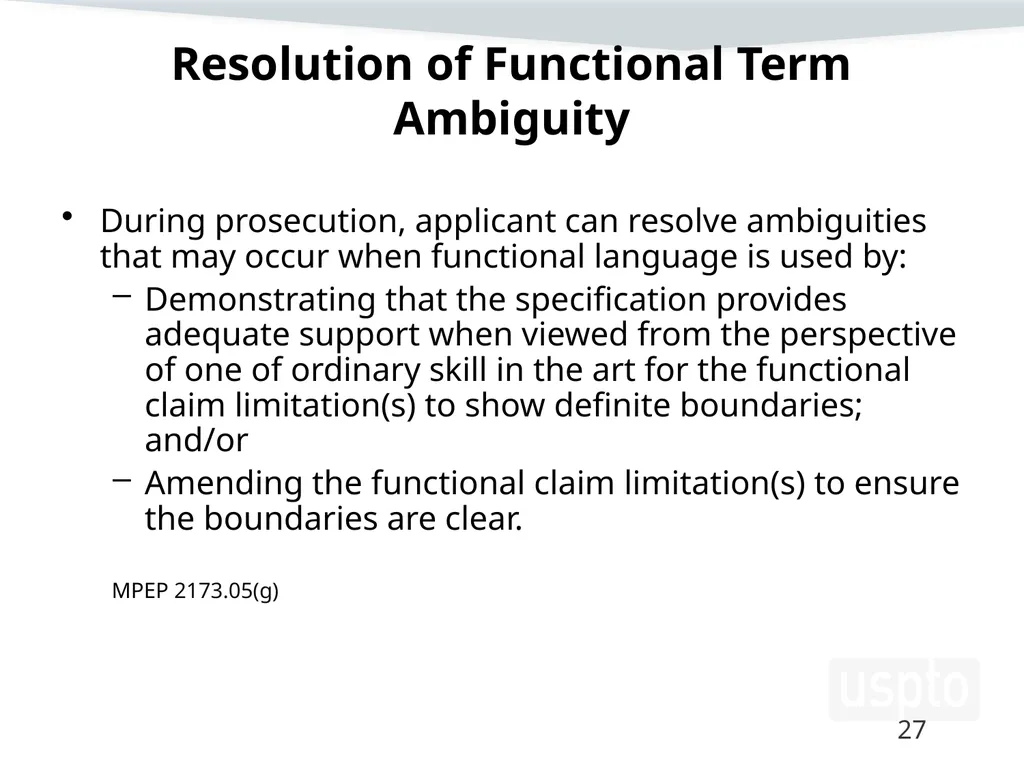
Resolution of Functional Term Ambiguity During prosecution, applicant can resolve ambiguities that may occur when functional language is used by:
Demonstrating that the specification provides adequate support when viewed from the perspective of one of ordinary skill in the art for the functional claim limitation(s) to show definite boundaries; and/or
Amending the functional claim limitation(s) to ensure the boundaries are clear.
MPEP 2173.05(g) 27<br>
Demonstrating that the specification provides adequate support when viewed from the perspective of one of ordinary skill in the art for the functional claim limitation(s) to show definite boundaries; and/or
Amending the functional claim limitation(s) to ensure the boundaries are clear.
MPEP 2173.05(g) 27<br>
27
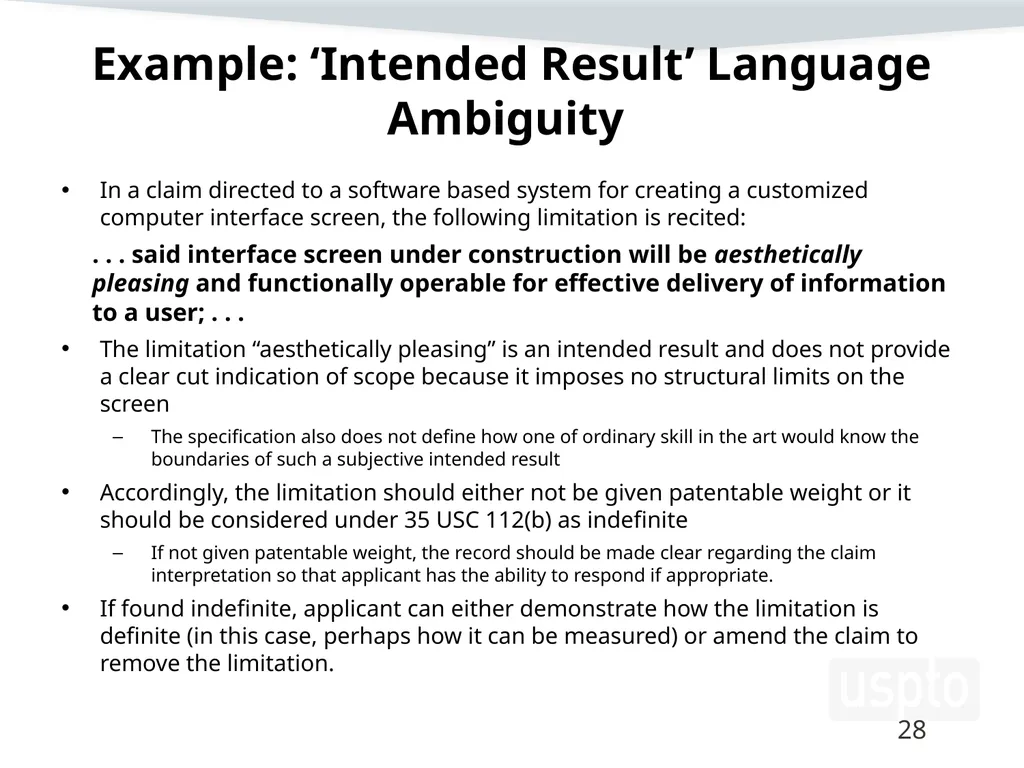
Example: ‘Intended Result’ Language Ambiguity In a claim directed to a software based system for creating a customized computer interface screen, the following limitation is recited:
. . . said interface screen under construction will be aesthetically pleasing and functionally operable for effective delivery of information to a user; . . .
The limitation “aesthetically pleasing” is an intended result and does not provide a clear cut indication of scope because it imposes no structural limits on the screen
The specification also does not define how one of ordinary skill in the art would know the boundaries of such a subjective intended result
Accordingly, the limitation should either not be given patentable weight or it should be considered under 35 USC 112(b) as indefinite
If not given patentable weight, the record should be made clear regarding the claim interpretation so that applicant has the ability to respond if appropriate.
If found indefinite, applicant can either demonstrate how the limitation is definite (in this case, perhaps how it can be measured) or amend the claim to remove the limitation. 28<br>
. . . said interface screen under construction will be aesthetically pleasing and functionally operable for effective delivery of information to a user; . . .
The limitation “aesthetically pleasing” is an intended result and does not provide a clear cut indication of scope because it imposes no structural limits on the screen
The specification also does not define how one of ordinary skill in the art would know the boundaries of such a subjective intended result
Accordingly, the limitation should either not be given patentable weight or it should be considered under 35 USC 112(b) as indefinite
If not given patentable weight, the record should be made clear regarding the claim interpretation so that applicant has the ability to respond if appropriate.
If found indefinite, applicant can either demonstrate how the limitation is definite (in this case, perhaps how it can be measured) or amend the claim to remove the limitation. 28<br>
28
Adequate Supporting Disclosure
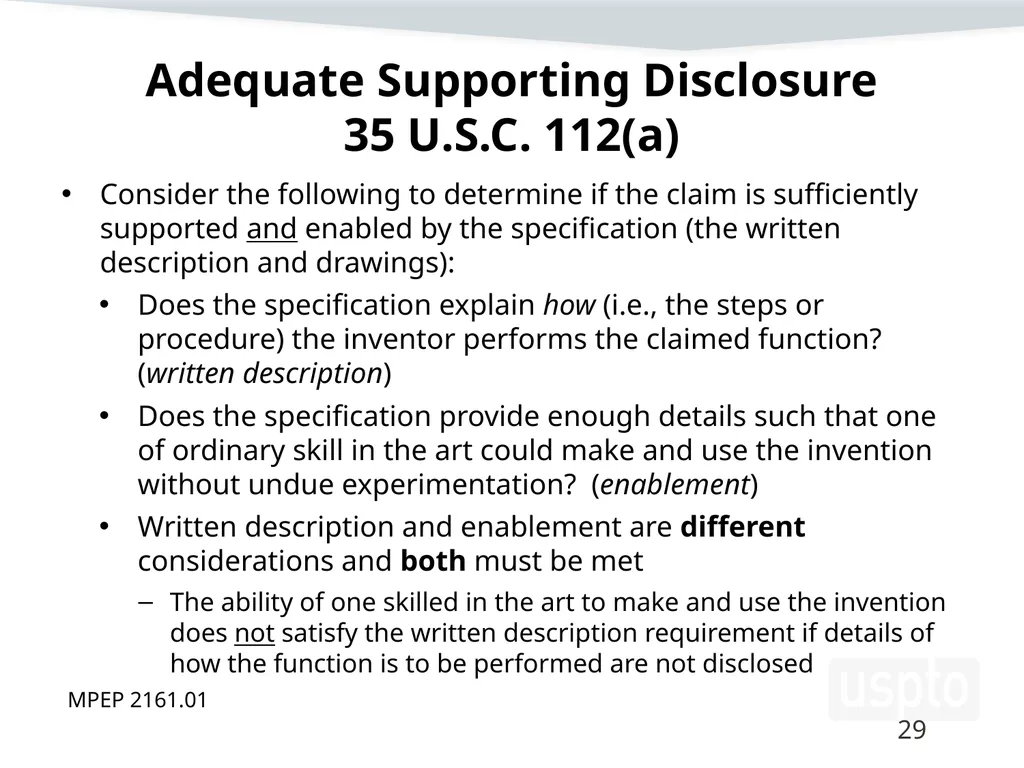
35 U.S.C. 112(a) Consider the following to determine if the claim is sufficiently supported and enabled by the specification (the written description and drawings):
Does the specification explain how (i.e., the steps or procedure) the inventor performs the claimed function? (written description)
Does the specification provide enough details such that one of ordinary skill in the art could make and use the invention without undue experimentation? (enablement)
Written description and enablement are different considerations and both must be met
The ability of one skilled in the art to make and use the invention does not satisfy the written description requirement if details of how the function is to be performed are not disclosed
MPEP 2161.01 29<br>
Does the specification explain how (i.e., the steps or procedure) the inventor performs the claimed function? (written description)
Does the specification provide enough details such that one of ordinary skill in the art could make and use the invention without undue experimentation? (enablement)
Written description and enablement are different considerations and both must be met
The ability of one skilled in the art to make and use the invention does not satisfy the written description requirement if details of how the function is to be performed are not disclosed
MPEP 2161.01 29<br>
29
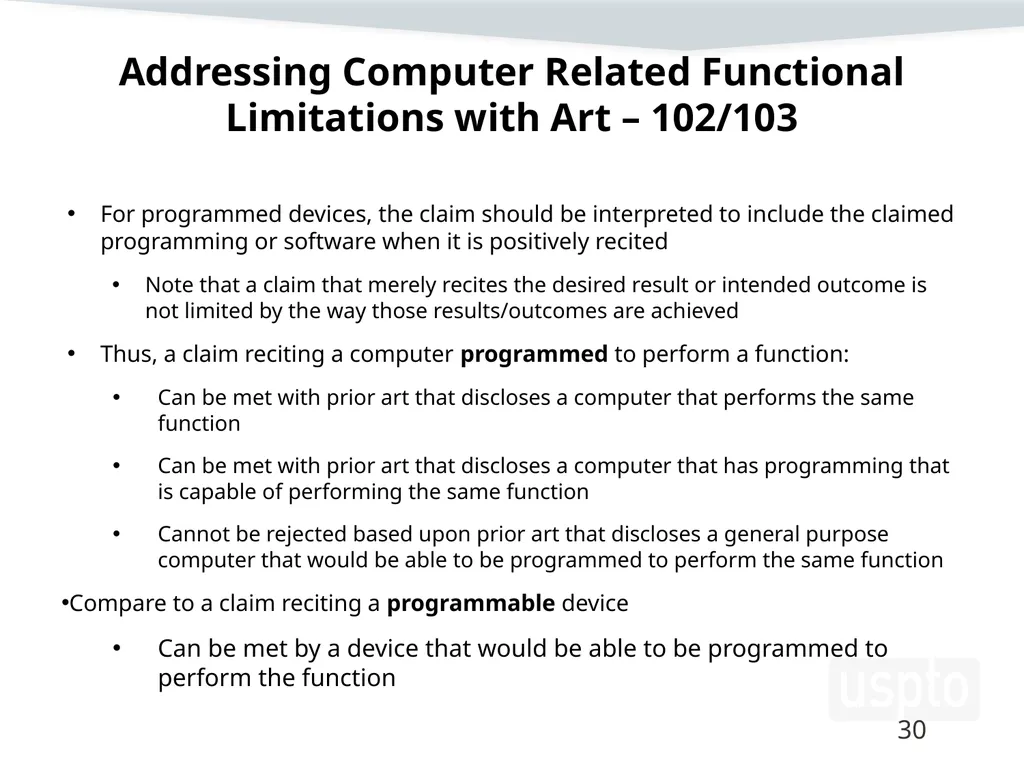
Addressing Computer Related Functional Limitations with Art – 102/103 For programmed devices, the claim should be interpreted to include the claimed programming or software when it is positively recited
Note that a claim that merely recites the desired result or intended outcome is not limited by the way those results/outcomes are achieved
Thus, a claim reciting a computer programmed to perform a function:
Can be met with prior art that discloses a computer that performs the same function
Can be met with prior art that discloses a computer that has programming that is capable of performing the same function
Cannot be rejected based upon prior art that discloses a general purpose computer that would be able to be programmed to perform the same function
Compare to a claim reciting a programmable device
Can be met by a device that would be able to be programmed to perform the function 30<br>
Note that a claim that merely recites the desired result or intended outcome is not limited by the way those results/outcomes are achieved
Thus, a claim reciting a computer programmed to perform a function:
Can be met with prior art that discloses a computer that performs the same function
Can be met with prior art that discloses a computer that has programming that is capable of performing the same function
Cannot be rejected based upon prior art that discloses a general purpose computer that would be able to be programmed to perform the same function
Compare to a claim reciting a programmable device
Can be met by a device that would be able to be programmed to perform the function 30<br>
30
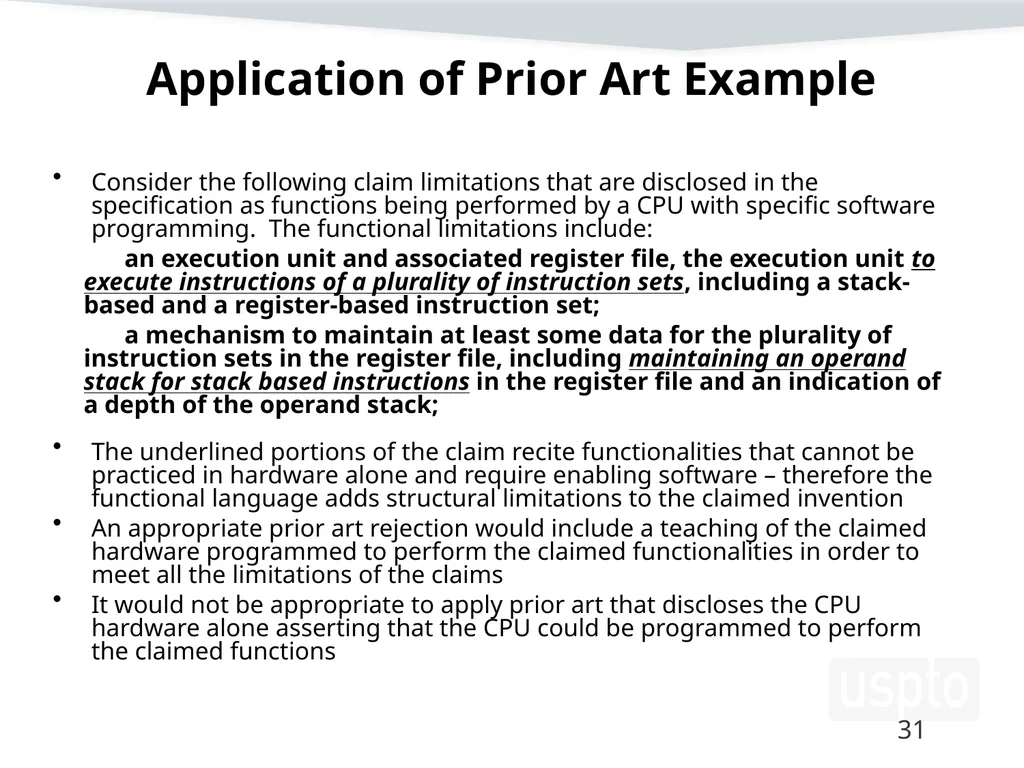
Application of Prior Art Example Consider the following claim limitations that are disclosed in the specification as functions being performed by a CPU with specific software programming. The functional limitations include:
an execution unit and associated register file, the execution unit to execute instructions of a plurality of instruction sets, including a stack-based and a register-based instruction set;
a mechanism to maintain at least some data for the plurality of instruction sets in the register file, including maintaining an operand stack for stack based instructions in the register file and an indication of a depth of the operand stack;
The underlined portions of the claim recite functionalities that cannot be practiced in hardware alone and require enabling software – therefore the functional language adds structural limitations to the claimed invention
An appropriate prior art rejection would include a teaching of the claimed hardware programmed to perform the claimed functionalities in order to meet all the limitations of the claims
It would not be appropriate to apply prior art that discloses the CPU hardware alone asserting that the CPU could be programmed to perform the claimed functions 31<br>
an execution unit and associated register file, the execution unit to execute instructions of a plurality of instruction sets, including a stack-based and a register-based instruction set;
a mechanism to maintain at least some data for the plurality of instruction sets in the register file, including maintaining an operand stack for stack based instructions in the register file and an indication of a depth of the operand stack;
The underlined portions of the claim recite functionalities that cannot be practiced in hardware alone and require enabling software – therefore the functional language adds structural limitations to the claimed invention
An appropriate prior art rejection would include a teaching of the claimed hardware programmed to perform the claimed functionalities in order to meet all the limitations of the claims
It would not be appropriate to apply prior art that discloses the CPU hardware alone asserting that the CPU could be programmed to perform the claimed functions 31<br>
31
Summary The identification and interpretation of functional claim limitations is important for ensuring claim scope is clear
Adding the interpretation to the record will increase the clarity of the Office Action and benefits the applicant, public and the Examiner
Functional claim limitations that are not properly construed undermine the public notice function of claims
Functional claim limitations require due consideration as their scope is highly dependent upon contextual usage
Functional claim limitations must comport with the statutory requirements of 35 USC 112(a) and (b)
Functional claim limitations must be evaluated to determine whether they impose a patentable distinction over prior art 32<br>
Adding the interpretation to the record will increase the clarity of the Office Action and benefits the applicant, public and the Examiner
Functional claim limitations that are not properly construed undermine the public notice function of claims
Functional claim limitations require due consideration as their scope is highly dependent upon contextual usage
Functional claim limitations must comport with the statutory requirements of 35 USC 112(a) and (b)
Functional claim limitations must be evaluated to determine whether they impose a patentable distinction over prior art 32<br>