
EXAMPLE: At one time it was thought that protons
EM
Published · 45 slides · 0 views
1 / 1





Description
EXAMPLE: At one time it was thought that protons and neutrons were elementary particles. Explain why they are not. SOLUTION: Protons and neutrons are each built from three elementary particles called quarks. PRACTICE: At one time it was
Related Topics
Share
Embed code
Download this presentation From Below
"EXAMPLE: At one time it was thought that protons" is the property of its rightful owner. Permission is granted to download and print the materials on this website for personal, non-commercial use only, and to display it on your personal computer provided you do not modify the materials and that you retain all copyright notices contained in the materials. By downloading content from our website, you accept the terms of this agreement.
Presentation Transcript
01
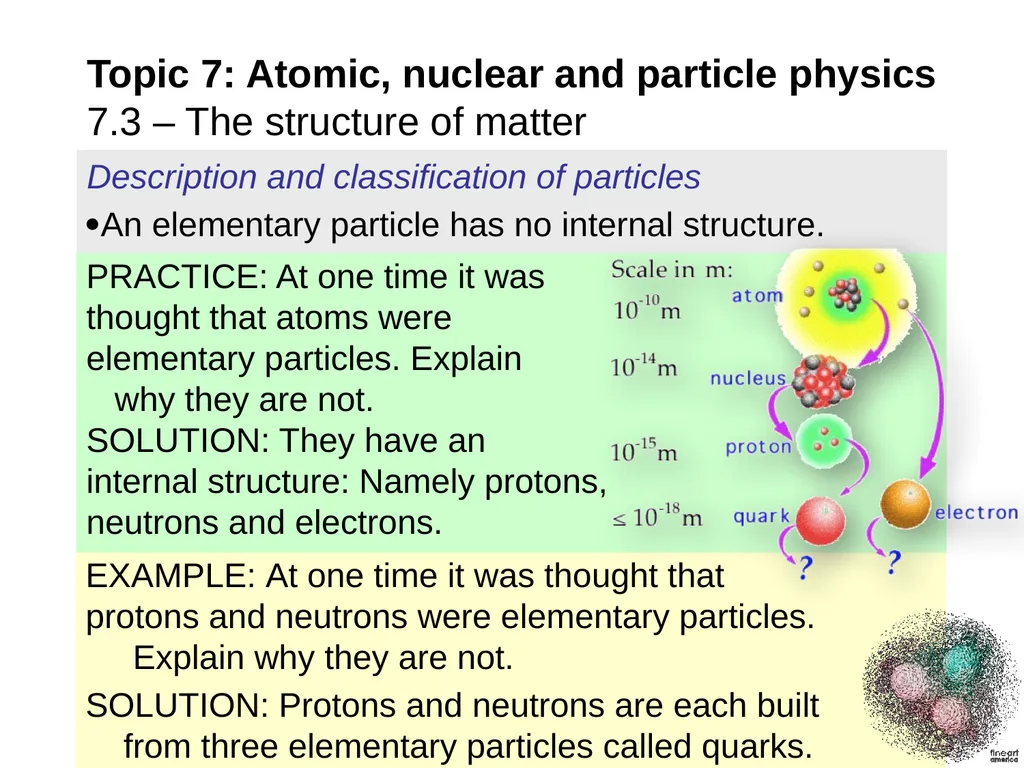
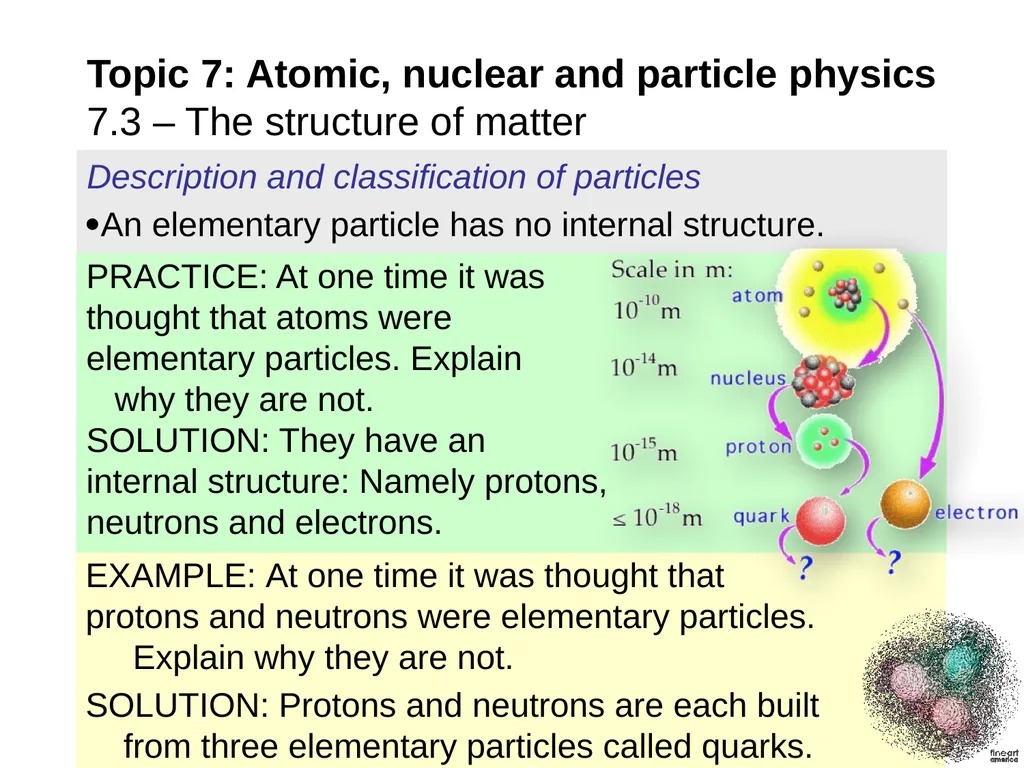
EXAMPLE: At one time it was thought that protons and neutrons were elementary particles. Explain why they are not.
SOLUTION: Protons and neutrons are each built from three elementary particles called quarks. PRACTICE: At one time it was thought that atoms were elementary particles. Explain why they are not.
SOLUTION: They have an internal structure: Namely protons, neutrons and electrons. Description and classification of particles
An elementary particle has no internal structure. Topic 7: Atomic, nuclear and particle physics 7.3 – The structure of matter<br>
SOLUTION: Protons and neutrons are each built from three elementary particles called quarks. PRACTICE: At one time it was thought that atoms were elementary particles. Explain why they are not.
SOLUTION: They have an internal structure: Namely protons, neutrons and electrons. Description and classification of particles
An elementary particle has no internal structure. Topic 7: Atomic, nuclear and particle physics 7.3 – The structure of matter<br>
02
FYI For example, quarks interact via the strong force particles called gluons. Description and classification of particles
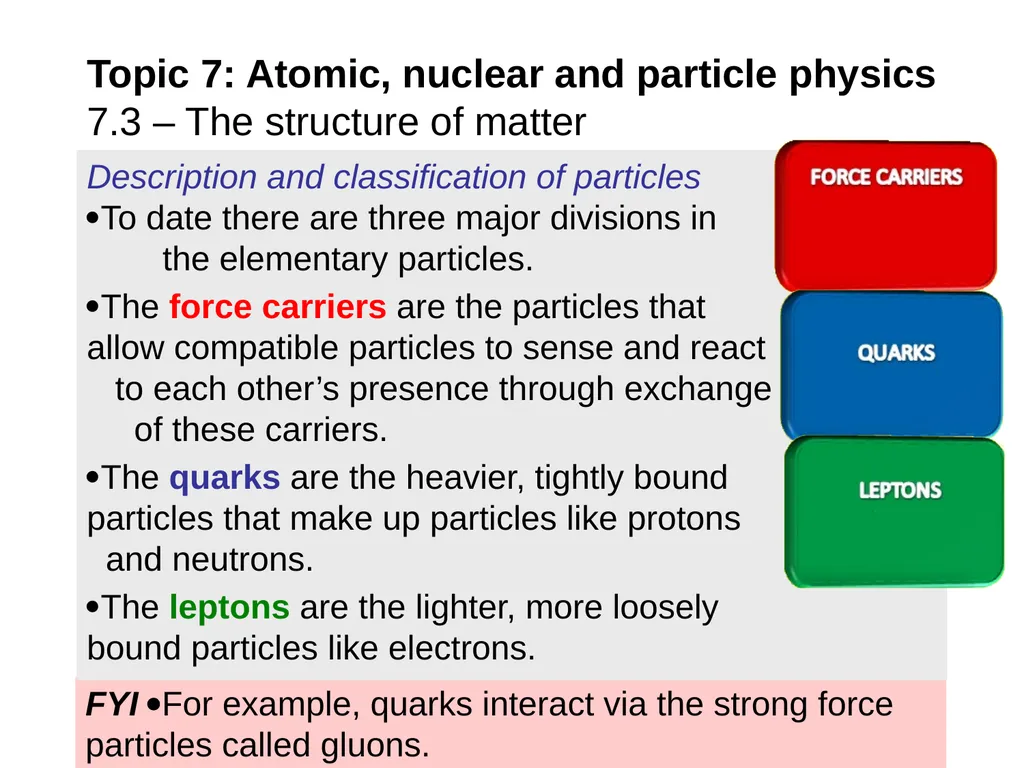
To date there are three major divisions in the elementary particles.
The force carriers are the particles that allow compatible particles to sense and react to each other’s presence through exchange of these carriers.
The quarks are the heavier, tightly bound particles that make up particles like protons and neutrons.
The leptons are the lighter, more loosely bound particles like electrons. Topic 7: Atomic, nuclear and particle physics 7.3 – The structure of matter<br>
To date there are three major divisions in the elementary particles.
The force carriers are the particles that allow compatible particles to sense and react to each other’s presence through exchange of these carriers.
The quarks are the heavier, tightly bound particles that make up particles like protons and neutrons.
The leptons are the lighter, more loosely bound particles like electrons. Topic 7: Atomic, nuclear and particle physics 7.3 – The structure of matter<br>
03
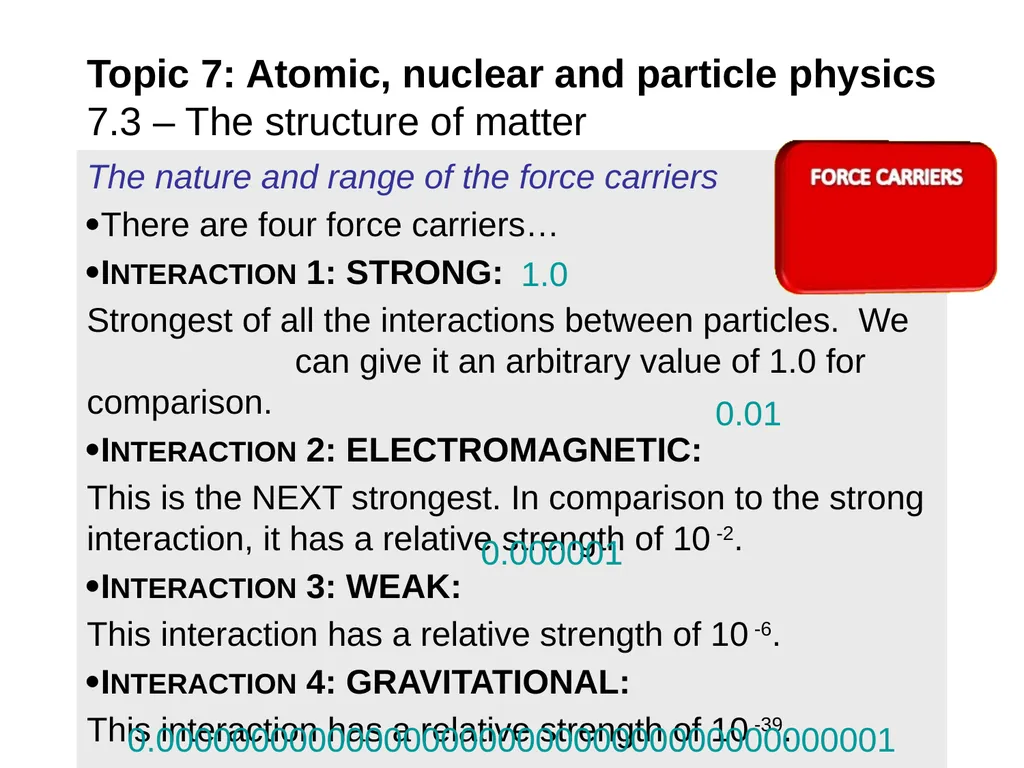
The nature and range of the force carriers
There are four force carriers…
INTERACTION 1: STRONG:
Strongest of all the interactions between particles. We can give it an arbitrary value of 1.0 for comparison.
INTERACTION 2: ELECTROMAGNETIC:
This is the NEXT strongest. In comparison to the strong interaction, it has a relative strength of 10 -2.
INTERACTION 3: WEAK:
This interaction has a relative strength of 10 -6.
INTERACTION 4: GRAVITATIONAL:
This interaction has a relative strength of 10 -39. Topic 7: Atomic, nuclear and particle physics 7.3 – The structure of matter 1.0 0.01 0.000001 0.000000000000000000000000000000000000001<br>
There are four force carriers…
INTERACTION 1: STRONG:
Strongest of all the interactions between particles. We can give it an arbitrary value of 1.0 for comparison.
INTERACTION 2: ELECTROMAGNETIC:
This is the NEXT strongest. In comparison to the strong interaction, it has a relative strength of 10 -2.
INTERACTION 3: WEAK:
This interaction has a relative strength of 10 -6.
INTERACTION 4: GRAVITATIONAL:
This interaction has a relative strength of 10 -39. Topic 7: Atomic, nuclear and particle physics 7.3 – The structure of matter 1.0 0.01 0.000001 0.000000000000000000000000000000000000001<br>
04
FYI
This photon exchange is the electromagnetic force. The nature and range of the force carriers
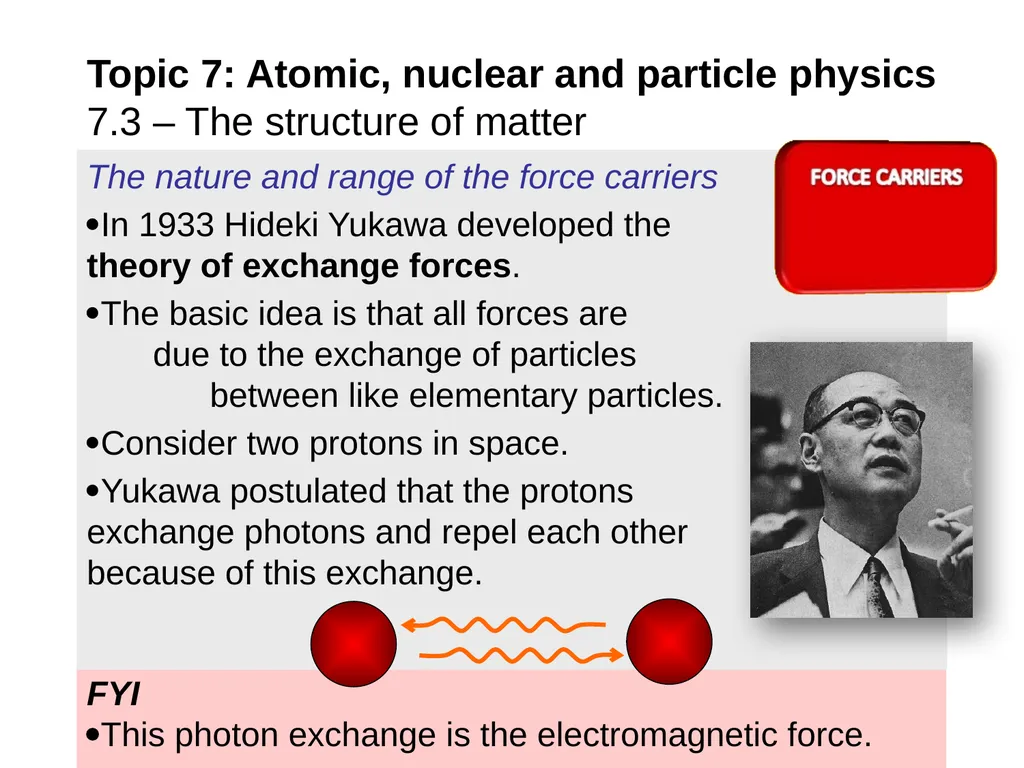
In 1933 Hideki Yukawa developed the theory of exchange forces.
The basic idea is that all forces are due to the exchange of particles between like elementary particles.
Consider two protons in space.
Yukawa postulated that the protons exchange photons and repel each other because of this exchange. Topic 7: Atomic, nuclear and particle physics 7.3 – The structure of matter<br>
This photon exchange is the electromagnetic force. The nature and range of the force carriers
In 1933 Hideki Yukawa developed the theory of exchange forces.
The basic idea is that all forces are due to the exchange of particles between like elementary particles.
Consider two protons in space.
Yukawa postulated that the protons exchange photons and repel each other because of this exchange. Topic 7: Atomic, nuclear and particle physics 7.3 – The structure of matter<br>
05
The nature and range of the force carriers
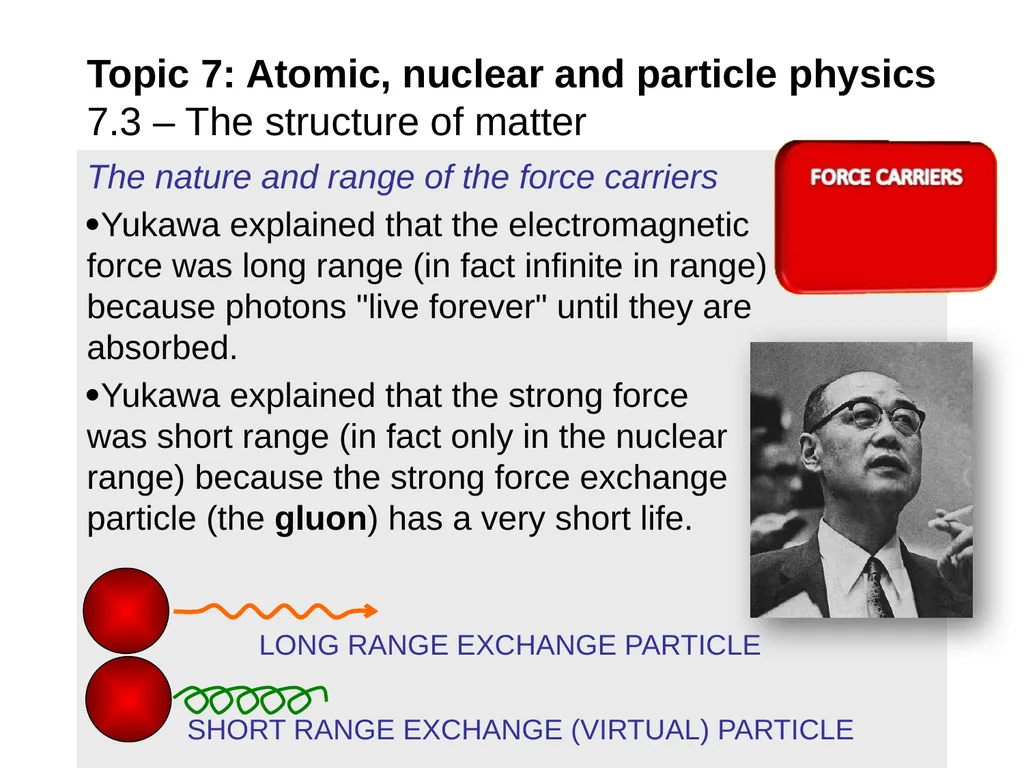
Yukawa explained that the electromagnetic force was long range (in fact infinite in range) because photons "live forever" until they are absorbed.
Yukawa explained that the strong force was short range (in fact only in the nuclear range) because the strong force exchange particle (the gluon) has a very short life. Topic 7: Atomic, nuclear and particle physics 7.3 – The structure of matter LONG RANGE EXCHANGE PARTICLE SHORT RANGE EXCHANGE (VIRTUAL) PARTICLE<br>
Yukawa explained that the electromagnetic force was long range (in fact infinite in range) because photons "live forever" until they are absorbed.
Yukawa explained that the strong force was short range (in fact only in the nuclear range) because the strong force exchange particle (the gluon) has a very short life. Topic 7: Atomic, nuclear and particle physics 7.3 – The structure of matter LONG RANGE EXCHANGE PARTICLE SHORT RANGE EXCHANGE (VIRTUAL) PARTICLE<br>
06
The nature and range of the force carriers
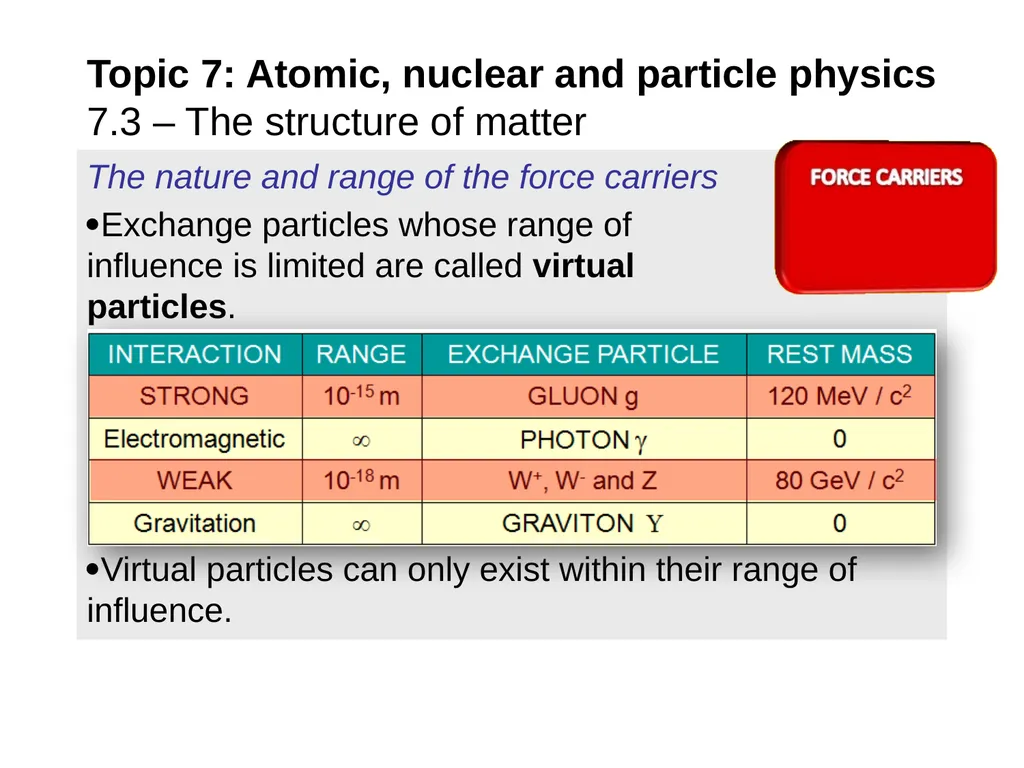
Exchange particles whose range of influence is limited are called virtual particles.
Virtual particles can only exist within their range of influence. Topic 7: Atomic, nuclear and particle physics 7.3 – The structure of matter<br>
Exchange particles whose range of influence is limited are called virtual particles.
Virtual particles can only exist within their range of influence. Topic 7: Atomic, nuclear and particle physics 7.3 – The structure of matter<br>
07
FYI
A proton is uud and a neutron is udd. Quarks and their antiparticles
In 1964 the particle model was looking quite complex and unsatisfying. Murray Gell-Mann proposed a model where all the strong-force particles were made up of three fundamental particles called quarks. Topic 7: Atomic, nuclear and particle physics 7.3 – The structure of matter u u d proton<br>
A proton is uud and a neutron is udd. Quarks and their antiparticles
In 1964 the particle model was looking quite complex and unsatisfying. Murray Gell-Mann proposed a model where all the strong-force particles were made up of three fundamental particles called quarks. Topic 7: Atomic, nuclear and particle physics 7.3 – The structure of matter u u d proton<br>
08
FYI
When matter meets antimatter both annihilate each other to become energy! Quarks and their antiparticles
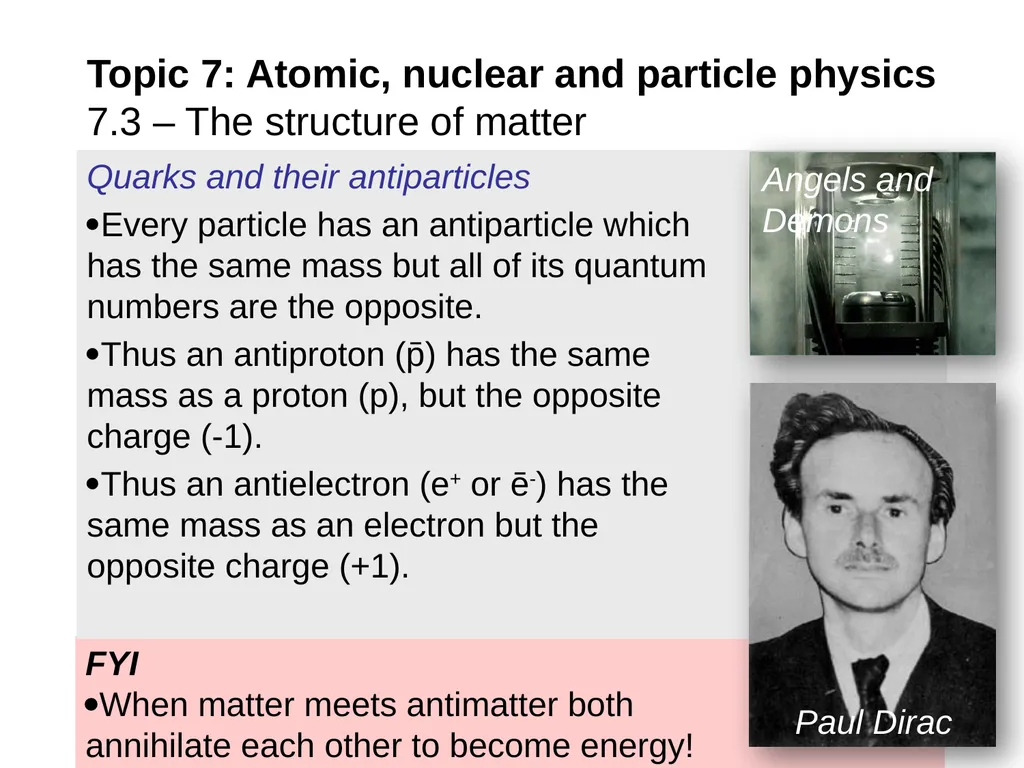
Every particle has an antiparticle which has the same mass but all of its quantum numbers are the opposite.
Thus an antiproton (p) has the same mass as a proton (p), but the opposite charge (-1).
Thus an antielectron (e+ or e-) has the same mass as an electron but the opposite charge (+1). Topic 7: Atomic, nuclear and particle physics 7.3 – The structure of matter Angels and Demons Paul Dirac<br>
When matter meets antimatter both annihilate each other to become energy! Quarks and their antiparticles
Every particle has an antiparticle which has the same mass but all of its quantum numbers are the opposite.
Thus an antiproton (p) has the same mass as a proton (p), but the opposite charge (-1).
Thus an antielectron (e+ or e-) has the same mass as an electron but the opposite charge (+1). Topic 7: Atomic, nuclear and particle physics 7.3 – The structure of matter Angels and Demons Paul Dirac<br>
09
FYI
An antiquark has the quark symbol, with a bar over it.
Thus an anti-up quark looks like this: u.
An alternate way to represent the anti-up quark would be to write “u-bar.”
Incidentally, this is how you would actually say it. Quarks and their antiparticles
Each quark has an antiquark, which has the opposite charge as the corresponding quark.
Here are the names of the 6 quarks: Topic 7: Atomic, nuclear and particle physics 7.3 – The structure of matter<br>
An antiquark has the quark symbol, with a bar over it.
Thus an anti-up quark looks like this: u.
An alternate way to represent the anti-up quark would be to write “u-bar.”
Incidentally, this is how you would actually say it. Quarks and their antiparticles
Each quark has an antiquark, which has the opposite charge as the corresponding quark.
Here are the names of the 6 quarks: Topic 7: Atomic, nuclear and particle physics 7.3 – The structure of matter<br>
10
FYI
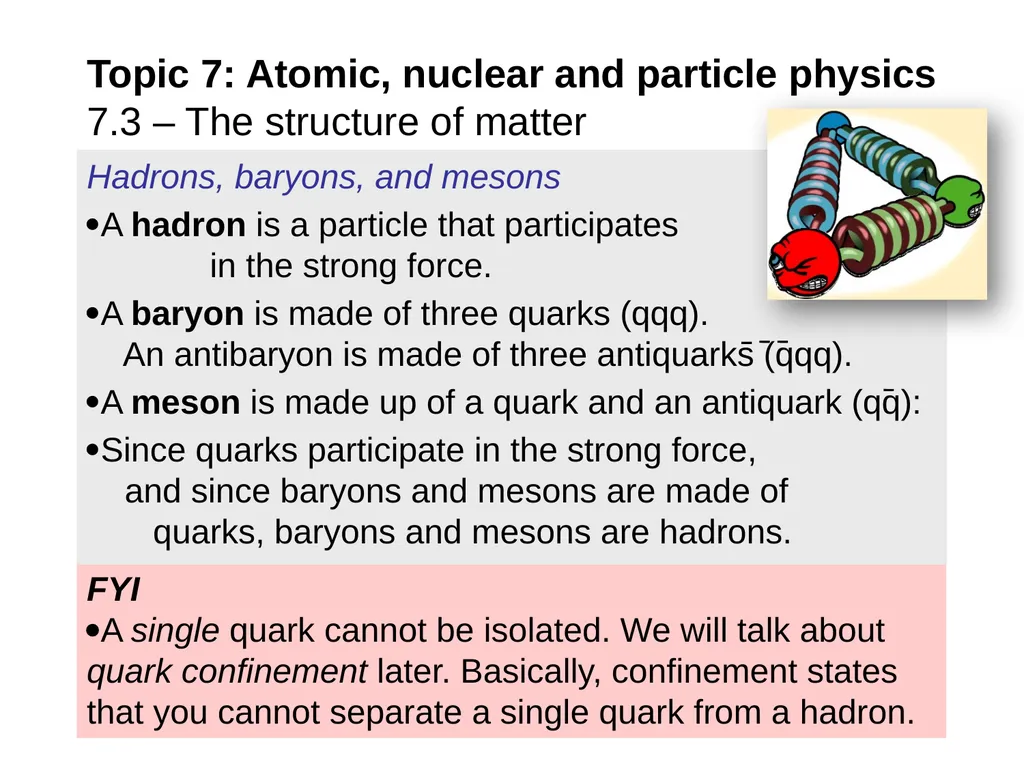
A single quark cannot be isolated. We will talk about quark confinement later. Basically, confinement states that you cannot separate a single quark from a hadron. Hadrons, baryons, and mesons
A hadron is a particle that participates in the strong force.
A baryon is made of three quarks (qqq). An antibaryon is made of three antiquarks (qqq).
A meson is made up of a quark and an antiquark (qq):
Since quarks participate in the strong force, and since baryons and mesons are made of quarks, baryons and mesons are hadrons. Topic 7: Atomic, nuclear and particle physics 7.3 – The structure of matter<br>
A single quark cannot be isolated. We will talk about quark confinement later. Basically, confinement states that you cannot separate a single quark from a hadron. Hadrons, baryons, and mesons
A hadron is a particle that participates in the strong force.
A baryon is made of three quarks (qqq). An antibaryon is made of three antiquarks (qqq).
A meson is made up of a quark and an antiquark (qq):
Since quarks participate in the strong force, and since baryons and mesons are made of quarks, baryons and mesons are hadrons. Topic 7: Atomic, nuclear and particle physics 7.3 – The structure of matter<br>
11
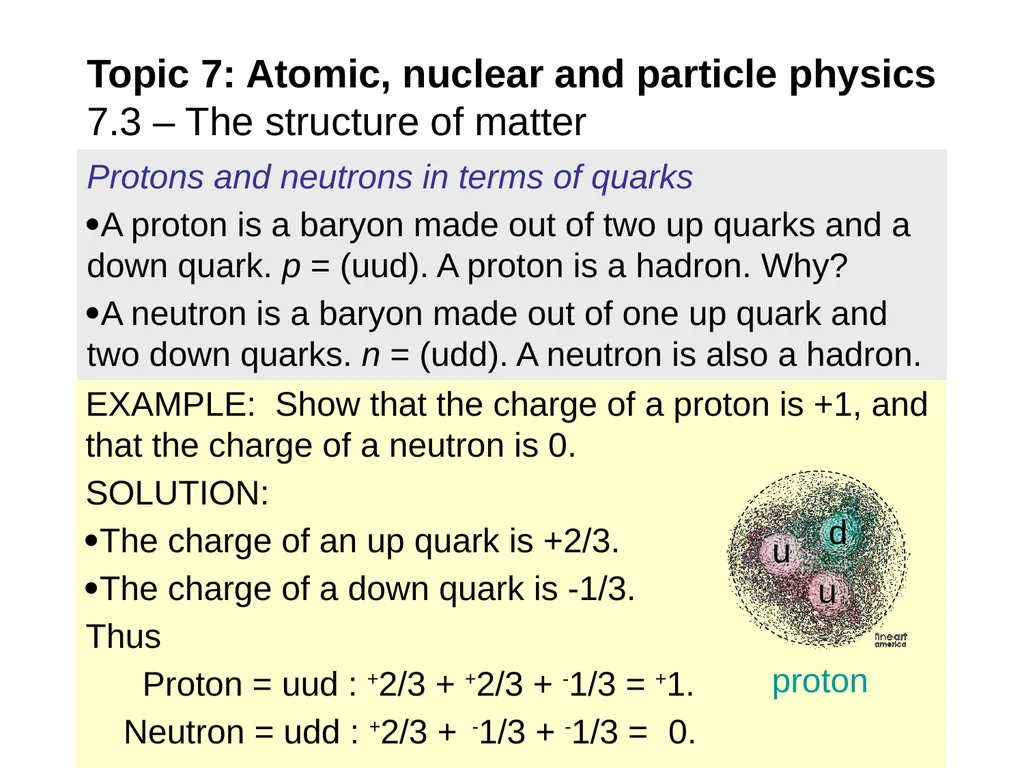
EXAMPLE: Show that the charge of a proton is +1, and that the charge of a neutron is 0.
SOLUTION:
The charge of an up quark is +2/3.
The charge of a down quark is -1/3.
Thus
Proton = uud : +2/3 + +2/3 + -1/3 = +1.
Neutron = udd : +2/3 + -1/3 + -1/3 = 0. Protons and neutrons in terms of quarks
A proton is a baryon made out of two up quarks and a down quark. p = (uud). A proton is a hadron. Why?
A neutron is a baryon made out of one up quark and two down quarks. n = (udd). A neutron is also a hadron. Topic 7: Atomic, nuclear and particle physics 7.3 – The structure of matter u u d proton<br>
SOLUTION:
The charge of an up quark is +2/3.
The charge of a down quark is -1/3.
Thus
Proton = uud : +2/3 + +2/3 + -1/3 = +1.
Neutron = udd : +2/3 + -1/3 + -1/3 = 0. Protons and neutrons in terms of quarks
A proton is a baryon made out of two up quarks and a down quark. p = (uud). A proton is a hadron. Why?
A neutron is a baryon made out of one up quark and two down quarks. n = (udd). A neutron is also a hadron. Topic 7: Atomic, nuclear and particle physics 7.3 – The structure of matter u u d proton<br>
12
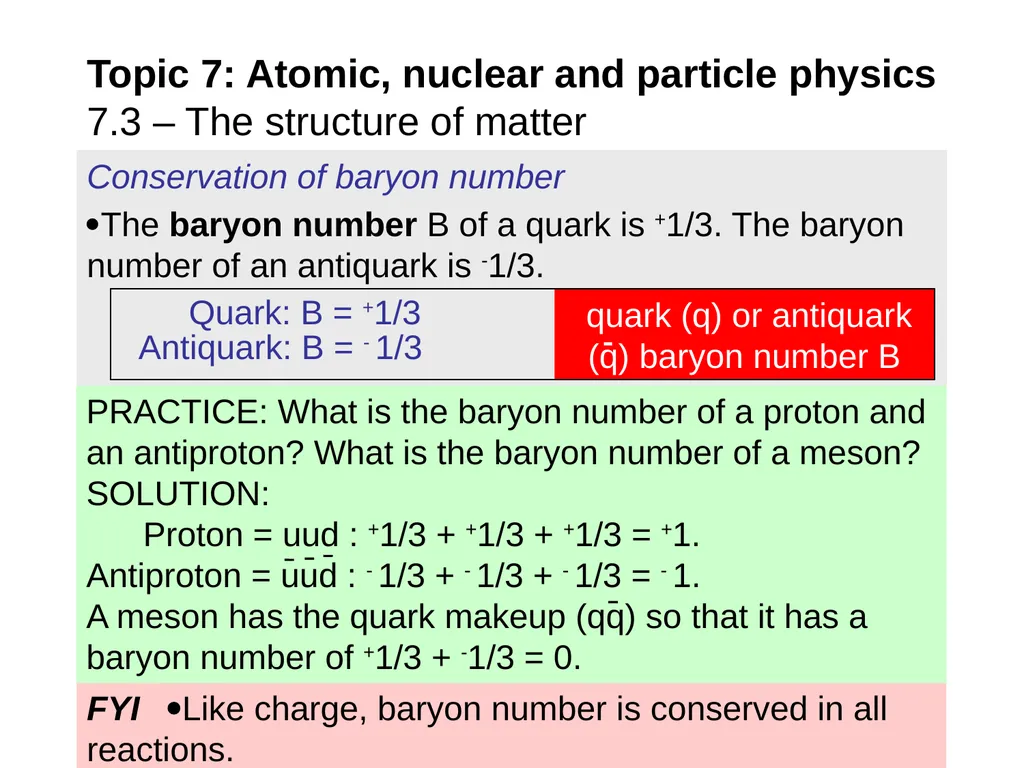
FYI Like charge, baryon number is conserved in all reactions. PRACTICE: What is the baryon number of a proton and an antiproton? What is the baryon number of a meson?
SOLUTION:
Proton = uud : +1/3 + +1/3 + +1/3 = +1.
Antiproton = uud : - 1/3 + - 1/3 + - 1/3 = - 1.
A meson has the quark makeup (qq) so that it has a baryon number of +1/3 + -1/3 = 0. Conservation of baryon number
The baryon number B of a quark is +1/3. The baryon number of an antiquark is -1/3. Topic 7: Atomic, nuclear and particle physics 7.3 – The structure of matter<br>
SOLUTION:
Proton = uud : +1/3 + +1/3 + +1/3 = +1.
Antiproton = uud : - 1/3 + - 1/3 + - 1/3 = - 1.
A meson has the quark makeup (qq) so that it has a baryon number of +1/3 + -1/3 = 0. Conservation of baryon number
The baryon number B of a quark is +1/3. The baryon number of an antiquark is -1/3. Topic 7: Atomic, nuclear and particle physics 7.3 – The structure of matter<br>
13
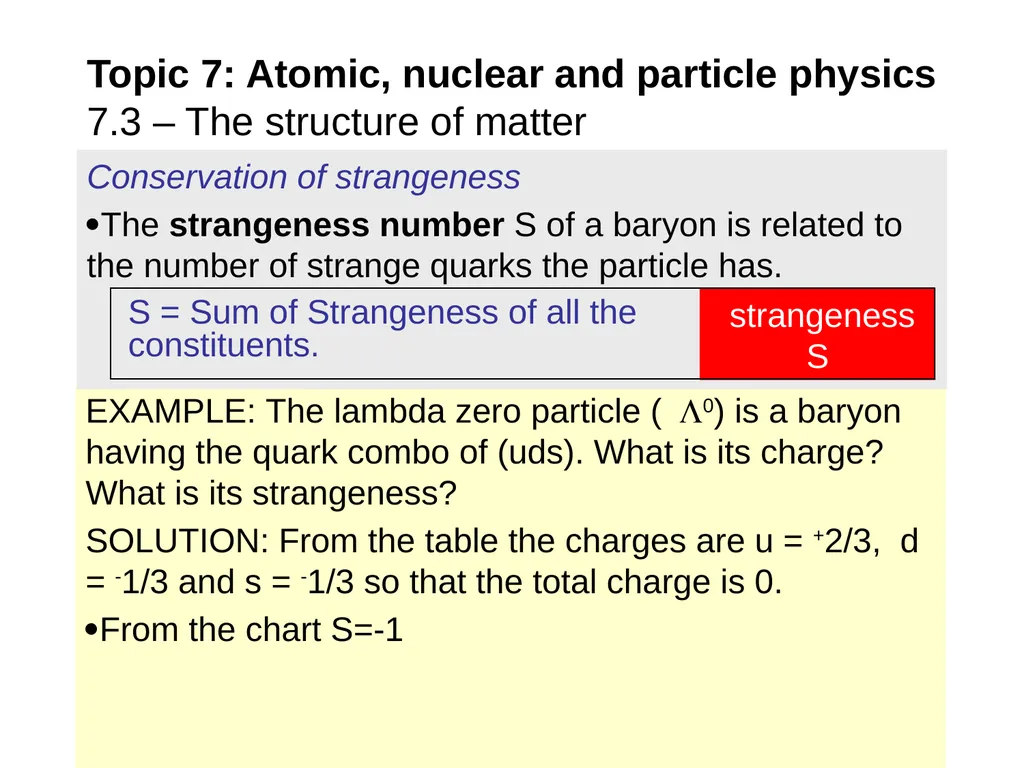
EXAMPLE: The lambda zero particle (0) is a baryon having the quark combo of (uds). What is its charge? What is its strangeness?
SOLUTION: From the table the charges are u = +2/3, d = -1/3 and s = -1/3 so that the total charge is 0.
From the chart S=-1 Conservation of strangeness
The strangeness number S of a baryon is related to the number of strange quarks the particle has. Topic 7: Atomic, nuclear and particle physics 7.3 – The structure of matter<br>
SOLUTION: From the table the charges are u = +2/3, d = -1/3 and s = -1/3 so that the total charge is 0.
From the chart S=-1 Conservation of strangeness
The strangeness number S of a baryon is related to the number of strange quarks the particle has. Topic 7: Atomic, nuclear and particle physics 7.3 – The structure of matter<br>
14
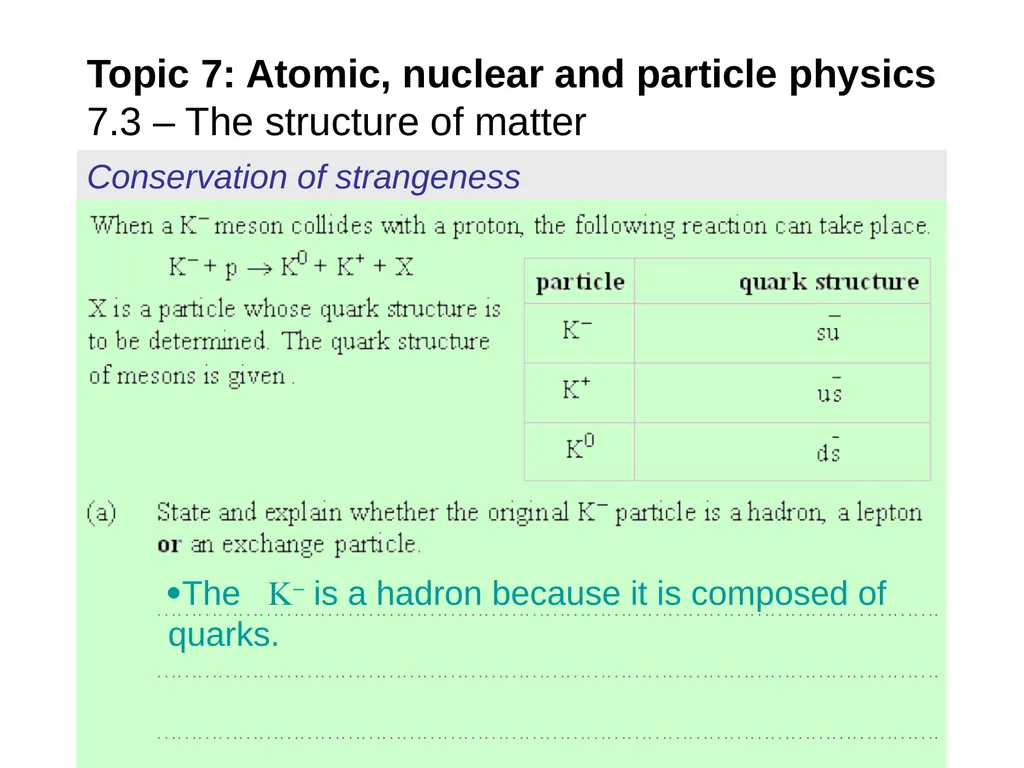
Conservation of strangeness Topic 7: Atomic, nuclear and particle physics
7.3 – The structure of matter The – is a hadron because it is composed of quarks.<br>
15
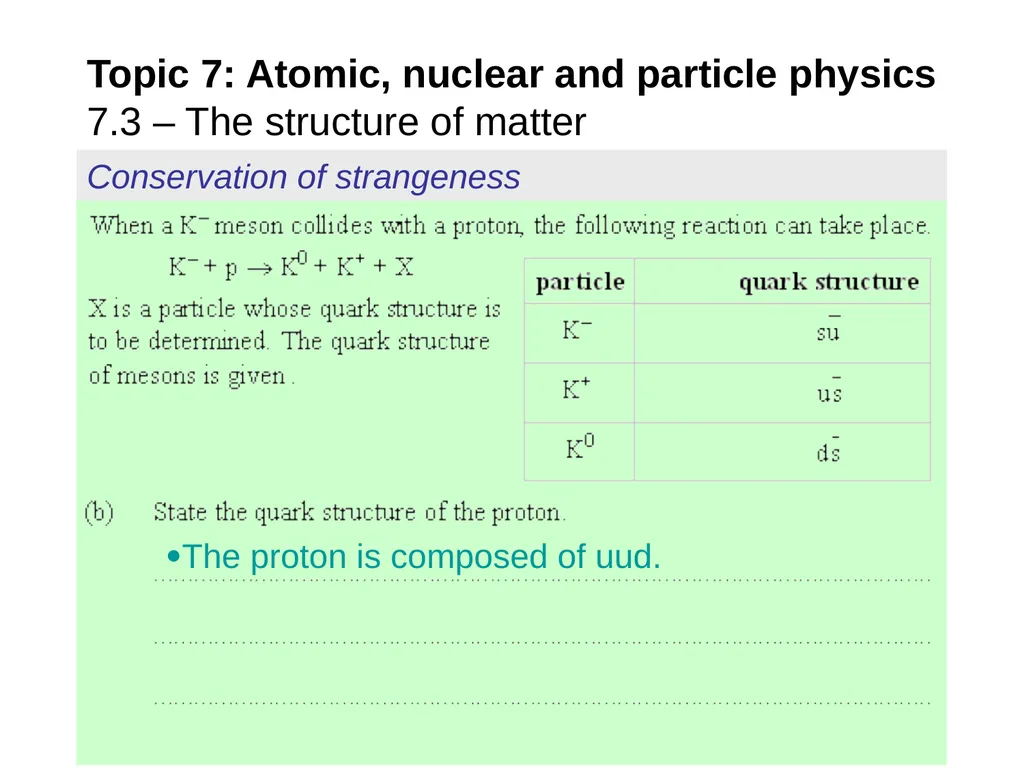
Conservation of strangeness Topic 7: Atomic, nuclear and particle physics
7.3 – The structure of matter The proton is composed of uud.<br>
16
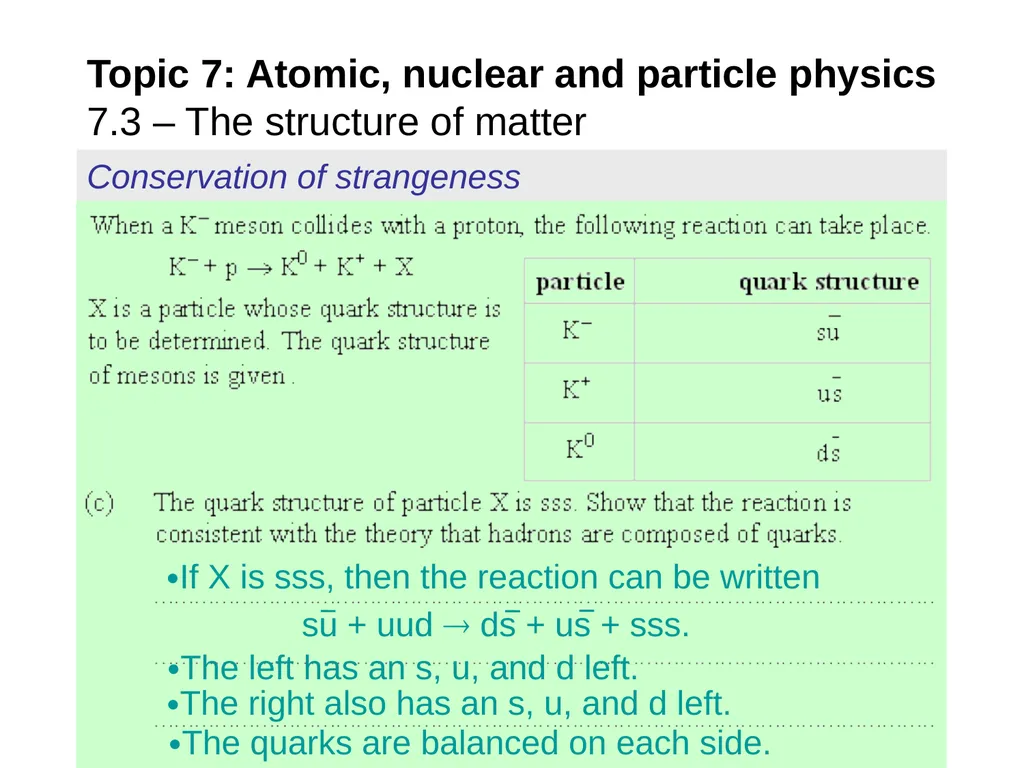
Conservation of strangeness Topic 7: Atomic, nuclear and particle physics
7.3 – The structure of matter If X is sss, then the reaction can be written su + uud ds + us + sss. The left has an s, u, and d left. The right also has an s, u, and d left. The quarks are balanced on each side.<br>
17
Quark confinement
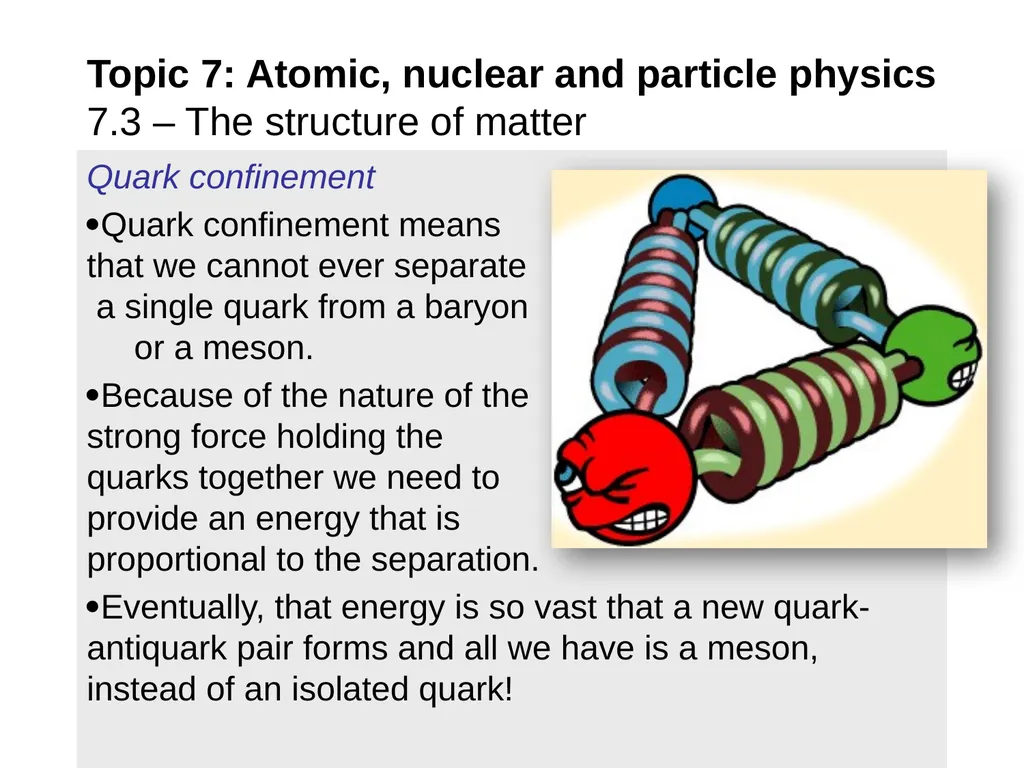
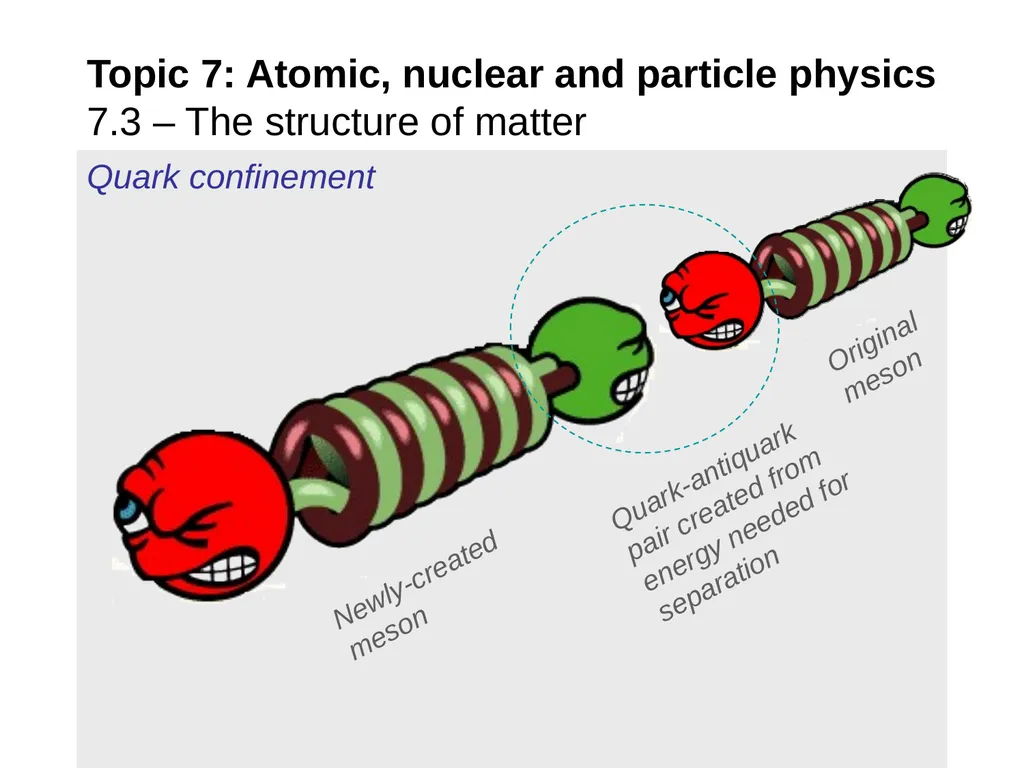
Quark confinement means that we cannot ever separate a single quark from a baryon or a meson.
Because of the nature of the strong force holding the quarks together we need to provide an energy that is proportional to the separation.
Eventually, that energy is so vast that a new quark-antiquark pair forms and all we have is a meson, instead of an isolated quark! Topic 7: Atomic, nuclear and particle physics 7.3 – The structure of matter<br>
Quark confinement means that we cannot ever separate a single quark from a baryon or a meson.
Because of the nature of the strong force holding the quarks together we need to provide an energy that is proportional to the separation.
Eventually, that energy is so vast that a new quark-antiquark pair forms and all we have is a meson, instead of an isolated quark! Topic 7: Atomic, nuclear and particle physics 7.3 – The structure of matter<br>
18
Quark confinement Topic 7: Atomic, nuclear and particle physics
7.3 – The structure of matter Original meson Newly-created meson Quark-antiquark pair created from energy needed for separation<br>
19
FYI
Of course the leptons also have their antiparticles. Leptons and their antiparticles
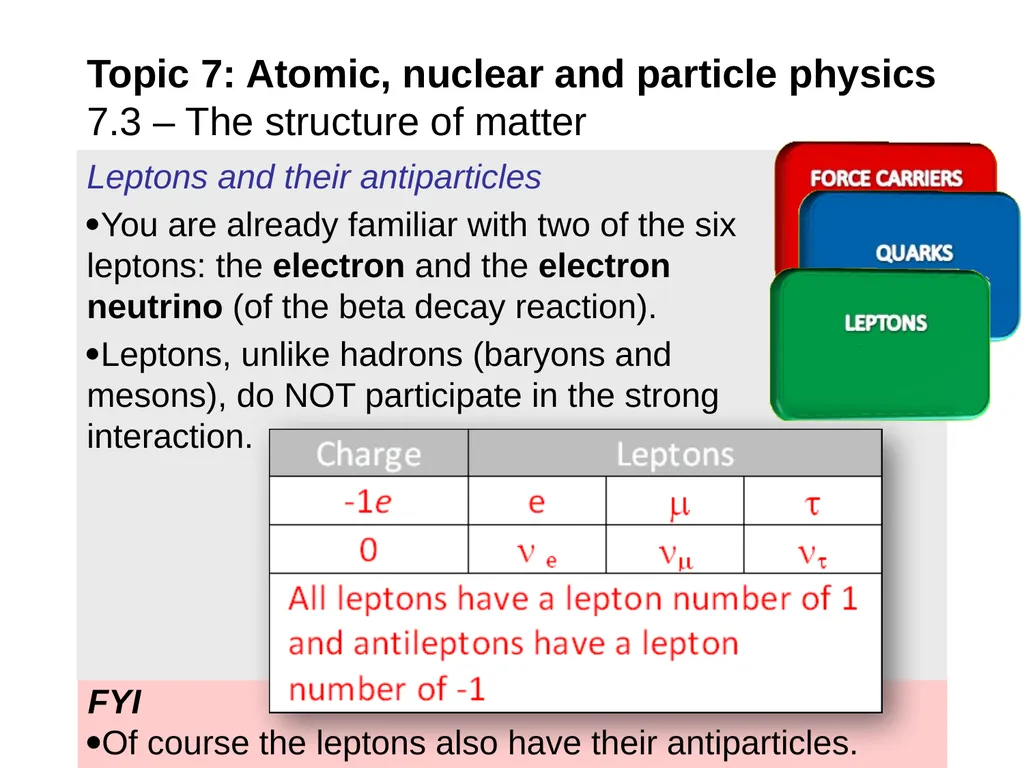
You are already familiar with two of the six leptons: the electron and the electron neutrino (of the beta decay reaction).
Leptons, unlike hadrons (baryons and mesons), do NOT participate in the strong interaction. Topic 7: Atomic, nuclear and particle physics 7.3 – The structure of matter<br>
Of course the leptons also have their antiparticles. Leptons and their antiparticles
You are already familiar with two of the six leptons: the electron and the electron neutrino (of the beta decay reaction).
Leptons, unlike hadrons (baryons and mesons), do NOT participate in the strong interaction. Topic 7: Atomic, nuclear and particle physics 7.3 – The structure of matter<br>
20
Leptons and their antiparticles
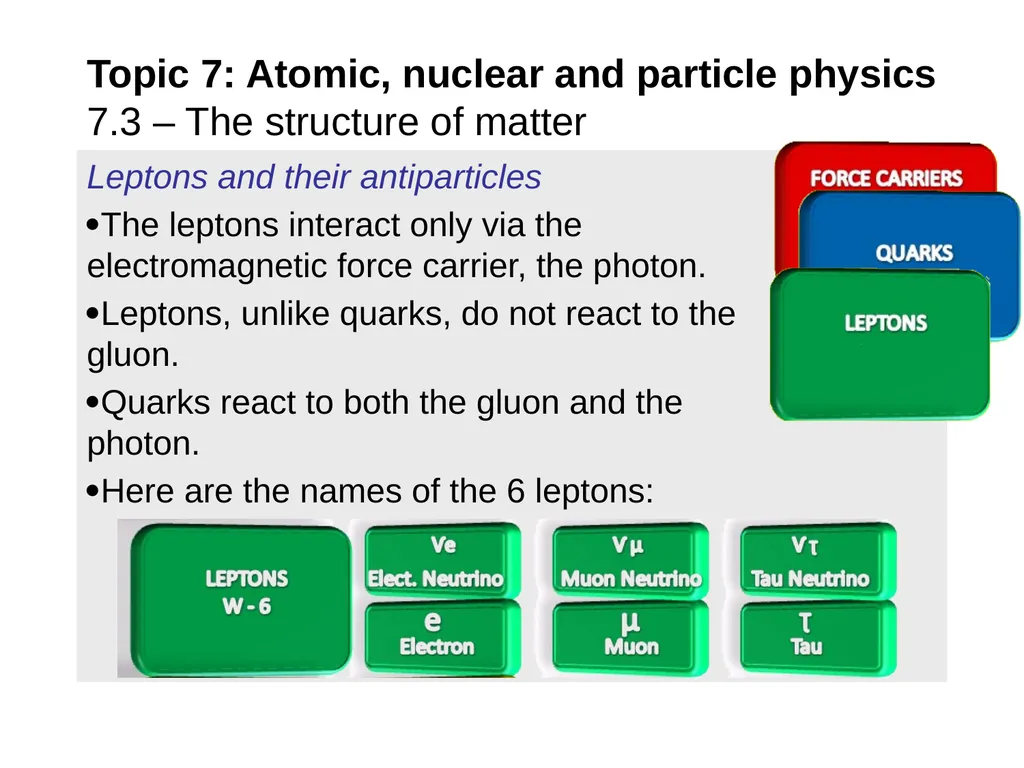
The leptons interact only via the electromagnetic force carrier, the photon.
Leptons, unlike quarks, do not react to the gluon.
Quarks react to both the gluon and the photon.
Here are the names of the 6 leptons: Topic 7: Atomic, nuclear and particle physics 7.3 – The structure of matter<br>
The leptons interact only via the electromagnetic force carrier, the photon.
Leptons, unlike quarks, do not react to the gluon.
Quarks react to both the gluon and the photon.
Here are the names of the 6 leptons: Topic 7: Atomic, nuclear and particle physics 7.3 – The structure of matter<br>
21
FYI
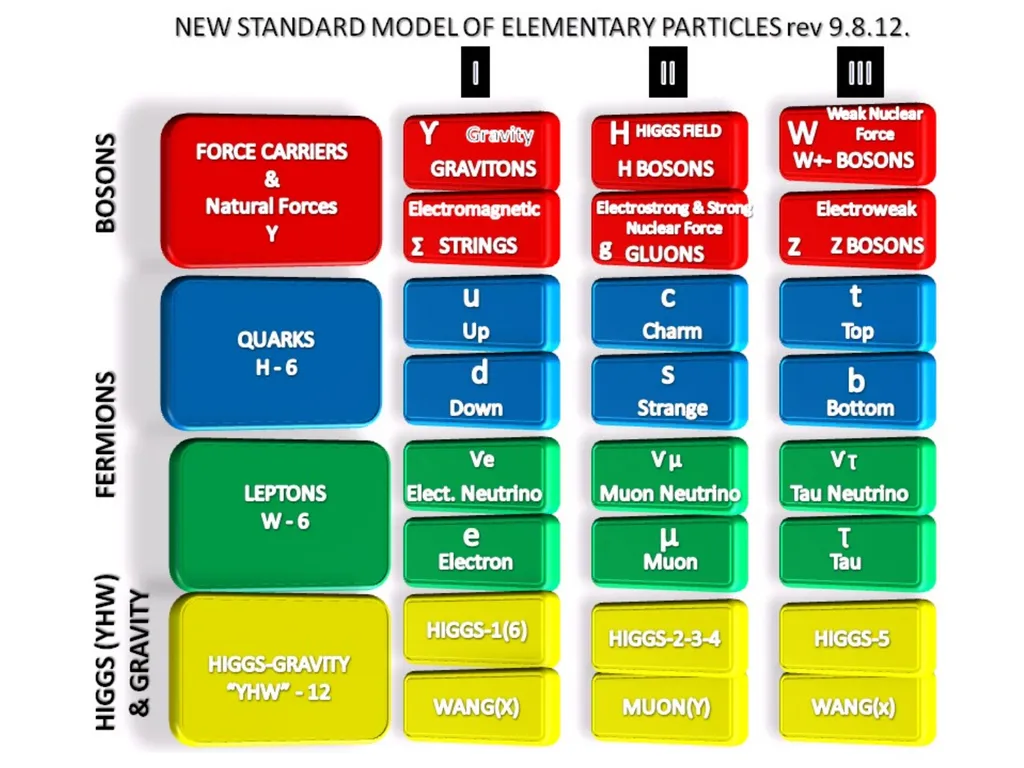
Particles are divided into “generations” or “families” of increasing mass. The standard model
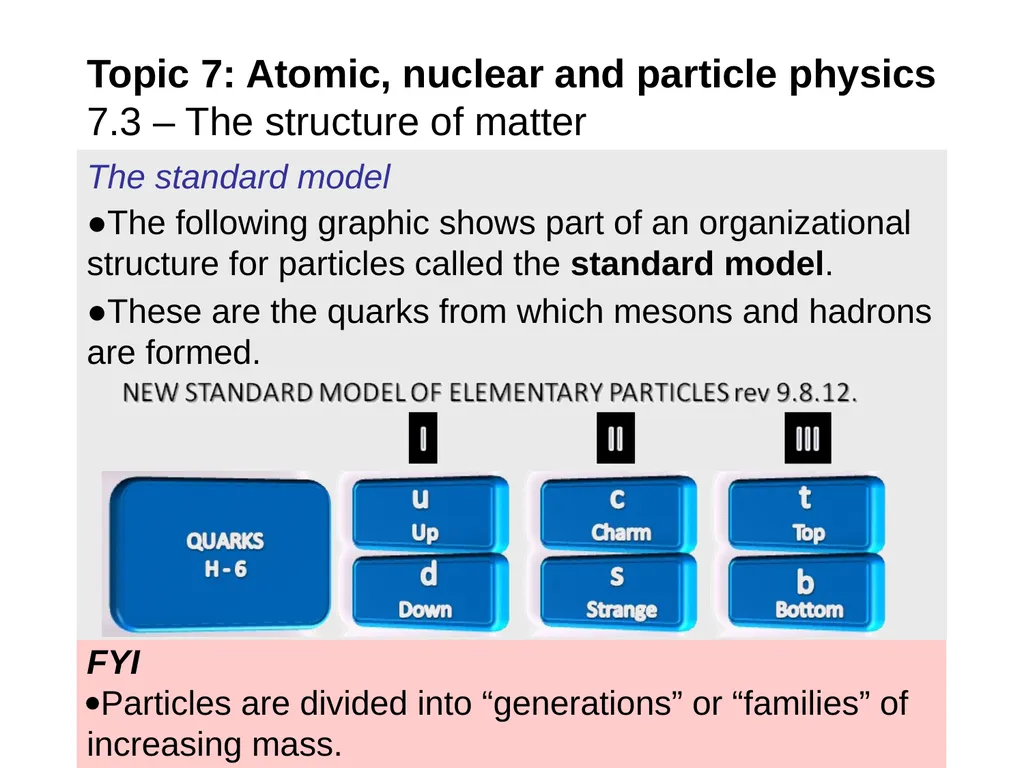
●The following graphic shows part of an organizational structure for particles called the standard model.
●These are the quarks from which mesons and hadrons are formed. Topic 7: Atomic, nuclear and particle physics 7.3 – The structure of matter<br>
Particles are divided into “generations” or “families” of increasing mass. The standard model
●The following graphic shows part of an organizational structure for particles called the standard model.
●These are the quarks from which mesons and hadrons are formed. Topic 7: Atomic, nuclear and particle physics 7.3 – The structure of matter<br>
22
FYI
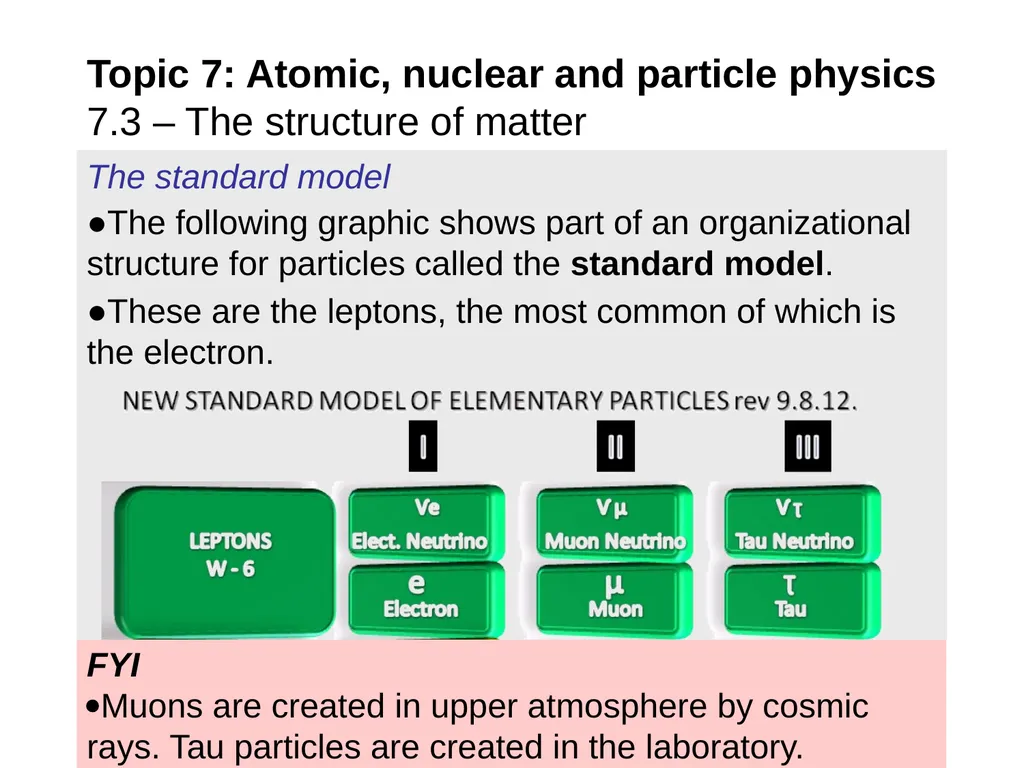
Muons are created in upper atmosphere by cosmic rays. Tau particles are created in the laboratory. The standard model
●The following graphic shows part of an organizational structure for particles called the standard model.
●These are the leptons, the most common of which is the electron. Topic 7: Atomic, nuclear and particle physics 7.3 – The structure of matter<br>
Muons are created in upper atmosphere by cosmic rays. Tau particles are created in the laboratory. The standard model
●The following graphic shows part of an organizational structure for particles called the standard model.
●These are the leptons, the most common of which is the electron. Topic 7: Atomic, nuclear and particle physics 7.3 – The structure of matter<br>
23
Leptons and their antiparticles
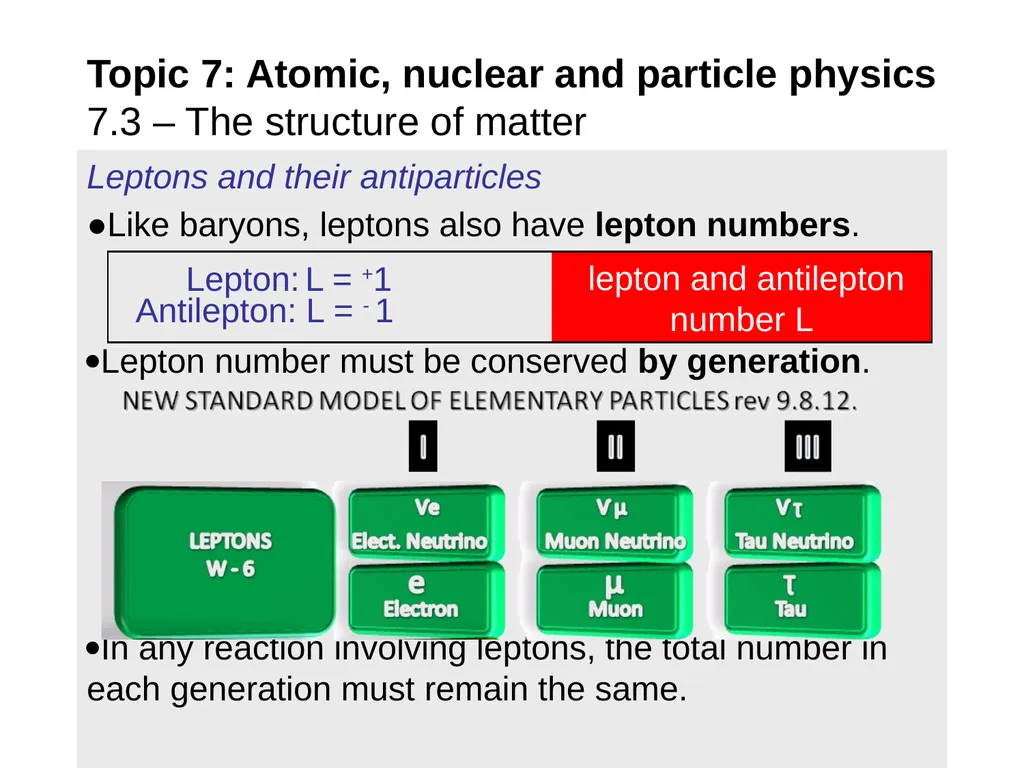
●Like baryons, leptons also have lepton numbers.
Lepton number must be conserved by generation.
In any reaction involving leptons, the total number in each generation must remain the same. Topic 7: Atomic, nuclear and particle physics 7.3 – The structure of matter<br>
●Like baryons, leptons also have lepton numbers.
Lepton number must be conserved by generation.
In any reaction involving leptons, the total number in each generation must remain the same. Topic 7: Atomic, nuclear and particle physics 7.3 – The structure of matter<br>
24
FYI
Note the family/generation-distinguishing subscripts. PRACTICE:
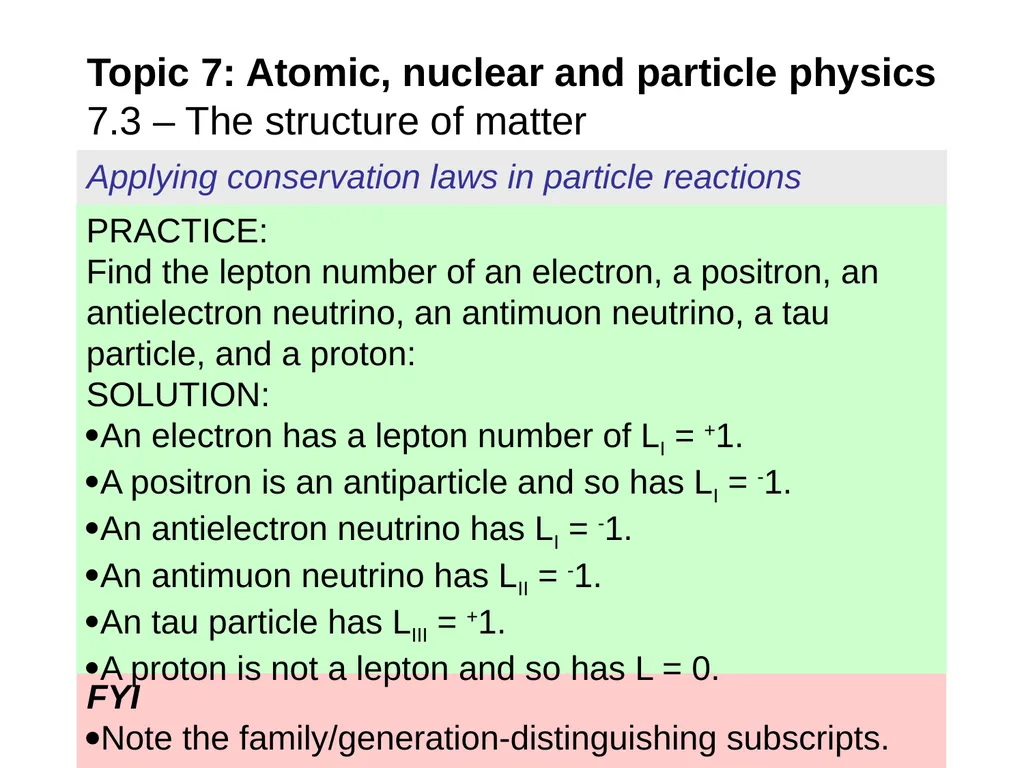
Find the lepton number of an electron, a positron, an antielectron neutrino, an antimuon neutrino, a tau particle, and a proton:
SOLUTION:
An electron has a lepton number of LI = +1.
A positron is an antiparticle and so has LI = -1.
An antielectron neutrino has LI = -1.
An antimuon neutrino has LII = -1.
An tau particle has LIII = +1.
A proton is not a lepton and so has L = 0. Applying conservation laws in particle reactions Topic 7: Atomic, nuclear and particle physics 7.3 – The structure of matter<br>
Note the family/generation-distinguishing subscripts. PRACTICE:
Find the lepton number of an electron, a positron, an antielectron neutrino, an antimuon neutrino, a tau particle, and a proton:
SOLUTION:
An electron has a lepton number of LI = +1.
A positron is an antiparticle and so has LI = -1.
An antielectron neutrino has LI = -1.
An antimuon neutrino has LII = -1.
An tau particle has LIII = +1.
A proton is not a lepton and so has L = 0. Applying conservation laws in particle reactions Topic 7: Atomic, nuclear and particle physics 7.3 – The structure of matter<br>
25
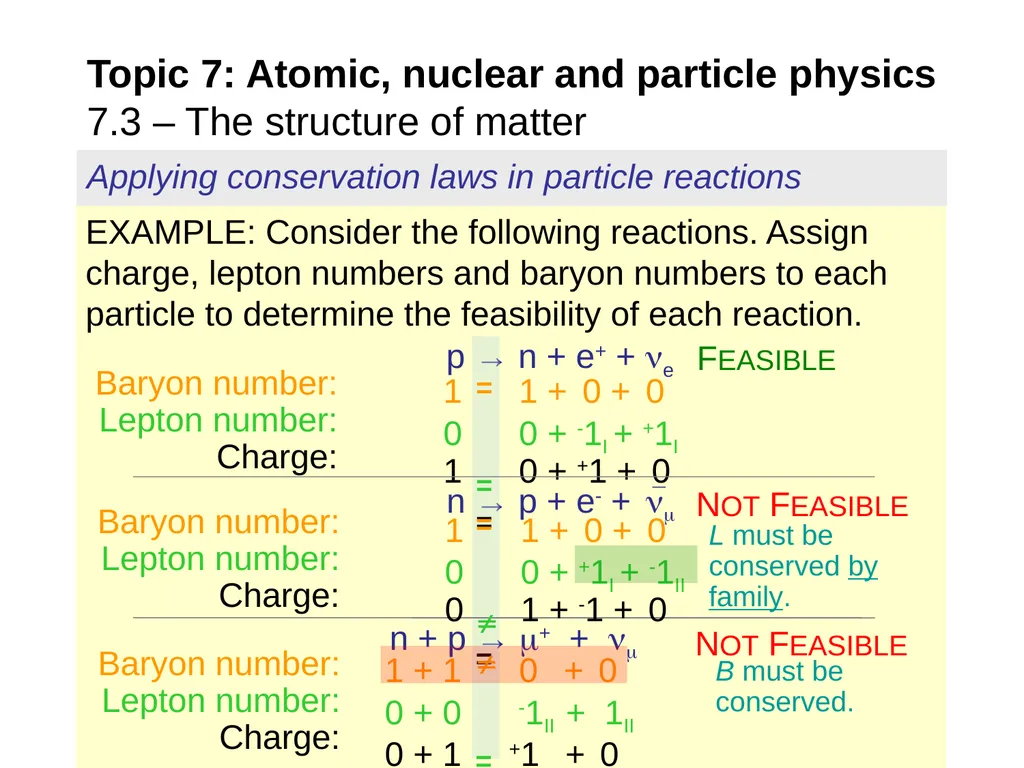
EXAMPLE: Consider the following reactions. Assign charge, lepton numbers and baryon numbers to each particle to determine the feasibility of each reaction. Applying conservation laws in particle reactions Topic 7: Atomic, nuclear and particle physics
7.3 – The structure of matter p → n + e+ + e n + p → + + Baryon number:
Lepton number:
Charge: Baryon number:
Lepton number:
Charge: Baryon number:
Lepton number:
Charge: 1 1 + 0 + 0
0 0 + -1I + +1I
1 0 + +1 + 0 =
=
= FEASIBLE 1 1 + 0 + 0
0 0 + +1I + -1II
0 1 + -1 + 0 =
= 1 + 1 0 + 0
0 + 0 -1II + 1II
0 + 1 +1 + 0
=
= NOT FEASIBLE NOT FEASIBLE L must be conserved by family. B must be conserved.<br>
Lepton number:
Charge: Baryon number:
Lepton number:
Charge: Baryon number:
Lepton number:
Charge: 1 1 + 0 + 0
0 0 + -1I + +1I
1 0 + +1 + 0 =
=
= FEASIBLE 1 1 + 0 + 0
0 0 + +1I + -1II
0 1 + -1 + 0 =
= 1 + 1 0 + 0
0 + 0 -1II + 1II
0 + 1 +1 + 0
=
= NOT FEASIBLE NOT FEASIBLE L must be conserved by family. B must be conserved.<br>
26
Applying conservation laws in particle reactions Topic 7: Atomic, nuclear and particle physics
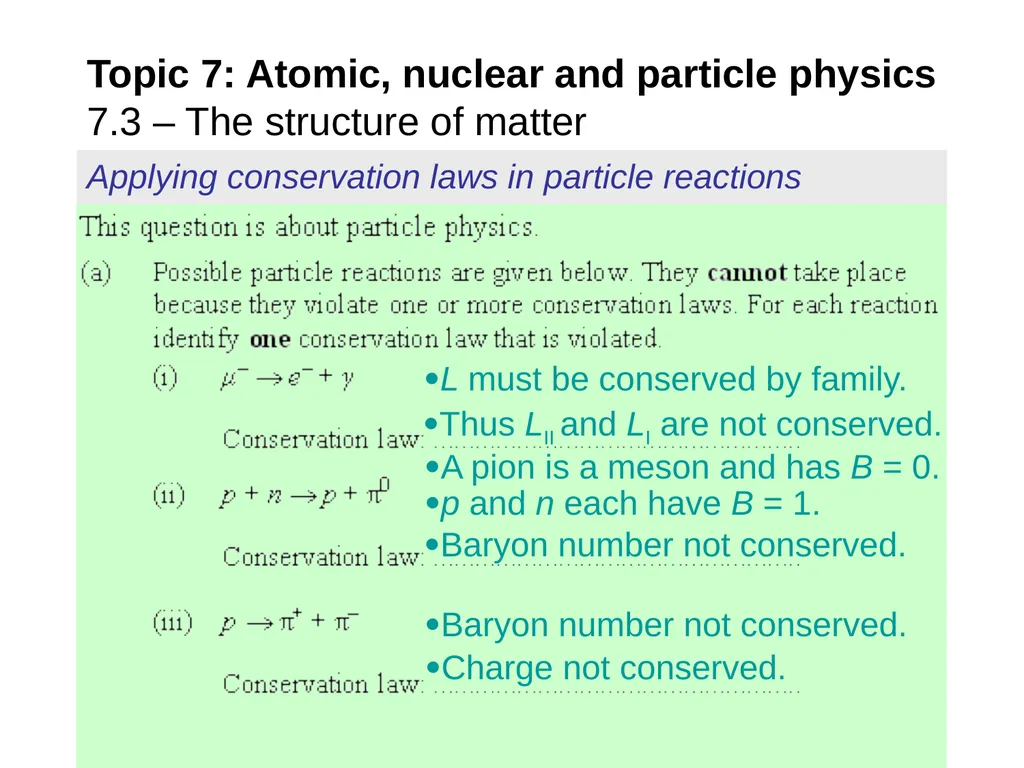
7.3 – The structure of matter L must be conserved by family. Thus LII and LI are not conserved. A pion is a meson and has B = 0. p and n each have B = 1. Baryon number not conserved. Baryon number not conserved. Charge not conserved.<br>
27
Applying conservation laws in particle reactions Topic 7: Atomic, nuclear and particle physics
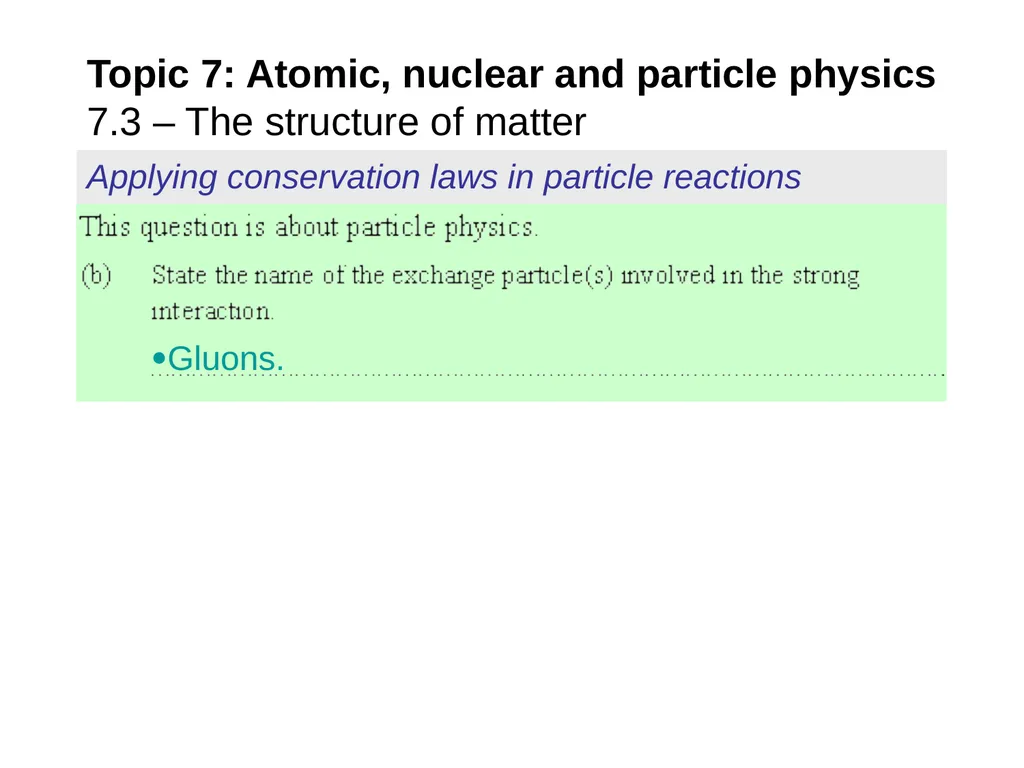
7.3 – The structure of matter Gluons.<br>
28
Applying conservation laws in particle reactions Topic 7: Atomic, nuclear and particle physics
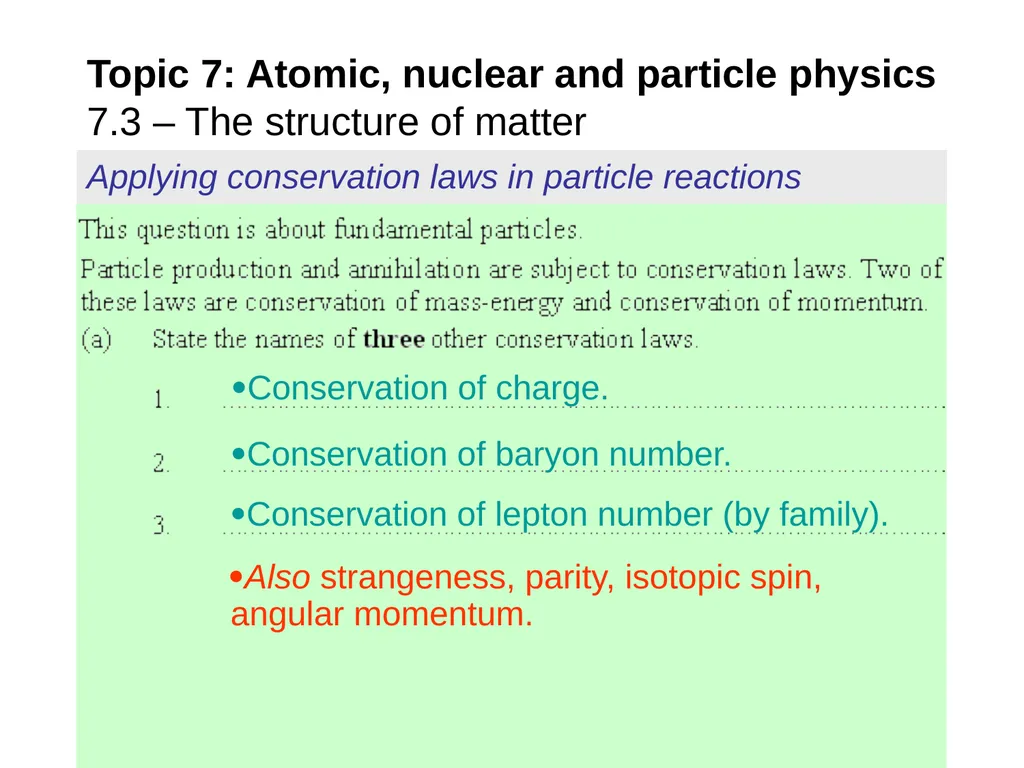
7.3 – The structure of matter Conservation of charge. Conservation of baryon number. Conservation of lepton number (by family). Also strangeness, parity, isotopic spin, angular momentum.<br>
29
Applying conservation laws in particle reactions Topic 7: Atomic, nuclear and particle physics
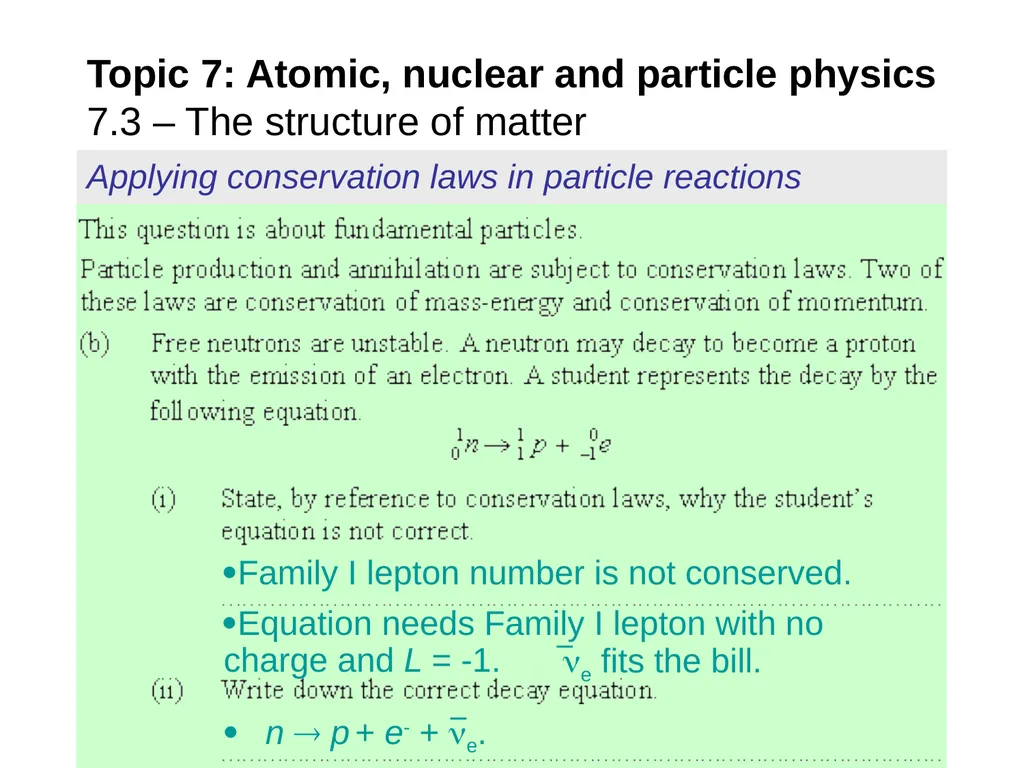
7.3 – The structure of matter Family I lepton number is not conserved. Equation needs Family I lepton with no charge and L = -1. e fits the bill. n p + e- + e.<br>
30
Topic 7: Atomic, nuclear and particle physics
7.3 – The structure of matter FYI
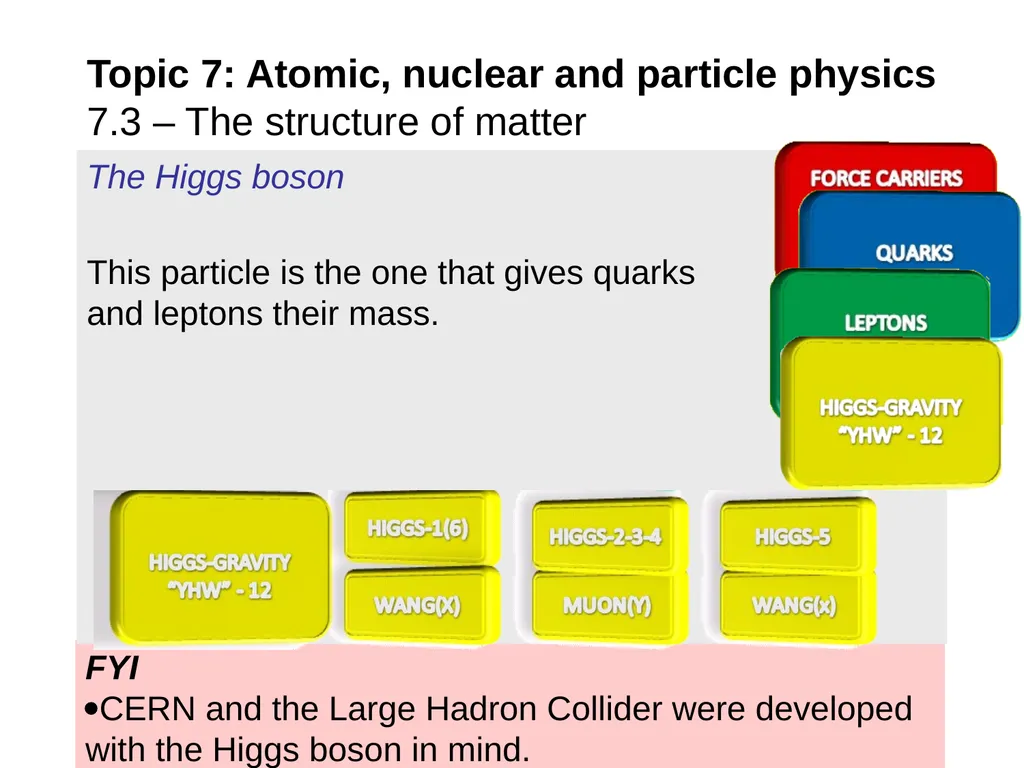
CERN and the Large Hadron Collider were developed with the Higgs boson in mind. The Higgs boson
This particle is the one that gives quarks and leptons their mass.<br>
CERN and the Large Hadron Collider were developed with the Higgs boson in mind. The Higgs boson
This particle is the one that gives quarks and leptons their mass.<br>
31
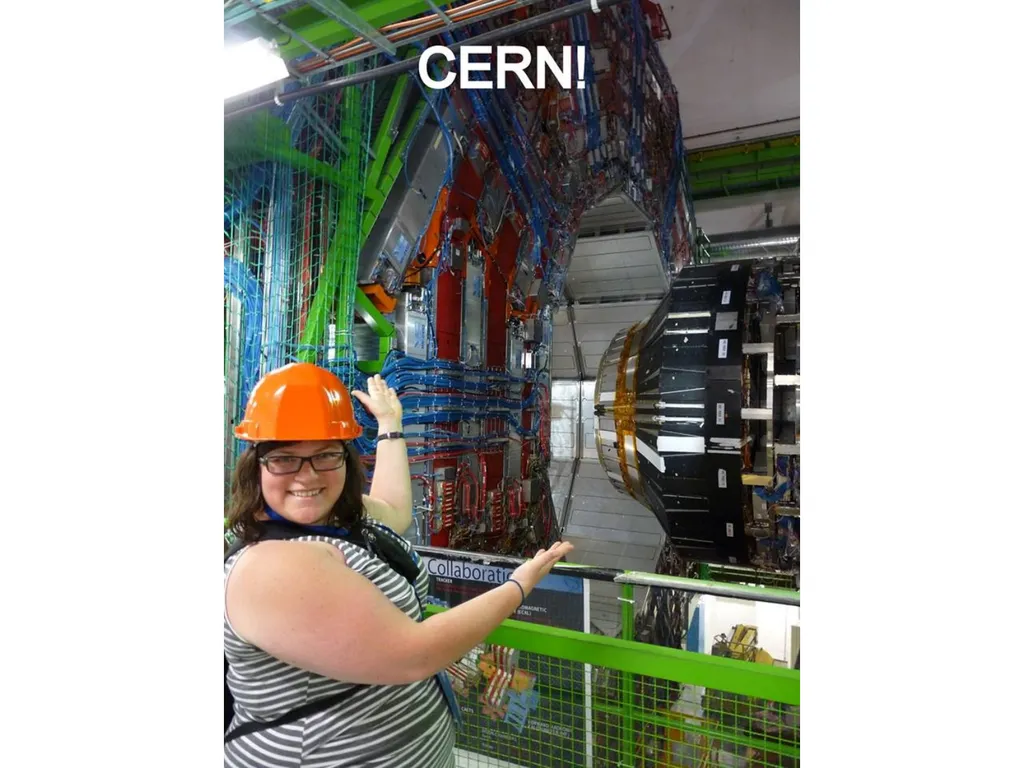
The Large Hadron Collider at CERN.<br>
32
The Higgs boson – an analogy
Imagine a room full of physicists. The Higgs field.
Suddenly Einstein enters and attempts to cross the room, but the star-struck physicists cluster around him and impede his movements, effectively increasing his mass. High-mass particle.
Now imagine that I enter the room. Nobody wants to interact with me, so I pass through the physicists relatively unimpeded—no effective mass for me! Low-mass (or massless) particle.
Lastly, imagine that somebody whispers a rumor, causing the physicists to cluster together excitedly on their own. Field disturbance – Higgs boson.
-Burton DeWilde Topic 7: Atomic, nuclear and particle physics 7.3 – The structure of matter<br>
Imagine a room full of physicists. The Higgs field.
Suddenly Einstein enters and attempts to cross the room, but the star-struck physicists cluster around him and impede his movements, effectively increasing his mass. High-mass particle.
Now imagine that I enter the room. Nobody wants to interact with me, so I pass through the physicists relatively unimpeded—no effective mass for me! Low-mass (or massless) particle.
Lastly, imagine that somebody whispers a rumor, causing the physicists to cluster together excitedly on their own. Field disturbance – Higgs boson.
-Burton DeWilde Topic 7: Atomic, nuclear and particle physics 7.3 – The structure of matter<br>
33
The Higgs boson – an analogy Topic 7: Atomic, nuclear and particle physics
7.3 – The structure of matter Big mass Small mass<br>
34
The Higgs boson
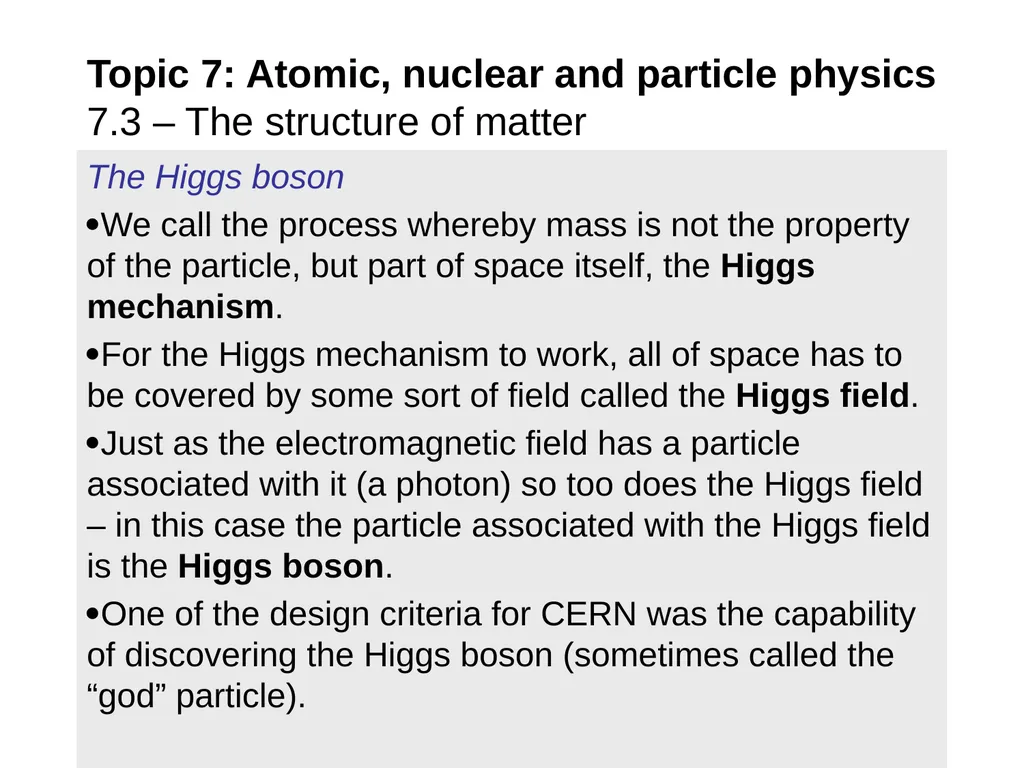
We call the process whereby mass is not the property of the particle, but part of space itself, the Higgs mechanism.
For the Higgs mechanism to work, all of space has to be covered by some sort of field called the Higgs field.
Just as the electromagnetic field has a particle associated with it (a photon) so too does the Higgs field – in this case the particle associated with the Higgs field is the Higgs boson.
One of the design criteria for CERN was the capability of discovering the Higgs boson (sometimes called the “god” particle). Topic 7: Atomic, nuclear and particle physics 7.3 – The structure of matter<br>
We call the process whereby mass is not the property of the particle, but part of space itself, the Higgs mechanism.
For the Higgs mechanism to work, all of space has to be covered by some sort of field called the Higgs field.
Just as the electromagnetic field has a particle associated with it (a photon) so too does the Higgs field – in this case the particle associated with the Higgs field is the Higgs boson.
One of the design criteria for CERN was the capability of discovering the Higgs boson (sometimes called the “god” particle). Topic 7: Atomic, nuclear and particle physics 7.3 – The structure of matter<br>
35
FYI
Some books switch the space and time axis. The IB presentation is as shown above. Feynman diagrams
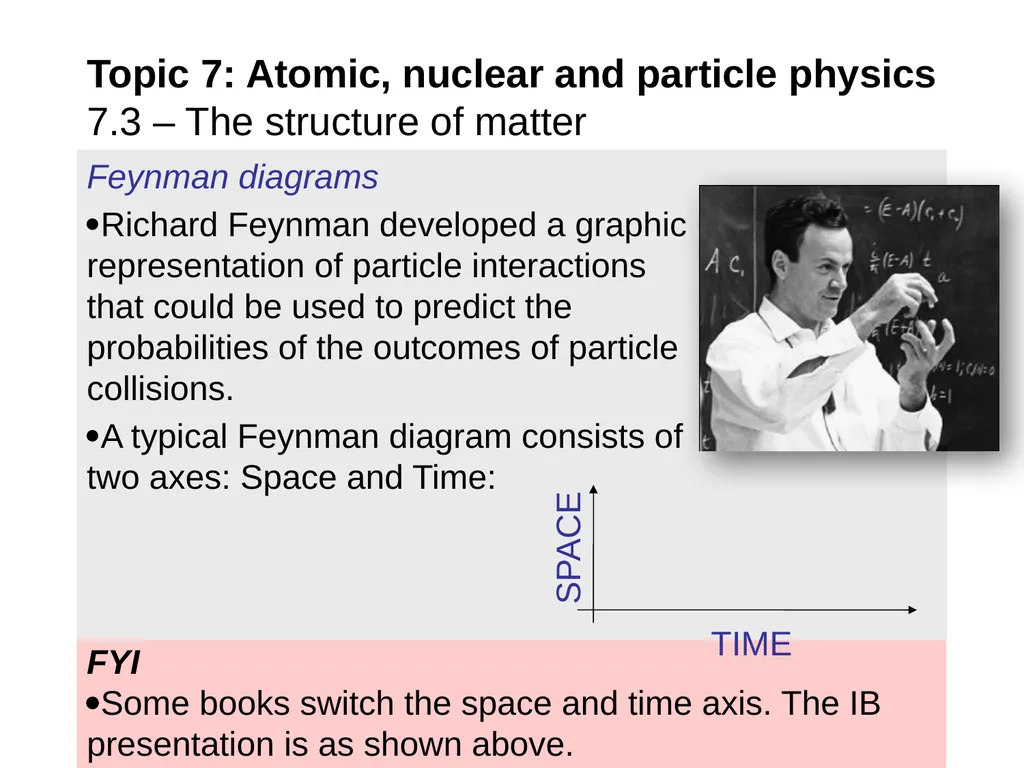
Richard Feynman developed a graphic representation of particle interactions that could be used to predict the probabilities of the outcomes of particle collisions.
A typical Feynman diagram consists of two axes: Space and Time: Topic 7: Atomic, nuclear and particle physics 7.3 – The structure of matter SPACE TIME<br>
Some books switch the space and time axis. The IB presentation is as shown above. Feynman diagrams
Richard Feynman developed a graphic representation of particle interactions that could be used to predict the probabilities of the outcomes of particle collisions.
A typical Feynman diagram consists of two axes: Space and Time: Topic 7: Atomic, nuclear and particle physics 7.3 – The structure of matter SPACE TIME<br>
36
FYI
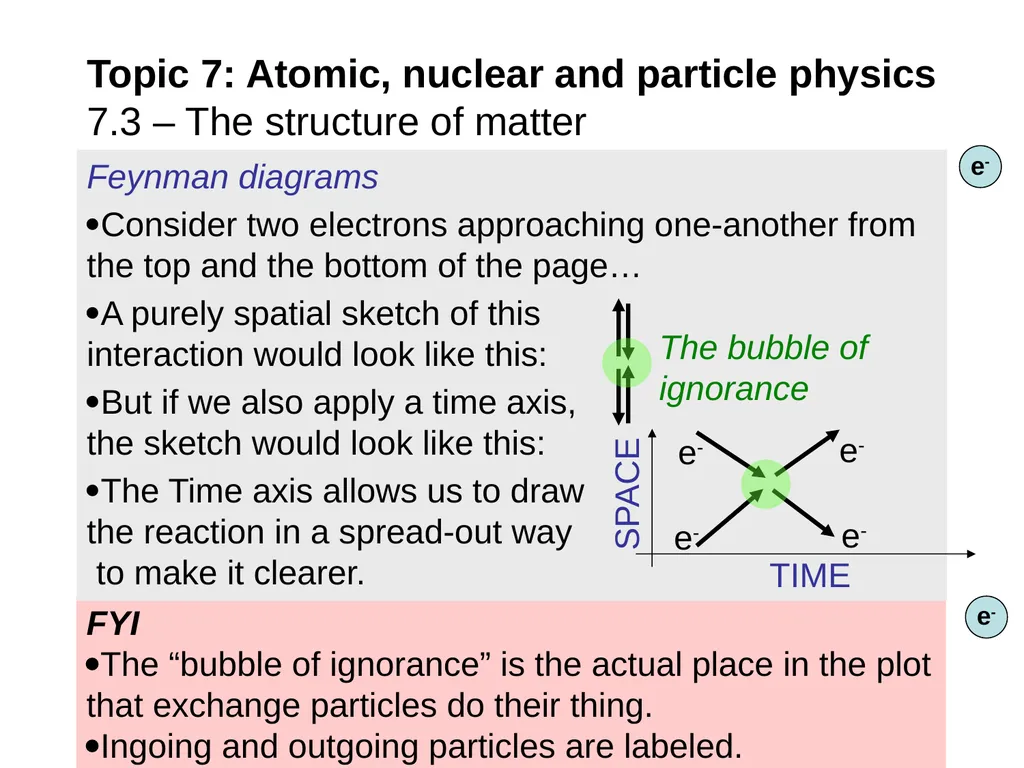
The “bubble of ignorance” is the actual place in the plot that exchange particles do their thing.
Ingoing and outgoing particles are labeled. Feynman diagrams
Consider two electrons approaching one-another from the top and the bottom of the page…
A purely spatial sketch of this interaction would look like this:
But if we also apply a time axis, the sketch would look like this:
The Time axis allows us to draw the reaction in a spread-out way to make it clearer. Topic 7: Atomic, nuclear and particle physics 7.3 – The structure of matter The bubble of ignorance SPACE TIME e- e- e- e-<br>
The “bubble of ignorance” is the actual place in the plot that exchange particles do their thing.
Ingoing and outgoing particles are labeled. Feynman diagrams
Consider two electrons approaching one-another from the top and the bottom of the page…
A purely spatial sketch of this interaction would look like this:
But if we also apply a time axis, the sketch would look like this:
The Time axis allows us to draw the reaction in a spread-out way to make it clearer. Topic 7: Atomic, nuclear and particle physics 7.3 – The structure of matter The bubble of ignorance SPACE TIME e- e- e- e-<br>
37
FYI
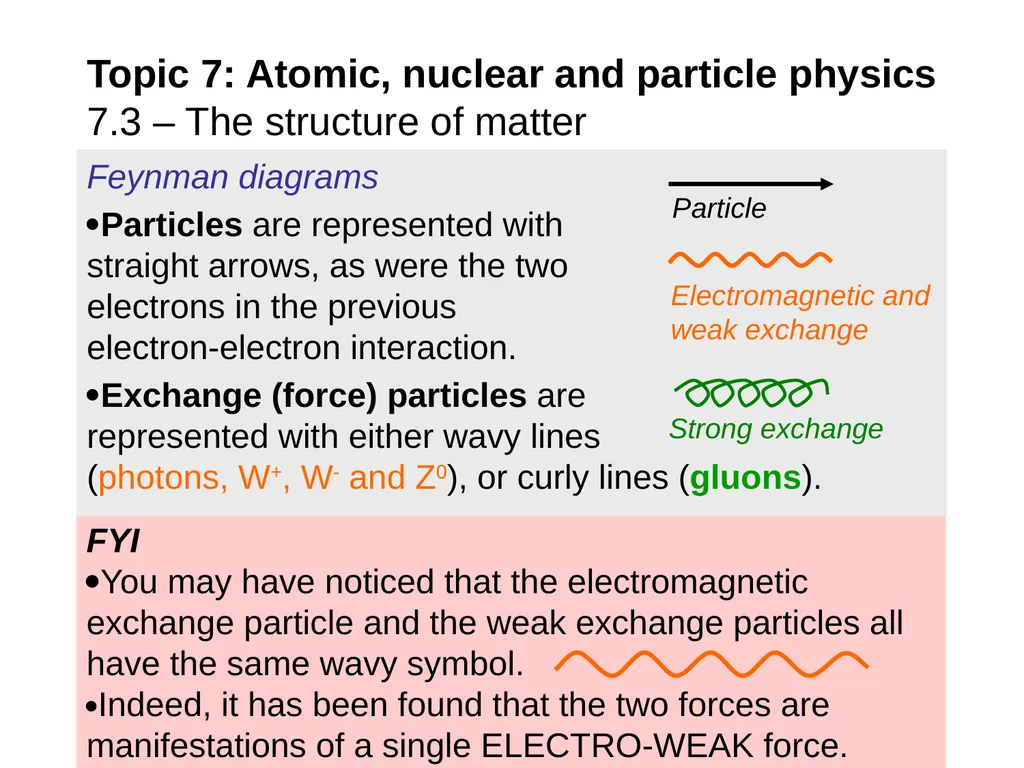
You may have noticed that the electromagnetic exchange particle and the weak exchange particles all have the same wavy symbol.
Indeed, it has been found that the two forces are manifestations of a single ELECTRO-WEAK force. Feynman diagrams
Particles are represented with straight arrows, as were the two electrons in the previous electron-electron interaction.
Exchange (force) particles are represented with either wavy lines (photons, W+, W- and Z0), or curly lines (gluons). Topic 7: Atomic, nuclear and particle physics 7.3 – The structure of matter Electromagnetic and weak exchange Strong exchange Particle<br>
You may have noticed that the electromagnetic exchange particle and the weak exchange particles all have the same wavy symbol.
Indeed, it has been found that the two forces are manifestations of a single ELECTRO-WEAK force. Feynman diagrams
Particles are represented with straight arrows, as were the two electrons in the previous electron-electron interaction.
Exchange (force) particles are represented with either wavy lines (photons, W+, W- and Z0), or curly lines (gluons). Topic 7: Atomic, nuclear and particle physics 7.3 – The structure of matter Electromagnetic and weak exchange Strong exchange Particle<br>
38
EXAMPLE:
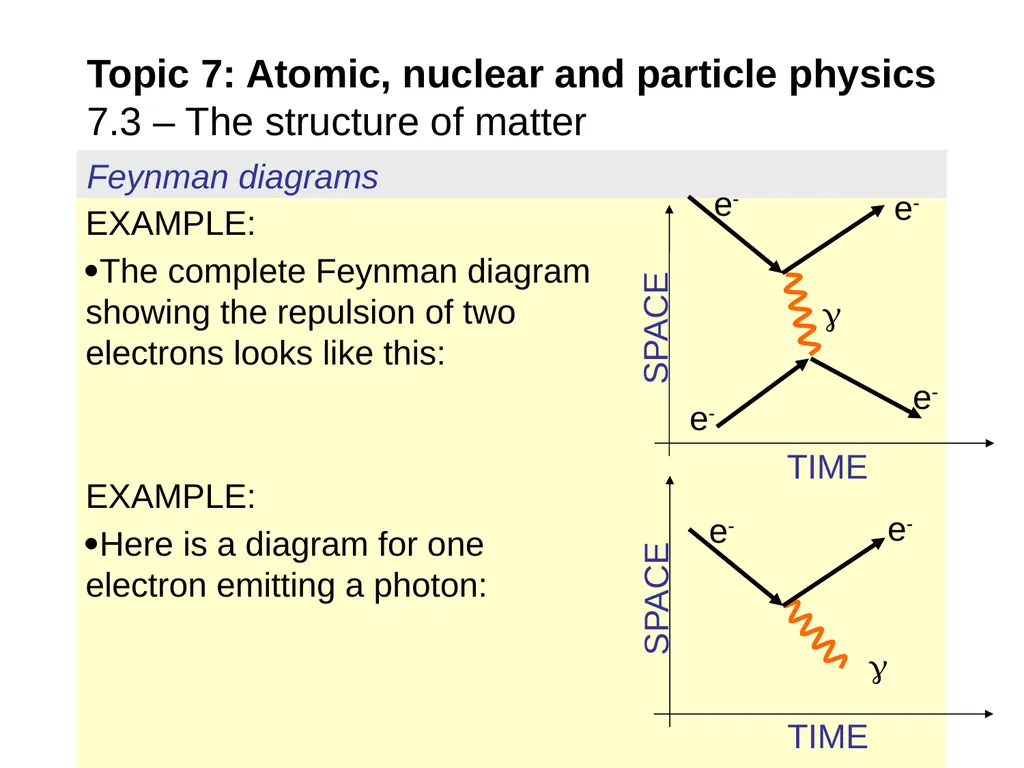
The complete Feynman diagram showing the repulsion of two electrons looks like this:
EXAMPLE:
Here is a diagram for one electron emitting a photon: Feynman diagrams Topic 7: Atomic, nuclear and particle physics 7.3 – The structure of matter SPACE TIME e- e- SPACE TIME e- e- e- e-<br>
The complete Feynman diagram showing the repulsion of two electrons looks like this:
EXAMPLE:
Here is a diagram for one electron emitting a photon: Feynman diagrams Topic 7: Atomic, nuclear and particle physics 7.3 – The structure of matter SPACE TIME e- e- SPACE TIME e- e- e- e-<br>
39
EXAMPLE:
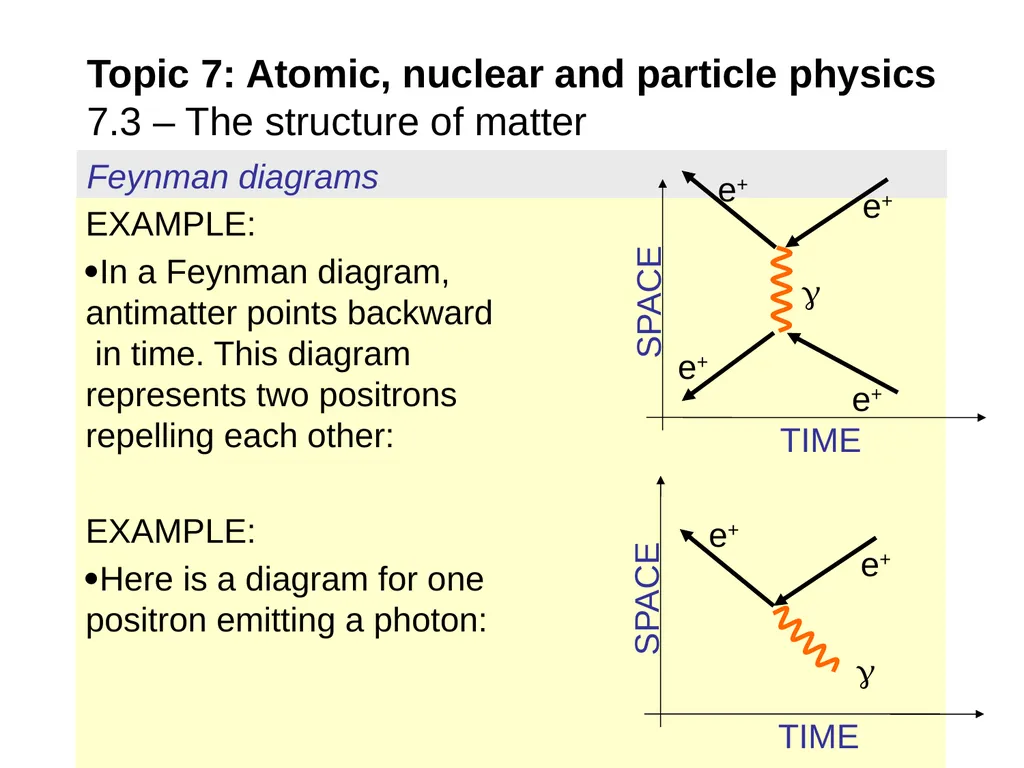
In a Feynman diagram, antimatter points backward in time. This diagram represents two positrons repelling each other:
EXAMPLE:
Here is a diagram for one positron emitting a photon: Feynman diagrams Topic 7: Atomic, nuclear and particle physics 7.3 – The structure of matter SPACE TIME e+ e+ e+ e+ SPACE TIME e+ e+ <br>
In a Feynman diagram, antimatter points backward in time. This diagram represents two positrons repelling each other:
EXAMPLE:
Here is a diagram for one positron emitting a photon: Feynman diagrams Topic 7: Atomic, nuclear and particle physics 7.3 – The structure of matter SPACE TIME e+ e+ e+ e+ SPACE TIME e+ e+ <br>
40
EXAMPLE:
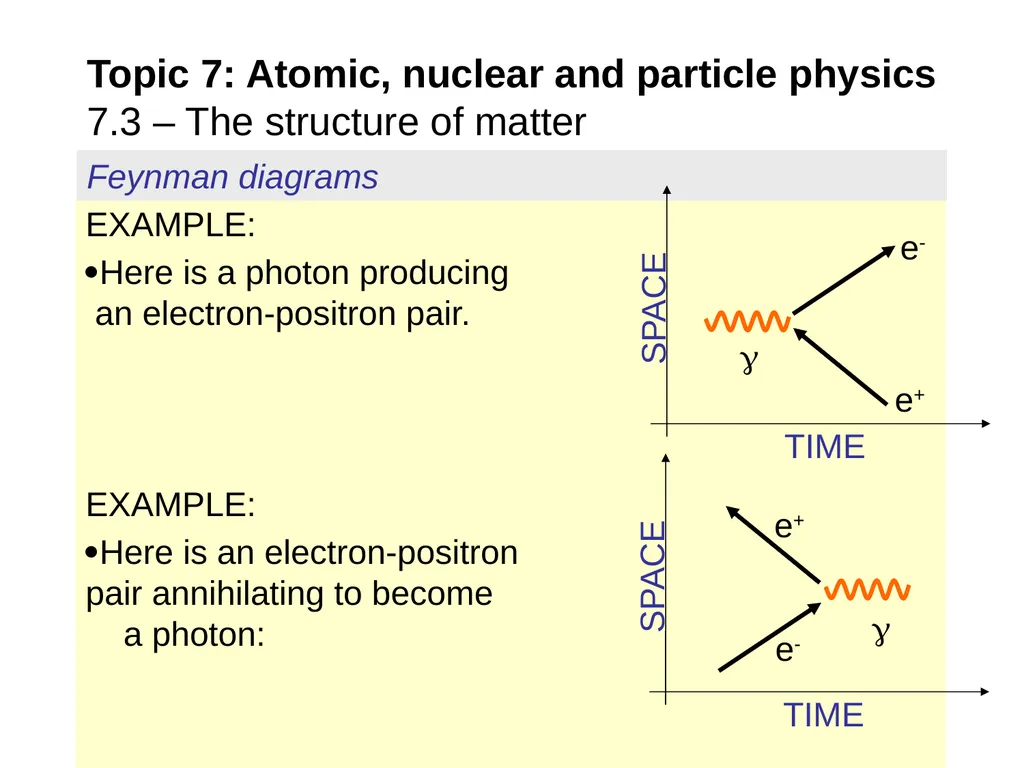
Here is a photon producing an electron-positron pair.
EXAMPLE:
Here is an electron-positron pair annihilating to become a photon: Feynman diagrams Topic 7: Atomic, nuclear and particle physics 7.3 – The structure of matter SPACE TIME e- e+ SPACE TIME e- e+ <br>
Here is a photon producing an electron-positron pair.
EXAMPLE:
Here is an electron-positron pair annihilating to become a photon: Feynman diagrams Topic 7: Atomic, nuclear and particle physics 7.3 – The structure of matter SPACE TIME e- e+ SPACE TIME e- e+ <br>
41
FYI
One can use Feynman diagrams to map out complete processes – including the bubble of ignorance. Using the conservation rules and the exchange particles, you can predict what kind of processes can occur. EXAMPLE:
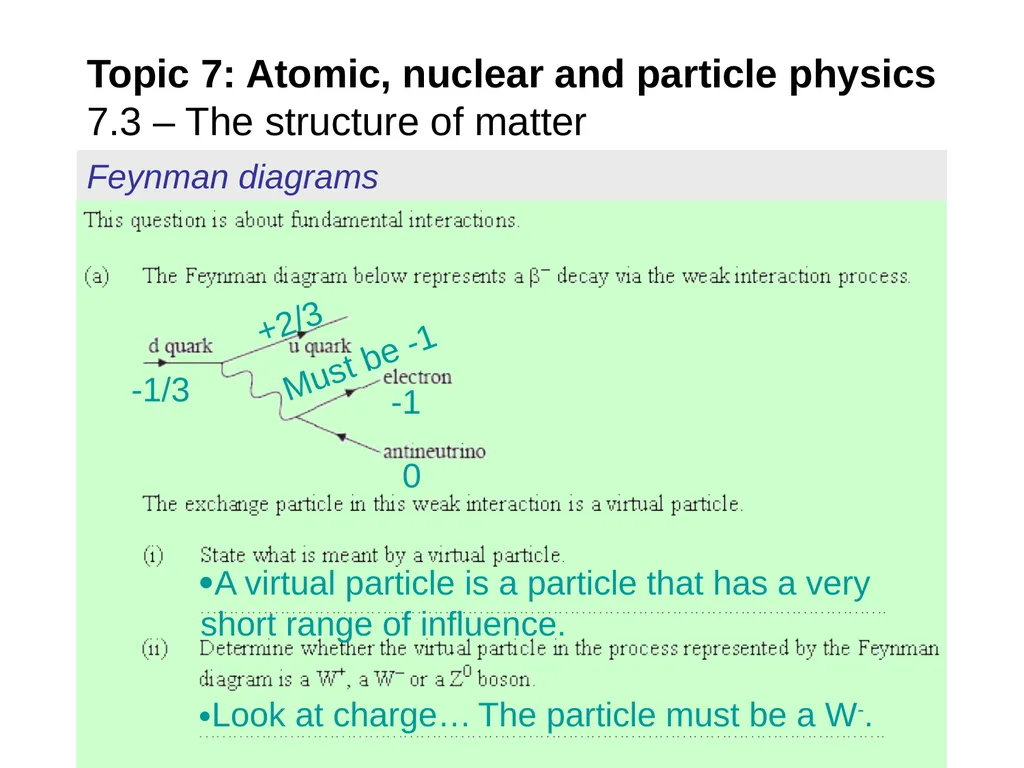
Here is a diagram of a down quark emitting a W- particle that decays into an electron and an antineutrino: Feynman diagrams Topic 7: Atomic, nuclear and particle physics 7.3 – The structure of matter SPACE TIME d u e- e W-<br>
One can use Feynman diagrams to map out complete processes – including the bubble of ignorance. Using the conservation rules and the exchange particles, you can predict what kind of processes can occur. EXAMPLE:
Here is a diagram of a down quark emitting a W- particle that decays into an electron and an antineutrino: Feynman diagrams Topic 7: Atomic, nuclear and particle physics 7.3 – The structure of matter SPACE TIME d u e- e W-<br>
42
FYI
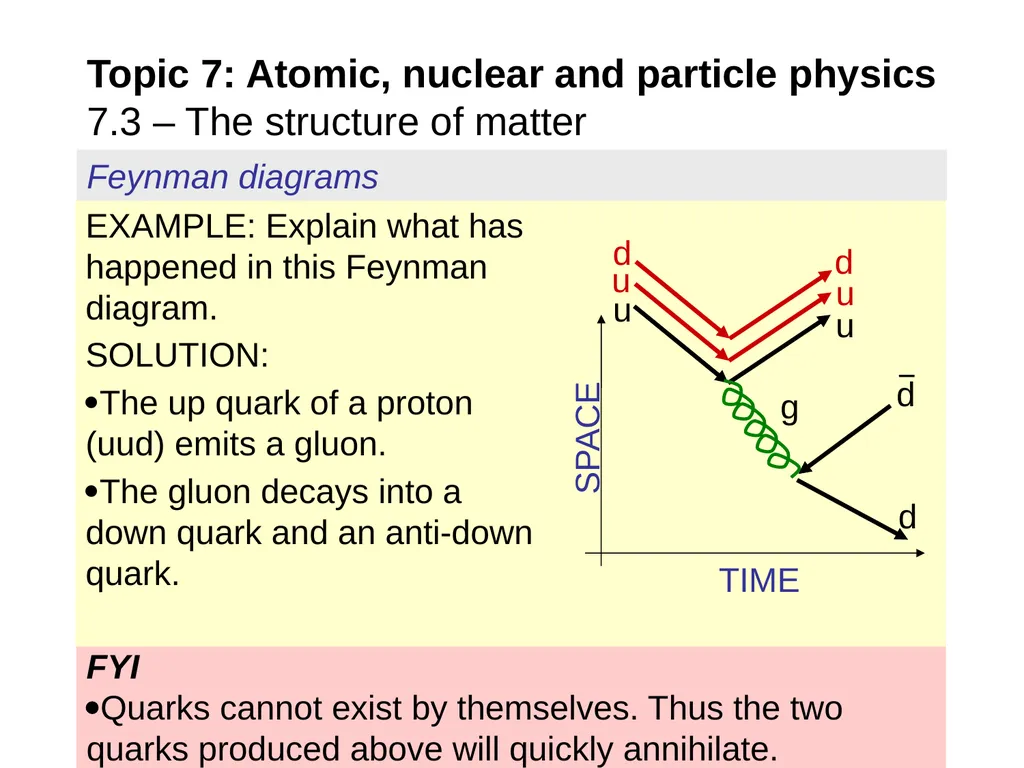
Quarks cannot exist by themselves. Thus the two quarks produced above will quickly annihilate. EXAMPLE: Explain what has happened in this Feynman diagram.
SOLUTION:
The up quark of a proton (uud) emits a gluon.
The gluon decays into a down quark and an anti-down quark. Feynman diagrams Topic 7: Atomic, nuclear and particle physics 7.3 – The structure of matter SPACE TIME u u d d g u u d d<br>
Quarks cannot exist by themselves. Thus the two quarks produced above will quickly annihilate. EXAMPLE: Explain what has happened in this Feynman diagram.
SOLUTION:
The up quark of a proton (uud) emits a gluon.
The gluon decays into a down quark and an anti-down quark. Feynman diagrams Topic 7: Atomic, nuclear and particle physics 7.3 – The structure of matter SPACE TIME u u d d g u u d d<br>
43
EXAMPLE: Explain what has happened in this Feynman diagram.
SOLUTION:
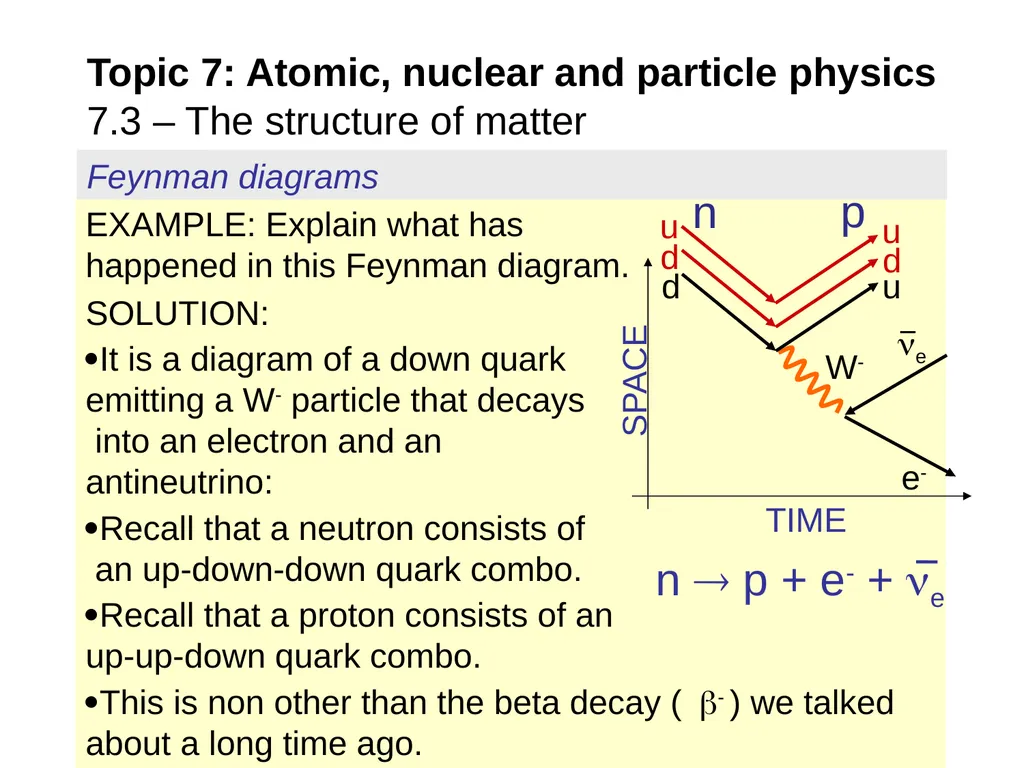
It is a diagram of a down quark emitting a W- particle that decays into an electron and an antineutrino:
Recall that a neutron consists of an up-down-down quark combo.
Recall that a proton consists of an up-up-down quark combo.
This is non other than the beta decay (- ) we talked about a long time ago. Feynman diagrams Topic 7: Atomic, nuclear and particle physics 7.3 – The structure of matter SPACE TIME d u e- e W- d d u u n p n p + e- + e<br>
SOLUTION:
It is a diagram of a down quark emitting a W- particle that decays into an electron and an antineutrino:
Recall that a neutron consists of an up-down-down quark combo.
Recall that a proton consists of an up-up-down quark combo.
This is non other than the beta decay (- ) we talked about a long time ago. Feynman diagrams Topic 7: Atomic, nuclear and particle physics 7.3 – The structure of matter SPACE TIME d u e- e W- d d u u n p n p + e- + e<br>
44
Feynman diagrams Topic 7: Atomic, nuclear and particle physics
7.3 – The structure of matter A virtual particle is a particle that has a very short range of influence. Look at charge… -1/3 +2/3 Must be -1 -1 0 The particle must be a W-.<br>