
Excellence in Oral Presentation for Technical
LD
Published · 35 slides · 0 views
1 / 1


Description
Excellence in Oral Presentation for Technical Speakers (Part I) Klara Nahrstedt KOM Retreat 2010 One of the Most Important Aspects to be Successful in Your Research, Your Job and Your Career is Excellent Oral and Written Communication
Related Topics
Share
Embed code
Download this presentation From Below
"Excellence in Oral Presentation for Technical" is the property of its rightful owner. Permission is granted to download and print the materials on this website for personal, non-commercial use only, and to display it on your personal computer provided you do not modify the materials and that you retain all copyright notices contained in the materials. By downloading content from our website, you accept the terms of this agreement.
Presentation Transcript
01
Excellence in Oral Presentation for Technical Speakers (Part I) Klara Nahrstedt
KOM Retreat 2010<br>
KOM Retreat 2010<br>
02
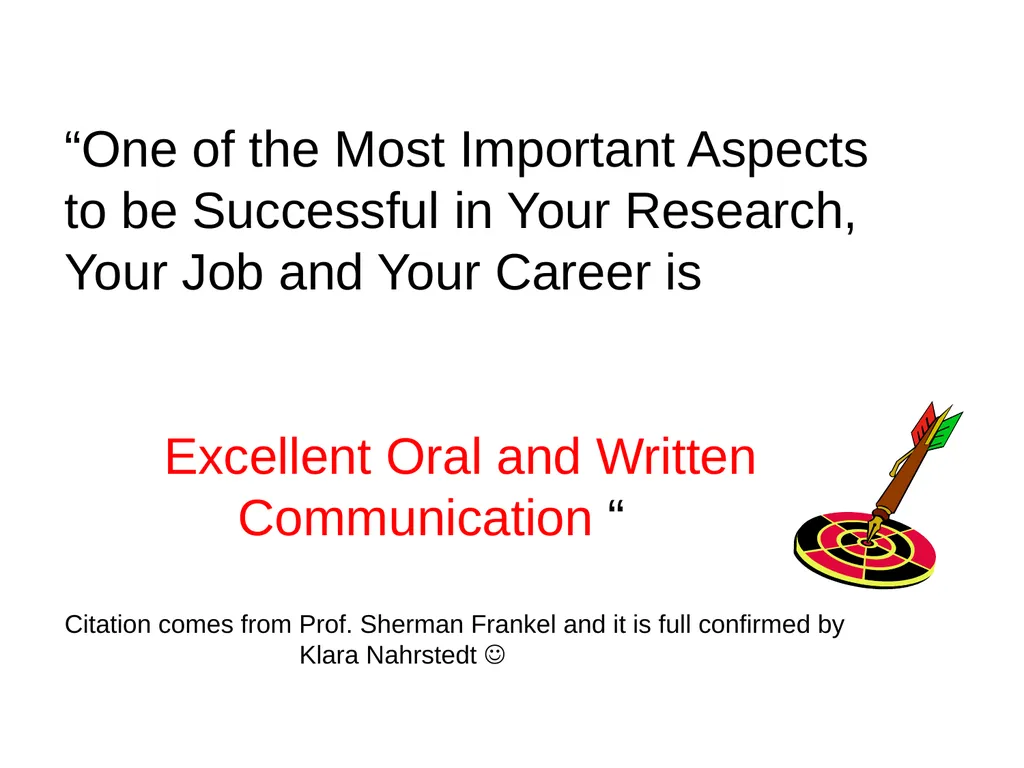
“One of the Most Important Aspects
to be Successful in Your Research,
Your Job and Your Career is
Excellent Oral and Written
Communication “
Citation comes from Prof. Sherman Frankel and it is full confirmed by
Klara Nahrstedt <br>
to be Successful in Your Research,
Your Job and Your Career is
Excellent Oral and Written
Communication “
Citation comes from Prof. Sherman Frankel and it is full confirmed by
Klara Nahrstedt <br>
03
Oral Communication (Part I) Exercising Your Presentation Muscle
Overcoming Speech Anxiety
Openings and Closings of Presentation
Presentation Organization
Visual Assistance
Presentation Delivery<br>
Overcoming Speech Anxiety
Openings and Closings of Presentation
Presentation Organization
Visual Assistance
Presentation Delivery<br>
04
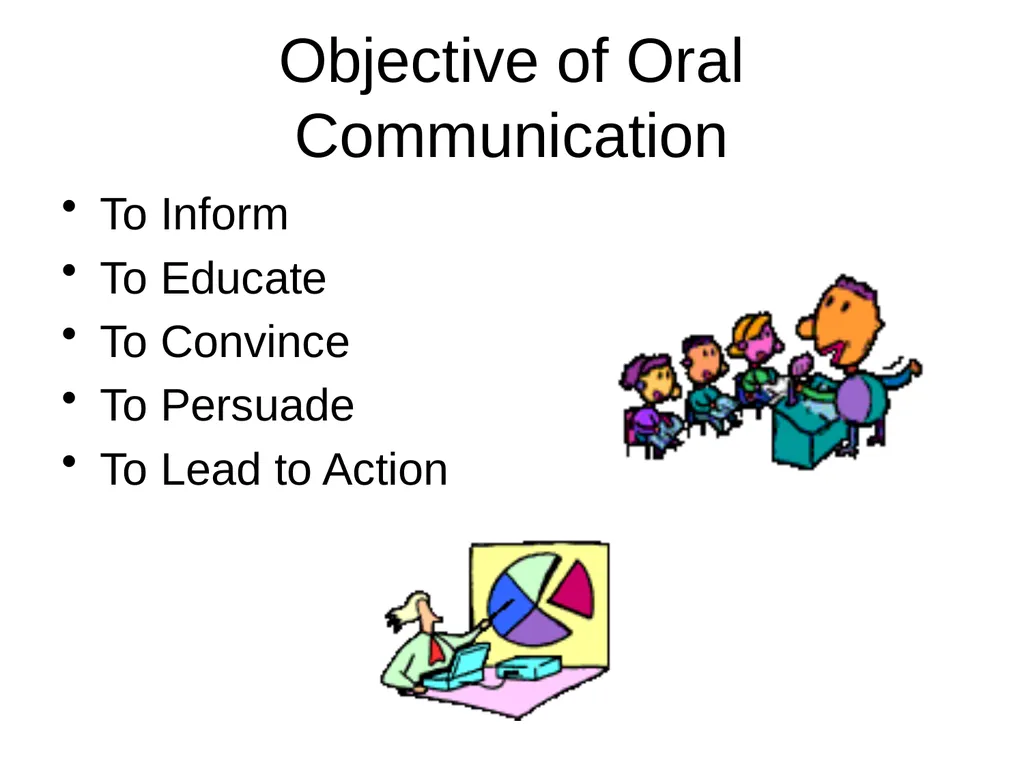
Objective of Oral Communication To Inform
To Educate
To Convince
To Persuade
To Lead to Action<br>
To Educate
To Convince
To Persuade
To Lead to Action<br>
05
Often You May Experience “Although he could boast of a PhD in his field, he was a poor communicator.
He showed dozens of transparencies crammed with complex equations and text descriptions.
He delivered, at times read, his narration in a monotone tone addressed to the screen, oblivious to us, the audience.
I tried not to, but I fell asleep.”<br>
He showed dozens of transparencies crammed with complex equations and text descriptions.
He delivered, at times read, his narration in a monotone tone addressed to the screen, oblivious to us, the audience.
I tried not to, but I fell asleep.”<br>
06
Myths and Mistakes of Technical Presentations Popular Myth: A technical audience requires a lot of technical details in order to evaluate the speaker’s ideas
In 1989 HP conducted a survey to determine what technical presenters want to hear from other technical presenters.
Result: Listeners want talks easy to follow and well organized; they want simplified message “less is more”
Studies showed that simplifying and repeating the main idea will result in increased attentiveness and retention<br>
In 1989 HP conducted a survey to determine what technical presenters want to hear from other technical presenters.
Result: Listeners want talks easy to follow and well organized; they want simplified message “less is more”
Studies showed that simplifying and repeating the main idea will result in increased attentiveness and retention<br>
07
Myths and Mistakes of Technical Presentations Popular Myth: Content is everything. Style is unimportant and enthusiasm is offensive
HP study indicated that technical audience wanted more enthusiasm and effective style, which included better visual assistance.
Often unenthusiastic delivery will ruin a speaker’s effectiveness
Mehrabian, a communication theorist, showed that
Body language and tone of voice together supply 93% of the overall message impact
Actual words only supply 7% of the overall impact<br>
HP study indicated that technical audience wanted more enthusiasm and effective style, which included better visual assistance.
Often unenthusiastic delivery will ruin a speaker’s effectiveness
Mehrabian, a communication theorist, showed that
Body language and tone of voice together supply 93% of the overall message impact
Actual words only supply 7% of the overall impact<br>
08
Myths and Mistakes of Technical Presentations Popular Myth: The text on the visuals is more important than the speaker.
Technical presenters traditionally rely too much on slides
Often, technical audiences find the slides distracting and boring
Remember, the speaker is always the focal point of presentation, visual assistance helps
Pace of the presentation
Flow of the information presented<br>
Technical presenters traditionally rely too much on slides
Often, technical audiences find the slides distracting and boring
Remember, the speaker is always the focal point of presentation, visual assistance helps
Pace of the presentation
Flow of the information presented<br>
09
Myths and Mistakes of Technical Presentations Popular Myth: Strategic organization is not necessary for technical talks.
Technical presenters often think that as long as they supply all the details, the audience is capable of drawing the appropriate conclusions.
Technical speakers often jump into the body of the presentation and start discussing data
Often the objective of the talk is not stated until the end of the talk
Technical speaker must not rely on the audience to fill in gaps and reach appropriate conclusions.
Technical speaker must understand different types of presentations, organization, and strategies for a particular type of speech.<br>
Technical presenters often think that as long as they supply all the details, the audience is capable of drawing the appropriate conclusions.
Technical speakers often jump into the body of the presentation and start discussing data
Often the objective of the talk is not stated until the end of the talk
Technical speaker must not rely on the audience to fill in gaps and reach appropriate conclusions.
Technical speaker must understand different types of presentations, organization, and strategies for a particular type of speech.<br>
10
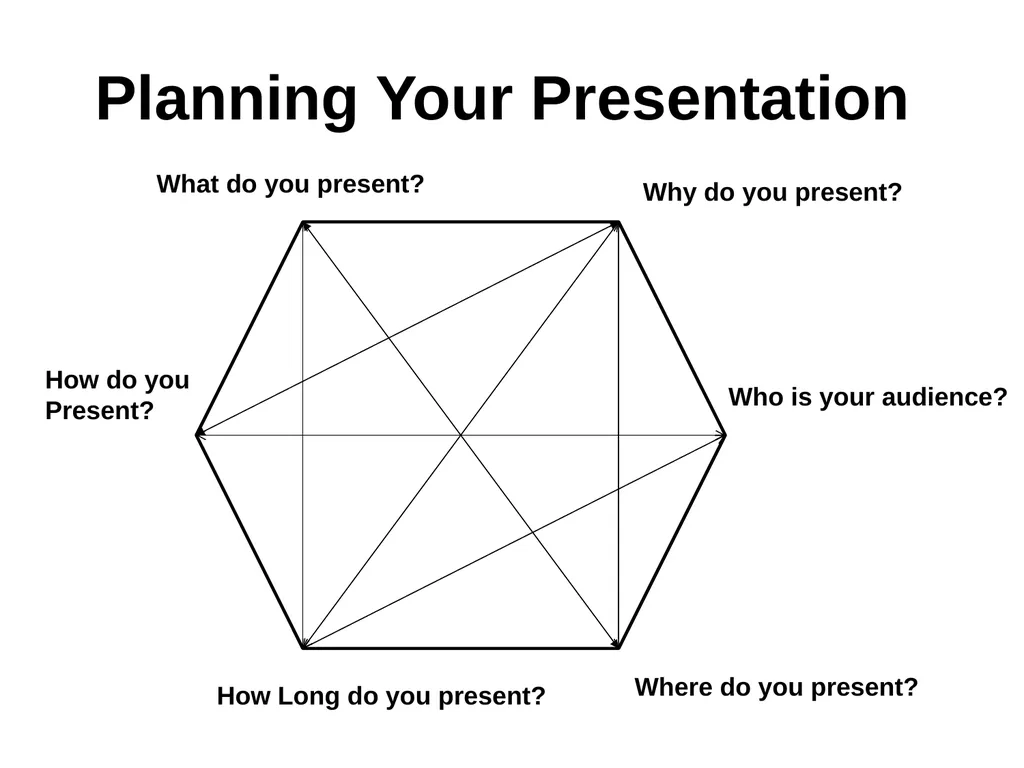
Planning Your Presentation What do you present? Why do you present? How do you
Present? Who is your audience? How Long do you present? Where do you present?<br>
Present? Who is your audience? How Long do you present? Where do you present?<br>
11
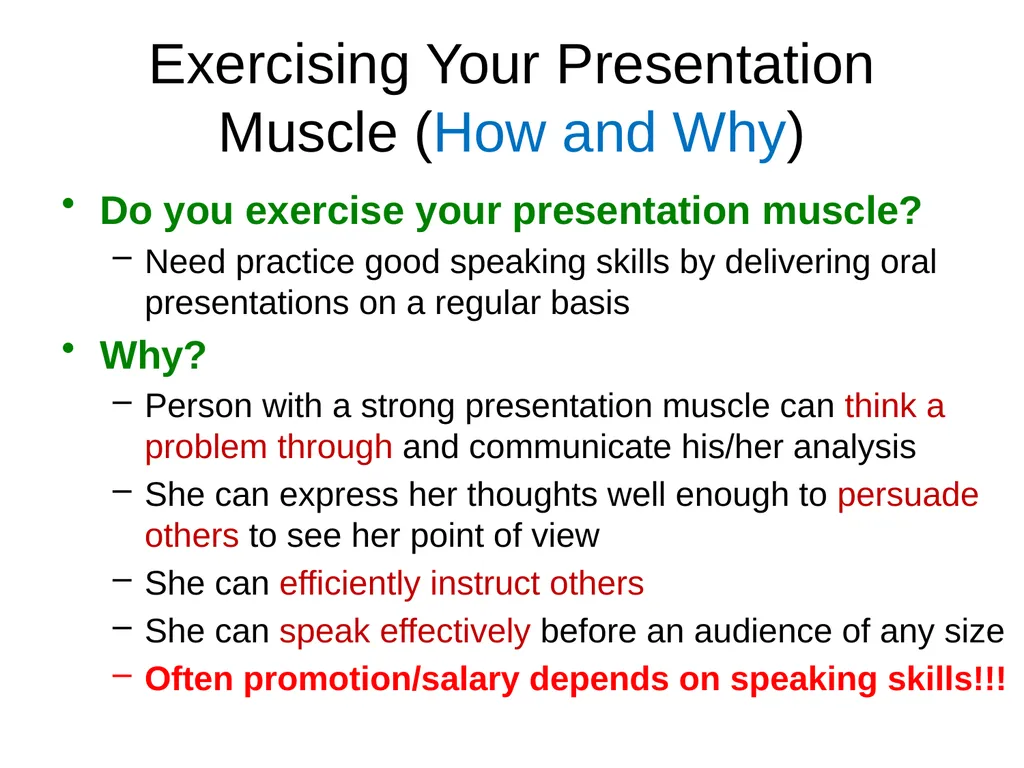
Exercising Your Presentation Muscle (How and Why) Do you exercise your presentation muscle?
Need practice good speaking skills by delivering oral presentations on a regular basis
Why?
Person with a strong presentation muscle can think a problem through and communicate his/her analysis
She can express her thoughts well enough to persuade others to see her point of view
She can efficiently instruct others
She can speak effectively before an audience of any size
Often promotion/salary depends on speaking skills!!!<br>
Need practice good speaking skills by delivering oral presentations on a regular basis
Why?
Person with a strong presentation muscle can think a problem through and communicate his/her analysis
She can express her thoughts well enough to persuade others to see her point of view
She can efficiently instruct others
She can speak effectively before an audience of any size
Often promotion/salary depends on speaking skills!!!<br>
12
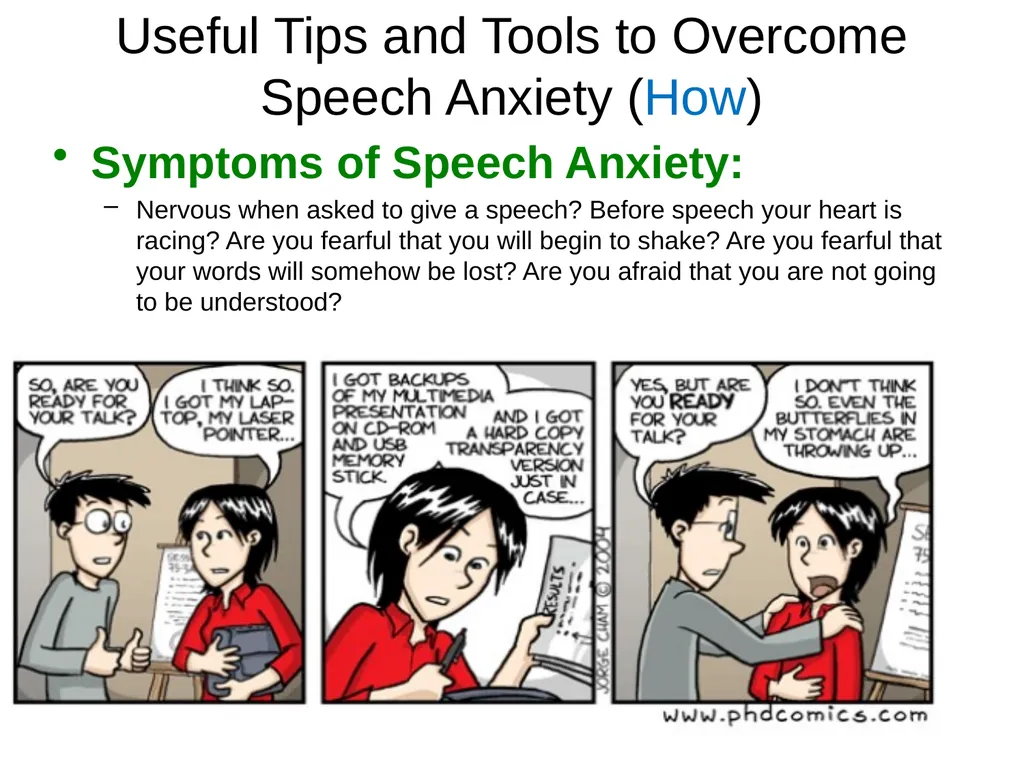
Useful Tips and Tools to Overcome Speech Anxiety (How) Symptoms of Speech Anxiety:
Nervous when asked to give a speech? Before speech your heart is racing? Are you fearful that you will begin to shake? Are you fearful that your words will somehow be lost? Are you afraid that you are not going to be understood?<br>
Nervous when asked to give a speech? Before speech your heart is racing? Are you fearful that you will begin to shake? Are you fearful that your words will somehow be lost? Are you afraid that you are not going to be understood?<br>
13
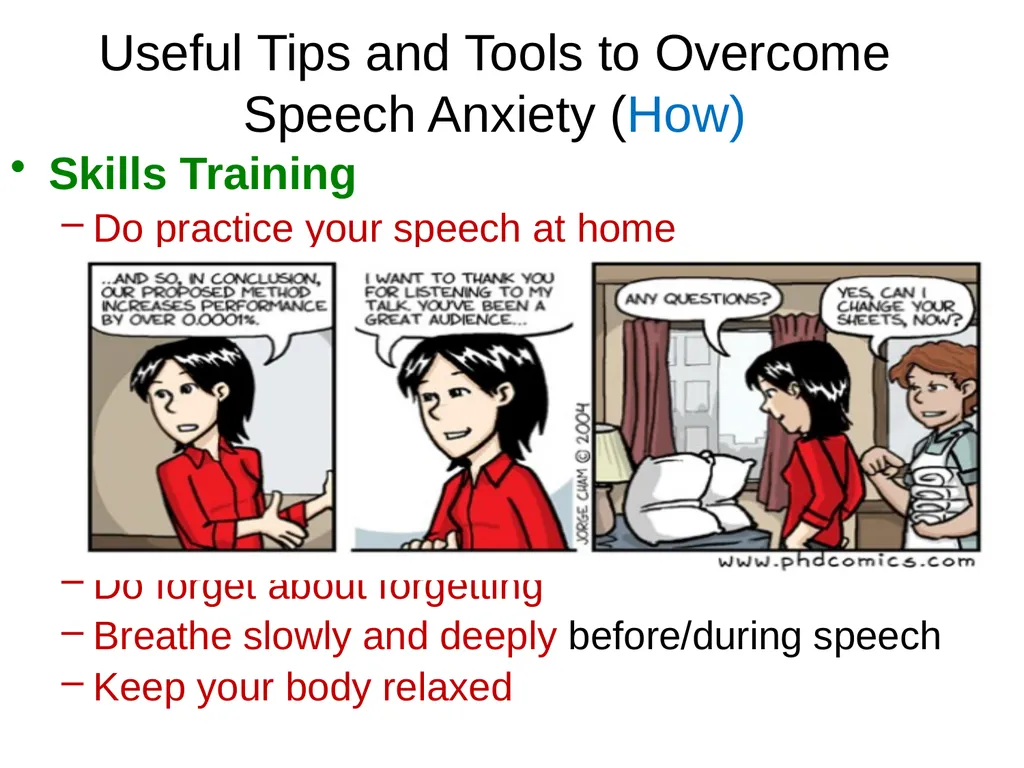
Useful Tips and Tools to Overcome Speech Anxiety (How) Skills Training
Do practice your speech at home
Do forget about forgetting
Breathe slowly and deeply before/during speech
Keep your body relaxed<br>
Do practice your speech at home
Do forget about forgetting
Breathe slowly and deeply before/during speech
Keep your body relaxed<br>
14
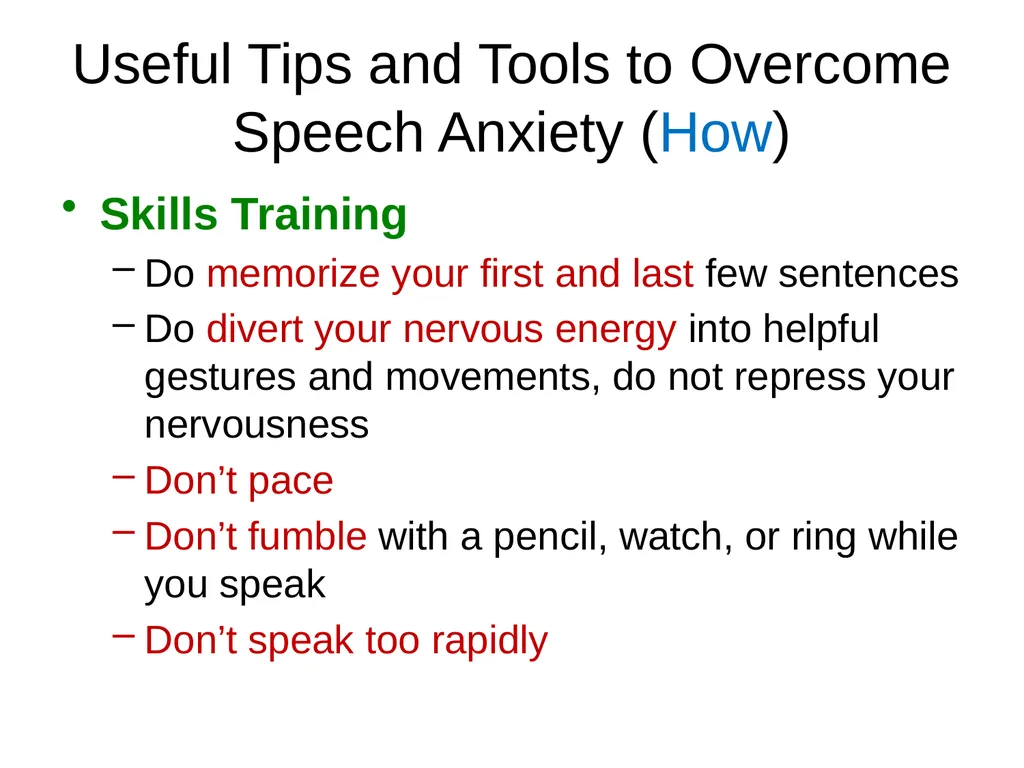
Useful Tips and Tools to Overcome Speech Anxiety (How) Skills Training
Do memorize your first and last few sentences
Do divert your nervous energy into helpful gestures and movements, do not repress your nervousness
Don’t pace
Don’t fumble with a pencil, watch, or ring while you speak
Don’t speak too rapidly<br>
Do memorize your first and last few sentences
Do divert your nervous energy into helpful gestures and movements, do not repress your nervousness
Don’t pace
Don’t fumble with a pencil, watch, or ring while you speak
Don’t speak too rapidly<br>
15
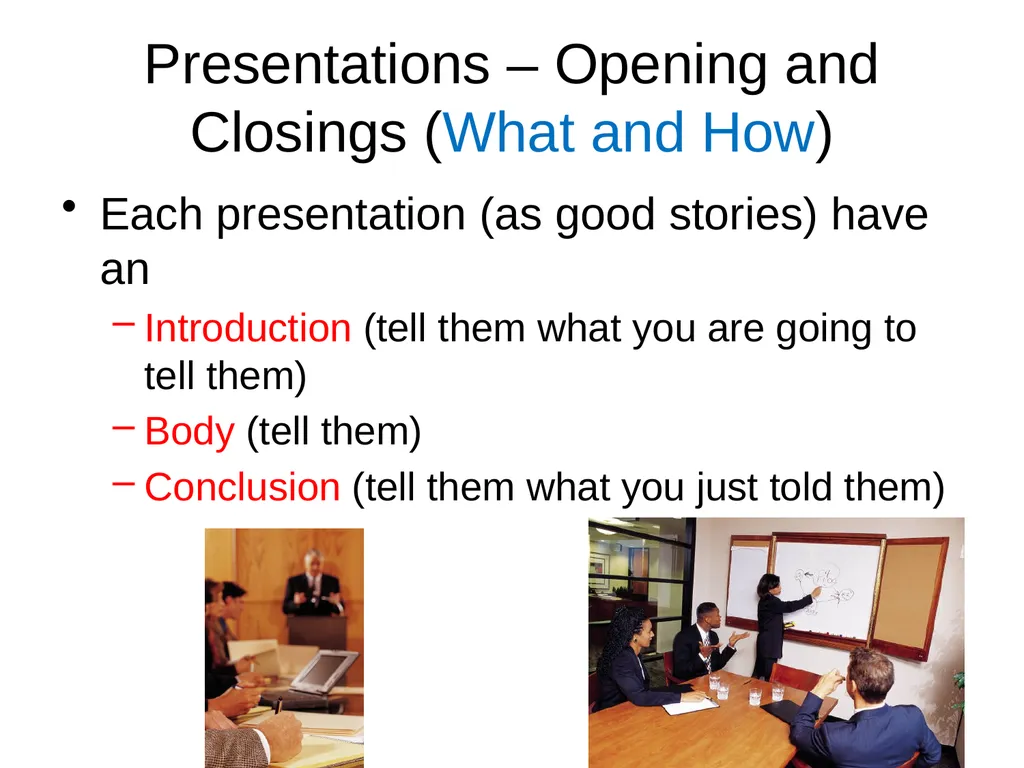
Presentations – Opening and Closings (What and How) Each presentation (as good stories) have an
Introduction (tell them what you are going to tell them)
Body (tell them)
Conclusion (tell them what you just told them)<br>
Introduction (tell them what you are going to tell them)
Body (tell them)
Conclusion (tell them what you just told them)<br>
16
Openings Purpose
Grab audience’s attention so that they will want to hear what you have to say
Should be a “grabber” or “attention seeker”
Not only arouse interest, but also suggest theme of speech
Openings can be dramatic, emotional, humorous or rhetorical
Opening does not have to have words, you can use gestures, demonstration, silence – related to the topic<br>
Grab audience’s attention so that they will want to hear what you have to say
Should be a “grabber” or “attention seeker”
Not only arouse interest, but also suggest theme of speech
Openings can be dramatic, emotional, humorous or rhetorical
Opening does not have to have words, you can use gestures, demonstration, silence – related to the topic<br>
17
Good Openings Startling question
Challenging statement
Appropriate short quotation or illustration
Surprising generalization
Exhibit – object, article, picture
Personal story<br>
Challenging statement
Appropriate short quotation or illustration
Surprising generalization
Exhibit – object, article, picture
Personal story<br>
18
Poor Openings Long or slow-moving quotation
Self introduction
Apologetic statement
Story, joke or anecdote which does not connect to the theme
Stale remark
Statement of your objective<br>
Self introduction
Apologetic statement
Story, joke or anecdote which does not connect to the theme
Stale remark
Statement of your objective<br>
19
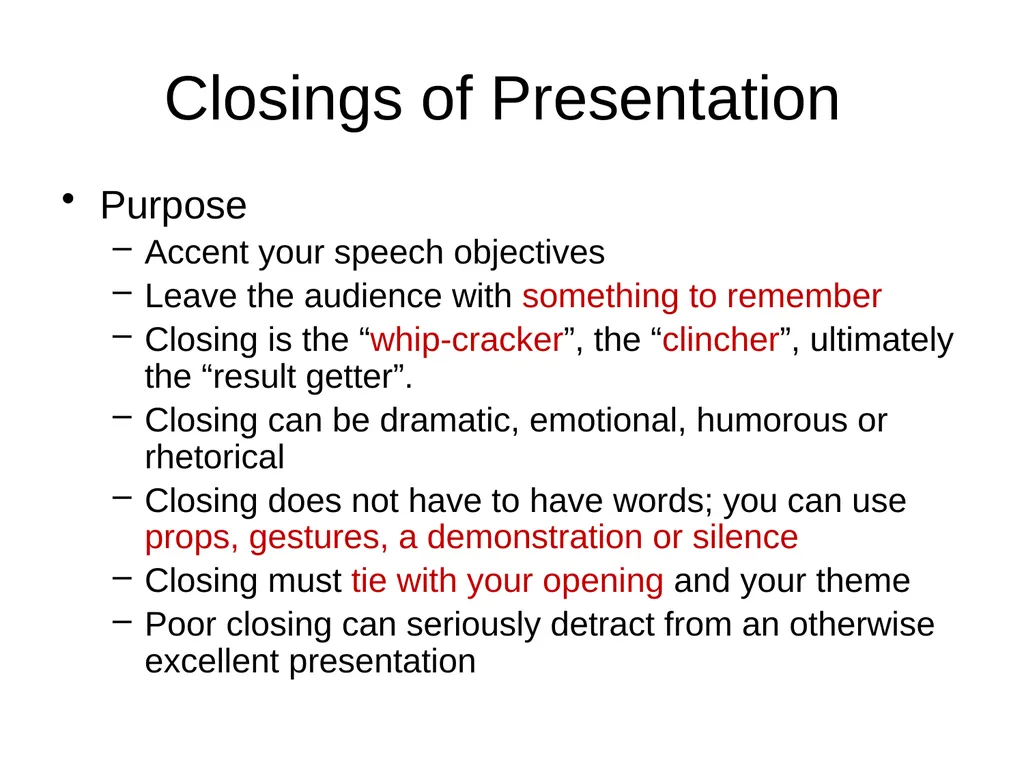
Closings of Presentation Purpose
Accent your speech objectives
Leave the audience with something to remember
Closing is the “whip-cracker”, the “clincher”, ultimately the “result getter”.
Closing can be dramatic, emotional, humorous or rhetorical
Closing does not have to have words; you can use props, gestures, a demonstration or silence
Closing must tie with your opening and your theme
Poor closing can seriously detract from an otherwise excellent presentation<br>
Accent your speech objectives
Leave the audience with something to remember
Closing is the “whip-cracker”, the “clincher”, ultimately the “result getter”.
Closing can be dramatic, emotional, humorous or rhetorical
Closing does not have to have words; you can use props, gestures, a demonstration or silence
Closing must tie with your opening and your theme
Poor closing can seriously detract from an otherwise excellent presentation<br>
20
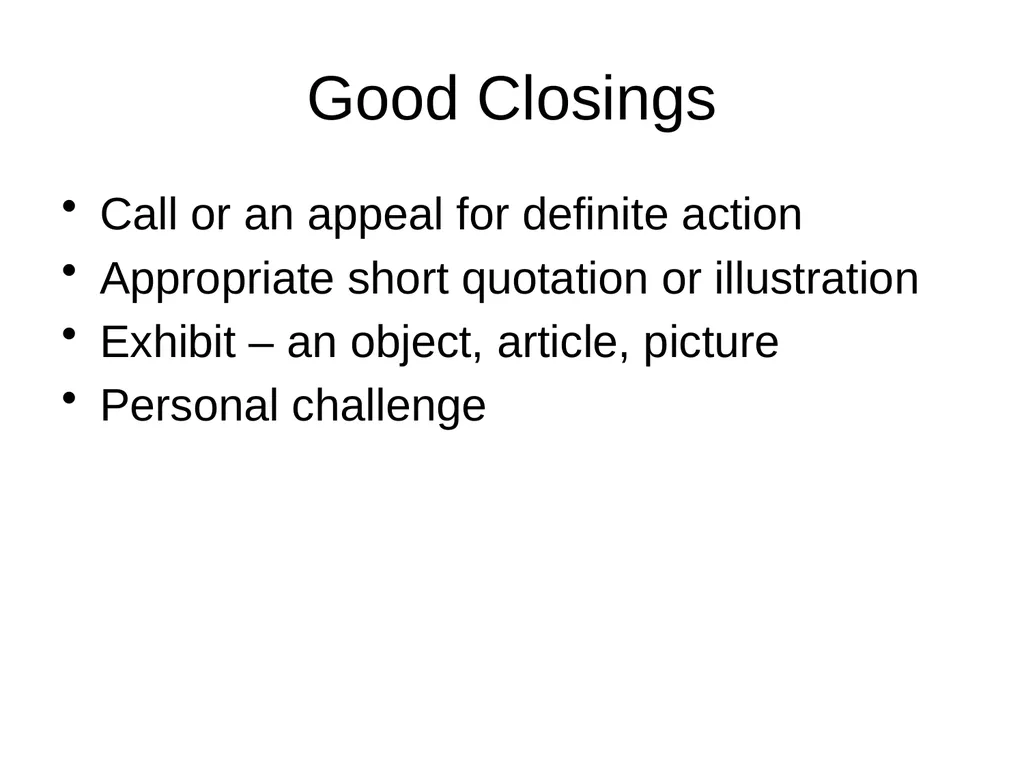
Good Closings Call or an appeal for definite action
Appropriate short quotation or illustration
Exhibit – an object, article, picture
Personal challenge<br>
Appropriate short quotation or illustration
Exhibit – an object, article, picture
Personal challenge<br>
21
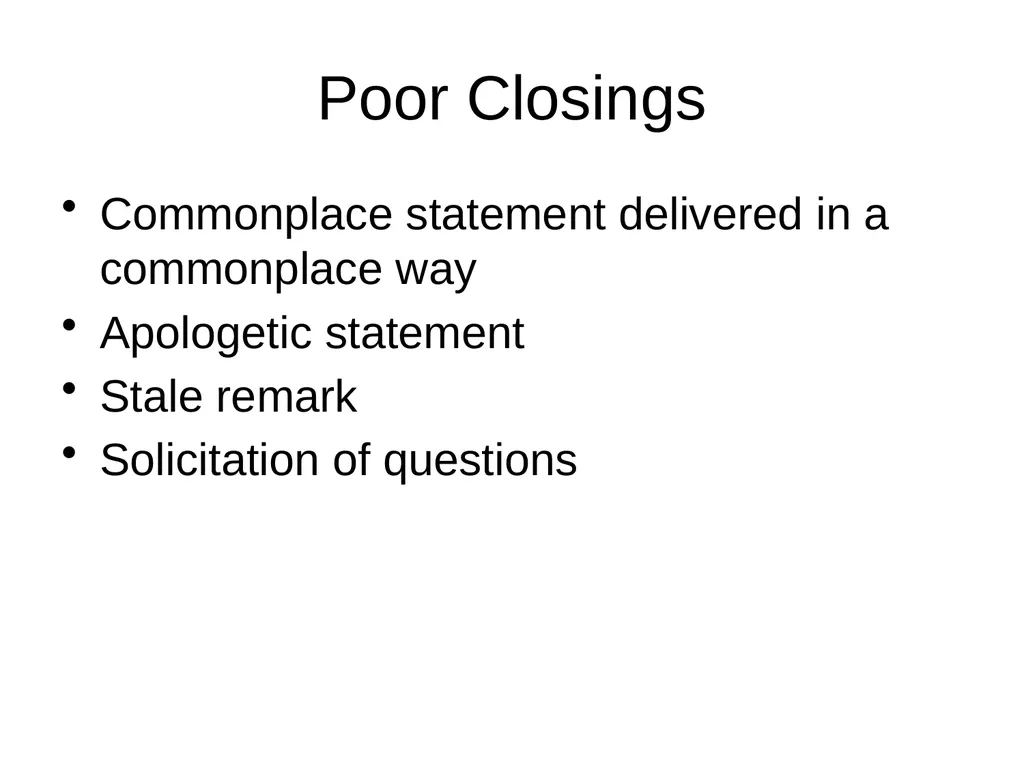
Poor Closings Commonplace statement delivered in a commonplace way
Apologetic statement
Stale remark
Solicitation of questions<br>
Apologetic statement
Stale remark
Solicitation of questions<br>
22
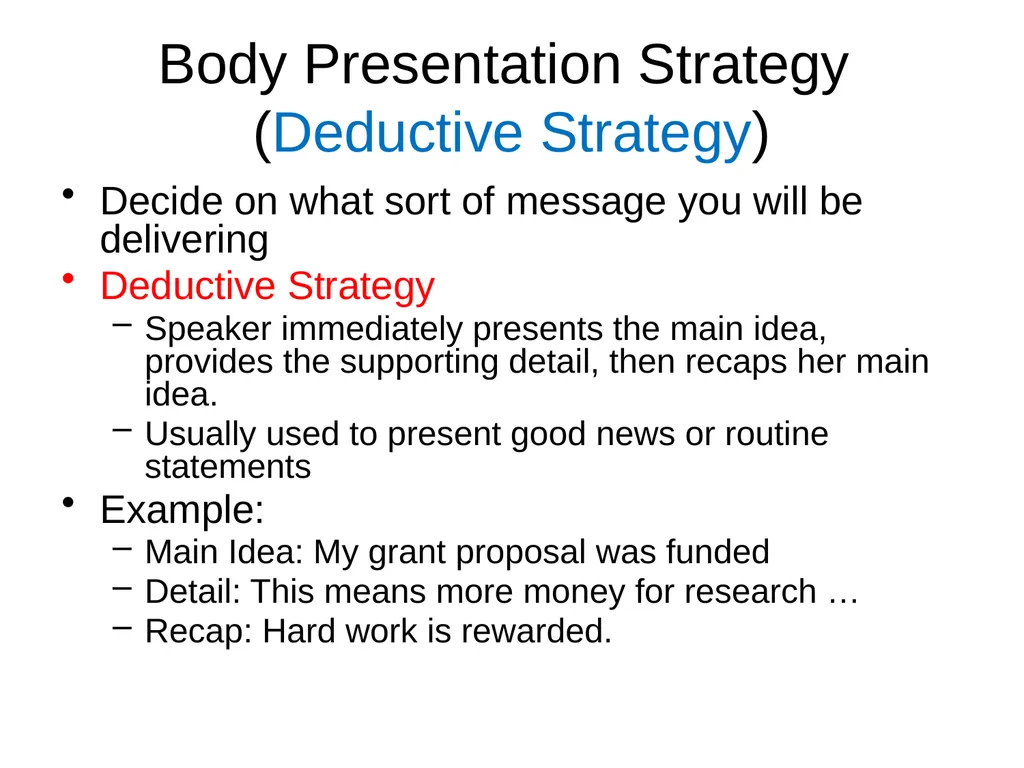
Body Presentation Strategy
(Deductive Strategy) Decide on what sort of message you will be delivering
Deductive Strategy
Speaker immediately presents the main idea, provides the supporting detail, then recaps her main idea.
Usually used to present good news or routine statements
Example:
Main Idea: My grant proposal was funded
Detail: This means more money for research …
Recap: Hard work is rewarded.<br>
Deductive Strategy
Speaker immediately presents the main idea, provides the supporting detail, then recaps her main idea.
Usually used to present good news or routine statements
Example:
Main Idea: My grant proposal was funded
Detail: This means more money for research …
Recap: Hard work is rewarded.<br>
23
Body Presentation Strategy
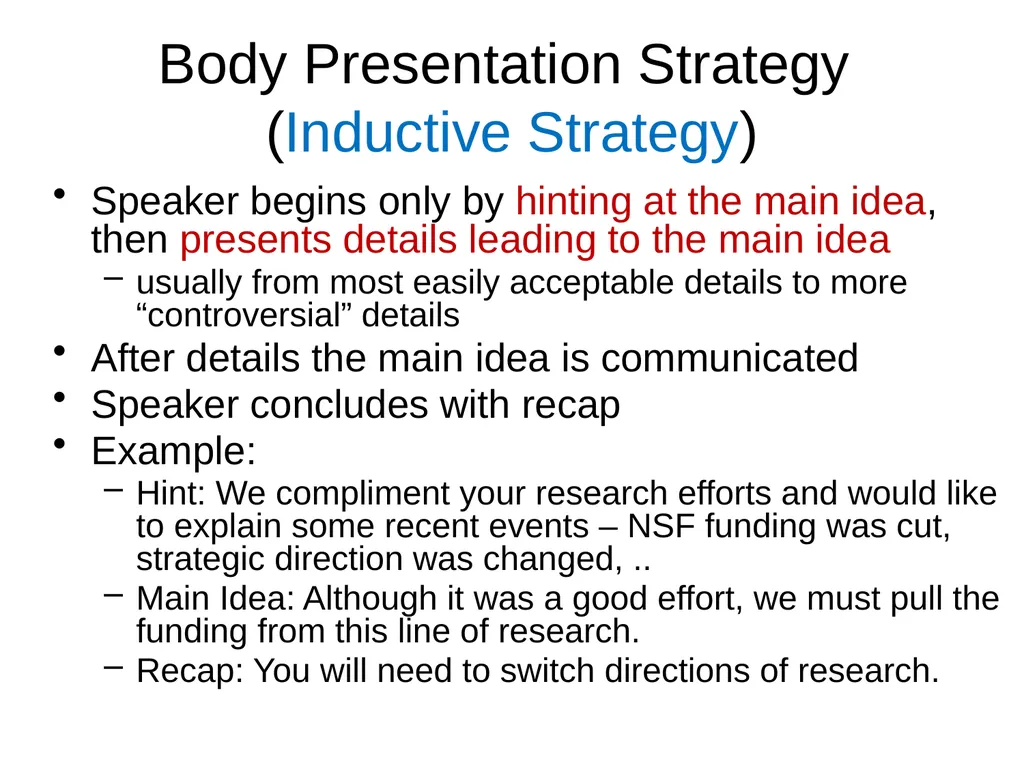
(Inductive Strategy) Speaker begins only by hinting at the main idea, then presents details leading to the main idea
usually from most easily acceptable details to more “controversial” details
After details the main idea is communicated
Speaker concludes with recap
Example:
Hint: We compliment your research efforts and would like to explain some recent events – NSF funding was cut, strategic direction was changed, ..
Main Idea: Although it was a good effort, we must pull the funding from this line of research.
Recap: You will need to switch directions of research.<br>
usually from most easily acceptable details to more “controversial” details
After details the main idea is communicated
Speaker concludes with recap
Example:
Hint: We compliment your research efforts and would like to explain some recent events – NSF funding was cut, strategic direction was changed, ..
Main Idea: Although it was a good effort, we must pull the funding from this line of research.
Recap: You will need to switch directions of research.<br>
24
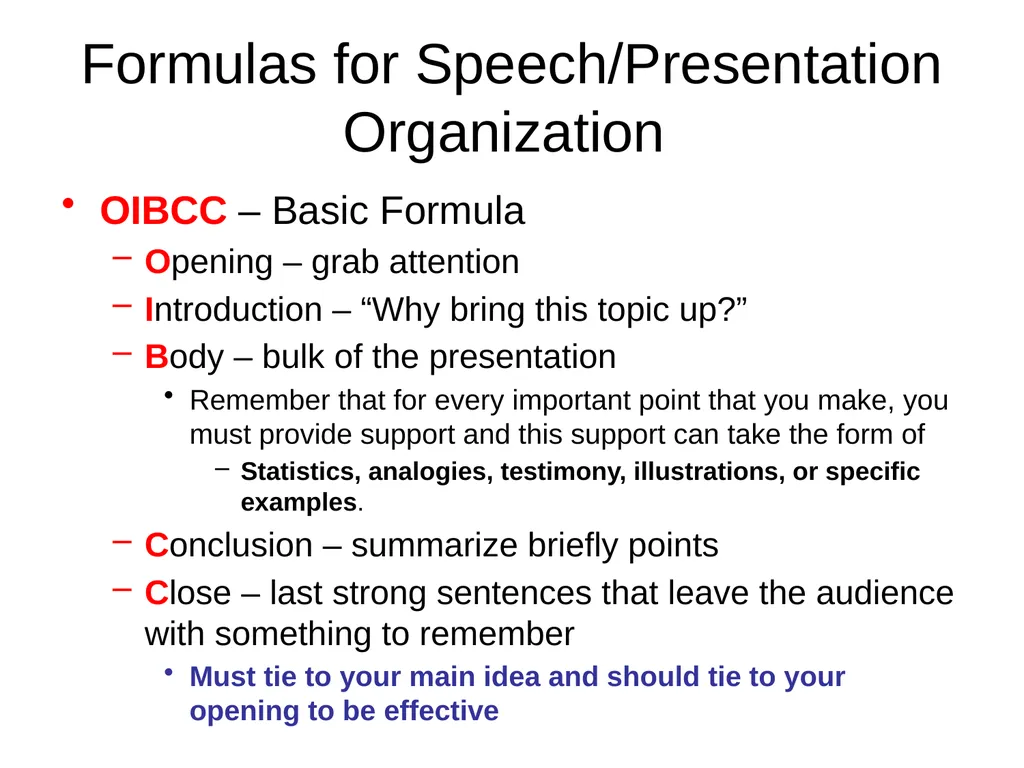
Formulas for Speech/Presentation Organization OIBCC – Basic Formula
Opening – grab attention
Introduction – “Why bring this topic up?”
Body – bulk of the presentation
Remember that for every important point that you make, you must provide support and this support can take the form of
Statistics, analogies, testimony, illustrations, or specific examples.
Conclusion – summarize briefly points
Close – last strong sentences that leave the audience with something to remember
Must tie to your main idea and should tie to your opening to be effective<br>
Opening – grab attention
Introduction – “Why bring this topic up?”
Body – bulk of the presentation
Remember that for every important point that you make, you must provide support and this support can take the form of
Statistics, analogies, testimony, illustrations, or specific examples.
Conclusion – summarize briefly points
Close – last strong sentences that leave the audience with something to remember
Must tie to your main idea and should tie to your opening to be effective<br>
25
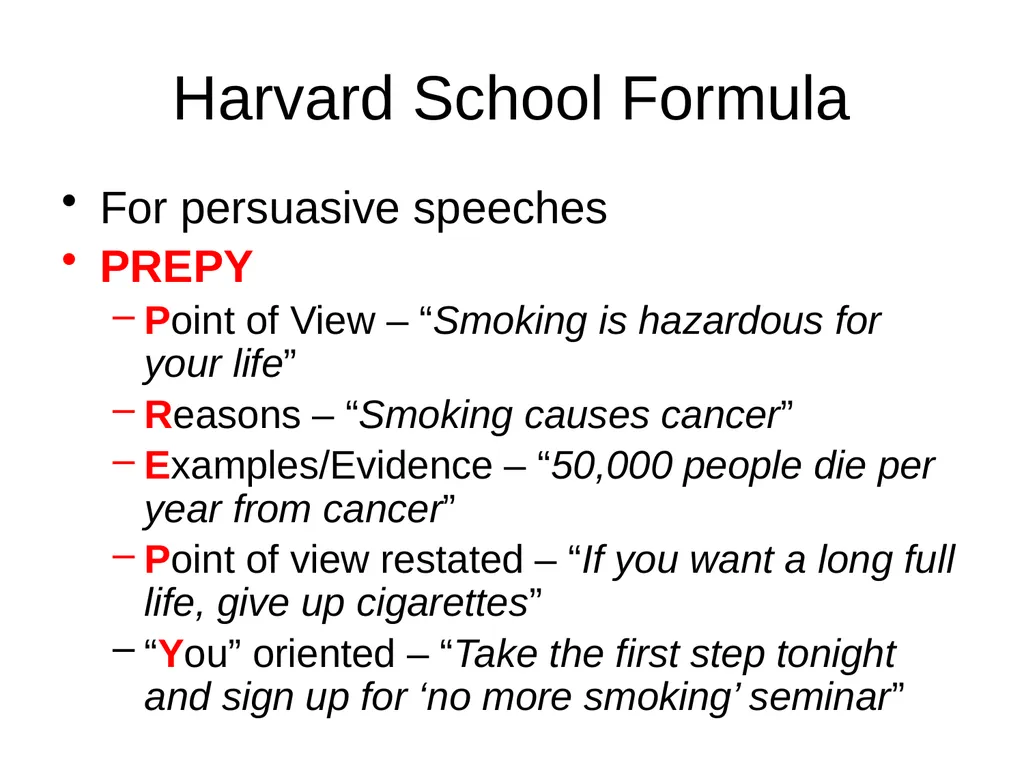
Harvard School Formula For persuasive speeches
PREPY
Point of View – “Smoking is hazardous for your life”
Reasons – “Smoking causes cancer”
Examples/Evidence – “50,000 people die per year from cancer”
Point of view restated – “If you want a long full life, give up cigarettes”
“You” oriented – “Take the first step tonight and sign up for ‘no more smoking’ seminar”<br>
PREPY
Point of View – “Smoking is hazardous for your life”
Reasons – “Smoking causes cancer”
Examples/Evidence – “50,000 people die per year from cancer”
Point of view restated – “If you want a long full life, give up cigarettes”
“You” oriented – “Take the first step tonight and sign up for ‘no more smoking’ seminar”<br>
26
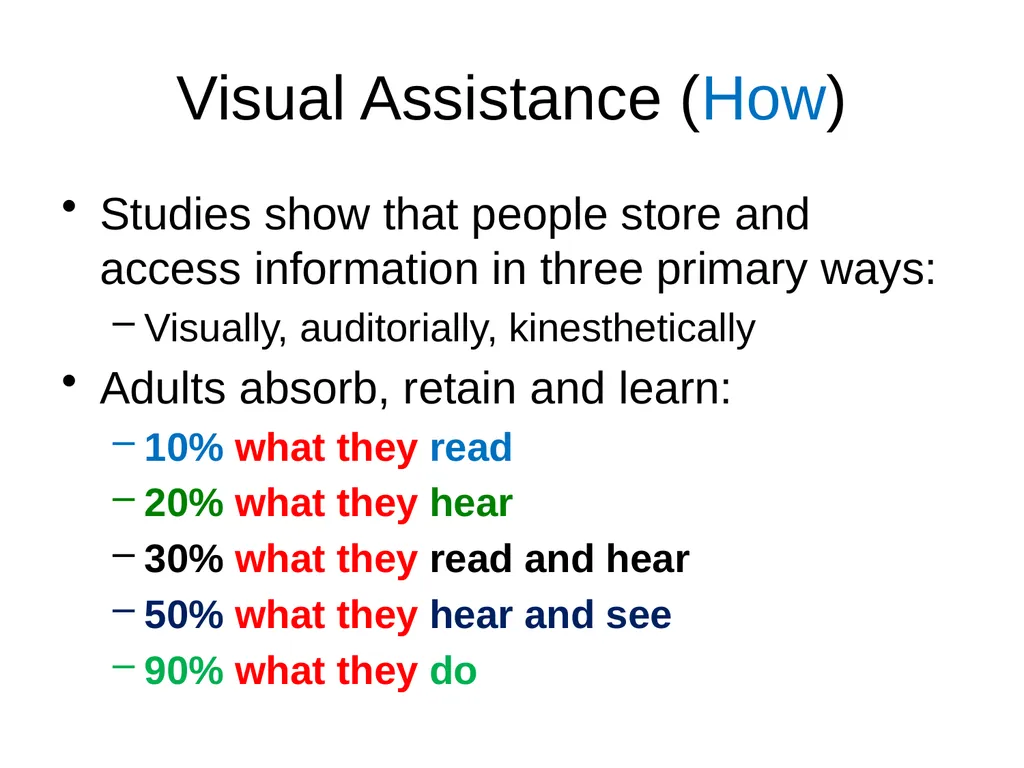
Visual Assistance (How) Studies show that people store and access information in three primary ways:
Visually, auditorially, kinesthetically
Adults absorb, retain and learn:
10% what they read
20% what they hear
30% what they read and hear
50% what they hear and see
90% what they do<br>
Visually, auditorially, kinesthetically
Adults absorb, retain and learn:
10% what they read
20% what they hear
30% what they read and hear
50% what they hear and see
90% what they do<br>
27
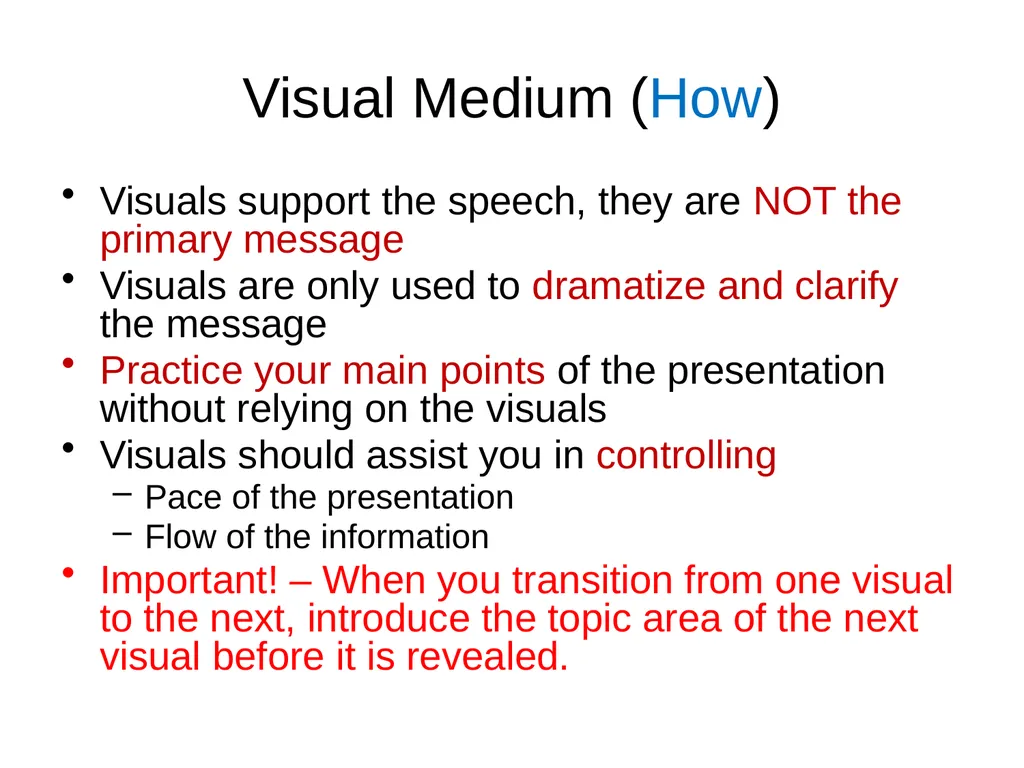
Visual Medium (How) Visuals support the speech, they are NOT the primary message
Visuals are only used to dramatize and clarify the message
Practice your main points of the presentation without relying on the visuals
Visuals should assist you in controlling
Pace of the presentation
Flow of the information
Important! – When you transition from one visual to the next, introduce the topic area of the next visual before it is revealed.<br>
Visuals are only used to dramatize and clarify the message
Practice your main points of the presentation without relying on the visuals
Visuals should assist you in controlling
Pace of the presentation
Flow of the information
Important! – When you transition from one visual to the next, introduce the topic area of the next visual before it is revealed.<br>
28
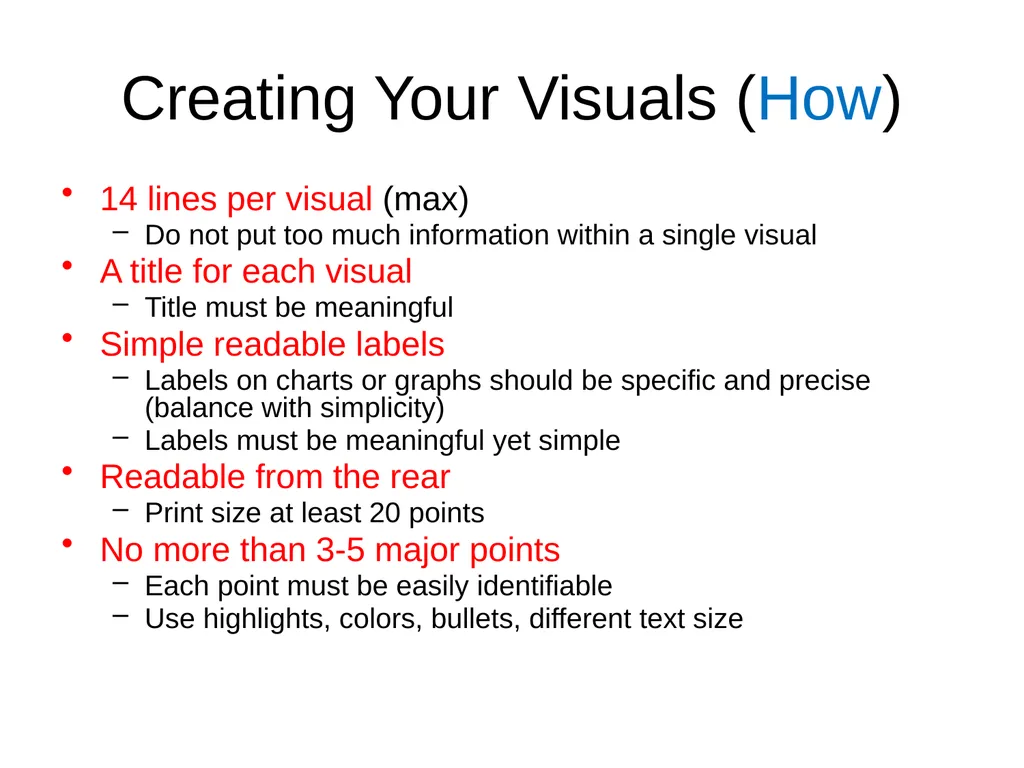
Creating Your Visuals (How) 14 lines per visual (max)
Do not put too much information within a single visual
A title for each visual
Title must be meaningful
Simple readable labels
Labels on charts or graphs should be specific and precise (balance with simplicity)
Labels must be meaningful yet simple
Readable from the rear
Print size at least 20 points
No more than 3-5 major points
Each point must be easily identifiable
Use highlights, colors, bullets, different text size<br>
Do not put too much information within a single visual
A title for each visual
Title must be meaningful
Simple readable labels
Labels on charts or graphs should be specific and precise (balance with simplicity)
Labels must be meaningful yet simple
Readable from the rear
Print size at least 20 points
No more than 3-5 major points
Each point must be easily identifiable
Use highlights, colors, bullets, different text size<br>
29
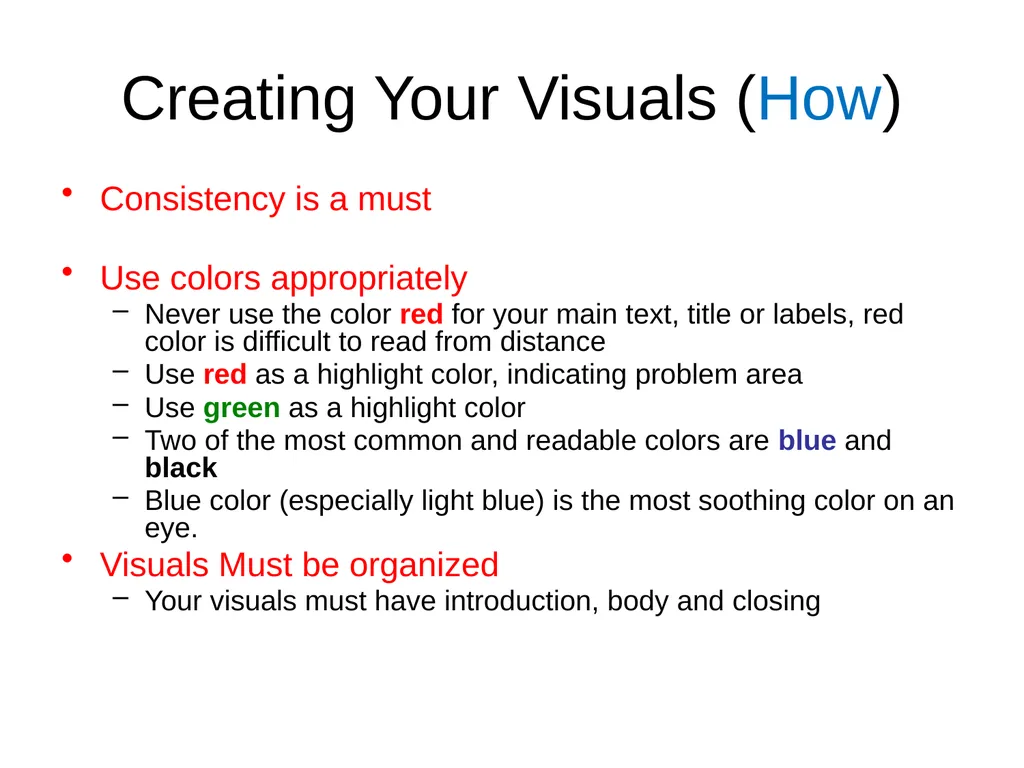
Creating Your Visuals (How) Consistency is a must
Use colors appropriately
Never use the color red for your main text, title or labels, red color is difficult to read from distance
Use red as a highlight color, indicating problem area
Use green as a highlight color
Two of the most common and readable colors are blue and black
Blue color (especially light blue) is the most soothing color on an eye.
Visuals Must be organized
Your visuals must have introduction, body and closing<br>
Use colors appropriately
Never use the color red for your main text, title or labels, red color is difficult to read from distance
Use red as a highlight color, indicating problem area
Use green as a highlight color
Two of the most common and readable colors are blue and black
Blue color (especially light blue) is the most soothing color on an eye.
Visuals Must be organized
Your visuals must have introduction, body and closing<br>
30
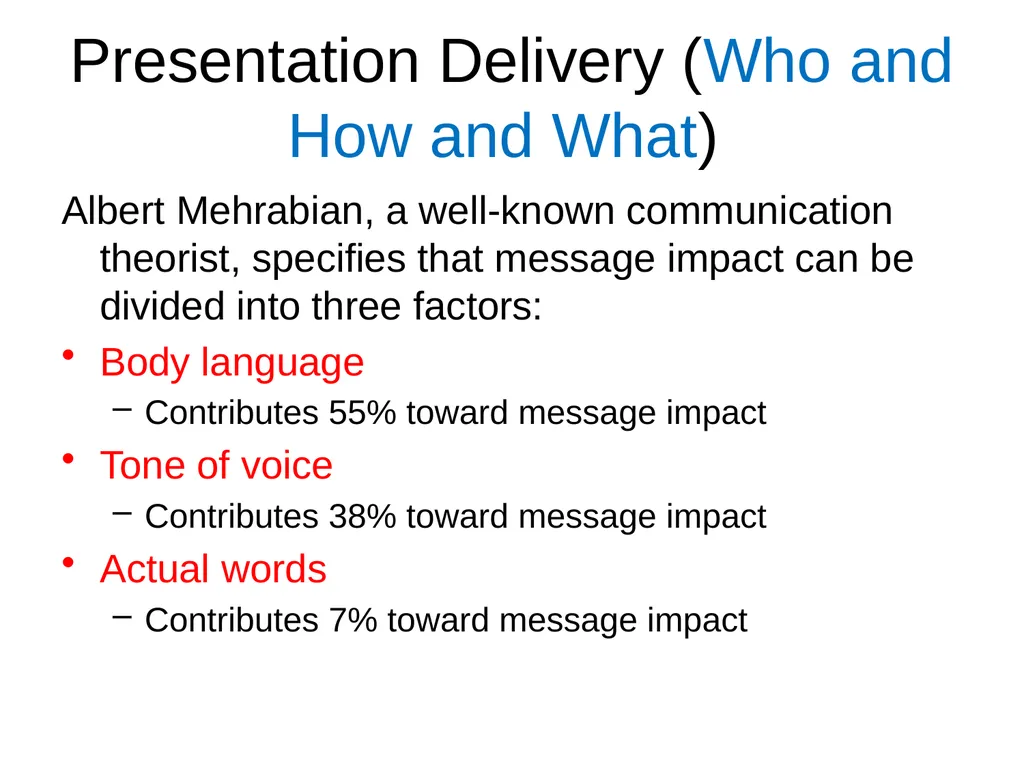
Presentation Delivery (Who and How and What) Albert Mehrabian, a well-known communication theorist, specifies that message impact can be divided into three factors:
Body language
Contributes 55% toward message impact
Tone of voice
Contributes 38% toward message impact
Actual words
Contributes 7% toward message impact<br>
Body language
Contributes 55% toward message impact
Tone of voice
Contributes 38% toward message impact
Actual words
Contributes 7% toward message impact<br>
31
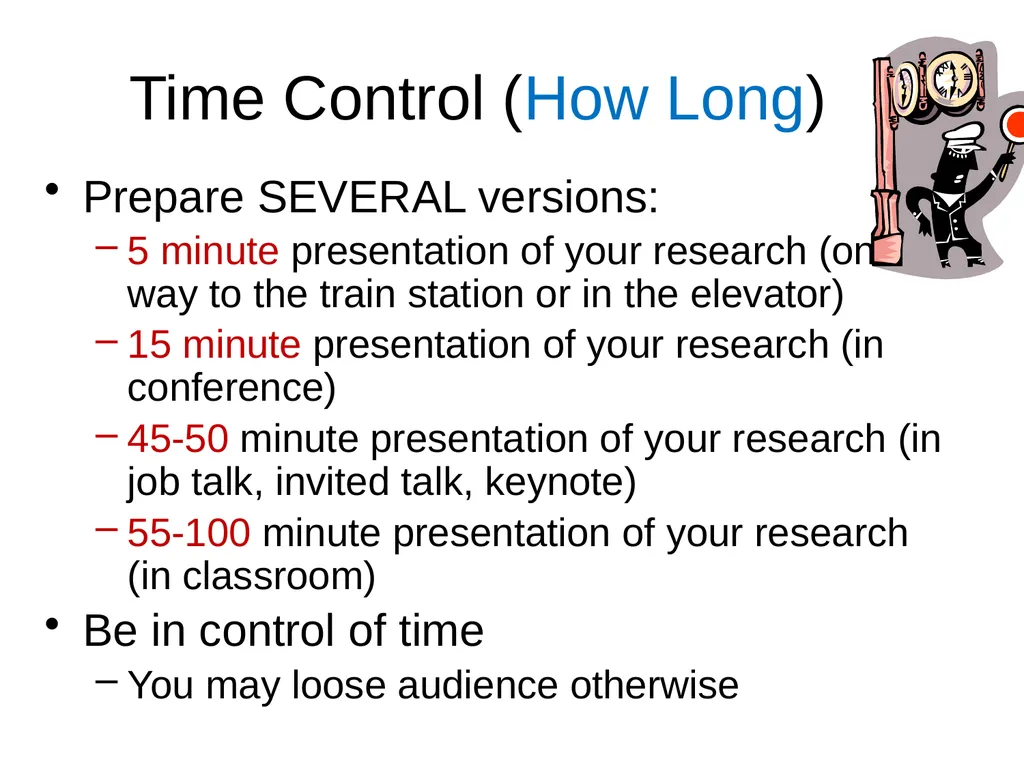
Time Control (How Long) Prepare SEVERAL versions:
5 minute presentation of your research (on the way to the train station or in the elevator)
15 minute presentation of your research (in conference)
45-50 minute presentation of your research (in job talk, invited talk, keynote)
55-100 minute presentation of your research (in classroom)
Be in control of time
You may loose audience otherwise<br>
5 minute presentation of your research (on the way to the train station or in the elevator)
15 minute presentation of your research (in conference)
45-50 minute presentation of your research (in job talk, invited talk, keynote)
55-100 minute presentation of your research (in classroom)
Be in control of time
You may loose audience otherwise<br>
32
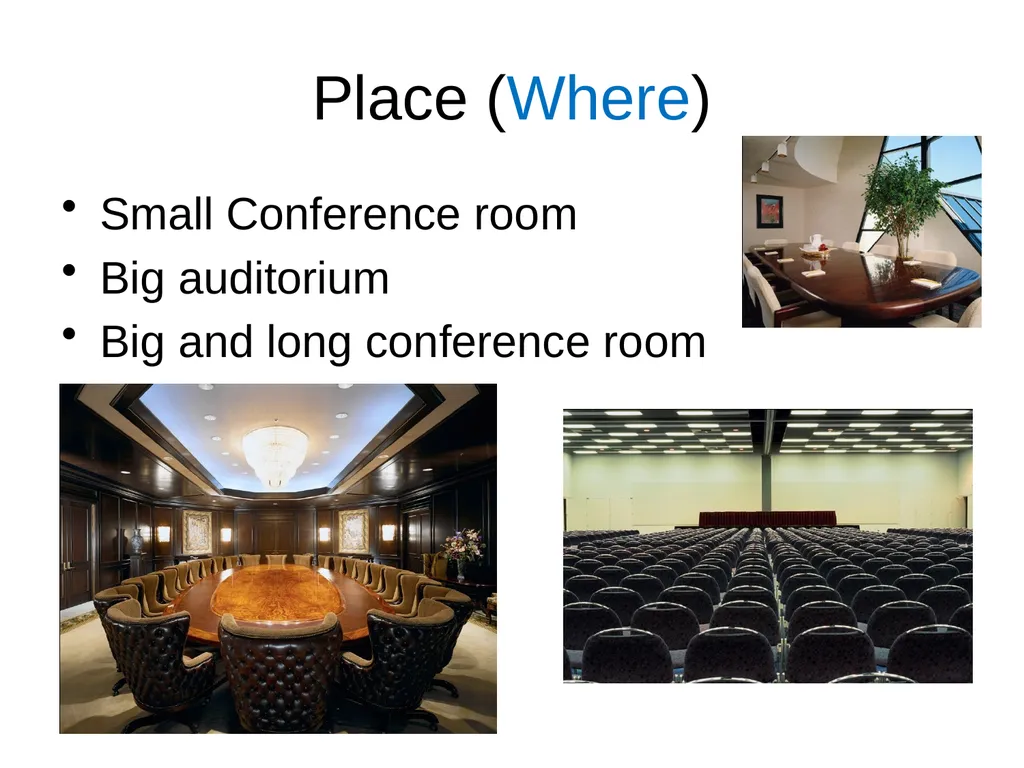
Place (Where) Small Conference room
Big auditorium
Big and long conference room<br>
Big auditorium
Big and long conference room<br>
33
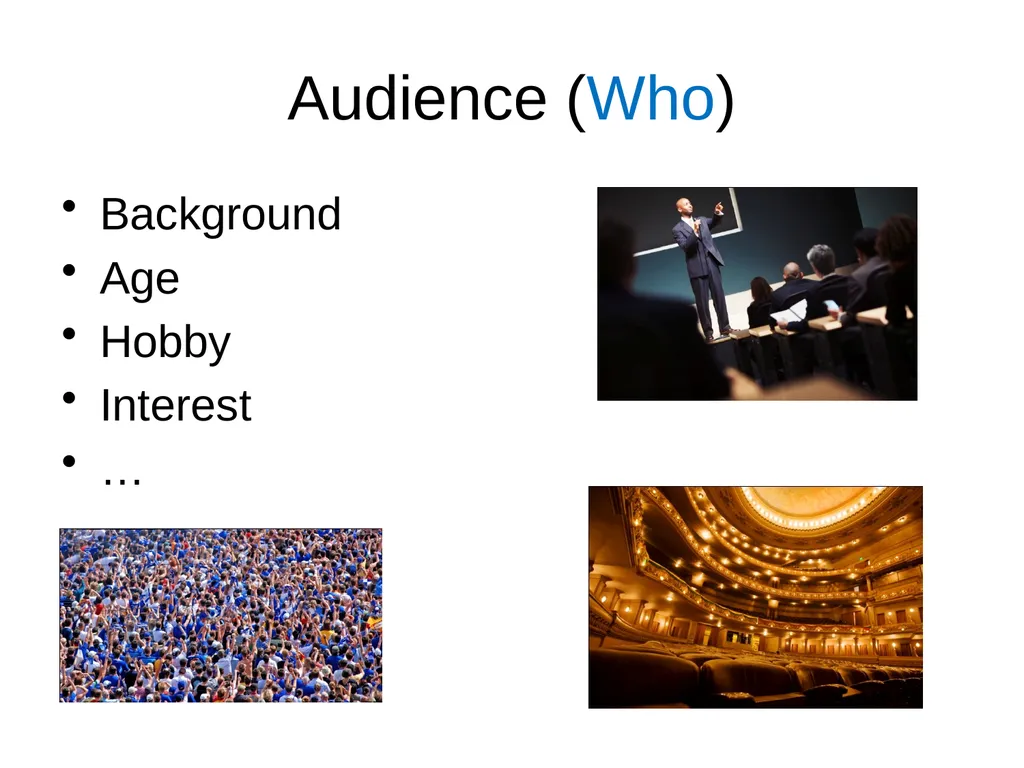
Audience (Who) Background
Age
Hobby
Interest
…<br>
Age
Hobby
Interest
…<br>
34
Summary Pay attention to oral communication in every technical communication !!!
Giving Presentations is not the only oral communication : Asking good questions is also oral and memorable communication
Be sincere, interested, enthusiastic, warm and friendly – be yourself!!!
Ultimate Goal: Be effective Communicator in every Situation
Other Questions connected to Oral Communication
What if people walk out in the middle of my talk?
What if I don’t know the answer to questions?
What if I make a mistake during presentation?
What if I forgot a detail in my presentation?
…..<br>
Giving Presentations is not the only oral communication : Asking good questions is also oral and memorable communication
Be sincere, interested, enthusiastic, warm and friendly – be yourself!!!
Ultimate Goal: Be effective Communicator in every Situation
Other Questions connected to Oral Communication
What if people walk out in the middle of my talk?
What if I don’t know the answer to questions?
What if I make a mistake during presentation?
What if I forgot a detail in my presentation?
…..<br>
35
References/Acknowledgments Toastmaster club
http://www.toastmasters-public-speaking.com/toastmaster-club.html
Source for the Presented Material: “Creative Communication by LBM”, Company in NJ<br>
http://www.toastmasters-public-speaking.com/toastmaster-club.html
Source for the Presented Material: “Creative Communication by LBM”, Company in NJ<br>