
Excerpt from Interconnection Networks Computer
LS
Published · 30 slides · 0 views
1 / 1
Description
Excerpt from Interconnection Networks Computer Architecture: A Quantitative Approach 4th Edition, Appendix E Timothy Mark Pinkston University of Southern California http:ceng.usc.edusmartslidesappendixE.html José Duato Universidad
Related Topics
Share
Embed code
Download this presentation From Below
"Excerpt from Interconnection Networks Computer" is the property of its rightful owner. Permission is granted to download and print the materials on this website for personal, non-commercial use only, and to display it on your personal computer provided you do not modify the materials and that you retain all copyright notices contained in the materials. By downloading content from our website, you accept the terms of this agreement.
Presentation Transcript
01
Excerpt from
Interconnection Networks
Computer Architecture: A Quantitative Approach
4th Edition, Appendix E Timothy Mark Pinkston
University of Southern California
http://ceng.usc.edu/smart/slides/appendixE.html
José Duato
Universidad Politécnica de Valencia
http://www.gap.upv.es/slides/appendixE.html …with major presentation contribution from José Flich, UPV
(and Cell BE EIB slides by Tom Ainsworth, USC)<br>
University of Southern California
http://ceng.usc.edu/smart/slides/appendixE.html
José Duato
Universidad Politécnica de Valencia
http://www.gap.upv.es/slides/appendixE.html …with major presentation contribution from José Flich, UPV
(and Cell BE EIB slides by Tom Ainsworth, USC)<br>
02
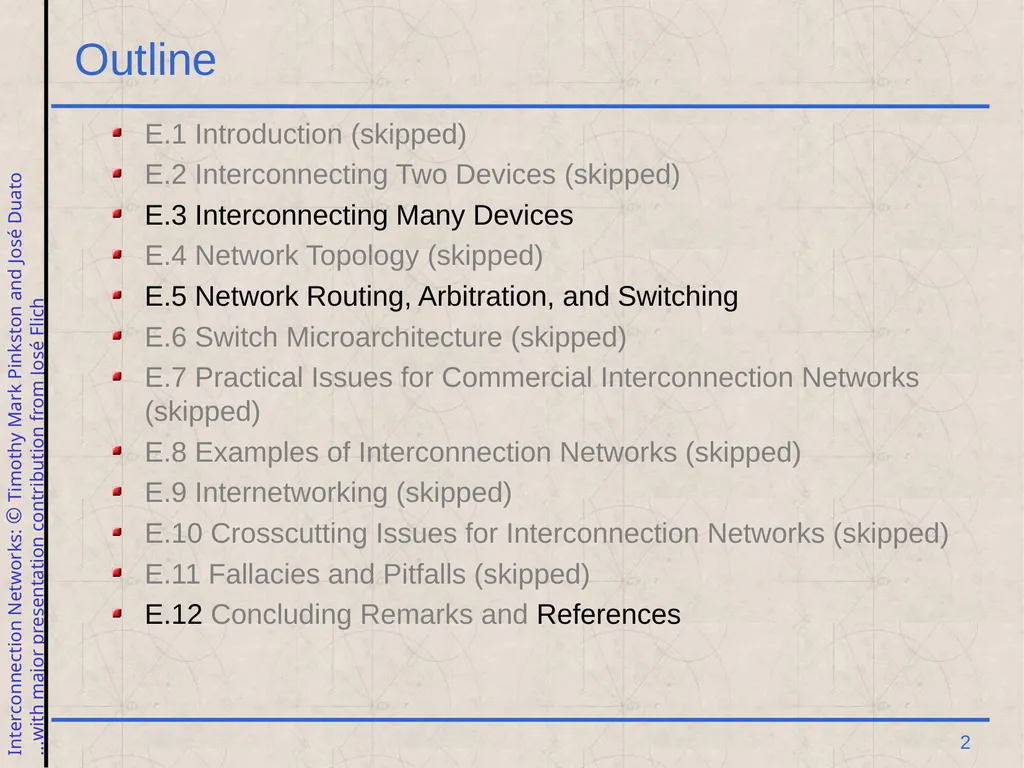
2 Outline E.1 Introduction (skipped)
E.2 Interconnecting Two Devices (skipped)
E.3 Interconnecting Many Devices
E.4 Network Topology (skipped)
E.5 Network Routing, Arbitration, and Switching
E.6 Switch Microarchitecture (skipped)
E.7 Practical Issues for Commercial Interconnection Networks (skipped)
E.8 Examples of Interconnection Networks (skipped)
E.9 Internetworking (skipped)
E.10 Crosscutting Issues for Interconnection Networks (skipped)
E.11 Fallacies and Pitfalls (skipped)
E.12 Concluding Remarks and References<br>
E.2 Interconnecting Two Devices (skipped)
E.3 Interconnecting Many Devices
E.4 Network Topology (skipped)
E.5 Network Routing, Arbitration, and Switching
E.6 Switch Microarchitecture (skipped)
E.7 Practical Issues for Commercial Interconnection Networks (skipped)
E.8 Examples of Interconnection Networks (skipped)
E.9 Internetworking (skipped)
E.10 Crosscutting Issues for Interconnection Networks (skipped)
E.11 Fallacies and Pitfalls (skipped)
E.12 Concluding Remarks and References<br>
03
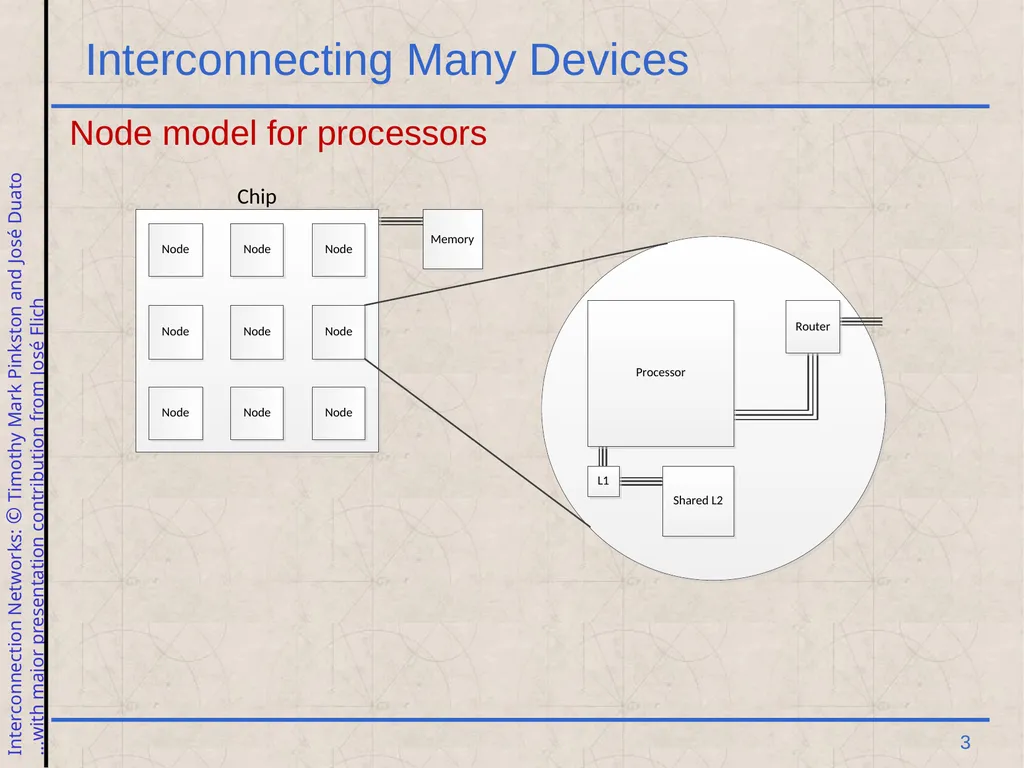
Interconnecting Many Devices 3 Node model for processors<br>
04
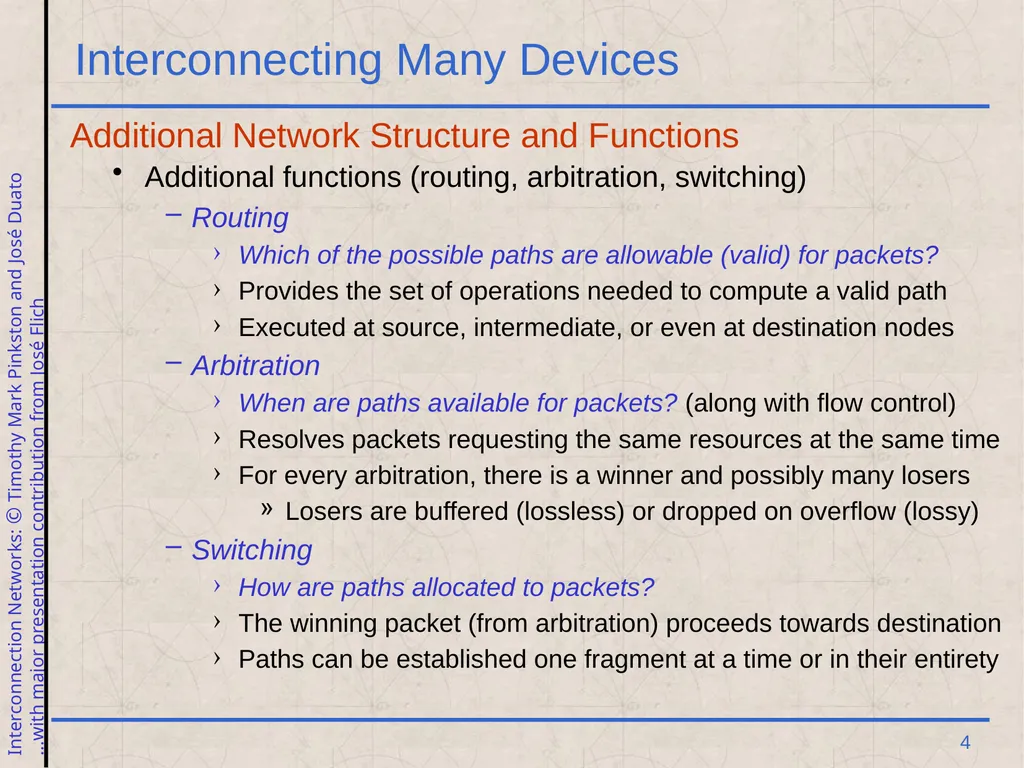
4 Interconnecting Many Devices Additional Network Structure and Functions
Additional functions (routing, arbitration, switching)
Routing
Which of the possible paths are allowable (valid) for packets?
Provides the set of operations needed to compute a valid path
Executed at source, intermediate, or even at destination nodes
Arbitration
When are paths available for packets? (along with flow control)
Resolves packets requesting the same resources at the same time
For every arbitration, there is a winner and possibly many losers
Losers are buffered (lossless) or dropped on overflow (lossy)
Switching
How are paths allocated to packets?
The winning packet (from arbitration) proceeds towards destination
Paths can be established one fragment at a time or in their entirety<br>
Additional functions (routing, arbitration, switching)
Routing
Which of the possible paths are allowable (valid) for packets?
Provides the set of operations needed to compute a valid path
Executed at source, intermediate, or even at destination nodes
Arbitration
When are paths available for packets? (along with flow control)
Resolves packets requesting the same resources at the same time
For every arbitration, there is a winner and possibly many losers
Losers are buffered (lossless) or dropped on overflow (lossy)
Switching
How are paths allocated to packets?
The winning packet (from arbitration) proceeds towards destination
Paths can be established one fragment at a time or in their entirety<br>
05
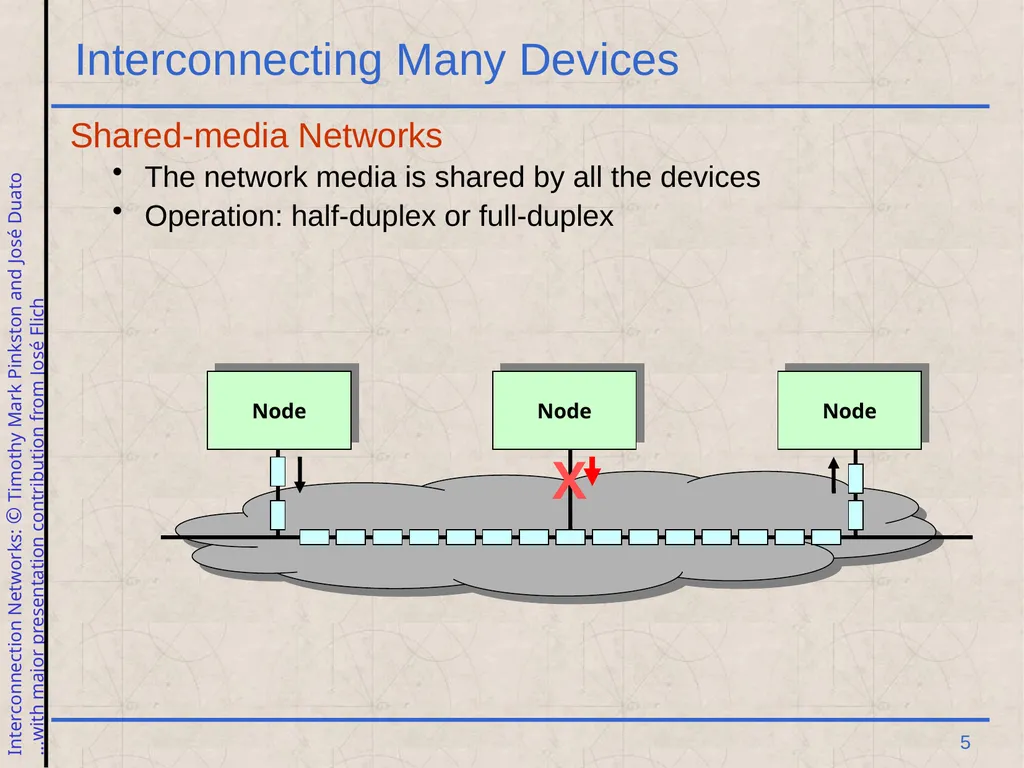
5 Interconnecting Many Devices Shared-media Networks
The network media is shared by all the devices
Operation: half-duplex or full-duplex Node Node Node<br>
The network media is shared by all the devices
Operation: half-duplex or full-duplex Node Node Node<br>
06
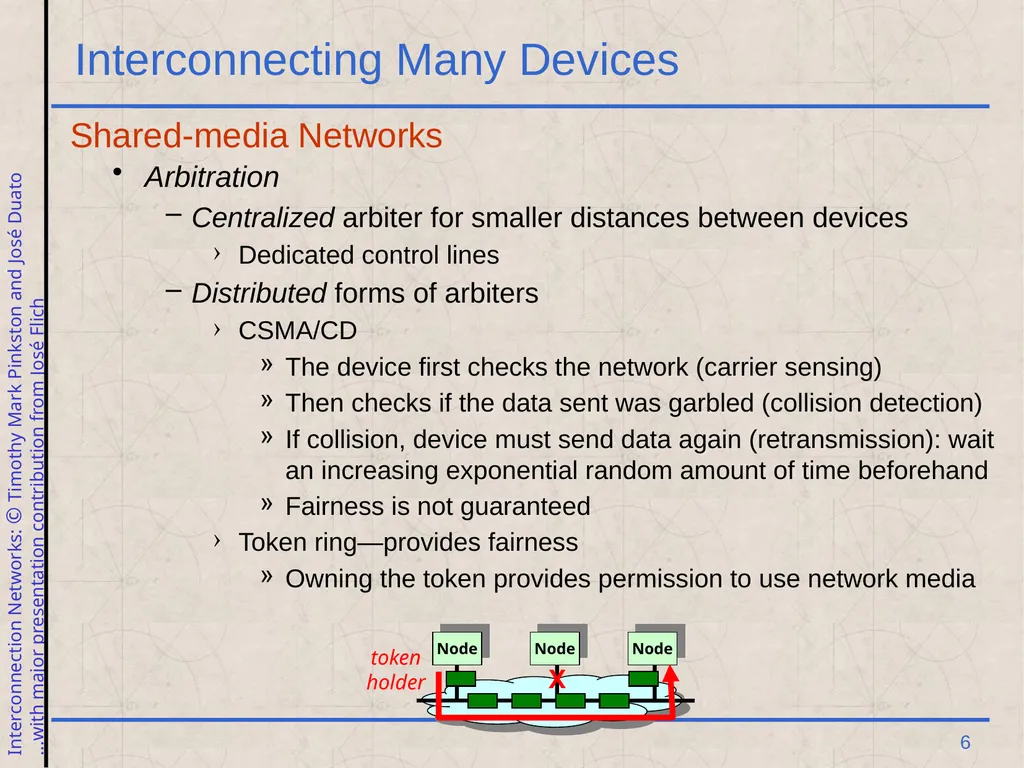
6 Interconnecting Many Devices Shared-media Networks
Arbitration
Centralized arbiter for smaller distances between devices
Dedicated control lines
Distributed forms of arbiters
CSMA/CD
The device first checks the network (carrier sensing)
Then checks if the data sent was garbled (collision detection)
If collision, device must send data again (retransmission): wait an increasing exponential random amount of time beforehand
Fairness is not guaranteed
Token ring—provides fairness
Owning the token provides permission to use network media token
holder X<br>
Arbitration
Centralized arbiter for smaller distances between devices
Dedicated control lines
Distributed forms of arbiters
CSMA/CD
The device first checks the network (carrier sensing)
Then checks if the data sent was garbled (collision detection)
If collision, device must send data again (retransmission): wait an increasing exponential random amount of time beforehand
Fairness is not guaranteed
Token ring—provides fairness
Owning the token provides permission to use network media token
holder X<br>
07
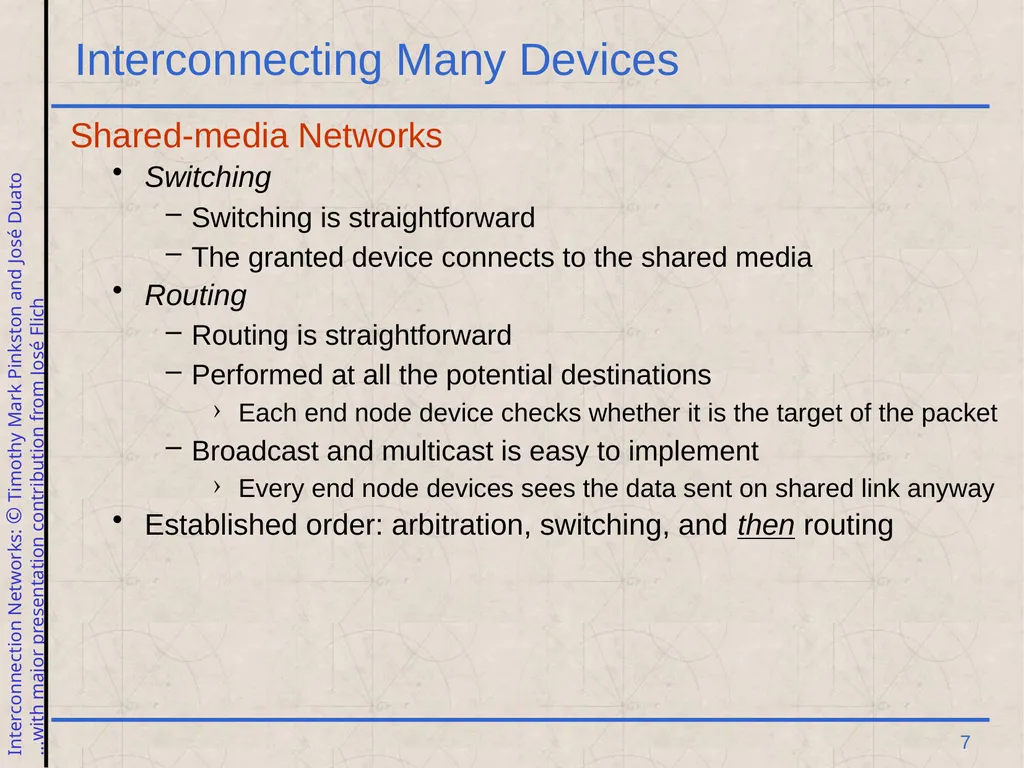
7 Interconnecting Many Devices Shared-media Networks
Switching
Switching is straightforward
The granted device connects to the shared media
Routing
Routing is straightforward
Performed at all the potential destinations
Each end node device checks whether it is the target of the packet
Broadcast and multicast is easy to implement
Every end node devices sees the data sent on shared link anyway
Established order: arbitration, switching, and then routing<br>
Switching
Switching is straightforward
The granted device connects to the shared media
Routing
Routing is straightforward
Performed at all the potential destinations
Each end node device checks whether it is the target of the packet
Broadcast and multicast is easy to implement
Every end node devices sees the data sent on shared link anyway
Established order: arbitration, switching, and then routing<br>
08
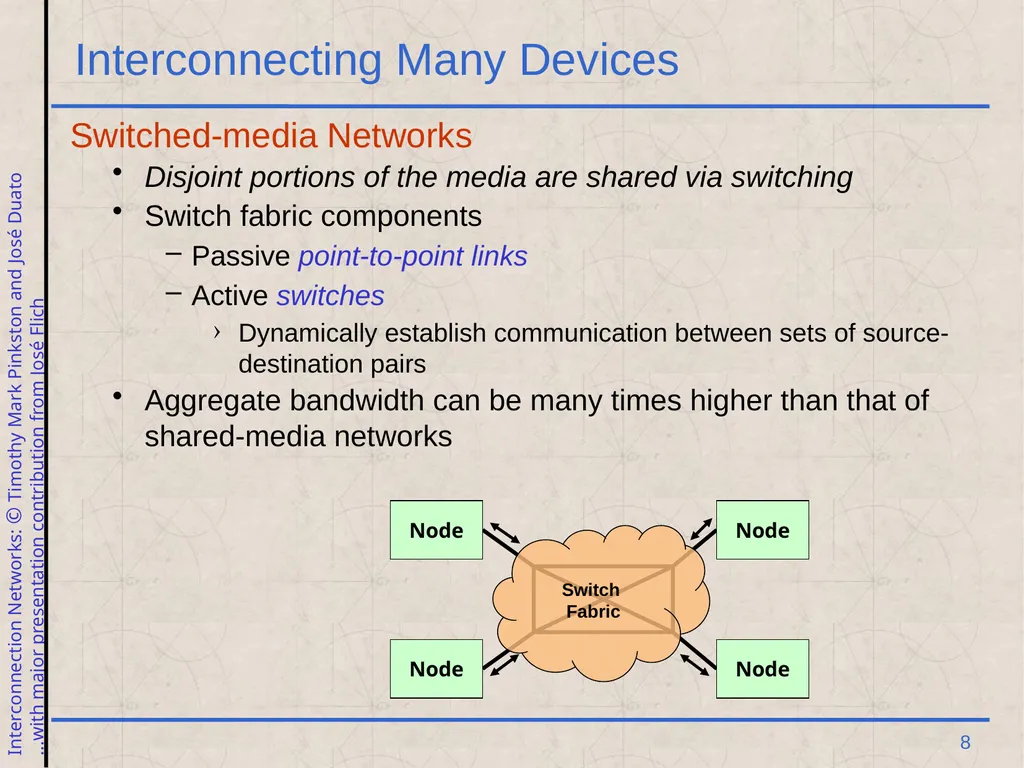
8 Interconnecting Many Devices Switched-media Networks
Disjoint portions of the media are shared via switching
Switch fabric components
Passive point-to-point links
Active switches
Dynamically establish communication between sets of source-destination pairs
Aggregate bandwidth can be many times higher than that of shared-media networks<br>
Disjoint portions of the media are shared via switching
Switch fabric components
Passive point-to-point links
Active switches
Dynamically establish communication between sets of source-destination pairs
Aggregate bandwidth can be many times higher than that of shared-media networks<br>
09
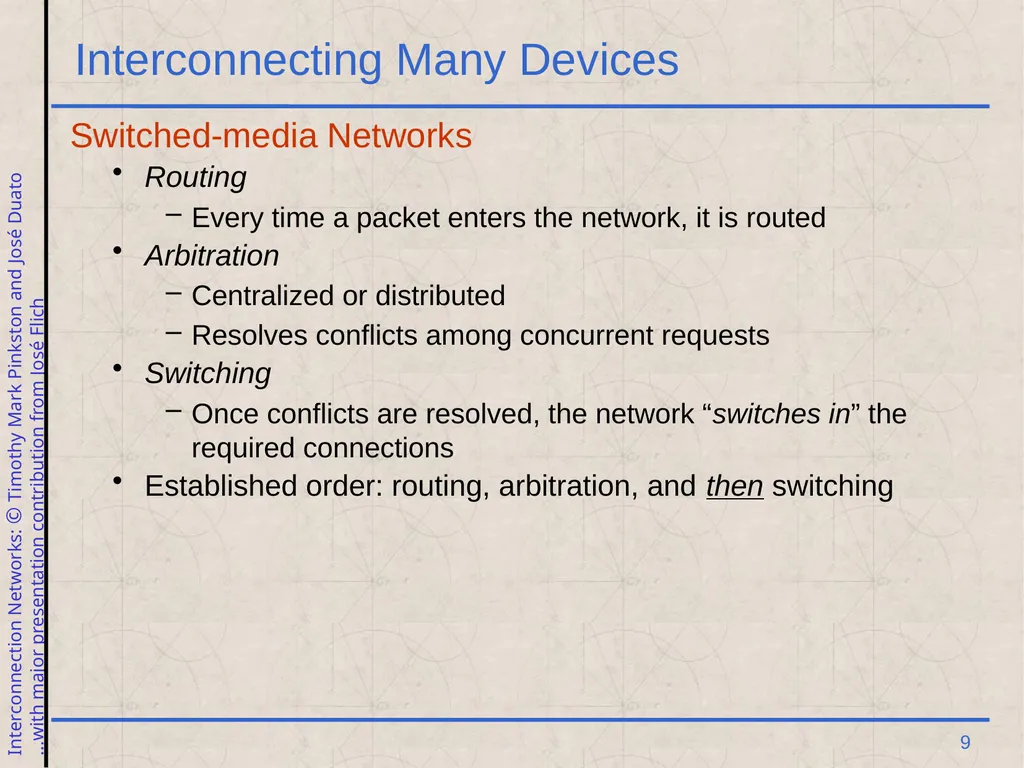
9 Interconnecting Many Devices Switched-media Networks
Routing
Every time a packet enters the network, it is routed
Arbitration
Centralized or distributed
Resolves conflicts among concurrent requests
Switching
Once conflicts are resolved, the network “switches in” the required connections
Established order: routing, arbitration, and then switching<br>
Routing
Every time a packet enters the network, it is routed
Arbitration
Centralized or distributed
Resolves conflicts among concurrent requests
Switching
Once conflicts are resolved, the network “switches in” the required connections
Established order: routing, arbitration, and then switching<br>
10
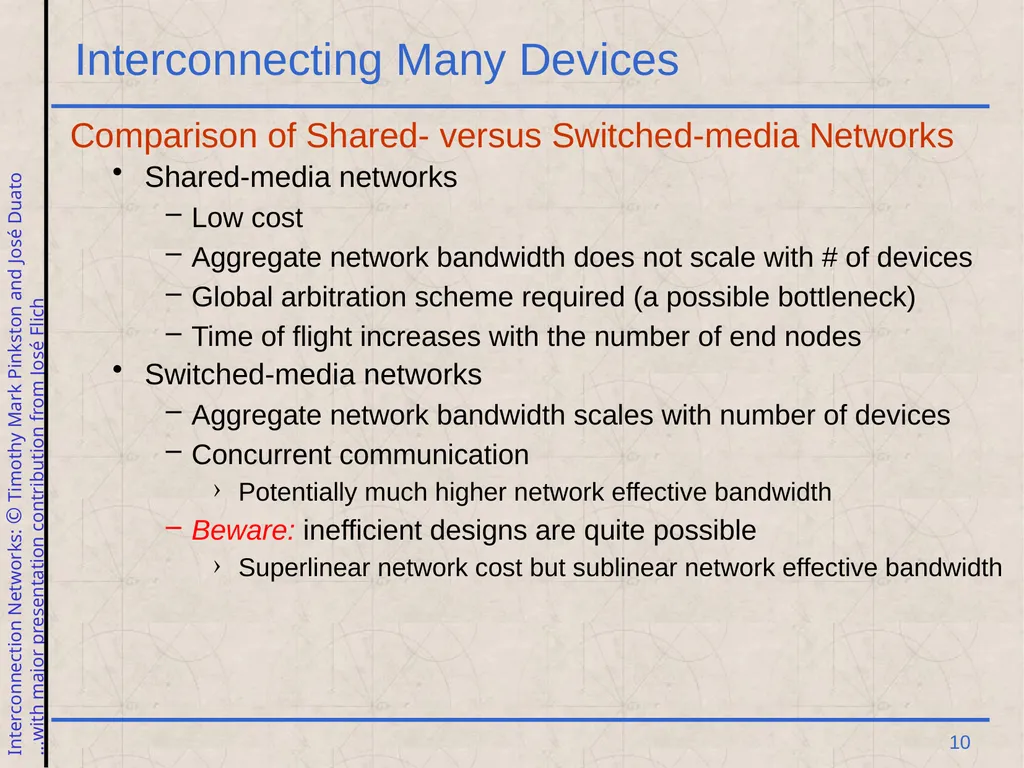
10 Interconnecting Many Devices Comparison of Shared- versus Switched-media Networks
Shared-media networks
Low cost
Aggregate network bandwidth does not scale with # of devices
Global arbitration scheme required (a possible bottleneck)
Time of flight increases with the number of end nodes
Switched-media networks
Aggregate network bandwidth scales with number of devices
Concurrent communication
Potentially much higher network effective bandwidth
Beware: inefficient designs are quite possible
Superlinear network cost but sublinear network effective bandwidth<br>
Shared-media networks
Low cost
Aggregate network bandwidth does not scale with # of devices
Global arbitration scheme required (a possible bottleneck)
Time of flight increases with the number of end nodes
Switched-media networks
Aggregate network bandwidth scales with number of devices
Concurrent communication
Potentially much higher network effective bandwidth
Beware: inefficient designs are quite possible
Superlinear network cost but sublinear network effective bandwidth<br>
11
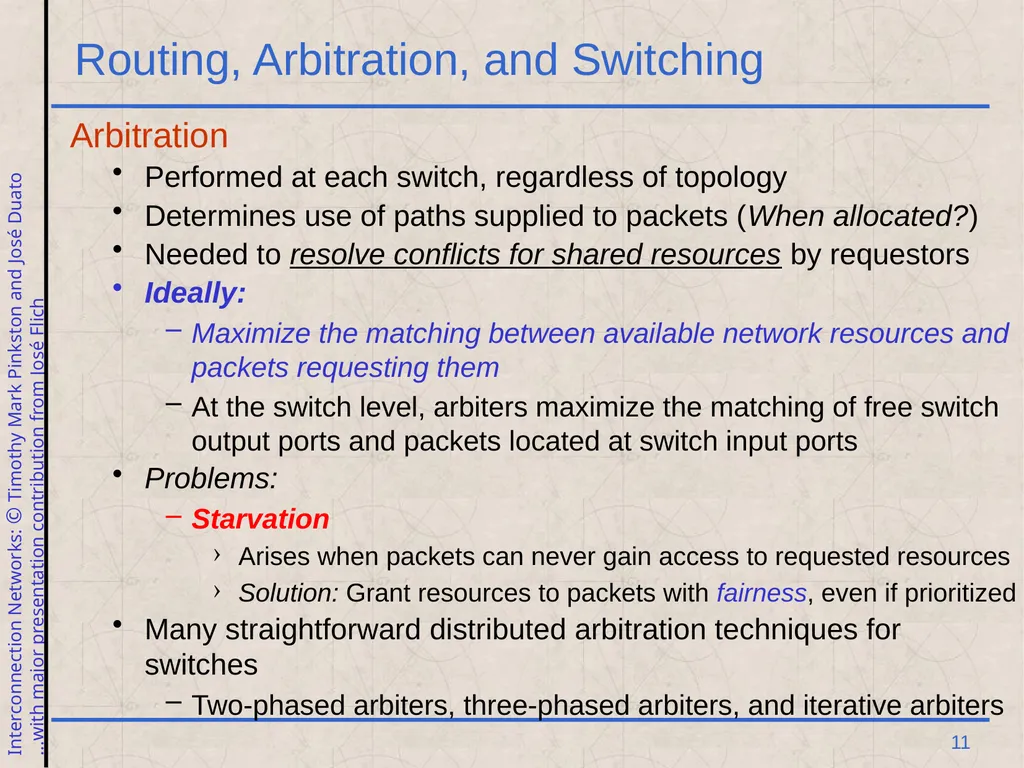
11 Routing, Arbitration, and Switching Arbitration
Performed at each switch, regardless of topology
Determines use of paths supplied to packets (When allocated?)
Needed to resolve conflicts for shared resources by requestors
Ideally:
Maximize the matching between available network resources and packets requesting them
At the switch level, arbiters maximize the matching of free switch output ports and packets located at switch input ports
Problems:
Starvation
Arises when packets can never gain access to requested resources
Solution: Grant resources to packets with fairness, even if prioritized
Many straightforward distributed arbitration techniques for switches
Two-phased arbiters, three-phased arbiters, and iterative arbiters<br>
Performed at each switch, regardless of topology
Determines use of paths supplied to packets (When allocated?)
Needed to resolve conflicts for shared resources by requestors
Ideally:
Maximize the matching between available network resources and packets requesting them
At the switch level, arbiters maximize the matching of free switch output ports and packets located at switch input ports
Problems:
Starvation
Arises when packets can never gain access to requested resources
Solution: Grant resources to packets with fairness, even if prioritized
Many straightforward distributed arbitration techniques for switches
Two-phased arbiters, three-phased arbiters, and iterative arbiters<br>
12
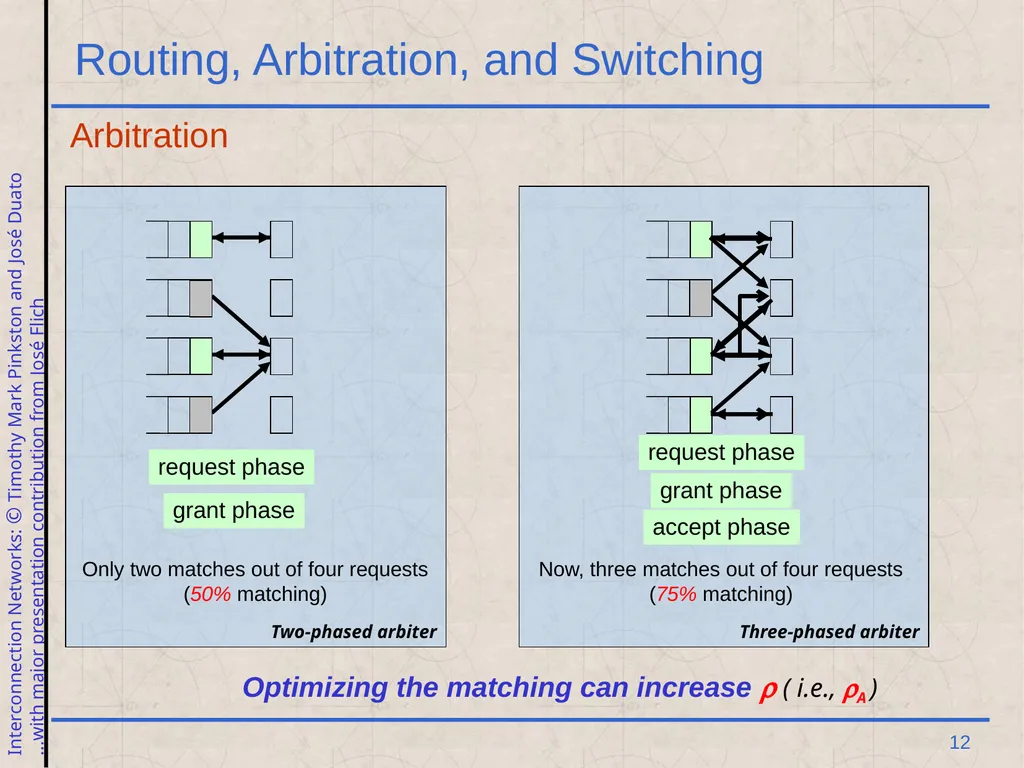
12 Two-phased arbiter Routing, Arbitration, and Switching Arbitration request phase grant phase Three-phased arbiter request phase grant phase accept phase Only two matches out of four requests
(50% matching) Now, three matches out of four requests
(75% matching) Optimizing the matching can increase r ( i.e., rA )<br>
(50% matching) Now, three matches out of four requests
(75% matching) Optimizing the matching can increase r ( i.e., rA )<br>
13
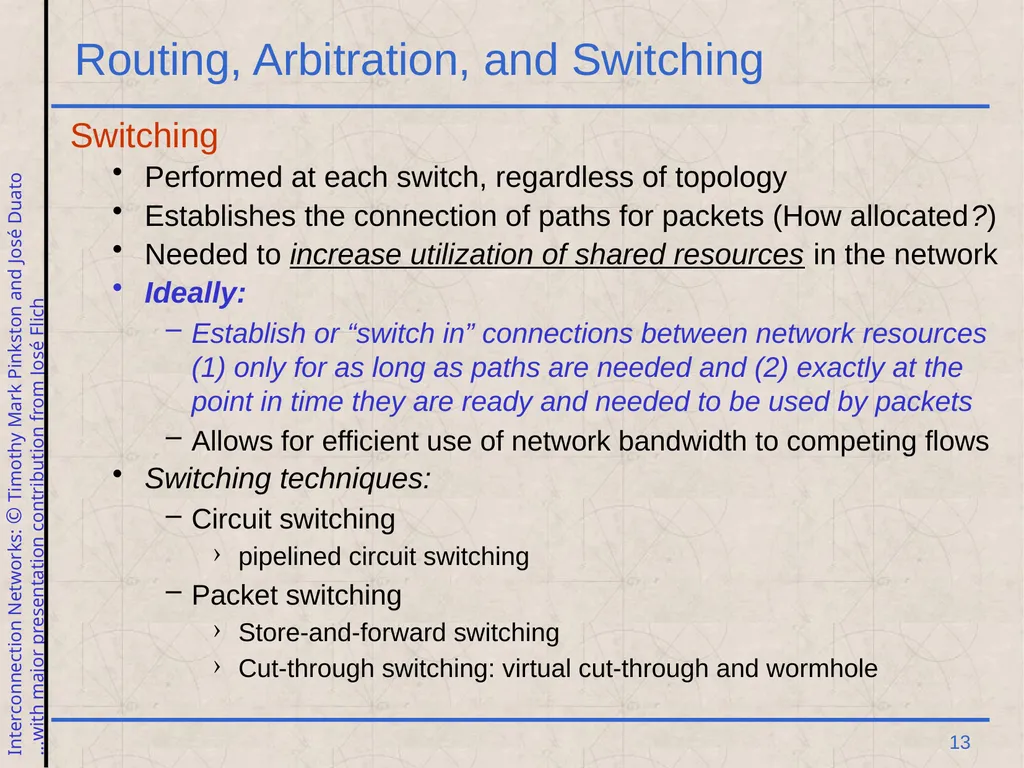
13 Routing, Arbitration, and Switching Switching
Performed at each switch, regardless of topology
Establishes the connection of paths for packets (How allocated?)
Needed to increase utilization of shared resources in the network
Ideally:
Establish or “switch in” connections between network resources (1) only for as long as paths are needed and (2) exactly at the point in time they are ready and needed to be used by packets
Allows for efficient use of network bandwidth to competing flows
Switching techniques:
Circuit switching
pipelined circuit switching
Packet switching
Store-and-forward switching
Cut-through switching: virtual cut-through and wormhole<br>
Performed at each switch, regardless of topology
Establishes the connection of paths for packets (How allocated?)
Needed to increase utilization of shared resources in the network
Ideally:
Establish or “switch in” connections between network resources (1) only for as long as paths are needed and (2) exactly at the point in time they are ready and needed to be used by packets
Allows for efficient use of network bandwidth to competing flows
Switching techniques:
Circuit switching
pipelined circuit switching
Packet switching
Store-and-forward switching
Cut-through switching: virtual cut-through and wormhole<br>
14
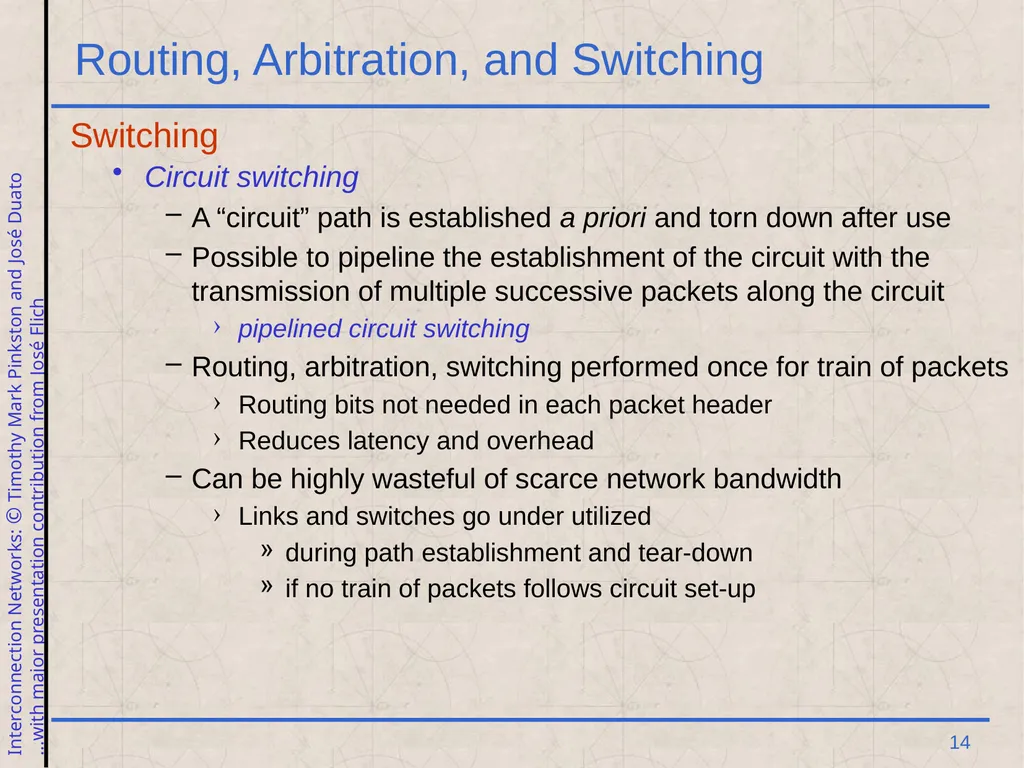
14 Routing, Arbitration, and Switching Switching
Circuit switching
A “circuit” path is established a priori and torn down after use
Possible to pipeline the establishment of the circuit with the transmission of multiple successive packets along the circuit
pipelined circuit switching
Routing, arbitration, switching performed once for train of packets
Routing bits not needed in each packet header
Reduces latency and overhead
Can be highly wasteful of scarce network bandwidth
Links and switches go under utilized
during path establishment and tear-down
if no train of packets follows circuit set-up<br>
Circuit switching
A “circuit” path is established a priori and torn down after use
Possible to pipeline the establishment of the circuit with the transmission of multiple successive packets along the circuit
pipelined circuit switching
Routing, arbitration, switching performed once for train of packets
Routing bits not needed in each packet header
Reduces latency and overhead
Can be highly wasteful of scarce network bandwidth
Links and switches go under utilized
during path establishment and tear-down
if no train of packets follows circuit set-up<br>
15
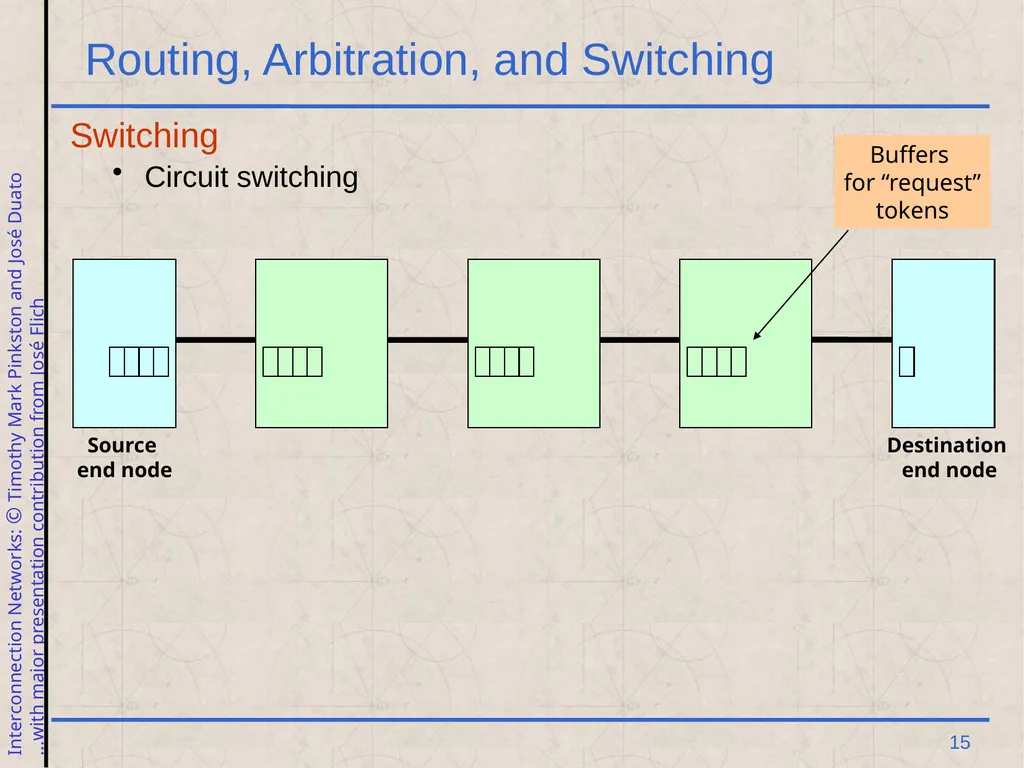
15 Routing, Arbitration, and Switching Switching
Circuit switching Source
end node Destination
end node<br>
Circuit switching Source
end node Destination
end node<br>
16
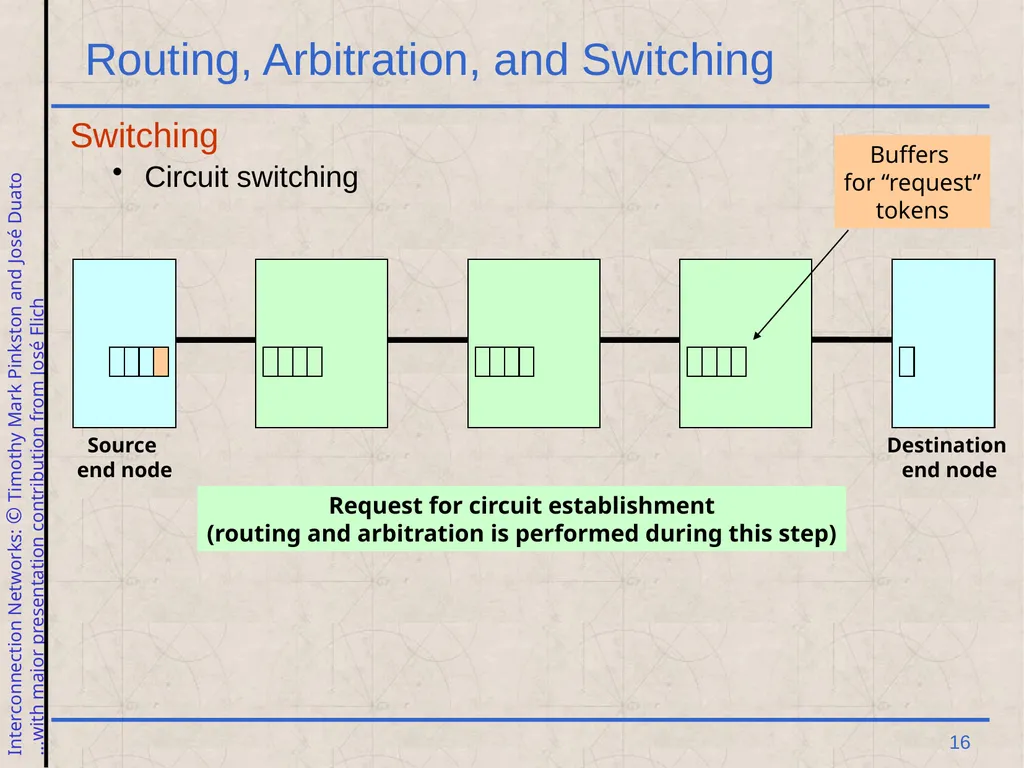
16 Routing, Arbitration, and Switching Request for circuit establishment
(routing and arbitration is performed during this step) Switching
Circuit switching Source
end node Destination
end node<br>
(routing and arbitration is performed during this step) Switching
Circuit switching Source
end node Destination
end node<br>
17
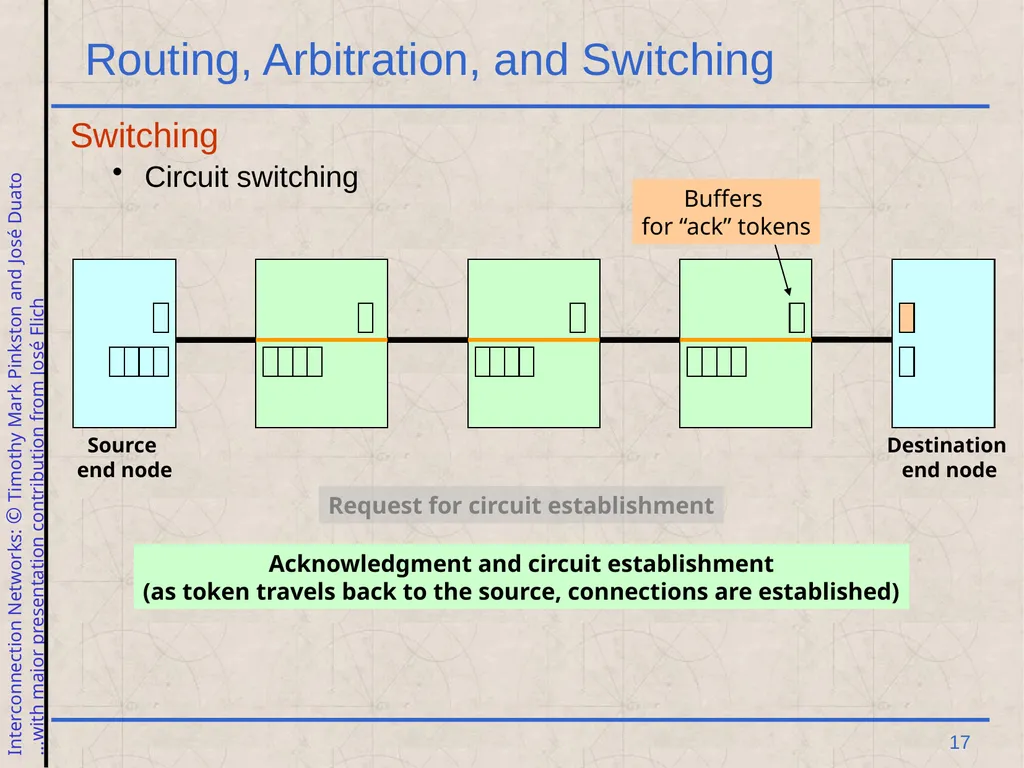
17 Routing, Arbitration, and Switching Request for circuit establishment Switching
Circuit switching Source
end node Destination
end node Acknowledgment and circuit establishment
(as token travels back to the source, connections are established)<br>
Circuit switching Source
end node Destination
end node Acknowledgment and circuit establishment
(as token travels back to the source, connections are established)<br>
18
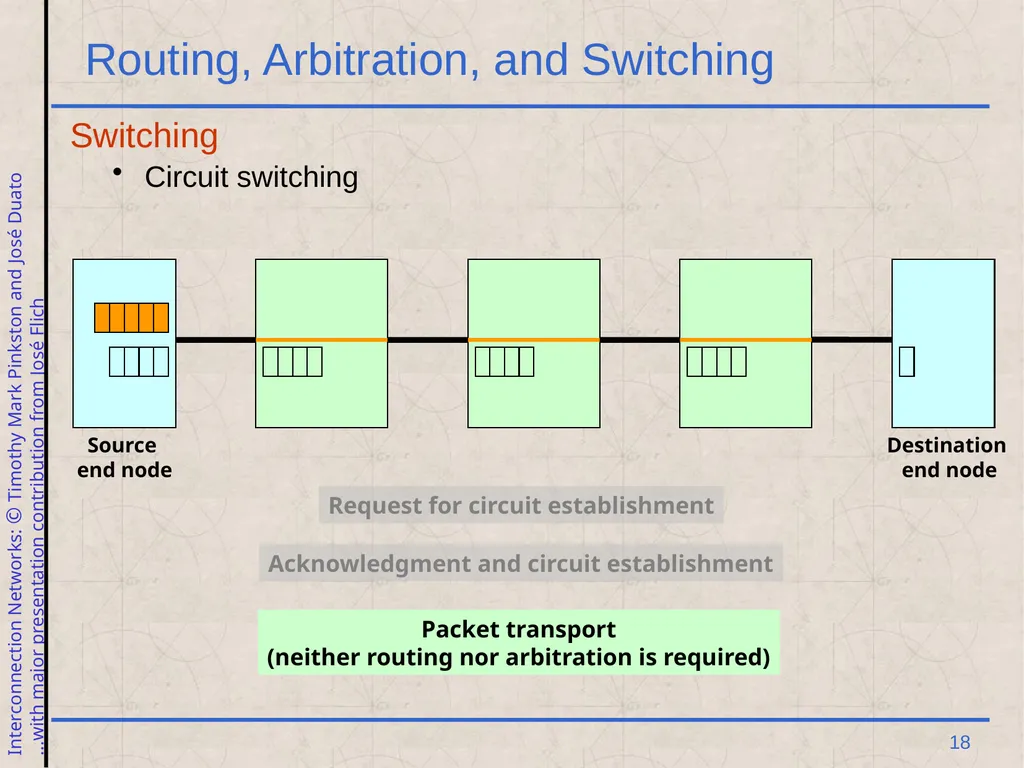
18 Routing, Arbitration, and Switching Request for circuit establishment Switching
Circuit switching Source
end node Destination
end node Acknowledgment and circuit establishment Packet transport
(neither routing nor arbitration is required)<br>
Circuit switching Source
end node Destination
end node Acknowledgment and circuit establishment Packet transport
(neither routing nor arbitration is required)<br>
19
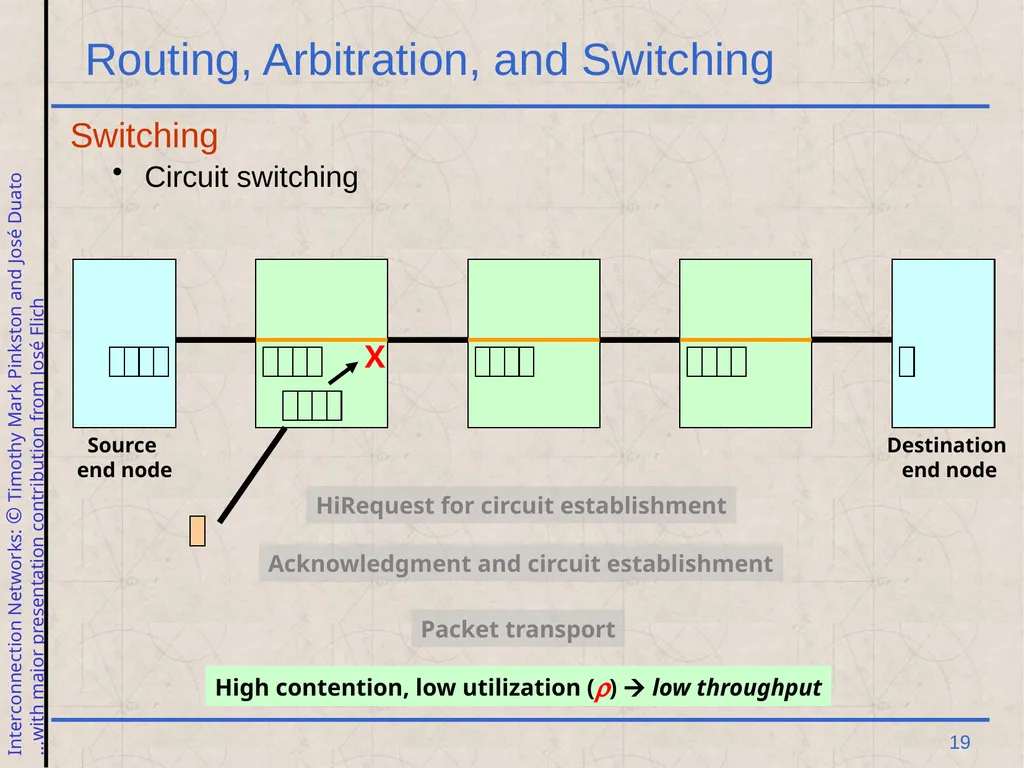
19 Routing, Arbitration, and Switching HiRequest for circuit establishment Switching
Circuit switching Source
end node Destination
end node Acknowledgment and circuit establishment Packet transport High contention, low utilization (r) low throughput<br>
Circuit switching Source
end node Destination
end node Acknowledgment and circuit establishment Packet transport High contention, low utilization (r) low throughput<br>
20
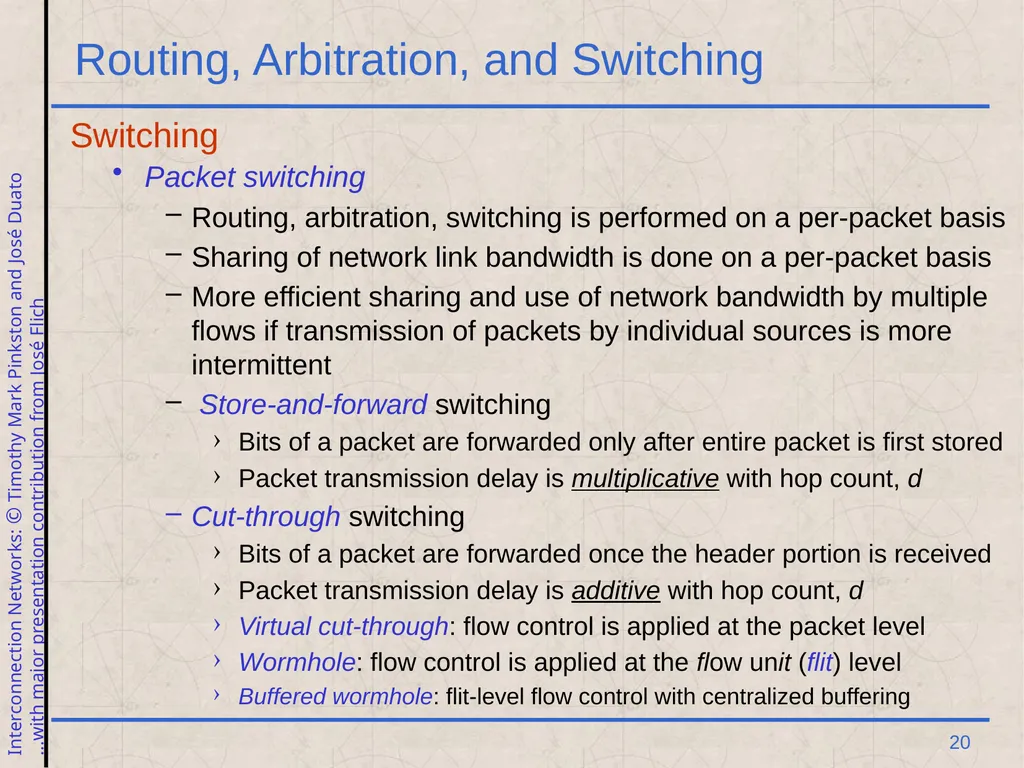
20 Routing, Arbitration, and Switching Switching
Packet switching
Routing, arbitration, switching is performed on a per-packet basis
Sharing of network link bandwidth is done on a per-packet basis
More efficient sharing and use of network bandwidth by multiple flows if transmission of packets by individual sources is more intermittent
Store-and-forward switching
Bits of a packet are forwarded only after entire packet is first stored
Packet transmission delay is multiplicative with hop count, d
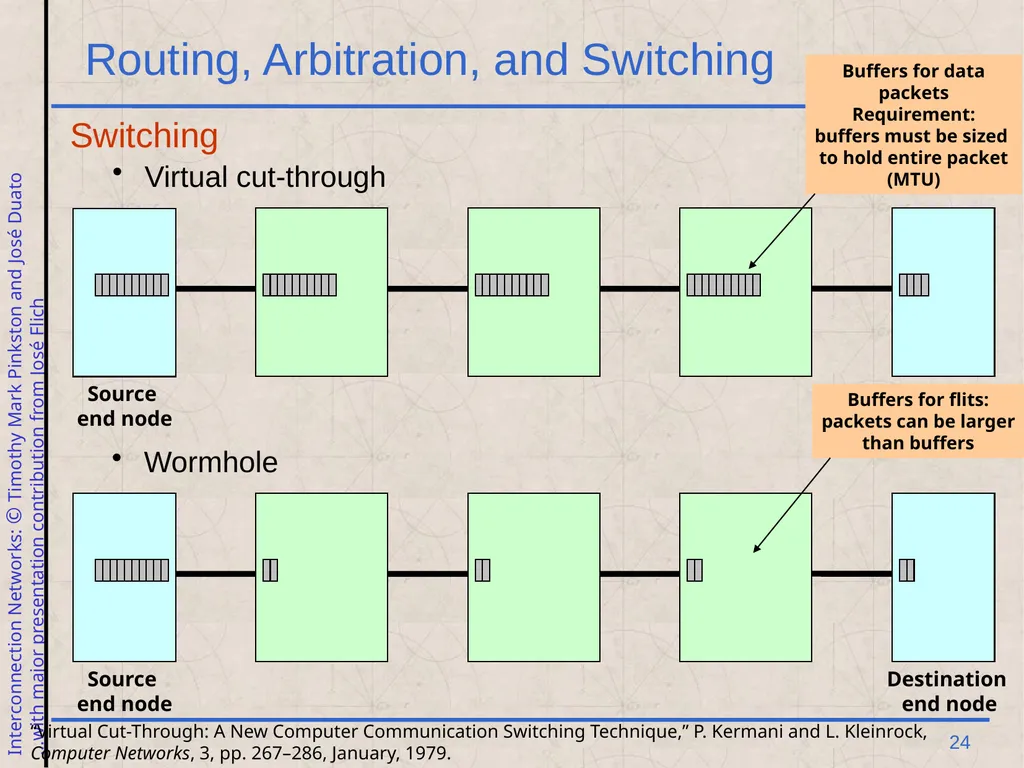
Cut-through switching
Bits of a packet are forwarded once the header portion is received
Packet transmission delay is additive with hop count, d
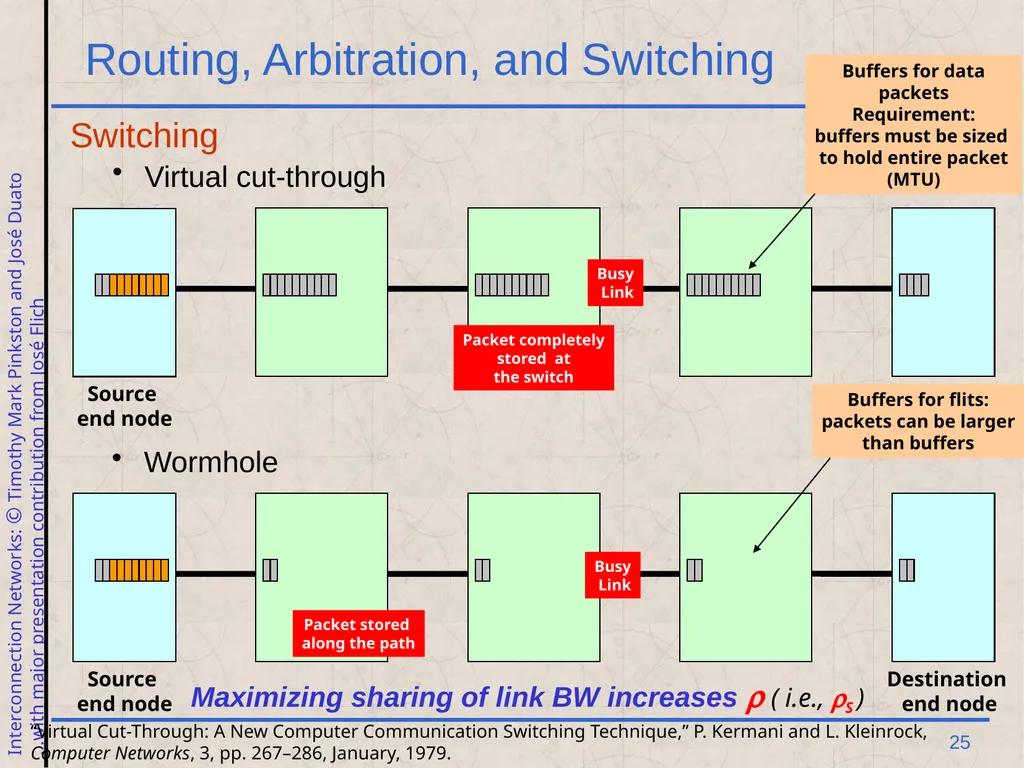
Virtual cut-through: flow control is applied at the packet level
Wormhole: flow control is applied at the flow unit (flit) level
Buffered wormhole: flit-level flow control with centralized buffering<br>
Packet switching
Routing, arbitration, switching is performed on a per-packet basis
Sharing of network link bandwidth is done on a per-packet basis
More efficient sharing and use of network bandwidth by multiple flows if transmission of packets by individual sources is more intermittent
Store-and-forward switching
Bits of a packet are forwarded only after entire packet is first stored
Packet transmission delay is multiplicative with hop count, d
Cut-through switching
Bits of a packet are forwarded once the header portion is received
Packet transmission delay is additive with hop count, d
Virtual cut-through: flow control is applied at the packet level
Wormhole: flow control is applied at the flow unit (flit) level
Buffered wormhole: flit-level flow control with centralized buffering<br>
21
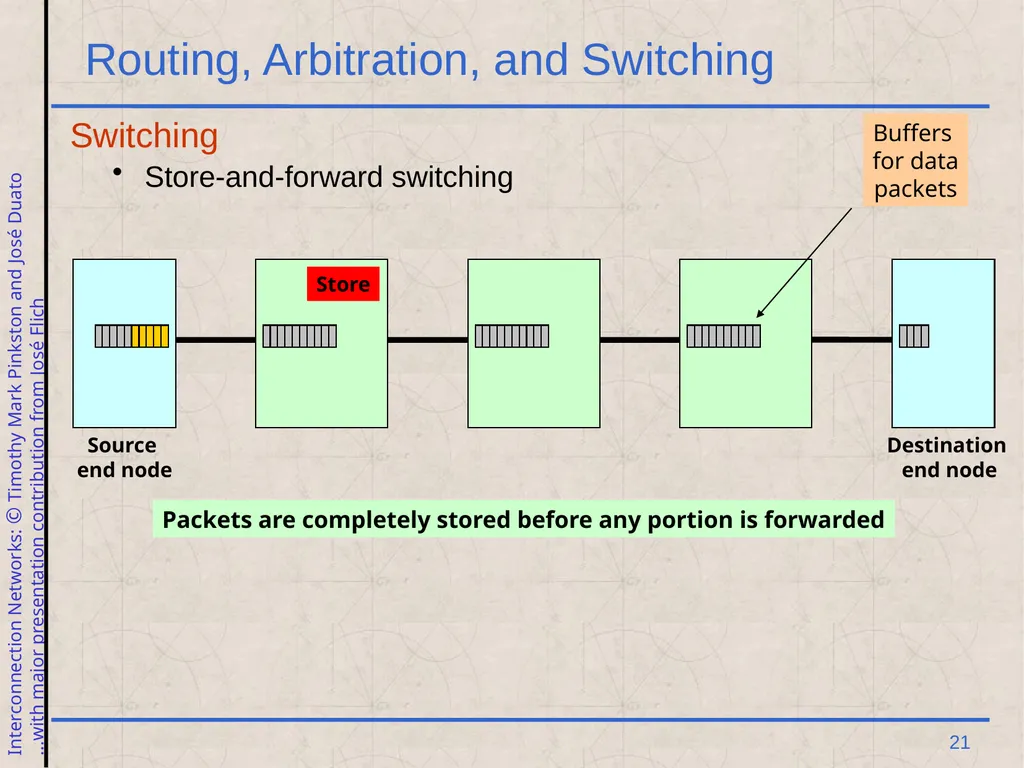
21 Routing, Arbitration, and Switching Switching
Store-and-forward switching Source
end node Destination
end node Packets are completely stored before any portion is forwarded Store<br>
Store-and-forward switching Source
end node Destination
end node Packets are completely stored before any portion is forwarded Store<br>
22
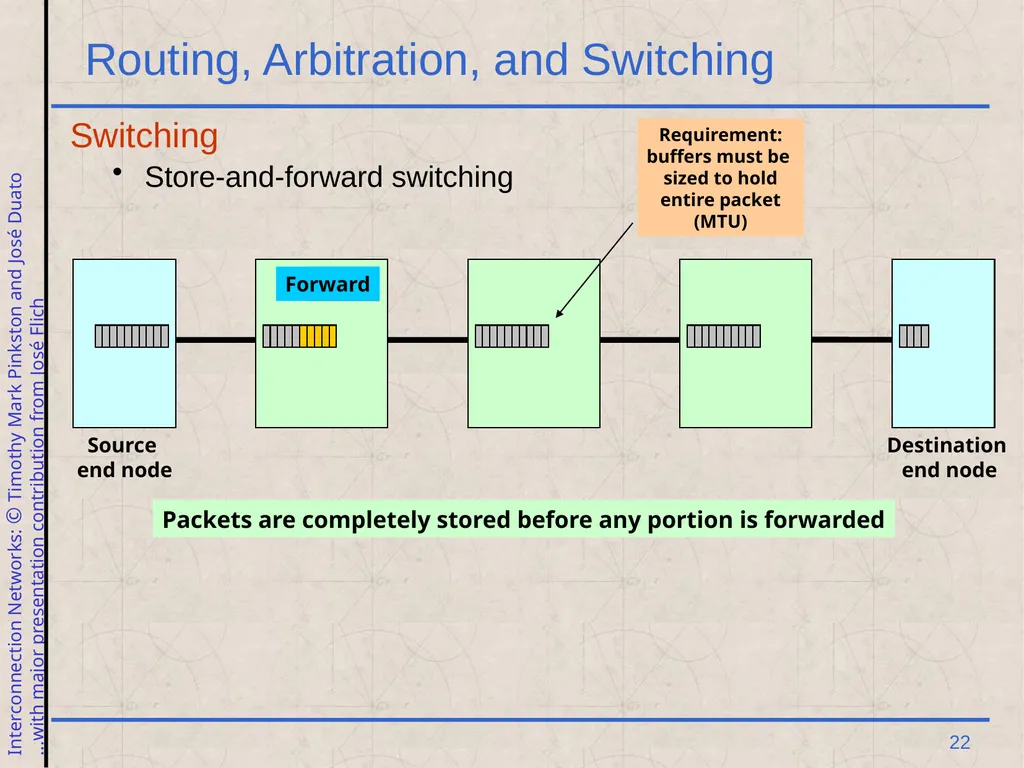
22 Routing, Arbitration, and Switching Switching
Store-and-forward switching Source
end node Destination
end node Packets are completely stored before any portion is forwarded Store Forward<br>
Store-and-forward switching Source
end node Destination
end node Packets are completely stored before any portion is forwarded Store Forward<br>
23
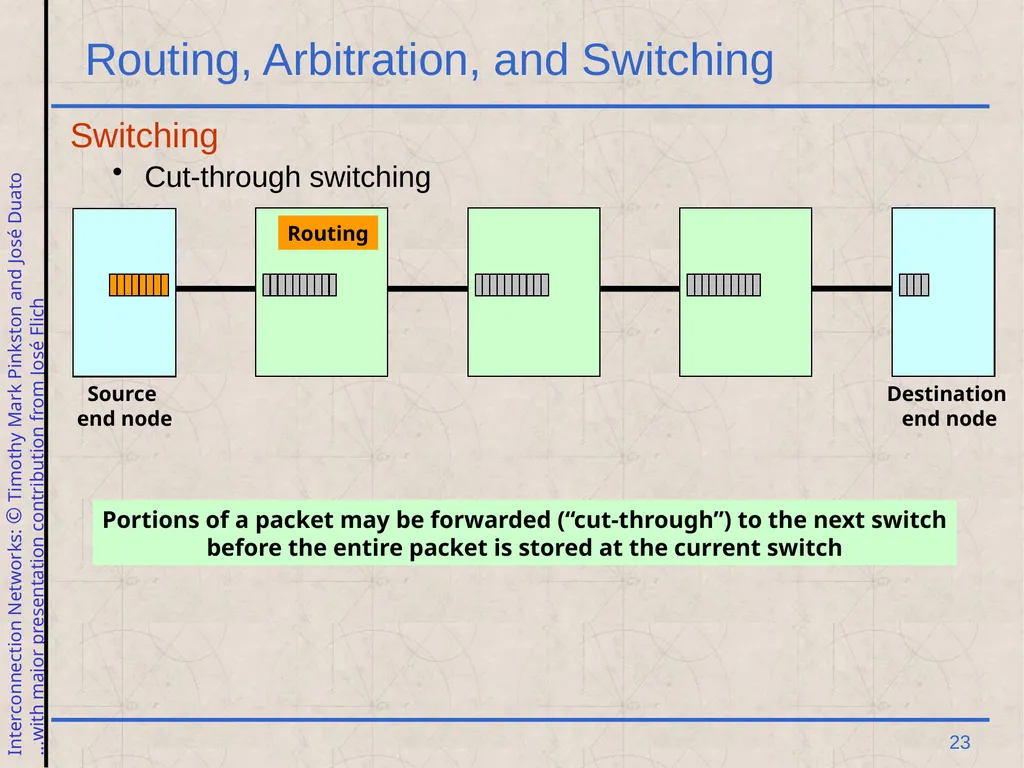
23 Routing, Arbitration, and Switching Switching
Cut-through switching Source
end node Destination
end node Routing Portions of a packet may be forwarded (“cut-through”) to the next switch
before the entire packet is stored at the current switch<br>
Cut-through switching Source
end node Destination
end node Routing Portions of a packet may be forwarded (“cut-through”) to the next switch
before the entire packet is stored at the current switch<br>
24
24 Routing, Arbitration, and Switching Switching
Virtual cut-through Wormhole Source
end node Destination
end node Source
end node Destination
end node “Virtual Cut-Through: A New Computer Communication Switching Technique,” P. Kermani and L. Kleinrock,
Computer Networks, 3, pp. 267–286, January, 1979.<br>
Virtual cut-through Wormhole Source
end node Destination
end node Source
end node Destination
end node “Virtual Cut-Through: A New Computer Communication Switching Technique,” P. Kermani and L. Kleinrock,
Computer Networks, 3, pp. 267–286, January, 1979.<br>
25
25 Routing, Arbitration, and Switching Switching
Virtual cut-through Wormhole Source
end node Destination
end node Source
end node Destination
end node Busy
Link Packet stored
along the path Busy
Link Packet completely
stored at
the switch Maximizing sharing of link BW increases r ( i.e., rS ) “Virtual Cut-Through: A New Computer Communication Switching Technique,” P. Kermani and L. Kleinrock,
Computer Networks, 3, pp. 267–286, January, 1979.<br>
Virtual cut-through Wormhole Source
end node Destination
end node Source
end node Destination
end node Busy
Link Packet stored
along the path Busy
Link Packet completely
stored at
the switch Maximizing sharing of link BW increases r ( i.e., rS ) “Virtual Cut-Through: A New Computer Communication Switching Technique,” P. Kermani and L. Kleinrock,
Computer Networks, 3, pp. 267–286, January, 1979.<br>
26
26 Concluding Remarks and References Agarwal, A. [1991]. “Limits on interconnection network performance,” IEEE Trans. on Parallel and Distributed Systems 2:4 (April), 398–412.
Anderson, T. E., D. E. Culler, and D. Patterson [1995]. “A case for NOW (networks of workstations),” IEEE Micro 15:1 (February), 54–64.
Anjan, K. V., and T. M. Pinkston [1995]. “An efficient, fully-adaptive deadlock recovery scheme: Disha,” Proc. 22nd Int’l Symposium on Computer Architecture (June), Italy.
Benes, V.E. [1962]. “Rearrangeable three stage connecting networks,” Bell System Technical Journal 41, 1481–1492.
Bertozzi, D., A. Jalabert, S. Murali, R. Tamhankar, S. Stergiou, L. Benini, and G. De Micheli [2005]. “NoC synthesis flow for customized domain specific multiprocessor systems-on-chip,” IEEE Trans. on Parallel and Distributed Systems 16:2 (February),113–130.
Bhuyan, L. N., and D. P. Agrawal [1984]. “Generalized hypercube and hyperbus structures for a computer network,” IEEE Trans. on Computers 32:4 (April), 323–333.
Clos, C. [1953]. “A study of non-blocking switching networks,” Bell Systems Technical Journal 32 (March), 406–424.
Dally, W. J. [1990]. “Performance analysis of k-ary n-cube interconnection networks,” IEEE Trans. on Computers 39:6 (June), 775–785.
Dally, W. J. [1992]. “Virtual channel flow control,” IEEE Trans. on Parallel and Distributed Systems 3:2 (March), 194–205. References<br>
Anderson, T. E., D. E. Culler, and D. Patterson [1995]. “A case for NOW (networks of workstations),” IEEE Micro 15:1 (February), 54–64.
Anjan, K. V., and T. M. Pinkston [1995]. “An efficient, fully-adaptive deadlock recovery scheme: Disha,” Proc. 22nd Int’l Symposium on Computer Architecture (June), Italy.
Benes, V.E. [1962]. “Rearrangeable three stage connecting networks,” Bell System Technical Journal 41, 1481–1492.
Bertozzi, D., A. Jalabert, S. Murali, R. Tamhankar, S. Stergiou, L. Benini, and G. De Micheli [2005]. “NoC synthesis flow for customized domain specific multiprocessor systems-on-chip,” IEEE Trans. on Parallel and Distributed Systems 16:2 (February),113–130.
Bhuyan, L. N., and D. P. Agrawal [1984]. “Generalized hypercube and hyperbus structures for a computer network,” IEEE Trans. on Computers 32:4 (April), 323–333.
Clos, C. [1953]. “A study of non-blocking switching networks,” Bell Systems Technical Journal 32 (March), 406–424.
Dally, W. J. [1990]. “Performance analysis of k-ary n-cube interconnection networks,” IEEE Trans. on Computers 39:6 (June), 775–785.
Dally, W. J. [1992]. “Virtual channel flow control,” IEEE Trans. on Parallel and Distributed Systems 3:2 (March), 194–205. References<br>
27
27 Concluding Remarks and References Dally, W. J. [1999]. “Interconnect limited VLSI architecture,” Proc. of the International Interconnect Technology Conference, San Francisco (May).
Dally, W. J., and C. I. Seitz [1986]. “The torus routing chip,” Distributed Computing 1:4, 187–196.
Dally, W. J., and B. Towles [2001]. “Route packets, not wires: On-chip interconnection networks,” Proc. of the Design Automation Conference, Las Vegas (June).
Dally, W. J., and B. Towles [2004]. Principles and Practices of Interconnection Networks, Morgan Kaufmann Publishers, San Francisco.
Duato, J. [1993]. “A new theory of deadlock-free adaptive routing in wormhole networks,” IEEE Trans. on Parallel and Distributed Systems 4:12 (Dec.) 1320–1331.
Duato, J., I. Johnson, J. Flich, F. Naven, P. Garcia, T. Nachiondo [2005]. “A new scalable and cost-effective congestion management strategy for lossless multistage interconnection networks,” Proc. 11th Int’l Symposium on High Performance Computer Architecture (February), San Francisco.
Duato, J., O. Lysne, R. Pang, and T. M. Pinkston [2005]. “Part I: A theory for deadlock-free dynamic reconfiguration of interconnection networks,” IEEE Trans. on Parallel and Distributed Systems 16:5 (May), 412–427.
Duato, J., and T. M. Pinkston [2001]. “A general theory for deadlock-free adaptive routing using a mixed set of resources,” IEEE Trans. on Parallel and Distributed Systems 12:12 (December), 1219–1235.
Duato, J., S. Yalamanchili, and L. Ni [2003]. Interconnection Networks: An Engineering Approach, 2nd printing, Morgan Kaufmann Publishers, San Francisco. References<br>
Dally, W. J., and C. I. Seitz [1986]. “The torus routing chip,” Distributed Computing 1:4, 187–196.
Dally, W. J., and B. Towles [2001]. “Route packets, not wires: On-chip interconnection networks,” Proc. of the Design Automation Conference, Las Vegas (June).
Dally, W. J., and B. Towles [2004]. Principles and Practices of Interconnection Networks, Morgan Kaufmann Publishers, San Francisco.
Duato, J. [1993]. “A new theory of deadlock-free adaptive routing in wormhole networks,” IEEE Trans. on Parallel and Distributed Systems 4:12 (Dec.) 1320–1331.
Duato, J., I. Johnson, J. Flich, F. Naven, P. Garcia, T. Nachiondo [2005]. “A new scalable and cost-effective congestion management strategy for lossless multistage interconnection networks,” Proc. 11th Int’l Symposium on High Performance Computer Architecture (February), San Francisco.
Duato, J., O. Lysne, R. Pang, and T. M. Pinkston [2005]. “Part I: A theory for deadlock-free dynamic reconfiguration of interconnection networks,” IEEE Trans. on Parallel and Distributed Systems 16:5 (May), 412–427.
Duato, J., and T. M. Pinkston [2001]. “A general theory for deadlock-free adaptive routing using a mixed set of resources,” IEEE Trans. on Parallel and Distributed Systems 12:12 (December), 1219–1235.
Duato, J., S. Yalamanchili, and L. Ni [2003]. Interconnection Networks: An Engineering Approach, 2nd printing, Morgan Kaufmann Publishers, San Francisco. References<br>
28
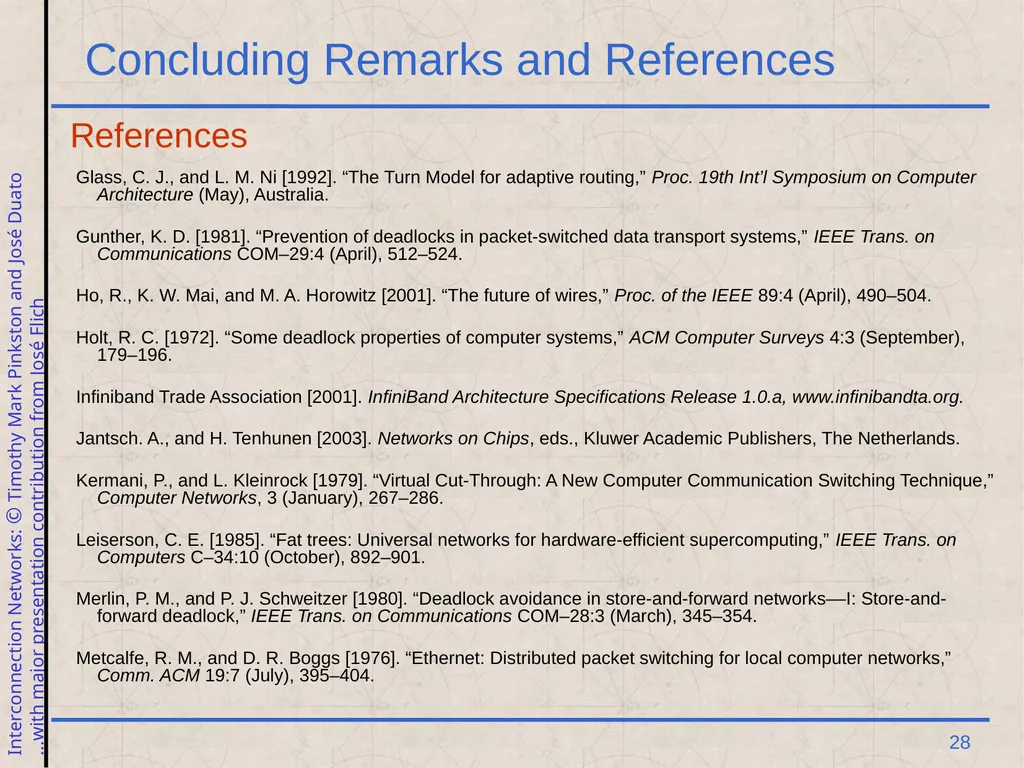
28 Concluding Remarks and References Glass, C. J., and L. M. Ni [1992]. “The Turn Model for adaptive routing,” Proc. 19th Int’l Symposium on Computer Architecture (May), Australia.
Gunther, K. D. [1981]. “Prevention of deadlocks in packet-switched data transport systems,” IEEE Trans. on Communications COM–29:4 (April), 512–524.
Ho, R., K. W. Mai, and M. A. Horowitz [2001]. “The future of wires,” Proc. of the IEEE 89:4 (April), 490–504.
Holt, R. C. [1972]. “Some deadlock properties of computer systems,” ACM Computer Surveys 4:3 (September), 179–196.
Infiniband Trade Association [2001]. InfiniBand Architecture Specifications Release 1.0.a, www.infinibandta.org.
Jantsch. A., and H. Tenhunen [2003]. Networks on Chips, eds., Kluwer Academic Publishers, The Netherlands.
Kermani, P., and L. Kleinrock [1979]. “Virtual Cut-Through: A New Computer Communication Switching Technique,” Computer Networks, 3 (January), 267–286.
Leiserson, C. E. [1985]. “Fat trees: Universal networks for hardware-efficient supercomputing,” IEEE Trans. on Computers C–34:10 (October), 892–901.
Merlin, P. M., and P. J. Schweitzer [1980]. “Deadlock avoidance in store-and-forward networks––I: Store-and-forward deadlock,” IEEE Trans. on Communications COM–28:3 (March), 345–354.
Metcalfe, R. M., and D. R. Boggs [1976]. “Ethernet: Distributed packet switching for local computer networks,” Comm. ACM 19:7 (July), 395–404. References<br>
Gunther, K. D. [1981]. “Prevention of deadlocks in packet-switched data transport systems,” IEEE Trans. on Communications COM–29:4 (April), 512–524.
Ho, R., K. W. Mai, and M. A. Horowitz [2001]. “The future of wires,” Proc. of the IEEE 89:4 (April), 490–504.
Holt, R. C. [1972]. “Some deadlock properties of computer systems,” ACM Computer Surveys 4:3 (September), 179–196.
Infiniband Trade Association [2001]. InfiniBand Architecture Specifications Release 1.0.a, www.infinibandta.org.
Jantsch. A., and H. Tenhunen [2003]. Networks on Chips, eds., Kluwer Academic Publishers, The Netherlands.
Kermani, P., and L. Kleinrock [1979]. “Virtual Cut-Through: A New Computer Communication Switching Technique,” Computer Networks, 3 (January), 267–286.
Leiserson, C. E. [1985]. “Fat trees: Universal networks for hardware-efficient supercomputing,” IEEE Trans. on Computers C–34:10 (October), 892–901.
Merlin, P. M., and P. J. Schweitzer [1980]. “Deadlock avoidance in store-and-forward networks––I: Store-and-forward deadlock,” IEEE Trans. on Communications COM–28:3 (March), 345–354.
Metcalfe, R. M., and D. R. Boggs [1976]. “Ethernet: Distributed packet switching for local computer networks,” Comm. ACM 19:7 (July), 395–404. References<br>
29
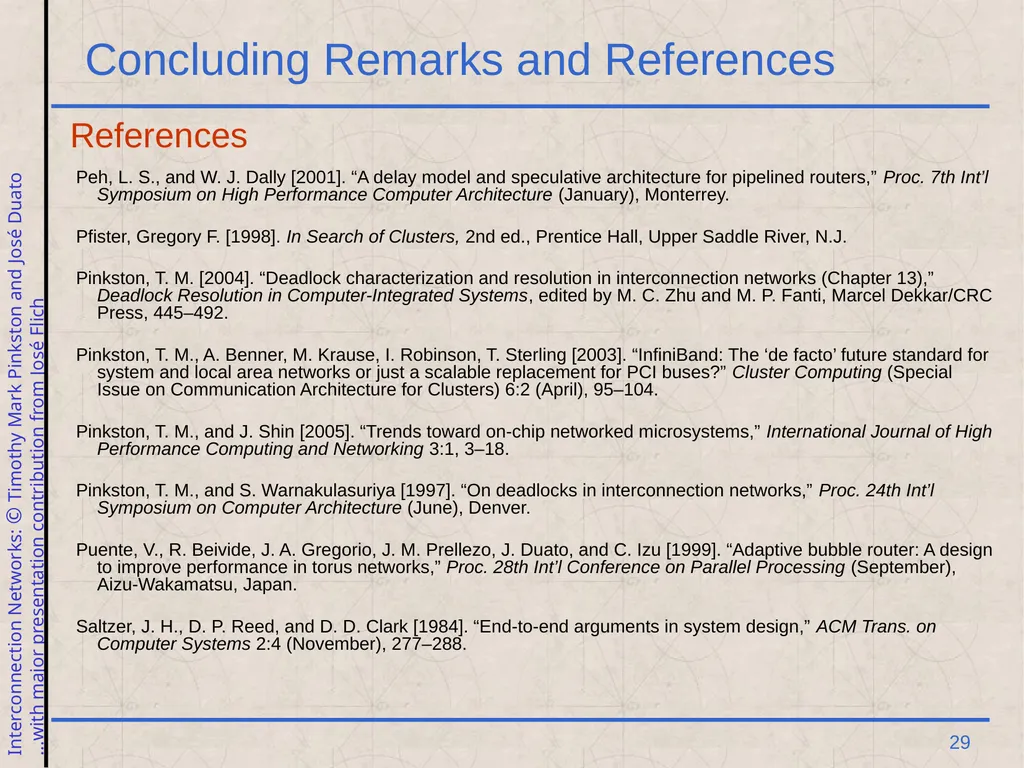
29 Concluding Remarks and References Peh, L. S., and W. J. Dally [2001]. “A delay model and speculative architecture for pipelined routers,” Proc. 7th Int’l Symposium on High Performance Computer Architecture (January), Monterrey.
Pfister, Gregory F. [1998]. In Search of Clusters, 2nd ed., Prentice Hall, Upper Saddle River, N.J.
Pinkston, T. M. [2004]. “Deadlock characterization and resolution in interconnection networks (Chapter 13),” Deadlock Resolution in Computer-Integrated Systems, edited by M. C. Zhu and M. P. Fanti, Marcel Dekkar/CRC Press, 445–492.
Pinkston, T. M., A. Benner, M. Krause, I. Robinson, T. Sterling [2003]. “InfiniBand: The ‘de facto’ future standard for system and local area networks or just a scalable replacement for PCI buses?” Cluster Computing (Special Issue on Communication Architecture for Clusters) 6:2 (April), 95–104.
Pinkston, T. M., and J. Shin [2005]. “Trends toward on-chip networked microsystems,” International Journal of High Performance Computing and Networking 3:1, 3–18.
Pinkston, T. M., and S. Warnakulasuriya [1997]. “On deadlocks in interconnection networks,” Proc. 24th Int’l Symposium on Computer Architecture (June), Denver.
Puente, V., R. Beivide, J. A. Gregorio, J. M. Prellezo, J. Duato, and C. Izu [1999]. “Adaptive bubble router: A design to improve performance in torus networks,” Proc. 28th Int’l Conference on Parallel Processing (September), Aizu-Wakamatsu, Japan.
Saltzer, J. H., D. P. Reed, and D. D. Clark [1984]. “End-to-end arguments in system design,” ACM Trans. on Computer Systems 2:4 (November), 277–288. References<br>
Pfister, Gregory F. [1998]. In Search of Clusters, 2nd ed., Prentice Hall, Upper Saddle River, N.J.
Pinkston, T. M. [2004]. “Deadlock characterization and resolution in interconnection networks (Chapter 13),” Deadlock Resolution in Computer-Integrated Systems, edited by M. C. Zhu and M. P. Fanti, Marcel Dekkar/CRC Press, 445–492.
Pinkston, T. M., A. Benner, M. Krause, I. Robinson, T. Sterling [2003]. “InfiniBand: The ‘de facto’ future standard for system and local area networks or just a scalable replacement for PCI buses?” Cluster Computing (Special Issue on Communication Architecture for Clusters) 6:2 (April), 95–104.
Pinkston, T. M., and J. Shin [2005]. “Trends toward on-chip networked microsystems,” International Journal of High Performance Computing and Networking 3:1, 3–18.
Pinkston, T. M., and S. Warnakulasuriya [1997]. “On deadlocks in interconnection networks,” Proc. 24th Int’l Symposium on Computer Architecture (June), Denver.
Puente, V., R. Beivide, J. A. Gregorio, J. M. Prellezo, J. Duato, and C. Izu [1999]. “Adaptive bubble router: A design to improve performance in torus networks,” Proc. 28th Int’l Conference on Parallel Processing (September), Aizu-Wakamatsu, Japan.
Saltzer, J. H., D. P. Reed, and D. D. Clark [1984]. “End-to-end arguments in system design,” ACM Trans. on Computer Systems 2:4 (November), 277–288. References<br>
30
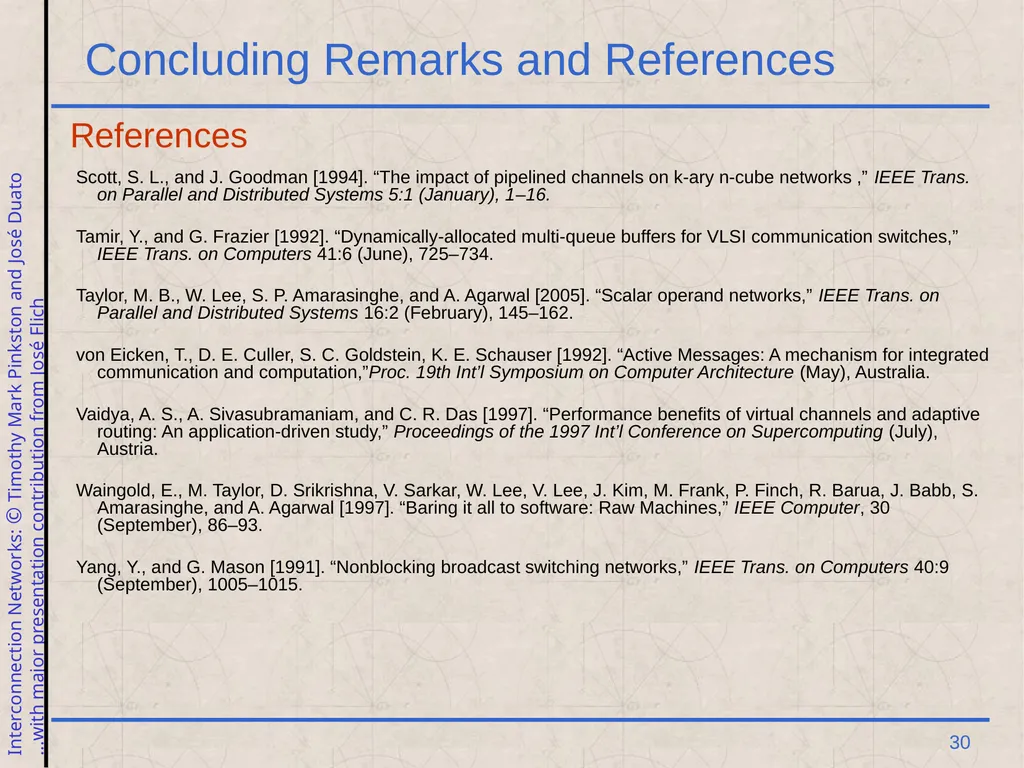
30 Concluding Remarks and References Scott, S. L., and J. Goodman [1994]. “The impact of pipelined channels on k-ary n-cube networks ,” IEEE Trans. on Parallel and Distributed Systems 5:1 (January), 1–16.
Tamir, Y., and G. Frazier [1992]. “Dynamically-allocated multi-queue buffers for VLSI communication switches,” IEEE Trans. on Computers 41:6 (June), 725–734.
Taylor, M. B., W. Lee, S. P. Amarasinghe, and A. Agarwal [2005]. “Scalar operand networks,” IEEE Trans. on Parallel and Distributed Systems 16:2 (February), 145–162.
von Eicken, T., D. E. Culler, S. C. Goldstein, K. E. Schauser [1992]. “Active Messages: A mechanism for integrated communication and computation,”Proc. 19th Int’l Symposium on Computer Architecture (May), Australia.
Vaidya, A. S., A. Sivasubramaniam, and C. R. Das [1997]. “Performance benefits of virtual channels and adaptive routing: An application-driven study,” Proceedings of the 1997 Int’l Conference on Supercomputing (July), Austria.
Waingold, E., M. Taylor, D. Srikrishna, V. Sarkar, W. Lee, V. Lee, J. Kim, M. Frank, P. Finch, R. Barua, J. Babb, S. Amarasinghe, and A. Agarwal [1997]. “Baring it all to software: Raw Machines,” IEEE Computer, 30 (September), 86–93.
Yang, Y., and G. Mason [1991]. “Nonblocking broadcast switching networks,” IEEE Trans. on Computers 40:9 (September), 1005–1015. References<br>
Tamir, Y., and G. Frazier [1992]. “Dynamically-allocated multi-queue buffers for VLSI communication switches,” IEEE Trans. on Computers 41:6 (June), 725–734.
Taylor, M. B., W. Lee, S. P. Amarasinghe, and A. Agarwal [2005]. “Scalar operand networks,” IEEE Trans. on Parallel and Distributed Systems 16:2 (February), 145–162.
von Eicken, T., D. E. Culler, S. C. Goldstein, K. E. Schauser [1992]. “Active Messages: A mechanism for integrated communication and computation,”Proc. 19th Int’l Symposium on Computer Architecture (May), Australia.
Vaidya, A. S., A. Sivasubramaniam, and C. R. Das [1997]. “Performance benefits of virtual channels and adaptive routing: An application-driven study,” Proceedings of the 1997 Int’l Conference on Supercomputing (July), Austria.
Waingold, E., M. Taylor, D. Srikrishna, V. Sarkar, W. Lee, V. Lee, J. Kim, M. Frank, P. Finch, R. Barua, J. Babb, S. Amarasinghe, and A. Agarwal [1997]. “Baring it all to software: Raw Machines,” IEEE Computer, 30 (September), 86–93.
Yang, Y., and G. Mason [1991]. “Nonblocking broadcast switching networks,” IEEE Trans. on Computers 40:9 (September), 1005–1015. References<br>