
Existentialism in the Sailor Who Fell From Grace
NS
Published · 46 slides · 0 views

1 / 1












Description
Existentialism in the Sailor Who Fell From Grace with the Sea Yukio Mishima develops the themes of Existentialism and Nihilism through the characters Noboru and Ryuji alekzialive.com The Only Thing to Write Down Outline existential schools
Related Topics
Share
Embed code
Download this presentation From Below
"Existentialism in the Sailor Who Fell From Grace" is the property of its rightful owner. Permission is granted to download and print the materials on this website for personal, non-commercial use only, and to display it on your personal computer provided you do not modify the materials and that you retain all copyright notices contained in the materials. By downloading content from our website, you accept the terms of this agreement.
Presentation Transcript
01
Existentialism in the Sailor Who Fell From Grace with the Sea Yukio Mishima develops the themes of Existentialism and Nihilism through the characters Noboru and Ryuji<br>
02
alekzia@live.com The Only Thing to Write Down<br>
03
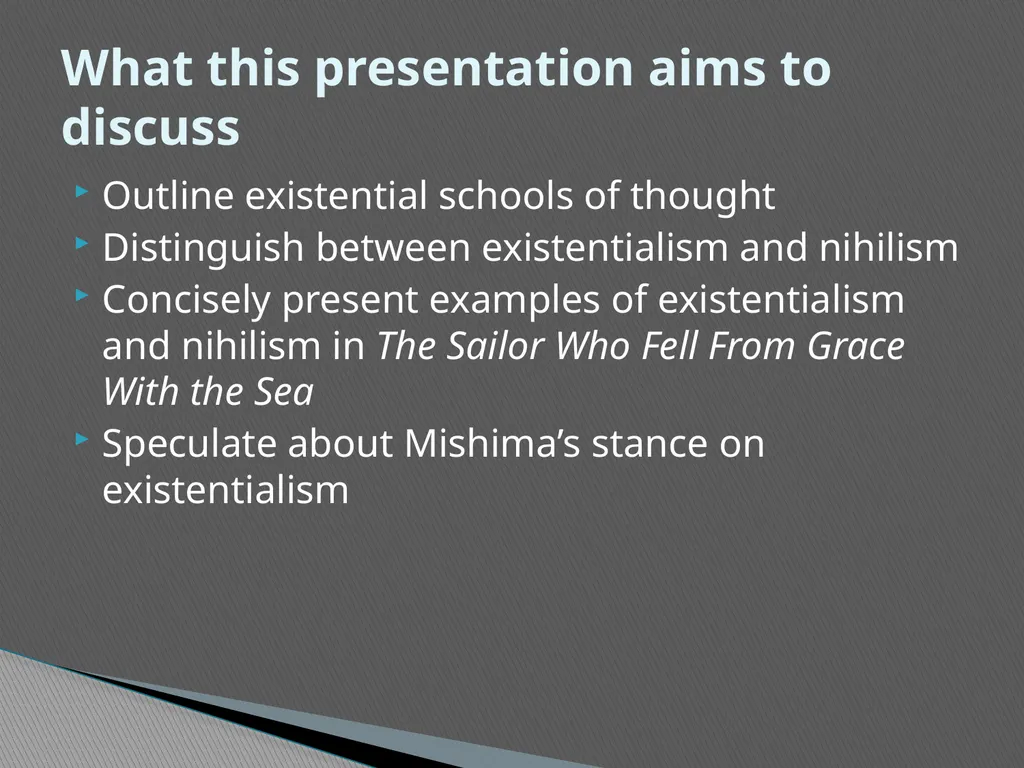
Outline existential schools of thought
Distinguish between existentialism and nihilism
Concisely present examples of existentialism and nihilism in The Sailor Who Fell From Grace With the Sea
Speculate about Mishima’s stance on existentialism What this presentation aims to discuss<br>
Distinguish between existentialism and nihilism
Concisely present examples of existentialism and nihilism in The Sailor Who Fell From Grace With the Sea
Speculate about Mishima’s stance on existentialism What this presentation aims to discuss<br>
04
Introduction to Existentialism<br>
05
A chiefly 20th-century philosophical movement prevalent in Europe assuming that people are entirely free and thus responsible for what they make of themselves
Existentialism is the philosophy that deals with the subjective existence of an individual. What is Existentialism?<br>
Existentialism is the philosophy that deals with the subjective existence of an individual. What is Existentialism?<br>
06
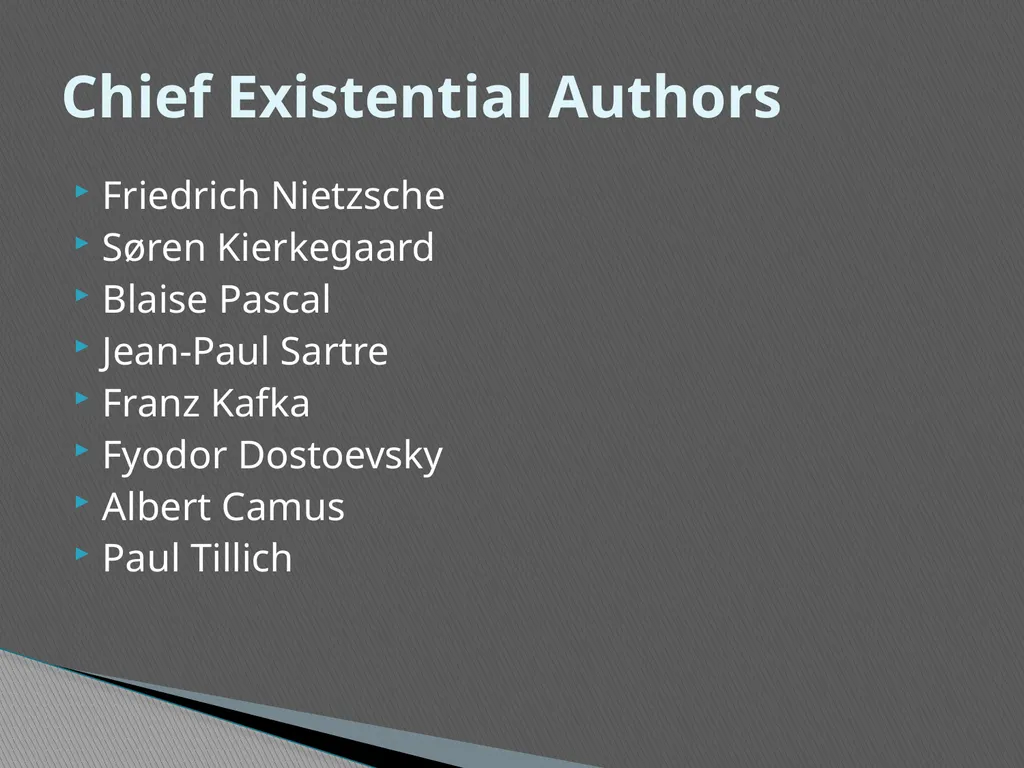
Friedrich Nietzsche
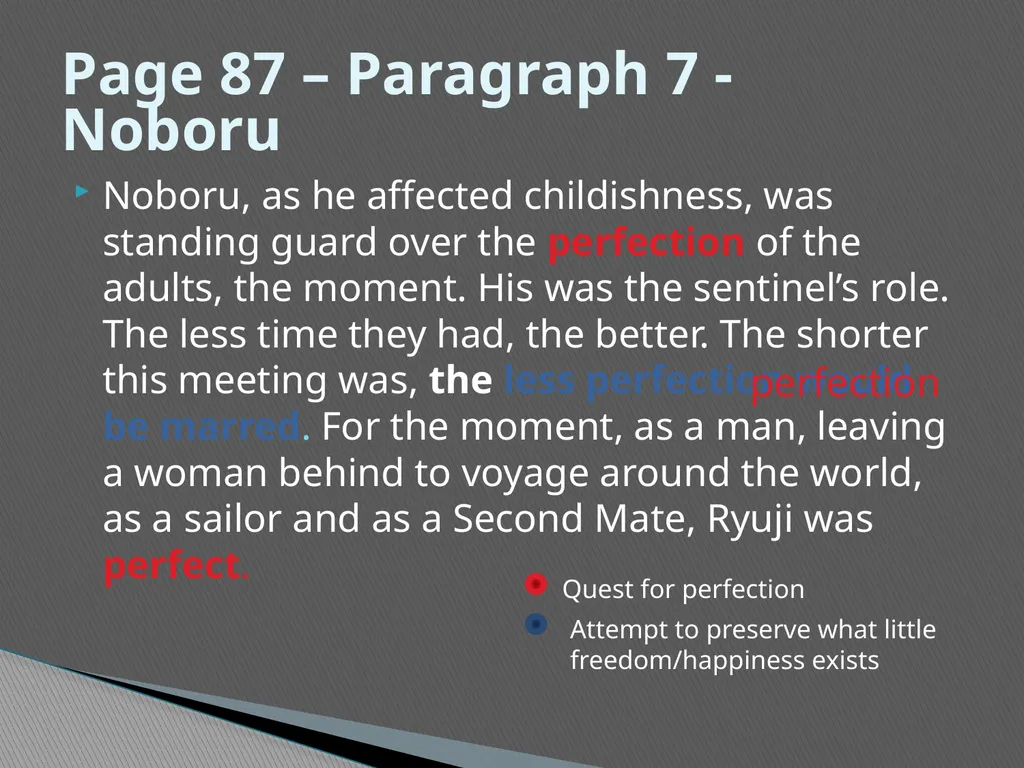
Søren Kierkegaard
Blaise Pascal
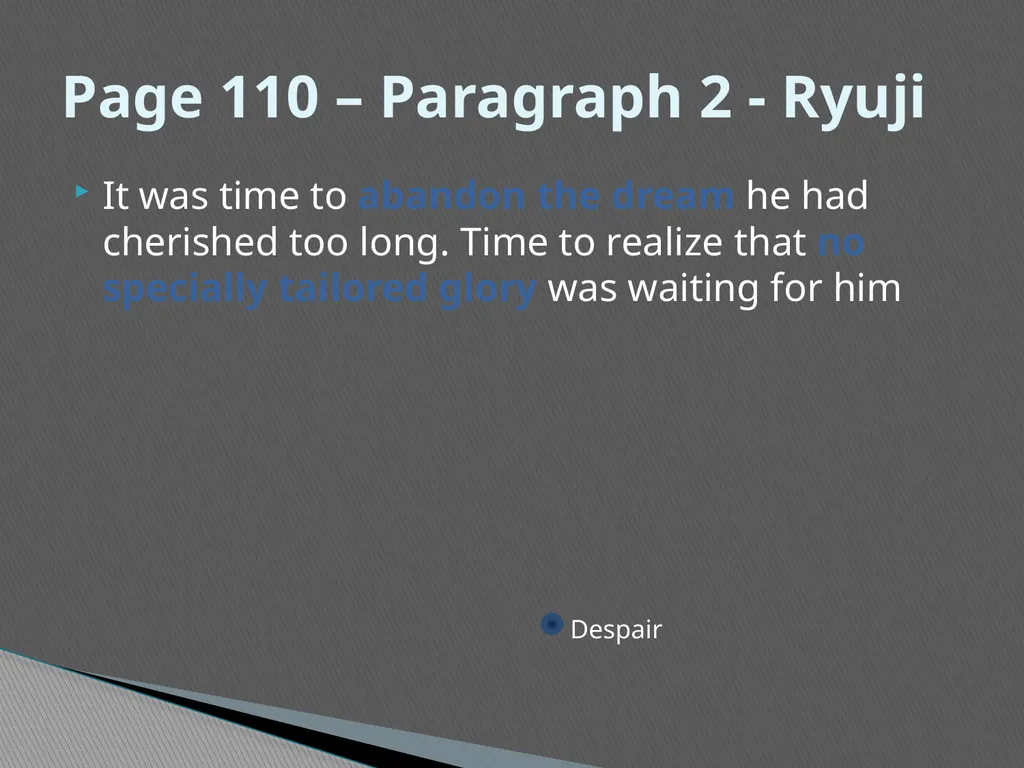
Jean-Paul Sartre
Franz Kafka
Fyodor Dostoevsky
Albert Camus
Paul Tillich Chief Existential Authors<br>
Søren Kierkegaard
Blaise Pascal
Jean-Paul Sartre
Franz Kafka
Fyodor Dostoevsky
Albert Camus
Paul Tillich Chief Existential Authors<br>
07
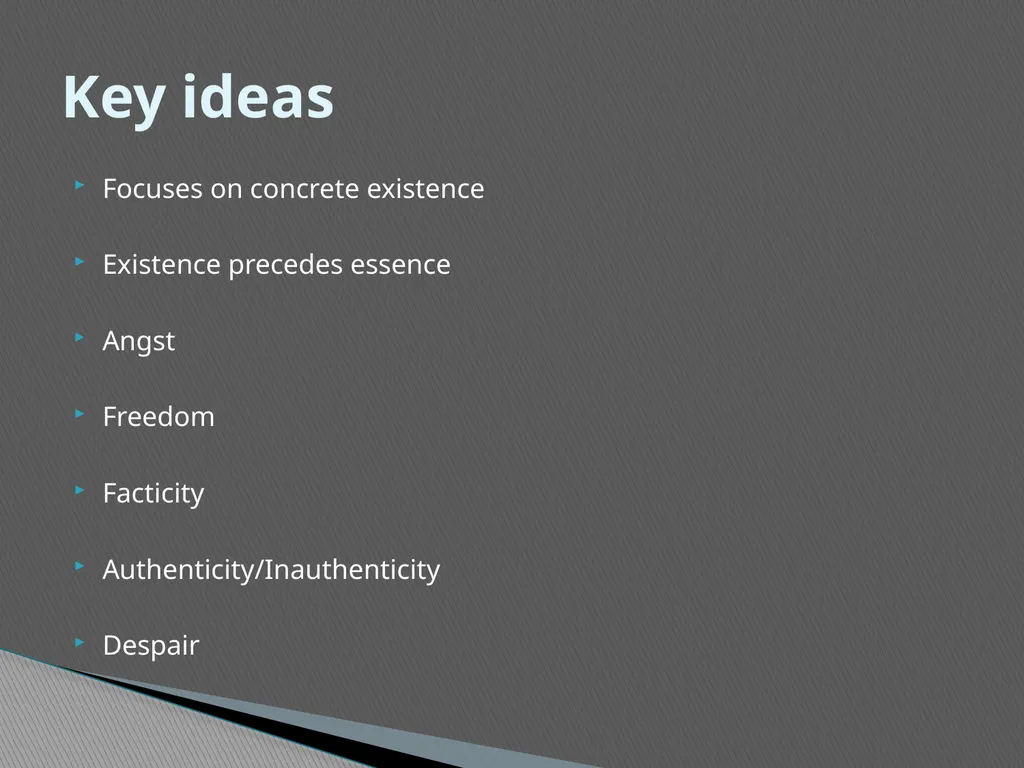
Focuses on concrete existence
Existence precedes essence
Angst
Freedom
Facticity
Authenticity/Inauthenticity
Despair Key ideas<br>
Existence precedes essence
Angst
Freedom
Facticity
Authenticity/Inauthenticity
Despair Key ideas<br>
08
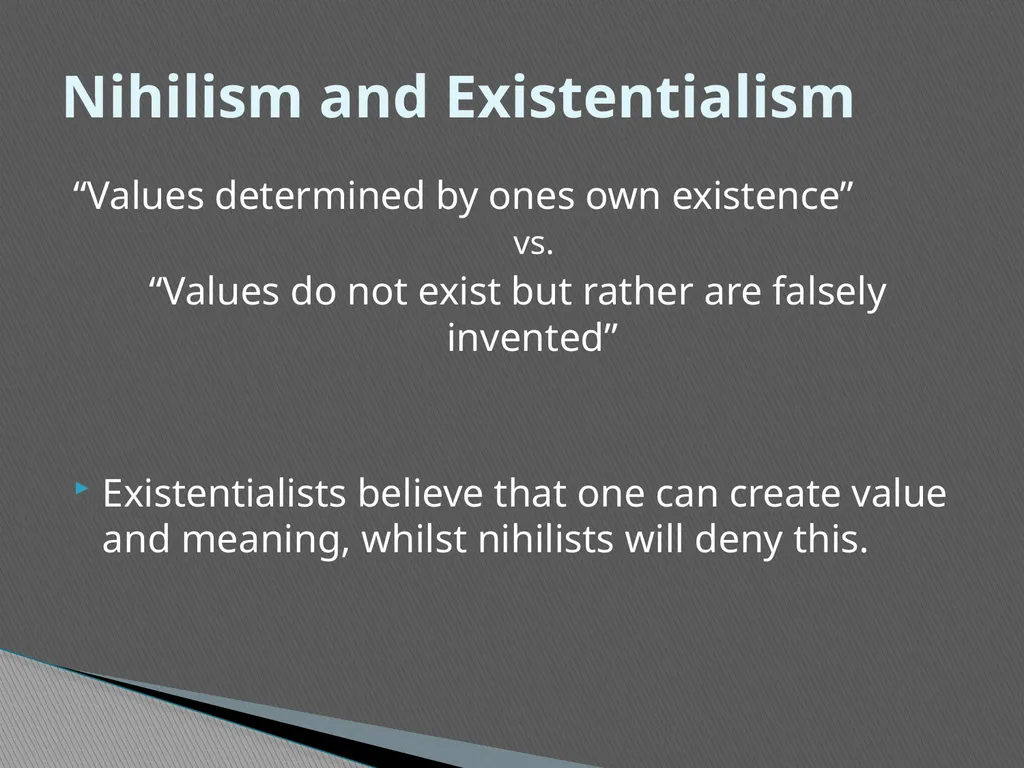
“Values determined by ones own existence”
vs.
“Values do not exist but rather are falsely invented”
Existentialists believe that one can create value and meaning, whilst nihilists will deny this. Nihilism and Existentialism<br>
vs.
“Values do not exist but rather are falsely invented”
Existentialists believe that one can create value and meaning, whilst nihilists will deny this. Nihilism and Existentialism<br>
09
Yukio Mishima followed many samurai teachings that coincide with views resembling typical European existentialism
Authentication
Life is meaningless
Lack of forward-thinking/retrospective ideas Why existentialism?<br>
Authentication
Life is meaningless
Lack of forward-thinking/retrospective ideas Why existentialism?<br>
10
Examples in the text<br>
11
If I were an amoeba, he thought, with an infinitesimal body, I could defeat ugliness. A man isn’t tiny or giant enough to defeat anything. Page 9 – Paragraph 1 - Noboru<br>
12
If I were an amoeba, he thought, with an infinitesimal body, I could defeat ugliness. A man isn’t tiny or giant enough to defeat anything. Page 9 – Paragraph 1 - Noboru Seeking authentication
The cry of despair: “There is no purpose.”<br>
The cry of despair: “There is no purpose.”<br>
13
But as the years passed, he grew indifferent to the lure of exotic lands. He found himself in the same predicament all sailors share: essentially he belonged neither to the land nor the sea. Page 16 – Paragraph 2 - Ryuji<br>
14
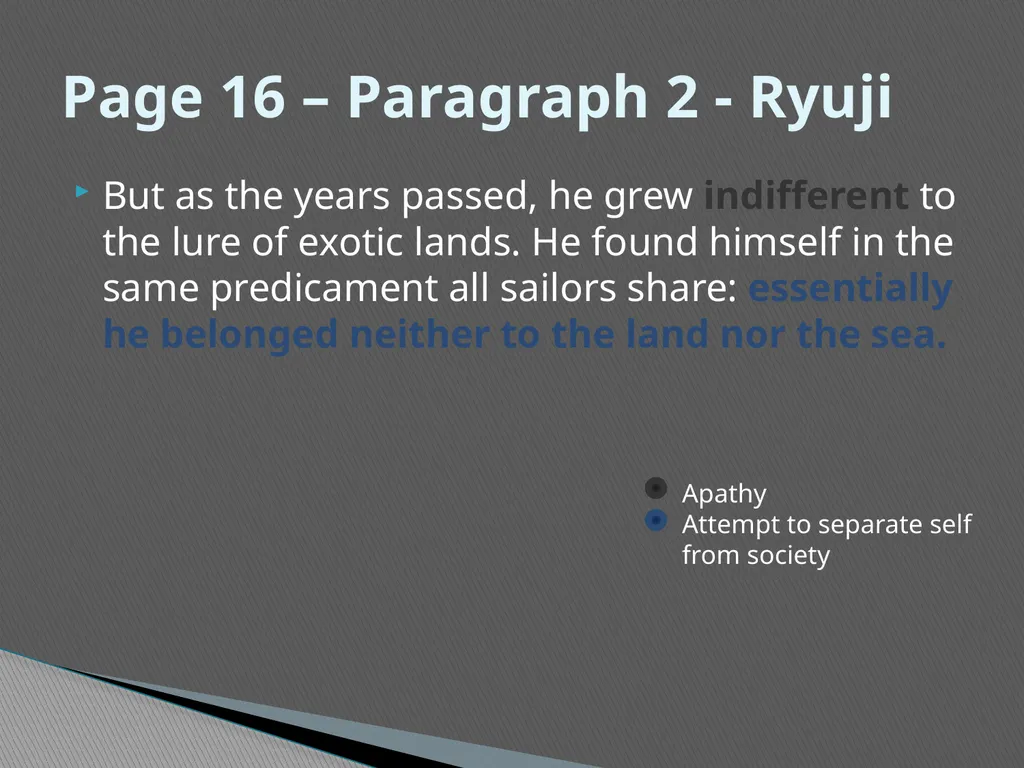
But as the years passed, he grew indifferent to the lure of exotic lands. He found himself in the same predicament all sailors share: essentially he belonged neither to the land nor the sea. Page 16 – Paragraph 2 - Ryuji Apathy
Attempt to separate self from society<br>
Attempt to separate self from society<br>
15
But life aboard ship taught him only the regularity of natural law and the dynamic stability of the wobbling world. Page 17 – Paragraph 1 - Ryuji<br>
16
But life aboard ship taught him only the regularity of natural law and the dynamic stability of the wobbling world. Page 17 – Paragraph 1 - Ryuji Separation from society<br>
17
There must be a special destiny in store for me; a glittering special-order kind no ordinary man would be permitted. Page 17 – Paragraph 3 - Ryuji<br>
18
There must be a special destiny in store for me; a glittering special-order kind no ordinary man would be permitted. Page 17 – Paragraph 3 - Ryuji Self-importance<br>
19
... And his favorite one was called “I can’t Give Up The Sailor’s Life.”
The Whistle wails and streamers tear,
Our ship slips away from the pier.
Now, the sea’s my home, I decided that
But even I must shed a tear
As I wave, boys, I wave so sad
At the harbor town where my heart was glad. Page 17 – Paragraph 5 - Ryuji<br>
The Whistle wails and streamers tear,
Our ship slips away from the pier.
Now, the sea’s my home, I decided that
But even I must shed a tear
As I wave, boys, I wave so sad
At the harbor town where my heart was glad. Page 17 – Paragraph 5 - Ryuji<br>
20
... And his favorite one was called “I Can’t Give Up The Sailor’s Life.”
The Whistle wails and streamers tear,
Our ship slips away from the pier.
Now, the sea’s my home, I decided that
But even I must shed a tear
As I wave, boys, I wave so sad
At the harbor town where by heart was glad. Page 17 – Paragraph 5 - Ryuji Despair-driven diction<br>
The Whistle wails and streamers tear,
Our ship slips away from the pier.
Now, the sea’s my home, I decided that
But even I must shed a tear
As I wave, boys, I wave so sad
At the harbor town where by heart was glad. Page 17 – Paragraph 5 - Ryuji Despair-driven diction<br>
21
Exaltation swelled in Ryuji’s voice when he touched on the misery of his life, and while he was recalling the total in his bankbook, he couldn’t help digressing from the sea’s power to and benevolence, which was the story he had longed to tell, in order to boast about his own prowess like a very ordinary man indeed. It was just another particular aspect of his vanity. Page 41 – Paragraph 2 - Ryuji<br>
22
Exaltation swelled in Ryuji’s voice when he touched on the misery of his life, and while he was recalling the total in his bankbook, he couldn’t help digressing from the sea’s power to and benevolence, which was the story he had longed to tell, in order to boast about his own prowess like a very ordinary man indeed. It was just another particular aspect of his vanity. Page 41 – Paragraph 2 - Ryuji<br>
23
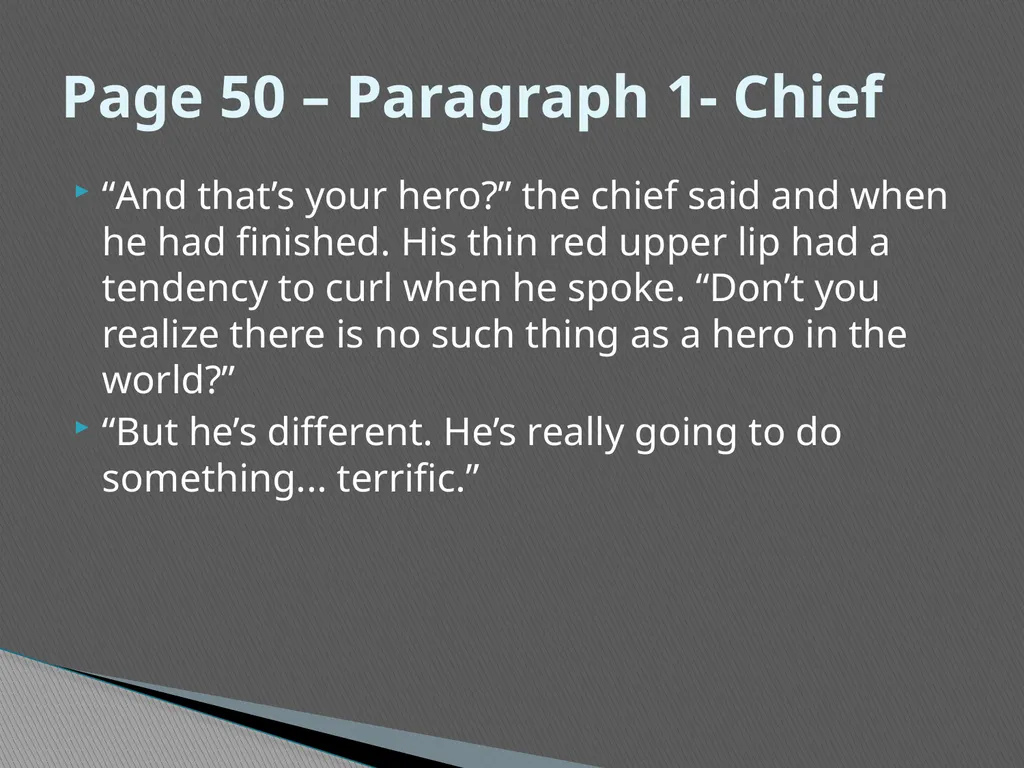
“And that’s your hero?” the chief said and when he had finished. His thin red upper lip had a tendency to curl when he spoke. “Don’t you realize there is no such thing as a hero in the world?”
“But he’s different. He’s really going to do something... terrific.” Page 50 – Paragraph 1- Chief<br>
“But he’s different. He’s really going to do something... terrific.” Page 50 – Paragraph 1- Chief<br>
24
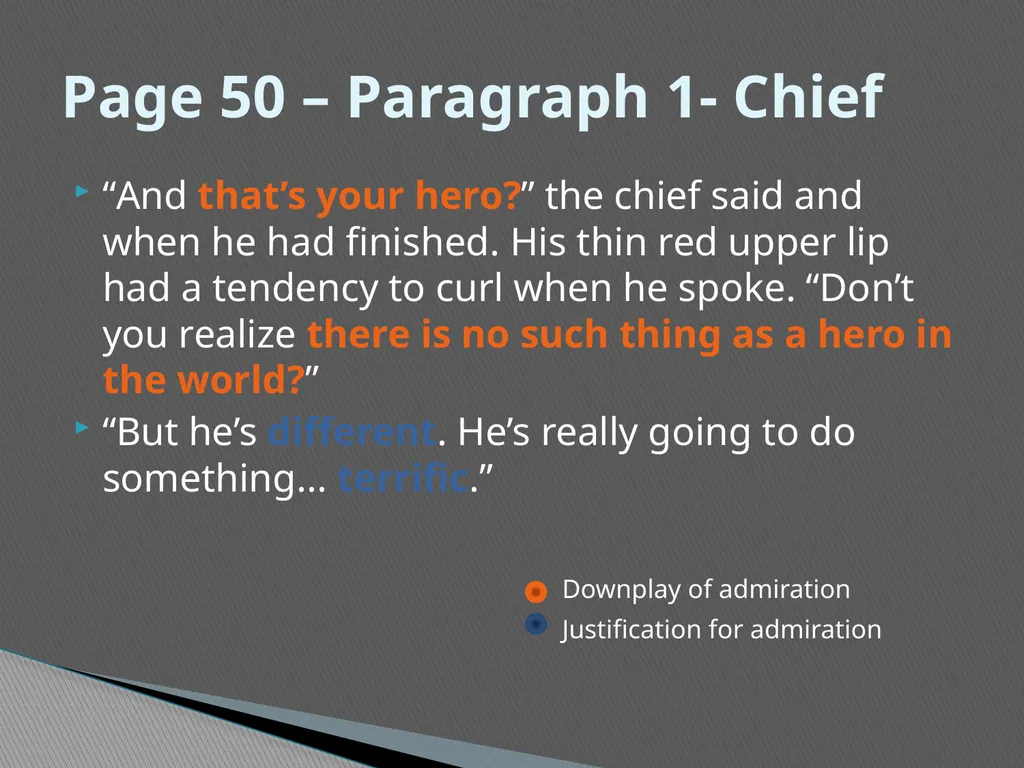
“And that’s your hero?” the chief said and when he had finished. His thin red upper lip had a tendency to curl when he spoke. “Don’t you realize there is no such thing as a hero in the world?”
“But he’s different. He’s really going to do something... terrific.” Page 50 – Paragraph 1- Chief Justification for admiration Downplay of admiration<br>
“But he’s different. He’s really going to do something... terrific.” Page 50 – Paragraph 1- Chief Justification for admiration Downplay of admiration<br>
25
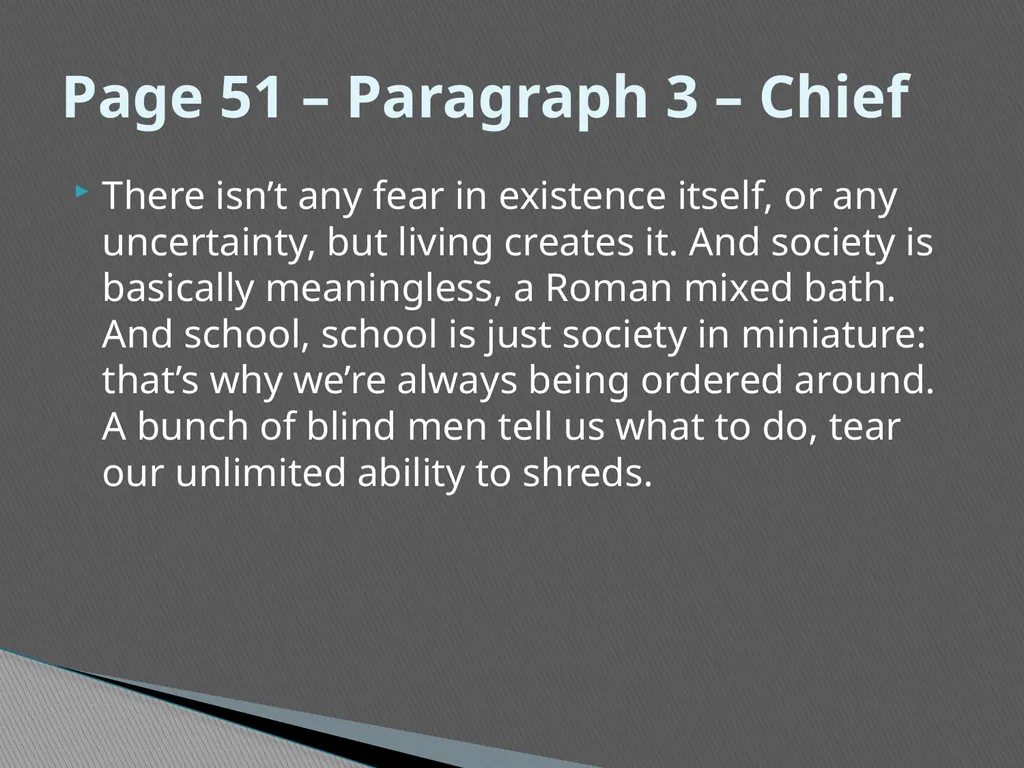
There isn’t any fear in existence itself, or any uncertainty, but living creates it. And society is basically meaningless, a Roman mixed bath. And school, school is just society in miniature: that’s why we’re always being ordered around. A bunch of blind men tell us what to do, tear our unlimited ability to shreds. Page 51 – Paragraph 3 – Chief<br>
26
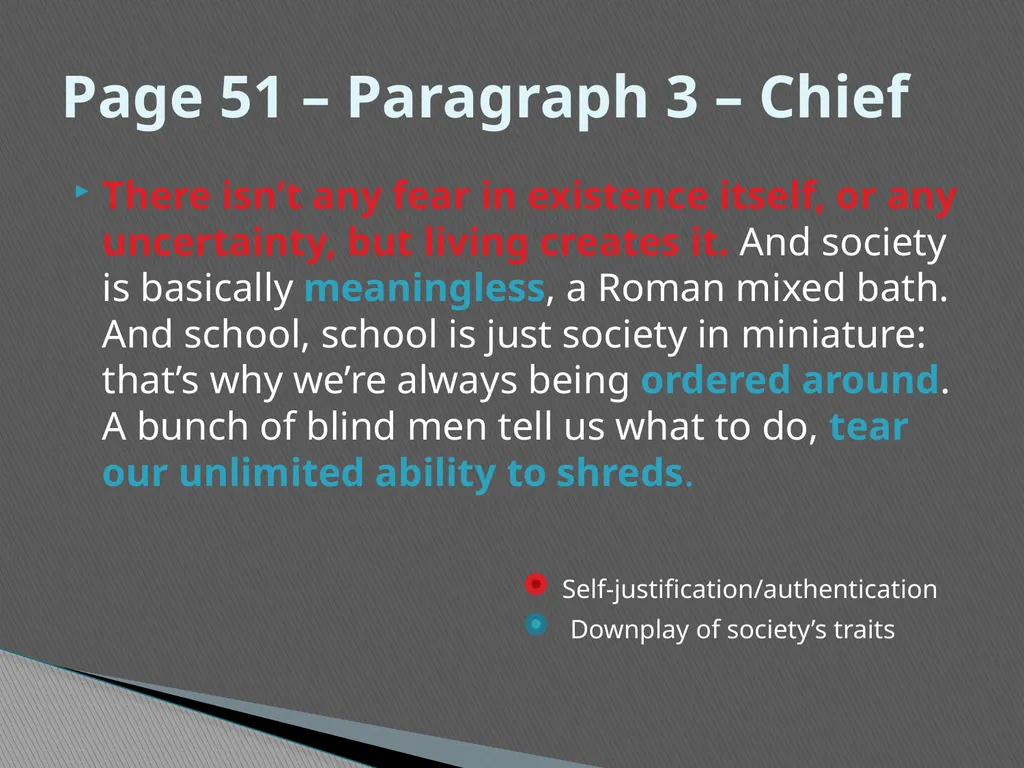
There isn’t any fear in existence itself, or any uncertainty, but living creates it. And society is basically meaningless, a Roman mixed bath. And school, school is just society in miniature: that’s why we’re always being ordered around. A bunch of blind men tell us what to do, tear our unlimited ability to shreds. Page 51 – Paragraph 3 – Chief Downplay of society’s traits Self-justification/authentication<br>
27
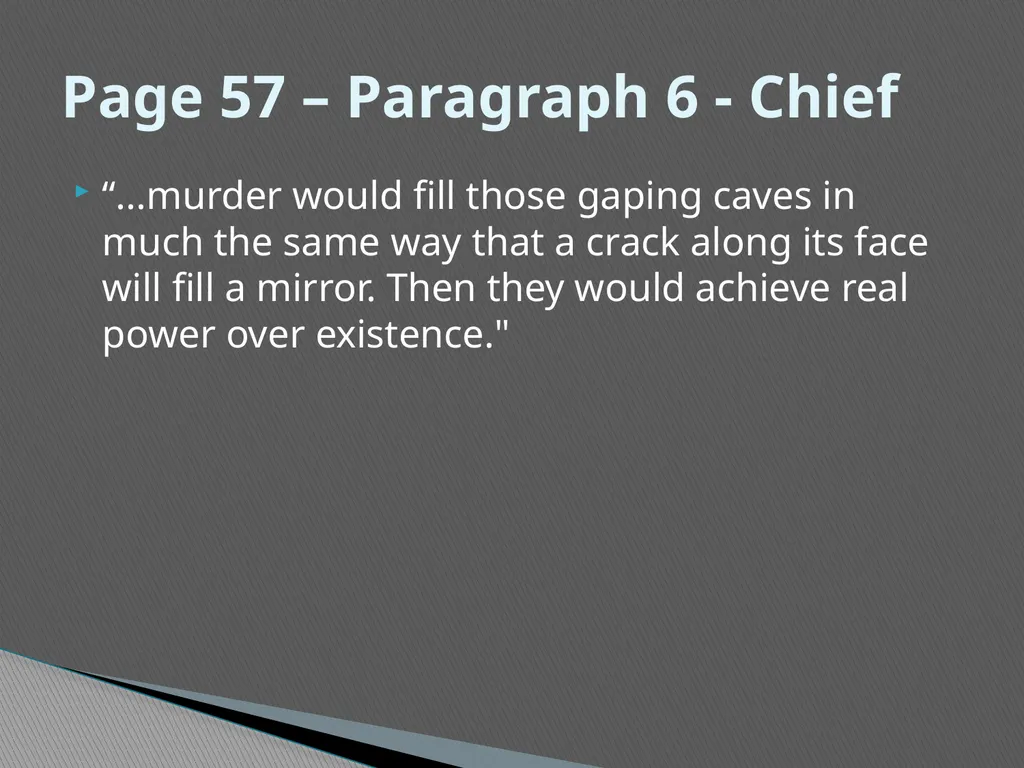
“...murder would fill those gaping caves in much the same way that a crack along its face will fill a mirror. Then they would achieve real power over existence." Page 57 – Paragraph 6 - Chief<br>
28
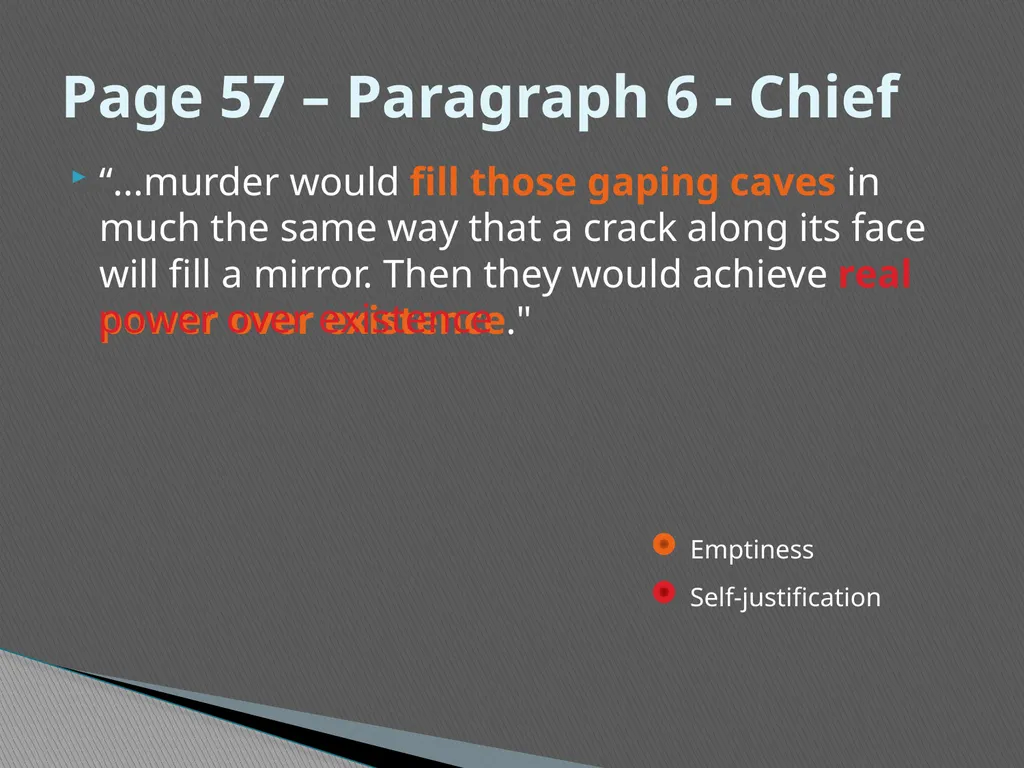
“...murder would fill those gaping caves in much the same way that a crack along its face will fill a mirror. Then they would achieve real power over existence." Page 57 – Paragraph 6 - Chief Self-justification power over existence Emptiness<br>
29
The death had transfigured the kitten into a perfect, autonomous world. Page 61 – Paragraph 3 - Cat<br>
30
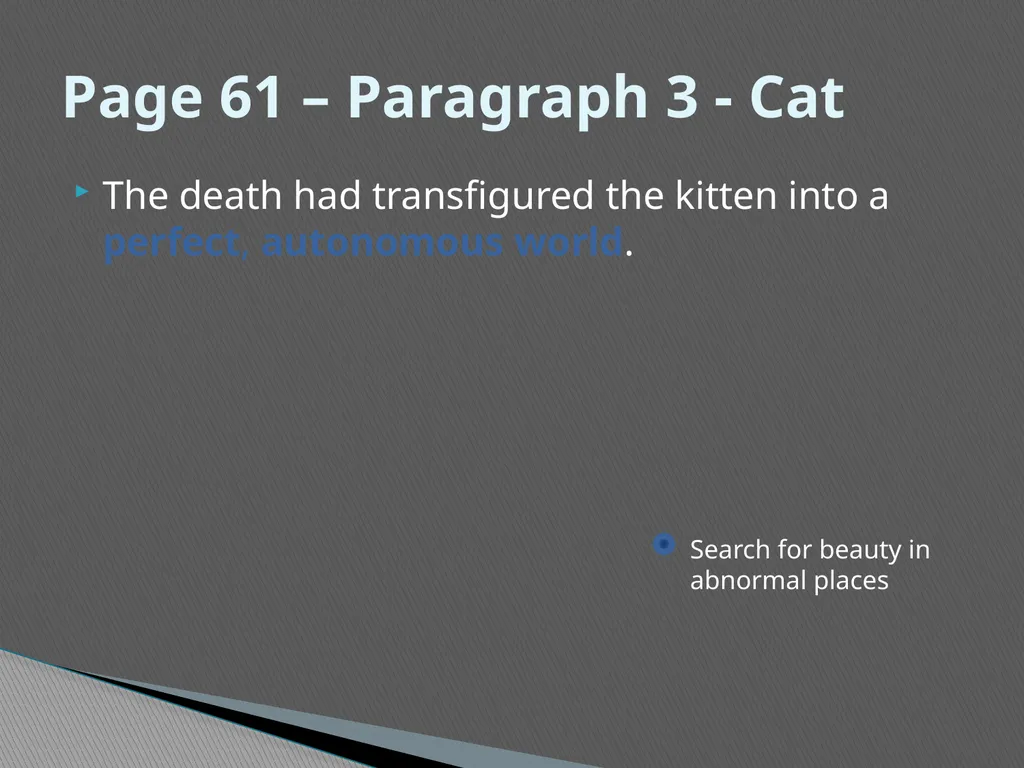
The death had transfigured the kitten into a perfect, autonomous world. Page 61 – Paragraph 3 - Cat Search for beauty in abnormal places<br>
31
Noboru, as he affected childishness, was standing guard over the perfection of the adults, the moment. His was the sentinel’s role. The less time they h ad, the better. The shorter this meeting was, the less perfection would be marred. For the moment, as a man, leaving a woman behind to voyage around the world, as a sailor and as a Second Mate, Ryuji was perfect. Page 87 – Paragraph 7 - Noboru<br>
32
Noboru, as he affected childishness, was standing guard over the perfection of the adults, the moment. His was the sentinel’s role. The less time they had, the better. The shorter this meeting was, the less perfection would be marred. For the moment, as a man, leaving a woman behind to voyage around the world, as a sailor and as a Second Mate, Ryuji was perfect. Page 87 – Paragraph 7 - Noboru Attempt to preserve what little freedom/happiness exists Quest for perfection perfection<br>
33
It was time to abandon the dream he had cherished too long. Time to realize that no specially tailored glory was waiting for him" (110). Page 110 – Paragraph 2 - Ryuji<br>
34
It was time to abandon the dream he had cherished too long. Time to realize that no specially tailored glory was waiting for him Page 110 – Paragraph 2 - Ryuji Despair<br>
35
“The only people in this world I really trust are my fans – even if they do forget you so fast,” Yoriko mumbled as she lit an imported women’s cigarette. Page 121 – Paragraph 3- Yoriko<br>
36
“The only people in this world I really trust are my fans – even if they do forget you so fast,” Yoriko mumbled as she lit an imported women’s cigarette. Page 121 – Paragraph 3- Yoriko Justification of lifestyle<br>
37
There is no such thing as a good father because the role itself is bad. Strict fathers, soft fathers, nice moderate fathers – one’s as bad as another. They stand in the way of our progress while they try to burden us with their inferiority complexes and their unrealized aspirations and their resentments, and their ideals, and the weaknesses they’ve never told anyone about, and their sins and their sweeter-than-honey dreams, and the maxims they’ve never had the courage to live by – they’d like to unload the all that silly crap on us, all of it! Page 136 – Paragraph 5 - Boys<br>
38
There is no such thing as a good father because the role itself is bad. Strict fathers, soft fathers, nice moderate fathers – one’s as bad as another. They stand in the way of our progress while they try to burden us with their inferiority complexes and their unrealized aspirations and their resentments, and their ideals, and the weaknesses they’ve never told anyone about, and their sins and their sweeter-than-honey dreams, and the maxims they’ve never had the courage to live by – they’d like to unload the all that silly crap on us, all of it! Page 136 – Paragraph 5 - Boys Angst<br>
39
"All six of us are geniuses. And the world, as you know, is empty” Page 161 – Paragraph 2 - Chief<br>
40
“All six of us are geniuses. And the world, as you know, is empty.” Page 161 – Paragraph 2 - Chief Authentication/inauthentication<br>
41
Right, he knew, in terms of a father’s moral obligation. Most books and magazines would agree. Page 171 – Paragraph 1 - Ryuji<br>
42
Right, he knew, in terms of a father’s moral obligation. Most books and magazines would agree. Page 171 – Paragraph 1 - Ryuji Justification<br>
43
Page 179-181 – Paragraph 5 Gradually, as he talked to the boys, Ryuji had come to understand himself as Noboru imagined him… Now perilous death had rejected him. And glory, no doubt of that… “Want some tea?”… Still immersed in his dream, he drank down the tepid tea.<br>
44
Speculations of Mishima’s Stance<br>
45
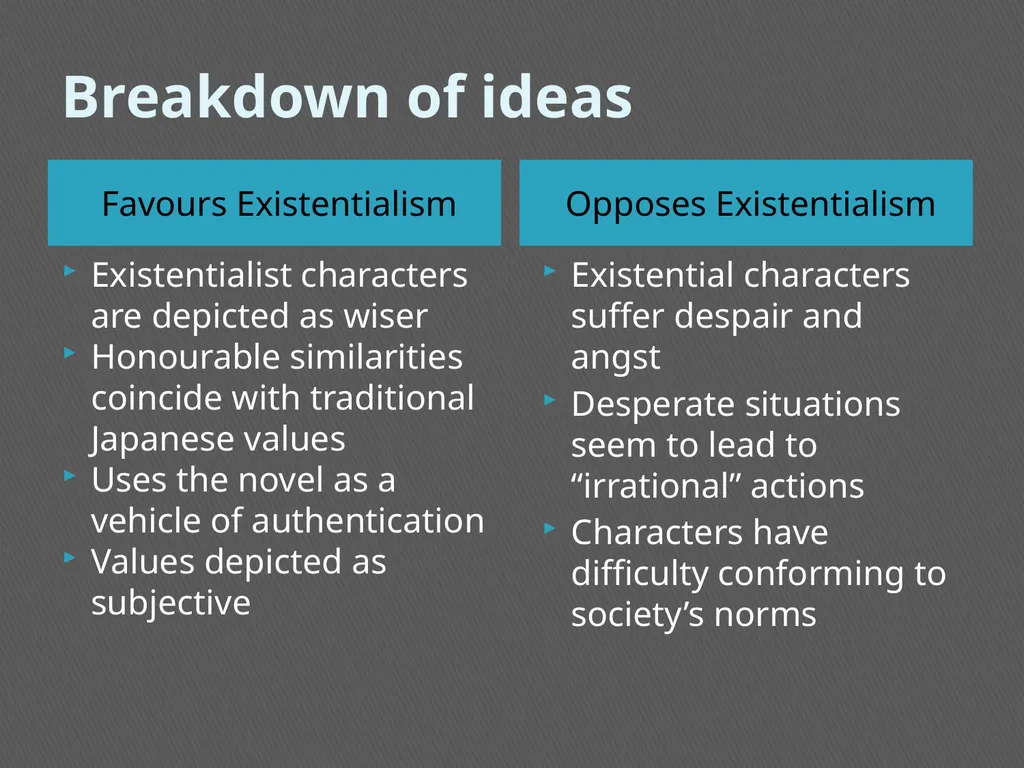
Breakdown of ideas Favours Existentialism Opposes Existentialism Existential characters suffer despair and angst
Desperate situations seem to lead to “irrational” actions
Characters have difficulty conforming to society’s norms Existentialist characters are depicted as wiser
Honourable similarities coincide with traditional Japanese values
Uses the novel as a vehicle of authentication
Values depicted as subjective<br>
Desperate situations seem to lead to “irrational” actions
Characters have difficulty conforming to society’s norms Existentialist characters are depicted as wiser
Honourable similarities coincide with traditional Japanese values
Uses the novel as a vehicle of authentication
Values depicted as subjective<br>
46
Jean Paul Sartre –
Literary and Philosophical Essays He stares at death with passionate attention and this fascination liberates him.<br>