
Exploring Global Business The Basis for



Description: Exploring Global Business The Basis for International Business International business: All business activities that involve exchanges across national boundaries Is international business good? Absolutely! No single country (or business) has
Related Topics
Download Presentation
"Exploring Global Business The Basis for" is the property of its rightful owner. Permission is granted to download and print the materials on this website for personal, non-commercial use only, and to display it on your personal computer provided you do not modify the materials and that you retain all copyright notices contained in the materials. By downloading content from our website, you accept the terms of this agreement.
Presentation Transcript
slide1. Exploring Global Business<br>
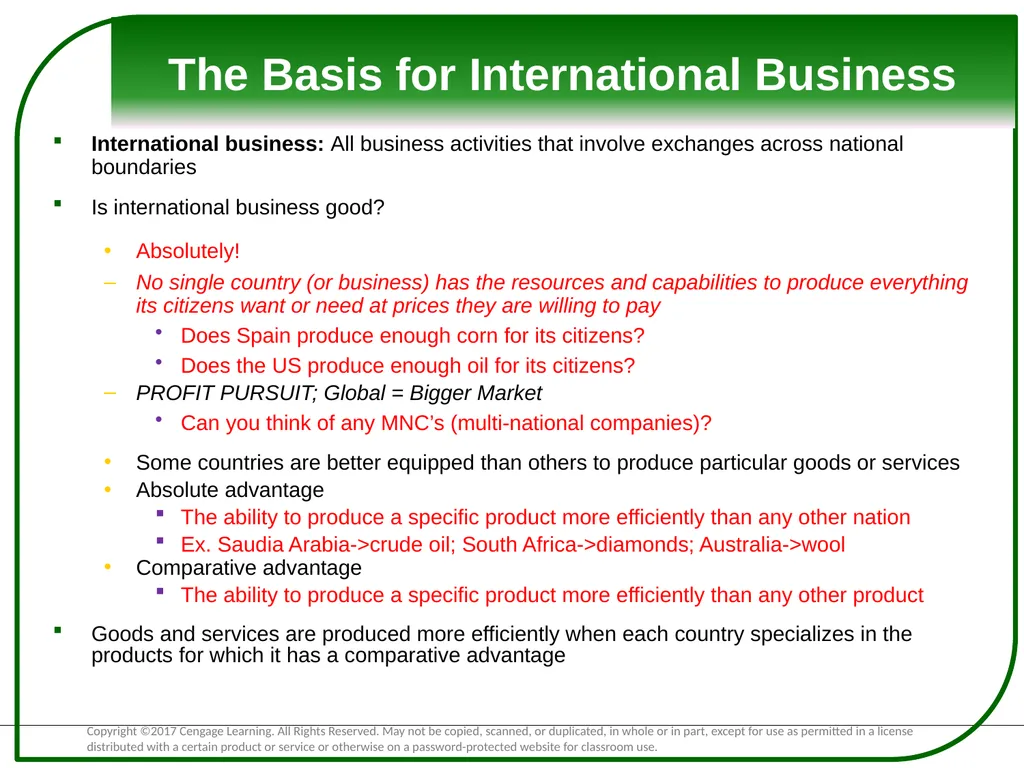
slide2. The Basis for International Business International business: All business activities that involve exchanges across national boundaries
Is international business good?
Absolutely!
No single country (or business) has the resources and capabilities to produce everything its citizens want or need at prices they are willing to pay
Does Spain produce enough corn for its citizens?
Does the US produce enough oil for its citizens?
PROFIT PURSUIT; Global = Bigger Market
Can you think of any MNC’s (multi-national companies)?
Some countries are better equipped than others to produce particular goods or services
Absolute advantage
The ability to produce a specific product more efficiently than any other nation
Ex. Saudia Arabia->crude oil; South Africa->diamonds; Australia->wool
Comparative advantage
The ability to produce a specific product more efficiently than any other product
Goods and services are produced more efficiently when each country specializes in the products for which it has a comparative advantage<br>
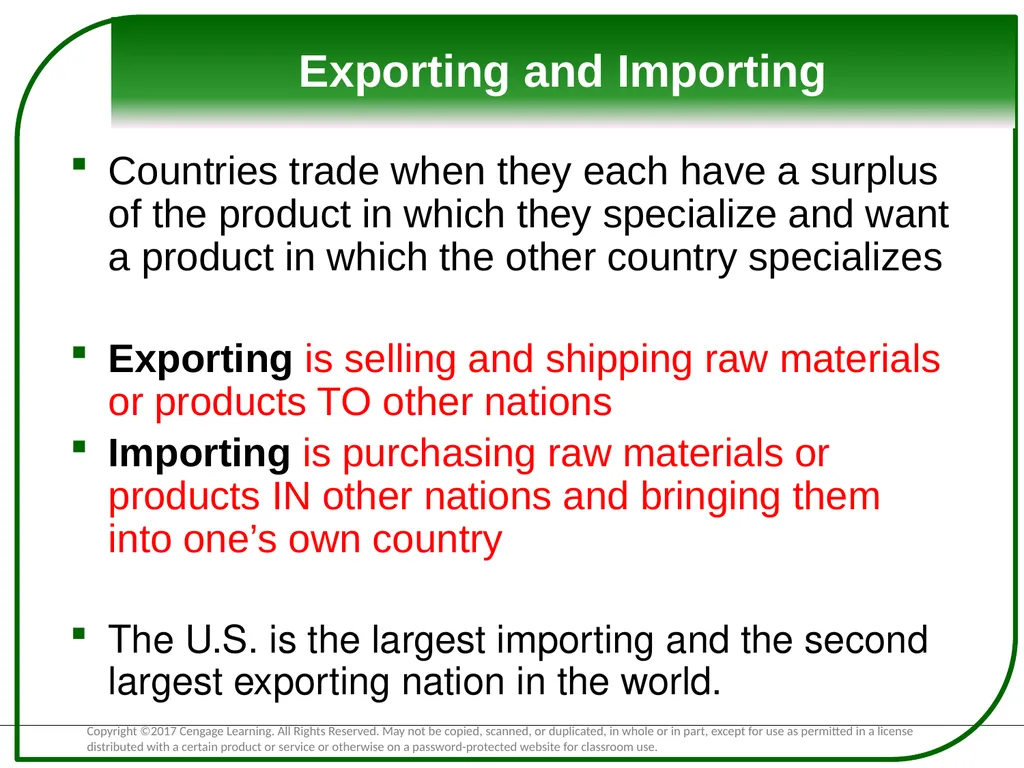
slide3. Exporting and Importing Countries trade when they each have a surplus of the product in which they specialize and want a product in which the other country specializes
Exporting is selling and shipping raw materials or products TO other nations
Importing is purchasing raw materials or products IN other nations and bringing them into one’s own country
The U.S. is the largest importing and the second largest exporting nation in the world.<br>
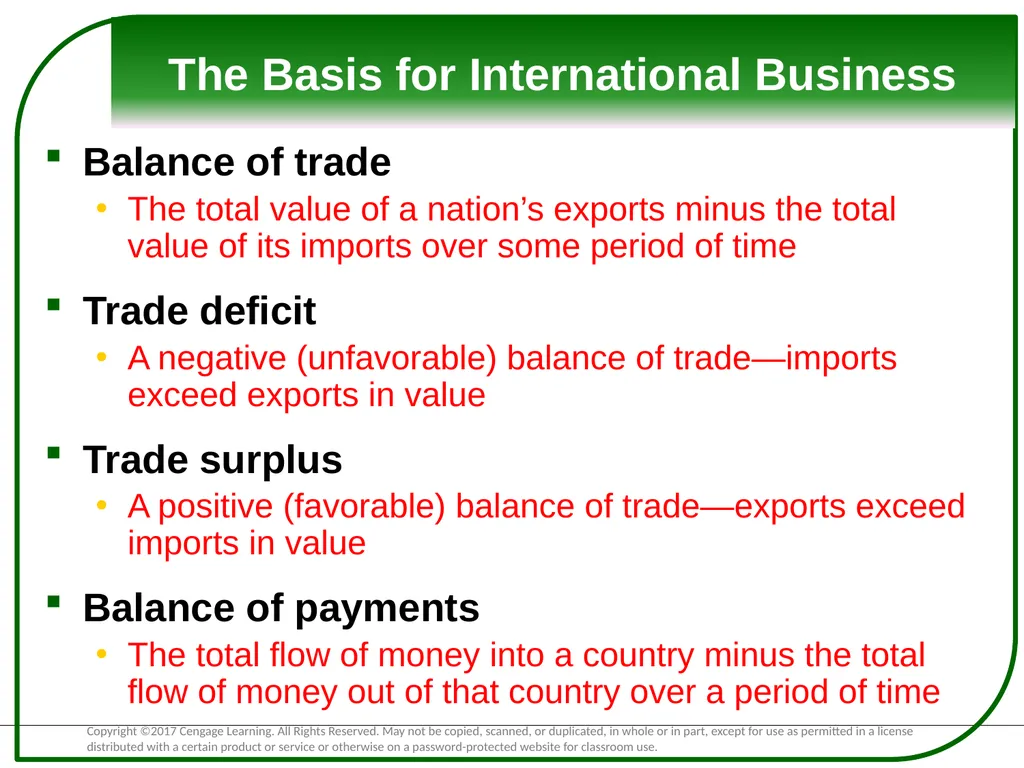
slide4. The Basis for International Business Balance of trade
The total value of a nation’s exports minus the total value of its imports over some period of time
Trade deficit
A negative (unfavorable) balance of trade—imports exceed exports in value
Trade surplus
A positive (favorable) balance of trade—exports exceed imports in value
Balance of payments
The total flow of money into a country minus the total flow of money out of that country over a period of time<br>
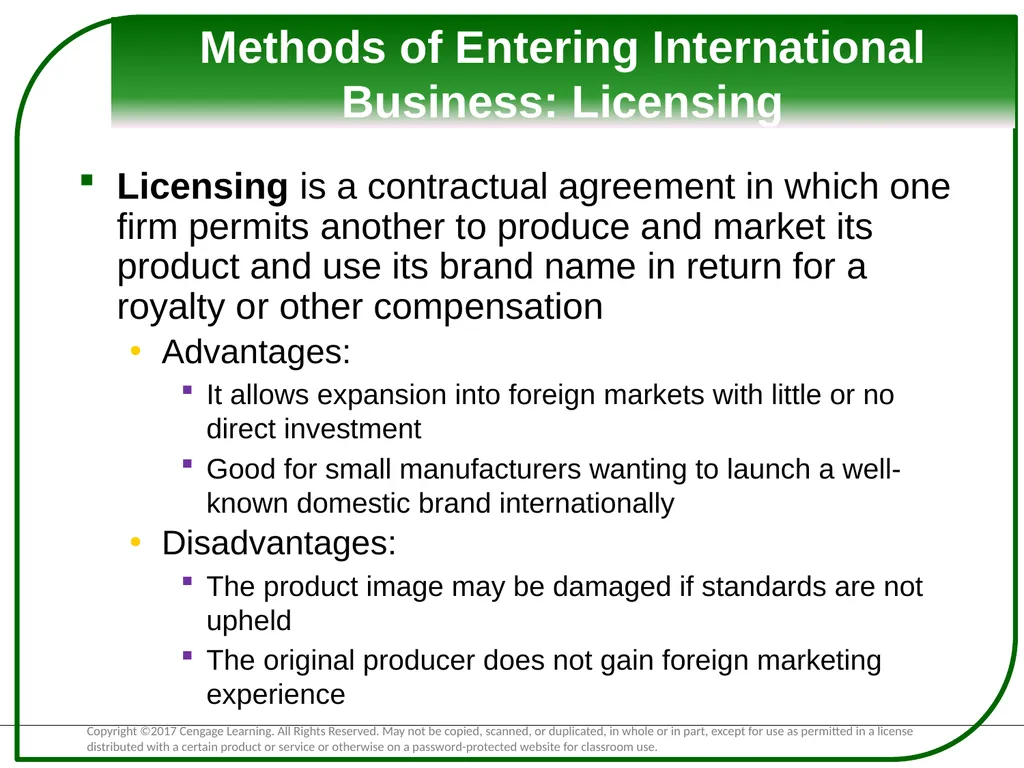
slide5. Methods of Entering International Business: Licensing Licensing is a contractual agreement in which one firm permits another to produce and market its product and use its brand name in return for a royalty or other compensation
Advantages:
It allows expansion into foreign markets with little or no direct investment
Good for small manufacturers wanting to launch a well-known domestic brand internationally
Disadvantages:
The product image may be damaged if standards are not upheld
The original producer does not gain foreign marketing experience<br>
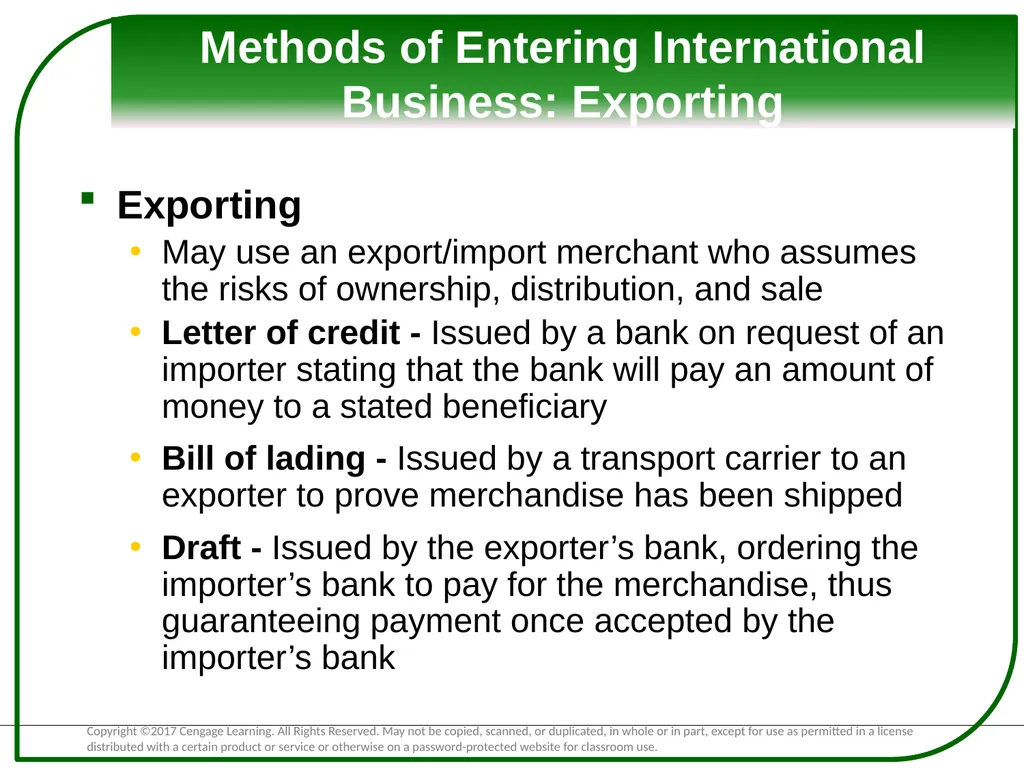
slide6. Methods of Entering International Business: Exporting Exporting
May use an export/import merchant who assumes the risks of ownership, distribution, and sale
Letter of credit - Issued by a bank on request of an importer stating that the bank will pay an amount of money to a stated beneficiary
Bill of lading - Issued by a transport carrier to an exporter to prove merchandise has been shipped
Draft - Issued by the exporter’s bank, ordering the importer’s bank to pay for the merchandise, thus guaranteeing payment once accepted by the importer’s bank<br>
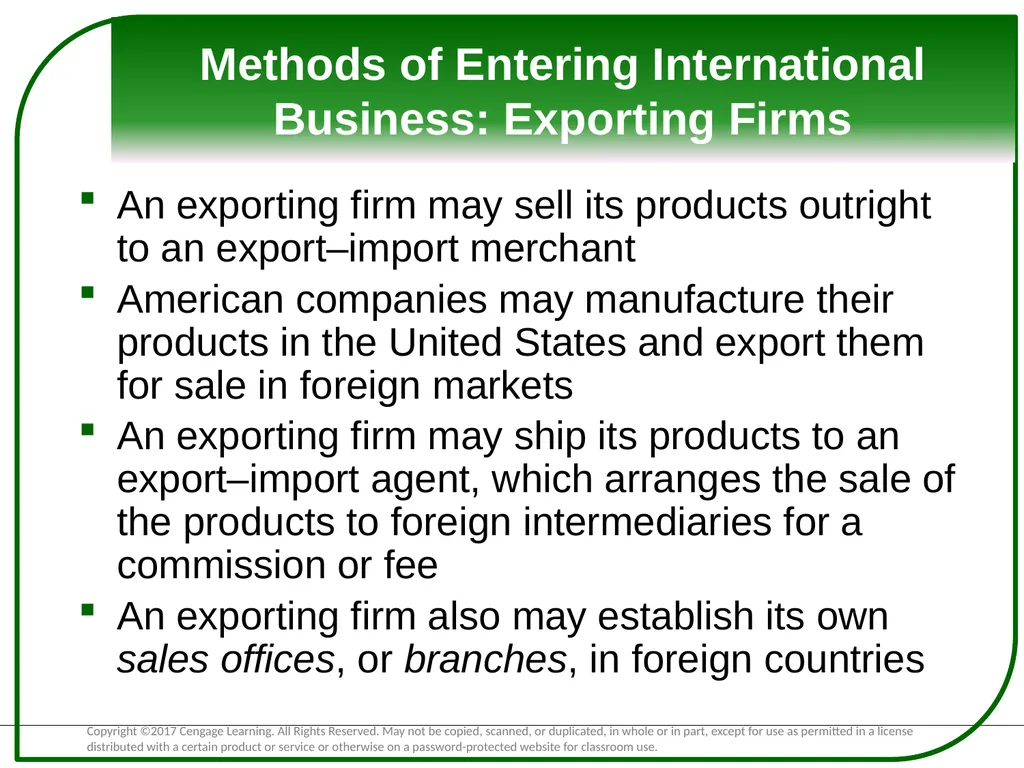
slide7. Methods of Entering International Business: Exporting Firms An exporting firm may sell its products outright to an export–import merchant
American companies may manufacture their products in the United States and export them for sale in foreign markets
An exporting firm may ship its products to an export–import agent, which arranges the sale of the products to foreign intermediaries for a commission or fee
An exporting firm also may establish its own sales offices, or branches, in foreign countries<br>
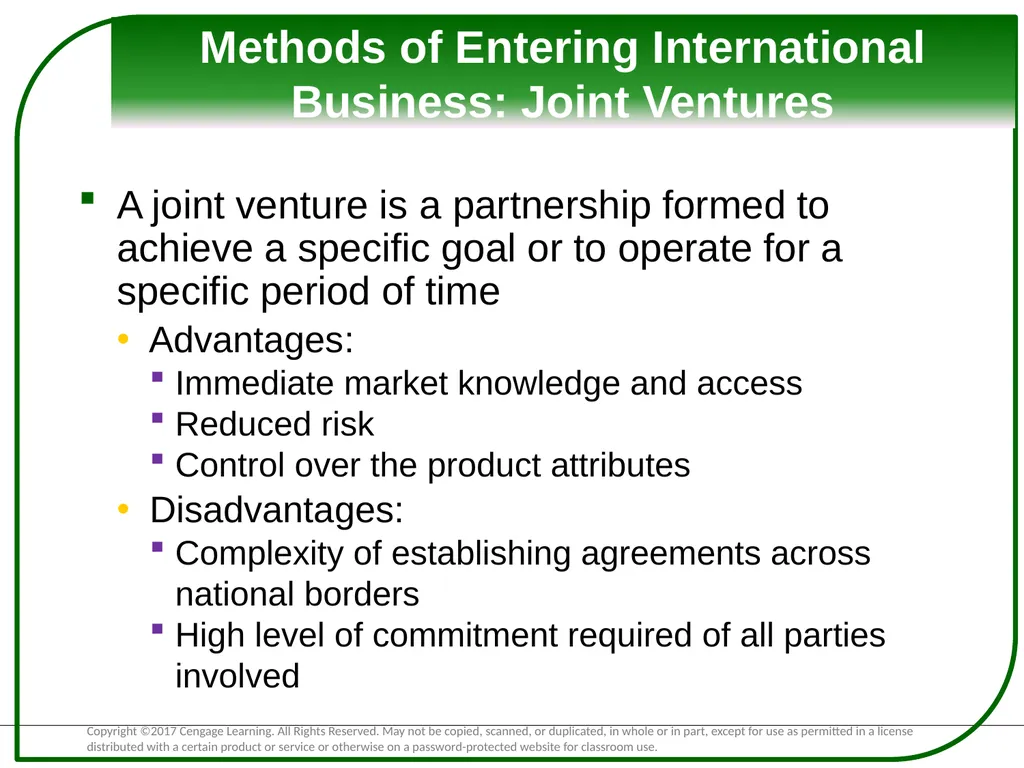
slide8. Methods of Entering International Business: Joint Ventures A joint venture is a partnership formed to achieve a specific goal or to operate for a specific period of time
Advantages:
Immediate market knowledge and access
Reduced risk
Control over the product attributes
Disadvantages:
Complexity of establishing agreements across national borders
High level of commitment required of all parties involved<br>
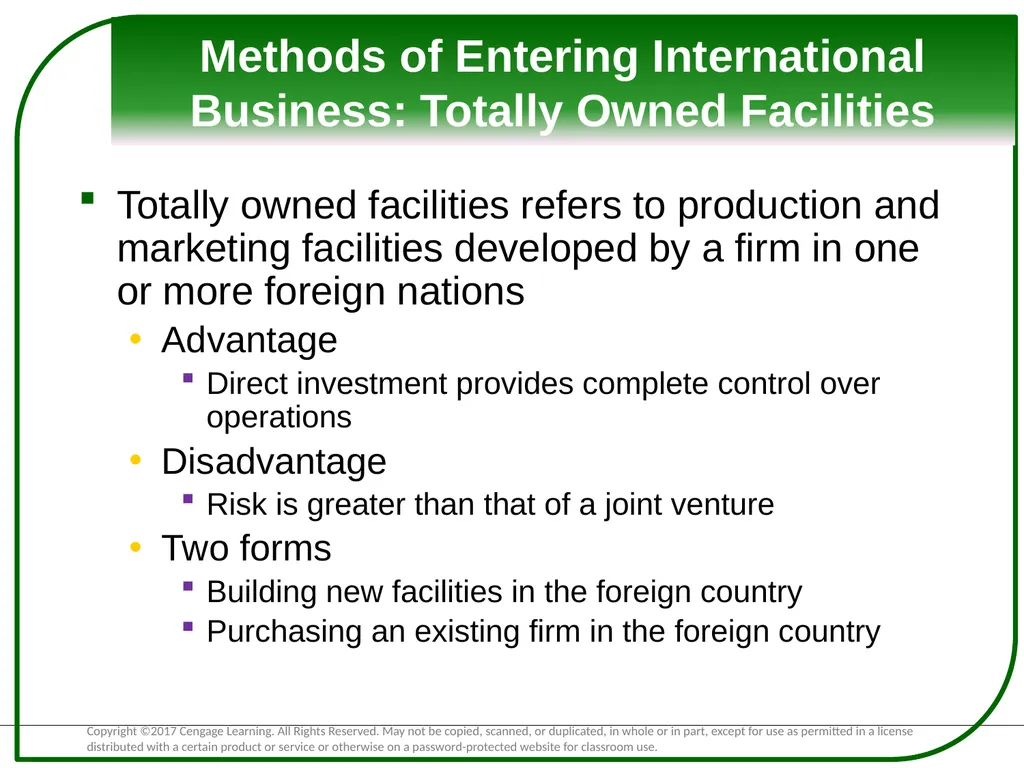
slide9. Methods of Entering International Business: Totally Owned Facilities Totally owned facilities refers to production and marketing facilities developed by a firm in one or more foreign nations
Advantage
Direct investment provides complete control over operations
Disadvantage
Risk is greater than that of a joint venture
Two forms
Building new facilities in the foreign country
Purchasing an existing firm in the foreign country<br>
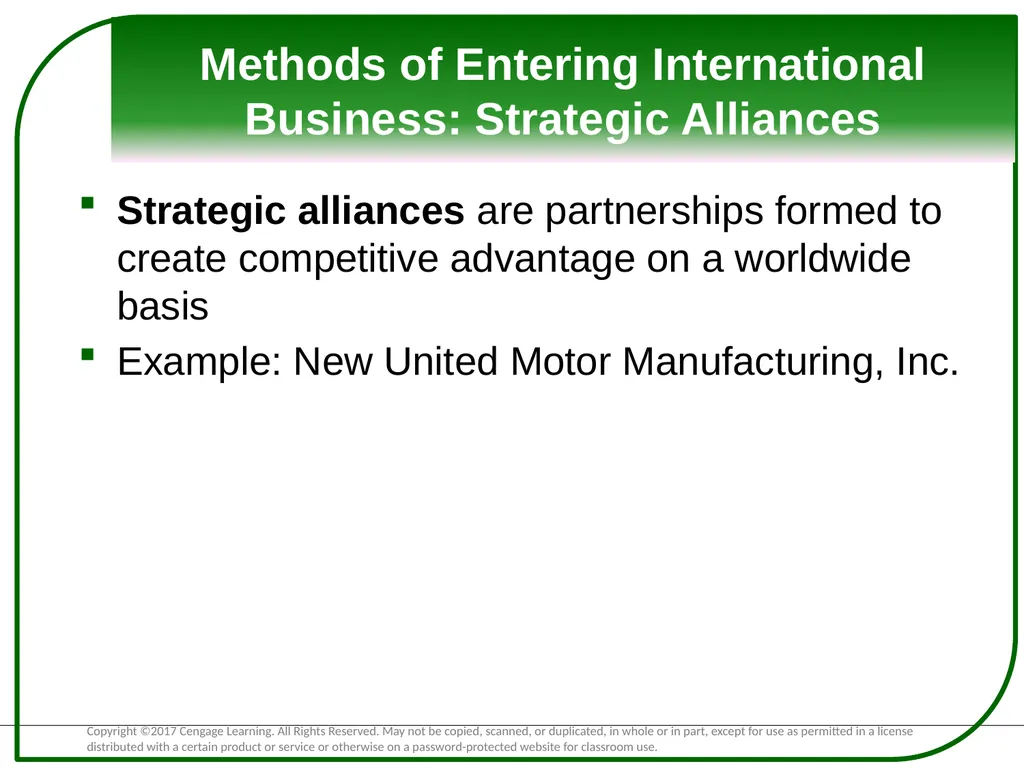
slide10. Methods of Entering International Business: Strategic Alliances Strategic alliances are partnerships formed to create competitive advantage on a worldwide basis
Example: New United Motor Manufacturing, Inc.<br>
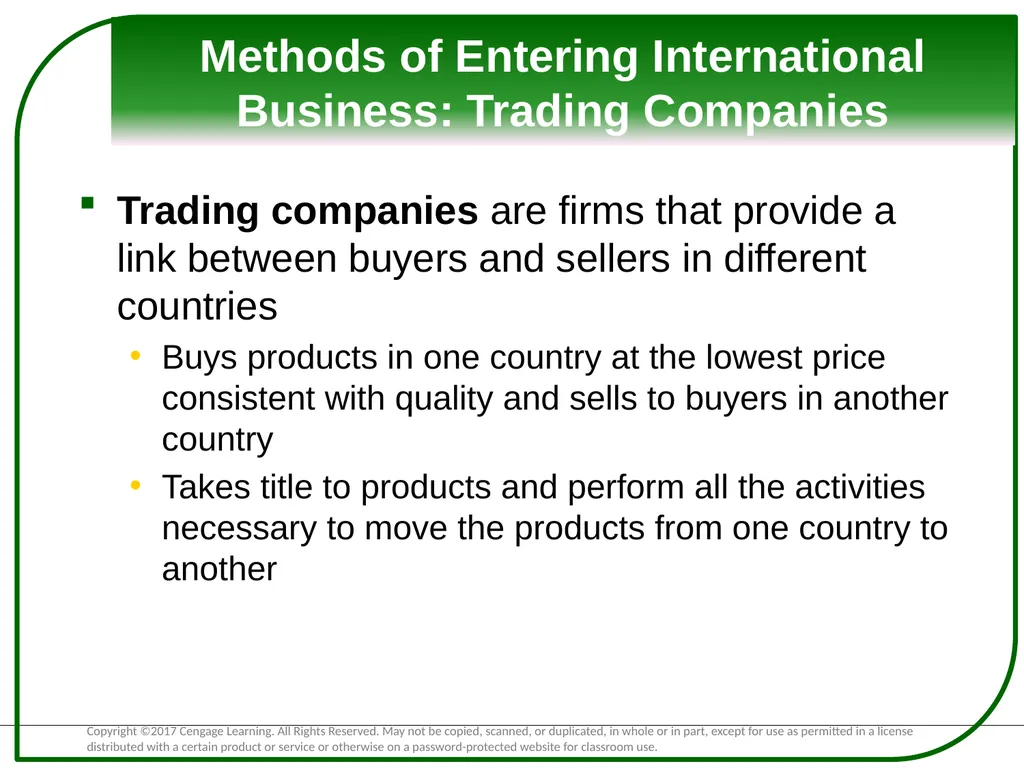
slide11. Methods of Entering International Business: Trading Companies Trading companies are firms that provide a link between buyers and sellers in different countries
Buys products in one country at the lowest price consistent with quality and sells to buyers in another country
Takes title to products and perform all the activities necessary to move the products from one country to another<br>
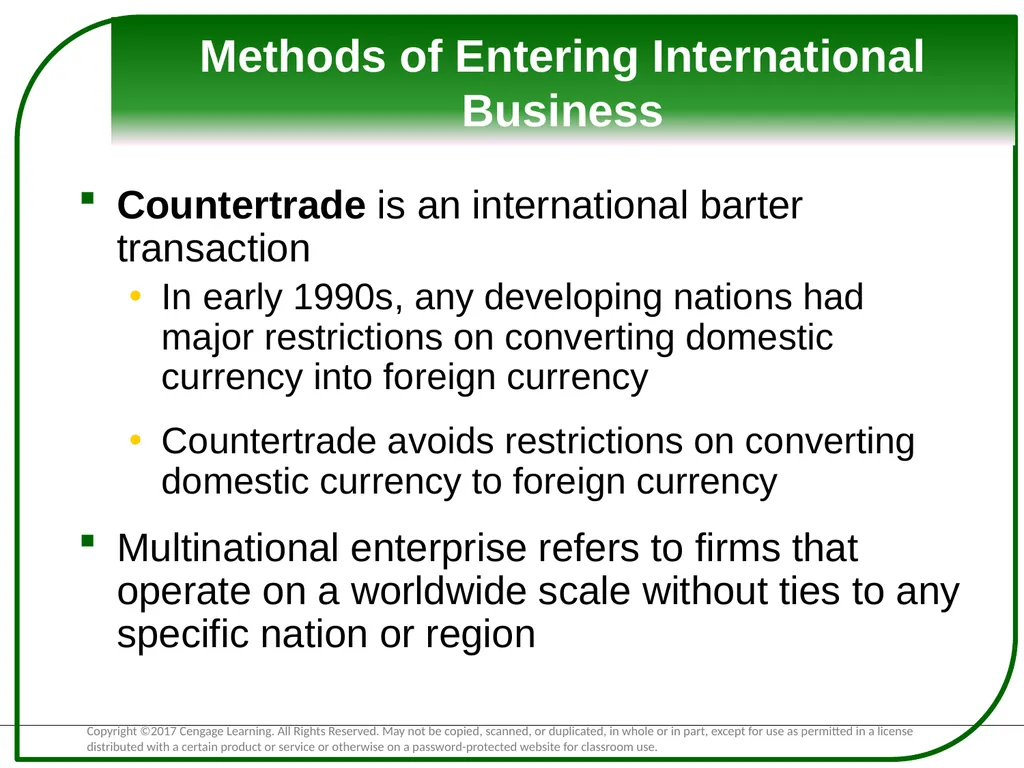
slide12. Methods of Entering International Business Countertrade is an international barter transaction
In early 1990s, any developing nations had major restrictions on converting domestic currency into foreign currency
Countertrade avoids restrictions on converting domestic currency to foreign currency
Multinational enterprise refers to firms that operate on a worldwide scale without ties to any specific nation or region<br>
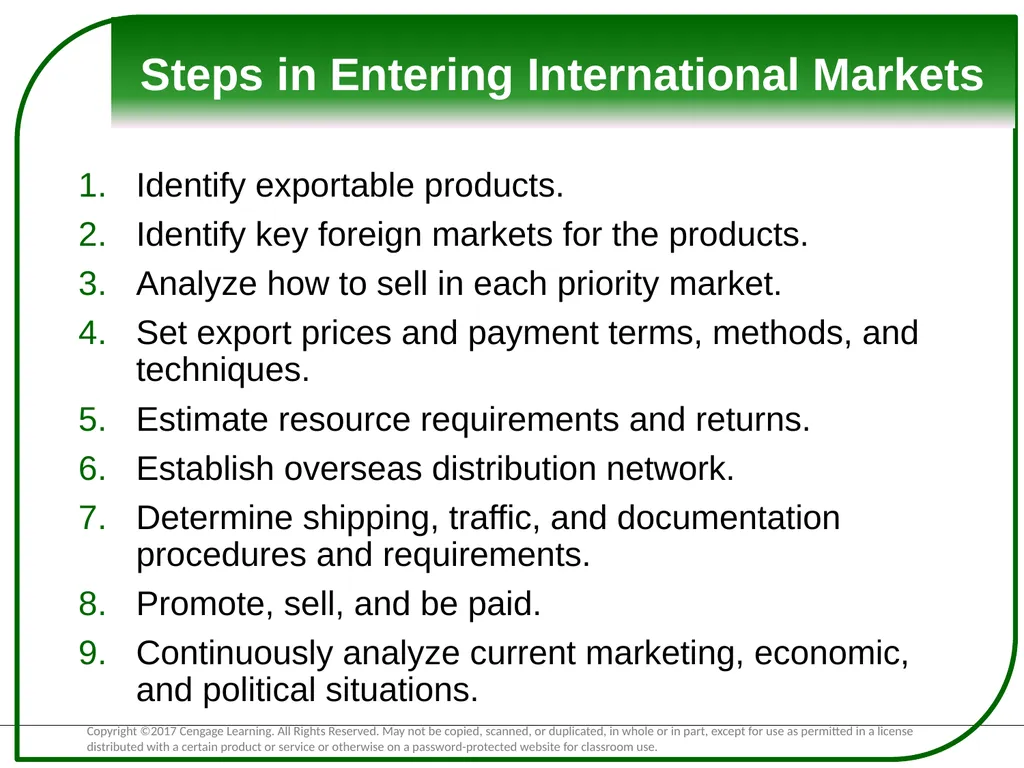
slide13. Steps in Entering International Markets Identify exportable products.
Identify key foreign markets for the products.
Analyze how to sell in each priority market.
Set export prices and payment terms, methods, and techniques.
Estimate resource requirements and returns.
Establish overseas distribution network.
Determine shipping, traffic, and documentation procedures and requirements.
Promote, sell, and be paid.
Continuously analyze current marketing, economic, and political situations.<br>
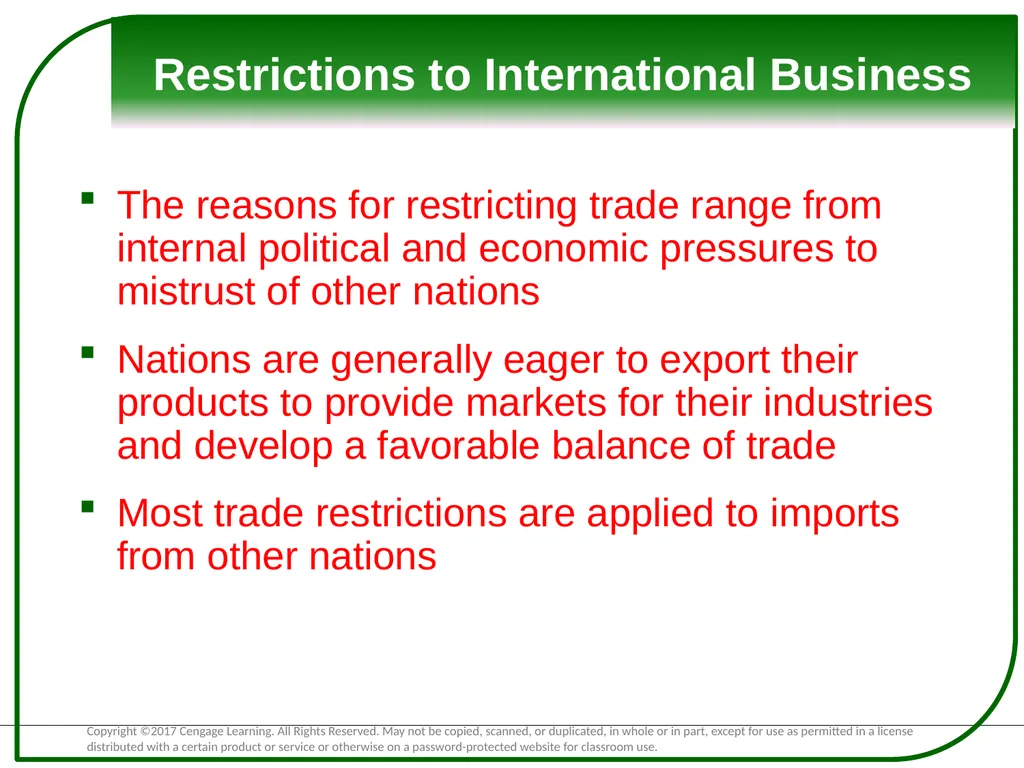
slide14. Restrictions to International Business The reasons for restricting trade range from internal political and economic pressures to mistrust of other nations
Nations are generally eager to export their products to provide markets for their industries and develop a favorable balance of trade
Most trade restrictions are applied to imports from other nations<br>
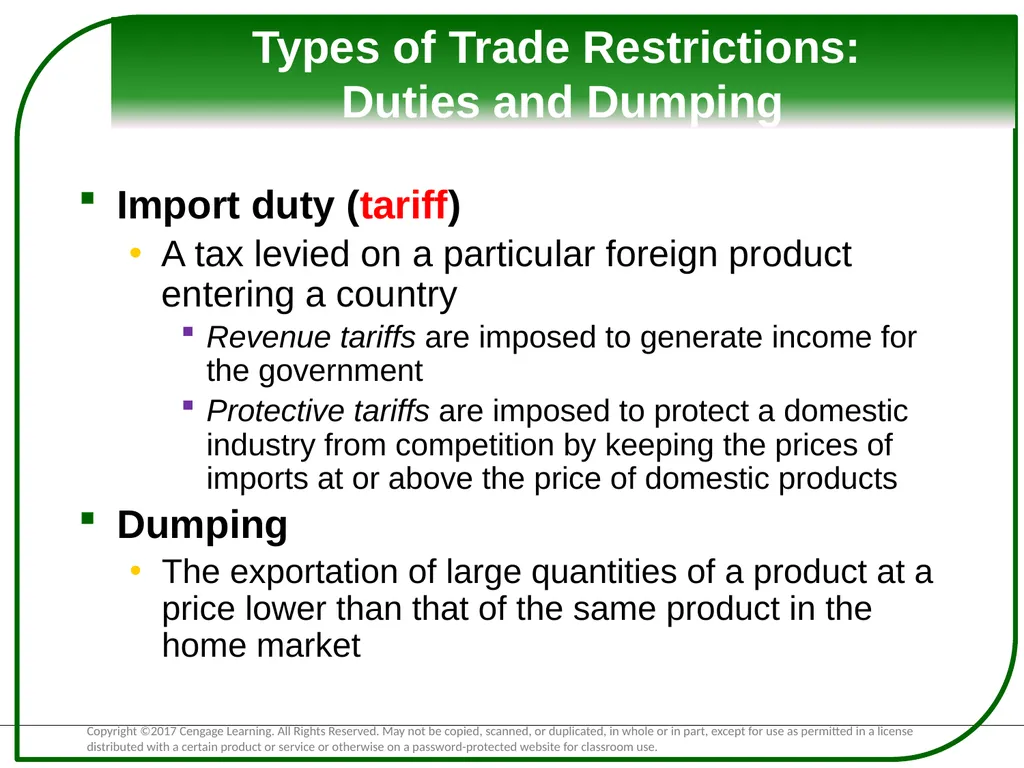
slide15. Types of Trade Restrictions: Duties and Dumping Import duty (tariff)
A tax levied on a particular foreign product entering a country
Revenue tariffs are imposed to generate income for the government
Protective tariffs are imposed to protect a domestic industry from competition by keeping the prices of imports at or above the price of domestic products
Dumping
The exportation of large quantities of a product at a price lower than that of the same product in the home market<br>
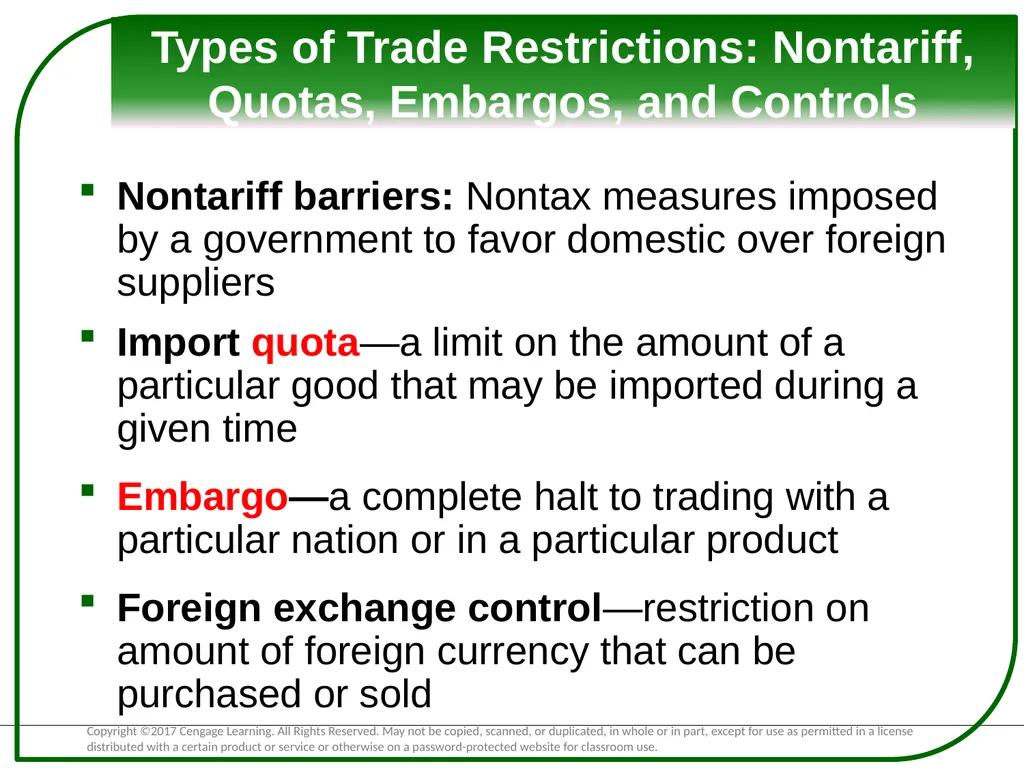
slide16. Types of Trade Restrictions: Nontariff, Quotas, Embargos, and Controls Nontariff barriers: Nontax measures imposed by a government to favor domestic over foreign suppliers
Import quota—a limit on the amount of a particular good that may be imported during a given time
Embargo—a complete halt to trading with a particular nation or in a particular product
Foreign exchange control—restriction on amount of foreign currency that can be purchased or sold<br>
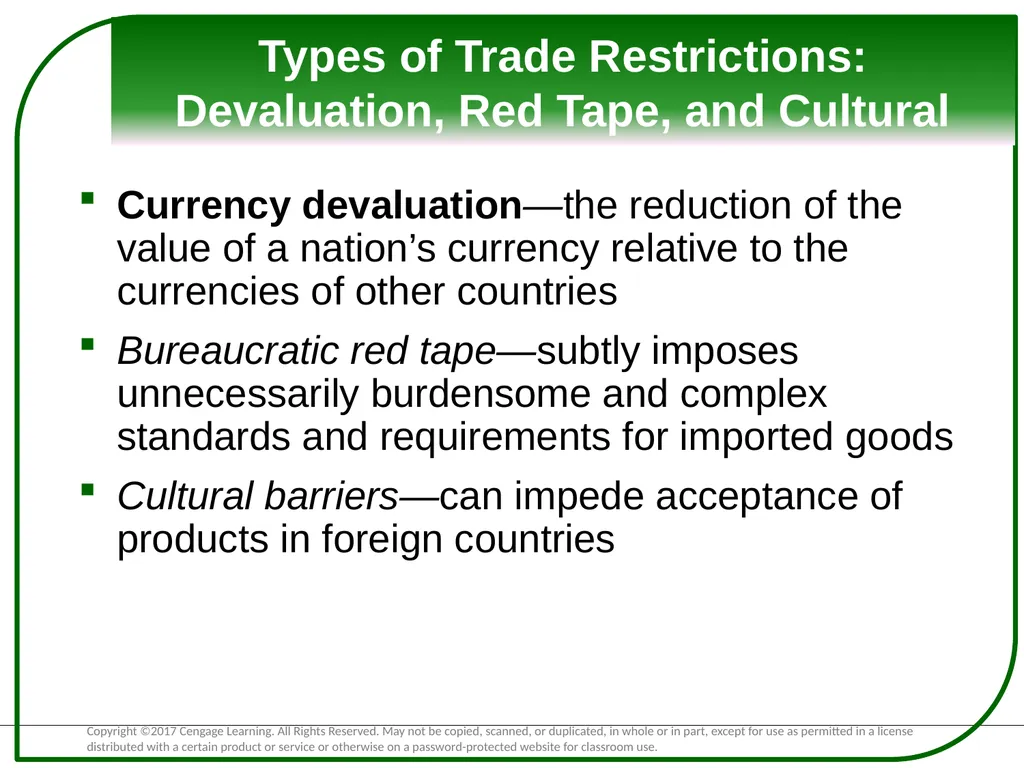
slide17. Types of Trade Restrictions: Devaluation, Red Tape, and Cultural Currency devaluation—the reduction of the value of a nation’s currency relative to the currencies of other countries
Bureaucratic red tape—subtly imposes unnecessarily burdensome and complex standards and requirements for imported goods
Cultural barriers—can impede acceptance of products in foreign countries<br>
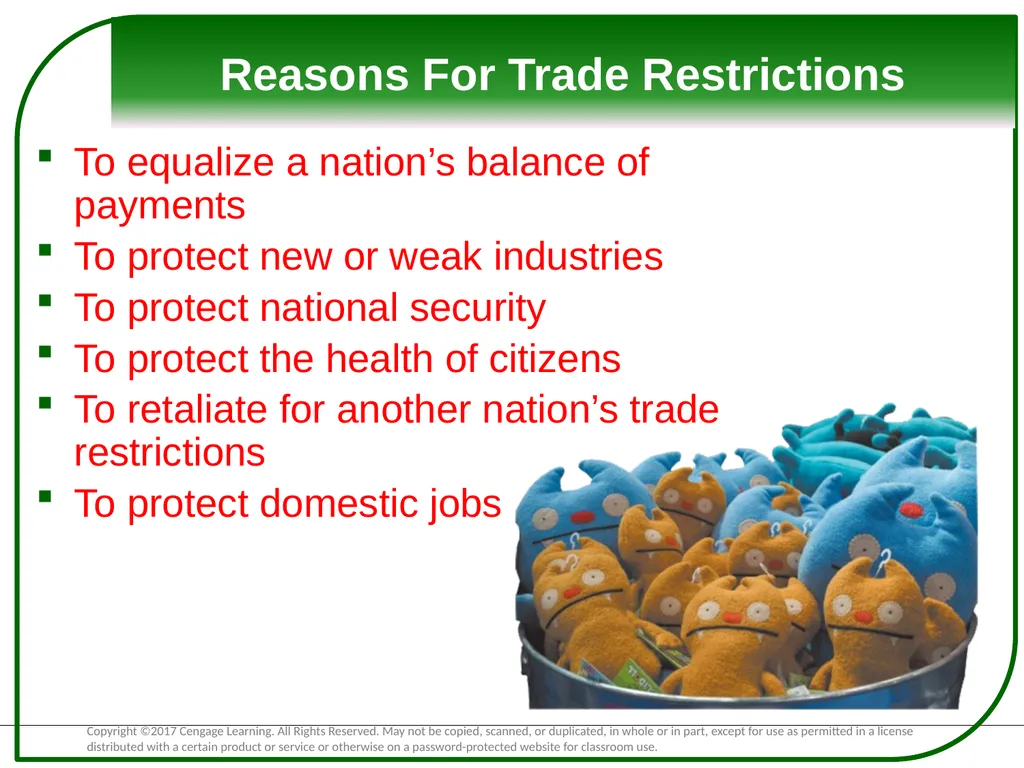
slide18. Reasons For Trade Restrictions To equalize a nation’s balance of payments
To protect new or weak industries
To protect national security
To protect the health of citizens
To retaliate for another nation’s trade restrictions
To protect domestic jobs<br>
slide19. Reasons Against Trade Restrictions Higher prices for consumers
Restriction of consumers’ choices
Misallocation of international resources
Loss of jobs<br>
slide20. The Extent of International Business Although the worldwide recessions of 1991 and 2001–2002 slowed the rate of growth, and the 2008–2009 global economic crisis caused the sharpest decline in more than 70 years, globalization is a reality of our time
In the United States, international trade now accounts for over one-fourth of Gross Domestic Product (GDP)
Trade barriers are decreasing, new competitors are entering the global marketplace, creating more choices for consumers and new job opportunities
International business will grow with the expansion of commercial use of the Internet<br>
slide21. The Economic Outlook for Trade Economic performance among nations is not equal
Growth in advanced countries slowed and then stopped in 2009
Emerging and developing economies continue to grow rapidly
International experts expected global economic growth in 2010 and 2011, despite the high oil prices<br>
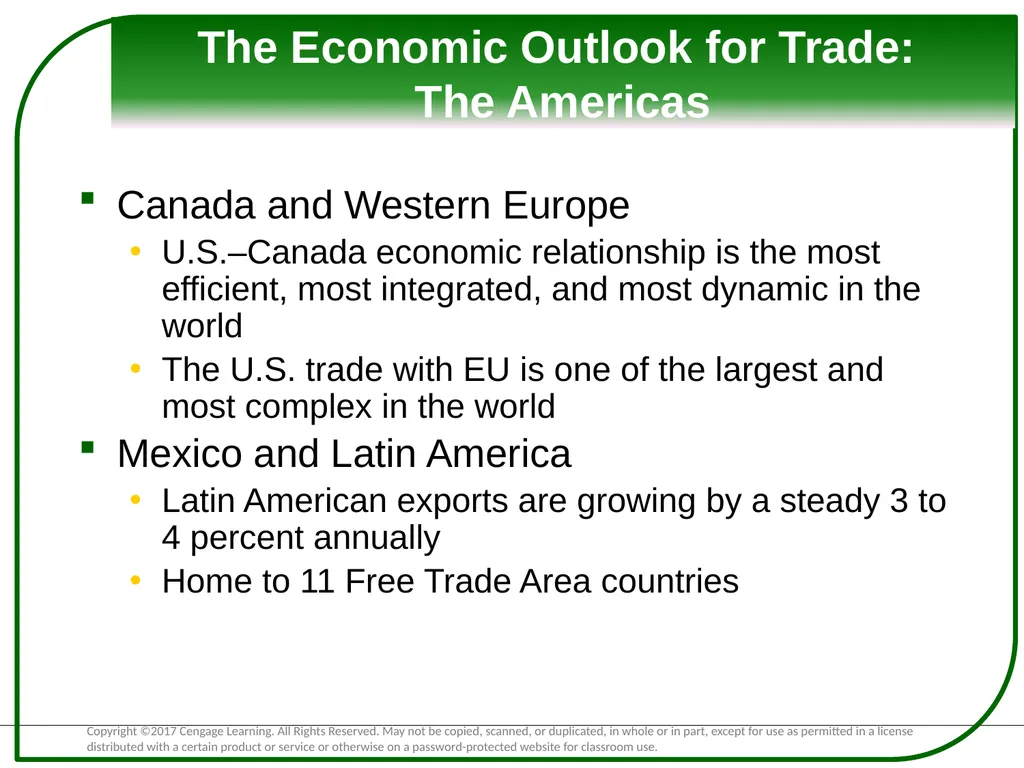
slide22. The Economic Outlook for Trade: The Americas Canada and Western Europe
U.S.–Canada economic relationship is the most efficient, most integrated, and most dynamic in the world
The U.S. trade with EU is one of the largest and most complex in the world
Mexico and Latin America
Latin American exports are growing by a steady 3 to 4 percent annually
Home to 11 Free Trade Area countries<br>
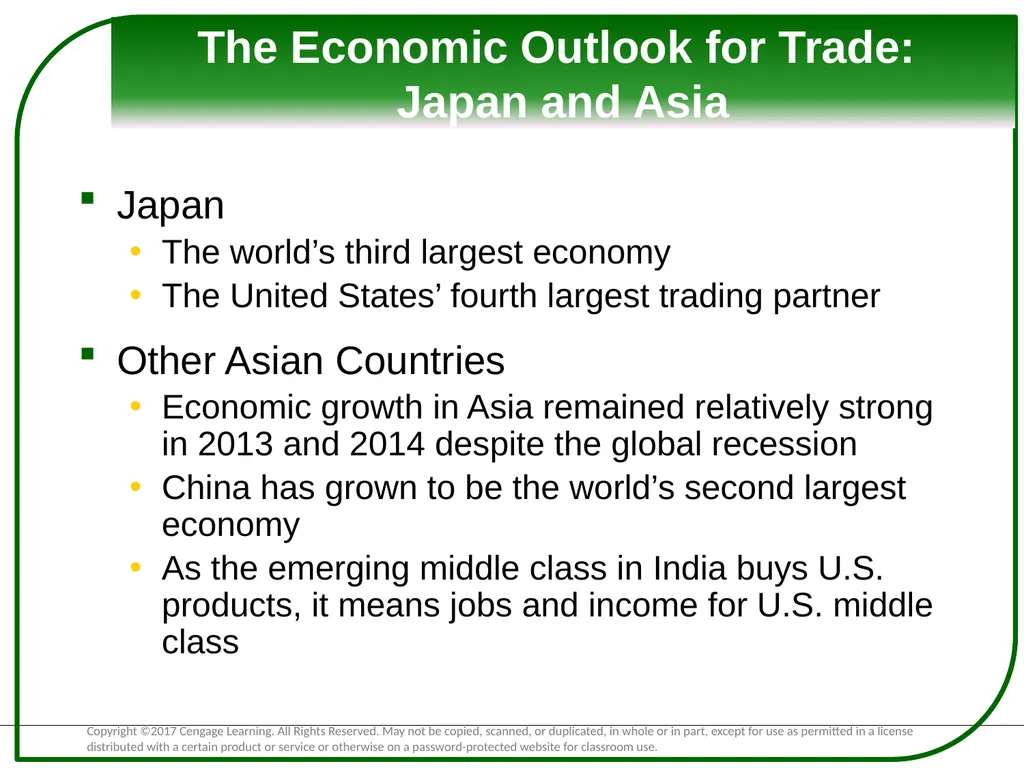
slide23. The Economic Outlook for Trade: Japan and Asia Japan
The world’s third largest economy
The United States’ fourth largest trading partner
Other Asian Countries
Economic growth in Asia remained relatively strong in 2013 and 2014 despite the global recession
China has grown to be the world’s second largest economy
As the emerging middle class in India buys U.S. products, it means jobs and income for U.S. middle class<br>
slide24. The Economic Outlook for Trade: Africa Africa
Sub-Saharan Africa is home to seven of the top ten fastest growing economies in the world
The growth in the African continent is projected to be positive, but uncertain<br>
slide25. Exports and the U.S. Economy Exports as a percentage of GDP:
Record high of 13.5% in 2013
Have increased steadily since 1985, except in the 2001 and 2008 recessions
In 2013, exports U.S. exports exceeded $2.3 trillion
15-fold increase in trade volume over the past 65 years has been one of the most important factors in the rise of living standards around the world<br>
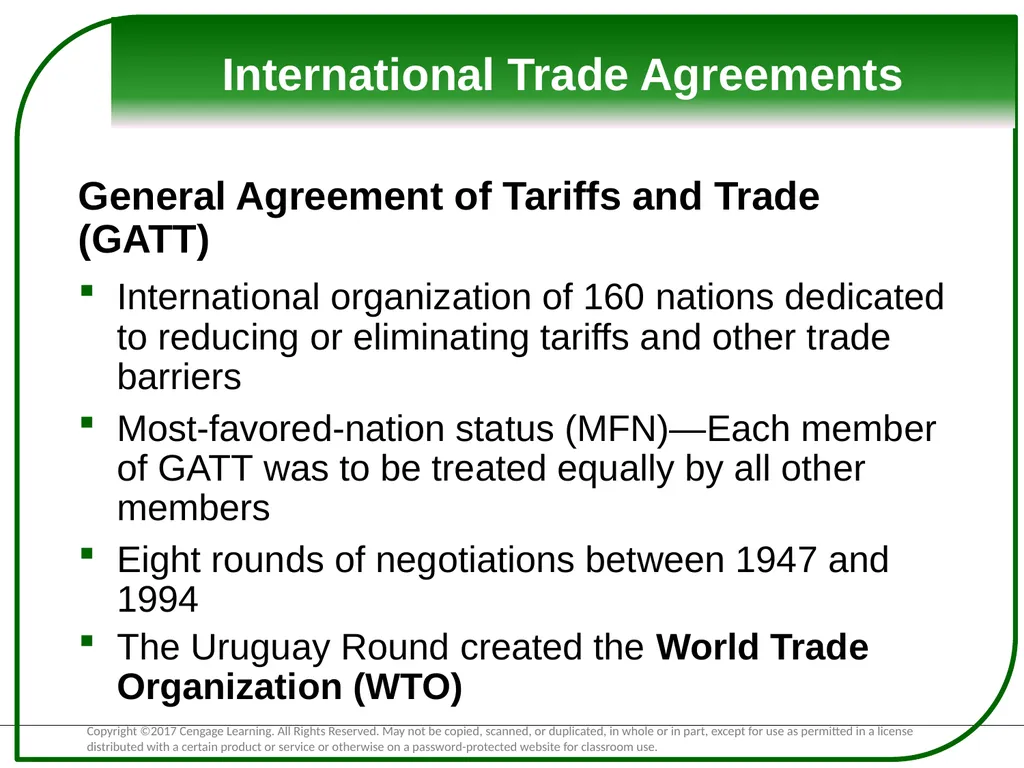
slide26. International Trade Agreements General Agreement of Tariffs and Trade (GATT)
International organization of 160 nations dedicated to reducing or eliminating tariffs and other trade barriers
Most-favored-nation status (MFN)—Each member of GATT was to be treated equally by all other members
Eight rounds of negotiations between 1947 and 1994
The Uruguay Round created the World Trade Organization (WTO)<br>
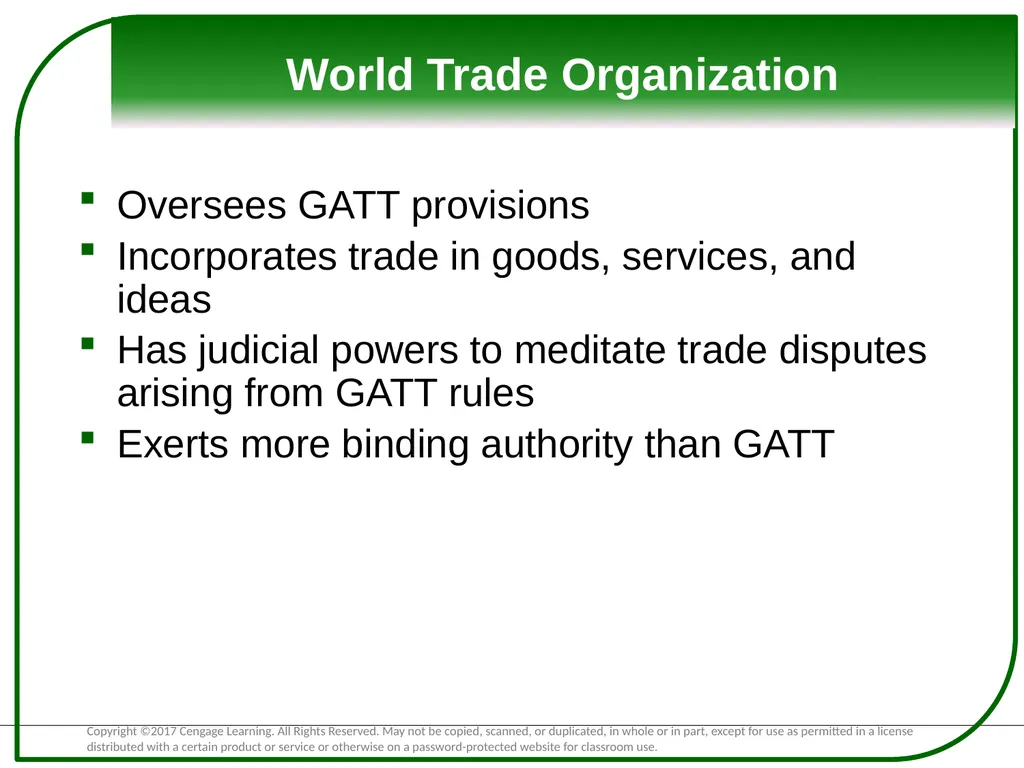
slide27. World Trade Organization Oversees GATT provisions
Incorporates trade in goods, services, and ideas
Has judicial powers to meditate trade disputes arising from GATT rules
Exerts more binding authority than GATT<br>
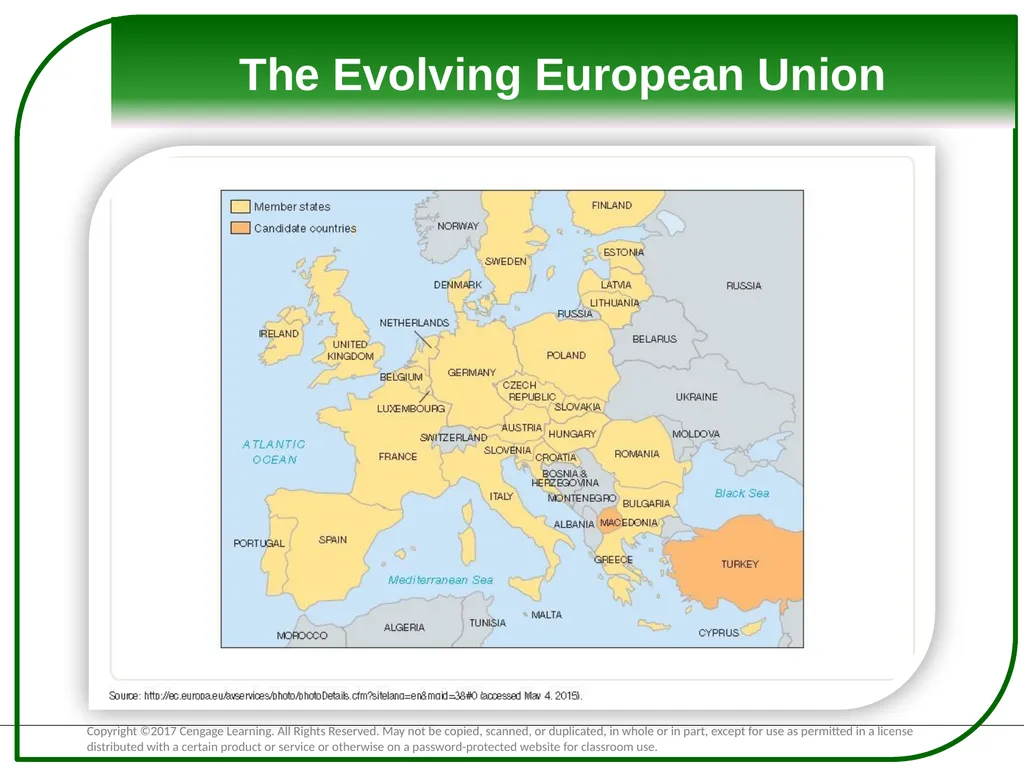
slide28. The Evolving European Union<br>
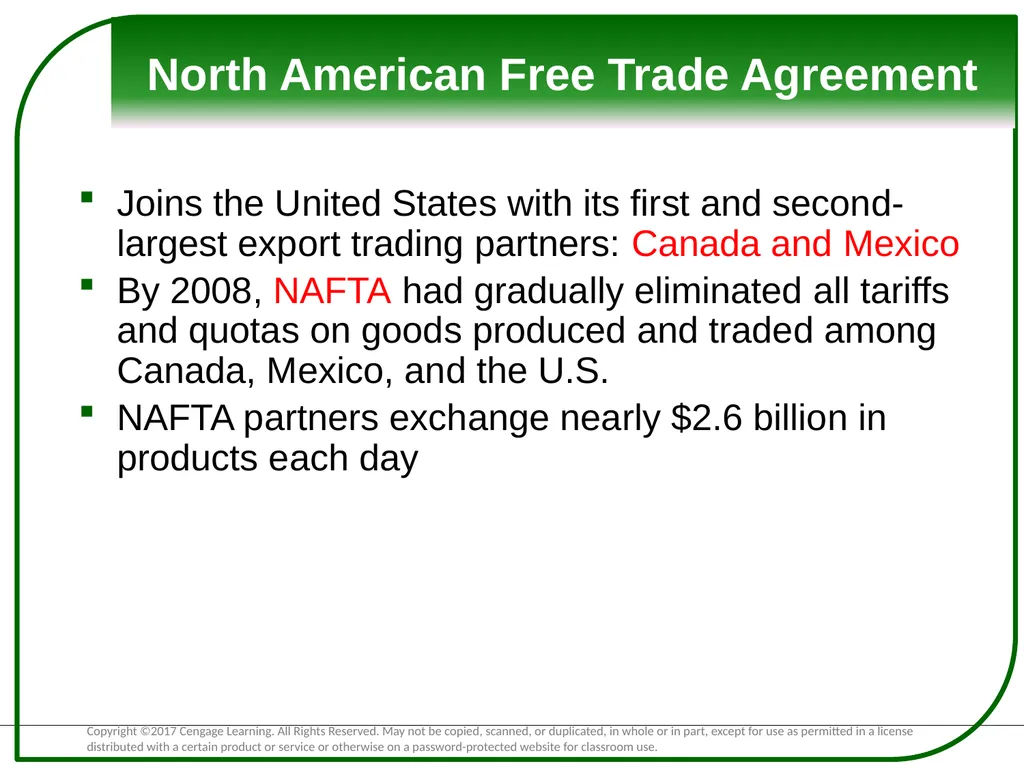
slide29. North American Free Trade Agreement Joins the United States with its first and second-largest export trading partners: Canada and Mexico
By 2008, NAFTA had gradually eliminated all tariffs and quotas on goods produced and traded among Canada, Mexico, and the U.S.
NAFTA partners exchange nearly $2.6 billion in products each day<br>
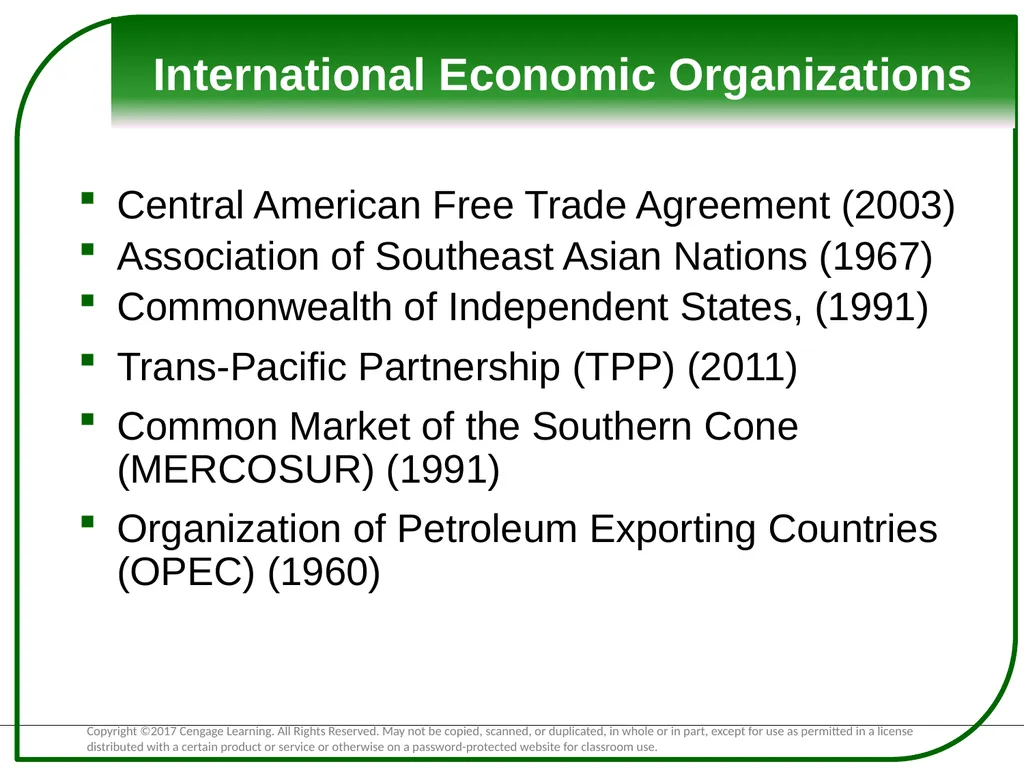
slide30. International Economic Organizations Central American Free Trade Agreement (2003)
Association of Southeast Asian Nations (1967)
Commonwealth of Independent States, (1991)
Trans-Pacific Partnership (TPP) (2011)
Common Market of the Southern Cone (MERCOSUR) (1991)
Organization of Petroleum Exporting Countries (OPEC) (1960)<br>
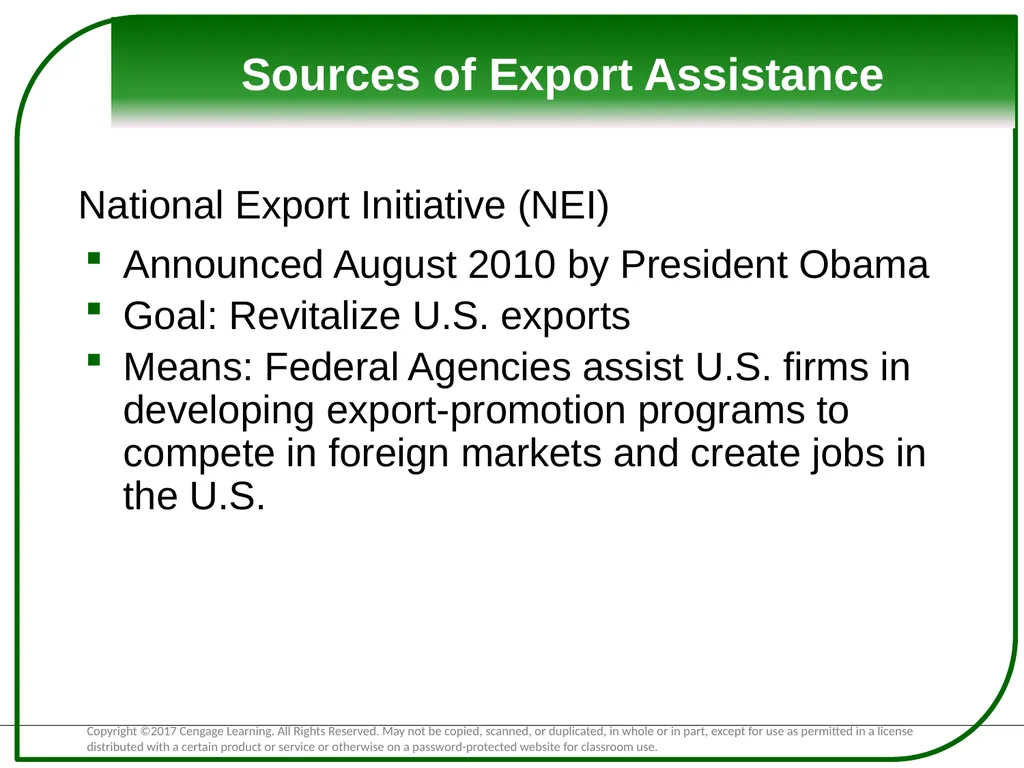
slide31. Sources of Export Assistance National Export Initiative (NEI)
Announced August 2010 by President Obama
Goal: Revitalize U.S. exports
Means: Federal Agencies assist U.S. firms in developing export-promotion programs to compete in foreign markets and create jobs in the U.S.<br>
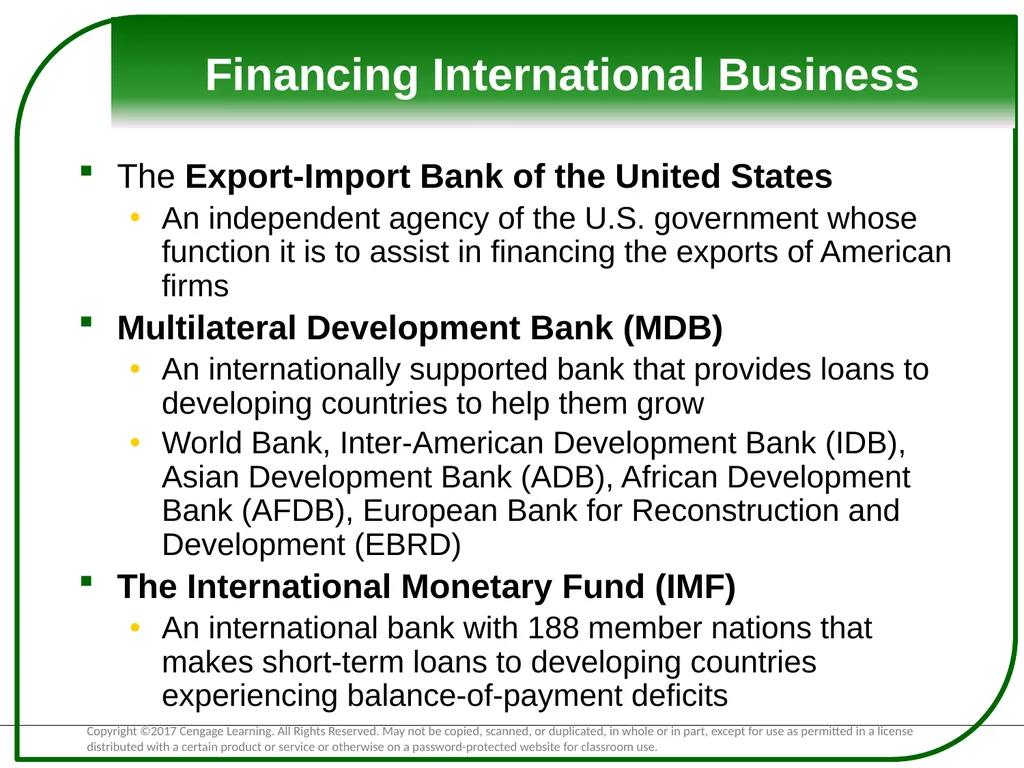
slide32. Financing International Business The Export-Import Bank of the United States
An independent agency of the U.S. government whose function it is to assist in financing the exports of American firms
Multilateral Development Bank (MDB)
An internationally supported bank that provides loans to developing countries to help them grow
World Bank, Inter-American Development Bank (IDB), Asian Development Bank (ADB), African Development Bank (AFDB), European Bank for Reconstruction and Development (EBRD)
The International Monetary Fund (IMF)
An international bank with 188 member nations that makes short-term loans to developing countries experiencing balance-of-payment deficits<br>
slide2. The Basis for International Business International business: All business activities that involve exchanges across national boundaries
Is international business good?
Absolutely!
No single country (or business) has the resources and capabilities to produce everything its citizens want or need at prices they are willing to pay
Does Spain produce enough corn for its citizens?
Does the US produce enough oil for its citizens?
PROFIT PURSUIT; Global = Bigger Market
Can you think of any MNC’s (multi-national companies)?
Some countries are better equipped than others to produce particular goods or services
Absolute advantage
The ability to produce a specific product more efficiently than any other nation
Ex. Saudia Arabia->crude oil; South Africa->diamonds; Australia->wool
Comparative advantage
The ability to produce a specific product more efficiently than any other product
Goods and services are produced more efficiently when each country specializes in the products for which it has a comparative advantage<br>
slide3. Exporting and Importing Countries trade when they each have a surplus of the product in which they specialize and want a product in which the other country specializes
Exporting is selling and shipping raw materials or products TO other nations
Importing is purchasing raw materials or products IN other nations and bringing them into one’s own country
The U.S. is the largest importing and the second largest exporting nation in the world.<br>
slide4. The Basis for International Business Balance of trade
The total value of a nation’s exports minus the total value of its imports over some period of time
Trade deficit
A negative (unfavorable) balance of trade—imports exceed exports in value
Trade surplus
A positive (favorable) balance of trade—exports exceed imports in value
Balance of payments
The total flow of money into a country minus the total flow of money out of that country over a period of time<br>
slide5. Methods of Entering International Business: Licensing Licensing is a contractual agreement in which one firm permits another to produce and market its product and use its brand name in return for a royalty or other compensation
Advantages:
It allows expansion into foreign markets with little or no direct investment
Good for small manufacturers wanting to launch a well-known domestic brand internationally
Disadvantages:
The product image may be damaged if standards are not upheld
The original producer does not gain foreign marketing experience<br>
slide6. Methods of Entering International Business: Exporting Exporting
May use an export/import merchant who assumes the risks of ownership, distribution, and sale
Letter of credit - Issued by a bank on request of an importer stating that the bank will pay an amount of money to a stated beneficiary
Bill of lading - Issued by a transport carrier to an exporter to prove merchandise has been shipped
Draft - Issued by the exporter’s bank, ordering the importer’s bank to pay for the merchandise, thus guaranteeing payment once accepted by the importer’s bank<br>
slide7. Methods of Entering International Business: Exporting Firms An exporting firm may sell its products outright to an export–import merchant
American companies may manufacture their products in the United States and export them for sale in foreign markets
An exporting firm may ship its products to an export–import agent, which arranges the sale of the products to foreign intermediaries for a commission or fee
An exporting firm also may establish its own sales offices, or branches, in foreign countries<br>
slide8. Methods of Entering International Business: Joint Ventures A joint venture is a partnership formed to achieve a specific goal or to operate for a specific period of time
Advantages:
Immediate market knowledge and access
Reduced risk
Control over the product attributes
Disadvantages:
Complexity of establishing agreements across national borders
High level of commitment required of all parties involved<br>
slide9. Methods of Entering International Business: Totally Owned Facilities Totally owned facilities refers to production and marketing facilities developed by a firm in one or more foreign nations
Advantage
Direct investment provides complete control over operations
Disadvantage
Risk is greater than that of a joint venture
Two forms
Building new facilities in the foreign country
Purchasing an existing firm in the foreign country<br>
slide10. Methods of Entering International Business: Strategic Alliances Strategic alliances are partnerships formed to create competitive advantage on a worldwide basis
Example: New United Motor Manufacturing, Inc.<br>
slide11. Methods of Entering International Business: Trading Companies Trading companies are firms that provide a link between buyers and sellers in different countries
Buys products in one country at the lowest price consistent with quality and sells to buyers in another country
Takes title to products and perform all the activities necessary to move the products from one country to another<br>
slide12. Methods of Entering International Business Countertrade is an international barter transaction
In early 1990s, any developing nations had major restrictions on converting domestic currency into foreign currency
Countertrade avoids restrictions on converting domestic currency to foreign currency
Multinational enterprise refers to firms that operate on a worldwide scale without ties to any specific nation or region<br>
slide13. Steps in Entering International Markets Identify exportable products.
Identify key foreign markets for the products.
Analyze how to sell in each priority market.
Set export prices and payment terms, methods, and techniques.
Estimate resource requirements and returns.
Establish overseas distribution network.
Determine shipping, traffic, and documentation procedures and requirements.
Promote, sell, and be paid.
Continuously analyze current marketing, economic, and political situations.<br>
slide14. Restrictions to International Business The reasons for restricting trade range from internal political and economic pressures to mistrust of other nations
Nations are generally eager to export their products to provide markets for their industries and develop a favorable balance of trade
Most trade restrictions are applied to imports from other nations<br>
slide15. Types of Trade Restrictions: Duties and Dumping Import duty (tariff)
A tax levied on a particular foreign product entering a country
Revenue tariffs are imposed to generate income for the government
Protective tariffs are imposed to protect a domestic industry from competition by keeping the prices of imports at or above the price of domestic products
Dumping
The exportation of large quantities of a product at a price lower than that of the same product in the home market<br>
slide16. Types of Trade Restrictions: Nontariff, Quotas, Embargos, and Controls Nontariff barriers: Nontax measures imposed by a government to favor domestic over foreign suppliers
Import quota—a limit on the amount of a particular good that may be imported during a given time
Embargo—a complete halt to trading with a particular nation or in a particular product
Foreign exchange control—restriction on amount of foreign currency that can be purchased or sold<br>
slide17. Types of Trade Restrictions: Devaluation, Red Tape, and Cultural Currency devaluation—the reduction of the value of a nation’s currency relative to the currencies of other countries
Bureaucratic red tape—subtly imposes unnecessarily burdensome and complex standards and requirements for imported goods
Cultural barriers—can impede acceptance of products in foreign countries<br>
slide18. Reasons For Trade Restrictions To equalize a nation’s balance of payments
To protect new or weak industries
To protect national security
To protect the health of citizens
To retaliate for another nation’s trade restrictions
To protect domestic jobs<br>
slide19. Reasons Against Trade Restrictions Higher prices for consumers
Restriction of consumers’ choices
Misallocation of international resources
Loss of jobs<br>
slide20. The Extent of International Business Although the worldwide recessions of 1991 and 2001–2002 slowed the rate of growth, and the 2008–2009 global economic crisis caused the sharpest decline in more than 70 years, globalization is a reality of our time
In the United States, international trade now accounts for over one-fourth of Gross Domestic Product (GDP)
Trade barriers are decreasing, new competitors are entering the global marketplace, creating more choices for consumers and new job opportunities
International business will grow with the expansion of commercial use of the Internet<br>
slide21. The Economic Outlook for Trade Economic performance among nations is not equal
Growth in advanced countries slowed and then stopped in 2009
Emerging and developing economies continue to grow rapidly
International experts expected global economic growth in 2010 and 2011, despite the high oil prices<br>
slide22. The Economic Outlook for Trade: The Americas Canada and Western Europe
U.S.–Canada economic relationship is the most efficient, most integrated, and most dynamic in the world
The U.S. trade with EU is one of the largest and most complex in the world
Mexico and Latin America
Latin American exports are growing by a steady 3 to 4 percent annually
Home to 11 Free Trade Area countries<br>
slide23. The Economic Outlook for Trade: Japan and Asia Japan
The world’s third largest economy
The United States’ fourth largest trading partner
Other Asian Countries
Economic growth in Asia remained relatively strong in 2013 and 2014 despite the global recession
China has grown to be the world’s second largest economy
As the emerging middle class in India buys U.S. products, it means jobs and income for U.S. middle class<br>
slide24. The Economic Outlook for Trade: Africa Africa
Sub-Saharan Africa is home to seven of the top ten fastest growing economies in the world
The growth in the African continent is projected to be positive, but uncertain<br>
slide25. Exports and the U.S. Economy Exports as a percentage of GDP:
Record high of 13.5% in 2013
Have increased steadily since 1985, except in the 2001 and 2008 recessions
In 2013, exports U.S. exports exceeded $2.3 trillion
15-fold increase in trade volume over the past 65 years has been one of the most important factors in the rise of living standards around the world<br>
slide26. International Trade Agreements General Agreement of Tariffs and Trade (GATT)
International organization of 160 nations dedicated to reducing or eliminating tariffs and other trade barriers
Most-favored-nation status (MFN)—Each member of GATT was to be treated equally by all other members
Eight rounds of negotiations between 1947 and 1994
The Uruguay Round created the World Trade Organization (WTO)<br>
slide27. World Trade Organization Oversees GATT provisions
Incorporates trade in goods, services, and ideas
Has judicial powers to meditate trade disputes arising from GATT rules
Exerts more binding authority than GATT<br>
slide28. The Evolving European Union<br>
slide29. North American Free Trade Agreement Joins the United States with its first and second-largest export trading partners: Canada and Mexico
By 2008, NAFTA had gradually eliminated all tariffs and quotas on goods produced and traded among Canada, Mexico, and the U.S.
NAFTA partners exchange nearly $2.6 billion in products each day<br>
slide30. International Economic Organizations Central American Free Trade Agreement (2003)
Association of Southeast Asian Nations (1967)
Commonwealth of Independent States, (1991)
Trans-Pacific Partnership (TPP) (2011)
Common Market of the Southern Cone (MERCOSUR) (1991)
Organization of Petroleum Exporting Countries (OPEC) (1960)<br>
slide31. Sources of Export Assistance National Export Initiative (NEI)
Announced August 2010 by President Obama
Goal: Revitalize U.S. exports
Means: Federal Agencies assist U.S. firms in developing export-promotion programs to compete in foreign markets and create jobs in the U.S.<br>
slide32. Financing International Business The Export-Import Bank of the United States
An independent agency of the U.S. government whose function it is to assist in financing the exports of American firms
Multilateral Development Bank (MDB)
An internationally supported bank that provides loans to developing countries to help them grow
World Bank, Inter-American Development Bank (IDB), Asian Development Bank (ADB), African Development Bank (AFDB), European Bank for Reconstruction and Development (EBRD)
The International Monetary Fund (IMF)
An international bank with 188 member nations that makes short-term loans to developing countries experiencing balance-of-payment deficits<br>