
Exploring Linkages Between the Carbon Cycle and
Description: Exploring Linkages Between the Carbon Cycle and Biodiversity in North American Ecosystems NACP 7th Open Science Meeting Breakout Report March 26, 2021 Co Chairs: Iris Anderson, Virginia Institute of Marine Science Erika Podest, JPL Breakout
Related Topics
Download Presentation
"Exploring Linkages Between the Carbon Cycle and" is the property of its rightful owner. Permission is granted to download and print the materials on this website for personal, non-commercial use only, and to display it on your personal computer provided you do not modify the materials and that you retain all copyright notices contained in the materials. By downloading content from our website, you accept the terms of this agreement.
Presentation Transcript
slide1. Exploring Linkages Between the Carbon Cycle and Biodiversity in North American Ecosystems NACP 7th Open Science Meeting
Breakout Report
March 26, 2021 Co Chairs:
Iris Anderson, Virginia Institute of Marine Science
Erika Podest, JPL<br>
slide2. Breakout ~25 Attendees
Presenters:
Dr. Rebecca Shaw, Chief Scientist, WWF
Discussed biodiversity/carbon related to terrestrial ecosystems.
Stressed on the importance of biodiversity as a nature based solution for climate mitigation.
Dr. Deborah Steinberg, Professor of Marine Science & Chair, Department of Biological Sciences, Virginia Institute of Marine Science
Discussed the ocean biological pump and the role of biodiversity in carbon sequestration through fecal matter.<br>
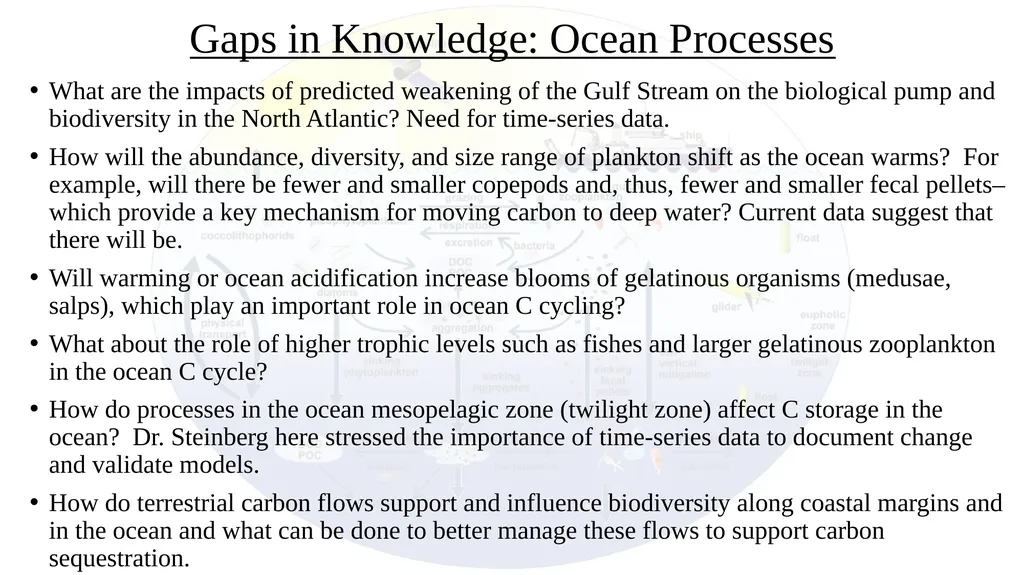
slide3. Gaps in Knowledge: Ocean Processes What are the impacts of predicted weakening of the Gulf Stream on the biological pump and biodiversity in the North Atlantic? Need for time-series data.
How will the abundance, diversity, and size range of plankton shift as the ocean warms? For example, will there be fewer and smaller copepods and, thus, fewer and smaller fecal pellets–which provide a key mechanism for moving carbon to deep water? Current data suggest that there will be.
Will warming or ocean acidification increase blooms of gelatinous organisms (medusae, salps), which play an important role in ocean C cycling?
What about the role of higher trophic levels such as fishes and larger gelatinous zooplankton in the ocean C cycle?
How do processes in the ocean mesopelagic zone (twilight zone) affect C storage in the ocean? Dr. Steinberg here stressed the importance of time-series data to document change and validate models.
How do terrestrial carbon flows support and influence biodiversity along coastal margins and in the ocean and what can be done to better manage these flows to support carbon sequestration.<br>
slide4. Gaps in Knowledge: Terrestrial Processes What trends need to be reversed with regard to biodiversity in order to support functioning of ecosystems and C sequestration?
What should be the most important consideration regarding response to loss of habitat-- restoration vs. resilience? Ex. Is it better to plant a palm forest which can rapidly sequester C, but may be less resilient than a more diverse forest?
Biodiversity increases resilience but not necessarily C storage – how true is that? How do environmental factors impact resilience vs. C storage?
Several initiatives have been proposed to mitigate climate change; for example, the Half Earth initiative (E.O Wilson Biodiversity Foundation) and the 30 x 30 Movement (The Wilderness Society). How should sites be chosen to maximize outcomes? Will these initiatives to set aside protected areas protect diversity as well as C storage?
Soil C holds 4x as much as carbon as plant biomass in terrestrial systems. What are the implications of microbial biodiversity in soils to carbon sequestration?
What are the best strategies for responding to habitat loss from extreme events such as wildfires or hurricanes?
How are invasive species affecting biodiversity and can this change affect the ability of ecosystems to store carbon?
Does a certain level of plant diversity increase carbon accumulation and does this differ between grasslands, forests, and wetlands?<br>
slide5. Take Home Message We currently lack sufficient knowledge about the relationship between carbon and biodiversity in terrestrial and aquatic ecosystems.
Of particular interest are the effects of climate change on the relationship between biodiversity and carbon sequestration, especially on the long term storage of carbon.
Climate mitigation actions should account for the role of biodiversity in the storage of carbon.
There is a need for better models and better monitoring to detect changes over longer time scales.<br>
slide6. Recommendations Different U.S. Programs (e.g. NSF, NASA, NOAA, USGS) should consider calls addressing the linkages between carbon and biodiversity.<br>
slide7. Thank you Iris Anderson, iris@vims.edu
Erika Podest, erika.podest@jpl.nasa.gov<br>
Breakout Report
March 26, 2021 Co Chairs:
Iris Anderson, Virginia Institute of Marine Science
Erika Podest, JPL<br>
slide2. Breakout ~25 Attendees
Presenters:
Dr. Rebecca Shaw, Chief Scientist, WWF
Discussed biodiversity/carbon related to terrestrial ecosystems.
Stressed on the importance of biodiversity as a nature based solution for climate mitigation.
Dr. Deborah Steinberg, Professor of Marine Science & Chair, Department of Biological Sciences, Virginia Institute of Marine Science
Discussed the ocean biological pump and the role of biodiversity in carbon sequestration through fecal matter.<br>
slide3. Gaps in Knowledge: Ocean Processes What are the impacts of predicted weakening of the Gulf Stream on the biological pump and biodiversity in the North Atlantic? Need for time-series data.
How will the abundance, diversity, and size range of plankton shift as the ocean warms? For example, will there be fewer and smaller copepods and, thus, fewer and smaller fecal pellets–which provide a key mechanism for moving carbon to deep water? Current data suggest that there will be.
Will warming or ocean acidification increase blooms of gelatinous organisms (medusae, salps), which play an important role in ocean C cycling?
What about the role of higher trophic levels such as fishes and larger gelatinous zooplankton in the ocean C cycle?
How do processes in the ocean mesopelagic zone (twilight zone) affect C storage in the ocean? Dr. Steinberg here stressed the importance of time-series data to document change and validate models.
How do terrestrial carbon flows support and influence biodiversity along coastal margins and in the ocean and what can be done to better manage these flows to support carbon sequestration.<br>
slide4. Gaps in Knowledge: Terrestrial Processes What trends need to be reversed with regard to biodiversity in order to support functioning of ecosystems and C sequestration?
What should be the most important consideration regarding response to loss of habitat-- restoration vs. resilience? Ex. Is it better to plant a palm forest which can rapidly sequester C, but may be less resilient than a more diverse forest?
Biodiversity increases resilience but not necessarily C storage – how true is that? How do environmental factors impact resilience vs. C storage?
Several initiatives have been proposed to mitigate climate change; for example, the Half Earth initiative (E.O Wilson Biodiversity Foundation) and the 30 x 30 Movement (The Wilderness Society). How should sites be chosen to maximize outcomes? Will these initiatives to set aside protected areas protect diversity as well as C storage?
Soil C holds 4x as much as carbon as plant biomass in terrestrial systems. What are the implications of microbial biodiversity in soils to carbon sequestration?
What are the best strategies for responding to habitat loss from extreme events such as wildfires or hurricanes?
How are invasive species affecting biodiversity and can this change affect the ability of ecosystems to store carbon?
Does a certain level of plant diversity increase carbon accumulation and does this differ between grasslands, forests, and wetlands?<br>
slide5. Take Home Message We currently lack sufficient knowledge about the relationship between carbon and biodiversity in terrestrial and aquatic ecosystems.
Of particular interest are the effects of climate change on the relationship between biodiversity and carbon sequestration, especially on the long term storage of carbon.
Climate mitigation actions should account for the role of biodiversity in the storage of carbon.
There is a need for better models and better monitoring to detect changes over longer time scales.<br>
slide6. Recommendations Different U.S. Programs (e.g. NSF, NASA, NOAA, USGS) should consider calls addressing the linkages between carbon and biodiversity.<br>
slide7. Thank you Iris Anderson, iris@vims.edu
Erika Podest, erika.podest@jpl.nasa.gov<br>