
Exploring the ICU Education Experience Across
CB
Published · 19 slides · 0 views
1 / 1


Description
Exploring the ICU Education Experience Across London During the COVID Pandemic: Survey Results Speech and Language Therapists Redeployed to ICU London Transformation and Learning Collaboration (LTLC) Purpose of the London Transformation
Related Topics
Download this presentation From Below
"Exploring the ICU Education Experience Across" is the property of its rightful owner. Permission is granted to download and print the materials on this website for personal, non-commercial use only, and to display it on your personal computer provided you do not modify the materials and that you retain all copyright notices contained in the materials. By downloading content from our website, you accept the terms of this agreement.
Share
Embed code
Presentation Transcript
01
Exploring the ICU Education Experience Across London During the COVID Pandemic: Survey Results
Speech and Language Therapists Redeployed to ICU London Transformation and Learning Collaboration (LTLC)<br>
02
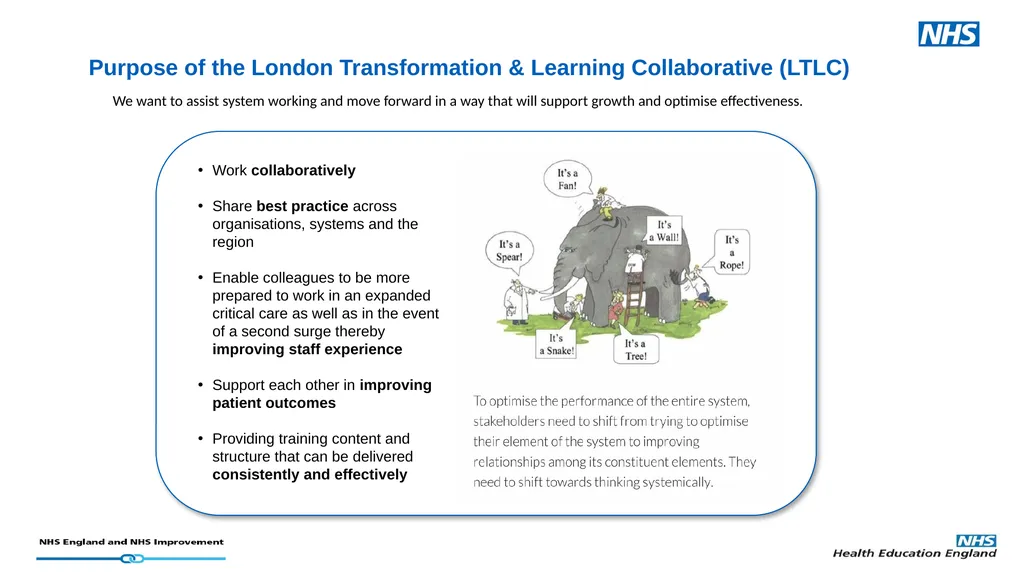
Purpose of the London Transformation & Learning Collaborative (LTLC) Work collaboratively
Share best practice across organisations, systems and the region
Enable colleagues to be more prepared to work in an expanded critical care as well as in the event of a second surge thereby improving staff experience
Support each other in improving patient outcomes
Providing training content and structure that can be delivered consistently and effectively We want to assist system working and move forward in a way that will support growth and optimise effectiveness.<br>
Share best practice across organisations, systems and the region
Enable colleagues to be more prepared to work in an expanded critical care as well as in the event of a second surge thereby improving staff experience
Support each other in improving patient outcomes
Providing training content and structure that can be delivered consistently and effectively We want to assist system working and move forward in a way that will support growth and optimise effectiveness.<br>
03
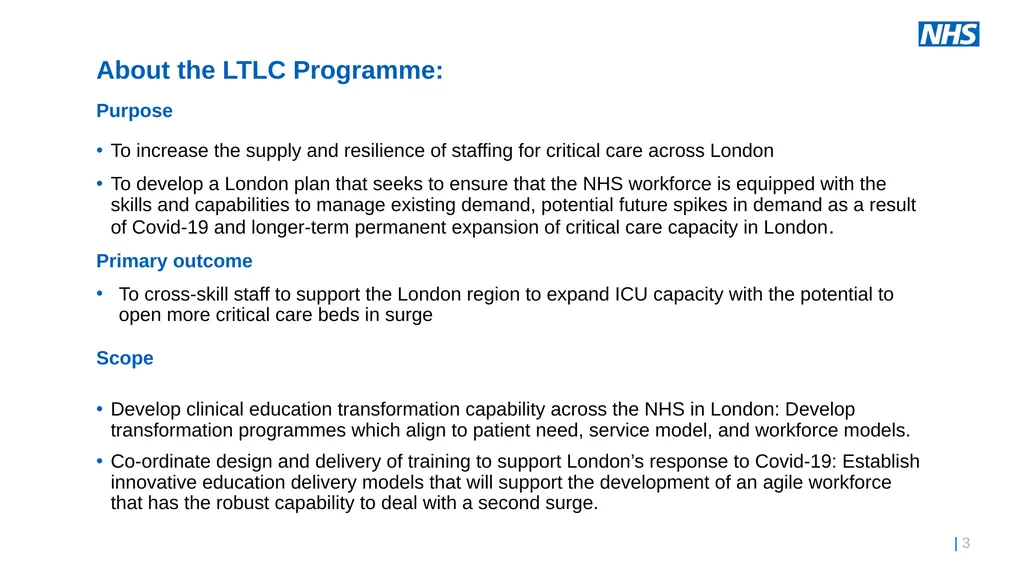
To increase the supply and resilience of staffing for critical care across London
To develop a London plan that seeks to ensure that the NHS workforce is equipped with the skills and capabilities to manage existing demand, potential future spikes in demand as a result of Covid-19 and longer-term permanent expansion of critical care capacity in London.
Primary outcome
To cross-skill staff to support the London region to expand ICU capacity with the potential to open more critical care beds in surge Purpose Scope Develop clinical education transformation capability across the NHS in London: Develop transformation programmes which align to patient need, service model, and workforce models.
Co-ordinate design and delivery of training to support London’s response to Covid-19: Establish innovative education delivery models that will support the development of an agile workforce that has the robust capability to deal with a second surge. About the LTLC Programme:<br>
To develop a London plan that seeks to ensure that the NHS workforce is equipped with the skills and capabilities to manage existing demand, potential future spikes in demand as a result of Covid-19 and longer-term permanent expansion of critical care capacity in London.
Primary outcome
To cross-skill staff to support the London region to expand ICU capacity with the potential to open more critical care beds in surge Purpose Scope Develop clinical education transformation capability across the NHS in London: Develop transformation programmes which align to patient need, service model, and workforce models.
Co-ordinate design and delivery of training to support London’s response to Covid-19: Establish innovative education delivery models that will support the development of an agile workforce that has the robust capability to deal with a second surge. About the LTLC Programme:<br>
04
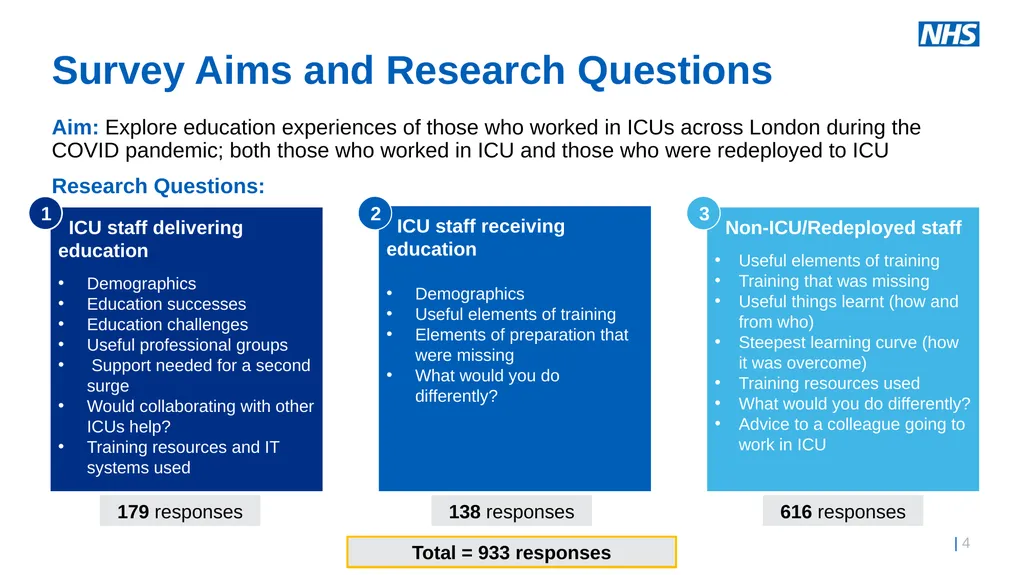
Aim: Explore education experiences of those who worked in ICUs across London during the COVID pandemic; both those who worked in ICU and those who were redeployed to ICU
Research Questions: Survey Aims and Research Questions ICU staff delivering education
Demographics
Education successes
Education challenges
Useful professional groups
Support needed for a second surge
Would collaborating with other ICUs help?
Training resources and IT systems used ICU staff receiving education
Demographics
Useful elements of training
Elements of preparation that were missing
What would you do differently? Non-ICU/Redeployed staff
Useful elements of training
Training that was missing
Useful things learnt (how and from who)
Steepest learning curve (how it was overcome)
Training resources used
What would you do differently?
Advice to a colleague going to work in ICU 179 responses 138 responses 616 responses 1 2 3 Total = 933 responses<br>
Research Questions: Survey Aims and Research Questions ICU staff delivering education
Demographics
Education successes
Education challenges
Useful professional groups
Support needed for a second surge
Would collaborating with other ICUs help?
Training resources and IT systems used ICU staff receiving education
Demographics
Useful elements of training
Elements of preparation that were missing
What would you do differently? Non-ICU/Redeployed staff
Useful elements of training
Training that was missing
Useful things learnt (how and from who)
Steepest learning curve (how it was overcome)
Training resources used
What would you do differently?
Advice to a colleague going to work in ICU 179 responses 138 responses 616 responses 1 2 3 Total = 933 responses<br>
05
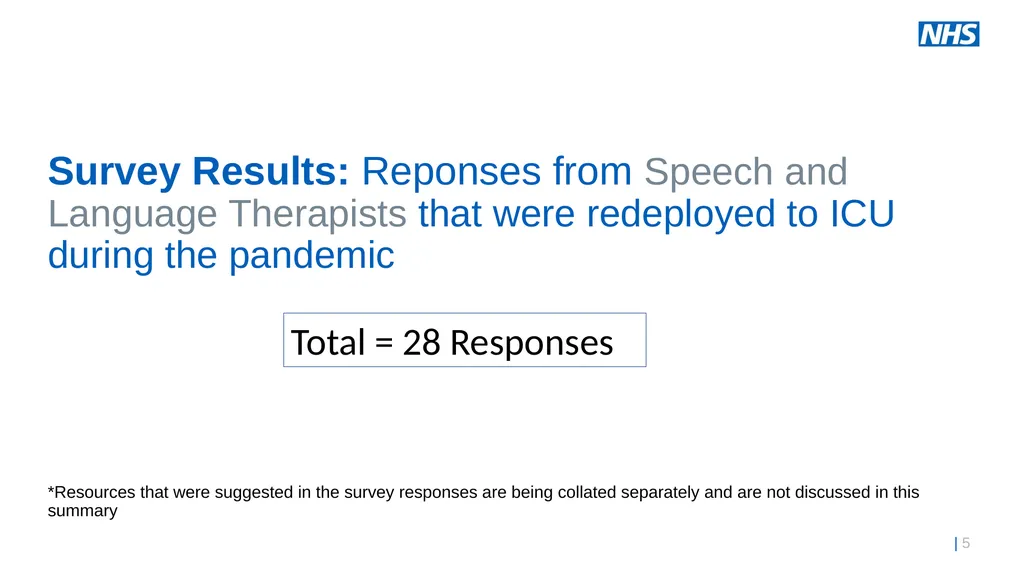
Survey Results: Reponses from Speech and Language Therapists that were redeployed to ICU during the pandemic
*Resources that were suggested in the survey responses are being collated separately and are not discussed in this summary Total = 28 Responses<br>
06
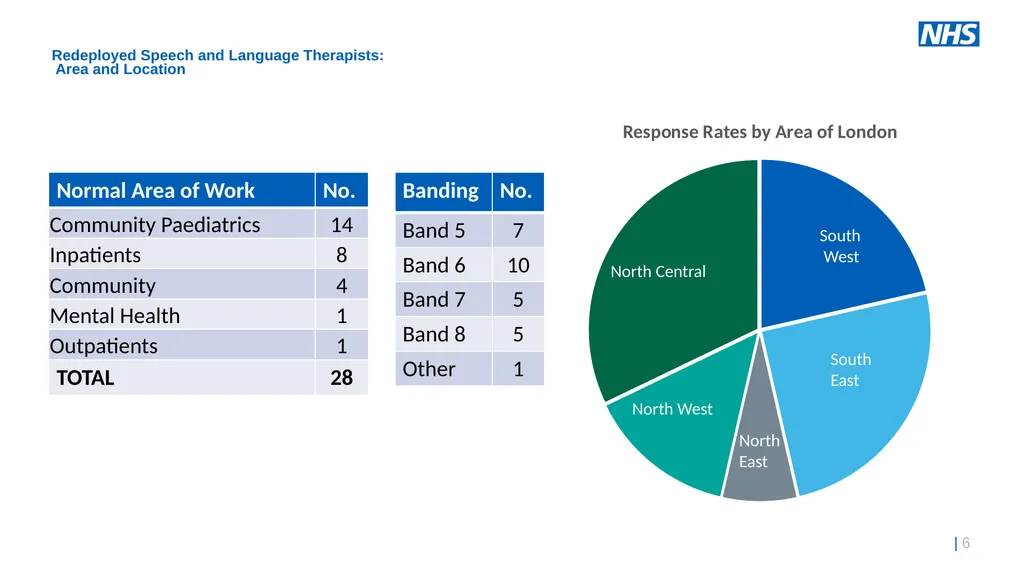
Redeployed Speech and Language Therapists:
Area and Location North
East North West South East South
West North Central<br>
East North West South East South
West North Central<br>
07
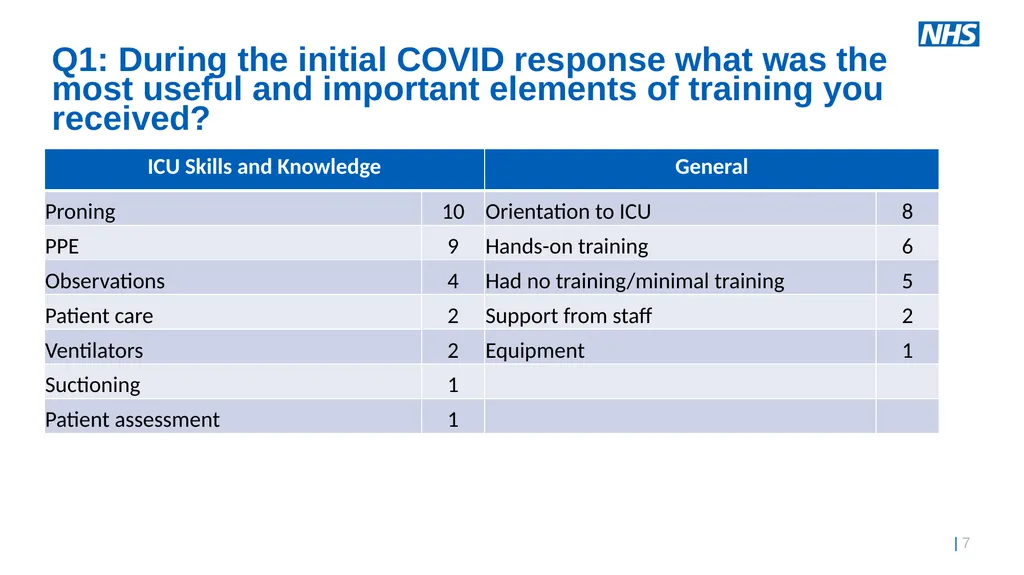
Q1: During the initial COVID response what was the most useful and important elements of training you received?<br>
08
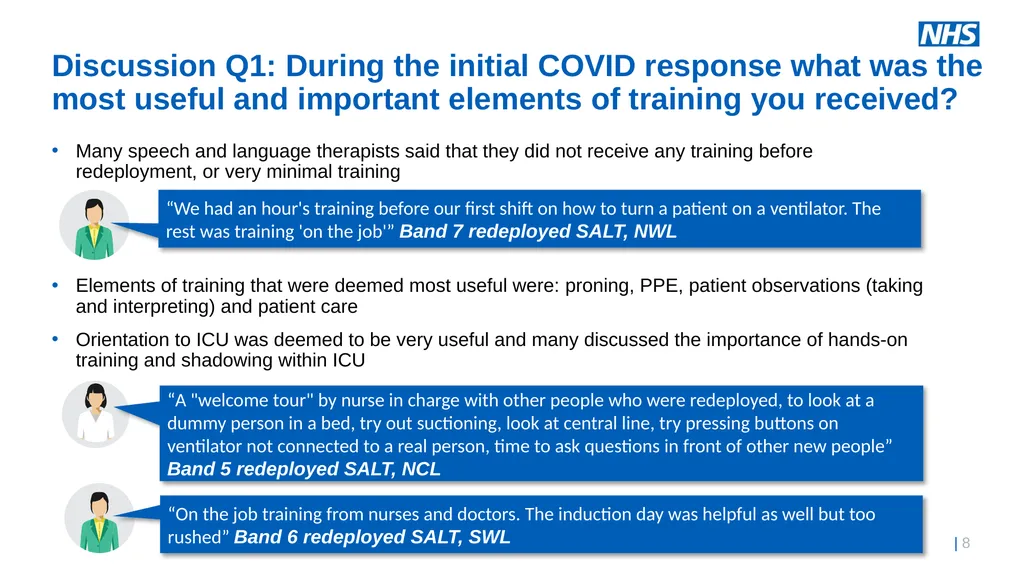
Many speech and language therapists said that they did not receive any training before redeployment, or very minimal training
Elements of training that were deemed most useful were: proning, PPE, patient observations (taking and interpreting) and patient care
Orientation to ICU was deemed to be very useful and many discussed the importance of hands-on training and shadowing within ICU Discussion Q1: During the initial COVID response what was the most useful and important elements of training you received? “A "welcome tour" by nurse in charge with other people who were redeployed, to look at a dummy person in a bed, try out suctioning, look at central line, try pressing buttons on ventilator not connected to a real person, time to ask questions in front of other new people” Band 5 redeployed SALT, NCL “We had an hour's training before our first shift on how to turn a patient on a ventilator. The rest was training 'on the job'” Band 7 redeployed SALT, NWL “On the job training from nurses and doctors. The induction day was helpful as well but too rushed” Band 6 redeployed SALT, SWL<br>
Elements of training that were deemed most useful were: proning, PPE, patient observations (taking and interpreting) and patient care
Orientation to ICU was deemed to be very useful and many discussed the importance of hands-on training and shadowing within ICU Discussion Q1: During the initial COVID response what was the most useful and important elements of training you received? “A "welcome tour" by nurse in charge with other people who were redeployed, to look at a dummy person in a bed, try out suctioning, look at central line, try pressing buttons on ventilator not connected to a real person, time to ask questions in front of other new people” Band 5 redeployed SALT, NCL “We had an hour's training before our first shift on how to turn a patient on a ventilator. The rest was training 'on the job'” Band 7 redeployed SALT, NWL “On the job training from nurses and doctors. The induction day was helpful as well but too rushed” Band 6 redeployed SALT, SWL<br>
09
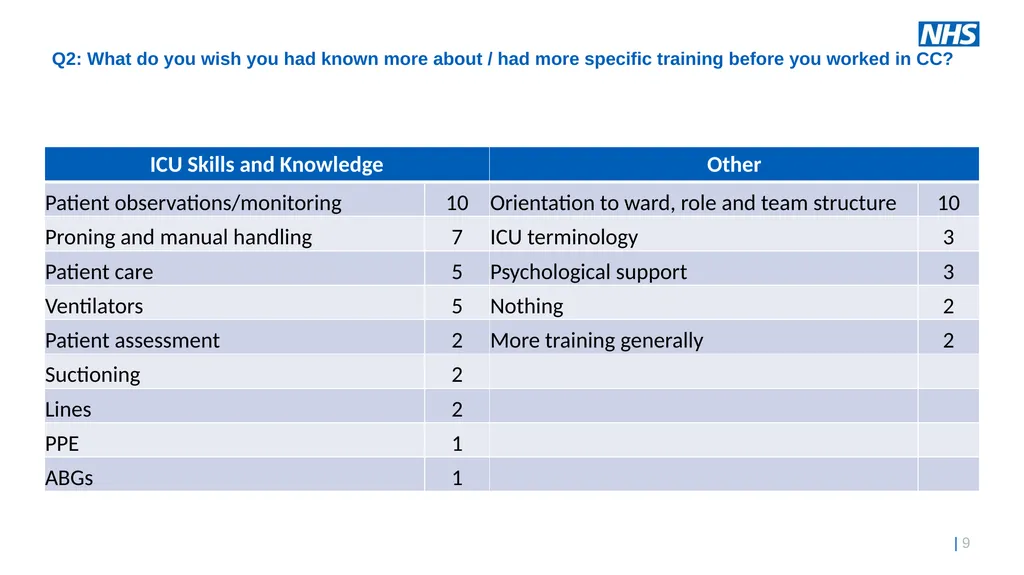
Q2: What do you wish you had known more about / had more specific training before you worked in CC?<br>
10
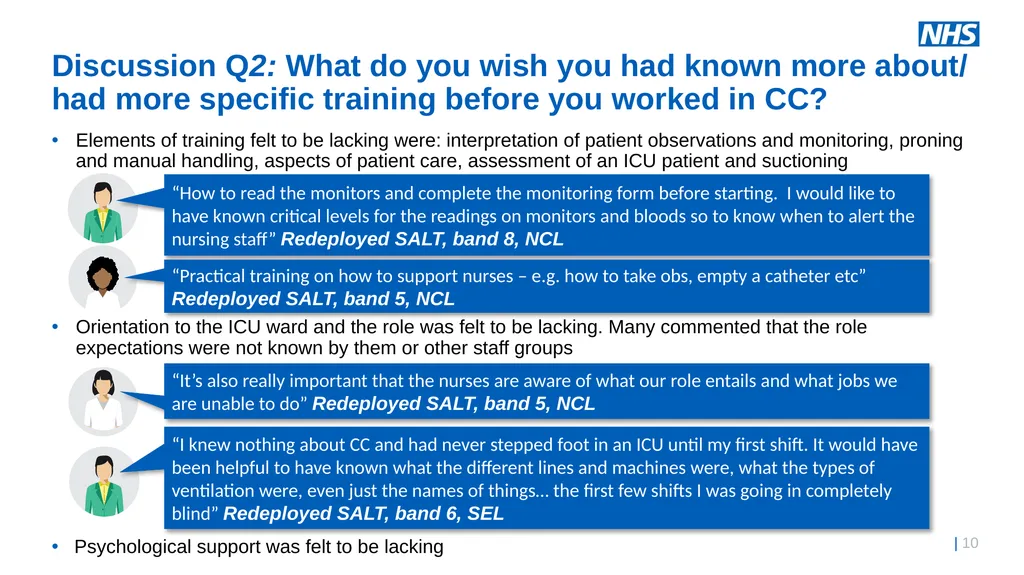
Elements of training felt to be lacking were: interpretation of patient observations and monitoring, proning and manual handling, aspects of patient care, assessment of an ICU patient and suctioning
Orientation to the ICU ward and the role was felt to be lacking. Many commented that the role expectations were not known by them or other staff groups
Psychological support was felt to be lacking Discussion Q2: What do you wish you had known more about/ had more specific training before you worked in CC? “How to read the monitors and complete the monitoring form before starting. I would like to have known critical levels for the readings on monitors and bloods so to know when to alert the nursing staff” Redeployed SALT, band 8, NCL “Practical training on how to support nurses – e.g. how to take obs, empty a catheter etc” Redeployed SALT, band 5, NCL “I knew nothing about CC and had never stepped foot in an ICU until my first shift. It would have been helpful to have known what the different lines and machines were, what the types of ventilation were, even just the names of things… the first few shifts I was going in completely blind” Redeployed SALT, band 6, SEL “It’s also really important that the nurses are aware of what our role entails and what jobs we are unable to do” Redeployed SALT, band 5, NCL<br>
Orientation to the ICU ward and the role was felt to be lacking. Many commented that the role expectations were not known by them or other staff groups
Psychological support was felt to be lacking Discussion Q2: What do you wish you had known more about/ had more specific training before you worked in CC? “How to read the monitors and complete the monitoring form before starting. I would like to have known critical levels for the readings on monitors and bloods so to know when to alert the nursing staff” Redeployed SALT, band 8, NCL “Practical training on how to support nurses – e.g. how to take obs, empty a catheter etc” Redeployed SALT, band 5, NCL “I knew nothing about CC and had never stepped foot in an ICU until my first shift. It would have been helpful to have known what the different lines and machines were, what the types of ventilation were, even just the names of things… the first few shifts I was going in completely blind” Redeployed SALT, band 6, SEL “It’s also really important that the nurses are aware of what our role entails and what jobs we are unable to do” Redeployed SALT, band 5, NCL<br>
11
Q3. What were the most useful things you learnt whilst looking after patients in CC?* Who did you learn this from and how? *Themes with only 1 response not included<br>
12
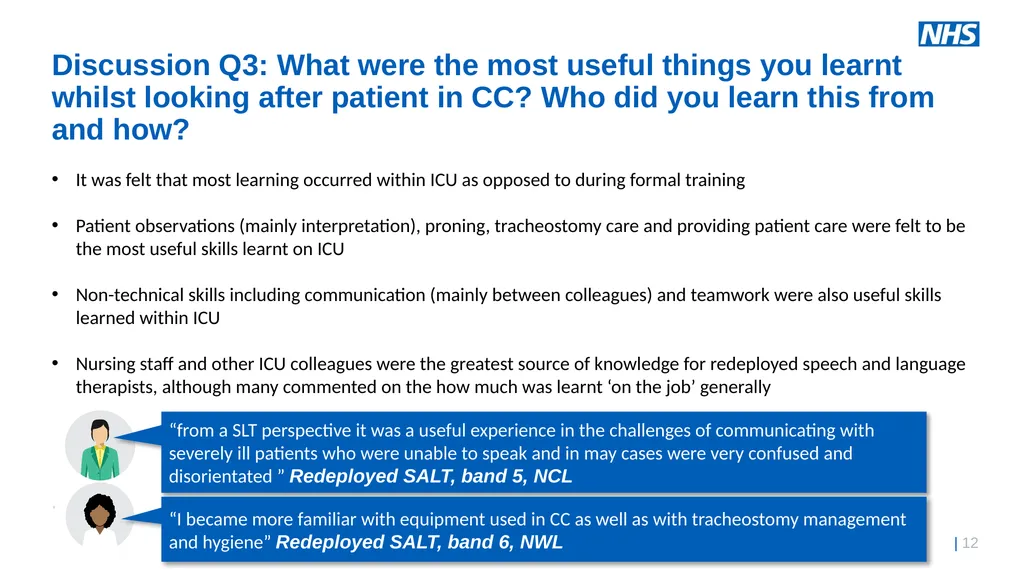
Discussion Q3: What were the most useful things you learnt whilst looking after patient in CC? Who did you learn this from and how? It was felt that most learning occurred within ICU as opposed to during formal training
Patient observations (mainly interpretation), proning, tracheostomy care and providing patient care were felt to be the most useful skills learnt on ICU
Non-technical skills including communication (mainly between colleagues) and teamwork were also useful skills learned within ICU
Nursing staff and other ICU colleagues were the greatest source of knowledge for redeployed speech and language therapists, although many commented on the how much was learnt ‘on the job’ generally “from a SLT perspective it was a useful experience in the challenges of communicating with severely ill patients who were unable to speak and in may cases were very confused and disorientated ” Redeployed SALT, band 5, NCL “I became more familiar with equipment used in CC as well as with tracheostomy management and hygiene” Redeployed SALT, band 6, NWL<br>
Patient observations (mainly interpretation), proning, tracheostomy care and providing patient care were felt to be the most useful skills learnt on ICU
Non-technical skills including communication (mainly between colleagues) and teamwork were also useful skills learned within ICU
Nursing staff and other ICU colleagues were the greatest source of knowledge for redeployed speech and language therapists, although many commented on the how much was learnt ‘on the job’ generally “from a SLT perspective it was a useful experience in the challenges of communicating with severely ill patients who were unable to speak and in may cases were very confused and disorientated ” Redeployed SALT, band 5, NCL “I became more familiar with equipment used in CC as well as with tracheostomy management and hygiene” Redeployed SALT, band 6, NWL<br>
13
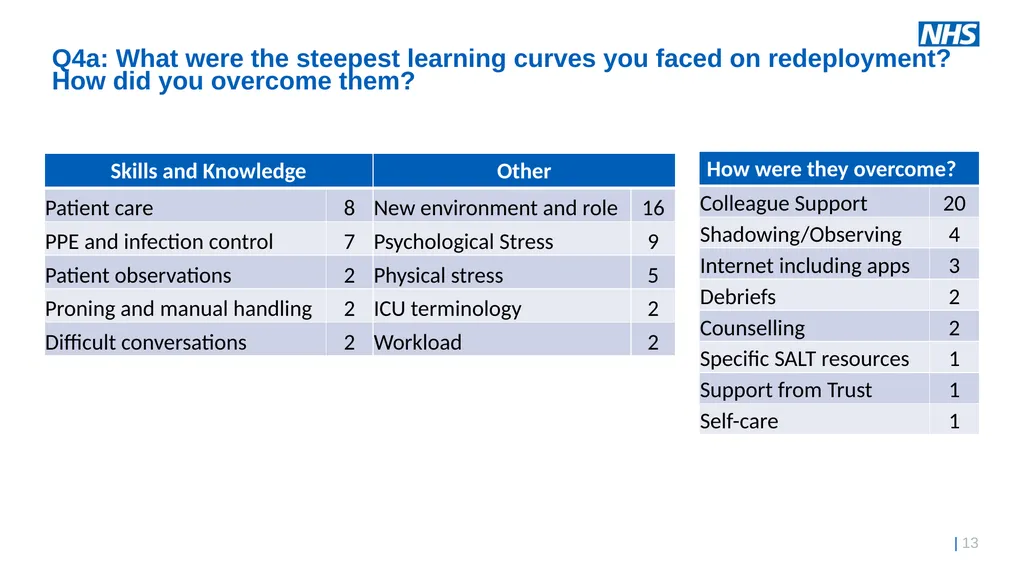
Q4a: What were the steepest learning curves you faced on redeployment? How did you overcome them?<br>
14
Providing patient care and PPE and infection control were the steepest skill related learning curves
The lack of knowledge about the new working environment and the expectations of the role were commonly discussed
Coping with psychological and physical stress were steep learning curves for many
Physical stress included fatigue, dehydration and wearing PPE
Colleagues were crucial to managing the steep learning curves Discussion Q4: What were the steepest learning curves you faced on redeployment? How did you overcome them? “Everything involved in patient care in ICU ” Redeployed SALT, band 8, NCL “Learning the names for medical equipment and where things were kept, the set up on ICU and what different people's roles were” Redeployed SALT, band 7, NWL “How to support the nurses in any way - quite exasperating as I did not feel I was much use and they were so busy” Redeployed SALT, band 5, NCL “Probably just the environment. It was very overwhelming” Redeployed SALT, band 6, SWL<br>
The lack of knowledge about the new working environment and the expectations of the role were commonly discussed
Coping with psychological and physical stress were steep learning curves for many
Physical stress included fatigue, dehydration and wearing PPE
Colleagues were crucial to managing the steep learning curves Discussion Q4: What were the steepest learning curves you faced on redeployment? How did you overcome them? “Everything involved in patient care in ICU ” Redeployed SALT, band 8, NCL “Learning the names for medical equipment and where things were kept, the set up on ICU and what different people's roles were” Redeployed SALT, band 7, NWL “How to support the nurses in any way - quite exasperating as I did not feel I was much use and they were so busy” Redeployed SALT, band 5, NCL “Probably just the environment. It was very overwhelming” Redeployed SALT, band 6, SWL<br>
15
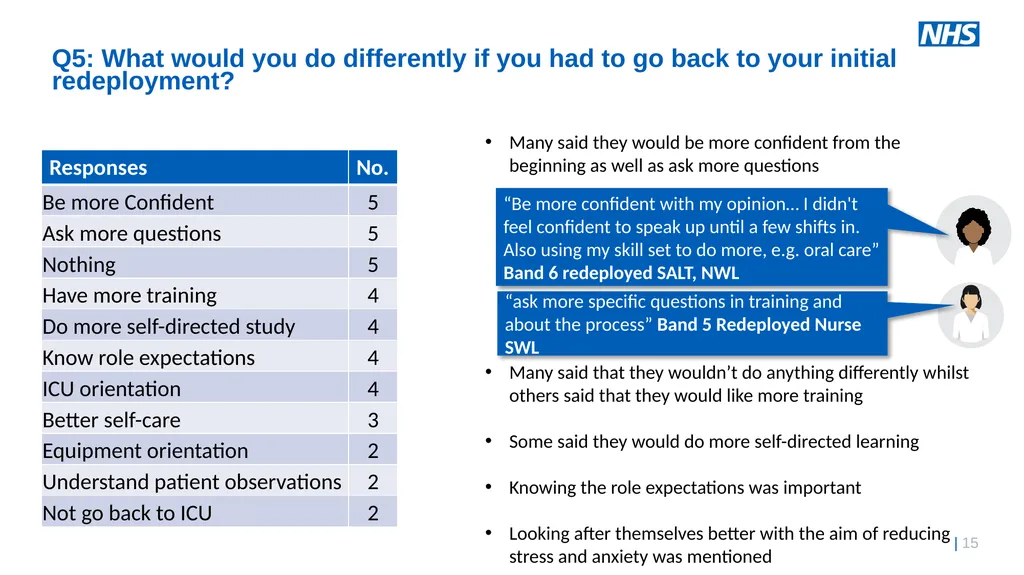
Q5: What would you do differently if you had to go back to your initial redeployment? Many said they would be more confident from the beginning as well as ask more questions
Many said that they wouldn’t do anything differently whilst others said that they would like more training
Some said they would do more self-directed learning
Knowing the role expectations was important
Looking after themselves better with the aim of reducing stress and anxiety was mentioned “Be more confident with my opinion… I didn't feel confident to speak up until a few shifts in. Also using my skill set to do more, e.g. oral care” Band 6 redeployed SALT, NWL “ask more specific questions in training and about the process” Band 5 Redeployed Nurse SWL<br>
Many said that they wouldn’t do anything differently whilst others said that they would like more training
Some said they would do more self-directed learning
Knowing the role expectations was important
Looking after themselves better with the aim of reducing stress and anxiety was mentioned “Be more confident with my opinion… I didn't feel confident to speak up until a few shifts in. Also using my skill set to do more, e.g. oral care” Band 6 redeployed SALT, NWL “ask more specific questions in training and about the process” Band 5 Redeployed Nurse SWL<br>
16
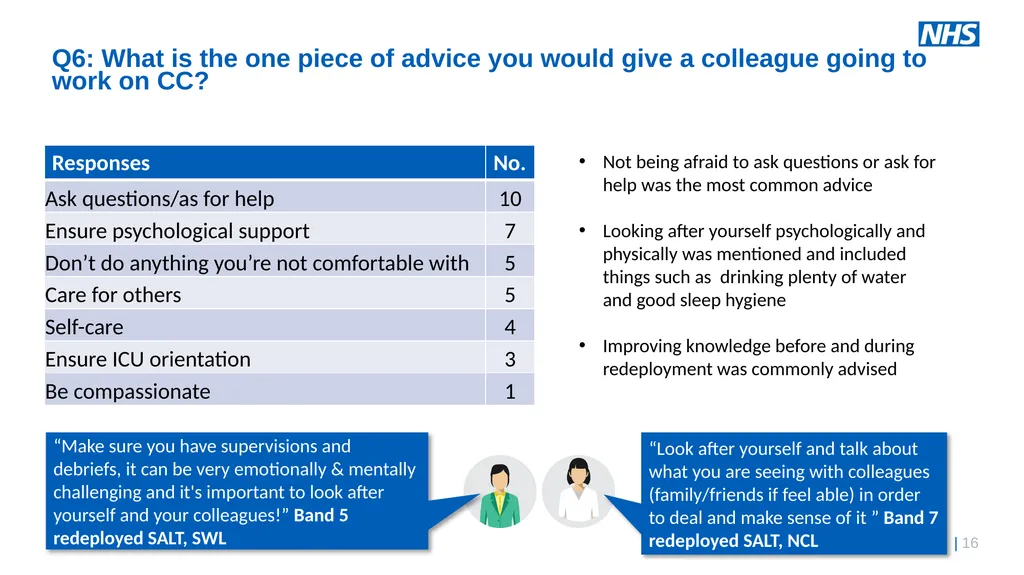
Q6: What is the one piece of advice you would give a colleague going to work on CC? Not being afraid to ask questions or ask for help was the most common advice
Looking after yourself psychologically and physically was mentioned and included things such as drinking plenty of water and good sleep hygiene
Improving knowledge before and during redeployment was commonly advised “Look after yourself and talk about what you are seeing with colleagues (family/friends if feel able) in order to deal and make sense of it ” Band 7 redeployed SALT, NCL “Make sure you have supervisions and debriefs, it can be very emotionally & mentally challenging and it's important to look after yourself and your colleagues!” Band 5 redeployed SALT, SWL<br>
Looking after yourself psychologically and physically was mentioned and included things such as drinking plenty of water and good sleep hygiene
Improving knowledge before and during redeployment was commonly advised “Look after yourself and talk about what you are seeing with colleagues (family/friends if feel able) in order to deal and make sense of it ” Band 7 redeployed SALT, NCL “Make sure you have supervisions and debriefs, it can be very emotionally & mentally challenging and it's important to look after yourself and your colleagues!” Band 5 redeployed SALT, SWL<br>
17
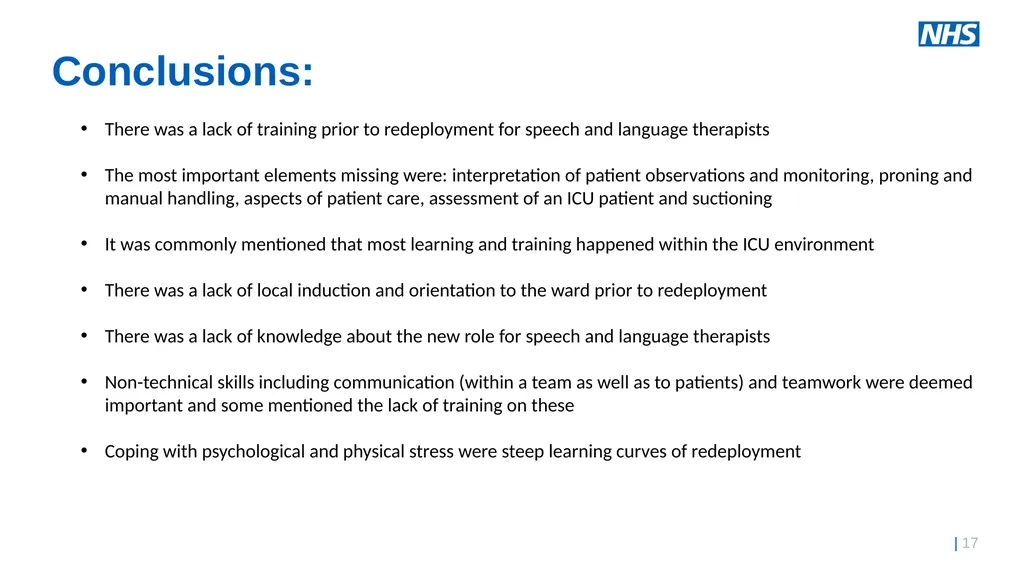
Conclusions: There was a lack of training prior to redeployment for speech and language therapists
The most important elements missing were: interpretation of patient observations and monitoring, proning and manual handling, aspects of patient care, assessment of an ICU patient and suctioning
It was commonly mentioned that most learning and training happened within the ICU environment
There was a lack of local induction and orientation to the ward prior to redeployment
There was a lack of knowledge about the new role for speech and language therapists
Non-technical skills including communication (within a team as well as to patients) and teamwork were deemed important and some mentioned the lack of training on these
Coping with psychological and physical stress were steep learning curves of redeployment<br>
The most important elements missing were: interpretation of patient observations and monitoring, proning and manual handling, aspects of patient care, assessment of an ICU patient and suctioning
It was commonly mentioned that most learning and training happened within the ICU environment
There was a lack of local induction and orientation to the ward prior to redeployment
There was a lack of knowledge about the new role for speech and language therapists
Non-technical skills including communication (within a team as well as to patients) and teamwork were deemed important and some mentioned the lack of training on these
Coping with psychological and physical stress were steep learning curves of redeployment<br>
18
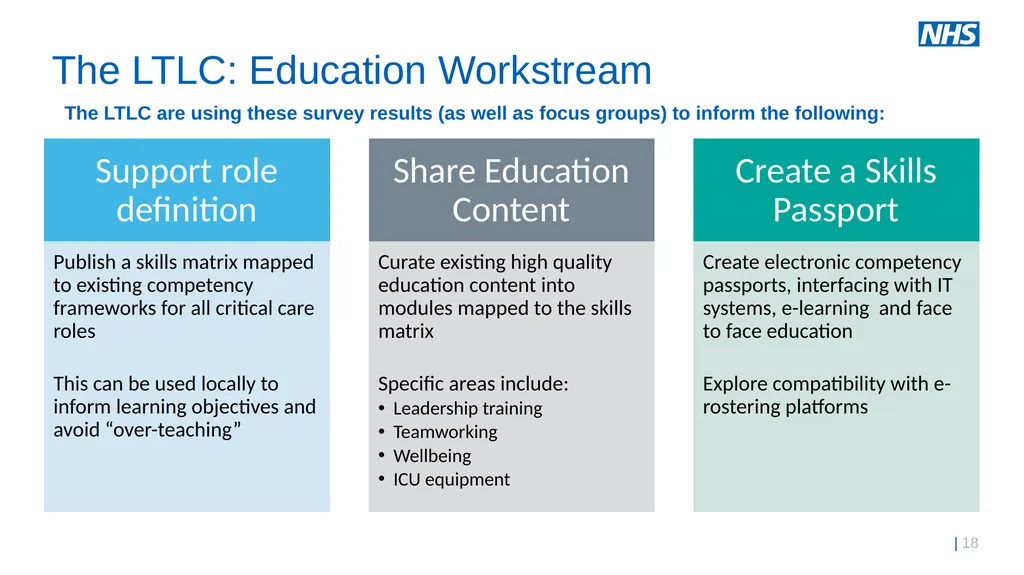
The LTLC: Education Workstream The LTLC are using these survey results (as well as focus groups) to inform the following:<br>
19
Close<br>