Exponents and Logarithms Dr. Haider Raheem
Description: Exponents and Logarithms Dr. Haider Raheem Mohammad Introduction The value of Pi (π) is the ratio of the circumference of a circle to its diameter and is approximately equal to 3.14159 (3.14159265). In a circle, if you divide the
Related Topics
Download Presentation
"Exponents and Logarithms Dr. Haider Raheem" is the property of its rightful owner. Permission is granted to download and print the materials on this website for personal, non-commercial use only, and to display it on your personal computer provided you do not modify the materials and that you retain all copyright notices contained in the materials. By downloading content from our website, you accept the terms of this agreement.
Presentation Transcript
slide1. Exponents and Logarithms Dr. Haider Raheem Mohammad<br>
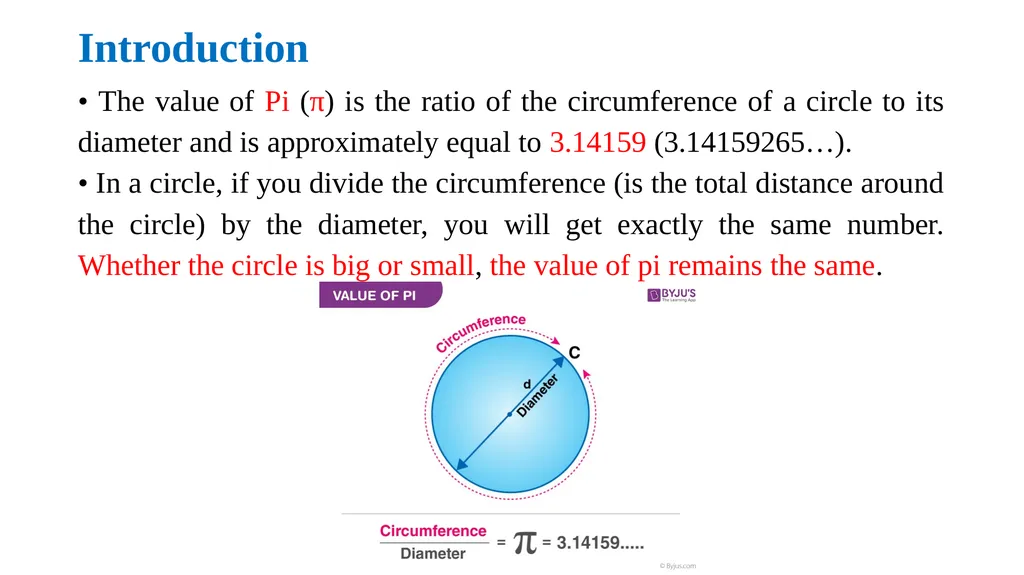
slide3. Introduction • The value of Pi (π) is the ratio of the circumference of a circle to its diameter and is approximately equal to 3.14159 (3.14159265…).
• In a circle, if you divide the circumference (is the total distance around the circle) by the diameter, you will get exactly the same number. Whether the circle is big or small, the value of pi remains the same.<br>
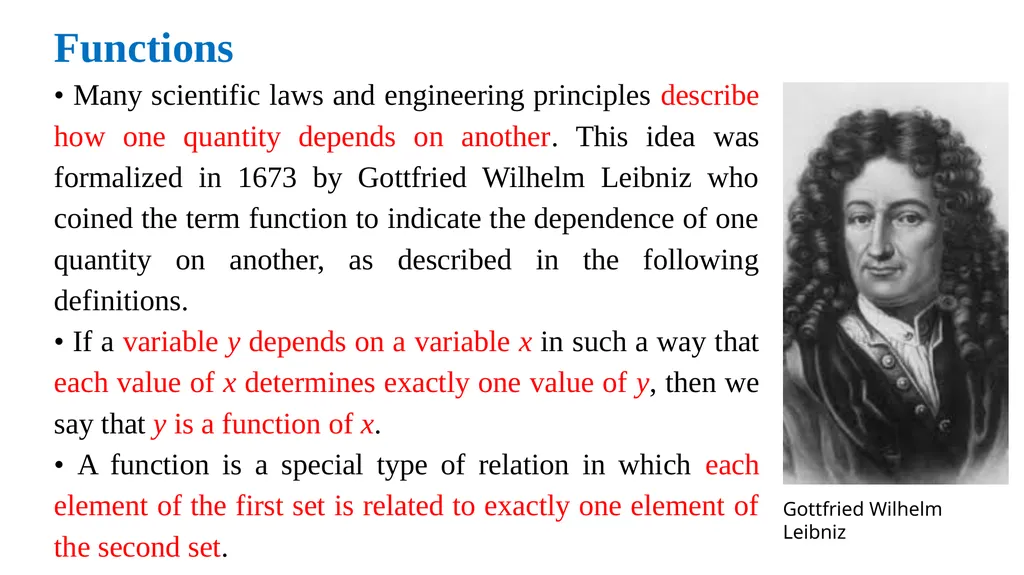
slide4. Functions • Many scientific laws and engineering principles describe how one quantity depends on another. This idea was formalized in 1673 by Gottfried Wilhelm Leibniz who coined the term function to indicate the dependence of one quantity on another, as described in the following definitions.
• If a variable y depends on a variable x in such a way that each value of x determines exactly one value of y, then we say that y is a function of x.
• A function is a special type of relation in which each element of the first set is related to exactly one element of the second set. Gottfried Wilhelm Leibniz<br>
slide5. Exponents and Logarithms • When logarithms were introduced in the seventeenth century as a computational tool, they provided scientists of that period computing power that was previously unimaginable.
• Although computers and calculators have replaced logarithm tables for numerical calculations, the logarithmic functions have wide-ranging applications in mathematics and science.<br>
slide6. Exponents and Logarithms • For many processes in nature, the rate of removal or modification of a species is proportional to, and driven by, the amount of that species present at a given time. This is true for the kinetics of diffusion, for chemical reactions, for radioactive decay, and for the kinetics of the ADME processes of pharmaceuticals. Systems of this type are naturally described by exponential expressions.<br>
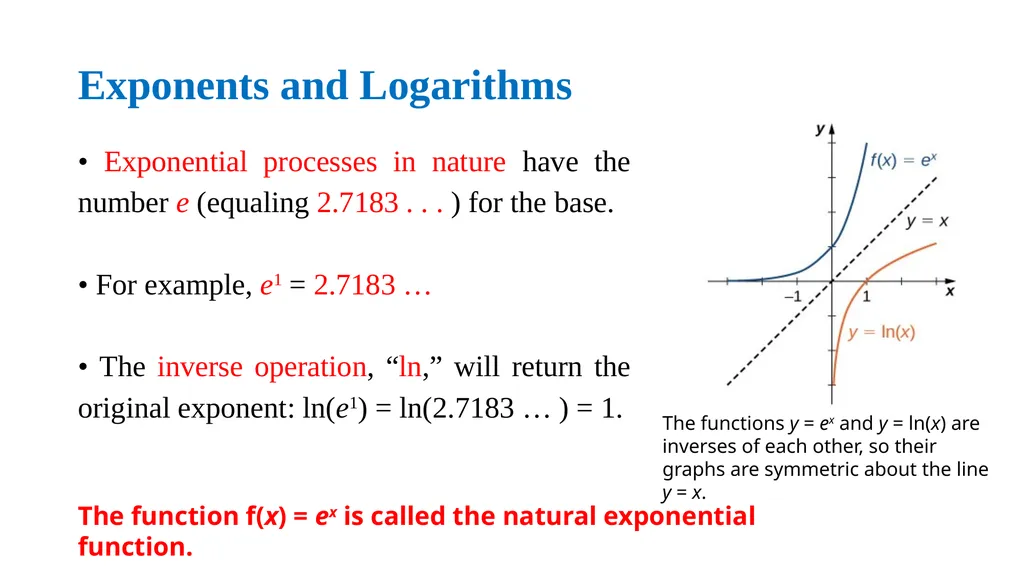
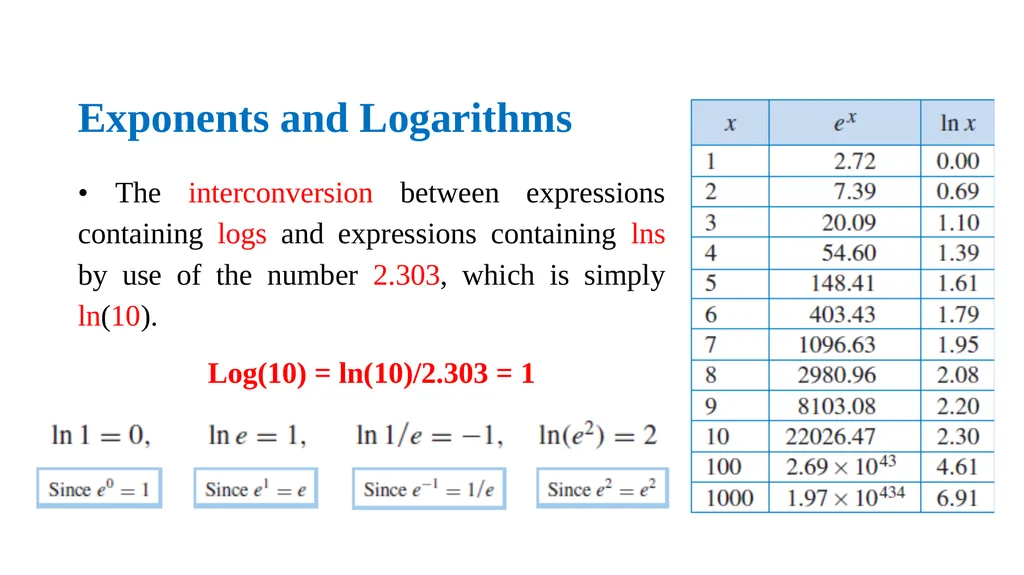
slide7. Exponents and Logarithms • Exponential processes in nature have the number e (equaling 2.7183 . . . ) for the base.
• For example, e1 = 2.7183 …
• The inverse operation, “ln,” will return the original exponent: ln(e1) = ln(2.7183 … ) = 1. The function f(x) = ex is called the natural exponential function. The functions y = ex and y = ln(x) are inverses of each other, so their graphs are symmetric about the line y = x.<br>
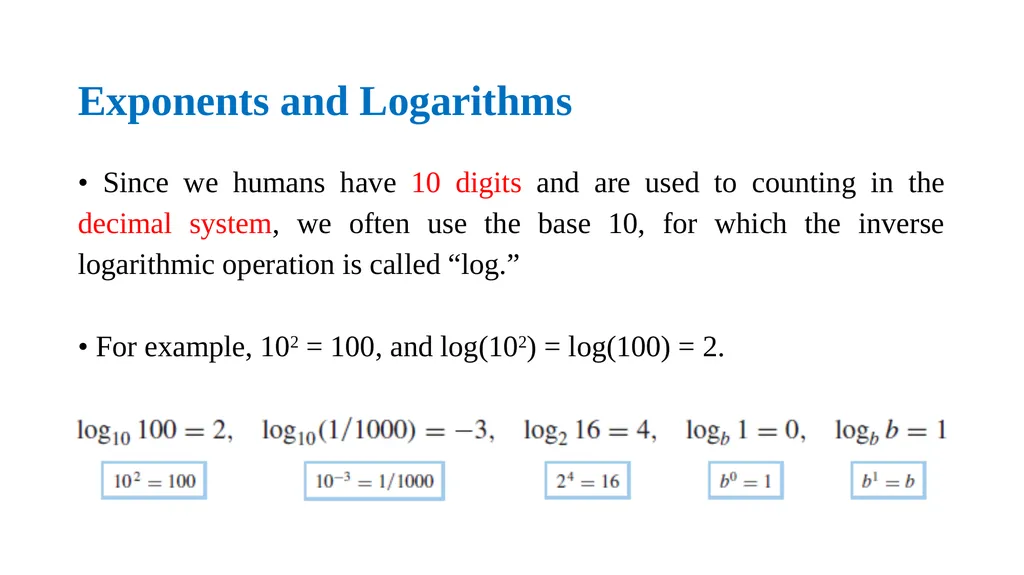
slide8. Exponents and Logarithms • Since we humans have 10 digits and are used to counting in the decimal system, we often use the base 10, for which the inverse logarithmic operation is called “log.”
• For example, 102 = 100, and log(102) = log(100) = 2.<br>
slide9. Exponents and Logarithms • The interconversion between expressions containing logs and expressions containing lns by use of the number 2.303, which is simply ln(10).
Log(10) = ln(10)/2.303 = 1<br>
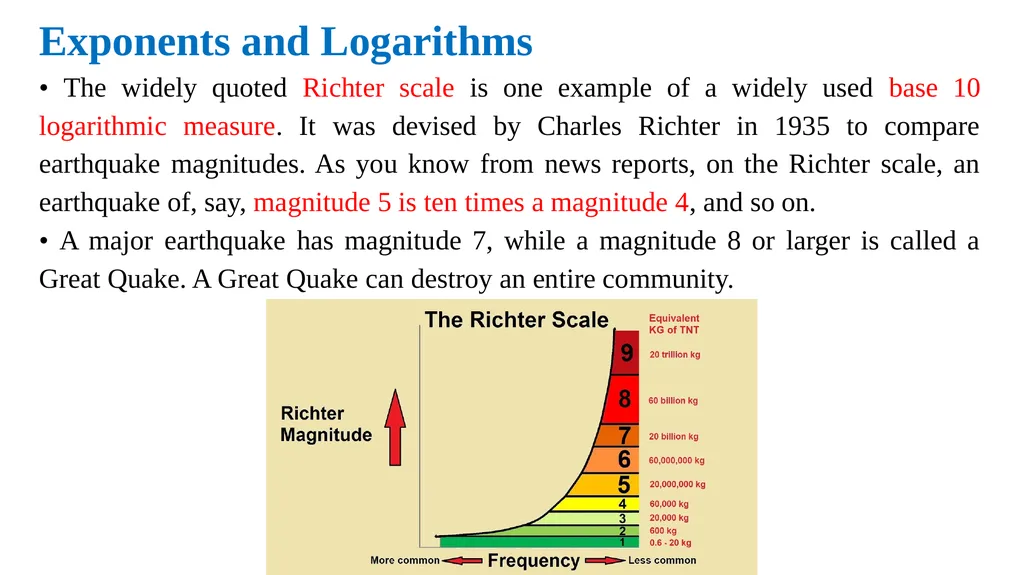
slide10. Exponents and Logarithms • The widely quoted Richter scale is one example of a widely used base 10 logarithmic measure. It was devised by Charles Richter in 1935 to compare earthquake magnitudes. As you know from news reports, on the Richter scale, an earthquake of, say, magnitude 5 is ten times a magnitude 4, and so on.
• A major earthquake has magnitude 7, while a magnitude 8 or larger is called a Great Quake. A Great Quake can destroy an entire community.<br>
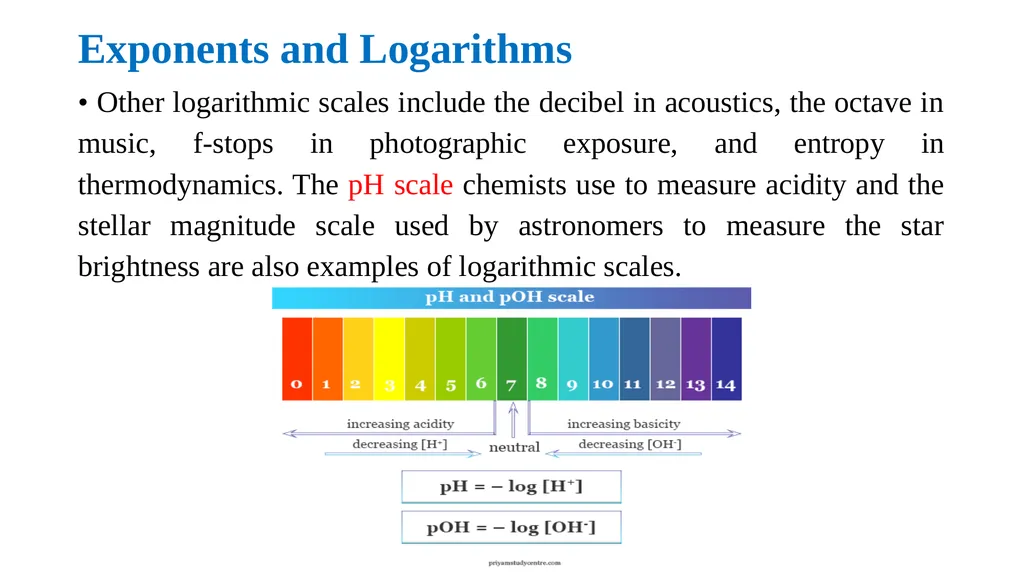
slide11. Exponents and Logarithms • Other logarithmic scales include the decibel in acoustics, the octave in music, f-stops in photographic exposure, and entropy in thermodynamics. The pH scale chemists use to measure acidity and the stellar magnitude scale used by astronomers to measure the star brightness are also examples of logarithmic scales.<br>
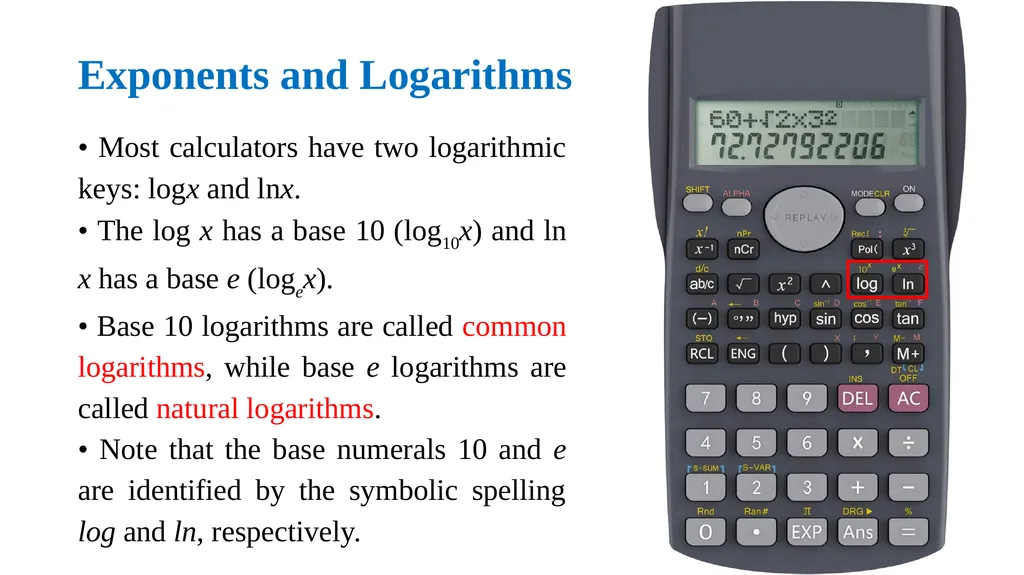
slide12. Exponents and Logarithms • Most calculators have two logarithmic keys: logx and lnx.
• The log x has a base 10 (log10x) and ln x has a base e (logex).
• Base 10 logarithms are called common logarithms, while base e logarithms are called natural logarithms.
• Note that the base numerals 10 and e are identified by the symbolic spelling log and ln, respectively.<br>

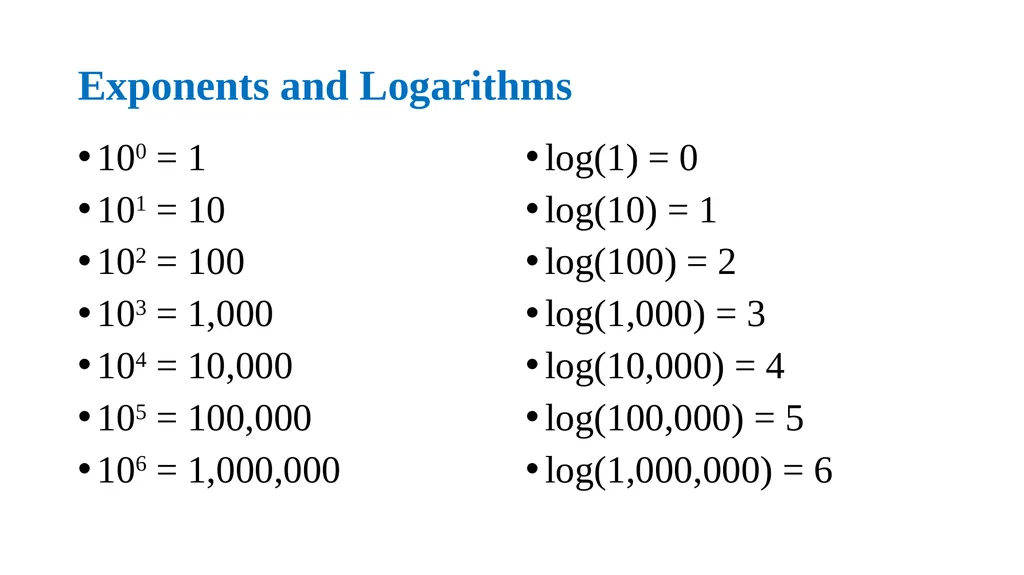
slide13. Exponents and Logarithms 100 = 1
101 = 10
102 = 100
103 = 1,000
104 = 10,000
105 = 100,000
106 = 1,000,000 log(1) = 0
log(10) = 1
log(100) = 2
log(1,000) = 3
log(10,000) = 4
log(100,000) = 5
log(1,000,000) = 6<br>
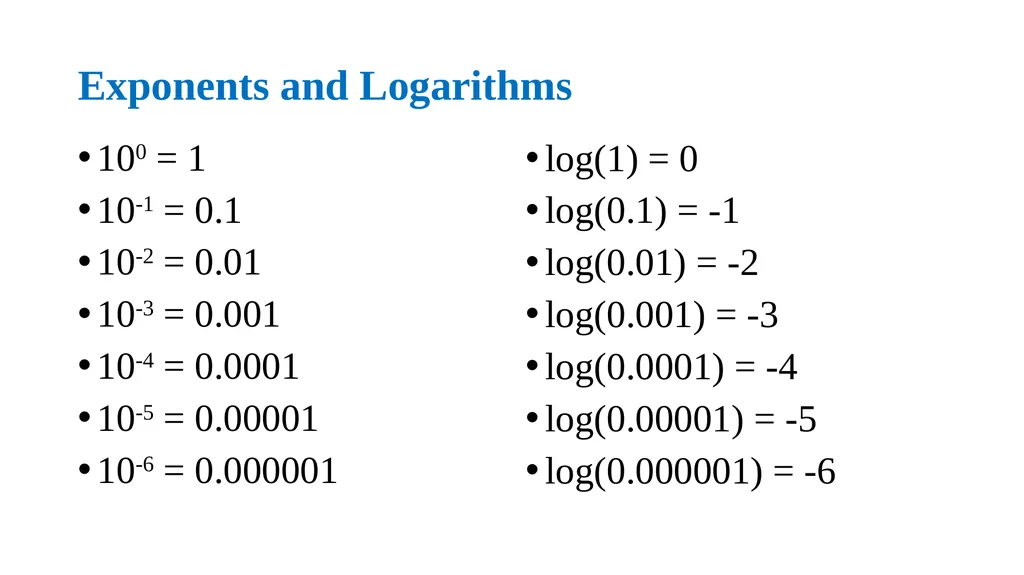
slide14. Exponents and Logarithms 100 = 1
10-1 = 0.1
10-2 = 0.01
10-3 = 0.001
10-4 = 0.0001
10-5 = 0.00001
10-6 = 0.000001 log(1) = 0
log(0.1) = -1
log(0.01) = -2
log(0.001) = -3
log(0.0001) = -4
log(0.00001) = -5
log(0.000001) = -6<br>
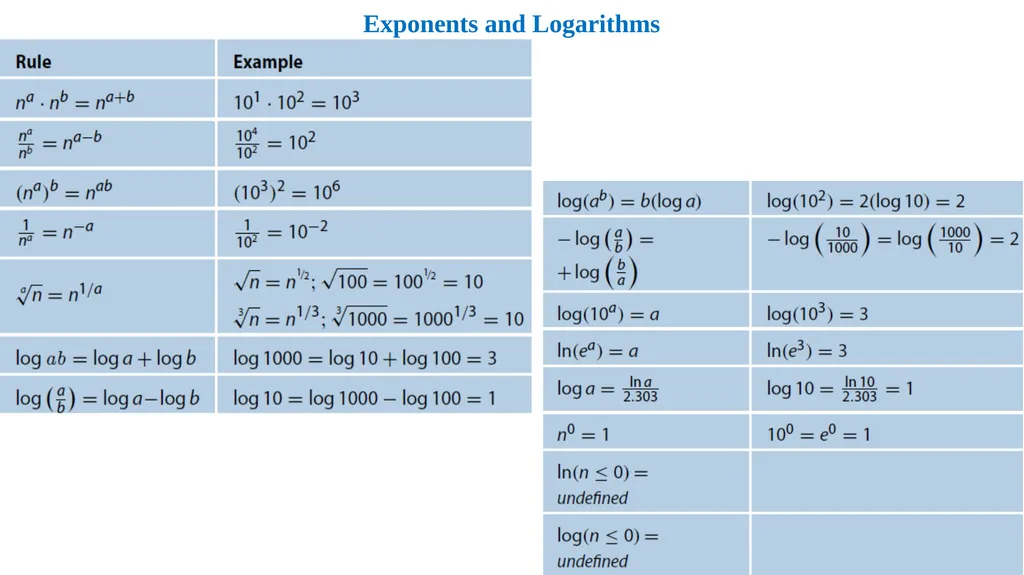
slide15. Exponents and Logarithms<br>
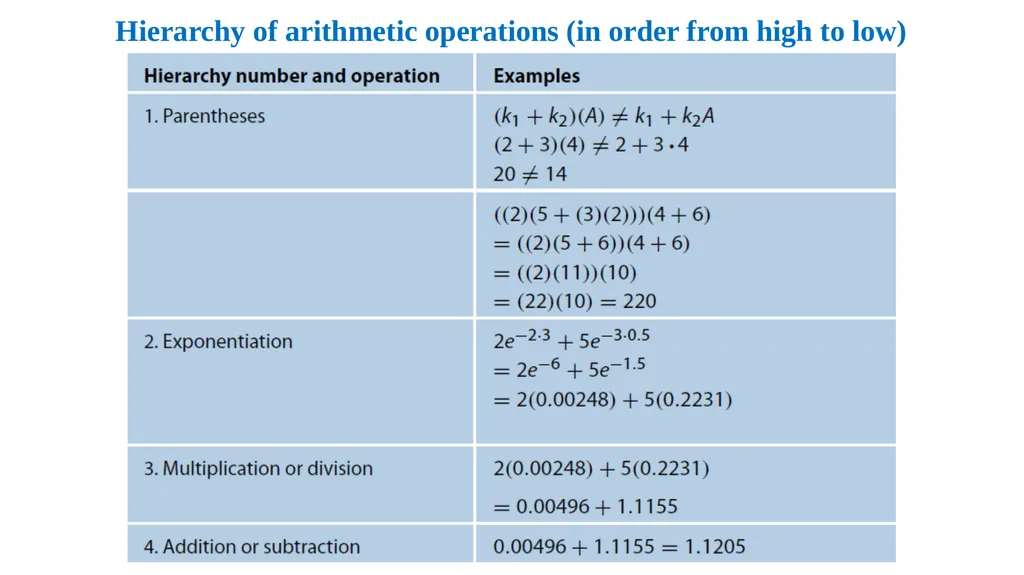
slide16. Hierarchy of arithmetic operations (in order from high to low)<br>
slide17. THANK YOU<br>
slide3. Introduction • The value of Pi (π) is the ratio of the circumference of a circle to its diameter and is approximately equal to 3.14159 (3.14159265…).
• In a circle, if you divide the circumference (is the total distance around the circle) by the diameter, you will get exactly the same number. Whether the circle is big or small, the value of pi remains the same.<br>
slide4. Functions • Many scientific laws and engineering principles describe how one quantity depends on another. This idea was formalized in 1673 by Gottfried Wilhelm Leibniz who coined the term function to indicate the dependence of one quantity on another, as described in the following definitions.
• If a variable y depends on a variable x in such a way that each value of x determines exactly one value of y, then we say that y is a function of x.
• A function is a special type of relation in which each element of the first set is related to exactly one element of the second set. Gottfried Wilhelm Leibniz<br>
slide5. Exponents and Logarithms • When logarithms were introduced in the seventeenth century as a computational tool, they provided scientists of that period computing power that was previously unimaginable.
• Although computers and calculators have replaced logarithm tables for numerical calculations, the logarithmic functions have wide-ranging applications in mathematics and science.<br>
slide6. Exponents and Logarithms • For many processes in nature, the rate of removal or modification of a species is proportional to, and driven by, the amount of that species present at a given time. This is true for the kinetics of diffusion, for chemical reactions, for radioactive decay, and for the kinetics of the ADME processes of pharmaceuticals. Systems of this type are naturally described by exponential expressions.<br>
slide7. Exponents and Logarithms • Exponential processes in nature have the number e (equaling 2.7183 . . . ) for the base.
• For example, e1 = 2.7183 …
• The inverse operation, “ln,” will return the original exponent: ln(e1) = ln(2.7183 … ) = 1. The function f(x) = ex is called the natural exponential function. The functions y = ex and y = ln(x) are inverses of each other, so their graphs are symmetric about the line y = x.<br>
slide8. Exponents and Logarithms • Since we humans have 10 digits and are used to counting in the decimal system, we often use the base 10, for which the inverse logarithmic operation is called “log.”
• For example, 102 = 100, and log(102) = log(100) = 2.<br>
slide9. Exponents and Logarithms • The interconversion between expressions containing logs and expressions containing lns by use of the number 2.303, which is simply ln(10).
Log(10) = ln(10)/2.303 = 1<br>
slide10. Exponents and Logarithms • The widely quoted Richter scale is one example of a widely used base 10 logarithmic measure. It was devised by Charles Richter in 1935 to compare earthquake magnitudes. As you know from news reports, on the Richter scale, an earthquake of, say, magnitude 5 is ten times a magnitude 4, and so on.
• A major earthquake has magnitude 7, while a magnitude 8 or larger is called a Great Quake. A Great Quake can destroy an entire community.<br>
slide11. Exponents and Logarithms • Other logarithmic scales include the decibel in acoustics, the octave in music, f-stops in photographic exposure, and entropy in thermodynamics. The pH scale chemists use to measure acidity and the stellar magnitude scale used by astronomers to measure the star brightness are also examples of logarithmic scales.<br>
slide12. Exponents and Logarithms • Most calculators have two logarithmic keys: logx and lnx.
• The log x has a base 10 (log10x) and ln x has a base e (logex).
• Base 10 logarithms are called common logarithms, while base e logarithms are called natural logarithms.
• Note that the base numerals 10 and e are identified by the symbolic spelling log and ln, respectively.<br>
slide13. Exponents and Logarithms 100 = 1
101 = 10
102 = 100
103 = 1,000
104 = 10,000
105 = 100,000
106 = 1,000,000 log(1) = 0
log(10) = 1
log(100) = 2
log(1,000) = 3
log(10,000) = 4
log(100,000) = 5
log(1,000,000) = 6<br>
slide14. Exponents and Logarithms 100 = 1
10-1 = 0.1
10-2 = 0.01
10-3 = 0.001
10-4 = 0.0001
10-5 = 0.00001
10-6 = 0.000001 log(1) = 0
log(0.1) = -1
log(0.01) = -2
log(0.001) = -3
log(0.0001) = -4
log(0.00001) = -5
log(0.000001) = -6<br>
slide15. Exponents and Logarithms<br>
slide16. Hierarchy of arithmetic operations (in order from high to low)<br>
slide17. THANK YOU<br>