
Export Control Considerations March 9, 2016 RAP
MJ
Published · 28 slides · 0 views
1 / 1

Description
Export Control Considerations March 9, 2016 RAP Meeting Presenter: Candita Meek, Export Compliance Coordinator Agenda Why are exports controlled? What is an export? Who are the regulators? What is controlled? Are there any exclusions? Why
Related Topics
Share
Embed code
Download this presentation From Below
"Export Control Considerations March 9, 2016 RAP" is the property of its rightful owner. Permission is granted to download and print the materials on this website for personal, non-commercial use only, and to display it on your personal computer provided you do not modify the materials and that you retain all copyright notices contained in the materials. By downloading content from our website, you accept the terms of this agreement.
Presentation Transcript
01
Export Control Considerations March 9, 2016 RAP Meeting
Presenter: Candita Meek, Export Compliance Coordinator<br>
Presenter: Candita Meek, Export Compliance Coordinator<br>
02
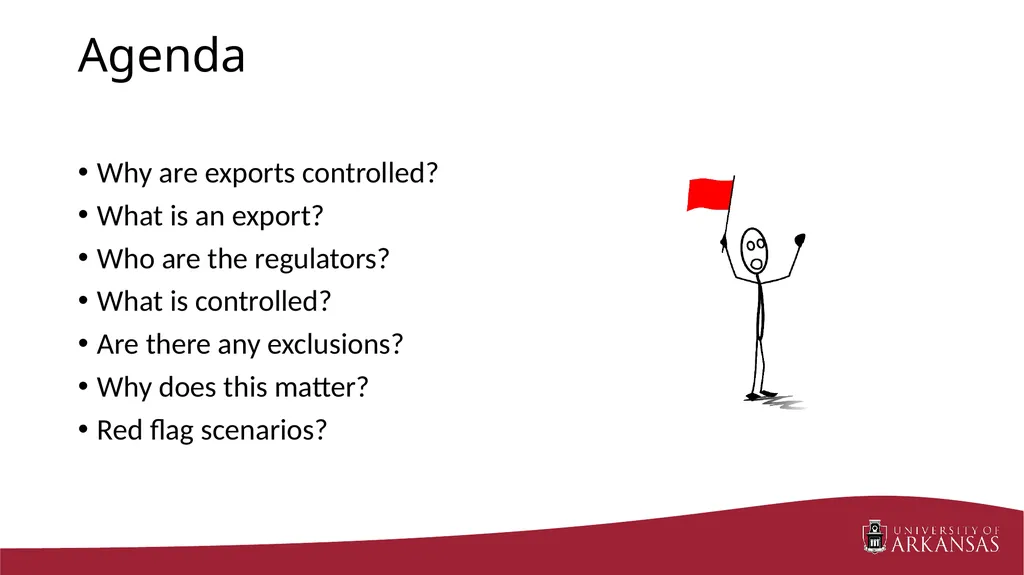
Agenda Why are exports controlled?
What is an export?
Who are the regulators?
What is controlled?
Are there any exclusions?
Why does this matter?
Red flag scenarios?<br>
What is an export?
Who are the regulators?
What is controlled?
Are there any exclusions?
Why does this matter?
Red flag scenarios?<br>
03
Why Are There Export Controls? Framework of Laws Directed At
Restriction on exports of items that could contribute to the military capabilities of our rivals
Prevention of proliferation of weapons of mass destruction (nuclear, biological, chemical)
Compliance with trade agreements and sanctions against other nations
Prevention of terrorism<br>
Restriction on exports of items that could contribute to the military capabilities of our rivals
Prevention of proliferation of weapons of mass destruction (nuclear, biological, chemical)
Compliance with trade agreements and sanctions against other nations
Prevention of terrorism<br>
04
What is An Export? Physical & electronic transfers of items outside the U.S.
(Ex: Freight, Mail, Handcarry)
Release or disclosure of technical data, technology, or source code to a non-U.S. Person, in the U.S. or abroad
(Ex: In-Person, Phone/Fax, E-mail, FTP)
Application of controlled data outside the U.S.
(Ex: Training, Technical Assistance)<br>
(Ex: Freight, Mail, Handcarry)
Release or disclosure of technical data, technology, or source code to a non-U.S. Person, in the U.S. or abroad
(Ex: In-Person, Phone/Fax, E-mail, FTP)
Application of controlled data outside the U.S.
(Ex: Training, Technical Assistance)<br>
05
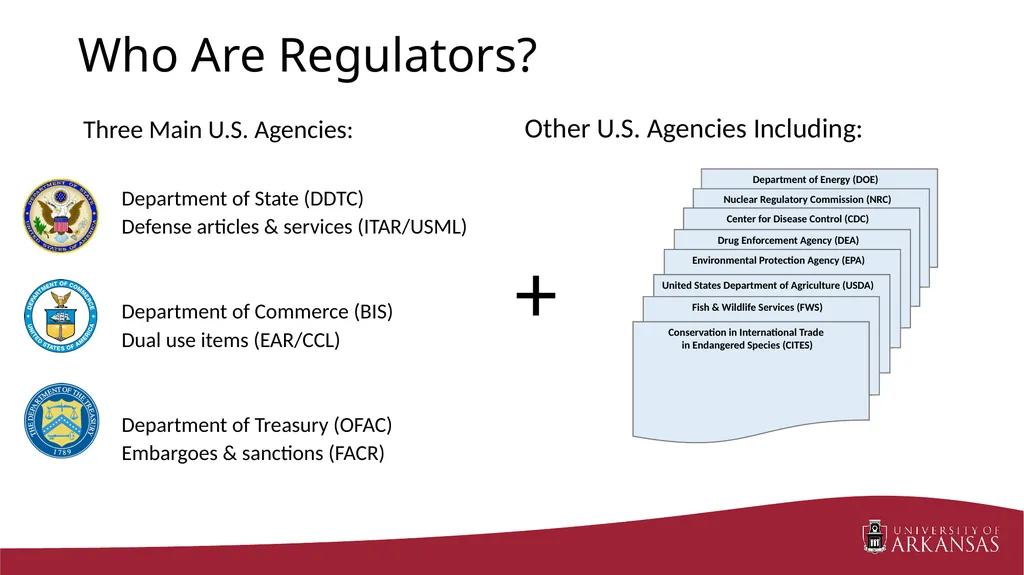
Who Are Regulators? Three Main U.S. Agencies:
Department of State (DDTC)
Defense articles & services (ITAR/USML)
Department of Commerce (BIS)
Dual use items (EAR/CCL)
Department of Treasury (OFAC)
Embargoes & sanctions (FACR)<br>
Department of State (DDTC)
Defense articles & services (ITAR/USML)
Department of Commerce (BIS)
Dual use items (EAR/CCL)
Department of Treasury (OFAC)
Embargoes & sanctions (FACR)<br>
06
What is Controlled? Restricted Items:
International shipment of tangible items
Technology & source code to non-U.S. persons (even within U.S.)
Controls Contingent On:
What is it? (classification)
Where is it going? (country/foreign nationals)
Who will receive it? (restricted party screening)
What will they do with it? (ultimate end-user/end-use)<br>
International shipment of tangible items
Technology & source code to non-U.S. persons (even within U.S.)
Controls Contingent On:
What is it? (classification)
Where is it going? (country/foreign nationals)
Who will receive it? (restricted party screening)
What will they do with it? (ultimate end-user/end-use)<br>
07
What is it? (Classification) Designed/Modified Military Application
ITAR: U.S. Munitions List (USML) 22 CFR §121.1
Dual-Use Applications
EAR: Commerce Control List (CCL) 15 CFR §774<br>
ITAR: U.S. Munitions List (USML) 22 CFR §121.1
Dual-Use Applications
EAR: Commerce Control List (CCL) 15 CFR §774<br>
08
ITAR - United States Munitions List (USML) I – Firearms, Close Assault Weapons and Combat Shotguns
II – Guns and Armament
III – Ammunition/Ordnance
IV – Launch Vehicles, Guided Missiles, Ballistic Missiles, Rockets, Torpedoes, Bombs and Mines
V – Explosives and Energetic Materials, Propellants, Incendiary Agents and Their Constituents
VI – Surface Vessels of War and Special Naval Equipment
VII – Ground Vehicles
VIII – Aircraft and Related Articles
IX – Military Training Equipment and Training
X – Personal Protective Equipment
XI – Military Electronics XII – Fire Control, Range Finder, Optical and Guidance and Control Equipment
XIII – Materials and Miscellaneous Articles
XIV – Toxicological Agents including Chemical agents, Biological Agents and Associated Equipment
XV – Spacecraft and Related Articles
XVI – Nuclear Weapons Related Articles
XVII – *Classified Articles, Technical Data, and Defense Services Not Otherwise Enumerated
XVIII – Directed Energy Weapons
XIX – Gas Turbine Engines and Associated Equipment
XX – Submersible Vessels and Related Articles
XXI – Articles, Technical Data and Defense Services Not Otherwise Enumerated 21 Categories w/Technical Specifications Ex: Category X
(a) (2) Clothing to protect against or reduce detection by radar, infrared (IR) or other sensors at wavelengths greater than 900 nanometers, and the specially treated or formulated dyes, coatings, and fabrics used in its design, manufacture, and production; *Note: Not all ITAR is classified; it is a subset.<br>
II – Guns and Armament
III – Ammunition/Ordnance
IV – Launch Vehicles, Guided Missiles, Ballistic Missiles, Rockets, Torpedoes, Bombs and Mines
V – Explosives and Energetic Materials, Propellants, Incendiary Agents and Their Constituents
VI – Surface Vessels of War and Special Naval Equipment
VII – Ground Vehicles
VIII – Aircraft and Related Articles
IX – Military Training Equipment and Training
X – Personal Protective Equipment
XI – Military Electronics XII – Fire Control, Range Finder, Optical and Guidance and Control Equipment
XIII – Materials and Miscellaneous Articles
XIV – Toxicological Agents including Chemical agents, Biological Agents and Associated Equipment
XV – Spacecraft and Related Articles
XVI – Nuclear Weapons Related Articles
XVII – *Classified Articles, Technical Data, and Defense Services Not Otherwise Enumerated
XVIII – Directed Energy Weapons
XIX – Gas Turbine Engines and Associated Equipment
XX – Submersible Vessels and Related Articles
XXI – Articles, Technical Data and Defense Services Not Otherwise Enumerated 21 Categories w/Technical Specifications Ex: Category X
(a) (2) Clothing to protect against or reduce detection by radar, infrared (IR) or other sensors at wavelengths greater than 900 nanometers, and the specially treated or formulated dyes, coatings, and fabrics used in its design, manufacture, and production; *Note: Not all ITAR is classified; it is a subset.<br>
09
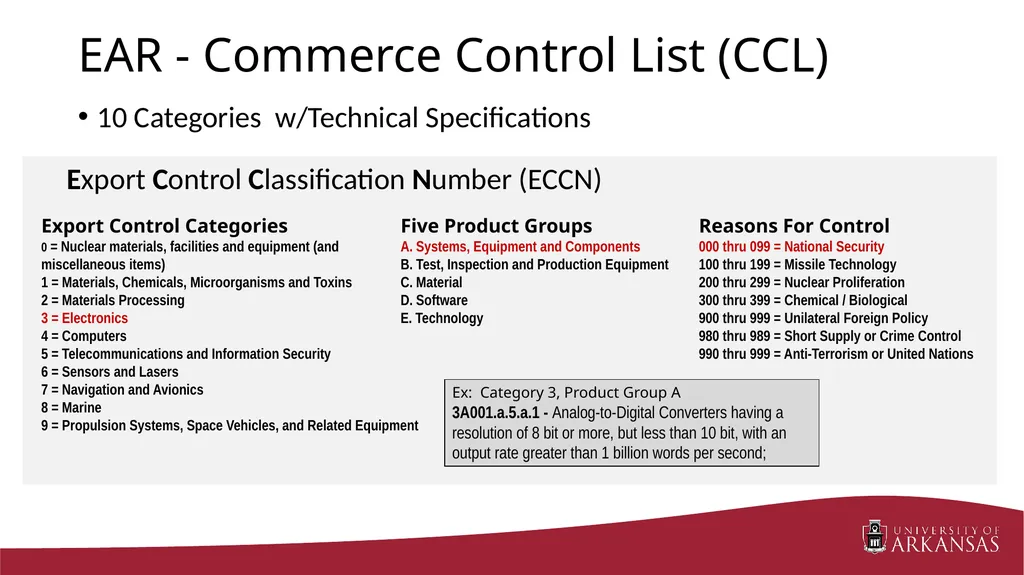
EAR - Commerce Control List (CCL) 10 Categories w/Technical Specifications Export Control Classification Number (ECCN) Export Control Categories
0 = Nuclear materials, facilities and equipment (and miscellaneous items) 1 = Materials, Chemicals, Microorganisms and Toxins 2 = Materials Processing 3 = Electronics 4 = Computers 5 = Telecommunications and Information Security 6 = Sensors and Lasers 7 = Navigation and Avionics 8 = Marine 9 = Propulsion Systems, Space Vehicles, and Related Equipment Five Product Groups
A. Systems, Equipment and Components B. Test, Inspection and Production Equipment C. Material D. Software E. Technology Ex: Category 3, Product Group A
3A001.a.5.a.1 - Analog-to-Digital Converters having a resolution of 8 bit or more, but less than 10 bit, with an output rate greater than 1 billion words per second; Reasons For Control
000 thru 099 = National Security
100 thru 199 = Missile Technology
200 thru 299 = Nuclear Proliferation
300 thru 399 = Chemical / Biological
900 thru 999 = Unilateral Foreign Policy
980 thru 989 = Short Supply or Crime Control
990 thru 999 = Anti-Terrorism or United Nations<br>
0 = Nuclear materials, facilities and equipment (and miscellaneous items) 1 = Materials, Chemicals, Microorganisms and Toxins 2 = Materials Processing 3 = Electronics 4 = Computers 5 = Telecommunications and Information Security 6 = Sensors and Lasers 7 = Navigation and Avionics 8 = Marine 9 = Propulsion Systems, Space Vehicles, and Related Equipment Five Product Groups
A. Systems, Equipment and Components B. Test, Inspection and Production Equipment C. Material D. Software E. Technology Ex: Category 3, Product Group A
3A001.a.5.a.1 - Analog-to-Digital Converters having a resolution of 8 bit or more, but less than 10 bit, with an output rate greater than 1 billion words per second; Reasons For Control
000 thru 099 = National Security
100 thru 199 = Missile Technology
200 thru 299 = Nuclear Proliferation
300 thru 399 = Chemical / Biological
900 thru 999 = Unilateral Foreign Policy
980 thru 989 = Short Supply or Crime Control
990 thru 999 = Anti-Terrorism or United Nations<br>
10
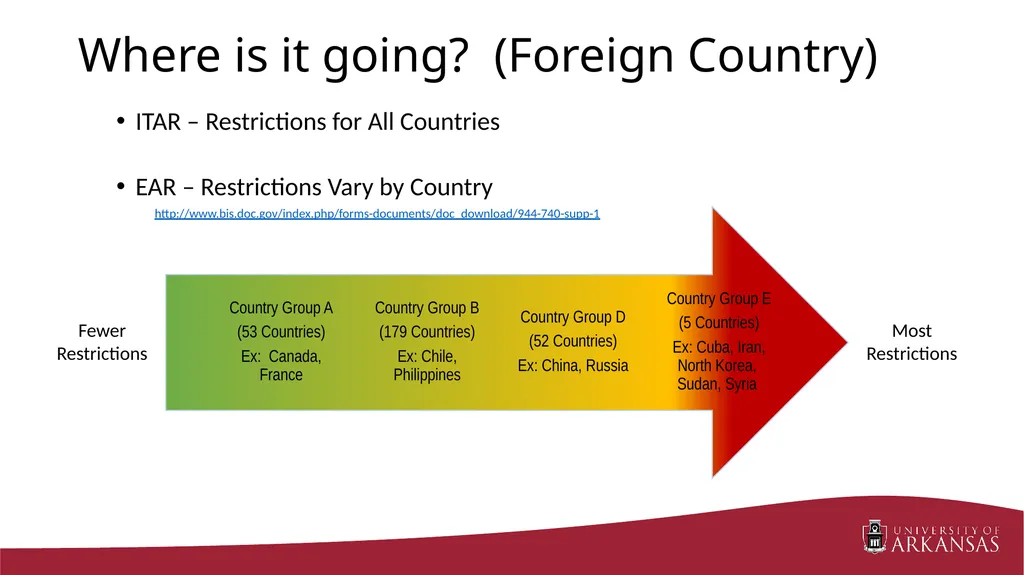
Where is it going? (Foreign Country) ITAR – Restrictions for All Countries
EAR – Restrictions Vary by Country
http://www.bis.doc.gov/index.php/forms-documents/doc_download/944-740-supp-1 Fewer Restrictions Most Restrictions<br>
EAR – Restrictions Vary by Country
http://www.bis.doc.gov/index.php/forms-documents/doc_download/944-740-supp-1 Fewer Restrictions Most Restrictions<br>
11
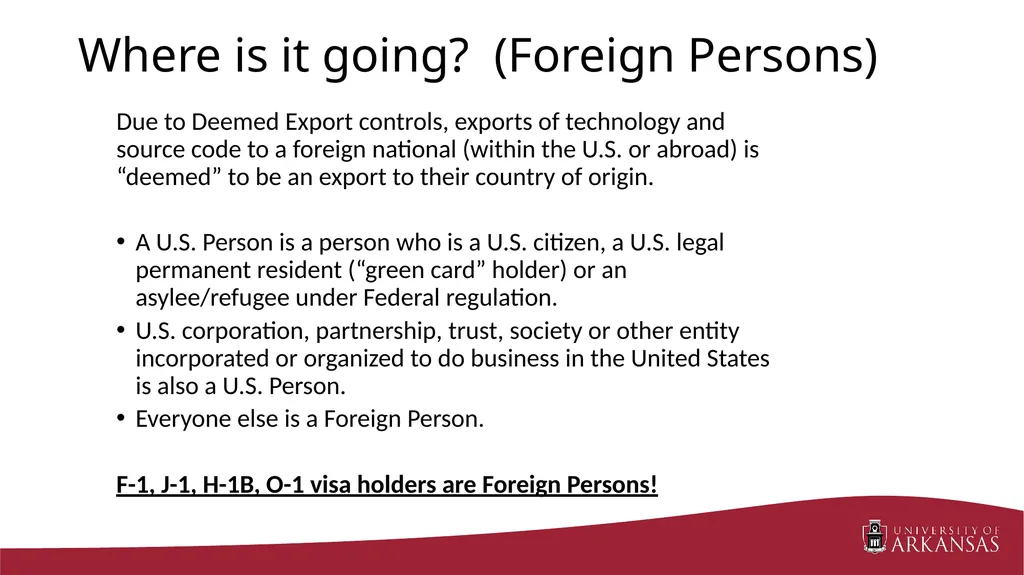
Where is it going? (Foreign Persons) Due to Deemed Export controls, exports of technology and source code to a foreign national (within the U.S. or abroad) is “deemed” to be an export to their country of origin.
A U.S. Person is a person who is a U.S. citizen, a U.S. legal permanent resident (“green card” holder) or an asylee/refugee under Federal regulation.
U.S. corporation, partnership, trust, society or other entity incorporated or organized to do business in the United States is also a U.S. Person.
Everyone else is a Foreign Person.
F-1, J-1, H-1B, O-1 visa holders are Foreign Persons!<br>
A U.S. Person is a person who is a U.S. citizen, a U.S. legal permanent resident (“green card” holder) or an asylee/refugee under Federal regulation.
U.S. corporation, partnership, trust, society or other entity incorporated or organized to do business in the United States is also a U.S. Person.
Everyone else is a Foreign Person.
F-1, J-1, H-1B, O-1 visa holders are Foreign Persons!<br>
12
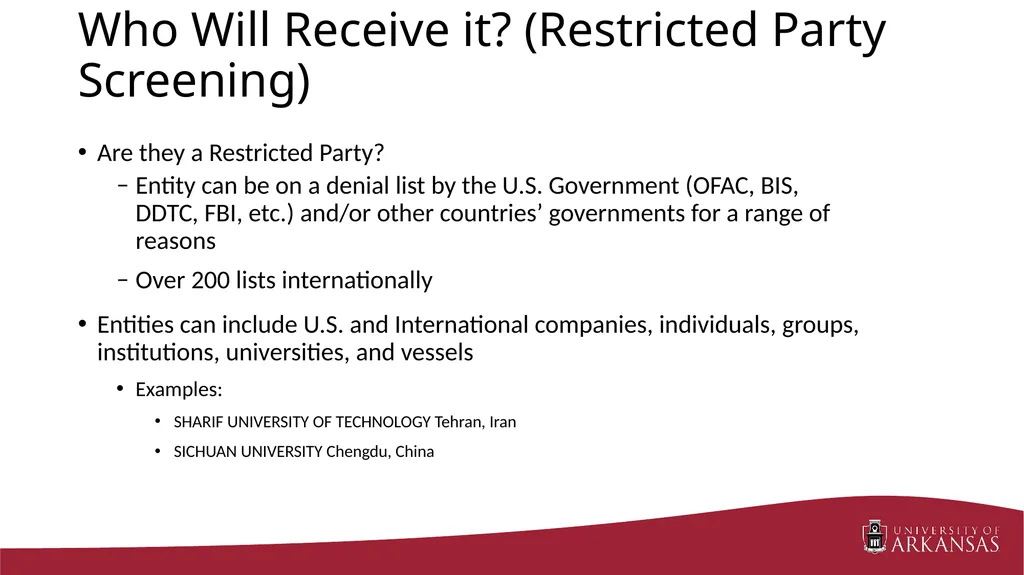
Who Will Receive it? (Restricted Party Screening) Are they a Restricted Party?
Entity can be on a denial list by the U.S. Government (OFAC, BIS, DDTC, FBI, etc.) and/or other countries’ governments for a range of reasons
Over 200 lists internationally
Entities can include U.S. and International companies, individuals, groups, institutions, universities, and vessels
Examples:
SHARIF UNIVERSITY OF TECHNOLOGY Tehran, Iran
SICHUAN UNIVERSITY Chengdu, China<br>
Entity can be on a denial list by the U.S. Government (OFAC, BIS, DDTC, FBI, etc.) and/or other countries’ governments for a range of reasons
Over 200 lists internationally
Entities can include U.S. and International companies, individuals, groups, institutions, universities, and vessels
Examples:
SHARIF UNIVERSITY OF TECHNOLOGY Tehran, Iran
SICHUAN UNIVERSITY Chengdu, China<br>
13
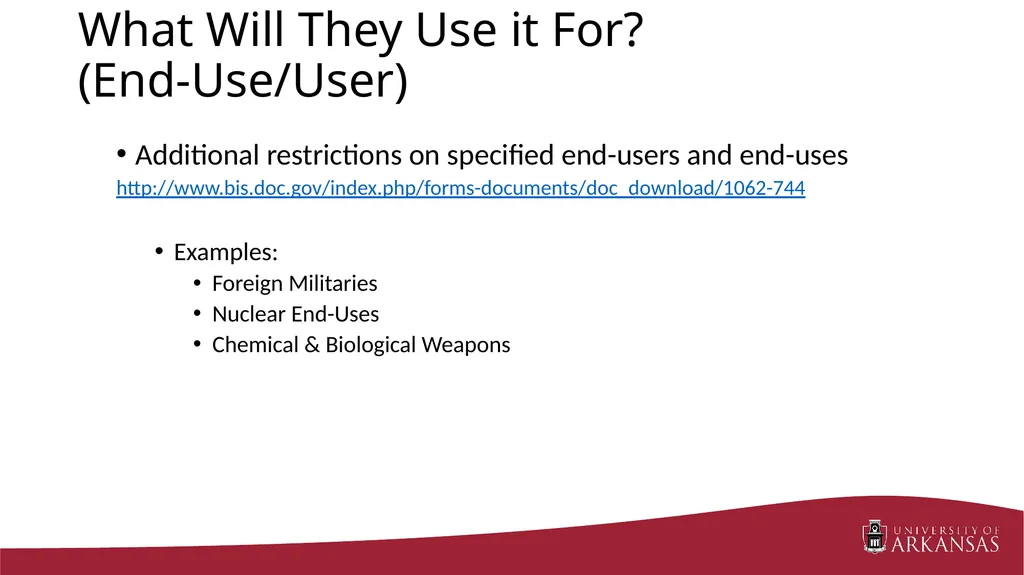
What Will They Use it For? (End-Use/User) Additional restrictions on specified end-users and end-uses
http://www.bis.doc.gov/index.php/forms-documents/doc_download/1062-744
Examples:
Foreign Militaries
Nuclear End-Uses
Chemical & Biological Weapons<br>
http://www.bis.doc.gov/index.php/forms-documents/doc_download/1062-744
Examples:
Foreign Militaries
Nuclear End-Uses
Chemical & Biological Weapons<br>
14
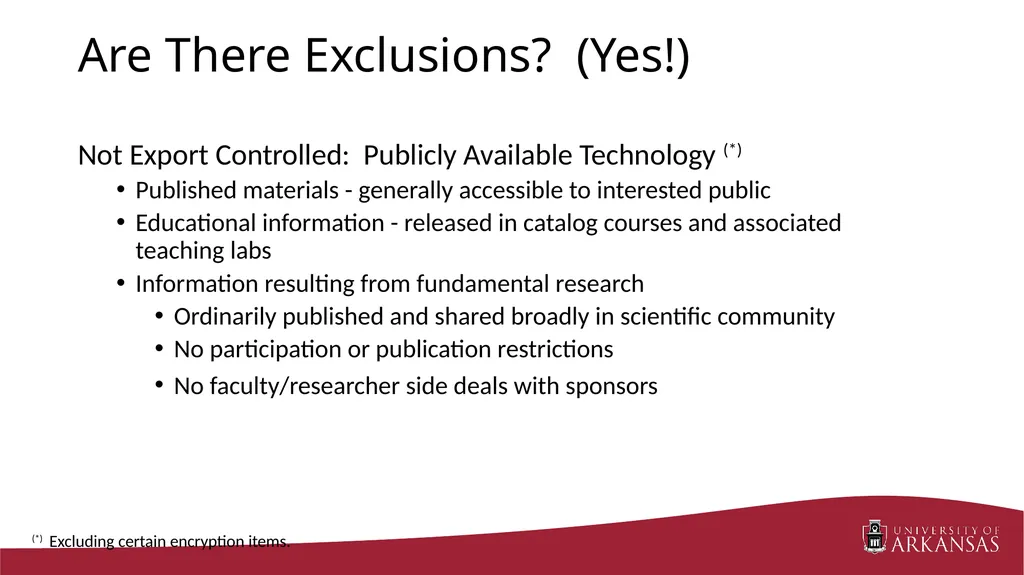
Are There Exclusions? (Yes!) Not Export Controlled: Publicly Available Technology (*)
Published materials - generally accessible to interested public
Educational information - released in catalog courses and associated teaching labs
Information resulting from fundamental research
Ordinarily published and shared broadly in scientific community
No participation or publication restrictions
No faculty/researcher side deals with sponsors (*) Excluding certain encryption items.<br>
Published materials - generally accessible to interested public
Educational information - released in catalog courses and associated teaching labs
Information resulting from fundamental research
Ordinarily published and shared broadly in scientific community
No participation or publication restrictions
No faculty/researcher side deals with sponsors (*) Excluding certain encryption items.<br>
15
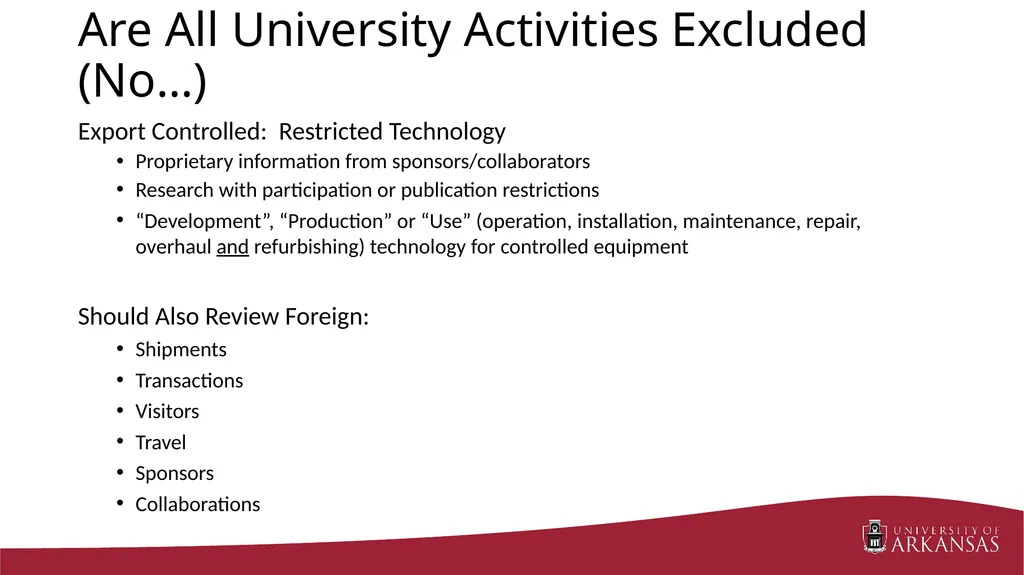
Are All University Activities Excluded (No…) Export Controlled: Restricted Technology
Proprietary information from sponsors/collaborators
Research with participation or publication restrictions
“Development”, “Production” or “Use” (operation, installation, maintenance, repair, overhaul and refurbishing) technology for controlled equipment
Should Also Review Foreign:
Shipments
Transactions
Visitors
Travel
Sponsors
Collaborations<br>
Proprietary information from sponsors/collaborators
Research with participation or publication restrictions
“Development”, “Production” or “Use” (operation, installation, maintenance, repair, overhaul and refurbishing) technology for controlled equipment
Should Also Review Foreign:
Shipments
Transactions
Visitors
Travel
Sponsors
Collaborations<br>
16
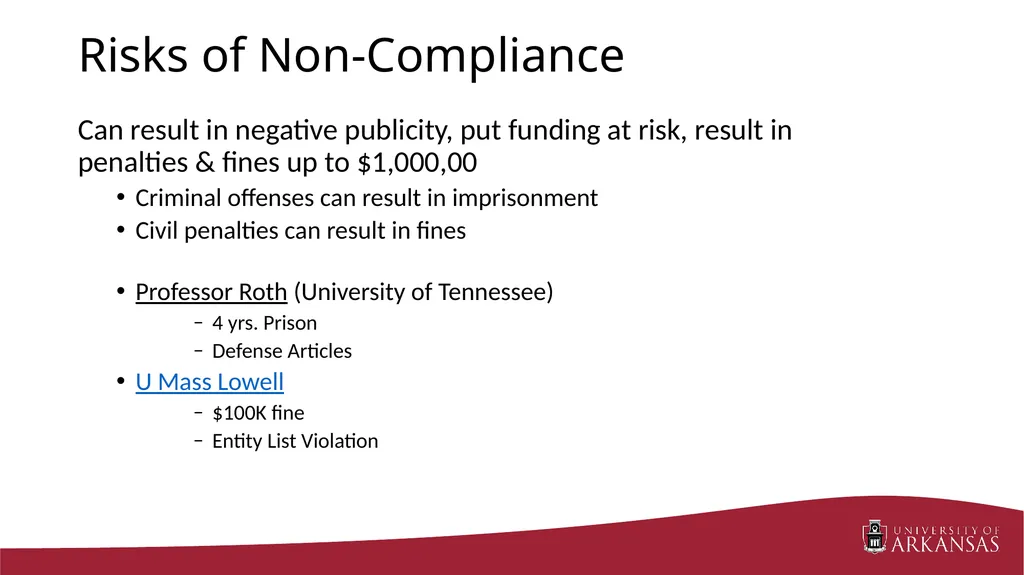
Risks of Non-Compliance Can result in negative publicity, put funding at risk, result in penalties & fines up to $1,000,00
Criminal offenses can result in imprisonment
Civil penalties can result in fines
Professor Roth (University of Tennessee)
4 yrs. Prison
Defense Articles
U Mass Lowell
$100K fine
Entity List Violation<br>
Criminal offenses can result in imprisonment
Civil penalties can result in fines
Professor Roth (University of Tennessee)
4 yrs. Prison
Defense Articles
U Mass Lowell
$100K fine
Entity List Violation<br>
17
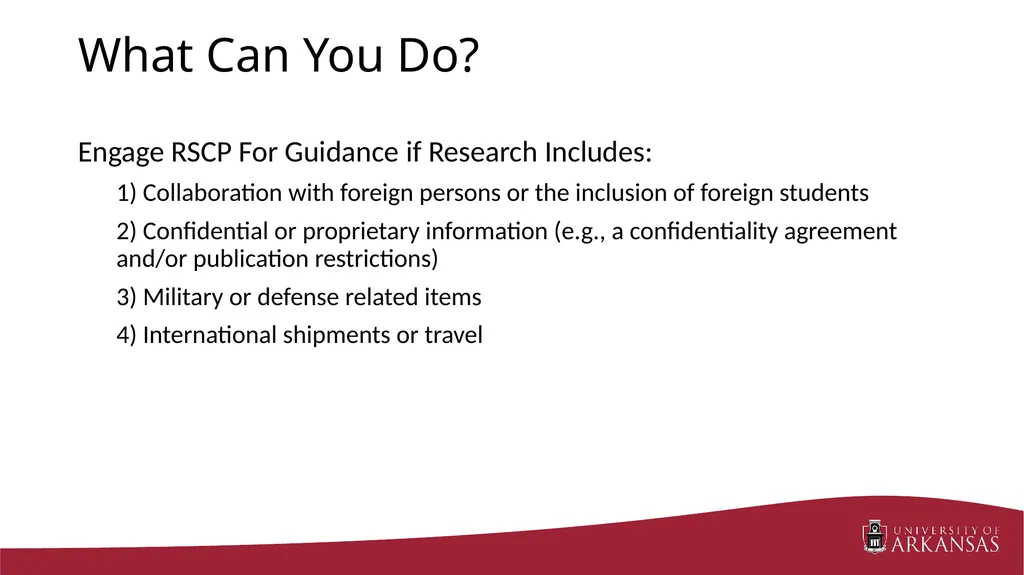
What Can You Do? Engage RSCP For Guidance if Research Includes:
1) Collaboration with foreign persons or the inclusion of foreign students
2) Confidential or proprietary information (e.g., a confidentiality agreement and/or publication restrictions)
3) Military or defense related items
4) International shipments or travel<br>
1) Collaboration with foreign persons or the inclusion of foreign students
2) Confidential or proprietary information (e.g., a confidentiality agreement and/or publication restrictions)
3) Military or defense related items
4) International shipments or travel<br>
18
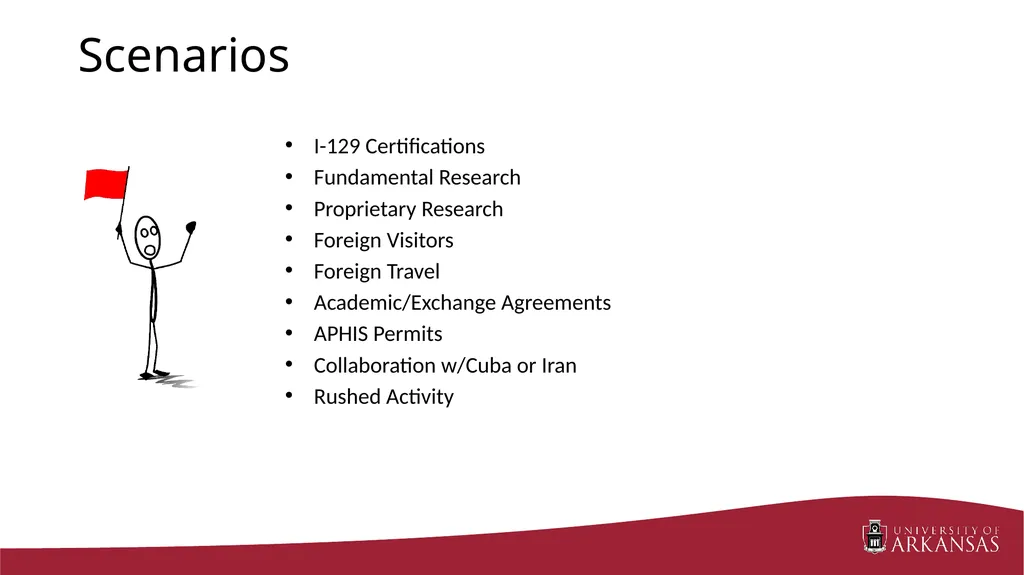
Scenarios I-129 Certifications
Fundamental Research
Proprietary Research
Foreign Visitors
Foreign Travel
Academic/Exchange Agreements
APHIS Permits
Collaboration w/Cuba or Iran
Rushed Activity<br>
Fundamental Research
Proprietary Research
Foreign Visitors
Foreign Travel
Academic/Exchange Agreements
APHIS Permits
Collaboration w/Cuba or Iran
Rushed Activity<br>
19
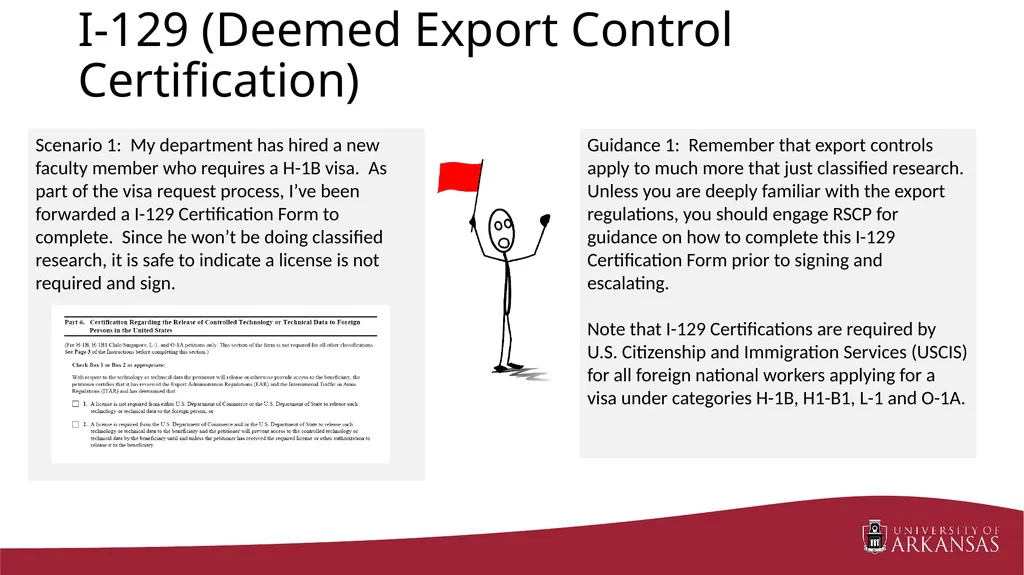
I-129 (Deemed Export Control Certification) Scenario 1: My department has hired a new faculty member who requires a H-1B visa. As part of the visa request process, I’ve been forwarded a I-129 Certification Form to complete. Since he won’t be doing classified research, it is safe to indicate a license is not required and sign. Guidance 1: Remember that export controls apply to much more that just classified research. Unless you are deeply familiar with the export regulations, you should engage RSCP for guidance on how to complete this I-129 Certification Form prior to signing and escalating.
Note that I-129 Certifications are required by U.S. Citizenship and Immigration Services (USCIS) for all foreign national workers applying for a visa under categories H-1B, H1-B1, L-1 and O-1A.<br>
Note that I-129 Certifications are required by U.S. Citizenship and Immigration Services (USCIS) for all foreign national workers applying for a visa under categories H-1B, H1-B1, L-1 and O-1A.<br>
20
Fundamental Research Scenario 2: A researcher in my department has been awarded a NSF grant. I’ve reviewed the terms and conditions and there are no participation or publication restrictions. This means the research qualifies as Fundamental Research, so her foreign national graduate student can work on the project. Guidance 2: Yes, the absence of participation and publication restrictions does qualify the research results for the Fundamental Research Exclusion (FRE). Foreign nationals can participate.
Note that the FRE applies to research results. Any related international shipments, travel and visitors would still need reviewing.<br>
Note that the FRE applies to research results. Any related international shipments, travel and visitors would still need reviewing.<br>
21
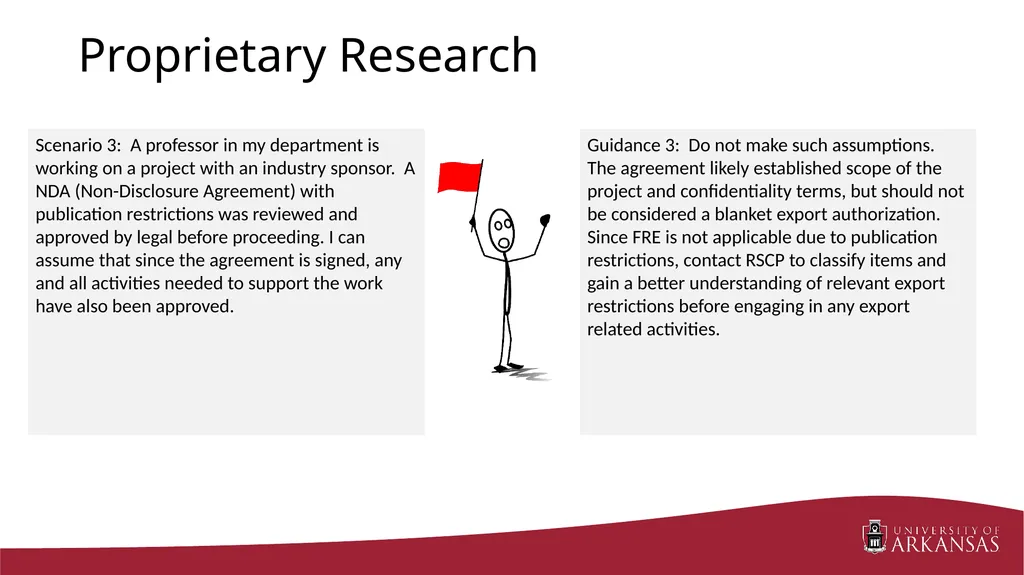
Proprietary Research Scenario 3: A professor in my department is working on a project with an industry sponsor. A NDA (Non-Disclosure Agreement) with publication restrictions was reviewed and approved by legal before proceeding. I can assume that since the agreement is signed, any and all activities needed to support the work have also been approved. Guidance 3: Do not make such assumptions. The agreement likely established scope of the project and confidentiality terms, but should not be considered a blanket export authorization. Since FRE is not applicable due to publication restrictions, contact RSCP to classify items and gain a better understanding of relevant export restrictions before engaging in any export related activities.<br>
22
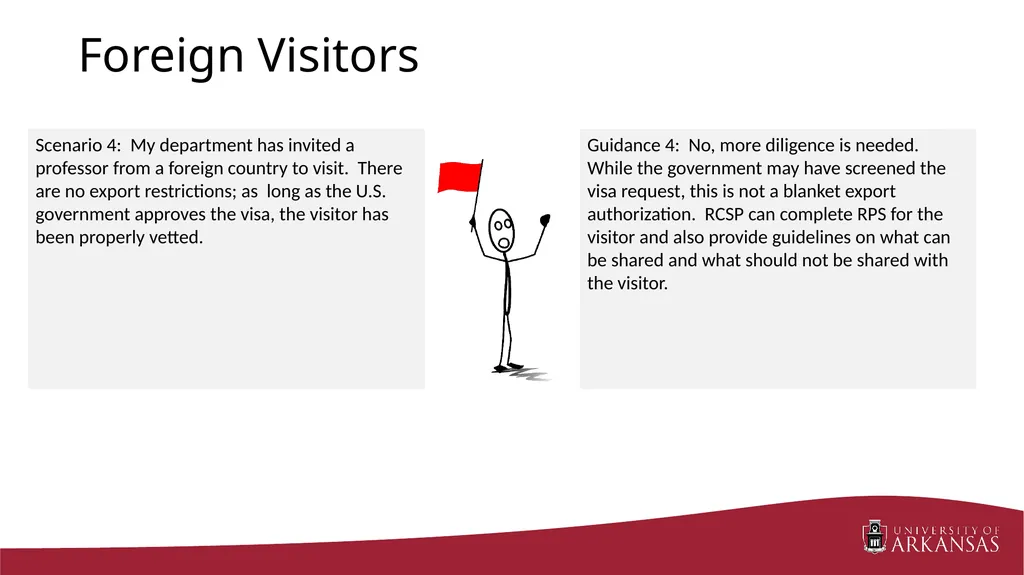
Foreign Visitors Scenario 4: My department has invited a professor from a foreign country to visit. There are no export restrictions; as long as the U.S. government approves the visa, the visitor has been properly vetted. Guidance 4: No, more diligence is needed. While the government may have screened the visa request, this is not a blanket export authorization. RCSP can complete RPS for the visitor and also provide guidelines on what can be shared and what should not be shared with the visitor.<br>
23
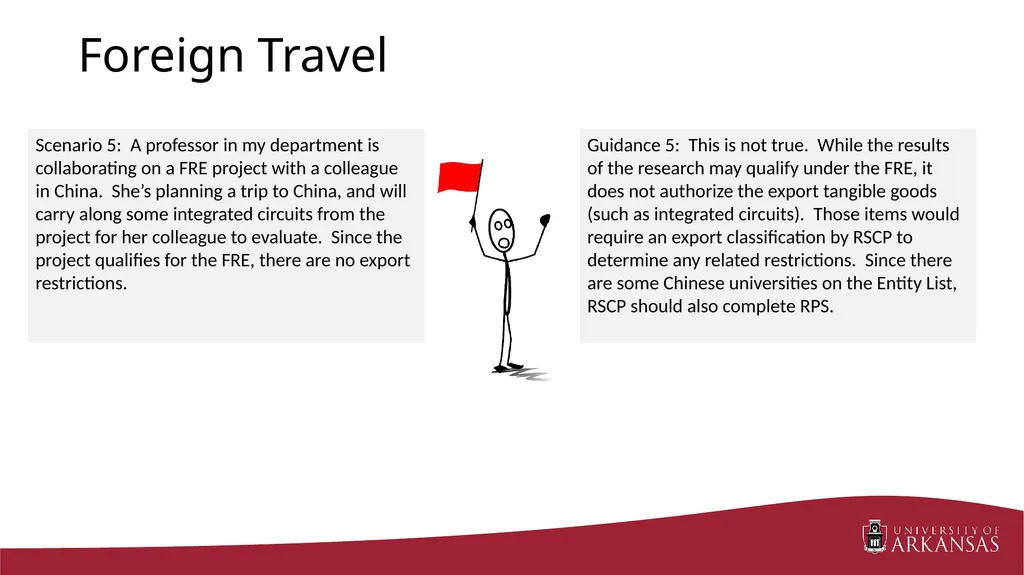
Foreign Travel Scenario 5: A professor in my department is collaborating on a FRE project with a colleague in China. She’s planning a trip to China, and will carry along some integrated circuits from the project for her colleague to evaluate. Since the project qualifies for the FRE, there are no export restrictions. Guidance 5: This is not true. While the results of the research may qualify under the FRE, it does not authorize the export tangible goods (such as integrated circuits). Those items would require an export classification by RSCP to determine any related restrictions. Since there are some Chinese universities on the Entity List, RSCP should also complete RPS.<br>
24
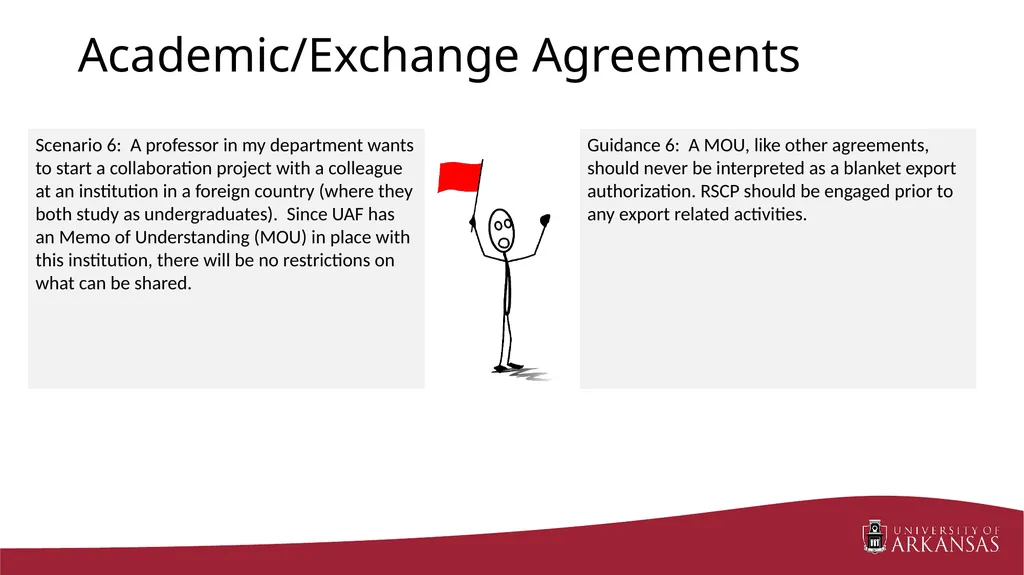
Academic/Exchange Agreements Scenario 6: A professor in my department wants to start a collaboration project with a colleague at an institution in a foreign country (where they both study as undergraduates). Since UAF has an Memo of Understanding (MOU) in place with this institution, there will be no restrictions on what can be shared. Guidance 6: A MOU, like other agreements, should never be interpreted as a blanket export authorization. RSCP should be engaged prior to any export related activities.<br>
25
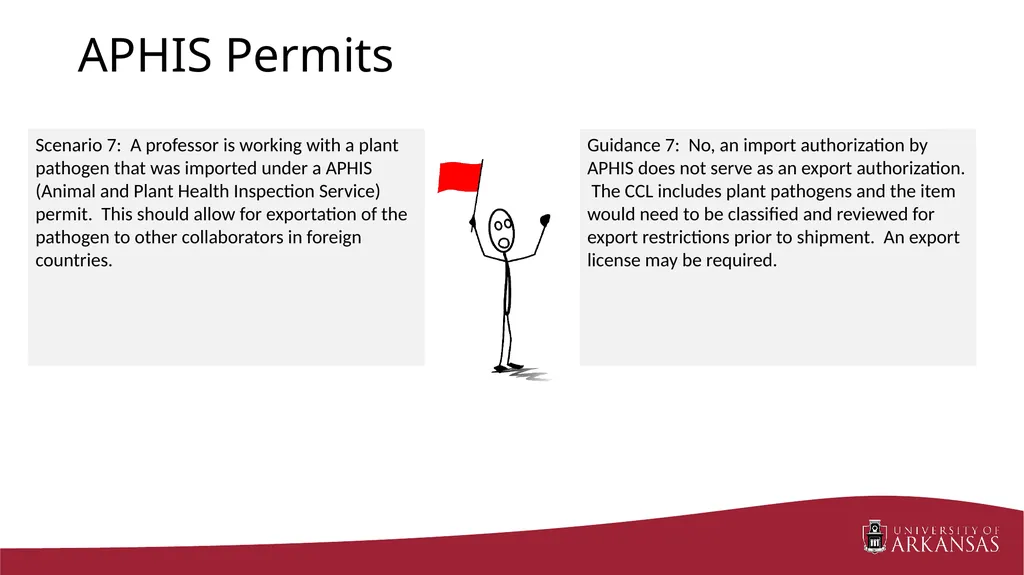
APHIS Permits Scenario 7: A professor is working with a plant pathogen that was imported under a APHIS (Animal and Plant Health Inspection Service) permit. This should allow for exportation of the pathogen to other collaborators in foreign countries. Guidance 7: No, an import authorization by APHIS does not serve as an export authorization. The CCL includes plant pathogens and the item would need to be classified and reviewed for export restrictions prior to shipment. An export license may be required.<br>
26
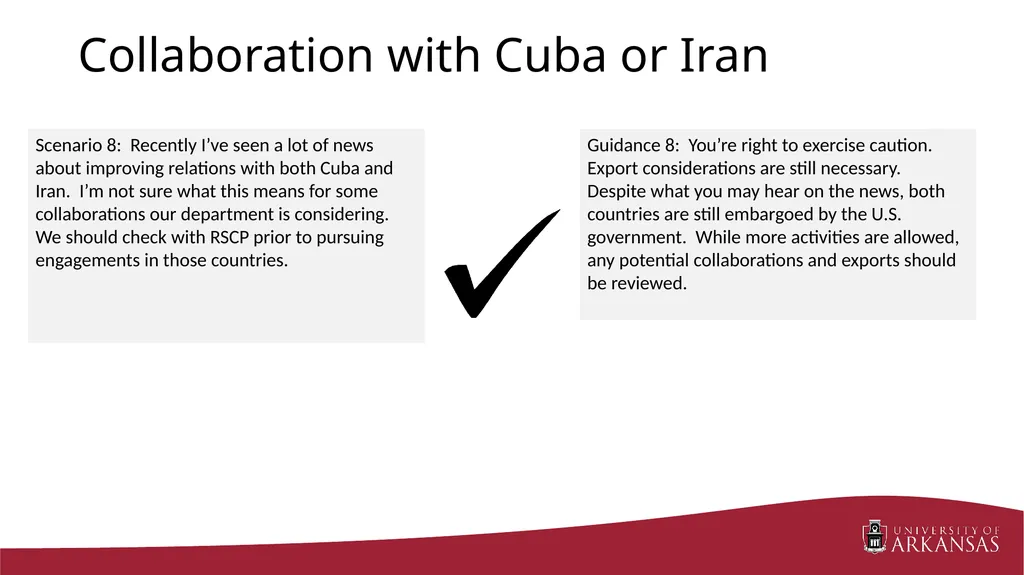
Collaboration with Cuba or Iran Scenario 8: Recently I’ve seen a lot of news about improving relations with both Cuba and Iran. I’m not sure what this means for some collaborations our department is considering. We should check with RSCP prior to pursuing engagements in those countries. Guidance 8: You’re right to exercise caution. Export considerations are still necessary. Despite what you may hear on the news, both countries are still embargoed by the U.S. government. While more activities are allowed, any potential collaborations and exports should be reviewed.<br>
27
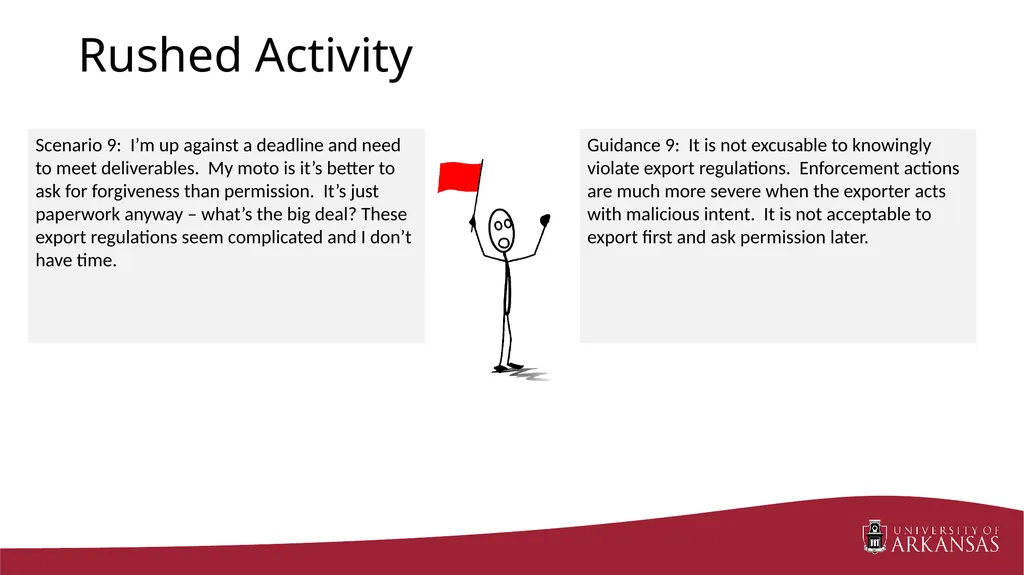
Rushed Activity Scenario 9: I’m up against a deadline and need to meet deliverables. My moto is it’s better to ask for forgiveness than permission. It’s just paperwork anyway – what’s the big deal? These export regulations seem complicated and I don’t have time. Guidance 9: It is not excusable to knowingly violate export regulations. Enforcement actions are much more severe when the exporter acts with malicious intent. It is not acceptable to export first and ask permission later.<br>
28
Contact RSCP
Phone: 479-575-4572 Email: canditam@uark.edu Web: http://vpred.uark.edu/units/rscp/
1424 Martin Luther King, Jr. Blvd
1 University of Arkansas
Fayetteville, AR 72701 Additional Questions<br>
Phone: 479-575-4572 Email: canditam@uark.edu Web: http://vpred.uark.edu/units/rscp/
1424 Martin Luther King, Jr. Blvd
1 University of Arkansas
Fayetteville, AR 72701 Additional Questions<br>