
EXPORT CONTROLS OVERVIEW & CONFLICTS OF INTEREST:

Description: EXPORT CONTROLS OVERVIEW CONFLICTS OF INTEREST: RECOGNITION AND MANAGEMENT Division of Research and Economic Development (D-RED) Edet E. Isuk, Ph.D. Director, Research Compliance www.morgan.eduora Export Controls Basics ITAREAROFAC
Related Topics
Download Presentation
"EXPORT CONTROLS OVERVIEW & CONFLICTS OF INTEREST:" is the property of its rightful owner. Permission is granted to download and print the materials on this website for personal, non-commercial use only, and to display it on your personal computer provided you do not modify the materials and that you retain all copyright notices contained in the materials. By downloading content from our website, you accept the terms of this agreement.
Presentation Transcript
slide1. EXPORT CONTROLS OVERVIEW
& CONFLICTS OF INTEREST:
RECOGNITION AND MANAGEMENT Division of Research and Economic Development (D-RED)
Edet E. Isuk, Ph.D.
Director, Research Compliance
www.morgan.edu/ora<br>
slide2. Export Controls Basics ITAR/EAR/OFAC<br>
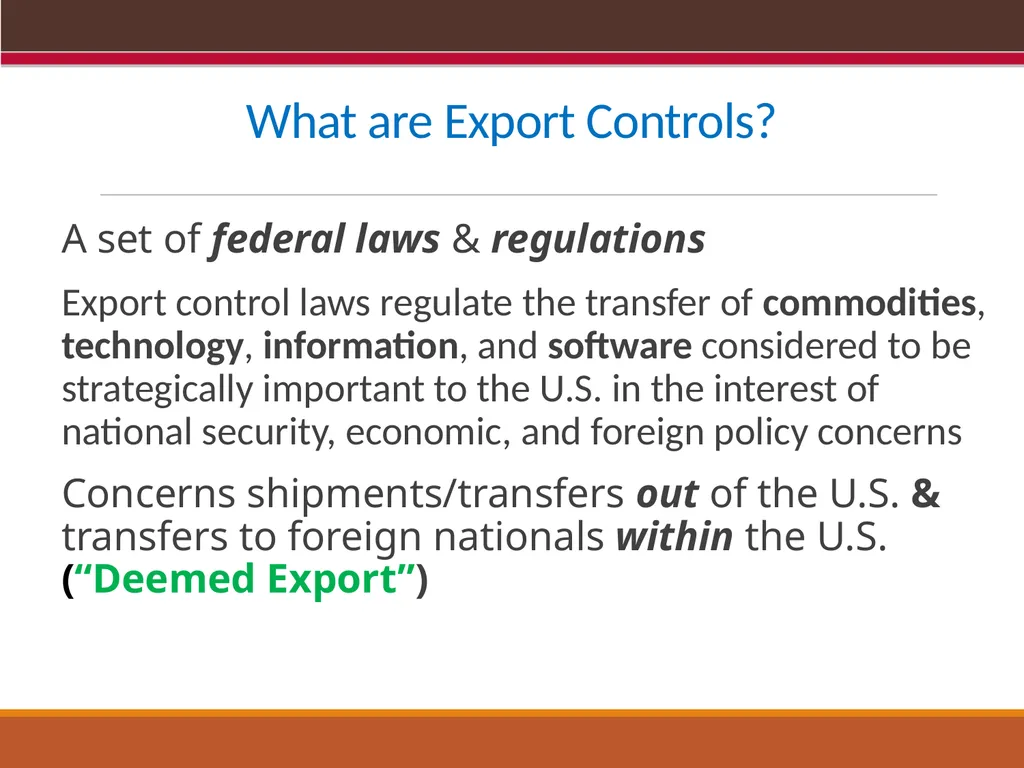
slide3. What are Export Controls? A set of federal laws & regulations
Export control laws regulate the transfer of commodities, technology, information, and software considered to be strategically important to the U.S. in the interest of national security, economic, and foreign policy concerns
Concerns shipments/transfers out of the U.S. & transfers to foreign nationals within the U.S. (“Deemed Export”)<br>
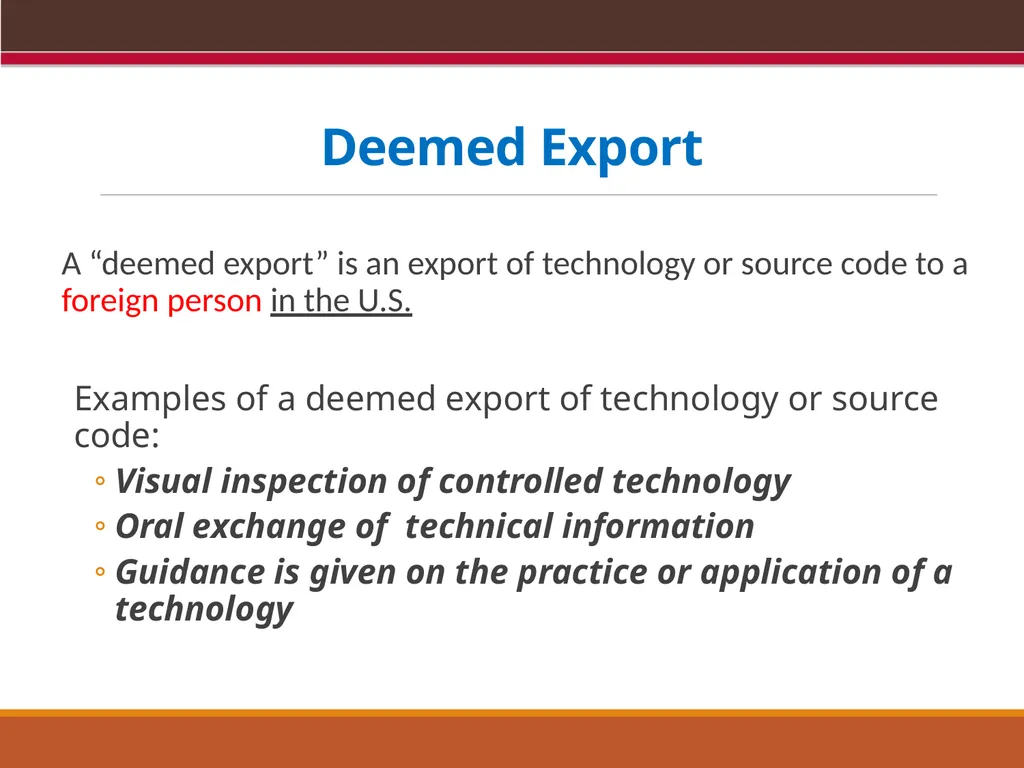
slide4. Deemed Export A “deemed export” is an export of technology or source code to a foreign person in the U.S.
Examples of a deemed export of technology or source code:
Visual inspection of controlled technology
Oral exchange of technical information
Guidance is given on the practice or application of a technology<br>
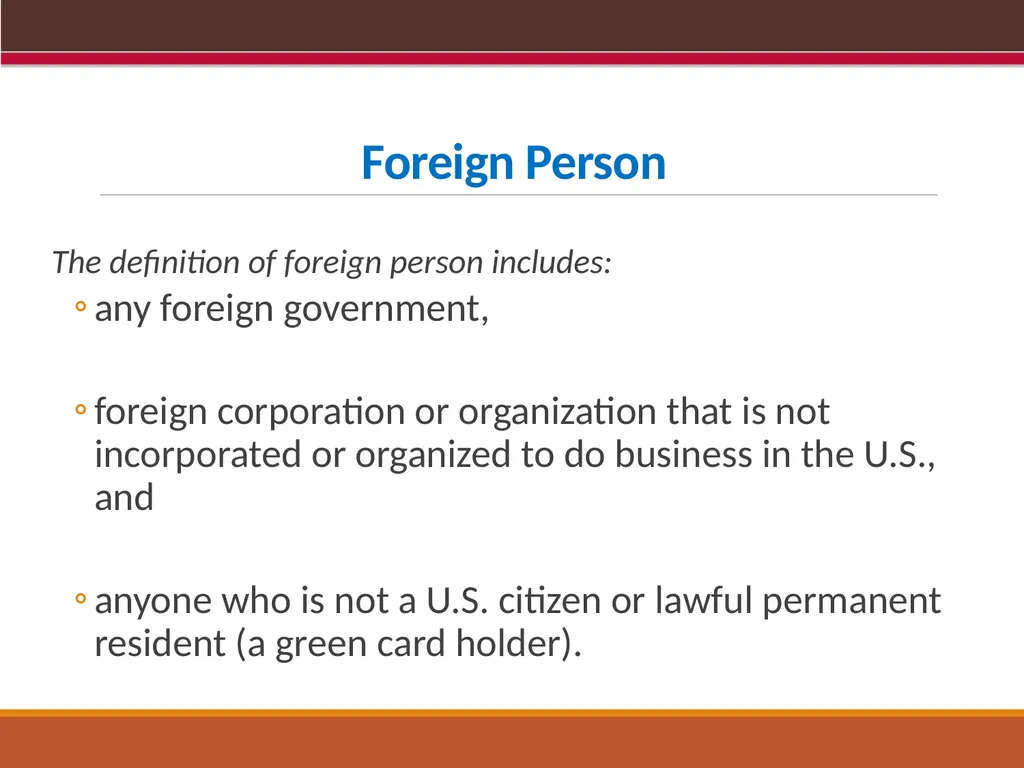
slide5. Foreign Person The definition of foreign person includes:
any foreign government,
foreign corporation or organization that is not incorporated or organized to do business in the U.S., and
anyone who is not a U.S. citizen or lawful permanent resident (a green card holder).<br>
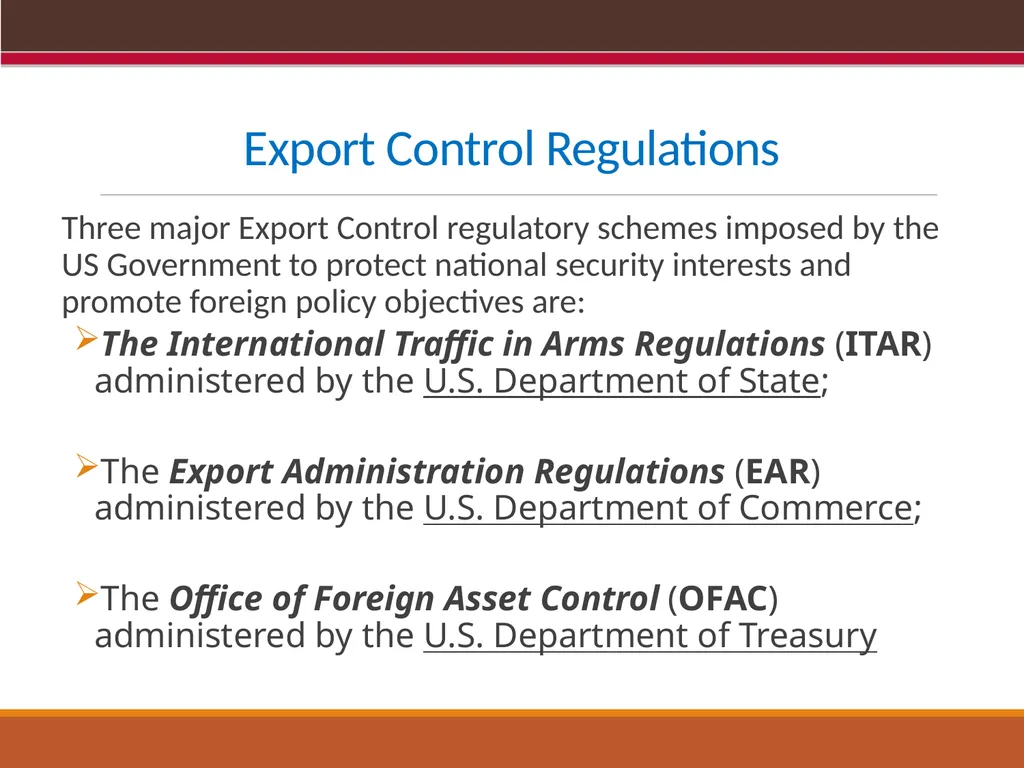
slide6. Export Control Regulations Three major Export Control regulatory schemes imposed by the US Government to protect national security interests and promote foreign policy objectives are:
The International Traffic in Arms Regulations (ITAR) administered by the U.S. Department of State;
The Export Administration Regulations (EAR) administered by the U.S. Department of Commerce;
The Office of Foreign Asset Control (OFAC) administered by the U.S. Department of Treasury<br>
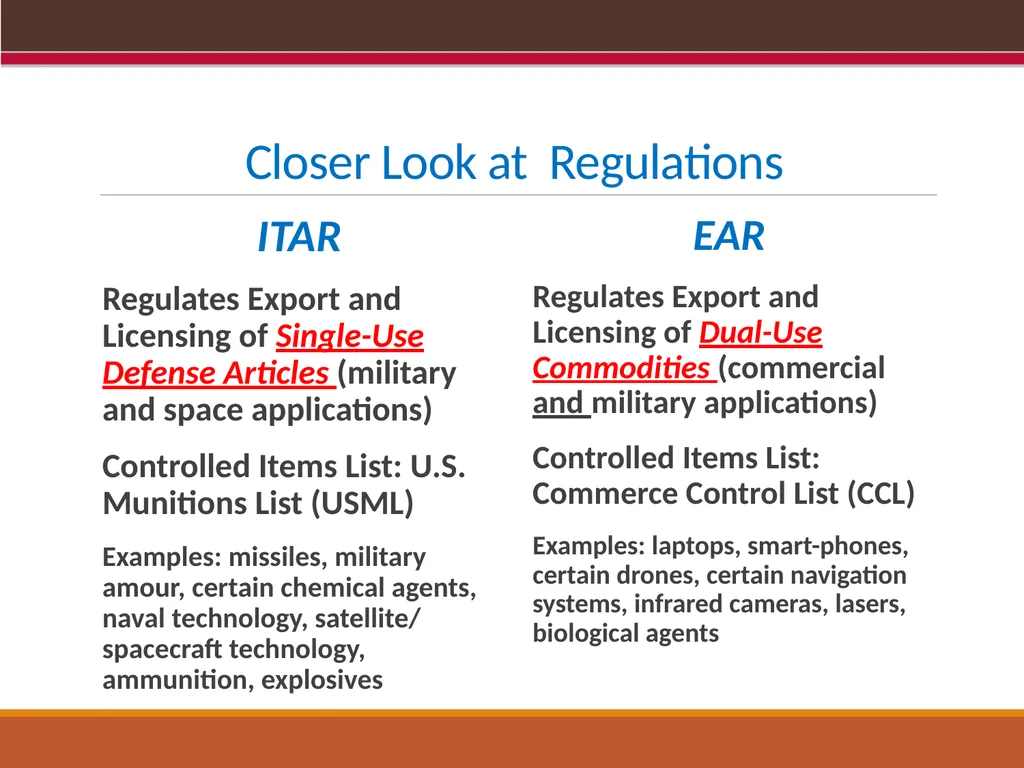
slide7. Closer Look at Regulations ITAR
Regulates Export and Licensing of Single-Use Defense Articles (military and space applications)
Controlled Items List: U.S. Munitions List (USML)
Examples: missiles, military amour, certain chemical agents, naval technology, satellite/ spacecraft technology, ammunition, explosives EAR
Regulates Export and Licensing of Dual-Use Commodities (commercial and military applications)
Controlled Items List: Commerce Control List (CCL)
Examples: laptops, smart-phones, certain drones, certain navigation systems, infrared cameras, lasers, biological agents<br>
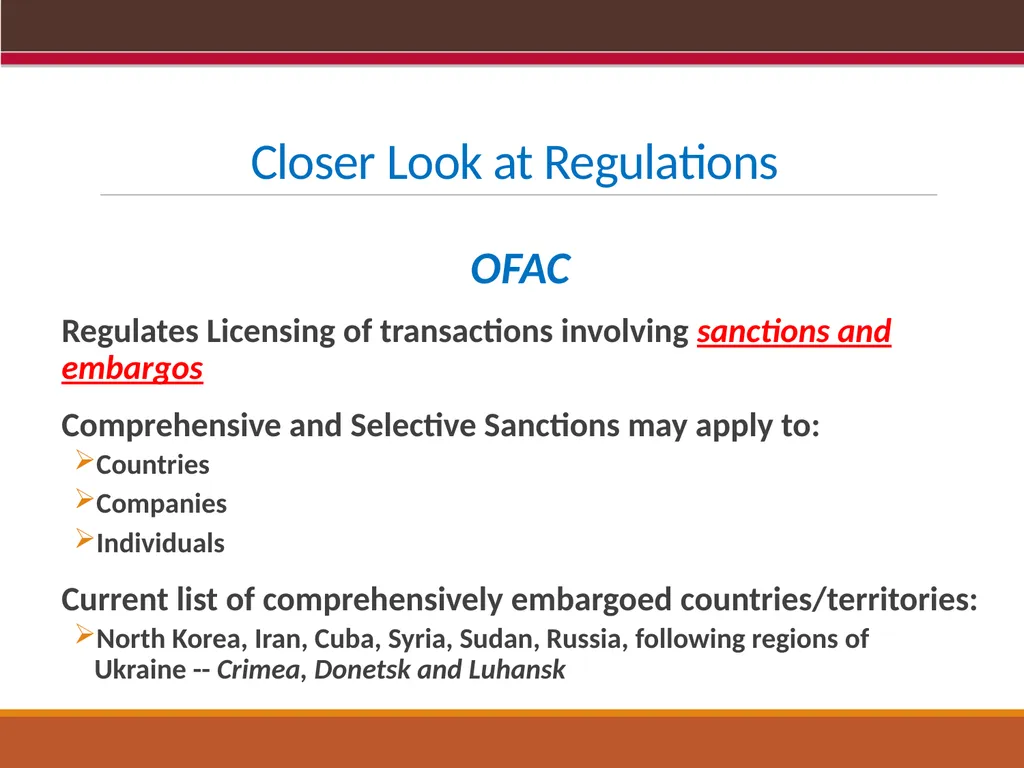
slide8. Closer Look at Regulations OFAC
Regulates Licensing of transactions involving sanctions and embargos
Comprehensive and Selective Sanctions may apply to:
Countries
Companies
Individuals
Current list of comprehensively embargoed countries/territories:
North Korea, Iran, Cuba, Syria, Sudan, Russia, following regions of Ukraine -- Crimea, Donetsk and Luhansk<br>
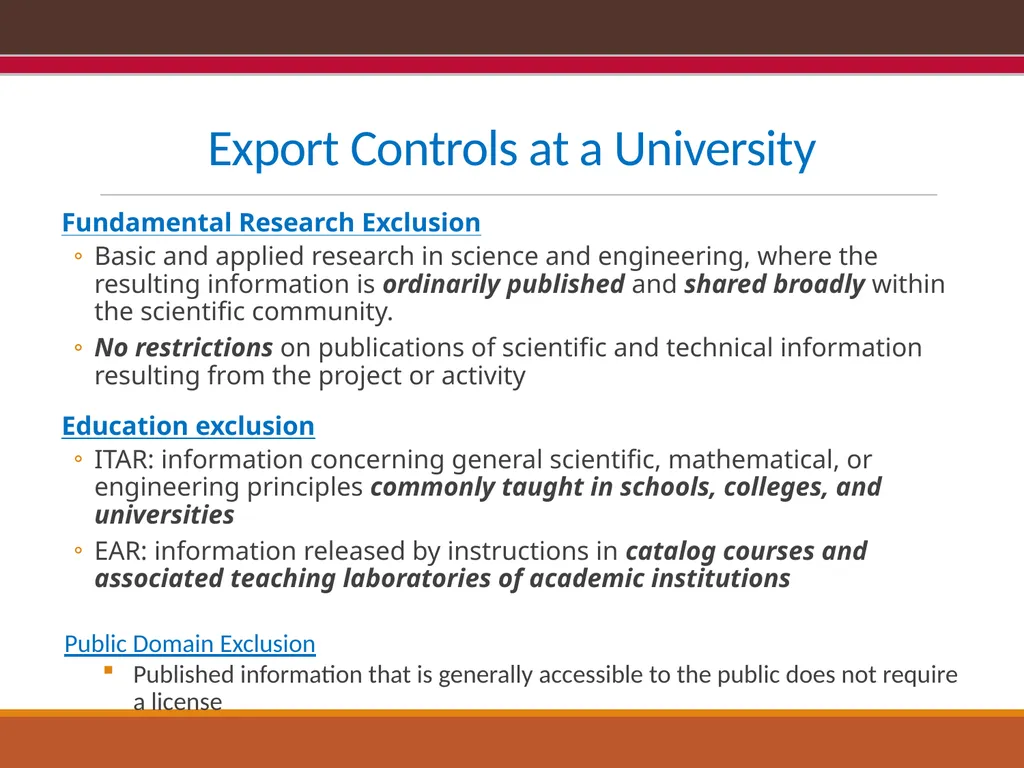
slide9. Export Controls at a University Fundamental Research Exclusion
Basic and applied research in science and engineering, where the resulting information is ordinarily published and shared broadly within the scientific community.
No restrictions on publications of scientific and technical information resulting from the project or activity
Education exclusion
ITAR: information concerning general scientific, mathematical, or engineering principles commonly taught in schools, colleges, and universities
EAR: information released by instructions in catalog courses and associated teaching laboratories of academic institutions
Public Domain Exclusion
Published information that is generally accessible to the public does not require a license<br>
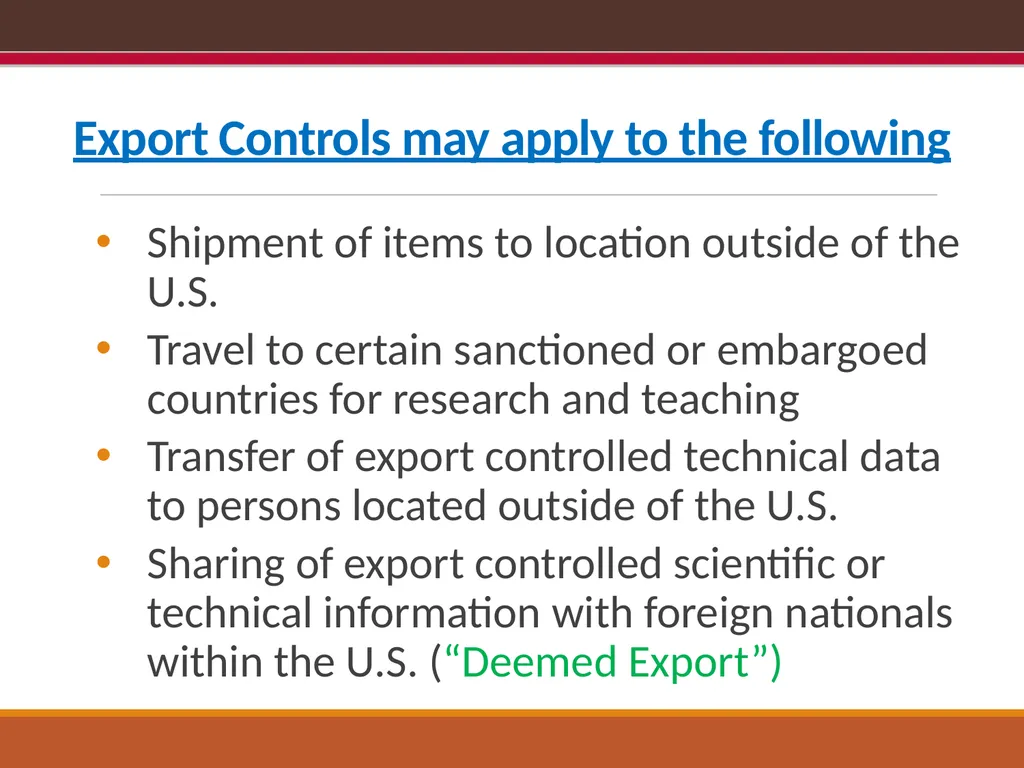
slide10. Export Controls may apply to the following Shipment of items to location outside of the U.S.
Travel to certain sanctioned or embargoed countries for research and teaching
Transfer of export controlled technical data to persons located outside of the U.S.
Sharing of export controlled scientific or technical information with foreign nationals within the U.S. (“Deemed Export”)<br>
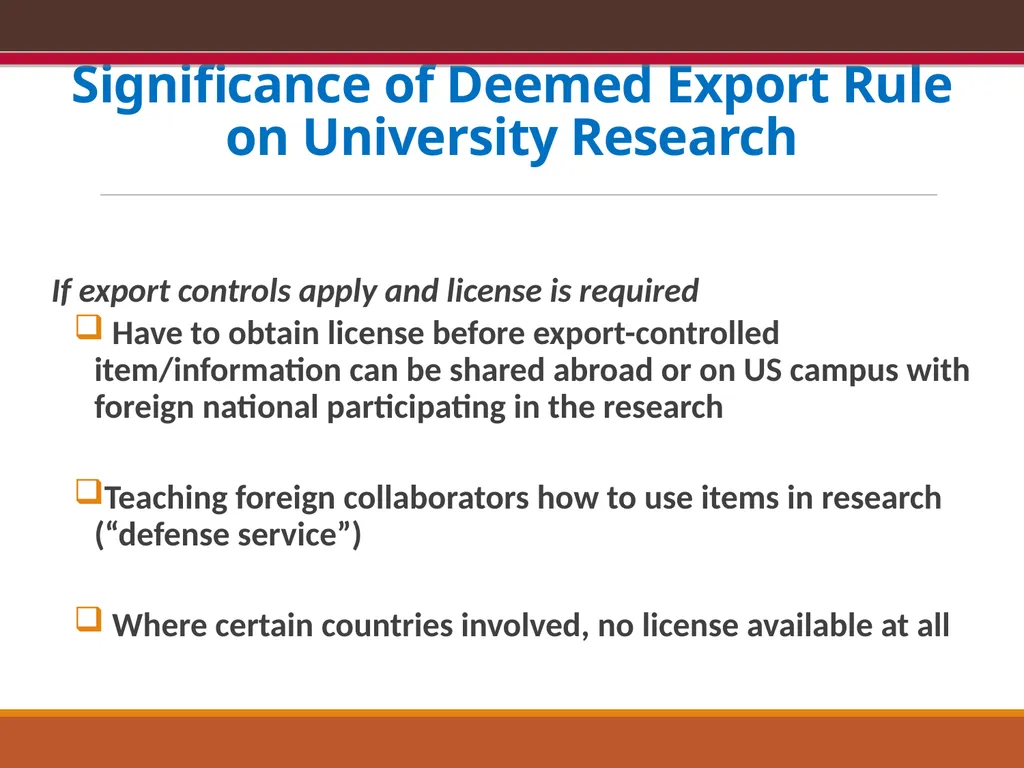
slide11. Significance of Deemed Export Rule on University Research If export controls apply and license is required
Have to obtain license before export-controlled item/information can be shared abroad or on US campus with foreign national participating in the research
Teaching foreign collaborators how to use items in research (“defense service”)
Where certain countries involved, no license available at all<br>
slide12. Significance of Deemed Export Rule on University Research, cont’d Conferences where previously unpublished research will be presented: who can participate, co-sponsor
Meetings where unpublished research will be discussed
Transfers of research equipment abroad<br>
slide13. When Export Controls are triggered… Determine if license exceptions apply (requires detailed analysis; may need to involve faculty; may reach out to peer institutions; can take several days)
Apply for licenses
ITAR – Morgan is not registered with the Department of State
EAR – Department of Commerce (can take 1-3 months)
OFAC – Treasury (lengthy process: can take 3-6 months)<br>
slide14. Non-Compliance Consequences Non-compliance can result in substantial monetary and criminal penalties against the institution and the individual.
Civil penalties per violation up to $250,000 (EAR) or $500,000 (ITAR)
Note: the government generally has the authority to charge more than one violation per transaction
Criminal fines for willful violations of up to $1 million and/or 20 years imprisonment
Academics have been given prison sentences in connection with willful violations
Denial of export privileges under the EAR
Debarment from participating directly or indirectly in the export of ITAR-controlled defense articles, technical data or defense services.<br>
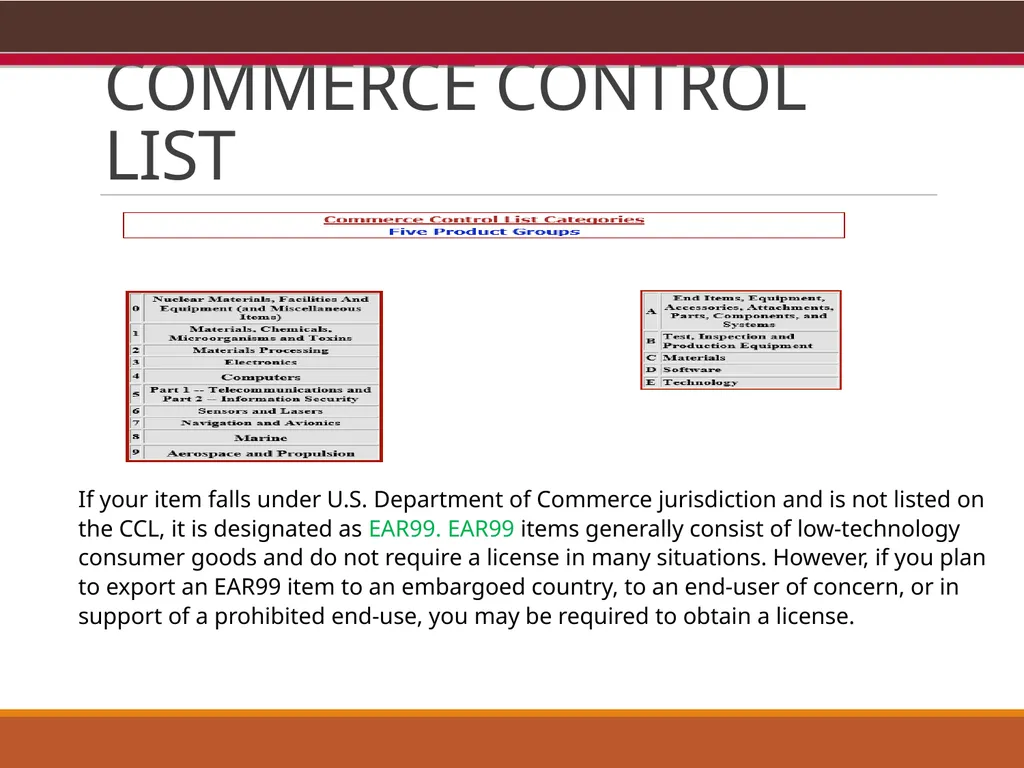
slide15. COMMERCE CONTROL LIST If your item falls under U.S. Department of Commerce jurisdiction and is not listed on the CCL, it is designated as EAR99. EAR99 items generally consist of low-technology consumer goods and do not require a license in many situations. However, if you plan to export an EAR99 item to an embargoed country, to an end-user of concern, or in support of a prohibited end-use, you may be required to obtain a license.<br>
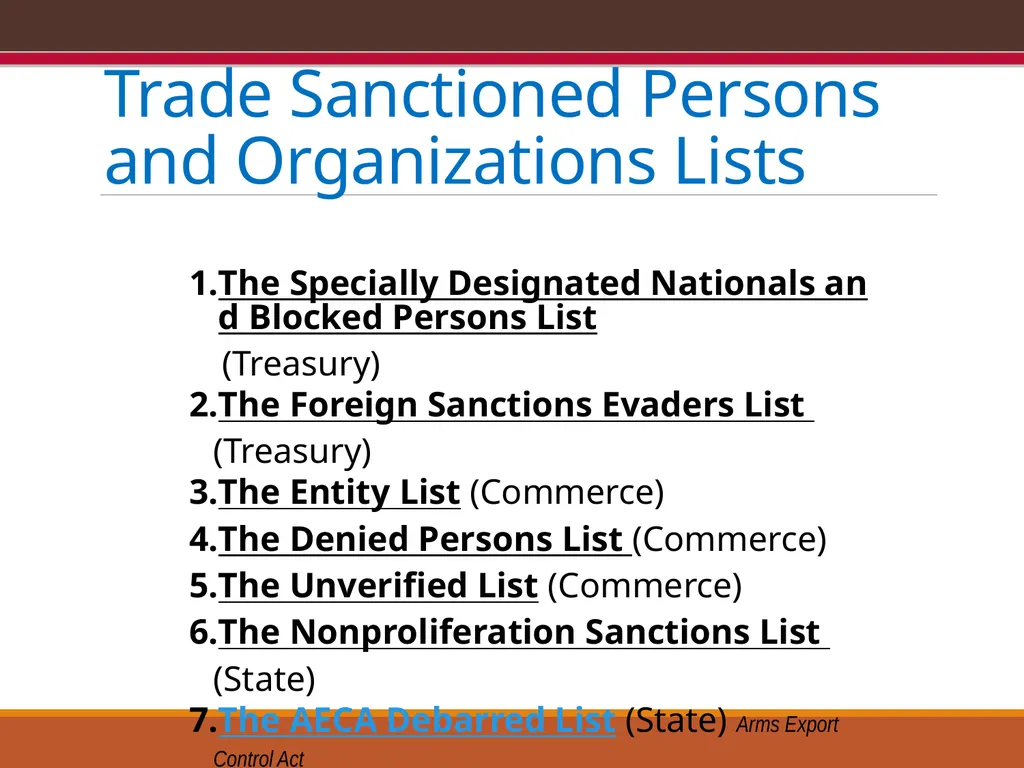
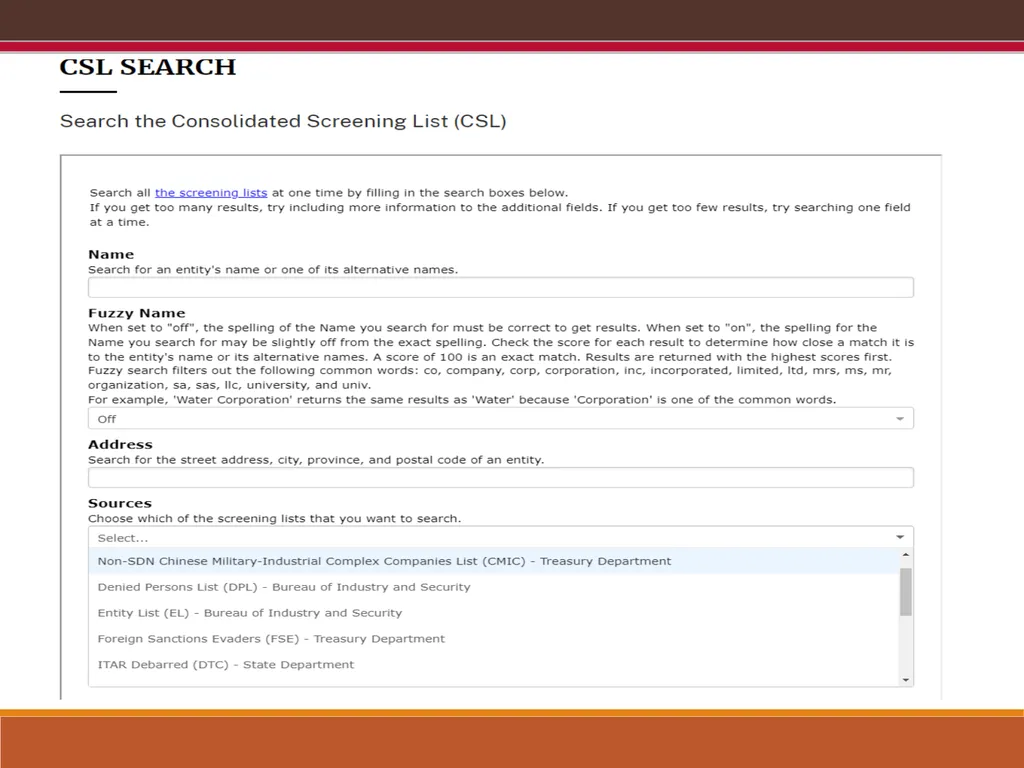
slide16. Trade Sanctioned Persons and Organizations Lists The Specially Designated Nationals and Blocked Persons List (Treasury)
The Foreign Sanctions Evaders List (Treasury)
The Entity List (Commerce)
The Denied Persons List (Commerce)
The Unverified List (Commerce)
The Nonproliferation Sanctions List (State)
The AECA Debarred List (State) Arms Export Control Act<br>
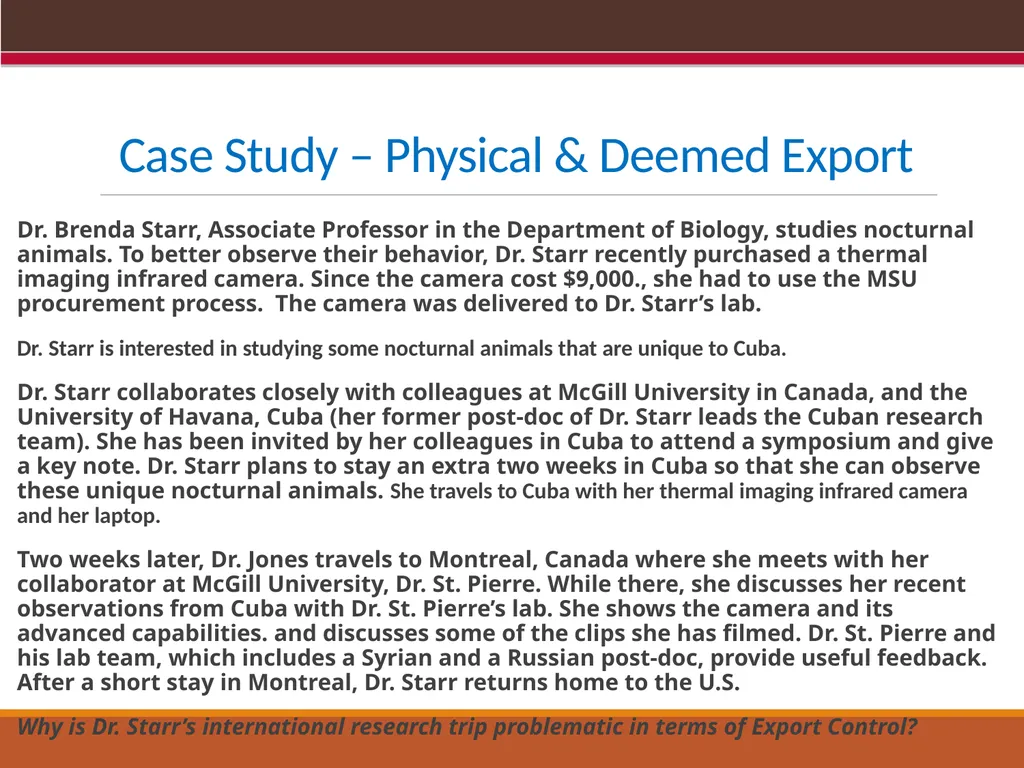
slide18. Case Study – Physical & Deemed Export Dr. Brenda Starr, Associate Professor in the Department of Biology, studies nocturnal animals. To better observe their behavior, Dr. Starr recently purchased a thermal imaging infrared camera. Since the camera cost $9,000., she had to use the MSU procurement process. The camera was delivered to Dr. Starr’s lab.
Dr. Starr is interested in studying some nocturnal animals that are unique to Cuba.
Dr. Starr collaborates closely with colleagues at McGill University in Canada, and the University of Havana, Cuba (her former post-doc of Dr. Starr leads the Cuban research team). She has been invited by her colleagues in Cuba to attend a symposium and give a key note. Dr. Starr plans to stay an extra two weeks in Cuba so that she can observe these unique nocturnal animals. She travels to Cuba with her thermal imaging infrared camera and her laptop.
Two weeks later, Dr. Jones travels to Montreal, Canada where she meets with her collaborator at McGill University, Dr. St. Pierre. While there, she discusses her recent observations from Cuba with Dr. St. Pierre’s lab. She shows the camera and its advanced capabilities. and discusses some of the clips she has filmed. Dr. St. Pierre and his lab team, which includes a Syrian and a Russian post-doc, provide useful feedback. After a short stay in Montreal, Dr. Starr returns home to the U.S.
Why is Dr. Starr’s international research trip problematic in terms of Export Control?<br>
slide19. Training Plan Complete CITI Training on Export Control
Attend D-RED Seminar Series on Export
Control
C. Consult D-RED/Research Compliance<br>
slide20. Questions?
Comments?
edet.isuk@morgan.edu
www.morgan.edu/ora<br>
slide21. Conflict of Interest - Financial Conflict of Interest Division of Research and Economic Development (D-RED)<br>
slide22. Introduction What are Conflicts of Interest
Why should you be concerned?
Consequences if not handled properly?<br>
slide23. Synopsis
Recognizing when you have a conflict of interest
Definition of an Investigator
Responsibilities of an Investigator
When to disclose a real or potential COI
Managing conflicts of interest
Things to Remember<br>
slide24. Overview Conflicts of Interest in the university may arise in:
Conduct of Research
Contract Management
Consulting and Other External Activities for Pay<br>
slide25. What Is Conflict of Interest? Financial or other considerations that may compromise (or have the appearance of compromising) investigator’s objectivity or independent professional judgment in reporting research results or meeting university responsibilities. It includes situations in which an individual, or the individual’s spouse or dependent children, has a significant financial interest, or financial relationship that could directly and significantly affect the design, conduct, reporting, or funding of research.
i.e., interest that creates potential for bias;
financial Possibility of profit that may affect researcher’s/investigator’s judgment<br>
slide26. What Kind of Research? All federally funded research
All industry-sponsored research
Research sponsored by foundations or other organizations with COI terms and conditions
All research involving human participants and submitted to the IRB, regardless of funding source<br>
slide27. Who Is Investigator ? Investigator includes individuals responsible for the design, conduct, or reporting of research, regardless of position or title;
Key Personnel are always considered Investigators by virtue of the definition of Key Personnel
Investigators may also include others (internal or external to MSU) who are independently responsible for research design, conduct, or reporting (i.e., individual(s) who have the authority to make independent decisions about the direction of the research and the subsequent conclusions about the results and/or are likely to be authors on manuscripts or to present research findings)
Investigators are not administrative staff or individuals who perform routine, pre-defined, or incidental tasks related to the research project<br>
slide28. Who Is Investigator cont’d?
If you are serving in the role of Principal Investigator (PI), it is your responsibility to make sure that all investigators/key personnel on the project also complete the Investigator Disclosure Form.
An investigator is anyone involved in the design, conduct, or reporting of research!<br>
slide29. When individually or in aggregate, such interest involves:
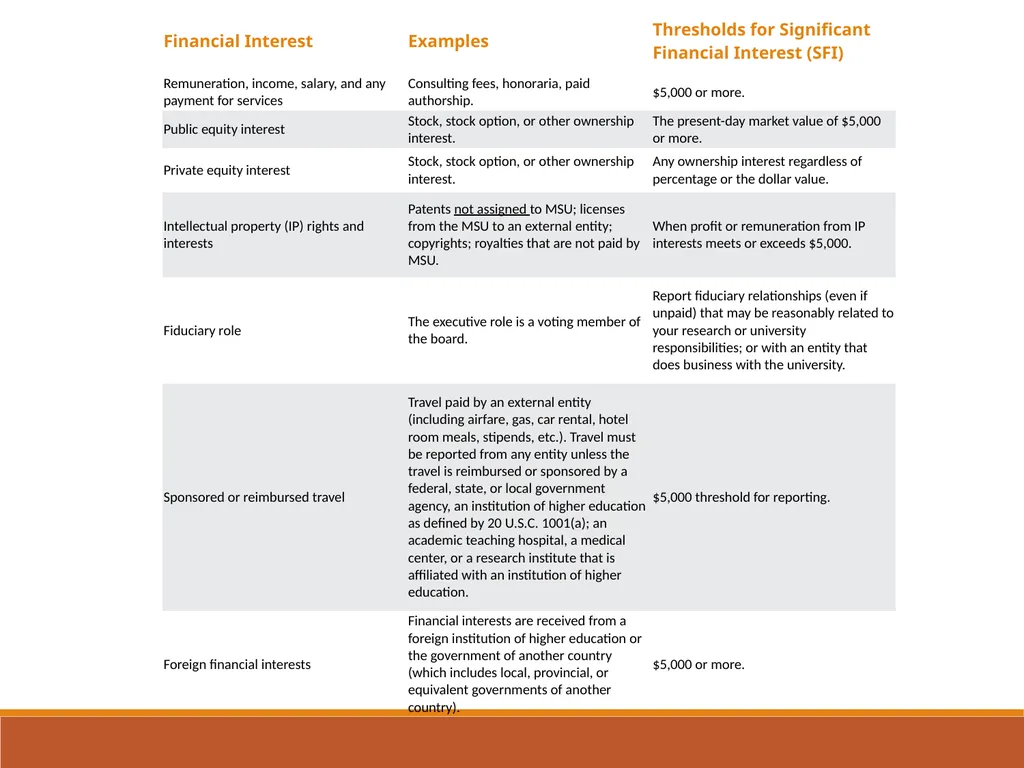
Earnings in excess of $5,000 (including salary, consulting fees, royalty or licensing payments from intellectual property, and honoraria and/or gifts) received within the past 12 months or anticipated for the next 12 months (excluding salary and other payments for services from the University);
An equity interest in a publicly traded company worth more than $5,000 or more than 5 percent of the business entity as determined by reference to its publicly listed price (excluding mutual funds);
Any equity interest if the value cannot be determined by reference to publicly listed prices (i.e., an equity interest in a privately held company, such as a start-up company);
All foreign financial interests (which includes income from seminars, lectures, or teaching engagements, income from service on advisory committees or review panels, and reimbursed or sponsored travel) received from any foreign entity, including foreign Institutions of higher education or foreign governments (which includes local, provincial, or equivalent governments of another country) when such income meets the threshold for disclosure (e.g., income in excess of $5,000);
A position giving rise to a fiduciary duty, such as director, officer, partner, trustee, employee, or any other position of management; or
Intellectual property rights (patents or copyrights) or royalties from such rights whose value may be affected by the outcome of the research. Financial Conflict of Interest<br>
slide31. Financial Interests DO NOT include
Salary royalties, or other remuneration paid by MSU to the investigator if the investigator is currently employed or otherwise appointed by MSU
Intellectual property rights assigned to MSU and agreements to share in royalties related to such rights.
Note: SFI excludes --
Phase I SBIR’s
Income from certain non-profit activities
Equity interests valued at less than $5K and less than 5% ownership interest and
Salary or other payments not exceeding $5K per year<br>
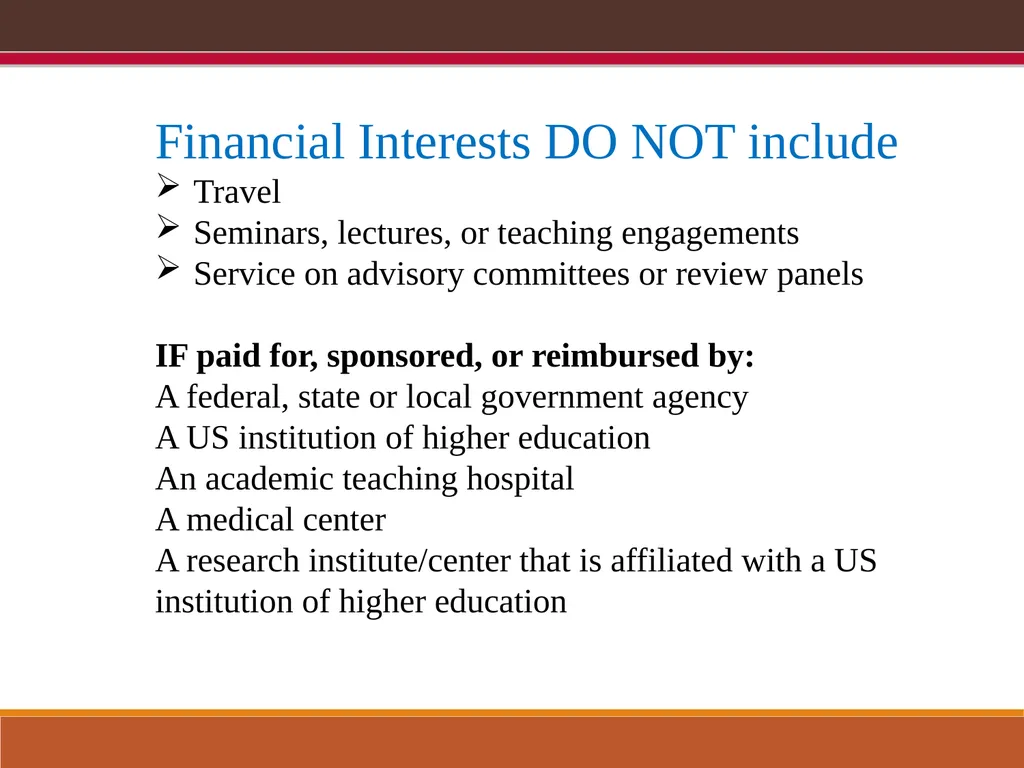
slide32. Financial Interests DO NOT include
Travel
Seminars, lectures, or teaching engagements
Service on advisory committees or review panels
IF paid for, sponsored, or reimbursed by:
A federal, state or local government agency
A US institution of higher education
An academic teaching hospital
A medical center
A research institute/center that is affiliated with a US institution of higher education<br>
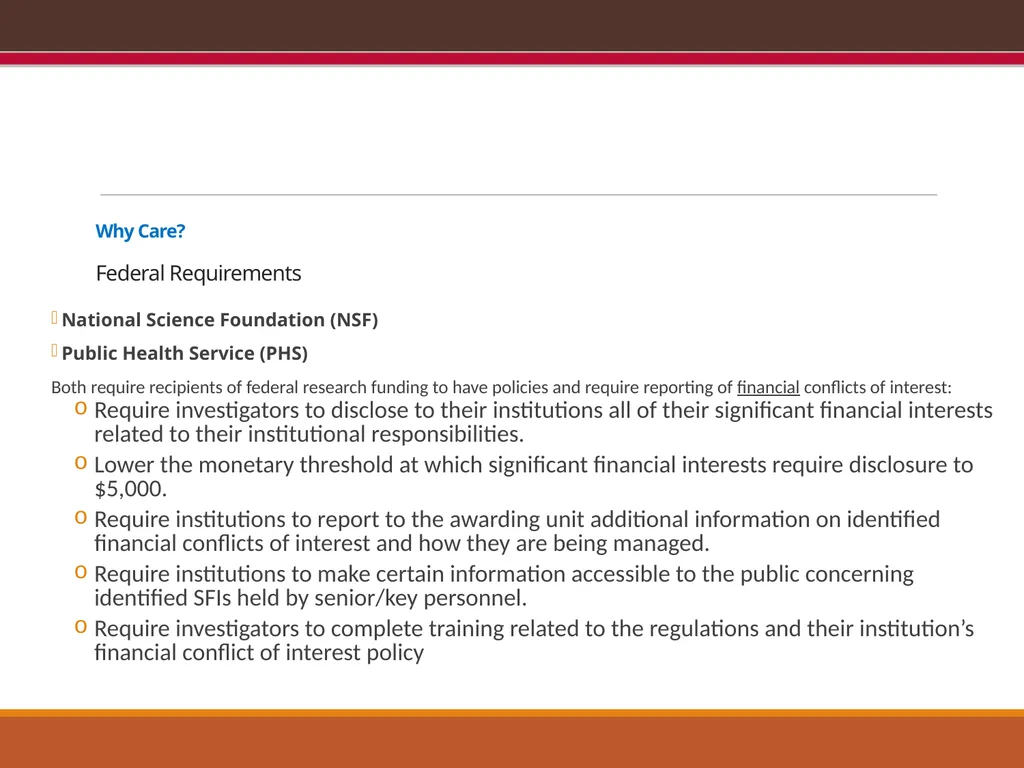
slide33. Why Care? Federal Requirements National Science Foundation (NSF)
Public Health Service (PHS)
Both require recipients of federal research funding to have policies and require reporting of financial conflicts of interest:
Require investigators to disclose to their institutions all of their significant financial interests related to their institutional responsibilities.
Lower the monetary threshold at which significant financial interests require disclosure to $5,000.
Require institutions to report to the awarding unit additional information on identified financial conflicts of interest and how they are being managed.
Require institutions to make certain information accessible to the public concerning identified SFIs held by senior/key personnel.
Require investigators to complete training related to the regulations and their institution’s financial conflict of interest policy<br>
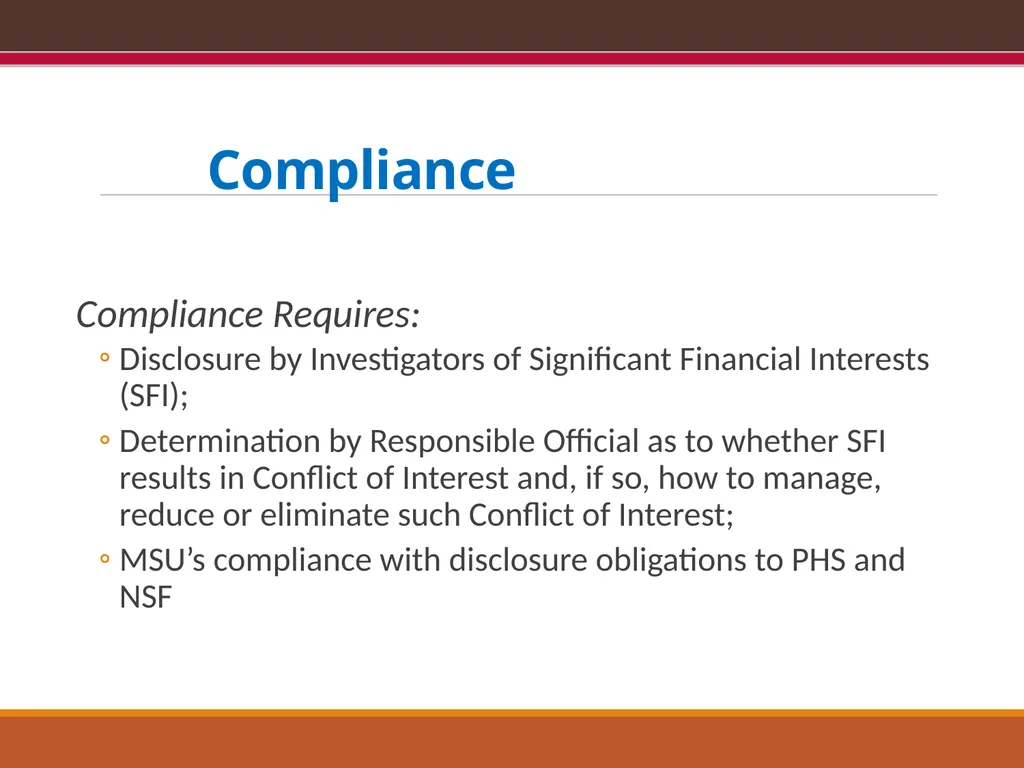
slide34. Compliance Compliance Requires:
Disclosure by Investigators of Significant Financial Interests (SFI);
Determination by Responsible Official as to whether SFI results in Conflict of Interest and, if so, how to manage, reduce or eliminate such Conflict of Interest;
MSU’s compliance with disclosure obligations to PHS and NSF<br>
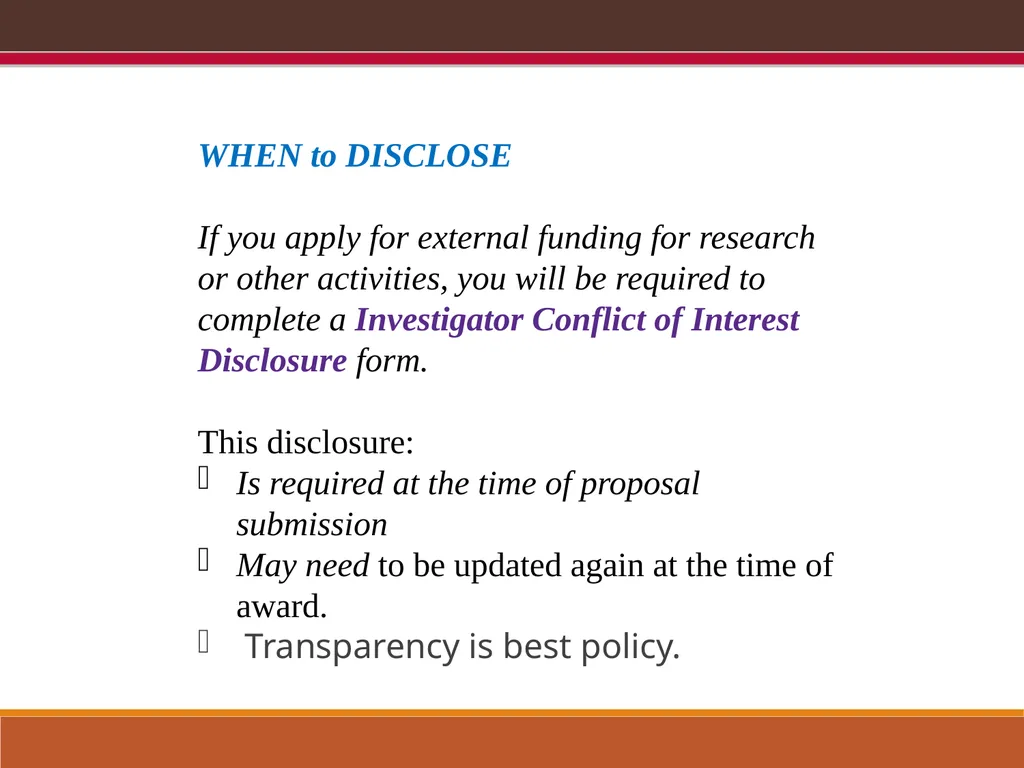
slide35. WHEN to DISCLOSE
If you apply for external funding for research or other activities, you will be required to complete a Investigator Conflict of Interest Disclosure form.
This disclosure:
Is required at the time of proposal submission
May need to be updated again at the time of award.
Transparency is best policy.<br>
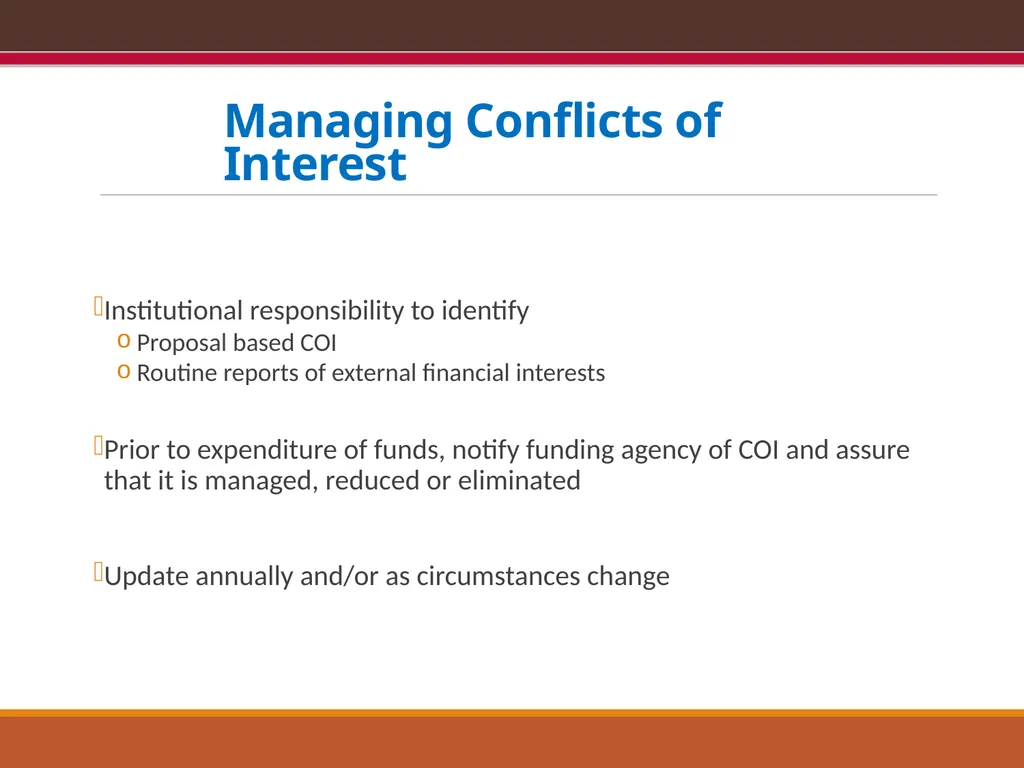
slide36. Managing Conflicts of Interest Institutional responsibility to identify
Proposal based COI
Routine reports of external financial interests
Prior to expenditure of funds, notify funding agency of COI and assure that it is managed, reduced or eliminated
Update annually and/or as circumstances change<br>
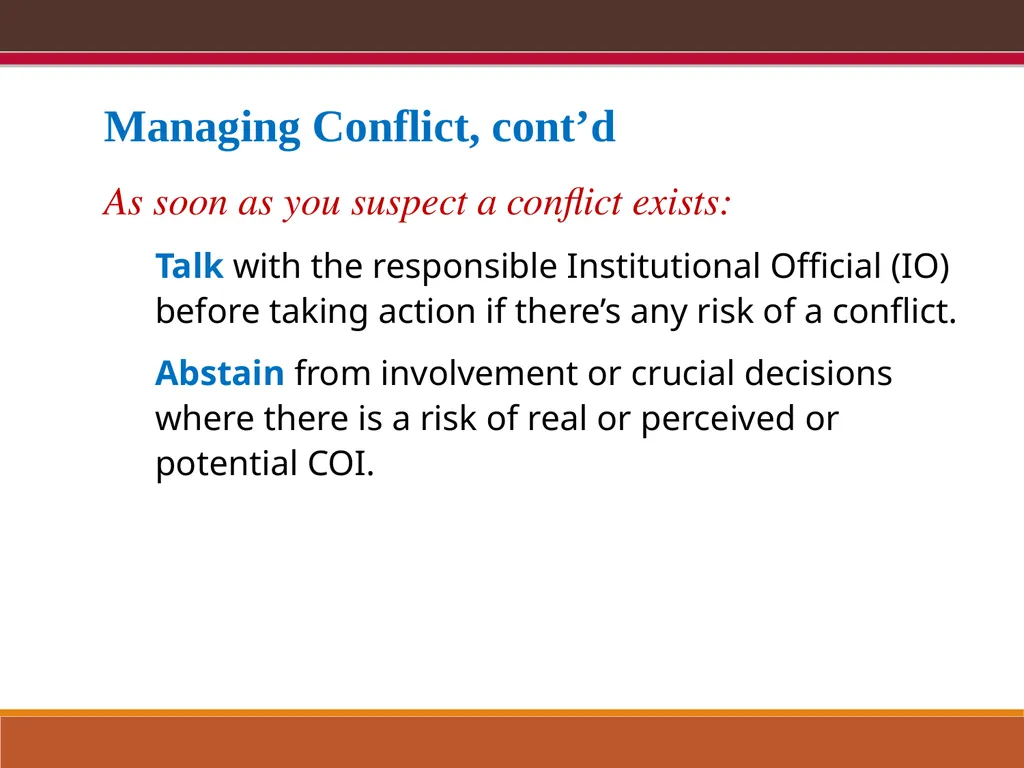
slide37. Managing Conflict, cont’d
As soon as you suspect a conflict exists:
Talk with the responsible Institutional Official (IO) before taking action if there’s any risk of a conflict.
Abstain from involvement or crucial decisions where there is a risk of real or perceived or potential COI.<br>
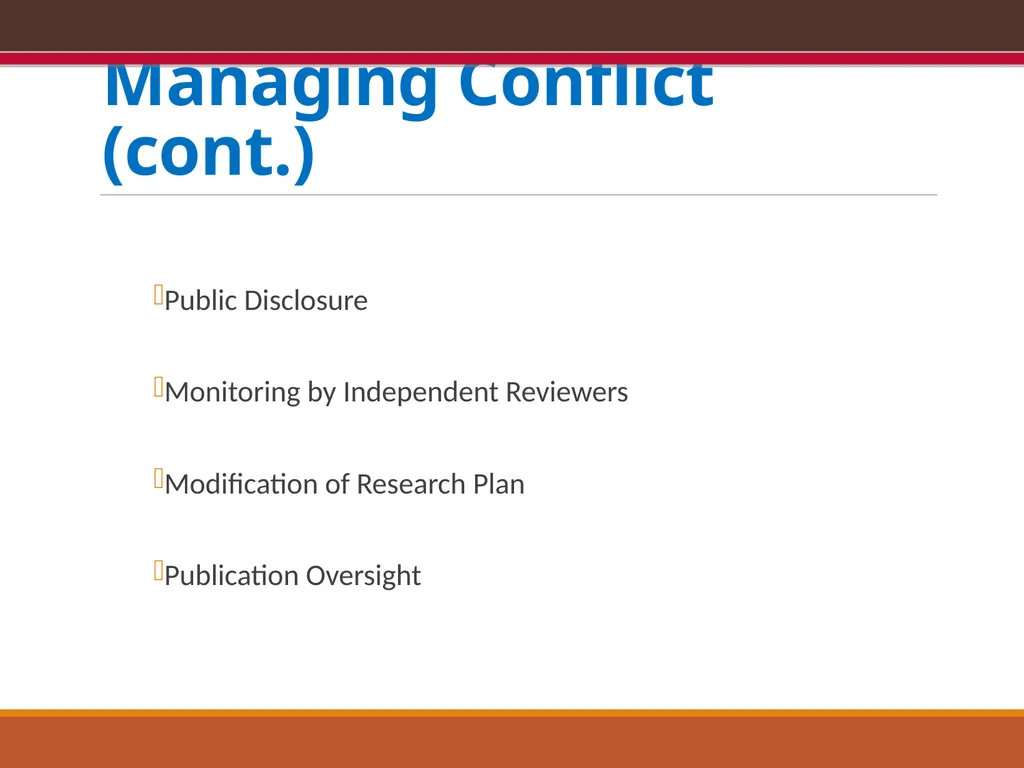
slide38. Managing Conflict (cont.) Public Disclosure
Monitoring by Independent Reviewers
Modification of Research Plan
Publication Oversight<br>
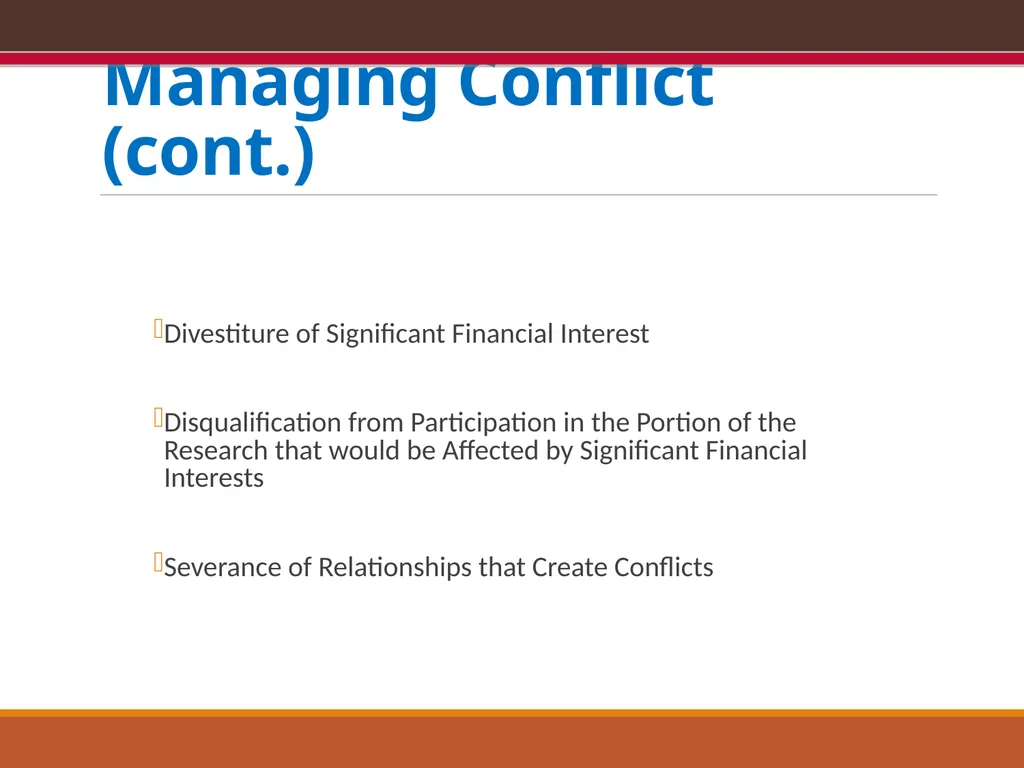
slide39. Managing Conflict (cont.) Divestiture of Significant Financial Interest
Disqualification from Participation in the Portion of the Research that would be Affected by Significant Financial Interests
Severance of Relationships that Create Conflicts<br>
slide40. Why Management Plans? Management Plans are:
Designed to help eliminate bias in your research
Individualized for you and the COIs that you have disclosed
Provide an opportunity for the D-RED/Office of Research Compliance to assist in making sure your work is in compliance.
Management Plans are NOT:
Punitive measures
Meant to be burdensome to you, your lab, or your research
Hindrances to your academic freedom or meant to interfere with your financial opportunities.<br>
slide41. CONSEQUENCES University subject to liability for failure to disclose known conflicts (See, e.g., Gelsinger v U Penn)
Gelsinger, who was 18 and had an inherited liver disorder, died Sept. 17, 1999, just four days after getting an experimental infusion of trillions of genetically engineered viruses. Researchers had hoped the treatment might lead to a cure for his disease, ornithine transcarbamylase deficiency, and other ailments. A subsequent investigation by the Food and Drug Administration found numerous breaches of federal research rules. The study was also widely criticized because of apparent financial conflicts of interest through which one of the principal investigators, Penn researcher James Wilson, stood to profit from the experiment through a biotechnology company he had founded, Genovo of Sharon Hill, Pa.
Loss of Funding<br>
slide42. FCOI Case Study
Dr. Atlas is a the PI of an award to MSU to evaluate the efficacy of a Renewable Energy System produced by Zircon, Inc., a publicly traded company.
Dr. Atlas has disclosable Interests!<br>
slide43. Dr. Atlas’ financial interests for the past 12 months:
Consulting activities for Zircon Inc. totaling $7,500
Zircon Inc. speaker’s bureau stipend totaling $3,000
His wife’s ownership interest in Garnet Inc., a privately held company developing a renewable energy system similar to the Zircon system being tested
His Society of Nuclear Physicists (SNP) board membership earned him an honorarium of $5,000
Free travel for his service as a grant reviewer for the DoE
Royalties of $200,000 from licensed intellectual property involving a computer program to map underwater seismic activity.
Which Financial Interests should Dr. Atlas Disclose?<br>
slide44. Dr. Atlas should disclose the following financial interests because they 1) are related to the research he is working on for MSU and 2) they meet the threshold for disclosure:
His consulting activities for Zircon Inc., totaling $7,500
His activities with, Zircon Inc. speaker’s bureau for which he received $3,000
His wife’s ownership interest in Garnet Inc., a privately held company that is developing a renewable energy system similar to the Zircon system being tested
The activities (consulting and speaker’s bureau) for Zircon Inc., when aggregated for the past 12 months totals $10,500, which exceeds the $5K threshold.
Furthermore, given that Garnet Inc. is a potential competitor of Zircon Inc., the interest in Garnet Inc. needs to be disclosed.
Any ownership in a privately held company reaches the disclosure threshold.<br>
slide45. Who Needs COI Training?
Faculty on all sponsored research
All Faculty listed on an NSF proposal/grant
The project director or principal Investigator and any other person, regardless of title or position, who is responsible for the design, conduct, or reporting of research funded by the PHS, or proposed for such funding, which may include, for example, collaborators or consultants.<br>
slide46. How to Train
Complete CITI Conflict of Interest training prior to engaging in research related to any PHS-funded grant and at least every four years. (citiprogram.org)
https://grants.nih.gov/grants/policy/coi/tutorial2018/story_html5.html
B. Attend D-RED Seminar Series on COI<br>
slide47. More Information NIH Review of Institutional Conflict of Interest Policies
http://grants.nih.gov/grants/policy/coi/nih_review.htm
Observations on Targeted Site Reviews (NIH)
http://grants.nih.gov/grants/policy/coi/index.htm
NSF
https://www.nsf.gov/pubs/manuals/gpm05_131/gpm5.jsp<br>
slide48. Take Home Point – Conflicts of Interest (COI/FCOI) When in doubt … disclose.<br>
slide49. Thank You! Questions?
Comments?
edet.isuk@morgan.edu
www.morgan.edu/ora<br>
Edet E. Isuk, Ph.D.
Director, Research Compliance
www.morgan.edu/ora<br>
slide2. Export Controls Basics ITAR/EAR/OFAC<br>
slide3. What are Export Controls? A set of federal laws & regulations
Export control laws regulate the transfer of commodities, technology, information, and software considered to be strategically important to the U.S. in the interest of national security, economic, and foreign policy concerns
Concerns shipments/transfers out of the U.S. & transfers to foreign nationals within the U.S. (“Deemed Export”)<br>
slide4. Deemed Export A “deemed export” is an export of technology or source code to a foreign person in the U.S.
Examples of a deemed export of technology or source code:
Visual inspection of controlled technology
Oral exchange of technical information
Guidance is given on the practice or application of a technology<br>
slide5. Foreign Person The definition of foreign person includes:
any foreign government,
foreign corporation or organization that is not incorporated or organized to do business in the U.S., and
anyone who is not a U.S. citizen or lawful permanent resident (a green card holder).<br>
slide6. Export Control Regulations Three major Export Control regulatory schemes imposed by the US Government to protect national security interests and promote foreign policy objectives are:
The International Traffic in Arms Regulations (ITAR) administered by the U.S. Department of State;
The Export Administration Regulations (EAR) administered by the U.S. Department of Commerce;
The Office of Foreign Asset Control (OFAC) administered by the U.S. Department of Treasury<br>
slide7. Closer Look at Regulations ITAR
Regulates Export and Licensing of Single-Use Defense Articles (military and space applications)
Controlled Items List: U.S. Munitions List (USML)
Examples: missiles, military amour, certain chemical agents, naval technology, satellite/ spacecraft technology, ammunition, explosives EAR
Regulates Export and Licensing of Dual-Use Commodities (commercial and military applications)
Controlled Items List: Commerce Control List (CCL)
Examples: laptops, smart-phones, certain drones, certain navigation systems, infrared cameras, lasers, biological agents<br>
slide8. Closer Look at Regulations OFAC
Regulates Licensing of transactions involving sanctions and embargos
Comprehensive and Selective Sanctions may apply to:
Countries
Companies
Individuals
Current list of comprehensively embargoed countries/territories:
North Korea, Iran, Cuba, Syria, Sudan, Russia, following regions of Ukraine -- Crimea, Donetsk and Luhansk<br>
slide9. Export Controls at a University Fundamental Research Exclusion
Basic and applied research in science and engineering, where the resulting information is ordinarily published and shared broadly within the scientific community.
No restrictions on publications of scientific and technical information resulting from the project or activity
Education exclusion
ITAR: information concerning general scientific, mathematical, or engineering principles commonly taught in schools, colleges, and universities
EAR: information released by instructions in catalog courses and associated teaching laboratories of academic institutions
Public Domain Exclusion
Published information that is generally accessible to the public does not require a license<br>
slide10. Export Controls may apply to the following Shipment of items to location outside of the U.S.
Travel to certain sanctioned or embargoed countries for research and teaching
Transfer of export controlled technical data to persons located outside of the U.S.
Sharing of export controlled scientific or technical information with foreign nationals within the U.S. (“Deemed Export”)<br>
slide11. Significance of Deemed Export Rule on University Research If export controls apply and license is required
Have to obtain license before export-controlled item/information can be shared abroad or on US campus with foreign national participating in the research
Teaching foreign collaborators how to use items in research (“defense service”)
Where certain countries involved, no license available at all<br>
slide12. Significance of Deemed Export Rule on University Research, cont’d Conferences where previously unpublished research will be presented: who can participate, co-sponsor
Meetings where unpublished research will be discussed
Transfers of research equipment abroad<br>
slide13. When Export Controls are triggered… Determine if license exceptions apply (requires detailed analysis; may need to involve faculty; may reach out to peer institutions; can take several days)
Apply for licenses
ITAR – Morgan is not registered with the Department of State
EAR – Department of Commerce (can take 1-3 months)
OFAC – Treasury (lengthy process: can take 3-6 months)<br>
slide14. Non-Compliance Consequences Non-compliance can result in substantial monetary and criminal penalties against the institution and the individual.
Civil penalties per violation up to $250,000 (EAR) or $500,000 (ITAR)
Note: the government generally has the authority to charge more than one violation per transaction
Criminal fines for willful violations of up to $1 million and/or 20 years imprisonment
Academics have been given prison sentences in connection with willful violations
Denial of export privileges under the EAR
Debarment from participating directly or indirectly in the export of ITAR-controlled defense articles, technical data or defense services.<br>
slide15. COMMERCE CONTROL LIST If your item falls under U.S. Department of Commerce jurisdiction and is not listed on the CCL, it is designated as EAR99. EAR99 items generally consist of low-technology consumer goods and do not require a license in many situations. However, if you plan to export an EAR99 item to an embargoed country, to an end-user of concern, or in support of a prohibited end-use, you may be required to obtain a license.<br>
slide16. Trade Sanctioned Persons and Organizations Lists The Specially Designated Nationals and Blocked Persons List (Treasury)
The Foreign Sanctions Evaders List (Treasury)
The Entity List (Commerce)
The Denied Persons List (Commerce)
The Unverified List (Commerce)
The Nonproliferation Sanctions List (State)
The AECA Debarred List (State) Arms Export Control Act<br>
slide18. Case Study – Physical & Deemed Export Dr. Brenda Starr, Associate Professor in the Department of Biology, studies nocturnal animals. To better observe their behavior, Dr. Starr recently purchased a thermal imaging infrared camera. Since the camera cost $9,000., she had to use the MSU procurement process. The camera was delivered to Dr. Starr’s lab.
Dr. Starr is interested in studying some nocturnal animals that are unique to Cuba.
Dr. Starr collaborates closely with colleagues at McGill University in Canada, and the University of Havana, Cuba (her former post-doc of Dr. Starr leads the Cuban research team). She has been invited by her colleagues in Cuba to attend a symposium and give a key note. Dr. Starr plans to stay an extra two weeks in Cuba so that she can observe these unique nocturnal animals. She travels to Cuba with her thermal imaging infrared camera and her laptop.
Two weeks later, Dr. Jones travels to Montreal, Canada where she meets with her collaborator at McGill University, Dr. St. Pierre. While there, she discusses her recent observations from Cuba with Dr. St. Pierre’s lab. She shows the camera and its advanced capabilities. and discusses some of the clips she has filmed. Dr. St. Pierre and his lab team, which includes a Syrian and a Russian post-doc, provide useful feedback. After a short stay in Montreal, Dr. Starr returns home to the U.S.
Why is Dr. Starr’s international research trip problematic in terms of Export Control?<br>
slide19. Training Plan Complete CITI Training on Export Control
Attend D-RED Seminar Series on Export
Control
C. Consult D-RED/Research Compliance<br>
slide20. Questions?
Comments?
edet.isuk@morgan.edu
www.morgan.edu/ora<br>
slide21. Conflict of Interest - Financial Conflict of Interest Division of Research and Economic Development (D-RED)<br>
slide22. Introduction What are Conflicts of Interest
Why should you be concerned?
Consequences if not handled properly?<br>
slide23. Synopsis
Recognizing when you have a conflict of interest
Definition of an Investigator
Responsibilities of an Investigator
When to disclose a real or potential COI
Managing conflicts of interest
Things to Remember<br>
slide24. Overview Conflicts of Interest in the university may arise in:
Conduct of Research
Contract Management
Consulting and Other External Activities for Pay<br>
slide25. What Is Conflict of Interest? Financial or other considerations that may compromise (or have the appearance of compromising) investigator’s objectivity or independent professional judgment in reporting research results or meeting university responsibilities. It includes situations in which an individual, or the individual’s spouse or dependent children, has a significant financial interest, or financial relationship that could directly and significantly affect the design, conduct, reporting, or funding of research.
i.e., interest that creates potential for bias;
financial Possibility of profit that may affect researcher’s/investigator’s judgment<br>
slide26. What Kind of Research? All federally funded research
All industry-sponsored research
Research sponsored by foundations or other organizations with COI terms and conditions
All research involving human participants and submitted to the IRB, regardless of funding source<br>
slide27. Who Is Investigator ? Investigator includes individuals responsible for the design, conduct, or reporting of research, regardless of position or title;
Key Personnel are always considered Investigators by virtue of the definition of Key Personnel
Investigators may also include others (internal or external to MSU) who are independently responsible for research design, conduct, or reporting (i.e., individual(s) who have the authority to make independent decisions about the direction of the research and the subsequent conclusions about the results and/or are likely to be authors on manuscripts or to present research findings)
Investigators are not administrative staff or individuals who perform routine, pre-defined, or incidental tasks related to the research project<br>
slide28. Who Is Investigator cont’d?
If you are serving in the role of Principal Investigator (PI), it is your responsibility to make sure that all investigators/key personnel on the project also complete the Investigator Disclosure Form.
An investigator is anyone involved in the design, conduct, or reporting of research!<br>
slide29. When individually or in aggregate, such interest involves:
Earnings in excess of $5,000 (including salary, consulting fees, royalty or licensing payments from intellectual property, and honoraria and/or gifts) received within the past 12 months or anticipated for the next 12 months (excluding salary and other payments for services from the University);
An equity interest in a publicly traded company worth more than $5,000 or more than 5 percent of the business entity as determined by reference to its publicly listed price (excluding mutual funds);
Any equity interest if the value cannot be determined by reference to publicly listed prices (i.e., an equity interest in a privately held company, such as a start-up company);
All foreign financial interests (which includes income from seminars, lectures, or teaching engagements, income from service on advisory committees or review panels, and reimbursed or sponsored travel) received from any foreign entity, including foreign Institutions of higher education or foreign governments (which includes local, provincial, or equivalent governments of another country) when such income meets the threshold for disclosure (e.g., income in excess of $5,000);
A position giving rise to a fiduciary duty, such as director, officer, partner, trustee, employee, or any other position of management; or
Intellectual property rights (patents or copyrights) or royalties from such rights whose value may be affected by the outcome of the research. Financial Conflict of Interest<br>
slide31. Financial Interests DO NOT include
Salary royalties, or other remuneration paid by MSU to the investigator if the investigator is currently employed or otherwise appointed by MSU
Intellectual property rights assigned to MSU and agreements to share in royalties related to such rights.
Note: SFI excludes --
Phase I SBIR’s
Income from certain non-profit activities
Equity interests valued at less than $5K and less than 5% ownership interest and
Salary or other payments not exceeding $5K per year<br>
slide32. Financial Interests DO NOT include
Travel
Seminars, lectures, or teaching engagements
Service on advisory committees or review panels
IF paid for, sponsored, or reimbursed by:
A federal, state or local government agency
A US institution of higher education
An academic teaching hospital
A medical center
A research institute/center that is affiliated with a US institution of higher education<br>
slide33. Why Care? Federal Requirements National Science Foundation (NSF)
Public Health Service (PHS)
Both require recipients of federal research funding to have policies and require reporting of financial conflicts of interest:
Require investigators to disclose to their institutions all of their significant financial interests related to their institutional responsibilities.
Lower the monetary threshold at which significant financial interests require disclosure to $5,000.
Require institutions to report to the awarding unit additional information on identified financial conflicts of interest and how they are being managed.
Require institutions to make certain information accessible to the public concerning identified SFIs held by senior/key personnel.
Require investigators to complete training related to the regulations and their institution’s financial conflict of interest policy<br>
slide34. Compliance Compliance Requires:
Disclosure by Investigators of Significant Financial Interests (SFI);
Determination by Responsible Official as to whether SFI results in Conflict of Interest and, if so, how to manage, reduce or eliminate such Conflict of Interest;
MSU’s compliance with disclosure obligations to PHS and NSF<br>
slide35. WHEN to DISCLOSE
If you apply for external funding for research or other activities, you will be required to complete a Investigator Conflict of Interest Disclosure form.
This disclosure:
Is required at the time of proposal submission
May need to be updated again at the time of award.
Transparency is best policy.<br>
slide36. Managing Conflicts of Interest Institutional responsibility to identify
Proposal based COI
Routine reports of external financial interests
Prior to expenditure of funds, notify funding agency of COI and assure that it is managed, reduced or eliminated
Update annually and/or as circumstances change<br>
slide37. Managing Conflict, cont’d
As soon as you suspect a conflict exists:
Talk with the responsible Institutional Official (IO) before taking action if there’s any risk of a conflict.
Abstain from involvement or crucial decisions where there is a risk of real or perceived or potential COI.<br>
slide38. Managing Conflict (cont.) Public Disclosure
Monitoring by Independent Reviewers
Modification of Research Plan
Publication Oversight<br>
slide39. Managing Conflict (cont.) Divestiture of Significant Financial Interest
Disqualification from Participation in the Portion of the Research that would be Affected by Significant Financial Interests
Severance of Relationships that Create Conflicts<br>
slide40. Why Management Plans? Management Plans are:
Designed to help eliminate bias in your research
Individualized for you and the COIs that you have disclosed
Provide an opportunity for the D-RED/Office of Research Compliance to assist in making sure your work is in compliance.
Management Plans are NOT:
Punitive measures
Meant to be burdensome to you, your lab, or your research
Hindrances to your academic freedom or meant to interfere with your financial opportunities.<br>
slide41. CONSEQUENCES University subject to liability for failure to disclose known conflicts (See, e.g., Gelsinger v U Penn)
Gelsinger, who was 18 and had an inherited liver disorder, died Sept. 17, 1999, just four days after getting an experimental infusion of trillions of genetically engineered viruses. Researchers had hoped the treatment might lead to a cure for his disease, ornithine transcarbamylase deficiency, and other ailments. A subsequent investigation by the Food and Drug Administration found numerous breaches of federal research rules. The study was also widely criticized because of apparent financial conflicts of interest through which one of the principal investigators, Penn researcher James Wilson, stood to profit from the experiment through a biotechnology company he had founded, Genovo of Sharon Hill, Pa.
Loss of Funding<br>
slide42. FCOI Case Study
Dr. Atlas is a the PI of an award to MSU to evaluate the efficacy of a Renewable Energy System produced by Zircon, Inc., a publicly traded company.
Dr. Atlas has disclosable Interests!<br>
slide43. Dr. Atlas’ financial interests for the past 12 months:
Consulting activities for Zircon Inc. totaling $7,500
Zircon Inc. speaker’s bureau stipend totaling $3,000
His wife’s ownership interest in Garnet Inc., a privately held company developing a renewable energy system similar to the Zircon system being tested
His Society of Nuclear Physicists (SNP) board membership earned him an honorarium of $5,000
Free travel for his service as a grant reviewer for the DoE
Royalties of $200,000 from licensed intellectual property involving a computer program to map underwater seismic activity.
Which Financial Interests should Dr. Atlas Disclose?<br>
slide44. Dr. Atlas should disclose the following financial interests because they 1) are related to the research he is working on for MSU and 2) they meet the threshold for disclosure:
His consulting activities for Zircon Inc., totaling $7,500
His activities with, Zircon Inc. speaker’s bureau for which he received $3,000
His wife’s ownership interest in Garnet Inc., a privately held company that is developing a renewable energy system similar to the Zircon system being tested
The activities (consulting and speaker’s bureau) for Zircon Inc., when aggregated for the past 12 months totals $10,500, which exceeds the $5K threshold.
Furthermore, given that Garnet Inc. is a potential competitor of Zircon Inc., the interest in Garnet Inc. needs to be disclosed.
Any ownership in a privately held company reaches the disclosure threshold.<br>
slide45. Who Needs COI Training?
Faculty on all sponsored research
All Faculty listed on an NSF proposal/grant
The project director or principal Investigator and any other person, regardless of title or position, who is responsible for the design, conduct, or reporting of research funded by the PHS, or proposed for such funding, which may include, for example, collaborators or consultants.<br>
slide46. How to Train
Complete CITI Conflict of Interest training prior to engaging in research related to any PHS-funded grant and at least every four years. (citiprogram.org)
https://grants.nih.gov/grants/policy/coi/tutorial2018/story_html5.html
B. Attend D-RED Seminar Series on COI<br>
slide47. More Information NIH Review of Institutional Conflict of Interest Policies
http://grants.nih.gov/grants/policy/coi/nih_review.htm
Observations on Targeted Site Reviews (NIH)
http://grants.nih.gov/grants/policy/coi/index.htm
NSF
https://www.nsf.gov/pubs/manuals/gpm05_131/gpm5.jsp<br>
slide48. Take Home Point – Conflicts of Interest (COI/FCOI) When in doubt … disclose.<br>
slide49. Thank You! Questions?
Comments?
edet.isuk@morgan.edu
www.morgan.edu/ora<br>