Extent of State control over individual and groups on Freedom of Religion Dr. Sudhir Krishnaswamy 9th March, 2019 ISBR Law College Recent Supreme Court Cases Decided Shayara Bano v. Union of India (Triple Talaq) Indian Young Lawyers
"Extent of State control over individual and groups" is the property of its rightful owner. Permission is granted to
download and print the materials on this website for personal, non-commercial use only, and to display it
on your personal computer provided you do not modify the materials and that you retain all copyright
notices contained in the materials. By downloading content from our website, you accept the terms of this
agreement.
Presentation Transcript
01
Extent of State control over individual and groups on Freedom of Religion Dr. Sudhir Krishnaswamy
9th March, 2019
ISBR Law College<br>
02
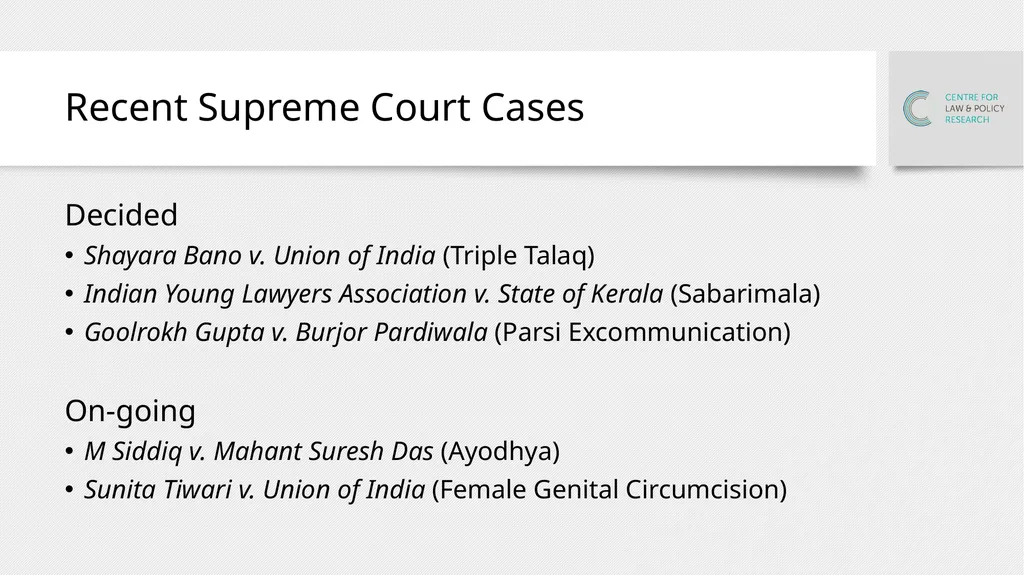
Recent Supreme Court Cases Decided
Shayara Bano v. Union of India (Triple Talaq)
Indian Young Lawyers Association v. State of Kerala (Sabarimala)
Goolrokh Gupta v. Burjor Pardiwala (Parsi Excommunication)
On-going
M Siddiq v. Mahant Suresh Das (Ayodhya)
Sunita Tiwari v. Union of India (Female Genital Circumcision)<br>
03
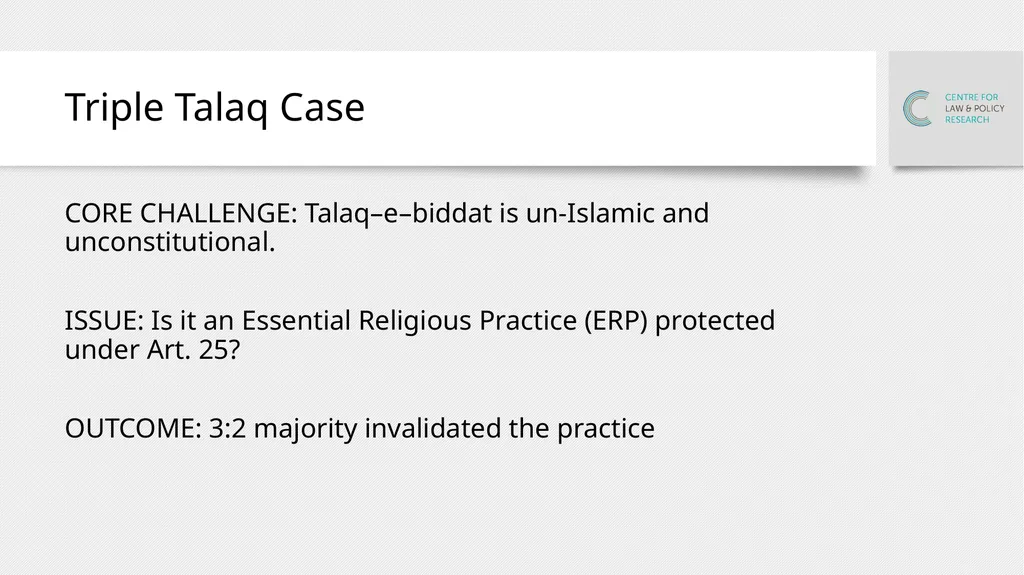
Triple Talaq Case CORE CHALLENGE: Talaq–e–biddat is un-Islamic and unconstitutional.
ISSUE: Is it an Essential Religious Practice (ERP) protected under Art. 25?
OUTCOME: 3:2 majority invalidated the practice<br>
04
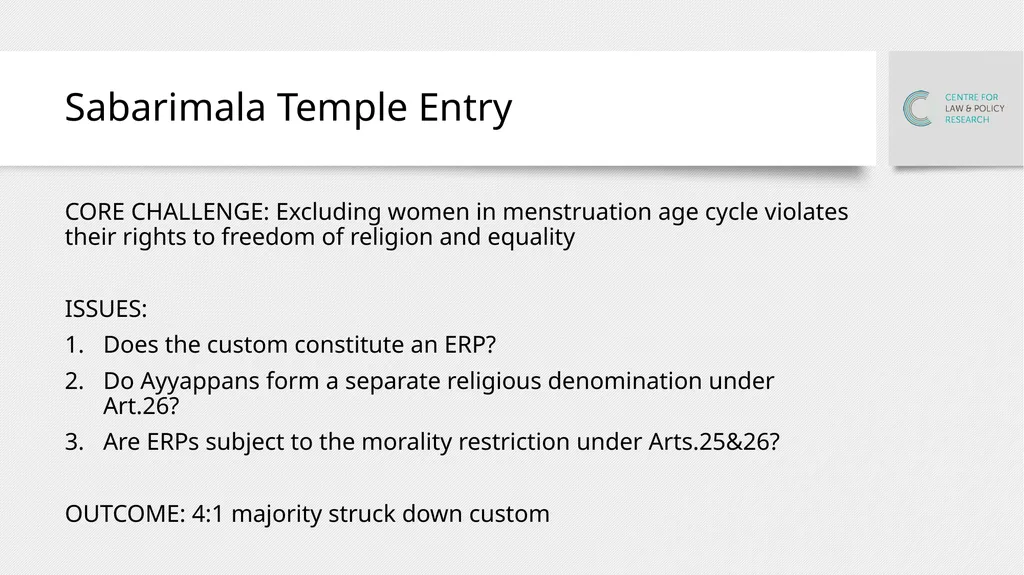
Sabarimala Temple Entry CORE CHALLENGE: Excluding women in menstruation age cycle violates their rights to freedom of religion and equality
ISSUES:
Does the custom constitute an ERP?
Do Ayyappans form a separate religious denomination under Art.26?
Are ERPs subject to the morality restriction under Arts.25&26?
OUTCOME: 4:1 majority struck down custom<br>
05
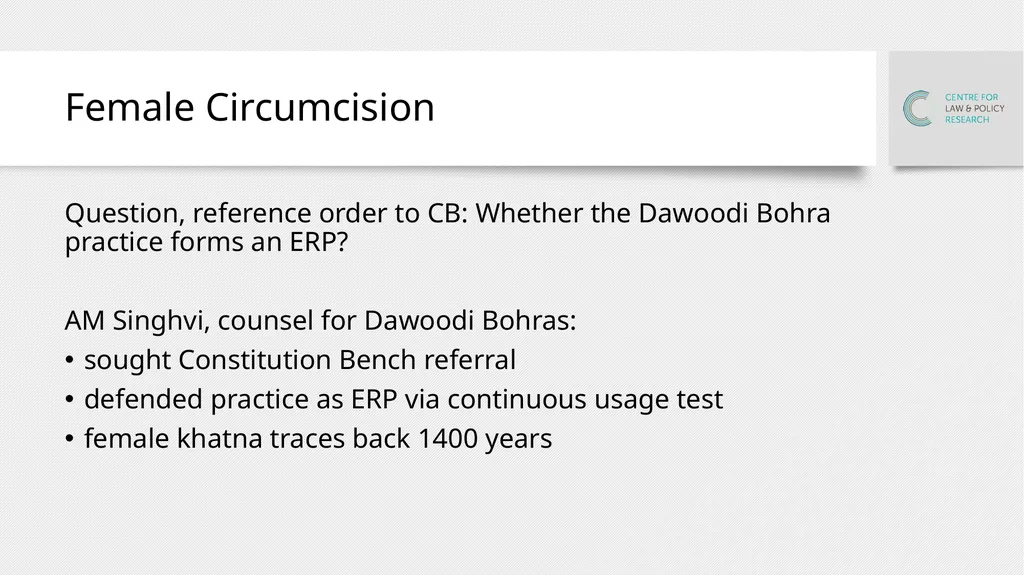
Female Circumcision Question, reference order to CB: Whether the Dawoodi Bohra practice forms an ERP?
AM Singhvi, counsel for Dawoodi Bohras:
sought Constitution Bench referral
defended practice as ERP via continuous usage test
female khatna traces back 1400 years<br>
06
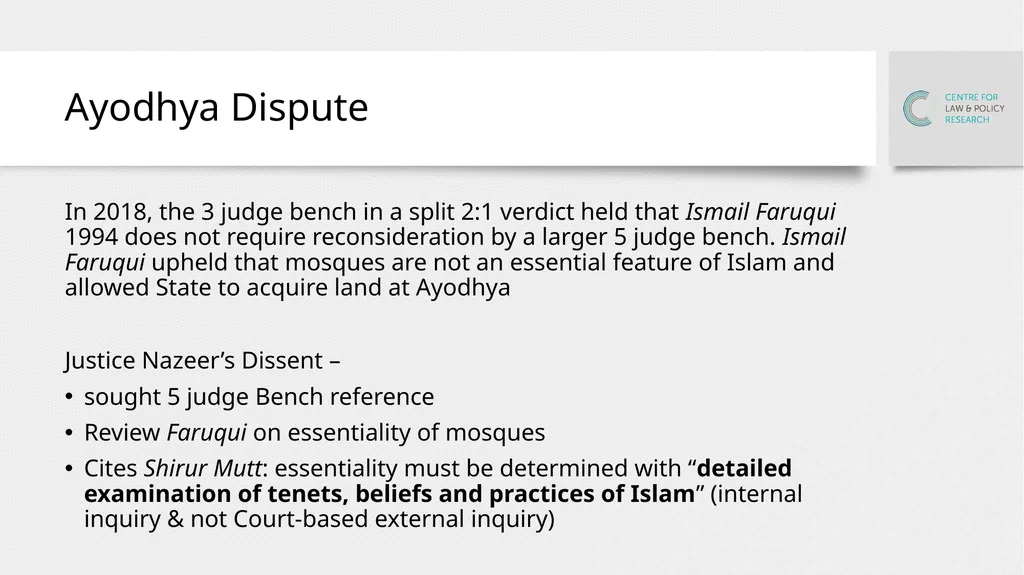
Ayodhya Dispute In 2018, the 3 judge bench in a split 2:1 verdict held that Ismail Faruqui 1994 does not require reconsideration by a larger 5 judge bench. Ismail Faruqui upheld that mosques are not an essential feature of Islam and allowed State to acquire land at Ayodhya
Justice Nazeer’s Dissent –
sought 5 judge Bench reference
Review Faruqui on essentiality of mosques
Cites Shirur Mutt: essentiality must be determined with “detailed examination of tenets, beliefs and practices of Islam” (internal inquiry & not Court-based external inquiry)<br>
07
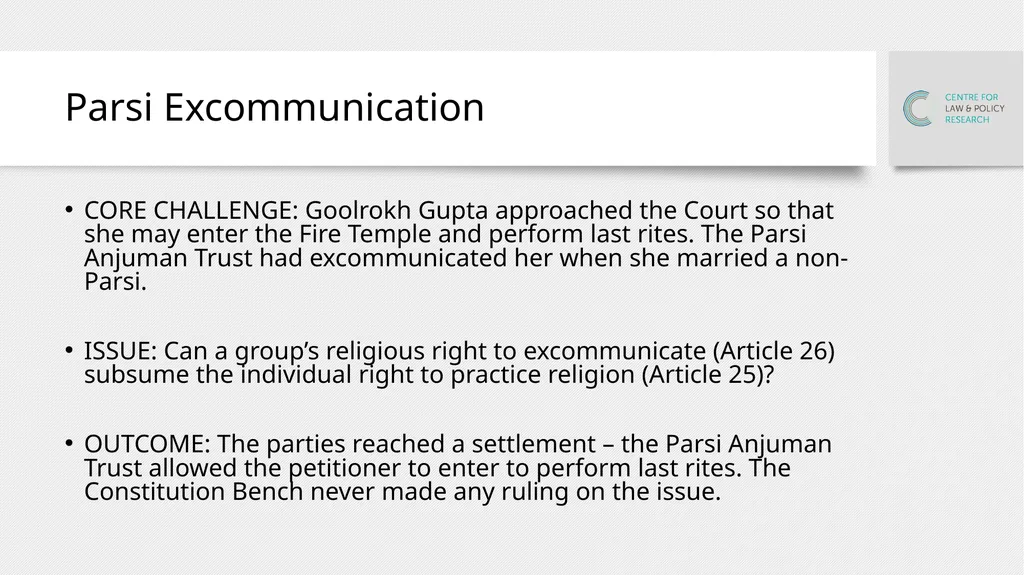
Parsi Excommunication CORE CHALLENGE: Goolrokh Gupta approached the Court so that she may enter the Fire Temple and perform last rites. The Parsi Anjuman Trust had excommunicated her when she married a non-Parsi.
ISSUE: Can a group’s religious right to excommunicate (Article 26) subsume the individual right to practice religion (Article 25)?
OUTCOME: The parties reached a settlement – the Parsi Anjuman Trust allowed the petitioner to enter to perform last rites. The Constitution Bench never made any ruling on the issue.<br>
08
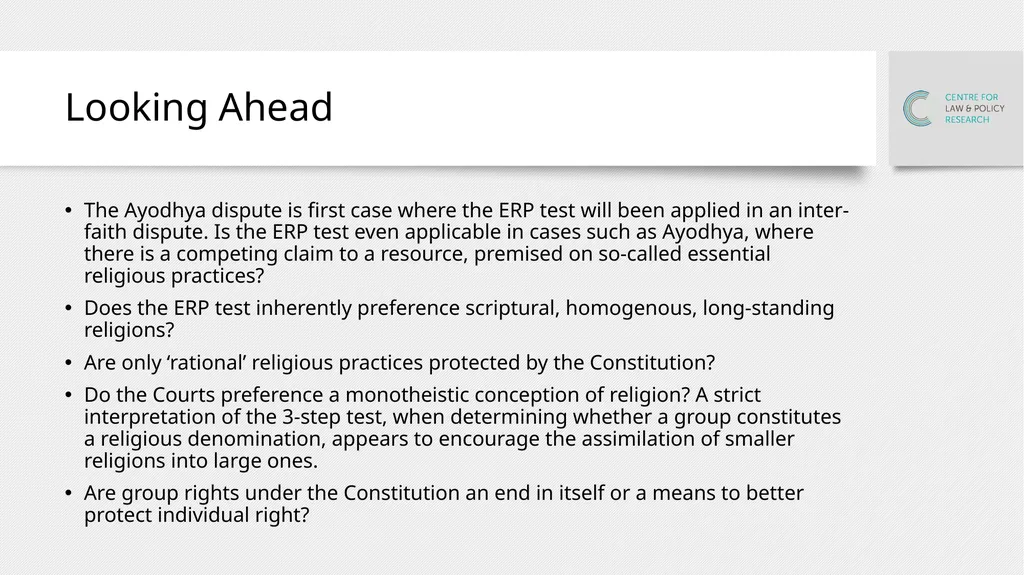
Looking Ahead The Ayodhya dispute is first case where the ERP test will been applied in an inter-faith dispute. Is the ERP test even applicable in cases such as Ayodhya, where there is a competing claim to a resource, premised on so-called essential religious practices?
Does the ERP test inherently preference scriptural, homogenous, long-standing religions?
Are only ‘rational’ religious practices protected by the Constitution?
Do the Courts preference a monotheistic conception of religion? A strict interpretation of the 3-step test, when determining whether a group constitutes a religious denomination, appears to encourage the assimilation of smaller religions into large ones.
Are group rights under the Constitution an end in itself or a means to better protect individual right?<br>