EXTERNAL COMMERCIAL BORROWINGS What is ECB? ECBs are commercial loans Raised by eligible borrowers From non-resident entities For permitted end use prescribed by RBI Should conform to parameters directed by RBI Borrowing vs Investments
"EXTERNAL COMMERCIAL BORROWINGS What is ECB? ECBs" is the property of its rightful owner. Permission is granted to
download and print the materials on this website for personal, non-commercial use only, and to display it
on your personal computer provided you do not modify the materials and that you retain all copyright
notices contained in the materials. By downloading content from our website, you accept the terms of this
agreement.
Presentation Transcript
01
EXTERNAL COMMERCIAL BORROWINGS<br>
02
What is ECB? ECBs are commercial loans
Raised by eligible borrowers
From non-resident entities
For permitted end use prescribed by RBI
Should conform to parameters directed by RBI<br>
03
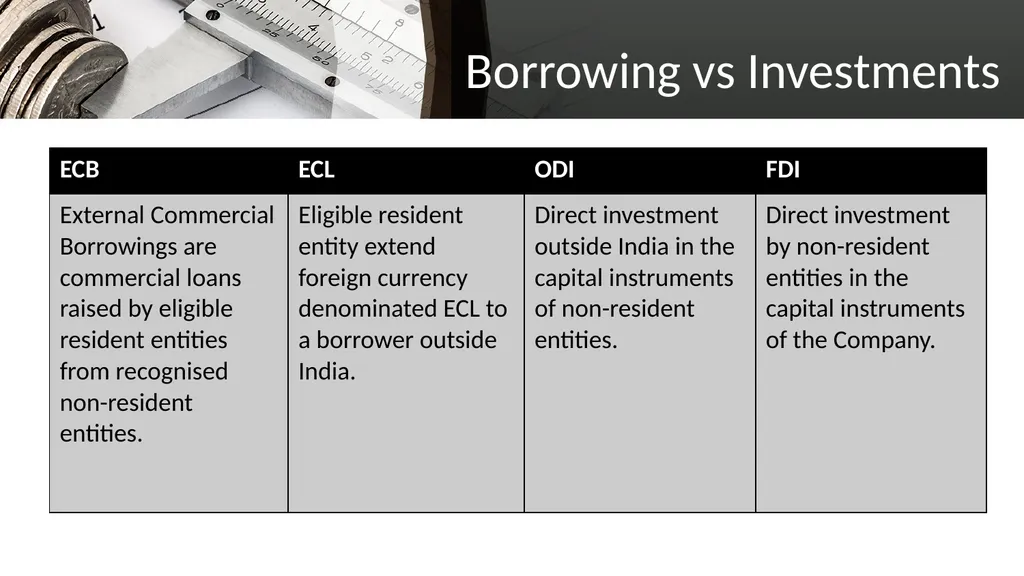
Borrowing vs Investments<br>
04
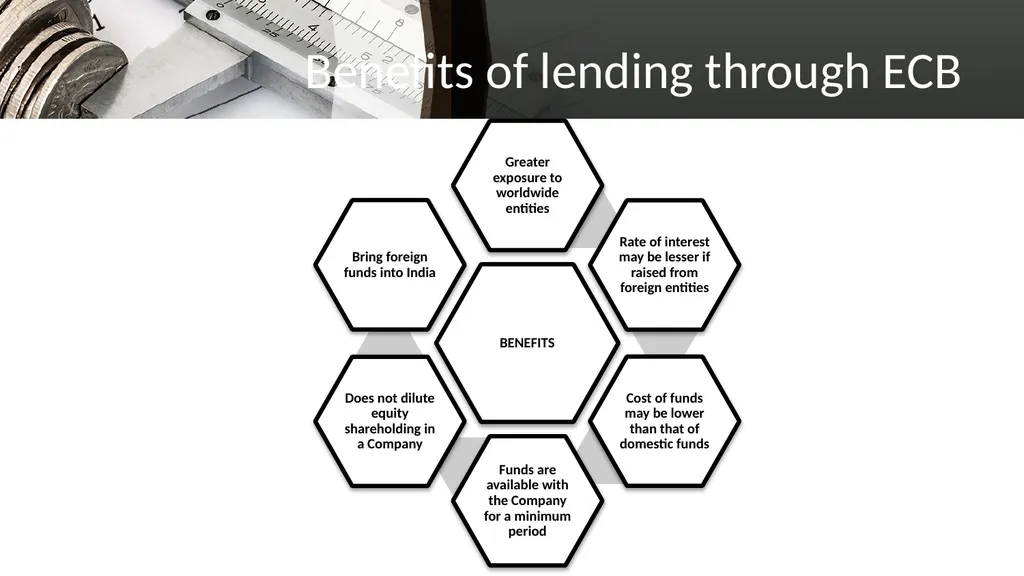
Benefits of lending through ECB<br>
05
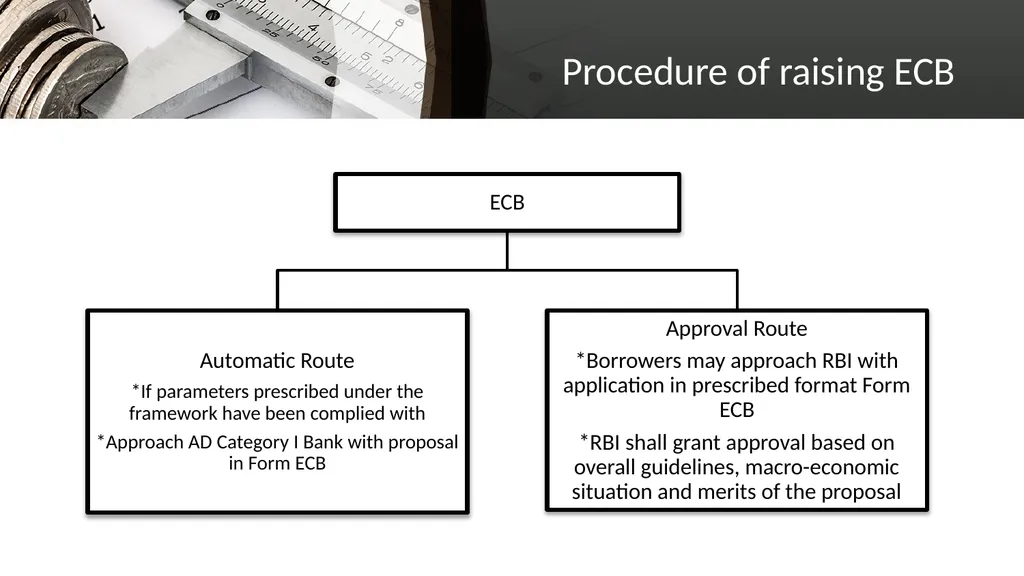
Procedure of raising ECB<br>
06
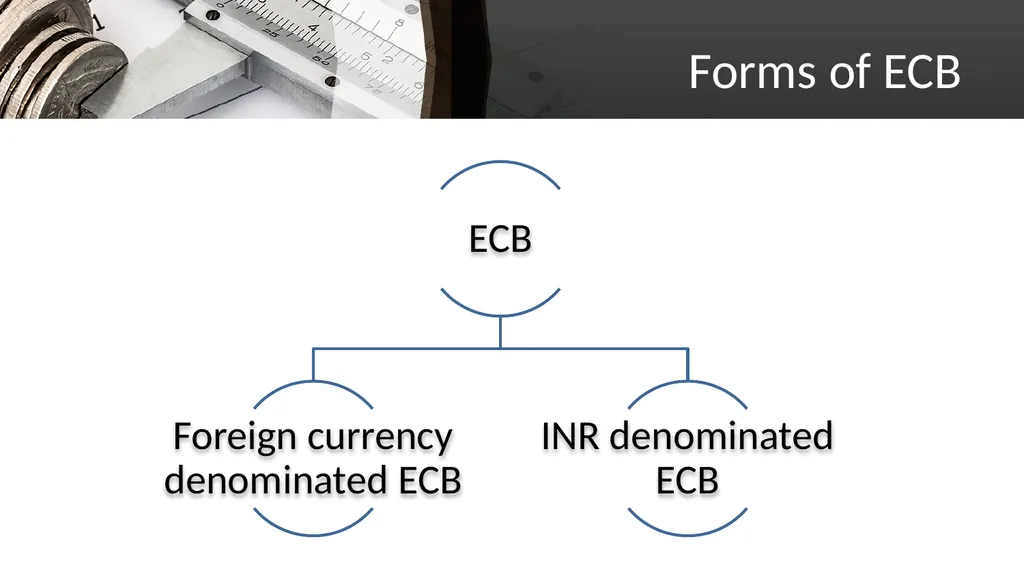
Forms of ECB<br>
07
Foreign Currency denominated ECBs:
As per the erstwhile provisions, ECB was divided into:
Track I Foreign Currency ECBs
Track II Foreign Currency ECBs
Track III Rupee denominated ECBs
However, the recent amendment dated 31st July, 2019 has merged track I and II as foreign currency denominated ECBs. These ECBs have forex hedging risk due to foreign currency difference.
INR denominated ECBs:
These are Indian Rupees denominated ECBs and do not have hedging risk.<br>
08
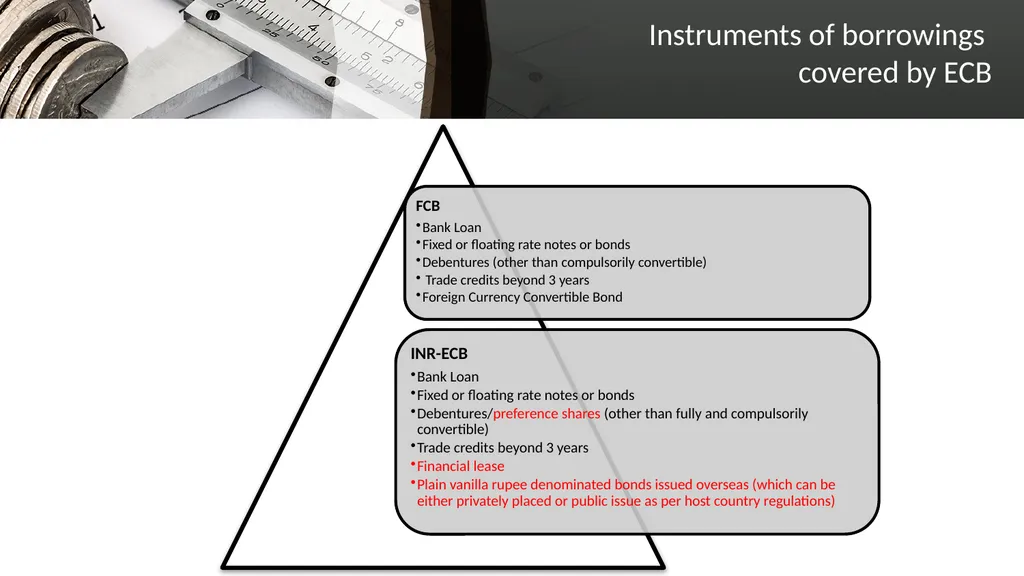
Instruments of borrowings covered by ECB<br>
09
Parameters for borrowing through ECBs ECBs should be borrowed from eligible borrowers
To ensure whether lenders are eligible to borrow from ECB route
Minimum maturity period of ECB
All-in-cost ceiling should be maintained
End uses of ECB should not be restricted
Exchange rate
Hedging provision for foreign exchange exposure<br>
10
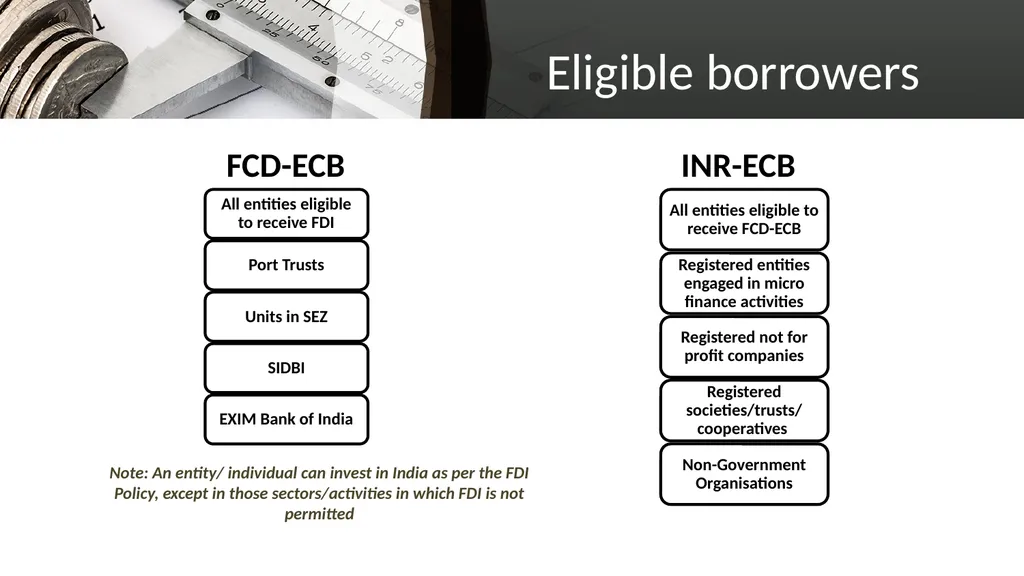
Eligible borrowers FCD-ECB INR-ECB Note: An entity/ individual can invest in India as per the FDI Policy, except in those sectors/activities in which FDI is not permitted<br>
11
Eligible lenders<br>
12
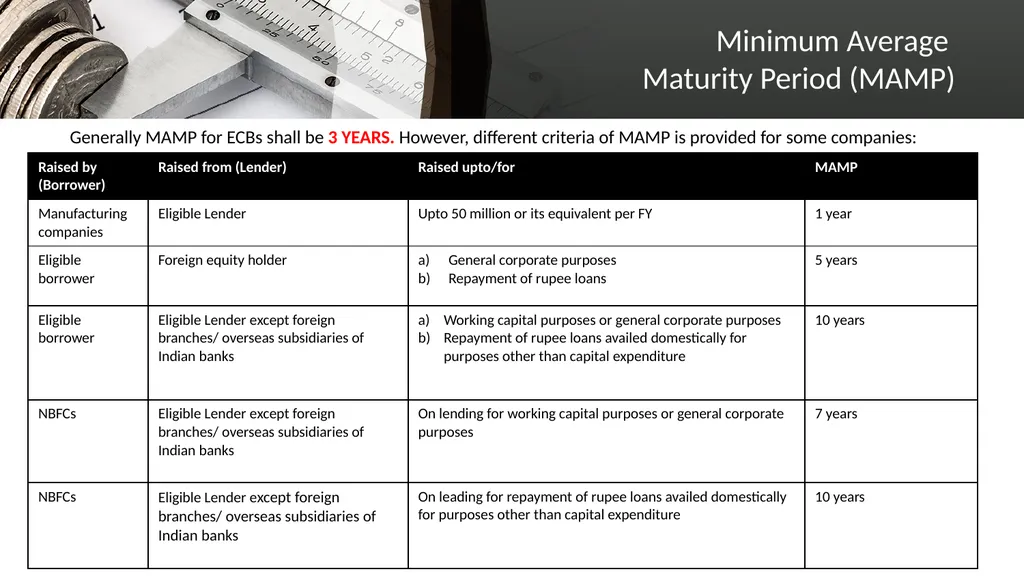
Minimum Average Maturity Period (MAMP) Generally MAMP for ECBs shall be 3 YEARS. However, different criteria of MAMP is provided for some companies:<br>
13
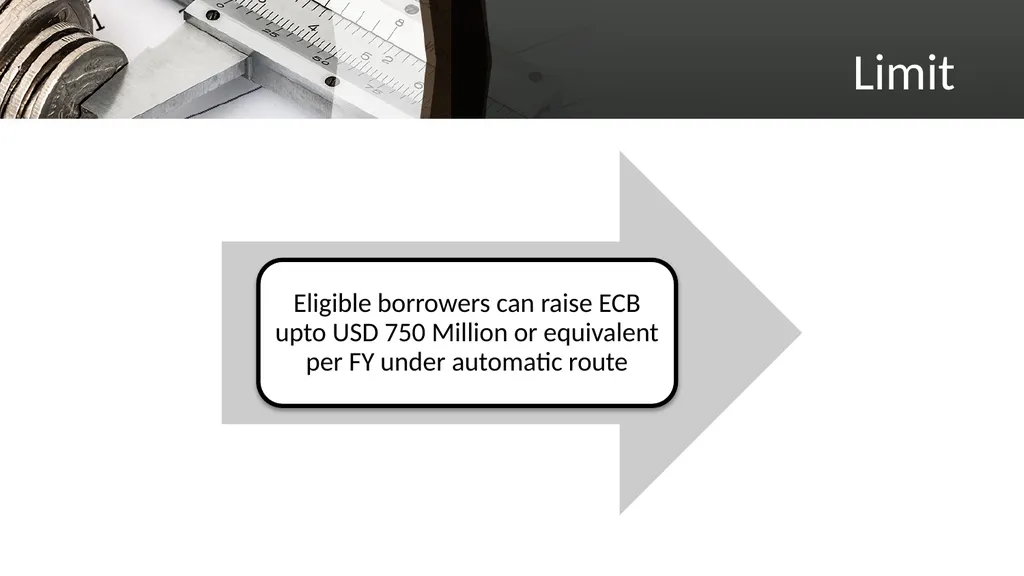
Limit<br>
14
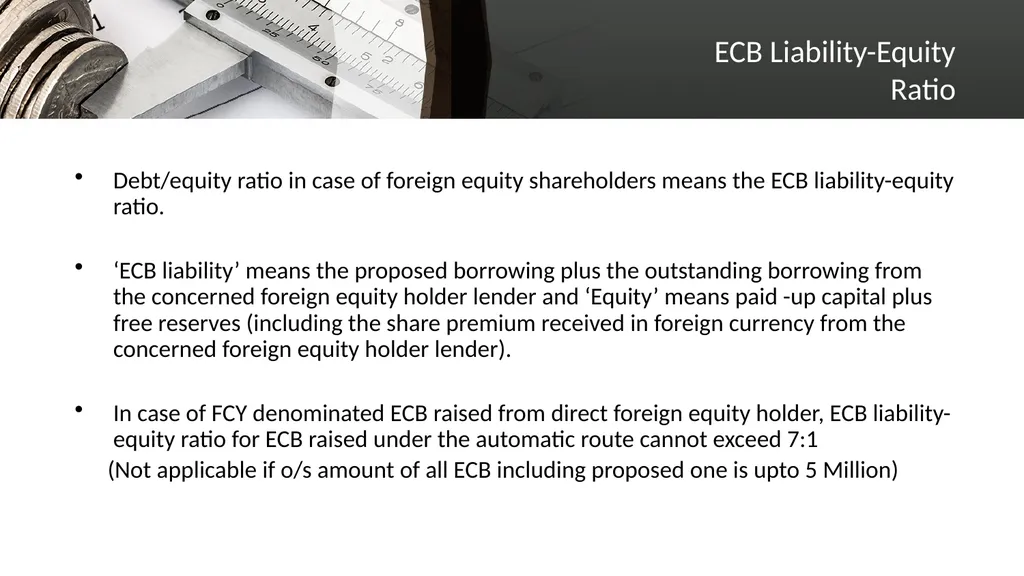
ECB Liability-Equity Ratio Debt/equity ratio in case of foreign equity shareholders means the ECB liability-equity ratio.
‘ECB liability’ means the proposed borrowing plus the outstanding borrowing from the concerned foreign equity holder lender and ‘Equity’ means paid -up capital plus free reserves (including the share premium received in foreign currency from the concerned foreign equity holder lender).
In case of FCY denominated ECB raised from direct foreign equity holder, ECB liability-equity ratio for ECB raised under the automatic route cannot exceed 7:1
(Not applicable if o/s amount of all ECB including proposed one is upto 5 Million)<br>
15
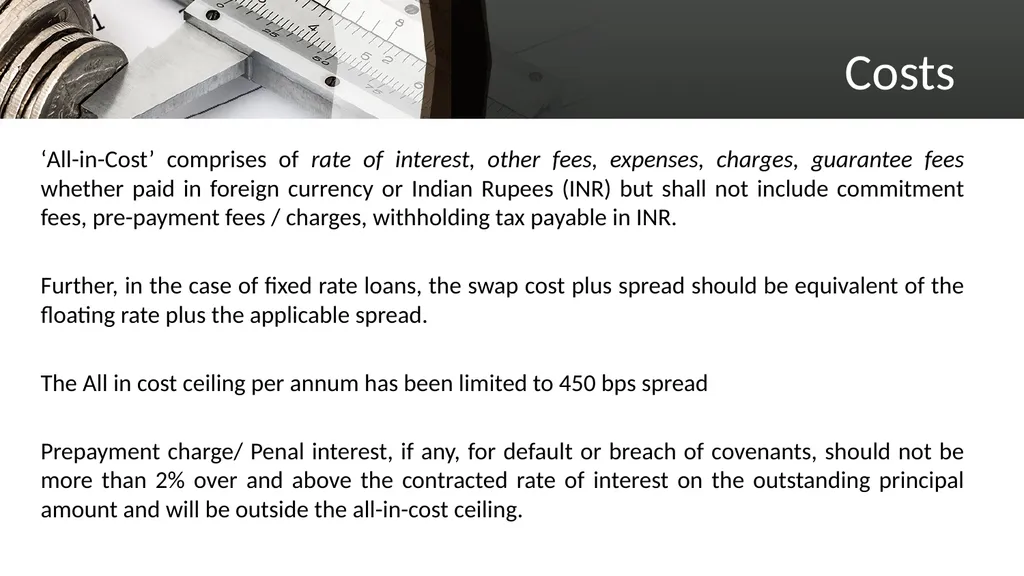
Costs ‘All-in-Cost’ comprises of rate of interest, other fees, expenses, charges, guarantee fees whether paid in foreign currency or Indian Rupees (INR) but shall not include commitment fees, pre-payment fees / charges, withholding tax payable in INR.
Further, in the case of fixed rate loans, the swap cost plus spread should be equivalent of the floating rate plus the applicable spread.
The All in cost ceiling per annum has been limited to 450 bps spread
Prepayment charge/ Penal interest, if any, for default or breach of covenants, should not be more than 2% over and above the contracted rate of interest on the outstanding principal amount and will be outside the all-in-cost ceiling.<br>
16
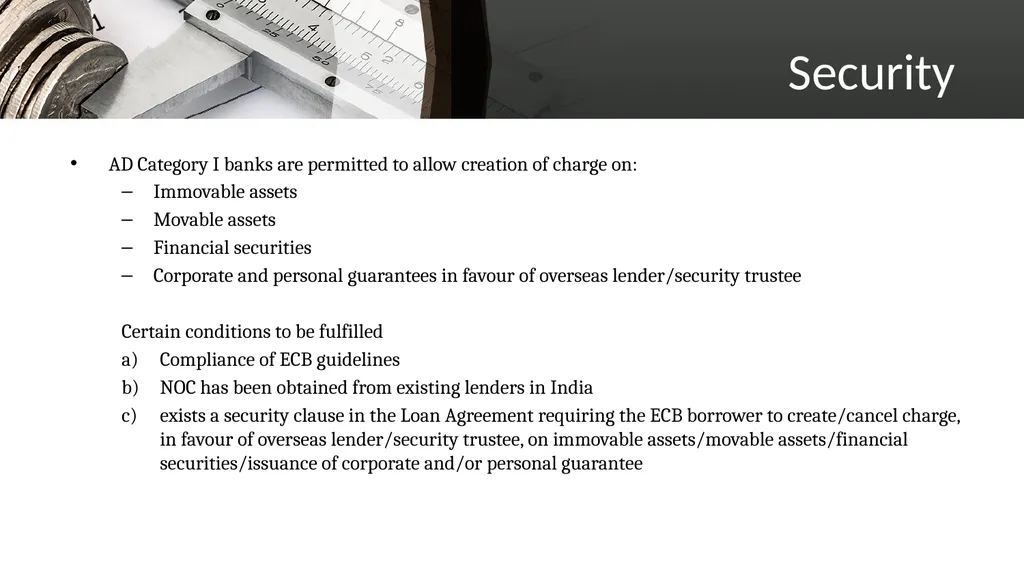
Security AD Category I banks are permitted to allow creation of charge on:
Immovable assets
Movable assets
Financial securities
Corporate and personal guarantees in favour of overseas lender/security trustee
Certain conditions to be fulfilled
Compliance of ECB guidelines
NOC has been obtained from existing lenders in India
exists a security clause in the Loan Agreement requiring the ECB borrower to create/cancel charge, in favour of overseas lender/security trustee, on immovable assets/movable assets/financial securities/issuance of corporate and/or personal guarantee<br>
17
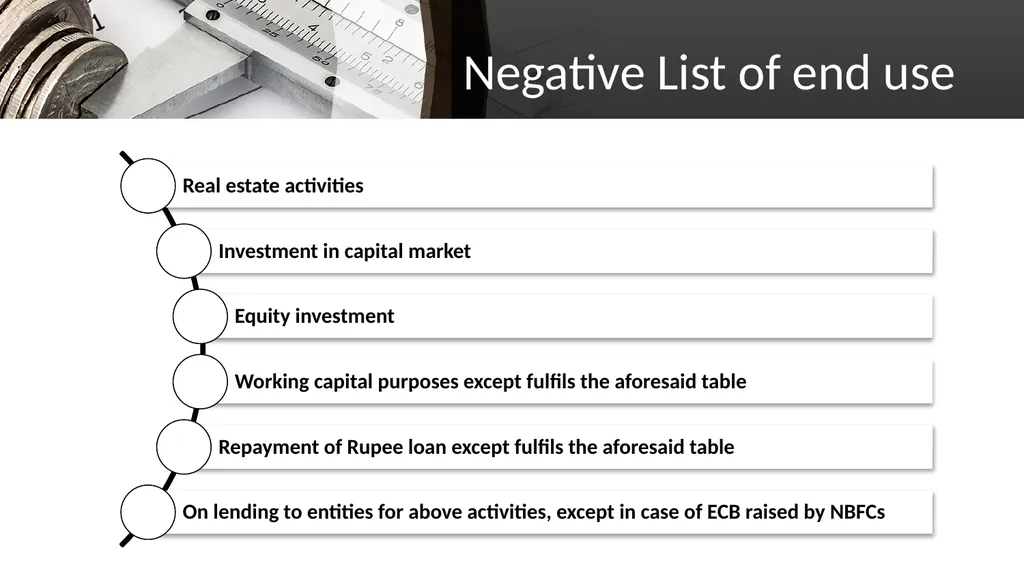
Negative List of end use<br>
18
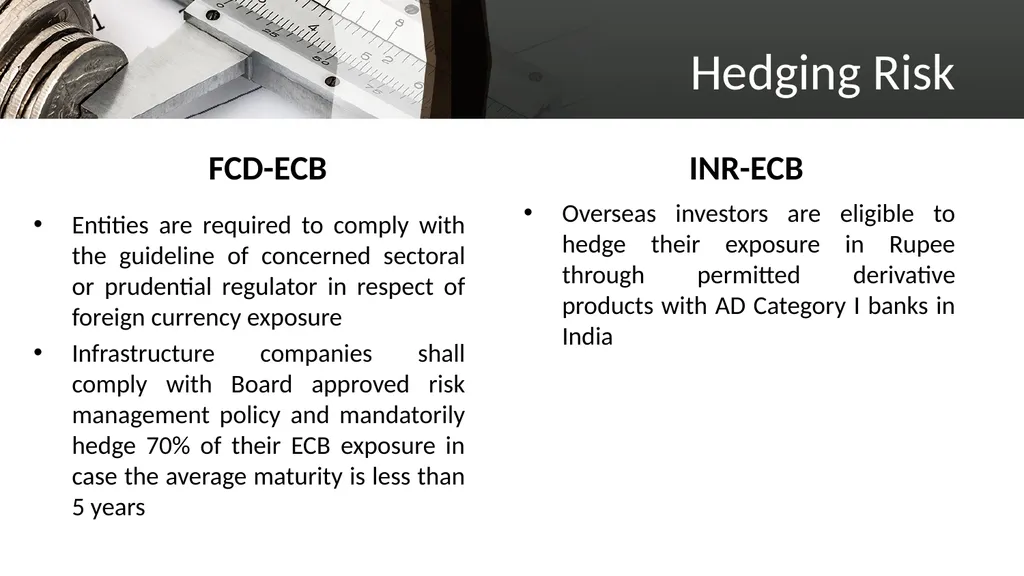
Hedging Risk FCD-ECB Entities are required to comply with the guideline of concerned sectoral or prudential regulator in respect of foreign currency exposure
Infrastructure companies shall comply with Board approved risk management policy and mandatorily hedge 70% of their ECB exposure in case the average maturity is less than 5 years INR-ECB Overseas investors are eligible to hedge their exposure in Rupee through permitted derivative products with AD Category I banks in India<br>
19
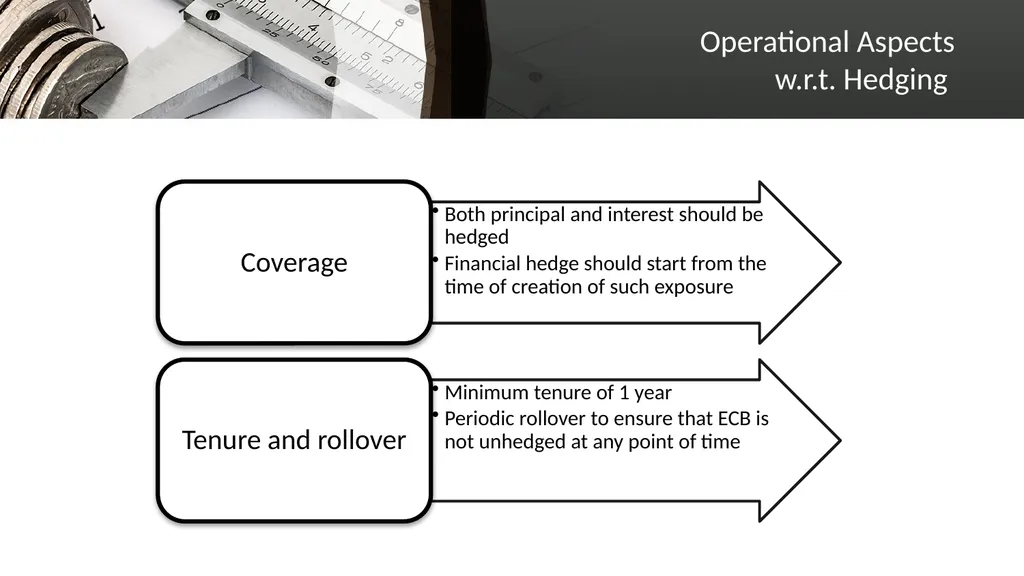
Operational Aspects w.r.t. Hedging<br>
20
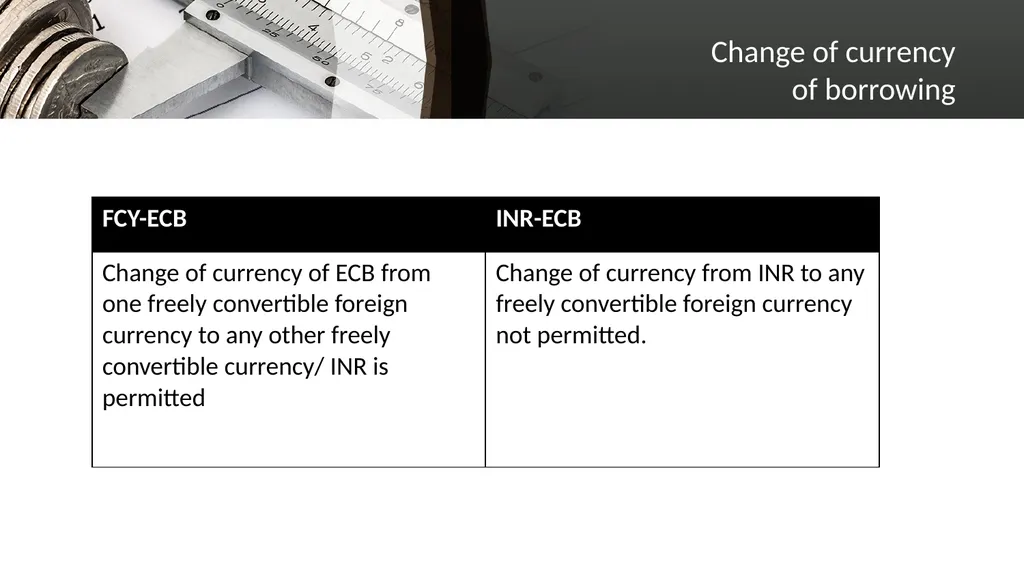
Change of currency of borrowing<br>
21
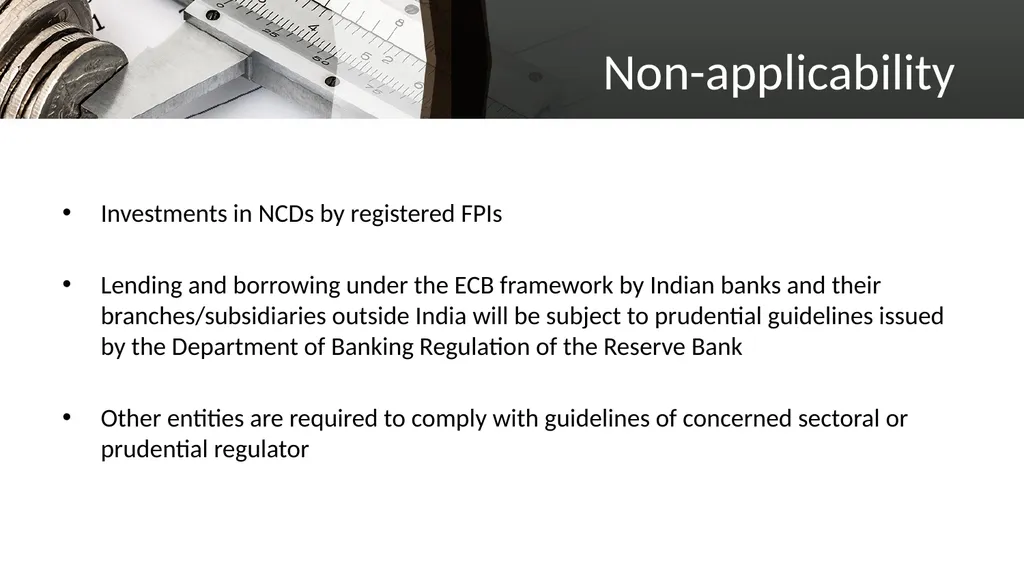
Non-applicability Investments in NCDs by registered FPIs
Lending and borrowing under the ECB framework by Indian banks and their branches/subsidiaries outside India will be subject to prudential guidelines issued by the Department of Banking Regulation of the Reserve Bank
Other entities are required to comply with guidelines of concerned sectoral or prudential regulator<br>
22
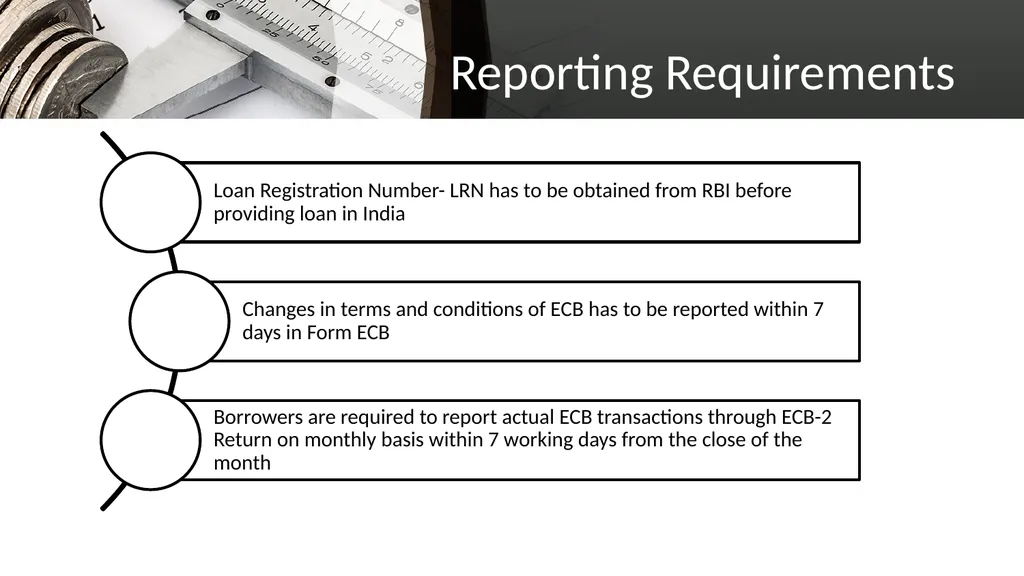
Reporting Requirements<br>
23
ECB in case of stressed assets Where entity is under a restructuring scheme/ corporate insolvency resolution process- it can raise ECB only if permitted under resolution plan.
Where domestic loans of eligible borrower for capital expenditure in manufacturing and infrastructure sector is classified as NPA or SMA-2 - can avail ECB for repayment of these loans under any one time settlement with lenders.<br>
24
Conversion of ECB into equity Following conditions have to be satisfied:
Activity of borrowing co. should be covered under automatic route for FDI or Govt,. Approval if received
Lender’s consent without additional cost
Should not result in contravention of eligibility or breach of sectoral cap under FDI policy
Applicable pricing guidelines for shares should be complied
If partial conversion, reporting in FC GPR and ECB-2 shall be required
If full conversion, reporting in FC-GPR shall be required
If borrower has obtained credit facilities from banks, applicable prudential norms of Banking Reg has to be complied
Consent of other lenders to the same borrower
exchange rate prevailing on the date of the agreement between the parties concerned for such conversion or any lesser rate can be applied with a mutual agreement with the ECB lender. It may be noted that the fair value of the equity shares to be issued shall be worked out with reference to the date of conversion only.<br>
25
Taxability Taxability on interest on ECBs shall be dependent on whether borrowing is in foreign currency or Indian rupees
Interest payable by an Indian company or a business trust to a non-resident, including a foreign company, in respect of rupee denominated bond issued outside India before the 1stof July, 2020 is liable for concessional rate of tax of Five Percent (5%).. However, the same is exempt from tax till 31st March, 2019.<br>