
EXTRACTION Made By: Swarnakshi Upadhyay Assistant

Description: EXTRACTION Made By: Swarnakshi Upadhyay Assistant Professor School of Pharmaceutical Sciences CSJM University INTRODUCTION Extraction is defined as the removal of soluble constituents from solid or liquid with the help of suitable solvent.
Related Topics
Download Presentation
"EXTRACTION Made By: Swarnakshi Upadhyay Assistant" is the property of its rightful owner. Permission is granted to download and print the materials on this website for personal, non-commercial use only, and to display it on your personal computer provided you do not modify the materials and that you retain all copyright notices contained in the materials. By downloading content from our website, you accept the terms of this agreement.
Presentation Transcript
slide1. EXTRACTION Made By:
Swarnakshi Upadhyay
Assistant Professor
School of Pharmaceutical Sciences
CSJM University<br>
slide2. INTRODUCTION Extraction is defined as the removal of soluble constituents from solid or liquid with the help of suitable solvent.
The solvent used for extraction is known as menstruum.
Menstruum is capable of penetrating, the plant or animal tissues and dissolving the active medicaments present in them.<br>
slide3. INTRODUCTION (Cont.) The solid residue which is exhausted of active constituents remains behind after extraction is known as marc.
In general, extraction consists of soaking the powdered material in a menstruum. The menstruum diffuses into the powdered material and dissolves the ingredients, which then diffuse out into the liquid.<br>
slide4. Classification of extraction process Classification of extraction process based on types of phases:
Liquid- Liquid Extraction
Solid Phase Extraction
Solid-Liquid Extraction (Leaching)<br>
slide5. Liquid-liquid extraction Also known as solvent extraction and partitioning.
Used a liquid solvent to remove a component from a liquid mixture.
Solvent used for extraction is immiscible or only partially miscible with the other solvent in the liquid mixture.
Application of this process include separation of vitamins from aqueous solutions and aromatic compounds from crude oil fractions.<br>
slide6. Solid phase extraction Widely used in analytical laboratories.
One or more analytes from a liquid sample are separated by extracted partitioning, and/or adsorbing onto a solid stationary phase.<br>
slide7. Solid-liquid extraction (leaching) The extraction of a soluble component from a solid by using a solvent is commonly known as leaching.
Application of solid-liquid extraction include:
Obtaining oil from oil seeds
Making of coffee
Making of hot tea<br>
slide8. Methods of extraction Infusion
Decoction
Digestion
Maceration
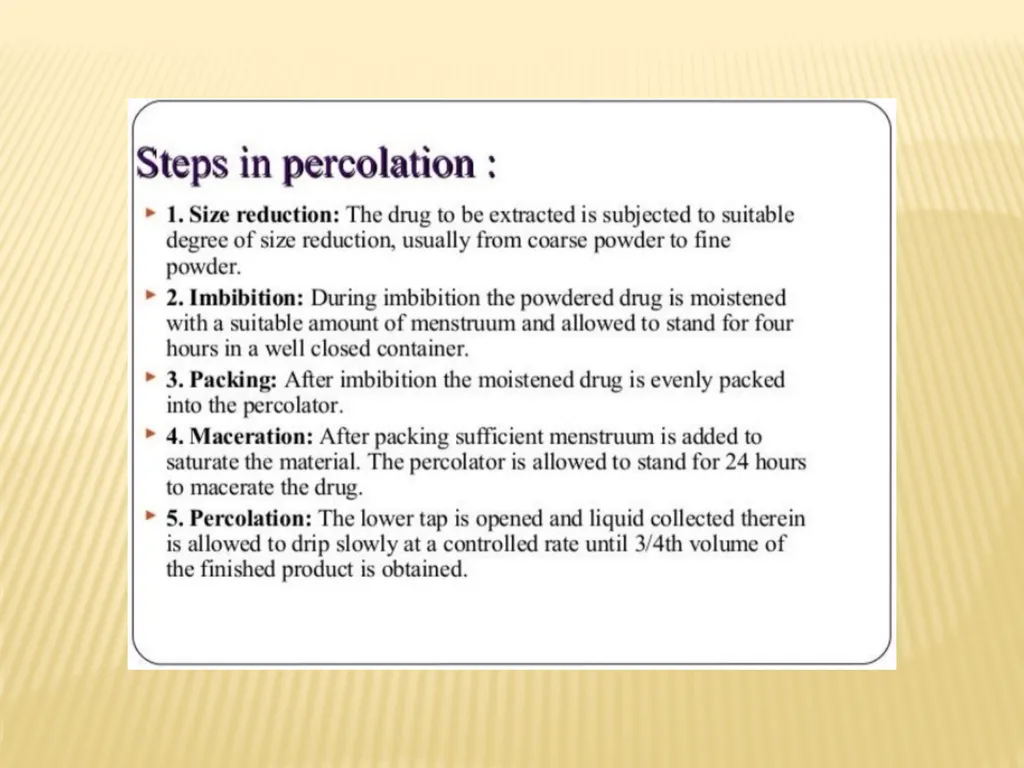
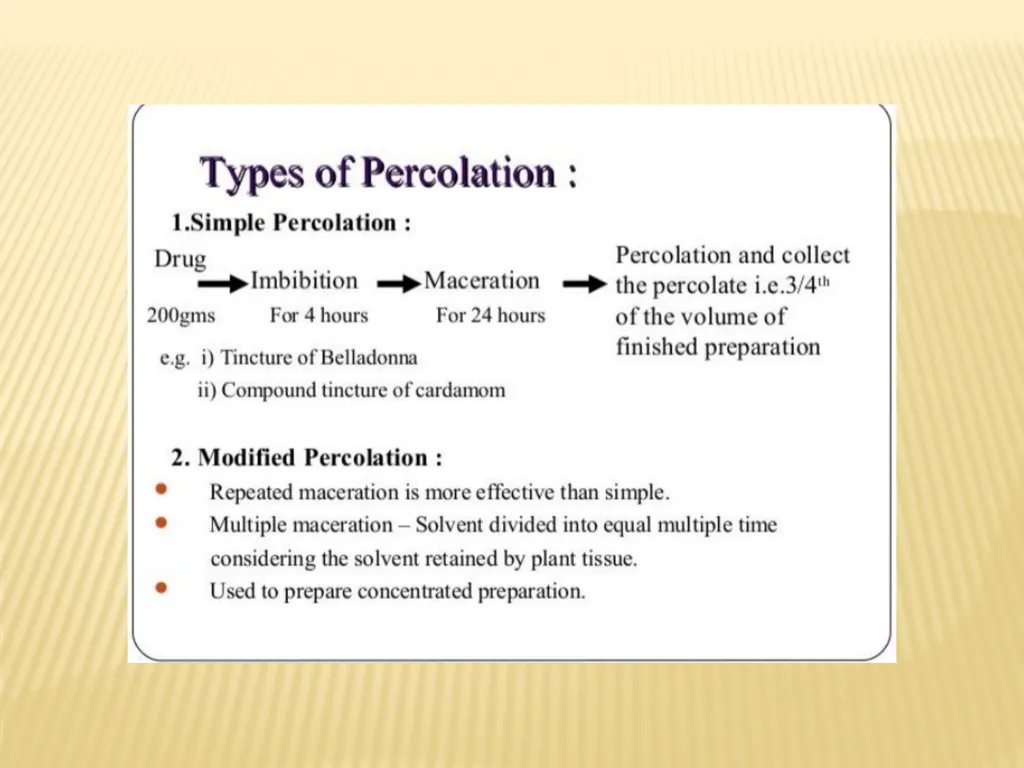
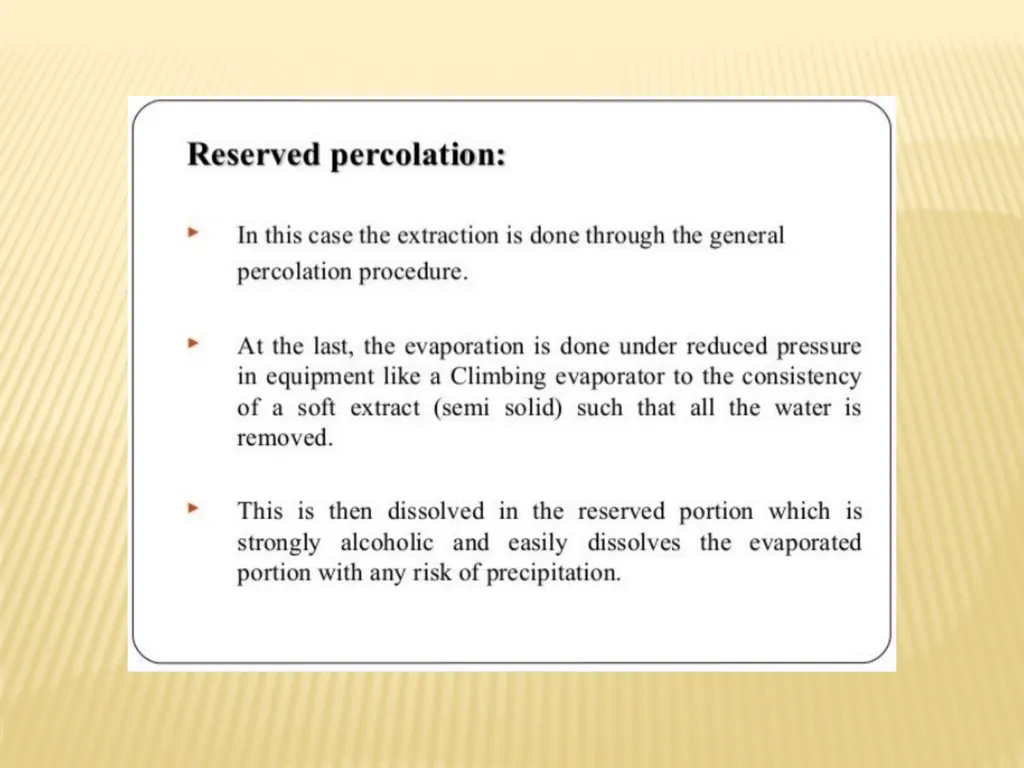
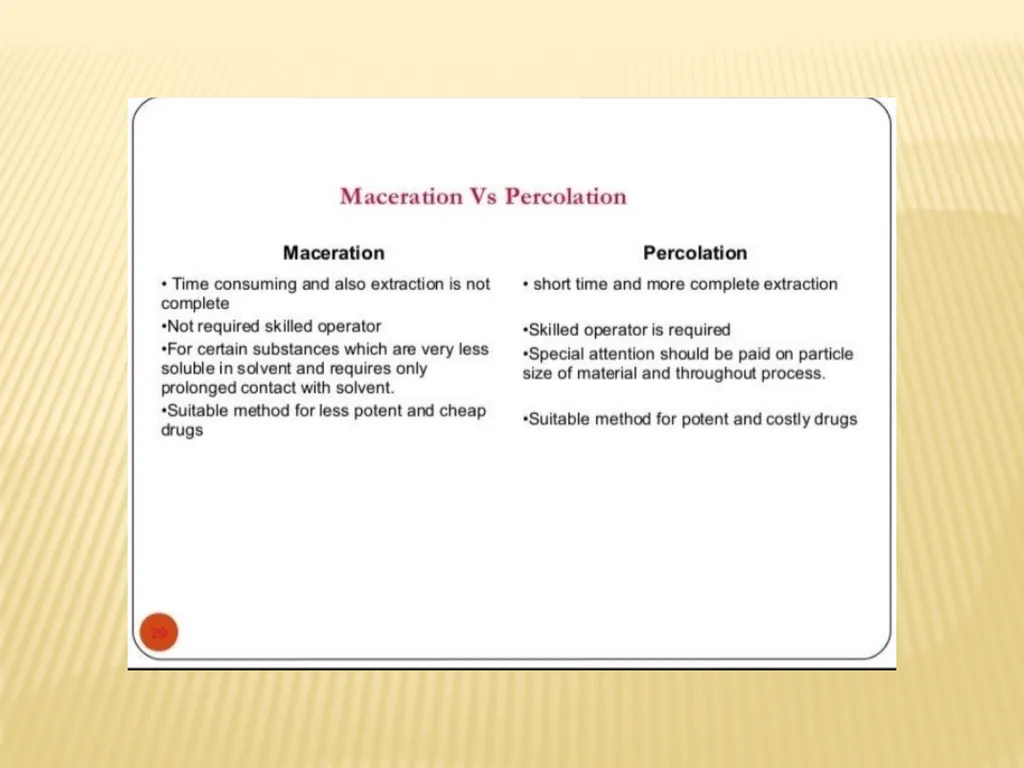
Percolation
Hot continuous extraction
Supercritical fluid extraction
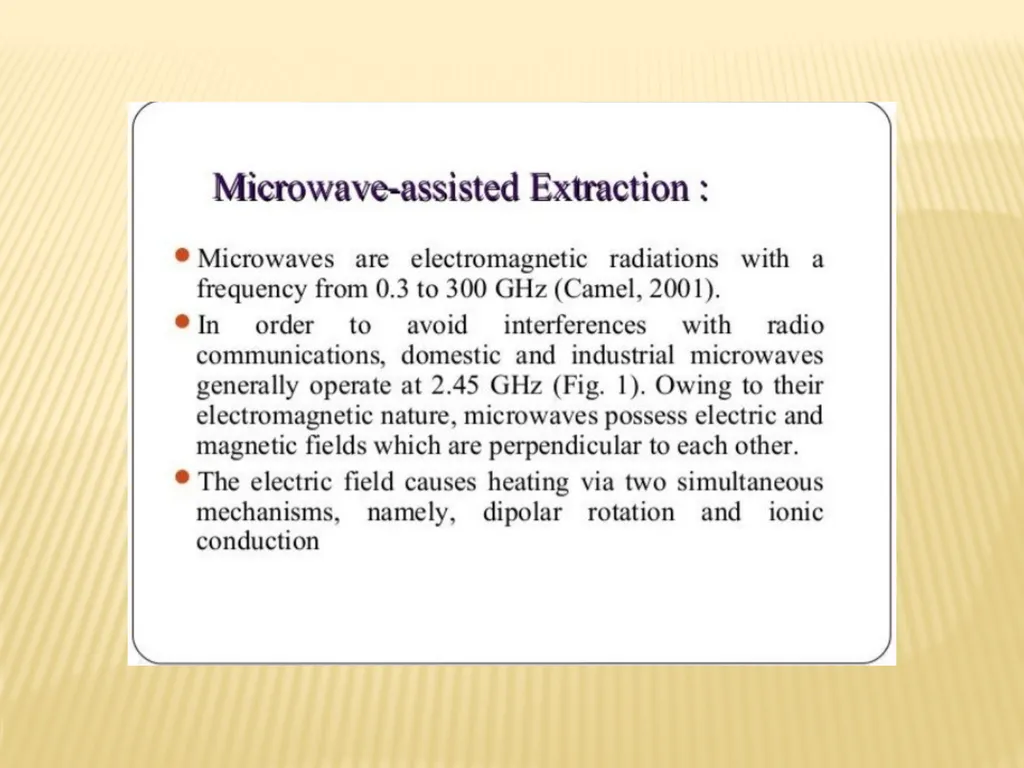
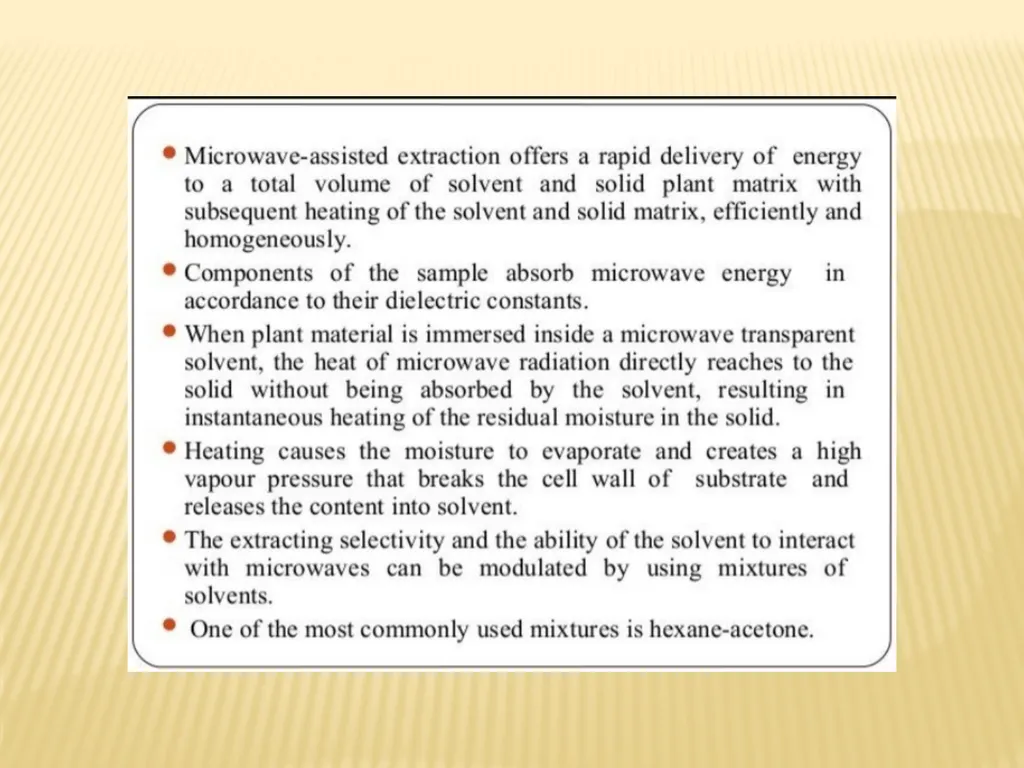
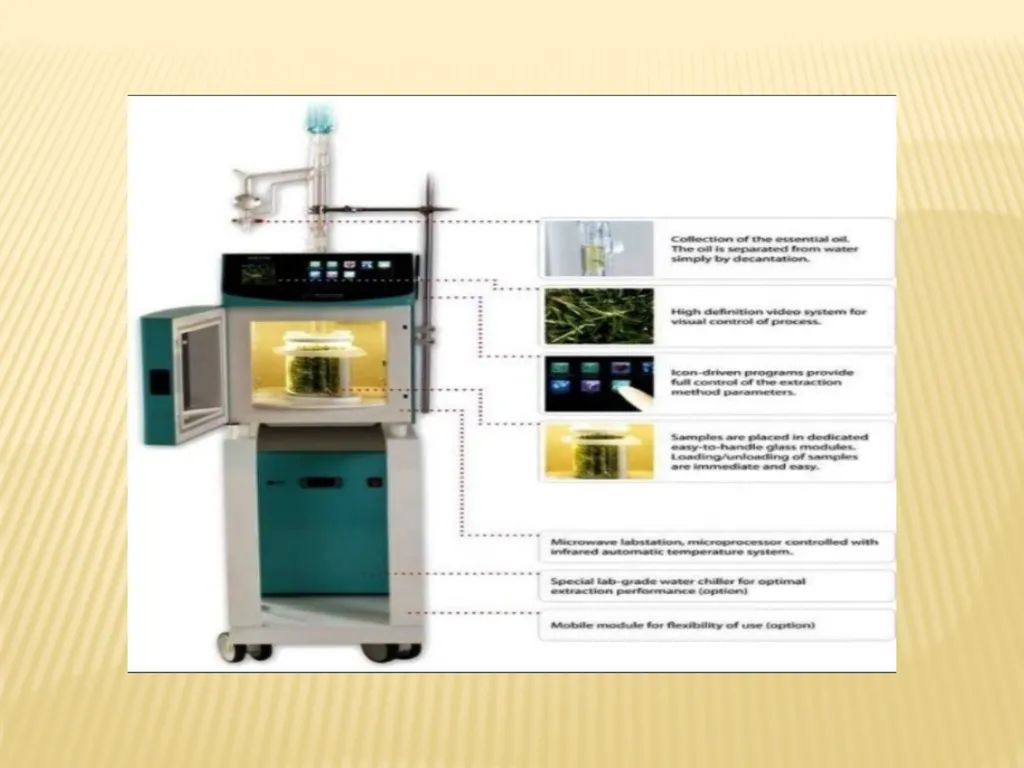
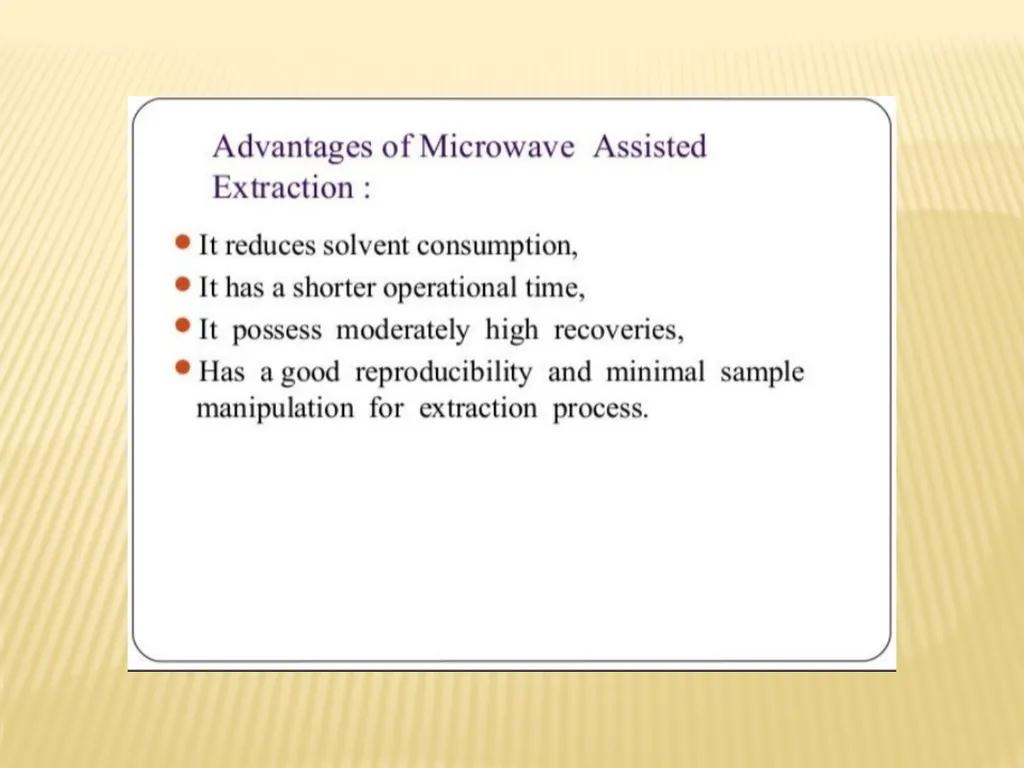
Microwave assisted extraction
ultrasonication<br>
slide9. infusion It consists of pouring water over the drugs and then allowing it to keep in contact with water for the stated period, usually 15 minutes, with occasional stirring and finally filtering off the liquid.
The marc is not pressed.
The boiling water is commonly used as a solvent, since it has a greater solvent action than cold water.<br>
slide10. For the preparation of infusions special pots are used which is known as infusion pots.
In that, firstly drug is placed in bottom of the pot.
Then add hot water & stirred three or four times during the period of infusion.
Infusion also prepared in muslin cloth. In that drug is placed in muslin cloth & enclose & then suspending it just below the level of the water in a beaker.
For that process stirring is not required.<br>
slide11. Types of infusion Fresh Infusion:
aqueous liquid used as a menstruum.
It is prepared by
Coarse drug + Hot water then filtrate after sometimes.
As per pharmacopoeia it is used within 12 hrs after formulation.
E.g. fresh infusion of Quassia.<br>
slide12. Cont. 2. Concentrated Infusion
It is 8 times stronger than fresh infusion.
In that 20-25% alcohol conc. Used as a menstruum.
It can be stored for a longer time period.
E.g. concentrated infusion of Quassia.<br>
slide13. Decoction In this process, the drug is boiled with water for a stated period usually 10 minutes.
After boiling, the liquid is strained and water is passed through the content of the strainer to make the required volume.
This process is mainly used for vegetable drugs of hard and woody nature having thermostable water soluble constituents.<br>
slide14. digestion In digestion process, the drug is extracted by heating at a particular pressure.
This will increase the penetration power of the menstruum, so that there is complete extraction of the drug.
Precaution should be taken so that the increased temperature may not harm the active constituents of the drug.<br>
slide15. Cont. The apparatus known as “DIGESTOR” is used for extraction of the drug by this method.
It is a vessel made up ofmetal. The whole of the drug along with the menstruum is placed in the body of the digestor.
Place the cover over it and bolt it with the help of nuts.
The drug is treated with menstruum for a definite period under specified conditions of temperature and pressure.<br>
slide16. maceration In this process solid ingredients are placed in a stoppered container with the whole of the solvent and allowed to stand for a period of at leas 3 days or 3-7 days with frequent agitation, until soluble matter is dissolved.
The mixture is then strained (through sieves/nets), the marc pressed and the combined liquids clarified (cleaned by filtration).<br>
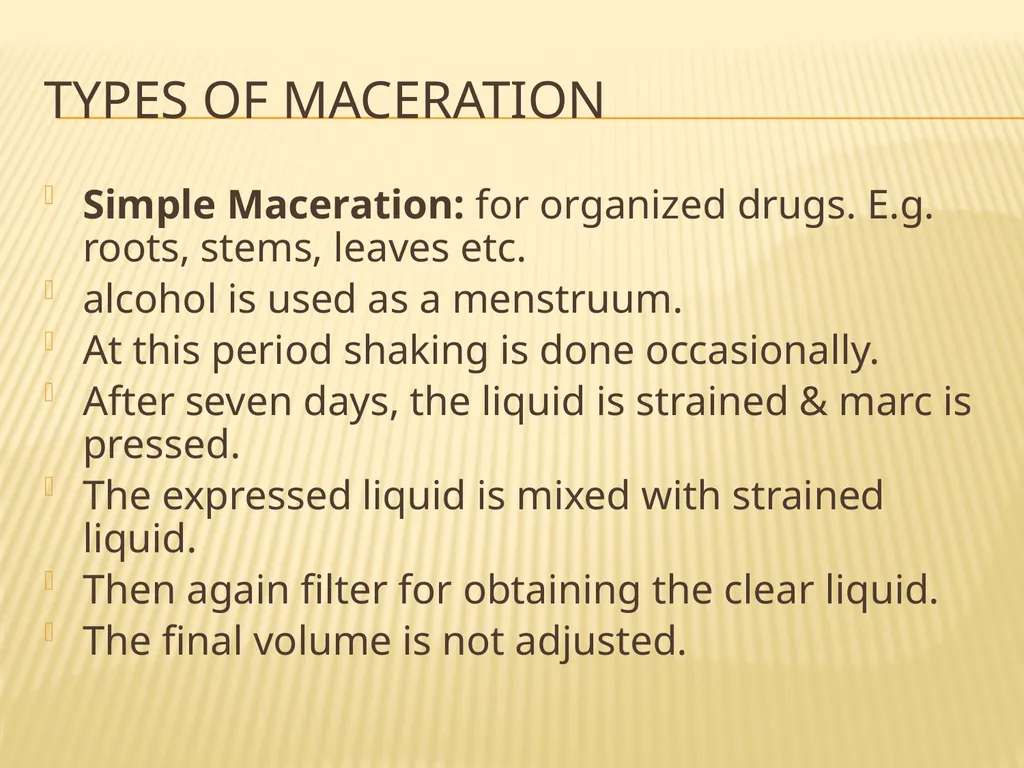
slide17. Types of maceration Simple Maceration: for organized drugs. E.g. roots, stems, leaves etc.
alcohol is used as a menstruum.
At this period shaking is done occasionally.
After seven days, the liquid is strained & marc is pressed.
The expressed liquid is mixed with strained liquid.
Then again filter for obtaining the clear liquid.
The final volume is not adjusted.<br>
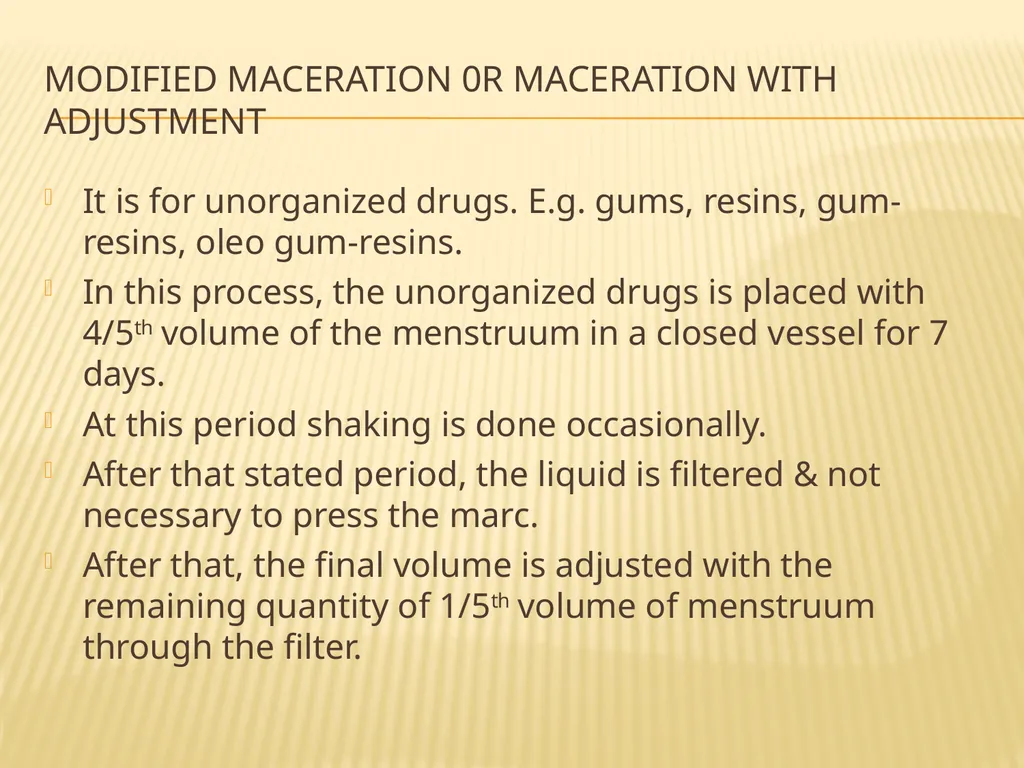
slide18. Modified maceration 0r maceration with adjustment It is for unorganized drugs. E.g. gums, resins, gum-resins, oleo gum-resins.
In this process, the unorganized drugs is placed with 4/5th volume of the menstruum in a closed vessel for 7 days.
At this period shaking is done occasionally.
After that stated period, the liquid is filtered & not necessary to press the marc.
After that, the final volume is adjusted with the remaining quantity of 1/5th volume of menstruum through the filter.<br>
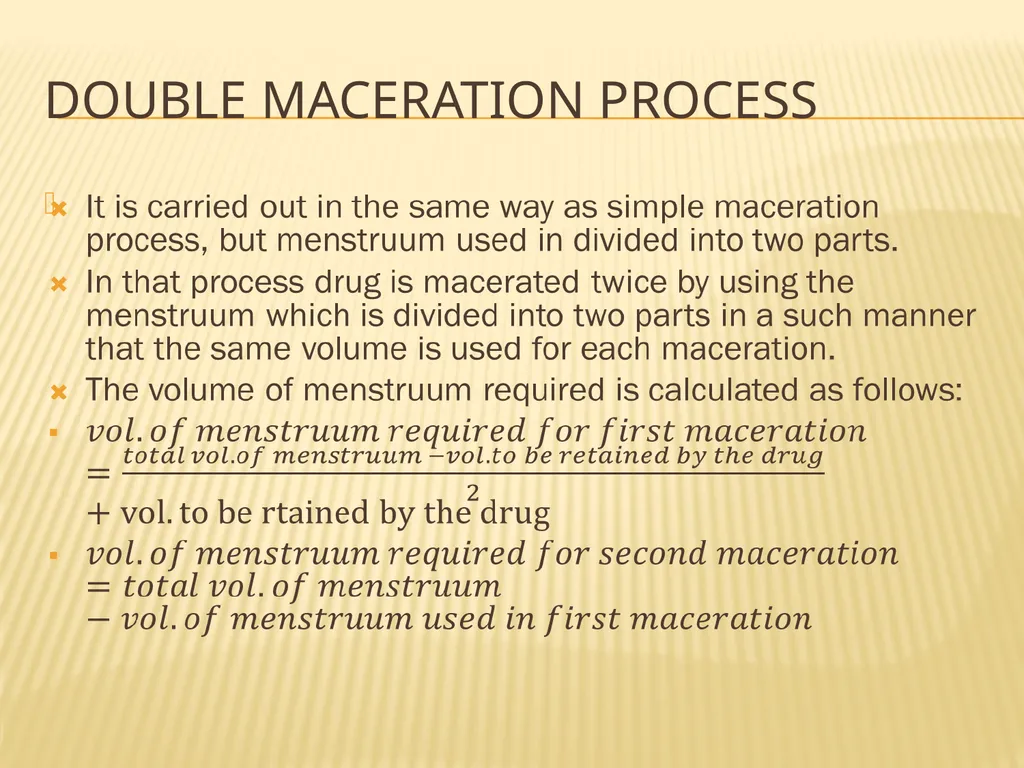
slide19. Double maceration process<br>
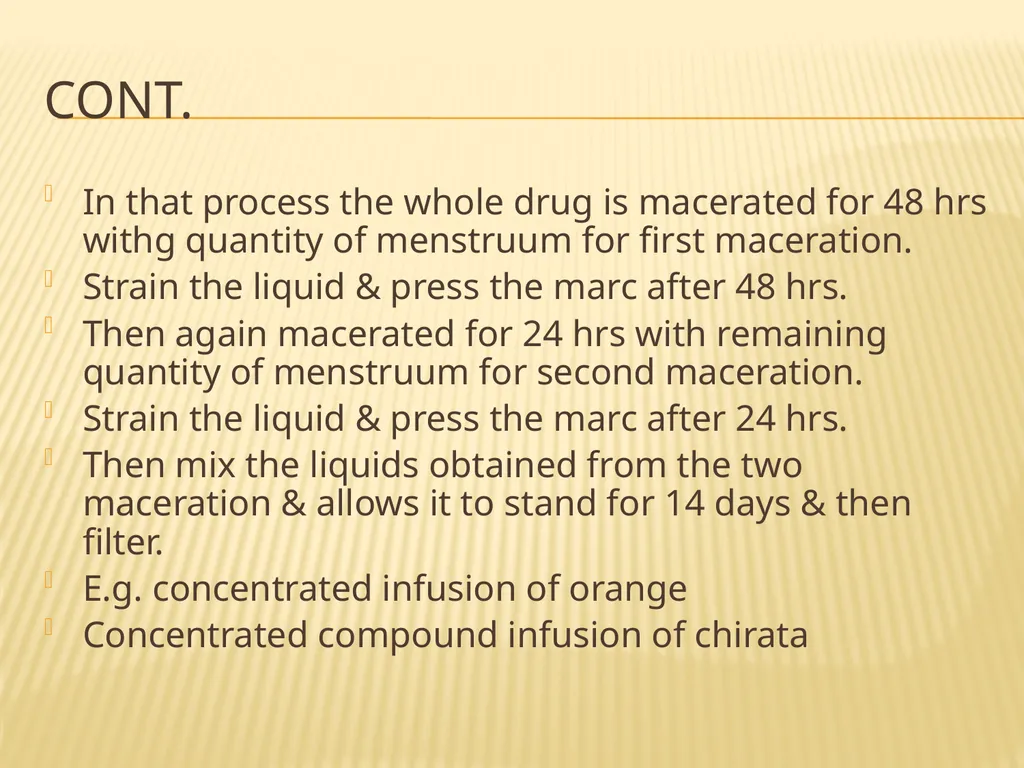
slide20. Cont. In that process the whole drug is macerated for 48 hrs withg quantity of menstruum for first maceration.
Strain the liquid & press the marc after 48 hrs.
Then again macerated for 24 hrs with remaining quantity of menstruum for second maceration.
Strain the liquid & press the marc after 24 hrs.
Then mix the liquids obtained from the two maceration & allows it to stand for 14 days & then filter.
E.g. concentrated infusion of orange
Concentrated compound infusion of chirata<br>
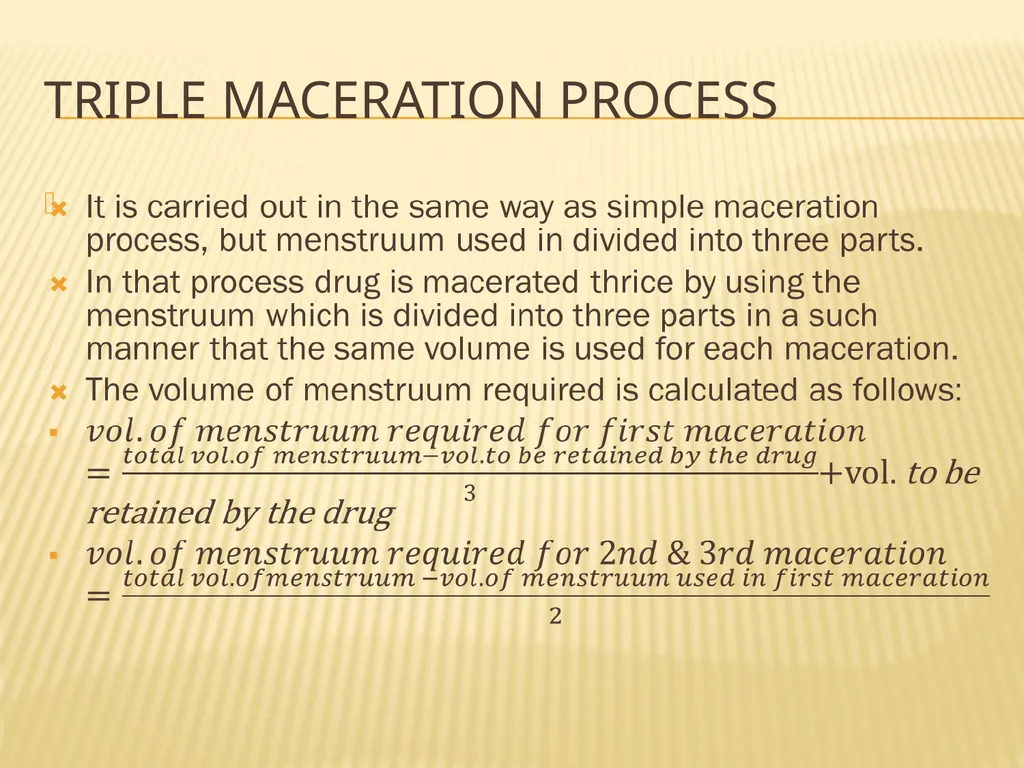
slide21. Triple maceration process<br>
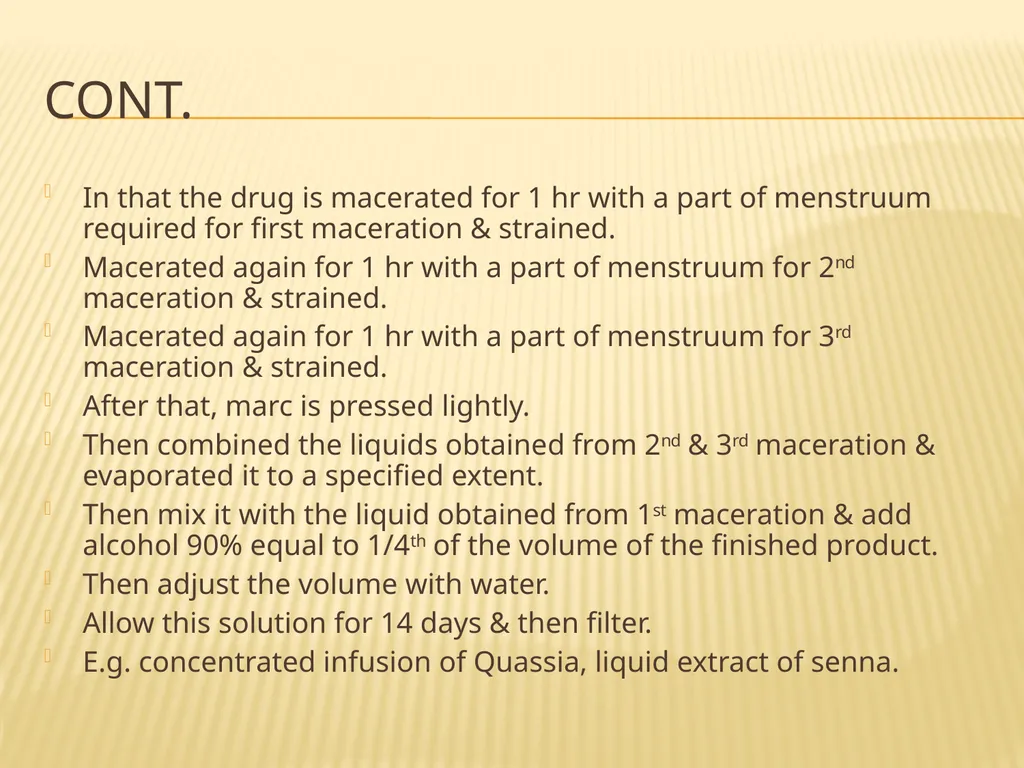
slide22. Cont. In that the drug is macerated for 1 hr with a part of menstruum required for first maceration & strained.
Macerated again for 1 hr with a part of menstruum for 2nd maceration & strained.
Macerated again for 1 hr with a part of menstruum for 3rd maceration & strained.
After that, marc is pressed lightly.
Then combined the liquids obtained from 2nd & 3rd maceration & evaporated it to a specified extent.
Then mix it with the liquid obtained from 1st maceration & add alcohol 90% equal to 1/4th of the volume of the finished product.
Then adjust the volume with water.
Allow this solution for 14 days & then filter.
E.g. concentrated infusion of Quassia, liquid extract of senna.<br>
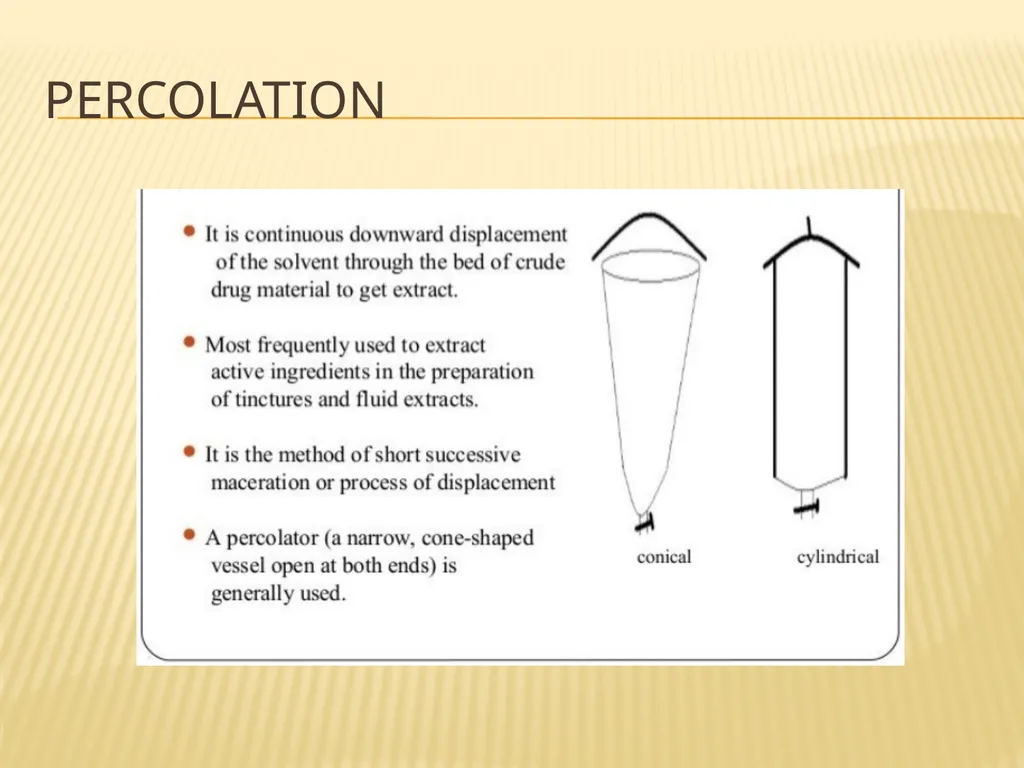
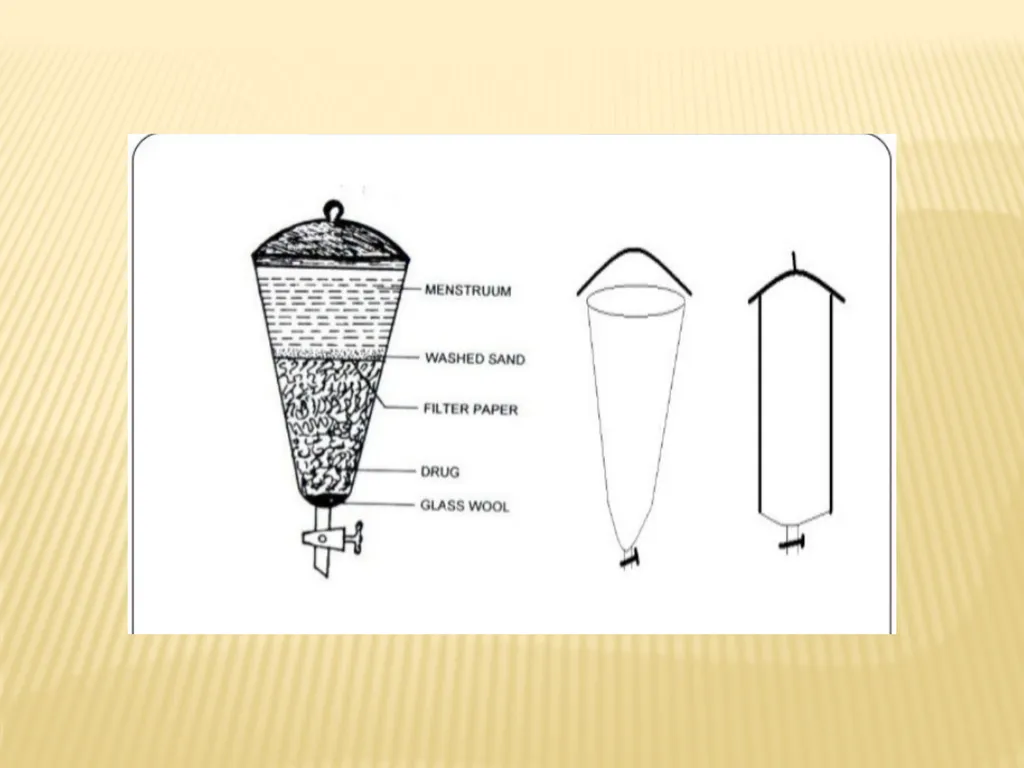
slide23. percolation<br>
Swarnakshi Upadhyay
Assistant Professor
School of Pharmaceutical Sciences
CSJM University<br>
slide2. INTRODUCTION Extraction is defined as the removal of soluble constituents from solid or liquid with the help of suitable solvent.
The solvent used for extraction is known as menstruum.
Menstruum is capable of penetrating, the plant or animal tissues and dissolving the active medicaments present in them.<br>
slide3. INTRODUCTION (Cont.) The solid residue which is exhausted of active constituents remains behind after extraction is known as marc.
In general, extraction consists of soaking the powdered material in a menstruum. The menstruum diffuses into the powdered material and dissolves the ingredients, which then diffuse out into the liquid.<br>
slide4. Classification of extraction process Classification of extraction process based on types of phases:
Liquid- Liquid Extraction
Solid Phase Extraction
Solid-Liquid Extraction (Leaching)<br>
slide5. Liquid-liquid extraction Also known as solvent extraction and partitioning.
Used a liquid solvent to remove a component from a liquid mixture.
Solvent used for extraction is immiscible or only partially miscible with the other solvent in the liquid mixture.
Application of this process include separation of vitamins from aqueous solutions and aromatic compounds from crude oil fractions.<br>
slide6. Solid phase extraction Widely used in analytical laboratories.
One or more analytes from a liquid sample are separated by extracted partitioning, and/or adsorbing onto a solid stationary phase.<br>
slide7. Solid-liquid extraction (leaching) The extraction of a soluble component from a solid by using a solvent is commonly known as leaching.
Application of solid-liquid extraction include:
Obtaining oil from oil seeds
Making of coffee
Making of hot tea<br>
slide8. Methods of extraction Infusion
Decoction
Digestion
Maceration
Percolation
Hot continuous extraction
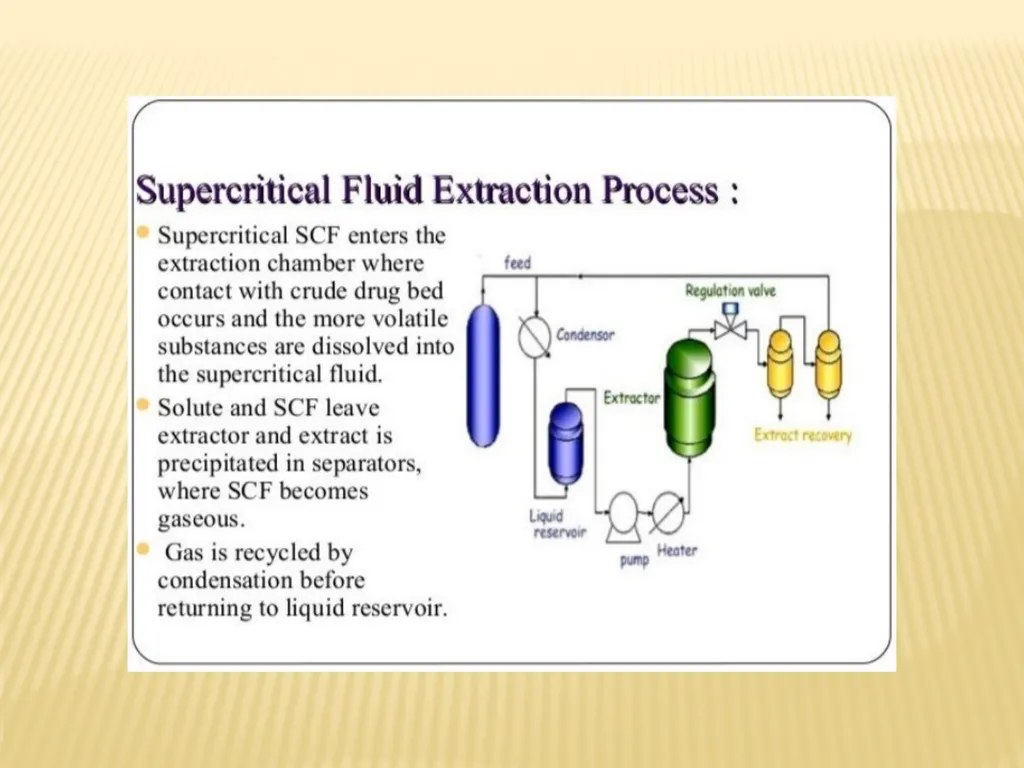
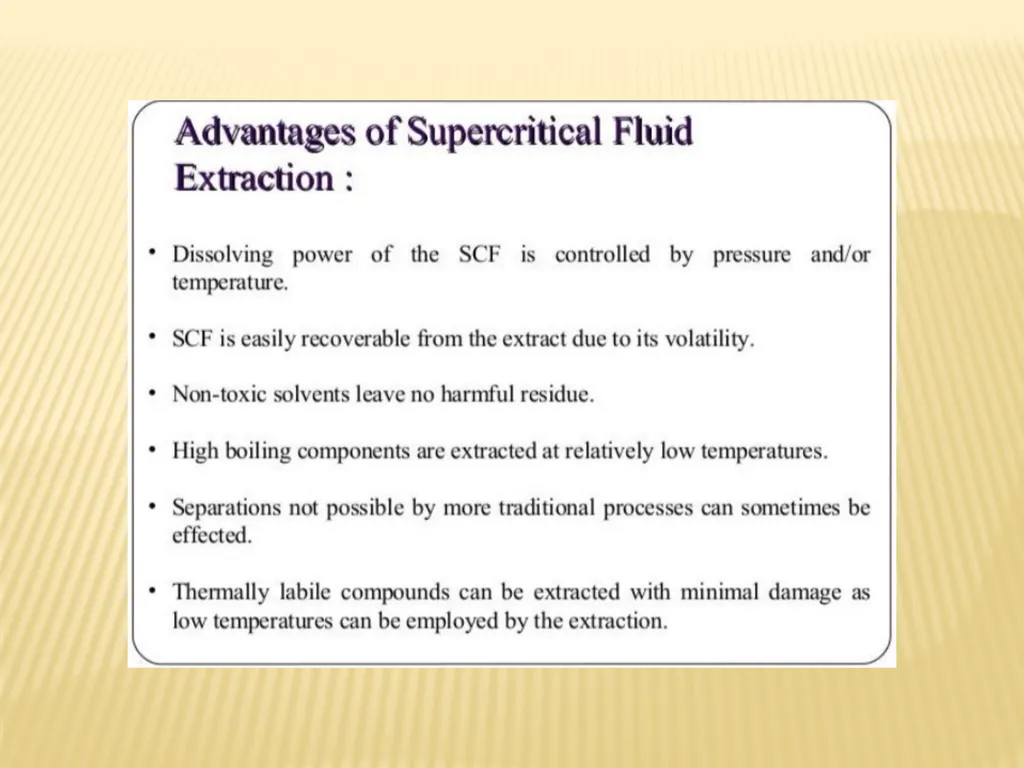
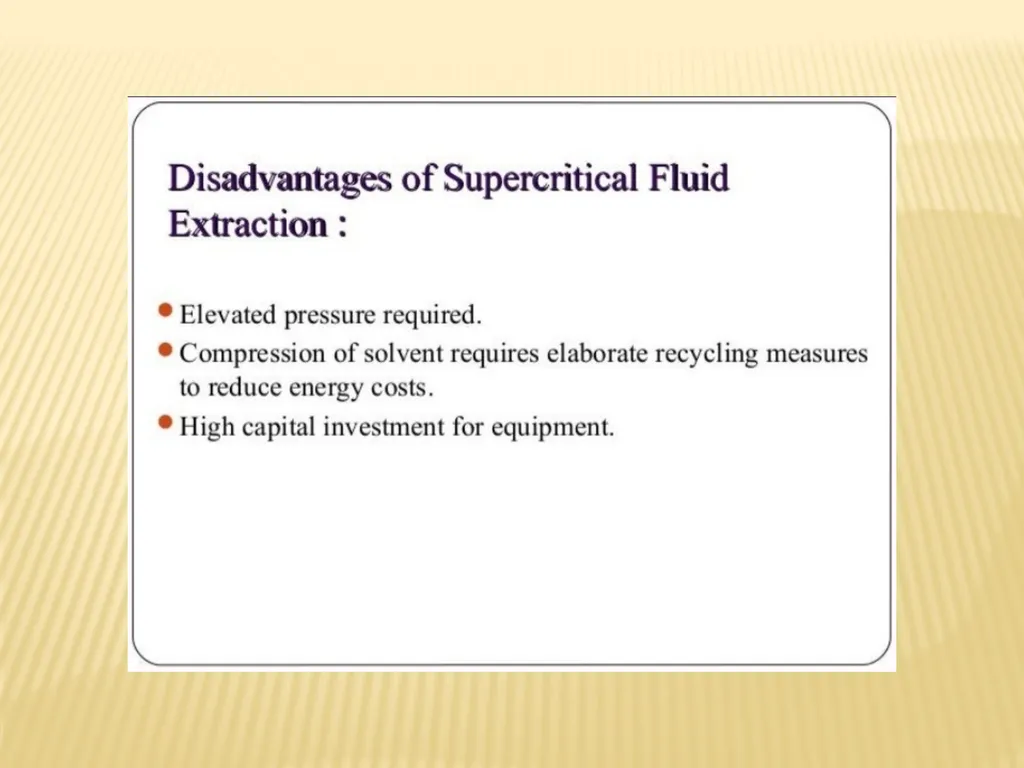
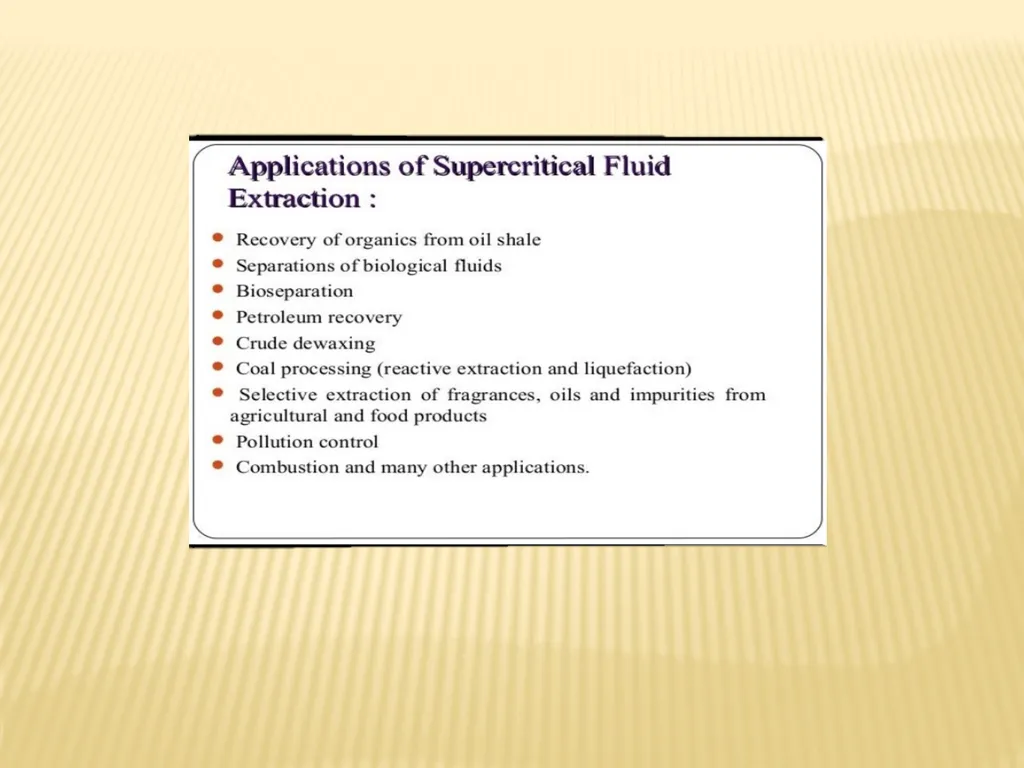
Supercritical fluid extraction
Microwave assisted extraction
ultrasonication<br>
slide9. infusion It consists of pouring water over the drugs and then allowing it to keep in contact with water for the stated period, usually 15 minutes, with occasional stirring and finally filtering off the liquid.
The marc is not pressed.
The boiling water is commonly used as a solvent, since it has a greater solvent action than cold water.<br>
slide10. For the preparation of infusions special pots are used which is known as infusion pots.
In that, firstly drug is placed in bottom of the pot.
Then add hot water & stirred three or four times during the period of infusion.
Infusion also prepared in muslin cloth. In that drug is placed in muslin cloth & enclose & then suspending it just below the level of the water in a beaker.
For that process stirring is not required.<br>
slide11. Types of infusion Fresh Infusion:
aqueous liquid used as a menstruum.
It is prepared by
Coarse drug + Hot water then filtrate after sometimes.
As per pharmacopoeia it is used within 12 hrs after formulation.
E.g. fresh infusion of Quassia.<br>
slide12. Cont. 2. Concentrated Infusion
It is 8 times stronger than fresh infusion.
In that 20-25% alcohol conc. Used as a menstruum.
It can be stored for a longer time period.
E.g. concentrated infusion of Quassia.<br>
slide13. Decoction In this process, the drug is boiled with water for a stated period usually 10 minutes.
After boiling, the liquid is strained and water is passed through the content of the strainer to make the required volume.
This process is mainly used for vegetable drugs of hard and woody nature having thermostable water soluble constituents.<br>
slide14. digestion In digestion process, the drug is extracted by heating at a particular pressure.
This will increase the penetration power of the menstruum, so that there is complete extraction of the drug.
Precaution should be taken so that the increased temperature may not harm the active constituents of the drug.<br>
slide15. Cont. The apparatus known as “DIGESTOR” is used for extraction of the drug by this method.
It is a vessel made up ofmetal. The whole of the drug along with the menstruum is placed in the body of the digestor.
Place the cover over it and bolt it with the help of nuts.
The drug is treated with menstruum for a definite period under specified conditions of temperature and pressure.<br>
slide16. maceration In this process solid ingredients are placed in a stoppered container with the whole of the solvent and allowed to stand for a period of at leas 3 days or 3-7 days with frequent agitation, until soluble matter is dissolved.
The mixture is then strained (through sieves/nets), the marc pressed and the combined liquids clarified (cleaned by filtration).<br>
slide17. Types of maceration Simple Maceration: for organized drugs. E.g. roots, stems, leaves etc.
alcohol is used as a menstruum.
At this period shaking is done occasionally.
After seven days, the liquid is strained & marc is pressed.
The expressed liquid is mixed with strained liquid.
Then again filter for obtaining the clear liquid.
The final volume is not adjusted.<br>
slide18. Modified maceration 0r maceration with adjustment It is for unorganized drugs. E.g. gums, resins, gum-resins, oleo gum-resins.
In this process, the unorganized drugs is placed with 4/5th volume of the menstruum in a closed vessel for 7 days.
At this period shaking is done occasionally.
After that stated period, the liquid is filtered & not necessary to press the marc.
After that, the final volume is adjusted with the remaining quantity of 1/5th volume of menstruum through the filter.<br>
slide19. Double maceration process<br>
slide20. Cont. In that process the whole drug is macerated for 48 hrs withg quantity of menstruum for first maceration.
Strain the liquid & press the marc after 48 hrs.
Then again macerated for 24 hrs with remaining quantity of menstruum for second maceration.
Strain the liquid & press the marc after 24 hrs.
Then mix the liquids obtained from the two maceration & allows it to stand for 14 days & then filter.
E.g. concentrated infusion of orange
Concentrated compound infusion of chirata<br>
slide21. Triple maceration process<br>
slide22. Cont. In that the drug is macerated for 1 hr with a part of menstruum required for first maceration & strained.
Macerated again for 1 hr with a part of menstruum for 2nd maceration & strained.
Macerated again for 1 hr with a part of menstruum for 3rd maceration & strained.
After that, marc is pressed lightly.
Then combined the liquids obtained from 2nd & 3rd maceration & evaporated it to a specified extent.
Then mix it with the liquid obtained from 1st maceration & add alcohol 90% equal to 1/4th of the volume of the finished product.
Then adjust the volume with water.
Allow this solution for 14 days & then filter.
E.g. concentrated infusion of Quassia, liquid extract of senna.<br>
slide23. percolation<br>