
Factory Vs Industry Is there any difference
FD
Published · 72 slides · 0 views
1 / 1









Description
Factory Vs Industry Is there any difference between factory and industry? Though factory and industry are intertwined, but there is a significant difference between the two. Factory- is a manufacturing plant. Actual location where the
Related Topics
Share
Embed code
Download this presentation From Below
"Factory Vs Industry Is there any difference" is the property of its rightful owner. Permission is granted to download and print the materials on this website for personal, non-commercial use only, and to display it on your personal computer provided you do not modify the materials and that you retain all copyright notices contained in the materials. By downloading content from our website, you accept the terms of this agreement.
Presentation Transcript
01
Factory Vs Industry Is there any difference between factory and industry?
Though factory and industry are intertwined, but there is a significant difference between the two.
Factory- is a manufacturing plant. Actual location where the materials or products are produced.
Ex. Maruti Suzuki, HM, Ford.
Industry- refers to production of material or service,
it also refers to group of companies that produce same materials, products or service.
EX. Garment Industry, Automobile Industry, IT industry<br>
Though factory and industry are intertwined, but there is a significant difference between the two.
Factory- is a manufacturing plant. Actual location where the materials or products are produced.
Ex. Maruti Suzuki, HM, Ford.
Industry- refers to production of material or service,
it also refers to group of companies that produce same materials, products or service.
EX. Garment Industry, Automobile Industry, IT industry<br>
02
Factory means…. any premises in which 10 or more workers are employed and a manufacturing process is carried with the aid of power.
any premises in which 20 or more workers are employed and a manufacturing process is carried without the aid of power.<br>
any premises in which 20 or more workers are employed and a manufacturing process is carried without the aid of power.<br>
03
The factories Act, 1948 Introduction
The first factories act was passed in 1881. Its comprehensive version was introduced in 1911. It was later amended several times.
following the recommendations of Rege Committee, the Government of India enacted the Factories Act, 1948, a comprehensive piece of legislation which came into force from 1 April, 1949.<br>
The first factories act was passed in 1881. Its comprehensive version was introduced in 1911. It was later amended several times.
following the recommendations of Rege Committee, the Government of India enacted the Factories Act, 1948, a comprehensive piece of legislation which came into force from 1 April, 1949.<br>
04
Objective of this Act The main objective of the act is to ensure adequate safety measures and to promote the health and welfare of the workers employed in factories.
The provisions of the Act gives an outline of obligations of a worker, obligations of an occupier and administration of the Act.<br>
The provisions of the Act gives an outline of obligations of a worker, obligations of an occupier and administration of the Act.<br>
05
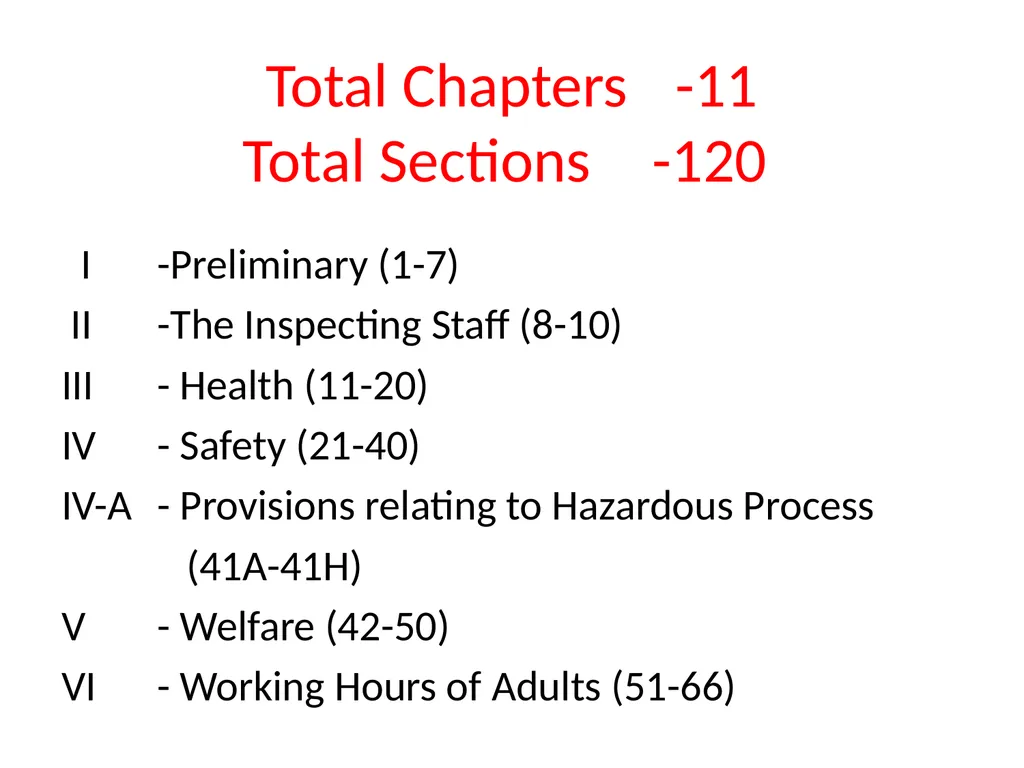
Total Chapters -11
Total Sections -120 I -Preliminary (1-7)
II -The Inspecting Staff (8-10)
III - Health (11-20)
IV - Safety (21-40)
IV-A - Provisions relating to Hazardous Process
(41A-41H)
V - Welfare (42-50)
VI - Working Hours of Adults (51-66)<br>
II -The Inspecting Staff (8-10)
III - Health (11-20)
IV - Safety (21-40)
IV-A - Provisions relating to Hazardous Process
(41A-41H)
V - Welfare (42-50)
VI - Working Hours of Adults (51-66)<br>
06
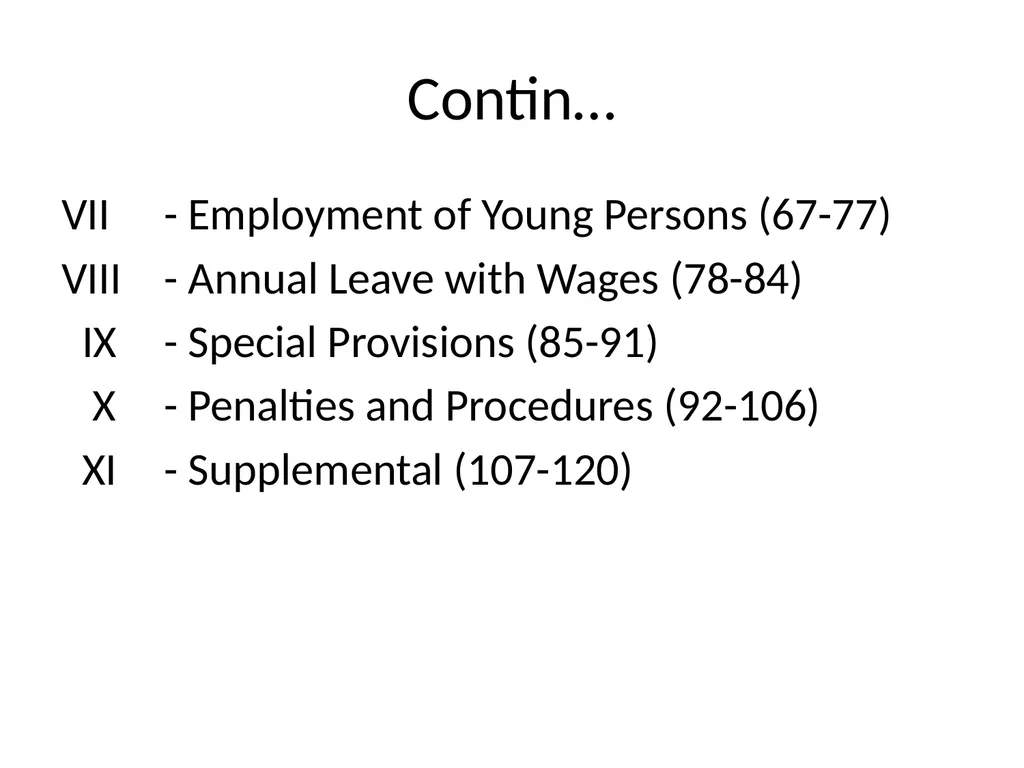
Contin… VII - Employment of Young Persons (67-77)
VIII - Annual Leave with Wages (78-84)
IX - Special Provisions (85-91)
X - Penalties and Procedures (92-106)
XI - Supplemental (107-120)<br>
VIII - Annual Leave with Wages (78-84)
IX - Special Provisions (85-91)
X - Penalties and Procedures (92-106)
XI - Supplemental (107-120)<br>
07
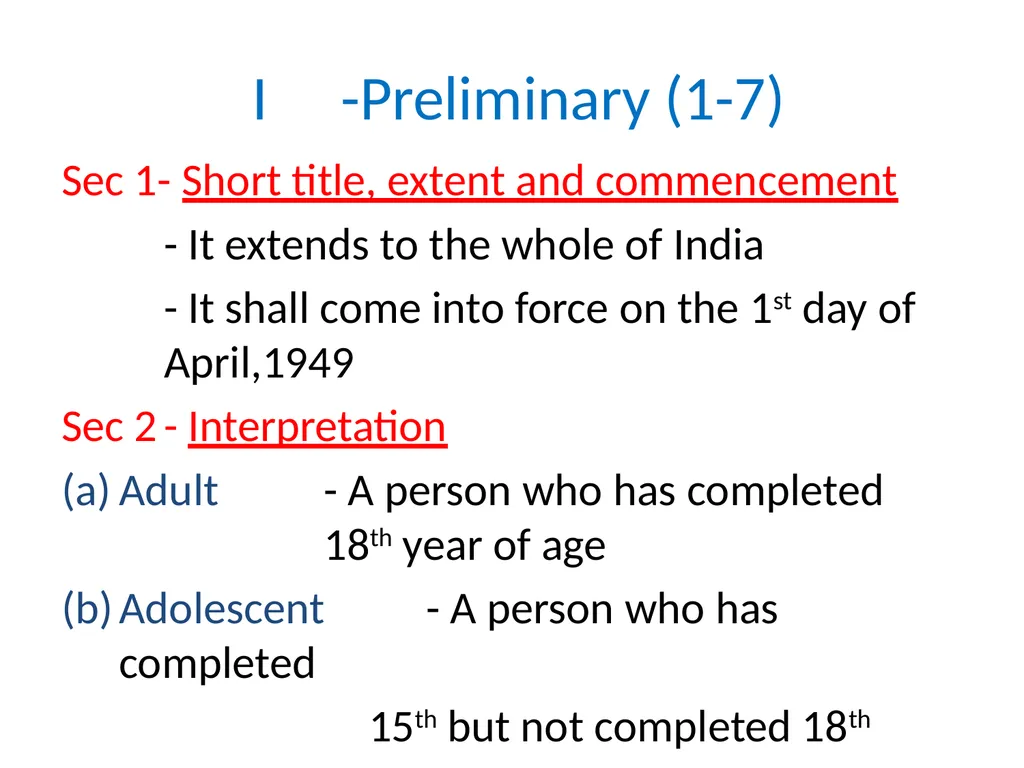
I -Preliminary (1-7) Sec 1- Short title, extent and commencement
- It extends to the whole of India
- It shall come into force on the 1st day of April,1949
Sec 2 - Interpretation
Adult - A person who has completed 18th year of age
Adolescent - A person who has completed
15th but not completed 18th<br>
- It extends to the whole of India
- It shall come into force on the 1st day of April,1949
Sec 2 - Interpretation
Adult - A person who has completed 18th year of age
Adolescent - A person who has completed
15th but not completed 18th<br>
08
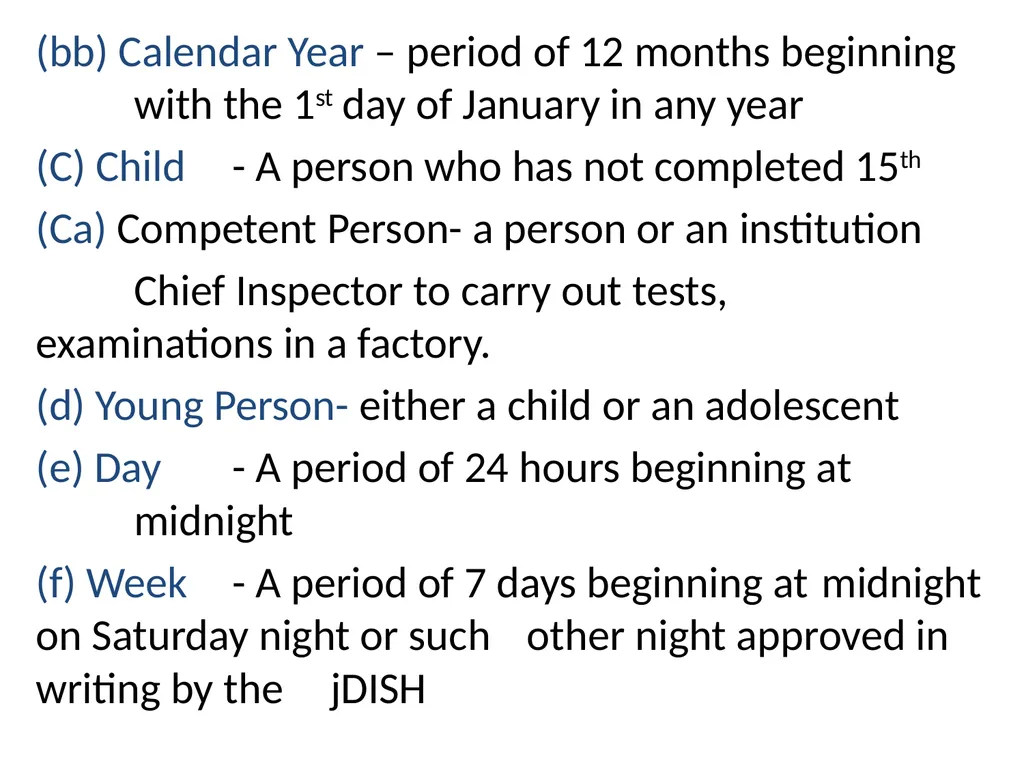
(bb) Calendar Year – period of 12 months beginning with the 1st day of January in any year
(C) Child - A person who has not completed 15th
(Ca) Competent Person- a person or an institution
Chief Inspector to carry out tests, examinations in a factory.
(d) Young Person- either a child or an adolescent
(e) Day - A period of 24 hours beginning at midnight
(f) Week - A period of 7 days beginning at midnight on Saturday night or such other night approved in writing by the jDISH<br>
(C) Child - A person who has not completed 15th
(Ca) Competent Person- a person or an institution
Chief Inspector to carry out tests, examinations in a factory.
(d) Young Person- either a child or an adolescent
(e) Day - A period of 24 hours beginning at midnight
(f) Week - A period of 7 days beginning at midnight on Saturday night or such other night approved in writing by the jDISH<br>
09
(g) Power – electrical energy or any other form of energy which is mechanically transmitted and is not generated by human or animal agency.
(h) Prime mover – any engine, motor or other appliances which generates power.
(i) Transmission machinery – means any shaft, wheel, drum, pulley, system of pulleys, coupling, clutch, driving belt or other appliance or device by which the motion of a prime mover is transmitted
(j) Machinery – includes prime movers, transmission machinery and all other appliances whereby power is generated, transformed and transmitted or applied<br>
(h) Prime mover – any engine, motor or other appliances which generates power.
(i) Transmission machinery – means any shaft, wheel, drum, pulley, system of pulleys, coupling, clutch, driving belt or other appliance or device by which the motion of a prime mover is transmitted
(j) Machinery – includes prime movers, transmission machinery and all other appliances whereby power is generated, transformed and transmitted or applied<br>
10
(k) Manufacturing process – any process
-making, altering, repairing, ornamenting, finishing, packing, oiling, washing, cleaning, breaking up, demolishing, or otherwise treating any article or substance with a view to its use, sale, transport, delivery or disposal;
-pumping oil, water, sewage or any other substance;
-generating, transforming or transmitting power;
-composing types for printing, printing by letter press, lithography, photogravure and book binding;<br>
-making, altering, repairing, ornamenting, finishing, packing, oiling, washing, cleaning, breaking up, demolishing, or otherwise treating any article or substance with a view to its use, sale, transport, delivery or disposal;
-pumping oil, water, sewage or any other substance;
-generating, transforming or transmitting power;
-composing types for printing, printing by letter press, lithography, photogravure and book binding;<br>
11
-constructing, reconstructing, repairing, refitting, finishing or breaking up ships or vessels;
-preserving or storing any article in cold storage.
(l) Worker – a person employed (directly or by through any agency including a contractor), with or without the knowledge of principal employer, whether for remuneration or not in any manufacturing process or in cleaning any part of the machinery or premises used for manufacturing process, or in any kind of work connected with manufacturing process.<br>
-preserving or storing any article in cold storage.
(l) Worker – a person employed (directly or by through any agency including a contractor), with or without the knowledge of principal employer, whether for remuneration or not in any manufacturing process or in cleaning any part of the machinery or premises used for manufacturing process, or in any kind of work connected with manufacturing process.<br>
12
(m) Factory –
any premises in which 10 or more workers are employed and a manufacturing process is carried with the aid of power.
any premises in which 20 or more workers are employed and a manufacturing process is carried without the aid of power.
but it does not include mines, a mobile unit, belonging to the armed forces of the Union, a railway running shed or a hotel, restaurant or eating place<br>
any premises in which 10 or more workers are employed and a manufacturing process is carried with the aid of power.
any premises in which 20 or more workers are employed and a manufacturing process is carried without the aid of power.
but it does not include mines, a mobile unit, belonging to the armed forces of the Union, a railway running shed or a hotel, restaurant or eating place<br>
13
(n) Occupier-
the person who has ultimate control over the affairs of the factory
the partner, in the case of a firm or any association
any director, in the case of a company
a person appointed to manage the affairs of a factory in case of the factory owned/ controlled by Central or State Govt.<br>
the person who has ultimate control over the affairs of the factory
the partner, in the case of a firm or any association
any director, in the case of a company
a person appointed to manage the affairs of a factory in case of the factory owned/ controlled by Central or State Govt.<br>
14
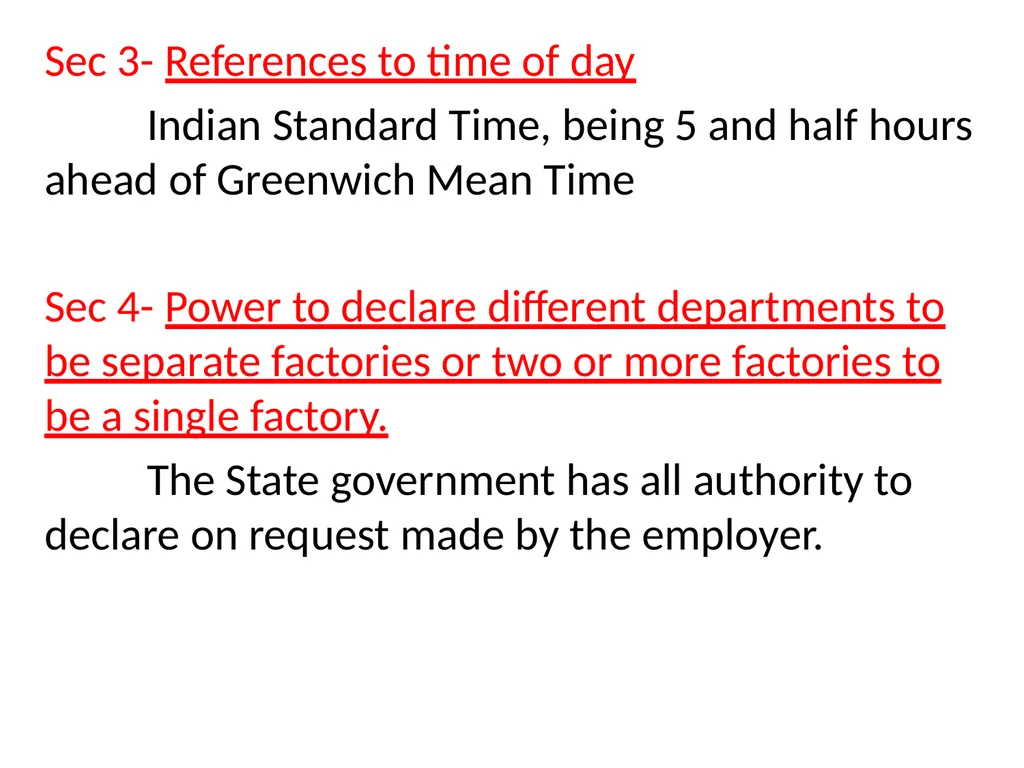
Sec 3- References to time of day
Indian Standard Time, being 5 and half hours ahead of Greenwich Mean Time
Sec 4- Power to declare different departments to be separate factories or two or more factories to be a single factory.
The State government has all authority to declare on request made by the employer.<br>
Indian Standard Time, being 5 and half hours ahead of Greenwich Mean Time
Sec 4- Power to declare different departments to be separate factories or two or more factories to be a single factory.
The State government has all authority to declare on request made by the employer.<br>
15
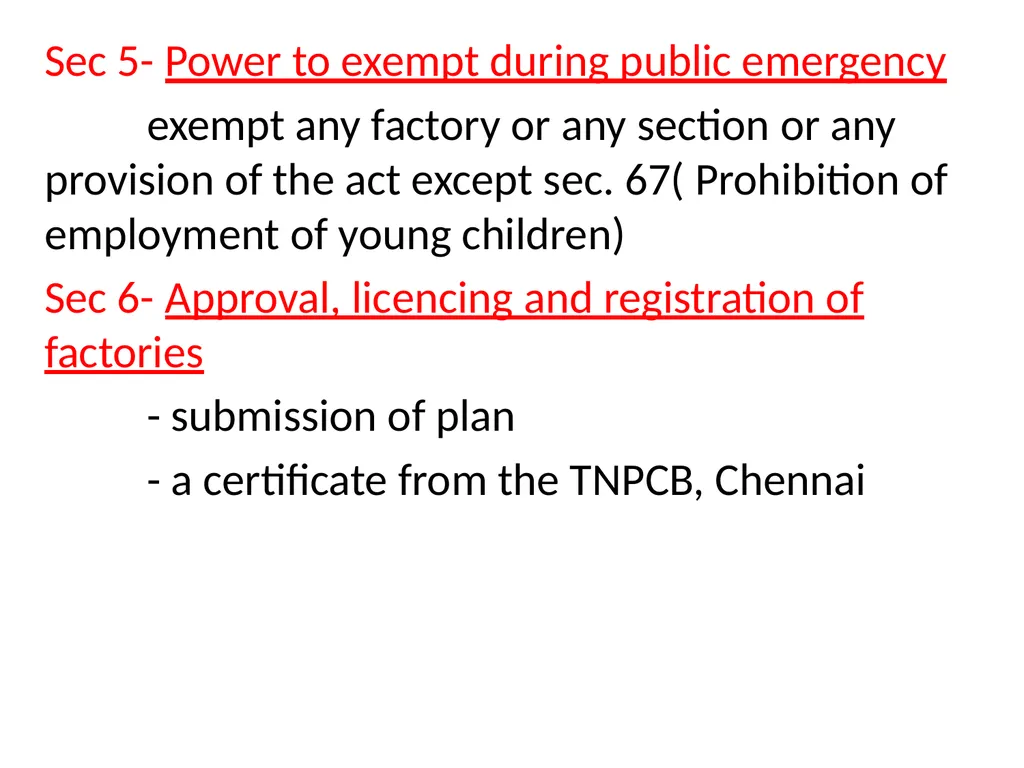
Sec 5- Power to exempt during public emergency
exempt any factory or any section or any provision of the act except sec. 67( Prohibition of employment of young children)
Sec 6- Approval, licencing and registration of factories
- submission of plan
- a certificate from the TNPCB, Chennai<br>
exempt any factory or any section or any provision of the act except sec. 67( Prohibition of employment of young children)
Sec 6- Approval, licencing and registration of factories
- submission of plan
- a certificate from the TNPCB, Chennai<br>
16
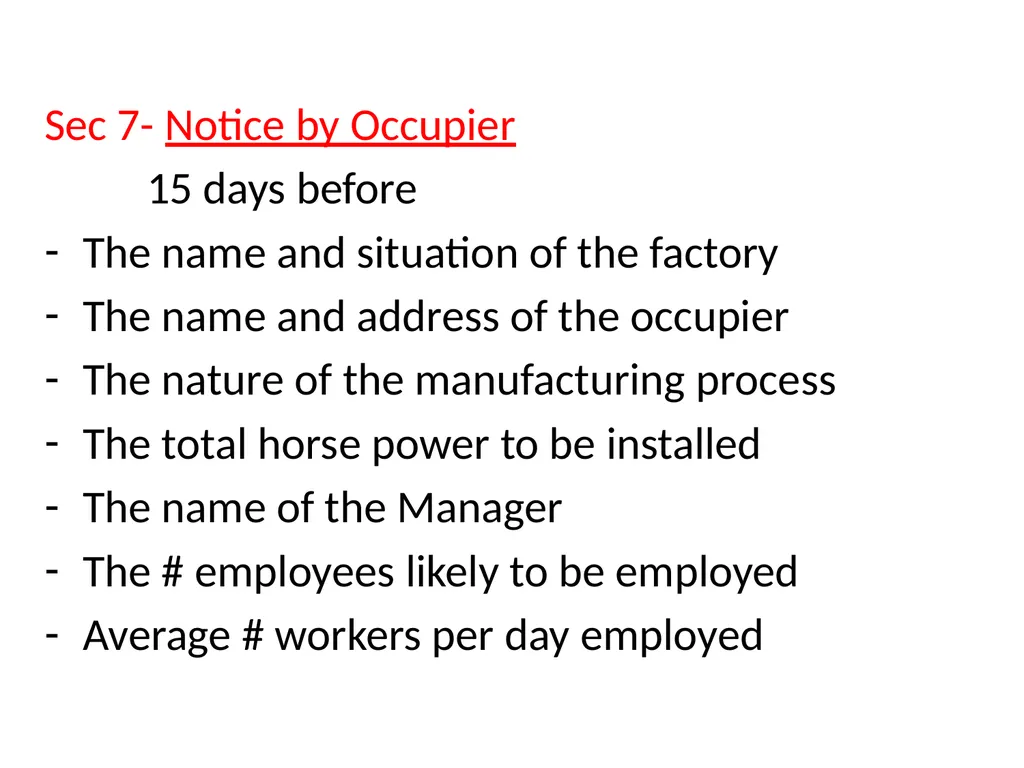
Sec 7- Notice by Occupier
15 days before
The name and situation of the factory
The name and address of the occupier
The nature of the manufacturing process
The total horse power to be installed
The name of the Manager
The # employees likely to be employed
Average # workers per day employed<br>
15 days before
The name and situation of the factory
The name and address of the occupier
The nature of the manufacturing process
The total horse power to be installed
The name of the Manager
The # employees likely to be employed
Average # workers per day employed<br>
17
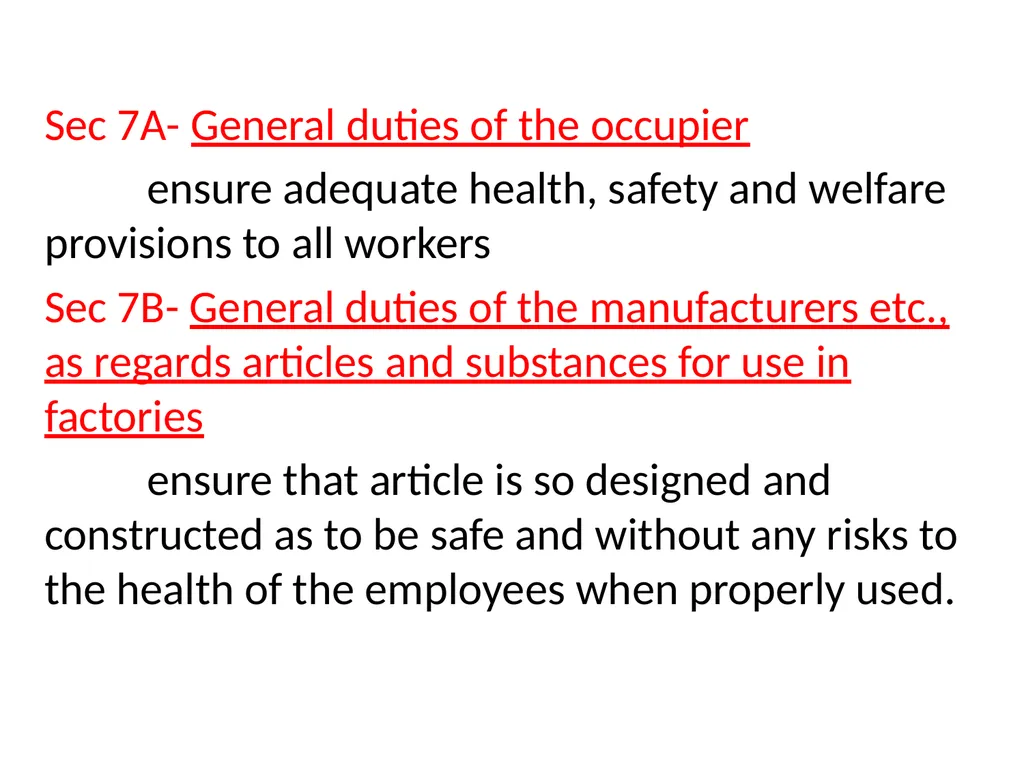
Sec 7A- General duties of the occupier
ensure adequate health, safety and welfare provisions to all workers
Sec 7B- General duties of the manufacturers etc., as regards articles and substances for use in factories
ensure that article is so designed and constructed as to be safe and without any risks to the health of the employees when properly used.<br>
ensure adequate health, safety and welfare provisions to all workers
Sec 7B- General duties of the manufacturers etc., as regards articles and substances for use in factories
ensure that article is so designed and constructed as to be safe and without any risks to the health of the employees when properly used.<br>
18
II -The Inspecting Staff (8-10) Sec- 8
Joint director of industrial safety and health
any person appointed by the state every district magistrate shall be an Inspector for his district.
Sec - 9
Joint director of industrial safety and health has all the authority to enter, the factory to examine the premises, plant, machinery, as well as look upon registers & documents maintained under the Act.
Sec – 10
Certifying Surgeons (qualified medical practitioner) to examine young persons<br>
Joint director of industrial safety and health
any person appointed by the state every district magistrate shall be an Inspector for his district.
Sec - 9
Joint director of industrial safety and health has all the authority to enter, the factory to examine the premises, plant, machinery, as well as look upon registers & documents maintained under the Act.
Sec – 10
Certifying Surgeons (qualified medical practitioner) to examine young persons<br>
19
III - Health (11-20) 11- Cleanliness
12- Disposal of wastes and effluents
13- Ventilation and temperature
14- Dust and fume
15- Artificial humidification
16- Overcrowding
17- Lighting
18- Drinking Water
19- Latrines and urinals
20- Spittoons<br>
12- Disposal of wastes and effluents
13- Ventilation and temperature
14- Dust and fume
15- Artificial humidification
16- Overcrowding
17- Lighting
18- Drinking Water
19- Latrines and urinals
20- Spittoons<br>
20
III - Health (11-20) Sec-11 Cleanliness
Every factory shall be kept clean and free from effluvia.
Daily sweeping (floors, benches of workrooms, staircases, passages)
Cleaning/washing once in a week (Floor of every workroom)
Wet floor shall be maintained well
Paints/varnishes – cleaned once in 14 months
White washing/colour washing – once in 14 months
If washable water paint- 1 coating once in 3 years and washed once in 6 months
Varnished/repainted once in 5 years (walls, partitions, all ceilings, tops of rooms, side walls)
Painted/varnished once in 5 years(all doors, window frames, wooden/metallic frames, shutters)<br>
Every factory shall be kept clean and free from effluvia.
Daily sweeping (floors, benches of workrooms, staircases, passages)
Cleaning/washing once in a week (Floor of every workroom)
Wet floor shall be maintained well
Paints/varnishes – cleaned once in 14 months
White washing/colour washing – once in 14 months
If washable water paint- 1 coating once in 3 years and washed once in 6 months
Varnished/repainted once in 5 years (walls, partitions, all ceilings, tops of rooms, side walls)
Painted/varnished once in 5 years(all doors, window frames, wooden/metallic frames, shutters)<br>
21
Sec-12 Disposal of wastes and effluents
Effective arrangements shall be made in every factory for the treatment of wastes and effluents due to manufacturing process<br>
Effective arrangements shall be made in every factory for the treatment of wastes and effluents due to manufacturing process<br>
22
Sec-13 Ventilation and Temperature
Effective and suitable provision shall be made in every factory for securing and maintaining in every workroom
Adequate ventilation by the circulation of fresh air
reasonable conditions of comfort to bear the temperature
Walls and roofs of good materials not to exceed the temperature
If work nature is excessive in temperature adequate measures are to be practicable by insulating the hot parts and other effective means<br>
Effective and suitable provision shall be made in every factory for securing and maintaining in every workroom
Adequate ventilation by the circulation of fresh air
reasonable conditions of comfort to bear the temperature
Walls and roofs of good materials not to exceed the temperature
If work nature is excessive in temperature adequate measures are to be practicable by insulating the hot parts and other effective means<br>
23
Sec-14 Dust and Fume
Dust and fume are always so injurious to health.
It is also an offensive
Sec-15 Artificial Humidification
Humidity of air is artificially increased
Adequate ventilation shall be installed
Cooling of the air shall ne made in work rooms<br>
Dust and fume are always so injurious to health.
It is also an offensive
Sec-15 Artificial Humidification
Humidity of air is artificially increased
Adequate ventilation shall be installed
Cooling of the air shall ne made in work rooms<br>
24
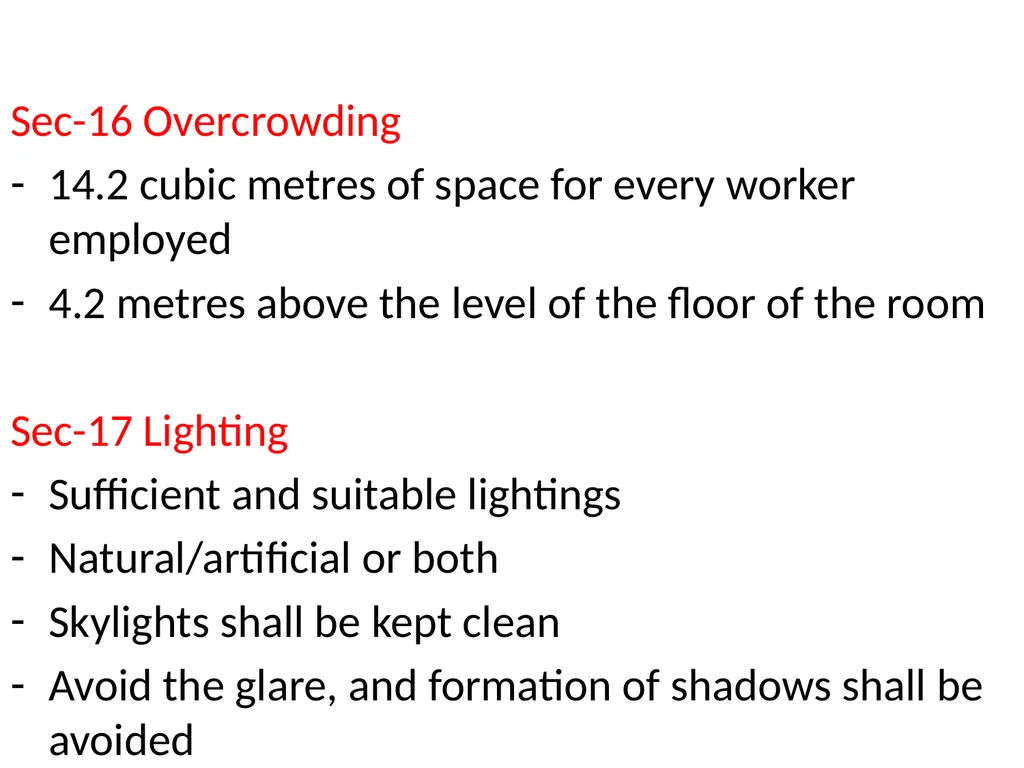
Sec-16 Overcrowding
14.2 cubic metres of space for every worker employed
4.2 metres above the level of the floor of the room
Sec-17 Lighting
Sufficient and suitable lightings
Natural/artificial or both
Skylights shall be kept clean
Avoid the glare, and formation of shadows shall be avoided<br>
14.2 cubic metres of space for every worker employed
4.2 metres above the level of the floor of the room
Sec-17 Lighting
Sufficient and suitable lightings
Natural/artificial or both
Skylights shall be kept clean
Avoid the glare, and formation of shadows shall be avoided<br>
25
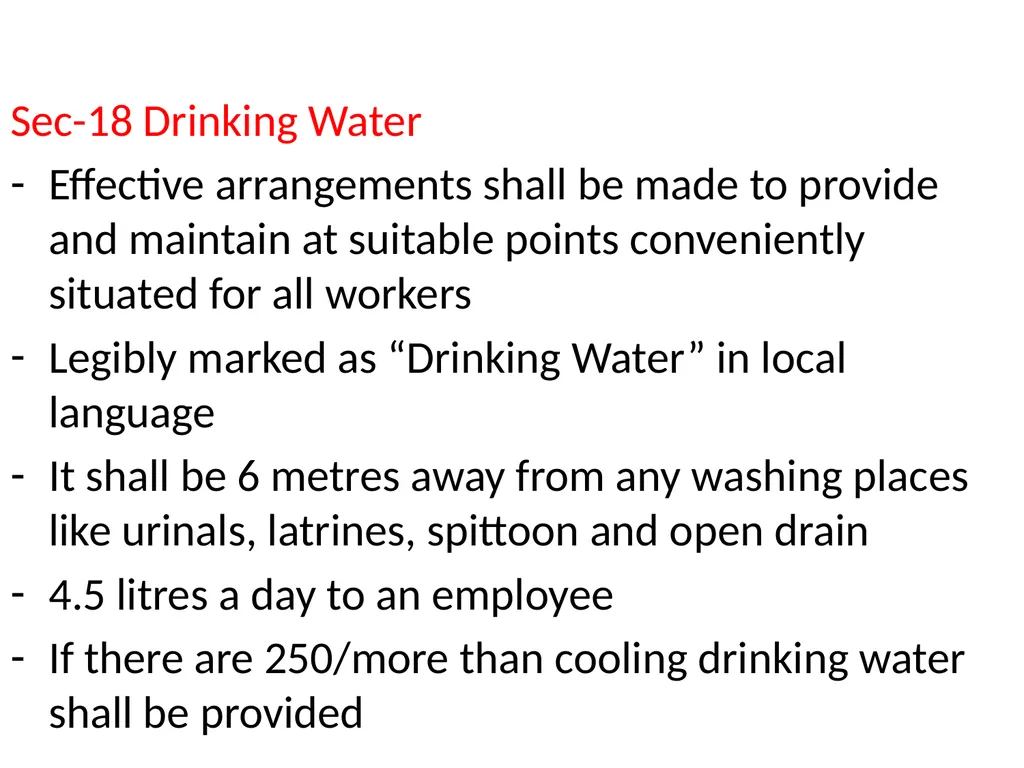
Sec-18 Drinking Water
Effective arrangements shall be made to provide and maintain at suitable points conveniently situated for all workers
Legibly marked as “Drinking Water” in local language
It shall be 6 metres away from any washing places like urinals, latrines, spittoon and open drain
4.5 litres a day to an employee
If there are 250/more than cooling drinking water shall be provided<br>
Effective arrangements shall be made to provide and maintain at suitable points conveniently situated for all workers
Legibly marked as “Drinking Water” in local language
It shall be 6 metres away from any washing places like urinals, latrines, spittoon and open drain
4.5 litres a day to an employee
If there are 250/more than cooling drinking water shall be provided<br>
26
Sec-19 Latrines and Urinals
Sufficient latrine & Urinal accommodation conveniently situated
Separate enclosed accommodation shall be provided for male and female workers
Such accommodation adequately lighted/ventilated
Kept clean all the time
Separate sweepers shall be employed
If there are 250/more workers, side walls shall be 90 cmts with sanitary blocks and glazed tiles
Latrine – 1 for every 20 women, 1 for every 20 men
(if above 100 workers 1 for 50 males/females)
Urinals – 1 for 50 (61 cmts Length),
(if above 500 workers 1 for 100)
- Separately for women workers<br>
Sufficient latrine & Urinal accommodation conveniently situated
Separate enclosed accommodation shall be provided for male and female workers
Such accommodation adequately lighted/ventilated
Kept clean all the time
Separate sweepers shall be employed
If there are 250/more workers, side walls shall be 90 cmts with sanitary blocks and glazed tiles
Latrine – 1 for every 20 women, 1 for every 20 men
(if above 100 workers 1 for 50 males/females)
Urinals – 1 for 50 (61 cmts Length),
(if above 500 workers 1 for 100)
- Separately for women workers<br>
27
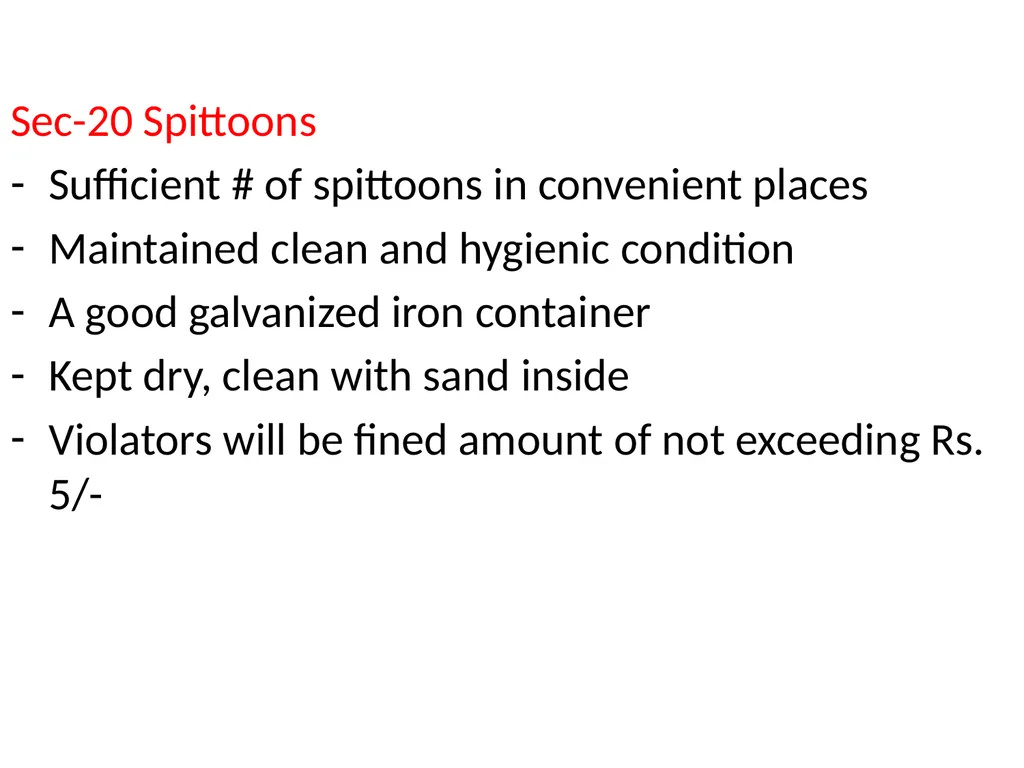
Sec-20 Spittoons
Sufficient # of spittoons in convenient places
Maintained clean and hygienic condition
A good galvanized iron container
Kept dry, clean with sand inside
Violators will be fined amount of not exceeding Rs. 5/-<br>
Sufficient # of spittoons in convenient places
Maintained clean and hygienic condition
A good galvanized iron container
Kept dry, clean with sand inside
Violators will be fined amount of not exceeding Rs. 5/-<br>
28
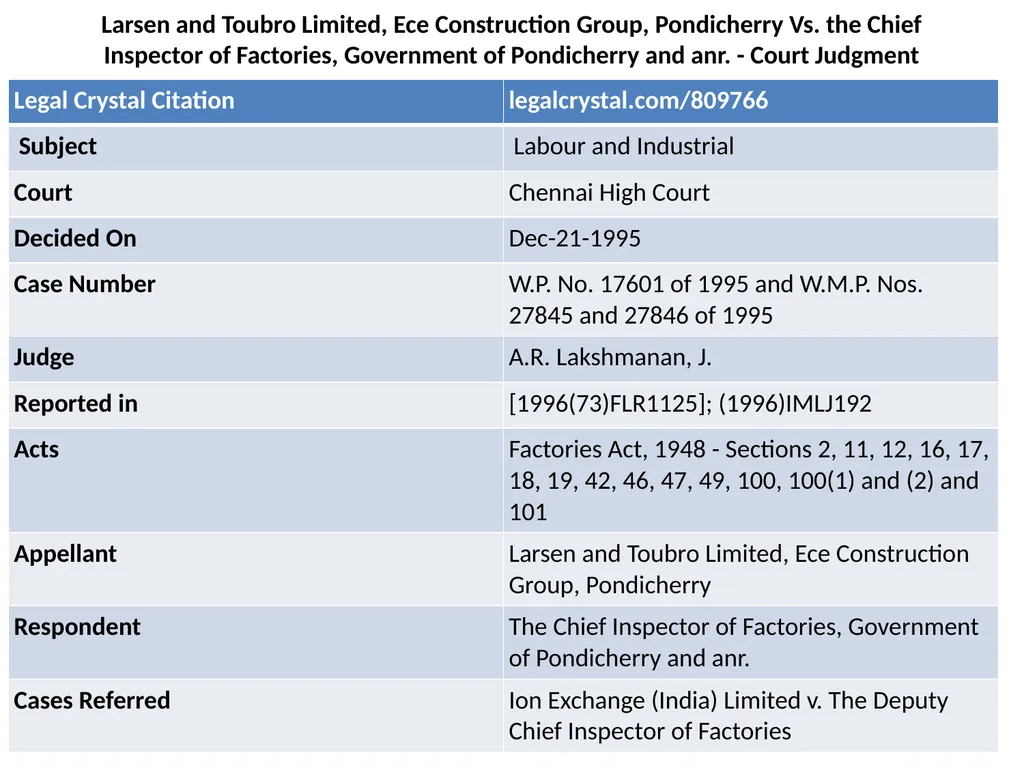
Larsen and Toubro Limited, Ece Construction Group, Pondicherry Vs. the Chief Inspector of Factories, Government of Pondicherry and anr. - Court Judgment<br>
29
Chapter IV - Safety Sec-21 Fencing of Machinery
Every moving part of a prime mover,
Headrace and tailrace of every water wheel & water turbine
Electric generator, a motor, rotary convertor
Every part of transmission machinery
Every dangerous part of any other machinery shall be securely fenced by safeguards<br>
Every moving part of a prime mover,
Headrace and tailrace of every water wheel & water turbine
Electric generator, a motor, rotary convertor
Every part of transmission machinery
Every dangerous part of any other machinery shall be securely fenced by safeguards<br>
30
Sec-22 Work on or near machinery in motion
To protect workers from repairing machines in motion
Only trained adult male worker wearing tight fitting clothing (which is provided by the occupier) whose name has been recorded in the register shall carry out the operation
No woman or young person shall be allowed to clean, lubricate or adjust any part of a prime mover<br>
To protect workers from repairing machines in motion
Only trained adult male worker wearing tight fitting clothing (which is provided by the occupier) whose name has been recorded in the register shall carry out the operation
No woman or young person shall be allowed to clean, lubricate or adjust any part of a prime mover<br>
31
Sec-23 Employment of young persons on dangerous machines
No young person shall be allowed to work unless he has been fully instructed as dangerous arising in connection with the machine.<br>
No young person shall be allowed to work unless he has been fully instructed as dangerous arising in connection with the machine.<br>
32
Sec-24 Striking gear and devices for cutting off power
To be safe while moving/running/driving belts
Suitable devices for cutting off power in emergencies
Arrangements shall be provided for locking the device<br>
To be safe while moving/running/driving belts
Suitable devices for cutting off power in emergencies
Arrangements shall be provided for locking the device<br>
33
Sec-25 Self-acting machines
No person is liable to pass close by self-acting machine in any factory (Min 45 cmts gap while walking)
Sec-26 Casing of new machinery
Effectively guarded
Completely encased
3 months / fine Rs. 500/-<br>
No person is liable to pass close by self-acting machine in any factory (Min 45 cmts gap while walking)
Sec-26 Casing of new machinery
Effectively guarded
Completely encased
3 months / fine Rs. 500/-<br>
34
Sec-27 Prohibition of employment of women and children near cotton-openers
No woman or child shall be employed in any part of a factory for pressing cotton in which cotton-opener is at work<br>
No woman or child shall be employed in any part of a factory for pressing cotton in which cotton-opener is at work<br>
35
Sec-28 Hoists and Lifts
To maintain hoists & lifts of good mechanical construction, sound material and with adequate strength
Checked at least once in 6 months by a competent person
Proper safeguarding gates
Marked as hoist or lift
Carry limited load<br>
To maintain hoists & lifts of good mechanical construction, sound material and with adequate strength
Checked at least once in 6 months by a competent person
Proper safeguarding gates
Marked as hoist or lift
Carry limited load<br>
36
Sec-29 Lifting machines, chains, ropes and lifting
Working ear fixed or movable
Lifting machine, chain, ropes, lifting tackle shall be of good constriction, sand material and with adequate strength and free from defects
Properly maintained
6 metres distance<br>
Working ear fixed or movable
Lifting machine, chain, ropes, lifting tackle shall be of good constriction, sand material and with adequate strength and free from defects
Properly maintained
6 metres distance<br>
37
Sec-30 Revolving machinery
Effective measures shall be taken in every factory to ensure that the safe working peripheral speed of every revolving vessel, cage, basket, fly-wheel, pulley, disc or similar appliance driver by power is not exceeded<br>
Effective measures shall be taken in every factory to ensure that the safe working peripheral speed of every revolving vessel, cage, basket, fly-wheel, pulley, disc or similar appliance driver by power is not exceeded<br>
38
Sec-31 Pressure plant
Effective measures shall be taken to ensure that the safe working pressure of such plant machinery or part is not exceeded<br>
Effective measures shall be taken to ensure that the safe working pressure of such plant machinery or part is not exceeded<br>
39
Sec-32 Floors, stairs and means of access
In every factory
All floors, steps, stair passages any gangways shall be of sound construction and properly maintained and provided with hand rails
When any person has to work at a height from where he is likely to fall, provision shall be made to ensure the safety of the person<br>
In every factory
All floors, steps, stair passages any gangways shall be of sound construction and properly maintained and provided with hand rails
When any person has to work at a height from where he is likely to fall, provision shall be made to ensure the safety of the person<br>
40
Sec-33 Pits, sumps, openings in floors, etc.
Whichever may become a source of danger, shall be either securely covered or securely fenced<br>
Whichever may become a source of danger, shall be either securely covered or securely fenced<br>
41
Sec-34 Excessive weights
No person shall be employed in any factory to lift, carry or move any load so heavy as to be likely to cause injury
Adult worker male - 50kgs
Adult worker female - 30 kgs
Adolescent male - 30 kgs
Adolescent female - 20 kgs
Male child - 16 kgs
Female child - 13 kgs<br>
No person shall be employed in any factory to lift, carry or move any load so heavy as to be likely to cause injury
Adult worker male - 50kgs
Adult worker female - 30 kgs
Adolescent male - 30 kgs
Adolescent female - 20 kgs
Male child - 16 kgs
Female child - 13 kgs<br>
42
Sec-35 Protection of Eyes
In respect of any such manufacturing process carried on,
Risk of injury to the eyes from particles or fragments thrown off in the course of the process
To avoid excessive light, effective screens or suitable goggles shall be provided for the protection of persons employed on,
Schedule - I (dry grinding, dividing metals, turning metals, drilling, welding cutting, hot fettling, breaking of scrap and furnace)<br>
In respect of any such manufacturing process carried on,
Risk of injury to the eyes from particles or fragments thrown off in the course of the process
To avoid excessive light, effective screens or suitable goggles shall be provided for the protection of persons employed on,
Schedule - I (dry grinding, dividing metals, turning metals, drilling, welding cutting, hot fettling, breaking of scrap and furnace)<br>
43
Schedule - II (welding/cutting, all furnace works, rolling, casting, forging metal, infra –red radiations)<br>
44
Sec-36 Precautions against dangerous fumes, gases etc.,
No person shall be required or allowed to enter any chamber, tank, vat, pit, pipe, flue or other confined space in any factory in which any gas, fume, vapour or dust is likely to be present
A certificate in writing has been given by a competent person, based on a test carried out by himself that the space is reasonably free from dangerous gas, fume, vapour or dust
Suitable breathing apparatus
A belt securely attached to a rope<br>
No person shall be required or allowed to enter any chamber, tank, vat, pit, pipe, flue or other confined space in any factory in which any gas, fume, vapour or dust is likely to be present
A certificate in writing has been given by a competent person, based on a test carried out by himself that the space is reasonably free from dangerous gas, fume, vapour or dust
Suitable breathing apparatus
A belt securely attached to a rope<br>
45
Sec-36 A- Precautions regarding the use of portable electric light
No portable electric light (or)
Any other electric appliance of voltage exceeding 24 volts shall be permitted for use inside any tank, vat, pipe, confined space<br>
No portable electric light (or)
Any other electric appliance of voltage exceeding 24 volts shall be permitted for use inside any tank, vat, pipe, confined space<br>
46
Sec-37 Explosive or inflammable dust, gas, etc..
All practicable measures shall be taken to prevent any explosion, fire hazards
Wall of fire-resistant construction
Doors and windows opening shall be easy access to come out in fire fighting
Cylinders containing compressed gas
Storage of inflammable liquids (21 degree Celsius)
Automatic fire alarm if 500 r there
First aid fire fighting arrangements<br>
All practicable measures shall be taken to prevent any explosion, fire hazards
Wall of fire-resistant construction
Doors and windows opening shall be easy access to come out in fire fighting
Cylinders containing compressed gas
Storage of inflammable liquids (21 degree Celsius)
Automatic fire alarm if 500 r there
First aid fire fighting arrangements<br>
47
Sec-38 Precautions in case of fire
All practicable measures shall be taken to prevent outbreak of fire and its spread both internally and externally
Safe means of escape for all persons in the event of a fire
The necessary equipment and facilities for extinguishing fire (Sl.No, D.O.R, D.o. last inspection)
Fire buckets (720 mm height from the floor)
Other fire fighting arrangements‘(fire hydrants, water supply, automatic sprinkler)<br>
All practicable measures shall be taken to prevent outbreak of fire and its spread both internally and externally
Safe means of escape for all persons in the event of a fire
The necessary equipment and facilities for extinguishing fire (Sl.No, D.O.R, D.o. last inspection)
Fire buckets (720 mm height from the floor)
Other fire fighting arrangements‘(fire hydrants, water supply, automatic sprinkler)<br>
48
Nature of Risk
Light hazard - engineering workshops (59)
Ordinary hazards - chemical manufacturing (75)
High Hazard – A - Match Factories (34)
High hazard – B - CNG compressing, LPG, Explosive factories, Petroleum refining, Ammonia & Urea synthesis, Petrochemicals
Class
A- Fire – water type extinguisher
B- Fire – foam, dry powder
C- Fire – dry powder<br>
Light hazard - engineering workshops (59)
Ordinary hazards - chemical manufacturing (75)
High Hazard – A - Match Factories (34)
High hazard – B - CNG compressing, LPG, Explosive factories, Petroleum refining, Ammonia & Urea synthesis, Petrochemicals
Class
A- Fire – water type extinguisher
B- Fire – foam, dry powder
C- Fire – dry powder<br>
49
Safety Committee
If 250 r ordinarily employed they shall constitute safety committee
A senior official – as a chairperson
Representatives (production, maintenance & purchase)
Workers representatives as equal to management
3 years tenure, meet once every quarter
Minutes produced to the inspector on demand<br>
If 250 r ordinarily employed they shall constitute safety committee
A senior official – as a chairperson
Representatives (production, maintenance & purchase)
Workers representatives as equal to management
3 years tenure, meet once every quarter
Minutes produced to the inspector on demand<br>
50
Sec – 39 Power to require specifications of defective parts or tests of stability
Writings
Drawings
Specification of safety<br>
Writings
Drawings
Specification of safety<br>
51
Sec – 40 Safety of buildings and machinery
Anything dangerous to human life
Writing ( repairing, altering)<br>
Anything dangerous to human life
Writing ( repairing, altering)<br>
52
Sec – 40 Safety of buildings and machinery
Anything dangerous to human life
Writing ( repairing, altering)
Sec – 40 A Maintenance of Building
Sec – 40 B Safety officers
1 safety officer shall be appointed for 1000 ees<br>
Anything dangerous to human life
Writing ( repairing, altering)
Sec – 40 A Maintenance of Building
Sec – 40 B Safety officers
1 safety officer shall be appointed for 1000 ees<br>
53
Functions and duties of safety Committee
Assisting and co-operating with the management in achieving the aims and objectives outlined in the health and safety policy of the occupier
Dealing with all matters concerning health, safety and environment and to arrive at practicable solutions to problems encountered
Creating safety awareness among all workers
Discussing reports on safety, environmental and occupational health surveys, safety audits, risks assessment, emergency and disaster management plans and implementation of the recommendations made in the reports<br>
Assisting and co-operating with the management in achieving the aims and objectives outlined in the health and safety policy of the occupier
Dealing with all matters concerning health, safety and environment and to arrive at practicable solutions to problems encountered
Creating safety awareness among all workers
Discussing reports on safety, environmental and occupational health surveys, safety audits, risks assessment, emergency and disaster management plans and implementation of the recommendations made in the reports<br>
54
Functions and duties of safety Committee
Carrying out health and safety surveys and identifying causes of accidents
Looking into any complaint made on the likelihood of an imminent danger to the safety and health of the workers and suggestions corrective measures
Reviewing the implementation of the recommendations made by it.<br>
Carrying out health and safety surveys and identifying causes of accidents
Looking into any complaint made on the likelihood of an imminent danger to the safety and health of the workers and suggestions corrective measures
Reviewing the implementation of the recommendations made by it.<br>
55
Sec 41- Power to make rules to supplement this chapter
Central & state Govt. may have all authority to change<br>
Central & state Govt. may have all authority to change<br>
56
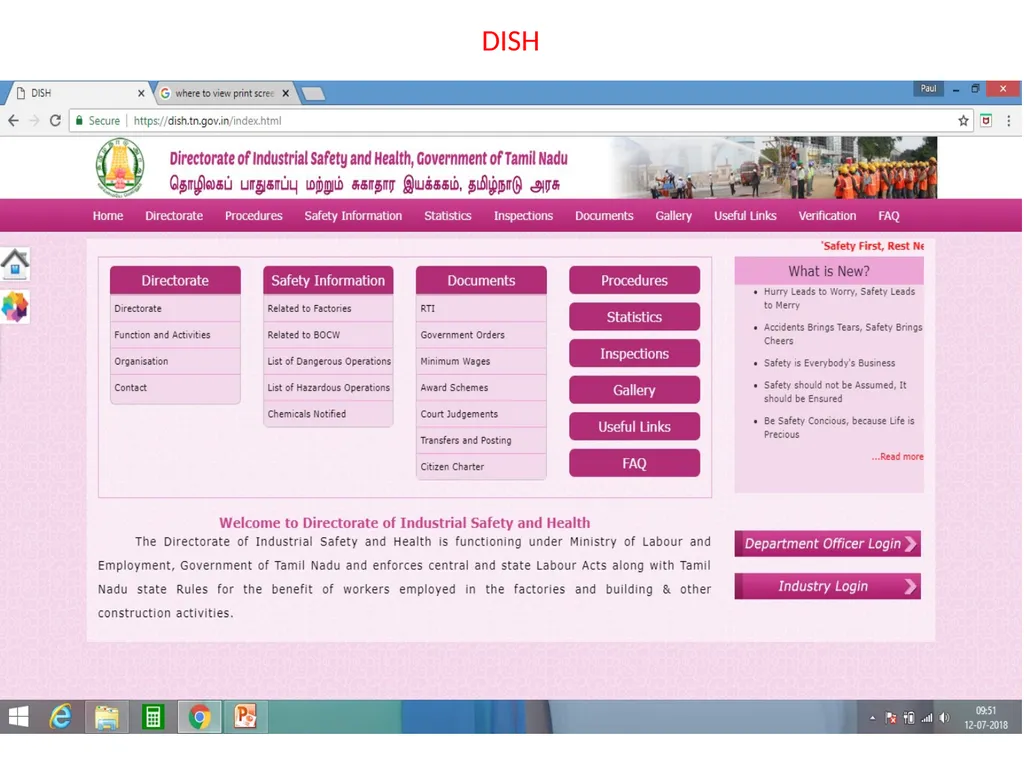
DISH<br>
57
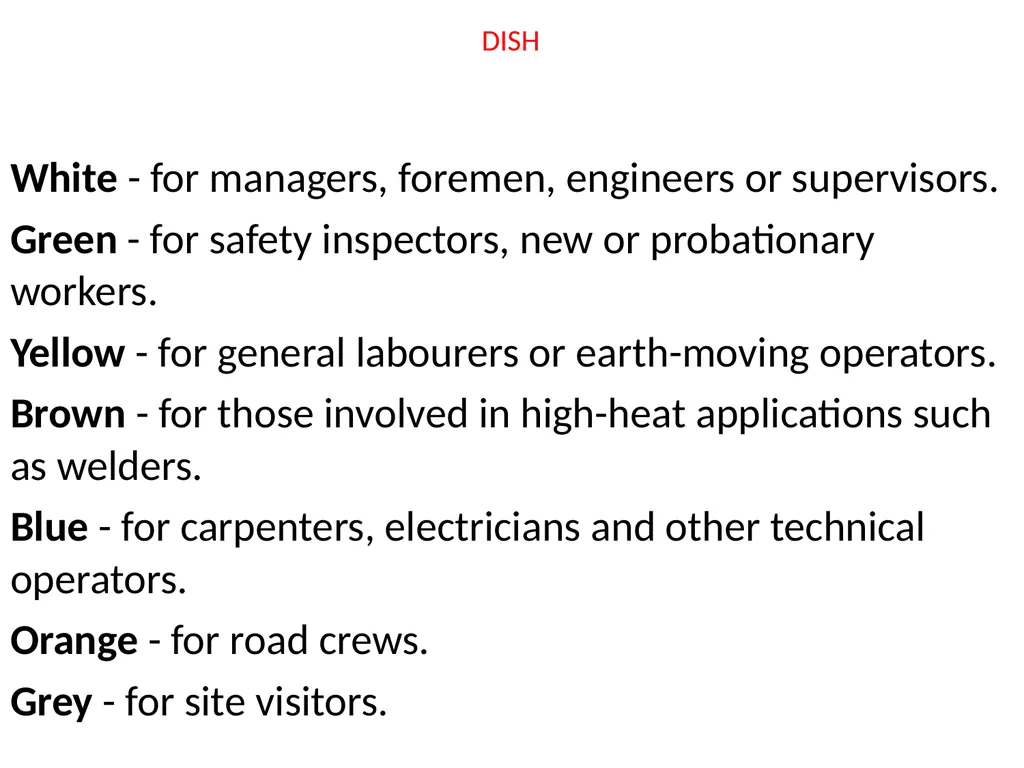
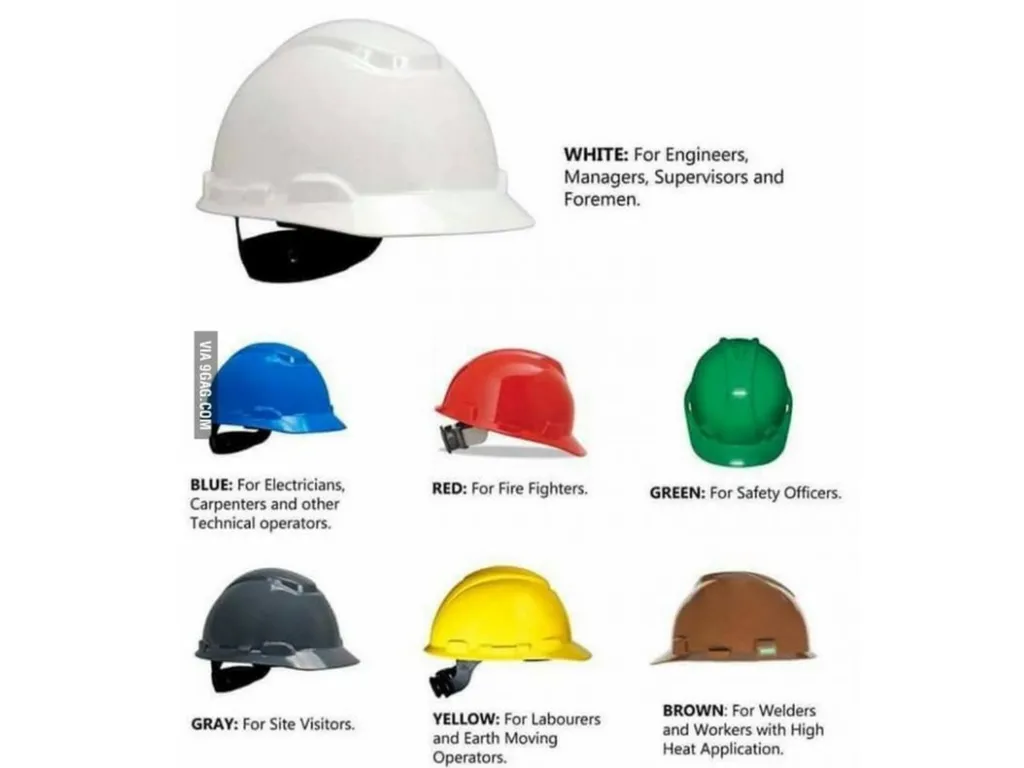
DISH White - for managers, foremen, engineers or supervisors.
Green - for safety inspectors, new or probationary workers.
Yellow - for general labourers or earth-moving operators.
Brown - for those involved in high-heat applications such as welders.
Blue - for carpenters, electricians and other technical operators.
Orange - for road crews.
Grey - for site visitors.<br>
Green - for safety inspectors, new or probationary workers.
Yellow - for general labourers or earth-moving operators.
Brown - for those involved in high-heat applications such as welders.
Blue - for carpenters, electricians and other technical operators.
Orange - for road crews.
Grey - for site visitors.<br>
58
DISH<br>
59
Chapter – IV A Provisions relating to hazardous process Sec 41 A – Constitution of Site Appraisal Committees
- DISH shall be it’s chairperson
1 Representative from the control board for the prevention and water pollution
1 Representative Air Pollution (Water prevention and control of pollution Act, 1974)
1 Representative from Department of Environment in the state
1 Representative from Meteorological department (G.of.I)
1 Expert from Occupational Health
1 Representative from Town Planning Department of the state Govt.
1 Scientist, 2 Local Authorities and 3 others by state<br>
- DISH shall be it’s chairperson
1 Representative from the control board for the prevention and water pollution
1 Representative Air Pollution (Water prevention and control of pollution Act, 1974)
1 Representative from Department of Environment in the state
1 Representative from Meteorological department (G.of.I)
1 Expert from Occupational Health
1 Representative from Town Planning Department of the state Govt.
1 Scientist, 2 Local Authorities and 3 others by state<br>
60
Sec 41 B – Compulsory disclosure of information by the occupier
Disclosed in the manner prescribed all information regarding dangers, including health hazards and the measures to overcome such hazards arising form the exposure<br>
Disclosed in the manner prescribed all information regarding dangers, including health hazards and the measures to overcome such hazards arising form the exposure<br>
61
Sec 41 C – Specific Responsibility of the Occupier in relation to hazardous process
Maintain accurate & up-to-date health records of workers who are exposed to any toxic and chemical
Appoint competent persons / supervisors to protect
Forms Used pertaining to this sections
Form – 17 & 17 A, Health Register
Form – 18 Report of Accident including dangerous occurrence
Form – 19 Report of further details of Accident<br>
Maintain accurate & up-to-date health records of workers who are exposed to any toxic and chemical
Appoint competent persons / supervisors to protect
Forms Used pertaining to this sections
Form – 17 & 17 A, Health Register
Form – 18 Report of Accident including dangerous occurrence
Form – 19 Report of further details of Accident<br>
62
Sec 41 D – Power of Central Government to oppoint inquiry committee
Sec 41 E – Emergency Standards
Standards of safety
Sec 41 F – Permissible limits of exposure of chemical and toxic substances<br>
Sec 41 E – Emergency Standards
Standards of safety
Sec 41 F – Permissible limits of exposure of chemical and toxic substances<br>
63
Sec 41 G – Workers participation in Safety Management
- Promote co-operation
Periodical measures / awareness training
Sec 41 H – Right to workers to warn about imminent danger
- Safety Committee & JDISH shall take remedial action against safety issues<br>
- Promote co-operation
Periodical measures / awareness training
Sec 41 H – Right to workers to warn about imminent danger
- Safety Committee & JDISH shall take remedial action against safety issues<br>
64
Chapter – V – Welfare (42-50) Sec 42 – Washing Facilities
Adequate and suitable facilities for washing
Separately for Men & Women
Kept clean
Sec 43 – Facilities for storing and drying clothing
Required provisions at suitable places
Off duty time
Wet clothes (Space to keep dry cloths & rope for drying their wet clothes)<br>
Adequate and suitable facilities for washing
Separately for Men & Women
Kept clean
Sec 43 – Facilities for storing and drying clothing
Required provisions at suitable places
Off duty time
Wet clothes (Space to keep dry cloths & rope for drying their wet clothes)<br>
65
Sec 44 – Facilities for sitting
Suitable arrangements for sitting
Long standing position
Sec 45 – First Aid Appliances
Readily accessible during all working hours
First aid boxes / cupboards equipped with prescribed contents inside
No other than things shall be kept inside
A separate responsible person
1 Ambulance – 500 workers (Nursing Staff)
26 mandatory items to be kept in first aid Kit.
1 first aid for every 150 workers<br>
Suitable arrangements for sitting
Long standing position
Sec 45 – First Aid Appliances
Readily accessible during all working hours
First aid boxes / cupboards equipped with prescribed contents inside
No other than things shall be kept inside
A separate responsible person
1 Ambulance – 500 workers (Nursing Staff)
26 mandatory items to be kept in first aid Kit.
1 first aid for every 150 workers<br>
66
Sec 46 – Canteen
1 Canteen for 250 workers
200 metres away form working place
15.2 metres away from latrine, urinal, boiler, ash dumps…
Min Height of the wall shall be 3.7 metres
Heat resisting materials & water proof
Adequate ventilation
Painted once in 3 years
Clean & Neat
Disposal of garbage with suitable arrangements<br>
1 Canteen for 250 workers
200 metres away form working place
15.2 metres away from latrine, urinal, boiler, ash dumps…
Min Height of the wall shall be 3.7 metres
Heat resisting materials & water proof
Adequate ventilation
Painted once in 3 years
Clean & Neat
Disposal of garbage with suitable arrangements<br>
67
Dinning Hall
30 % of the employees at a time it has to accommodate
Not less than 0.9 square metre per diner
Separate for women (partitioned)
Sufficient tables, chairs
Soaps, towels
Sufficient utensils
Medical examination of canteen staff
Blood test once in a year
Prices to charged<br>
30 % of the employees at a time it has to accommodate
Not less than 0.9 square metre per diner
Separate for women (partitioned)
Sufficient tables, chairs
Soaps, towels
Sufficient utensils
Medical examination of canteen staff
Blood test once in a year
Prices to charged<br>
68
Sec 47 – Shelters, Rest Rooms and Lunch Rooms
1 for 150 workers
Sec 48 – Crèche’
30 women workers
284.1 Mille litres of clean pure milk to each child on everyday
15 minutes break for the mother to feed the child (morning and evening)
Care taker to be appointed<br>
1 for 150 workers
Sec 48 – Crèche’
30 women workers
284.1 Mille litres of clean pure milk to each child on everyday
15 minutes break for the mother to feed the child (morning and evening)
Care taker to be appointed<br>
69
Sec 49 – Welfare officers
1 for 500 workers
Sec 50 – Power to make rules to supplement this chapter
The state Government may make rules alternative arrangements<br>
1 for 500 workers
Sec 50 – Power to make rules to supplement this chapter
The state Government may make rules alternative arrangements<br>
70
Chapter – VI – Working Hours of Adults Sec 51 – Weekly Hours
No adult worker shall be allowed to work more than 48 hours a week (6*8=48)
Sec 52 – Weekly Holidays
- No adult worker shall be allowed to work on the 1st day of the week
Sec 53 – Compensatory Holidays
- Not more than 2 holidays in 1 week<br>
No adult worker shall be allowed to work more than 48 hours a week (6*8=48)
Sec 52 – Weekly Holidays
- No adult worker shall be allowed to work on the 1st day of the week
Sec 53 – Compensatory Holidays
- Not more than 2 holidays in 1 week<br>
71
Sec 54 – Daily hours
- No adult worker shall be allowed to work for more than 9 hours in a day
Sec 55 – Intervals for Rest
- Half an hour of rest for 5 hours of continues work
Sec 56 – Spread Over
Maximum 10 and half hours including rest hours<br>
- No adult worker shall be allowed to work for more than 9 hours in a day
Sec 55 – Intervals for Rest
- Half an hour of rest for 5 hours of continues work
Sec 56 – Spread Over
Maximum 10 and half hours including rest hours<br>
72
Sec 57 – Night Shifts
Sec 58 – Prohibition of overlapping shifts
Sec 59 – Extra Wages for overtime
More than 9 hours in any day
More than 48 hours in any week
Shall be considered as OT hours (double wage)
But not more than 54 total hours in a week
Sec 60 – Restriction on double employment<br>
Sec 58 – Prohibition of overlapping shifts
Sec 59 – Extra Wages for overtime
More than 9 hours in any day
More than 48 hours in any week
Shall be considered as OT hours (double wage)
But not more than 54 total hours in a week
Sec 60 – Restriction on double employment<br>