
Facts and Values A Course in Business Ethics

Description: Facts and Values A Course in Business Ethics Module 5 John Hooker Carnegie Mellon University May 2022 Facts values The distinction will factor into every issue we discuss. Why? Facts are important in ethical arguments, but One cant
Related Topics
Download Presentation
"Facts and Values A Course in Business Ethics" is the property of its rightful owner. Permission is granted to download and print the materials on this website for personal, non-commercial use only, and to display it on your personal computer provided you do not modify the materials and that you retain all copyright notices contained in the materials. By downloading content from our website, you accept the terms of this agreement.
Presentation Transcript
slide1. Facts and Values A Course in Business Ethics
Module 5
John Hooker Carnegie Mellon University
May 2022<br>
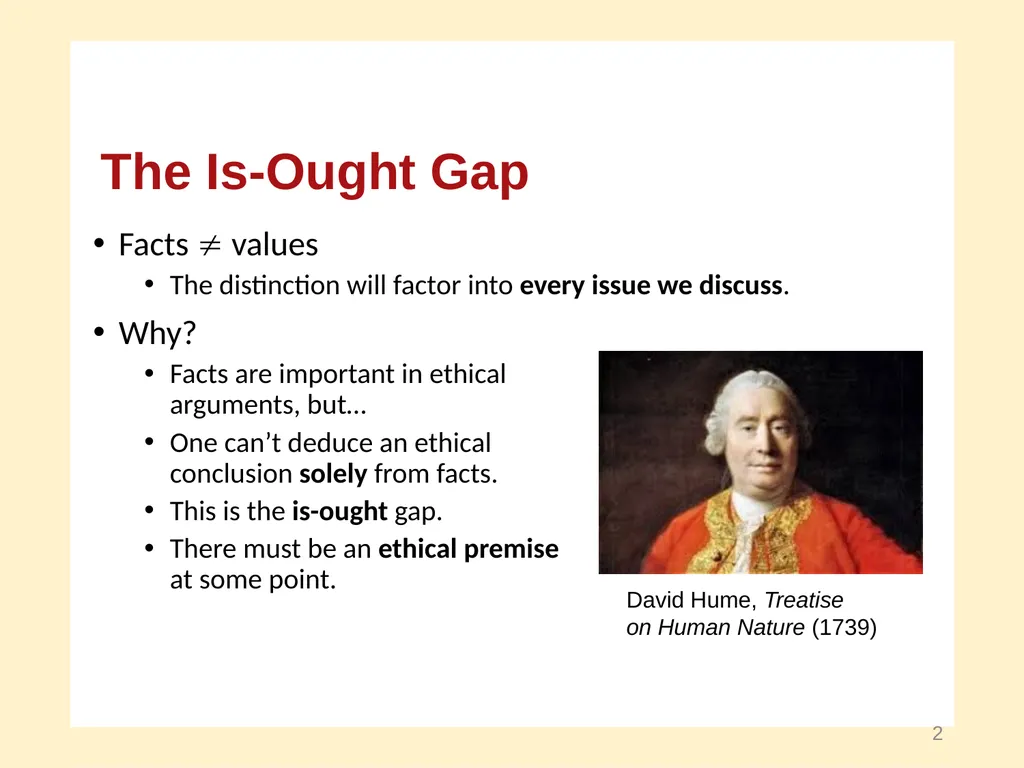
slide2. Facts values
The distinction will factor into every issue we discuss.
Why?
Facts are important in ethical arguments, but…
One can’t deduce an ethical conclusion solely from facts.
This is the is-ought gap.
There must be an ethical premise at some point. 2 The Is-Ought Gap David Hume, Treatise
on Human Nature (1739)<br>
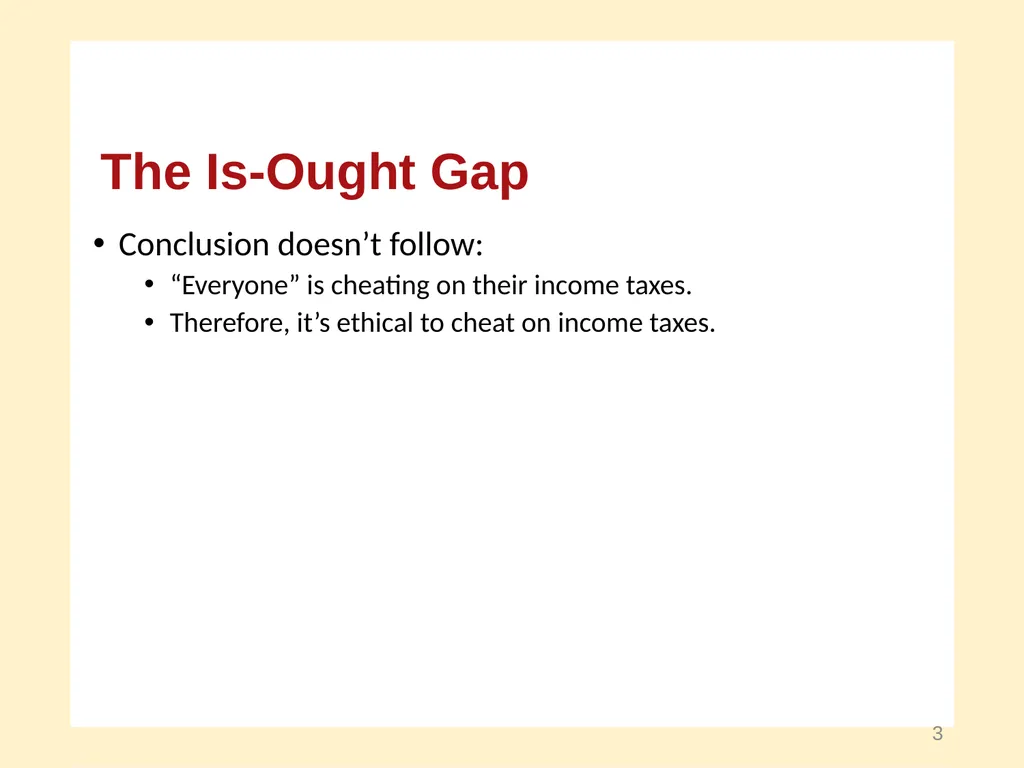
slide3. Conclusion doesn’t follow:
“Everyone” is cheating on their income taxes.
Therefore, it’s ethical to cheat on income taxes. 3 The Is-Ought Gap<br>
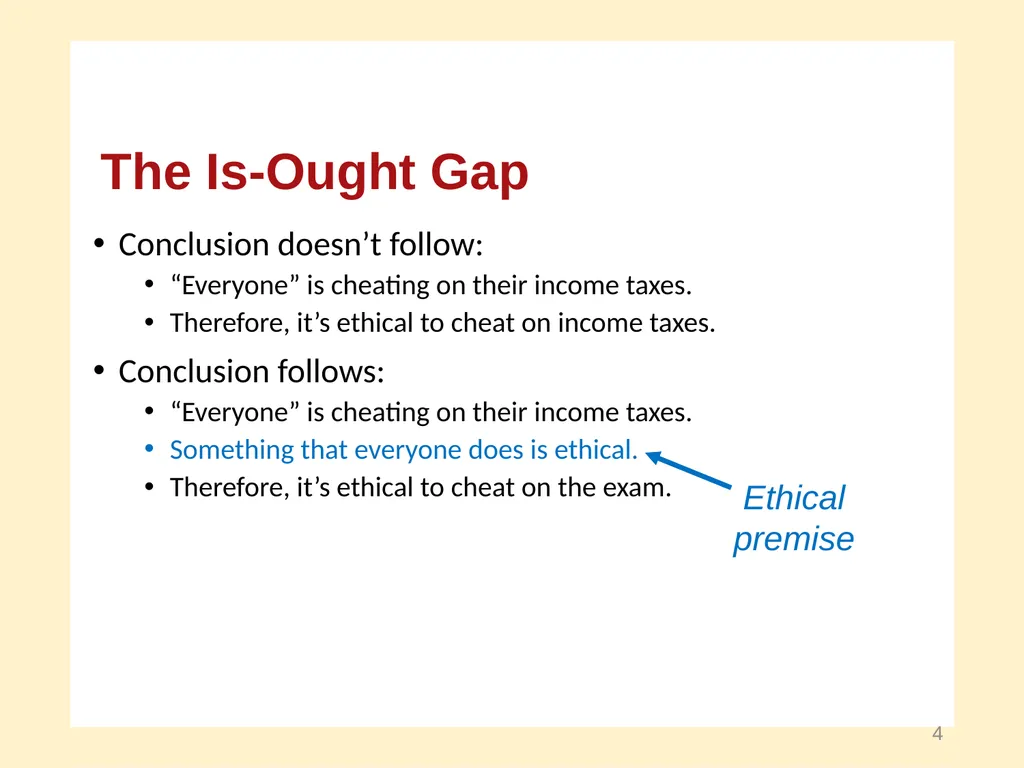
slide4. Conclusion doesn’t follow:
“Everyone” is cheating on their income taxes.
Therefore, it’s ethical to cheat on income taxes.
Conclusion follows:
“Everyone” is cheating on their income taxes.
Something that everyone does is ethical.
Therefore, it’s ethical to cheat on the exam. 4 The Is-Ought Gap Ethical premise<br>
slide5. Conclusion doesn’t follow:
“Everyone” is cheating on their income taxes.
Therefore, it’s ethical to cheat on income taxes.
Conclusion follows:
“Everyone” is cheating on their income taxes.
Something that everyone does is ethical.
Therefore, it’s ethical to cheat on the exam.
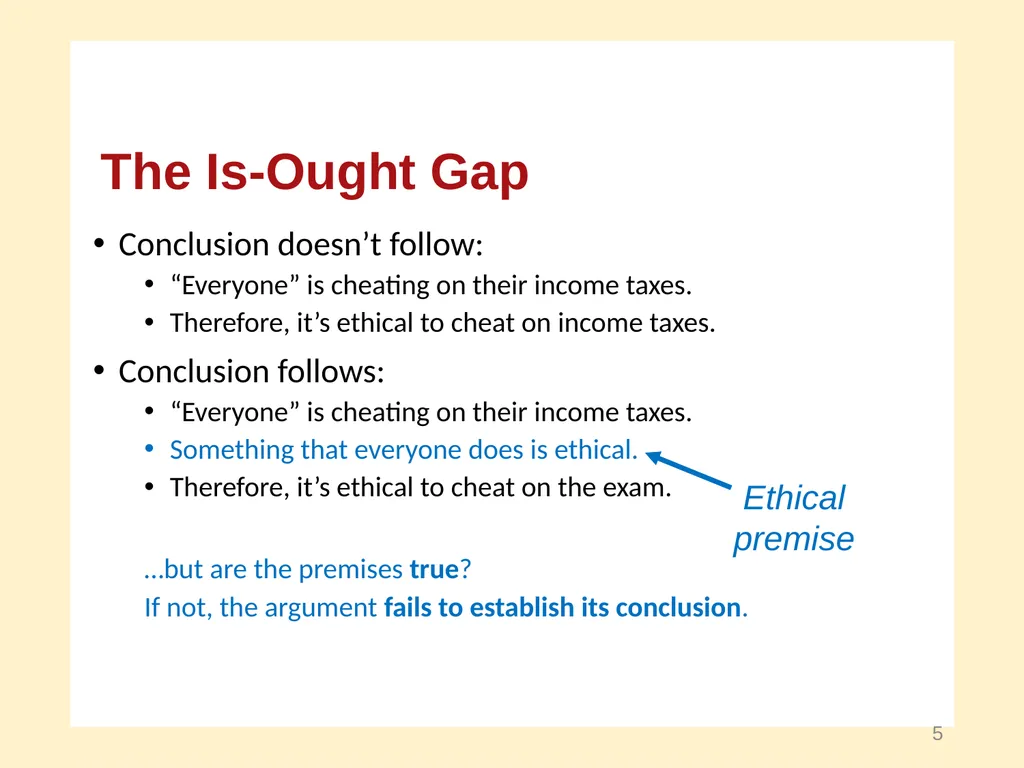
…but are the premises true?
If not, the argument fails to establish its conclusion. 5 The Is-Ought Gap Ethical premise<br>
slide6. Conclusion doesn’t follow:
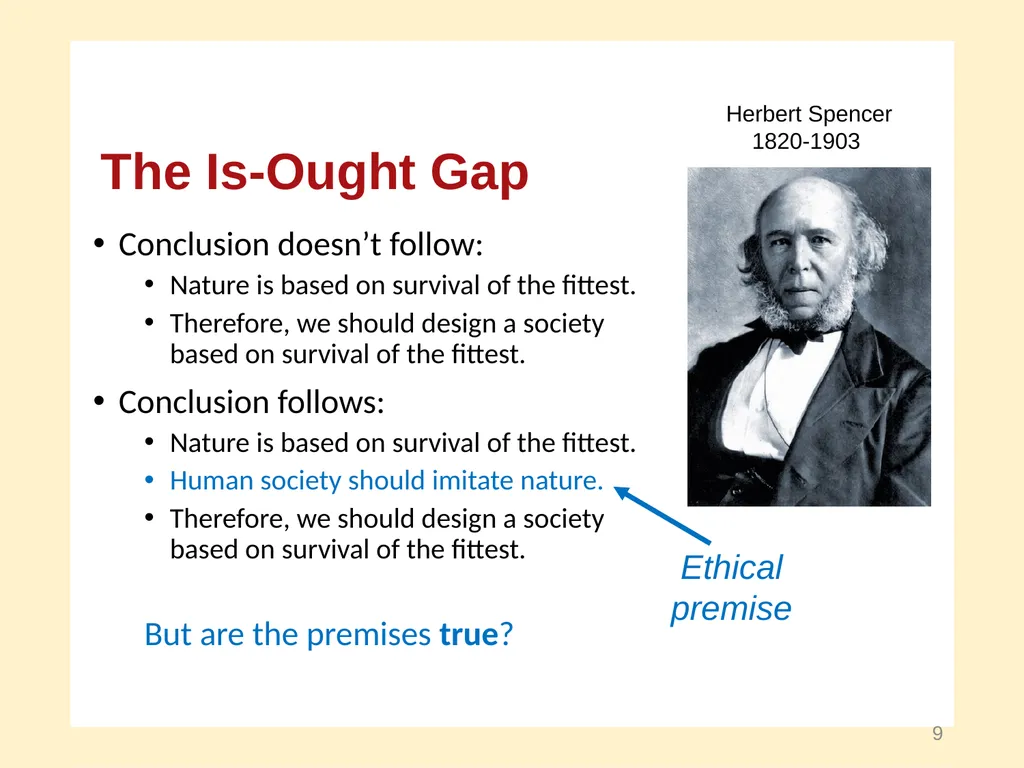
Nature is based on survival of the fittest.
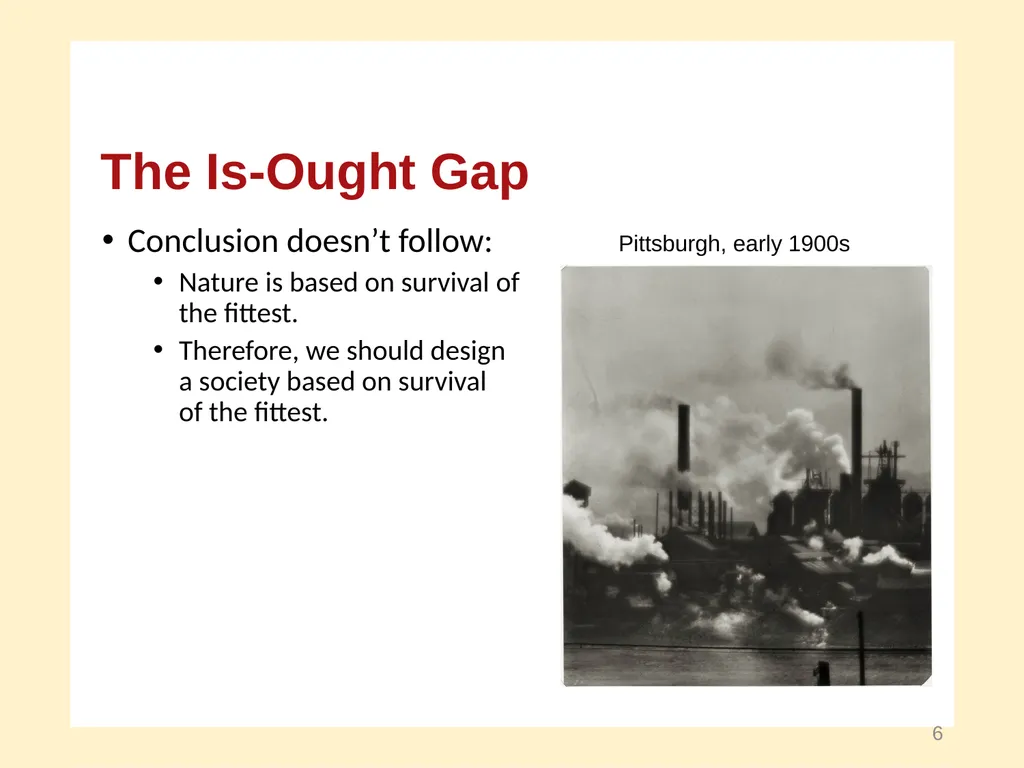
Therefore, we should design a society based on survival of the fittest. 6 The Is-Ought Gap Pittsburgh, early 1900s<br>
slide7. Conclusion doesn’t follow:
Nature is based on survival of the fittest.
Therefore, we should design a society based on survival of the fittest.
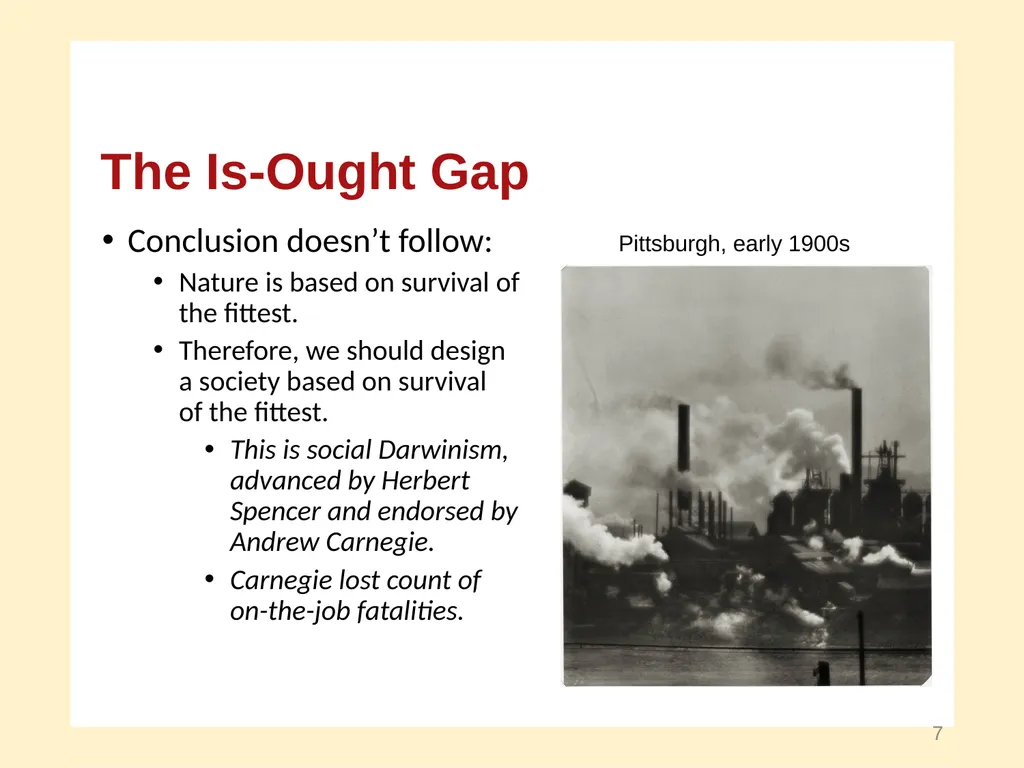
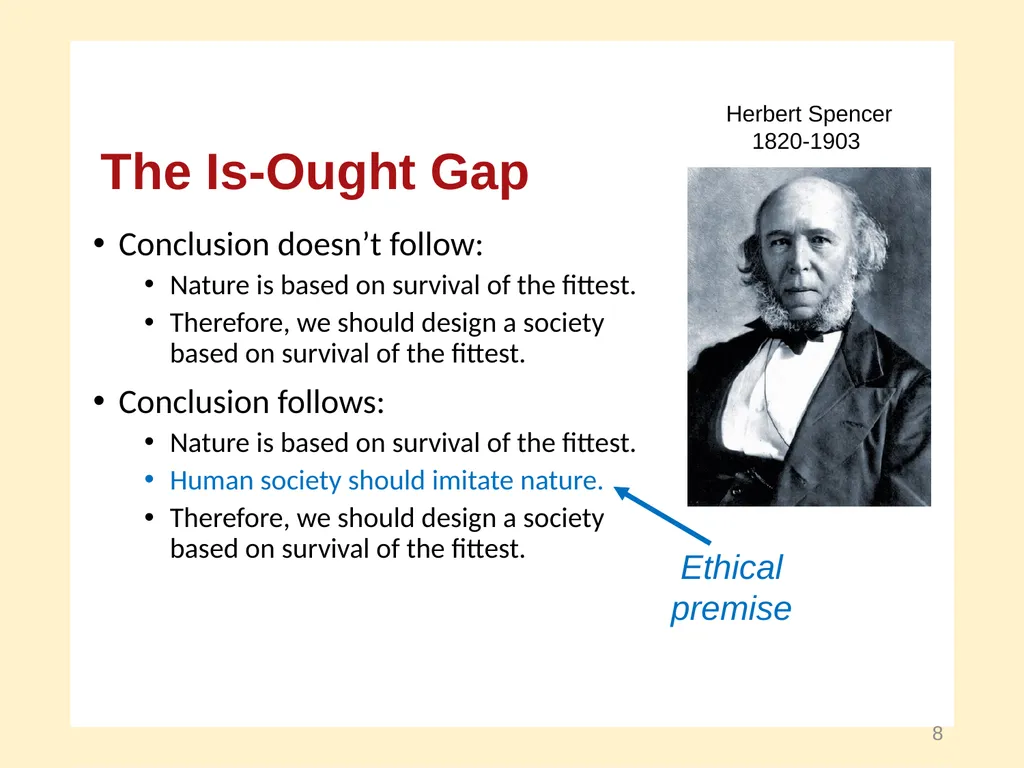
This is social Darwinism, advanced by Herbert Spencer and endorsed by Andrew Carnegie.
Carnegie lost count of on-the-job fatalities. 7 The Is-Ought Gap Pittsburgh, early 1900s<br>
slide8. Conclusion doesn’t follow:
Nature is based on survival of the fittest.
Therefore, we should design a society based on survival of the fittest.
Conclusion follows:
Nature is based on survival of the fittest.
Human society should imitate nature.
Therefore, we should design a society based on survival of the fittest. 8 The Is-Ought Gap Ethical premise Herbert Spencer 1820-1903<br>
slide9. Conclusion doesn’t follow:
Nature is based on survival of the fittest.
Therefore, we should design a society based on survival of the fittest.
Conclusion follows:
Nature is based on survival of the fittest.
Human society should imitate nature.
Therefore, we should design a society based on survival of the fittest.
But are the premises true? 9 The Is-Ought Gap Herbert Spencer 1820-1903 Ethical premise<br>
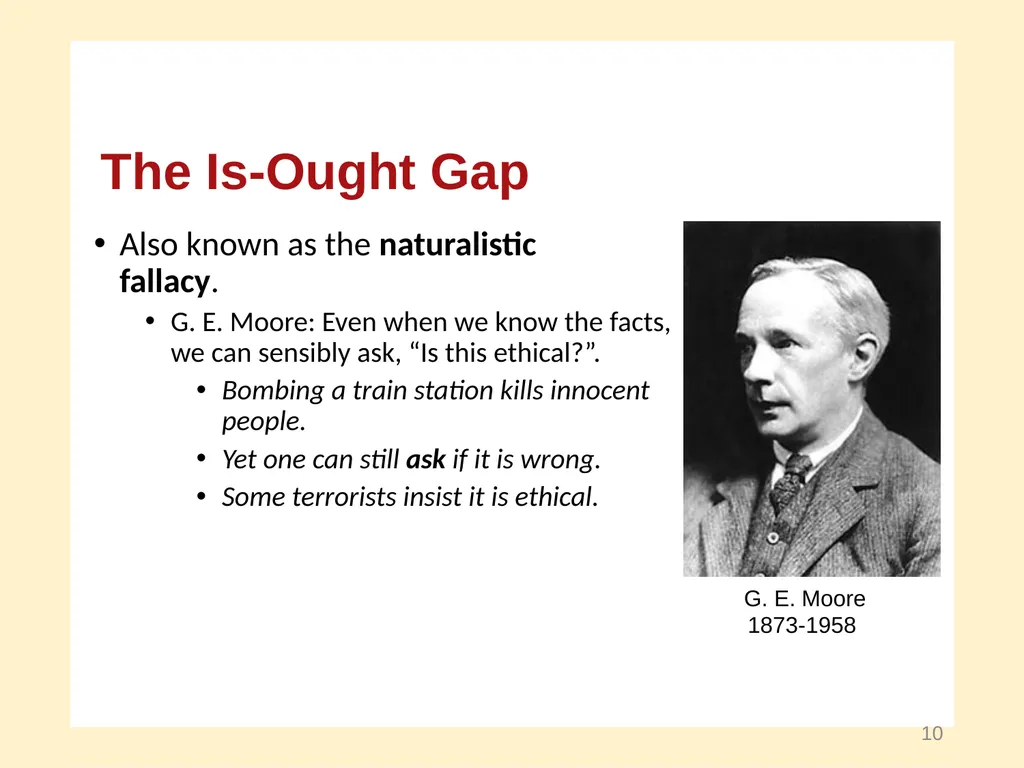
slide10. Also known as the naturalistic fallacy.
G. E. Moore: Even when we know the facts, we can sensibly ask, “Is this ethical?”.
Bombing a train station kills innocent people.
Yet one can still ask if it is wrong.
Some terrorists insist it is ethical. 10 The Is-Ought Gap G. E. Moore 1873-1958<br>
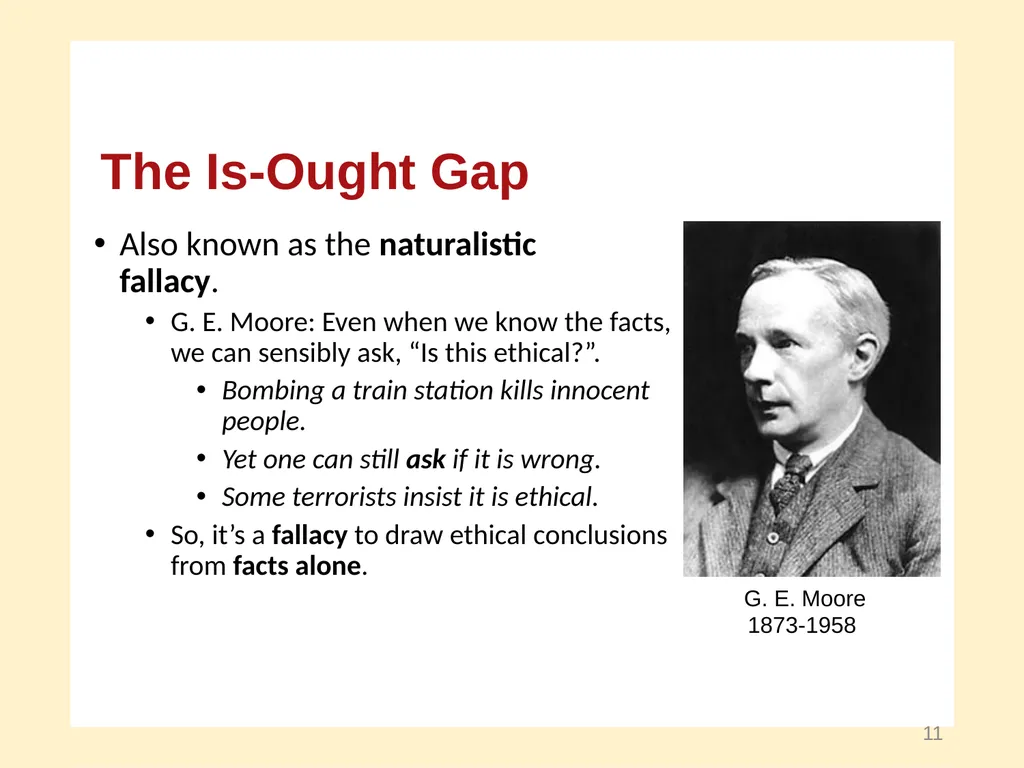
slide11. Also known as the naturalistic fallacy.
G. E. Moore: Even when we know the facts, we can sensibly ask, “Is this ethical?”.
Bombing a train station kills innocent people.
Yet one can still ask if it is wrong.
Some terrorists insist it is ethical.
So, it’s a fallacy to draw ethical conclusions from facts alone. 11 The Is-Ought Gap G. E. Moore 1873-1958<br>
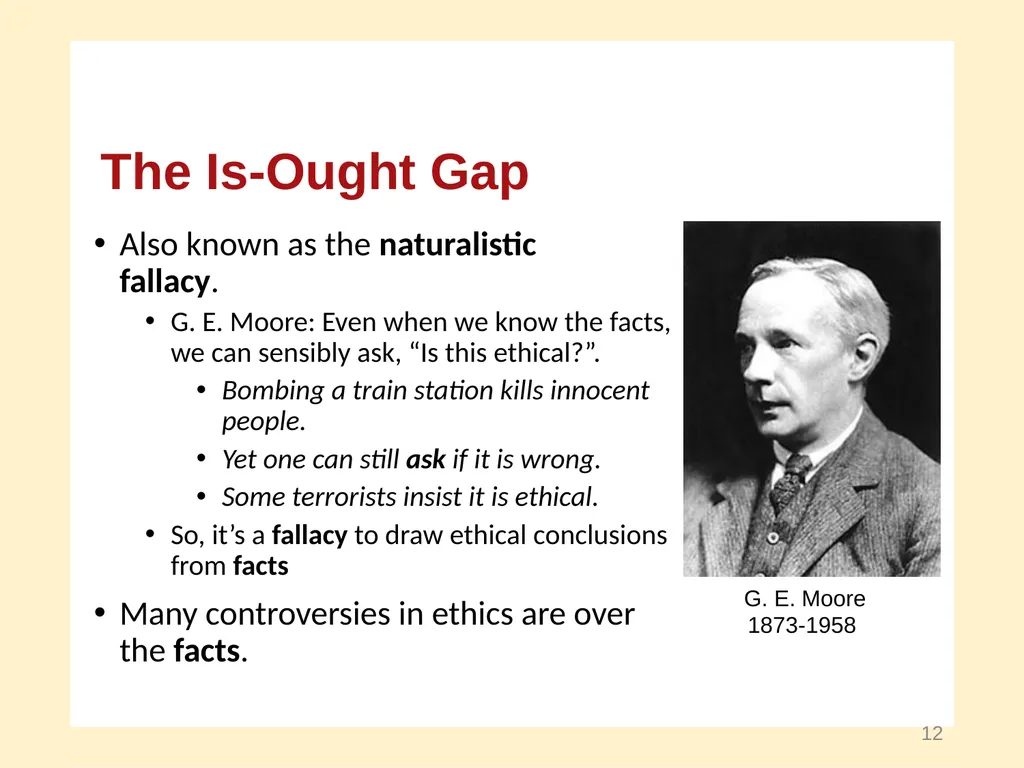
slide12. Also known as the naturalistic fallacy.
G. E. Moore: Even when we know the facts, we can sensibly ask, “Is this ethical?”.
Bombing a train station kills innocent people.
Yet one can still ask if it is wrong.
Some terrorists insist it is ethical.
So, it’s a fallacy to draw ethical conclusions from facts
Many controversies in ethics are over the facts. 12 The Is-Ought Gap G. E. Moore 1873-1958<br>
slide13. Recent example: Value alignment in AI
To be discussed. 13 The Is-Ought Gap<br>
slide14. Ethics cannot tell us the facts.
We must go out and investigate, gather data.
No amount of talk will settle issues of fact. 14 The Is-Ought Gap<br>
slide15. Ethics cannot tell us the facts.
We must go out and investigate, gather data.
No amount of talk will settle issues of fact.
Facts cannot tell us what is ethical.
We need ethical principles.
These are established by analysis. 15 The Is-Ought Gap<br>
slide16. Ethics cannot tell us the facts.
We must go out and investigate, gather data.
No amount of talk will settle issues of fact.
Facts cannot tell us what is ethical.
We need ethical principles.
These are established by analysis.
Ethics tells us which facts matter.
This can save us a lot of effort.
Only chase down the facts that matter. 16 The Is-Ought Gap<br>
slide17. Timothy Crews-Anderson, Critical Thinking and Informal Logic, 2007.
See this for a list of 71 logical fallacies! 17 Further reading<br>
Module 5
John Hooker Carnegie Mellon University
May 2022<br>
slide2. Facts values
The distinction will factor into every issue we discuss.
Why?
Facts are important in ethical arguments, but…
One can’t deduce an ethical conclusion solely from facts.
This is the is-ought gap.
There must be an ethical premise at some point. 2 The Is-Ought Gap David Hume, Treatise
on Human Nature (1739)<br>
slide3. Conclusion doesn’t follow:
“Everyone” is cheating on their income taxes.
Therefore, it’s ethical to cheat on income taxes. 3 The Is-Ought Gap<br>
slide4. Conclusion doesn’t follow:
“Everyone” is cheating on their income taxes.
Therefore, it’s ethical to cheat on income taxes.
Conclusion follows:
“Everyone” is cheating on their income taxes.
Something that everyone does is ethical.
Therefore, it’s ethical to cheat on the exam. 4 The Is-Ought Gap Ethical premise<br>
slide5. Conclusion doesn’t follow:
“Everyone” is cheating on their income taxes.
Therefore, it’s ethical to cheat on income taxes.
Conclusion follows:
“Everyone” is cheating on their income taxes.
Something that everyone does is ethical.
Therefore, it’s ethical to cheat on the exam.
…but are the premises true?
If not, the argument fails to establish its conclusion. 5 The Is-Ought Gap Ethical premise<br>
slide6. Conclusion doesn’t follow:
Nature is based on survival of the fittest.
Therefore, we should design a society based on survival of the fittest. 6 The Is-Ought Gap Pittsburgh, early 1900s<br>
slide7. Conclusion doesn’t follow:
Nature is based on survival of the fittest.
Therefore, we should design a society based on survival of the fittest.
This is social Darwinism, advanced by Herbert Spencer and endorsed by Andrew Carnegie.
Carnegie lost count of on-the-job fatalities. 7 The Is-Ought Gap Pittsburgh, early 1900s<br>
slide8. Conclusion doesn’t follow:
Nature is based on survival of the fittest.
Therefore, we should design a society based on survival of the fittest.
Conclusion follows:
Nature is based on survival of the fittest.
Human society should imitate nature.
Therefore, we should design a society based on survival of the fittest. 8 The Is-Ought Gap Ethical premise Herbert Spencer 1820-1903<br>
slide9. Conclusion doesn’t follow:
Nature is based on survival of the fittest.
Therefore, we should design a society based on survival of the fittest.
Conclusion follows:
Nature is based on survival of the fittest.
Human society should imitate nature.
Therefore, we should design a society based on survival of the fittest.
But are the premises true? 9 The Is-Ought Gap Herbert Spencer 1820-1903 Ethical premise<br>
slide10. Also known as the naturalistic fallacy.
G. E. Moore: Even when we know the facts, we can sensibly ask, “Is this ethical?”.
Bombing a train station kills innocent people.
Yet one can still ask if it is wrong.
Some terrorists insist it is ethical. 10 The Is-Ought Gap G. E. Moore 1873-1958<br>
slide11. Also known as the naturalistic fallacy.
G. E. Moore: Even when we know the facts, we can sensibly ask, “Is this ethical?”.
Bombing a train station kills innocent people.
Yet one can still ask if it is wrong.
Some terrorists insist it is ethical.
So, it’s a fallacy to draw ethical conclusions from facts alone. 11 The Is-Ought Gap G. E. Moore 1873-1958<br>
slide12. Also known as the naturalistic fallacy.
G. E. Moore: Even when we know the facts, we can sensibly ask, “Is this ethical?”.
Bombing a train station kills innocent people.
Yet one can still ask if it is wrong.
Some terrorists insist it is ethical.
So, it’s a fallacy to draw ethical conclusions from facts
Many controversies in ethics are over the facts. 12 The Is-Ought Gap G. E. Moore 1873-1958<br>
slide13. Recent example: Value alignment in AI
To be discussed. 13 The Is-Ought Gap<br>
slide14. Ethics cannot tell us the facts.
We must go out and investigate, gather data.
No amount of talk will settle issues of fact. 14 The Is-Ought Gap<br>
slide15. Ethics cannot tell us the facts.
We must go out and investigate, gather data.
No amount of talk will settle issues of fact.
Facts cannot tell us what is ethical.
We need ethical principles.
These are established by analysis. 15 The Is-Ought Gap<br>
slide16. Ethics cannot tell us the facts.
We must go out and investigate, gather data.
No amount of talk will settle issues of fact.
Facts cannot tell us what is ethical.
We need ethical principles.
These are established by analysis.
Ethics tells us which facts matter.
This can save us a lot of effort.
Only chase down the facts that matter. 16 The Is-Ought Gap<br>
slide17. Timothy Crews-Anderson, Critical Thinking and Informal Logic, 2007.
See this for a list of 71 logical fallacies! 17 Further reading<br>