
FACULTY and DEPARTMENTAL STRUCTURES: WHAT DRIVES

Description: FACULTY and DEPARTMENTAL STRUCTURES: WHAT DRIVES CHANGE IN UNIVERSITIES? Professor Stephen Hagen 1 Drivers for Change in a 21st Century University The higher expectations of students as fee-payers and consumers the pressure of a global
Related Topics
Download Presentation
"FACULTY and DEPARTMENTAL STRUCTURES: WHAT DRIVES" is the property of its rightful owner. Permission is granted to download and print the materials on this website for personal, non-commercial use only, and to display it on your personal computer provided you do not modify the materials and that you retain all copyright notices contained in the materials. By downloading content from our website, you accept the terms of this agreement.
Presentation Transcript
slide1. FACULTY and DEPARTMENTAL STRUCTURES: WHAT DRIVES CHANGE IN UNIVERSITIES? Professor Stephen Hagen 1<br>
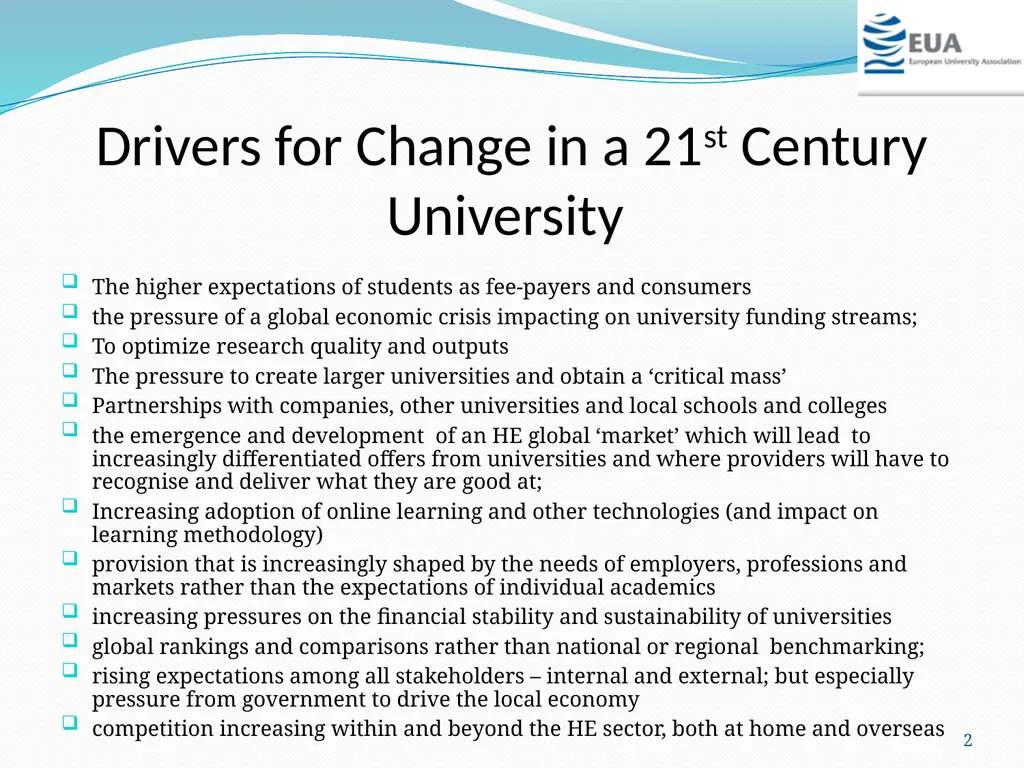
slide2. Drivers for Change in a 21st Century University The higher expectations of students as fee-payers and consumers
the pressure of a global economic crisis impacting on university funding streams;
To optimize research quality and outputs
The pressure to create larger universities and obtain a ‘critical mass’
Partnerships with companies, other universities and local schools and colleges
the emergence and development of an HE global ‘market’ which will lead to increasingly differentiated offers from universities and where providers will have to recognise and deliver what they are good at;
Increasing adoption of online learning and other technologies (and impact on learning methodology)
provision that is increasingly shaped by the needs of employers, professions and markets rather than the expectations of individual academics
increasing pressures on the financial stability and sustainability of universities
global rankings and comparisons rather than national or regional benchmarking;
rising expectations among all stakeholders – internal and external; but especially pressure from government to drive the local economy
competition increasing within and beyond the HE sector, both at home and overseas 2<br>
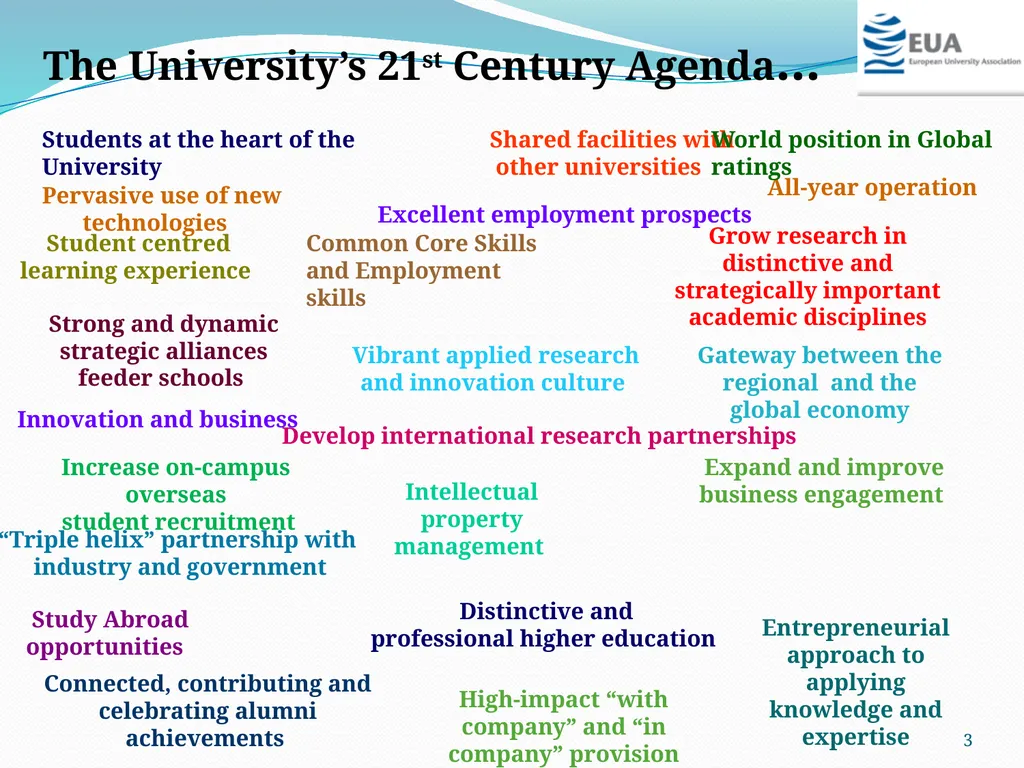
slide3. The University’s 21st Century Agenda... Students at the heart of the University All-year operation Student centred
learning experience Connected, contributing and celebrating alumni achievements Distinctive and
professional higher education “Triple helix” partnership with
industry and government Gateway between the regional and the global economy Common Core Skills and Employment skills Vibrant applied research and innovation culture Grow research in distinctive and strategically important academic disciplines Entrepreneurial approach to applying knowledge and expertise Innovation and business Strong and dynamic strategic alliances feeder schools Expand and improve business engagement Intellectual property management High-impact “with company” and “in company” provision Shared facilities with
other universities Pervasive use of new technologies Increase on-campus overseas
student recruitment Study Abroad
opportunities Develop international research partnerships Excellent employment prospects World position in Global ratings 3<br>
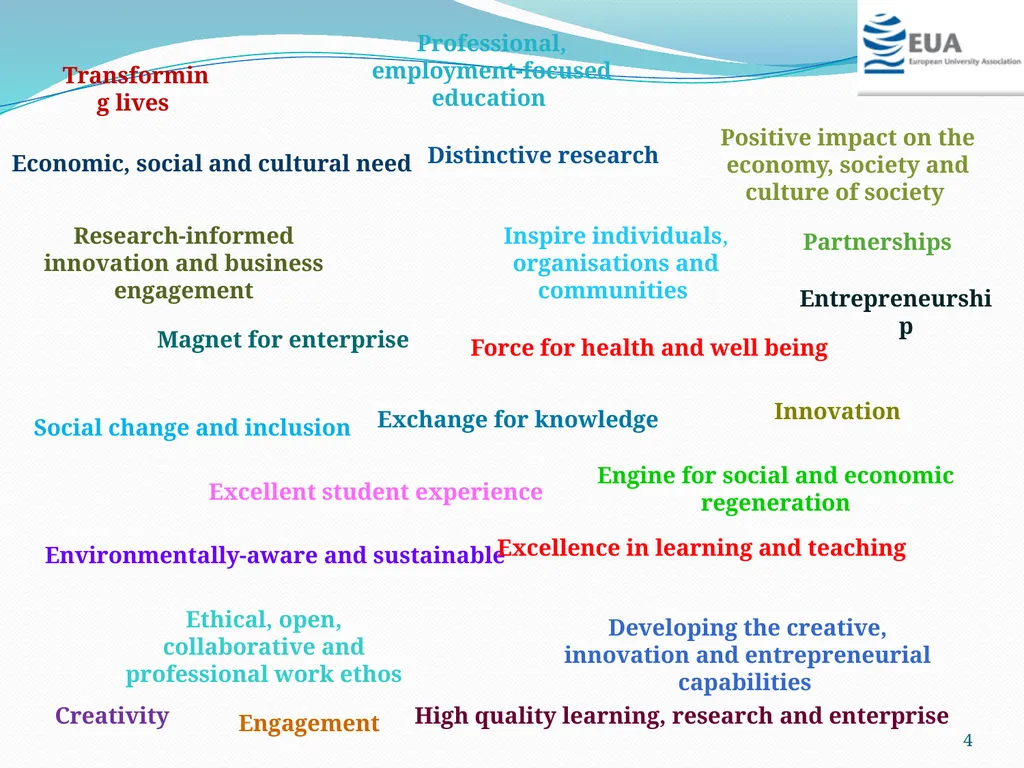
slide4. Research-informed innovation and business engagement Entrepreneurship Transforming lives Professional, employment-focused education Innovation Distinctive research Economic, social and cultural need Inspire individuals, organisations and communities High quality learning, research and enterprise Developing the creative, innovation and entrepreneurial capabilities Social change and inclusion Positive impact on the economy, society and culture of society Engagement Ethical, open, collaborative and professional work ethos Environmentally-aware and sustainable Excellent student experience Exchange for knowledge Magnet for enterprise Excellence in learning and teaching Creativity Engine for social and economic regeneration Force for health and well being Partnerships 4<br>
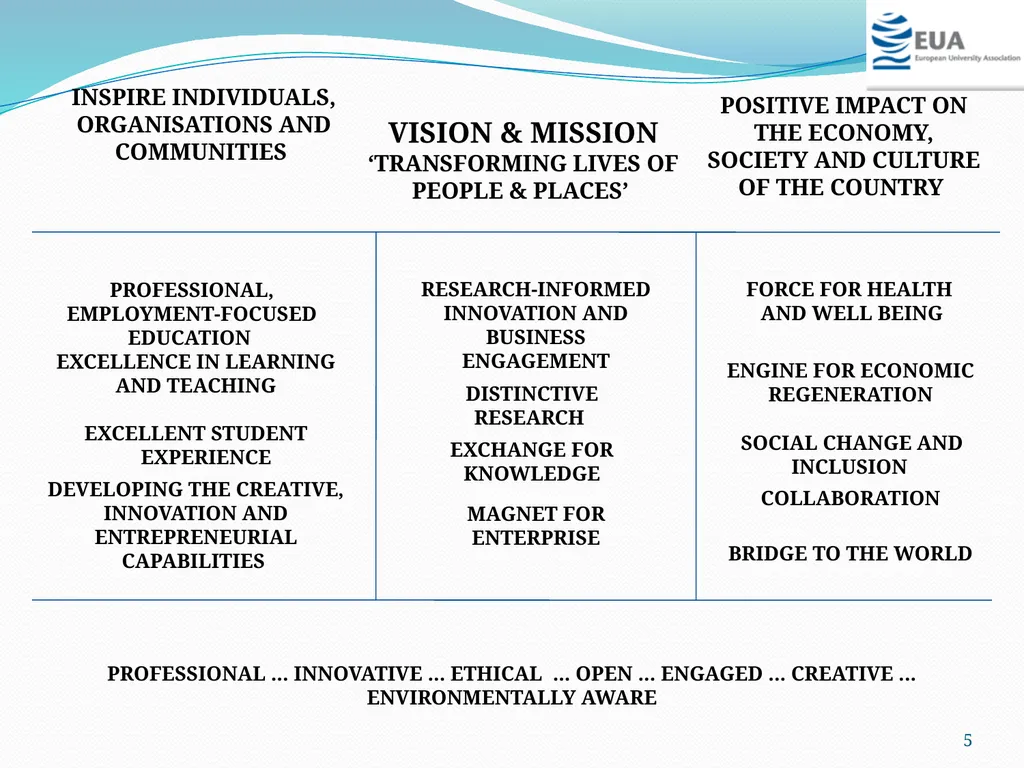
slide5. VISION & mission
‘Transforming lives OF PEOPLE & PLACES’ Inspire individuals, organisations and communities Positive impact on the economy, society and culture of THE COUNTRY Professional ... Innovative ... Ethical ... open ... Engaged ... Creative ... Environmentally Aware 5<br>
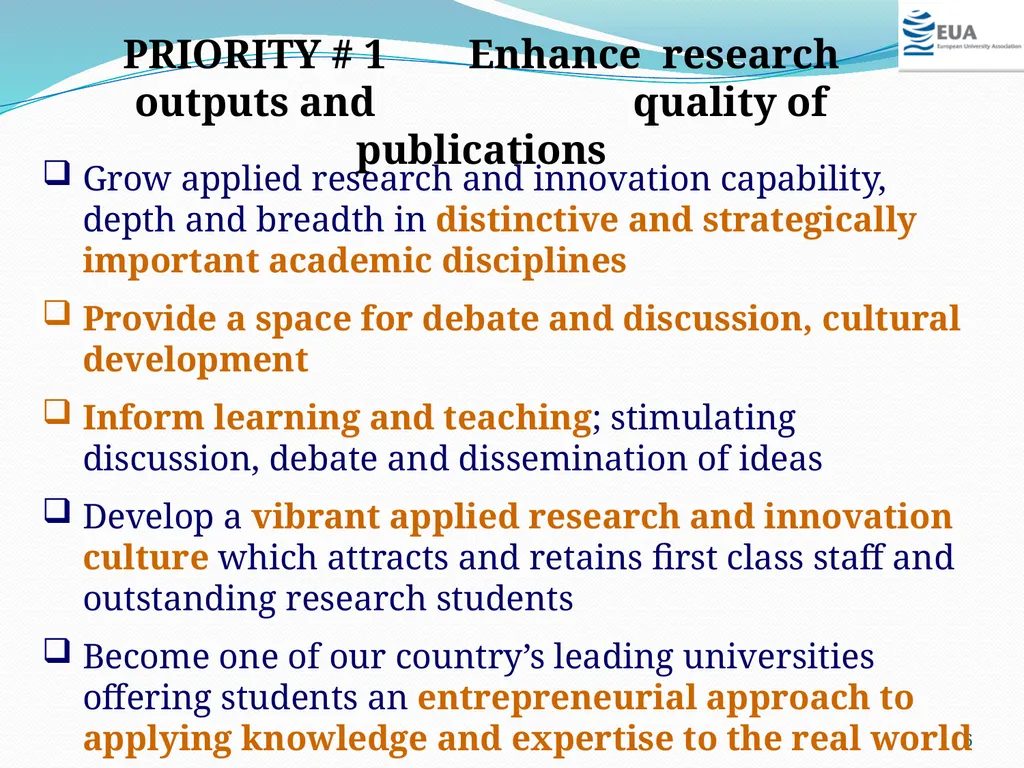
slide6. PRIORITY # 1 Enhance research outputs and quality of publications Grow applied research and innovation capability, depth and breadth in distinctive and strategically important academic disciplines
Provide a space for debate and discussion, cultural development
Inform learning and teaching; stimulating discussion, debate and dissemination of ideas
Develop a vibrant applied research and innovation culture which attracts and retains first class staff and outstanding research students
Become one of our country’s leading universities offering students an entrepreneurial approach to applying knowledge and expertise to the real world 6<br>
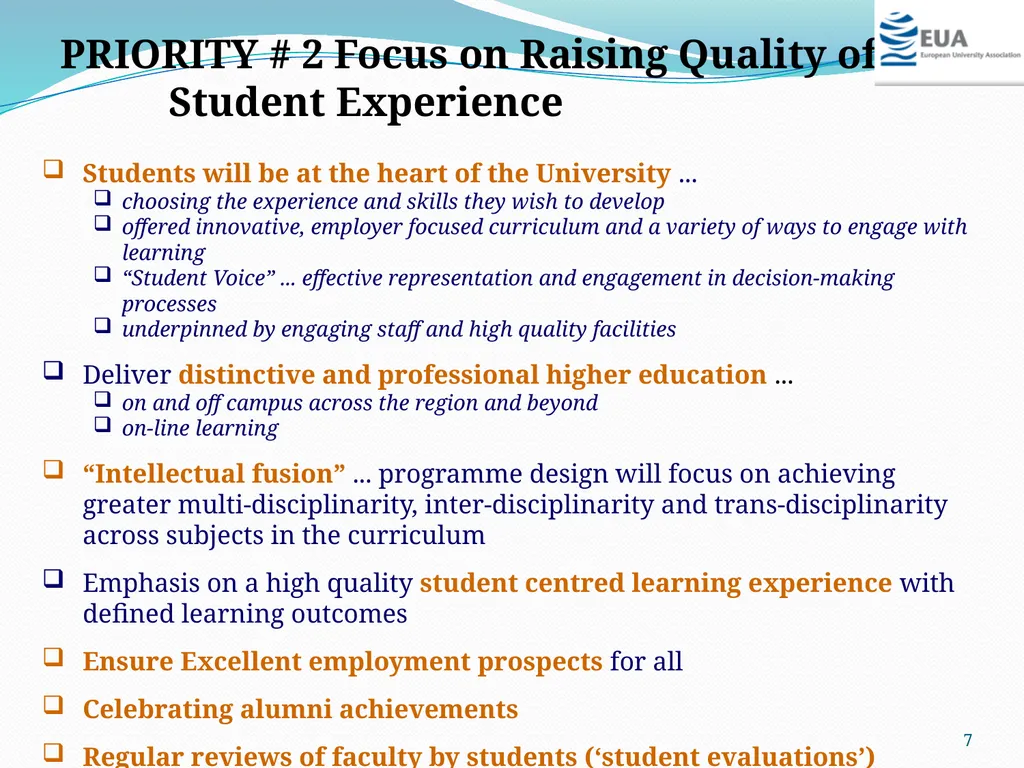
slide7. PRIORITY # 2 Focus on Raising Quality of Student Experience Students will be at the heart of the University ...
choosing the experience and skills they wish to develop
offered innovative, employer focused curriculum and a variety of ways to engage with learning
“Student Voice” ... effective representation and engagement in decision-making processes
underpinned by engaging staff and high quality facilities
Deliver distinctive and professional higher education ...
on and off campus across the region and beyond
on-line learning
“Intellectual fusion” ... programme design will focus on achieving greater multi-disciplinarity, inter-disciplinarity and trans-disciplinarity across subjects in the curriculum
Emphasis on a high quality student centred learning experience with defined learning outcomes
Ensure Excellent employment prospects for all
Celebrating alumni achievements
Regular reviews of faculty by students (‘student evaluations’) 7<br>
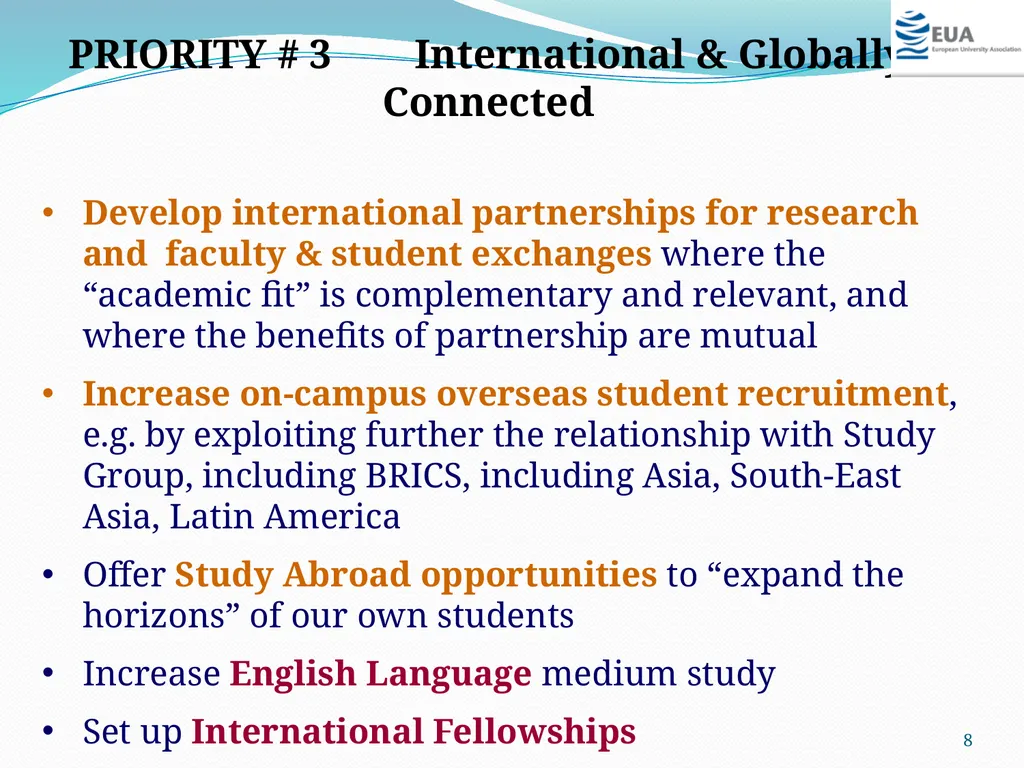
slide8. PRIORITY # 3 International & Globally Connected Develop international partnerships for research and faculty & student exchanges where the “academic fit” is complementary and relevant, and where the benefits of partnership are mutual
Increase on-campus overseas student recruitment, e.g. by exploiting further the relationship with Study Group, including BRICS, including Asia, South-East Asia, Latin America
Offer Study Abroad opportunities to “expand the horizons” of our own students
Increase English Language medium study
Set up International Fellowships 8<br>
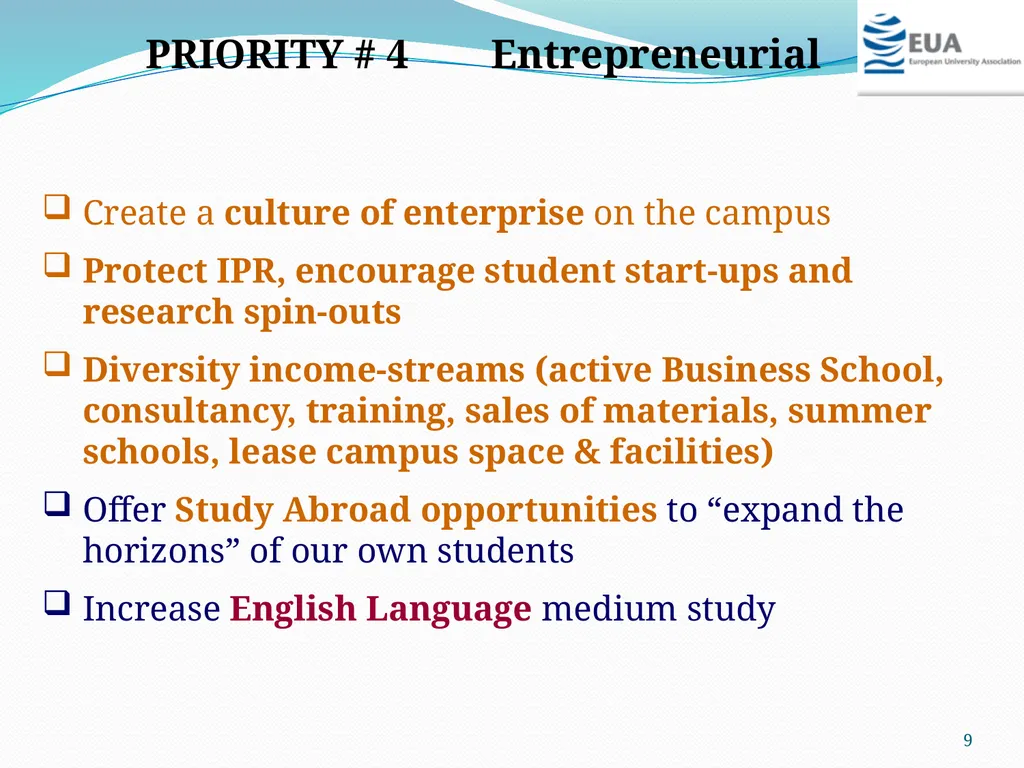
slide9. PRIORITY # 4 Entrepreneurial Create a culture of enterprise on the campus
Protect IPR, encourage student start-ups and research spin-outs
Diversity income-streams (active Business School, consultancy, training, sales of materials, summer schools, lease campus space & facilities)
Offer Study Abroad opportunities to “expand the horizons” of our own students
Increase English Language medium study 9<br>
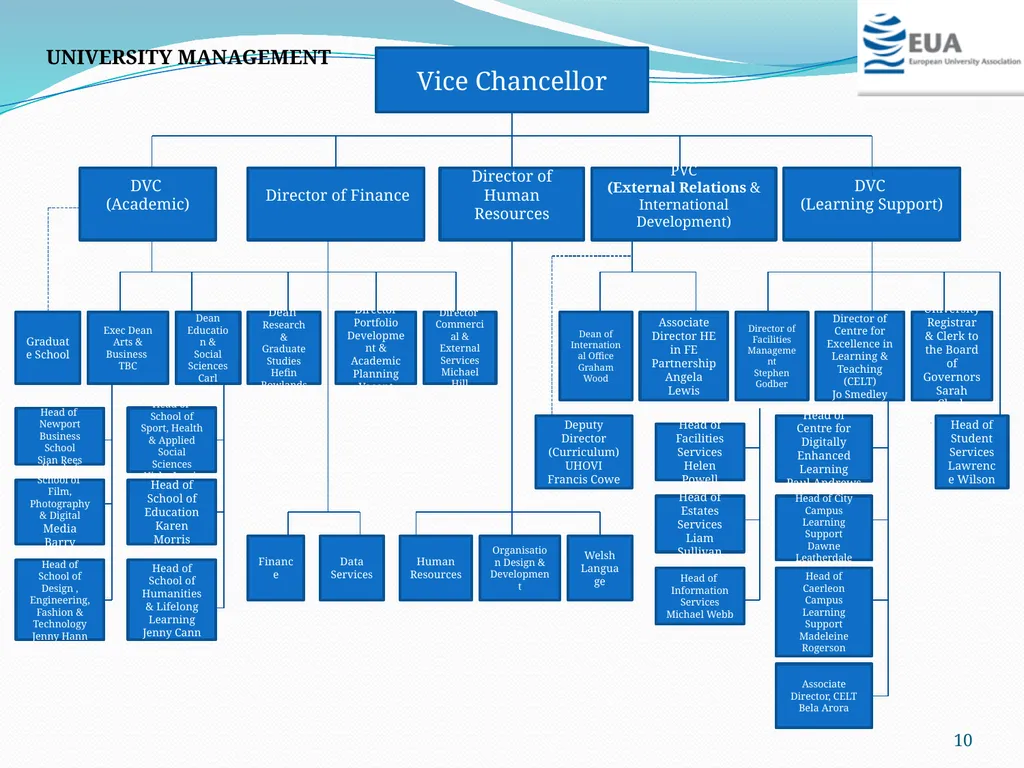
slide10. UNIVERSITY MANAGEMENT Vice Chancellor DVC
(Academic) Director of Finance Director of Human Resources PVC
(External Relations & International Development) DVC
(Learning Support) Exec Dean Arts & Business
TBC Exec Dean Education & Social Sciences
Carl Peters Dean Research & Graduate Studies
Hefin Rowlands Director Portfolio Development & Academic Planning
Vacant Director
Commercial & External Services
Michael Hill Dean of International Office
Graham Wood Director of Facilities Management
Stephen Godber Director of Centre for Excellence in Learning & Teaching (CELT)
Jo Smedley University Registrar & Clerk to the Board of Governors
Sarah Clark Head of Newport Business School
Sian Rees Head of School of Film, Photography & Digital Media
Barry Atkins Head of Facilities Services
Helen Powell Head of Estates Services
Liam Sullivan Head of
Information Services
Michael Webb Head of Centre for Digitally Enhanced Learning
Paul Andrews Head of City Campus Learning Support
Dawne Leatherdale Head of Caerleon Campus Learning Support
Madeleine Rogerson Head of Student Services
Lawrence Wilson Graduate School Associate Director HE in FE Partnership
Angela Lewis Deputy Director (Curriculum) UHOVI
Francis Cowe Head of School of Design , Engineering, Fashion & Technology
Jenny Hann Head of School of Sport, Health & Applied Social Sciences
Nicky Lewis Head of School of Education
Karen Morris Head of School of Humanities & Lifelong Learning
Jenny Cann Finance Data Services Human Resources Organisation Design & Development Welsh Language Associate Director, CELT
Bela Arora 10<br>
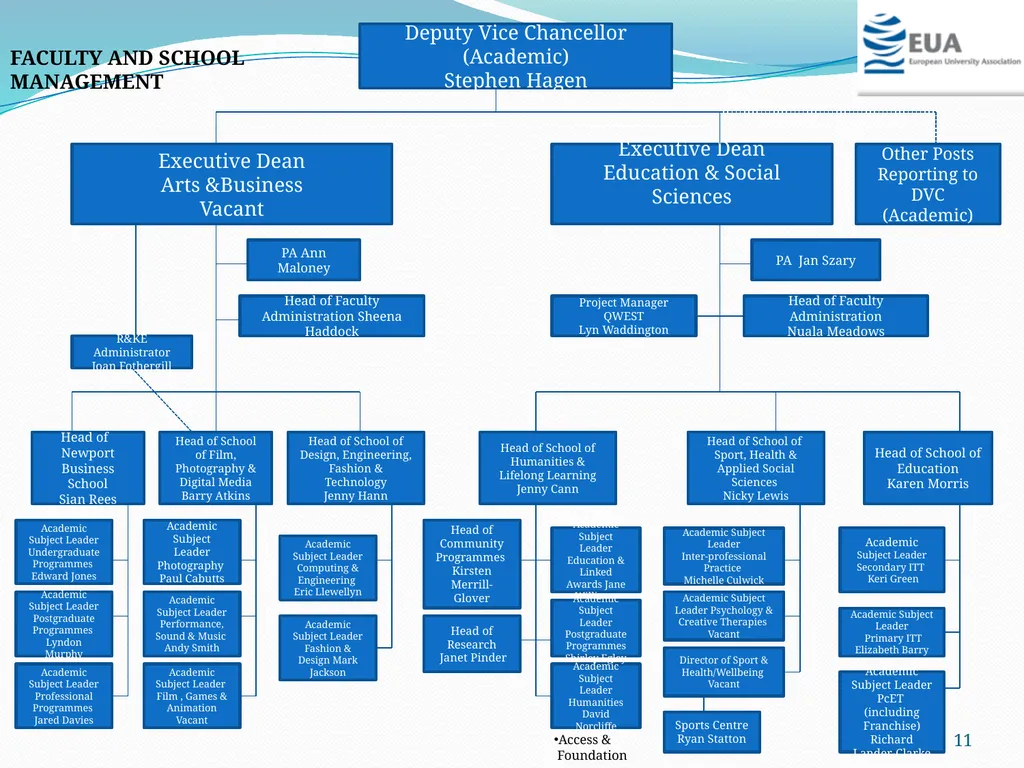
slide11. FACULTY AND SCHOOL MANAGEMENT Deputy Vice Chancellor (Academic)
Stephen Hagen Executive Dean
Arts &Business
Vacant Executive Dean
Education & Social Sciences Head of Newport Business School
Sian Rees Head of School of Film, Photography & Digital Media
Barry Atkins Head of School of Design, Engineering, Fashion & Technology
Jenny Hann Head of School of Education
Karen Morris Head of School of Sport, Health & Applied Social Sciences
Nicky Lewis Head of School of Humanities & Lifelong Learning
Jenny Cann Head of Faculty Administration Sheena Haddock Head of Faculty Administration
Nuala Meadows Head of Research
Janet Pinder Head of Community Programmes
Kirsten Merrill-
Glover Academic Subject Leader
Undergraduate Programmes
Edward Jones Academic Subject Leader
Postgraduate Programmes
Lyndon Murphy Academic Subject Leader
Photography
Paul Cabutts Academic Subject Leader
Performance,
Sound & Music
Andy Smith Academic Subject Leader
Computing & Engineering
Eric Llewellyn Academic Subject Leader
Fashion & Design Mark Jackson Academic Subject Leader
Secondary ITT
Keri Green Academic Subject Leader
Primary ITT Elizabeth Barry Academic Subject Leader
Inter-professional Practice
Michelle Culwick Project Manager QWEST
Lyn Waddington Academic Subject Leader PcET (including Franchise) Richard Lander-Clarke Director of Sport & Health/Wellbeing
Vacant Sports Centre
Ryan Statton Access &
Foundation Other Posts Reporting to DVC (Academic) Academic Subject Leader
Professional Programmes
Jared Davies Academic Subject Leader Humanities David Norcliffe Academic Subject Leader Psychology & Creative Therapies
Vacant Academic Subject Leader Education & Linked Awards Jane Williams Academic Subject Leader Postgraduate Programmes Shirley Egley Academic Subject Leader
Film , Games & Animation
Vacant PA Ann Maloney PA Jan Szary R&KE Administrator
Joan Fothergill 11<br>
slide12. THE ROLE OF THE DEPUTY VICE-CHANCELLOR FOR FACILITIES, LEARNING SUPPORT AND REGISTRY Deputy Vice Chancellor
(Learning Support) Director of Facilities and Campus Management Director of Learning & Teaching University Registrar Head of Centre for Digitally Enhanced Learning Head of City Campus Learning Support Head of Caerleon Campus Learning Supportn Head of Student Services & careers Head of Quality Support Head of Student Records
Debb Baff Head of Student Experience Study Advice
Tutors
Library Staff Careers Services
Purchasing
administrator
Regional Dev’t
Officer
Library Staff Quality Officers Head of Admissions & Enrolment
Kath Birden Curriculum Officer
Dirk Bieber Admissions & Enrolment Administrator
Sian Hossington
Lyne Pope
Colin Morgan
Michelle Alyeo-Thomas
Andy Prescott
Maria Smart Assessment Officer
Marc Turner Assessment & Awards Admin
Mary Davies/
Joanne Paling Deputy Head
Student Mentor
Manager
Counsellors
Disability Support
Healthcare
Student Finance Committee Manager
Lesley Douglas Records & Information Manager
Matthew Cooper Administrator
X 1.5 FTE
Kay Cashman
Julie Wallen Chair of Board of Governors 12<br>
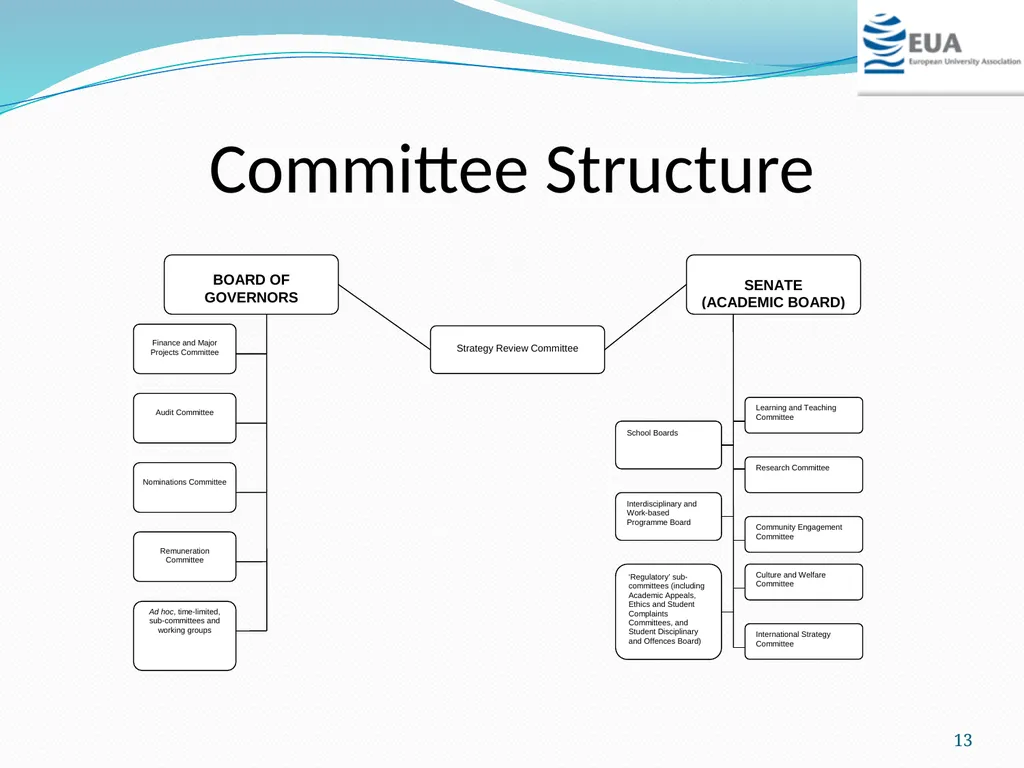
slide13. Committee Structure 13<br>
slide14. Relationship between Management Structure and Academic Board and its Sub Committees Academic Board is chaired by the Rector and the main policy sub committees are each chaired by a member of Senior Management Committee thus maintaining a conduit between the College’s executive structure and its deliberative and consultative fora.
The organisational sub committees (i.e. Faculty Committees) are chaired by Heads of Faculty.
Heads of service relevant to the deliberations of these Committees also attend or delegate a member of staff to attend.
Course Committees are chaired by the Subject Leader responsible for the course.
Heads of Faculty attend Course Committees are members are representative of service areas (academic registry, quality team, marketing etc.) relevant to the course’s operation. 14<br>
slide15. Deans of Faculty The Head of Faculty is responsible for the leadership and overall management of the provision within a Faculty. Duties include:
managing the Subject Leaders in the Faculty, conducting annual appraisal reviews and ensuring that Faculty staff have appropriate staff development (supported by Human Resources);
leading and coordinating academic planning and development in the Faculty (in consultation with Management Committee and in line with the strategic plan);
managing the Faculty budget and ensuring the effective utilisation of the Faculty’s resources (supported by Business Support);
representing the Faculty ex officio on Academic Board and its Sub Committees;
chairing the Faculty Committee, taking an overview of the quality and standards of the provision in the Faculty and ensuring that College policies and procedures are being implemented;
liaising with College support services in respect of the Faculty’s needs. 15<br>
slide16. Course Leaders Each course has a designated Subject Leader who is responsible for its day-to-day course leadership. Subject Leaders line manage the Senior Lecturers, Lecturers and Sessional Lecturers primarily involved in teaching students on the course(s) for which they are responsible. Subject Leaders are responsible for ensuring the efficient and effective discharge of the responsibilities of all course contributors in the provision of teaching, learning support and assessment.
Their duties include:
ensuring the effective organisation and timetabling of the course (supported by Business Support);
implementing the University’s policies and regulations (supported by the Quality Team/Registry);
leading the academic development of the course and preparing course documentation for internal and external validation (supported by the Quality Team);
interviewing and selecting students for admissions (supported by Registry) and organising the course based induction;
organising the election of Student Course Representatives and liaising with these representatives (supported by the Quality Team);
Chairing the Course Committee (supported by the Quality Team);
monitoring and evaluating continuously the quality and standards of the student experience and outcomes, and providing the Annual Course Monitoring Report on the quality and standards of the course (supported by the Quality Team and Registry/MIS);
gathering student feedback about the course and its constituent units (supported by the Quality Team); 16<br>
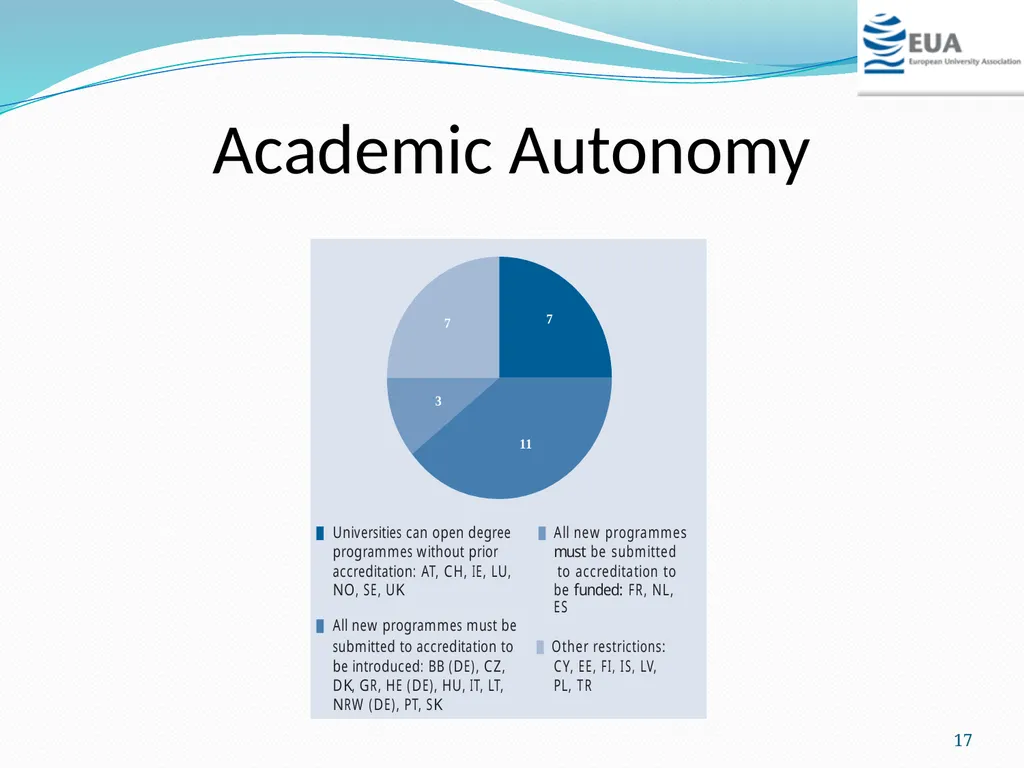
slide17. Academic Autonomy 17<br>
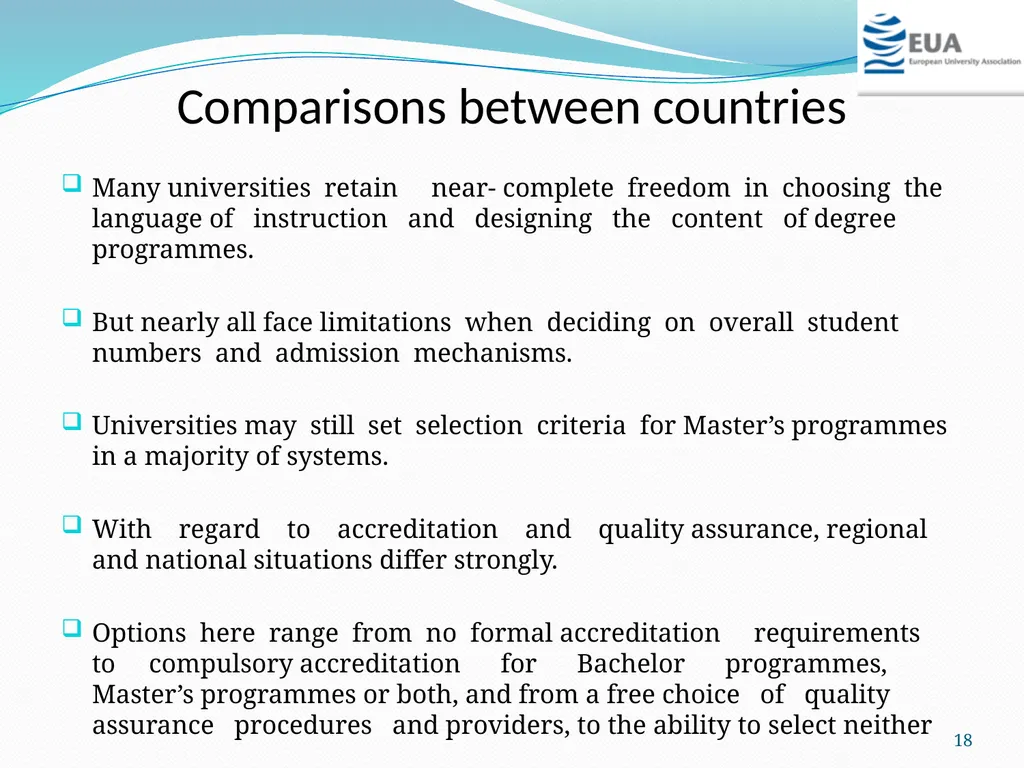
slide18. Comparisons between countries Many universities retain near- complete freedom in choosing the language of instruction and designing the content of degree programmes.
But nearly all face limitations when deciding on overall student numbers and admission mechanisms.
Universities may still set selection criteria for Master’s programmes in a majority of systems.
With regard to accreditation and quality assurance, regional and national situations differ strongly.
Options here range from no formal accreditation requirements to compulsory accreditation for Bachelor programmes, Master’s programmes or both, and from a free choice of quality assurance procedures and providers, to the ability to select neither 18<br>
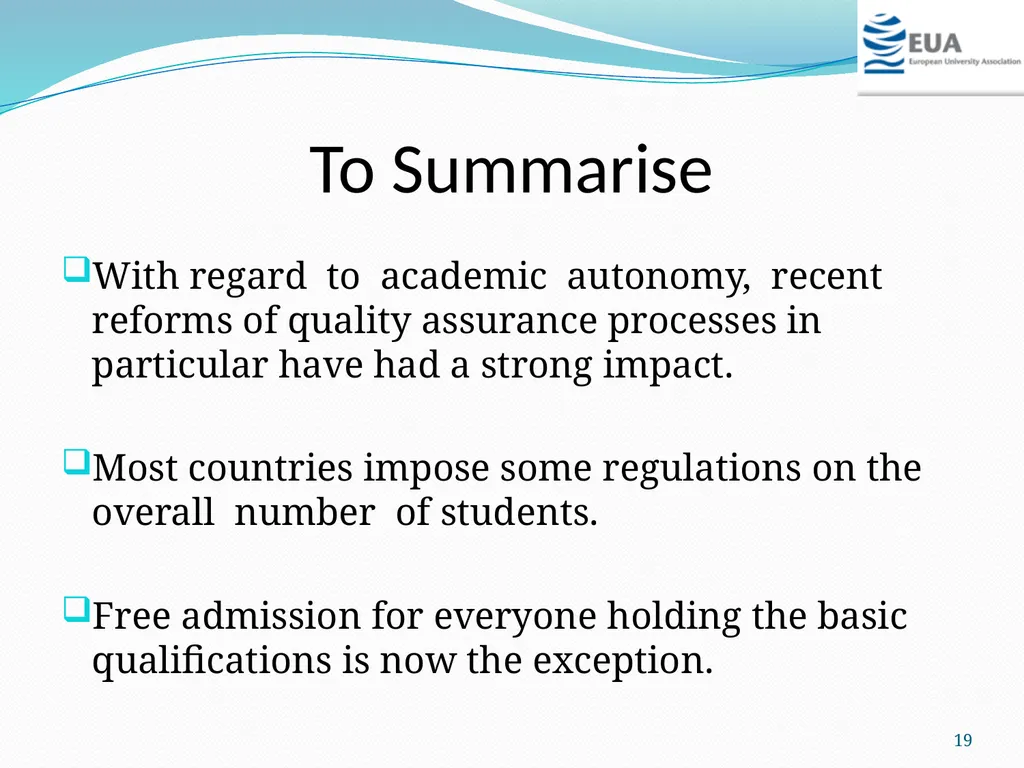
slide19. To Summarise With regard to academic autonomy, recent reforms of quality assurance processes in particular have had a strong impact.
Most countries impose some regulations on the overall number of students.
Free admission for everyone holding the basic qualifications is now the exception. 19<br>
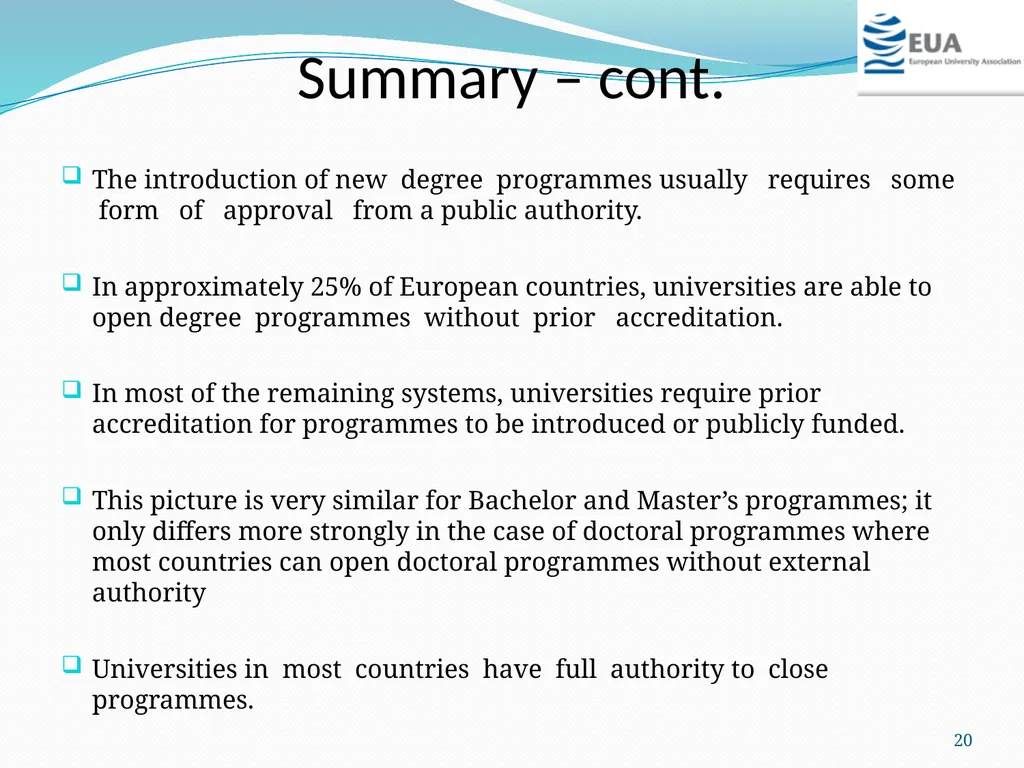
slide20. Summary – cont. The introduction of new degree programmes usually requires some form of approval from a public authority.
In approximately 25% of European countries, universities are able to open degree programmes without prior accreditation.
In most of the remaining systems, universities require prior accreditation for programmes to be introduced or publicly funded.
This picture is very similar for Bachelor and Master’s programmes; it only differs more strongly in the case of doctoral programmes where most countries can open doctoral programmes without external authority
Universities in most countries have full authority to close programmes. 20<br>
slide21. Conclusions Universities are restructuring their Faculties and Departments often to reflect the Agenda for the 21st Century
The agenda is global, student-oriented, economically-driven and research-led
Future reforms should focus on giving universities greater freedom in setting their own admission criteria and setting fees.
The trend is increasingly towards academic autonomy, linked to strong external quality assurance mechanisms.
It will also be crucial to find the right balance between autonomy and accountability by promoting institutional audits or evaluations of internal quality processes. 21<br>
slide2. Drivers for Change in a 21st Century University The higher expectations of students as fee-payers and consumers
the pressure of a global economic crisis impacting on university funding streams;
To optimize research quality and outputs
The pressure to create larger universities and obtain a ‘critical mass’
Partnerships with companies, other universities and local schools and colleges
the emergence and development of an HE global ‘market’ which will lead to increasingly differentiated offers from universities and where providers will have to recognise and deliver what they are good at;
Increasing adoption of online learning and other technologies (and impact on learning methodology)
provision that is increasingly shaped by the needs of employers, professions and markets rather than the expectations of individual academics
increasing pressures on the financial stability and sustainability of universities
global rankings and comparisons rather than national or regional benchmarking;
rising expectations among all stakeholders – internal and external; but especially pressure from government to drive the local economy
competition increasing within and beyond the HE sector, both at home and overseas 2<br>
slide3. The University’s 21st Century Agenda... Students at the heart of the University All-year operation Student centred
learning experience Connected, contributing and celebrating alumni achievements Distinctive and
professional higher education “Triple helix” partnership with
industry and government Gateway between the regional and the global economy Common Core Skills and Employment skills Vibrant applied research and innovation culture Grow research in distinctive and strategically important academic disciplines Entrepreneurial approach to applying knowledge and expertise Innovation and business Strong and dynamic strategic alliances feeder schools Expand and improve business engagement Intellectual property management High-impact “with company” and “in company” provision Shared facilities with
other universities Pervasive use of new technologies Increase on-campus overseas
student recruitment Study Abroad
opportunities Develop international research partnerships Excellent employment prospects World position in Global ratings 3<br>
slide4. Research-informed innovation and business engagement Entrepreneurship Transforming lives Professional, employment-focused education Innovation Distinctive research Economic, social and cultural need Inspire individuals, organisations and communities High quality learning, research and enterprise Developing the creative, innovation and entrepreneurial capabilities Social change and inclusion Positive impact on the economy, society and culture of society Engagement Ethical, open, collaborative and professional work ethos Environmentally-aware and sustainable Excellent student experience Exchange for knowledge Magnet for enterprise Excellence in learning and teaching Creativity Engine for social and economic regeneration Force for health and well being Partnerships 4<br>
slide5. VISION & mission
‘Transforming lives OF PEOPLE & PLACES’ Inspire individuals, organisations and communities Positive impact on the economy, society and culture of THE COUNTRY Professional ... Innovative ... Ethical ... open ... Engaged ... Creative ... Environmentally Aware 5<br>
slide6. PRIORITY # 1 Enhance research outputs and quality of publications Grow applied research and innovation capability, depth and breadth in distinctive and strategically important academic disciplines
Provide a space for debate and discussion, cultural development
Inform learning and teaching; stimulating discussion, debate and dissemination of ideas
Develop a vibrant applied research and innovation culture which attracts and retains first class staff and outstanding research students
Become one of our country’s leading universities offering students an entrepreneurial approach to applying knowledge and expertise to the real world 6<br>
slide7. PRIORITY # 2 Focus on Raising Quality of Student Experience Students will be at the heart of the University ...
choosing the experience and skills they wish to develop
offered innovative, employer focused curriculum and a variety of ways to engage with learning
“Student Voice” ... effective representation and engagement in decision-making processes
underpinned by engaging staff and high quality facilities
Deliver distinctive and professional higher education ...
on and off campus across the region and beyond
on-line learning
“Intellectual fusion” ... programme design will focus on achieving greater multi-disciplinarity, inter-disciplinarity and trans-disciplinarity across subjects in the curriculum
Emphasis on a high quality student centred learning experience with defined learning outcomes
Ensure Excellent employment prospects for all
Celebrating alumni achievements
Regular reviews of faculty by students (‘student evaluations’) 7<br>
slide8. PRIORITY # 3 International & Globally Connected Develop international partnerships for research and faculty & student exchanges where the “academic fit” is complementary and relevant, and where the benefits of partnership are mutual
Increase on-campus overseas student recruitment, e.g. by exploiting further the relationship with Study Group, including BRICS, including Asia, South-East Asia, Latin America
Offer Study Abroad opportunities to “expand the horizons” of our own students
Increase English Language medium study
Set up International Fellowships 8<br>
slide9. PRIORITY # 4 Entrepreneurial Create a culture of enterprise on the campus
Protect IPR, encourage student start-ups and research spin-outs
Diversity income-streams (active Business School, consultancy, training, sales of materials, summer schools, lease campus space & facilities)
Offer Study Abroad opportunities to “expand the horizons” of our own students
Increase English Language medium study 9<br>
slide10. UNIVERSITY MANAGEMENT Vice Chancellor DVC
(Academic) Director of Finance Director of Human Resources PVC
(External Relations & International Development) DVC
(Learning Support) Exec Dean Arts & Business
TBC Exec Dean Education & Social Sciences
Carl Peters Dean Research & Graduate Studies
Hefin Rowlands Director Portfolio Development & Academic Planning
Vacant Director
Commercial & External Services
Michael Hill Dean of International Office
Graham Wood Director of Facilities Management
Stephen Godber Director of Centre for Excellence in Learning & Teaching (CELT)
Jo Smedley University Registrar & Clerk to the Board of Governors
Sarah Clark Head of Newport Business School
Sian Rees Head of School of Film, Photography & Digital Media
Barry Atkins Head of Facilities Services
Helen Powell Head of Estates Services
Liam Sullivan Head of
Information Services
Michael Webb Head of Centre for Digitally Enhanced Learning
Paul Andrews Head of City Campus Learning Support
Dawne Leatherdale Head of Caerleon Campus Learning Support
Madeleine Rogerson Head of Student Services
Lawrence Wilson Graduate School Associate Director HE in FE Partnership
Angela Lewis Deputy Director (Curriculum) UHOVI
Francis Cowe Head of School of Design , Engineering, Fashion & Technology
Jenny Hann Head of School of Sport, Health & Applied Social Sciences
Nicky Lewis Head of School of Education
Karen Morris Head of School of Humanities & Lifelong Learning
Jenny Cann Finance Data Services Human Resources Organisation Design & Development Welsh Language Associate Director, CELT
Bela Arora 10<br>
slide11. FACULTY AND SCHOOL MANAGEMENT Deputy Vice Chancellor (Academic)
Stephen Hagen Executive Dean
Arts &Business
Vacant Executive Dean
Education & Social Sciences Head of Newport Business School
Sian Rees Head of School of Film, Photography & Digital Media
Barry Atkins Head of School of Design, Engineering, Fashion & Technology
Jenny Hann Head of School of Education
Karen Morris Head of School of Sport, Health & Applied Social Sciences
Nicky Lewis Head of School of Humanities & Lifelong Learning
Jenny Cann Head of Faculty Administration Sheena Haddock Head of Faculty Administration
Nuala Meadows Head of Research
Janet Pinder Head of Community Programmes
Kirsten Merrill-
Glover Academic Subject Leader
Undergraduate Programmes
Edward Jones Academic Subject Leader
Postgraduate Programmes
Lyndon Murphy Academic Subject Leader
Photography
Paul Cabutts Academic Subject Leader
Performance,
Sound & Music
Andy Smith Academic Subject Leader
Computing & Engineering
Eric Llewellyn Academic Subject Leader
Fashion & Design Mark Jackson Academic Subject Leader
Secondary ITT
Keri Green Academic Subject Leader
Primary ITT Elizabeth Barry Academic Subject Leader
Inter-professional Practice
Michelle Culwick Project Manager QWEST
Lyn Waddington Academic Subject Leader PcET (including Franchise) Richard Lander-Clarke Director of Sport & Health/Wellbeing
Vacant Sports Centre
Ryan Statton Access &
Foundation Other Posts Reporting to DVC (Academic) Academic Subject Leader
Professional Programmes
Jared Davies Academic Subject Leader Humanities David Norcliffe Academic Subject Leader Psychology & Creative Therapies
Vacant Academic Subject Leader Education & Linked Awards Jane Williams Academic Subject Leader Postgraduate Programmes Shirley Egley Academic Subject Leader
Film , Games & Animation
Vacant PA Ann Maloney PA Jan Szary R&KE Administrator
Joan Fothergill 11<br>
slide12. THE ROLE OF THE DEPUTY VICE-CHANCELLOR FOR FACILITIES, LEARNING SUPPORT AND REGISTRY Deputy Vice Chancellor
(Learning Support) Director of Facilities and Campus Management Director of Learning & Teaching University Registrar Head of Centre for Digitally Enhanced Learning Head of City Campus Learning Support Head of Caerleon Campus Learning Supportn Head of Student Services & careers Head of Quality Support Head of Student Records
Debb Baff Head of Student Experience Study Advice
Tutors
Library Staff Careers Services
Purchasing
administrator
Regional Dev’t
Officer
Library Staff Quality Officers Head of Admissions & Enrolment
Kath Birden Curriculum Officer
Dirk Bieber Admissions & Enrolment Administrator
Sian Hossington
Lyne Pope
Colin Morgan
Michelle Alyeo-Thomas
Andy Prescott
Maria Smart Assessment Officer
Marc Turner Assessment & Awards Admin
Mary Davies/
Joanne Paling Deputy Head
Student Mentor
Manager
Counsellors
Disability Support
Healthcare
Student Finance Committee Manager
Lesley Douglas Records & Information Manager
Matthew Cooper Administrator
X 1.5 FTE
Kay Cashman
Julie Wallen Chair of Board of Governors 12<br>
slide13. Committee Structure 13<br>
slide14. Relationship between Management Structure and Academic Board and its Sub Committees Academic Board is chaired by the Rector and the main policy sub committees are each chaired by a member of Senior Management Committee thus maintaining a conduit between the College’s executive structure and its deliberative and consultative fora.
The organisational sub committees (i.e. Faculty Committees) are chaired by Heads of Faculty.
Heads of service relevant to the deliberations of these Committees also attend or delegate a member of staff to attend.
Course Committees are chaired by the Subject Leader responsible for the course.
Heads of Faculty attend Course Committees are members are representative of service areas (academic registry, quality team, marketing etc.) relevant to the course’s operation. 14<br>
slide15. Deans of Faculty The Head of Faculty is responsible for the leadership and overall management of the provision within a Faculty. Duties include:
managing the Subject Leaders in the Faculty, conducting annual appraisal reviews and ensuring that Faculty staff have appropriate staff development (supported by Human Resources);
leading and coordinating academic planning and development in the Faculty (in consultation with Management Committee and in line with the strategic plan);
managing the Faculty budget and ensuring the effective utilisation of the Faculty’s resources (supported by Business Support);
representing the Faculty ex officio on Academic Board and its Sub Committees;
chairing the Faculty Committee, taking an overview of the quality and standards of the provision in the Faculty and ensuring that College policies and procedures are being implemented;
liaising with College support services in respect of the Faculty’s needs. 15<br>
slide16. Course Leaders Each course has a designated Subject Leader who is responsible for its day-to-day course leadership. Subject Leaders line manage the Senior Lecturers, Lecturers and Sessional Lecturers primarily involved in teaching students on the course(s) for which they are responsible. Subject Leaders are responsible for ensuring the efficient and effective discharge of the responsibilities of all course contributors in the provision of teaching, learning support and assessment.
Their duties include:
ensuring the effective organisation and timetabling of the course (supported by Business Support);
implementing the University’s policies and regulations (supported by the Quality Team/Registry);
leading the academic development of the course and preparing course documentation for internal and external validation (supported by the Quality Team);
interviewing and selecting students for admissions (supported by Registry) and organising the course based induction;
organising the election of Student Course Representatives and liaising with these representatives (supported by the Quality Team);
Chairing the Course Committee (supported by the Quality Team);
monitoring and evaluating continuously the quality and standards of the student experience and outcomes, and providing the Annual Course Monitoring Report on the quality and standards of the course (supported by the Quality Team and Registry/MIS);
gathering student feedback about the course and its constituent units (supported by the Quality Team); 16<br>
slide17. Academic Autonomy 17<br>
slide18. Comparisons between countries Many universities retain near- complete freedom in choosing the language of instruction and designing the content of degree programmes.
But nearly all face limitations when deciding on overall student numbers and admission mechanisms.
Universities may still set selection criteria for Master’s programmes in a majority of systems.
With regard to accreditation and quality assurance, regional and national situations differ strongly.
Options here range from no formal accreditation requirements to compulsory accreditation for Bachelor programmes, Master’s programmes or both, and from a free choice of quality assurance procedures and providers, to the ability to select neither 18<br>
slide19. To Summarise With regard to academic autonomy, recent reforms of quality assurance processes in particular have had a strong impact.
Most countries impose some regulations on the overall number of students.
Free admission for everyone holding the basic qualifications is now the exception. 19<br>
slide20. Summary – cont. The introduction of new degree programmes usually requires some form of approval from a public authority.
In approximately 25% of European countries, universities are able to open degree programmes without prior accreditation.
In most of the remaining systems, universities require prior accreditation for programmes to be introduced or publicly funded.
This picture is very similar for Bachelor and Master’s programmes; it only differs more strongly in the case of doctoral programmes where most countries can open doctoral programmes without external authority
Universities in most countries have full authority to close programmes. 20<br>
slide21. Conclusions Universities are restructuring their Faculties and Departments often to reflect the Agenda for the 21st Century
The agenda is global, student-oriented, economically-driven and research-led
Future reforms should focus on giving universities greater freedom in setting their own admission criteria and setting fees.
The trend is increasingly towards academic autonomy, linked to strong external quality assurance mechanisms.
It will also be crucial to find the right balance between autonomy and accountability by promoting institutional audits or evaluations of internal quality processes. 21<br>