Family-Staff Partnerships: First Steps
Description: Family-Staff Partnerships: First Steps Partnerships to Improve Care and Quality of Life for Persons with Dementia Training Goals Goals for our series Enhance family involvement in the daily care of their loved ones Promote person-centered
Related Topics
Download Presentation
"Family-Staff Partnerships: First Steps" is the property of its rightful owner. Permission is granted to download and print the materials on this website for personal, non-commercial use only, and to display it on your personal computer provided you do not modify the materials and that you retain all copyright notices contained in the materials. By downloading content from our website, you accept the terms of this agreement.
Presentation Transcript
slide1. Family-Staff Partnerships: First Steps Partnerships to Improve Care and Quality of Life for Persons with Dementia<br>
slide2. Training Goals Goals for our series
Enhance family involvement in the daily care of their loved ones
Promote person-centered care
Goals for today
Review main elements of the Family Involvement in Care (FIC) Intervention
Review steps to implement the intervention with family<br>
slide3. Family Involvement in Care (FIC) Intervention Orient family to the setting and to the idea of partnership
Educate staff Goal of this training series!
Negotiate and form partnership agreement with family
Educate family members about staying involved in care
Evaluate and renegotiate the agreement as needed
Staff play different roles, but ALL need the “Big Picture” to be effective team members!!<br>
slide4. Service Use = Family role change For the last year, I’ve done almost everything for him. I help him bathe and dress, go to the toilet, eat, and put him in bed. When he’s up, I’m up, and often in the middle of night.
It’s strange now. I did so much for so long. Now I don’t know what I’m supposed to do. I don’t want to interfere or bother the staff – after all, I asked for their help. I worry they will do the right things, and hear them saying things I don’t understand. Everything is so different now.<br>
slide5. Benefits of Staff-Family Partnerships Enables staff to learn important details need to personalize care
Helps family learn how to make a positive contribution
Helps staff “educate” families about changes, needs of person
Allows family to help support busy staff
Enhances quality of care to the person with dementia
Satisfaction increases for all involved!<br>
slide6. Consider Family Needs Families who benefit most from partnerships with staff . . .
Have had the most responsibility for care (e.g., spouse, daughter)
Are experiencing new and increasing caregiving demands
Are new to the care setting and/or care provider
Have a poor relationship with the setting and/or provider
Have a prior poor relationships with the person with dementia<br>
slide7. Step 1. Orienting Family Orient to care setting/service
Tour the setting/service
Introduce staff
Review philosophies and policies of the care setting/service
Philosophy of dementia care
Policies about visiting; family participation in care; communicating with families
Staff roles, responsibilities
Availability of resources, supports
Environmental factors (e.g., pets, freedom of movement, activities, access)<br>
slide8. Step 1. Orienting Family, cont. Introduce the idea of a “partnership” between families and staff
Best done by key leader
Discuss family concerns and expectations
Ask one family member to take a “leadership” role in partnership
Sign the form Family and Staff Statement of Partnership Intent
Complete assessments
Family: Characteristics , concerns, expectations
Person with dementia: level of function, needs<br>
slide9. Discussion Questions From/about family members
What would be helpful for staff to know?
What would you like to change?
What would you like to see done differently?
What specific needs does your loved one have?
What are the best ways to meet those needs?
How would you like to be involved?
What do you hope will happen inpartnership with staff?
What concerns do you have aboutthe partnership with staff?
MORE!<br>
slide10. Intervention Assessment Inventory From/about family members
Contact information for “Point-Person” and other family
Family support; other social support
Problems encountered in providing care
Feelings about new care setting/service
Expectations for participating in caregiving
Major concerns about the new service/setting
Expectations for staff
Knowledge of dementia
Current health
Level stress in caregiving role<br>
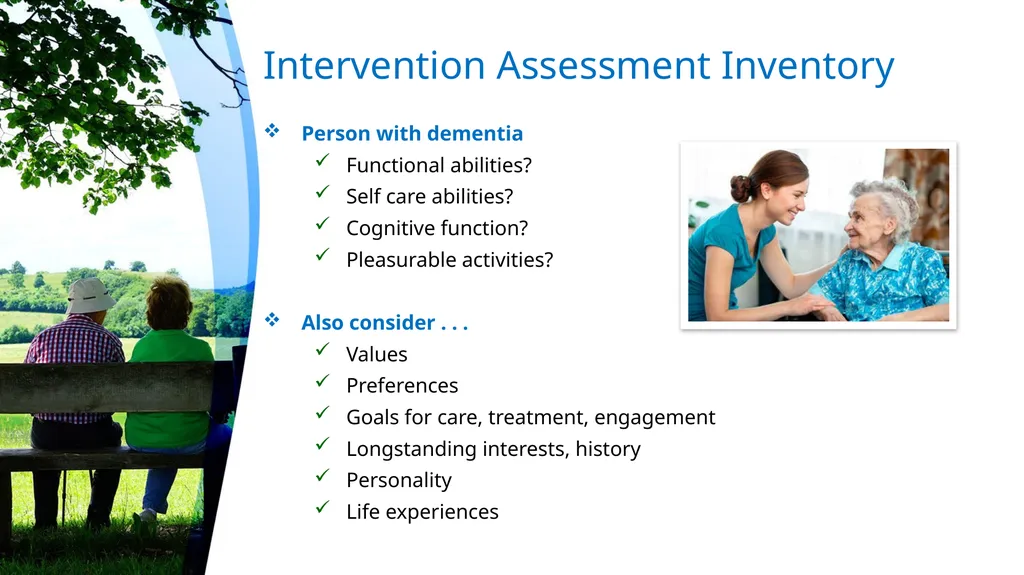
slide11. Intervention Assessment Inventory Person with dementia
Functional abilities?
Self care abilities?
Cognitive function?
Pleasurable activities?
Also consider . . .
Values
Preferences
Goals for care, treatment, engagement
Longstanding interests, history
Personality
Life experiences<br>
slide12. Step 3. Negotiation of Partnership Agreement Partnership Negotiation Session: Dedicated time to work out specifics of the Partnership Agreement
Prepare for the Session
Use information from Assessment Inventory
Identify needs of person with dementia
Include assisting staff (direct care) as much as possible
Share information with family: brochures, activity/resource list
Schedule a mutually agreeable time for the meeting<br>
slide13. Step 3. Negotiation of Agreement, cont. Partnership Negotiation Session
Discuss goals and activities for family AND staff
Identify mutually satisfying approaches
Partnership Agreement
Writing out mutually agreed upon goals and activities
Documenting the family caregiver’s involvement AND staff involvement<br>
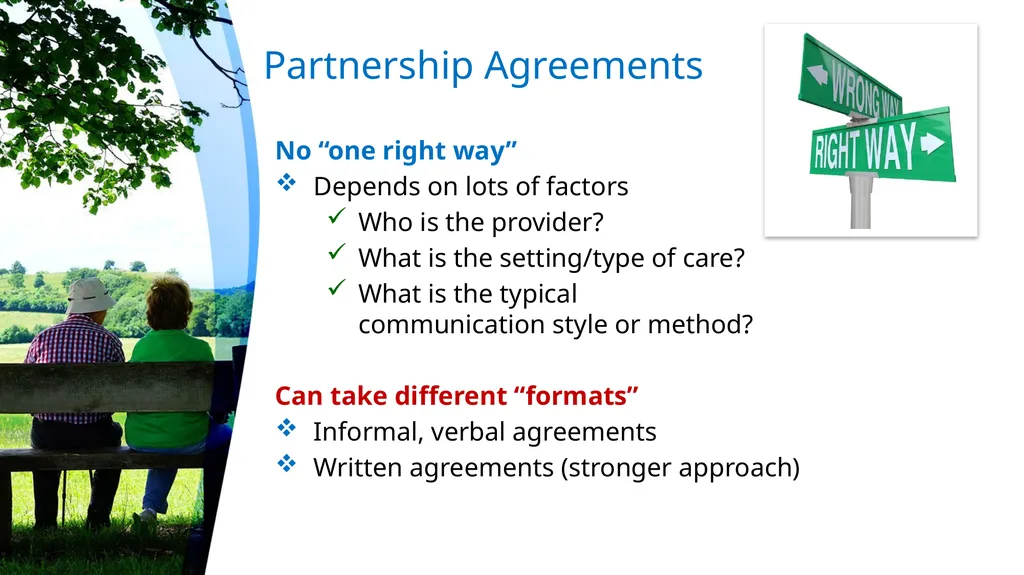
slide14. Partnership Agreements No “one right way”
Depends on lots of factors
Who is the provider?
What is the setting/type of care?
What is the typical communication style or method?
Can take different “formats”
Informal, verbal agreements
Written agreements (stronger approach)<br>
slide15. Partnership Agreements Key elements of an agreement
Health & quality of life needs
Staff & family participants
Specific goals
Specific activities
Physical
Psychosocial/spiritual
Leisure/recreational
Financial
Target outcomes/monitoring<br>
slide16. Partnership Agreement: Example Family and other caregivers have agreed that they are partners in planning, providing, and evaluating care for “Mary Smith.”
Partnership goals include: ___________________
To help reach these goal, “John Smith” will do the following activities: _______________
Other caregivers will do the following activities: ______________
Comments or explanations: _________________
Signatures: Family Caregiver and Staff Caregivers<br>
slide17. Step 4. Educate Family Share information: begins at initial contact, continues throughout partnership
Base education on family needs
Preferred level of involvement
Knowledge of dementia
Concerns, expectations for care
Use the companion training program for family Family Involvement in Care: Advancing Care Partnerships: https://igec.uiowa.edu/fic<br>
slide18. Step 4. Educate Family, cont. Family Resource Manual: Ideas for participating in care
General strategies: caring for persons with dementia
How to approach, give directions, communicate effectively
Therapeutic activities: purpose and procedures
Art therapy, music therapy, reminiscence, therapeutic recreation
Exercise
Eating/nutrition
Simple Pleasures
Online resources: brochures, websites<br>
slide19. Summary First steps in the Family Involvement in Care Intervention guide development of partnerships agreements!
Step 1: Orient families to your service
Identify and discuss family concerns
Conduct assessments to identify needs
Sign an Partnership Intent form
Step 2: Educate staff Underway!
Step 3: Educate family<br>
slide20. Coming up next Family-Staff Partnerships: Negotiation in Dementia Care
Principles of negotiation in forming a partnership agreement
Conflict in negotiation<br>

slide2. Training Goals Goals for our series
Enhance family involvement in the daily care of their loved ones
Promote person-centered care
Goals for today
Review main elements of the Family Involvement in Care (FIC) Intervention
Review steps to implement the intervention with family<br>
slide3. Family Involvement in Care (FIC) Intervention Orient family to the setting and to the idea of partnership
Educate staff Goal of this training series!
Negotiate and form partnership agreement with family
Educate family members about staying involved in care
Evaluate and renegotiate the agreement as needed
Staff play different roles, but ALL need the “Big Picture” to be effective team members!!<br>
slide4. Service Use = Family role change For the last year, I’ve done almost everything for him. I help him bathe and dress, go to the toilet, eat, and put him in bed. When he’s up, I’m up, and often in the middle of night.
It’s strange now. I did so much for so long. Now I don’t know what I’m supposed to do. I don’t want to interfere or bother the staff – after all, I asked for their help. I worry they will do the right things, and hear them saying things I don’t understand. Everything is so different now.<br>
slide5. Benefits of Staff-Family Partnerships Enables staff to learn important details need to personalize care
Helps family learn how to make a positive contribution
Helps staff “educate” families about changes, needs of person
Allows family to help support busy staff
Enhances quality of care to the person with dementia
Satisfaction increases for all involved!<br>
slide6. Consider Family Needs Families who benefit most from partnerships with staff . . .
Have had the most responsibility for care (e.g., spouse, daughter)
Are experiencing new and increasing caregiving demands
Are new to the care setting and/or care provider
Have a poor relationship with the setting and/or provider
Have a prior poor relationships with the person with dementia<br>
slide7. Step 1. Orienting Family Orient to care setting/service
Tour the setting/service
Introduce staff
Review philosophies and policies of the care setting/service
Philosophy of dementia care
Policies about visiting; family participation in care; communicating with families
Staff roles, responsibilities
Availability of resources, supports
Environmental factors (e.g., pets, freedom of movement, activities, access)<br>
slide8. Step 1. Orienting Family, cont. Introduce the idea of a “partnership” between families and staff
Best done by key leader
Discuss family concerns and expectations
Ask one family member to take a “leadership” role in partnership
Sign the form Family and Staff Statement of Partnership Intent
Complete assessments
Family: Characteristics , concerns, expectations
Person with dementia: level of function, needs<br>
slide9. Discussion Questions From/about family members
What would be helpful for staff to know?
What would you like to change?
What would you like to see done differently?
What specific needs does your loved one have?
What are the best ways to meet those needs?
How would you like to be involved?
What do you hope will happen inpartnership with staff?
What concerns do you have aboutthe partnership with staff?
MORE!<br>
slide10. Intervention Assessment Inventory From/about family members
Contact information for “Point-Person” and other family
Family support; other social support
Problems encountered in providing care
Feelings about new care setting/service
Expectations for participating in caregiving
Major concerns about the new service/setting
Expectations for staff
Knowledge of dementia
Current health
Level stress in caregiving role<br>
slide11. Intervention Assessment Inventory Person with dementia
Functional abilities?
Self care abilities?
Cognitive function?
Pleasurable activities?
Also consider . . .
Values
Preferences
Goals for care, treatment, engagement
Longstanding interests, history
Personality
Life experiences<br>
slide12. Step 3. Negotiation of Partnership Agreement Partnership Negotiation Session: Dedicated time to work out specifics of the Partnership Agreement
Prepare for the Session
Use information from Assessment Inventory
Identify needs of person with dementia
Include assisting staff (direct care) as much as possible
Share information with family: brochures, activity/resource list
Schedule a mutually agreeable time for the meeting<br>
slide13. Step 3. Negotiation of Agreement, cont. Partnership Negotiation Session
Discuss goals and activities for family AND staff
Identify mutually satisfying approaches
Partnership Agreement
Writing out mutually agreed upon goals and activities
Documenting the family caregiver’s involvement AND staff involvement<br>
slide14. Partnership Agreements No “one right way”
Depends on lots of factors
Who is the provider?
What is the setting/type of care?
What is the typical communication style or method?
Can take different “formats”
Informal, verbal agreements
Written agreements (stronger approach)<br>
slide15. Partnership Agreements Key elements of an agreement
Health & quality of life needs
Staff & family participants
Specific goals
Specific activities
Physical
Psychosocial/spiritual
Leisure/recreational
Financial
Target outcomes/monitoring<br>
slide16. Partnership Agreement: Example Family and other caregivers have agreed that they are partners in planning, providing, and evaluating care for “Mary Smith.”
Partnership goals include: ___________________
To help reach these goal, “John Smith” will do the following activities: _______________
Other caregivers will do the following activities: ______________
Comments or explanations: _________________
Signatures: Family Caregiver and Staff Caregivers<br>
slide17. Step 4. Educate Family Share information: begins at initial contact, continues throughout partnership
Base education on family needs
Preferred level of involvement
Knowledge of dementia
Concerns, expectations for care
Use the companion training program for family Family Involvement in Care: Advancing Care Partnerships: https://igec.uiowa.edu/fic<br>
slide18. Step 4. Educate Family, cont. Family Resource Manual: Ideas for participating in care
General strategies: caring for persons with dementia
How to approach, give directions, communicate effectively
Therapeutic activities: purpose and procedures
Art therapy, music therapy, reminiscence, therapeutic recreation
Exercise
Eating/nutrition
Simple Pleasures
Online resources: brochures, websites<br>
slide19. Summary First steps in the Family Involvement in Care Intervention guide development of partnerships agreements!
Step 1: Orient families to your service
Identify and discuss family concerns
Conduct assessments to identify needs
Sign an Partnership Intent form
Step 2: Educate staff Underway!
Step 3: Educate family<br>
slide20. Coming up next Family-Staff Partnerships: Negotiation in Dementia Care
Principles of negotiation in forming a partnership agreement
Conflict in negotiation<br>