FAO Turkey Partnership Programme (FTPP) FAO Final Evaluation of the FTPP Summary for FTPP Programming Meeting, 14 December 2015 1 Overview: Evaluation background Evaluation Findings Lessons Learned Recommendations 2 3 Goal of Final FTPP
"FAO Turkey Partnership Programme (FTPP) FAO Final" is the property of its rightful owner. Permission is granted to
download and print the materials on this website for personal, non-commercial use only, and to display it
on your personal computer provided you do not modify the materials and that you retain all copyright
notices contained in the materials. By downloading content from our website, you accept the terms of this
agreement.
Presentation Transcript
01
FAO Turkey Partnership Programme (FTPP) FAO Final Evaluation of the FTPP
Summary for FTPP Programming Meeting, 14 December 2015 1<br>
02
Overview:
Evaluation background
Evaluation Findings/ Lessons Learned
Recommendations 2<br>
03
3 Goal of Final FTPP Evaluation:
Assess achievements, identify shortcomings.
Guidance for FTPP second phase: increase impact and relevance
Orient FTPP to national / regional and thematic priorities.
Inform the new Country Programming Framework (CPF) cycle.<br>
04
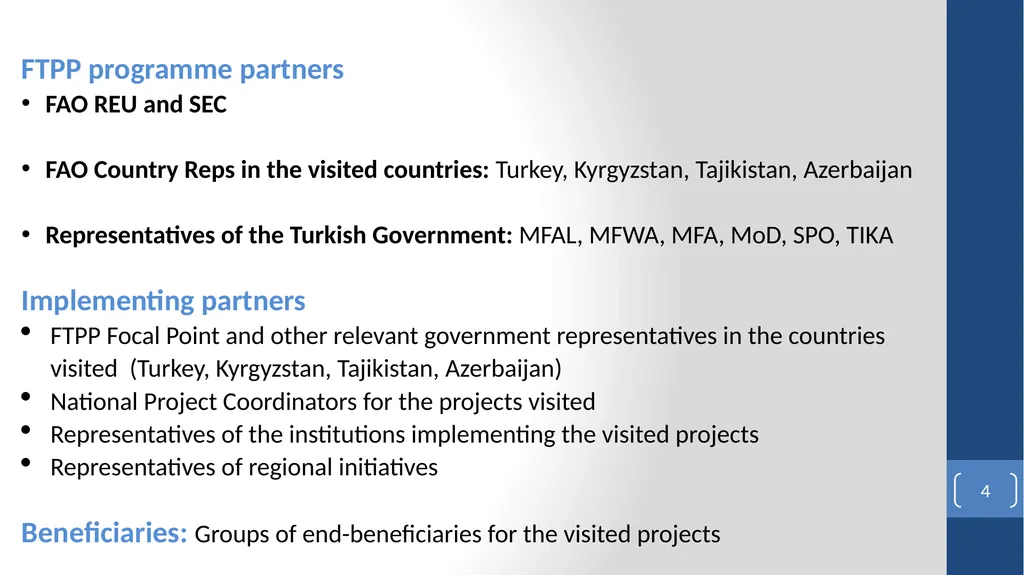
FTPP programme partners
FAO REU and SEC
FAO Country Reps in the visited countries: Turkey, Kyrgyzstan, Tajikistan, Azerbaijan
Representatives of the Turkish Government: MFAL, MFWA, MFA, MoD, SPO, TIKA
Implementing partners
FTPP Focal Point and other relevant government representatives in the countries visited (Turkey, Kyrgyzstan, Tajikistan, Azerbaijan)
National Project Coordinators for the projects visited
Representatives of the institutions implementing the visited projects
Representatives of regional initiatives
Beneficiaries: Groups of end-beneficiaries for the visited projects 4<br>
05
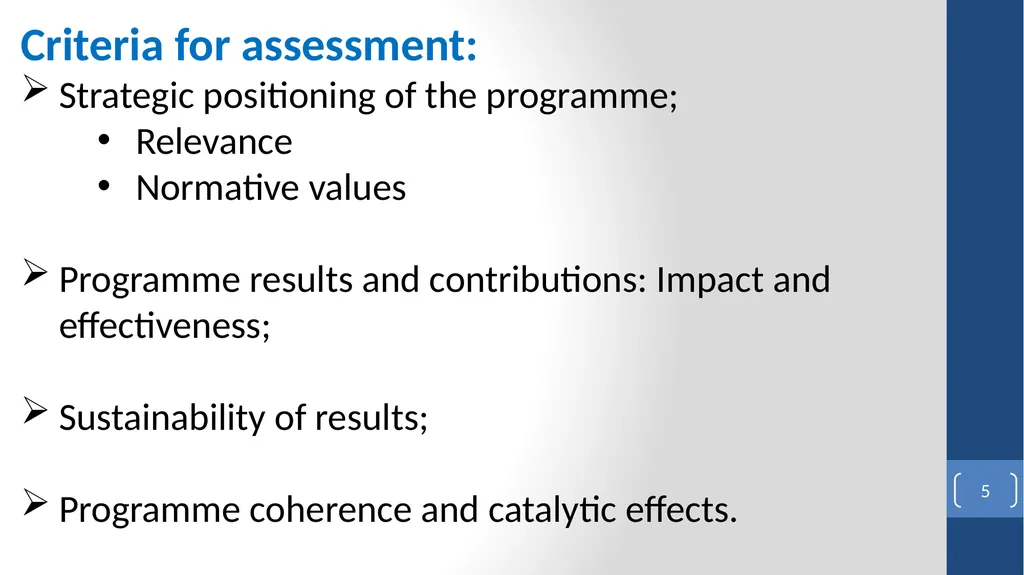
Criteria for assessment:
Strategic positioning of the programme;
Relevance
Normative values
Programme results and contributions: Impact and effectiveness;
Sustainability of results;
Programme coherence and catalytic effects. 5<br>
06
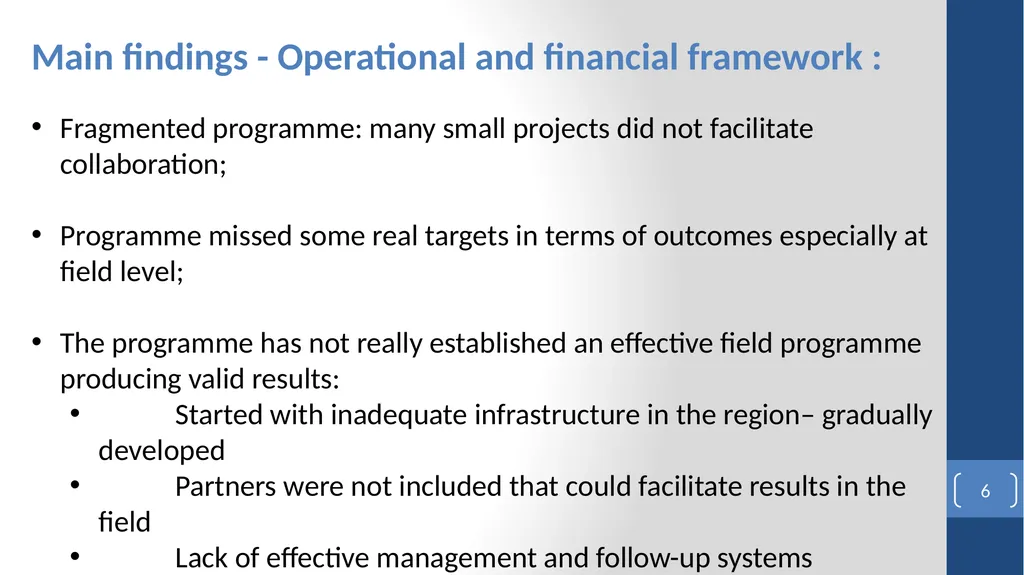
Main findings - Operational and financial framework :
Fragmented programme: many small projects did not facilitate collaboration;
Programme missed some real targets in terms of outcomes especially at field level;
The programme has not really established an effective field programme producing valid results:
Started with inadequate infrastructure in the region– gradually developed
Partners were not included that could facilitate results in the field
Lack of effective management and follow-up systems 6<br>
07
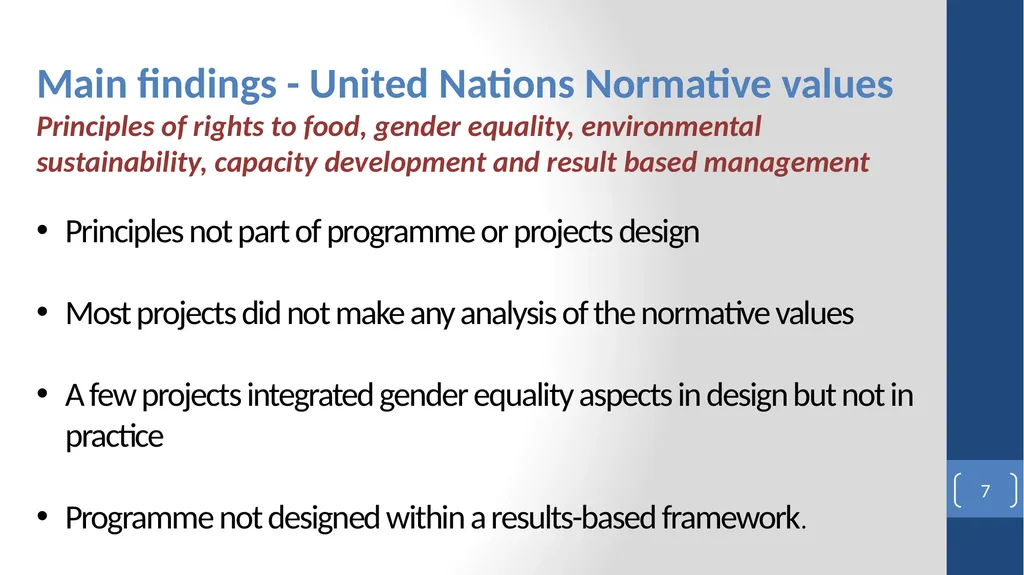
Main findings - United Nations Normative values
Principles of rights to food, gender equality, environmental sustainability, capacity development and result based management
Principles not part of programme or projects design
Most projects did not make any analysis of the normative values
A few projects integrated gender equality aspects in design but not in practice
Programme not designed within a results-based framework. 7<br>
08
Main findings - Catalytic effects
Some small projects created knowledge and awareness to formulate larger projects (i.e. several GEF projects on Obsolete pesticides, forestry etc.)
Example of Global Soil Partnership
Azerbaijan has signed own partnership programme with FAO inspired by the FTPP
Several FTTP projects have not collaborated with programmes of other agencies that could create synergy 8<br>
09
Infrastructure needed at national level for effective implementation;
Need for programme design and results based framework to keep track of ongoing activities and focus of the results;
More involvement of all stakeholders in programme design and planning to ensure ownership;
Contexts differ widely between the Central Asian Countries – programme needs to be able to adapt its approaches;
Smaller projects sometimes not well focused on what they can realistically achieve. Lessons learned 9<br>
10
Most scattered and small projects were unable to achieve impacts in isolation – challenges are often inter-dependent:
Seed systems – farming systems, watershed management, soil improvement etc.
Cattle production, husbandry skills, feed, pasture management, genetics etc.
Food safety – HACCP, Brucellosis, cattle husbandry etc.
The programme appeared to lack accountability – need for stronger management, monitoring and follow-up;
To achieve results at field level collaboration with implementing partners that have networks and capability for this type of work is essential. Lessons learned cont. 10<br>
11
Without participation of end-beneficiaries the efforts cannot be effective in addressing challenges;
Many projects too small in terms of duration and funds to work in isolation – no collaboration with larger programmes e.g. strategies plans and policies developed have not fulfilled their potential and further expanded;
Lack of institutional development limits the possibilities for effective results of technical interventions. Lessons learned cont. 11<br>
12
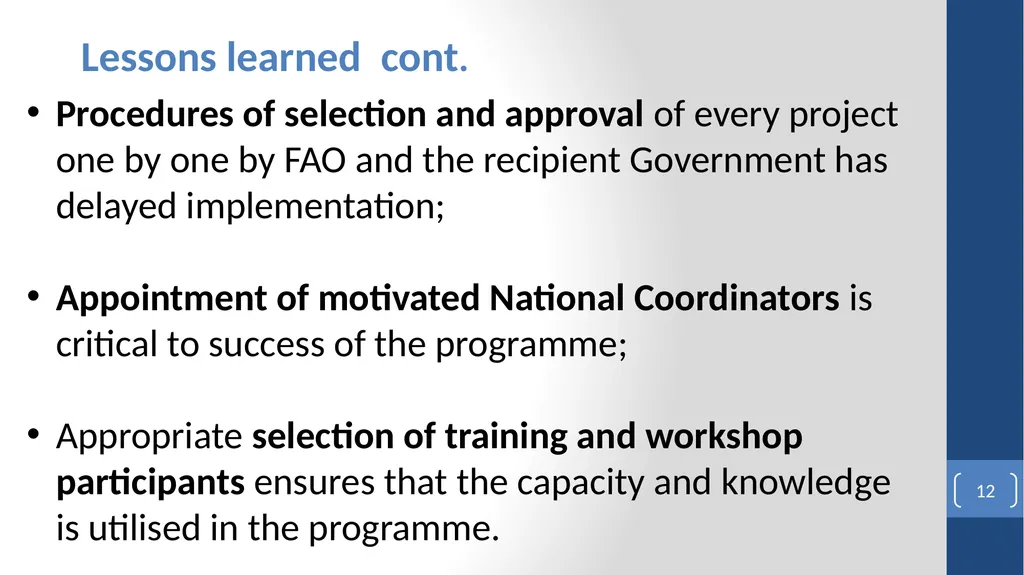
Procedures of selection and approval of every project one by one by FAO and the recipient Government has delayed implementation;
Appointment of motivated National Coordinators is critical to success of the programme;
Appropriate selection of training and workshop participants ensures that the capacity and knowledge is utilised in the programme. Lessons learned cont. 12<br>
13
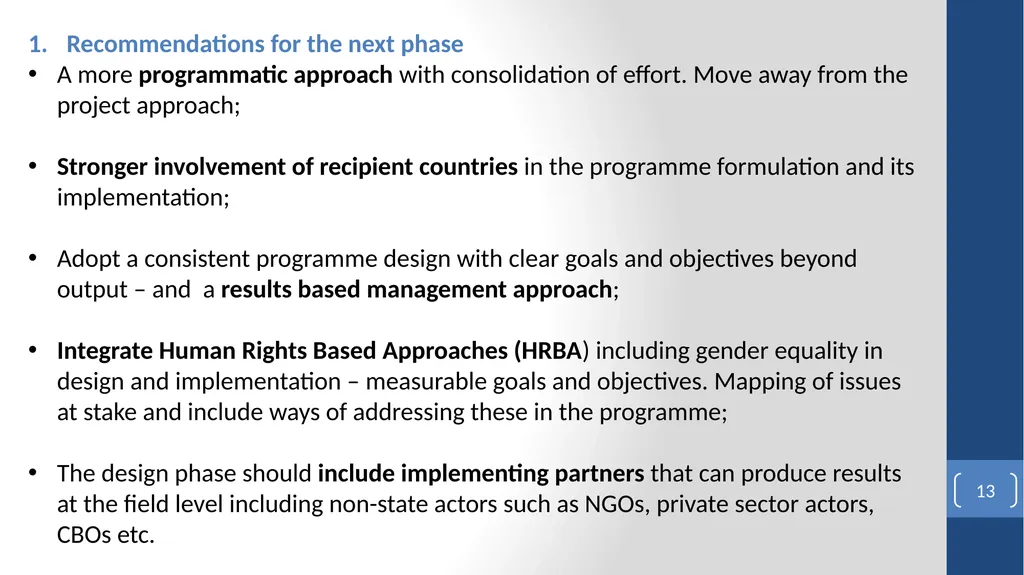
Recommendations for the next phase
A more programmatic approach with consolidation of effort. Move away from the project approach;
Stronger involvement of recipient countries in the programme formulation and its implementation;
Adopt a consistent programme design with clear goals and objectives beyond output – and a results based management approach;
Integrate Human Rights Based Approaches (HRBA) including gender equality in design and implementation – measurable goals and objectives. Mapping of issues at stake and include ways of addressing these in the programme;
The design phase should include implementing partners that can produce results at the field level including non-state actors such as NGOs, private sector actors, CBOs etc. 13<br>
14
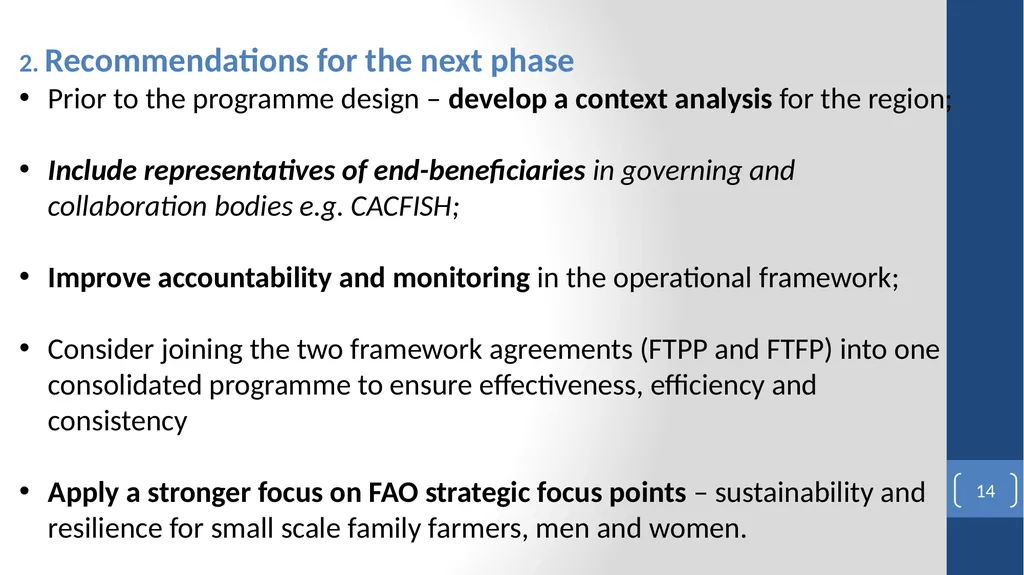
2. Recommendations for the next phase
Prior to the programme design – develop a context analysis for the region;
Include representatives of end-beneficiaries in governing and collaboration bodies e.g. CACFISH;
Improve accountability and monitoring in the operational framework;
Consider joining the two framework agreements (FTPP and FTFP) into one consolidated programme to ensure effectiveness, efficiency and consistency
Apply a stronger focus on FAO strategic focus points – sustainability and resilience for small scale family farmers, men and women. 14<br>
15
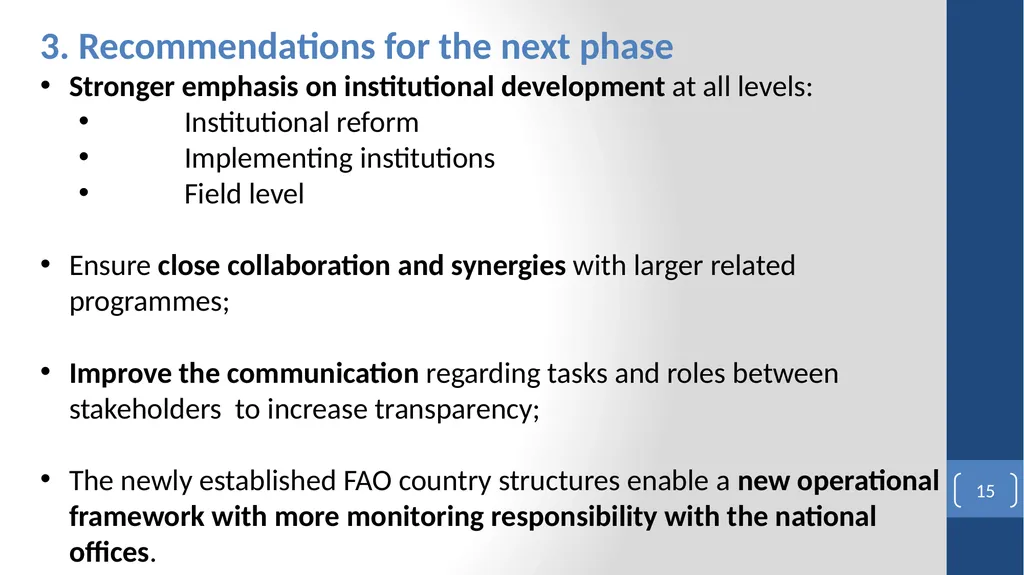
3. Recommendations for the next phase
Stronger emphasis on institutional development at all levels:
Institutional reform
Implementing institutions
Field level
Ensure close collaboration and synergies with larger related programmes;
Improve the communication regarding tasks and roles between stakeholders to increase transparency;
The newly established FAO country structures enable a new operational framework with more monitoring responsibility with the national offices. 15<br>