
Fariza Rahman, MBBS, MSc Geneva Foundation for
TG
Published · 23 slides · 0 views

1 / 1

Description
Fariza Rahman, MBBS, MSc Geneva Foundation for Medical Education and Research Key scientific and ethical considerations for clinical trials Training course in research methodology, research protocol development and scientific writing Geneva
Related Topics
Share
Embed code
Download this presentation From Below
"Fariza Rahman, MBBS, MSc Geneva Foundation for" is the property of its rightful owner. Permission is granted to download and print the materials on this website for personal, non-commercial use only, and to display it on your personal computer provided you do not modify the materials and that you retain all copyright notices contained in the materials. By downloading content from our website, you accept the terms of this agreement.
Presentation Transcript
01
Fariza Rahman, MBBS, MSc
Geneva Foundation for Medical Education and Research Key scientific and ethical considerations for clinical trials Training course in research methodology, research protocol development and scientific writing Geneva 2025<br>
Geneva Foundation for Medical Education and Research Key scientific and ethical considerations for clinical trials Training course in research methodology, research protocol development and scientific writing Geneva 2025<br>
02
At the end of the topic participants will be able to know:
The importance of ethics in clinical research
The significant ethical issues arise in clinical trials
How to manage the ethical matter in efficient and scientific ways
The pioneer ethical documents for protection of human in research Learning objectives<br>
The importance of ethics in clinical research
The significant ethical issues arise in clinical trials
How to manage the ethical matter in efficient and scientific ways
The pioneer ethical documents for protection of human in research Learning objectives<br>
03
Ensures the integrity of the research results.
Protects the safety of patients who volunteer to participate in the trials.
Prevents participants from being exploited or treated unfairly by the research team.
Fosters transparency and accountability within the scientific community.
Allows for scrutiny and validation of research methods, results, and conclusions, leading to a more robust and reliable body of evidence.
Contributes to the betterment of healthcare practices and patient outcomes. Importance of ethics in clinical research<br>
04
Participation in a clinical trial entails an increased level of risk with respect to ordinary clinical care, due to the potential for exposure to unexpected effects of a new treatment.
Majority of countries have guidelines, but few have regulations or laws related to clinical research.
“Risk benefit ratio/balance”
Sometimes the risk of the trial outweigh the benefit
For research that involves more than minimal risk of harm to the participants, the investigator must assure that the amount of benefit clearly outweighs the amount of risk. It is only if there is a favorable risk benefit ratio, that a study can be considered ethical. Ethical issues of clinical trial<br>
05
Five points are necessary for a well-planned and well-run good clinical trial:
Scientifically-sound design that answers to relevant questions
Respecting the rights and well-being of participants
Be collaborative and transparent
Feasible design for the context
Managing trial quality effectively and efficiently Key points for ethical and efficient clinical trial<br>
Scientifically-sound design that answers to relevant questions
Respecting the rights and well-being of participants
Be collaborative and transparent
Feasible design for the context
Managing trial quality effectively and efficiently Key points for ethical and efficient clinical trial<br>
06
Robust randomization process
Blinding or masking where feasible
Selection of appropriate trial population
Sufficient sample size with appropriate statistical power
Adherence of the participants to the allocated intervention(s)
Completed duration of follow up regardless of whether a participant continues to receive the allocated intervention or ceases
Measurement of outcome should be relevant and simple as possible Scientifically sound design 1/2<br>
07
Data collection should focus on the key aspects needed for assessment and should not be excessive.
The approach used to assess the outcome should be the same regardless of the assigned intervention.
The statistical analysis should follow the initial plan and protocol.
Potential harms of the intervention should be considered alongside potential benefits and in the wider clinical and health contexts.
An independent data monitoring committee to evaluate safety and efficacy of data from an ongoing trial. Scientifically sound design 2/2<br>
08
Appropriate communication with participants
Voluntary participation: Participation must be completely voluntary and free from coercion.
Informed consent:
At all stages of a clinical trial (before, during and after), relevant, easily-understandable information should be shared with trial participants.
Information should be provided in a clear manner and in suitable languages, culturally appropriate and formats for the intended audiences.
Informed Consent Forms
Must include purpose, procedures, risks, benefits, rights to withdraw, and contact information.
Should be translated and adapted to the local context and literacy level. Respect the rights and well-being of participants 1/5<br>
09
Changing consent
Participants should be free to stop or change the nature of their participation without affecting the usual care received
Where possible and acceptable to the participant, efforts should be made to determine the intended meaning of such individual decisions and to explain the potential impact of any such decisions.
Minimization of risk and maximization of benefit
Risks to participants must be minimized, and the benefits—both individual and societal—must outweigh the risks.
Regular risk–benefit assessments should guide the research process. Respect the rights and well-being of participants 2/5<br>
10
Non-exploitation of participants
Participants should not be exploited due to their socioeconomic status, limited literacy, or lack of access to healthcare.
Equitable selection of participants must be ensured.
Privacy and confidentiality
Personal data must be protected through secure storage and restricted access.
Anonymity should be preserved whenever possible.
Vulnerable populations
Extra precautions are required when including groups such as children, pregnant women, prisoners, refugees, or those with cognitive impairments.
Exclusion should be ethically justified if inclusion poses undue risk or violates autonomy. Respect the rights and well-being of participants 3/5<br>
11
Managing the safety of individual participants in the clinical trial
The procedures used to detect, investigate and respond to unwanted health events for individual participants should be shaped by what is already known about the effects of the intervention from previous research or usage, as well as the background epidemiological and clinical features of the intended trial population.
If new information emerges during the course of the trial (for example, from other studies or as a consequence of advice provided by a trial’s data monitoring committee) then processes and procedures for managing the safety of individual participants should be reviewed and may need to be modified. Respect the rights and well-being of participants 4/5<br>
12
Communication of new information relevant to the intervention
It is often preferable to produce and circulate contextualized periodic updates that are focused on safety issues.
Communications and reports should be informative, timely and actionable.
Reports should be sent to the data monitoring and regulatory bodies regularly. Respect the rights and well-being of participants 5/5<br>
13
Community engagement and agreement
Working in partnership with people and communities increase trust and confidence while decreasing the risk of important groups being excluded or the needs of local populations or sectors being overlooked or misunderstood.
Collaboration among organizations involved in clinical trials, leads to the sharing of ideas and expertise, helps to avoid misaligned approaches and maximize use of resources and increase efficiency.
Research should be conducted with the knowledge and agreement of the community, especially in low-resource or marginalized settings.
Community advisory boards may support ethical alignment and local acceptability. Collaboration and transparency 1/2<br>
14
Transparency
Clinical trials should be registered from the outset on a publicly-available registry of clinical trials.
Information about a trial (including its protocol and other documentation such as the statistical analysis plan) should be publicly available.
Once the trial is completed, reports should be made available in a timely manner on a publicly available clinical trial registry and/or in a peer-reviewed journal.
Sources of trial funding as well as declarations of any possible conflicts of interest.
Sharing of data considering data privacy and protection. Collaboration and transparency 2/2<br>
15
Setting and context
The place where the clinical trials take place should meet the health needs, preferences of communities, and their ability to access to health care.
Use of existing resources
The trial should optimally use the pre-existing resources and facilities, including the expertise, skills, professional standards and quality oversight mechanisms associated with routine health care practice.
Environmental Protection
Research must not negatively impact the environment or local ecosystems.
Environmental risk assessments should be incorporated into study planning where applicable. Feasible design for the context 1/2<br>
16
Good governance
Effective and efficient governance (for example, through a trial steering committee) helps to maintain the scientific and ethical integrity of a trial and provide advice on appropriate courses of action.
Protecting trial integrity
The integrity of the results of a clinical trial should be protected by ensuring that decisions about its design, delivery and analysis should not be influenced by premature access to unblinded information about the emerging results. Feasible design for the context 2/2<br>
17
Planning for success and focusing on issues that matter
Rather than trying to avoid all possible issues, the aim should be to identify the key issues that would have a meaningful impact on participants’ well-being and safety or on decision- making based on the trial results.
Efforts should then be focused on minimizing, mitigating and monitoring those issues. Effective and efficient quality 1/2<br>
18
Monitoring, auditing and inspection of study quality
Review and approve study protocols to ensure ethical compliance.
Monitor data collection and participant safety throughout the research.
Ensure protocols for managing adverse events and unexpected risks.
Good trial monitoring, auditing and inspection activities identify issues and provide an opportunity to further improve quality.
However excessive monitoring, auditing and inspection activities and failure to focus on details have a material impact on trial quality, waste resources, create distraction and demotivate staff. Effective and efficient quality 2/2<br>
19
The Nuremberg Code
A legal and ethical code promulgated by the U.S. judges at the trial of the Nazi doctors at Nuremberg after World War II.
Based on universal principles of natural law and human rights.
Establishes the research requirement of the free, informed consent of the participating subject.
The Declaration of Helsinki
An official policy of the World Medical Association (WMA) adopted for the first time in 1964 and has since undergone a number of revisions.
It expresses the WMA’s effort in balancing the need to generate sound medical knowledge with the need to protect the health and interests of research participants. Important ethical documents for human in research 1/4<br>
20
The Belmont Report
A document on moral principles that was published in 1978 by the National Commission for the Protection of Human Subjects of Biomedical and Behavioral Research, in the aftermath of scandals of research misconduct that were uncovered in the 1970s.
It establishes a framework of basic moral principles—respect for persons, beneficence, and justice—which should guide the conduct of research. Important ethical documents for human in research 2/4<br>
21
CIOMS Guidelines – Council for International Organizations of Medical Sciences
Provides ethical guidance on health-related research, especially in low-resource settings.
Emphasizes social value, informed consent, fair participant selection, and post-trial access and the protection of vulnerable populations.
The CIOMS has revised its guidelines over time, with the most recent version being the 2016 guidelines Important ethical documents for human in research 3/4<br>
22
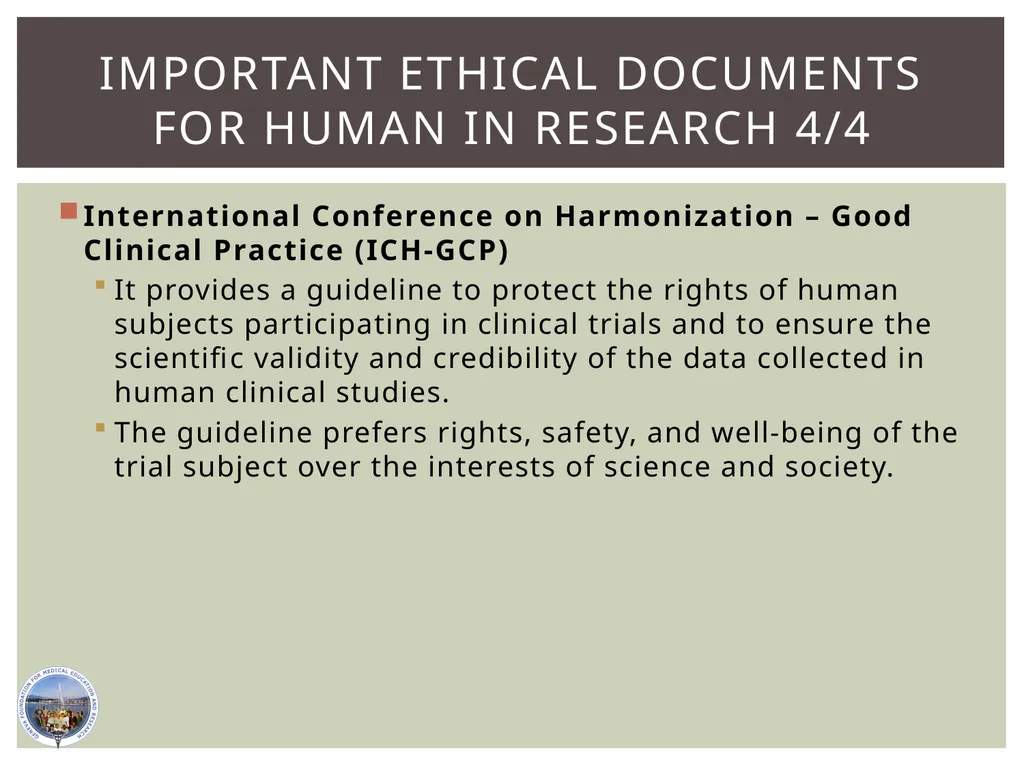
International Conference on Harmonization – Good Clinical Practice (ICH-GCP)
It provides a guideline to protect the rights of human subjects participating in clinical trials and to ensure the scientific validity and credibility of the data collected in human clinical studies.
The guideline prefers rights, safety, and well-being of the trial subject over the interests of science and society. Important ethical documents for human in research 4/4<br>
23
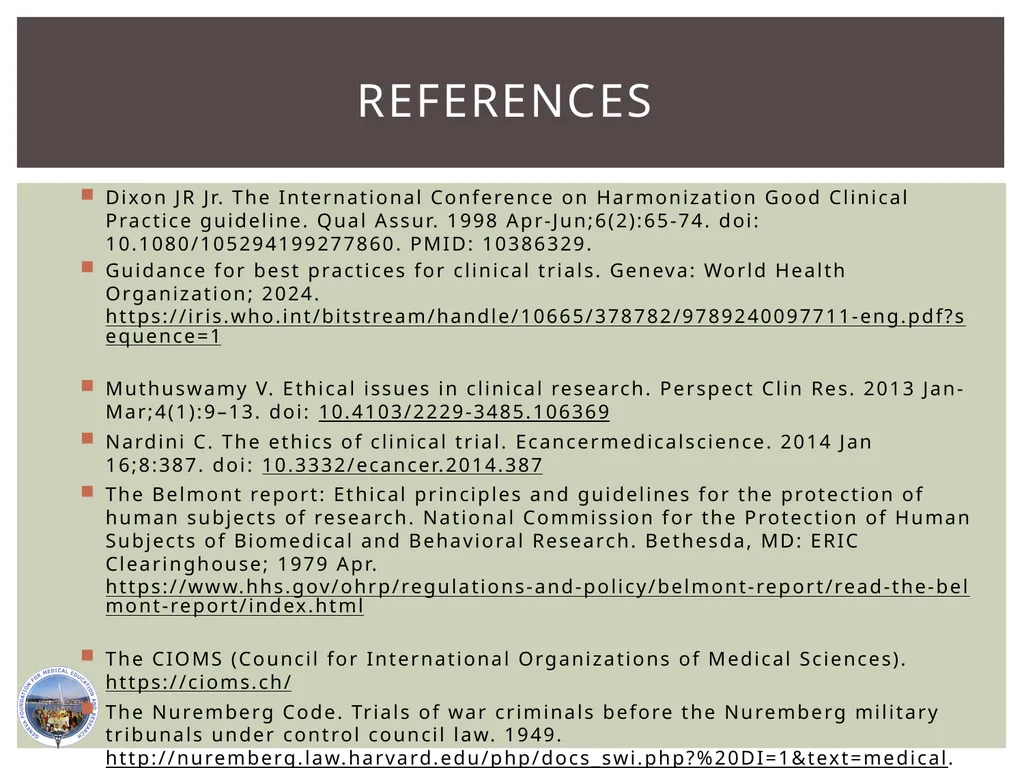
Dixon JR Jr. The International Conference on Harmonization Good Clinical Practice guideline. Qual Assur. 1998 Apr-Jun;6(2):65-74. doi: 10.1080/105294199277860. PMID: 10386329.
Guidance for best practices for clinical trials. Geneva: World Health Organization; 2024. https://iris.who.int/bitstream/handle/10665/378782/9789240097711-eng.pdf?sequence=1
Muthuswamy V. Ethical issues in clinical research. Perspect Clin Res. 2013 Jan-Mar;4(1):9–13. doi: 10.4103/2229-3485.106369
Nardini C. The ethics of clinical trial. Ecancermedicalscience. 2014 Jan 16;8:387. doi: 10.3332/ecancer.2014.387
The Belmont report: Ethical principles and guidelines for the protection of human subjects of research. National Commission for the Protection of Human Subjects of Biomedical and Behavioral Research. Bethesda, MD: ERIC Clearinghouse; 1979 Apr. https://www.hhs.gov/ohrp/regulations-and-policy/belmont-report/read-the-belmont-report/index.html
The CIOMS (Council for International Organizations of Medical Sciences). https://cioms.ch/
The Nuremberg Code. Trials of war criminals before the Nuremberg military tribunals under control council law. 1949. http://nuremberg.law.harvard.edu/php/docs_swi.php?%20DI=1&text=medical.
World Medical Association. Declaration of Helsinki, 6th revision. 2008. https://www.wma.net/what-we-do/medical-ethics/declaration-of-helsinki/doh-oct2008/ References<br>