
Farm Income Statement Analysis AAE 320 Paul D.
MJ
Published · 48 slides · 0 views

1 / 1



Description
Farm Income Statement Analysis AAE 320 Paul D. Mitchell Agricultural Applied Economics Learning Goals How to read an accounting Income Statement as it pertains to agricultural operations How to calculate several key measures of income and
Related Topics
Share
Embed code
Download this presentation From Below
"Farm Income Statement Analysis AAE 320 Paul D." is the property of its rightful owner. Permission is granted to download and print the materials on this website for personal, non-commercial use only, and to display it on your personal computer provided you do not modify the materials and that you retain all copyright notices contained in the materials. By downloading content from our website, you accept the terms of this agreement.
Presentation Transcript
01
Farm Income Statement Analysis AAE 320
Paul D. Mitchell
Agricultural & Applied Economics<br>
Paul D. Mitchell
Agricultural & Applied Economics<br>
02
Learning Goals How to read an accounting Income Statement as it pertains to agricultural operations
How to calculate several key measures of income and rates of return
Typical income and rates of return in agriculture
Common accounting software packages used by Wisconsin farms<br>
How to calculate several key measures of income and rates of return
Typical income and rates of return in agriculture
Common accounting software packages used by Wisconsin farms<br>
03
Income Statement Income Statement: Record of revenues and expenses over a period of time
Remember: Balance Sheet is statement of assets, liabilities and equity at a point in time
Other names for an income statement
Operating Statement
Profit and Loss Statement (P & L)
Income = Revenue minus Costs
Question it answers: Did you make money last year?<br>
Remember: Balance Sheet is statement of assets, liabilities and equity at a point in time
Other names for an income statement
Operating Statement
Profit and Loss Statement (P & L)
Income = Revenue minus Costs
Question it answers: Did you make money last year?<br>
04
Income Statement Income = Revenue minus Costs
Account for all business revenue earned and costs during the period, both cash and non-cash
Revenue consists of Cash Revenue and Non-Cash Revenue
Costs consist of Cash Expenses and Non-Cash Expenses<br>
Account for all business revenue earned and costs during the period, both cash and non-cash
Revenue consists of Cash Revenue and Non-Cash Revenue
Costs consist of Cash Expenses and Non-Cash Expenses<br>
05
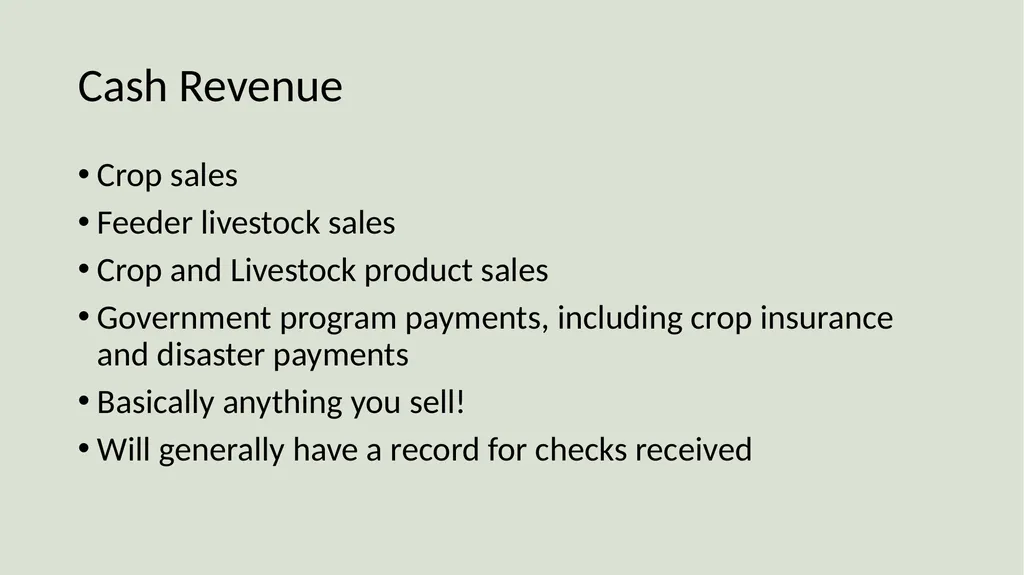
Cash Revenue Crop sales
Feeder livestock sales
Crop and Livestock product sales
Government program payments, including crop insurance and disaster payments
Basically anything you sell!
Will generally have a record for checks received<br>
Feeder livestock sales
Crop and Livestock product sales
Government program payments, including crop insurance and disaster payments
Basically anything you sell!
Will generally have a record for checks received<br>
06
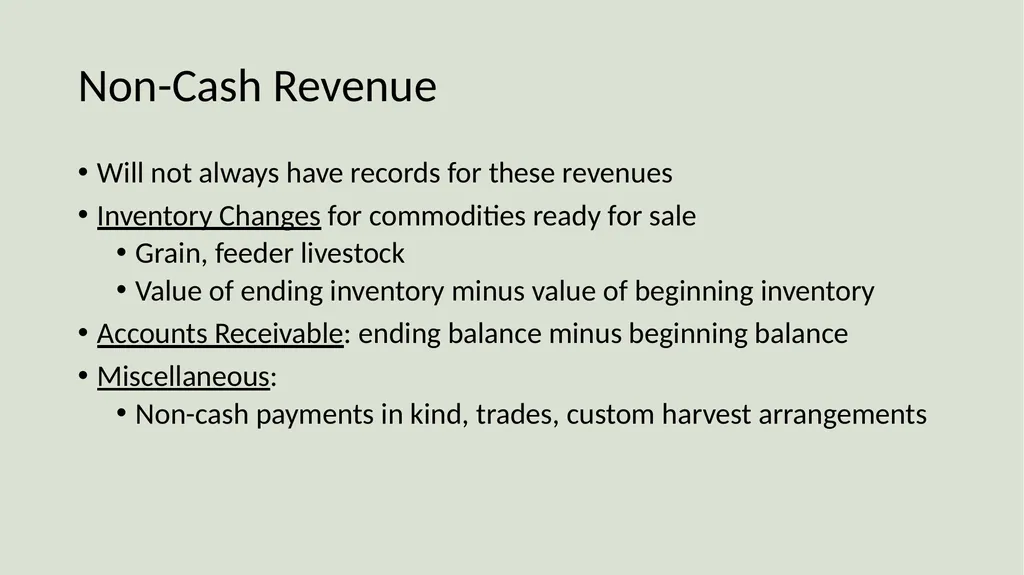
Non-Cash Revenue Will not always have records for these revenues
Inventory Changes for commodities ready for sale
Grain, feeder livestock
Value of ending inventory minus value of beginning inventory
Accounts Receivable: ending balance minus beginning balance
Miscellaneous:
Non-cash payments in kind, trades, custom harvest arrangements<br>
Inventory Changes for commodities ready for sale
Grain, feeder livestock
Value of ending inventory minus value of beginning inventory
Accounts Receivable: ending balance minus beginning balance
Miscellaneous:
Non-cash payments in kind, trades, custom harvest arrangements<br>
07
Revenue: Special Agricultural Cases Gain/Loss from sale of culled breeding livestock or milk cows
Treat as Cash Revenue, a normal part of production process
Typically do not treat it as gain/loss from sale of a capital asset
Change in value of raised breeding livestock or milk cows (a calf that becomes a heifer, a heifer that becomes a cow)
Treat the increase in value of raised livestock as an increase in Non-Cash revenue
Practical way: Treat it like an inventory change for the herd
Use a book value for each animal type, then calculate the ending value minus the beginning value for the herd<br>
08
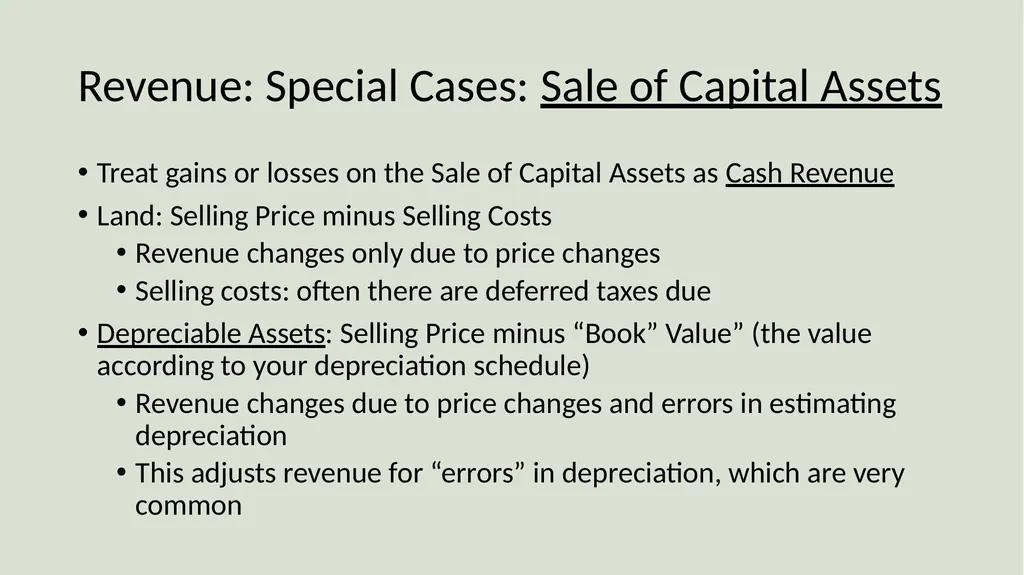
Revenue: Special Cases: Sale of Capital Assets Treat gains or losses on the Sale of Capital Assets as Cash Revenue
Land: Selling Price minus Selling Costs
Revenue changes only due to price changes
Selling costs: often there are deferred taxes due
Depreciable Assets: Selling Price minus “Book” Value” (the value according to your depreciation schedule)
Revenue changes due to price changes and errors in estimating depreciation
This adjusts revenue for “errors” in depreciation, which are very common<br>
09
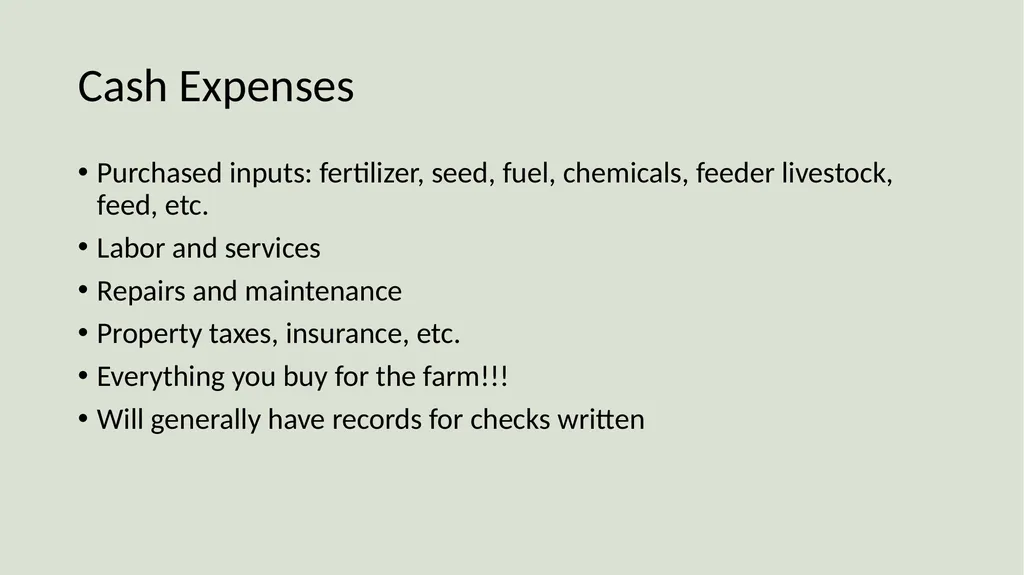
Cash Expenses Purchased inputs: fertilizer, seed, fuel, chemicals, feeder livestock, feed, etc.
Labor and services
Repairs and maintenance
Property taxes, insurance, etc.
Everything you buy for the farm!!!
Will generally have records for checks written<br>
Labor and services
Repairs and maintenance
Property taxes, insurance, etc.
Everything you buy for the farm!!!
Will generally have records for checks written<br>
10
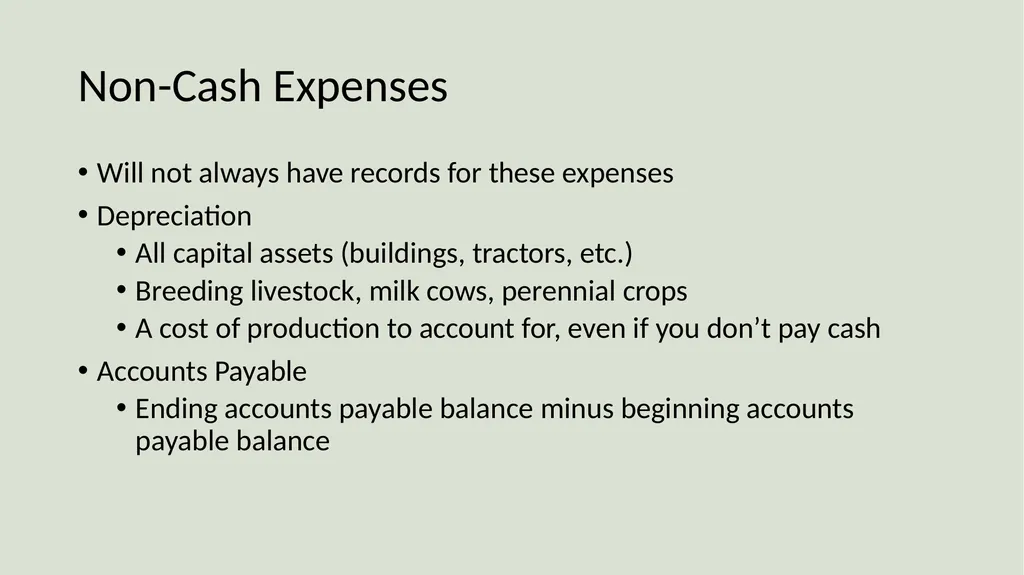
Non-Cash Expenses Will not always have records for these expenses
Depreciation
All capital assets (buildings, tractors, etc.)
Breeding livestock, milk cows, perennial crops
A cost of production to account for, even if you don’t pay cash
Accounts Payable
Ending accounts payable balance minus beginning accounts payable balance<br>
Depreciation
All capital assets (buildings, tractors, etc.)
Breeding livestock, milk cows, perennial crops
A cost of production to account for, even if you don’t pay cash
Accounts Payable
Ending accounts payable balance minus beginning accounts payable balance<br>
11
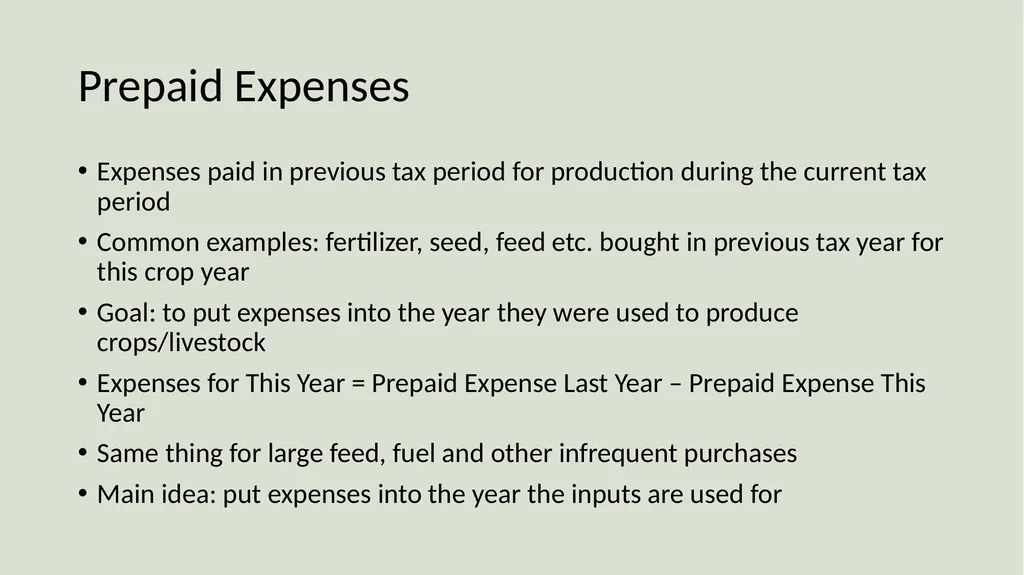
Prepaid Expenses Expenses paid in previous tax period for production during the current tax period
Common examples: fertilizer, seed, feed etc. bought in previous tax year for this crop year
Goal: to put expenses into the year they were used to produce crops/livestock
Expenses for This Year = Prepaid Expense Last Year – Prepaid Expense This Year
Same thing for large feed, fuel and other infrequent purchases
Main idea: put expenses into the year the inputs are used for<br>
12
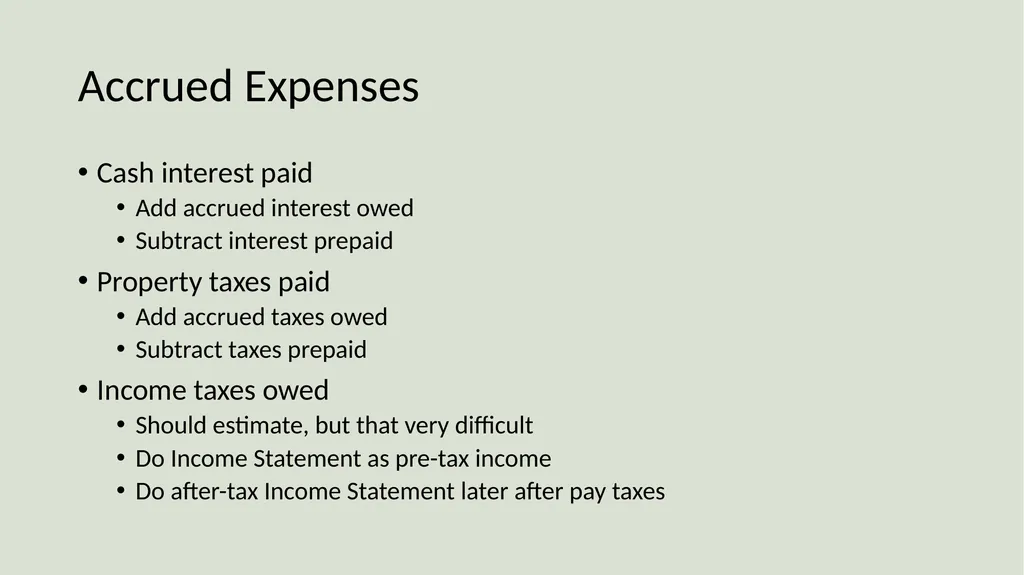
Accrued Expenses Cash interest paid
Add accrued interest owed
Subtract interest prepaid
Property taxes paid
Add accrued taxes owed
Subtract taxes prepaid
Income taxes owed
Should estimate, but that very difficult
Do Income Statement as pre-tax income
Do after-tax Income Statement later after pay taxes<br>
Add accrued interest owed
Subtract interest prepaid
Property taxes paid
Add accrued taxes owed
Subtract taxes prepaid
Income taxes owed
Should estimate, but that very difficult
Do Income Statement as pre-tax income
Do after-tax Income Statement later after pay taxes<br>
13
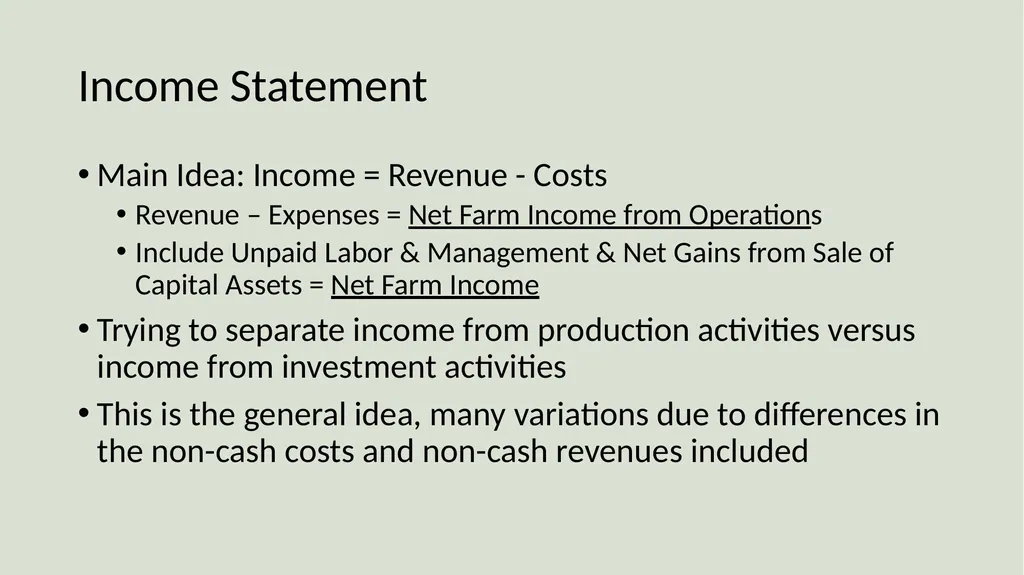
Income Statement Main Idea: Income = Revenue - Costs
Revenue – Expenses = Net Farm Income from Operations
Include Unpaid Labor & Management & Net Gains from Sale of Capital Assets = Net Farm Income
Trying to separate income from production activities versus income from investment activities
This is the general idea, many variations due to differences in the non-cash costs and non-cash revenues included<br>
14
Cash Accounting and Accrual Adjustments Most farms use cash accounting, especially for taxes
Common problems cash accounting creates
Prepaid expenses: Buy inputs (seed, fertilizer, chemicals, feed, fuel) in one year, but use them the next year
Output sales in year different than production year: Harvest crops and livestock born/raised in one year, but sell in next year
Buy inputs and make sales to reduce taxable income
Often cannot use costs and revenue from taxes to calculate profits by enterprise, only profits by year
Accrual Adjustments: Put costs and revenues into the right year to determine profits by enterprise<br>
15
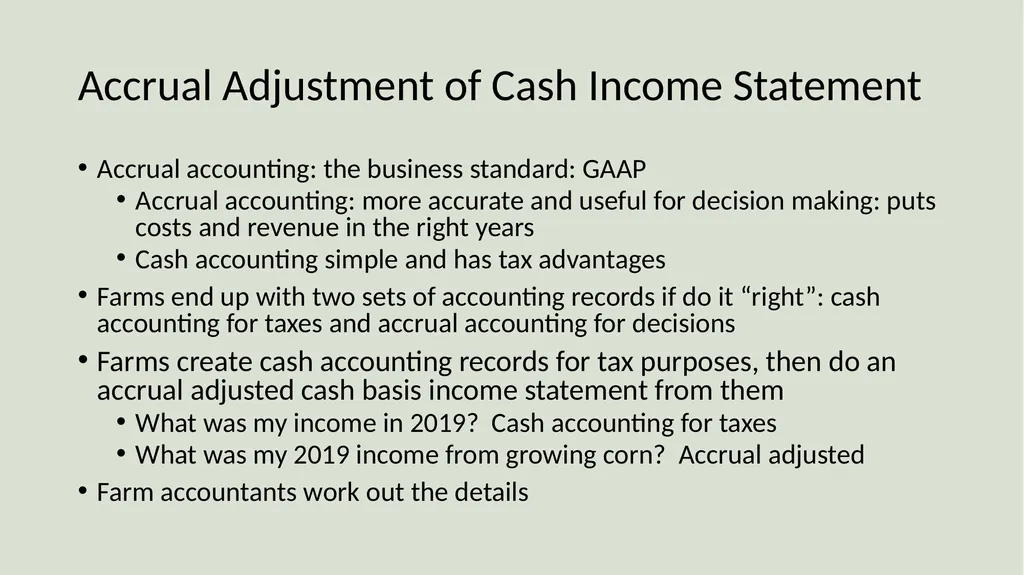
Accrual Adjustment of Cash Income Statement Accrual accounting: the business standard: GAAP
Accrual accounting: more accurate and useful for decision making: puts costs and revenue in the right years
Cash accounting simple and has tax advantages
Farms end up with two sets of accounting records if do it “right”: cash accounting for taxes and accrual accounting for decisions
Farms create cash accounting records for tax purposes, then do an accrual adjusted cash basis income statement from them
What was my income in 2019? Cash accounting for taxes
What was my 2019 income from growing corn? Accrual adjusted
Farm accountants work out the details<br>
16
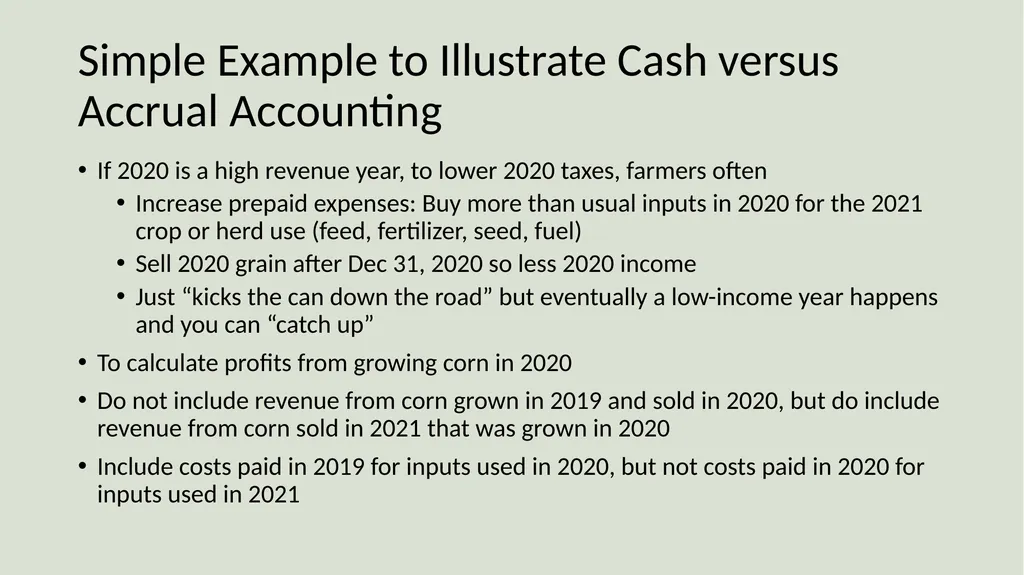
Simple Example to Illustrate Cash versus Accrual Accounting If 2020 is a high revenue year, to lower 2020 taxes, farmers often
Increase prepaid expenses: Buy more than usual inputs in 2020 for the 2021 crop or herd use (feed, fertilizer, seed, fuel)
Sell 2020 grain after Dec 31, 2020 so less 2020 income
Just “kicks the can down the road” but eventually a low-income year happens and you can “catch up”
To calculate profits from growing corn in 2020
Do not include revenue from corn grown in 2019 and sold in 2020, but do include revenue from corn sold in 2021 that was grown in 2020
Include costs paid in 2019 for inputs used in 2020, but not costs paid in 2020 for inputs used in 2021<br>
17
Illustration of Accrual Adjustment
What was my profit from growing corn in 2020? Jan 1, 2020 Jan 1, 2021 Sell some of your 2019 crop Buy seed corn for 2020 crop Buy seed corn for 2020 crop Sell some of your 2020 crop 2020 Crop Year Deduct as cost for 2019 taxes Declare as income for 2020 taxes Deduct as cost for 2020 taxes Declare as income for 2021 taxes Revenue on 2019 income statement Revenue on 2020 income statement Cost on 2020 income statement Cost on 2021 income statement<br>
18
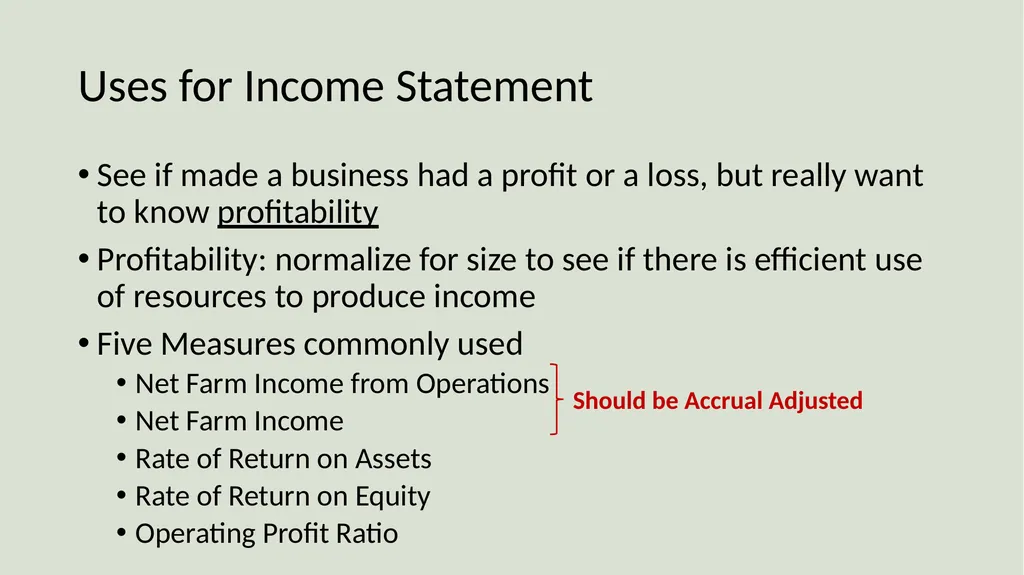
Uses for Income Statement See if made a business had a profit or a loss, but really want to know profitability
Profitability: normalize for size to see if there is efficient use of resources to produce income
Five Measures commonly used
Net Farm Income from Operations
Net Farm Income
Rate of Return on Assets
Rate of Return on Equity
Operating Profit Ratio Should be Accrual Adjusted<br>
Profitability: normalize for size to see if there is efficient use of resources to produce income
Five Measures commonly used
Net Farm Income from Operations
Net Farm Income
Rate of Return on Assets
Rate of Return on Equity
Operating Profit Ratio Should be Accrual Adjusted<br>
19
Calculating Farm Income: Revenue You decide which non-cash sources to include and whether it is accrual adjusted or not
Selling Things: self explanatory
Capital Gains: Selling of capital (non-current) assets for prices different than their basis
Sell land for different price than original cost
Depreciable assets: selling for price different than remaining basis
Are you going to do accrual adjustments?<br>
Selling Things: self explanatory
Capital Gains: Selling of capital (non-current) assets for prices different than their basis
Sell land for different price than original cost
Depreciable assets: selling for price different than remaining basis
Are you going to do accrual adjustments?<br>
20
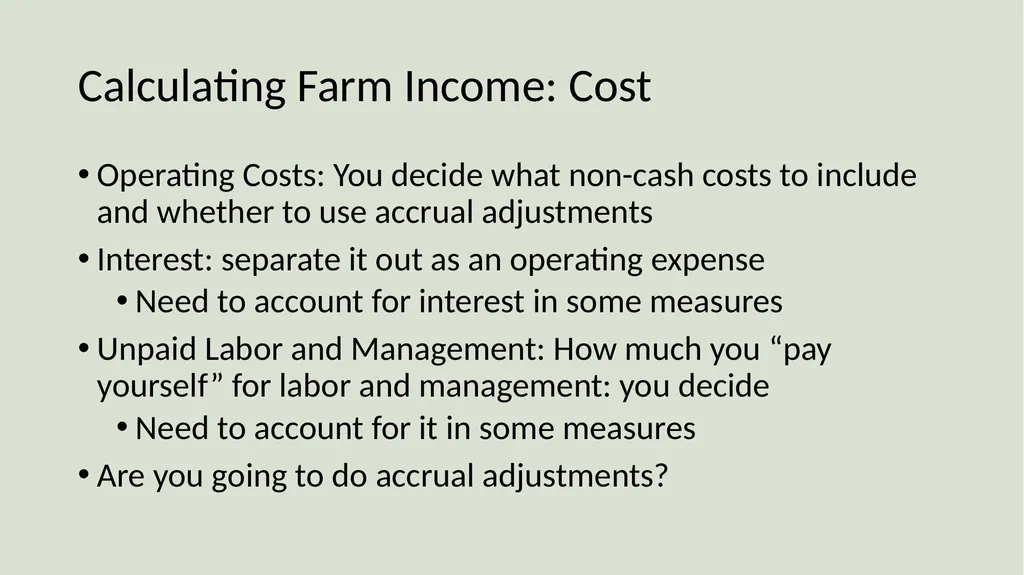
Calculating Farm Income: Cost Operating Costs: You decide what non-cash costs to include and whether to use accrual adjustments
Interest: separate it out as an operating expense
Need to account for interest in some measures
Unpaid Labor and Management: How much you “pay yourself” for labor and management: you decide
Need to account for it in some measures
Are you going to do accrual adjustments?<br>
Interest: separate it out as an operating expense
Need to account for interest in some measures
Unpaid Labor and Management: How much you “pay yourself” for labor and management: you decide
Need to account for it in some measures
Are you going to do accrual adjustments?<br>
21
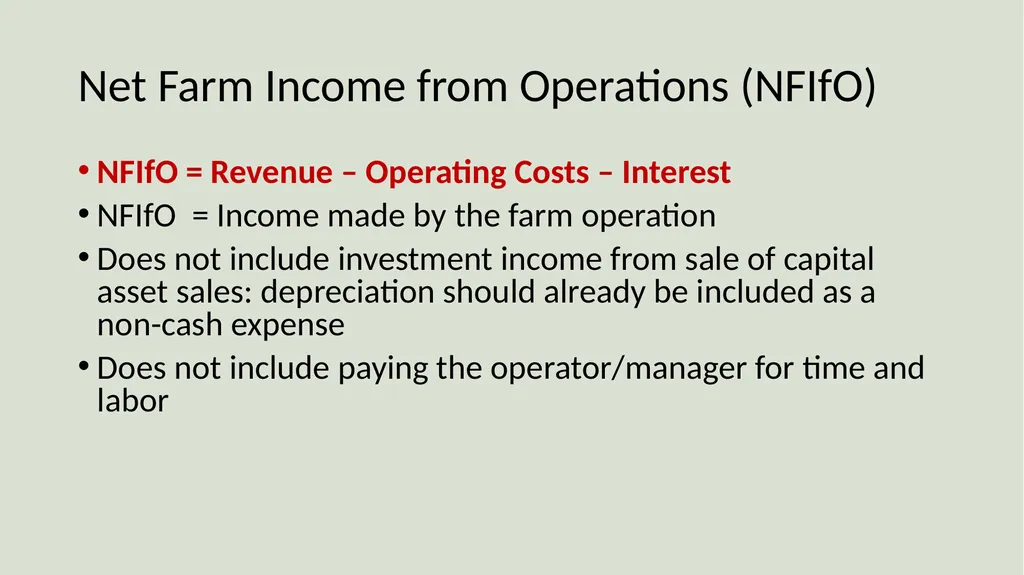
Net Farm Income from Operations (NFIfO) NFIfO = Revenue – Operating Costs – Interest
NFIfO = Income made by the farm operation
Does not include investment income from sale of capital asset sales: depreciation should already be included as a non-cash expense
Does not include paying the operator/manager for time and labor<br>
NFIfO = Income made by the farm operation
Does not include investment income from sale of capital asset sales: depreciation should already be included as a non-cash expense
Does not include paying the operator/manager for time and labor<br>
22
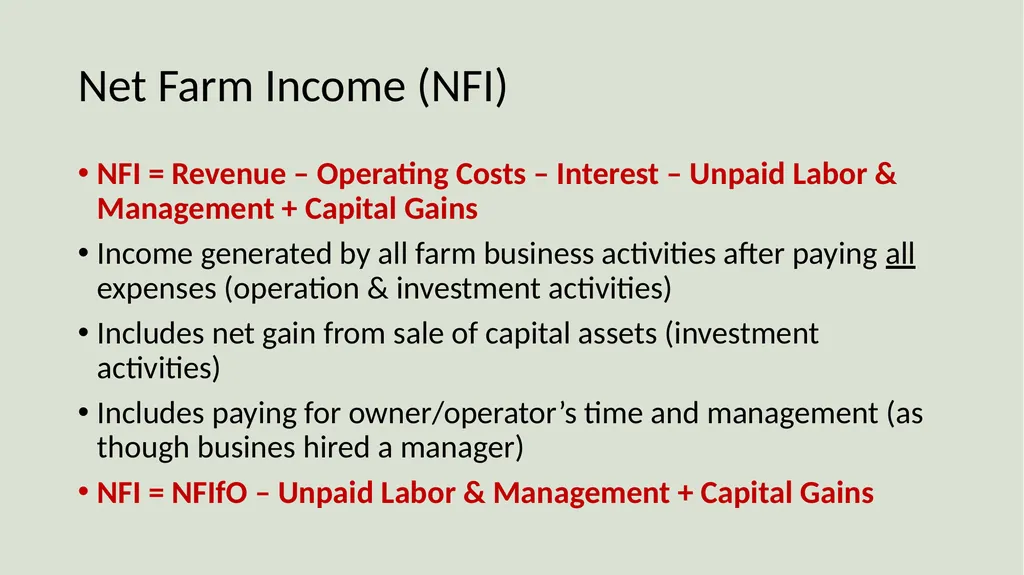
Net Farm Income (NFI) NFI = Revenue – Operating Costs – Interest – Unpaid Labor & Management + Capital Gains
Income generated by all farm business activities after paying all expenses (operation & investment activities)
Includes net gain from sale of capital assets (investment activities)
Includes paying for owner/operator’s time and management (as though busines hired a manager)
NFI = NFIfO – Unpaid Labor & Management + Capital Gains<br>
23
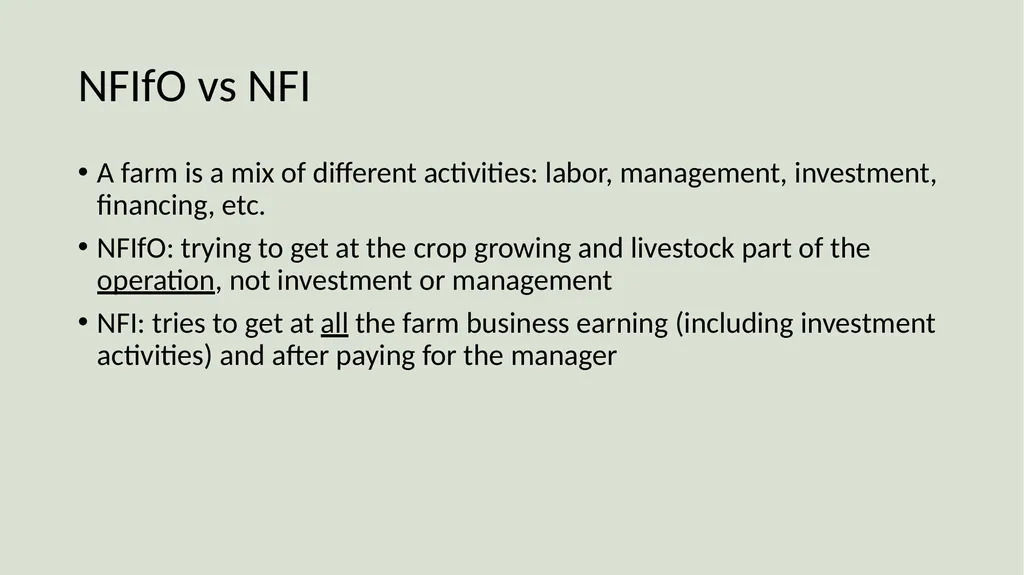
NFIfO vs NFI A farm is a mix of different activities: labor, management, investment, financing, etc.
NFIfO: trying to get at the crop growing and livestock part of the operation, not investment or management
NFI: tries to get at all the farm business earning (including investment activities) and after paying for the manager<br>
NFIfO: trying to get at the crop growing and livestock part of the operation, not investment or management
NFI: tries to get at all the farm business earning (including investment activities) and after paying for the manager<br>
24
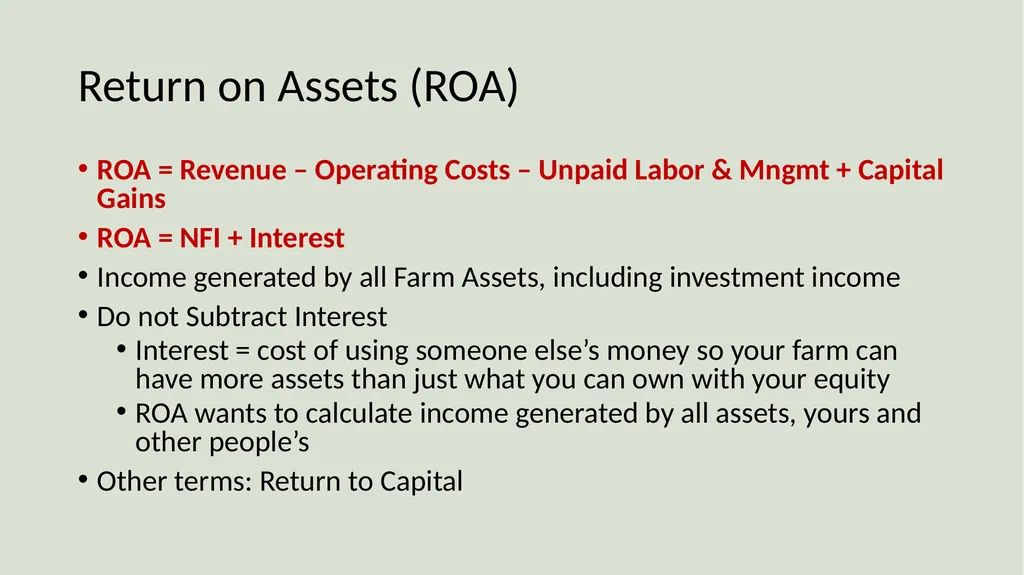
Return on Assets (ROA) ROA = Revenue – Operating Costs – Unpaid Labor & Mngmt + Capital Gains
ROA = NFI + Interest
Income generated by all Farm Assets, including investment income
Do not Subtract Interest
Interest = cost of using someone else’s money so your farm can have more assets than just what you can own with your equity
ROA wants to calculate income generated by all assets, yours and other people’s
Other terms: Return to Capital<br>
25
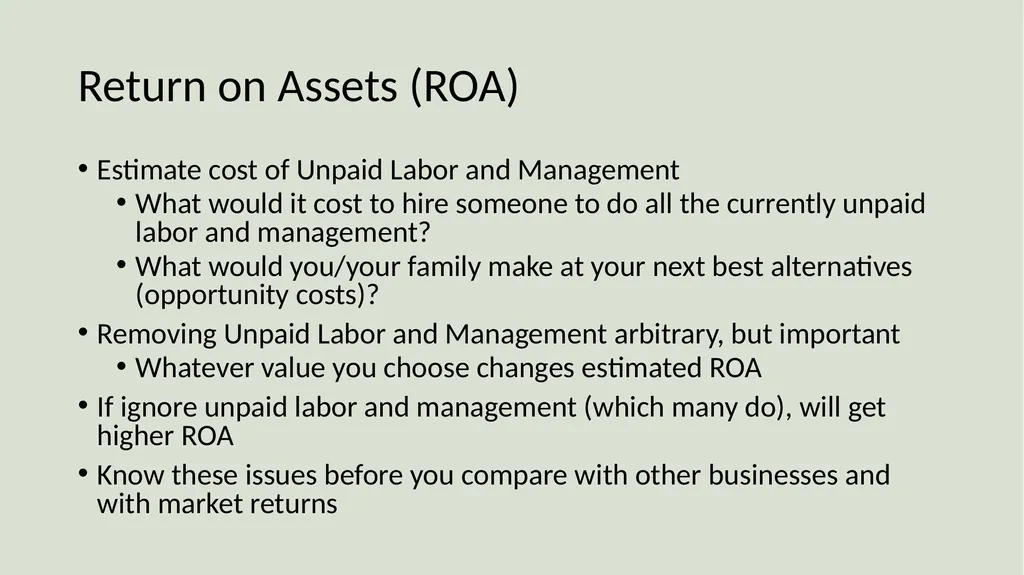
Return on Assets (ROA) Estimate cost of Unpaid Labor and Management
What would it cost to hire someone to do all the currently unpaid labor and management?
What would you/your family make at your next best alternatives (opportunity costs)?
Removing Unpaid Labor and Management arbitrary, but important
Whatever value you choose changes estimated ROA
If ignore unpaid labor and management (which many do), will get higher ROA
Know these issues before you compare with other businesses and with market returns<br>
26
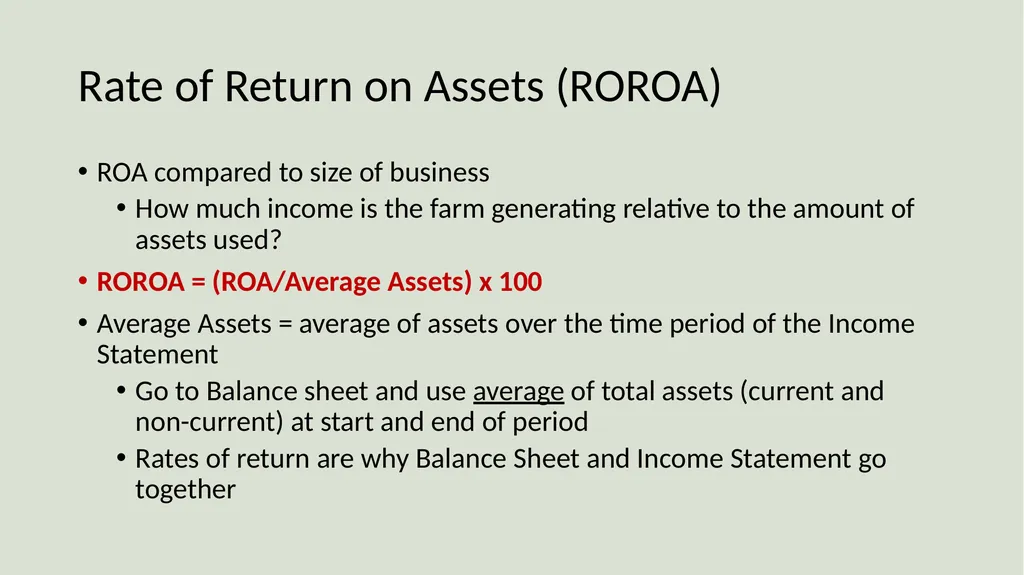
Rate of Return on Assets (ROROA) ROA compared to size of business
How much income is the farm generating relative to the amount of assets used?
ROROA = (ROA/Average Assets) x 100
Average Assets = average of assets over the time period of the Income Statement
Go to Balance sheet and use average of total assets (current and non-current) at start and end of period
Rates of return are why Balance Sheet and Income Statement go together<br>
27
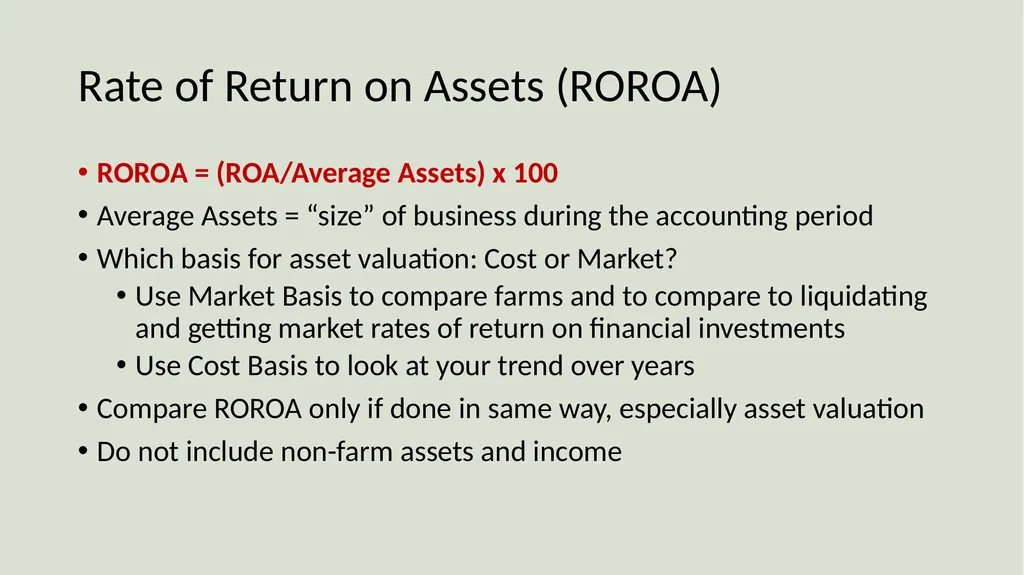
Rate of Return on Assets (ROROA) ROROA = (ROA/Average Assets) x 100
Average Assets = “size” of business during the accounting period
Which basis for asset valuation: Cost or Market?
Use Market Basis to compare farms and to compare to liquidating and getting market rates of return on financial investments
Use Cost Basis to look at your trend over years
Compare ROROA only if done in same way, especially asset valuation
Do not include non-farm assets and income<br>
28
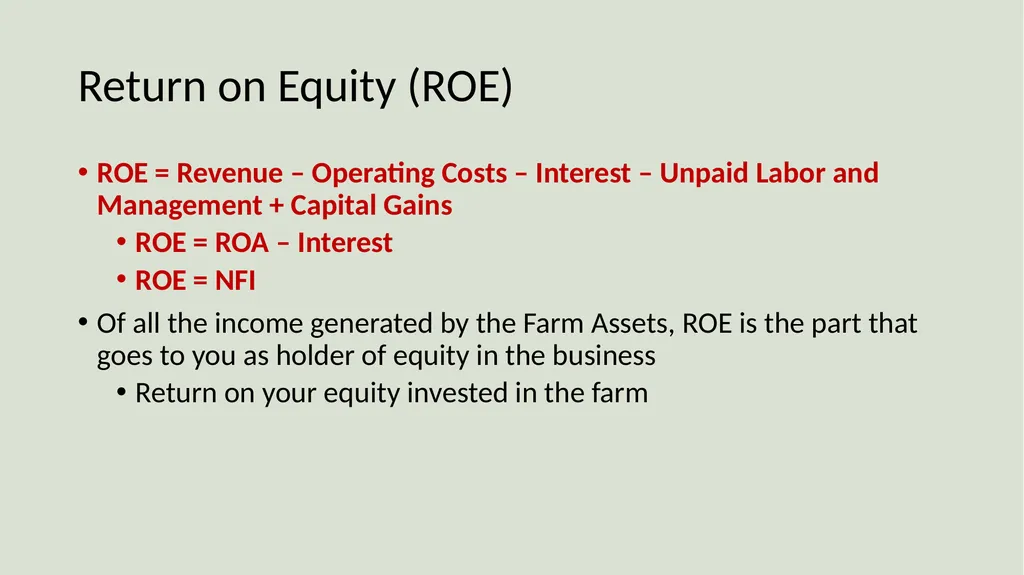
Return on Equity (ROE) ROE = Revenue – Operating Costs – Interest – Unpaid Labor and Management + Capital Gains
ROE = ROA – Interest
ROE = NFI
Of all the income generated by the Farm Assets, ROE is the part that goes to you as holder of equity in the business
Return on your equity invested in the farm<br>
ROE = ROA – Interest
ROE = NFI
Of all the income generated by the Farm Assets, ROE is the part that goes to you as holder of equity in the business
Return on your equity invested in the farm<br>
29
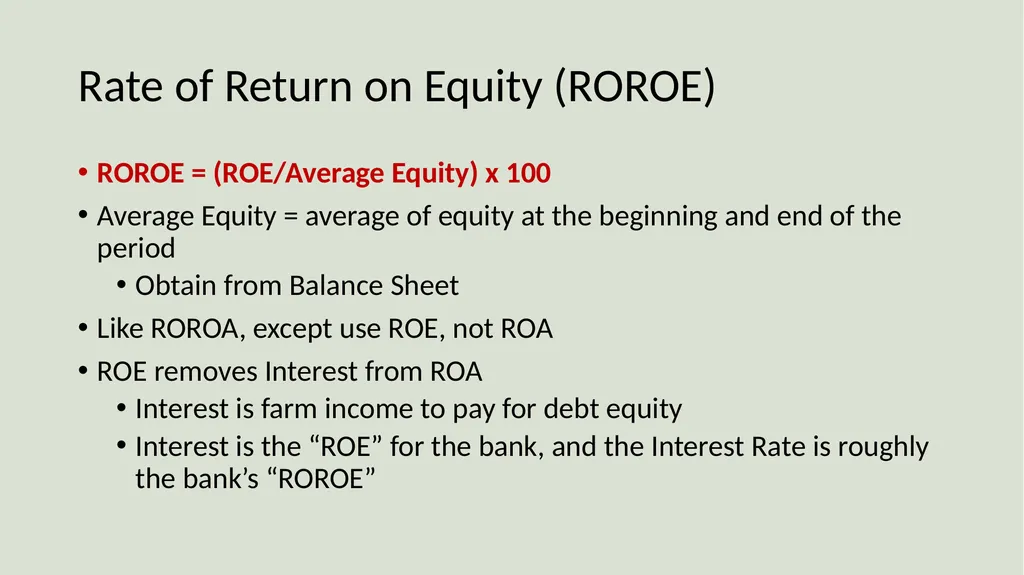
Rate of Return on Equity (ROROE) ROROE = (ROE/Average Equity) x 100
Average Equity = average of equity at the beginning and end of the period
Obtain from Balance Sheet
Like ROROA, except use ROE, not ROA
ROE removes Interest from ROA
Interest is farm income to pay for debt equity
Interest is the “ROE” for the bank, and the Interest Rate is roughly the bank’s “ROROE”<br>
30
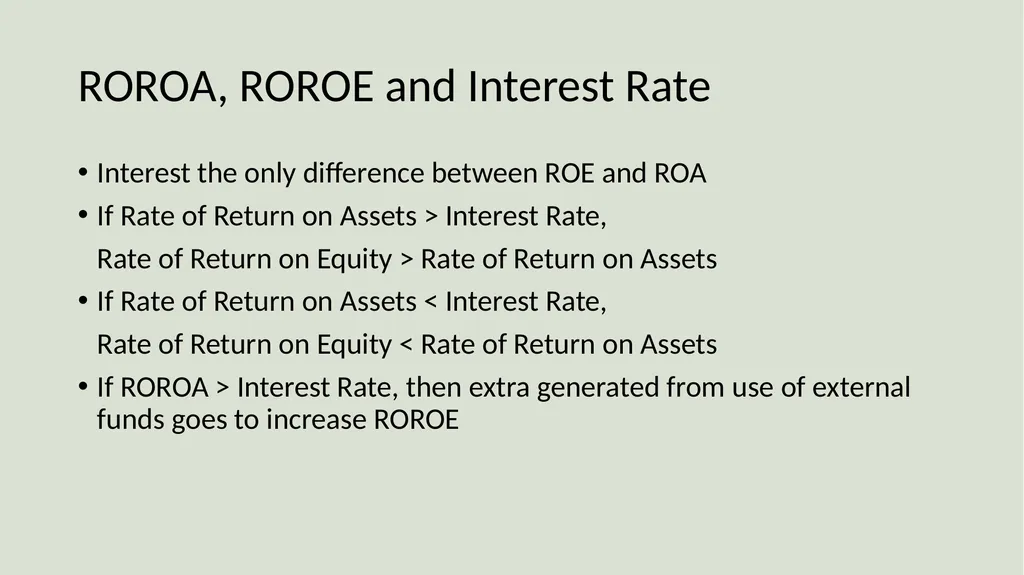
ROROA, ROROE and Interest Rate Interest the only difference between ROE and ROA
If Rate of Return on Assets > Interest Rate,
Rate of Return on Equity > Rate of Return on Assets
If Rate of Return on Assets < Interest Rate,
Rate of Return on Equity < Rate of Return on Assets
If ROROA > Interest Rate, then extra generated from use of external funds goes to increase ROROE<br>
If Rate of Return on Assets > Interest Rate,
Rate of Return on Equity > Rate of Return on Assets
If Rate of Return on Assets < Interest Rate,
Rate of Return on Equity < Rate of Return on Assets
If ROROA > Interest Rate, then extra generated from use of external funds goes to increase ROROE<br>
31
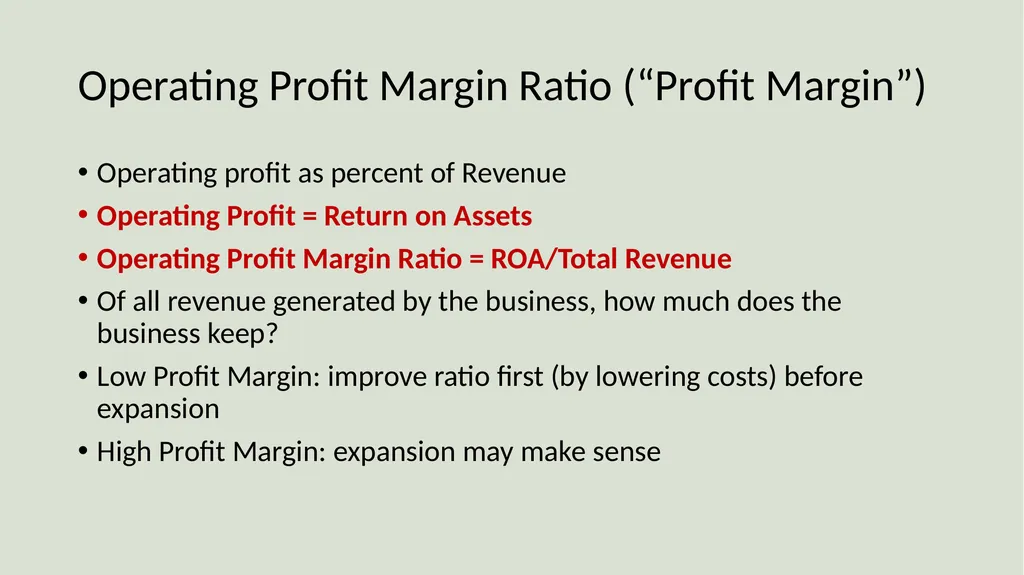
Operating Profit Margin Ratio (“Profit Margin”) Operating profit as percent of Revenue
Operating Profit = Return on Assets
Operating Profit Margin Ratio = ROA/Total Revenue
Of all revenue generated by the business, how much does the business keep?
Low Profit Margin: improve ratio first (by lowering costs) before expansion
High Profit Margin: expansion may make sense<br>
Operating Profit = Return on Assets
Operating Profit Margin Ratio = ROA/Total Revenue
Of all revenue generated by the business, how much does the business keep?
Low Profit Margin: improve ratio first (by lowering costs) before expansion
High Profit Margin: expansion may make sense<br>
32
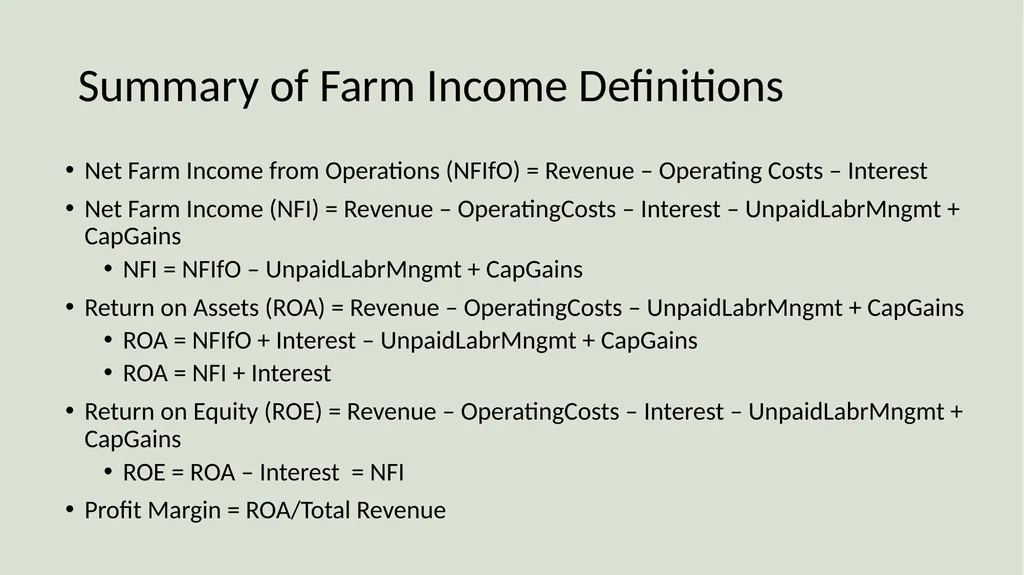
Summary of Farm Income Definitions Net Farm Income from Operations (NFIfO) = Revenue – Operating Costs – Interest
Net Farm Income (NFI) = Revenue – OperatingCosts – Interest – UnpaidLabrMngmt + CapGains
NFI = NFIfO – UnpaidLabrMngmt + CapGains
Return on Assets (ROA) = Revenue – OperatingCosts – UnpaidLabrMngmt + CapGains
ROA = NFIfO + Interest – UnpaidLabrMngmt + CapGains
ROA = NFI + Interest
Return on Equity (ROE) = Revenue – OperatingCosts – Interest – UnpaidLabrMngmt + CapGains
ROE = ROA – Interest = NFI
Profit Margin = ROA/Total Revenue<br>
33
Farm Income: Final Comment When a small business or farm does their accounting (or pays some one to do it) and they calculate farm income
They decide how they want to deal with non-cash costs, non-cash revenues, depreciation, inventory changes, accrued expenses, prepaid expenses, accrual adjustments and unpaid labor and management costs for themselves and their family
When comparing farms to one another, for an accurate comparison, must use the same assumptions for non-cash costs, non-cash revenues, depreciation, inventory changes, accrued expenses, prepaid expenses, accrual adjustments and unpaid labor and management<br>
34
Summary How to develop an Income Statement
Accrual Accounting vs Cash Accounting
Accrual Adjusted Cash Accounting
How to calculate and interpret measures from Income Statement
Net Farm Income
Net Farm Income from Operations
Return on Assets and Rate of Return on Assets
Return on Equity and Rate of Return on Equity
Profit Margin
Look at example rates and margins
Look at example income statement<br>
35
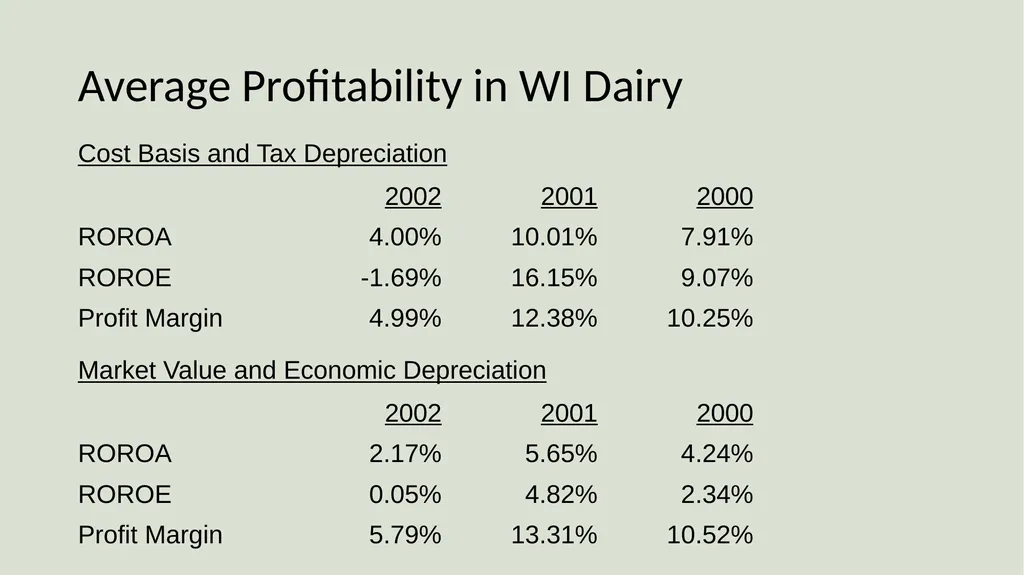
Rates of Return in Dairy UW Center for Dairy Profitability
http://cdp.wisc.edu/pdf/02bench.pdf http://cdp.wisc.edu/Financial%20Benchmarks.htm
Two methods
Assets at Cost Basis with Tax Depreciation
Assets at Market Basis with Economic Depreciation
Does NOT include cost of unpaid labor and management or opportunity cost of owner equity<br>
http://cdp.wisc.edu/pdf/02bench.pdf http://cdp.wisc.edu/Financial%20Benchmarks.htm
Two methods
Assets at Cost Basis with Tax Depreciation
Assets at Market Basis with Economic Depreciation
Does NOT include cost of unpaid labor and management or opportunity cost of owner equity<br>
36
Average Profitability in WI Dairy<br>
37
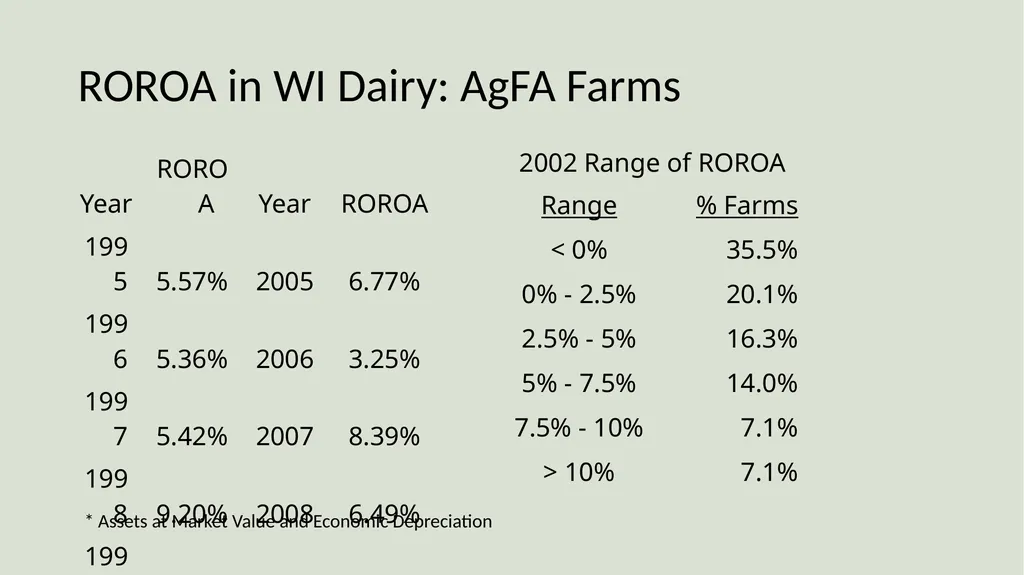
ROROA in WI Dairy: AgFA Farms * Assets at Market Value and Economic Depreciation<br>
38
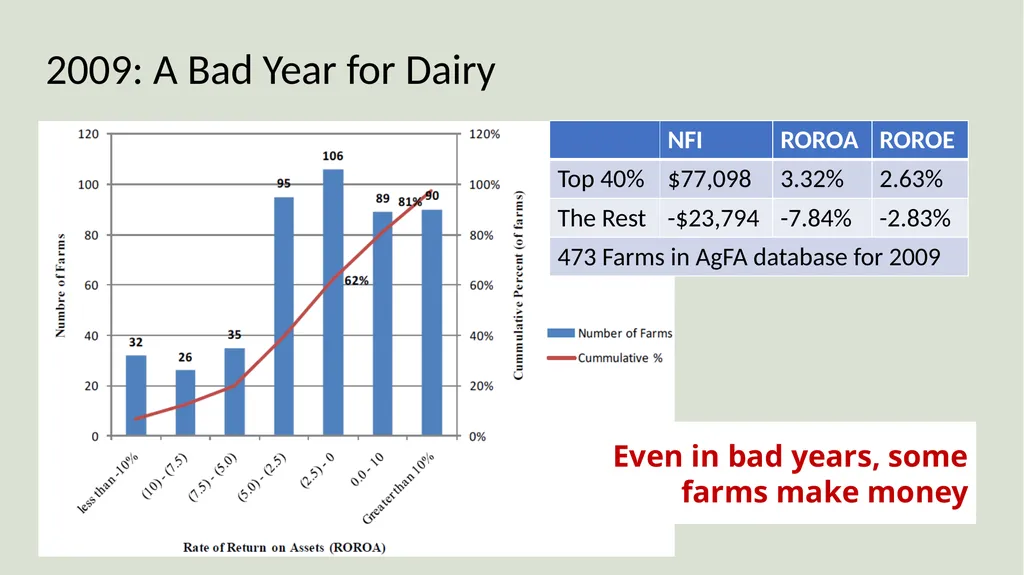
2009: A Bad Year for Dairy Even in bad years, some farms make money<br>
39
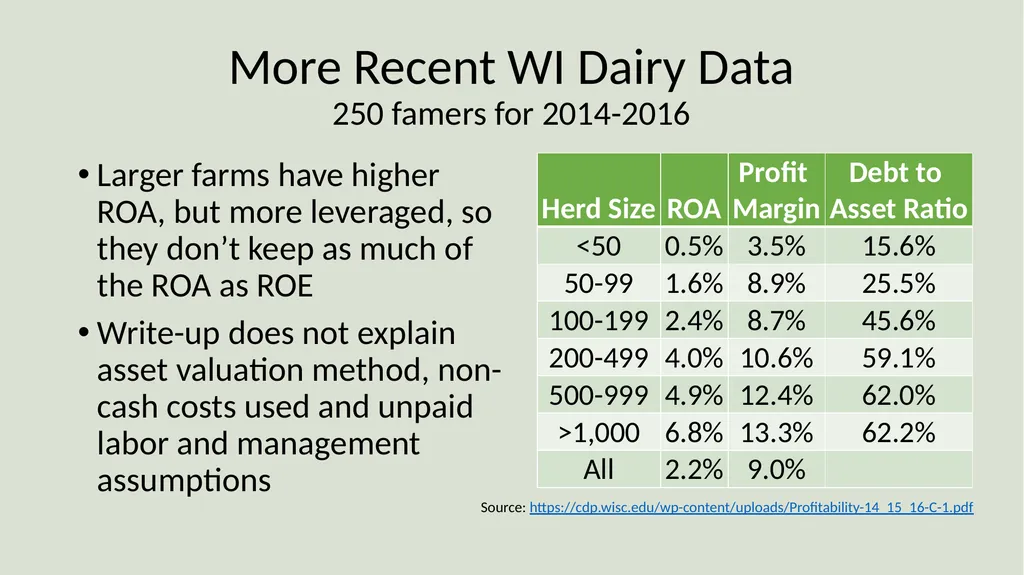
More Recent WI Dairy Data
250 famers for 2014-2016 Larger farms have higher ROA, but more leveraged, so they don’t keep as much of the ROA as ROE
Write-up does not explain asset valuation method, non-cash costs used and unpaid labor and management assumptions Source: https://cdp.wisc.edu/wp-content/uploads/Profitability-14_15_16-C-1.pdf<br>
Write-up does not explain asset valuation method, non-cash costs used and unpaid labor and management assumptions Source: https://cdp.wisc.edu/wp-content/uploads/Profitability-14_15_16-C-1.pdf<br>
40
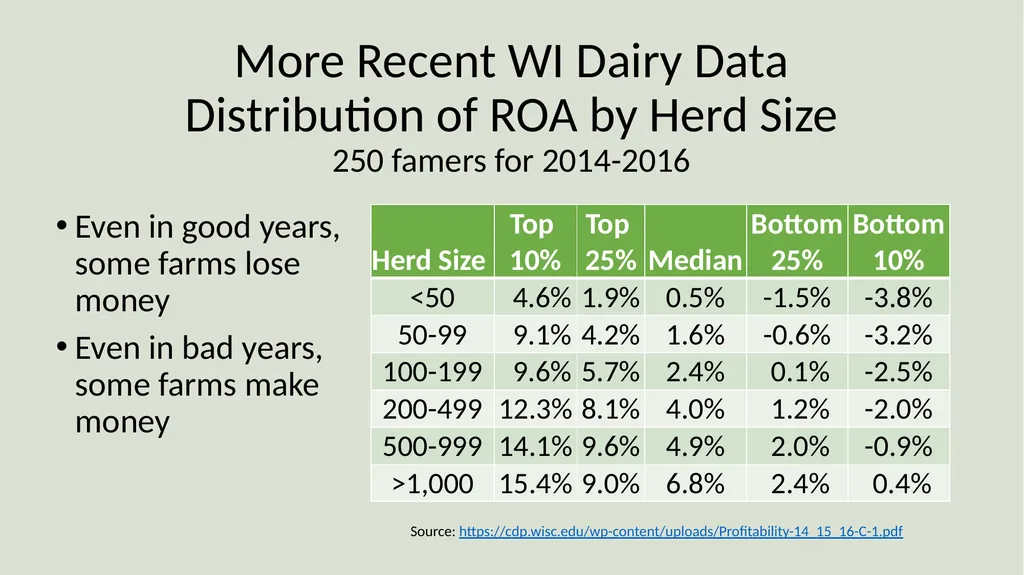
More Recent WI Dairy Data
Distribution of ROA by Herd Size
250 famers for 2014-2016 Even in good years, some farms lose money
Even in bad years, some farms make money Source: https://cdp.wisc.edu/wp-content/uploads/Profitability-14_15_16-C-1.pdf<br>
Even in bad years, some farms make money Source: https://cdp.wisc.edu/wp-content/uploads/Profitability-14_15_16-C-1.pdf<br>
41
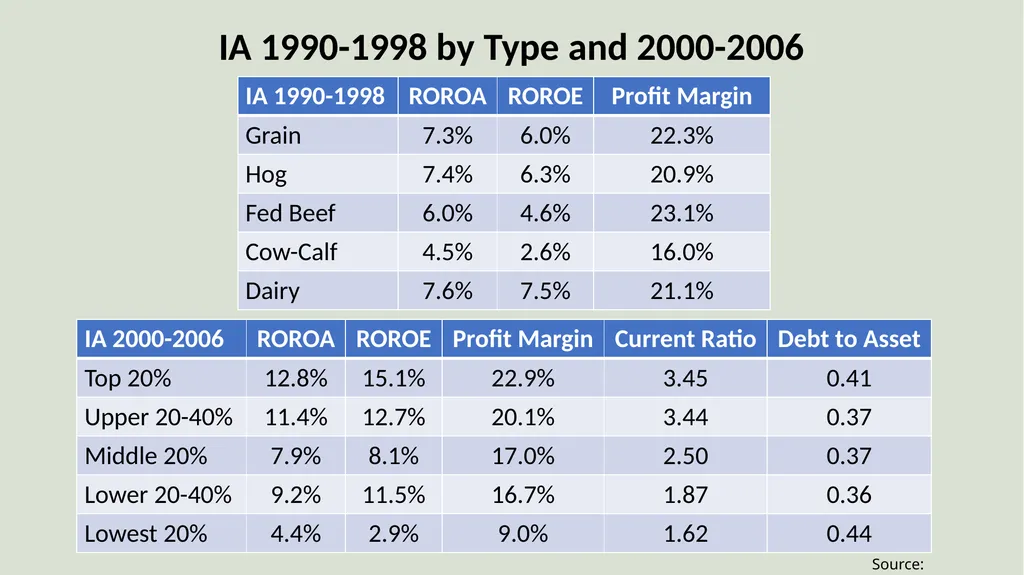
IA 1990-1998 by Type and 2000-2006 Source: http://www.extension.iastate.edu/Publications/FM1883.pdf<br>
42
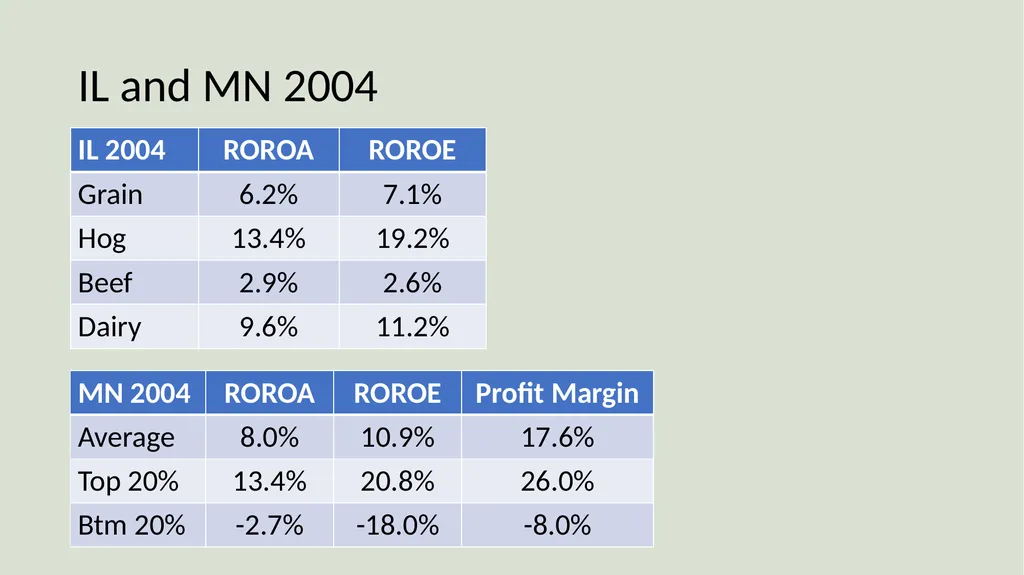
IL and MN 2004<br>
43
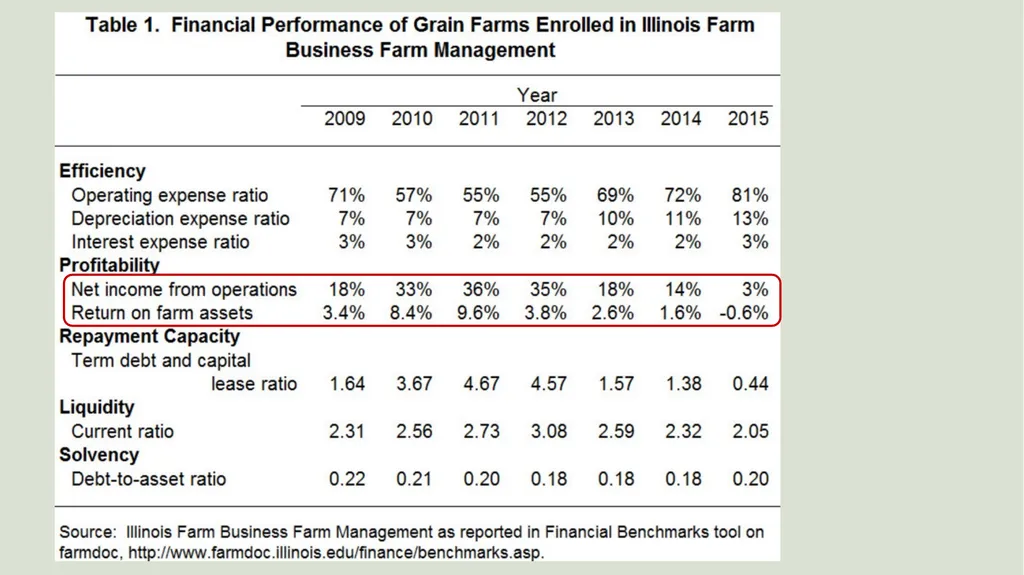
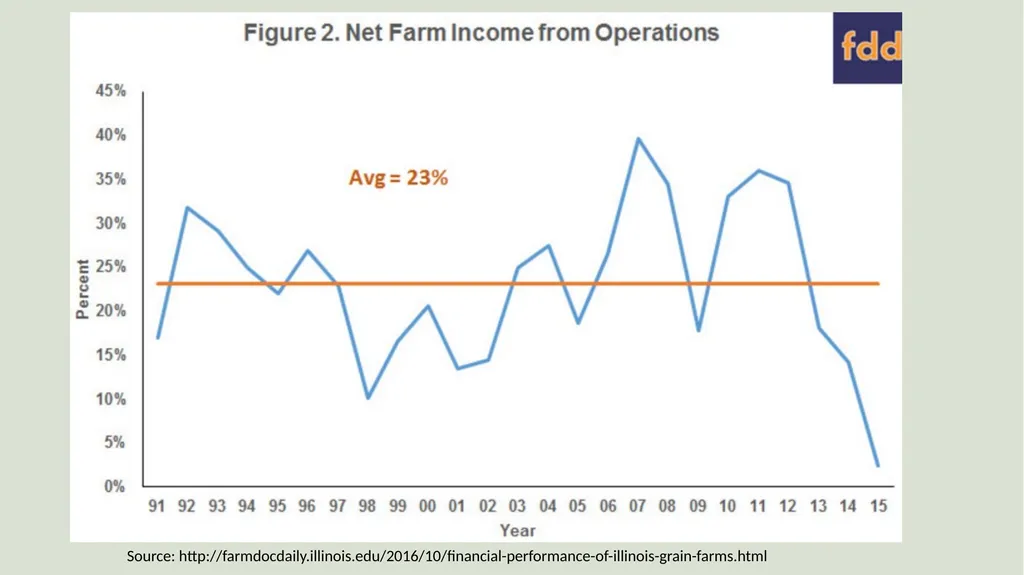
Source: http://farmdocdaily.illinois.edu/2016/10/financial-performance-of-illinois-grain-farms.html<br>
44
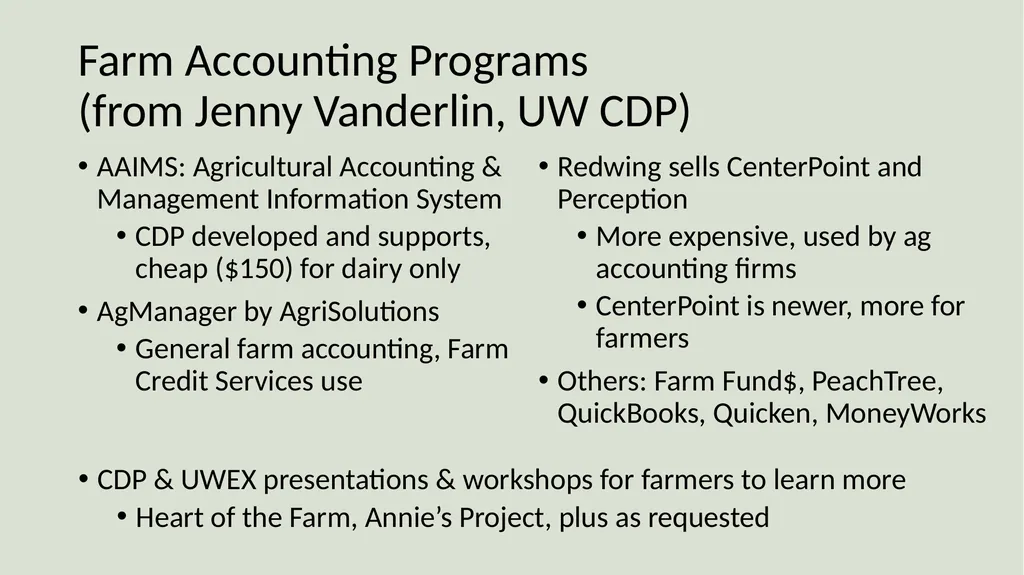
Farm Accounting Programs
(from Jenny Vanderlin, UW CDP) Redwing sells CenterPoint and Perception
More expensive, used by ag accounting firms
CenterPoint is newer, more for farmers
Others: Farm Fund$, PeachTree, QuickBooks, Quicken, MoneyWorks AAIMS: Agricultural Accounting & Management Information System
CDP developed and supports, cheap ($150) for dairy only
AgManager by AgriSolutions
General farm accounting, Farm Credit Services use CDP & UWEX presentations & workshops for farmers to learn more
Heart of the Farm, Annie’s Project, plus as requested<br>
45
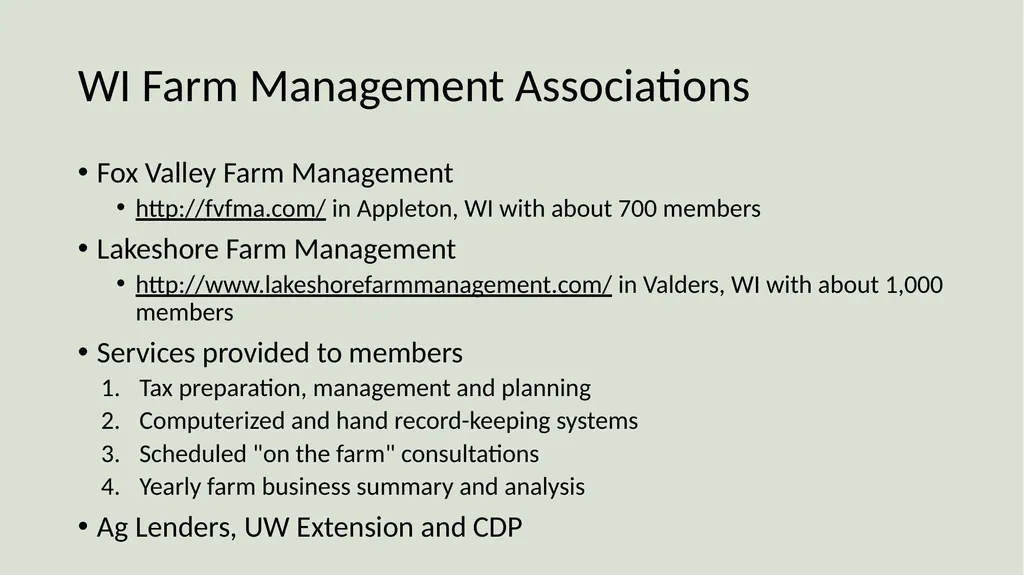
WI Farm Management Associations Fox Valley Farm Management
http://fvfma.com/ in Appleton, WI with about 700 members
Lakeshore Farm Management
http://www.lakeshorefarmmanagement.com/ in Valders, WI with about 1,000 members
Services provided to members
Tax preparation, management and planning
Computerized and hand record-keeping systems
Scheduled "on the farm" consultations
Yearly farm business summary and analysis
Ag Lenders, UW Extension and CDP<br>
46
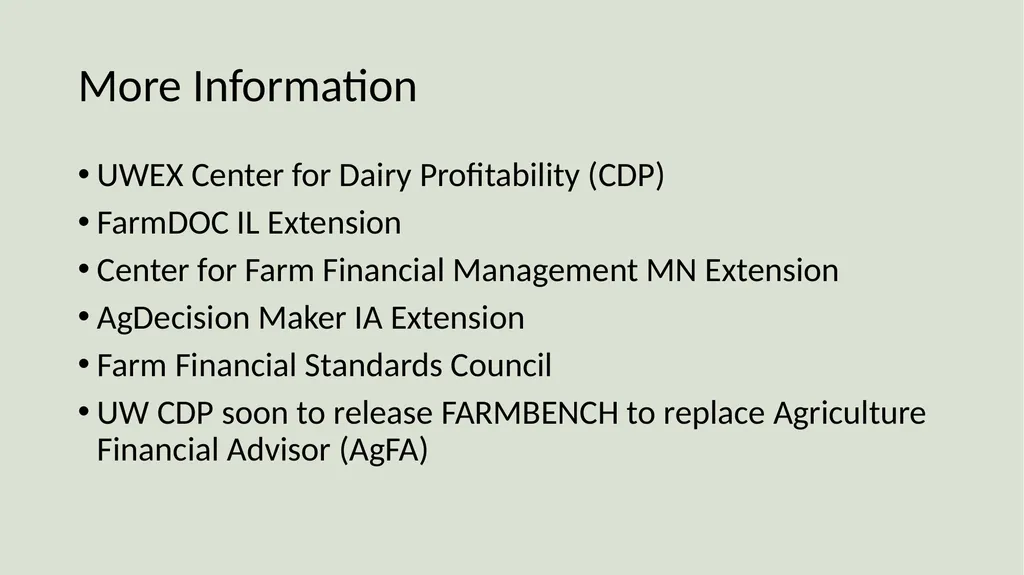
More Information UWEX Center for Dairy Profitability (CDP)
FarmDOC IL Extension
Center for Farm Financial Management MN Extension
AgDecision Maker IA Extension
Farm Financial Standards Council
UW CDP soon to release FARMBENCH to replace Agriculture Financial Advisor (AgFA)<br>
FarmDOC IL Extension
Center for Farm Financial Management MN Extension
AgDecision Maker IA Extension
Farm Financial Standards Council
UW CDP soon to release FARMBENCH to replace Agriculture Financial Advisor (AgFA)<br>
47
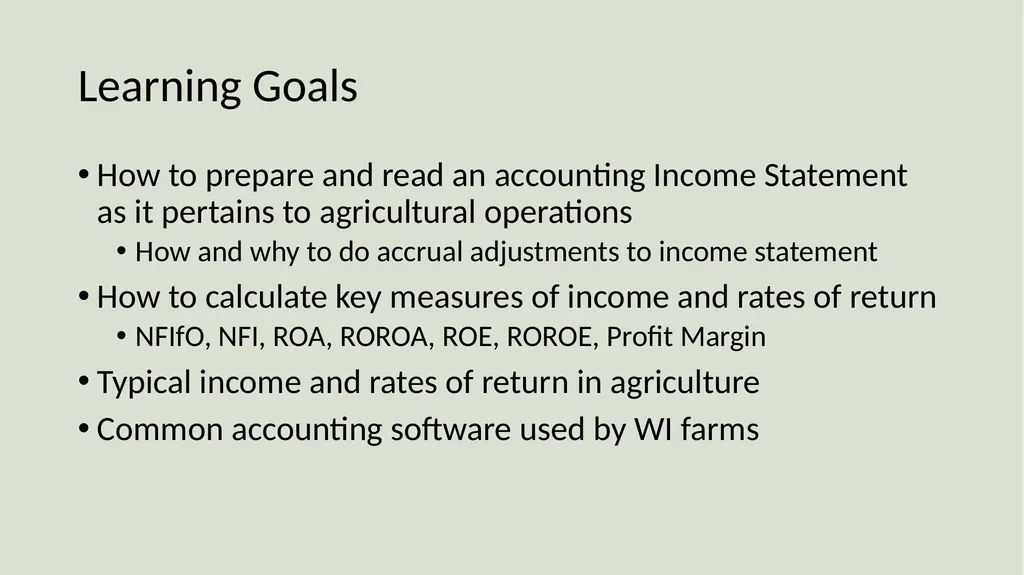
Learning Goals How to prepare and read an accounting Income Statement as it pertains to agricultural operations
How and why to do accrual adjustments to income statement
How to calculate key measures of income and rates of return
NFIfO, NFI, ROA, ROROA, ROE, ROROE, Profit Margin
Typical income and rates of return in agriculture
Common accounting software used by WI farms<br>
How and why to do accrual adjustments to income statement
How to calculate key measures of income and rates of return
NFIfO, NFI, ROA, ROROA, ROE, ROROE, Profit Margin
Typical income and rates of return in agriculture
Common accounting software used by WI farms<br>