
FB Mechanics Considerations, Emphasis, and
Description: FB Mechanics Considerations, Emphasis, and Differences Primarily NFL 7-person mechanics WHY UMPIRE POSITION IN BACKFIELD AND WHY FOCUS ON STATEWIDE CONSISTENCY? Basic Thoughts All All 7-person games will use the same mechanics with no
Related Topics
Download Presentation
"FB Mechanics Considerations, Emphasis, and" is the property of its rightful owner. Permission is granted to download and print the materials on this website for personal, non-commercial use only, and to display it on your personal computer provided you do not modify the materials and that you retain all copyright notices contained in the materials. By downloading content from our website, you accept the terms of this agreement.
Presentation Transcript
slide1. FB Mechanics Considerations, Emphasis, and Differences
Primarily – NFL 7-person mechanics<br>
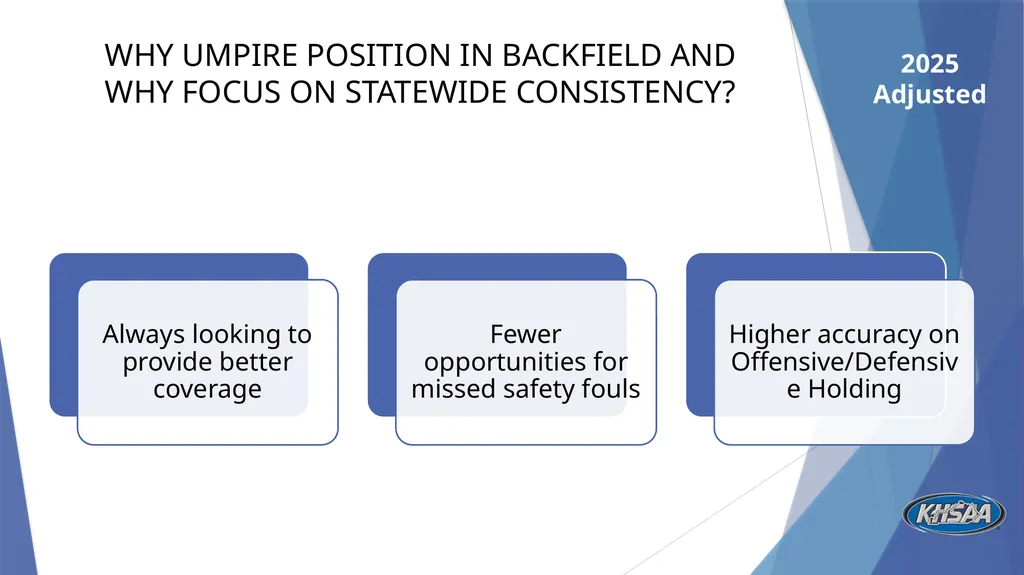
slide2. WHY UMPIRE POSITION IN BACKFIELD AND WHY FOCUS ON STATEWIDE CONSISTENCY?<br>
slide3. Basic Thoughts All –
All 7-person games will use the same mechanics with no local alterations
The NFL mechanics will be the guide as the starting point
The R and U will both be in the offensive backfield except on PAT and FG<br>
slide4. Scrimmage plays Referees –
Count players before Team A breaks the huddle or as early as possible without a huddle
Positioned to the right of the QB at least as wide as the Tight End
13-15 yards deep
Guard and Tackle on the right side are your initial keys (area of responsibility) as well as backs in your vision
All officials are to be in place before it is considered to be ready and premature snap at that point is against the offense.
Help manage the hurry-up as needed<br>
slide5. Scrimmage plays Umpires –
Count players before Team A breaks the huddle or as early as possible without a huddle
Positioned in offense backfield to the left of the QB at the left foot of the left tackle
At least 12 yards deep, but not on same yard line as Referee
Should be in advance of Referee
Center as well Guard and Tackle on the left side are your initial keys (area of responsibility) as well as backs in your vision
Use voice as needed, the “gain” of being in the backfield is emphasis on blocking, but may need strong voice to manage players.
Manage “hurry-up” situations, including positional changes if absolutely necessary, but make them absolutely necessary and game timing related decisions!<br>
slide6. Scrimmage plays Wings –
Count players if possible
Positioned one yard outside the sideline at a minimum
Watch for obvious movement of restricted linemen, particularly the tackle on your side
Rule on legality of formations
Warn zone
Obvious Fouls<br>
slide7. Scrimmage plays Deep Wings and BJ –
Count Team B players – Illegal substitution is a live ball foul
Field/Side positioned 20-24 yards deep; Back Judge -23-27 yards unless the ball is inside the 30
Watch for obvious movement of restricted linemen, particularly the tackle on your side
High emphasis on clock awareness (crew)
SJ – Game Clock
BJ – Play Clock<br>
slide8. Scrimmage plays – Running Play Referees –
Observe action behind the line and the runner to the neutral zone with a focus on the right side of the line
If you read run to the right or up the middle, focus on the blocks at the Point of Attack
If you read run to the left, focus on the blocks on the backside and QB
Stick with the QB wherever they go, sideline to sideline<br>
slide9. Scrimmage plays – running play Umpires –
Observe action at the line and threatened runners with a focus on the left side of the line
If you read run to the left or up the middle, focus on the blocks at the Point of Attack
If you read run to the right, focus on the blocks on the backside
Allow the QB to pass you if they scramble to the side zone, maintain blocking focus
Make your way to the inbounds spot after clearing dead ball responsibilities<br>
slide10. Scrimmage plays – running play Wings –
Observe the initial action by or to the offensive player who is your key, especially if pressed
If you read run to your side, focus on the blocks at the Point of Attack
Determine forward progress when you have a clear view of the ball
For plays that go away from you, clean up backside<br>
slide11. Scrimmage plays – running play Deep Wings and BJ-
Observe the initial action by or to the offensive player who is your key, especially if pressed
Pause, read and react. Do not bail
Field/Side - If you read run to your side, focus on the blocks at the Point of Attack
Field/Side – Be ready for crackback blocks
If a one-on-one play goes out of bounds on your side, focus on the field of play
Field/Side – Forward progress inside the two
Field/Side - Do not get another football until you clear the dead ball responsibilities
Back – Help with second level blocks up the middle and fouls in the area of the pile<br>
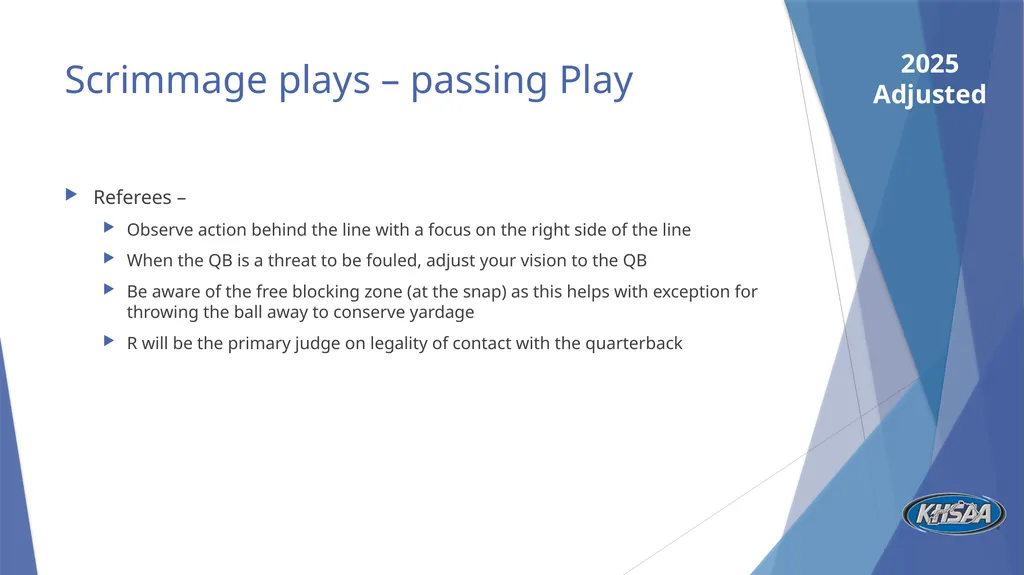
slide12. Scrimmage plays – passing Play Referees –
Observe action behind the line with a focus on the right side of the line
When the QB is a threat to be fouled, adjust your vision to the QB
Be aware of the free blocking zone (at the snap) as this helps with exception for throwing the ball away to conserve yardage
R will be the primary judge on legality of contact with the quarterback<br>
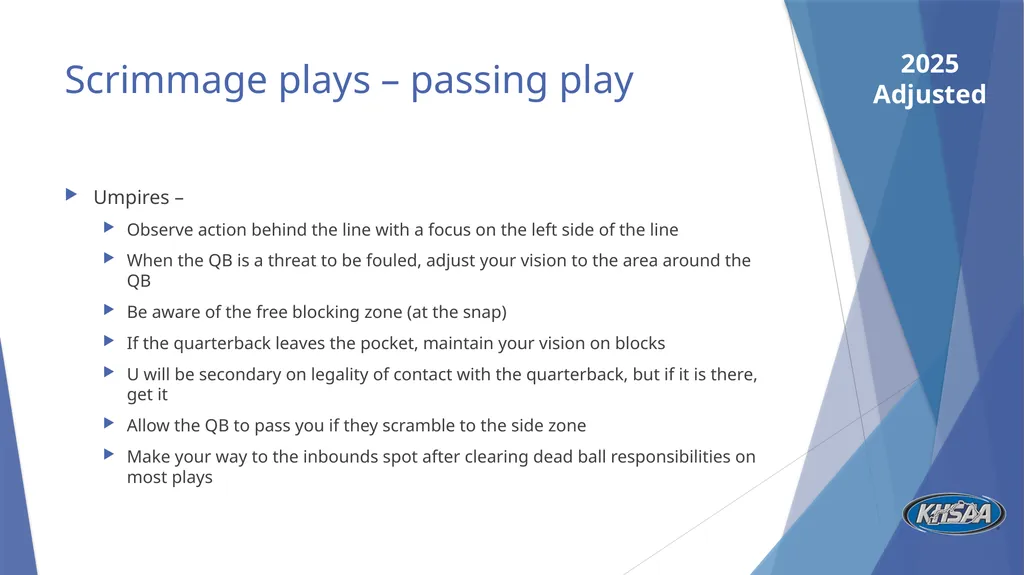
slide13. Scrimmage plays – passing play Umpires –
Observe action behind the line with a focus on the left side of the line
When the QB is a threat to be fouled, adjust your vision to the area around the QB
Be aware of the free blocking zone (at the snap)
If the quarterback leaves the pocket, maintain your vision on blocks
U will be secondary on legality of contact with the quarterback, but if it is there, get it
Allow the QB to pass you if they scramble to the side zone
Make your way to the inbounds spot after clearing dead ball responsibilities on most plays<br>
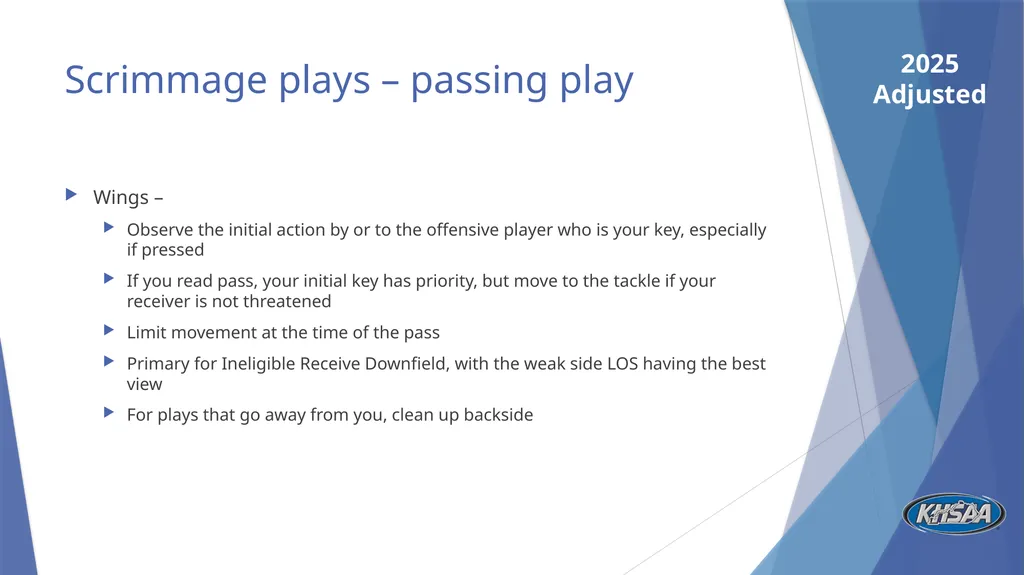
slide14. Scrimmage plays – passing play Wings –
Observe the initial action by or to the offensive player who is your key, especially if pressed
If you read pass, your initial key has priority, but move to the tackle if your receiver is not threatened
Limit movement at the time of the pass
Primary for Ineligible Receive Downfield, with the weak side LOS having the best view
For plays that go away from you, clean up backside<br>
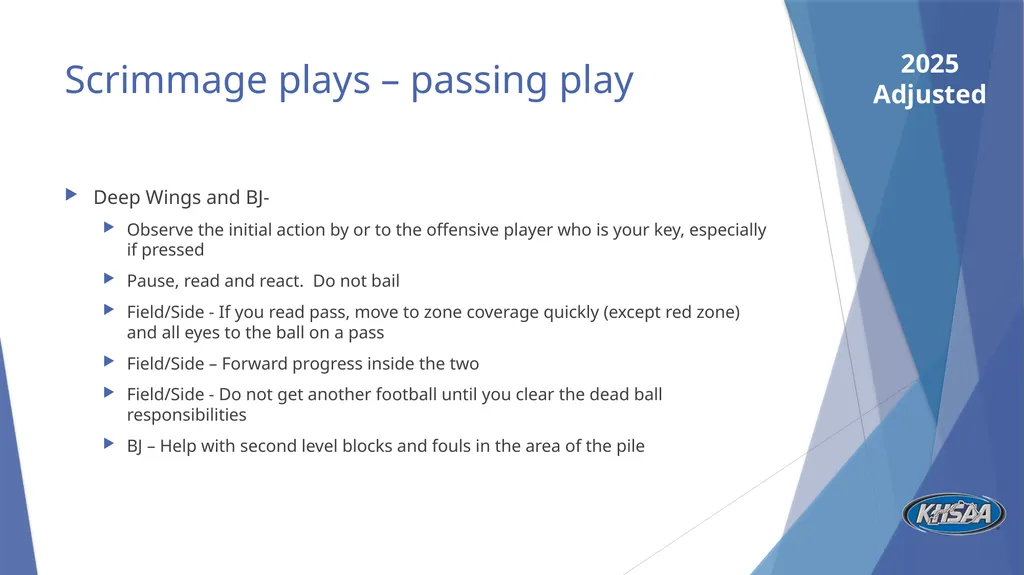
slide15. Scrimmage plays – passing play Deep Wings and BJ-
Observe the initial action by or to the offensive player who is your key, especially if pressed
Pause, read and react. Do not bail
Field/Side - If you read pass, move to zone coverage quickly (except red zone) and all eyes to the ball on a pass
Field/Side – Forward progress inside the two
Field/Side - Do not get another football until you clear the dead ball responsibilities
BJ – Help with second level blocks and fouls in the area of the pile<br>
slide16. Scrimmage plays – spotting the ball & pace Referees –
If a running play ends in your side zone, prepare to triangle the ball into the umpire
If a running play ends in the umpire’s side zone, prepare to help spot the ball
When the umpire has the ball in their hands, start the game clock if required
Scan the field for flags/subs, indicate a first down when needed<br>
slide17. Scrimmage plays – spotting the ball & pace Umpires –
Running play or completed pass in the middle third, you are responsible for retrieving the ball and spotting
On a run or completed pass to your side zone, prepare to triangle the ball to the referee for spotting
On a run or completed pass to the referee’s side zone, prepare to spot the ball at the inbounds spot
Keep a similar pace for the whole game (unless under 2:00 in the 2nd/4th quarter and time is a factor)
Our goal is to get the ball on the ground between :28 and :32
Maybe more time needed on a long pass play, but do not put the ball down early as that is the expected pace for the remainder of the game
If we go too fast, we make mistakes as do the players
Going too fast can lead to injuries
Keep the lateral position on a down indicator (1, 2, 3, 4, 5 or LH, LM, M, RM, RH)
Place the ball on a spot that you can consistently enforce penalties from<br>
slide18. Scrimmage plays – spotting the ball & pace Wings –
Mark forward progress – Don’t be too finite
Officiate players, do not worry about the exact blade of grass that a spot is on
Place the ball at your feet if the play ends in your side zone
Pinch hard on critical spots – in the field of play if you are not sure on a TD/safety
Ask for the ball and place it exactly when the LTG is threatened
Officiate players, do not worry about the exact blade of grass that a spot is on<br>
slide19. Scrimmage plays – spotting the ball & pace Deep Wings and BJ-
Accordion in when the play is over
Field/Side - Do not get another football until you clear the dead ball responsibilities
BJ – Help with fouls in the area of the pile
Make sure that the R has clock status as necessary
Make sure that clocks are correct when needed<br>
slide20. Free kicks Same initial positioning two yards off the sideline
Count players for K and R before putting the ball in play
Same coverages and mechanics as in the past
Once the ball is kicked, U and BJ need to let K cross their face before coming onto the field
Wings – hold your position until the GL is no longer threatened
Zone coverage for all officials, but don’t leave a threat
Officials may adjust after assuming INITIAL position properly, especially if short kick is anticipated for any reason<br>
slide21. Scrimmage kicks – punts Referees –
Initial position 8-10 yards wide of the ball and 3-4 yards behind the punter
Aware of numbering exceptions to the right side
When the punter is a threat to be fouled, adjust your vision to the punter
Be aware of the free blocking zone (at the snap) as this is your piece of ING/RRK
If the punter leaves the free blocking zone (at the snap), officiate inside-out
R will be the primary judge on legality of contact with the punter<br>
slide22. Scrimmage kicks – punts Umpires –
Normal Initial position normal TE position and 3-4 yards behind the punter.
Aware of numbering exceptions to the left side
When the punter is a threat to be fouled, adjust your vision to the area around the punter
Primary for leaping the shield
View the second wave blocks as K progresses downfield<br>
slide23. Scrimmage kicks – punts Wings –
Observe the initial action by or to the K players in your area of responsibility, especially if pressed
Legality of formation/FST
Wait for the ball to be kicked before vacating the line
View the second wave blocks as K progresses downfield
Get a new ball after clearing your dead ball responsibilities<br>
slide24. Scrimmage kicks – punts Deep Wings and BJ-
Observe the initial action by or to the kicking team player who is your key, especially if pressed
Line up evenly approximately 5 yards behind the deepest receiver
Start at the goal line if it can be reasonably threatened
Field/Side/Back – hold the dead ball spot until cleared by the U
Help with the first wave of blocks unless you have KCI responsibilities<br>
slide25. Scrimmage kicks – scoring tries (PAT/FG) Umpires –
Initial position alongside SJ just behind linebackers in defensive backfield, 7-10 yards off LOS, cover blocking and pivot to cover return in case of failed kick that is not otherwise dead by rule
Aware of numbering exceptions on your side
Primary for for illegal activity by players at the line of scrimmage attempting to block the kick
View the second wave blocks as K progresses downfield as needed (primarily FG)<br>
slide26. Scrimmage kicks – scoring tries (PAT/FG) Deep Officials –
SJ alongside U behind linebackers in defensive backfield, 7-10 yards off LOS, cover blocking and pivot to cover return in case of failed kick that is not otherwise dead by rule
BJ / FJ under goal post for initial position but flexible if play breaks loose
Aware of numbering exceptions on your side
Secondary for illegal activity by players at the line of scrimmage attempting to block the kick
View the second wave blocks as K progresses downfield (primarily FG)<br>
slide27. GOOD LUCK!<br>
slide2. WHY UMPIRE POSITION IN BACKFIELD AND WHY FOCUS ON STATEWIDE CONSISTENCY?<br>
slide3. Basic Thoughts All –
All 7-person games will use the same mechanics with no local alterations
The NFL mechanics will be the guide as the starting point
The R and U will both be in the offensive backfield except on PAT and FG<br>
slide4. Scrimmage plays Referees –
Count players before Team A breaks the huddle or as early as possible without a huddle
Positioned to the right of the QB at least as wide as the Tight End
13-15 yards deep
Guard and Tackle on the right side are your initial keys (area of responsibility) as well as backs in your vision
All officials are to be in place before it is considered to be ready and premature snap at that point is against the offense.
Help manage the hurry-up as needed<br>
slide5. Scrimmage plays Umpires –
Count players before Team A breaks the huddle or as early as possible without a huddle
Positioned in offense backfield to the left of the QB at the left foot of the left tackle
At least 12 yards deep, but not on same yard line as Referee
Should be in advance of Referee
Center as well Guard and Tackle on the left side are your initial keys (area of responsibility) as well as backs in your vision
Use voice as needed, the “gain” of being in the backfield is emphasis on blocking, but may need strong voice to manage players.
Manage “hurry-up” situations, including positional changes if absolutely necessary, but make them absolutely necessary and game timing related decisions!<br>
slide6. Scrimmage plays Wings –
Count players if possible
Positioned one yard outside the sideline at a minimum
Watch for obvious movement of restricted linemen, particularly the tackle on your side
Rule on legality of formations
Warn zone
Obvious Fouls<br>
slide7. Scrimmage plays Deep Wings and BJ –
Count Team B players – Illegal substitution is a live ball foul
Field/Side positioned 20-24 yards deep; Back Judge -23-27 yards unless the ball is inside the 30
Watch for obvious movement of restricted linemen, particularly the tackle on your side
High emphasis on clock awareness (crew)
SJ – Game Clock
BJ – Play Clock<br>
slide8. Scrimmage plays – Running Play Referees –
Observe action behind the line and the runner to the neutral zone with a focus on the right side of the line
If you read run to the right or up the middle, focus on the blocks at the Point of Attack
If you read run to the left, focus on the blocks on the backside and QB
Stick with the QB wherever they go, sideline to sideline<br>
slide9. Scrimmage plays – running play Umpires –
Observe action at the line and threatened runners with a focus on the left side of the line
If you read run to the left or up the middle, focus on the blocks at the Point of Attack
If you read run to the right, focus on the blocks on the backside
Allow the QB to pass you if they scramble to the side zone, maintain blocking focus
Make your way to the inbounds spot after clearing dead ball responsibilities<br>
slide10. Scrimmage plays – running play Wings –
Observe the initial action by or to the offensive player who is your key, especially if pressed
If you read run to your side, focus on the blocks at the Point of Attack
Determine forward progress when you have a clear view of the ball
For plays that go away from you, clean up backside<br>
slide11. Scrimmage plays – running play Deep Wings and BJ-
Observe the initial action by or to the offensive player who is your key, especially if pressed
Pause, read and react. Do not bail
Field/Side - If you read run to your side, focus on the blocks at the Point of Attack
Field/Side – Be ready for crackback blocks
If a one-on-one play goes out of bounds on your side, focus on the field of play
Field/Side – Forward progress inside the two
Field/Side - Do not get another football until you clear the dead ball responsibilities
Back – Help with second level blocks up the middle and fouls in the area of the pile<br>
slide12. Scrimmage plays – passing Play Referees –
Observe action behind the line with a focus on the right side of the line
When the QB is a threat to be fouled, adjust your vision to the QB
Be aware of the free blocking zone (at the snap) as this helps with exception for throwing the ball away to conserve yardage
R will be the primary judge on legality of contact with the quarterback<br>
slide13. Scrimmage plays – passing play Umpires –
Observe action behind the line with a focus on the left side of the line
When the QB is a threat to be fouled, adjust your vision to the area around the QB
Be aware of the free blocking zone (at the snap)
If the quarterback leaves the pocket, maintain your vision on blocks
U will be secondary on legality of contact with the quarterback, but if it is there, get it
Allow the QB to pass you if they scramble to the side zone
Make your way to the inbounds spot after clearing dead ball responsibilities on most plays<br>
slide14. Scrimmage plays – passing play Wings –
Observe the initial action by or to the offensive player who is your key, especially if pressed
If you read pass, your initial key has priority, but move to the tackle if your receiver is not threatened
Limit movement at the time of the pass
Primary for Ineligible Receive Downfield, with the weak side LOS having the best view
For plays that go away from you, clean up backside<br>
slide15. Scrimmage plays – passing play Deep Wings and BJ-
Observe the initial action by or to the offensive player who is your key, especially if pressed
Pause, read and react. Do not bail
Field/Side - If you read pass, move to zone coverage quickly (except red zone) and all eyes to the ball on a pass
Field/Side – Forward progress inside the two
Field/Side - Do not get another football until you clear the dead ball responsibilities
BJ – Help with second level blocks and fouls in the area of the pile<br>
slide16. Scrimmage plays – spotting the ball & pace Referees –
If a running play ends in your side zone, prepare to triangle the ball into the umpire
If a running play ends in the umpire’s side zone, prepare to help spot the ball
When the umpire has the ball in their hands, start the game clock if required
Scan the field for flags/subs, indicate a first down when needed<br>
slide17. Scrimmage plays – spotting the ball & pace Umpires –
Running play or completed pass in the middle third, you are responsible for retrieving the ball and spotting
On a run or completed pass to your side zone, prepare to triangle the ball to the referee for spotting
On a run or completed pass to the referee’s side zone, prepare to spot the ball at the inbounds spot
Keep a similar pace for the whole game (unless under 2:00 in the 2nd/4th quarter and time is a factor)
Our goal is to get the ball on the ground between :28 and :32
Maybe more time needed on a long pass play, but do not put the ball down early as that is the expected pace for the remainder of the game
If we go too fast, we make mistakes as do the players
Going too fast can lead to injuries
Keep the lateral position on a down indicator (1, 2, 3, 4, 5 or LH, LM, M, RM, RH)
Place the ball on a spot that you can consistently enforce penalties from<br>
slide18. Scrimmage plays – spotting the ball & pace Wings –
Mark forward progress – Don’t be too finite
Officiate players, do not worry about the exact blade of grass that a spot is on
Place the ball at your feet if the play ends in your side zone
Pinch hard on critical spots – in the field of play if you are not sure on a TD/safety
Ask for the ball and place it exactly when the LTG is threatened
Officiate players, do not worry about the exact blade of grass that a spot is on<br>
slide19. Scrimmage plays – spotting the ball & pace Deep Wings and BJ-
Accordion in when the play is over
Field/Side - Do not get another football until you clear the dead ball responsibilities
BJ – Help with fouls in the area of the pile
Make sure that the R has clock status as necessary
Make sure that clocks are correct when needed<br>
slide20. Free kicks Same initial positioning two yards off the sideline
Count players for K and R before putting the ball in play
Same coverages and mechanics as in the past
Once the ball is kicked, U and BJ need to let K cross their face before coming onto the field
Wings – hold your position until the GL is no longer threatened
Zone coverage for all officials, but don’t leave a threat
Officials may adjust after assuming INITIAL position properly, especially if short kick is anticipated for any reason<br>
slide21. Scrimmage kicks – punts Referees –
Initial position 8-10 yards wide of the ball and 3-4 yards behind the punter
Aware of numbering exceptions to the right side
When the punter is a threat to be fouled, adjust your vision to the punter
Be aware of the free blocking zone (at the snap) as this is your piece of ING/RRK
If the punter leaves the free blocking zone (at the snap), officiate inside-out
R will be the primary judge on legality of contact with the punter<br>
slide22. Scrimmage kicks – punts Umpires –
Normal Initial position normal TE position and 3-4 yards behind the punter.
Aware of numbering exceptions to the left side
When the punter is a threat to be fouled, adjust your vision to the area around the punter
Primary for leaping the shield
View the second wave blocks as K progresses downfield<br>
slide23. Scrimmage kicks – punts Wings –
Observe the initial action by or to the K players in your area of responsibility, especially if pressed
Legality of formation/FST
Wait for the ball to be kicked before vacating the line
View the second wave blocks as K progresses downfield
Get a new ball after clearing your dead ball responsibilities<br>
slide24. Scrimmage kicks – punts Deep Wings and BJ-
Observe the initial action by or to the kicking team player who is your key, especially if pressed
Line up evenly approximately 5 yards behind the deepest receiver
Start at the goal line if it can be reasonably threatened
Field/Side/Back – hold the dead ball spot until cleared by the U
Help with the first wave of blocks unless you have KCI responsibilities<br>
slide25. Scrimmage kicks – scoring tries (PAT/FG) Umpires –
Initial position alongside SJ just behind linebackers in defensive backfield, 7-10 yards off LOS, cover blocking and pivot to cover return in case of failed kick that is not otherwise dead by rule
Aware of numbering exceptions on your side
Primary for for illegal activity by players at the line of scrimmage attempting to block the kick
View the second wave blocks as K progresses downfield as needed (primarily FG)<br>
slide26. Scrimmage kicks – scoring tries (PAT/FG) Deep Officials –
SJ alongside U behind linebackers in defensive backfield, 7-10 yards off LOS, cover blocking and pivot to cover return in case of failed kick that is not otherwise dead by rule
BJ / FJ under goal post for initial position but flexible if play breaks loose
Aware of numbering exceptions on your side
Secondary for illegal activity by players at the line of scrimmage attempting to block the kick
View the second wave blocks as K progresses downfield (primarily FG)<br>
slide27. GOOD LUCK!<br>