February 24, 2017 Updated analysis of Fast Start
Description: February 24, 2017 Updated analysis of Fast Start Generator starts from 2014 through 2016 Analysis of Fast Start Generator Dispatch Frequency Fast Start Generator Definition The tariff defines Fast Start Generators based on the following
Related Topics
Download Presentation
"February 24, 2017 Updated analysis of Fast Start" is the property of its rightful owner. Permission is granted to download and print the materials on this website for personal, non-commercial use only, and to display it on your personal computer provided you do not modify the materials and that you retain all copyright notices contained in the materials. By downloading content from our website, you accept the terms of this agreement.
Presentation Transcript
slide1. February 24, 2017 Updated analysis of Fast Start Generator starts from 2014 through 2016 Analysis of Fast Start Generator Dispatch Frequency<br>
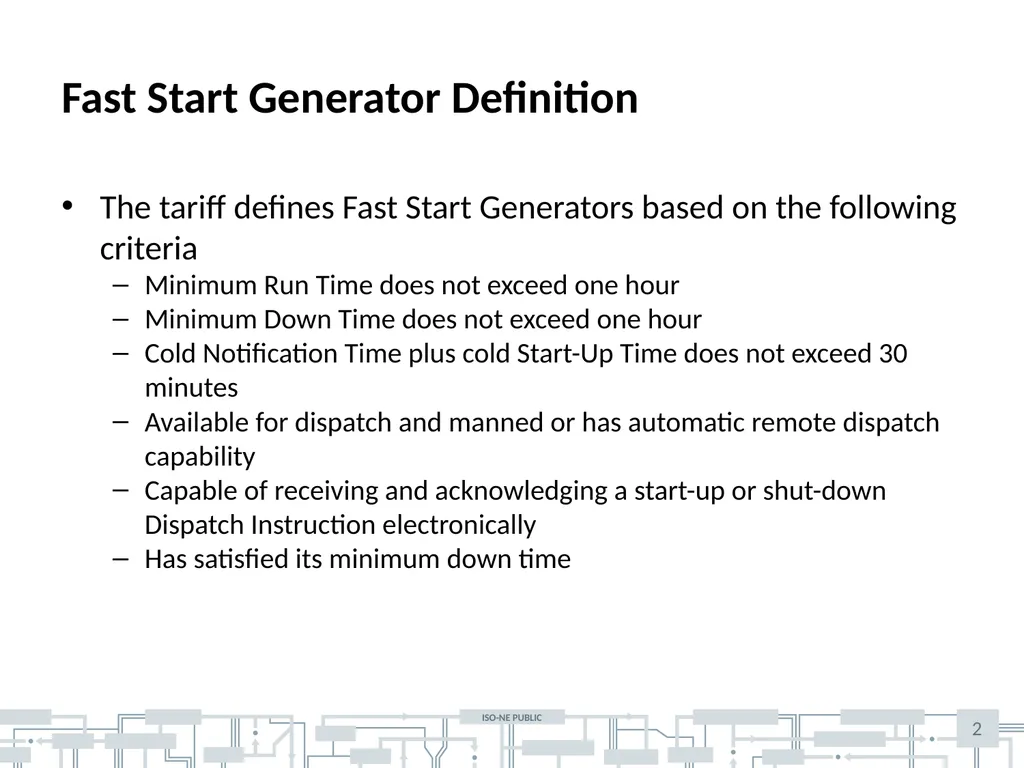
slide2. Fast Start Generator Definition The tariff defines Fast Start Generators based on the following criteria
Minimum Run Time does not exceed one hour
Minimum Down Time does not exceed one hour
Cold Notification Time plus cold Start-Up Time does not exceed 30 minutes
Available for dispatch and manned or has automatic remote dispatch capability
Capable of receiving and acknowledging a start-up or shut-down Dispatch Instruction electronically
Has satisfied its minimum down time 2<br>
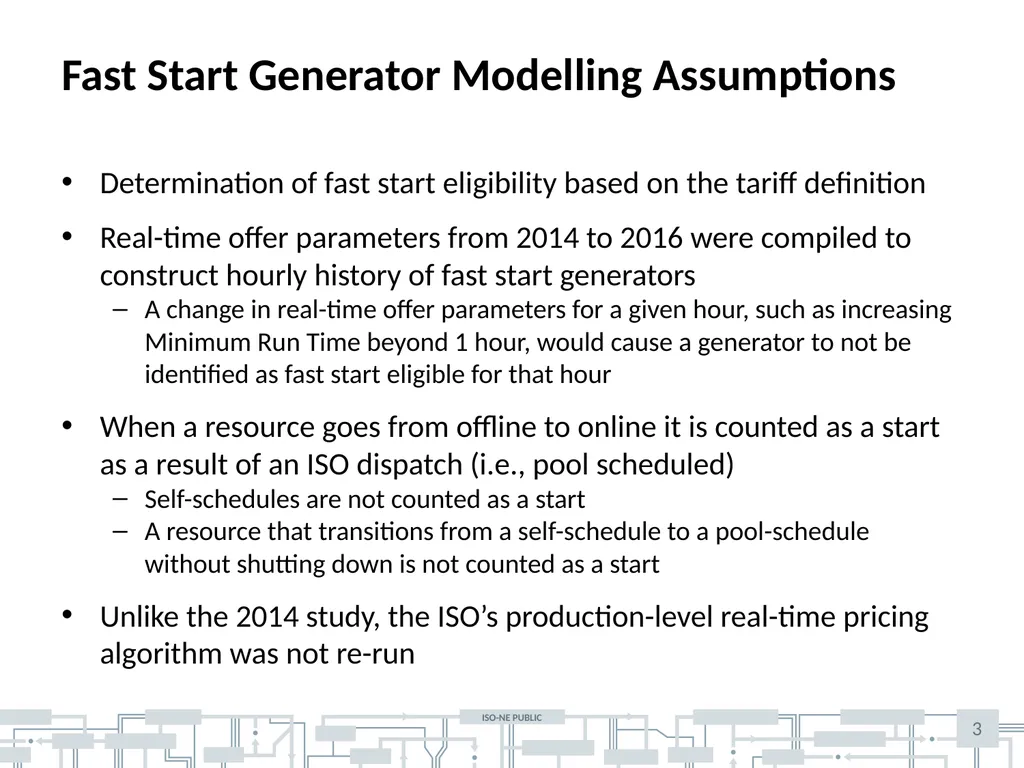
slide3. 3 Fast Start Generator Modelling Assumptions Determination of fast start eligibility based on the tariff definition
Real-time offer parameters from 2014 to 2016 were compiled to construct hourly history of fast start generators
A change in real-time offer parameters for a given hour, such as increasing Minimum Run Time beyond 1 hour, would cause a generator to not be identified as fast start eligible for that hour
When a resource goes from offline to online it is counted as a start as a result of an ISO dispatch (i.e., pool scheduled)
Self-schedules are not counted as a start
A resource that transitions from a self-schedule to a pool-schedule without shutting down is not counted as a start
Unlike the 2014 study, the ISO’s production-level real-time pricing algorithm was not re-run<br>
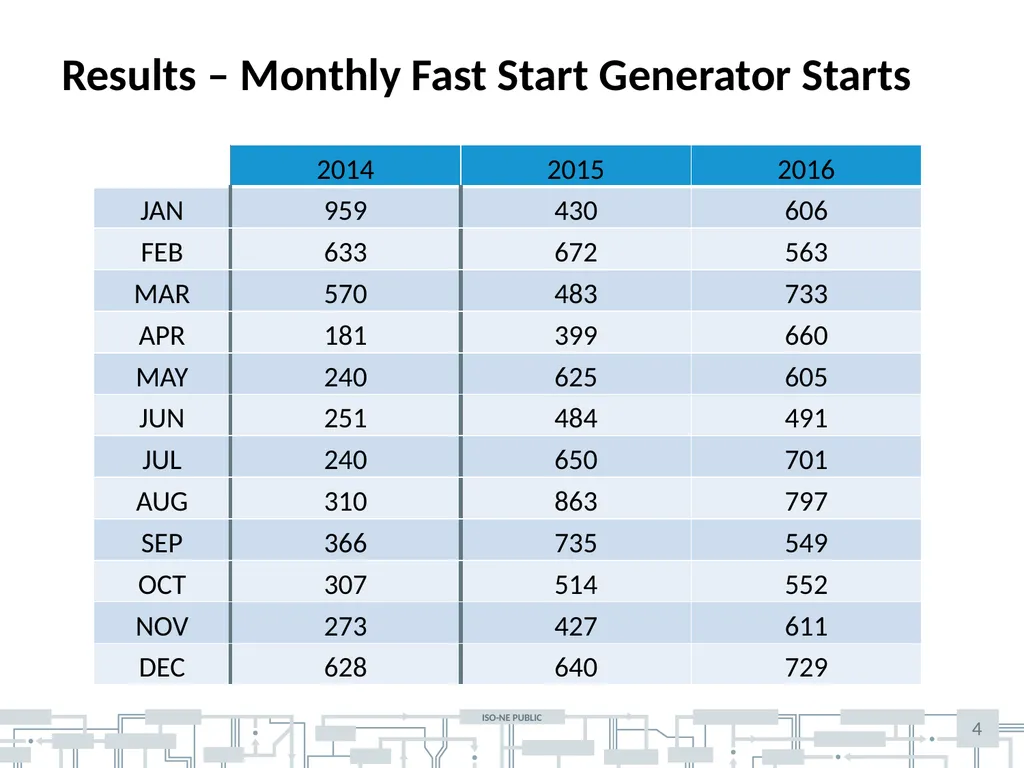
slide4. 4 Results – Monthly Fast Start Generator Starts<br>
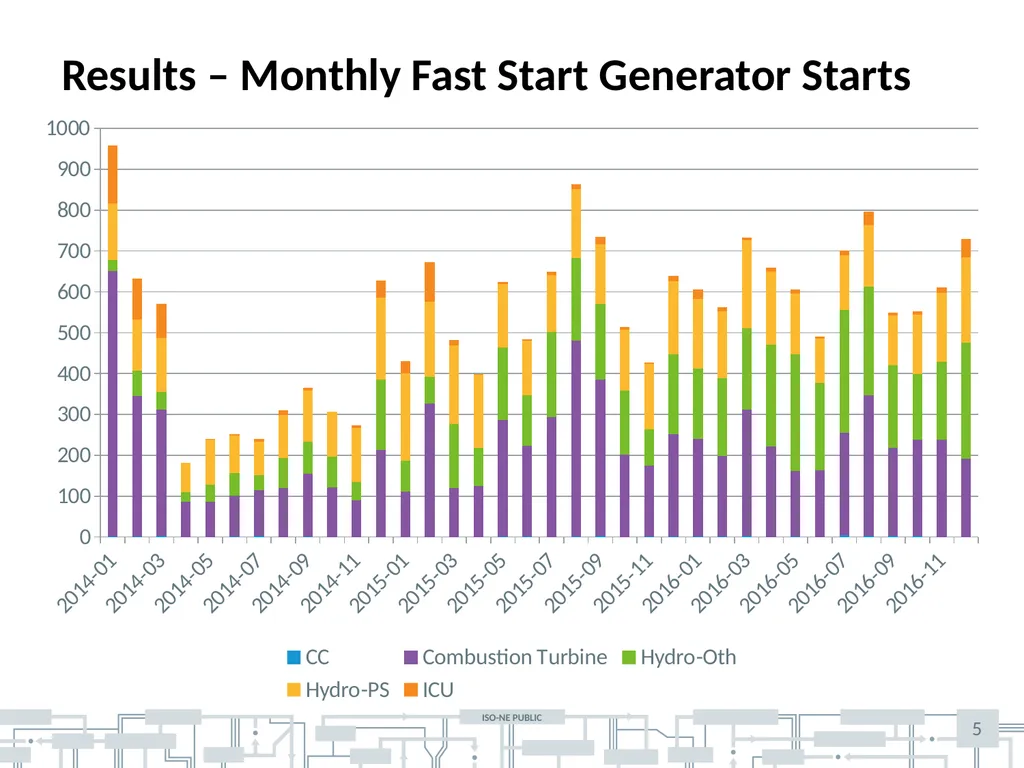
slide5. 5 Results – Monthly Fast Start Generator Starts<br>
slide2. Fast Start Generator Definition The tariff defines Fast Start Generators based on the following criteria
Minimum Run Time does not exceed one hour
Minimum Down Time does not exceed one hour
Cold Notification Time plus cold Start-Up Time does not exceed 30 minutes
Available for dispatch and manned or has automatic remote dispatch capability
Capable of receiving and acknowledging a start-up or shut-down Dispatch Instruction electronically
Has satisfied its minimum down time 2<br>
slide3. 3 Fast Start Generator Modelling Assumptions Determination of fast start eligibility based on the tariff definition
Real-time offer parameters from 2014 to 2016 were compiled to construct hourly history of fast start generators
A change in real-time offer parameters for a given hour, such as increasing Minimum Run Time beyond 1 hour, would cause a generator to not be identified as fast start eligible for that hour
When a resource goes from offline to online it is counted as a start as a result of an ISO dispatch (i.e., pool scheduled)
Self-schedules are not counted as a start
A resource that transitions from a self-schedule to a pool-schedule without shutting down is not counted as a start
Unlike the 2014 study, the ISO’s production-level real-time pricing algorithm was not re-run<br>
slide4. 4 Results – Monthly Fast Start Generator Starts<br>
slide5. 5 Results – Monthly Fast Start Generator Starts<br>