
Federal Financial Assistance Update May 2018
LV
Published · 41 slides · 0 views

1 / 1
Description
Federal Financial Assistance Update May 2018 Agenda This presentation includes the following five sections: Introduction Fundamentals Detailed Process Terms and Conditions Additional Resources 2 Acronyms The following acronyms are used in
Related Topics
Share
Embed code
Download this presentation From Below
"Federal Financial Assistance Update May 2018" is the property of its rightful owner. Permission is granted to download and print the materials on this website for personal, non-commercial use only, and to display it on your personal computer provided you do not modify the materials and that you retain all copyright notices contained in the materials. By downloading content from our website, you accept the terms of this agreement.
Presentation Transcript
01
Federal Financial Assistance
Update May 2018<br>
02
Agenda This presentation includes the following five sections:
Introduction
Fundamentals
Detailed Process
Terms and Conditions
Additional Resources 2<br>
Introduction
Fundamentals
Detailed Process
Terms and Conditions
Additional Resources 2<br>
03
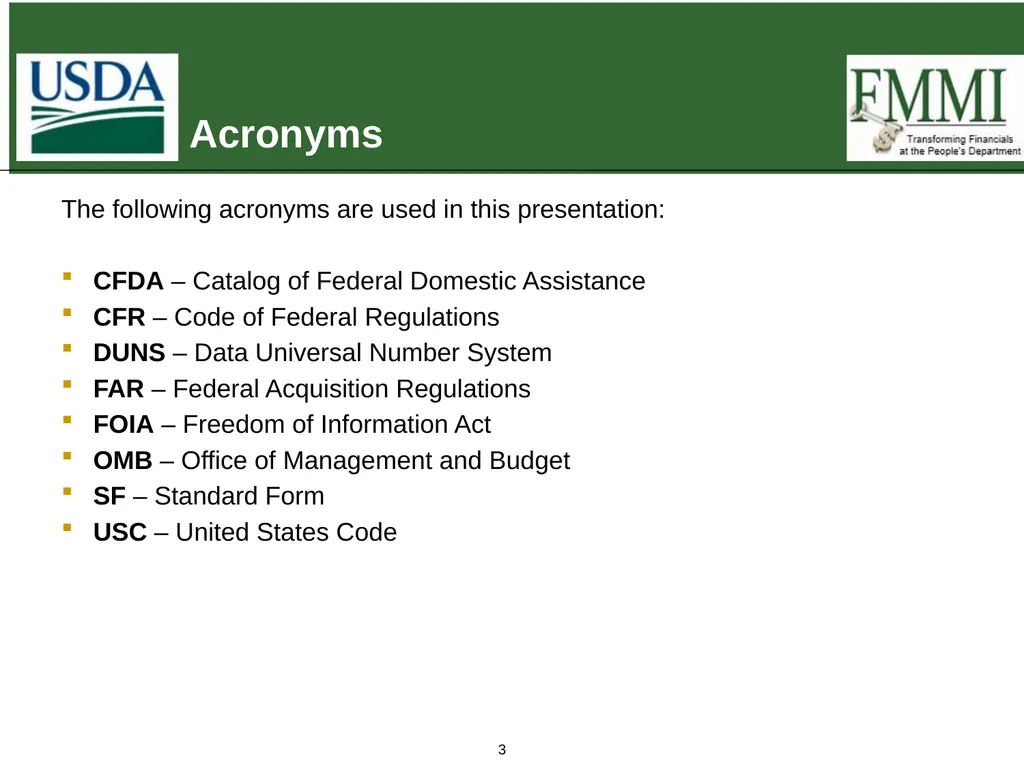
Acronyms The following acronyms are used in this presentation:
CFDA – Catalog of Federal Domestic Assistance
CFR – Code of Federal Regulations
DUNS – Data Universal Number System
FAR – Federal Acquisition Regulations
FOIA – Freedom of Information Act
OMB – Office of Management and Budget
SF – Standard Form
USC – United States Code 3<br>
CFDA – Catalog of Federal Domestic Assistance
CFR – Code of Federal Regulations
DUNS – Data Universal Number System
FAR – Federal Acquisition Regulations
FOIA – Freedom of Information Act
OMB – Office of Management and Budget
SF – Standard Form
USC – United States Code 3<br>
04
Fundamentals May 2018<br>
05
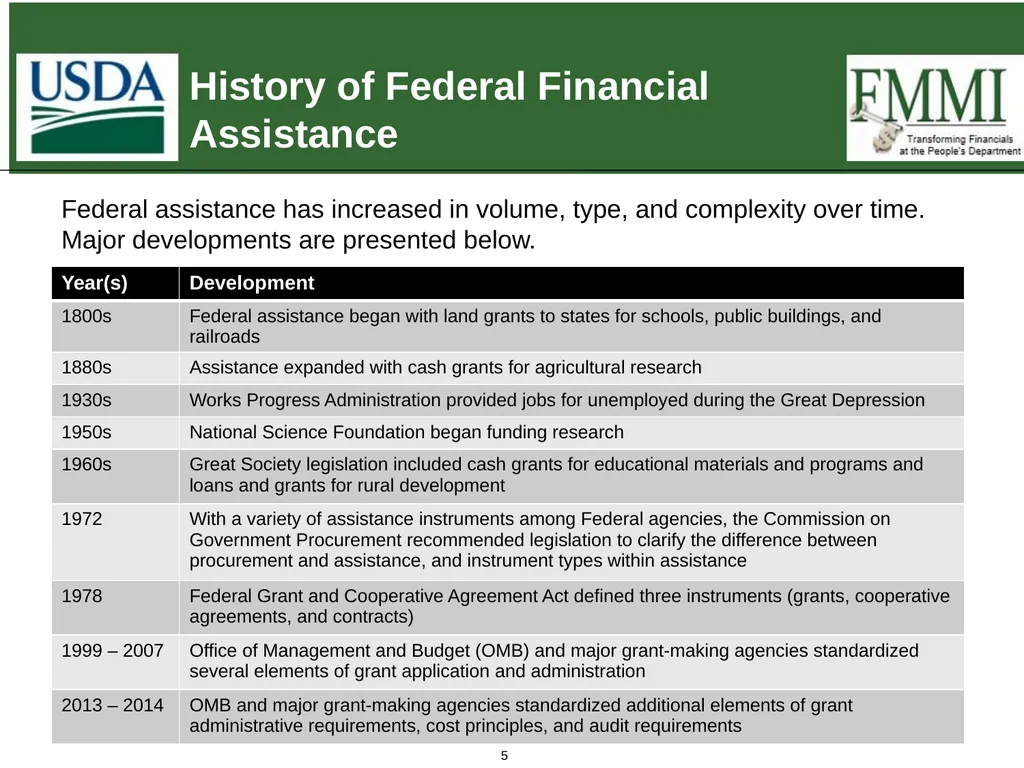
History of Federal Financial Assistance Federal assistance has increased in volume, type, and complexity over time. Major developments are presented below. 5<br>
06
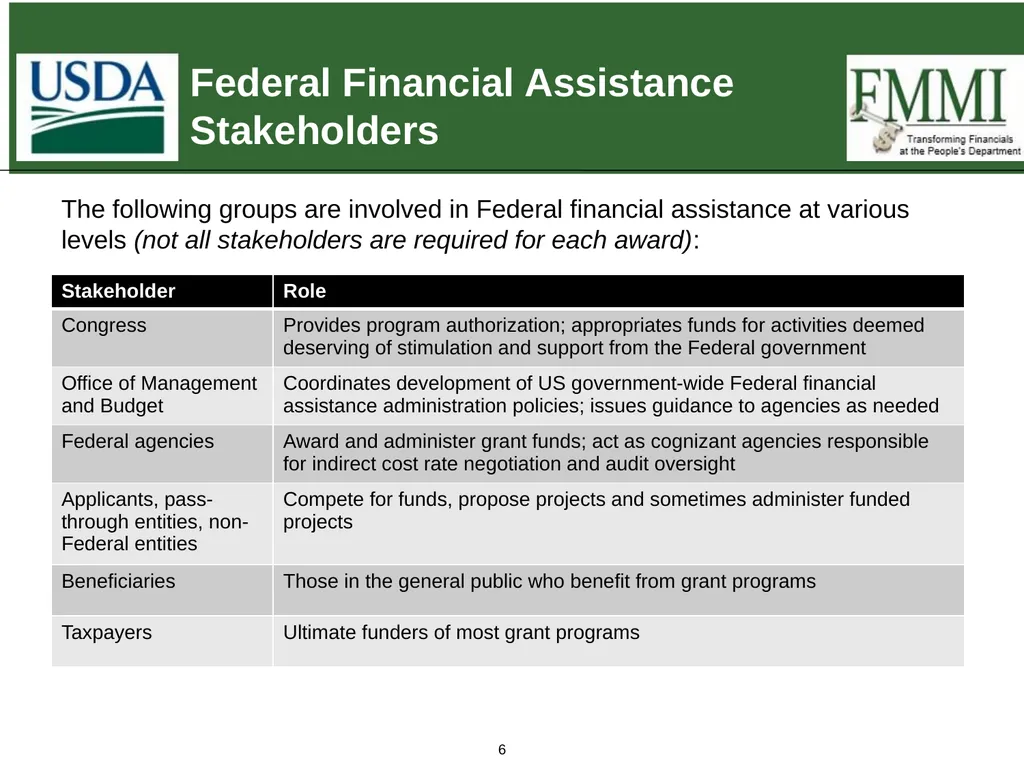
Federal Financial Assistance Stakeholders The following groups are involved in Federal financial assistance at various levels (not all stakeholders are required for each award): 6<br>
07
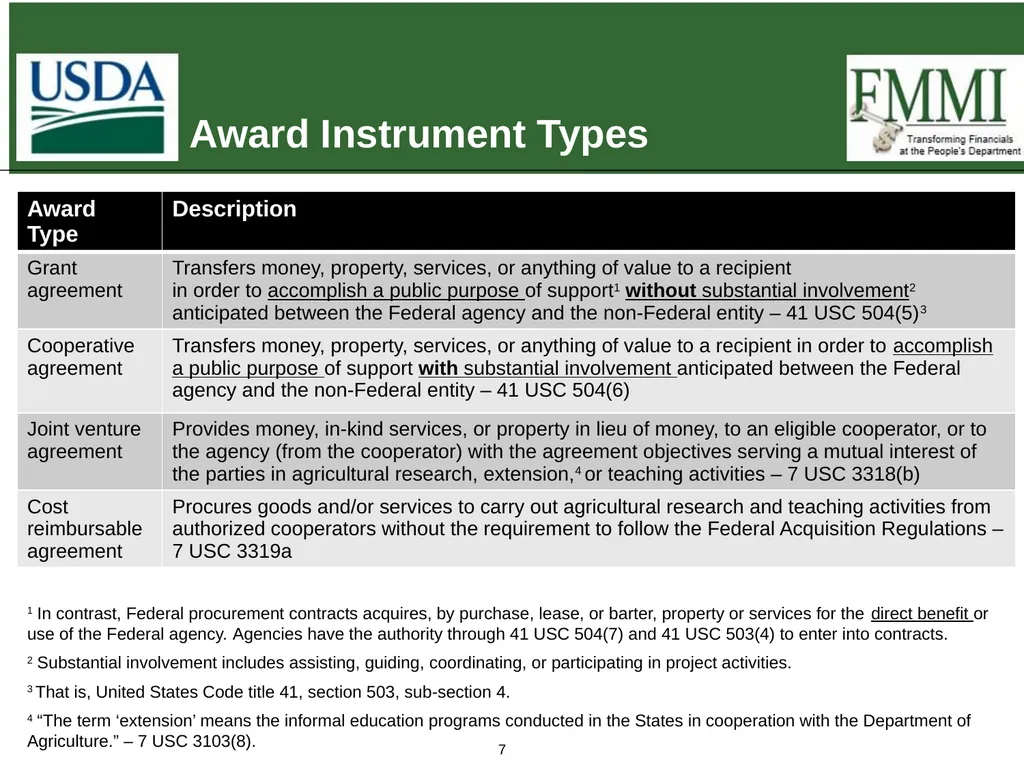
Award Instrument Types 1 In contrast, Federal procurement contracts acquires, by purchase, lease, or barter, property or services for the direct benefit or use of the Federal agency. Agencies have the authority through 41 USC 504(7) and 41 USC 503(4) to enter into contracts.
2 Substantial involvement includes assisting, guiding, coordinating, or participating in project activities.
3 That is, United States Code title 41, section 503, sub-section 4.
4 “The term ‘extension’ means the informal education programs conducted in the States in cooperation with the Department of Agriculture.” – 7 USC 3103(8). 7<br>
2 Substantial involvement includes assisting, guiding, coordinating, or participating in project activities.
3 That is, United States Code title 41, section 503, sub-section 4.
4 “The term ‘extension’ means the informal education programs conducted in the States in cooperation with the Department of Agriculture.” – 7 USC 3103(8). 7<br>
08
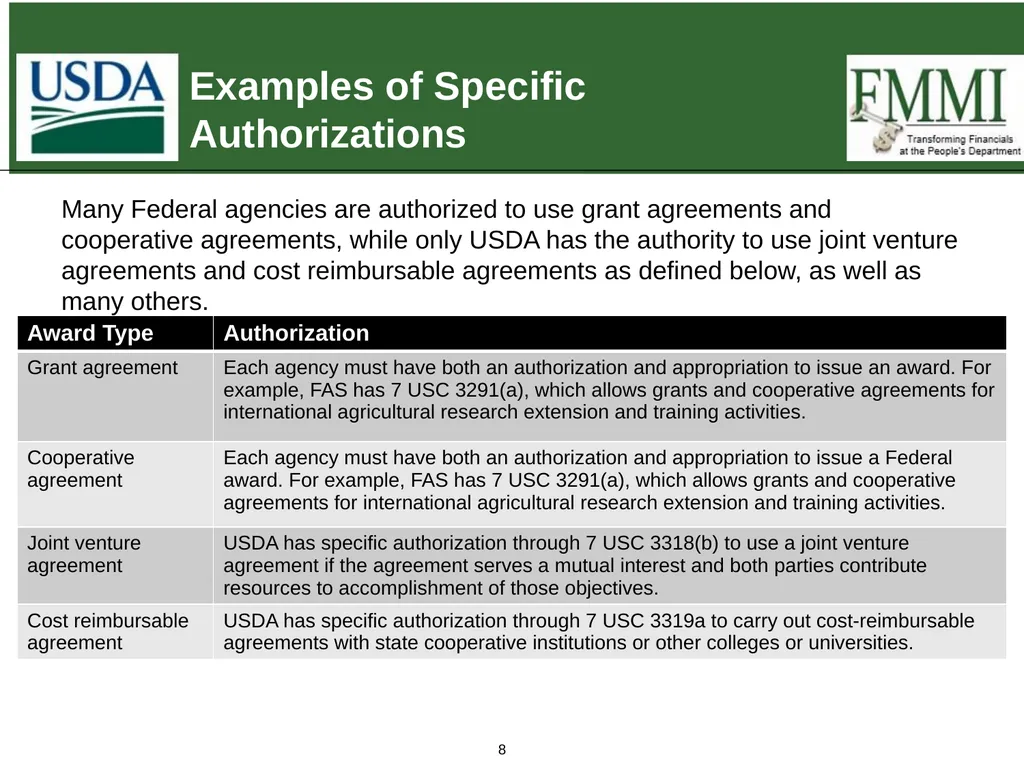
Examples of Specific
Authorizations Many Federal agencies are authorized to use grant agreements and cooperative agreements, while only USDA has the authority to use joint venture agreements and cost reimbursable agreements as defined below, as well as many others. 8<br>
09
Detailed Process May 2018<br>
10
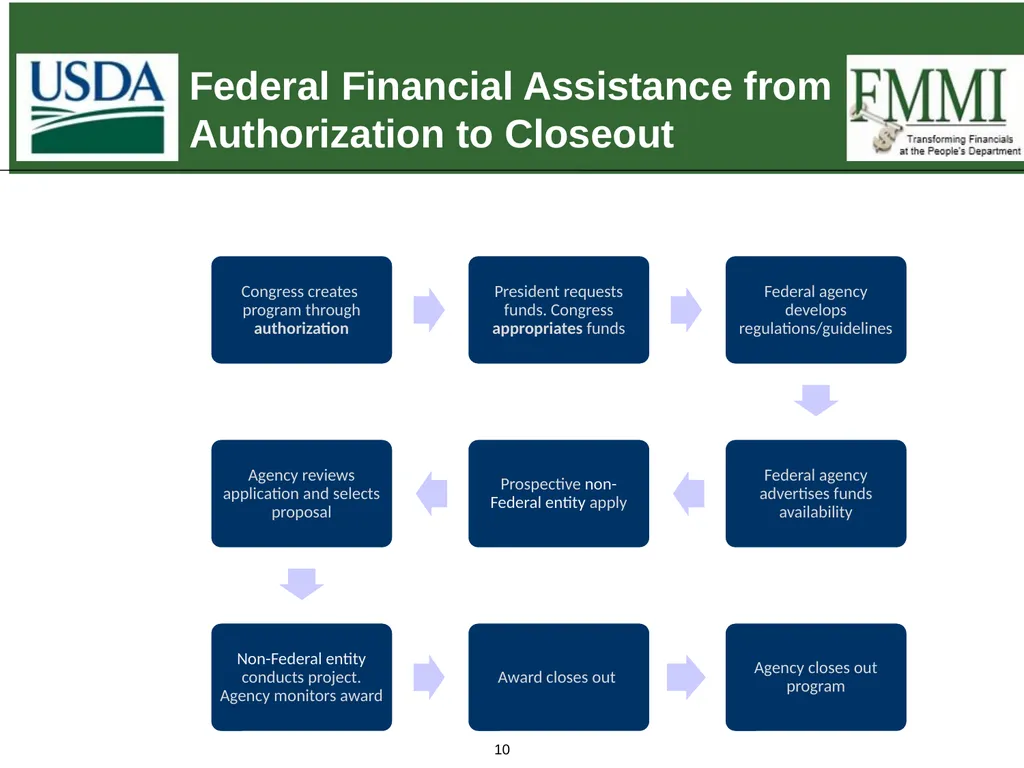
Federal Financial Assistance from Authorization to Closeout 10<br>
11
Authorization (1 of 3) Authorization statutes, in which Congress grants authority to a Federal agency to create a Federal financial assistance program, include the following two types:
Permanent authorizations
For programs with ongoing broad applicability
Example: the School Breakfast Program, administered by USDA Food and Nutrition Service.
Time-limited authorizations
For programs serving specialized purposes or interest groups
Example: the McGovern–Dole International Food for Education and Child Nutrition Program, administered by USDA Foreign Agriculture Service. 11<br>
Permanent authorizations
For programs with ongoing broad applicability
Example: the School Breakfast Program, administered by USDA Food and Nutrition Service.
Time-limited authorizations
For programs serving specialized purposes or interest groups
Example: the McGovern–Dole International Food for Education and Child Nutrition Program, administered by USDA Foreign Agriculture Service. 11<br>
12
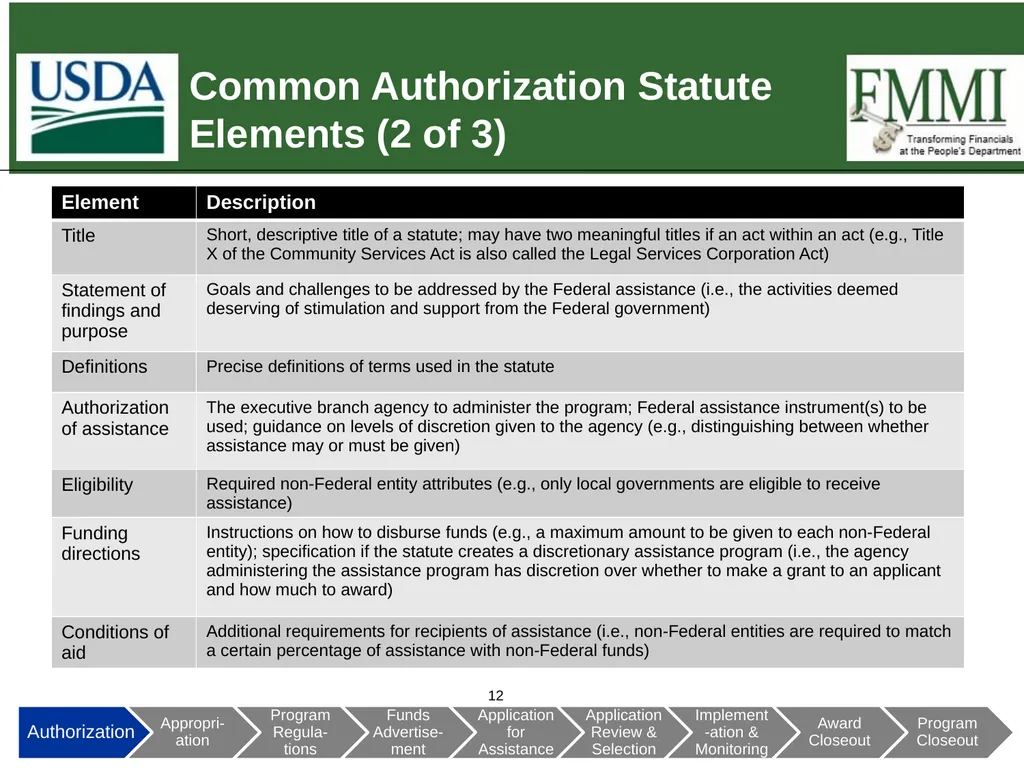
Common Authorization Statute Elements (2 of 3) 12<br>
13
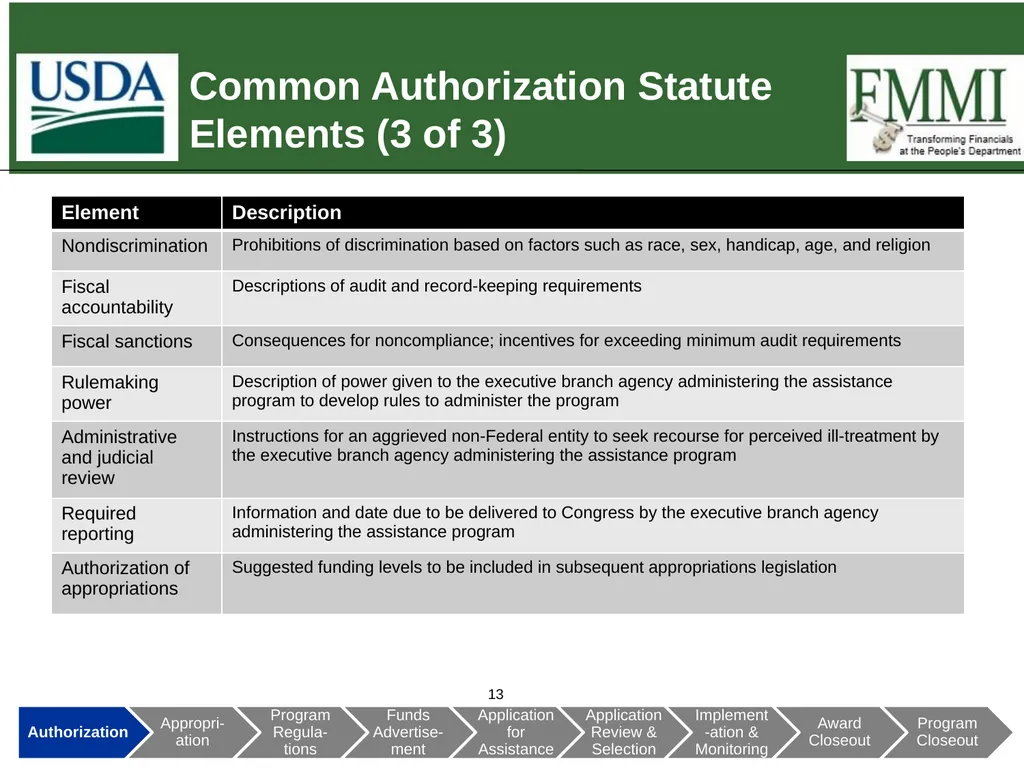
Common Authorization Statute Elements (3 of 3) 13<br>
14
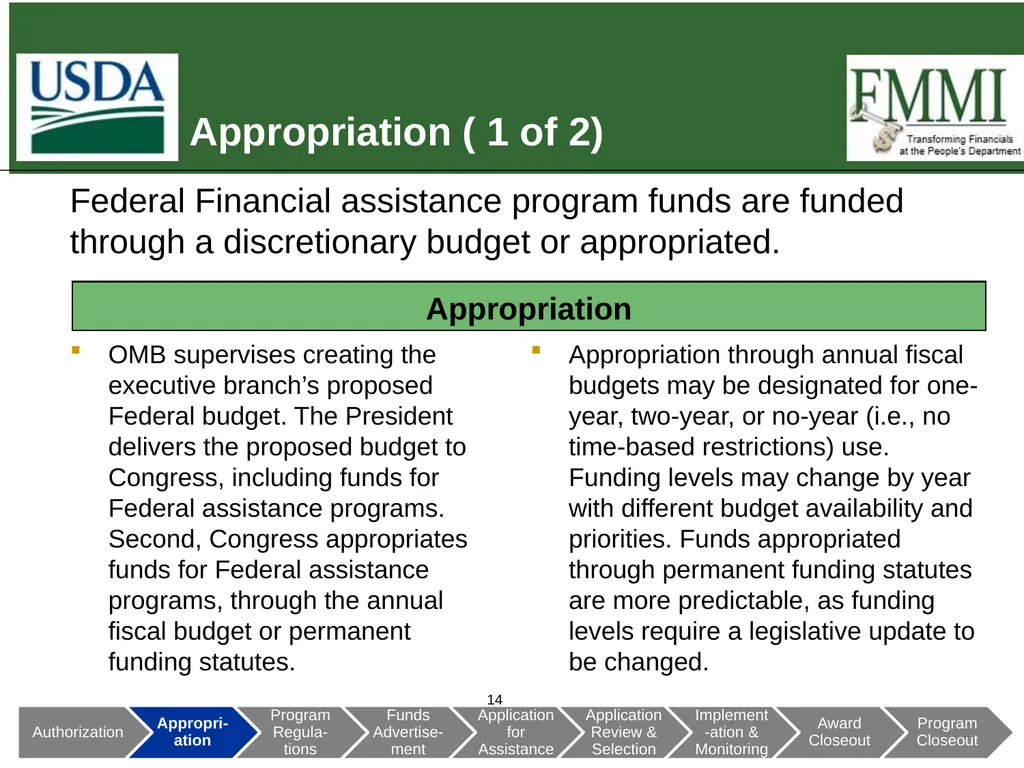
Appropriation ( 1 of 2) Federal Financial assistance program funds are funded through a discretionary budget or appropriated. Appropriation OMB supervises creating the executive branch’s proposed Federal budget. The President delivers the proposed budget to Congress, including funds for Federal assistance programs. Second, Congress appropriates funds for Federal assistance programs, through the annual fiscal budget or permanent funding statutes. Appropriation through annual fiscal budgets may be designated for one-year, two-year, or no-year (i.e., no time-based restrictions) use. Funding levels may change by year with different budget availability and priorities. Funds appropriated through permanent funding statutes are more predictable, as funding levels require a legislative update to be changed. 14<br>
15
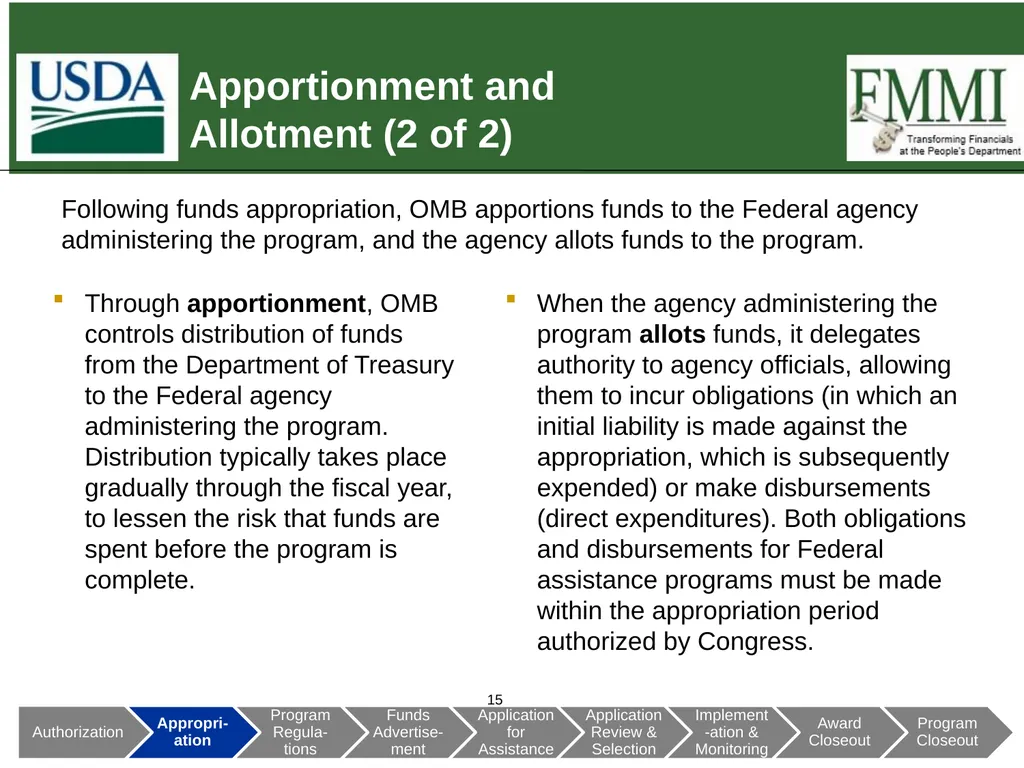
Apportionment and
Allotment (2 of 2) Following funds appropriation, OMB apportions funds to the Federal agency administering the program, and the agency allots funds to the program. Through apportionment, OMB controls distribution of funds from the Department of Treasury to the Federal agency administering the program. Distribution typically takes place gradually through the fiscal year, to lessen the risk that funds are spent before the program is complete. When the agency administering the program allots funds, it delegates authority to agency officials, allowing them to incur obligations (in which an initial liability is made against the appropriation, which is subsequently expended) or make disbursements (direct expenditures). Both obligations and disbursements for Federal assistance programs must be made within the appropriation period authorized by Congress. 15<br>
16
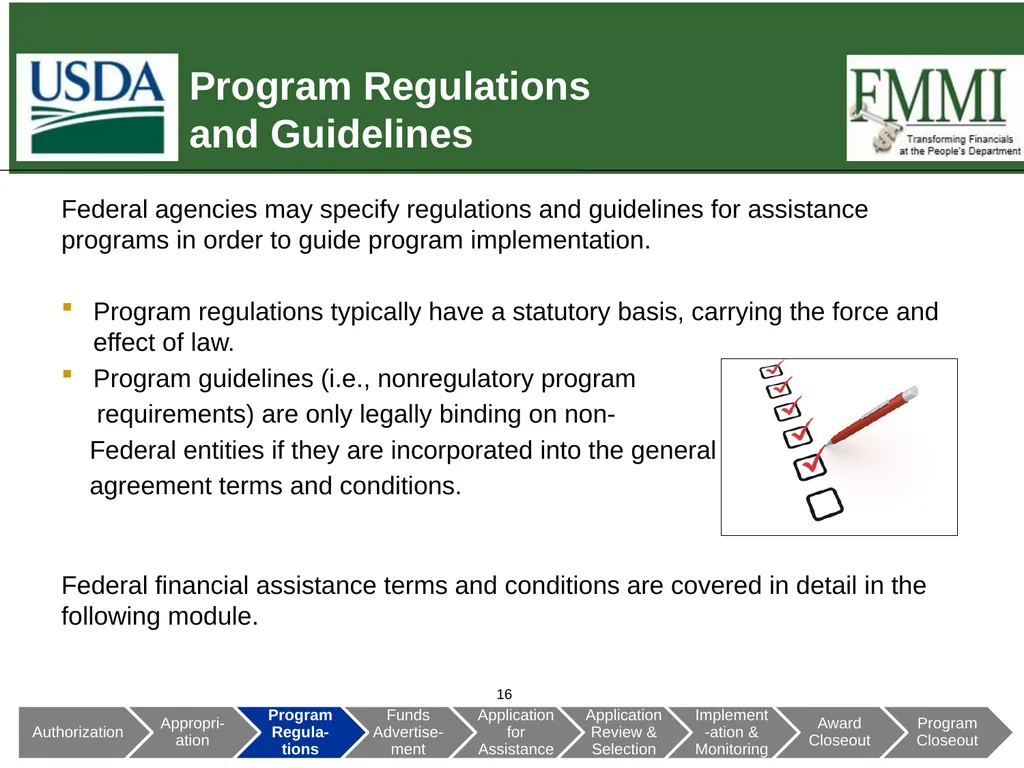
Program Regulations
and Guidelines Federal agencies may specify regulations and guidelines for assistance programs in order to guide program implementation.
Program regulations typically have a statutory basis, carrying the force and effect of law.
Program guidelines (i.e., nonregulatory program
requirements) are only legally binding on non-
Federal entities if they are incorporated into the general
agreement terms and conditions.
Federal financial assistance terms and conditions are covered in detail in the following module. 16<br>
Program regulations typically have a statutory basis, carrying the force and effect of law.
Program guidelines (i.e., nonregulatory program
requirements) are only legally binding on non-
Federal entities if they are incorporated into the general
agreement terms and conditions.
Federal financial assistance terms and conditions are covered in detail in the following module. 16<br>
17
Funds Advertisement Many funding availability announcements for Federal financial assistance are posted publicly in order to promote competition among potential non-Federal entities.
Funds advertisements are often found in the following four places:
Catalog of Federal Domestic Assistance (CFDA) All CFDA users will now be redirected to (https://sam.gov/content/assistance-listings), which is now the authoritative site for assistance listings.
Grants.gov (http://www.grants.gov)
Federal agency’s website, such as ezFedGrants external portal (https://grants.fms.usda.gov)
Federal Register (https://www.federalregister.gov) 17<br>
Funds advertisements are often found in the following four places:
Catalog of Federal Domestic Assistance (CFDA) All CFDA users will now be redirected to (https://sam.gov/content/assistance-listings), which is now the authoritative site for assistance listings.
Grants.gov (http://www.grants.gov)
Federal agency’s website, such as ezFedGrants external portal (https://grants.fms.usda.gov)
Federal Register (https://www.federalregister.gov) 17<br>
18
Application Materials (1 of 2) Agencies use standard forms (form names prefixed with “SF”) to collect information from applicants for Federal assistance. For Federal financial assistance, these application materials typically include the following:
SF-424: Form face page collecting information, such as contact information, applicant type, project description, congressional district, and more.
SF-424A: Budget information for non-construction projects.
AD-3030 or 3031: Assurance regarding felony conviction or tax delinquent status
Partners and points of contact: Key individuals within the applicant organization.
Additional details: A cover letter or form capturing information such as the project title, recipient type, and whether the proposal includes research, subawards, program income, publications, and more.
Detailed project budget and narrative: Costs for the proposed project, presented by category with detailed justifications.
Project narrative, scope of work, and operating plan: Description of project background, goals, activities, and plans. 18<br>
SF-424: Form face page collecting information, such as contact information, applicant type, project description, congressional district, and more.
SF-424A: Budget information for non-construction projects.
AD-3030 or 3031: Assurance regarding felony conviction or tax delinquent status
Partners and points of contact: Key individuals within the applicant organization.
Additional details: A cover letter or form capturing information such as the project title, recipient type, and whether the proposal includes research, subawards, program income, publications, and more.
Detailed project budget and narrative: Costs for the proposed project, presented by category with detailed justifications.
Project narrative, scope of work, and operating plan: Description of project background, goals, activities, and plans. 18<br>
19
Application Materials Required
for Grants and Cooperative
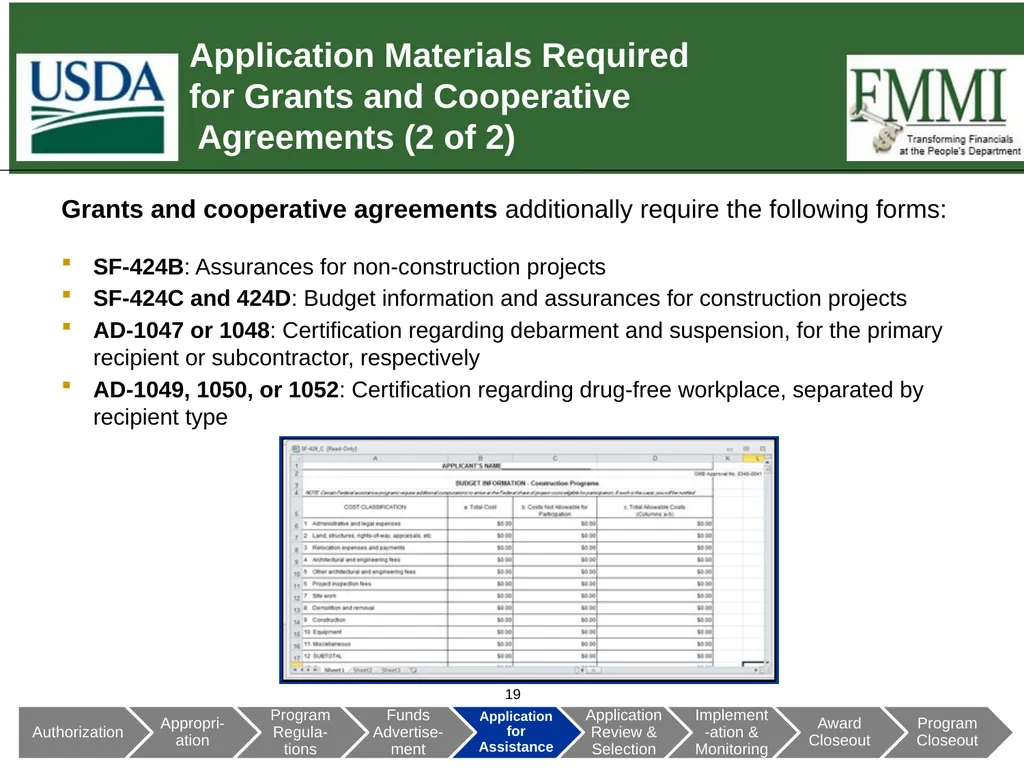
Agreements (2 of 2) Grants and cooperative agreements additionally require the following forms:
SF-424B: Assurances for non-construction projects
SF-424C and 424D: Budget information and assurances for construction projects
AD-1047 or 1048: Certification regarding debarment and suspension, for the primary recipient or subcontractor, respectively
AD-1049, 1050, or 1052: Certification regarding drug-free workplace, separated by recipient type 19<br>
SF-424B: Assurances for non-construction projects
SF-424C and 424D: Budget information and assurances for construction projects
AD-1047 or 1048: Certification regarding debarment and suspension, for the primary recipient or subcontractor, respectively
AD-1049, 1050, or 1052: Certification regarding drug-free workplace, separated by recipient type 19<br>
20
Application Review Once an application for funding is received by the agency administering the Federal assistance program, it is reviewed by agency officials. This typically includes robust reviews by assembled panels or field readers.
Panel reviews are conducted by several people assembled in the same place that review, rate, and comment on applications as a group. These panels may be conducted by standing committees, which meet regularly on a continuing basis, or by ad-hoc committees, which are established to perform a single, short-term task.
Field readers independently review, rate, and comment on applications.
Reviewers are given criteria on which to rate applications, however agency officials may use discretion in recommending applications for funding. 20<br>
Panel reviews are conducted by several people assembled in the same place that review, rate, and comment on applications as a group. These panels may be conducted by standing committees, which meet regularly on a continuing basis, or by ad-hoc committees, which are established to perform a single, short-term task.
Field readers independently review, rate, and comment on applications.
Reviewers are given criteria on which to rate applications, however agency officials may use discretion in recommending applications for funding. 20<br>
21
Proposal Selection
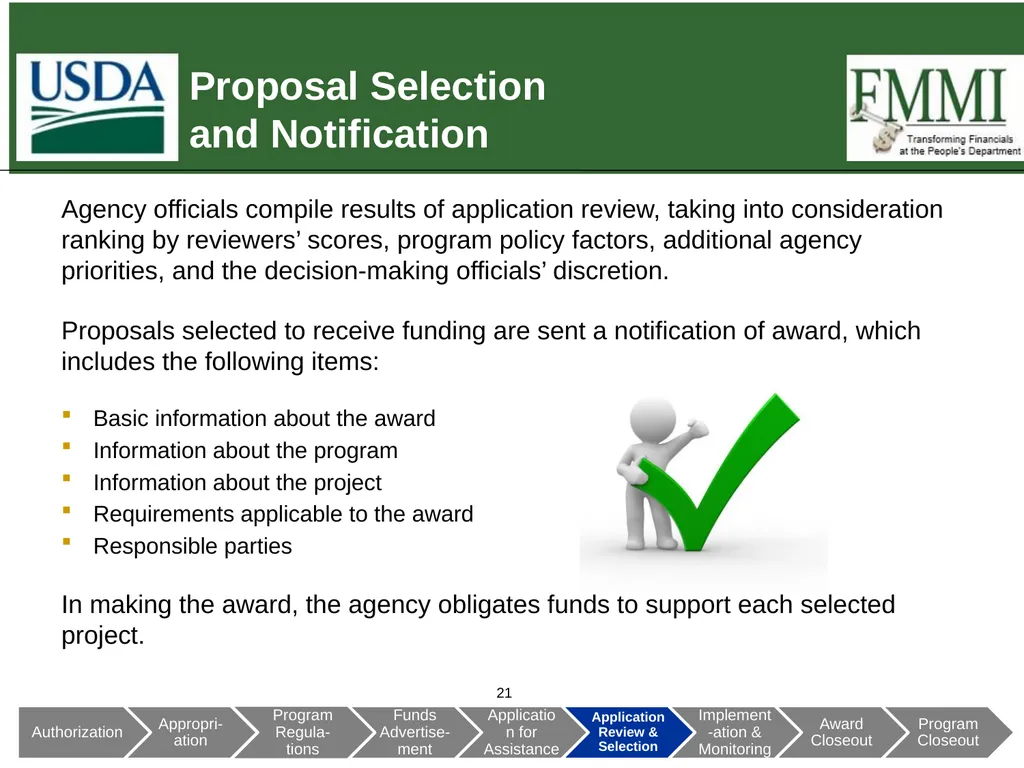
and Notification Agency officials compile results of application review, taking into consideration ranking by reviewers’ scores, program policy factors, additional agency priorities, and the decision-making officials’ discretion.
Proposals selected to receive funding are sent a notification of award, which includes the following items:
Basic information about the award
Information about the program
Information about the project
Requirements applicable to the award
Responsible parties
In making the award, the agency obligates funds to support each selected project. 21<br>
Proposals selected to receive funding are sent a notification of award, which includes the following items:
Basic information about the award
Information about the program
Information about the project
Requirements applicable to the award
Responsible parties
In making the award, the agency obligates funds to support each selected project. 21<br>
22
Project Implementation
and Monitoring Having successfully applied for and received a Federal assistance award, the non-Federal entity begins to implement the approved project, expending funds according to the approved budget.
Recipients are responsible for submitting the following items, according to timelines agreed upon in the notice of award:
SF-270: Receipts (for projects paid on advance basis) or invoices (for projects paid on reimbursement basis)
SF-PPR: performance progress reports
SF-425: Federal Financial Report
SF-428: Tangible Personal Property Report
The agency monitors the project and provides technical assistance, as agreed upon in the notice of award. 22<br>
Recipients are responsible for submitting the following items, according to timelines agreed upon in the notice of award:
SF-270: Receipts (for projects paid on advance basis) or invoices (for projects paid on reimbursement basis)
SF-PPR: performance progress reports
SF-425: Federal Financial Report
SF-428: Tangible Personal Property Report
The agency monitors the project and provides technical assistance, as agreed upon in the notice of award. 22<br>
23
Project Modifications Most deviations from the project implementation plan agreed to in the notice of award must be detailed in an amendment to the agreement unless the original agreement allows specific changes without prior written approval.
Many programmatic changes require written amendments, such as the following:
Change in the project scope, timeline, and/or objectives
Revisions requiring additional Federal funds
Transfers of funds between budget categories exceeding a certain proportion or dollar amount (such as 10% of the approved budget or $100,000)
Changes in key personnel specified in the application or agreement
A one-time, unfunded (i.e., no-cost) project extension of up to 12 months may be allowed with a simplified amendment process. 23<br>
Many programmatic changes require written amendments, such as the following:
Change in the project scope, timeline, and/or objectives
Revisions requiring additional Federal funds
Transfers of funds between budget categories exceeding a certain proportion or dollar amount (such as 10% of the approved budget or $100,000)
Changes in key personnel specified in the application or agreement
A one-time, unfunded (i.e., no-cost) project extension of up to 12 months may be allowed with a simplified amendment process. 23<br>
24
Award Closeout – Non-Federal Entity Actions (1 of 2) Closing out a Federal award completes the agreement between the Federal agency and the recipient. The recipient takes the following actions to close out a Federal award after project activities are complete:
Submits final reports (financial, performance, and property, as applicable)
Disposes of property purchased with grant funds
Either disposes of or returns government-furnished property no longer being used for grant-related activities
The recipient retains financial records and supporting documentation for three years from 90 days after the end of the grant. 24<br>
Submits final reports (financial, performance, and property, as applicable)
Disposes of property purchased with grant funds
Either disposes of or returns government-furnished property no longer being used for grant-related activities
The recipient retains financial records and supporting documentation for three years from 90 days after the end of the grant. 24<br>
25
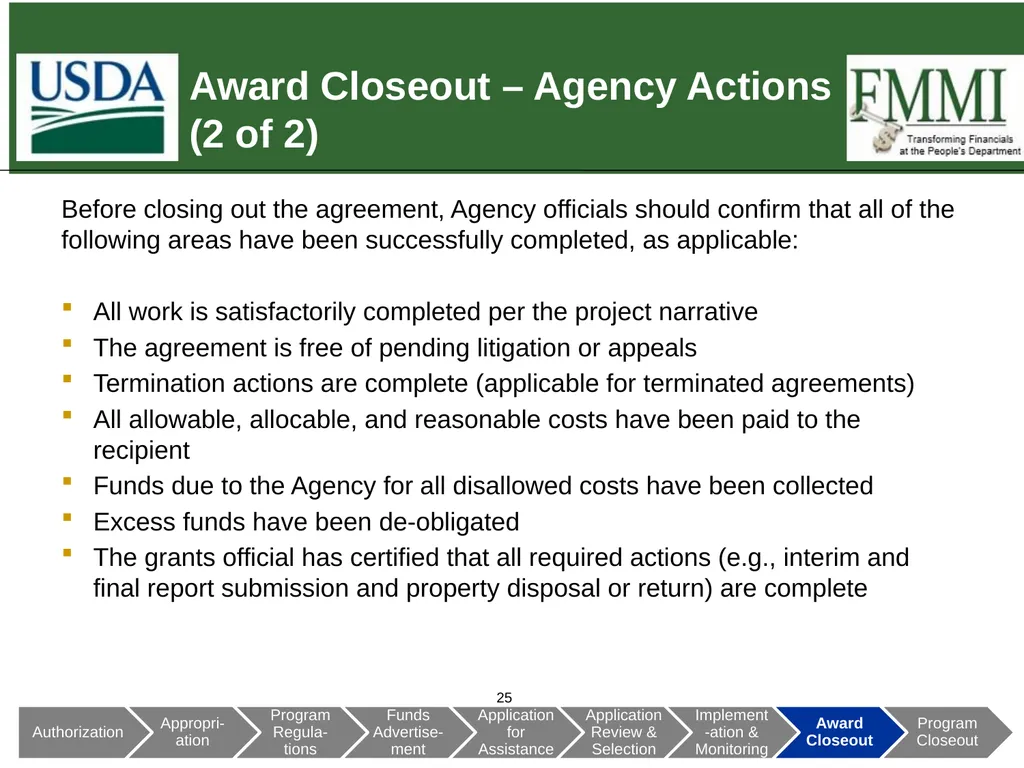
Award Closeout – Agency Actions (2 of 2) Before closing out the agreement, Agency officials should confirm that all of the following areas have been successfully completed, as applicable:
All work is satisfactorily completed per the project narrative
The agreement is free of pending litigation or appeals
Termination actions are complete (applicable for terminated agreements)
All allowable, allocable, and reasonable costs have been paid to the recipient
Funds due to the Agency for all disallowed costs have been collected
Excess funds have been de-obligated
The grants official has certified that all required actions (e.g., interim and final report submission and property disposal or return) are complete 25<br>
All work is satisfactorily completed per the project narrative
The agreement is free of pending litigation or appeals
Termination actions are complete (applicable for terminated agreements)
All allowable, allocable, and reasonable costs have been paid to the recipient
Funds due to the Agency for all disallowed costs have been collected
Excess funds have been de-obligated
The grants official has certified that all required actions (e.g., interim and final report submission and property disposal or return) are complete 25<br>
26
Program Closeout Once the authorization or appropriation for a Federal assistance program is discontinued, agency officials do the following:
Ensure that all agreements under the program are closed out
Ensure that all fund reservation balances under the program are closed out
Archive or remove all funding advertisements 26<br>
Ensure that all agreements under the program are closed out
Ensure that all fund reservation balances under the program are closed out
Archive or remove all funding advertisements 26<br>
27
Terms and Conditions May 2018<br>
28
Terms and Conditions USDA agreements include general terms and conditions based on a variety of requirements, typically including the following:
General terms – apply to many awards
National policy general terms and conditions
Administrative general terms and conditions
Agency general terms and conditions
Specific terms – differ for each award
The non-Federal entity’s application package
Award-specific terms and conditions
Upon signing the Federal award, the non-Federal entity consents to fulfill and comply with all conditions. 28<br>
General terms – apply to many awards
National policy general terms and conditions
Administrative general terms and conditions
Agency general terms and conditions
Specific terms – differ for each award
The non-Federal entity’s application package
Award-specific terms and conditions
Upon signing the Federal award, the non-Federal entity consents to fulfill and comply with all conditions. 28<br>
29
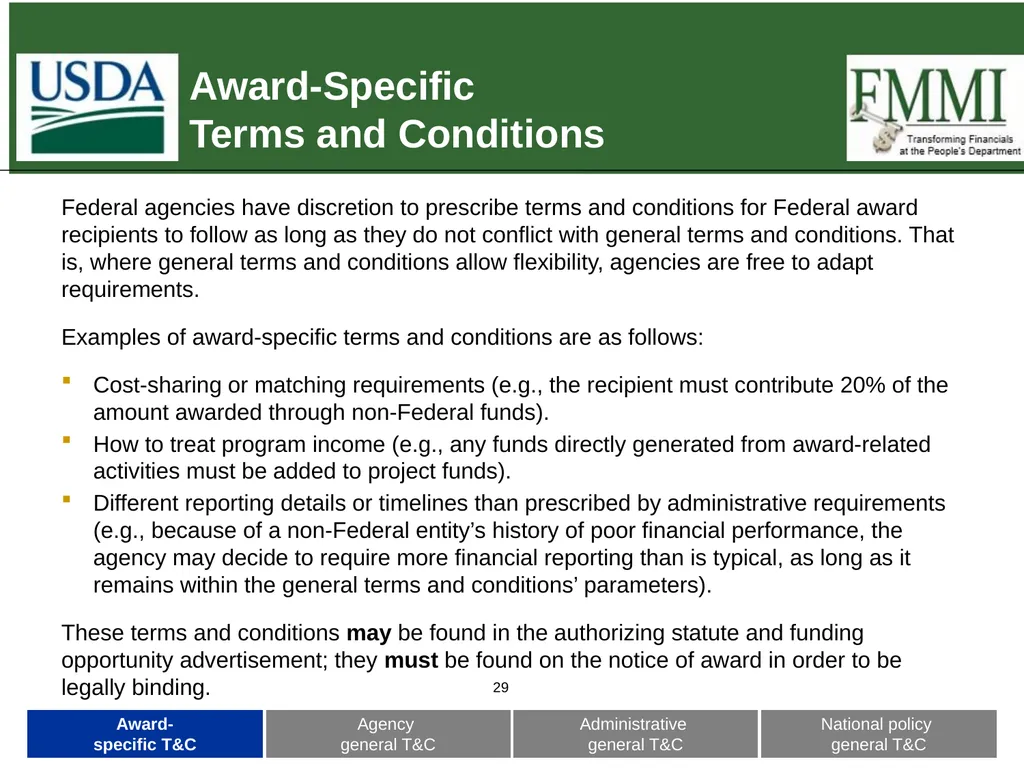
Award-Specific
Terms and Conditions Federal agencies have discretion to prescribe terms and conditions for Federal award recipients to follow as long as they do not conflict with general terms and conditions. That is, where general terms and conditions allow flexibility, agencies are free to adapt requirements.
Examples of award-specific terms and conditions are as follows:
Cost-sharing or matching requirements (e.g., the recipient must contribute 20% of the amount awarded through non-Federal funds).
How to treat program income (e.g., any funds directly generated from award-related activities must be added to project funds).
Different reporting details or timelines than prescribed by administrative requirements (e.g., because of a non-Federal entity’s history of poor financial performance, the agency may decide to require more financial reporting than is typical, as long as it remains within the general terms and conditions’ parameters).
These terms and conditions may be found in the authorizing statute and funding opportunity advertisement; they must be found on the notice of award in order to be legally binding. Award-
specific T&C Agency
general T&C Administrative
general T&C National policy
general T&C 29<br>
Examples of award-specific terms and conditions are as follows:
Cost-sharing or matching requirements (e.g., the recipient must contribute 20% of the amount awarded through non-Federal funds).
How to treat program income (e.g., any funds directly generated from award-related activities must be added to project funds).
Different reporting details or timelines than prescribed by administrative requirements (e.g., because of a non-Federal entity’s history of poor financial performance, the agency may decide to require more financial reporting than is typical, as long as it remains within the general terms and conditions’ parameters).
These terms and conditions may be found in the authorizing statute and funding opportunity advertisement; they must be found on the notice of award in order to be legally binding. Award-
specific T&C Agency
general T&C Administrative
general T&C National policy
general T&C 29<br>
30
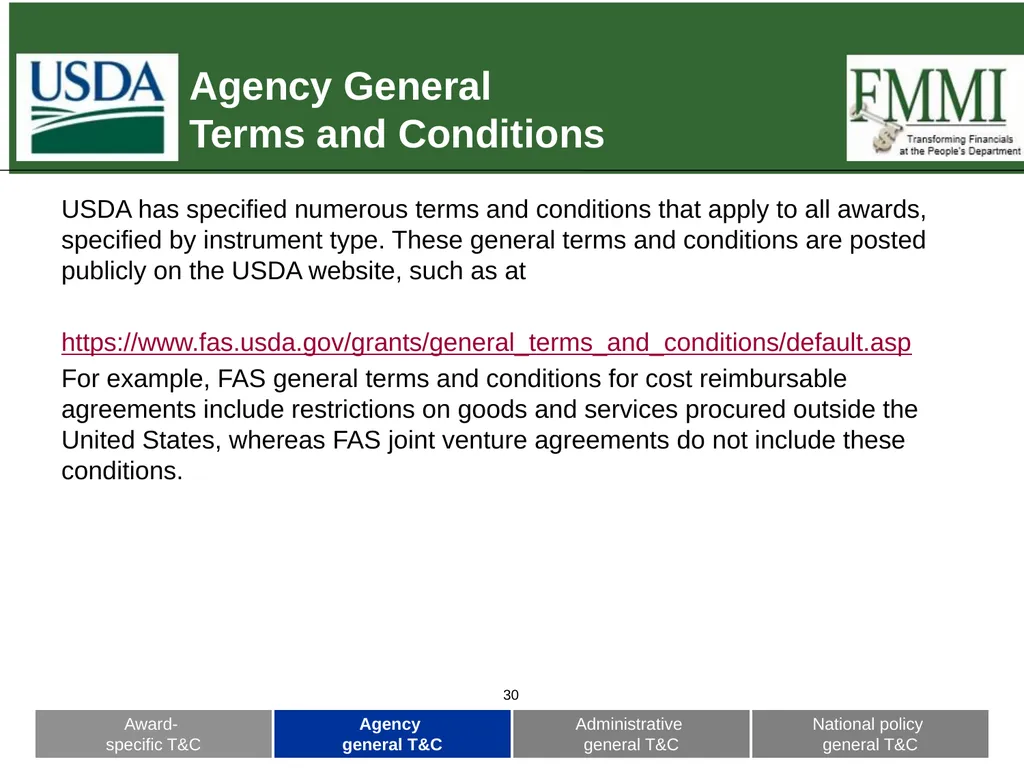
Agency General
Terms and Conditions USDA has specified numerous terms and conditions that apply to all awards, specified by instrument type. These general terms and conditions are posted publicly on the USDA website, such as at
https://www.fas.usda.gov/grants/general_terms_and_conditions/default.asp
For example, FAS general terms and conditions for cost reimbursable agreements include restrictions on goods and services procured outside the United States, whereas FAS joint venture agreements do not include these conditions. Award-
specific T&C Agency
general T&C Administrative
general T&C National policy
general T&C 30<br>
https://www.fas.usda.gov/grants/general_terms_and_conditions/default.asp
For example, FAS general terms and conditions for cost reimbursable agreements include restrictions on goods and services procured outside the United States, whereas FAS joint venture agreements do not include these conditions. Award-
specific T&C Agency
general T&C Administrative
general T&C National policy
general T&C 30<br>
31
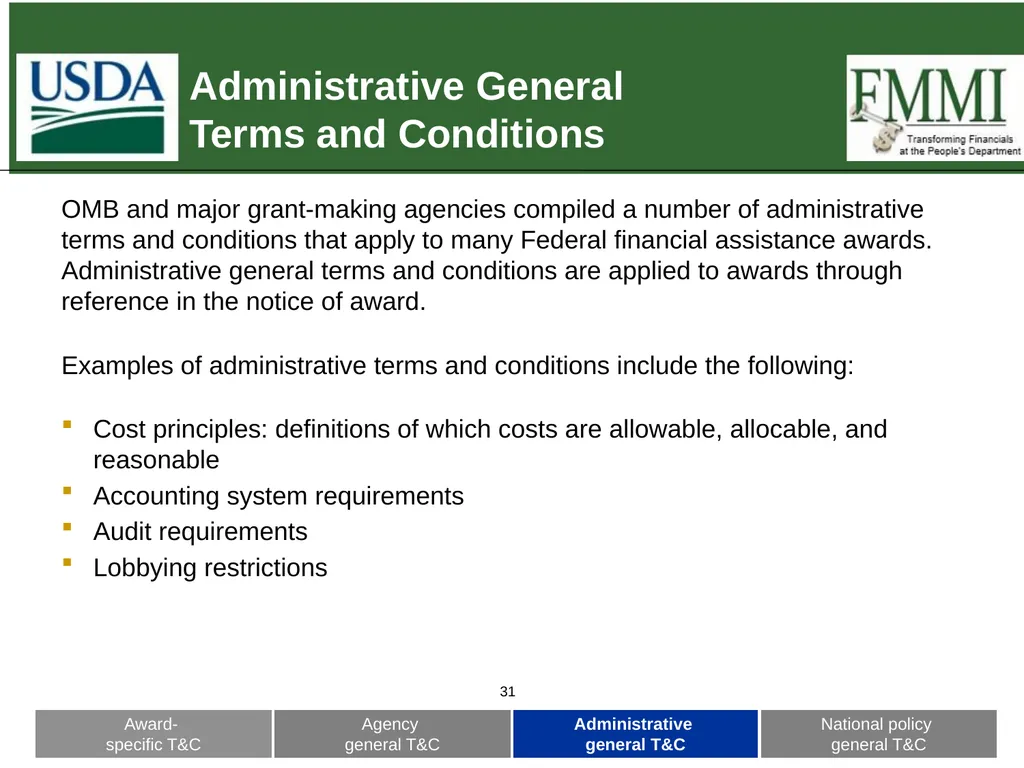
Administrative General
Terms and Conditions OMB and major grant-making agencies compiled a number of administrative terms and conditions that apply to many Federal financial assistance awards. Administrative general terms and conditions are applied to awards through reference in the notice of award.
Examples of administrative terms and conditions include the following:
Cost principles: definitions of which costs are allowable, allocable, and reasonable
Accounting system requirements
Audit requirements
Lobbying restrictions Award-
specific T&C Agency
general T&C Administrative
general T&C National policy
general T&C 31<br>
Examples of administrative terms and conditions include the following:
Cost principles: definitions of which costs are allowable, allocable, and reasonable
Accounting system requirements
Audit requirements
Lobbying restrictions Award-
specific T&C Agency
general T&C Administrative
general T&C National policy
general T&C 31<br>
32
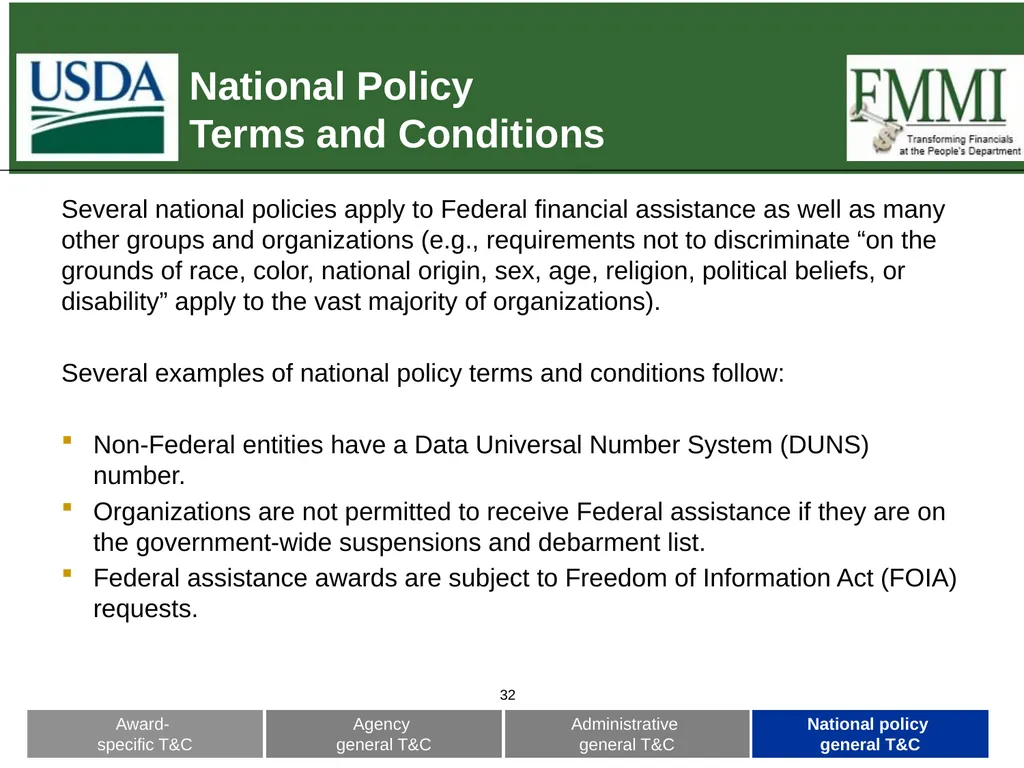
National Policy
Terms and Conditions Several national policies apply to Federal financial assistance as well as many other groups and organizations (e.g., requirements not to discriminate “on the grounds of race, color, national origin, sex, age, religion, political beliefs, or disability” apply to the vast majority of organizations).
Several examples of national policy terms and conditions follow:
Non-Federal entities have a Data Universal Number System (DUNS) number.
Organizations are not permitted to receive Federal assistance if they are on the government-wide suspensions and debarment list.
Federal assistance awards are subject to Freedom of Information Act (FOIA) requests. Award-
specific T&C Agency
general T&C Administrative
general T&C National policy
general T&C 32<br>
Several examples of national policy terms and conditions follow:
Non-Federal entities have a Data Universal Number System (DUNS) number.
Organizations are not permitted to receive Federal assistance if they are on the government-wide suspensions and debarment list.
Federal assistance awards are subject to Freedom of Information Act (FOIA) requests. Award-
specific T&C Agency
general T&C Administrative
general T&C National policy
general T&C 32<br>
33
Additional Resources May 2018<br>
34
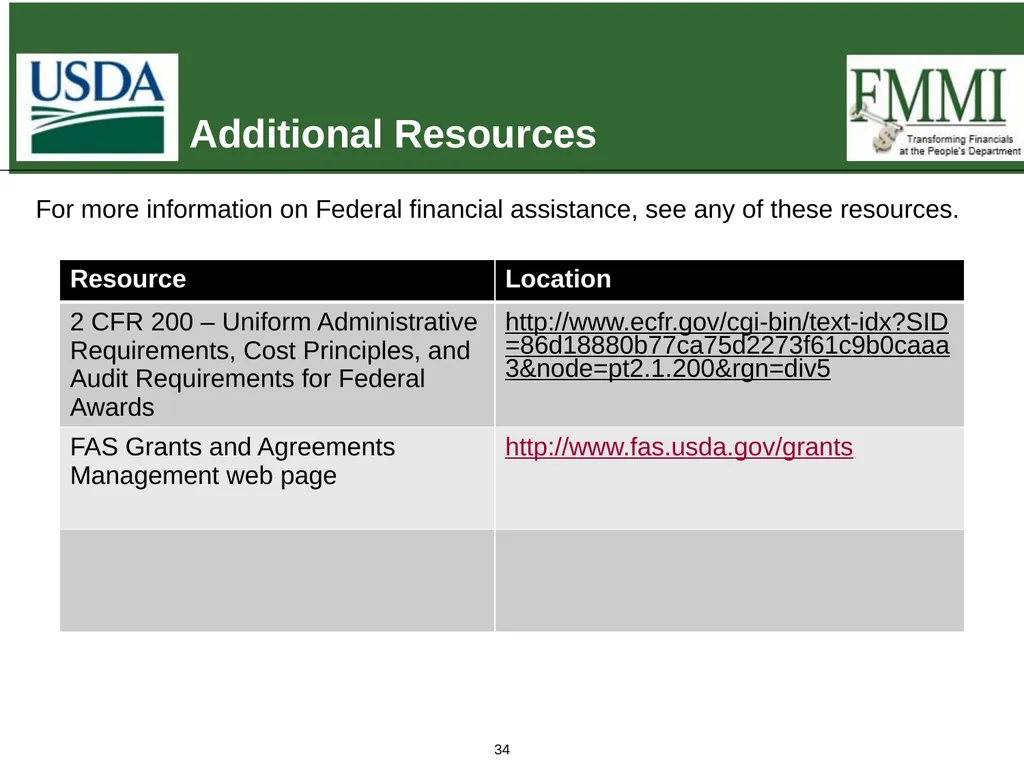
Additional Resources For more information on Federal financial assistance, see any of these resources. 34<br>
35
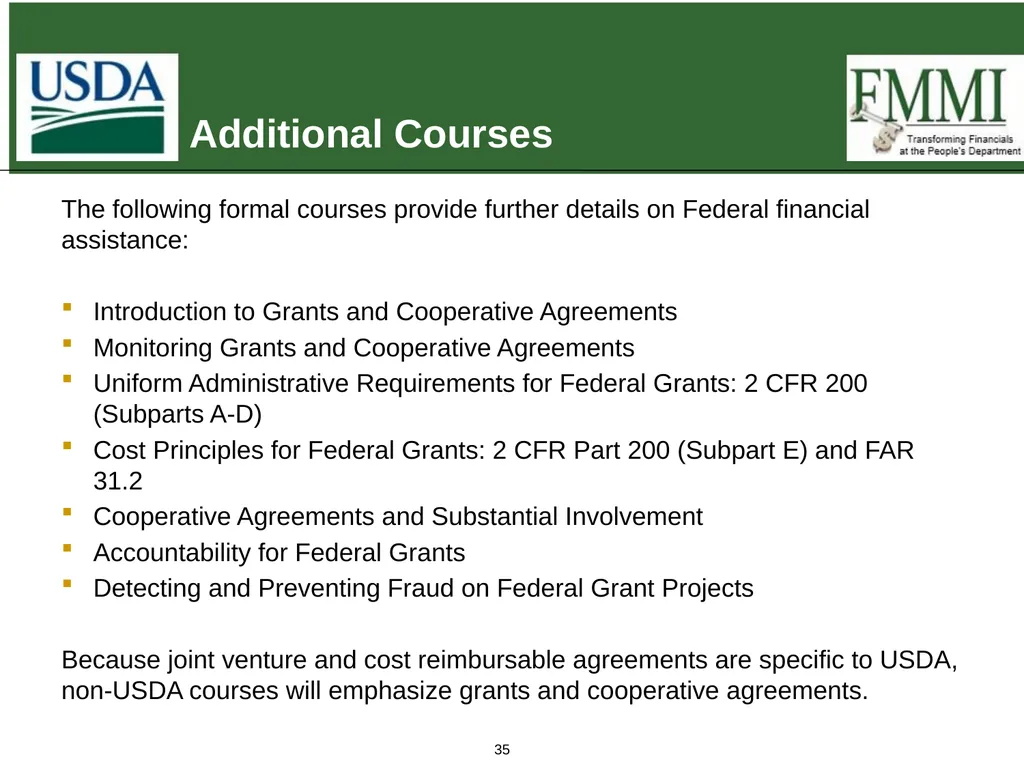
Additional Courses The following formal courses provide further details on Federal financial assistance:
Introduction to Grants and Cooperative Agreements
Monitoring Grants and Cooperative Agreements
Uniform Administrative Requirements for Federal Grants: 2 CFR 200 (Subparts A-D)
Cost Principles for Federal Grants: 2 CFR Part 200 (Subpart E) and FAR 31.2
Cooperative Agreements and Substantial Involvement
Accountability for Federal Grants
Detecting and Preventing Fraud on Federal Grant Projects
Because joint venture and cost reimbursable agreements are specific to USDA, non-USDA courses will emphasize grants and cooperative agreements. 35<br>
Introduction to Grants and Cooperative Agreements
Monitoring Grants and Cooperative Agreements
Uniform Administrative Requirements for Federal Grants: 2 CFR 200 (Subparts A-D)
Cost Principles for Federal Grants: 2 CFR Part 200 (Subpart E) and FAR 31.2
Cooperative Agreements and Substantial Involvement
Accountability for Federal Grants
Detecting and Preventing Fraud on Federal Grant Projects
Because joint venture and cost reimbursable agreements are specific to USDA, non-USDA courses will emphasize grants and cooperative agreements. 35<br>
36
The End May 2018<br>
37
Congratulations! Q&A 37<br>
38
Knowledge Check How many types of instruments are discussed?
What instruments does USDA use?
What is a Grant? 38<br>
What instruments does USDA use?
What is a Grant? 38<br>
39
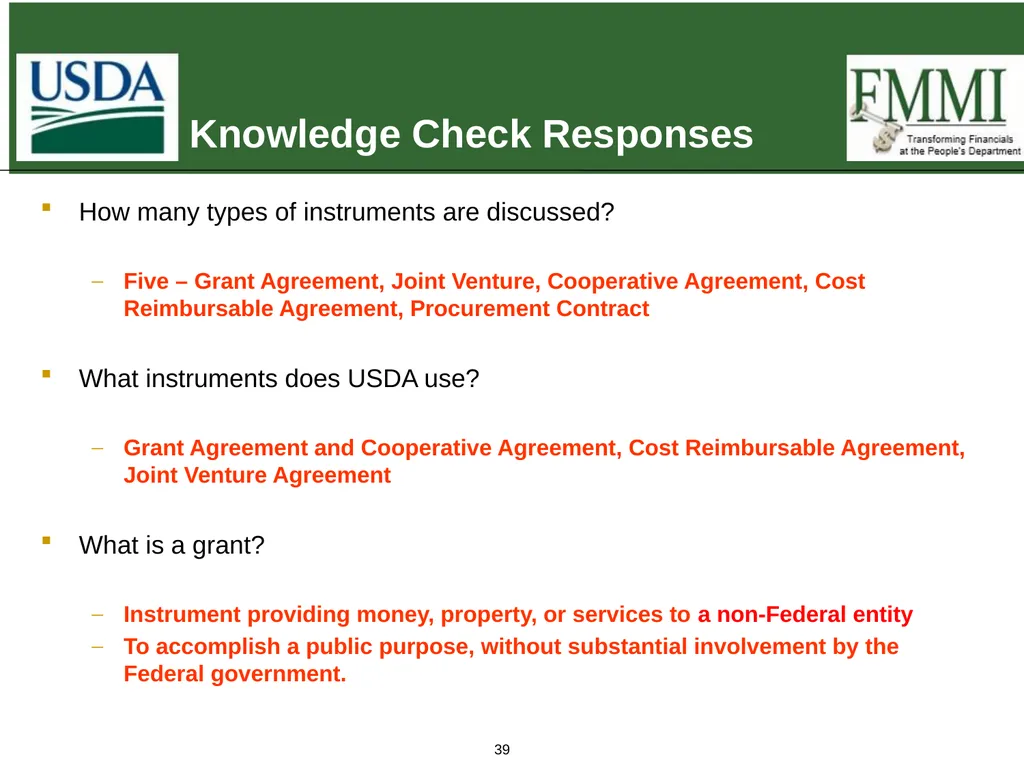
Knowledge Check Responses How many types of instruments are discussed?
Five – Grant Agreement, Joint Venture, Cooperative Agreement, Cost Reimbursable Agreement, Procurement Contract
What instruments does USDA use?
Grant Agreement and Cooperative Agreement, Cost Reimbursable Agreement, Joint Venture Agreement
What is a grant?
Instrument providing money, property, or services to a non-Federal entity
To accomplish a public purpose, without substantial involvement by the Federal government. 39<br>
Five – Grant Agreement, Joint Venture, Cooperative Agreement, Cost Reimbursable Agreement, Procurement Contract
What instruments does USDA use?
Grant Agreement and Cooperative Agreement, Cost Reimbursable Agreement, Joint Venture Agreement
What is a grant?
Instrument providing money, property, or services to a non-Federal entity
To accomplish a public purpose, without substantial involvement by the Federal government. 39<br>
40
Knowledge Checka What are some of the agency’s responsibilities during closeout?
FOIA does not apply to agreements?
True or False 40<br>
FOIA does not apply to agreements?
True or False 40<br>
41
Knowledge Checkb What are some of the agency’s responsibilities during closeout?
Ensure excess funds are de-obligated, no litigation or appeals are pending, work has been completed according to project narrative, etc.
FOIA does not apply to agreements?
False
FOIA is one the national policies terms and conditions applicable to awards. 41<br>
Ensure excess funds are de-obligated, no litigation or appeals are pending, work has been completed according to project narrative, etc.
FOIA does not apply to agreements?
False
FOIA is one the national policies terms and conditions applicable to awards. 41<br>