
Federalism in India; Issues and Challenges By
PM
Published · 15 slides · 0 views

1 / 1
Description
Federalism in India; Issues and Challenges By Baikuntha Nath Swain Asst. Professor Dept. of Political Science B. J. B. (Auto) College Bhubaneswar - 14 Introduction India is a vast state, having huge population with multi faceted diversities
Related Topics
Share
Embed code
Download this presentation From Below
"Federalism in India; Issues and Challenges By" is the property of its rightful owner. Permission is granted to download and print the materials on this website for personal, non-commercial use only, and to display it on your personal computer provided you do not modify the materials and that you retain all copyright notices contained in the materials. By downloading content from our website, you accept the terms of this agreement.
Presentation Transcript
01
Federalism in India; Issues and Challenges By
Baikuntha Nath Swain
Asst. Professor
Dept. of Political Science
B. J. B. (Auto) College
Bhubaneswar - 14<br>
Baikuntha Nath Swain
Asst. Professor
Dept. of Political Science
B. J. B. (Auto) College
Bhubaneswar - 14<br>
02
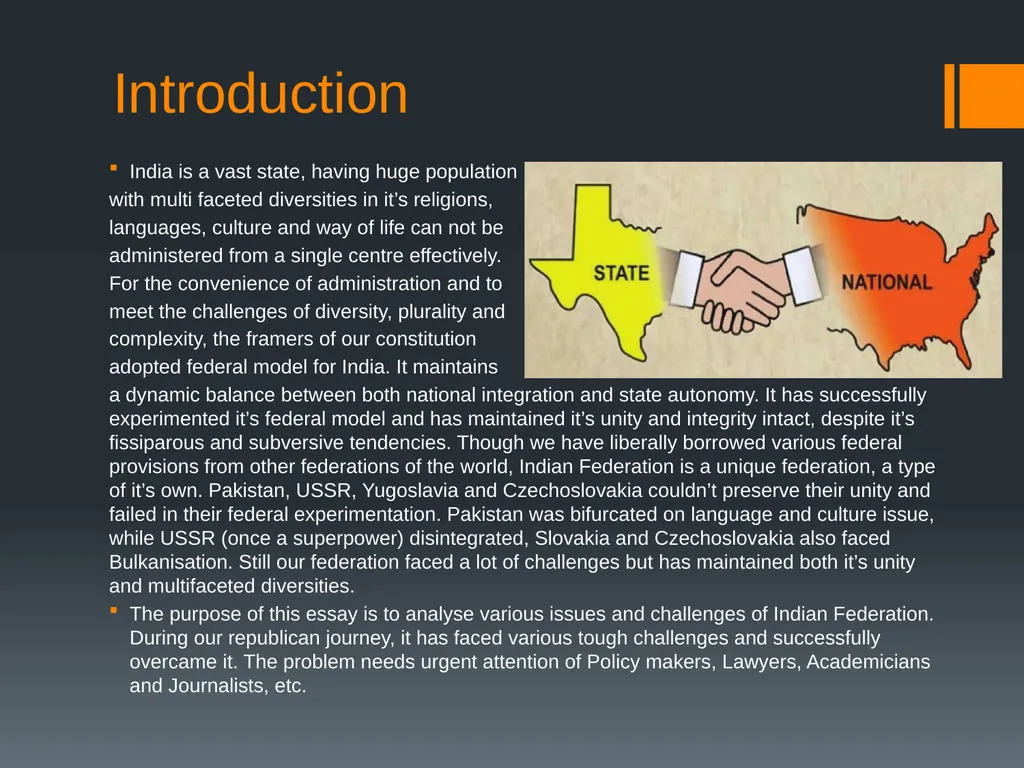
Introduction India is a vast state, having huge population
with multi faceted diversities in it’s religions,
languages, culture and way of life can not be
administered from a single centre effectively.
For the convenience of administration and to
meet the challenges of diversity, plurality and
complexity, the framers of our constitution
adopted federal model for India. It maintains
a dynamic balance between both national integration and state autonomy. It has successfully experimented it’s federal model and has maintained it’s unity and integrity intact, despite it’s fissiparous and subversive tendencies. Though we have liberally borrowed various federal provisions from other federations of the world, Indian Federation is a unique federation, a type of it’s own. Pakistan, USSR, Yugoslavia and Czechoslovakia couldn’t preserve their unity and failed in their federal experimentation. Pakistan was bifurcated on language and culture issue, while USSR (once a superpower) disintegrated, Slovakia and Czechoslovakia also faced Bulkanisation. Still our federation faced a lot of challenges but has maintained both it’s unity and multifaceted diversities.
The purpose of this essay is to analyse various issues and challenges of Indian Federation. During our republican journey, it has faced various tough challenges and successfully overcame it. The problem needs urgent attention of Policy makers, Lawyers, Academicians and Journalists, etc.<br>
with multi faceted diversities in it’s religions,
languages, culture and way of life can not be
administered from a single centre effectively.
For the convenience of administration and to
meet the challenges of diversity, plurality and
complexity, the framers of our constitution
adopted federal model for India. It maintains
a dynamic balance between both national integration and state autonomy. It has successfully experimented it’s federal model and has maintained it’s unity and integrity intact, despite it’s fissiparous and subversive tendencies. Though we have liberally borrowed various federal provisions from other federations of the world, Indian Federation is a unique federation, a type of it’s own. Pakistan, USSR, Yugoslavia and Czechoslovakia couldn’t preserve their unity and failed in their federal experimentation. Pakistan was bifurcated on language and culture issue, while USSR (once a superpower) disintegrated, Slovakia and Czechoslovakia also faced Bulkanisation. Still our federation faced a lot of challenges but has maintained both it’s unity and multifaceted diversities.
The purpose of this essay is to analyse various issues and challenges of Indian Federation. During our republican journey, it has faced various tough challenges and successfully overcame it. The problem needs urgent attention of Policy makers, Lawyers, Academicians and Journalists, etc.<br>
03
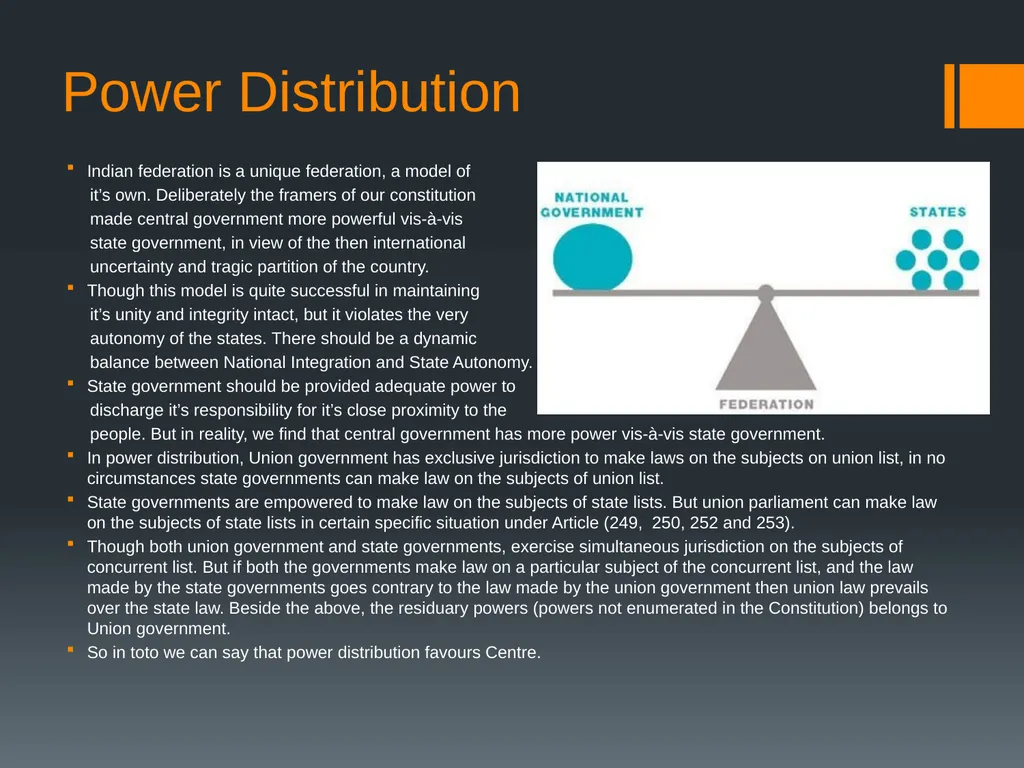
Power Distribution Indian federation is a unique federation, a model of
it’s own. Deliberately the framers of our constitution
made central government more powerful vis-à-vis
state government, in view of the then international
uncertainty and tragic partition of the country.
Though this model is quite successful in maintaining
it’s unity and integrity intact, but it violates the very
autonomy of the states. There should be a dynamic
balance between National Integration and State Autonomy.
State government should be provided adequate power to
discharge it’s responsibility for it’s close proximity to the
people. But in reality, we find that central government has more power vis-à-vis state government.
In power distribution, Union government has exclusive jurisdiction to make laws on the subjects on union list, in no circumstances state governments can make law on the subjects of union list.
State governments are empowered to make law on the subjects of state lists. But union parliament can make law on the subjects of state lists in certain specific situation under Article (249, 250, 252 and 253).
Though both union government and state governments, exercise simultaneous jurisdiction on the subjects of concurrent list. But if both the governments make law on a particular subject of the concurrent list, and the law made by the state governments goes contrary to the law made by the union government then union law prevails over the state law. Beside the above, the residuary powers (powers not enumerated in the Constitution) belongs to Union government.
So in toto we can say that power distribution favours Centre.<br>
it’s own. Deliberately the framers of our constitution
made central government more powerful vis-à-vis
state government, in view of the then international
uncertainty and tragic partition of the country.
Though this model is quite successful in maintaining
it’s unity and integrity intact, but it violates the very
autonomy of the states. There should be a dynamic
balance between National Integration and State Autonomy.
State government should be provided adequate power to
discharge it’s responsibility for it’s close proximity to the
people. But in reality, we find that central government has more power vis-à-vis state government.
In power distribution, Union government has exclusive jurisdiction to make laws on the subjects on union list, in no circumstances state governments can make law on the subjects of union list.
State governments are empowered to make law on the subjects of state lists. But union parliament can make law on the subjects of state lists in certain specific situation under Article (249, 250, 252 and 253).
Though both union government and state governments, exercise simultaneous jurisdiction on the subjects of concurrent list. But if both the governments make law on a particular subject of the concurrent list, and the law made by the state governments goes contrary to the law made by the union government then union law prevails over the state law. Beside the above, the residuary powers (powers not enumerated in the Constitution) belongs to Union government.
So in toto we can say that power distribution favours Centre.<br>
04
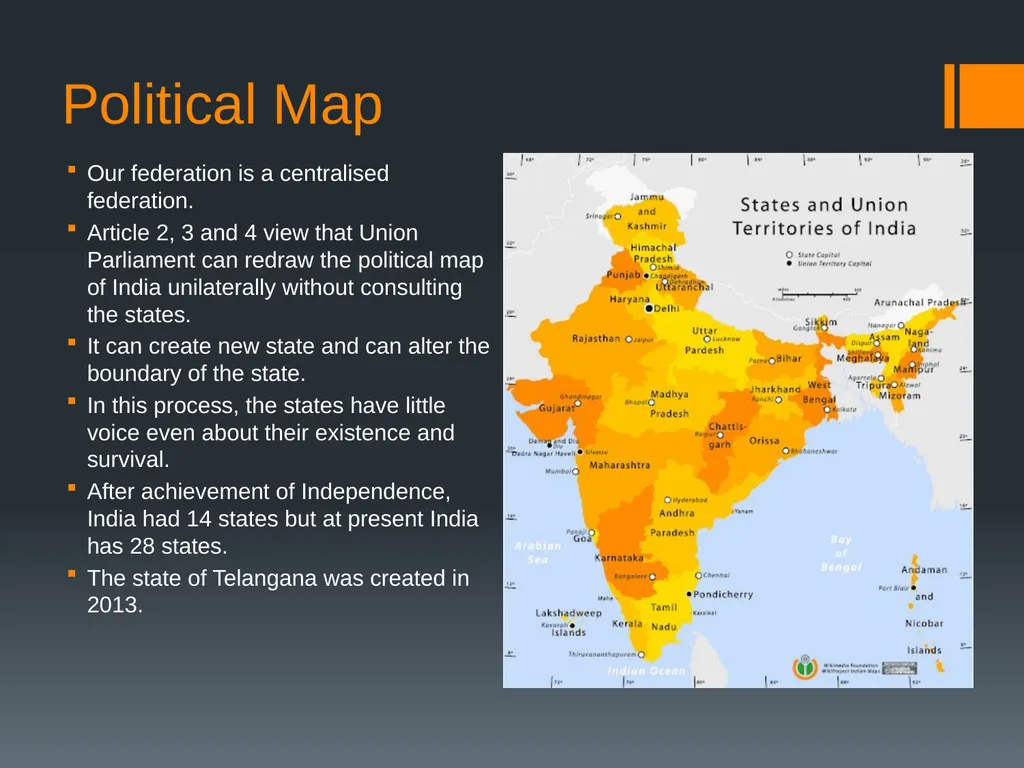
Political Map Our federation is a centralised federation.
Article 2, 3 and 4 view that Union Parliament can redraw the political map of India unilaterally without consulting the states.
It can create new state and can alter the boundary of the state.
In this process, the states have little voice even about their existence and survival.
After achievement of Independence, India had 14 states but at present India has 28 states.
The state of Telangana was created in 2013.<br>
Article 2, 3 and 4 view that Union Parliament can redraw the political map of India unilaterally without consulting the states.
It can create new state and can alter the boundary of the state.
In this process, the states have little voice even about their existence and survival.
After achievement of Independence, India had 14 states but at present India has 28 states.
The state of Telangana was created in 2013.<br>
05
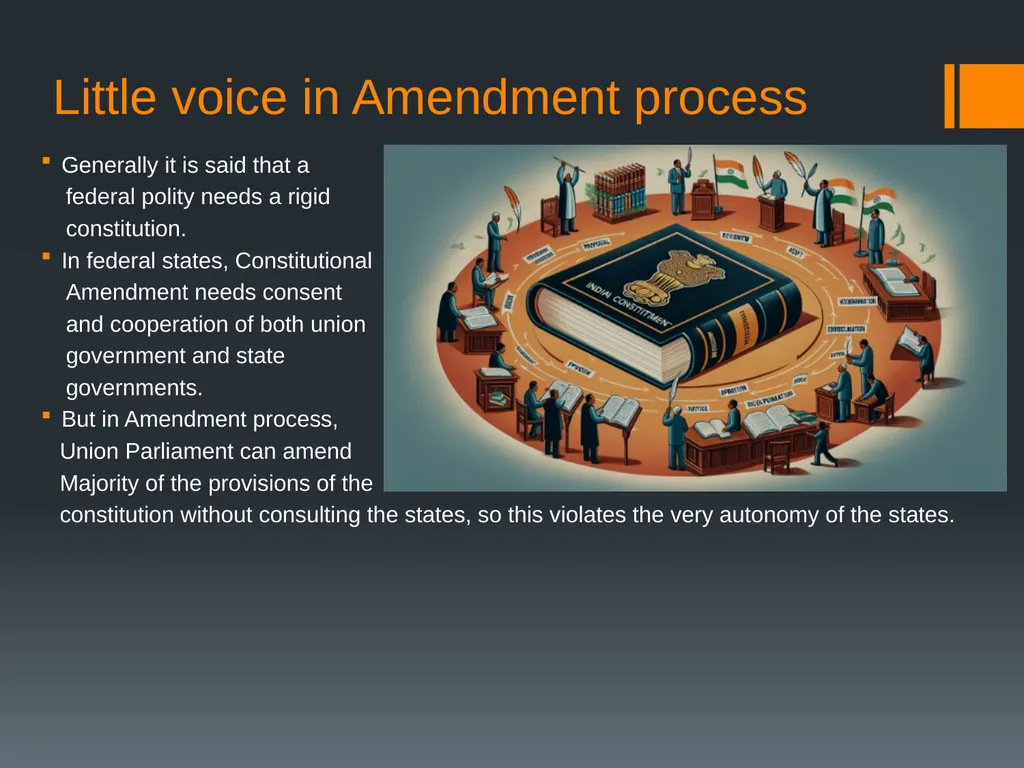
Little voice in Amendment process Generally it is said that a
federal polity needs a rigid
constitution.
In federal states, Constitutional
Amendment needs consent
and cooperation of both union
government and state
governments.
But in Amendment process,
Union Parliament can amend
Majority of the provisions of the
constitution without consulting the states, so this violates the very autonomy of the states.<br>
federal polity needs a rigid
constitution.
In federal states, Constitutional
Amendment needs consent
and cooperation of both union
government and state
governments.
But in Amendment process,
Union Parliament can amend
Majority of the provisions of the
constitution without consulting the states, so this violates the very autonomy of the states.<br>
06
Unequal representation of States In our federation we find unequal representation of the states in the upper chamber of the national legislature, i.e. Rajya Sabha (Council of States). It is unfederal in nature.
In American Congress, senate consists of 100 members, each state sends 2 representatives irrespective of their size and population.
But in our federation unequal representation on the basis of size and population keeps the smaller states in precarious positions to raise their legitimate voice in the Upper chamber of the Legislature.<br>
In American Congress, senate consists of 100 members, each state sends 2 representatives irrespective of their size and population.
But in our federation unequal representation on the basis of size and population keeps the smaller states in precarious positions to raise their legitimate voice in the Upper chamber of the Legislature.<br>
07
Finance It is said that finance fuels the
administrative engine. Finance is most
important for successful implementation
of various welfare policies for any
government.
We find that state governments are
nearer the people in comparison to
central government stationed at
national capital New Delhi.
Welfare needs of the people calls for
urgent and immediate attention of the state government.
Central government has more finance while state governments are unable to cater the welfare needs of the people.
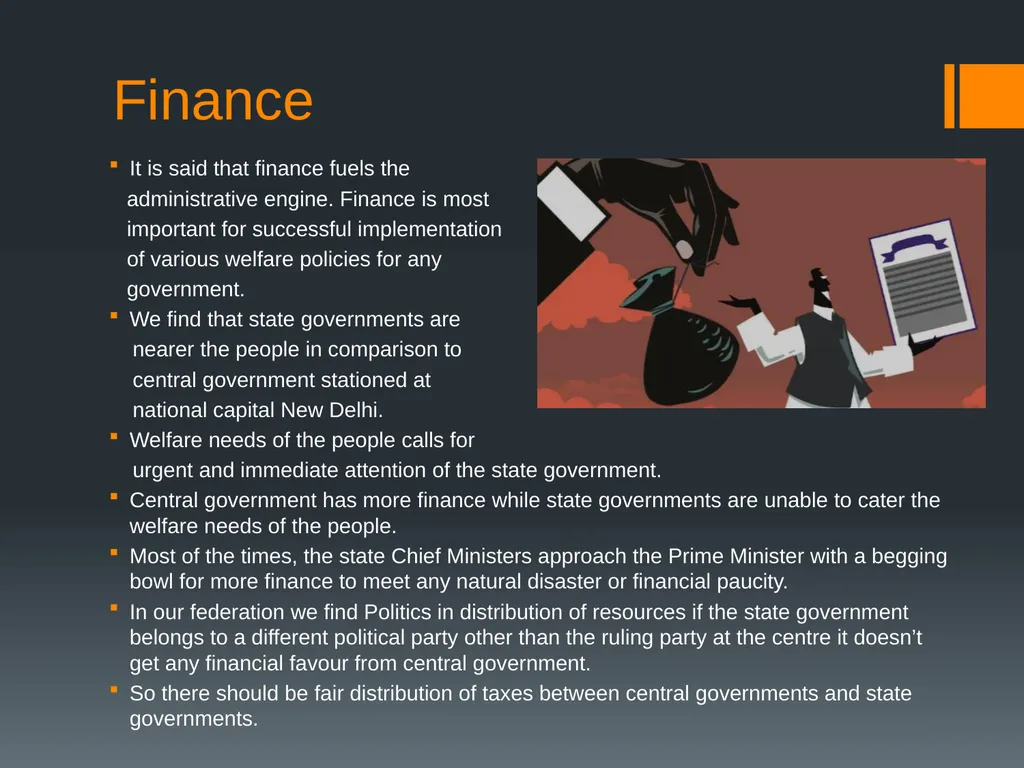
Most of the times, the state Chief Ministers approach the Prime Minister with a begging bowl for more finance to meet any natural disaster or financial paucity.
In our federation we find Politics in distribution of resources if the state government belongs to a different political party other than the ruling party at the centre it doesn’t get any financial favour from central government.
So there should be fair distribution of taxes between central governments and state governments.<br>
administrative engine. Finance is most
important for successful implementation
of various welfare policies for any
government.
We find that state governments are
nearer the people in comparison to
central government stationed at
national capital New Delhi.
Welfare needs of the people calls for
urgent and immediate attention of the state government.
Central government has more finance while state governments are unable to cater the welfare needs of the people.
Most of the times, the state Chief Ministers approach the Prime Minister with a begging bowl for more finance to meet any natural disaster or financial paucity.
In our federation we find Politics in distribution of resources if the state government belongs to a different political party other than the ruling party at the centre it doesn’t get any financial favour from central government.
So there should be fair distribution of taxes between central governments and state governments.<br>
08
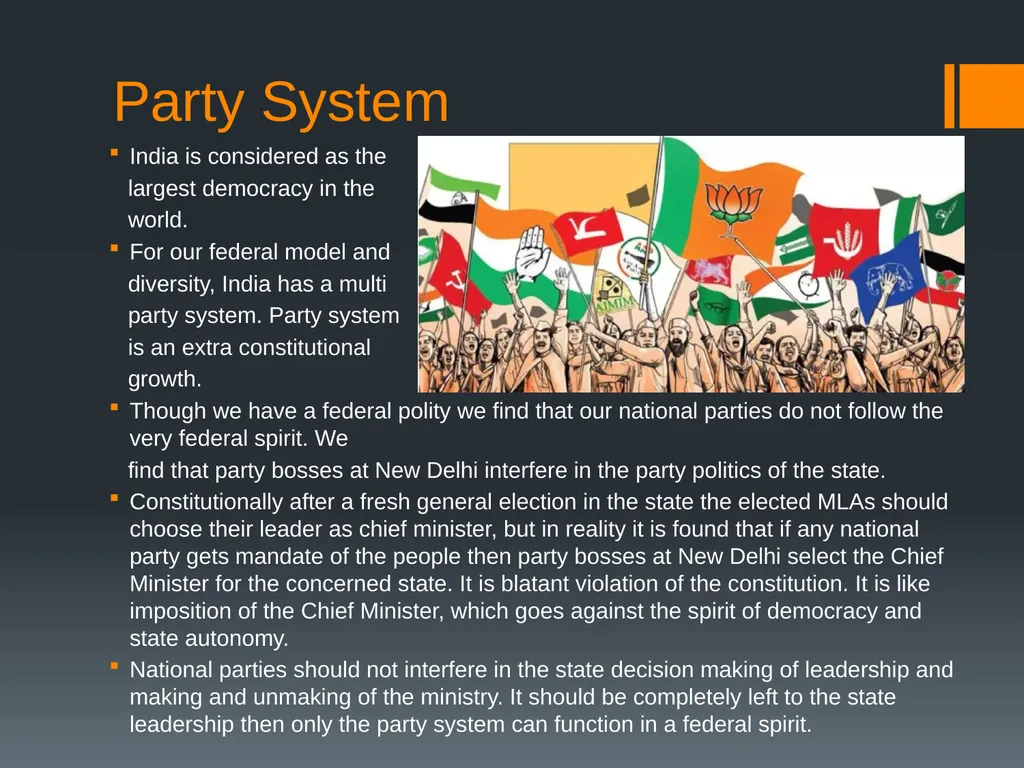
Party System India is considered as the
largest democracy in the
world.
For our federal model and
diversity, India has a multi
party system. Party system
is an extra constitutional
growth.
Though we have a federal polity we find that our national parties do not follow the very federal spirit. We
find that party bosses at New Delhi interfere in the party politics of the state.
Constitutionally after a fresh general election in the state the elected MLAs should choose their leader as chief minister, but in reality it is found that if any national party gets mandate of the people then party bosses at New Delhi select the Chief Minister for the concerned state. It is blatant violation of the constitution. It is like imposition of the Chief Minister, which goes against the spirit of democracy and state autonomy.
National parties should not interfere in the state decision making of leadership and making and unmaking of the ministry. It should be completely left to the state leadership then only the party system can function in a federal spirit.<br>
largest democracy in the
world.
For our federal model and
diversity, India has a multi
party system. Party system
is an extra constitutional
growth.
Though we have a federal polity we find that our national parties do not follow the very federal spirit. We
find that party bosses at New Delhi interfere in the party politics of the state.
Constitutionally after a fresh general election in the state the elected MLAs should choose their leader as chief minister, but in reality it is found that if any national party gets mandate of the people then party bosses at New Delhi select the Chief Minister for the concerned state. It is blatant violation of the constitution. It is like imposition of the Chief Minister, which goes against the spirit of democracy and state autonomy.
National parties should not interfere in the state decision making of leadership and making and unmaking of the ministry. It should be completely left to the state leadership then only the party system can function in a federal spirit.<br>
09
Planning Development through planning is the modern credo. Our first Prime Minister, the Architect of modern India Pandit Jawaharlal Nehru established planning commission on 15th march 1950 through an executive resolution to plan for all round development of people.
Though planning commission is an extra constitutional agency but it had immense power by virtue of prime minister being its chairman. It not only planned for both union and state governments but also allocated resources to the states. It became extremely powerful for which the eminent administrator H. M. Patel remarked that “Planning Commission is the super cabinet of the entire federation.”
All the mega projects needs approval of the planning commission. Though prime minister Narendra Modi abolished Planning Commission and established NITI AYOGA which is nothing but old wine in a new bottle.<br>
Though planning commission is an extra constitutional agency but it had immense power by virtue of prime minister being its chairman. It not only planned for both union and state governments but also allocated resources to the states. It became extremely powerful for which the eminent administrator H. M. Patel remarked that “Planning Commission is the super cabinet of the entire federation.”
All the mega projects needs approval of the planning commission. Though prime minister Narendra Modi abolished Planning Commission and established NITI AYOGA which is nothing but old wine in a new bottle.<br>
10
The post of Governor The post of governor is very crucial constitutional position in our federal system. Governor plays a dual role in our federal system.
Governor is regarded as the agent of the Central government, at the same time he is the head of the state.
Governor maintains federal link between union government and state governments. Though governor plays a dual role, it is found that he shows more loyalty and allegiance to central government than to the state government.
As governor is appointed by the President of India (decided by Union Cabinet). So the governor is loyal to the party bosses at New Delhi.
Now the post of Governors is very much politicised. When there are political differences between union governments and state governments, then the governors and Chief Ministers are at loggerheads which hampers the development of the state. At present we find this position in national capital region (NCR, New Delhi, West Bengal and Kerala).<br>
Governor is regarded as the agent of the Central government, at the same time he is the head of the state.
Governor maintains federal link between union government and state governments. Though governor plays a dual role, it is found that he shows more loyalty and allegiance to central government than to the state government.
As governor is appointed by the President of India (decided by Union Cabinet). So the governor is loyal to the party bosses at New Delhi.
Now the post of Governors is very much politicised. When there are political differences between union governments and state governments, then the governors and Chief Ministers are at loggerheads which hampers the development of the state. At present we find this position in national capital region (NCR, New Delhi, West Bengal and Kerala).<br>
11
Article 356 Article 356 is the most misused and abused
article of our Constitution. Mostly it is used
for political purpose by union government
which violates the very spirit of the
constitution and federalism.
From working of the constitution this article
was misused by Pandit Nehru to unsettle
the communist government in Kerala. This
trend continued till Bommai judgement
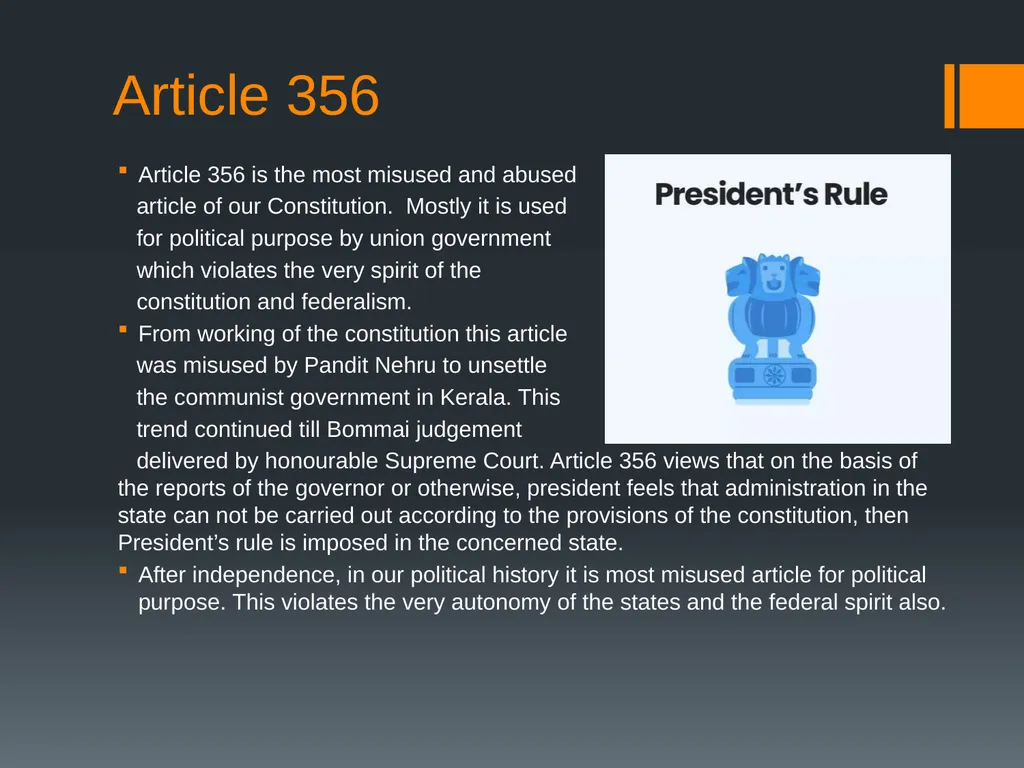
delivered by honourable Supreme Court. Article 356 views that on the basis of the reports of the governor or otherwise, president feels that administration in the state can not be carried out according to the provisions of the constitution, then President’s rule is imposed in the concerned state.
After independence, in our political history it is most misused article for political purpose. This violates the very autonomy of the states and the federal spirit also.<br>
article of our Constitution. Mostly it is used
for political purpose by union government
which violates the very spirit of the
constitution and federalism.
From working of the constitution this article
was misused by Pandit Nehru to unsettle
the communist government in Kerala. This
trend continued till Bommai judgement
delivered by honourable Supreme Court. Article 356 views that on the basis of the reports of the governor or otherwise, president feels that administration in the state can not be carried out according to the provisions of the constitution, then President’s rule is imposed in the concerned state.
After independence, in our political history it is most misused article for political purpose. This violates the very autonomy of the states and the federal spirit also.<br>
12
All India Services All India services is a unique innovation of our Constitution. All India services like IAS, IPS and IFS (Indian Forest Service) occupy strategic position in both union governments and state governments.
Sardar Vallabhai Patel considered the all India services as steelframe of our administration. As all India services occupy all strategic positions even in state governments but naturally the all India services show more loyalty and allegiance to the central government than to the state government.<br>
Sardar Vallabhai Patel considered the all India services as steelframe of our administration. As all India services occupy all strategic positions even in state governments but naturally the all India services show more loyalty and allegiance to the central government than to the state government.<br>
13
Common Constitutional Authority In our federation there are certain common constitutional authorities which work for both union government and state government.
The offices like Election Commission, CAG (Comptroller and Auditor General in India), Finance Commission, etc. work both for the Union governments and state governments.
The election commission of India conducts elections for President, Vice-President, Lok Sabha, Rajya Sabha, State Vidhan Sabhas, etc.
Similarly the CAG provides audit report to the Parliament and State Legislatures
And the Finance Commission recommends for fair distribution of taxes between Union governments and State governments.
Naturally these common constitutional authority show more loyalty to the union government than to the state governments.<br>
The offices like Election Commission, CAG (Comptroller and Auditor General in India), Finance Commission, etc. work both for the Union governments and state governments.
The election commission of India conducts elections for President, Vice-President, Lok Sabha, Rajya Sabha, State Vidhan Sabhas, etc.
Similarly the CAG provides audit report to the Parliament and State Legislatures
And the Finance Commission recommends for fair distribution of taxes between Union governments and State governments.
Naturally these common constitutional authority show more loyalty to the union government than to the state governments.<br>
14
The Way Out On the above we discussed about the issue area of our federation.
The answer is cooperative federalism. Both union government and state government should go beyond vision of the party politics for a developed India.
Power distribution, party system, governor, article 356, finance, etc. needs recasting in the changed circumstances of 21st century.<br>
The answer is cooperative federalism. Both union government and state government should go beyond vision of the party politics for a developed India.
Power distribution, party system, governor, article 356, finance, etc. needs recasting in the changed circumstances of 21st century.<br>
15
Bibliography Our Constitution by Subash C. Kashyap
Our Political system by Subash C. Kashyap
Introduction to Indian Constitution by D. D. Basu
Indian Administration by S. R. Maheshwari
Our Constitution by NCERT publications
Politics in India by Rajni Kothari
The Indian Constitution: Cornerstone of a Nation by Granville Austin
Politics in India edited by Niraja Gopal Jayal & Pratap Bhanu Mehta<br>
Our Political system by Subash C. Kashyap
Introduction to Indian Constitution by D. D. Basu
Indian Administration by S. R. Maheshwari
Our Constitution by NCERT publications
Politics in India by Rajni Kothari
The Indian Constitution: Cornerstone of a Nation by Granville Austin
Politics in India edited by Niraja Gopal Jayal & Pratap Bhanu Mehta<br>