
FERTASA SYMPOSIUM: Facing the Onslaught – Fact or
A
Published · 30 slides · 0 views

1 / 1






Description
FERTASA SYMPOSIUM: Facing the Onslaught Fact or Fiction Prof Alewyn Nel Department of Human Resource Management University of Pretoria 18 September 2025 Make today matter Content of the presentation Introduction of concepts AI impact on
Related Topics
Share
Embed code
Download this presentation From Below
"FERTASA SYMPOSIUM: Facing the Onslaught – Fact or" is the property of its rightful owner. Permission is granted to download and print the materials on this website for personal, non-commercial use only, and to display it on your personal computer provided you do not modify the materials and that you retain all copyright notices contained in the materials. By downloading content from our website, you accept the terms of this agreement.
Presentation Transcript
01
FERTASA SYMPOSIUM: Facing the Onslaught – Fact or Fiction
Prof Alewyn Nel
Department of Human Resource Management
University of Pretoria
18 September 2025 Make today matter<br>
Prof Alewyn Nel
Department of Human Resource Management
University of Pretoria
18 September 2025 Make today matter<br>
02
Content of the presentation Introduction of concepts
AI impact on Professional Identity
AI impact on Social Desirability Bias
AI Impact on Stereotypes
AI Impact on Leadership
AI Impact on Workforce Planning
Take-Ways<br>
AI impact on Professional Identity
AI impact on Social Desirability Bias
AI Impact on Stereotypes
AI Impact on Leadership
AI Impact on Workforce Planning
Take-Ways<br>
03
Human Factors in AI Adoption (Agriculture) Professional Identity
The way farmers and agricultural workers define themselves through their roles, AI can reshape this sense of “being a soil steward.”
Social Desirability
The tendency to give socially acceptable answers (e.g., claiming to support AI) rather than revealing true feelings or practices.
Stereotypes
Oversimplified beliefs (e.g., “AI is only for big farms” or “older farmers can’t adapt”) that block fair and effective adoption.
Leadership
The ability of agricultural leaders to set vision, build trust, and ensure ethical, inclusive use of AI technologies.
Workforce Planning
Strategically preparing people and skills for the future by redesigning roles, reskilling workers, and ensuring succession in an AI-enabled environment.<br>
The way farmers and agricultural workers define themselves through their roles, AI can reshape this sense of “being a soil steward.”
Social Desirability
The tendency to give socially acceptable answers (e.g., claiming to support AI) rather than revealing true feelings or practices.
Stereotypes
Oversimplified beliefs (e.g., “AI is only for big farms” or “older farmers can’t adapt”) that block fair and effective adoption.
Leadership
The ability of agricultural leaders to set vision, build trust, and ensure ethical, inclusive use of AI technologies.
Workforce Planning
Strategically preparing people and skills for the future by redesigning roles, reskilling workers, and ensuring succession in an AI-enabled environment.<br>
04
Professional Identity concepts in Agriculture Productivist: Values maximising yield and profit through large-scale, intensive farming practices and chemical technologies.
Conservationist: Prioritises environmental protection and sustainable practices, sometimes even at the expense of maximum profit.
Civic-minded: Focuses on community engagement, leadership, and responsibility within the local community.
Naturalist: Balances production goals with a strong interest in wildlife, biodiversity, and ecosystem health.
Traditionalist: Emphasises cultural stewardship and traditional farming methods, which may cause resistance to new technologies.
Innovationist: Open to adopting new technologies and practices, driven by a forward-looking perspective<br>
Conservationist: Prioritises environmental protection and sustainable practices, sometimes even at the expense of maximum profit.
Civic-minded: Focuses on community engagement, leadership, and responsibility within the local community.
Naturalist: Balances production goals with a strong interest in wildlife, biodiversity, and ecosystem health.
Traditionalist: Emphasises cultural stewardship and traditional farming methods, which may cause resistance to new technologies.
Innovationist: Open to adopting new technologies and practices, driven by a forward-looking perspective<br>
05
Identity Threats vs Opportunities Understanding adoption barriers: Financial incentives alone are not always enough to encourage the adoption of new technologies. Identity and cultural factors play a significant role.
Reframing the future of agriculture: Instead of portraying automation as a replacement for certain jobs, it can rather be a shift that creates new, higher-skilled roles. This narrative can address fears of job displacement and help attract a new generation to the agricultural sector.
Designing effective programs: Programs and messaging aimed at improving sustainability or promoting new technology should consider and respect the identity work. Tailoring approaches to different identity types (e.g., appealing to the "Conservationist" or the "Productivist") could increase effectiveness.<br>
Reframing the future of agriculture: Instead of portraying automation as a replacement for certain jobs, it can rather be a shift that creates new, higher-skilled roles. This narrative can address fears of job displacement and help attract a new generation to the agricultural sector.
Designing effective programs: Programs and messaging aimed at improving sustainability or promoting new technology should consider and respect the identity work. Tailoring approaches to different identity types (e.g., appealing to the "Conservationist" or the "Productivist") could increase effectiveness.<br>
06
AI’s impact on Agriculture identity Artificial intelligence (AI) profoundly impacts agricultural identity by changing the nature of work, shifting sources of knowledge
AI raises complex questions of data ownership, ethics, and social equity across disciplines.
Instead of simply replacing human labour, AI augments it, transforming, for instance, a farmer's identity from a manual labourer to a technology-driven farm manager.<br>
AI raises complex questions of data ownership, ethics, and social equity across disciplines.
Instead of simply replacing human labour, AI augments it, transforming, for instance, a farmer's identity from a manual labourer to a technology-driven farm manager.<br>
07
AI’s impact on Agriculture identity From manual expert to system manager: Traditional farming often relies on embodied knowledge gained over generations—feeling the soil, watching the weather, and visually inspecting crops. AI introduces a new layer of data analysis, moving the farmer's role toward interpreting dashboards, managing automated systems, and responding to algorithm-based alerts.
A skills gap and digital divide: For workers in agriculture to adopt AI, they must gain new skills in data interpretation and technology management. This creates a digital divide that benefits larger, more technologically advanced farms while putting smallholder farmers at a significant disadvantage, particularly in developing regions.
New specialised roles: The technology may also create new roles for people who operate and maintain complex AI-powered equipment. However, this may displace some low-skilled manual labourers in the process<br>
A skills gap and digital divide: For workers in agriculture to adopt AI, they must gain new skills in data interpretation and technology management. This creates a digital divide that benefits larger, more technologically advanced farms while putting smallholder farmers at a significant disadvantage, particularly in developing regions.
New specialised roles: The technology may also create new roles for people who operate and maintain complex AI-powered equipment. However, this may displace some low-skilled manual labourers in the process<br>
08
How can Professional Identity adapt to AI in the Agricultural environment? Reframe Identity, Don’t Replace It
Farmers and agronomists already identify as “guardians of the soil”.
Position AI as a tool that strengthens that guardianship rather than something that makes their expertise obsolete.
Highlight Continuity of Core Values
Emphasise that values like sustainability, stewardship, and productivity remain the same.
Job Crafting & Co-Creation
Involve farmers/workers in redefining their own roles with AI. Small adaptations (e.g., combining soil intuition with AI data) foster ownership of the “new” identity.<br>
Farmers and agronomists already identify as “guardians of the soil”.
Position AI as a tool that strengthens that guardianship rather than something that makes their expertise obsolete.
Highlight Continuity of Core Values
Emphasise that values like sustainability, stewardship, and productivity remain the same.
Job Crafting & Co-Creation
Involve farmers/workers in redefining their own roles with AI. Small adaptations (e.g., combining soil intuition with AI data) foster ownership of the “new” identity.<br>
09
How can Professional Identity adapt to AI in the Agricultural environment? Recognition of Hybrid Expertise
Acknowledge and celebrate those who successfully blend traditional knowledge with AI insights.
Creates prestige around being a “modern soil steward” rather than a “displaced worker.”
Leadership Storytelling
Leaders and co-op managers should use narratives of growth and pride to connect identity with AI.
Example: “With AI, you are not less of a farmer — you are a next-generation steward of the land.”
Peer Role Models
Showcase farmers and agronomists who have embraced AI while maintaining their professional dignity.
Identity shifts become easier when people see “someone like me” succeeding.<br>
Acknowledge and celebrate those who successfully blend traditional knowledge with AI insights.
Creates prestige around being a “modern soil steward” rather than a “displaced worker.”
Leadership Storytelling
Leaders and co-op managers should use narratives of growth and pride to connect identity with AI.
Example: “With AI, you are not less of a farmer — you are a next-generation steward of the land.”
Peer Role Models
Showcase farmers and agronomists who have embraced AI while maintaining their professional dignity.
Identity shifts become easier when people see “someone like me” succeeding.<br>
10
How can Professional Identity adapt to AI in the Agricultural environment? Training with Respect for Experience
Design training that acknowledges existing expertise instead of assuming “blank slates.” Pair digital literacy with recognition of tacit soil knowledge.
Encourage Collective Identity (“We”)
Frame AI adoption as a community effort rather than an individual burden.
Strengthens belonging and reduces identity threat.<br>
Design training that acknowledges existing expertise instead of assuming “blank slates.” Pair digital literacy with recognition of tacit soil knowledge.
Encourage Collective Identity (“We”)
Frame AI adoption as a community effort rather than an individual burden.
Strengthens belonging and reduces identity threat.<br>
11
Social Desirability Threat to Agriculture When evaluating the impact of artificial intelligence (AI) in agriculture, it is crucial to consider the potential for a social desirability threat.
The concept of AI and automated technologies is often associated with progress, innovation, and efficiency, which can put pressure on farmers to portray themselves as tech-savvy and forward-thinking, even if it contradicts their true feelings and practices.
This creates a social desirability threat that can affect research findings and policy outcomes if not properly understood and managed.<br>
The concept of AI and automated technologies is often associated with progress, innovation, and efficiency, which can put pressure on farmers to portray themselves as tech-savvy and forward-thinking, even if it contradicts their true feelings and practices.
This creates a social desirability threat that can affect research findings and policy outcomes if not properly understood and managed.<br>
12
Social Desirability Threat to Agriculture Perceptions versus reality
AI can present a conflict between the farmer's personal practices and the technologies promoted as socially and environmentally responsible.
While some farmers may be hesitant to invest due to high costs or scepticism, they might over-report their willingness to adopt AI to appear innovative and responsible to peers, agricultural extension agents, or policymakers.
Conforming to industry norms
The farming community, influenced by industry leaders, can set a social norm around technology adoption.
Farmers may feel pressure to conform to the practices of highly visible and successful early adopters, even if their own farms are not suited for the technology.
This can lead to them overstating their positive perceptions of AI or downplaying their challenges in surveys, skewing data on overall adoption rates and perceived usefulness.<br>
AI can present a conflict between the farmer's personal practices and the technologies promoted as socially and environmentally responsible.
While some farmers may be hesitant to invest due to high costs or scepticism, they might over-report their willingness to adopt AI to appear innovative and responsible to peers, agricultural extension agents, or policymakers.
Conforming to industry norms
The farming community, influenced by industry leaders, can set a social norm around technology adoption.
Farmers may feel pressure to conform to the practices of highly visible and successful early adopters, even if their own farms are not suited for the technology.
This can lead to them overstating their positive perceptions of AI or downplaying their challenges in surveys, skewing data on overall adoption rates and perceived usefulness.<br>
13
Social Desirability Threat to Agriculture Shame and skill gaps:
The shift toward digital farming can create a skills gap, making traditional farming knowledge seem outdated.
Farmers who feel they lack the digital literacy to effectively manage AI tools may feel shame or a diminished sense of professional identity.
In a survey, they may conceal their lack of knowledge to avoid the stigma of being perceived as "behind the times," which hinders efforts to accurately assess training needs.
Indigenous knowledge vs. tech solutionism: Some AI solutions risk displacing Indigenous or traditional farming knowledge systems, which are central to the cultural identity of many farming communities.
There is a social desirability threat to both those who develop the technology and the farmers using it.
In a research setting, farmers may feel pressured to praise the new technology and its data-driven recommendations over their traditional, time-tested practices to appease researchers, who may be viewed as representing a more "advanced" way of farming.<br>
The shift toward digital farming can create a skills gap, making traditional farming knowledge seem outdated.
Farmers who feel they lack the digital literacy to effectively manage AI tools may feel shame or a diminished sense of professional identity.
In a survey, they may conceal their lack of knowledge to avoid the stigma of being perceived as "behind the times," which hinders efforts to accurately assess training needs.
Indigenous knowledge vs. tech solutionism: Some AI solutions risk displacing Indigenous or traditional farming knowledge systems, which are central to the cultural identity of many farming communities.
There is a social desirability threat to both those who develop the technology and the farmers using it.
In a research setting, farmers may feel pressured to praise the new technology and its data-driven recommendations over their traditional, time-tested practices to appease researchers, who may be viewed as representing a more "advanced" way of farming.<br>
14
How to combat social desirability bias Acknowledge Doubt and Resistance
Leaders (e.g., Fertasa) should openly acknowledge that it’s natural to feel sceptical or hesitant, reducing pressure to “perform positivity.”
Demonstration Projects with Transparency
Pilot AI tools on real farms and share both successes and failures — creating realistic expectations instead of hype.
Peer-to-Peer Learning Spaces
Farmers trust other farmers. Create forums where they can share genuine experiences rather than what they “should” say.
Leadership Modelling Honest Dialogue
Transformational leaders can admit their own learning curves with AI, signalling that uncertainty is acceptable.<br>
Leaders (e.g., Fertasa) should openly acknowledge that it’s natural to feel sceptical or hesitant, reducing pressure to “perform positivity.”
Demonstration Projects with Transparency
Pilot AI tools on real farms and share both successes and failures — creating realistic expectations instead of hype.
Peer-to-Peer Learning Spaces
Farmers trust other farmers. Create forums where they can share genuine experiences rather than what they “should” say.
Leadership Modelling Honest Dialogue
Transformational leaders can admit their own learning curves with AI, signalling that uncertainty is acceptable.<br>
15
Stereotypes about AI in Agriculture Similar to the social desirability threat, several persistent stereotypes related to farming and technology can hinder the implementation and acceptance of AI in agriculture.
These stereotypes can affect both farmers' willingness to adopt AI and the assumptions made by technology developers and policymakers.<br>
These stereotypes can affect both farmers' willingness to adopt AI and the assumptions made by technology developers and policymakers.<br>
16
Stereotype: "AI is a black box" The stereotype: The AI is seen as a magical, infallible tool whose suggestions must be followed without question, rather than a transparent tool to be used in conjunction with a farmer's expertise.
Impact on implementation:
Erodes trust: When AI provides recommendations without clear justification, farmers are more likely to default to their own intuition, especially when the advice seems counterintuitive. This reduces the technology's perceived value.
Complicates accountability: In the event of a negative outcome, such as crop damage or financial loss, it becomes difficult to assign responsibility. Was it the farmer's error, a sensor malfunction, or a flawed algorithm? This ambiguity makes farmers wary of relinquishing control.<br>
Impact on implementation:
Erodes trust: When AI provides recommendations without clear justification, farmers are more likely to default to their own intuition, especially when the advice seems counterintuitive. This reduces the technology's perceived value.
Complicates accountability: In the event of a negative outcome, such as crop damage or financial loss, it becomes difficult to assign responsibility. Was it the farmer's error, a sensor malfunction, or a flawed algorithm? This ambiguity makes farmers wary of relinquishing control.<br>
17
Stereotype: "AI will replace my job" The stereotype: AI is an inevitable force that will replace the need for traditional farming skills, diminishing the farmer's role and expertise. This is particularly prevalent with discussions of automation, like self-driving tractors and automated harvesting.
Impact on implementation:
Cultural resistance: It can trigger an identity threat for farmers whose sense of worth is tied to hands-on, embodied knowledge of the land. This can cause them to resist adoption simply to protect their professional identity.
Focus on augmentation, not replacement: To counter this, successful adoption often requires reframing AI not as a replacement but as a "co-pilot" or an "assistant" that handles repetitive tasks while freeing the farmer to focus on higher-level, complex decisions.<br>
Impact on implementation:
Cultural resistance: It can trigger an identity threat for farmers whose sense of worth is tied to hands-on, embodied knowledge of the land. This can cause them to resist adoption simply to protect their professional identity.
Focus on augmentation, not replacement: To counter this, successful adoption often requires reframing AI not as a replacement but as a "co-pilot" or an "assistant" that handles repetitive tasks while freeing the farmer to focus on higher-level, complex decisions.<br>
18
Stereotype: "AI is built for Big Agriculture" The stereotype: AI tools are too expensive and complex for small or mid-sized farms and are designed to serve the interests of large agribusinesses, not individual farmers. This can lead to a belief that AI is not a neutral tool but one that reinforces existing power imbalances.
Impact on implementation:
Reinforces the digital divide: If AI developers focus solely on large, high-return markets, it can create a cycle where smallholders are left out of technological progress, increasing the divide in productivity and profitability.
Exclusion of diverse needs: AI models trained on data from large farms may not be relevant or effective for the diverse crop systems and environmental conditions of smaller farms, leading to inaccurate and untrustworthy recommendations.<br>
Impact on implementation:
Reinforces the digital divide: If AI developers focus solely on large, high-return markets, it can create a cycle where smallholders are left out of technological progress, increasing the divide in productivity and profitability.
Exclusion of diverse needs: AI models trained on data from large farms may not be relevant or effective for the diverse crop systems and environmental conditions of smaller farms, leading to inaccurate and untrustworthy recommendations.<br>
19
How to combat these AI stereotypes from a farming perspective Focus on explainable AI (XAI): Developers should prioritise building XAI systems that can clearly explain their reasoning to the agriculture community in understandable terms. This moves the AI from a "black box" to a trusted "advisor".
Promote collaboration and co-creation: Involve the agricultural community directly in the development and design process. A "farmer-first" approach ensures the technology is relevant to real-world needs and context, not just theoretical algorithms.
Develop accessible and affordable solutions: Create AI solutions that are modular, affordable, and scalable to address the needs of small and mid-sized companies/farms. Public-private partnerships and open-source models can help make AI more equitable.
Establish clear data ownership policies: Implement transparent and legally binding frameworks that clearly define data ownership, usage rights, and privacy. This helps rebuild trust and demonstrates respect for the agricultural community as data producers.
Create realistic case studies and pilots: Instead of broad promises, demonstrate the value of AI through focused, on-farm pilots that prove a clear return on investment. This counters cynicism built on past frustrations with ineffective technology.<br>
Promote collaboration and co-creation: Involve the agricultural community directly in the development and design process. A "farmer-first" approach ensures the technology is relevant to real-world needs and context, not just theoretical algorithms.
Develop accessible and affordable solutions: Create AI solutions that are modular, affordable, and scalable to address the needs of small and mid-sized companies/farms. Public-private partnerships and open-source models can help make AI more equitable.
Establish clear data ownership policies: Implement transparent and legally binding frameworks that clearly define data ownership, usage rights, and privacy. This helps rebuild trust and demonstrates respect for the agricultural community as data producers.
Create realistic case studies and pilots: Instead of broad promises, demonstrate the value of AI through focused, on-farm pilots that prove a clear return on investment. This counters cynicism built on past frustrations with ineffective technology.<br>
20
Leadership in AI adoption in Agricultural environment Agricultural leaders play a crucial, multifaceted role in guiding the successful adoption of Artificial Intelligence (AI) and other advanced technologies.
For AI to move beyond a niche tool for large commercial farms and be successfully implemented across the agricultural sector, leadership is needed to navigate complex challenges, build trust, and drive meaningful, inclusive transformation<br>
For AI to move beyond a niche tool for large commercial farms and be successfully implemented across the agricultural sector, leadership is needed to navigate complex challenges, build trust, and drive meaningful, inclusive transformation<br>
21
What can Leaders do? Framing the Narrative
Leaders set the tone: if they describe AI as a threat, workers will fear it; if they present it as a partner, adoption feels empowering.
Building Trust in Technology
Farmers and agri-workers often mistrust “black-box” AI. Leaders must ensure transparency, explain how data is used, and protect ownership of farm data. Ethical leadership builds this trust by championing fairness and integrity.<br>
Leaders set the tone: if they describe AI as a threat, workers will fear it; if they present it as a partner, adoption feels empowering.
Building Trust in Technology
Farmers and agri-workers often mistrust “black-box” AI. Leaders must ensure transparency, explain how data is used, and protect ownership of farm data. Ethical leadership builds this trust by championing fairness and integrity.<br>
22
What can Leaders do? Challenging Stereotypes & Bias
Leaders counter myths like “AI is only for big farms” or “older farmers can’t adapt.” By providing equal training opportunities, leaders break down exclusion and ensure inclusion.
Managing Change & Technostress
AI adoption often creates anxiety (technostress, overload, fear of being replaced). Leaders provide psychological safety by communicating clearly, pacing change, and offering support.<br>
Leaders counter myths like “AI is only for big farms” or “older farmers can’t adapt.” By providing equal training opportunities, leaders break down exclusion and ensure inclusion.
Managing Change & Technostress
AI adoption often creates anxiety (technostress, overload, fear of being replaced). Leaders provide psychological safety by communicating clearly, pacing change, and offering support.<br>
23
What can Leaders do? Reskilling & Workforce Planning
Leaders identify which tasks are shifting (e.g., fertiliser application → precision AI application) and create pathways for workers to gain new skills. This ensures continuity of employment and preserves dignity.
Sustaining Identity & Meaning
Farmers and agronomists see themselves as guardians of the soil. Leaders must connect AI adoption back to this identity — “AI helps you care for the soil better” — to protect pride and motivation.
Role Modelling Honest Adoption
If leaders themselves use AI tools, acknowledge challenges, and show curiosity, workers are more likely to follow authentically rather than pretend (reduces social desirability bias).<br>
Leaders identify which tasks are shifting (e.g., fertiliser application → precision AI application) and create pathways for workers to gain new skills. This ensures continuity of employment and preserves dignity.
Sustaining Identity & Meaning
Farmers and agronomists see themselves as guardians of the soil. Leaders must connect AI adoption back to this identity — “AI helps you care for the soil better” — to protect pride and motivation.
Role Modelling Honest Adoption
If leaders themselves use AI tools, acknowledge challenges, and show curiosity, workers are more likely to follow authentically rather than pretend (reduces social desirability bias).<br>
24
Workforce Planning: The Shift Artificial intelligence (AI) is fundamentally reshaping workforce planning in agriculture by automating repetitive tasks, creating demand for new skills, and altering how labour is managed and allocated.
As the industry shifts from manual labour to data-driven management, the workforce must adapt to new roles that emphasise digital literacy and technical expertise.<br>
As the industry shifts from manual labour to data-driven management, the workforce must adapt to new roles that emphasise digital literacy and technical expertise.<br>
25
AI’s Impact on Workforce Planning Task-Level Transformation
AI doesn’t always eliminate whole jobs, but it changes tasks.
Example: Fertiliser spreading → from manual uniform application to AI-guided precision application.
Workforce planning must break jobs into task components to see what shifts, disappears, or emerges.
Emergence of Hybrid Roles
New roles combine traditional expertise with digital skills (e.g., “digital agronomist,” “precision farming technician”).
Planning must anticipate these hybrids and prepare career pathways.<br>
AI doesn’t always eliminate whole jobs, but it changes tasks.
Example: Fertiliser spreading → from manual uniform application to AI-guided precision application.
Workforce planning must break jobs into task components to see what shifts, disappears, or emerges.
Emergence of Hybrid Roles
New roles combine traditional expertise with digital skills (e.g., “digital agronomist,” “precision farming technician”).
Planning must anticipate these hybrids and prepare career pathways.<br>
26
AI’s Impact on Workforce Planning Reskilling and Upskilling Needs
Workers need digital literacy, data interpretation, and system oversight skills.
Fact: World Economic Forum (2023) projects 44% of workers’ skills will be disrupted within 5 years due to AI.
Succession Planning Under Uncertainty
AI adoption speeds up role change — succession planning must focus on adaptive leadership, not just technical expertise.
Leaders of the future will need to balance soil science, tech, and people skills.<br>
Workers need digital literacy, data interpretation, and system oversight skills.
Fact: World Economic Forum (2023) projects 44% of workers’ skills will be disrupted within 5 years due to AI.
Succession Planning Under Uncertainty
AI adoption speeds up role change — succession planning must focus on adaptive leadership, not just technical expertise.
Leaders of the future will need to balance soil science, tech, and people skills.<br>
27
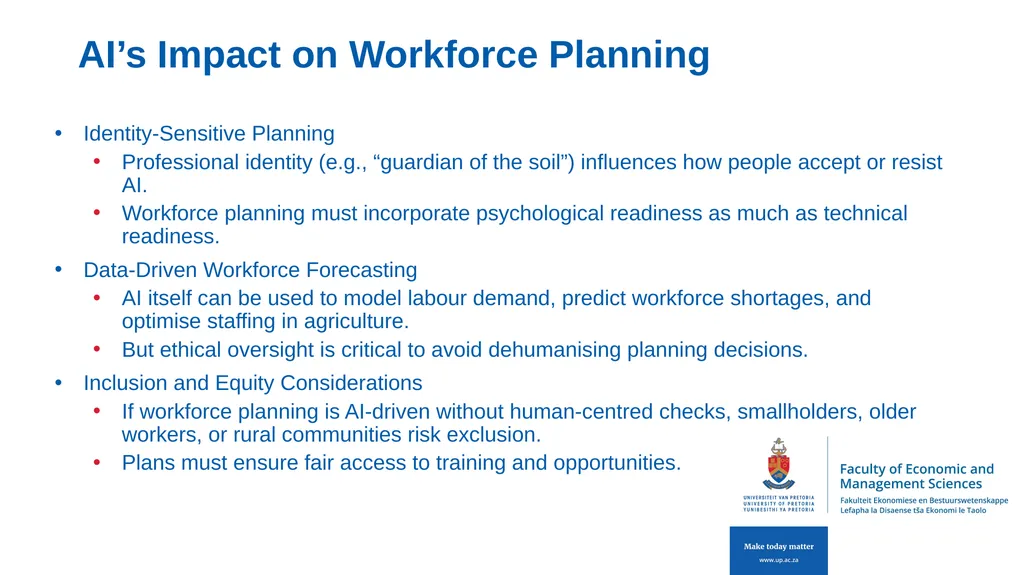
AI’s Impact on Workforce Planning Identity-Sensitive Planning
Professional identity (e.g., “guardian of the soil”) influences how people accept or resist AI.
Workforce planning must incorporate psychological readiness as much as technical readiness.
Data-Driven Workforce Forecasting
AI itself can be used to model labour demand, predict workforce shortages, and optimise staffing in agriculture.
But ethical oversight is critical to avoid dehumanising planning decisions.
Inclusion and Equity Considerations
If workforce planning is AI-driven without human-centred checks, smallholders, older workers, or rural communities risk exclusion.
Plans must ensure fair access to training and opportunities.<br>
Professional identity (e.g., “guardian of the soil”) influences how people accept or resist AI.
Workforce planning must incorporate psychological readiness as much as technical readiness.
Data-Driven Workforce Forecasting
AI itself can be used to model labour demand, predict workforce shortages, and optimise staffing in agriculture.
But ethical oversight is critical to avoid dehumanising planning decisions.
Inclusion and Equity Considerations
If workforce planning is AI-driven without human-centred checks, smallholders, older workers, or rural communities risk exclusion.
Plans must ensure fair access to training and opportunities.<br>
28
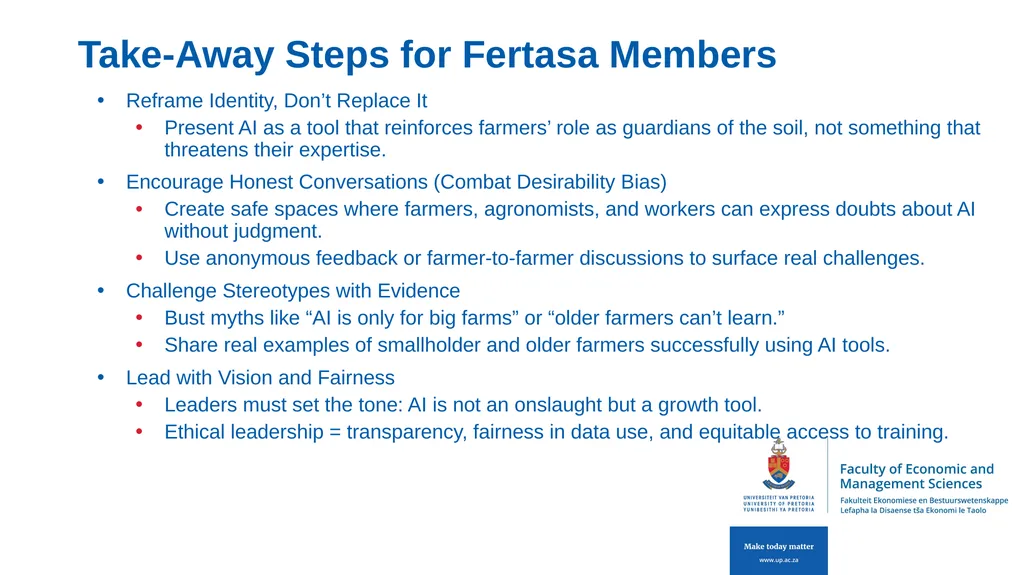
Take-Away Steps for Fertasa Members Reframe Identity, Don’t Replace It
Present AI as a tool that reinforces farmers’ role as guardians of the soil, not something that threatens their expertise.
Encourage Honest Conversations (Combat Desirability Bias)
Create safe spaces where farmers, agronomists, and workers can express doubts about AI without judgment.
Use anonymous feedback or farmer-to-farmer discussions to surface real challenges.
Challenge Stereotypes with Evidence
Bust myths like “AI is only for big farms” or “older farmers can’t learn.”
Share real examples of smallholder and older farmers successfully using AI tools.
Lead with Vision and Fairness
Leaders must set the tone: AI is not an onslaught but a growth tool.
Ethical leadership = transparency, fairness in data use, and equitable access to training.<br>
Present AI as a tool that reinforces farmers’ role as guardians of the soil, not something that threatens their expertise.
Encourage Honest Conversations (Combat Desirability Bias)
Create safe spaces where farmers, agronomists, and workers can express doubts about AI without judgment.
Use anonymous feedback or farmer-to-farmer discussions to surface real challenges.
Challenge Stereotypes with Evidence
Bust myths like “AI is only for big farms” or “older farmers can’t learn.”
Share real examples of smallholder and older farmers successfully using AI tools.
Lead with Vision and Fairness
Leaders must set the tone: AI is not an onslaught but a growth tool.
Ethical leadership = transparency, fairness in data use, and equitable access to training.<br>
29
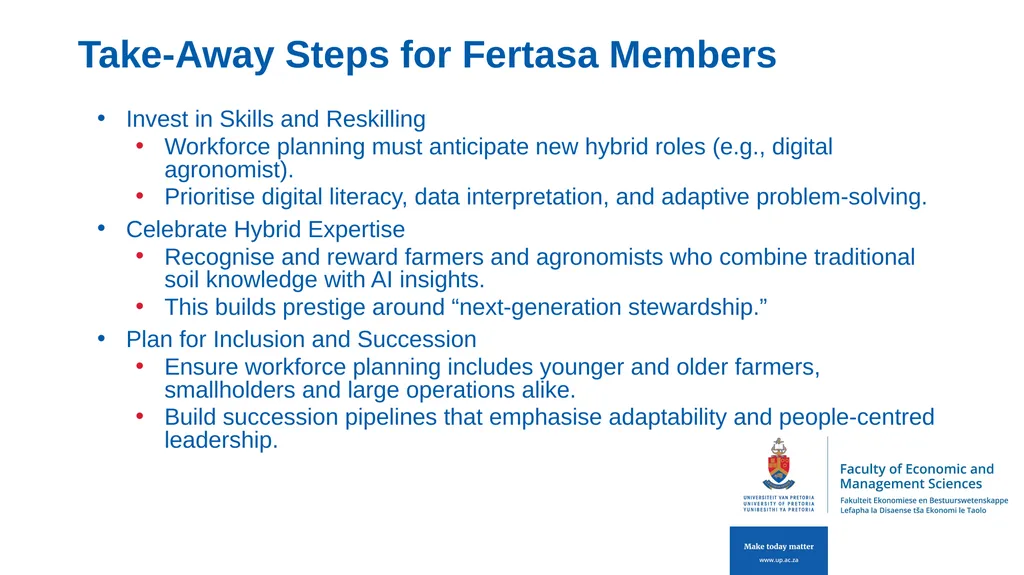
Take-Away Steps for Fertasa Members Invest in Skills and Reskilling
Workforce planning must anticipate new hybrid roles (e.g., digital agronomist).
Prioritise digital literacy, data interpretation, and adaptive problem-solving.
Celebrate Hybrid Expertise
Recognise and reward farmers and agronomists who combine traditional soil knowledge with AI insights.
This builds prestige around “next-generation stewardship.”
Plan for Inclusion and Succession
Ensure workforce planning includes younger and older farmers, smallholders and large operations alike.
Build succession pipelines that emphasise adaptability and people-centred leadership.<br>
Workforce planning must anticipate new hybrid roles (e.g., digital agronomist).
Prioritise digital literacy, data interpretation, and adaptive problem-solving.
Celebrate Hybrid Expertise
Recognise and reward farmers and agronomists who combine traditional soil knowledge with AI insights.
This builds prestige around “next-generation stewardship.”
Plan for Inclusion and Succession
Ensure workforce planning includes younger and older farmers, smallholders and large operations alike.
Build succession pipelines that emphasise adaptability and people-centred leadership.<br>
30
Thank You Questions?
Contact: alewyn.nel@up.ac.za<br>
Contact: alewyn.nel@up.ac.za<br>