04
Why Pitch Quality Matters GAA pitches: long playing season, high rainfall, and wet winters demand structured fertiliser planning, not ad‑hoc applications
The GAA National Pitch Maintenance Work Group (est. 2017) sets national best practice guidelines for all clubs
Annual investment of €5,000–€10,000 per pitch prevents significant reconstruction costs
Aeration, fertilising, sand topdressing and overseeding are the highest-value routine activities a groundsman can perform<br>
05
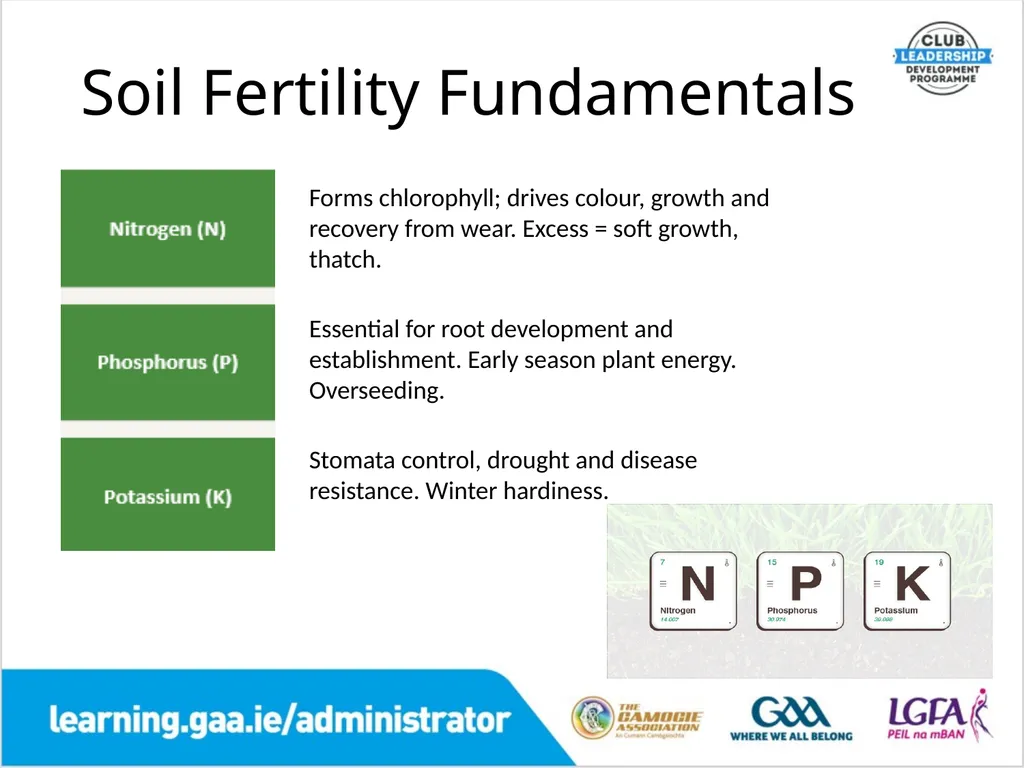
Soil Fertility Fundamentals Forms chlorophyll; drives colour, growth and recovery from wear. Excess = soft growth, thatch. Essential for root development and establishment. Early season plant energy. Overseeding. Stomata control, drought and disease resistance. Winter hardiness.<br>
06
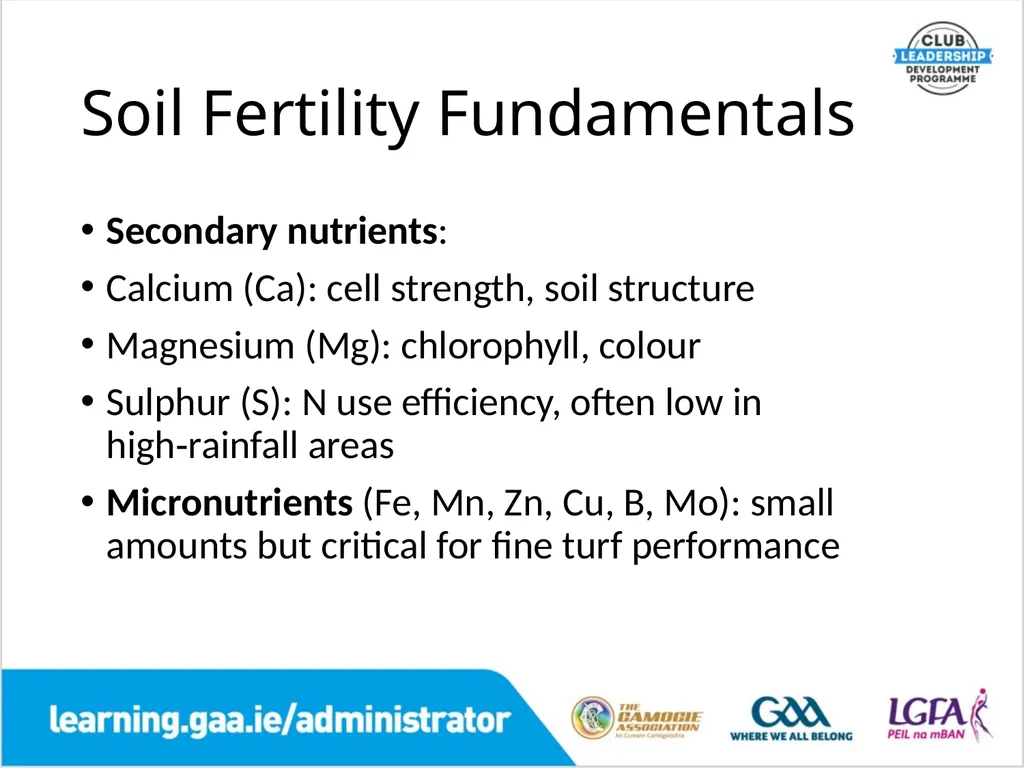
Soil Fertility Fundamentals Secondary nutrients:
Calcium (Ca): cell strength, soil structure
Magnesium (Mg): chlorophyll, colour
Sulphur (S): N use efficiency, often low in high‑rainfall areas
Micronutrients (Fe, Mn, Zn, Cu, B, Mo): small amounts but critical for fine turf performance<br>
07
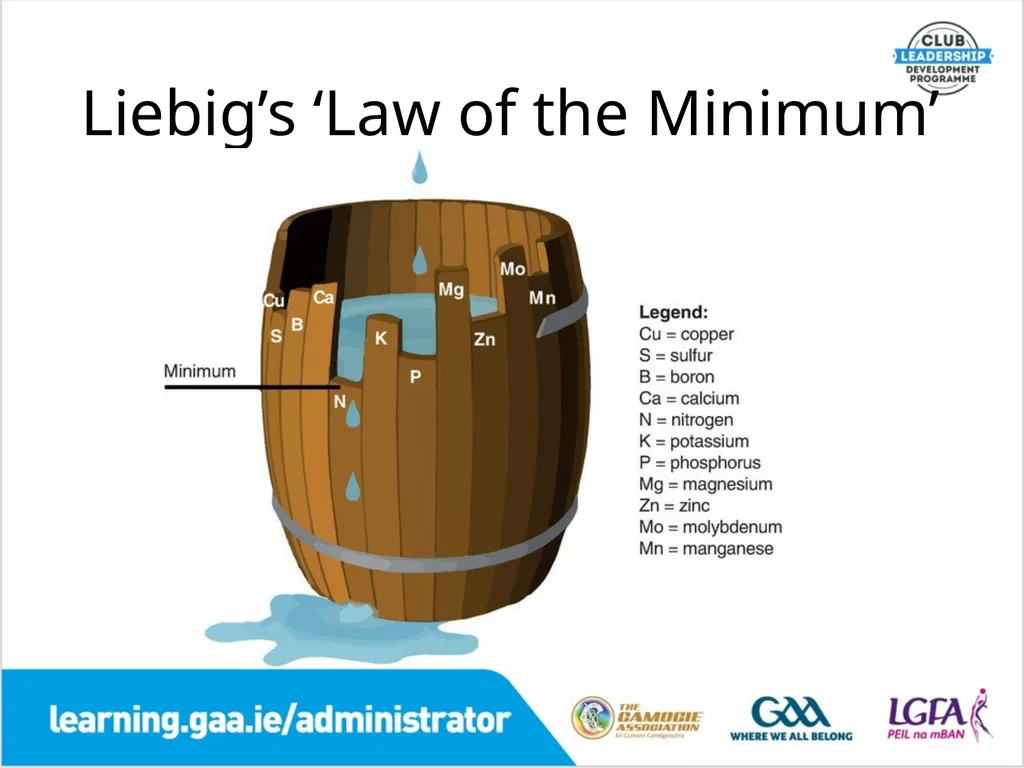
Liebig’s ‘Law of the Minimum’<br>
08
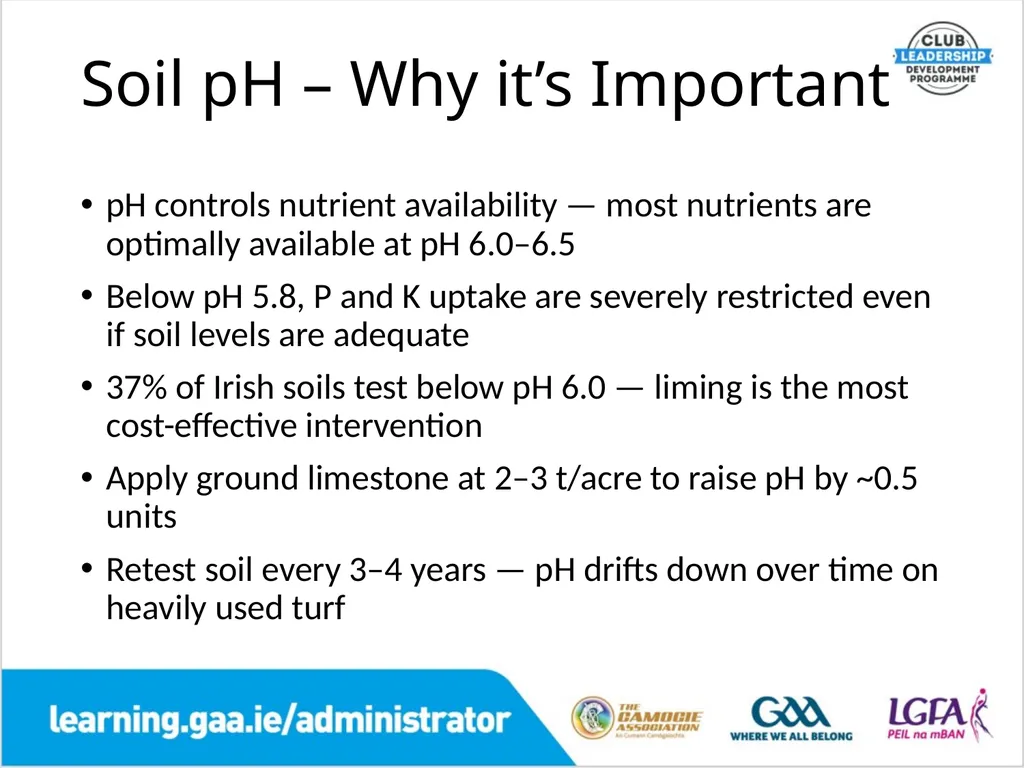
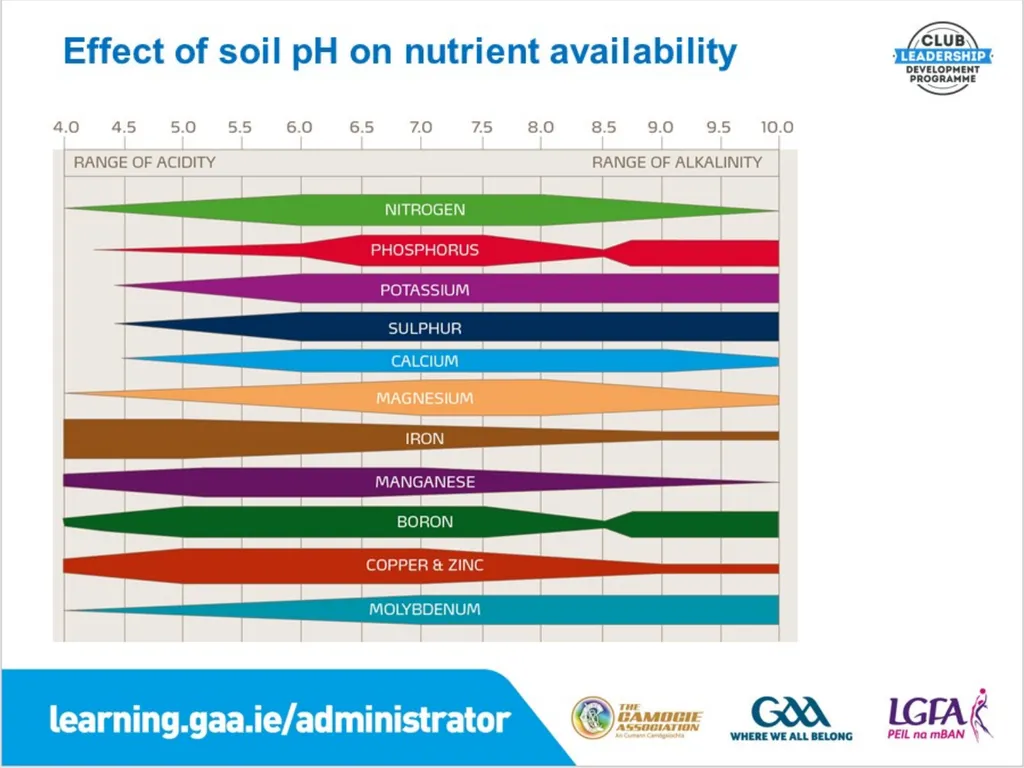
Soil pH – Why it’s Important pH controls nutrient availability — most nutrients are optimally available at pH 6.0–6.5
Below pH 5.8, P and K uptake are severely restricted even if soil levels are adequate
37% of Irish soils test below pH 6.0 — liming is the most cost-effective intervention
Apply ground limestone at 2–3 t/acre to raise pH by ~0.5 units
Retest soil every 3–4 years — pH drifts down over time on heavily used turf<br>
09
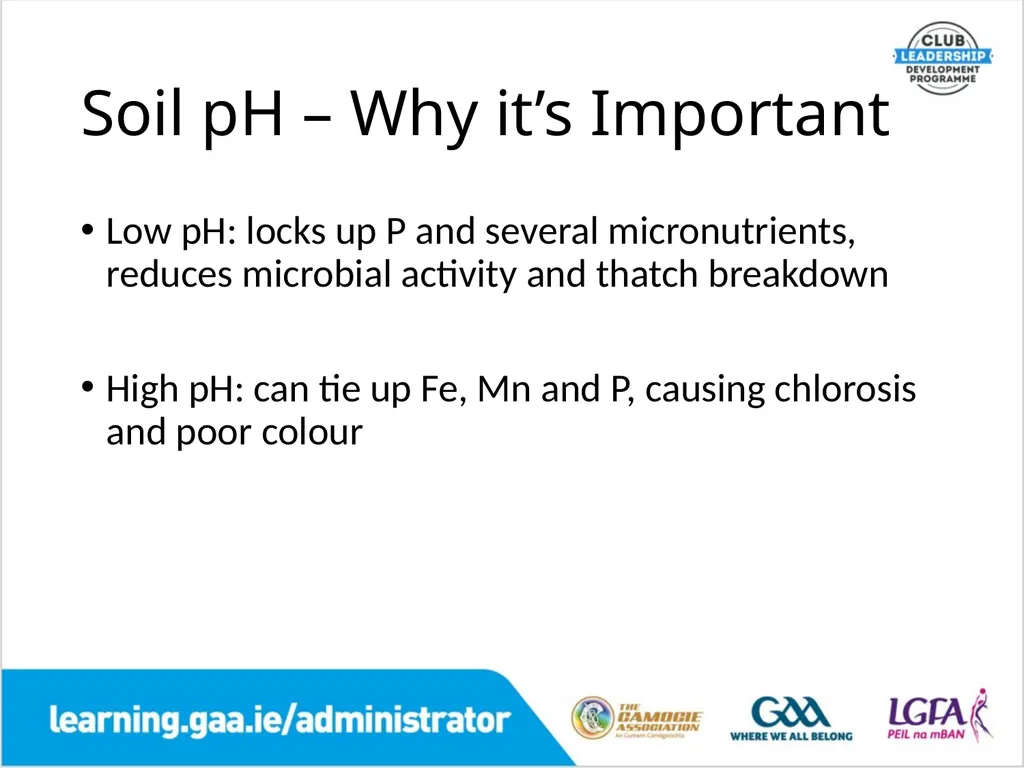
Soil pH – Why it’s Important Low pH: locks up P and several micronutrients, reduces microbial activity and thatch breakdown
High pH: can tie up Fe, Mn and P, causing chlorosis and poor colour<br>
10
What Approach to Take Get a soil test carried out every year as a rule of thumb and discuss with your agronomist
Independent Laboratory
Through your fertiliser representative.
Colm Ryan (Cropcare) - 085 2547678
Padraig Doyle (Goldcrop) - 087 9030877
Eamonn Maguire (Greentech) - 087 9013915
Dennis Collins (NAD) - 087 1056830
Fergal Greenan (ICL) - 086 0542566
Tony White (Turfcare) – 086 8630935<br>
11
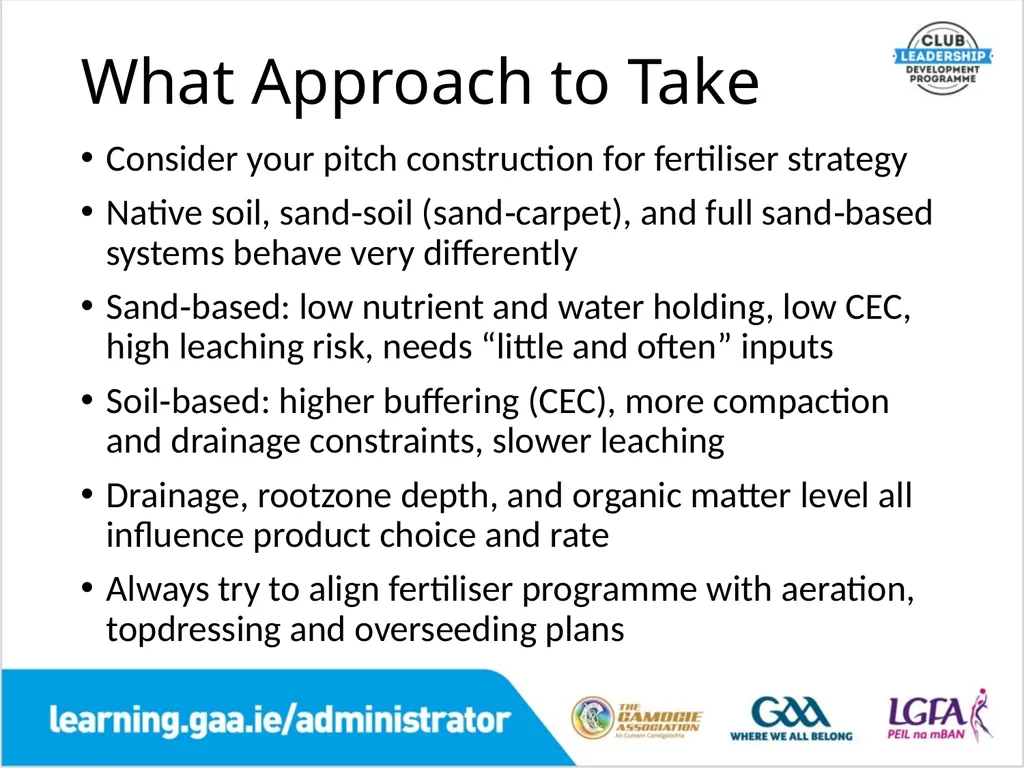
What Approach to Take Consider your pitch construction for fertiliser strategy
Native soil, sand‑soil (sand‑carpet), and full sand‑based systems behave very differently
Sand‑based: low nutrient and water holding, low CEC, high leaching risk, needs “little and often” inputs
Soil‑based: higher buffering (CEC), more compaction and drainage constraints, slower leaching
Drainage, rootzone depth, and organic matter level all influence product choice and rate
Always try to align fertiliser programme with aeration, topdressing and overseeding plans<br>
12
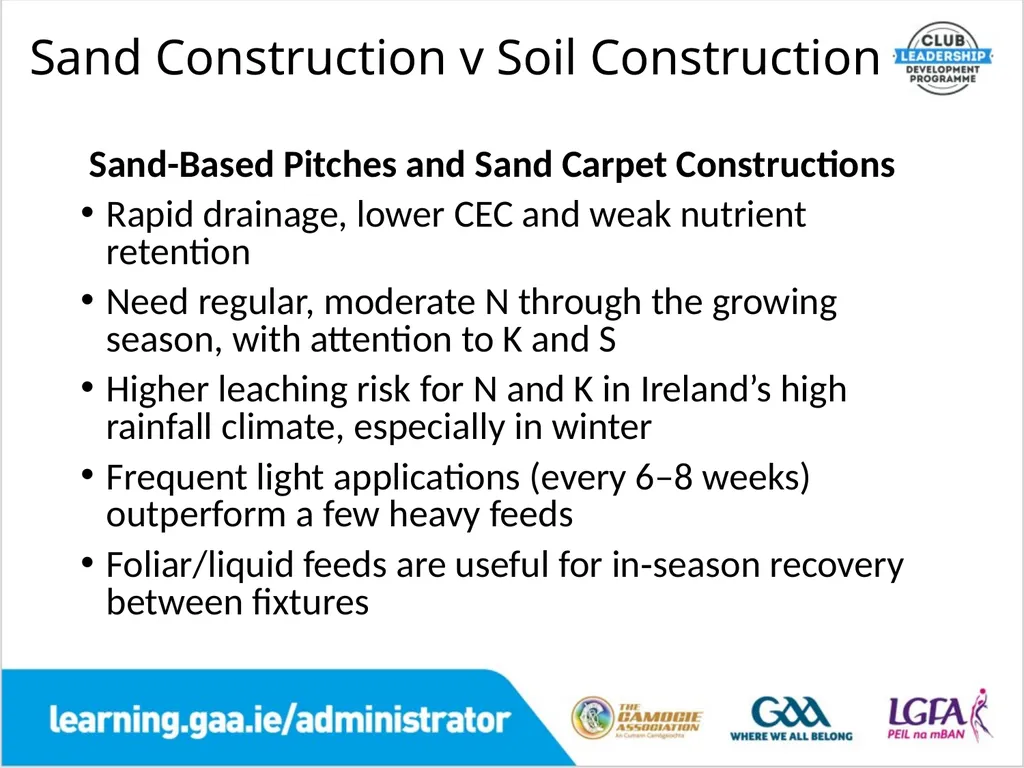
Sand Construction v Soil Construction Sand-Based Pitches and Sand Carpet Constructions
Rapid drainage, lower CEC and weak nutrient retention
Need regular, moderate N through the growing season, with attention to K and S
Higher leaching risk for N and K in Ireland’s high rainfall climate, especially in winter
Frequent light applications (every 6–8 weeks) outperform a few heavy feeds
Foliar/liquid feeds are useful for in‑season recovery between fixtures<br>
13
Sand Construction v Soil Construction Soil‑Based Pitches: Characteristics
Native topsoil over subsoil, moderate–high CEC and better nutrient holding capacity
More susceptible to compaction and waterlogging; nutrition must work alongside aeration and drainage
Fewer, slightly heavier granular applications can work when pH is correct
P and K often adequate where clippings are returned; refer to soil test where low
Risk of surface softness if high N is used without addressing drainage and compaction<br>
14
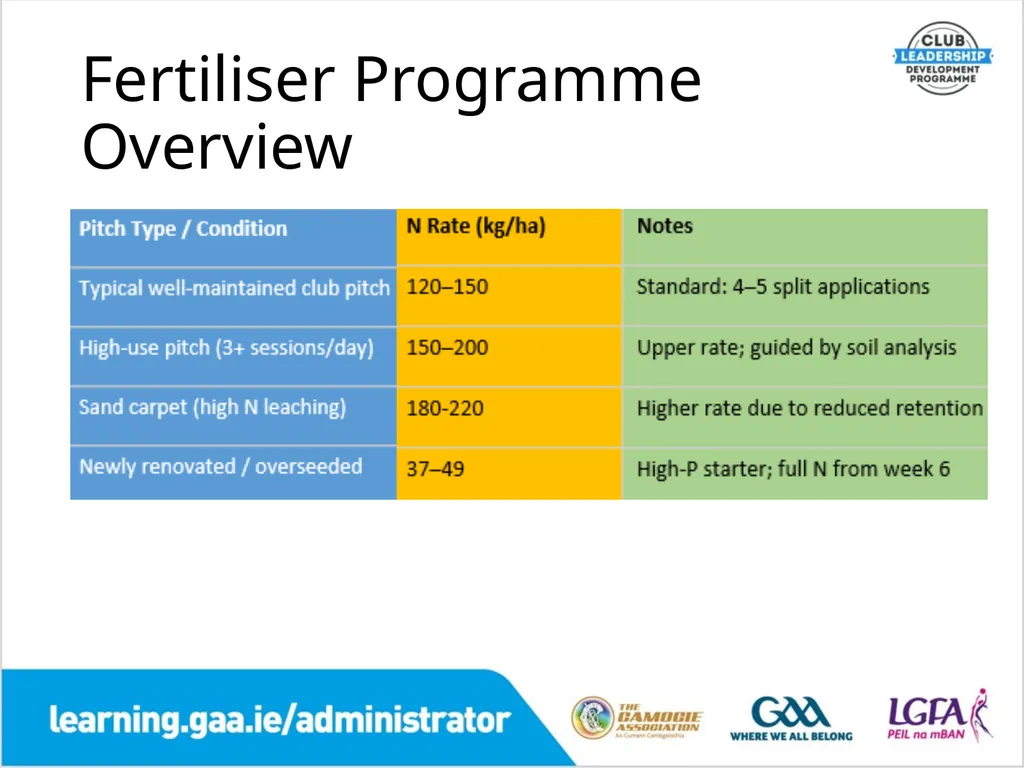
Fertiliser Programme Overview<br>
15
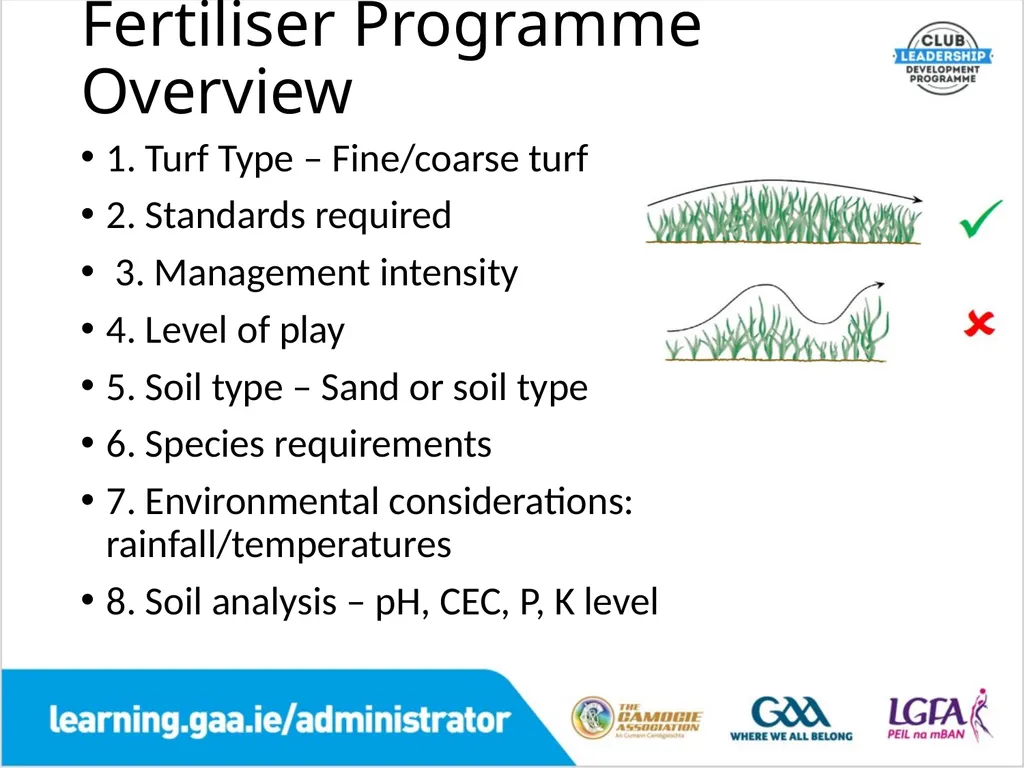
Fertiliser Programme Overview 1. Turf Type – Fine/coarse turf
2. Standards required
3. Management intensity
4. Level of play
5. Soil type – Sand or soil type
6. Species requirements
7. Environmental considerations: rainfall/temperatures
8. Soil analysis – pH, CEC, P, K level<br>
16
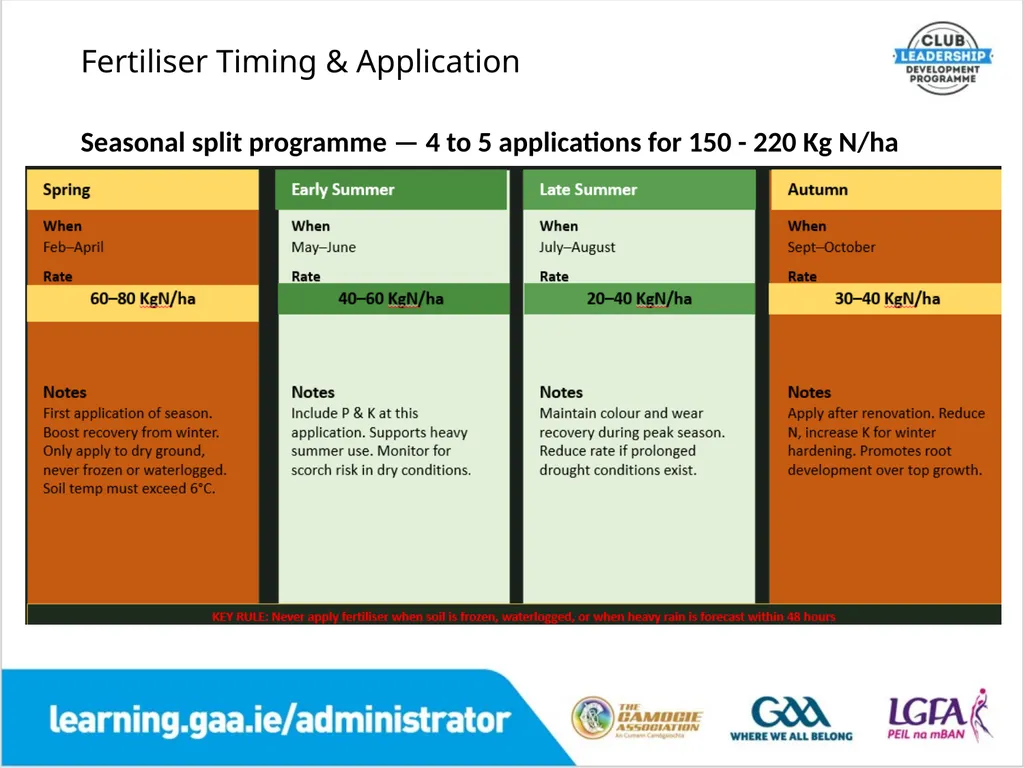
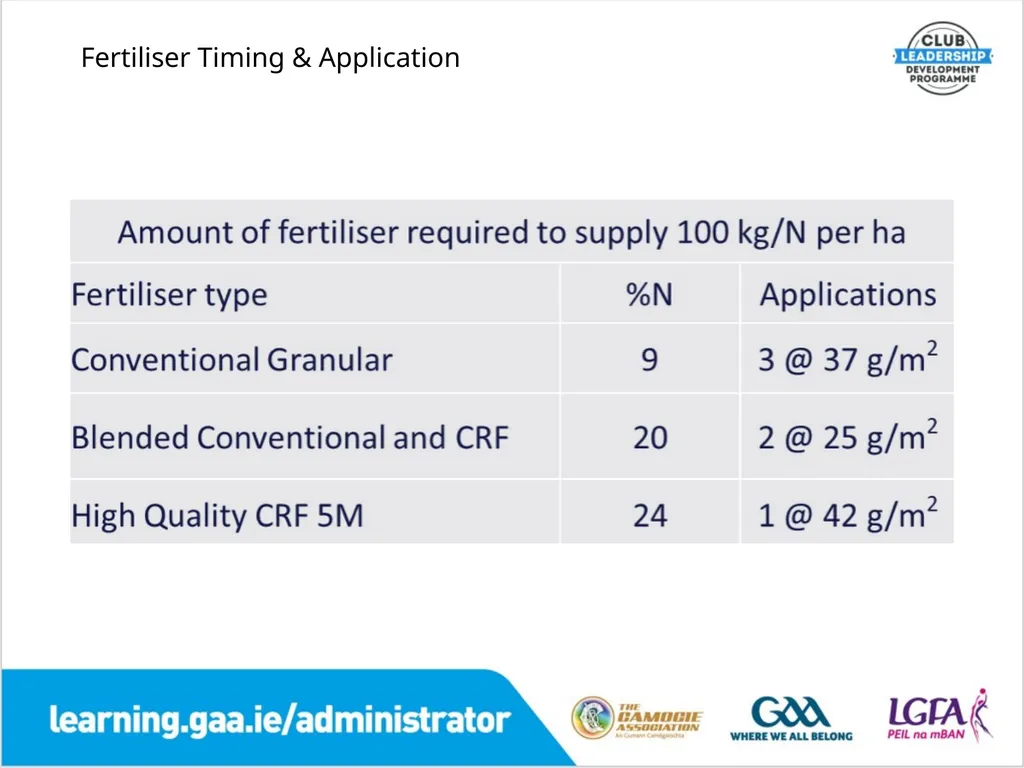
Fertiliser Timing & Application Seasonal split programme — 4 to 5 applications for 150 - 220 Kg N/ha<br>
17
Fertiliser Timing & Application<br>
18
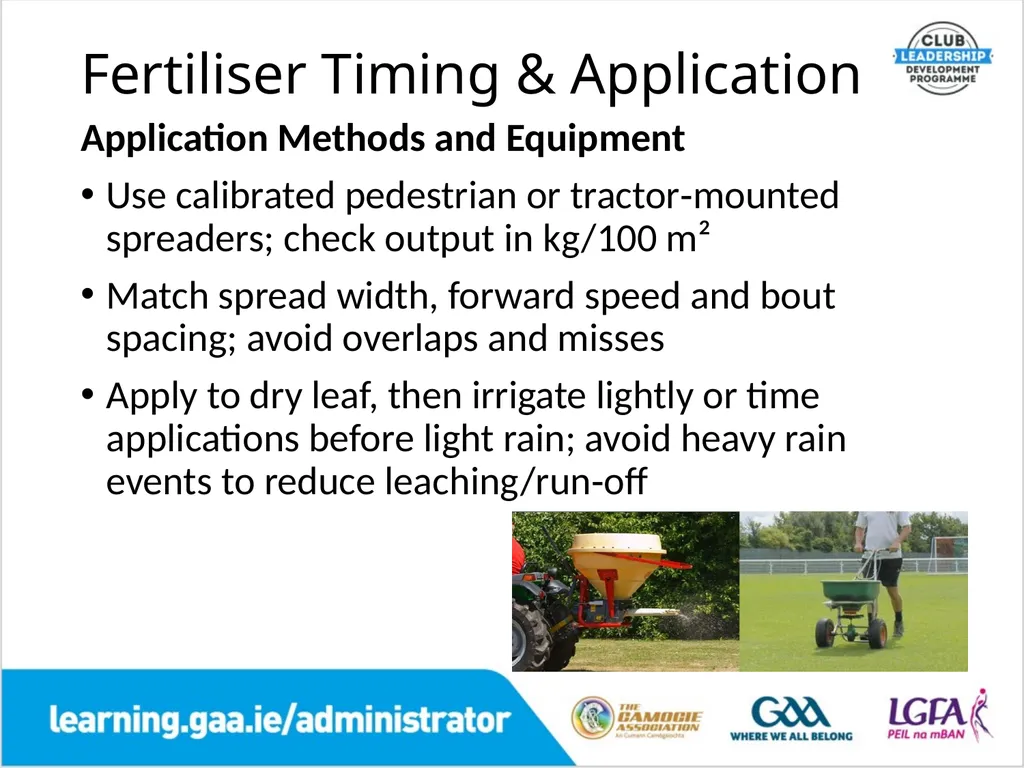
Fertiliser Timing & Application Application Methods and Equipment
Use calibrated pedestrian or tractor‑mounted spreaders; check output in kg/100 m²
Match spread width, forward speed and bout spacing; avoid overlaps and misses
Apply to dry leaf, then irrigate lightly or time applications before light rain; avoid heavy rain events to reduce leaching/run‑off<br>
19
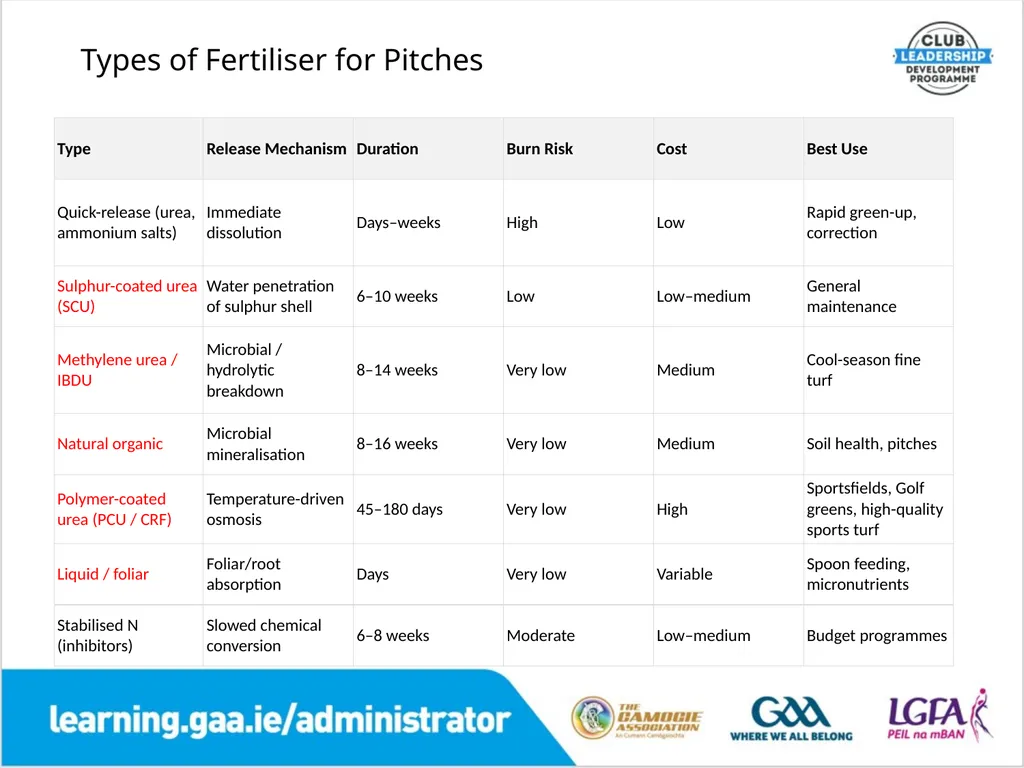
Types of Fertiliser for Pitches<br>
20
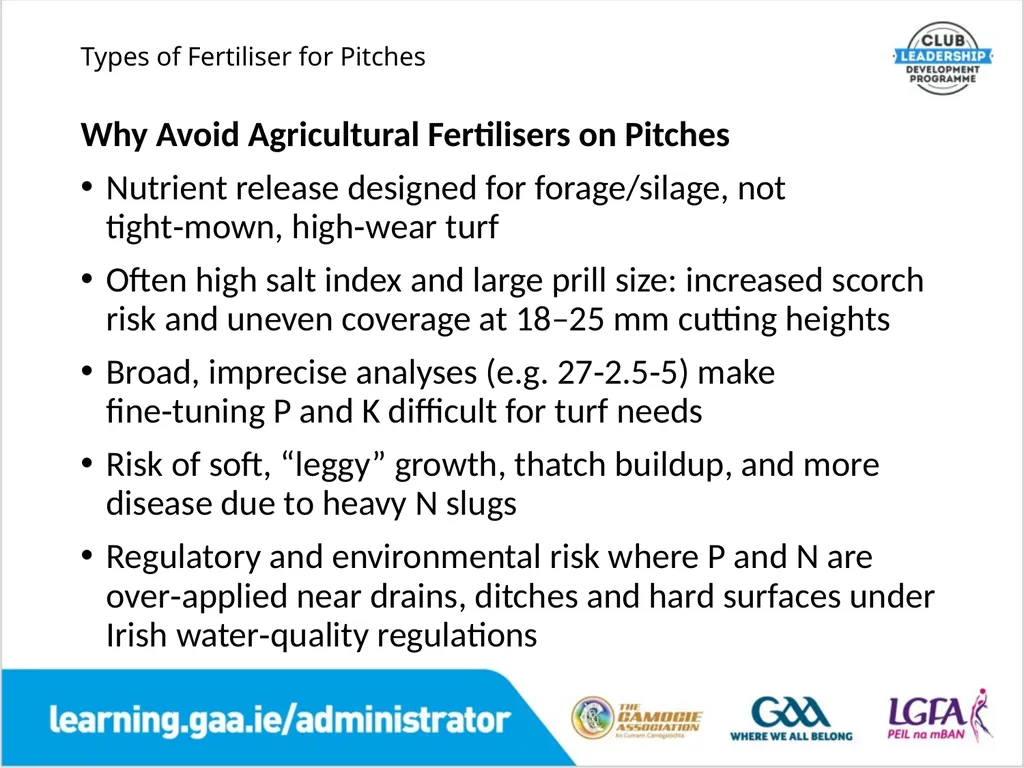
Types of Fertiliser for Pitches Why Avoid Agricultural Fertilisers on Pitches
Nutrient release designed for forage/silage, not tight‑mown, high‑wear turf
Often high salt index and large prill size: increased scorch risk and uneven coverage at 18–25 mm cutting heights
Broad, imprecise analyses (e.g. 27‑2.5‑5) make fine‑tuning P and K difficult for turf needs
Risk of soft, “leggy” growth, thatch buildup, and more disease due to heavy N slugs
Regulatory and environmental risk where P and N are over‑applied near drains, ditches and hard surfaces under Irish water‑quality regulations<br>
21
Final Summary Common mistakes
Over‑fertilising: soft growth, more mowing, disease, thatch,
Under‑fertilising: thin sward, bare areas, weeds and Poa invasion
Ignoring soil pH ; “feeding symptoms” instead of fixing causes
Poor timing: heavy N just before frost, drought, or major compaction Key takeaways
Test soils, correct pH, then build turf‑specific granular and/or liquid programmes
Match product choice and rate to construction type (sand vs soil) and level of activity
Apply little and often, with accurate equipment, within environmental rules<br>
22
Thank You For Listening!<br>