FES Perspective E.J. Synakowski Associate Director, Office of Science Fusion Energy Sciences Presented to the Fusion Energy Sciences Advisory Committee January 31, 2013 FES updates Hiring process underway for new FOP Division Director
"FES Perspective E.J. Synakowski Associate" is the property of its rightful owner. Permission is granted to
download and print the materials on this website for personal, non-commercial use only, and to display it
on your personal computer provided you do not modify the materials and that you retain all copyright
notices contained in the materials. By downloading content from our website, you accept the terms of this
agreement.
Presentation Transcript
01
FES Perspective E.J. Synakowski
Associate Director, Office of Science
Fusion Energy Sciences Presented to the Fusion Energy Sciences Advisory Committee
January 31, 2013<br>
02
FES updates<br>
03
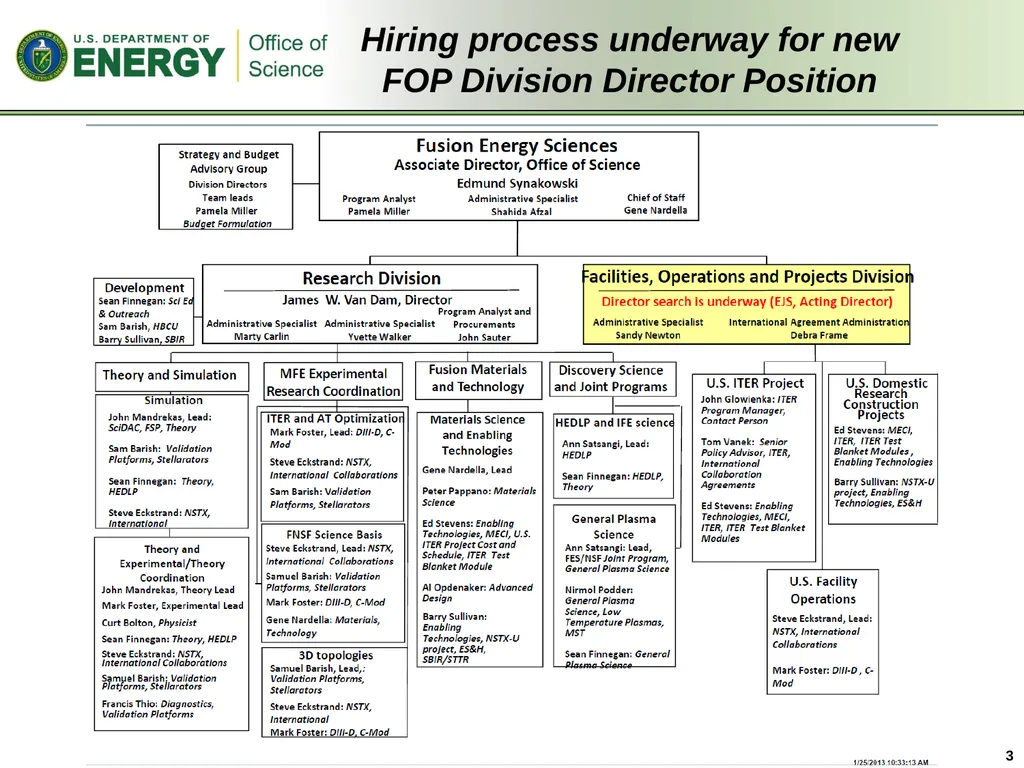
Hiring process underway for new FOP Division Director Position 3<br>
04
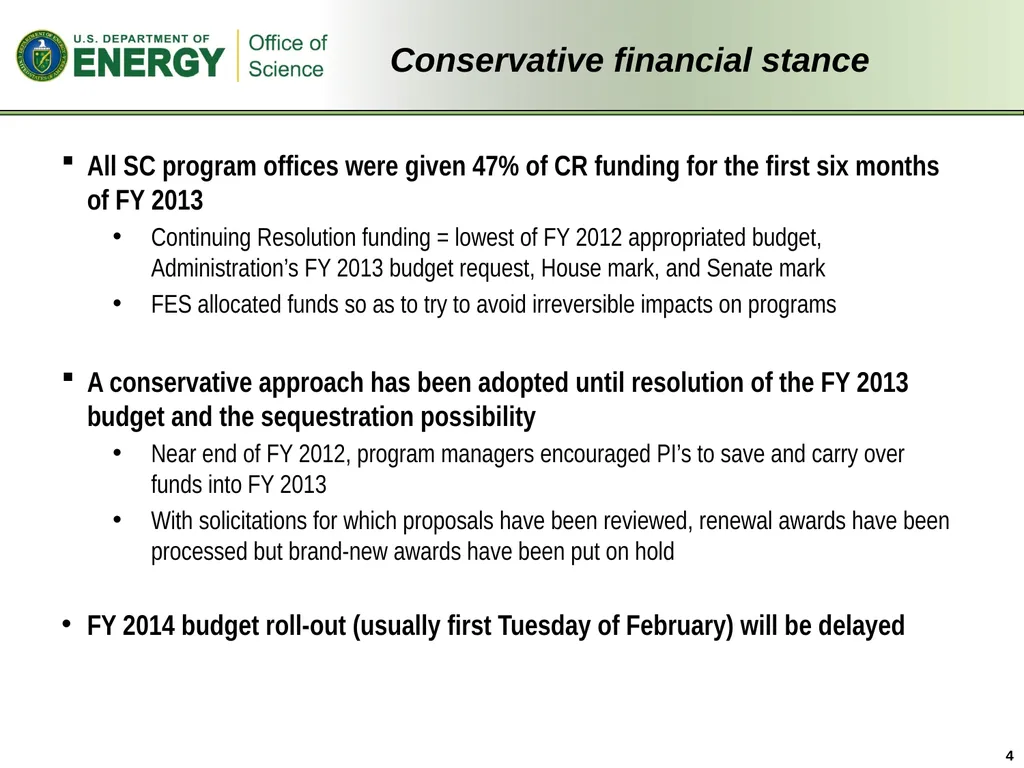
All SC program offices were given 47% of CR funding for the first six months of FY 2013
Continuing Resolution funding = lowest of FY 2012 appropriated budget, Administration’s FY 2013 budget request, House mark, and Senate mark
FES allocated funds so as to try to avoid irreversible impacts on programs
A conservative approach has been adopted until resolution of the FY 2013 budget and the sequestration possibility
Near end of FY 2012, program managers encouraged PI’s to save and carry over funds into FY 2013
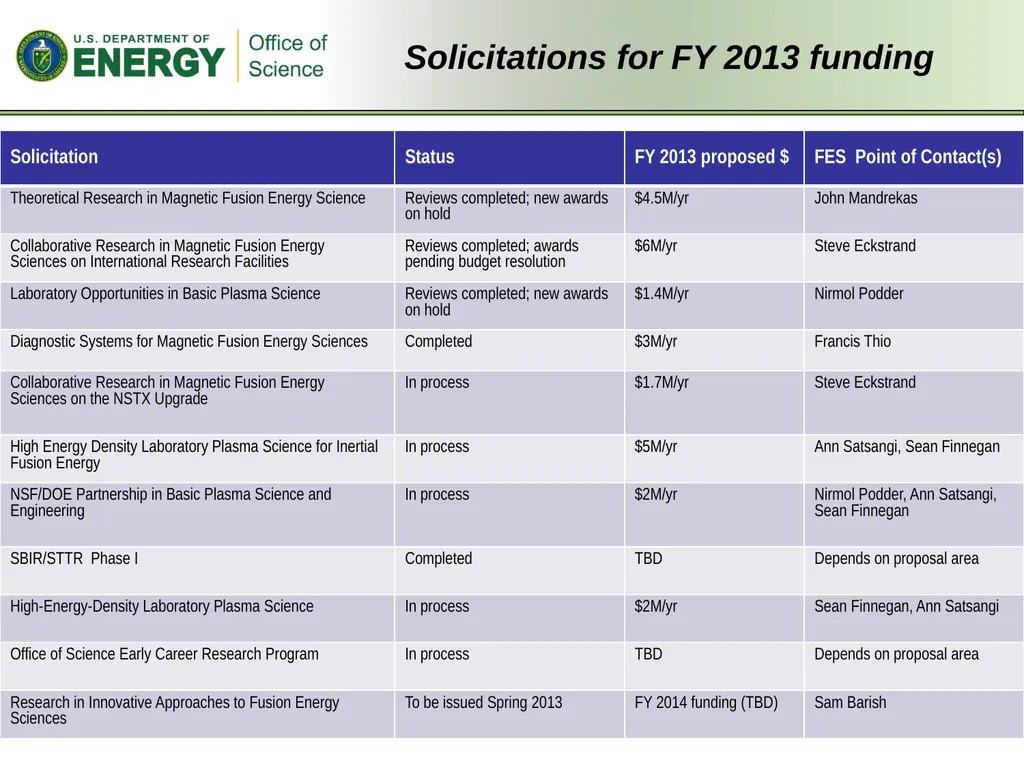
With solicitations for which proposals have been reviewed, renewal awards have been processed but brand-new awards have been put on hold
FY 2014 budget roll-out (usually first Tuesday of February) will be delayed Conservative financial stance 4<br>
05
Solicitations for FY 2013 funding<br>
06
FESAC status 6<br>
07
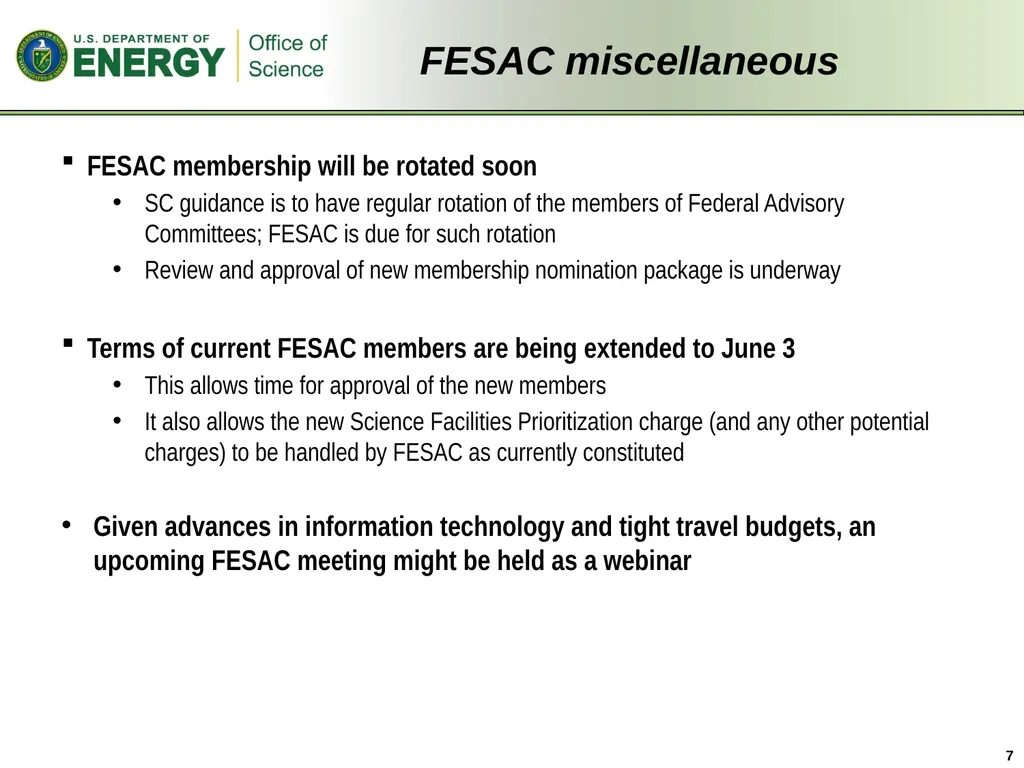
FESAC membership will be rotated soon
SC guidance is to have regular rotation of the members of Federal Advisory Committees; FESAC is due for such rotation
Review and approval of new membership nomination package is underway
Terms of current FESAC members are being extended to June 3
This allows time for approval of the new members
It also allows the new Science Facilities Prioritization charge (and any other potential charges) to be handled by FESAC as currently constituted
Given advances in information technology and tight travel budgets, an upcoming FESAC meeting might be held as a webinar FESAC miscellaneous 7<br>
08
FESAC charge on MFE Program Priorities 8<br>
09
9 FESAC activity to assess MFE priorities is completed Charge was issued in mid-April 2012
We look forward to the presentation of the report at this FESAC meeting
The charge was a difficult one, albeit very important
The circumstances: a constrained, difficult budget at a critical time in the program’s evolution
Given the nature of the charge, the size of the community, and its tight-knit character, special care was required for managing potential conflicts of interest
Sincere thanks to all of the members of this FESAC panel, chaired by Bob Rosner<br>
10
New FESAC charge on Science Facilities Prioritization 10<br>
11
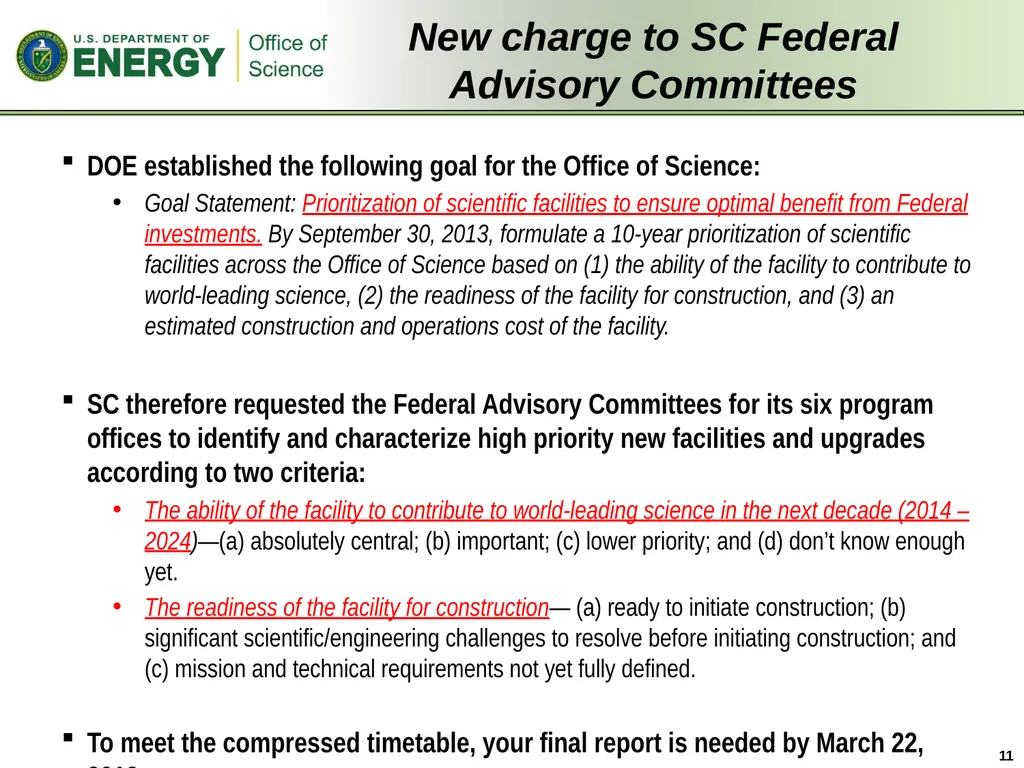
DOE established the following goal for the Office of Science:
Goal Statement: Prioritization of scientific facilities to ensure optimal benefit from Federal investments. By September 30, 2013, formulate a 10-year prioritization of scientific facilities across the Office of Science based on (1) the ability of the facility to contribute to world-leading science, (2) the readiness of the facility for construction, and (3) an estimated construction and operations cost of the facility.
SC therefore requested the Federal Advisory Committees for its six program offices to identify and characterize high priority new facilities and upgrades according to two criteria:
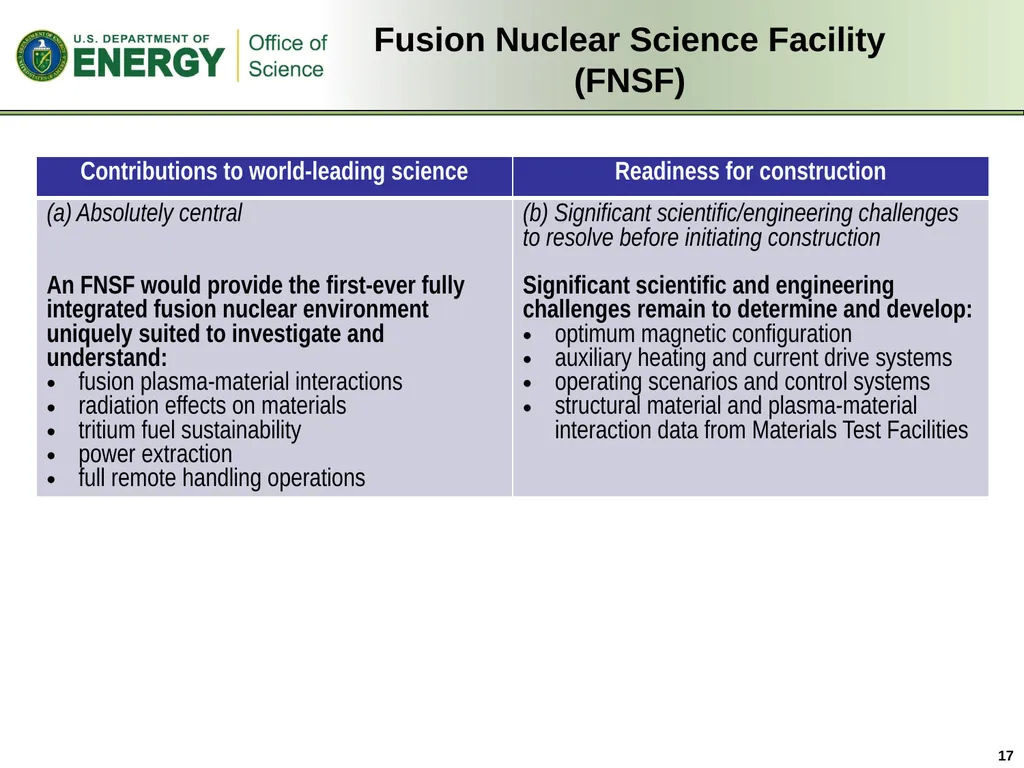
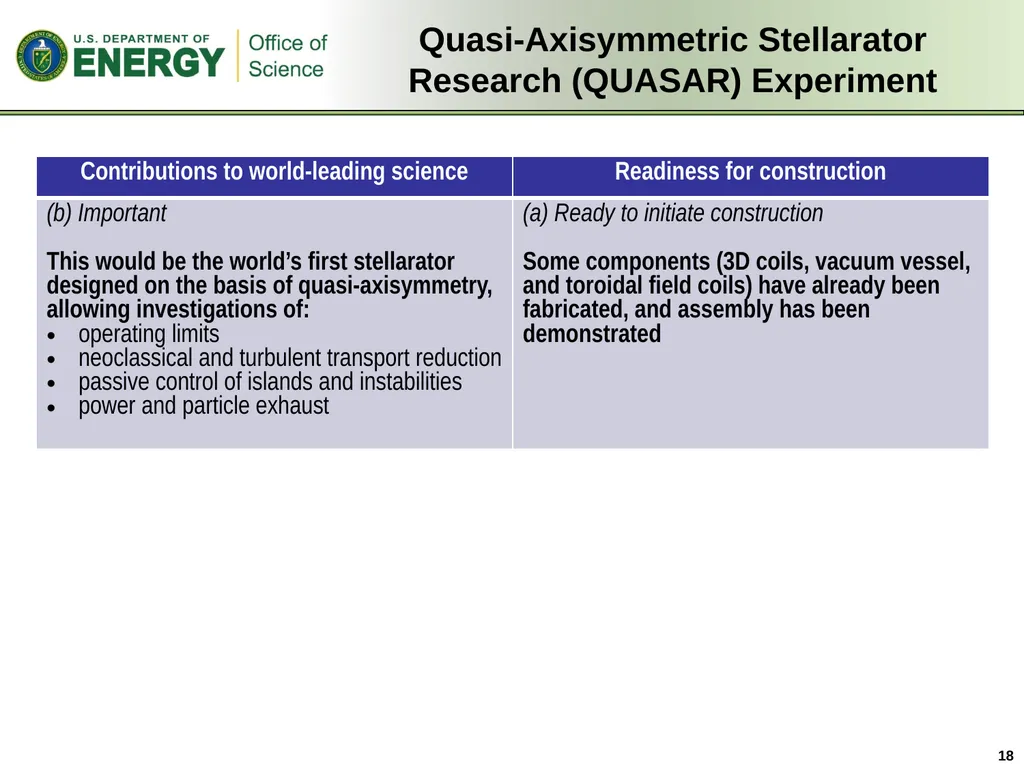
The ability of the facility to contribute to world-leading science in the next decade (2014 – 2024)—(a) absolutely central; (b) important; (c) lower priority; and (d) don’t know enough yet.
The readiness of the facility for construction— (a) ready to initiate construction; (b) significant scientific/engineering challenges to resolve before initiating construction; and (c) mission and technical requirements not yet fully defined.
To meet the compressed timetable, your final report is needed by March 22, 2013 New charge to SC Federal Advisory Committees 11<br>
12
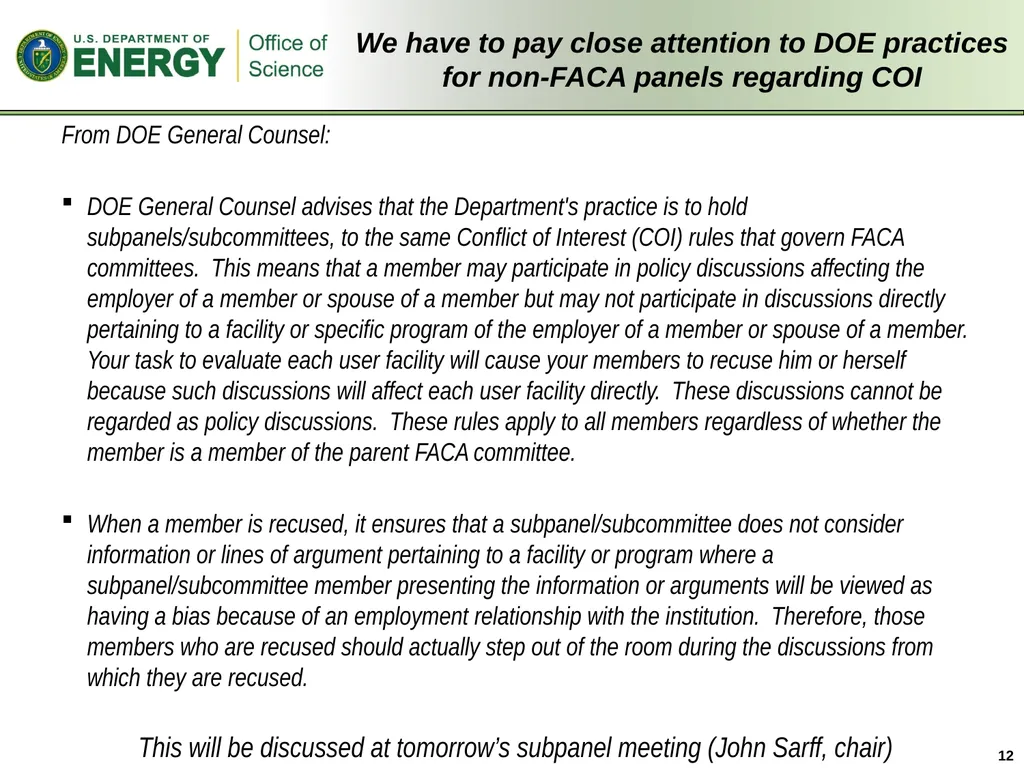
From DOE General Counsel:
DOE General Counsel advises that the Department's practice is to hold subpanels/subcommittees, to the same Conflict of Interest (COI) rules that govern FACA committees. This means that a member may participate in policy discussions affecting the employer of a member or spouse of a member but may not participate in discussions directly pertaining to a facility or specific program of the employer of a member or spouse of a member. Your task to evaluate each user facility will cause your members to recuse him or herself because such discussions will affect each user facility directly. These discussions cannot be regarded as policy discussions. These rules apply to all members regardless of whether the member is a member of the parent FACA committee.
When a member is recused, it ensures that a subpanel/subcommittee does not consider information or lines of argument pertaining to a facility or program where a subpanel/subcommittee member presenting the information or arguments will be viewed as having a bias because of an employment relationship with the institution. Therefore, those members who are recused should actually step out of the room during the discussions from which they are recused.
This will be discussed at tomorrow’s subpanel meeting (John Sarff, chair) We have to pay close attention to DOE practices for non-FACA panels regarding COI 12<br>
13
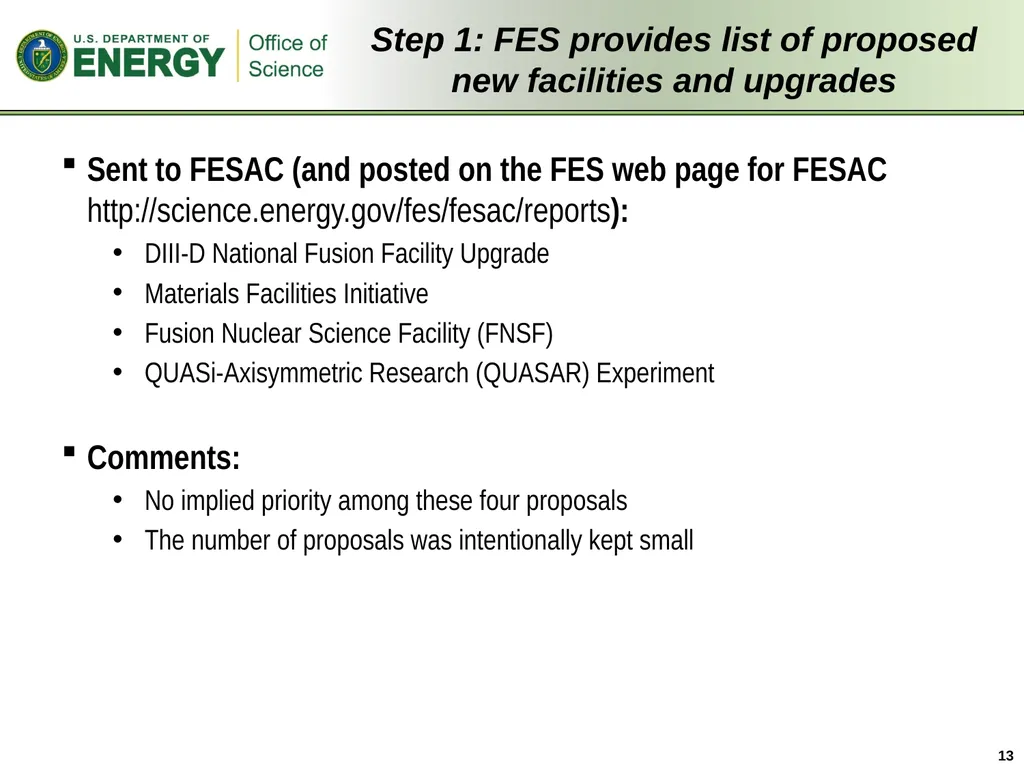
Sent to FESAC (and posted on the FES web page for FESAC http://science.energy.gov/fes/fesac/reports):
DIII-D National Fusion Facility Upgrade
Materials Facilities Initiative
Fusion Nuclear Science Facility (FNSF)
QUASi-Axisymmetric Research (QUASAR) Experiment
Comments:
No implied priority among these four proposals
The number of proposals was intentionally kept small Step 1: FES provides list of proposed new facilities and upgrades 13<br>
14
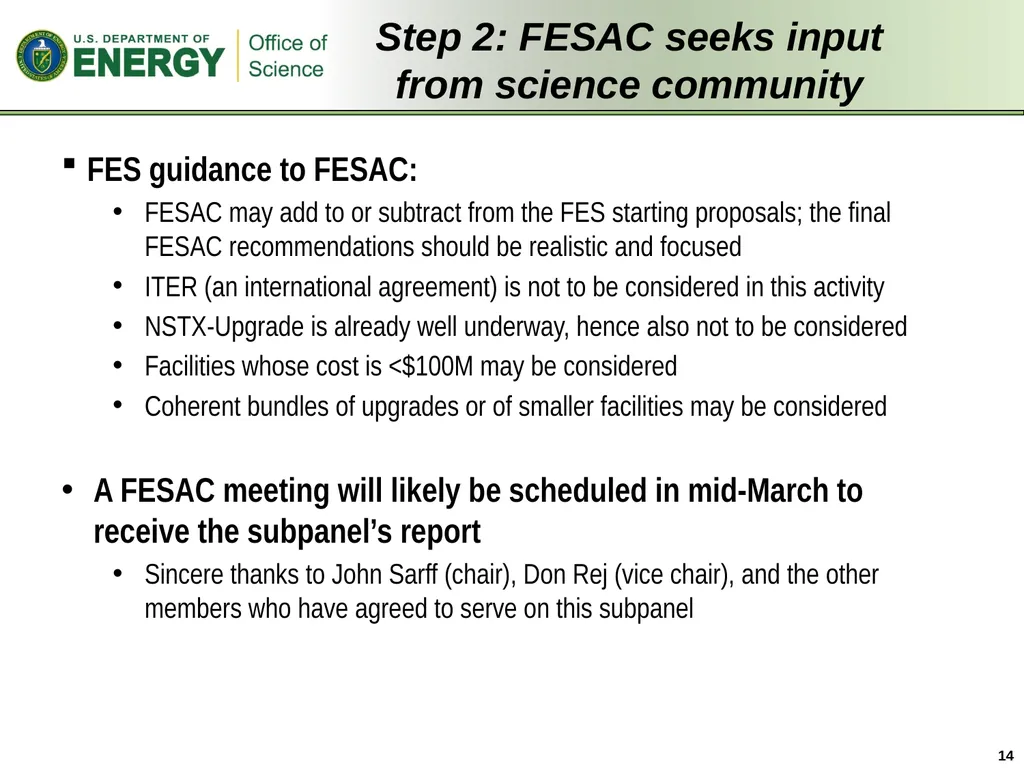
FES guidance to FESAC:
FESAC may add to or subtract from the FES starting proposals; the final FESAC recommendations should be realistic and focused
ITER (an international agreement) is not to be considered in this activity
NSTX-Upgrade is already well underway, hence also not to be considered
Facilities whose cost is <$100M may be considered
Coherent bundles of upgrades or of smaller facilities may be considered
A FESAC meeting will likely be scheduled in mid-March to receive the subpanel’s report
Sincere thanks to John Sarff (chair), Don Rej (vice chair), and the other members who have agreed to serve on this subpanel Step 2: FESAC seeks input from science community 14<br>
15
DIII-D National Fusion Facility Upgrade 15<br>
16
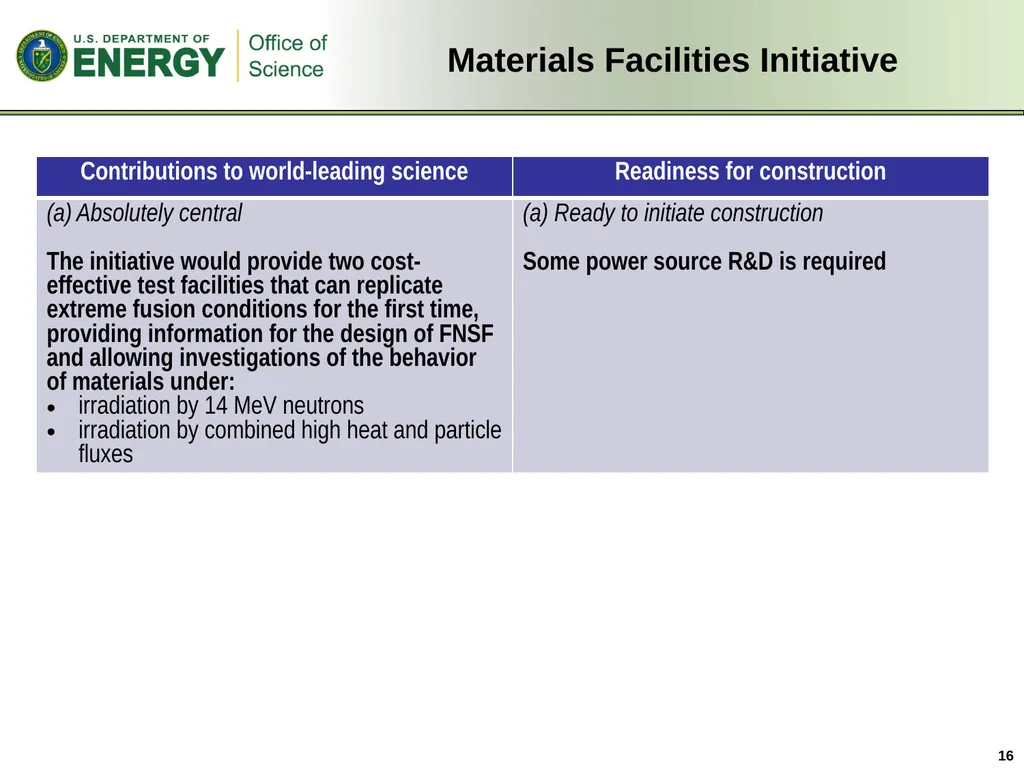
Materials Facilities Initiative 16<br>
17
Fusion Nuclear Science Facility (FNSF) 17<br>
18
Quasi-Axisymmetric Stellarator Research (QUASAR) Experiment 18<br>
19
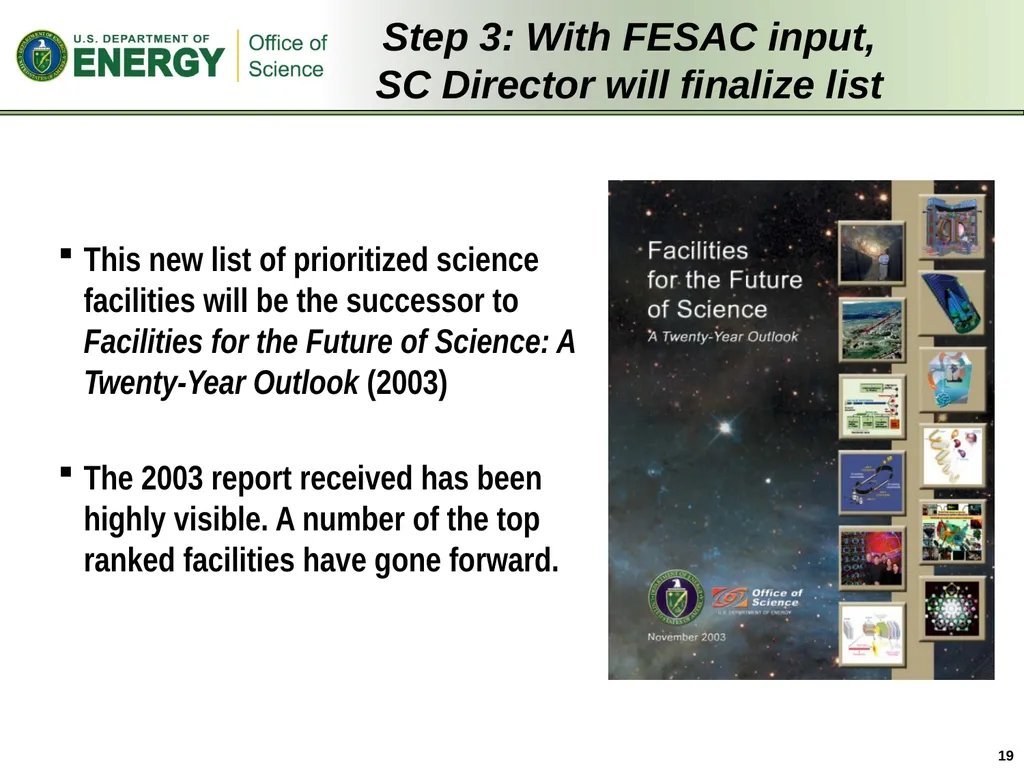
This new list of prioritized science facilities will be the successor to Facilities for the Future of Science: A Twenty-Year Outlook (2003)
The 2003 report received has been highly visible. A number of the top ranked facilities have gone forward. Step 3: With FESAC input, SC Director will finalize list 19<br>