Figure caption Key Research ResultScientific Development: Replace with a high-level overview of the key result or scientific advancement. You might address 1-2 of the following using limited text: What did we learn andor discover about
"Figure caption Key Research Result/Scientific" is the property of its rightful owner. Permission is granted to
download and print the materials on this website for personal, non-commercial use only, and to display it
on your personal computer provided you do not modify the materials and that you retain all copyright
notices contained in the materials. By downloading content from our website, you accept the terms of this
agreement.
Presentation Transcript
01
Figure caption Key Research Result/Scientific Development: [Replace with a high-level overview of the key result or scientific advancement. You might address 1-2 of the following using limited text:
What did we learn and/or discover about the Earth system that we did not know before?
Did we learn something that we already knew, but in a different way? If so, how is it new or different?
How is the development different and/or better than what we currently have?
What does the new knowledge, insight, method, or advance allow us to know/do that we did/could not before?]
Significance: [Replace with optional statement:
What is the overall importance for Earth system science?]
[Additional talking points and details should be placed in the slide notes section] [Replace with 1-2 key images that demonstrate the highlighted research result or scientific advance.
You do not need to use a 2-column layout. You can adjust the position of the summary, image(s), and caption sections if your graphics have a larger horizontal span.] Title (Verdana 24)
Principal Investigator Name and Institutional Affiliation (Verdana 16)<br>
02
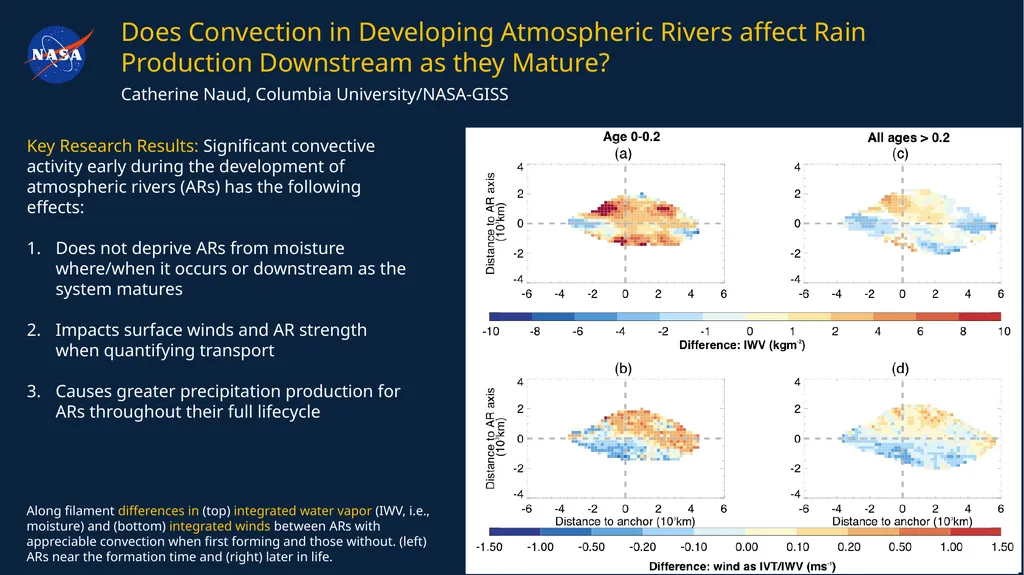
Key Research Results: Significant convective activity early during the development of atmospheric rivers (ARs) has the following effects:
Does not deprive ARs from moisture where/when it occurs or downstream as the system matures
Impacts surface winds and AR strength when quantifying transport
Causes greater precipitation production for ARs throughout their full lifecycle Does Convection in Developing Atmospheric Rivers affect Rain Production Downstream as they Mature?
Catherine Naud, Columbia University/NASA-GISS Along filament differences in (top) integrated water vapor (IWV, i.e., moisture) and (bottom) integrated winds between ARs with appreciable convection when first forming and those without. (left) ARs near the formation time and (right) later in life.<br>
03
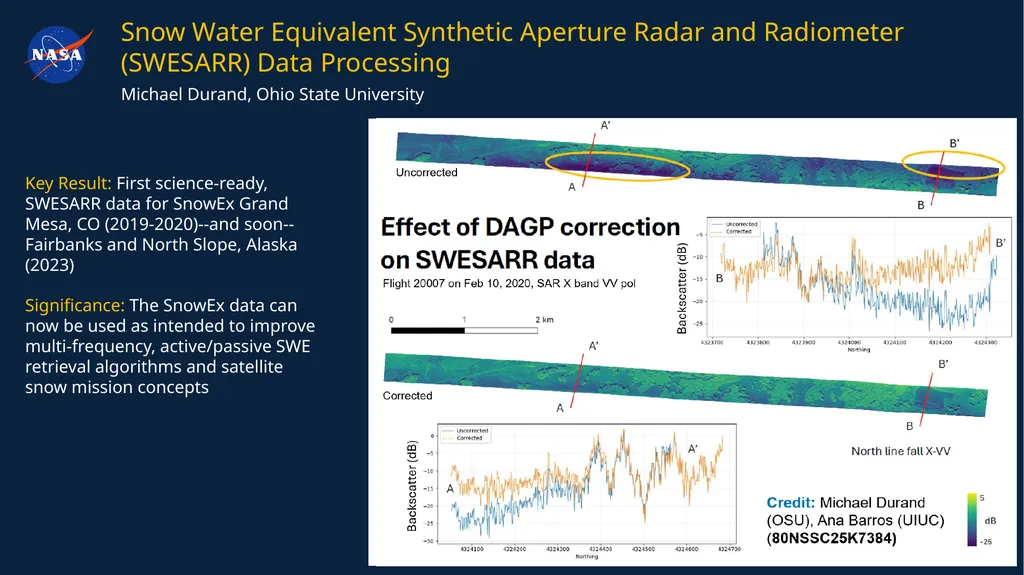
Snow Water Equivalent Synthetic Aperture Radar and Radiometer (SWESARR) Data Processing
Michael Durand, Ohio State University Key Result: First science-ready, SWESARR data for SnowEx Grand Mesa, CO (2019-2020)--and soon-- Fairbanks and North Slope, Alaska (2023)
Significance: The SnowEx data can now be used as intended to improve multi-frequency, active/passive SWE retrieval algorithms and satellite snow mission concepts<br>
04
Using GMI Brightness Temperatures to Monitor Global Distribution of Hydrometeor Species
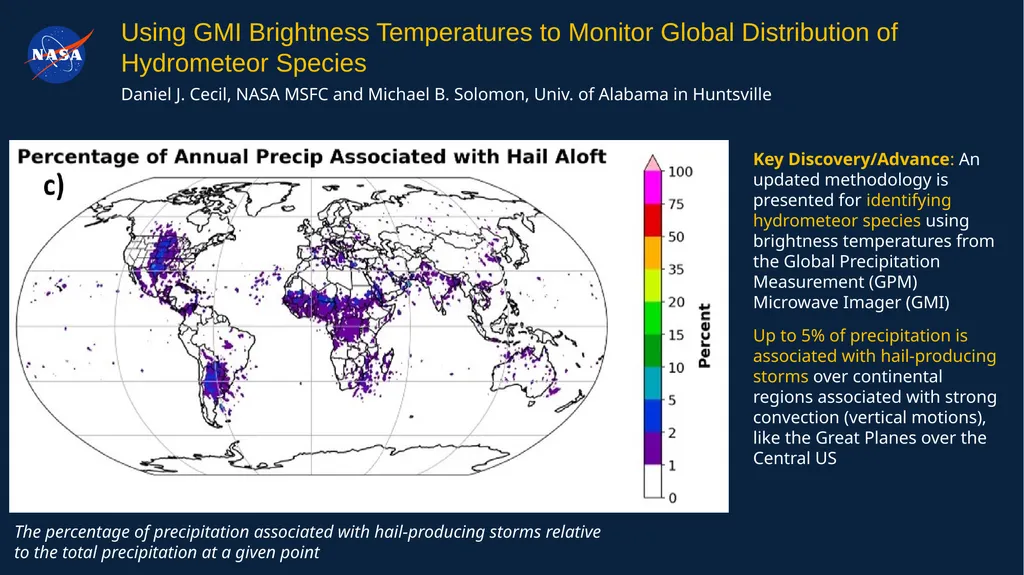
Daniel J. Cecil, NASA MSFC and Michael B. Solomon, Univ. of Alabama in Huntsville The percentage of precipitation associated with hail-producing storms relative to the total precipitation at a given point Key Discovery/Advance: An updated methodology is presented for identifying hydrometeor species using brightness temperatures from the Global Precipitation Measurement (GPM) Microwave Imager (GMI)
Up to 5% of precipitation is associated with hail-producing storms over continental regions associated with strong convection (vertical motions), like the Great Planes over the Central US<br>
05
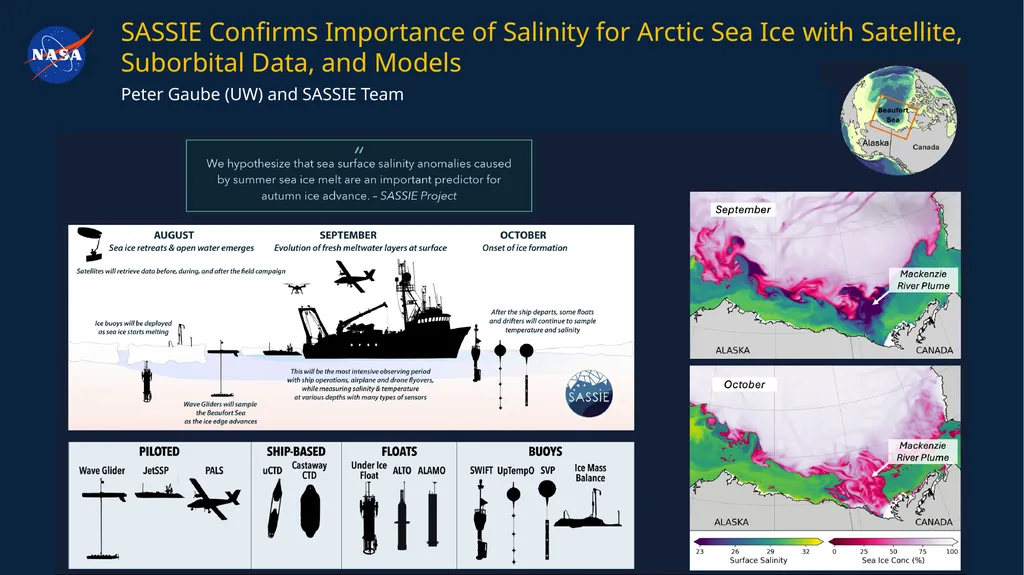
SASSIE Confirms Importance of Salinity for Arctic Sea Ice with Satellite, Suborbital Data, and Models
Peter Gaube (UW) and SASSIE Team<br>
06
National Ocean Science Bowl 2026 is a Wrap
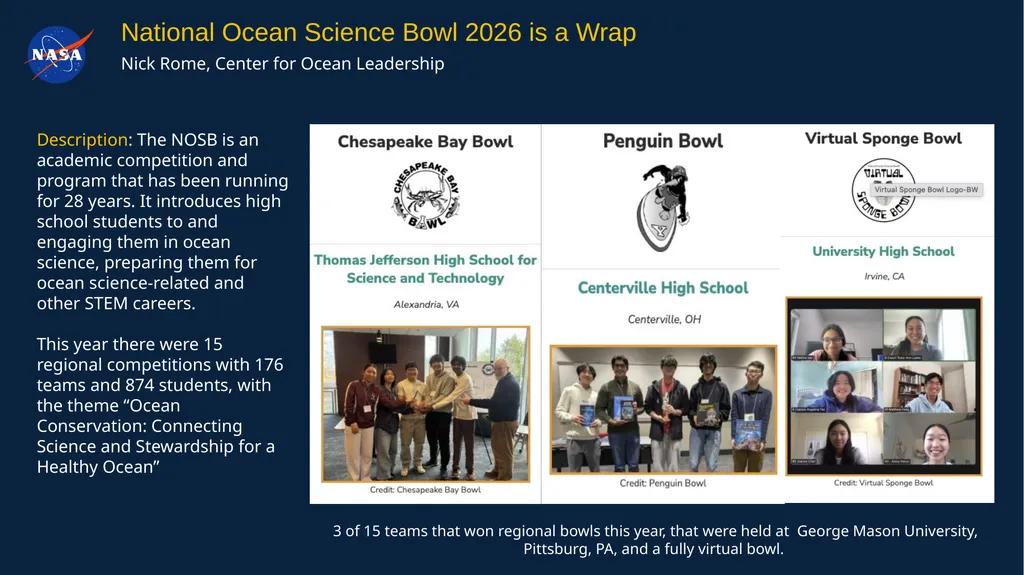
Nick Rome, Center for Ocean Leadership Description: The NOSB is an academic competition and program that has been running for 28 years. It introduces high school students to and engaging them in ocean science, preparing them for ocean science-related and other STEM careers.
This year there were 15 regional competitions with 176 teams and 874 students, with the theme “Ocean Conservation: Connecting Science and Stewardship for a Healthy Ocean” 3 of 15 teams that won regional bowls this year, that were held at George Mason University, Pittsburg, PA, and a fully virtual bowl.<br>
07
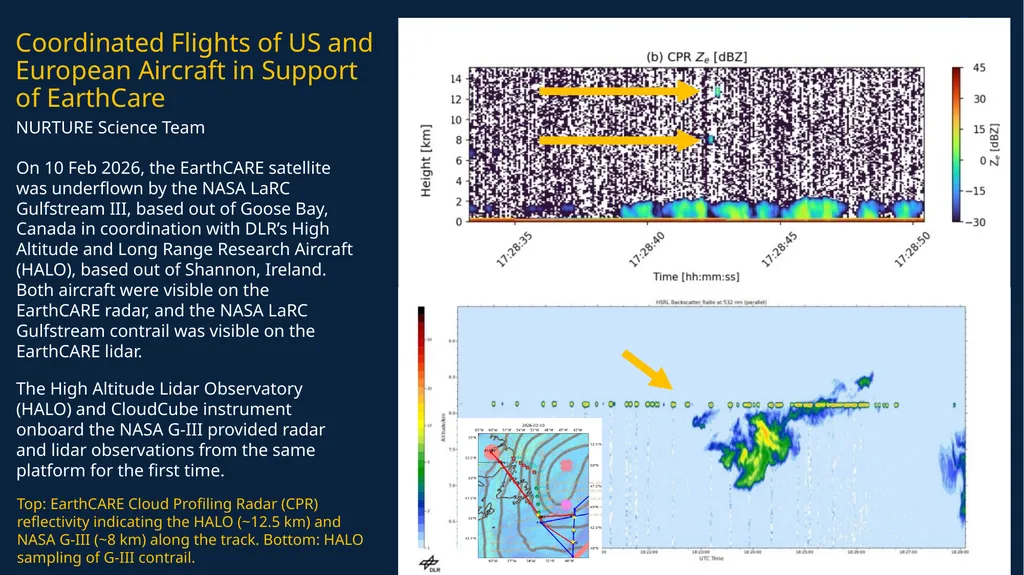
On 10 Feb 2026, the EarthCARE satellite was underflown by the NASA LaRC Gulfstream III, based out of Goose Bay, Canada in coordination with DLR’s High Altitude and Long Range Research Aircraft (HALO), based out of Shannon, Ireland. Both aircraft were visible on the EarthCARE radar, and the NASA LaRC Gulfstream contrail was visible on the EarthCARE lidar.
The High Altitude Lidar Observatory (HALO) and CloudCube instrument onboard the NASA G-III provided radar and lidar observations from the same platform for the first time. Top: EarthCARE Cloud Profiling Radar (CPR) reflectivity indicating the HALO (~12.5 km) and NASA G-III (~8 km) along the track. Bottom: HALO sampling of G-III contrail. Coordinated Flights of US and European Aircraft in Support of EarthCare
NURTURE Science Team<br>