04
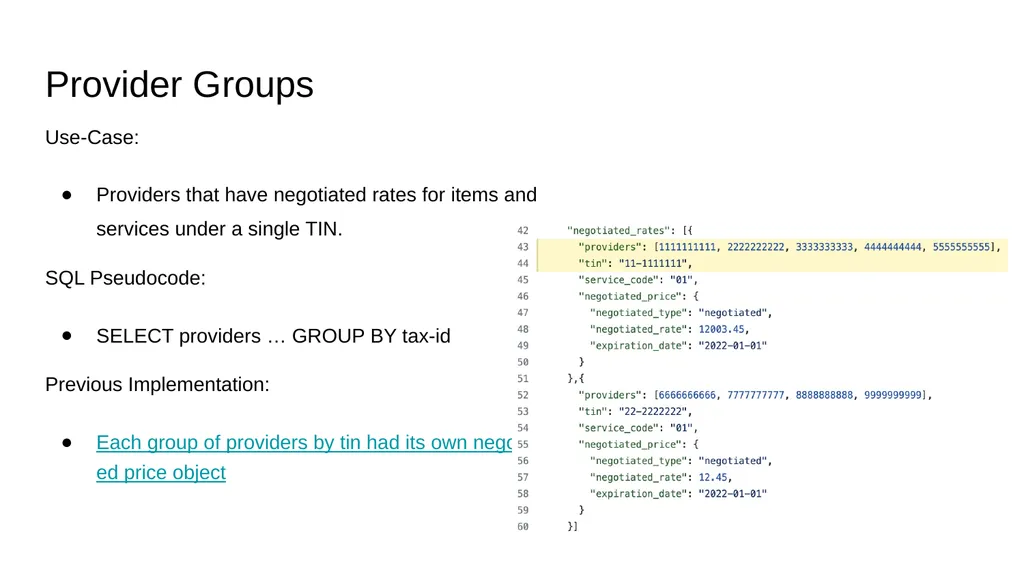
Provider Groups Use-Case:
Providers that have negotiated rates for items and services under a single TIN. SQL Pseudocode:
SELECT providers … GROUP BY tax-id Previous Implementation:
Each group of providers by tin had its own negotiated price object<br>
05
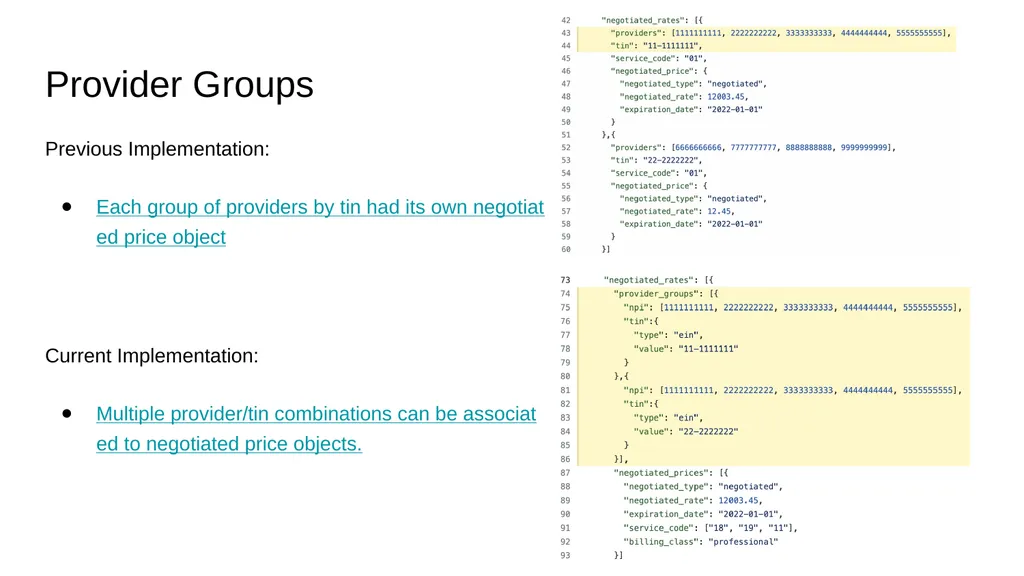
Provider Groups Previous Implementation:
Each group of providers by tin had its own negotiated price object Current Implementation:
Multiple provider/tin combinations can be associated to negotiated price objects.<br>
06
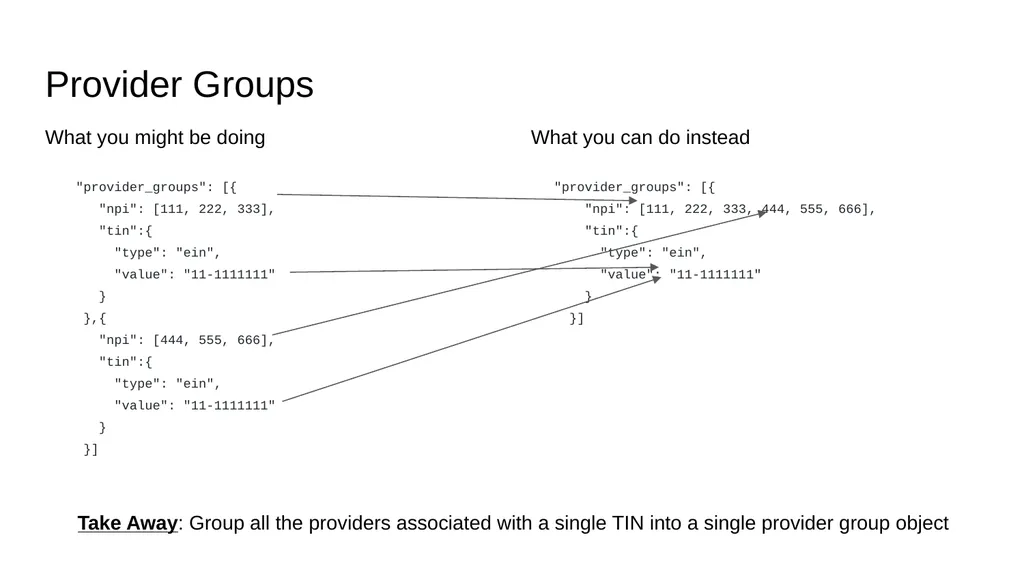
Provider Groups What you might be doing
"provider_groups": [{
"npi": [111, 222, 333],
"tin":{
"type": "ein",
"value": "11-1111111"
}
},{
"npi": [444, 555, 666],
"tin":{
"type": "ein",
"value": "11-1111111"
}
}] What you can do instead
"provider_groups": [{
"npi": [111, 222, 333, 444, 555, 666],
"tin":{
"type": "ein",
"value": "11-1111111"
}
}] Take Away: Group all the providers associated with a single TIN into a single provider group object<br>
08
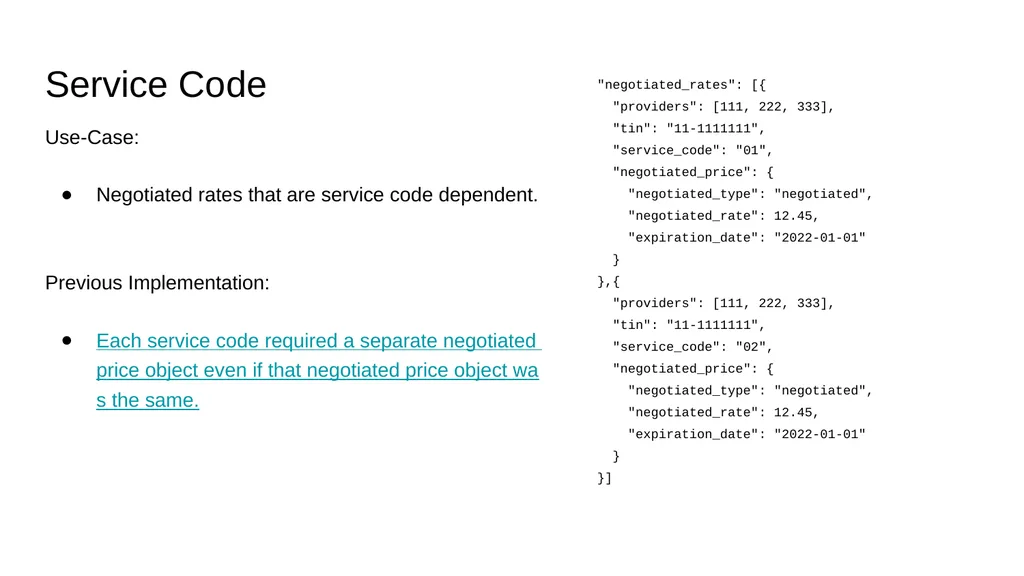
Service Code Use-Case:
Negotiated rates that are service code dependent. Previous Implementation:
Each service code required a separate negotiated price object even if that negotiated price object was the same. "negotiated_rates": [{
"providers": [111, 222, 333],
"tin": "11-1111111",
"service_code": "01",
"negotiated_price": {
"negotiated_type": "negotiated",
"negotiated_rate": 12.45,
"expiration_date": "2022-01-01"
}
},{
"providers": [111, 222, 333],
"tin": "11-1111111",
"service_code": "02",
"negotiated_price": {
"negotiated_type": "negotiated",
"negotiated_rate": 12.45,
"expiration_date": "2022-01-01"
}
}]<br>
09
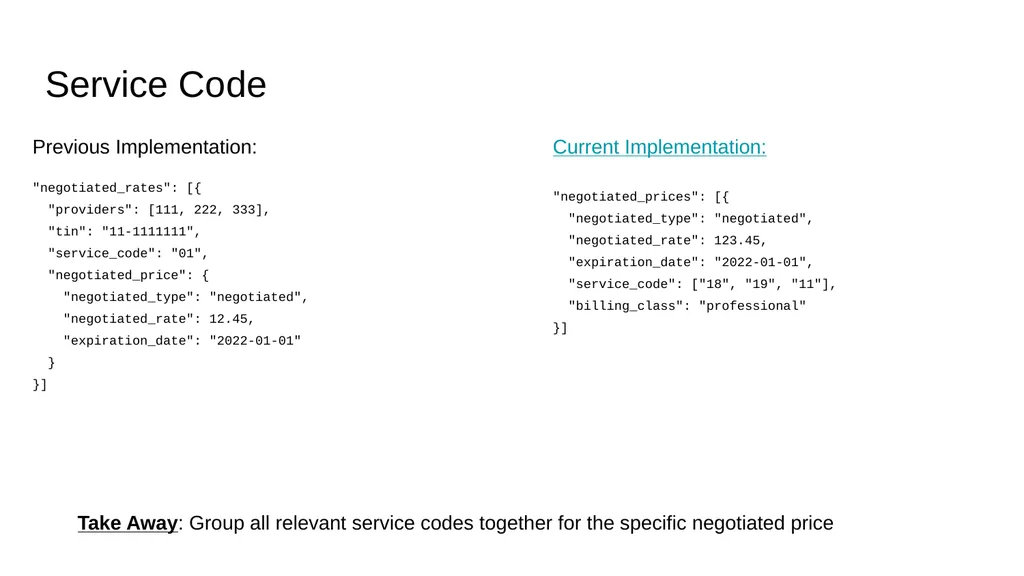
Service Code Previous Implementation:
"negotiated_rates": [{
"providers": [111, 222, 333],
"tin": "11-1111111",
"service_code": "01",
"negotiated_price": {
"negotiated_type": "negotiated",
"negotiated_rate": 12.45,
"expiration_date": "2022-01-01"
}
}] Current Implementation:
"negotiated_prices": [{
"negotiated_type": "negotiated",
"negotiated_rate": 123.45,
"expiration_date": "2022-01-01",
"service_code": ["18", "19", "11"],
"billing_class": "professional"
}] Take Away: Group all relevant service codes together for the specific negotiated price<br>
10
Multiple Plans Per File<br>
11
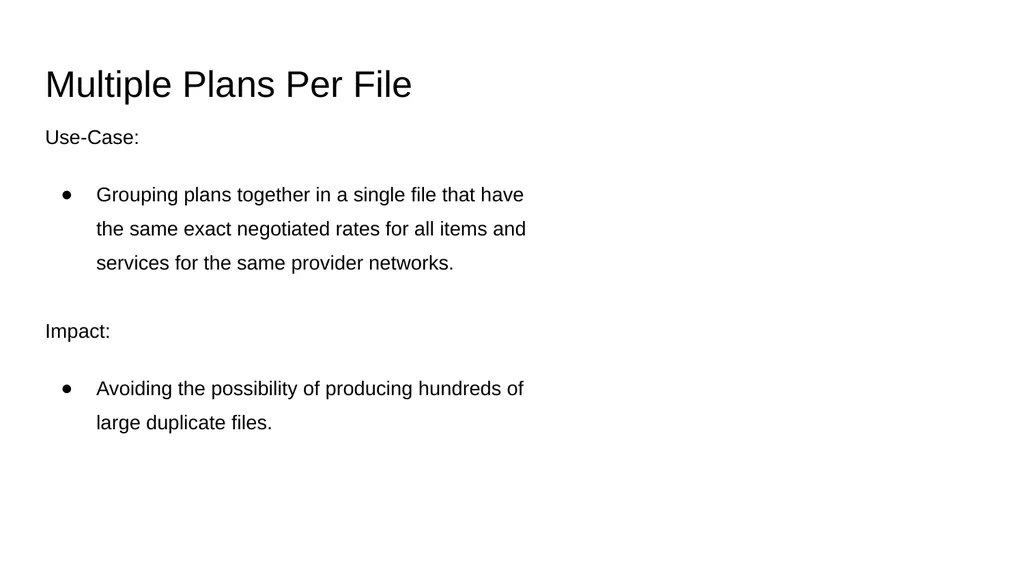
Multiple Plans Per File Use-Case:
Grouping plans together in a single file that have the same exact negotiated rates for all items and services for the same provider networks. Impact:
Avoiding the possibility of producing hundreds of large duplicate files.<br>
12
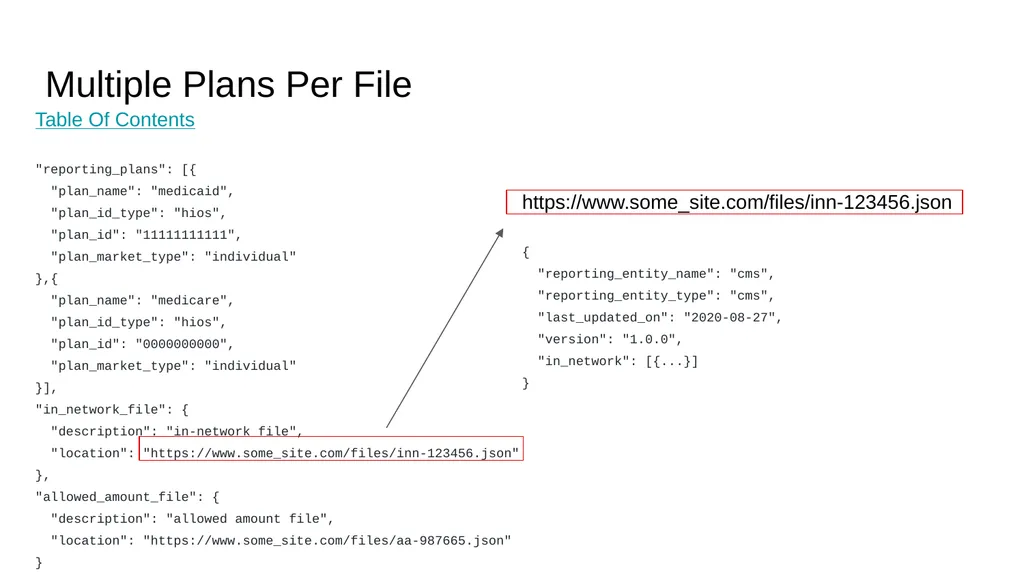
Multiple Plans Per File Table Of Contents
"reporting_plans": [{
"plan_name": "medicaid",
"plan_id_type": "hios",
"plan_id": "11111111111",
"plan_market_type": "individual"
},{
"plan_name": "medicare",
"plan_id_type": "hios",
"plan_id": "0000000000",
"plan_market_type": "individual"
}],
"in_network_file": {
"description": "in-network file",
"location": "https://www.some_site.com/files/inn-123456.json"
},
"allowed_amount_file": {
"description": "allowed amount file",
"location": "https://www.some_site.com/files/aa-987665.json"
} https://www.some_site.com/files/inn-123456.json
{
"reporting_entity_name": "cms",
"reporting_entity_type": "cms",
"last_updated_on": "2020-08-27",
"version": "1.0.0",
"in_network": [{...}]
}<br>
13
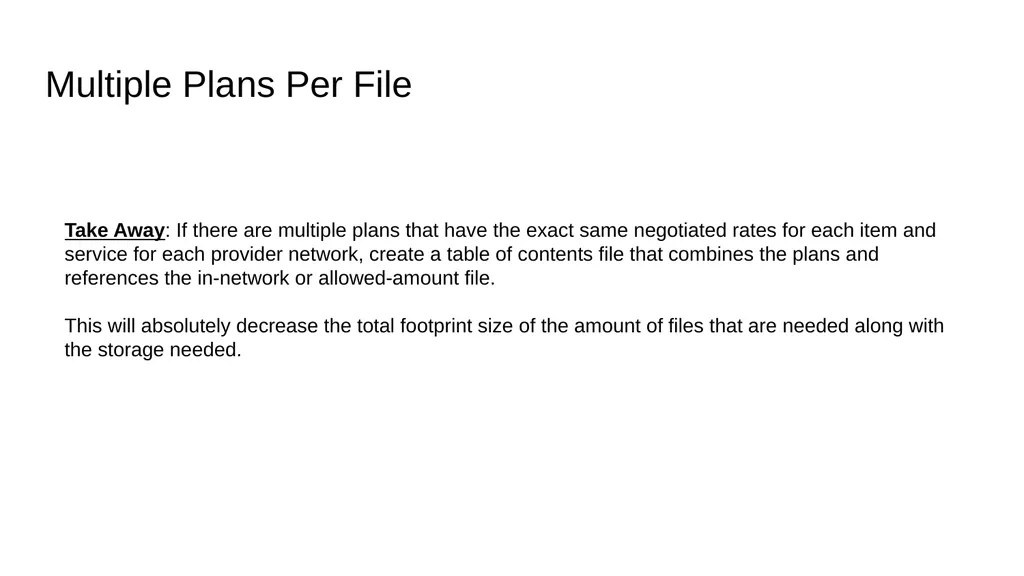
Multiple Plans Per File Take Away: If there are multiple plans that have the exact same negotiated rates for each item and service for each provider network, create a table of contents file that combines the plans and references the in-network or allowed-amount file.
This will absolutely decrease the total footprint size of the amount of files that are needed along with the storage needed.<br>
14
Referenced Provider Groups<br>
15
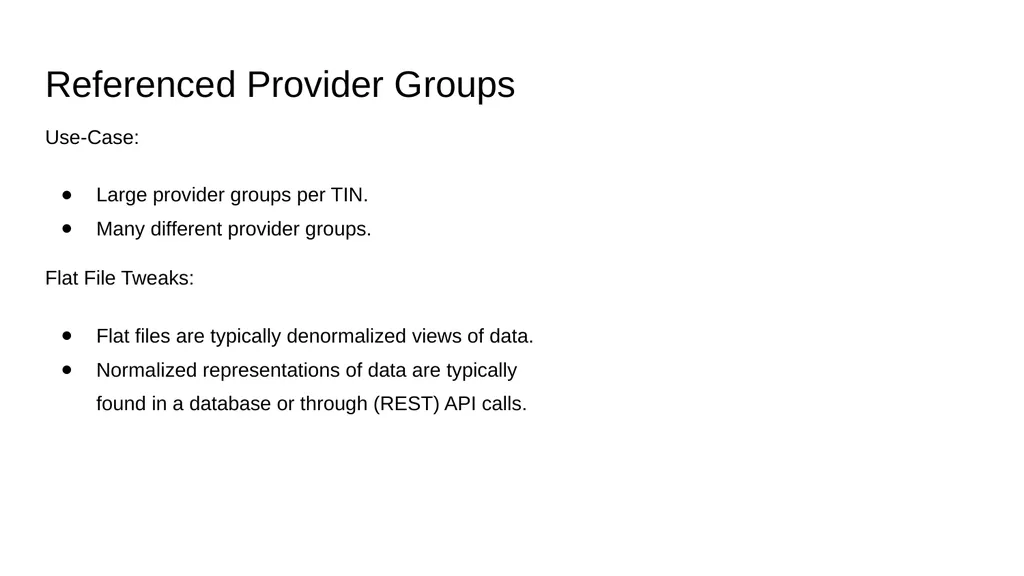
Referenced Provider Groups Use-Case:
Large provider groups per TIN.
Many different provider groups. Flat File Tweaks:
Flat files are typically denormalized views of data.
Normalized representations of data are typically found in a database or through (REST) API calls.<br>
16
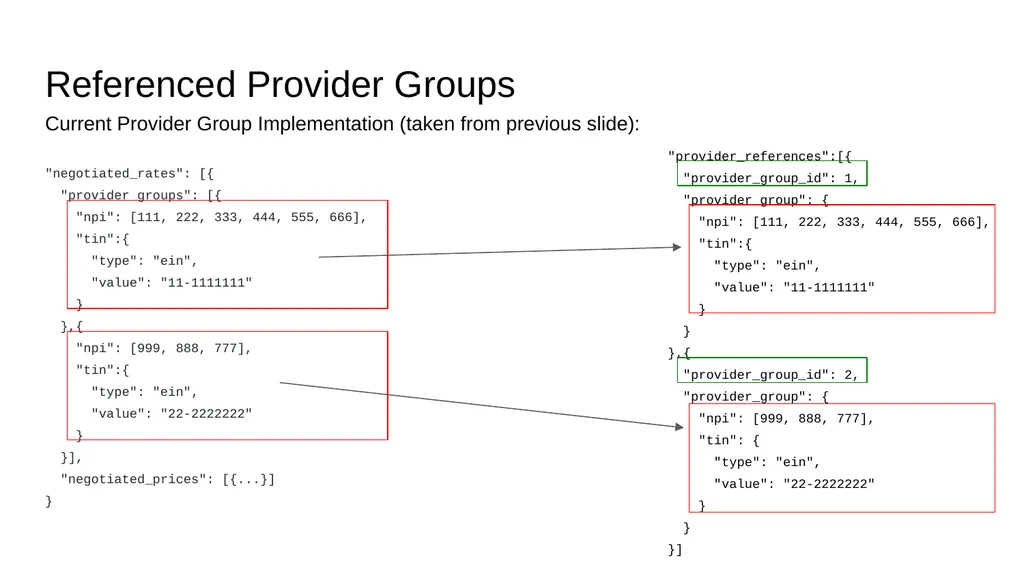
Referenced Provider Groups Current Provider Group Implementation (taken from previous slide):
"negotiated_rates": [{
"provider_groups": [{
"npi": [111, 222, 333, 444, 555, 666],
"tin":{
"type": "ein",
"value": "11-1111111"
}
},{
"npi": [999, 888, 777],
"tin":{
"type": "ein",
"value": "22-2222222"
}
}],
"negotiated_prices": [{...}]
} "provider_references":[{
"provider_group_id": 1,
"provider_group": {
"npi": [111, 222, 333, 444, 555, 666],
"tin":{
"type": "ein",
"value": "11-1111111"
}
}
},{
"provider_group_id": 2,
"provider_group": {
"npi": [999, 888, 777],
"tin": {
"type": "ein",
"value": "22-2222222"
}
}
}]<br>
17
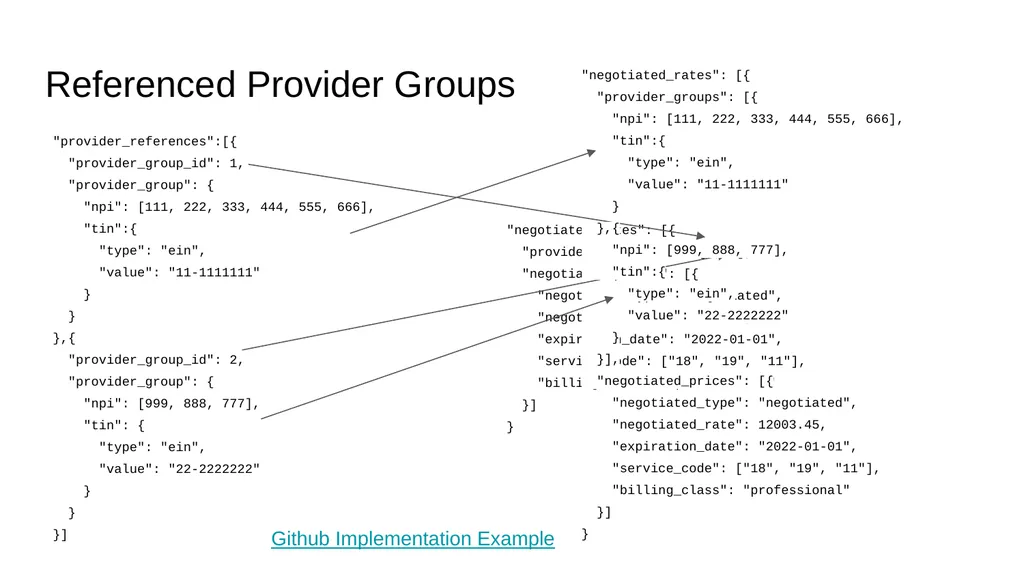
Referenced Provider Groups "provider_references":[{
"provider_group_id": 1,
"provider_group": {
"npi": [111, 222, 333, 444, 555, 666],
"tin":{
"type": "ein",
"value": "11-1111111"
}
}
},{
"provider_group_id": 2,
"provider_group": {
"npi": [999, 888, 777],
"tin": {
"type": "ein",
"value": "22-2222222"
}
}
}] "negotiated_rates": [{
"provider_references": [1, 2],
"negotiated_prices": [{
"negotiated_type": "negotiated",
"negotiated_rate": 12003.45,
"expiration_date": "2022-01-01",
"service_code": ["18", "19", "11"],
"billing_class": "professional"
}]
} Github Implementation Example "negotiated_rates": [{
"provider_groups": [{
"npi": [111, 222, 333, 444, 555, 666],
"tin":{
"type": "ein",
"value": "11-1111111"
}
},{
"npi": [999, 888, 777],
"tin":{
"type": "ein",
"value": "22-2222222"
}
}],
"negotiated_prices": [{
"negotiated_type": "negotiated",
"negotiated_rate": 12003.45,
"expiration_date": "2022-01-01",
"service_code": ["18", "19", "11"],
"billing_class": "professional"
}]
}<br>
18
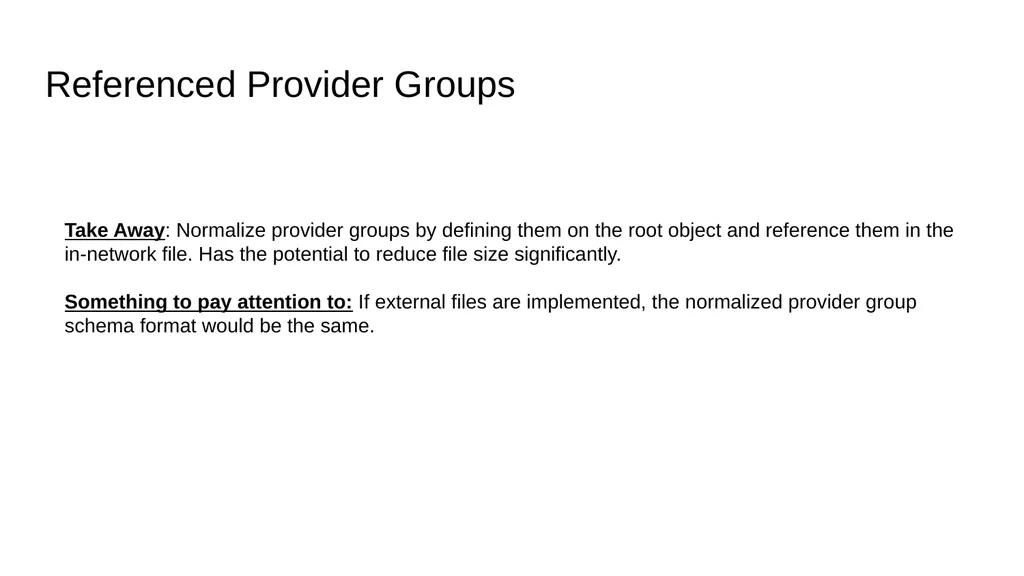
Referenced Provider Groups Take Away: Normalize provider groups by defining them on the root object and reference them in the in-network file. Has the potential to reduce file size significantly.
Something to pay attention to: If external files are implemented, the normalized provider group schema format would be the same.<br>
20
File Compression Use-Case:
Large uncompressed text files. Common compression formats:
.7z, .zip, .tar.gz, .rar, etc Take Away: Text files such as the machine-readable files will benefit greatly from being compressed. This will not only help with storage considerations but also with network bandwidth.<br>