
Finance and Development Is Schumpeter’s analysis



Description: Finance and Development Is Schumpeters analysis still relevant? 1.1 Rajan and Zingales use important elements of Schumpeters theoretical framework meanwhile re-evaluate the importance of Schumpeters contribution the paper is divided in
Related Topics
Download Presentation
"Finance and Development Is Schumpeter’s analysis" is the property of its rightful owner. Permission is granted to download and print the materials on this website for personal, non-commercial use only, and to display it on your personal computer provided you do not modify the materials and that you retain all copyright notices contained in the materials. By downloading content from our website, you accept the terms of this agreement.
Presentation Transcript
slide1. Finance and Development Is Schumpeter’s analysis still relevant?<br>
slide2. 1.1 Rajan and Zingales
use important elements of Schumpeter’s theoretical framework
meanwhile re-evaluate the importance of Schumpeter’s contribution
the paper is divided in two parts
analysis of RZ
elements of Schumpeter’s theory that they overlook<br>
slide3. 2.1 Thesis: The presence of a well-developed financial system is a necessary condition for the achievement of high economic growth rates A) Theory to explain the link between financial structure and economic development B) Definition and measurement of financial structure’s development i.e. distinction between developed and undeveloped financial structure using the concept of innovation underlined by the Schumpeter’s analysis i.e. innovation is based upon a change Part One: Rajan and Zingales analysis<br>
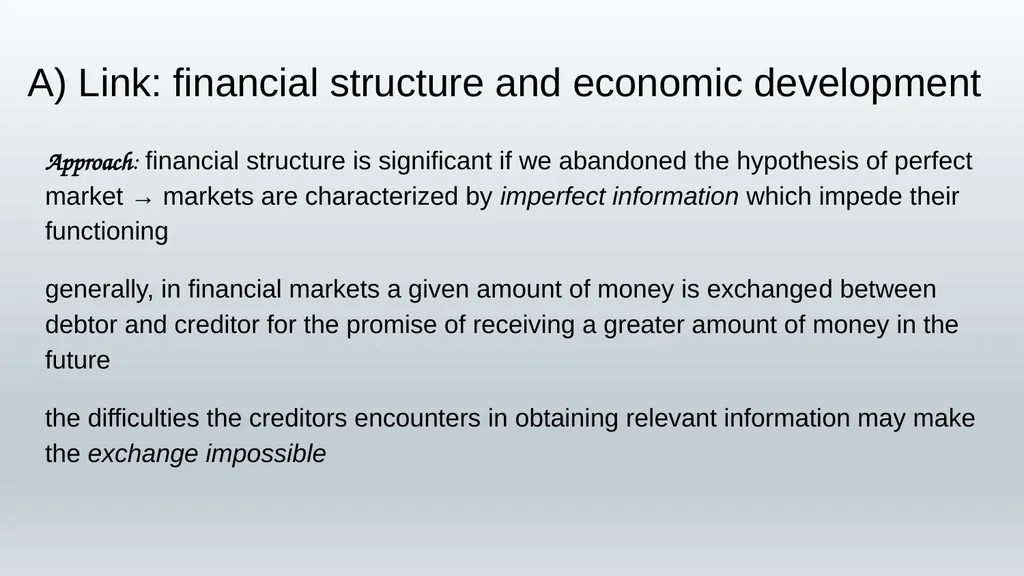
slide4. A) Link: financial structure and economic development Approach: financial structure is significant if we abandoned the hypothesis of perfect market → markets are characterized by imperfect information which impede their functioning
generally, in financial markets a given amount of money is exchanged between debtor and creditor for the promise of receiving a greater amount of money in the future
the difficulties the creditors encounters in obtaining relevant information may make the exchange impossible<br>
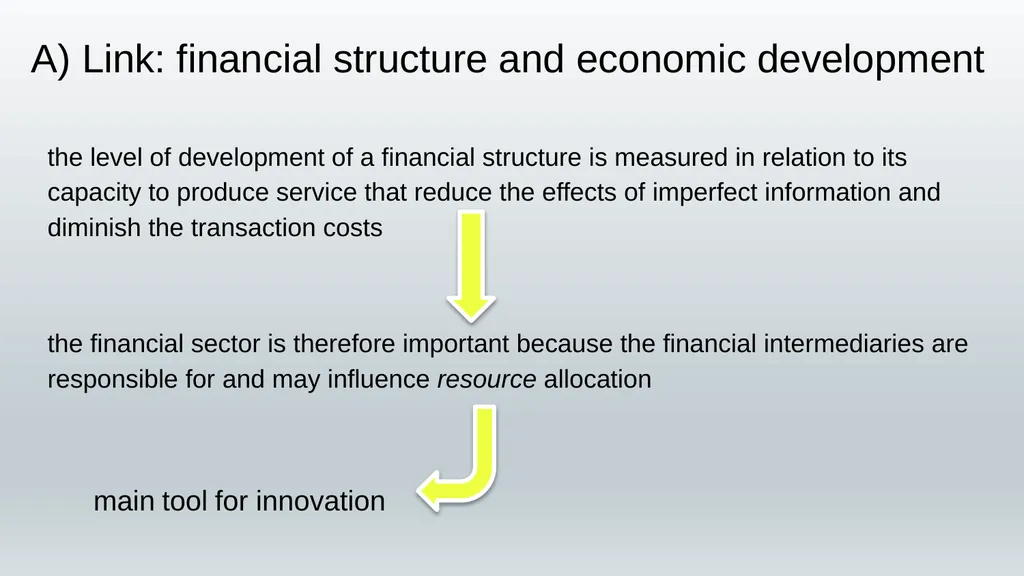
slide5. the level of development of a financial structure is measured in relation to its capacity to produce service that reduce the effects of imperfect information and diminish the transaction costs
the financial sector is therefore important because the financial intermediaries are responsible for and may influence resource allocation main tool for innovation A) Link: financial structure and economic development<br>
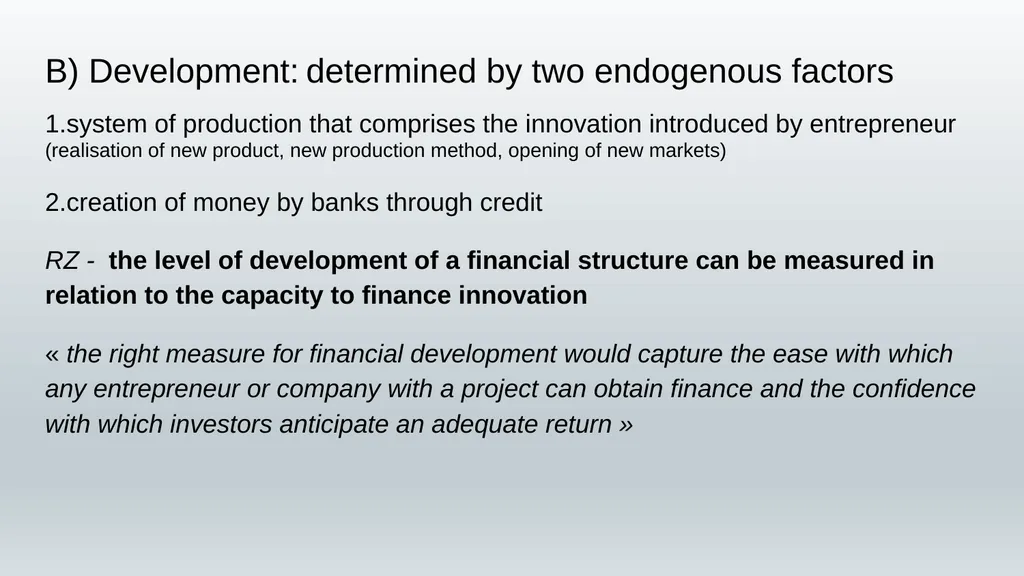
slide6. B) Development: determined by two endogenous factors 1.system of production that comprises the innovation introduced by entrepreneur
(realisation of new product, new production method, opening of new markets)
2.creation of money by banks through credit
RZ - the level of development of a financial structure can be measured in relation to the capacity to finance innovation
« the right measure for financial development would capture the ease with which any entrepreneur or company with a project can obtain finance and the confidence with which investors anticipate an adequate return »<br>
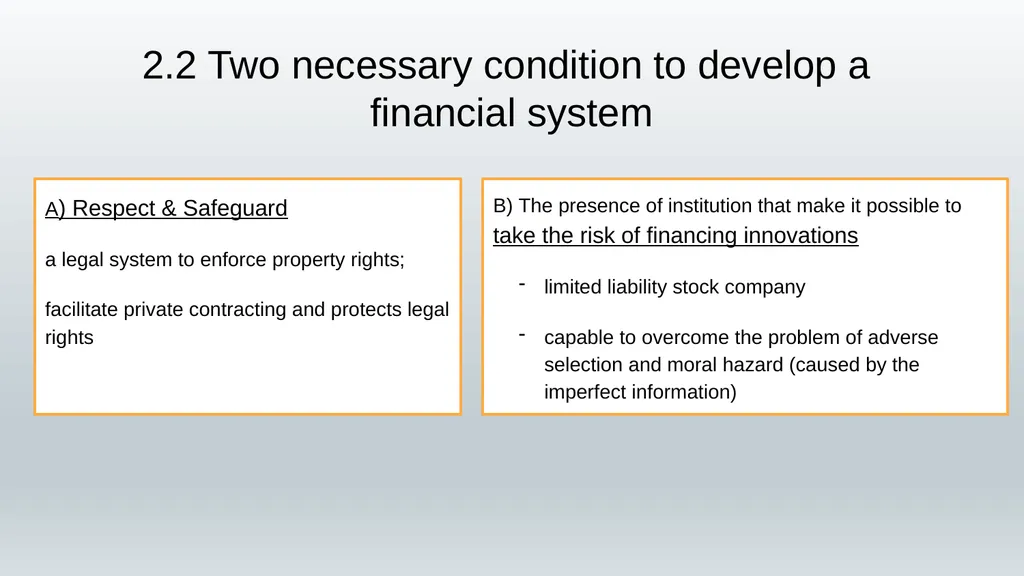
slide7. 2.2 Two necessary condition to develop a
financial system A) Respect & Safeguard
a legal system to enforce property rights;
facilitate private contracting and protects legal rights B) The presence of institution that make it possible to take the risk of financing innovations
limited liability stock company
capable to overcome the problem of adverse selection and moral hazard (caused by the imperfect information)<br>
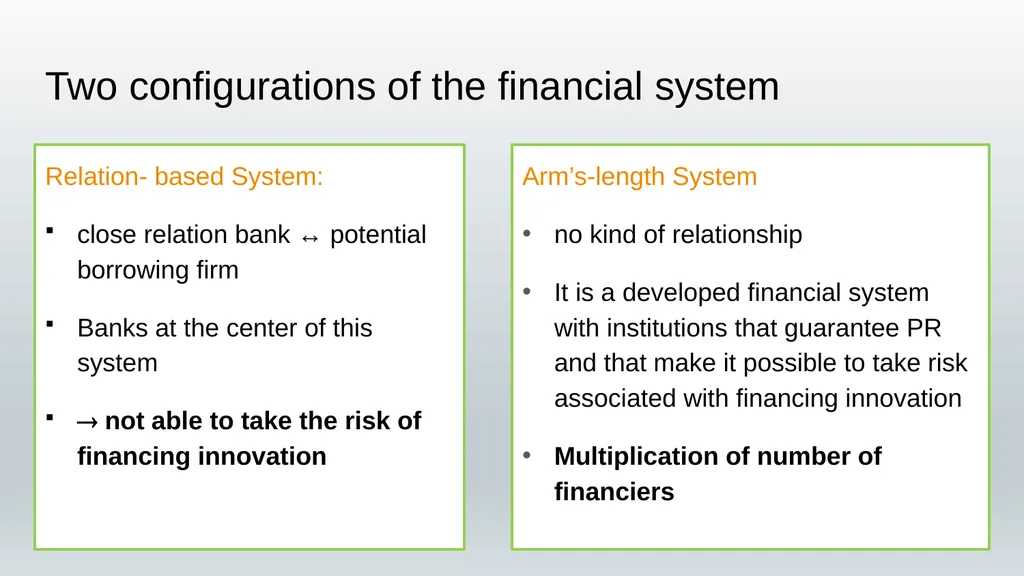
slide8. Two configurations of the financial system Relation- based System:
close relation bank ↔ potential borrowing firm
Banks at the center of this system
not able to take the risk of financing innovation Arm’s-length System
no kind of relationship
It is a developed financial system with institutions that guarantee PR and that make it possible to take risk associated with financing innovation
Multiplication of number of financiers<br>
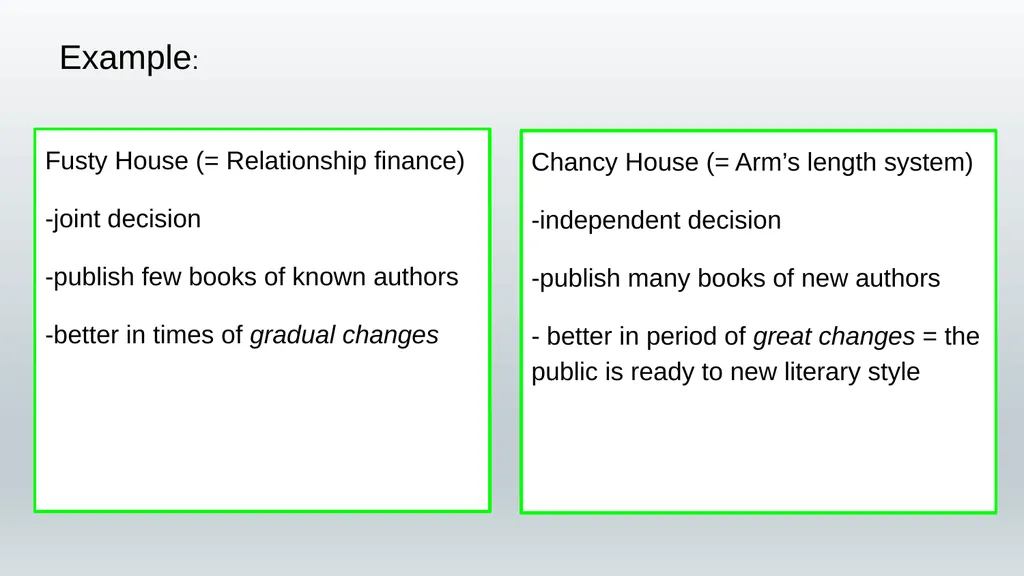
slide9. Fusty House (= Relationship finance)
-joint decision
-publish few books of known authors
-better in times of gradual changes Example: Chancy House (= Arm’s length system)
-independent decision
-publish many books of new authors
- better in period of great changes = the public is ready to new literary style<br>
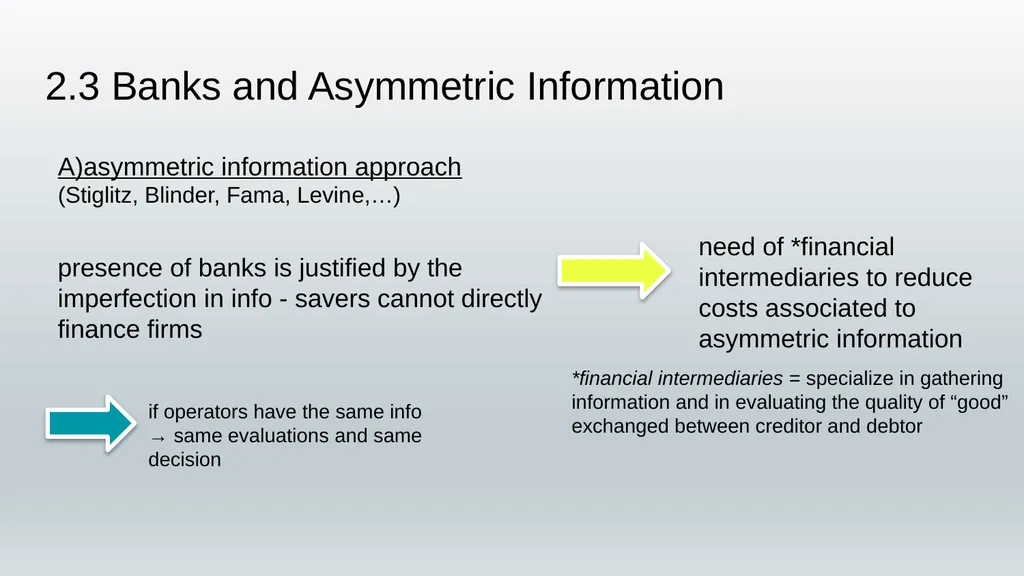
slide10. 2.3 Banks and Asymmetric Information A)asymmetric information approach
(Stiglitz, Blinder, Fama, Levine,…) need of *financial intermediaries to reduce costs associated to asymmetric information *financial intermediaries = specialize in gathering information and in evaluating the quality of “good” exchanged between creditor and debtor if operators have the same info
→ same evaluations and same decision presence of banks is justified by the imperfection in info - savers cannot directly finance firms<br>
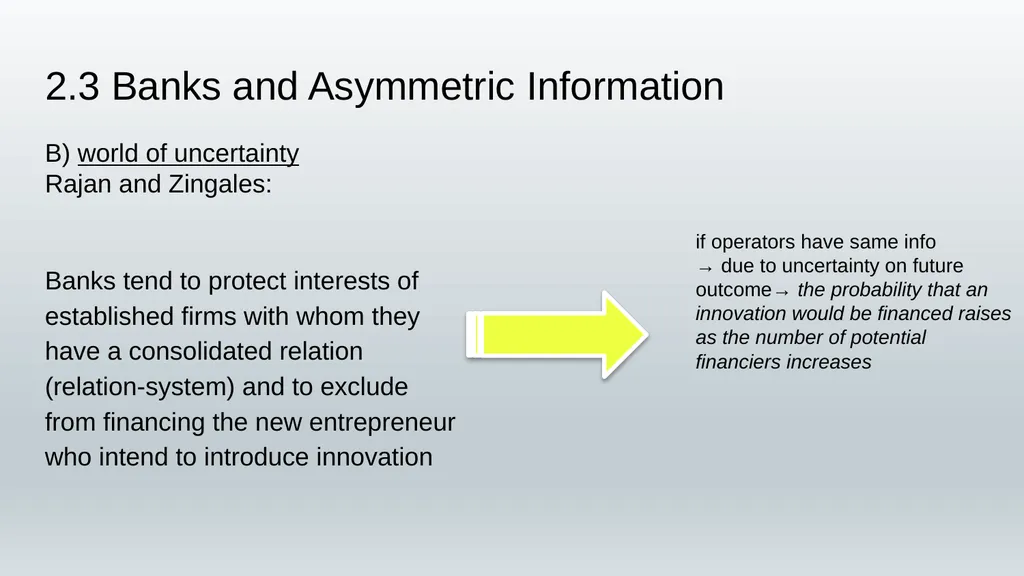
slide11. 2.3 Banks and Asymmetric Information B) world of uncertainty
Rajan and Zingales:
Banks tend to protect interests of established firms with whom they have a consolidated relation (relation-system) and to exclude from financing the new entrepreneur who intend to introduce innovation if operators have same info
→ due to uncertainty on future outcome→ the probability that an innovation would be financed raises as the number of potential financiers increases<br>
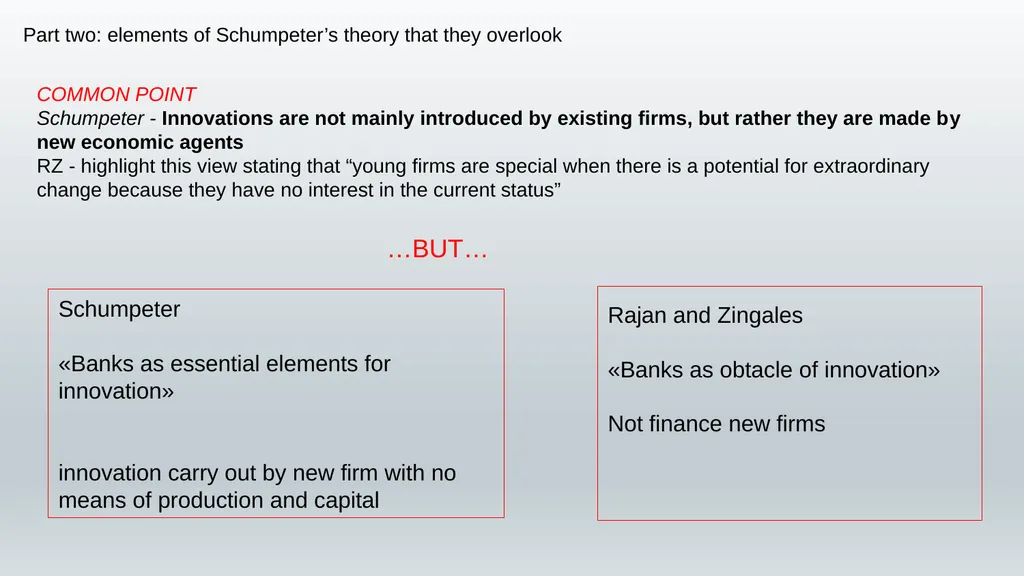
slide12. Part two: elements of Schumpeter’s theory that they overlook Rajan and Zingales
«Banks as obtacle of innovation»
Not finance new firms Schumpeter
«Banks as essential elements for innovation»
innovation carry out by new firm with no means of production and capital COMMON POINT
Schumpeter - Innovations are not mainly introduced by existing firms, but rather they are made by new economic agents
RZ - highlight this view stating that “young firms are special when there is a potential for extraordinary change because they have no interest in the current status” …BUT…<br>
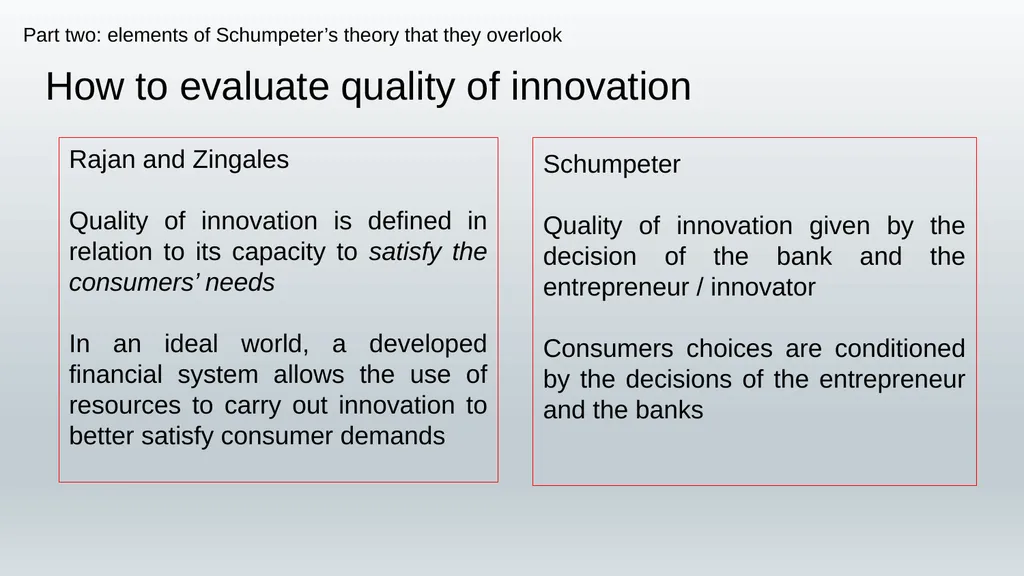
slide13. How to evaluate quality of innovation Schumpeter
Quality of innovation given by the decision of the bank and the entrepreneur / innovator
Consumers choices are conditioned by the decisions of the entrepreneur and the banks Rajan and Zingales
Quality of innovation is defined in relation to its capacity to satisfy the consumers’ needs
In an ideal world, a developed financial system allows the use of resources to carry out innovation to better satisfy consumer demands Part two: elements of Schumpeter’s theory that they overlook<br>
slide14. THANK YOU FOR YOUR ATTENTION
ELEONORA CIA and ROBERTA ROPPO<br>
slide2. 1.1 Rajan and Zingales
use important elements of Schumpeter’s theoretical framework
meanwhile re-evaluate the importance of Schumpeter’s contribution
the paper is divided in two parts
analysis of RZ
elements of Schumpeter’s theory that they overlook<br>
slide3. 2.1 Thesis: The presence of a well-developed financial system is a necessary condition for the achievement of high economic growth rates A) Theory to explain the link between financial structure and economic development B) Definition and measurement of financial structure’s development i.e. distinction between developed and undeveloped financial structure using the concept of innovation underlined by the Schumpeter’s analysis i.e. innovation is based upon a change Part One: Rajan and Zingales analysis<br>
slide4. A) Link: financial structure and economic development Approach: financial structure is significant if we abandoned the hypothesis of perfect market → markets are characterized by imperfect information which impede their functioning
generally, in financial markets a given amount of money is exchanged between debtor and creditor for the promise of receiving a greater amount of money in the future
the difficulties the creditors encounters in obtaining relevant information may make the exchange impossible<br>
slide5. the level of development of a financial structure is measured in relation to its capacity to produce service that reduce the effects of imperfect information and diminish the transaction costs
the financial sector is therefore important because the financial intermediaries are responsible for and may influence resource allocation main tool for innovation A) Link: financial structure and economic development<br>
slide6. B) Development: determined by two endogenous factors 1.system of production that comprises the innovation introduced by entrepreneur
(realisation of new product, new production method, opening of new markets)
2.creation of money by banks through credit
RZ - the level of development of a financial structure can be measured in relation to the capacity to finance innovation
« the right measure for financial development would capture the ease with which any entrepreneur or company with a project can obtain finance and the confidence with which investors anticipate an adequate return »<br>
slide7. 2.2 Two necessary condition to develop a
financial system A) Respect & Safeguard
a legal system to enforce property rights;
facilitate private contracting and protects legal rights B) The presence of institution that make it possible to take the risk of financing innovations
limited liability stock company
capable to overcome the problem of adverse selection and moral hazard (caused by the imperfect information)<br>
slide8. Two configurations of the financial system Relation- based System:
close relation bank ↔ potential borrowing firm
Banks at the center of this system
not able to take the risk of financing innovation Arm’s-length System
no kind of relationship
It is a developed financial system with institutions that guarantee PR and that make it possible to take risk associated with financing innovation
Multiplication of number of financiers<br>
slide9. Fusty House (= Relationship finance)
-joint decision
-publish few books of known authors
-better in times of gradual changes Example: Chancy House (= Arm’s length system)
-independent decision
-publish many books of new authors
- better in period of great changes = the public is ready to new literary style<br>
slide10. 2.3 Banks and Asymmetric Information A)asymmetric information approach
(Stiglitz, Blinder, Fama, Levine,…) need of *financial intermediaries to reduce costs associated to asymmetric information *financial intermediaries = specialize in gathering information and in evaluating the quality of “good” exchanged between creditor and debtor if operators have the same info
→ same evaluations and same decision presence of banks is justified by the imperfection in info - savers cannot directly finance firms<br>
slide11. 2.3 Banks and Asymmetric Information B) world of uncertainty
Rajan and Zingales:
Banks tend to protect interests of established firms with whom they have a consolidated relation (relation-system) and to exclude from financing the new entrepreneur who intend to introduce innovation if operators have same info
→ due to uncertainty on future outcome→ the probability that an innovation would be financed raises as the number of potential financiers increases<br>
slide12. Part two: elements of Schumpeter’s theory that they overlook Rajan and Zingales
«Banks as obtacle of innovation»
Not finance new firms Schumpeter
«Banks as essential elements for innovation»
innovation carry out by new firm with no means of production and capital COMMON POINT
Schumpeter - Innovations are not mainly introduced by existing firms, but rather they are made by new economic agents
RZ - highlight this view stating that “young firms are special when there is a potential for extraordinary change because they have no interest in the current status” …BUT…<br>
slide13. How to evaluate quality of innovation Schumpeter
Quality of innovation given by the decision of the bank and the entrepreneur / innovator
Consumers choices are conditioned by the decisions of the entrepreneur and the banks Rajan and Zingales
Quality of innovation is defined in relation to its capacity to satisfy the consumers’ needs
In an ideal world, a developed financial system allows the use of resources to carry out innovation to better satisfy consumer demands Part two: elements of Schumpeter’s theory that they overlook<br>
slide14. THANK YOU FOR YOUR ATTENTION
ELEONORA CIA and ROBERTA ROPPO<br>