
Finance for Non-financial Managers Sonja





Description: Finance for Non-financial Managers Sonja Stojanović Gajić 30 January 2023 FOCUS FINANCIAL MANAGEMENT LEADERSHIP IN OLD NORMAL FINANCIAL HEALTH IN THE CRISIS 4 Sonja Stojanovic Gajic 2006-2019 Director of Belgrade Centre for Security
Related Topics
Download Presentation
"Finance for Non-financial Managers Sonja" is the property of its rightful owner. Permission is granted to download and print the materials on this website for personal, non-commercial use only, and to display it on your personal computer provided you do not modify the materials and that you retain all copyright notices contained in the materials. By downloading content from our website, you accept the terms of this agreement.
Presentation Transcript
slide2. Finance for
Non-financial Managers Sonja Stojanović Gajić
30 January 2023<br>
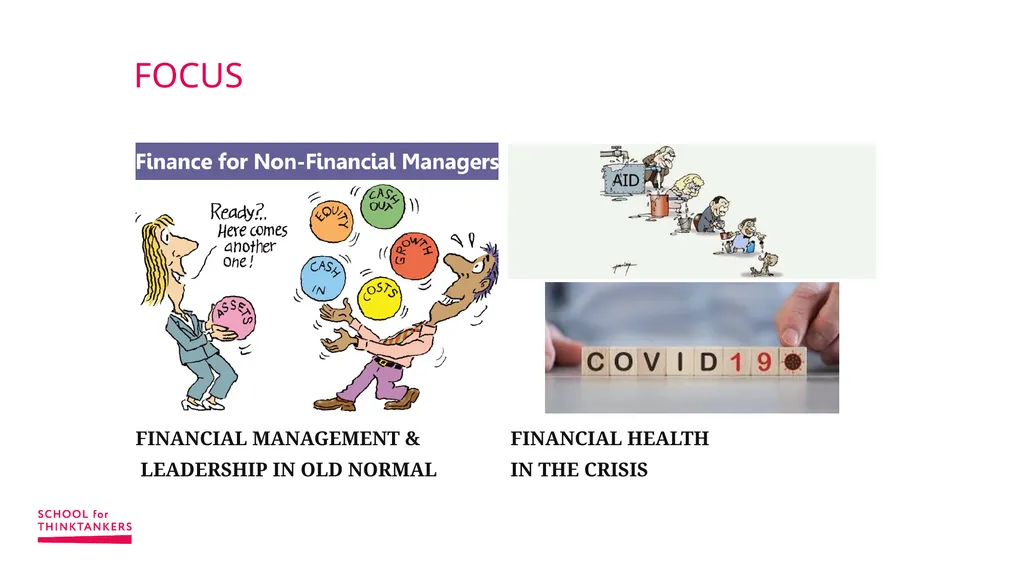
slide3. FOCUS FINANCIAL MANAGEMENT &
LEADERSHIP IN OLD NORMAL FINANCIAL HEALTH
IN THE CRISIS<br>
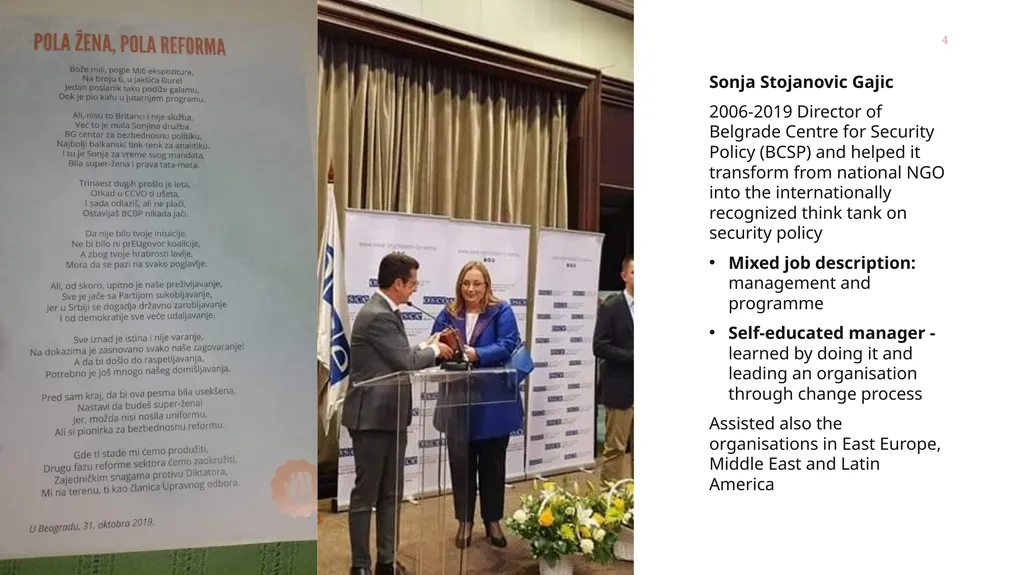
slide4. 4 Sonja Stojanovic Gajic
2006-2019 Director of Belgrade Centre for Security Policy (BCSP) and helped it transform from national NGO into the internationally recognized think tank on security policy
Mixed job description: management and programme
Self-educated manager - learned by doing it and leading an organisation through change process
Assisted also the organisations in East Europe, Middle East and Latin America<br>
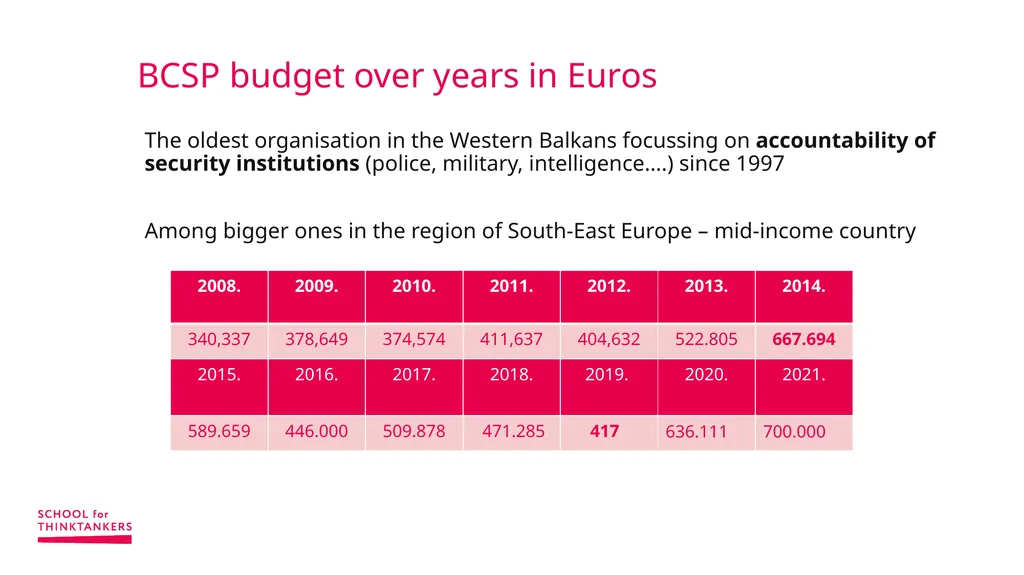
slide5. BCSP budget over years in Euros The oldest organisation in the Western Balkans focussing on accountability of security institutions (police, military, intelligence….) since 1997
Among bigger ones in the region of South-East Europe – mid-income country<br>
slide6. How do you feel about finance management and fundraising?<br>
slide7. INTRO SURVEY https://docs.google.com/forms/d/e/1FAIpQLSdNiXbs3XZBPSzZQih34855dXeaKJ5sJU0ectKCj-GhBNBo-g/viewform<br>
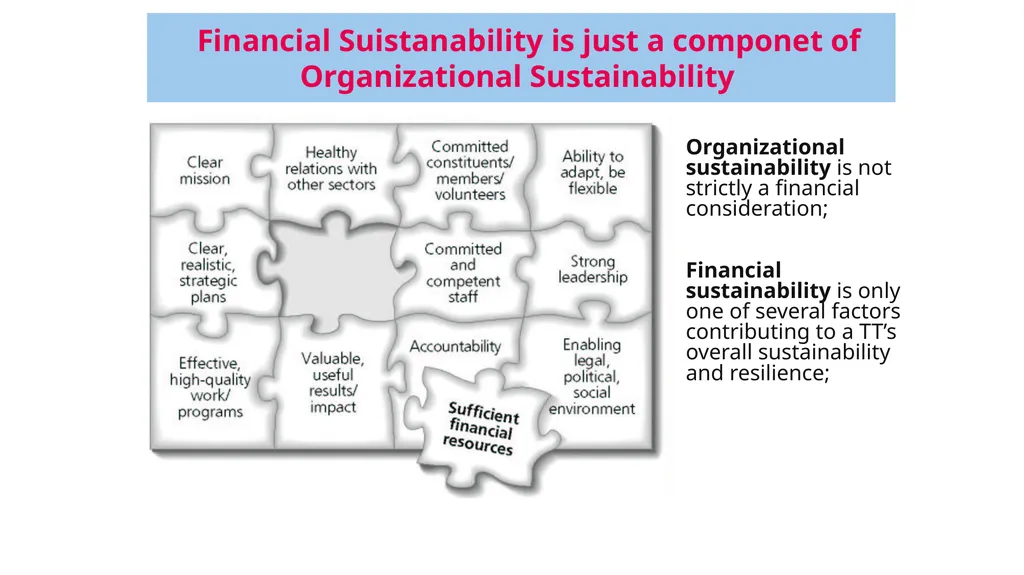
slide8. Financial Suistanability is just a componet of Organizational Sustainability Organizational sustainability is not strictly a financial consideration;
Financial sustainability is only one of several factors contributing to a TT’s overall sustainability and resilience;<br>
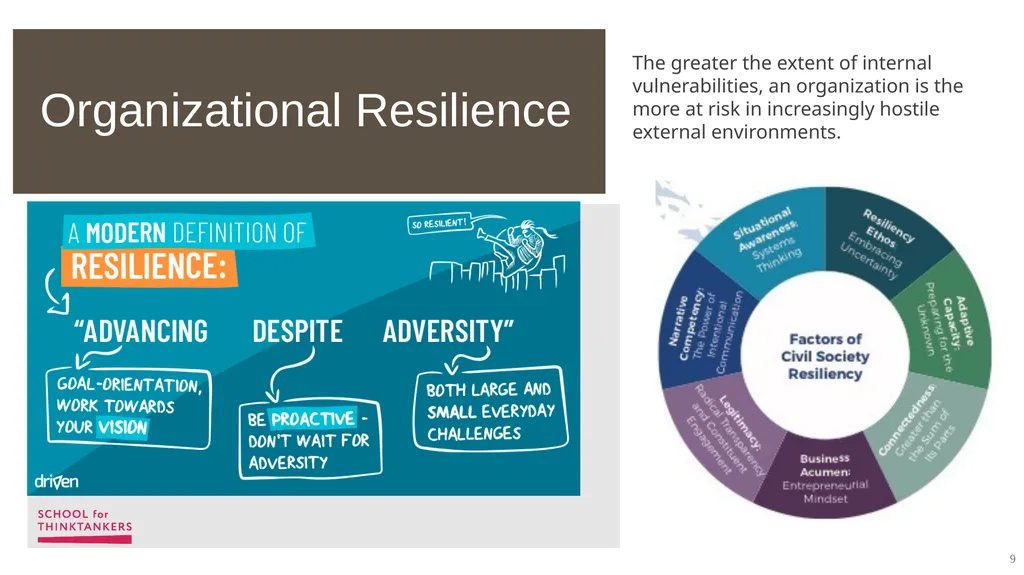
slide9. Organizational Resilience 9 The greater the extent of internal vulnerabilities, an organization is the more at risk in increasingly hostile external environments.<br>
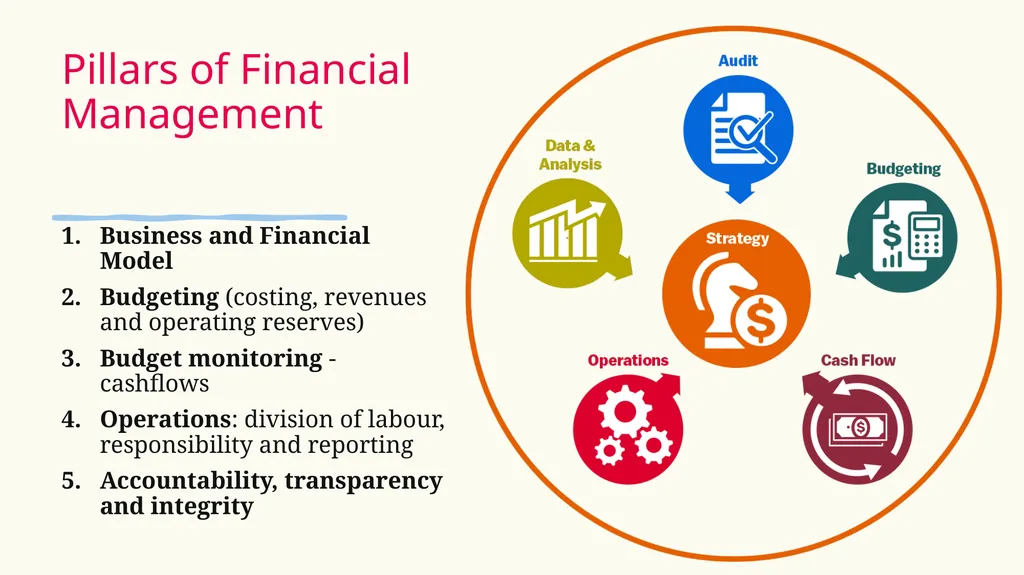
slide10. Pillars of Financial Management Business and Financial Model
Budgeting (costing, revenues and operating reserves)
Budget monitoring - cashflows
Operations: division of labour, responsibility and reporting
Accountability, transparency and integrity<br>
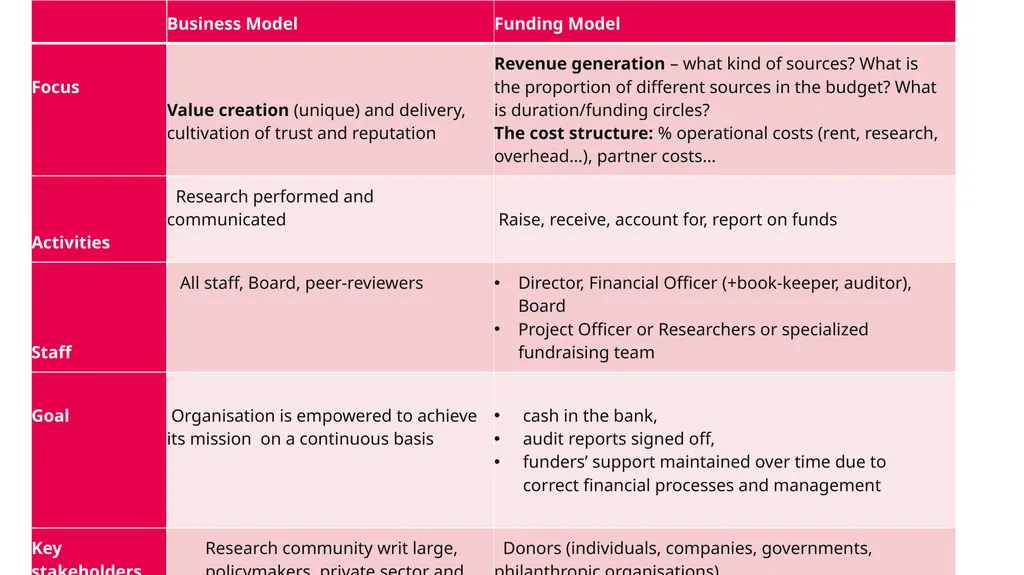
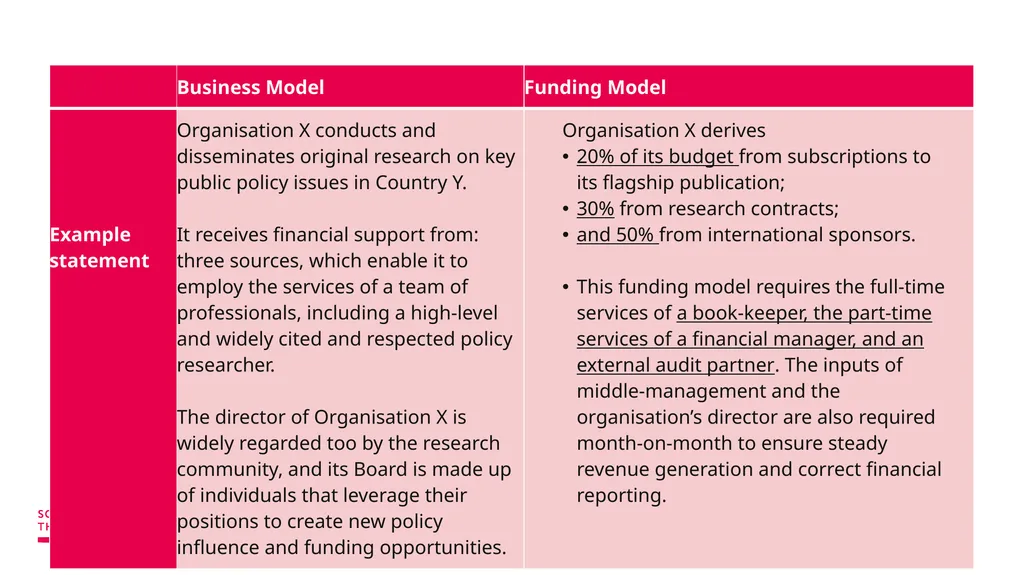
slide11. Difference between business and funding models<br>
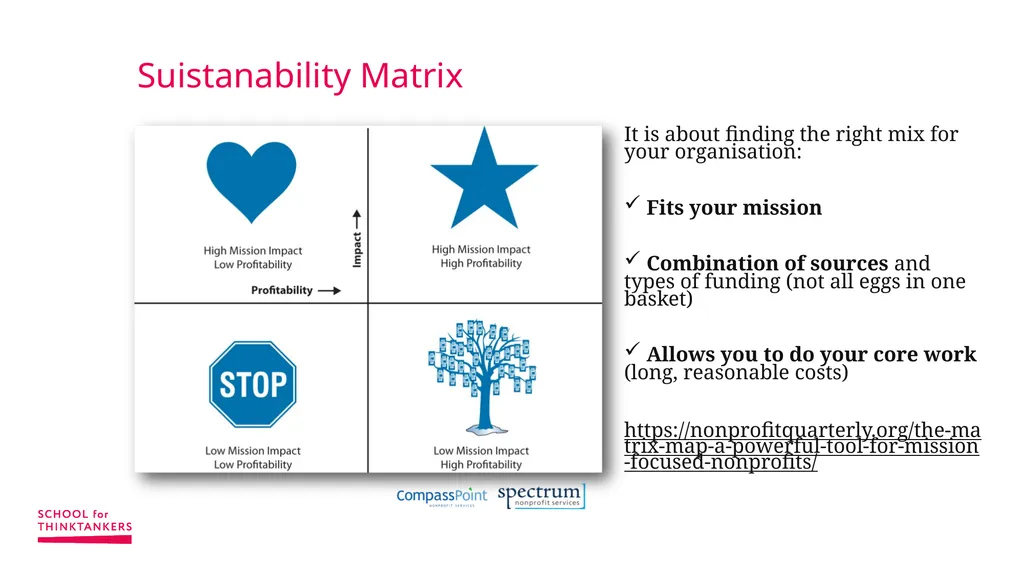
slide14. Suistanability Matrix It is about finding the right mix for your organisation:
Fits your mission
Combination of sources and types of funding (not all eggs in one basket)
Allows you to do your core work (long, reasonable costs)
https://nonprofitquarterly.org/the-matrix-map-a-powerful-tool-for-mission-focused-nonprofits/<br>
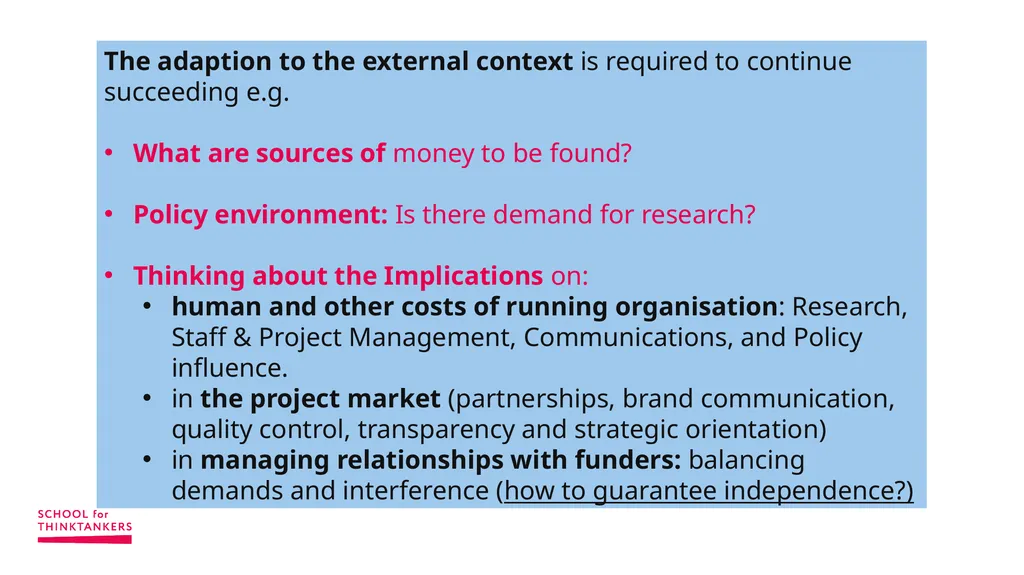
slide15. The adaption to the external context is required to continue succeeding e.g.
What are sources of money to be found?
Policy environment: Is there demand for research?
Thinking about the Implications on:
human and other costs of running organisation: Research, Staff & Project Management, Communications, and Policy influence.
in the project market (partnerships, brand communication, quality control, transparency and strategic orientation)
in managing relationships with funders: balancing demands and interference (how to guarantee independence?)<br>
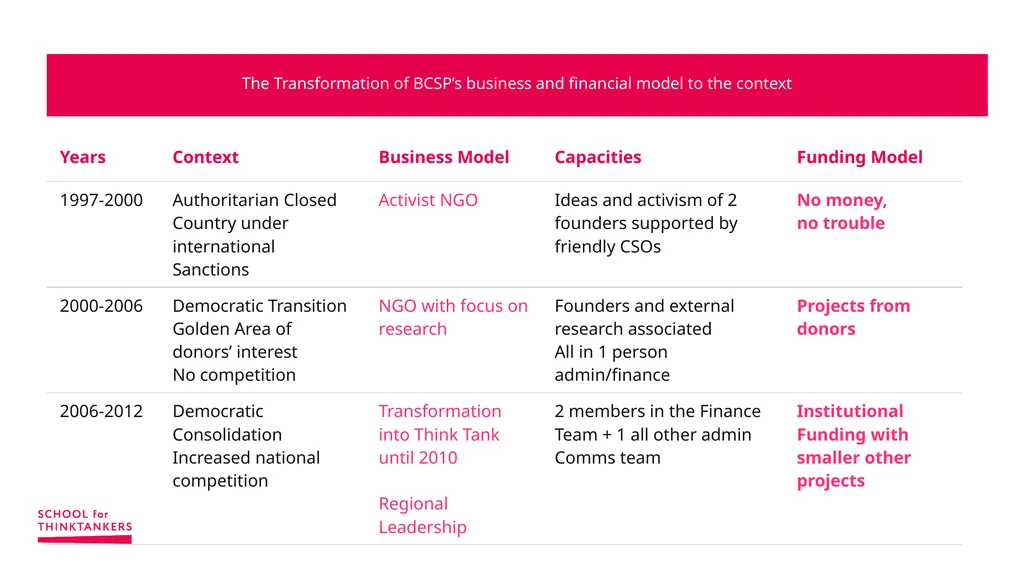
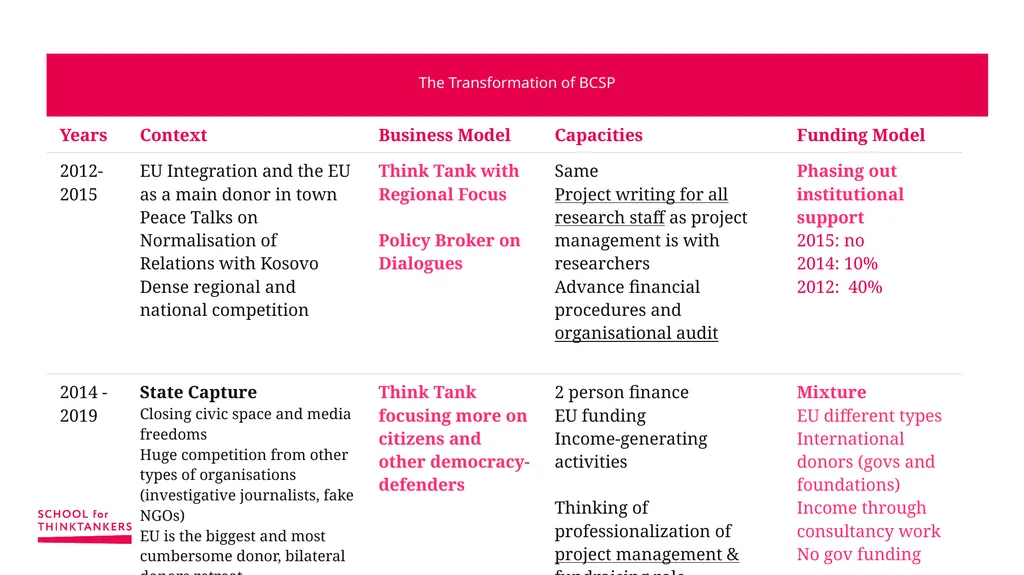
slide16. The Transformation of BCSP’s business and financial model to the context<br>
slide17. The Transformation of BCSP<br>
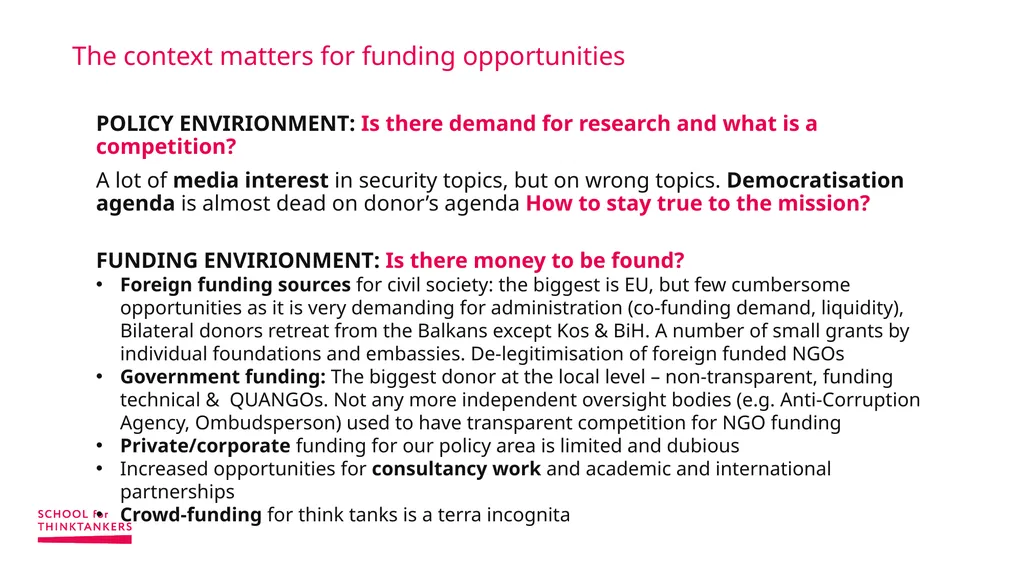
slide18. The context matters for funding opportunities POLICY ENVIRIONMENT: Is there demand for research and what is a competition?
A lot of media interest in security topics, but on wrong topics. Democratisation agenda is almost dead on donor’s agenda How to stay true to the mission?
FUNDING ENVIRIONMENT: Is there money to be found?
Foreign funding sources for civil society: the biggest is EU, but few cumbersome opportunities as it is very demanding for administration (co-funding demand, liquidity), Bilateral donors retreat from the Balkans except Kos & BiH. A number of small grants by individual foundations and embassies. De-legitimisation of foreign funded NGOs
Government funding: The biggest donor at the local level – non-transparent, funding technical & QUANGOs. Not any more independent oversight bodies (e.g. Anti-Corruption Agency, Ombudsperson) used to have transparent competition for NGO funding
Private/corporate funding for our policy area is limited and dubious
Increased opportunities for consultancy work and academic and international partnerships
Crowd-funding for think tanks is a terra incognita<br>
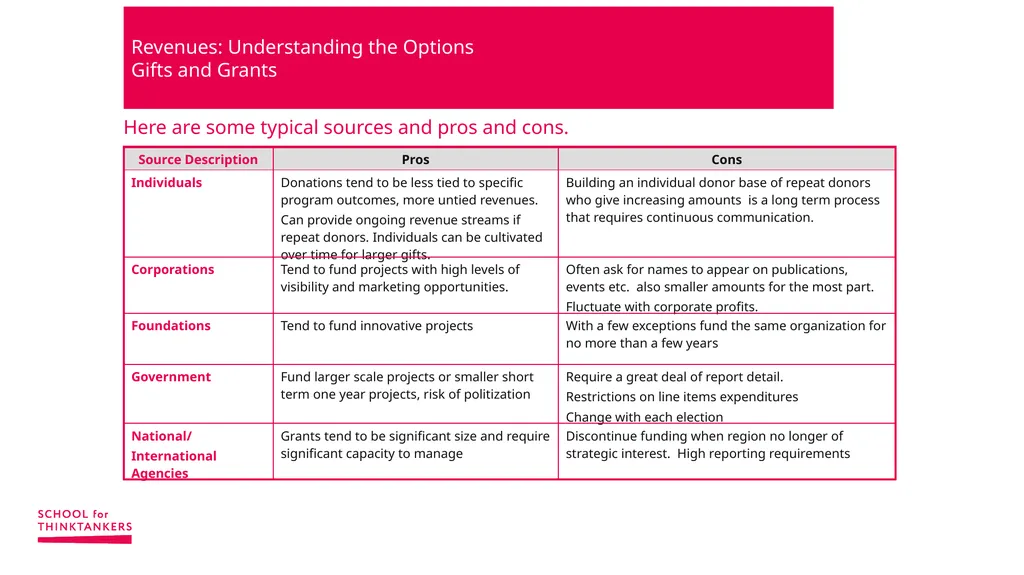
slide20. Revenues: Understanding the Options Gifts and Grants Here are some typical sources and pros and cons.<br>
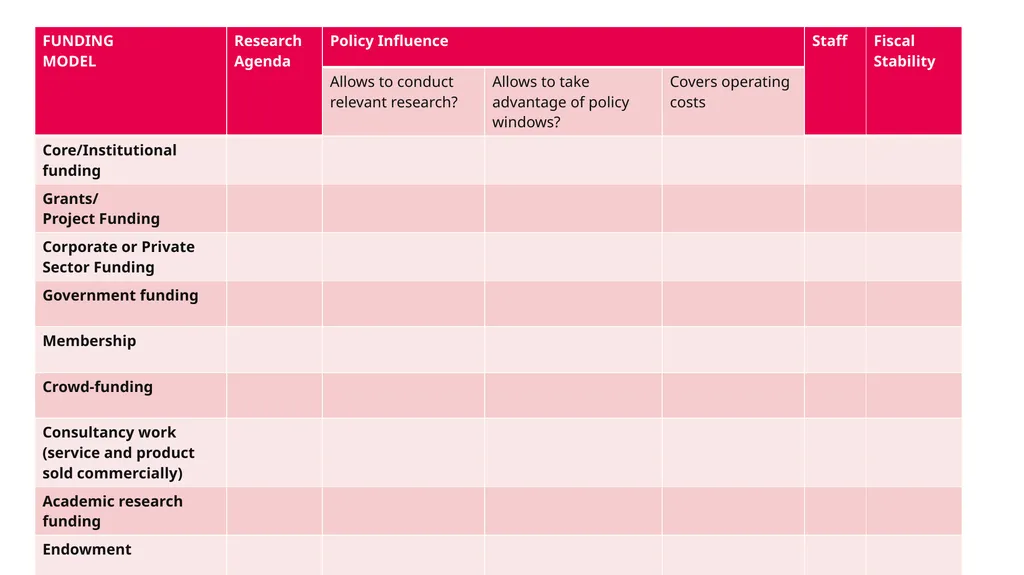
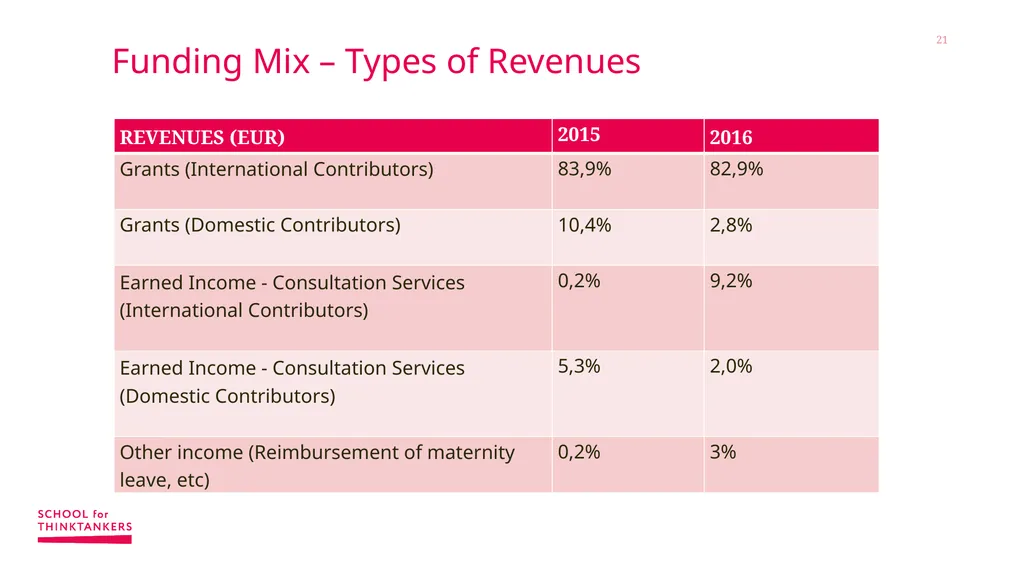
slide21. 21 Funding Mix – Types of Revenues<br>
slide22. SUCCESSFUL FUNDING<br>
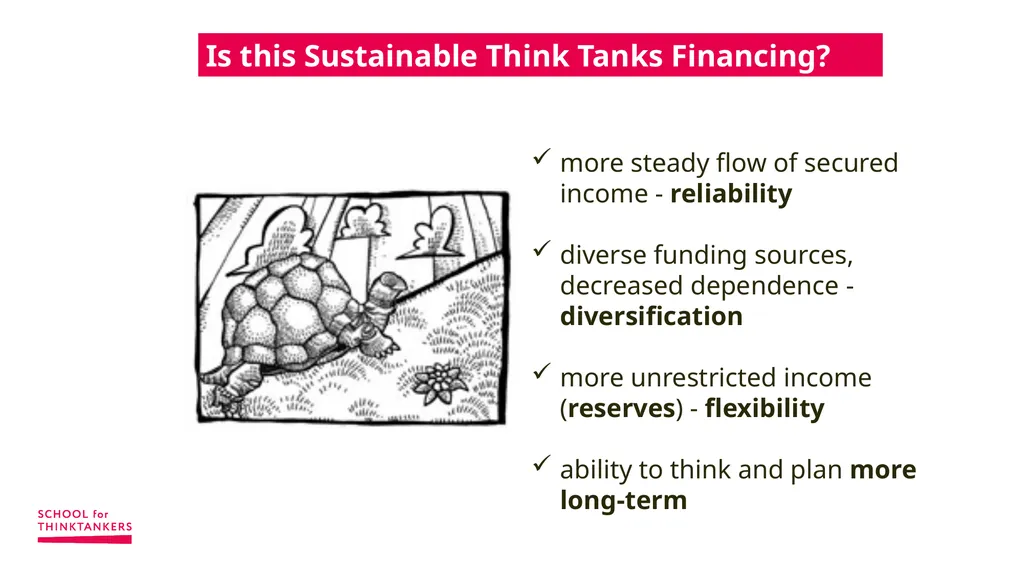
slide23. Is this Sustainable Think Tanks Financing? more steady flow of secured income - reliability
diverse funding sources, decreased dependence - diversification
more unrestricted income (reserves) - flexibility
ability to think and plan more long-term<br>
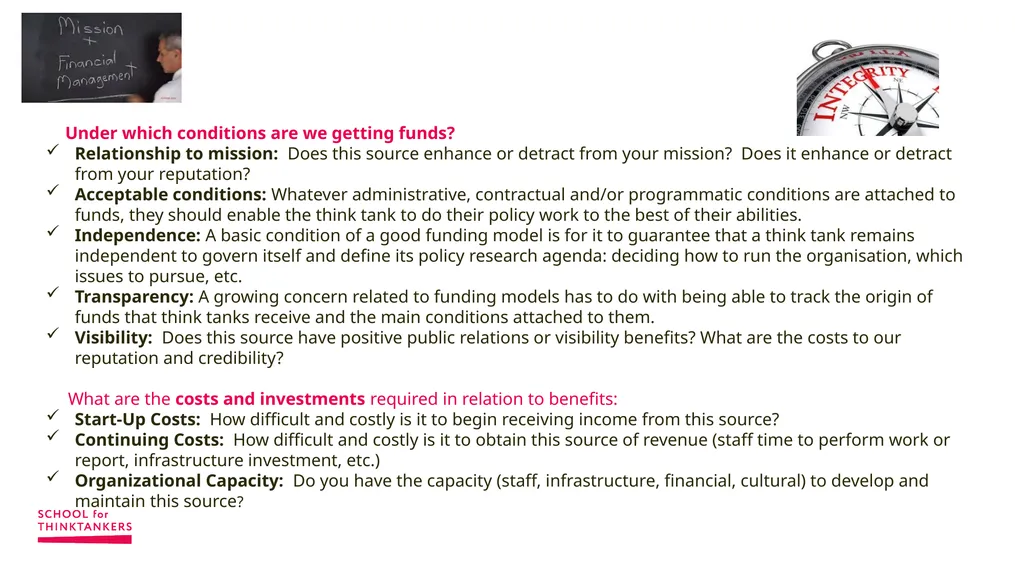
slide24. Under which conditions are we getting funds?
Relationship to mission: Does this source enhance or detract from your mission? Does it enhance or detract from your reputation?
Acceptable conditions: Whatever administrative, contractual and/or programmatic conditions are attached to funds, they should enable the think tank to do their policy work to the best of their abilities.
Independence: A basic condition of a good funding model is for it to guarantee that a think tank remains independent to govern itself and define its policy research agenda: deciding how to run the organisation, which issues to pursue, etc.
Transparency: A growing concern related to funding models has to do with being able to track the origin of funds that think tanks receive and the main conditions attached to them.
Visibility: Does this source have positive public relations or visibility benefits? What are the costs to our reputation and credibility?
What are the costs and investments required in relation to benefits:
Start-Up Costs: How difficult and costly is it to begin receiving income from this source?
Continuing Costs: How difficult and costly is it to obtain this source of revenue (staff time to perform work or report, infrastructure investment, etc.)
Organizational Capacity: Do you have the capacity (staff, infrastructure, financial, cultural) to develop and maintain this source?<br>
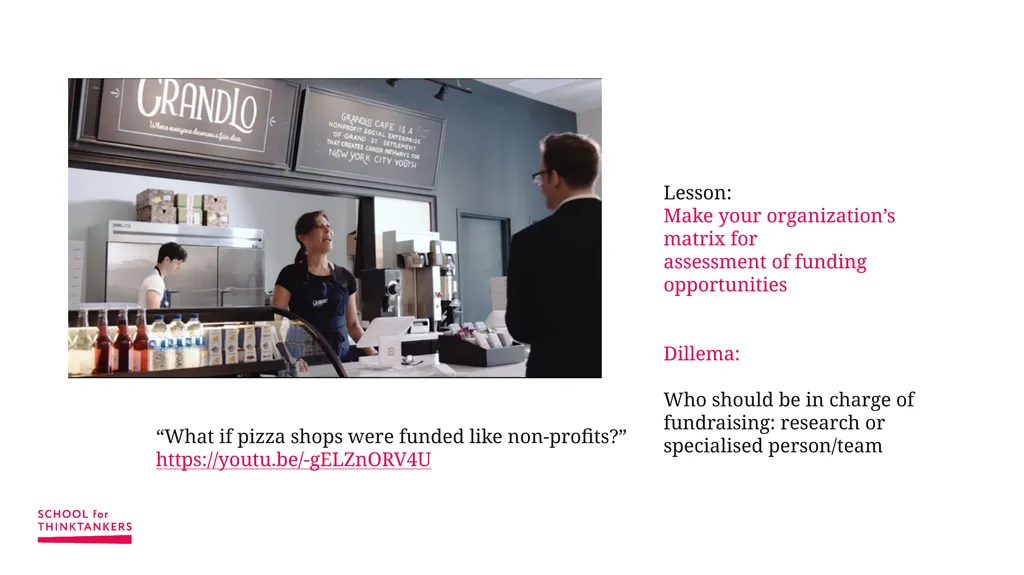
slide25. “What if pizza shops were funded like non-profits?”
https://youtu.be/-gELZnORV4U Lesson:
Make your organization’s matrix for
assessment of funding opportunities
Dillema:
Who should be in charge of fundraising: research or specialised person/team<br>
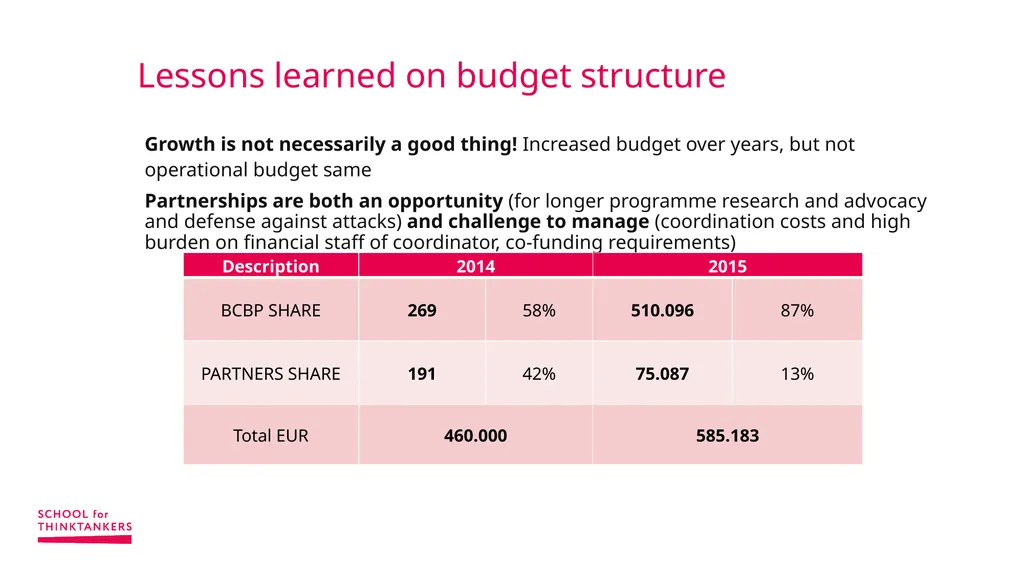
slide26. Lessons learned on budget structure Growth is not necessarily a good thing! Increased budget over years, but not operational budget same
Partnerships are both an opportunity (for longer programme research and advocacy and defense against attacks) and challenge to manage (coordination costs and high burden on financial staff of coordinator, co-funding requirements)<br>
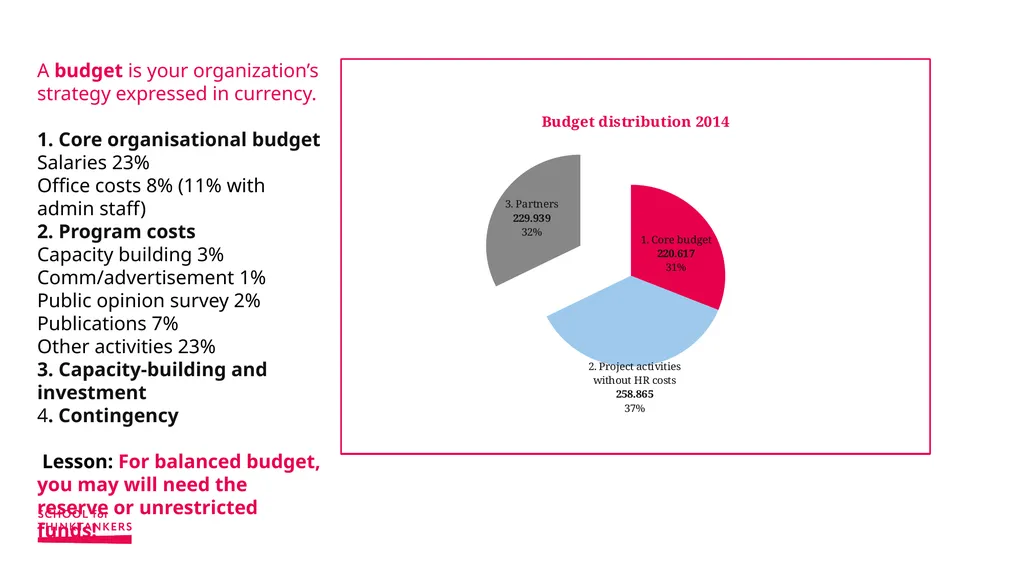
slide27. A budget is your organization’s strategy expressed in currency. 1. Core organisational budget Salaries 23% Office costs 8% (11% with admin staff) 2. Program costs Capacity building 3% Comm/advertisement 1% Public opinion survey 2% Publications 7% Other activities 23% 3. Capacity-building and investment 4. Contingency Lesson: For balanced budget, you may will need the reserve or unrestricted funds!<br>
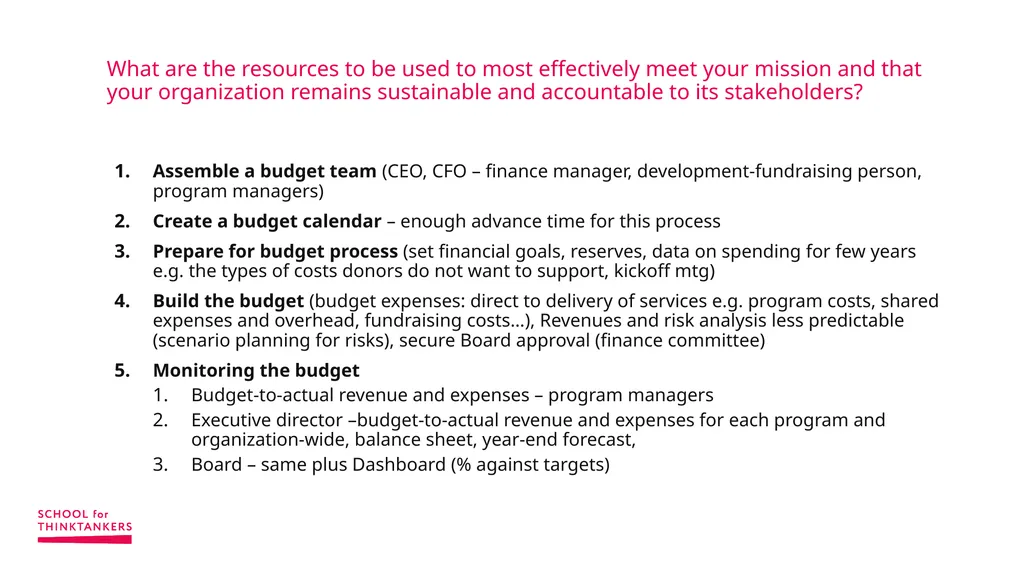
slide28. What are the resources to be used to most effectively meet your mission and that your organization remains sustainable and accountable to its stakeholders? Assemble a budget team (CEO, CFO – finance manager, development-fundraising person, program managers)
Create a budget calendar – enough advance time for this process
Prepare for budget process (set financial goals, reserves, data on spending for few years e.g. the types of costs donors do not want to support, kickoff mtg)
Build the budget (budget expenses: direct to delivery of services e.g. program costs, shared expenses and overhead, fundraising costs…), Revenues and risk analysis less predictable (scenario planning for risks), secure Board approval (finance committee)
Monitoring the budget
Budget-to-actual revenue and expenses – program managers
Executive director –budget-to-actual revenue and expenses for each program and organization-wide, balance sheet, year-end forecast,
Board – same plus Dashboard (% against targets)<br>
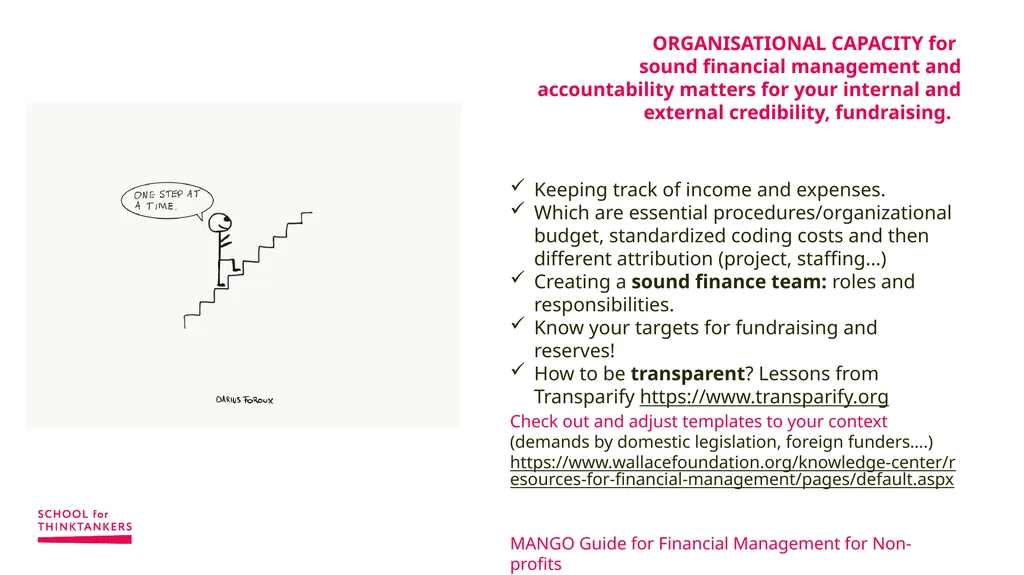
slide29. Keeping track of income and expenses.
Which are essential procedures/organizational budget, standardized coding costs and then different attribution (project, staffing…)
Creating a sound finance team: roles and responsibilities.
Know your targets for fundraising and reserves!
How to be transparent? Lessons from Transparify https://www.transparify.org
Check out and adjust templates to your context (demands by domestic legislation, foreign funders….)
https://www.wallacefoundation.org/knowledge-center/resources-for-financial-management/pages/default.aspx
MANGO Guide for Financial Management for Non-profits https://humentum.org/free-resources/guide/free-downloads? ORGANISATIONAL CAPACITY for
sound financial management and accountability matters for your internal and external credibility, fundraising.<br>
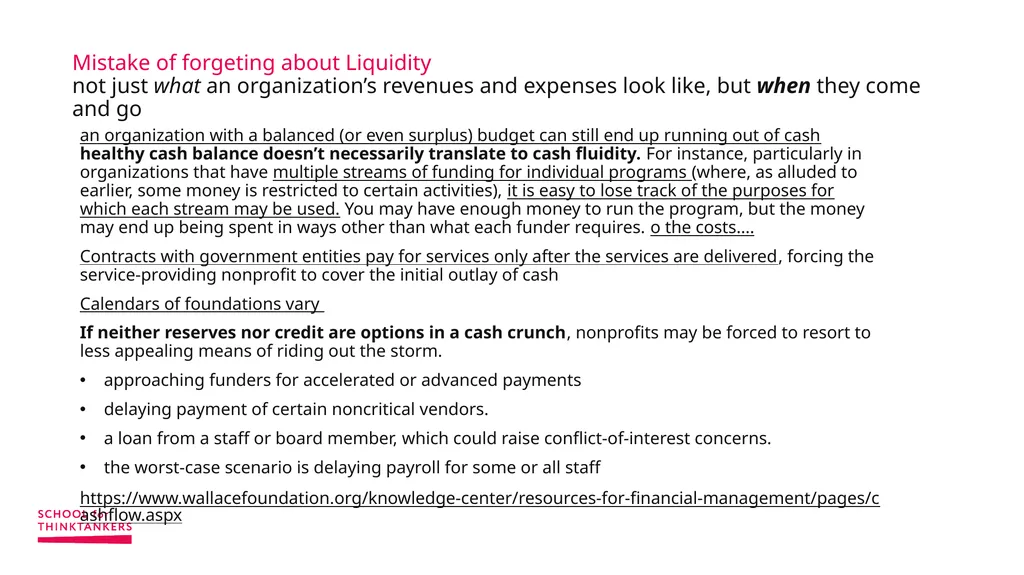
slide30. Mistake of forgeting about Liquidity not just what an organization’s revenues and expenses look like, but when they come and go an organization with a balanced (or even surplus) budget can still end up running out of cash healthy cash balance doesn’t necessarily translate to cash fluidity. For instance, particularly in organizations that have multiple streams of funding for individual programs (where, as alluded to earlier, some money is restricted to certain activities), it is easy to lose track of the purposes for which each stream may be used. You may have enough money to run the program, but the money may end up being spent in ways other than what each funder requires. o the costs….
Contracts with government entities pay for services only after the services are delivered, forcing the service-providing nonprofit to cover the initial outlay of cash
Calendars of foundations vary
If neither reserves nor credit are options in a cash crunch, nonprofits may be forced to resort to less appealing means of riding out the storm.
approaching funders for accelerated or advanced payments
delaying payment of certain noncritical vendors.
a loan from a staff or board member, which could raise conflict-of-interest concerns.
the worst-case scenario is delaying payroll for some or all staff
https://www.wallacefoundation.org/knowledge-center/resources-for-financial-management/pages/cashflow.aspx<br>
slide31. FINANCIAL MANAGEMENT AND LEADERSHIP DURING A CRISIS<br>
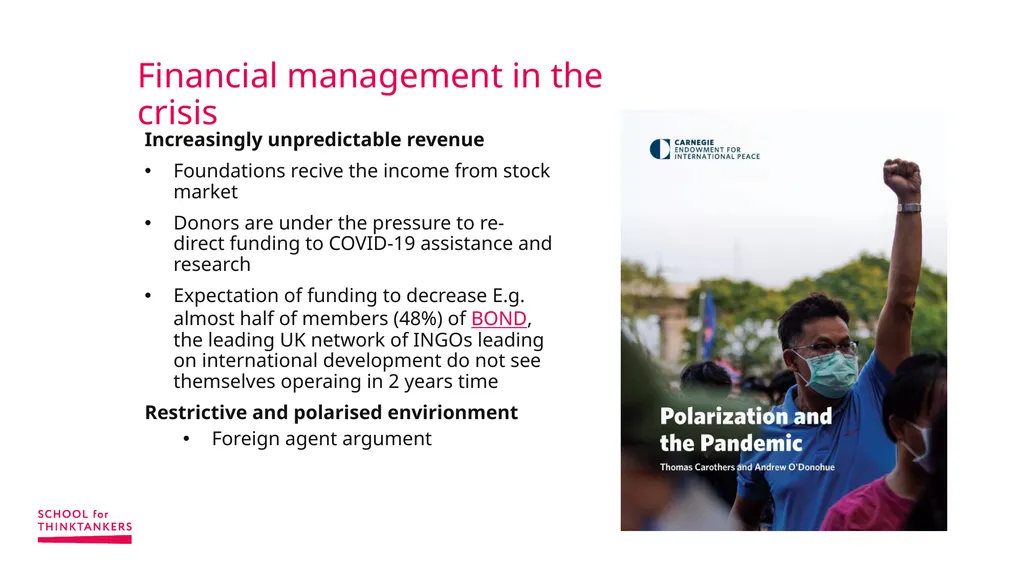
slide32. Financial management in the crisis Increasingly unpredictable revenue
Foundations recive the income from stock market
Donors are under the pressure to re-direct funding to COVID-19 assistance and research
Expectation of funding to decrease E.g. almost half of members (48%) of BOND, the leading UK network of INGOs leading on international development do not see themselves operaing in 2 years time
Restrictive and polarised envirionment
Foreign agent argument<br>
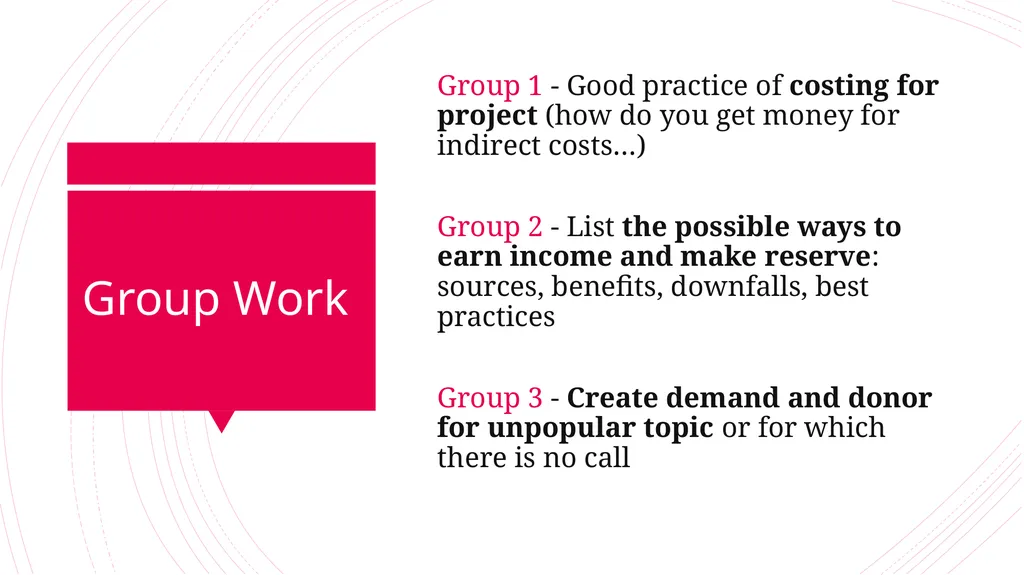
slide33. Group Work Group 1 - Good practice of costing for project (how do you get money for indirect costs…)
Group 2 - List the possible ways to earn income and make reserve: sources, benefits, downfalls, best practices
Group 3 - Create demand and donor for unpopular topic or for which there is no call<br>
slide34. USEFUL RESOURCES<br>
slide35. Recommended reading https://nonprofitquarterly.org/pizza-and-a-laugh-a-reminder-about-your-nonprofit-financial-stress-level/
On Think Tanks’s section devoted to funding for think tanks: www.onthinktanks.org/themes/funding-and-supporting-think-tanks
Nine webinars on sustainability https://onthinktanks.org/resources/nine-webinars-on-sustainability-for-think-tanks/ (recommend How to create a smart project budget for a think tank & Evidence-informed Fundraising Strategy)
Politics & Ideas has a collection of articles that are based on a series of online course on funding models, which were delivered to dozens of think tanks in 2015, 2016 and 2017: http://politicsandideas.org/tag/funding-model<br>
slide36. Recommended reading on nonprofit finance and crisis NPQ (2010) The Four Horsemen of Nonprofit Finance Apocalypse https://nonprofitquarterly.org/the-four-horsemen-of-the-nonprofit-financial-apocalypse
NPQ (2020) Sustanability to Survavibility: 5 Nonprofit Must-Do’s in the Time of COVID https://nonprofitquarterly.org/sustainability-to-survivability-nonprofit-finance-must-dos-in-the-time-of-covid
Cash Flow Nonprofit Model https://nonprofitquarterly.org/cash-flow-nonprofit-business-model-question-whats-whens
Bond – 4 ways funders are supporting NGOs https://www.bond.org.uk/news/2020/04/4-ways-funders-are-supporting-ngos-and-responding-to-coronavirus<br>
slide37. How to manage finances in nonprofits https://www.wallacefoundation.org/knowledge-center/financial-management-for-nonprofits/pages/default.aspx
MANGO Guide for Financial Management for Non-profits https://humentum.org/free-resources/guide/free-downloads?
Executive directors guide to financial leadership https://nonprofitquarterly.org/executive-directors-guide-financial-leadership-2
Financial stress forecasting tool https://onthinktanks.org/resources/think-tanks-stress-test-a-forecasting-tool/
Transparify - transparency of funding https://www.transparify.org/our-methodology<br>
slide38. Stay in touch Sonja Stojanović Gajić
Twitter: @StojanovicSonja
LinkedIn: @SonjaStojanovicGajic
Academia: https://ucl.academia.edu/SonjaStojanovicGajic
E-mail: sonja.stojanovic.gajic@outlook.com<br>
30 January 2023<br>
slide3. FOCUS FINANCIAL MANAGEMENT &
LEADERSHIP IN OLD NORMAL FINANCIAL HEALTH
IN THE CRISIS<br>
slide4. 4 Sonja Stojanovic Gajic
2006-2019 Director of Belgrade Centre for Security Policy (BCSP) and helped it transform from national NGO into the internationally recognized think tank on security policy
Mixed job description: management and programme
Self-educated manager - learned by doing it and leading an organisation through change process
Assisted also the organisations in East Europe, Middle East and Latin America<br>
slide5. BCSP budget over years in Euros The oldest organisation in the Western Balkans focussing on accountability of security institutions (police, military, intelligence….) since 1997
Among bigger ones in the region of South-East Europe – mid-income country<br>
slide6. How do you feel about finance management and fundraising?<br>
slide7. INTRO SURVEY https://docs.google.com/forms/d/e/1FAIpQLSdNiXbs3XZBPSzZQih34855dXeaKJ5sJU0ectKCj-GhBNBo-g/viewform<br>
slide8. Financial Suistanability is just a componet of Organizational Sustainability Organizational sustainability is not strictly a financial consideration;
Financial sustainability is only one of several factors contributing to a TT’s overall sustainability and resilience;<br>
slide9. Organizational Resilience 9 The greater the extent of internal vulnerabilities, an organization is the more at risk in increasingly hostile external environments.<br>
slide10. Pillars of Financial Management Business and Financial Model
Budgeting (costing, revenues and operating reserves)
Budget monitoring - cashflows
Operations: division of labour, responsibility and reporting
Accountability, transparency and integrity<br>
slide11. Difference between business and funding models<br>
slide14. Suistanability Matrix It is about finding the right mix for your organisation:
Fits your mission
Combination of sources and types of funding (not all eggs in one basket)
Allows you to do your core work (long, reasonable costs)
https://nonprofitquarterly.org/the-matrix-map-a-powerful-tool-for-mission-focused-nonprofits/<br>
slide15. The adaption to the external context is required to continue succeeding e.g.
What are sources of money to be found?
Policy environment: Is there demand for research?
Thinking about the Implications on:
human and other costs of running organisation: Research, Staff & Project Management, Communications, and Policy influence.
in the project market (partnerships, brand communication, quality control, transparency and strategic orientation)
in managing relationships with funders: balancing demands and interference (how to guarantee independence?)<br>
slide16. The Transformation of BCSP’s business and financial model to the context<br>
slide17. The Transformation of BCSP<br>
slide18. The context matters for funding opportunities POLICY ENVIRIONMENT: Is there demand for research and what is a competition?
A lot of media interest in security topics, but on wrong topics. Democratisation agenda is almost dead on donor’s agenda How to stay true to the mission?
FUNDING ENVIRIONMENT: Is there money to be found?
Foreign funding sources for civil society: the biggest is EU, but few cumbersome opportunities as it is very demanding for administration (co-funding demand, liquidity), Bilateral donors retreat from the Balkans except Kos & BiH. A number of small grants by individual foundations and embassies. De-legitimisation of foreign funded NGOs
Government funding: The biggest donor at the local level – non-transparent, funding technical & QUANGOs. Not any more independent oversight bodies (e.g. Anti-Corruption Agency, Ombudsperson) used to have transparent competition for NGO funding
Private/corporate funding for our policy area is limited and dubious
Increased opportunities for consultancy work and academic and international partnerships
Crowd-funding for think tanks is a terra incognita<br>
slide20. Revenues: Understanding the Options Gifts and Grants Here are some typical sources and pros and cons.<br>
slide21. 21 Funding Mix – Types of Revenues<br>
slide22. SUCCESSFUL FUNDING<br>
slide23. Is this Sustainable Think Tanks Financing? more steady flow of secured income - reliability
diverse funding sources, decreased dependence - diversification
more unrestricted income (reserves) - flexibility
ability to think and plan more long-term<br>
slide24. Under which conditions are we getting funds?
Relationship to mission: Does this source enhance or detract from your mission? Does it enhance or detract from your reputation?
Acceptable conditions: Whatever administrative, contractual and/or programmatic conditions are attached to funds, they should enable the think tank to do their policy work to the best of their abilities.
Independence: A basic condition of a good funding model is for it to guarantee that a think tank remains independent to govern itself and define its policy research agenda: deciding how to run the organisation, which issues to pursue, etc.
Transparency: A growing concern related to funding models has to do with being able to track the origin of funds that think tanks receive and the main conditions attached to them.
Visibility: Does this source have positive public relations or visibility benefits? What are the costs to our reputation and credibility?
What are the costs and investments required in relation to benefits:
Start-Up Costs: How difficult and costly is it to begin receiving income from this source?
Continuing Costs: How difficult and costly is it to obtain this source of revenue (staff time to perform work or report, infrastructure investment, etc.)
Organizational Capacity: Do you have the capacity (staff, infrastructure, financial, cultural) to develop and maintain this source?<br>
slide25. “What if pizza shops were funded like non-profits?”
https://youtu.be/-gELZnORV4U Lesson:
Make your organization’s matrix for
assessment of funding opportunities
Dillema:
Who should be in charge of fundraising: research or specialised person/team<br>
slide26. Lessons learned on budget structure Growth is not necessarily a good thing! Increased budget over years, but not operational budget same
Partnerships are both an opportunity (for longer programme research and advocacy and defense against attacks) and challenge to manage (coordination costs and high burden on financial staff of coordinator, co-funding requirements)<br>
slide27. A budget is your organization’s strategy expressed in currency. 1. Core organisational budget Salaries 23% Office costs 8% (11% with admin staff) 2. Program costs Capacity building 3% Comm/advertisement 1% Public opinion survey 2% Publications 7% Other activities 23% 3. Capacity-building and investment 4. Contingency Lesson: For balanced budget, you may will need the reserve or unrestricted funds!<br>
slide28. What are the resources to be used to most effectively meet your mission and that your organization remains sustainable and accountable to its stakeholders? Assemble a budget team (CEO, CFO – finance manager, development-fundraising person, program managers)
Create a budget calendar – enough advance time for this process
Prepare for budget process (set financial goals, reserves, data on spending for few years e.g. the types of costs donors do not want to support, kickoff mtg)
Build the budget (budget expenses: direct to delivery of services e.g. program costs, shared expenses and overhead, fundraising costs…), Revenues and risk analysis less predictable (scenario planning for risks), secure Board approval (finance committee)
Monitoring the budget
Budget-to-actual revenue and expenses – program managers
Executive director –budget-to-actual revenue and expenses for each program and organization-wide, balance sheet, year-end forecast,
Board – same plus Dashboard (% against targets)<br>
slide29. Keeping track of income and expenses.
Which are essential procedures/organizational budget, standardized coding costs and then different attribution (project, staffing…)
Creating a sound finance team: roles and responsibilities.
Know your targets for fundraising and reserves!
How to be transparent? Lessons from Transparify https://www.transparify.org
Check out and adjust templates to your context (demands by domestic legislation, foreign funders….)
https://www.wallacefoundation.org/knowledge-center/resources-for-financial-management/pages/default.aspx
MANGO Guide for Financial Management for Non-profits https://humentum.org/free-resources/guide/free-downloads? ORGANISATIONAL CAPACITY for
sound financial management and accountability matters for your internal and external credibility, fundraising.<br>
slide30. Mistake of forgeting about Liquidity not just what an organization’s revenues and expenses look like, but when they come and go an organization with a balanced (or even surplus) budget can still end up running out of cash healthy cash balance doesn’t necessarily translate to cash fluidity. For instance, particularly in organizations that have multiple streams of funding for individual programs (where, as alluded to earlier, some money is restricted to certain activities), it is easy to lose track of the purposes for which each stream may be used. You may have enough money to run the program, but the money may end up being spent in ways other than what each funder requires. o the costs….
Contracts with government entities pay for services only after the services are delivered, forcing the service-providing nonprofit to cover the initial outlay of cash
Calendars of foundations vary
If neither reserves nor credit are options in a cash crunch, nonprofits may be forced to resort to less appealing means of riding out the storm.
approaching funders for accelerated or advanced payments
delaying payment of certain noncritical vendors.
a loan from a staff or board member, which could raise conflict-of-interest concerns.
the worst-case scenario is delaying payroll for some or all staff
https://www.wallacefoundation.org/knowledge-center/resources-for-financial-management/pages/cashflow.aspx<br>
slide31. FINANCIAL MANAGEMENT AND LEADERSHIP DURING A CRISIS<br>
slide32. Financial management in the crisis Increasingly unpredictable revenue
Foundations recive the income from stock market
Donors are under the pressure to re-direct funding to COVID-19 assistance and research
Expectation of funding to decrease E.g. almost half of members (48%) of BOND, the leading UK network of INGOs leading on international development do not see themselves operaing in 2 years time
Restrictive and polarised envirionment
Foreign agent argument<br>
slide33. Group Work Group 1 - Good practice of costing for project (how do you get money for indirect costs…)
Group 2 - List the possible ways to earn income and make reserve: sources, benefits, downfalls, best practices
Group 3 - Create demand and donor for unpopular topic or for which there is no call<br>
slide34. USEFUL RESOURCES<br>
slide35. Recommended reading https://nonprofitquarterly.org/pizza-and-a-laugh-a-reminder-about-your-nonprofit-financial-stress-level/
On Think Tanks’s section devoted to funding for think tanks: www.onthinktanks.org/themes/funding-and-supporting-think-tanks
Nine webinars on sustainability https://onthinktanks.org/resources/nine-webinars-on-sustainability-for-think-tanks/ (recommend How to create a smart project budget for a think tank & Evidence-informed Fundraising Strategy)
Politics & Ideas has a collection of articles that are based on a series of online course on funding models, which were delivered to dozens of think tanks in 2015, 2016 and 2017: http://politicsandideas.org/tag/funding-model<br>
slide36. Recommended reading on nonprofit finance and crisis NPQ (2010) The Four Horsemen of Nonprofit Finance Apocalypse https://nonprofitquarterly.org/the-four-horsemen-of-the-nonprofit-financial-apocalypse
NPQ (2020) Sustanability to Survavibility: 5 Nonprofit Must-Do’s in the Time of COVID https://nonprofitquarterly.org/sustainability-to-survivability-nonprofit-finance-must-dos-in-the-time-of-covid
Cash Flow Nonprofit Model https://nonprofitquarterly.org/cash-flow-nonprofit-business-model-question-whats-whens
Bond – 4 ways funders are supporting NGOs https://www.bond.org.uk/news/2020/04/4-ways-funders-are-supporting-ngos-and-responding-to-coronavirus<br>
slide37. How to manage finances in nonprofits https://www.wallacefoundation.org/knowledge-center/financial-management-for-nonprofits/pages/default.aspx
MANGO Guide for Financial Management for Non-profits https://humentum.org/free-resources/guide/free-downloads?
Executive directors guide to financial leadership https://nonprofitquarterly.org/executive-directors-guide-financial-leadership-2
Financial stress forecasting tool https://onthinktanks.org/resources/think-tanks-stress-test-a-forecasting-tool/
Transparify - transparency of funding https://www.transparify.org/our-methodology<br>
slide38. Stay in touch Sonja Stojanović Gajić
Twitter: @StojanovicSonja
LinkedIn: @SonjaStojanovicGajic
Academia: https://ucl.academia.edu/SonjaStojanovicGajic
E-mail: sonja.stojanovic.gajic@outlook.com<br>