04
Learning Outcomes: Merchandising Business 7.1: Identify issues unique to merchandising companies
7.1.1: Compare and contrast merchandising enterprises and service providers
7.1.2: Define merchandise inventory
7.1.3: Describe cost of goods sold in relation to the matching principles
7.1.4: Define gross profit and gross profit percentage<br>
05
Merchandisers versus Service Enterprises Merchandising businesses, unlike service businesses have inventory. Inventory is goods for sale during the ordinary course of business.
Manufacturing business have inventory as well: raw materials, work-in-process and finished goods.<br>
06
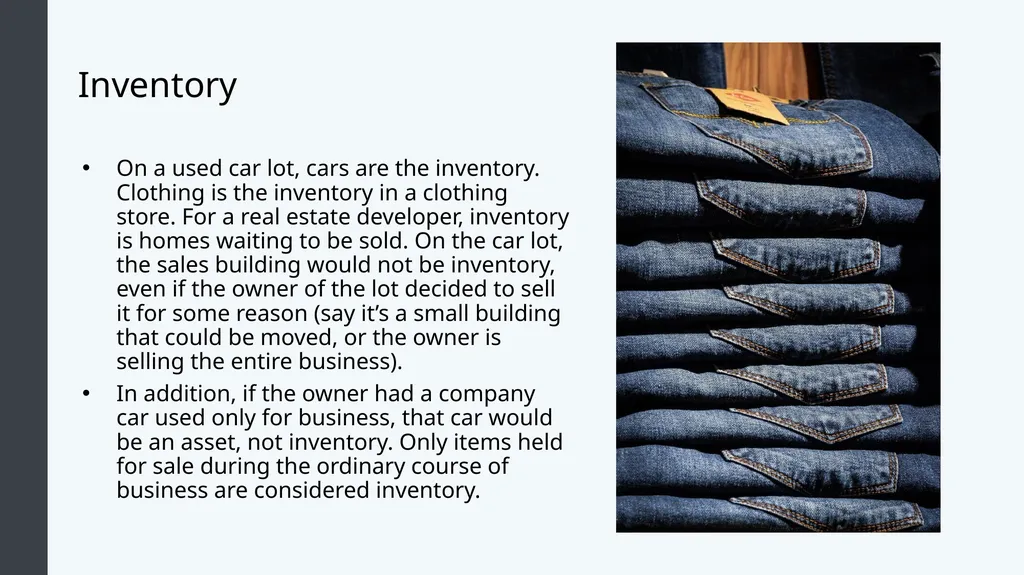
Inventory On a used car lot, cars are the inventory. Clothing is the inventory in a clothing store. For a real estate developer, inventory is homes waiting to be sold. On the car lot, the sales building would not be inventory, even if the owner of the lot decided to sell it for some reason (say it’s a small building that could be moved, or the owner is selling the entire business).
In addition, if the owner had a company car used only for business, that car would be an asset, not inventory. Only items held for sale during the ordinary course of business are considered inventory.<br>
07
Cost of Goods Sold Under accrual basis accounting, we recognize revenue as it is earned and expenses as they are incurred in order to match those expenses with the revenue. It means when we buy inventory, and it is sitting on the lot, lying on the shelf, or hanging on a rack, it is not an expense.
Inventory is not recorded as an expense when we buy it from the wholesaler or distributor. It is an asset: something we own that will produce future revenue.
Under the matching principle, we record the expense when we recognize the revenue from the sale of inventory.
Cost of Goods Sold = Beginning Inventory + Purchases - Ending Inventory<br>
08
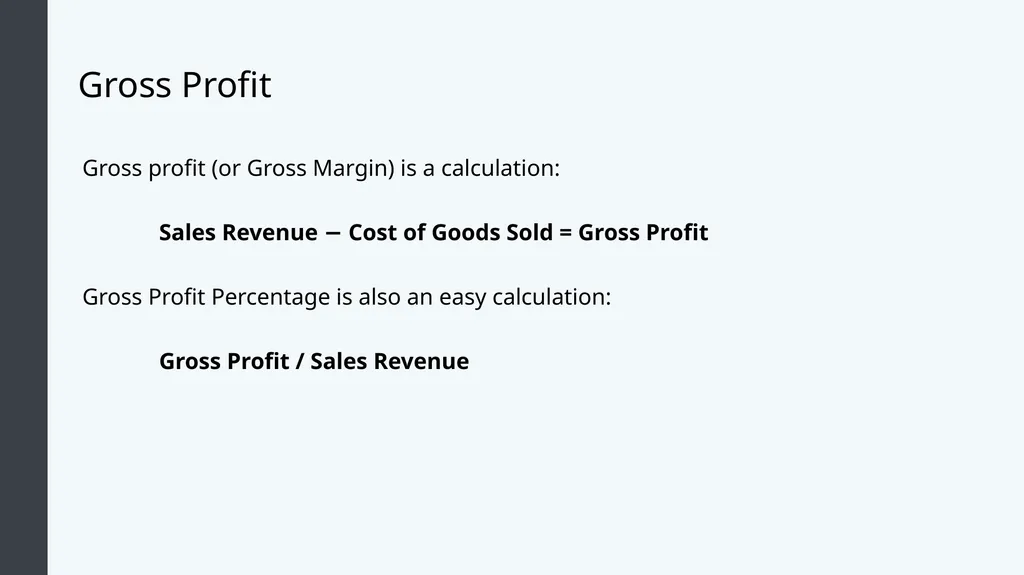
Gross Profit Gross profit (or Gross Margin) is a calculation:
Sales Revenue − Cost of Goods Sold = Gross Profit
Gross Profit Percentage is also an easy calculation:
Gross Profit / Sales Revenue<br>
09
The Warm Tootsies company sells socks in bulk. This year the company had a total in sales of $350,000, with the cost of goods sold being $225,000 and the company’s operating expenses at $50,000. What is the gross profit and the gross profit percentage for the company?
$125,000 gross profit : 36% gross profit percentage
$75,000 gross profit : 21% gross profit percentage
$175,000 gross profit : 50% gross profit percentage
$300,000 gross profit : 86% gross profit percentage Practice Question 1<br>
10
Periodic Inventory System<br>
11
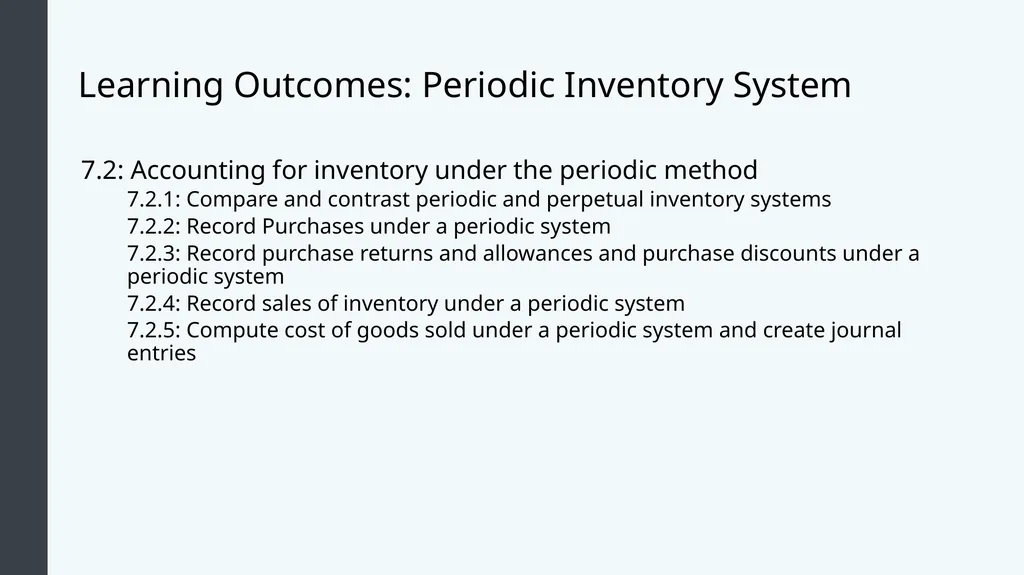
Learning Outcomes: Periodic Inventory System 7.2: Accounting for inventory under the periodic method
7.2.1: Compare and contrast periodic and perpetual inventory systems
7.2.2: Record Purchases under a periodic system
7.2.3: Record purchase returns and allowances and purchase discounts under a periodic system
7.2.4: Record sales of inventory under a periodic system
7.2.5: Compute cost of goods sold under a periodic system and create journal entries<br>
12
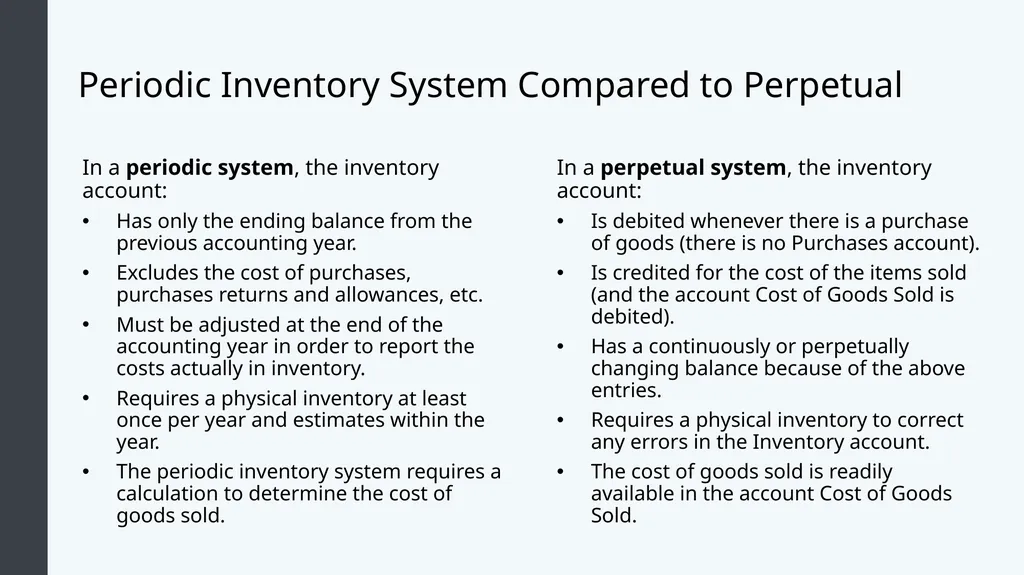
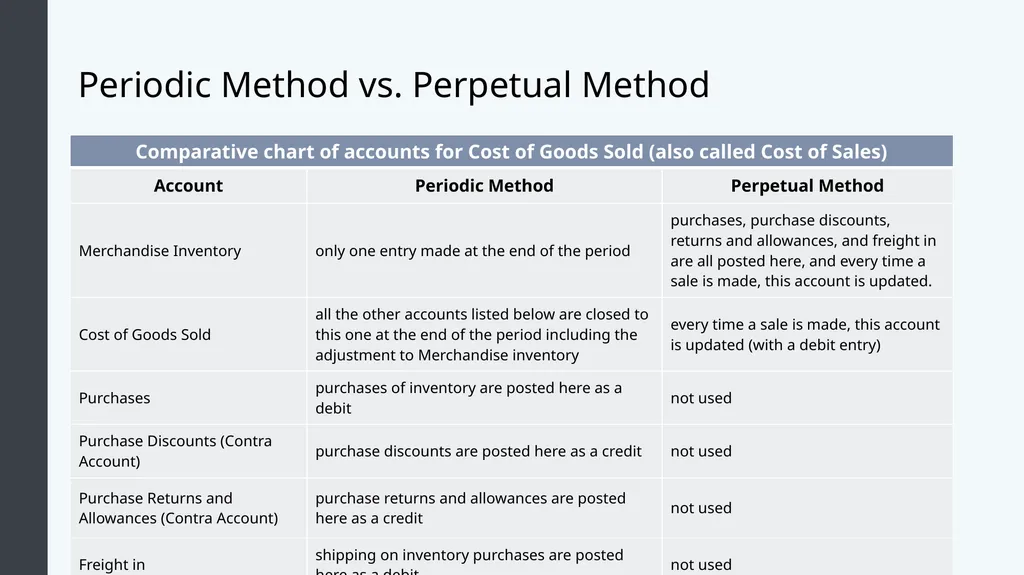
Periodic Inventory System Compared to Perpetual In a periodic system, the inventory account:
Has only the ending balance from the previous accounting year.
Excludes the cost of purchases, purchases returns and allowances, etc.
Must be adjusted at the end of the accounting year in order to report the costs actually in inventory.
Requires a physical inventory at least once per year and estimates within the year.
The periodic inventory system requires a calculation to determine the cost of goods sold. In a perpetual system, the inventory account:
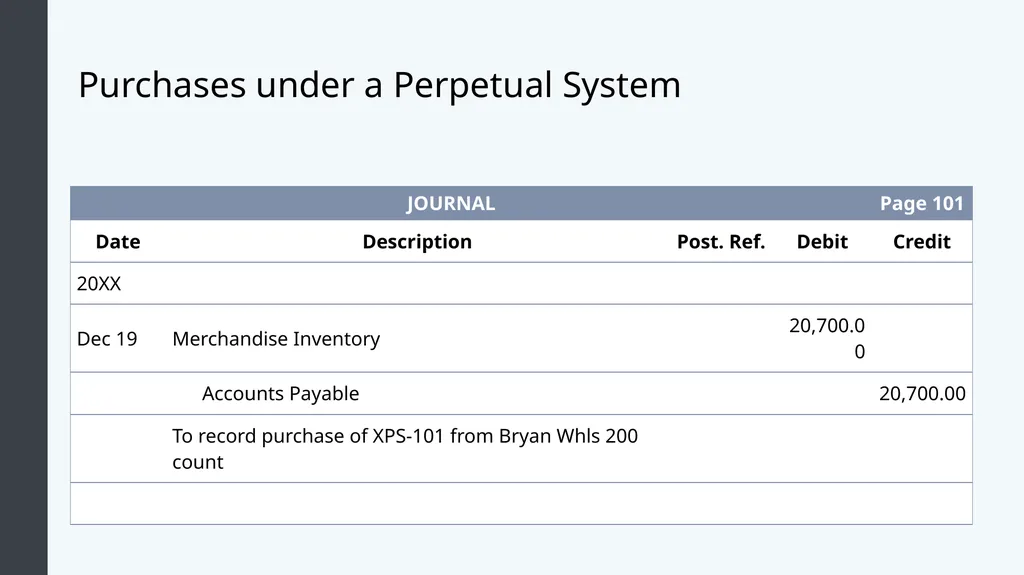
Is debited whenever there is a purchase of goods (there is no Purchases account).
Is credited for the cost of the items sold (and the account Cost of Goods Sold is debited).
Has a continuously or perpetually changing balance because of the above entries.
Requires a physical inventory to correct any errors in the Inventory account.
The cost of goods sold is readily available in the account Cost of Goods Sold.<br>
13
Purchases under a Periodic System Companies using periodic inventory don’t update the Merchandise Inventory account when purchases or sales are made. Instead, the company posts purchases of inventory to an expense account called Purchases.
The Purchases account is usually grouped with the income statement expense accounts in the chart of accounts.<br>
14
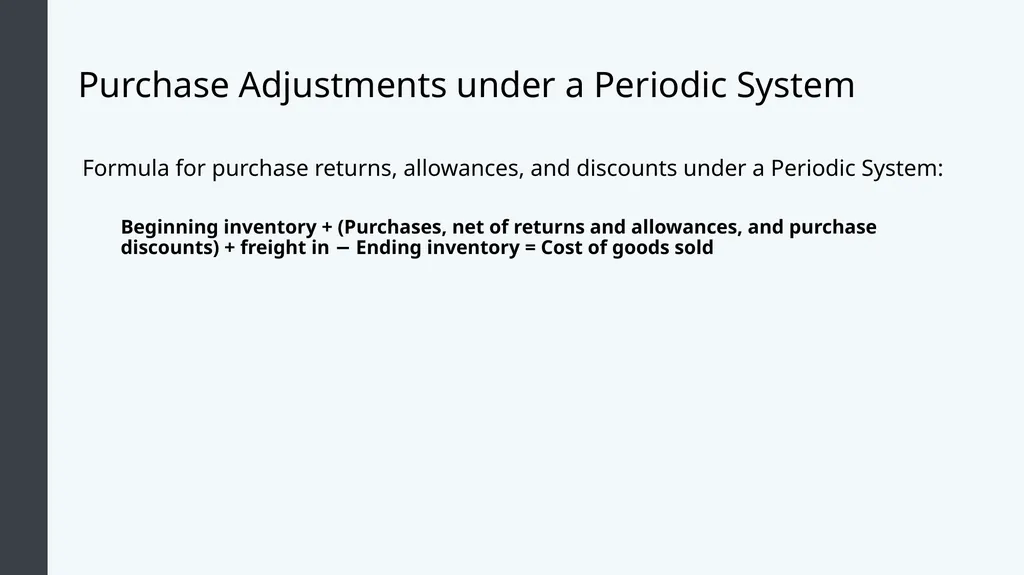
Purchase Adjustments under a Periodic System Formula for purchase returns, allowances, and discounts under a Periodic System:
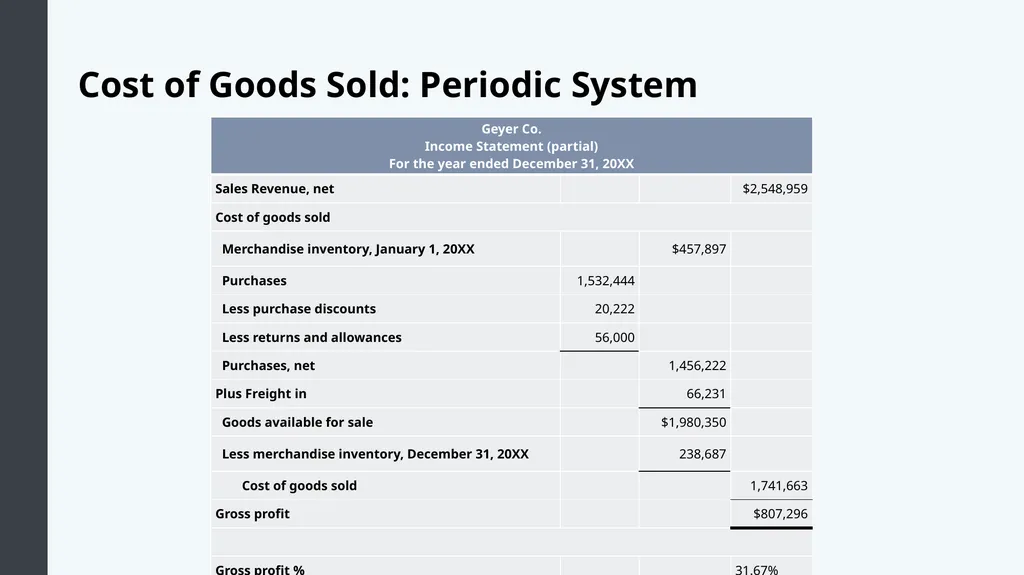
Beginning inventory + (Purchases, net of returns and allowances, and purchase discounts) + freight in − Ending inventory = Cost of goods sold<br>
15
Periodic Method vs. Perpetual Method<br>
16
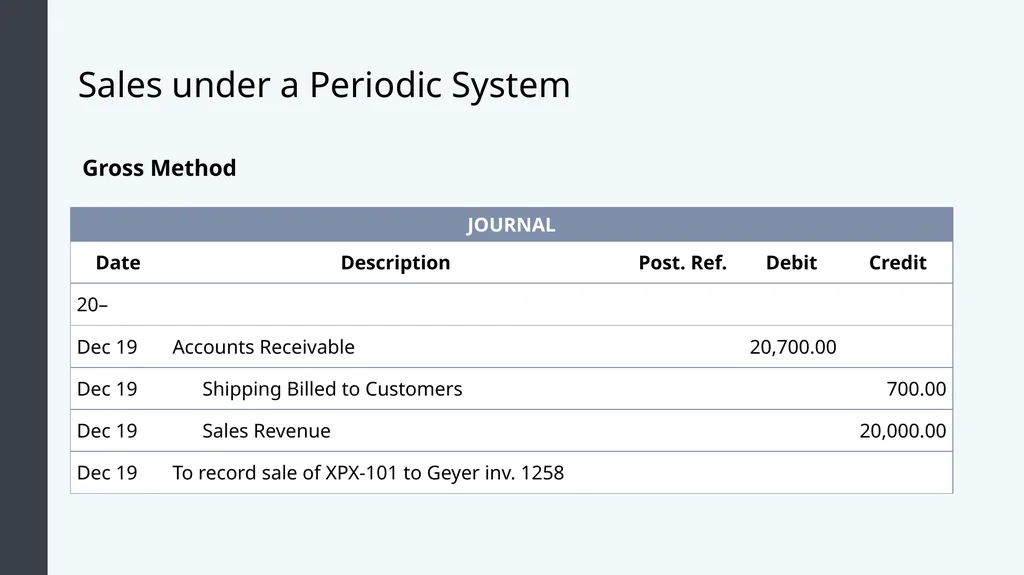
Sales under a Periodic System Gross Method<br>
17
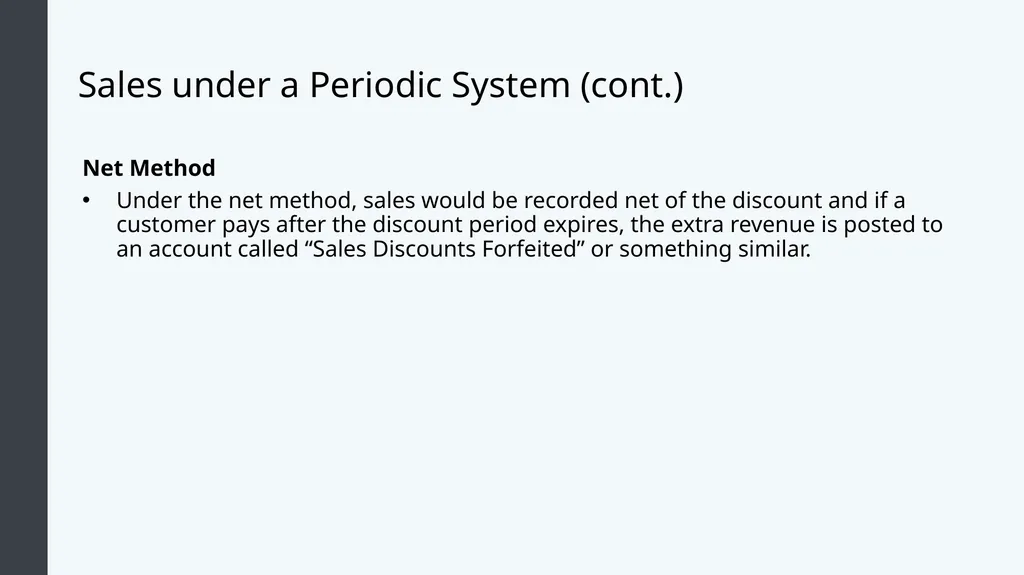
Sales under a Periodic System (cont.) Net Method
Under the net method, sales would be recorded net of the discount and if a customer pays after the discount period expires, the extra revenue is posted to an account called “Sales Discounts Forfeited” or something similar.<br>
18
Cost of Goods Sold: Periodic System<br>
19
Perpetual Inventory System<br>
20
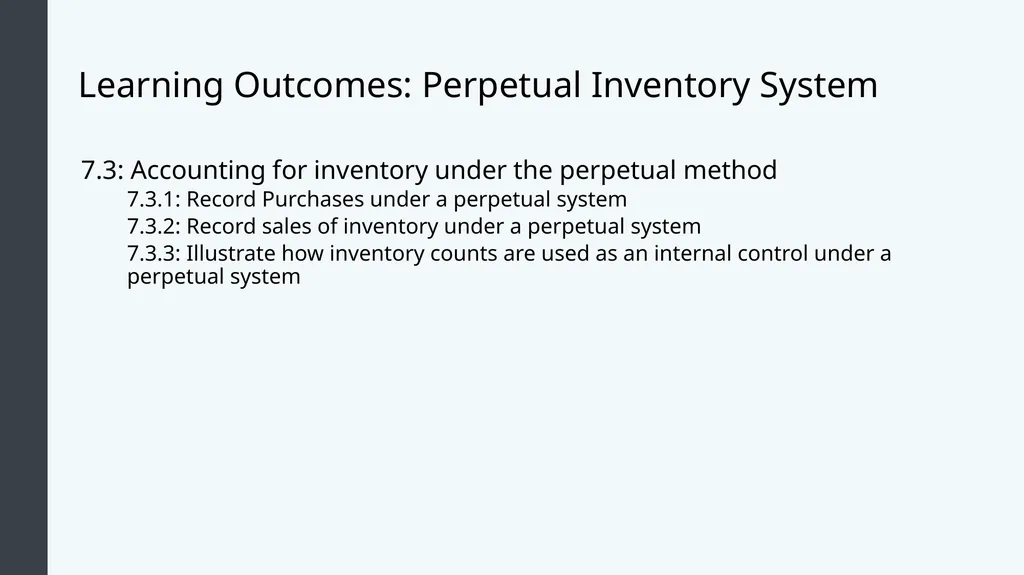
Learning Outcomes: Perpetual Inventory System 7.3: Accounting for inventory under the perpetual method
7.3.1: Record Purchases under a perpetual system
7.3.2: Record sales of inventory under a perpetual system
7.3.3: Illustrate how inventory counts are used as an internal control under a perpetual system<br>
21
Perpetual and Periodic Inventory Systems<br>
22
Purchases under a Perpetual System<br>
23
Purchases under a Perpetual System (cont.)<br>
24
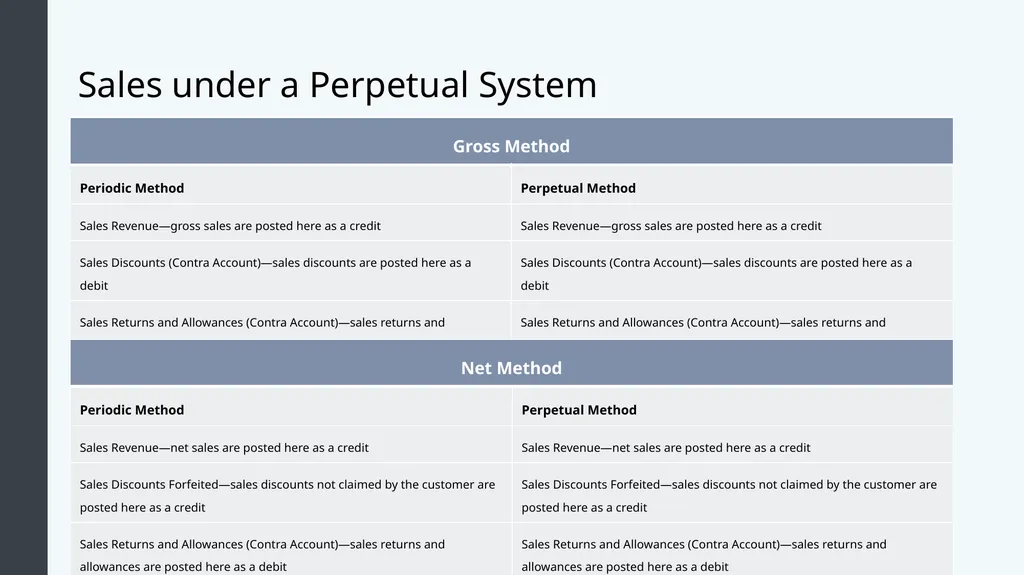
Sales under a Perpetual System<br>
25
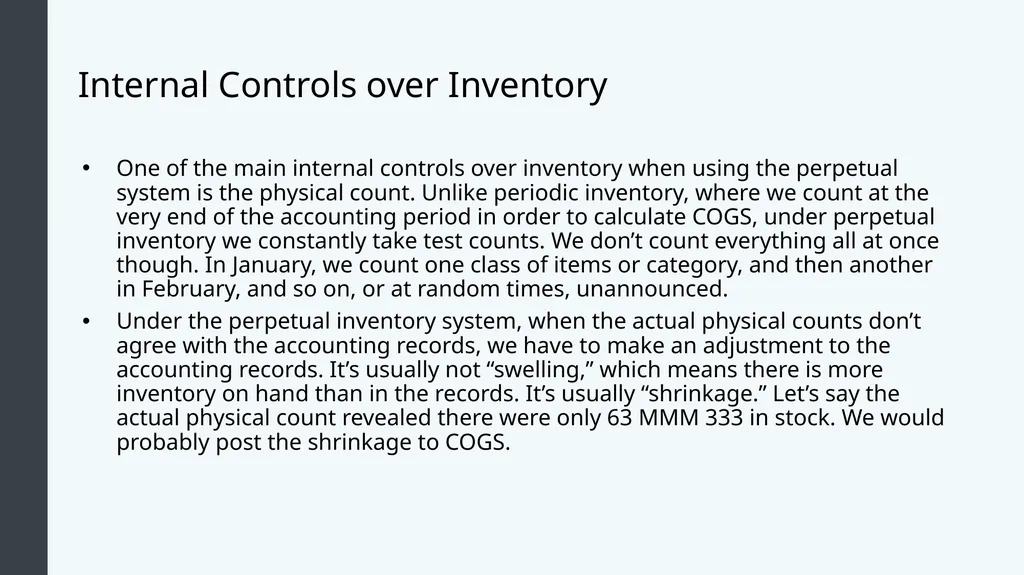
Internal Controls over Inventory One of the main internal controls over inventory when using the perpetual system is the physical count. Unlike periodic inventory, where we count at the very end of the accounting period in order to calculate COGS, under perpetual inventory we constantly take test counts. We don’t count everything all at once though. In January, we count one class of items or category, and then another in February, and so on, or at random times, unannounced.
Under the perpetual inventory system, when the actual physical counts don’t agree with the accounting records, we have to make an adjustment to the accounting records. It’s usually not “swelling,” which means there is more inventory on hand than in the records. It’s usually “shrinkage.” Let’s say the actual physical count revealed there were only 63 MMM 333 in stock. We would probably post the shrinkage to COGS.<br>
26
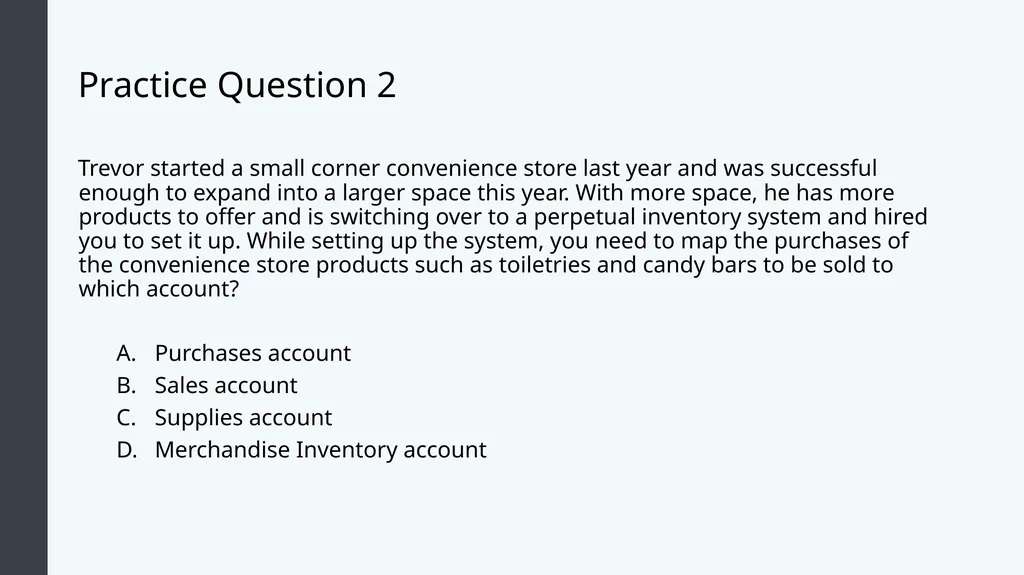
Practice Question 2 Trevor started a small corner convenience store last year and was successful enough to expand into a larger space this year. With more space, he has more products to offer and is switching over to a perpetual inventory system and hired you to set it up. While setting up the system, you need to map the purchases of the convenience store products such as toiletries and candy bars to be sold to which account?
Purchases account
Sales account
Supplies account
Merchandise Inventory account<br>
27
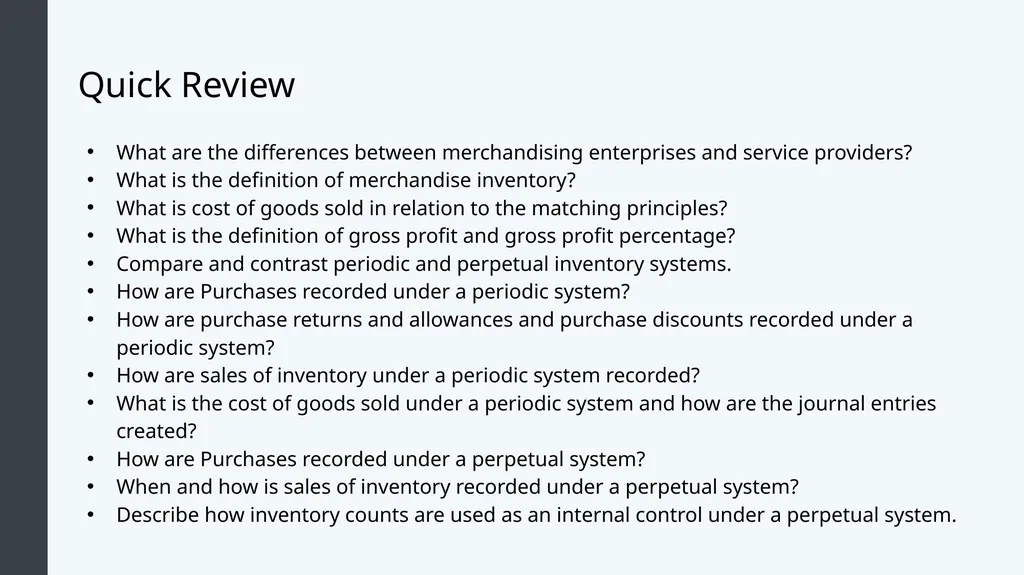
Quick Review What are the differences between merchandising enterprises and service providers?
What is the definition of merchandise inventory?
What is cost of goods sold in relation to the matching principles?
What is the definition of gross profit and gross profit percentage?
Compare and contrast periodic and perpetual inventory systems.
How are Purchases recorded under a periodic system?
How are purchase returns and allowances and purchase discounts recorded under a periodic system?
How are sales of inventory under a periodic system recorded?
What is the cost of goods sold under a periodic system and how are the journal entries created?
How are Purchases recorded under a perpetual system?
When and how is sales of inventory recorded under a perpetual system?
Describe how inventory counts are used as an internal control under a perpetual system.<br>