
FINANCIAL EDUCATION PROGRAMME FOR ADULTS (FEPA)
KL
Published · 46 slides · 0 views
1 / 1



Description
FINANCIAL EDUCATION PROGRAMME FOR ADULTS (FEPA) About NCFE VISION A financially aware and empowered India. MISSION To undertake massive Financial Education campaign to help people manage money more effectively to achieve financial well
Related Topics
Share
Embed code
Download this presentation From Below
"FINANCIAL EDUCATION PROGRAMME FOR ADULTS (FEPA)" is the property of its rightful owner. Permission is granted to download and print the materials on this website for personal, non-commercial use only, and to display it on your personal computer provided you do not modify the materials and that you retain all copyright notices contained in the materials. By downloading content from our website, you accept the terms of this agreement.
Presentation Transcript
01
FINANCIAL EDUCATION PROGRAMME FOR ADULTS (FEPA)<br>
02
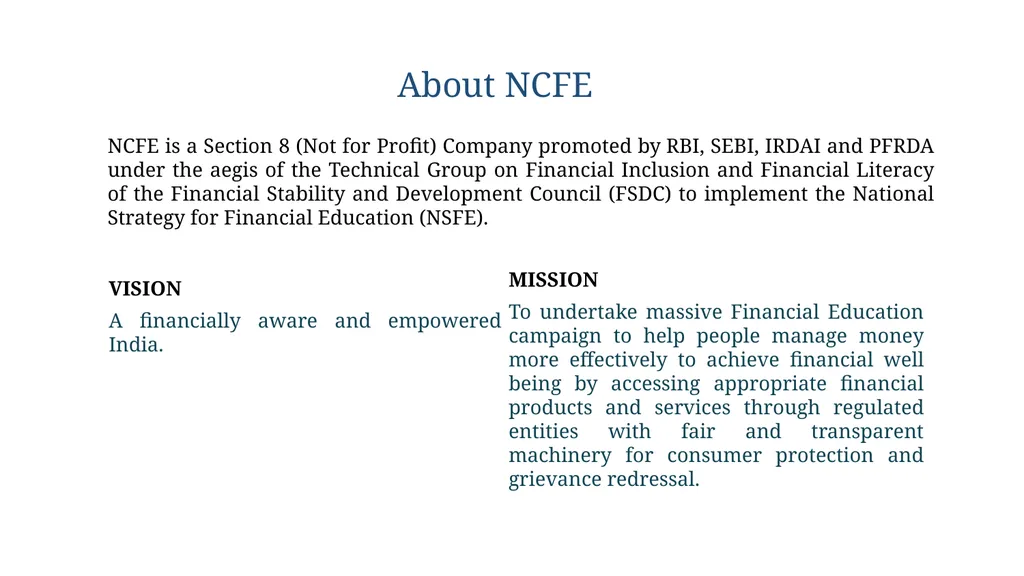
About NCFE VISION
A financially aware and empowered India. MISSION
To undertake massive Financial Education campaign to help people manage money more effectively to achieve financial well being by accessing appropriate financial products and services through regulated entities with fair and transparent machinery for consumer protection and grievance redressal. NCFE is a Section 8 (Not for Profit) Company promoted by RBI, SEBI, IRDAI and PFRDA under the aegis of the Technical Group on Financial Inclusion and Financial Literacy of the Financial Stability and Development Council (FSDC) to implement the National Strategy for Financial Education (NSFE).<br>
A financially aware and empowered India. MISSION
To undertake massive Financial Education campaign to help people manage money more effectively to achieve financial well being by accessing appropriate financial products and services through regulated entities with fair and transparent machinery for consumer protection and grievance redressal. NCFE is a Section 8 (Not for Profit) Company promoted by RBI, SEBI, IRDAI and PFRDA under the aegis of the Technical Group on Financial Inclusion and Financial Literacy of the Financial Stability and Development Council (FSDC) to implement the National Strategy for Financial Education (NSFE).<br>
03
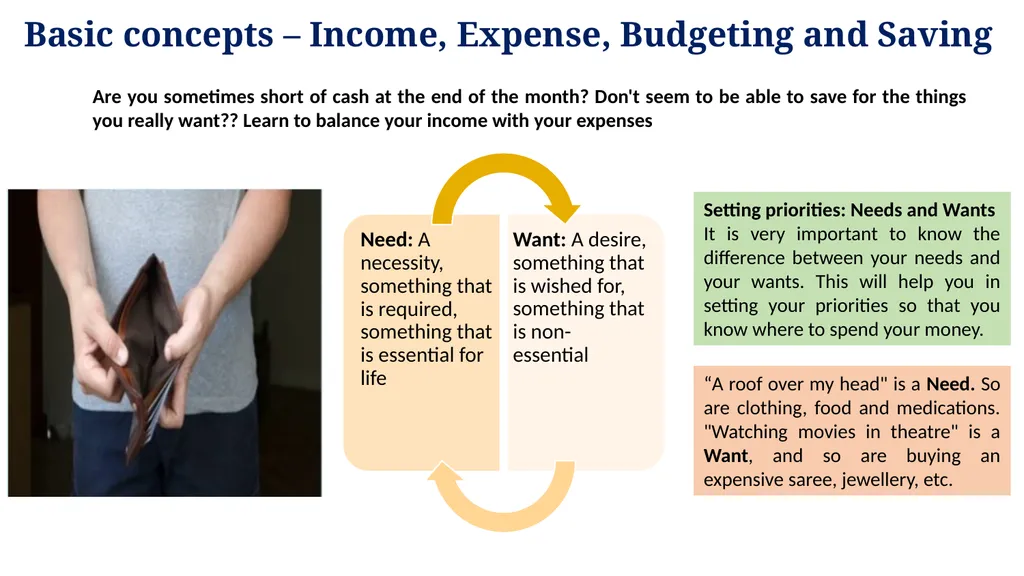
Basic concepts – Income, Expense, Budgeting and Saving Are you sometimes short of cash at the end of the month? Don't seem to be able to save for the things you really want?? Learn to balance your income with your expenses Setting priorities: Needs and Wants
It is very important to know the difference between your needs and your wants. This will help you in setting your priorities so that you know where to spend your money. “A roof over my head" is a Need. So are clothing, food and medications. "Watching movies in theatre" is a Want, and so are buying an expensive saree, jewellery, etc.<br>
It is very important to know the difference between your needs and your wants. This will help you in setting your priorities so that you know where to spend your money. “A roof over my head" is a Need. So are clothing, food and medications. "Watching movies in theatre" is a Want, and so are buying an expensive saree, jewellery, etc.<br>
04
Income and Expenses Income :
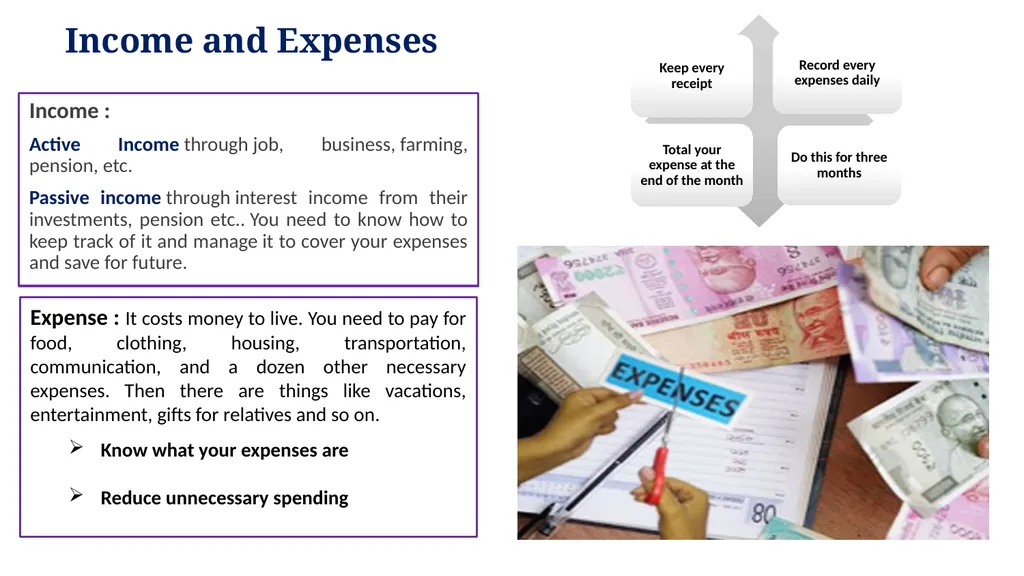
Active Income through job, business, farming, pension, etc.
Passive income through interest income from their investments, pension etc.. You need to know how to keep track of it and manage it to cover your expenses and save for future. Expense : It costs money to live. You need to pay for food, clothing, housing, transportation, communication, and a dozen other necessary expenses. Then there are things like vacations, entertainment, gifts for relatives and so on.
Know what your expenses are
Reduce unnecessary spending<br>
Active Income through job, business, farming, pension, etc.
Passive income through interest income from their investments, pension etc.. You need to know how to keep track of it and manage it to cover your expenses and save for future. Expense : It costs money to live. You need to pay for food, clothing, housing, transportation, communication, and a dozen other necessary expenses. Then there are things like vacations, entertainment, gifts for relatives and so on.
Know what your expenses are
Reduce unnecessary spending<br>
05
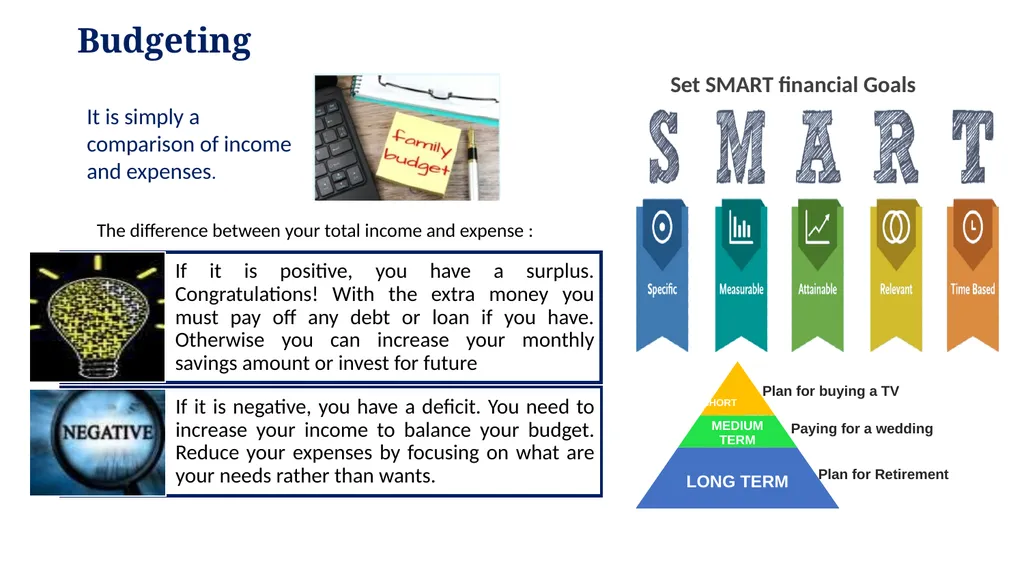
Budgeting Set SMART financial Goals Plan for Retirement Paying for a wedding Plan for buying a TV It is simply a comparison of income and expenses. The difference between your total income and expense :<br>
06
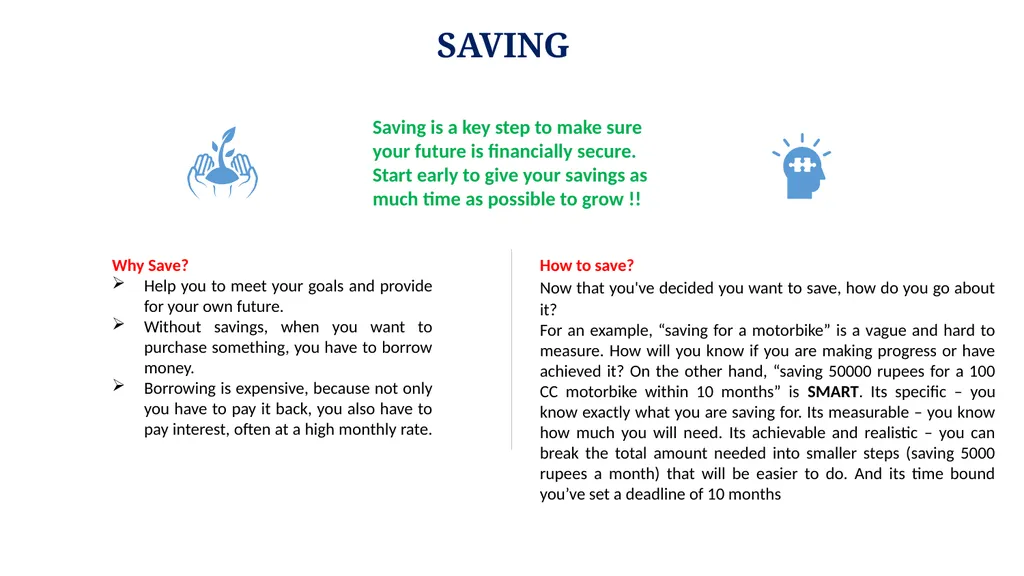
SAVING Why Save?
Help you to meet your goals and provide for your own future.
Without savings, when you want to purchase something, you have to borrow money.
Borrowing is expensive, because not only you have to pay it back, you also have to pay interest, often at a high monthly rate. How to save?
Now that you've decided you want to save, how do you go about it?
For an example, “saving for a motorbike” is a vague and hard to measure. How will you know if you are making progress or have achieved it? On the other hand, “saving 50000 rupees for a 100 CC motorbike within 10 months” is SMART. Its specific – you know exactly what you are saving for. Its measurable – you know how much you will need. Its achievable and realistic – you can break the total amount needed into smaller steps (saving 5000 rupees a month) that will be easier to do. And its time bound you’ve set a deadline of 10 months Saving is a key step to make sure your future is financially secure. Start early to give your savings as much time as possible to grow !!<br>
Help you to meet your goals and provide for your own future.
Without savings, when you want to purchase something, you have to borrow money.
Borrowing is expensive, because not only you have to pay it back, you also have to pay interest, often at a high monthly rate. How to save?
Now that you've decided you want to save, how do you go about it?
For an example, “saving for a motorbike” is a vague and hard to measure. How will you know if you are making progress or have achieved it? On the other hand, “saving 50000 rupees for a 100 CC motorbike within 10 months” is SMART. Its specific – you know exactly what you are saving for. Its measurable – you know how much you will need. Its achievable and realistic – you can break the total amount needed into smaller steps (saving 5000 rupees a month) that will be easier to do. And its time bound you’ve set a deadline of 10 months Saving is a key step to make sure your future is financially secure. Start early to give your savings as much time as possible to grow !!<br>
07
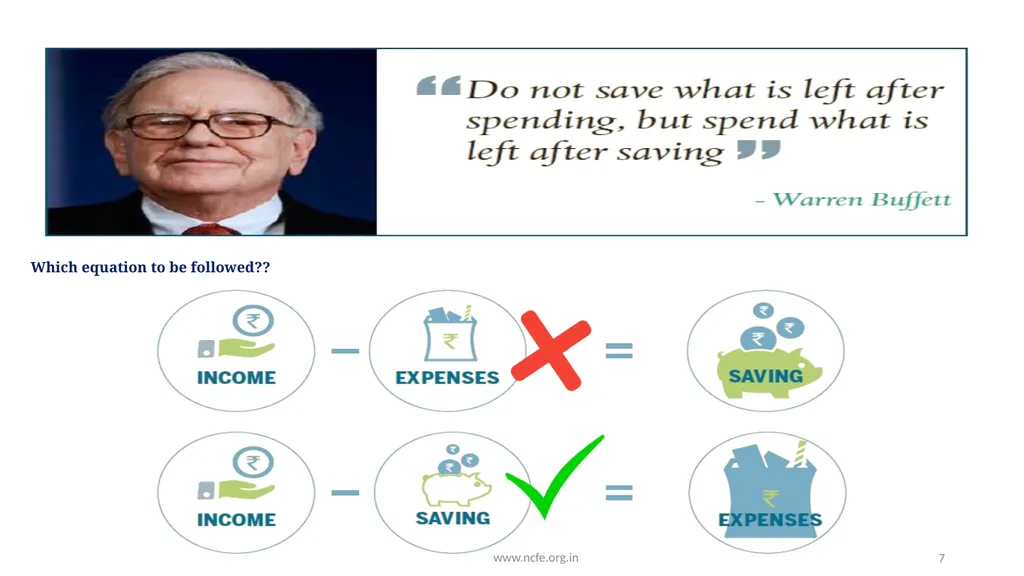
Which equation to be followed?? www.ncfe.org.in 7<br>
08
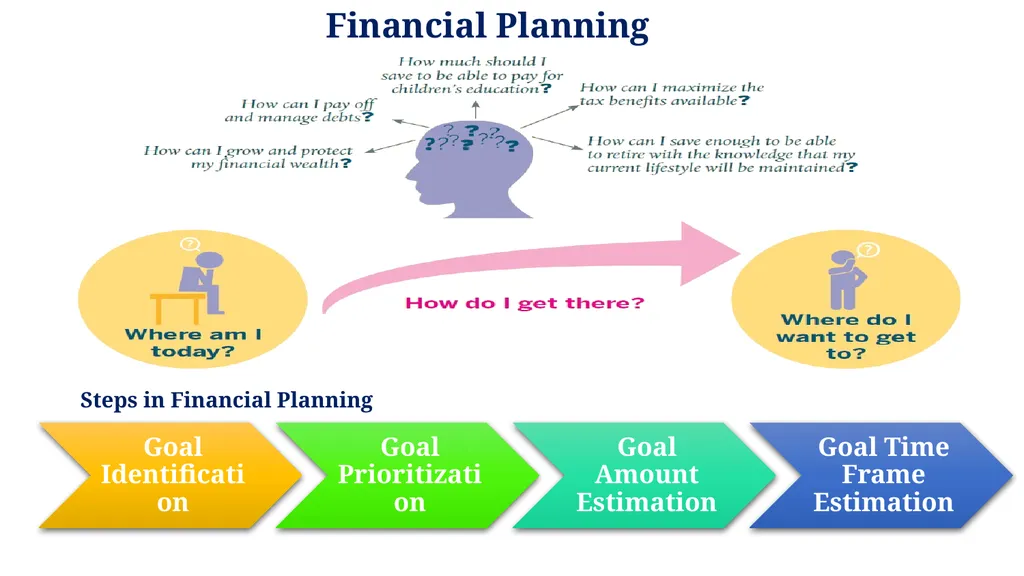
Financial Planning Steps in Financial Planning www.ncfe.org.in 8<br>
09
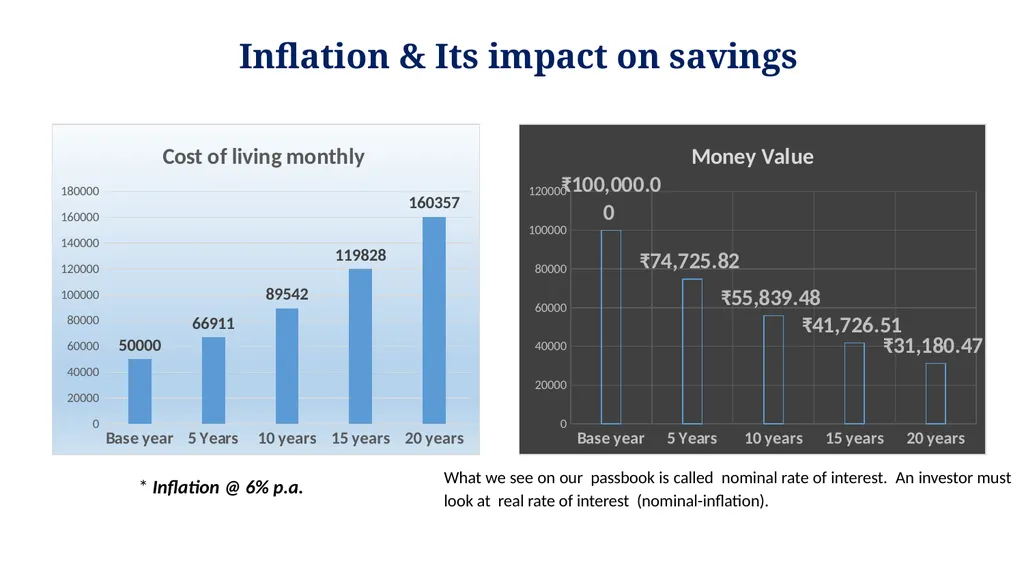
Inflation & Its impact on savings * Inflation @ 6% p.a. What we see on our passbook is called nominal rate of interest. An investor must look at real rate of interest (nominal-inflation).<br>
10
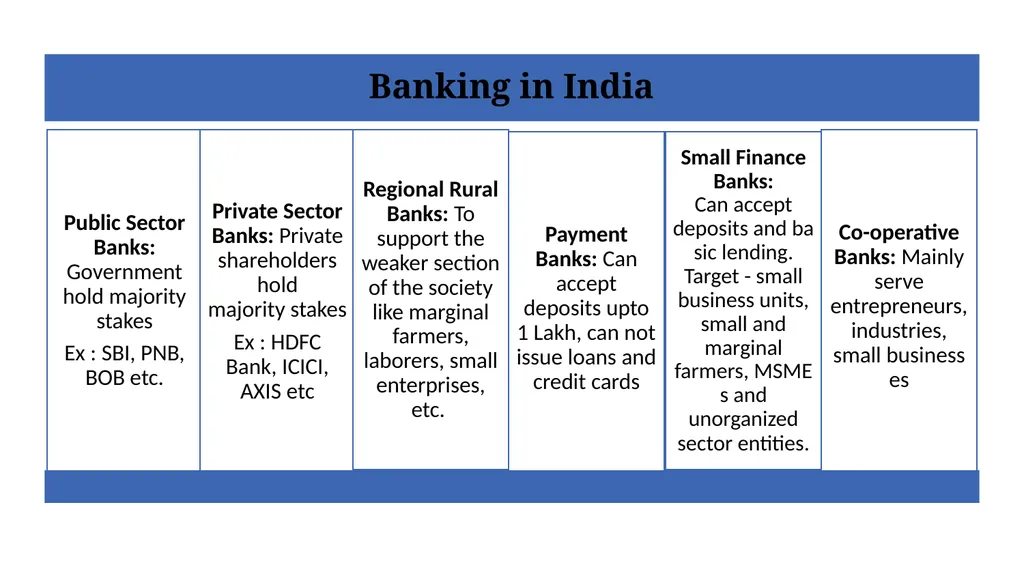
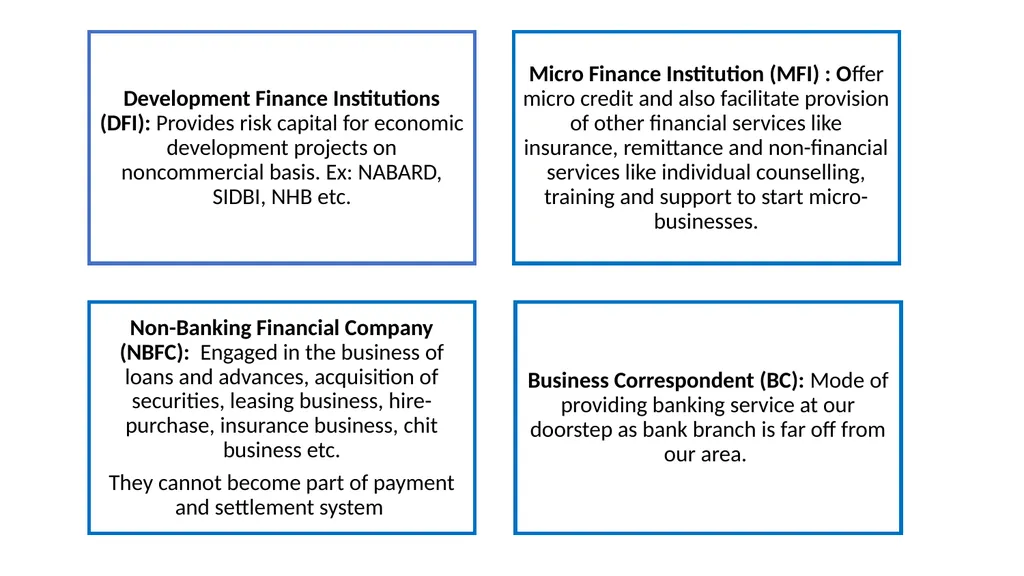
BANKING Secure Money
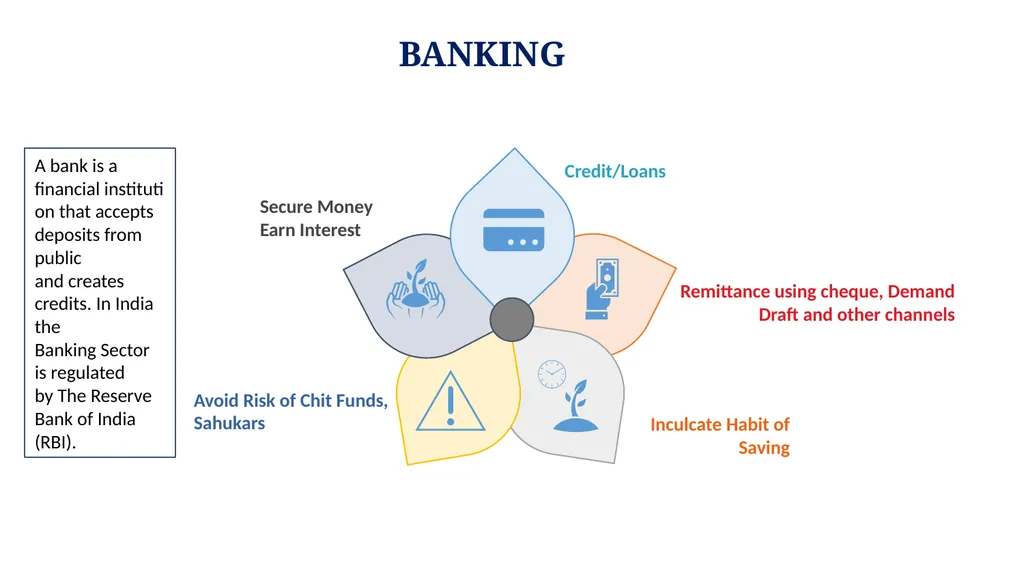
Earn Interest Avoid Risk of Chit Funds, Sahukars Credit/Loans Inculcate Habit of Saving Remittance using cheque, Demand Draft and other channels A bank is a financial institution that accepts deposits from public and creates credits. In India the Banking Sector is regulated by The Reserve Bank of India (RBI).<br>
Earn Interest Avoid Risk of Chit Funds, Sahukars Credit/Loans Inculcate Habit of Saving Remittance using cheque, Demand Draft and other channels A bank is a financial institution that accepts deposits from public and creates credits. In India the Banking Sector is regulated by The Reserve Bank of India (RBI).<br>
11
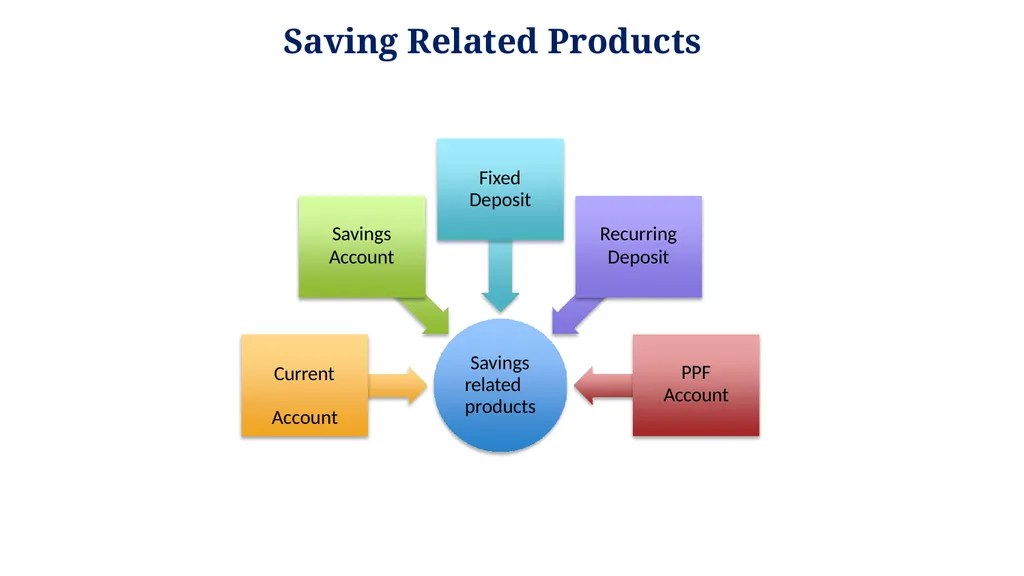
Saving Related Products Savings related products Current Account Savings
Account Fixed Deposit Recurring
Deposit PPF
Account<br>
Account Fixed Deposit Recurring
Deposit PPF
Account<br>
12
Borrowing related products Borrowing related products Loans Cash Credit Credit Card Overdraft<br>
13
Pradhan Mantri Jan-Dhan Yojana (PMJDY) Universal access to banking services Creation of credit Guarantee Fund. Financial Literacy Programme Pension Scheme for unorganized sector Basic Savings Bank Accounts with Overdraft facility of Rs. 10,000/- to every households Micro-Insurance For more information visit : https://pmjdy.gov.in/<br>
14
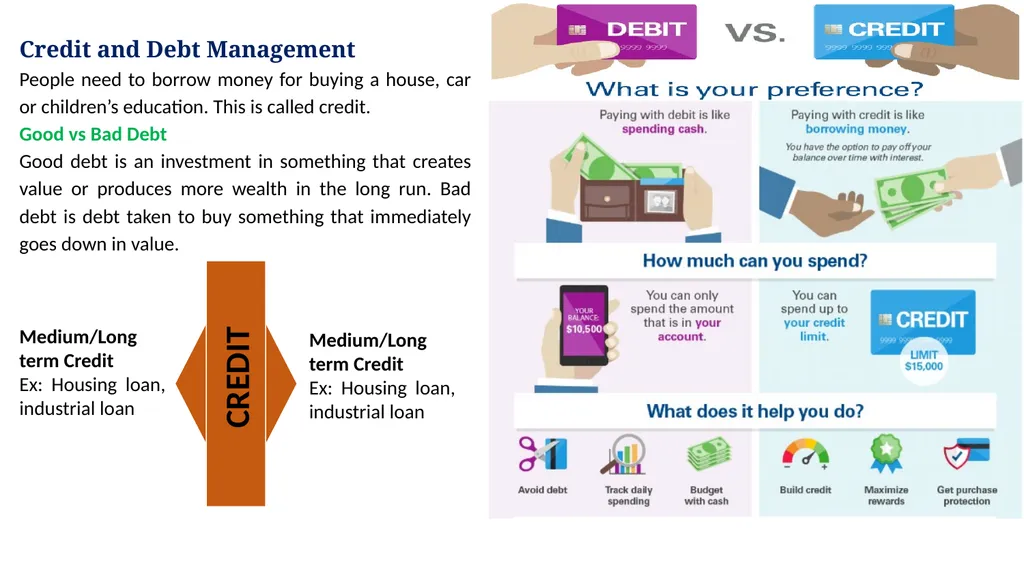
Credit and Debt Management
People need to borrow money for buying a house, car or children’s education. This is called credit.
Good vs Bad Debt
Good debt is an investment in something that creates value or produces more wealth in the long run. Bad debt is debt taken to buy something that immediately goes down in value. Medium/Long term Credit
Ex: Housing loan, industrial loan Medium/Long term Credit
Ex: Housing loan, industrial loan CREDIT<br>
People need to borrow money for buying a house, car or children’s education. This is called credit.
Good vs Bad Debt
Good debt is an investment in something that creates value or produces more wealth in the long run. Bad debt is debt taken to buy something that immediately goes down in value. Medium/Long term Credit
Ex: Housing loan, industrial loan Medium/Long term Credit
Ex: Housing loan, industrial loan CREDIT<br>
15
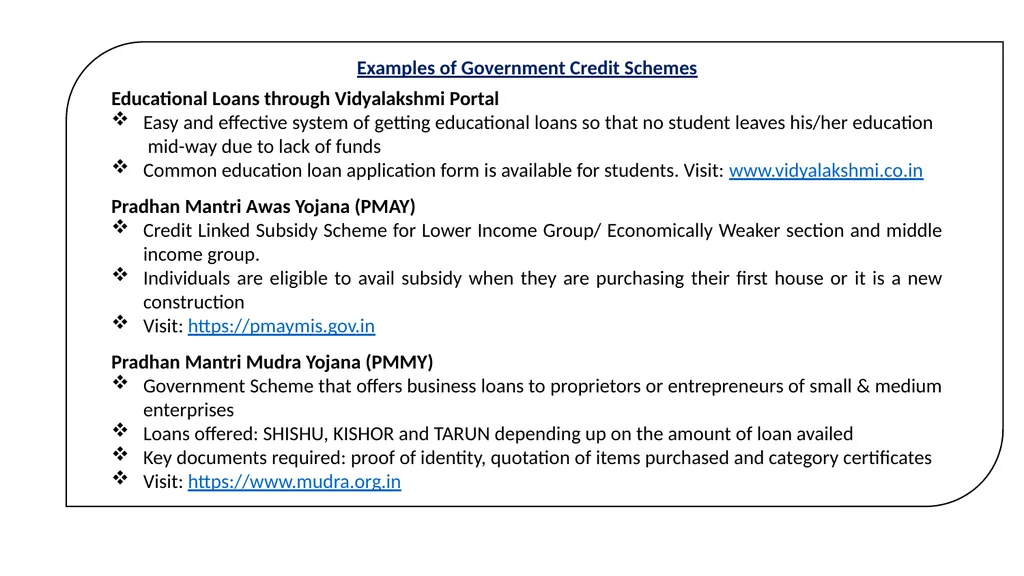
Examples of Government Credit Schemes
Educational Loans through Vidyalakshmi Portal
Easy and effective system of getting educational loans so that no student leaves his/her education mid-way due to lack of funds
Common education loan application form is available for students. Visit: www.vidyalakshmi.co.in
Pradhan Mantri Awas Yojana (PMAY)
Credit Linked Subsidy Scheme for Lower Income Group/ Economically Weaker section and middle income group.
Individuals are eligible to avail subsidy when they are purchasing their first house or it is a new construction
Visit: https://pmaymis.gov.in
Pradhan Mantri Mudra Yojana (PMMY)
Government Scheme that offers business loans to proprietors or entrepreneurs of small & medium enterprises
Loans offered: SHISHU, KISHOR and TARUN depending up on the amount of loan availed
Key documents required: proof of identity, quotation of items purchased and category certificates
Visit: https://www.mudra.org.in<br>
Educational Loans through Vidyalakshmi Portal
Easy and effective system of getting educational loans so that no student leaves his/her education mid-way due to lack of funds
Common education loan application form is available for students. Visit: www.vidyalakshmi.co.in
Pradhan Mantri Awas Yojana (PMAY)
Credit Linked Subsidy Scheme for Lower Income Group/ Economically Weaker section and middle income group.
Individuals are eligible to avail subsidy when they are purchasing their first house or it is a new construction
Visit: https://pmaymis.gov.in
Pradhan Mantri Mudra Yojana (PMMY)
Government Scheme that offers business loans to proprietors or entrepreneurs of small & medium enterprises
Loans offered: SHISHU, KISHOR and TARUN depending up on the amount of loan availed
Key documents required: proof of identity, quotation of items purchased and category certificates
Visit: https://www.mudra.org.in<br>
16
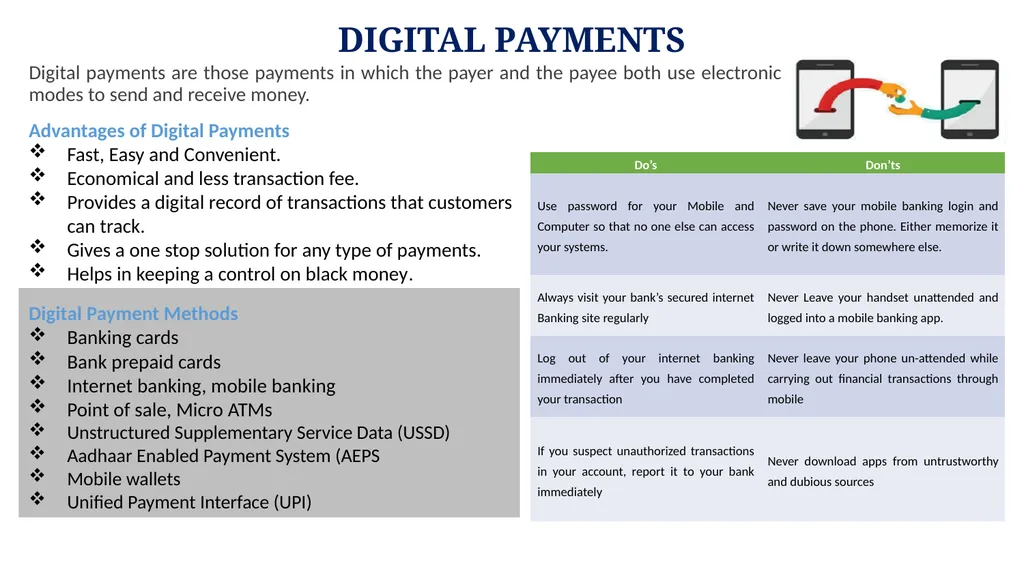
DIGITAL PAYMENTS Digital payments are those payments in which the payer and the payee both use electronic modes to send and receive money. Advantages of Digital Payments
Fast, Easy and Convenient.
Economical and less transaction fee.
Provides a digital record of transactions that customers can track.
Gives a one stop solution for any type of payments.
Helps in keeping a control on black money. Digital Payment Methods
Banking cards
Bank prepaid cards
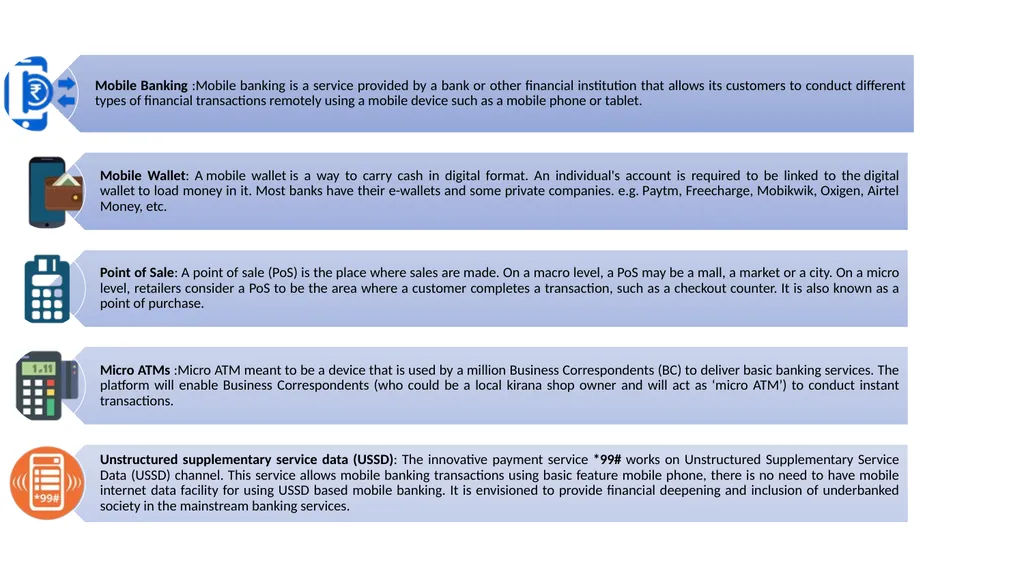
Internet banking, mobile banking
Point of sale, Micro ATMs
Unstructured Supplementary Service Data (USSD)
Aadhaar Enabled Payment System (AEPS
Mobile wallets
Unified Payment Interface (UPI)<br>
Fast, Easy and Convenient.
Economical and less transaction fee.
Provides a digital record of transactions that customers can track.
Gives a one stop solution for any type of payments.
Helps in keeping a control on black money. Digital Payment Methods
Banking cards
Bank prepaid cards
Internet banking, mobile banking
Point of sale, Micro ATMs
Unstructured Supplementary Service Data (USSD)
Aadhaar Enabled Payment System (AEPS
Mobile wallets
Unified Payment Interface (UPI)<br>
17
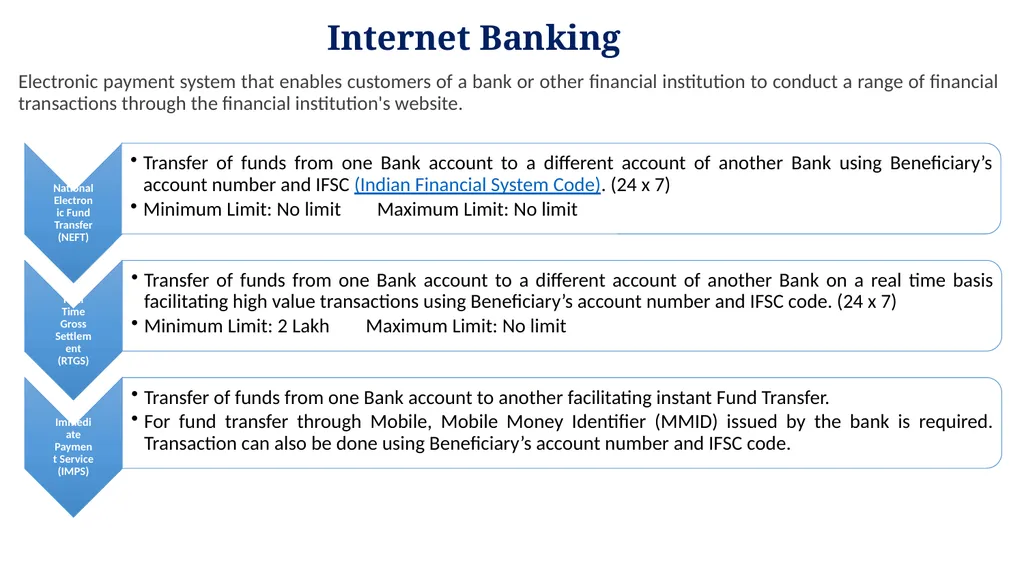
Internet Banking Electronic payment system that enables customers of a bank or other financial institution to conduct a range of financial transactions through the financial institution's website.<br>
18
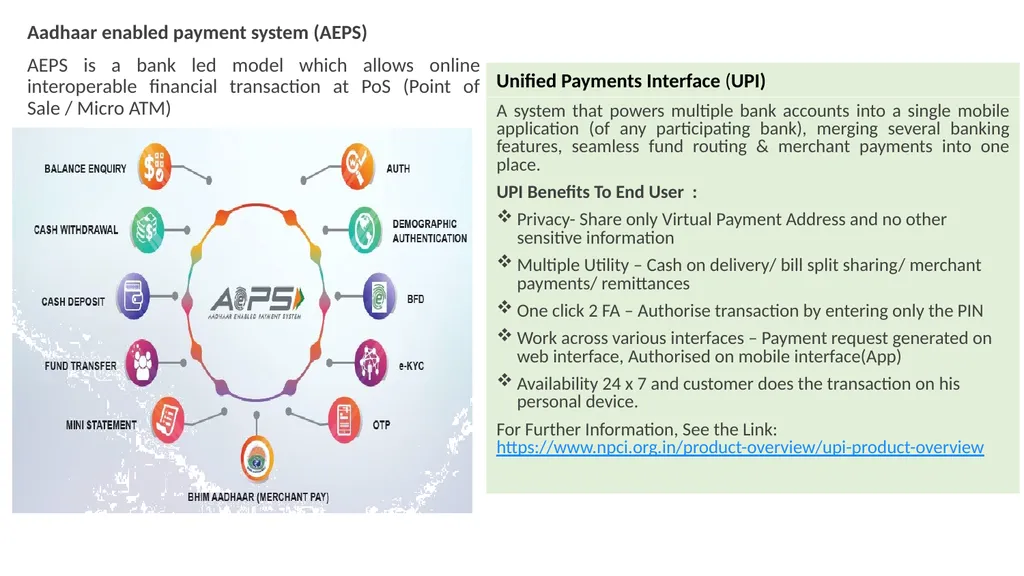
A system that powers multiple bank accounts into a single mobile application (of any participating bank), merging several banking features, seamless fund routing & merchant payments into one place.
UPI Benefits To End User :
Privacy- Share only Virtual Payment Address and no other sensitive information
Multiple Utility – Cash on delivery/ bill split sharing/ merchant payments/ remittances
One click 2 FA – Authorise transaction by entering only the PIN
Work across various interfaces – Payment request generated on web interface, Authorised on mobile interface(App)
Availability 24 x 7 and customer does the transaction on his personal device.
For Further Information, See the Link: https://www.npci.org.in/product-overview/upi-product-overview Aadhaar enabled payment system (AEPS)
AEPS is a bank led model which allows online interoperable financial transaction at PoS (Point of Sale / Micro ATM) Unified Payments Interface (UPI)<br>
UPI Benefits To End User :
Privacy- Share only Virtual Payment Address and no other sensitive information
Multiple Utility – Cash on delivery/ bill split sharing/ merchant payments/ remittances
One click 2 FA – Authorise transaction by entering only the PIN
Work across various interfaces – Payment request generated on web interface, Authorised on mobile interface(App)
Availability 24 x 7 and customer does the transaction on his personal device.
For Further Information, See the Link: https://www.npci.org.in/product-overview/upi-product-overview Aadhaar enabled payment system (AEPS)
AEPS is a bank led model which allows online interoperable financial transaction at PoS (Point of Sale / Micro ATM) Unified Payments Interface (UPI)<br>
19
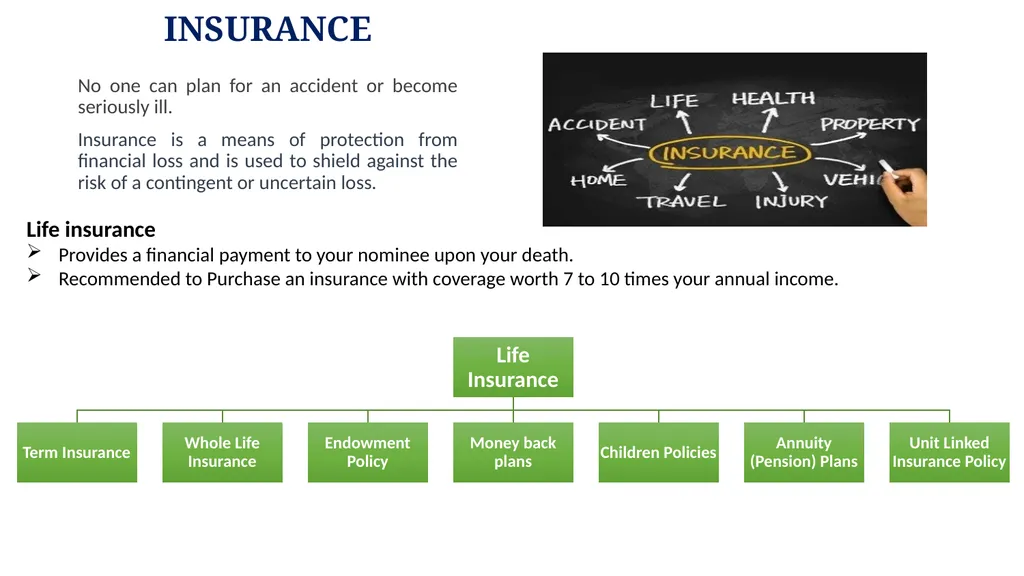
INSURANCE No one can plan for an accident or become seriously ill.
Insurance is a means of protection from financial loss and is used to shield against the risk of a contingent or uncertain loss. Life insurance
Provides a financial payment to your nominee upon your death.
Recommended to Purchase an insurance with coverage worth 7 to 10 times your annual income.<br>
Insurance is a means of protection from financial loss and is used to shield against the risk of a contingent or uncertain loss. Life insurance
Provides a financial payment to your nominee upon your death.
Recommended to Purchase an insurance with coverage worth 7 to 10 times your annual income.<br>
20
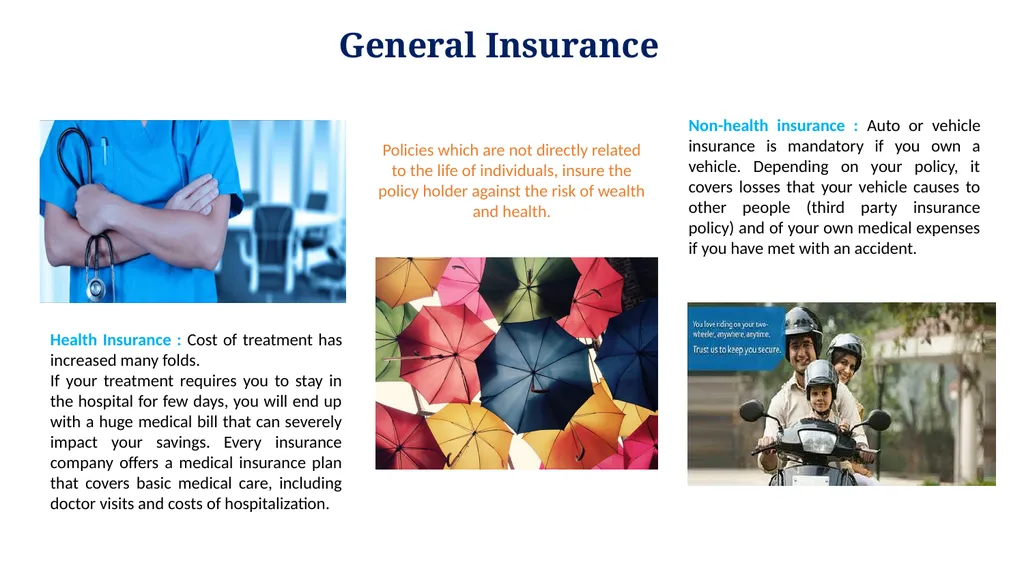
General Insurance Health Insurance : Cost of treatment has increased many folds.
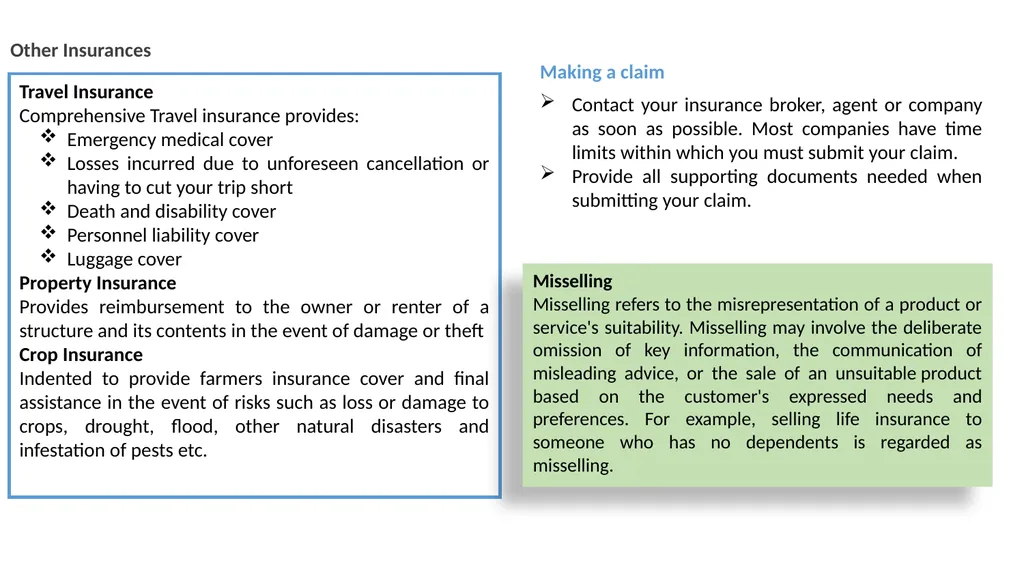
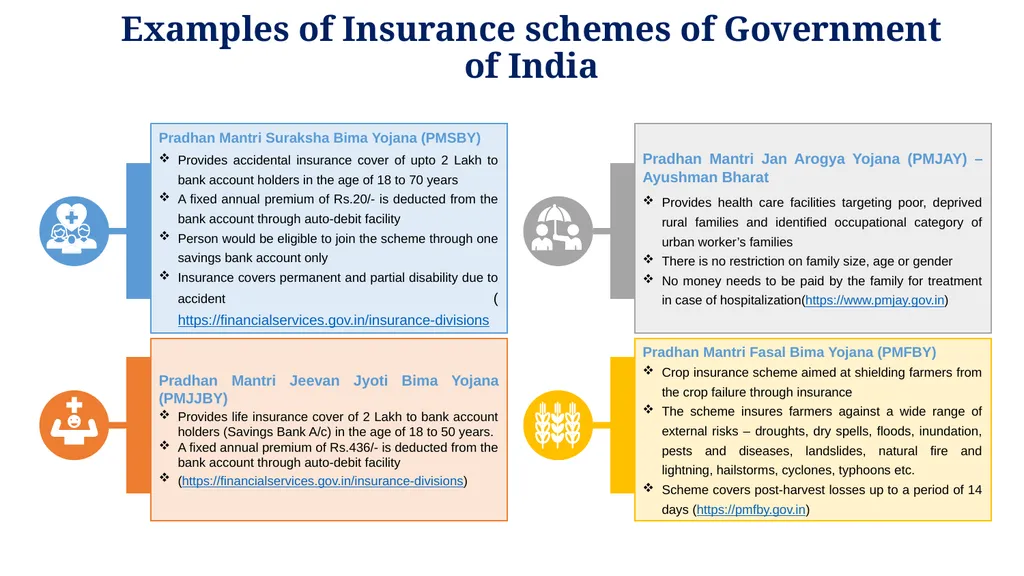
If your treatment requires you to stay in the hospital for few days, you will end up with a huge medical bill that can severely impact your savings. Every insurance company offers a medical insurance plan that covers basic medical care, including doctor visits and costs of hospitalization. Non-health insurance : Auto or vehicle insurance is mandatory if you own a vehicle. Depending on your policy, it covers losses that your vehicle causes to other people (third party insurance policy) and of your own medical expenses if you have met with an accident. Policies which are not directly related to the life of individuals, insure the policy holder against the risk of wealth and health.<br>
If your treatment requires you to stay in the hospital for few days, you will end up with a huge medical bill that can severely impact your savings. Every insurance company offers a medical insurance plan that covers basic medical care, including doctor visits and costs of hospitalization. Non-health insurance : Auto or vehicle insurance is mandatory if you own a vehicle. Depending on your policy, it covers losses that your vehicle causes to other people (third party insurance policy) and of your own medical expenses if you have met with an accident. Policies which are not directly related to the life of individuals, insure the policy holder against the risk of wealth and health.<br>
21
Other Insurances Travel Insurance
Comprehensive Travel insurance provides:
Emergency medical cover
Losses incurred due to unforeseen cancellation or having to cut your trip short
Death and disability cover
Personnel liability cover
Luggage cover
Property Insurance
Provides reimbursement to the owner or renter of a structure and its contents in the event of damage or theft
Crop Insurance
Indented to provide farmers insurance cover and final assistance in the event of risks such as loss or damage to crops, drought, flood, other natural disasters and infestation of pests etc. Making a claim
Contact your insurance broker, agent or company as soon as possible. Most companies have time limits within which you must submit your claim.
Provide all supporting documents needed when submitting your claim. Misselling
Misselling refers to the misrepresentation of a product or service's suitability. Misselling may involve the deliberate omission of key information, the communication of misleading advice, or the sale of an unsuitable product based on the customer's expressed needs and preferences. For example, selling life insurance to someone who has no dependents is regarded as misselling.<br>
Comprehensive Travel insurance provides:
Emergency medical cover
Losses incurred due to unforeseen cancellation or having to cut your trip short
Death and disability cover
Personnel liability cover
Luggage cover
Property Insurance
Provides reimbursement to the owner or renter of a structure and its contents in the event of damage or theft
Crop Insurance
Indented to provide farmers insurance cover and final assistance in the event of risks such as loss or damage to crops, drought, flood, other natural disasters and infestation of pests etc. Making a claim
Contact your insurance broker, agent or company as soon as possible. Most companies have time limits within which you must submit your claim.
Provide all supporting documents needed when submitting your claim. Misselling
Misselling refers to the misrepresentation of a product or service's suitability. Misselling may involve the deliberate omission of key information, the communication of misleading advice, or the sale of an unsuitable product based on the customer's expressed needs and preferences. For example, selling life insurance to someone who has no dependents is regarded as misselling.<br>
22
Examples of Insurance schemes of Government of India Pradhan Mantri Suraksha Bima Yojana (PMSBY)
Provides accidental insurance cover of upto 2 Lakh to bank account holders in the age of 18 to 70 years
A fixed annual premium of Rs.20/- is deducted from the bank account through auto-debit facility
Person would be eligible to join the scheme through one savings bank account only
Insurance covers permanent and partial disability due to accident (https://financialservices.gov.in/insurance-divisions Pradhan Mantri Jeevan Jyoti Bima Yojana (PMJJBY)
Provides life insurance cover of 2 Lakh to bank account holders (Savings Bank A/c) in the age of 18 to 50 years.
A fixed annual premium of Rs.436/- is deducted from the bank account through auto-debit facility
(https://financialservices.gov.in/insurance-divisions) Pradhan Mantri Jan Arogya Yojana (PMJAY) – Ayushman Bharat
Provides health care facilities targeting poor, deprived rural families and identified occupational category of urban worker’s families
There is no restriction on family size, age or gender
No money needs to be paid by the family for treatment in case of hospitalization(https://www.pmjay.gov.in) Pradhan Mantri Fasal Bima Yojana (PMFBY)
Crop insurance scheme aimed at shielding farmers from the crop failure through insurance
The scheme insures farmers against a wide range of external risks – droughts, dry spells, floods, inundation, pests and diseases, landslides, natural fire and lightning, hailstorms, cyclones, typhoons etc.
Scheme covers post-harvest losses up to a period of 14 days (https://pmfby.gov.in)<br>
Provides accidental insurance cover of upto 2 Lakh to bank account holders in the age of 18 to 70 years
A fixed annual premium of Rs.20/- is deducted from the bank account through auto-debit facility
Person would be eligible to join the scheme through one savings bank account only
Insurance covers permanent and partial disability due to accident (https://financialservices.gov.in/insurance-divisions Pradhan Mantri Jeevan Jyoti Bima Yojana (PMJJBY)
Provides life insurance cover of 2 Lakh to bank account holders (Savings Bank A/c) in the age of 18 to 50 years.
A fixed annual premium of Rs.436/- is deducted from the bank account through auto-debit facility
(https://financialservices.gov.in/insurance-divisions) Pradhan Mantri Jan Arogya Yojana (PMJAY) – Ayushman Bharat
Provides health care facilities targeting poor, deprived rural families and identified occupational category of urban worker’s families
There is no restriction on family size, age or gender
No money needs to be paid by the family for treatment in case of hospitalization(https://www.pmjay.gov.in) Pradhan Mantri Fasal Bima Yojana (PMFBY)
Crop insurance scheme aimed at shielding farmers from the crop failure through insurance
The scheme insures farmers against a wide range of external risks – droughts, dry spells, floods, inundation, pests and diseases, landslides, natural fire and lightning, hailstorms, cyclones, typhoons etc.
Scheme covers post-harvest losses up to a period of 14 days (https://pmfby.gov.in)<br>
23
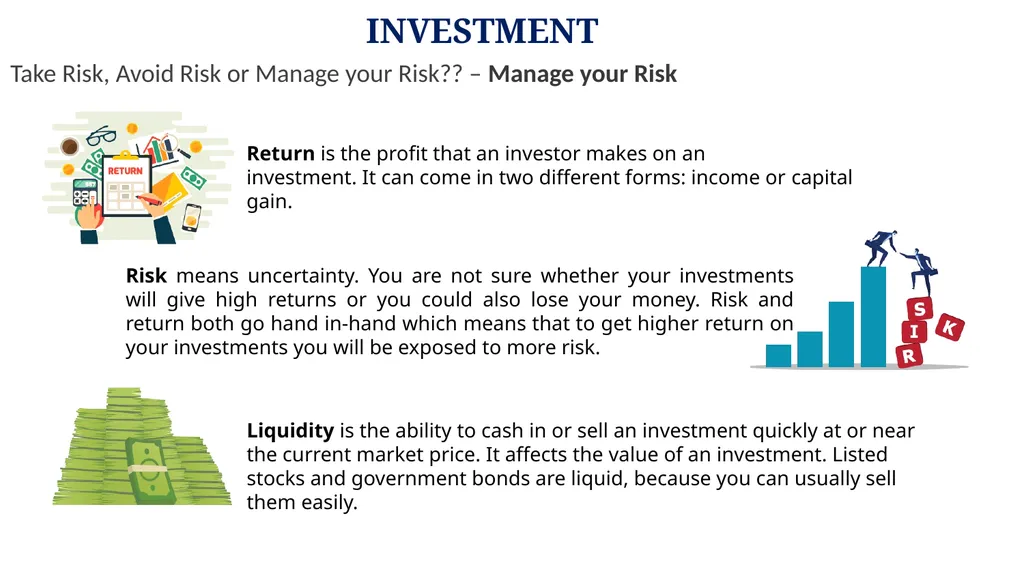
INVESTMENT Take Risk, Avoid Risk or Manage your Risk?? – Manage your Risk Return is the profit that an investor makes on an
investment. It can come in two different forms: income or capital gain. Risk means uncertainty. You are not sure whether your investments will give high returns or you could also lose your money. Risk and return both go hand in-hand which means that to get higher return on your investments you will be exposed to more risk. Liquidity is the ability to cash in or sell an investment quickly at or near the current market price. It affects the value of an investment. Listed stocks and government bonds are liquid, because you can usually sell them easily.<br>
investment. It can come in two different forms: income or capital gain. Risk means uncertainty. You are not sure whether your investments will give high returns or you could also lose your money. Risk and return both go hand in-hand which means that to get higher return on your investments you will be exposed to more risk. Liquidity is the ability to cash in or sell an investment quickly at or near the current market price. It affects the value of an investment. Listed stocks and government bonds are liquid, because you can usually sell them easily.<br>
24
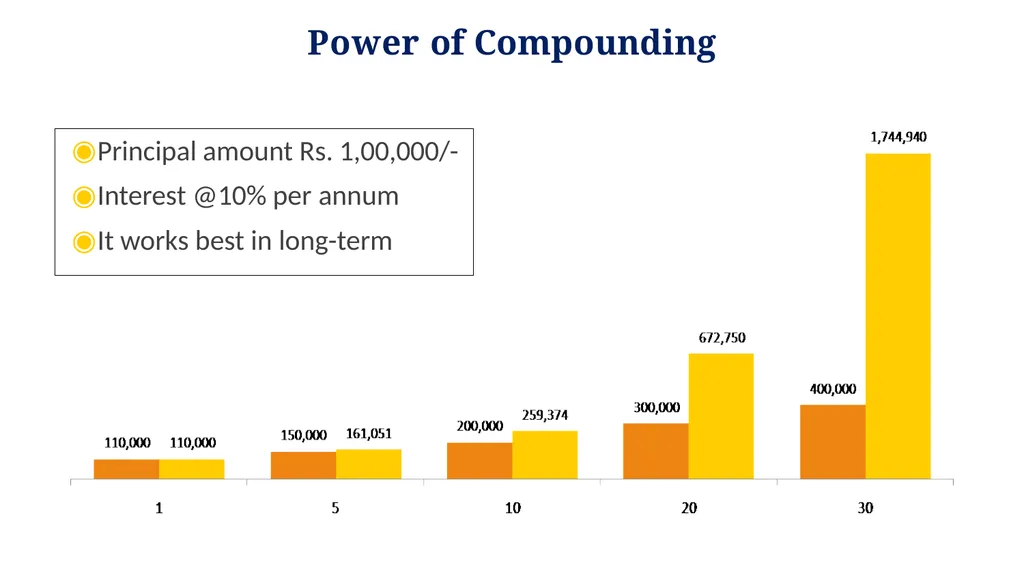
Power of Compounding Principal amount Rs. 1,00,000/-
Interest @10% per annum
It works best in long-term<br>
Interest @10% per annum
It works best in long-term<br>
25
Inflation and its effect on Investment
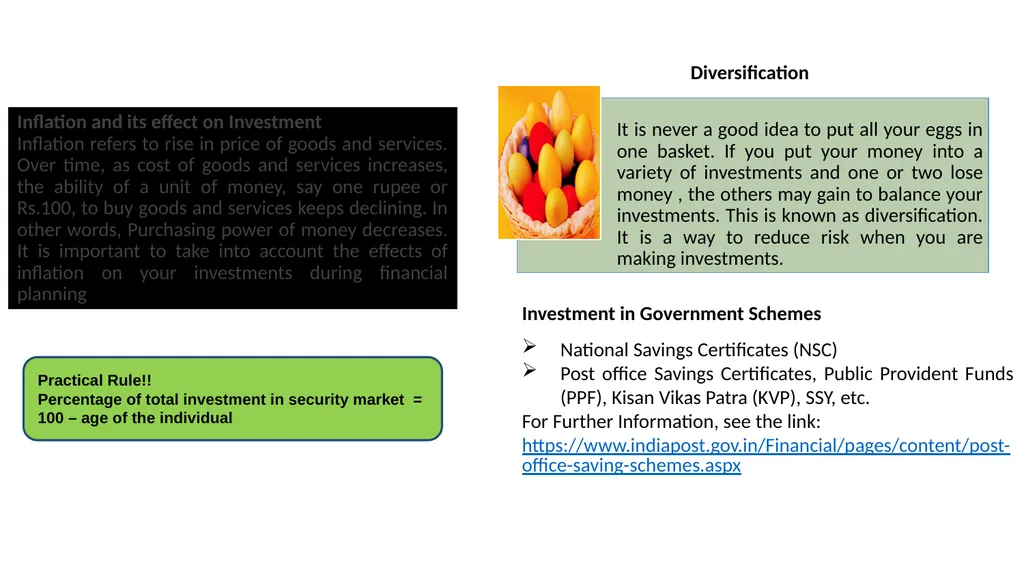
Inflation refers to rise in price of goods and services. Over time, as cost of goods and services increases, the ability of a unit of money, say one rupee or Rs.100, to buy goods and services keeps declining. In other words, Purchasing power of money decreases. It is important to take into account the effects of inflation on your investments during financial planning Practical Rule!!
Percentage of total investment in security market = 100 – age of the individual Diversification Investment in Government Schemes
National Savings Certificates (NSC)
Post office Savings Certificates, Public Provident Funds (PPF), Kisan Vikas Patra (KVP), SSY, etc.
For Further Information, see the link: https://www.indiapost.gov.in/Financial/pages/content/post-office-saving-schemes.aspx<br>
Inflation refers to rise in price of goods and services. Over time, as cost of goods and services increases, the ability of a unit of money, say one rupee or Rs.100, to buy goods and services keeps declining. In other words, Purchasing power of money decreases. It is important to take into account the effects of inflation on your investments during financial planning Practical Rule!!
Percentage of total investment in security market = 100 – age of the individual Diversification Investment in Government Schemes
National Savings Certificates (NSC)
Post office Savings Certificates, Public Provident Funds (PPF), Kisan Vikas Patra (KVP), SSY, etc.
For Further Information, see the link: https://www.indiapost.gov.in/Financial/pages/content/post-office-saving-schemes.aspx<br>
26
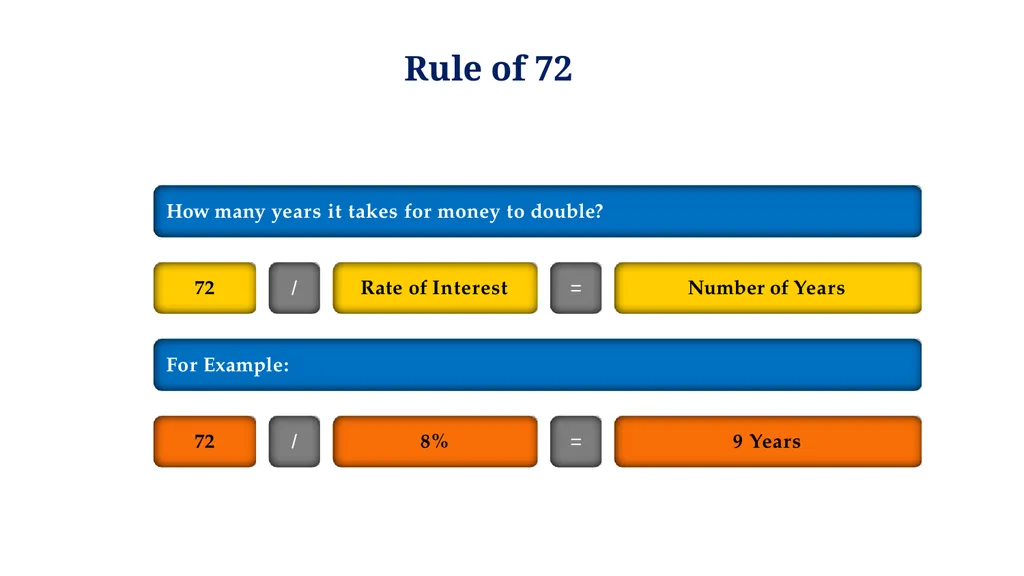
Rule of 72 How many years it takes for money to double? 72 Rate of Interest Number of Years 9 Years For Example: 72 8% / = / =<br>
27
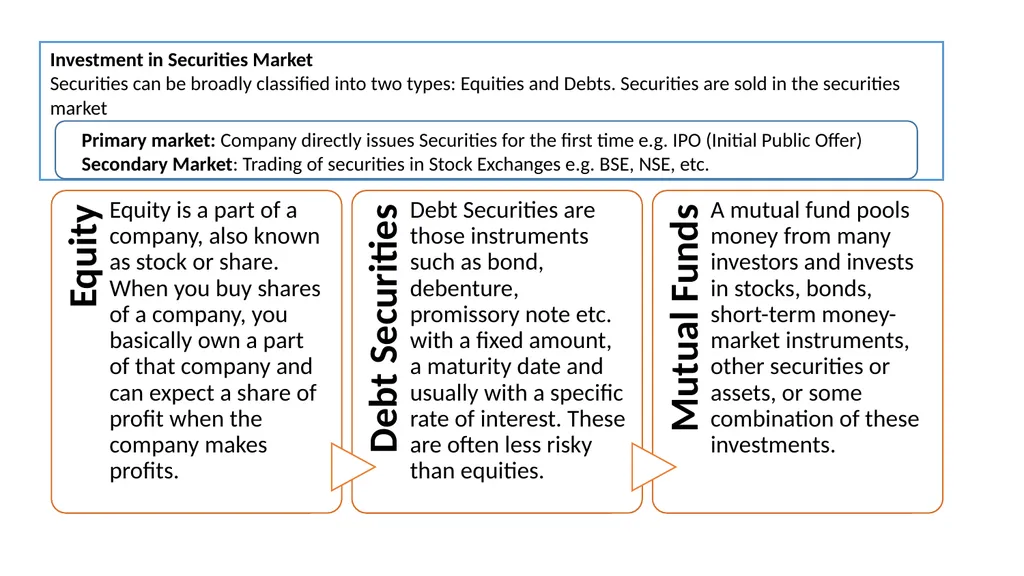
Investment in Securities Market
Securities can be broadly classified into two types: Equities and Debts. Securities are sold in the securities market
Primary market: Company directly issues Securities for the first time e.g. IPO (Initial Public Offer)
Secondary Market: Trading of securities in Stock Exchanges e.g. BSE, NSE, etc.<br>
Securities can be broadly classified into two types: Equities and Debts. Securities are sold in the securities market
Primary market: Company directly issues Securities for the first time e.g. IPO (Initial Public Offer)
Secondary Market: Trading of securities in Stock Exchanges e.g. BSE, NSE, etc.<br>
28
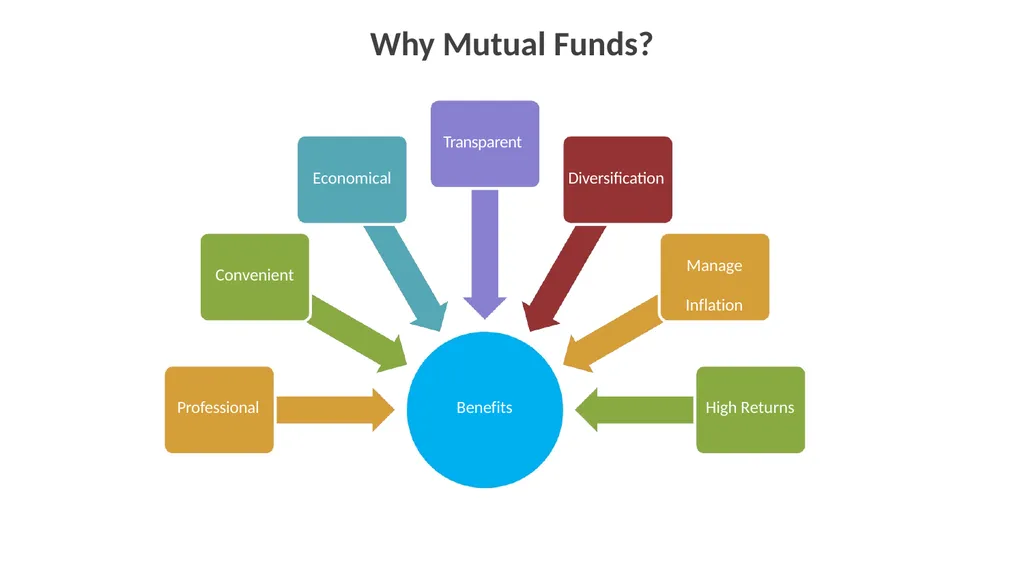
Why Mutual Funds? Benefits Professional Convenient Economical Transparent Diversification Manage Inflation High Returns<br>
29
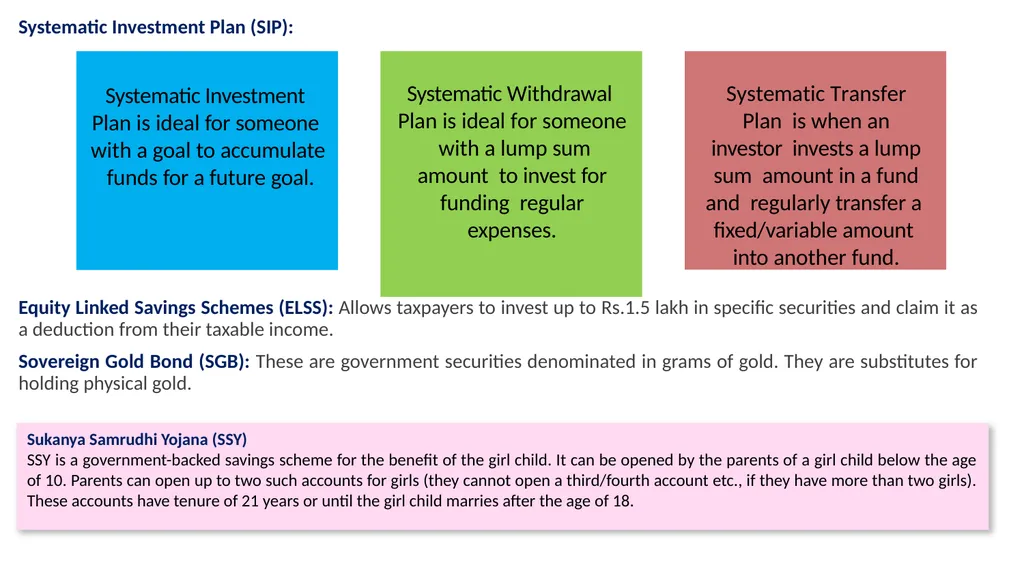
Systematic Investment Plan (SIP):
Equity Linked Savings Schemes (ELSS): Allows taxpayers to invest up to Rs.1.5 lakh in specific securities and claim it as a deduction from their taxable income.
Sovereign Gold Bond (SGB): These are government securities denominated in grams of gold. They are substitutes for holding physical gold. Sukanya Samrudhi Yojana (SSY)
SSY is a government-backed savings scheme for the benefit of the girl child. It can be opened by the parents of a girl child below the age of 10. Parents can open up to two such accounts for girls (they cannot open a third/fourth account etc., if they have more than two girls). These accounts have tenure of 21 years or until the girl child marries after the age of 18. Systematic Investment Plan is ideal for someone with a goal to accumulate funds for a future goal. Systematic Withdrawal Plan is ideal for someone with a lump sum amount to invest for funding regular expenses. Systematic Transfer Plan is when an investor invests a lump sum amount in a fund and regularly transfer a fixed/variable amount into another fund.<br>
Equity Linked Savings Schemes (ELSS): Allows taxpayers to invest up to Rs.1.5 lakh in specific securities and claim it as a deduction from their taxable income.
Sovereign Gold Bond (SGB): These are government securities denominated in grams of gold. They are substitutes for holding physical gold. Sukanya Samrudhi Yojana (SSY)
SSY is a government-backed savings scheme for the benefit of the girl child. It can be opened by the parents of a girl child below the age of 10. Parents can open up to two such accounts for girls (they cannot open a third/fourth account etc., if they have more than two girls). These accounts have tenure of 21 years or until the girl child marries after the age of 18. Systematic Investment Plan is ideal for someone with a goal to accumulate funds for a future goal. Systematic Withdrawal Plan is ideal for someone with a lump sum amount to invest for funding regular expenses. Systematic Transfer Plan is when an investor invests a lump sum amount in a fund and regularly transfer a fixed/variable amount into another fund.<br>
30
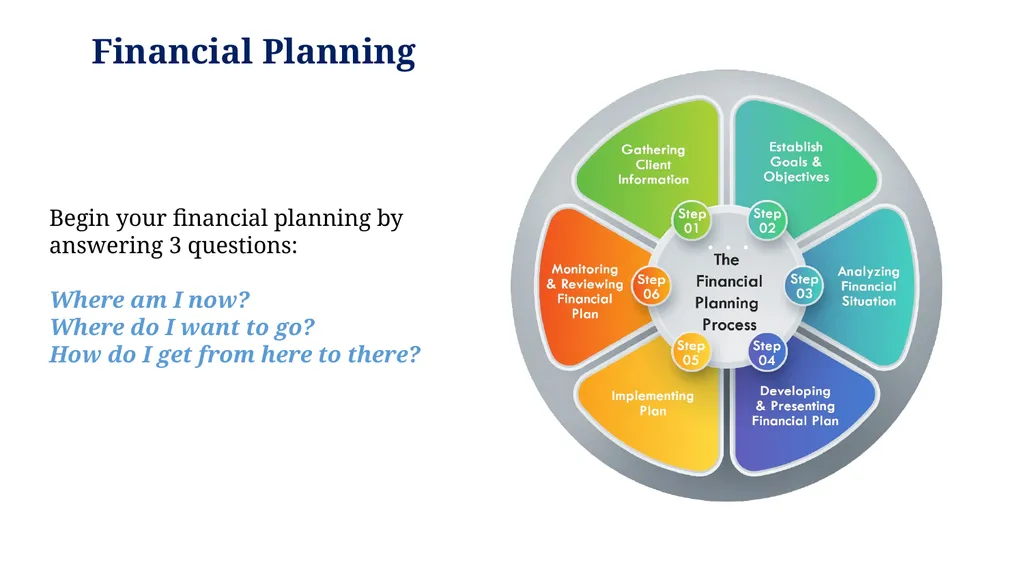
Financial Planning Begin your financial planning by answering 3 questions:
Where am I now?
Where do I want to go?
How do I get from here to there?<br>
Where am I now?
Where do I want to go?
How do I get from here to there?<br>
31
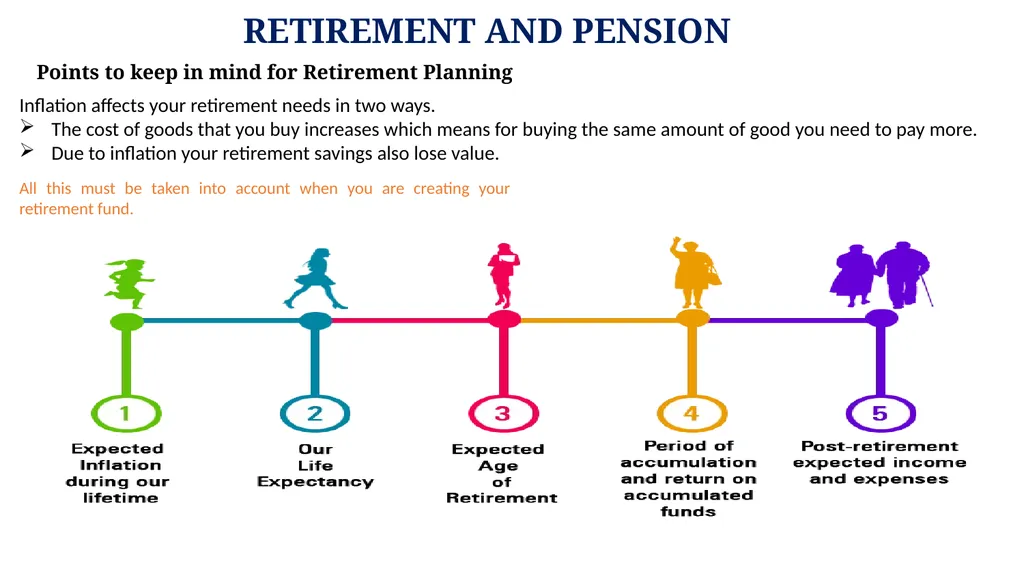
RETIREMENT AND PENSION Points to keep in mind for Retirement Planning Inflation affects your retirement needs in two ways.
The cost of goods that you buy increases which means for buying the same amount of good you need to pay more.
Due to inflation your retirement savings also lose value. All this must be taken into account when you are creating your retirement fund.<br>
The cost of goods that you buy increases which means for buying the same amount of good you need to pay more.
Due to inflation your retirement savings also lose value. All this must be taken into account when you are creating your retirement fund.<br>
32
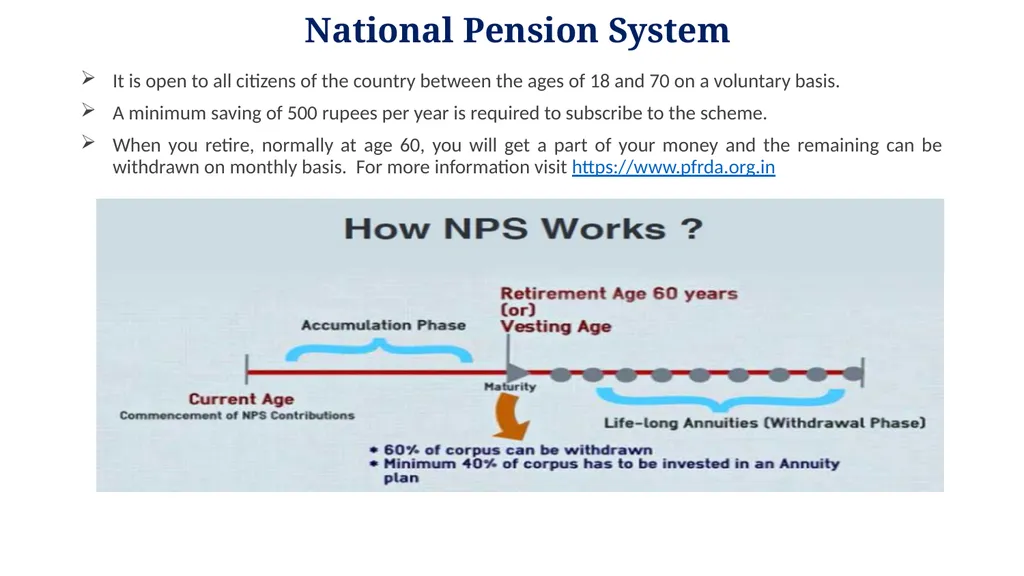
National Pension System It is open to all citizens of the country between the ages of 18 and 70 on a voluntary basis.
A minimum saving of 500 rupees per year is required to subscribe to the scheme.
When you retire, normally at age 60, you will get a part of your money and the remaining can be withdrawn on monthly basis. For more information visit https://www.pfrda.org.in<br>
A minimum saving of 500 rupees per year is required to subscribe to the scheme.
When you retire, normally at age 60, you will get a part of your money and the remaining can be withdrawn on monthly basis. For more information visit https://www.pfrda.org.in<br>
33
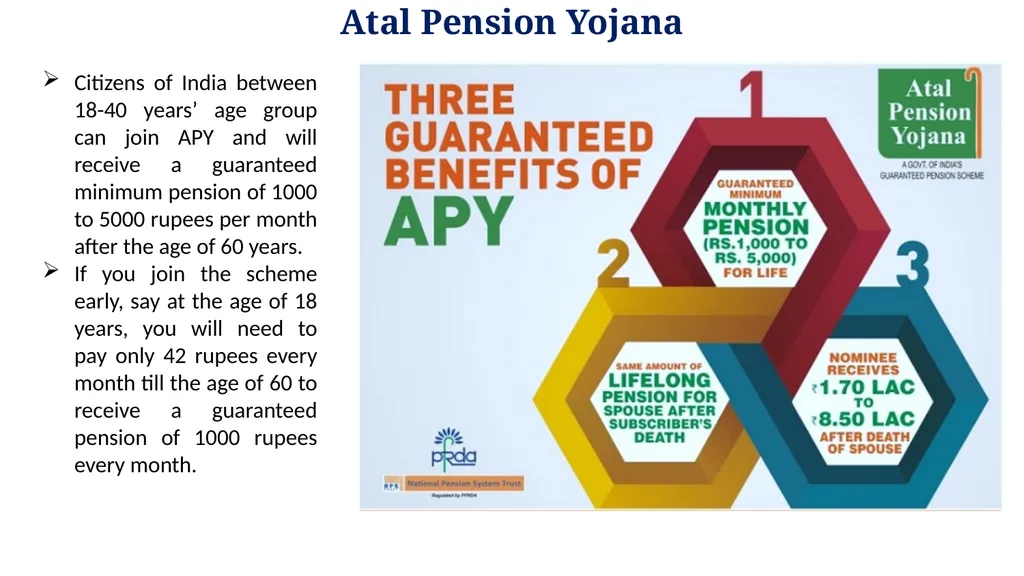
Citizens of India between 18-40 years’ age group can join APY and will receive a guaranteed minimum pension of 1000 to 5000 rupees per month after the age of 60 years.
If you join the scheme early, say at the age of 18 years, you will need to pay only 42 rupees every month till the age of 60 to receive a guaranteed pension of 1000 rupees every month. Atal Pension Yojana<br>
If you join the scheme early, say at the age of 18 years, you will need to pay only 42 rupees every month till the age of 60 to receive a guaranteed pension of 1000 rupees every month. Atal Pension Yojana<br>
34
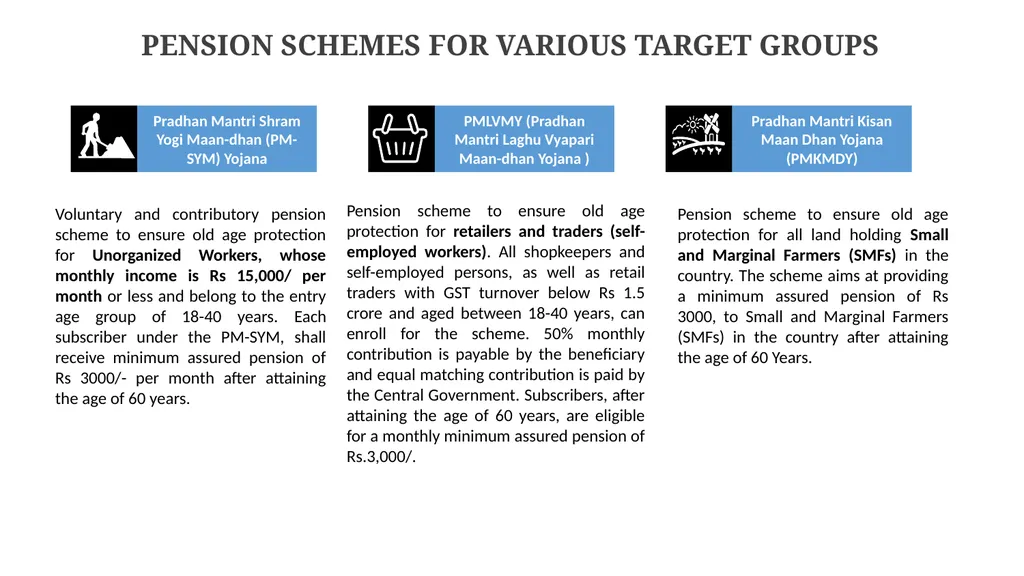
PENSION SCHEMES FOR VARIOUS TARGET GROUPS Pradhan Mantri Shram Yogi Maan-dhan (PM-SYM) Yojana PMLVMY (Pradhan Mantri Laghu Vyapari Maan-dhan Yojana ) Pradhan Mantri Kisan Maan Dhan Yojana (PMKMDY) Voluntary and contributory pension scheme to ensure old age protection for Unorganized Workers, whose monthly income is Rs 15,000/ per month or less and belong to the entry age group of 18-40 years. Each subscriber under the PM-SYM, shall receive minimum assured pension of Rs 3000/- per month after attaining the age of 60 years. Pension scheme to ensure old age protection for retailers and traders (self-employed workers). All shopkeepers and self-employed persons, as well as retail traders with GST turnover below Rs 1.5 crore and aged between 18-40 years, can enroll for the scheme. 50% monthly contribution is payable by the beneficiary and equal matching contribution is paid by the Central Government. Subscribers, after attaining the age of 60 years, are eligible for a monthly minimum assured pension of Rs.3,000/. Pension scheme to ensure old age protection for all land holding Small and Marginal Farmers (SMFs) in the country. The scheme aims at providing a minimum assured pension of Rs 3000, to Small and Marginal Farmers (SMFs) in the country after attaining the age of 60 Years.<br>
35
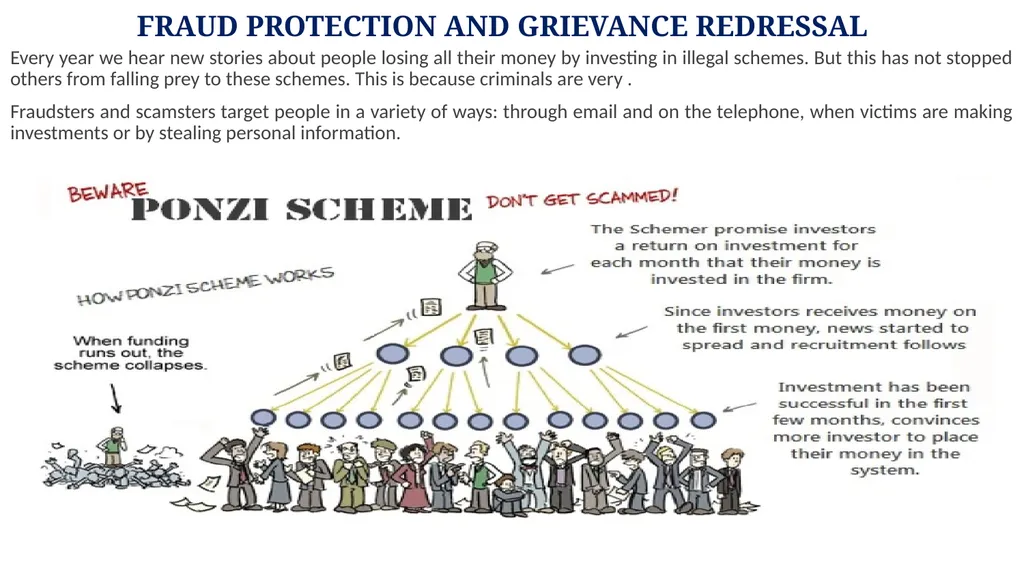
FRAUD PROTECTION AND GRIEVANCE REDRESSAL Every year we hear new stories about people losing all their money by investing in illegal schemes. But this has not stopped others from falling prey to these schemes. This is because criminals are very .
Fraudsters and scamsters target people in a variety of ways: through email and on the telephone, when victims are making investments or by stealing personal information.<br>
Fraudsters and scamsters target people in a variety of ways: through email and on the telephone, when victims are making investments or by stealing personal information.<br>
36
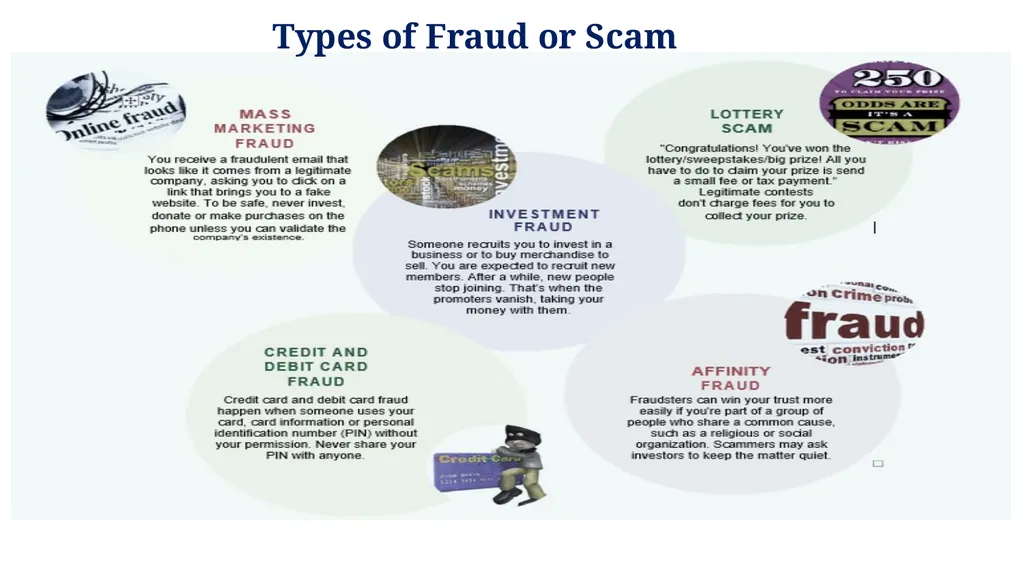
Types of Fraud or Scam<br>
37
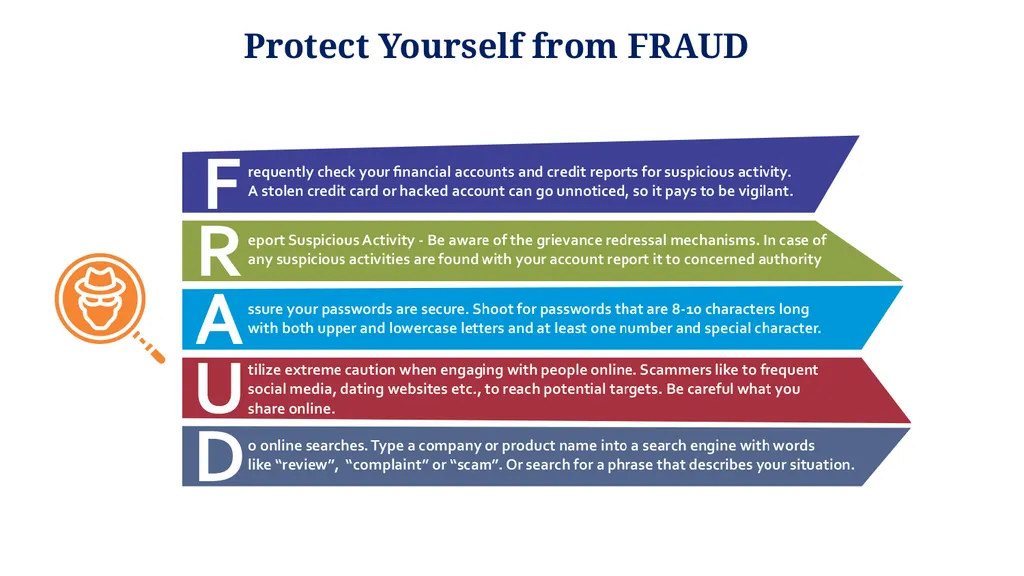
Protect Yourself from FRAUD<br>
38
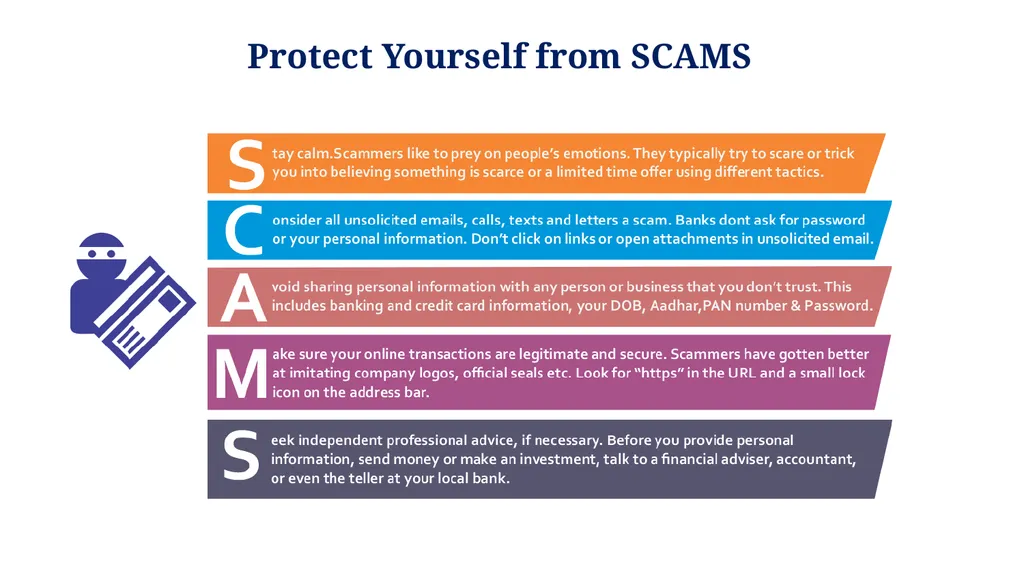
Protect Yourself from SCAMS<br>
39
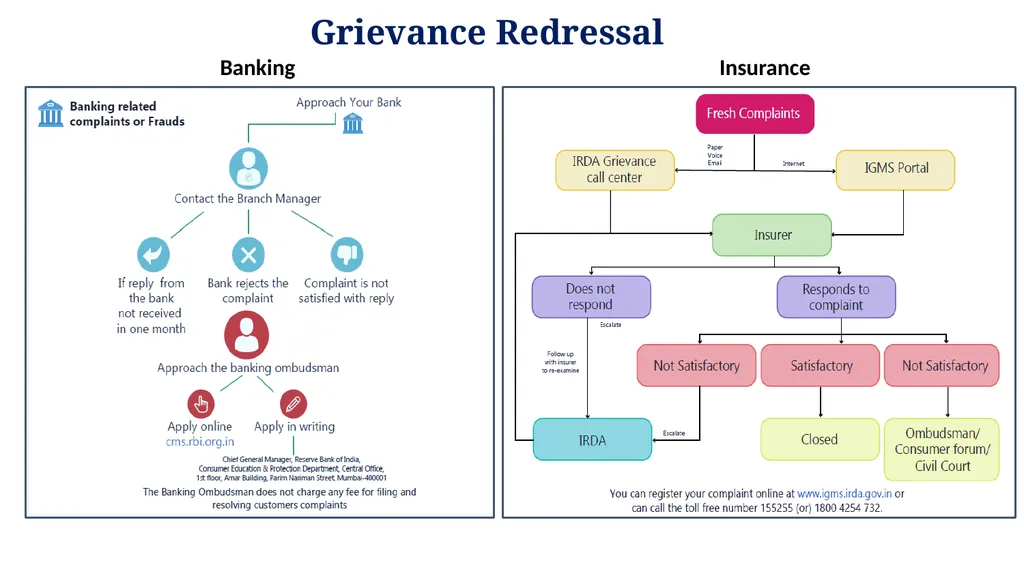
Grievance Redressal Banking Insurance<br>
40
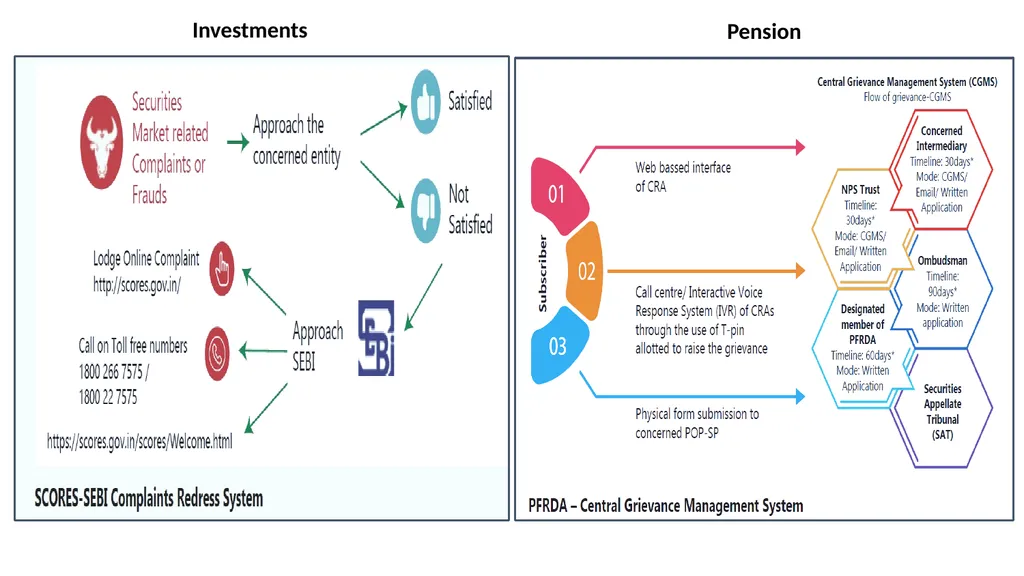
Investments Pension<br>
41
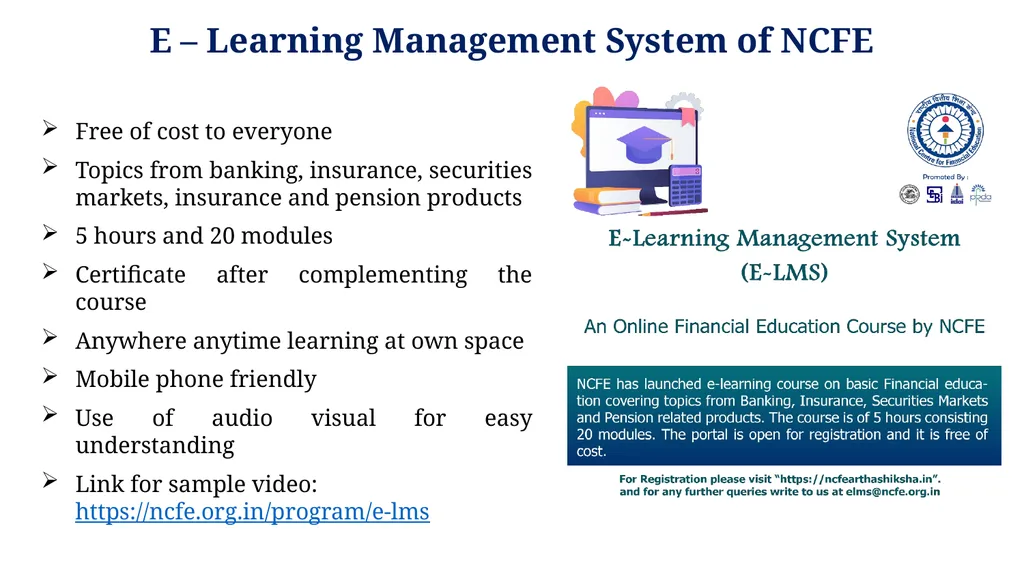
E – Learning Management System of NCFE Free of cost to everyone
Topics from banking, insurance, securities markets, insurance and pension products
5 hours and 20 modules
Certificate after complementing the course
Anywhere anytime learning at own space
Mobile phone friendly
Use of audio visual for easy understanding
Link for sample video: https://ncfe.org.in/program/e-lms<br>
Topics from banking, insurance, securities markets, insurance and pension products
5 hours and 20 modules
Certificate after complementing the course
Anywhere anytime learning at own space
Mobile phone friendly
Use of audio visual for easy understanding
Link for sample video: https://ncfe.org.in/program/e-lms<br>
42
www.ncfe.org.in 46<br>