
Financial Management (AB 215) Unit-1 Syllabus
OM
Published · 40 slides · 0 views

1 / 1
Description
Financial Management (AB 215) Unit-1 Syllabus Concept of finance-Scope and objectives of finance, Functions of Financial Management, Role of Finance Manager, Financial Planning Strategies. Forms of Business Organization and Financial
Related Topics
Share
Embed code
Download this presentation From Below
"Financial Management (AB 215) Unit-1 Syllabus" is the property of its rightful owner. Permission is granted to download and print the materials on this website for personal, non-commercial use only, and to display it on your personal computer provided you do not modify the materials and that you retain all copyright notices contained in the materials. By downloading content from our website, you accept the terms of this agreement.
Presentation Transcript
01
Financial Management
(AB 215) Unit-1<br>
(AB 215) Unit-1<br>
02
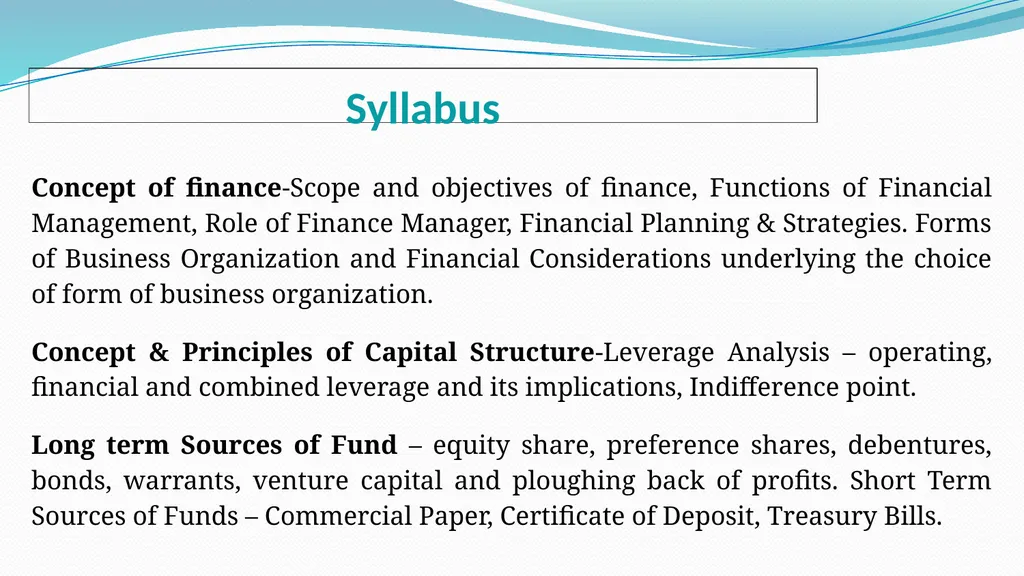
Syllabus Concept of finance-Scope and objectives of finance, Functions of Financial Management, Role of Finance Manager, Financial Planning & Strategies. Forms of Business Organization and Financial Considerations underlying the choice of form of business organization.
Concept & Principles of Capital Structure-Leverage Analysis – operating, financial and combined leverage and its implications, Indifference point.
Long term Sources of Fund – equity share, preference shares, debentures, bonds, warrants, venture capital and ploughing back of profits. Short Term Sources of Funds – Commercial Paper, Certificate of Deposit, Treasury Bills.<br>
Concept & Principles of Capital Structure-Leverage Analysis – operating, financial and combined leverage and its implications, Indifference point.
Long term Sources of Fund – equity share, preference shares, debentures, bonds, warrants, venture capital and ploughing back of profits. Short Term Sources of Funds – Commercial Paper, Certificate of Deposit, Treasury Bills.<br>
03
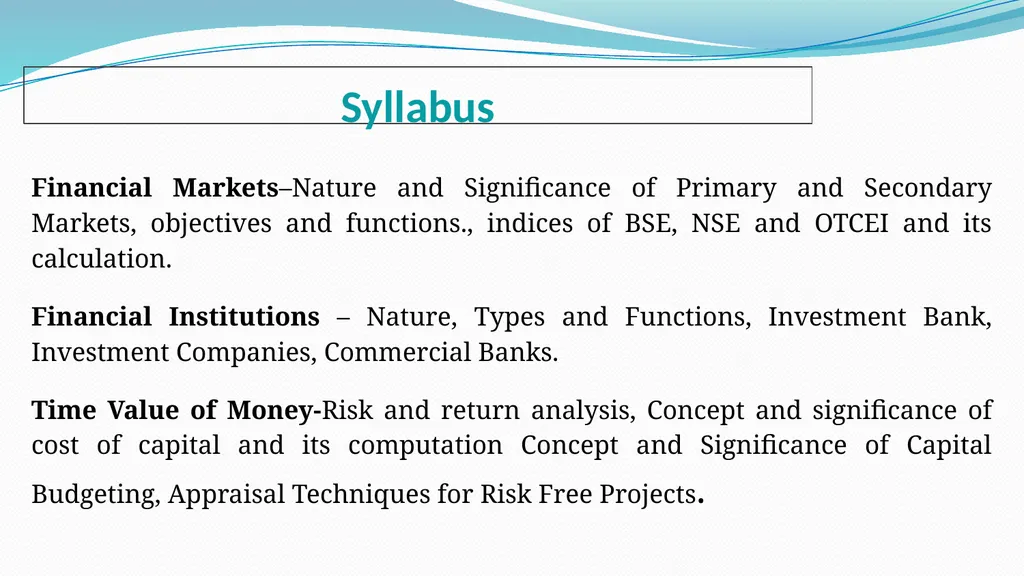
Syllabus Financial Markets–Nature and Significance of Primary and Secondary Markets, objectives and functions., indices of BSE, NSE and OTCEI and its calculation.
Financial Institutions – Nature, Types and Functions, Investment Bank, Investment Companies, Commercial Banks.
Time Value of Money-Risk and return analysis, Concept and significance of cost of capital and its computation Concept and Significance of Capital Budgeting, Appraisal Techniques for Risk Free Projects.<br>
Financial Institutions – Nature, Types and Functions, Investment Bank, Investment Companies, Commercial Banks.
Time Value of Money-Risk and return analysis, Concept and significance of cost of capital and its computation Concept and Significance of Capital Budgeting, Appraisal Techniques for Risk Free Projects.<br>
04
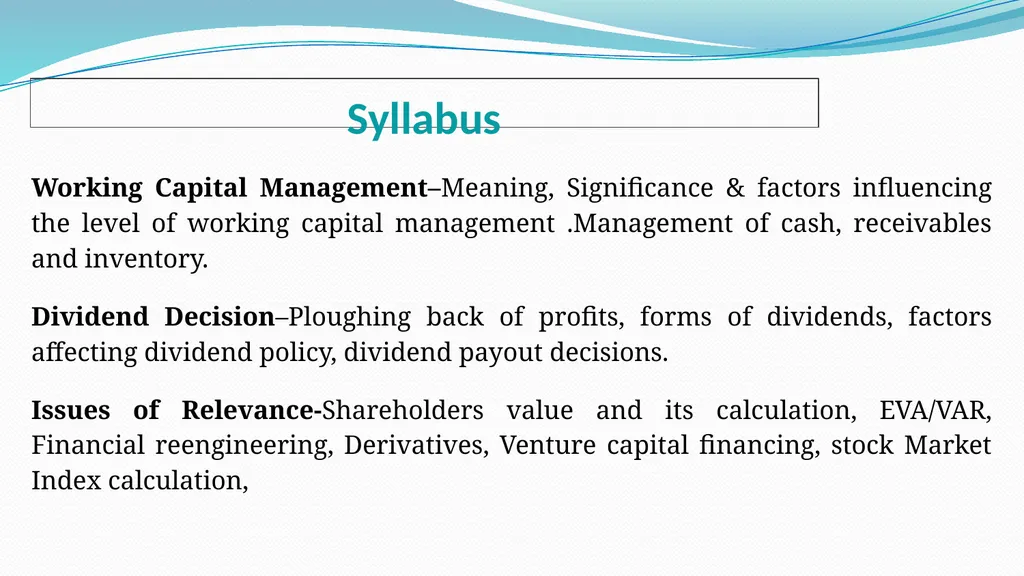
Syllabus Working Capital Management–Meaning, Significance & factors influencing the level of working capital management .Management of cash, receivables and inventory.
Dividend Decision–Ploughing back of profits, forms of dividends, factors affecting dividend policy, dividend payout decisions.
Issues of Relevance-Shareholders value and its calculation, EVA/VAR, Financial reengineering, Derivatives, Venture capital financing, stock Market Index calculation,<br>
Dividend Decision–Ploughing back of profits, forms of dividends, factors affecting dividend policy, dividend payout decisions.
Issues of Relevance-Shareholders value and its calculation, EVA/VAR, Financial reengineering, Derivatives, Venture capital financing, stock Market Index calculation,<br>
05
Some Questions... What is finance???
What are a firm’s financial activities???
How are they related to the firm’s other activities??<br>
What are a firm’s financial activities???
How are they related to the firm’s other activities??<br>
06
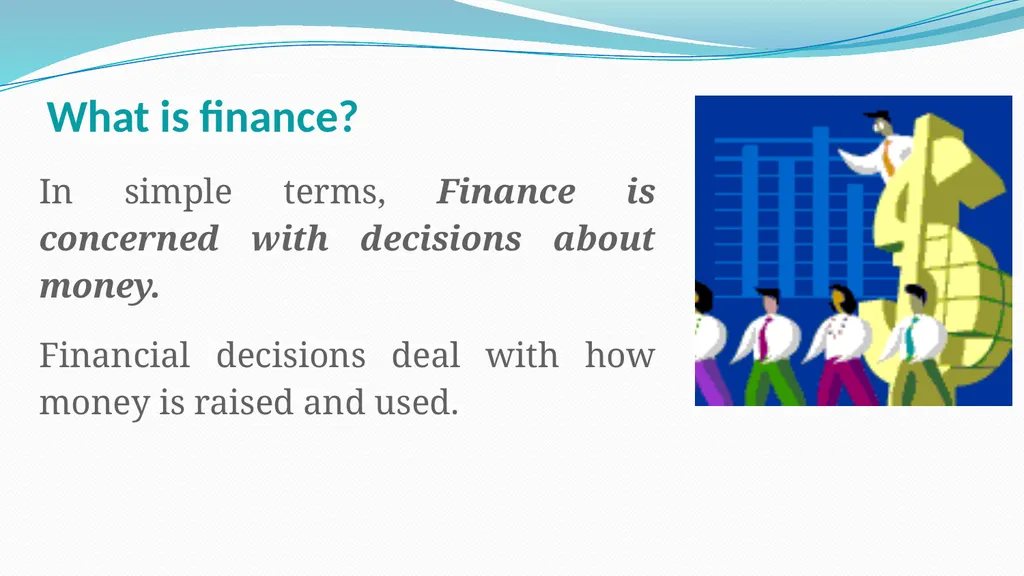
What is finance? In simple terms, Finance is concerned with decisions about money.
Financial decisions deal with how money is raised and used.<br>
Financial decisions deal with how money is raised and used.<br>
07
Finance and Management Functions Almost all business activities, directly or indirectly involve the acquisition and use of funds.
For Example:
Recruitment and promotion of employees is a responsibility of human resource department but requires payment of wages and salaries thus involves, finance.
Buying a new machine or replacing an old machine for increasing productive capacity affects the flow of funds.
Advertising and other sales promotion activities come within the purview of marketing but require cash outlays, therefore affect financial resources.<br>
For Example:
Recruitment and promotion of employees is a responsibility of human resource department but requires payment of wages and salaries thus involves, finance.
Buying a new machine or replacing an old machine for increasing productive capacity affects the flow of funds.
Advertising and other sales promotion activities come within the purview of marketing but require cash outlays, therefore affect financial resources.<br>
08
Financial Management???????????<br>
09
Management????? . Securing optimum use of resources at the disposal towards attainment of some pre-determined goals. Financial Management…… Managing financial resources in the most optimal manner.<br>
10
Why financial management?? Although Businesses vary in terms of their industry, environment, products or services they provide, however, the finance issues that grapple them are mostly universal i.e.
From where to raise the most cost effective financial resources and how to manage the risks associated with such financing?
Where to invest the scarce business resources so as to maximize the returns (i.e. right nature and optimal scale of business, projects etc. and at most suitable locations.<br>
From where to raise the most cost effective financial resources and how to manage the risks associated with such financing?
Where to invest the scarce business resources so as to maximize the returns (i.e. right nature and optimal scale of business, projects etc. and at most suitable locations.<br>
11
Why financial management?? (contd.) 3. How to manage the routine production and distribution function in the most cost effective manner so as to maximize the wealth of shareholders.
4. How much of profits to retain for future investment and how much to distribute as dividend to the shareholders.<br>
4. How much of profits to retain for future investment and how much to distribute as dividend to the shareholders.<br>
12
Scope of financial management Financial management performs facilitation, reconciliation and control functions in an organization.
Facilitation :
Sourcing of financial resources needed by various departments.
Its rational allocation for various activities.
This facilitates attainment of departmental goals along with realization of overall organizational objectives.<br>
Facilitation :
Sourcing of financial resources needed by various departments.
Its rational allocation for various activities.
This facilitates attainment of departmental goals along with realization of overall organizational objectives.<br>
13
Scope of financial management (contd.) Reconciliation :
Rational and balanced allocation of resources reconciles the interests of various departments.
Also pre-empts any kind of probable conflict for resources between departments.
Control:
Finance department maintains constant control over various activities of organization.
Makes departments accountable for the resources they consume.<br>
Rational and balanced allocation of resources reconciles the interests of various departments.
Also pre-empts any kind of probable conflict for resources between departments.
Control:
Finance department maintains constant control over various activities of organization.
Makes departments accountable for the resources they consume.<br>
14
Functions of Financial Management / Finance Functions/ Finance Decisions<br>
15
INVESTMENT DECISION Types of assets deployed in business – fixed and current.
Fixed assets serve business for a long time,
Current assets have a short life, mostly held for sale, either in same form or after transforming them, within a year’s time.
The decision to invest in long term (fixed assets) by the firm is investment decision.<br>
Fixed assets serve business for a long time,
Current assets have a short life, mostly held for sale, either in same form or after transforming them, within a year’s time.
The decision to invest in long term (fixed assets) by the firm is investment decision.<br>
16
INVESTMENT DECISION (contd.) Also referred to as capital budgeting decisions.
Putting resources in avenues that give returns in excess of cost incurred (this maximizes shareholder's wealth).
Basic issues:
Evaluation of alternative avenues so as to select the best option.
Implementation and monitoring of selected option.<br>
Putting resources in avenues that give returns in excess of cost incurred (this maximizes shareholder's wealth).
Basic issues:
Evaluation of alternative avenues so as to select the best option.
Implementation and monitoring of selected option.<br>
17
INVESTMENT DECISION (contd.) Such decisions relate to:
For new business – setting up of new production distribution facilities
For existing business – replacement, modernization and Research and development.
Depend upon nature of industry, type of products/services offered and scale of operations.<br>
For new business – setting up of new production distribution facilities
For existing business – replacement, modernization and Research and development.
Depend upon nature of industry, type of products/services offered and scale of operations.<br>
18
INVESTMENT DECISION (contd.) Have Long term implications (as they involve huge capital outlay and normally irreversible).
Are significantly important because of their risk-return perspective (a wrong decision in nature and scale of investment may not only bring down return but may also enhance operating risk of business.
Are critical for survival and growth of the firm.<br>
Are significantly important because of their risk-return perspective (a wrong decision in nature and scale of investment may not only bring down return but may also enhance operating risk of business.
Are critical for survival and growth of the firm.<br>
19
INVESTMENT DECISION (contd.) Decision to invest or not is taken in light of probable impact on shareholder’s wealth.
If it is likely to create/enhance wealth – acceptable, otherwise it is not.
Whether cash generated from operations carried out by using long term assets is sufficient to satisfy expectations of investors. If yes, then proposal is accepted otherwise rejected.<br>
If it is likely to create/enhance wealth – acceptable, otherwise it is not.
Whether cash generated from operations carried out by using long term assets is sufficient to satisfy expectations of investors. If yes, then proposal is accepted otherwise rejected.<br>
20
FINANCING DECISION Relate to procurement of required amount of capital.
At lowest possible cost and most convenient terms.
Main Issues:
From where to procure requisite capital?
What should be optimal mix of various sources of capital?
How much should be proportion of short-term and long-term capital?<br>
At lowest possible cost and most convenient terms.
Main Issues:
From where to procure requisite capital?
What should be optimal mix of various sources of capital?
How much should be proportion of short-term and long-term capital?<br>
21
FINANCING DECISION (contd.) 4. How do the expectations of providers of each source of capital change with an alteration in the capital mix?
The financial manager must strive to achieve the best financing mix or optimum capital structure which helps in maximizing market value of shares.
Use of debt affects the return and risk of shareholders.
A proper balance needs to be struck between return and risk.<br>
The financial manager must strive to achieve the best financing mix or optimum capital structure which helps in maximizing market value of shares.
Use of debt affects the return and risk of shareholders.
A proper balance needs to be struck between return and risk.<br>
22
FINANCING DECISION (contd.) Once the financial manager is able to decide best combination of debt and equity, he must raise appropriate resources through best available sources.
Other factors to be considered-
Control, flexibility, loan covenants, legal aspects etc.<br>
Other factors to be considered-
Control, flexibility, loan covenants, legal aspects etc.<br>
23
DIVIDEND DECISION Financial manager should decide:
Whether to distribute all the profits, or
Should retain them, or
Distribute a portion and retain the balance.
Proportion of profits distributed is known as dividend payout ratio.
Retained portion is known as retention ratio.<br>
Whether to distribute all the profits, or
Should retain them, or
Distribute a portion and retain the balance.
Proportion of profits distributed is known as dividend payout ratio.
Retained portion is known as retention ratio.<br>
24
DIVIDEND DECISION (contd.) Optimum dividend policy is one that maximizes return of shareholders (market value of shares).
Dividend are generally paid in cash, but a firm may issue bonus shares.
Bonus shares: issued to existing shareholders without any charge.
Factors to be considered – dividend stability, bonus shares and cash dividends in practice.<br>
Dividend are generally paid in cash, but a firm may issue bonus shares.
Bonus shares: issued to existing shareholders without any charge.
Factors to be considered – dividend stability, bonus shares and cash dividends in practice.<br>
25
SHORT TERM FINANCE DECISIONS Involve a period of less than one year.
Needed for managing day-to-day fund requirements.
Generally related to – current assets, current liabilities, short term borrowings and investment of surplus cash for short period.<br>
Needed for managing day-to-day fund requirements.
Generally related to – current assets, current liabilities, short term borrowings and investment of surplus cash for short period.<br>
26
SHORT TERM FINANCE DECISIONS (contd.) Liquidity Decision:
Investment in current assets affects profitability and liquidity.
Lack of liquidity in extreme situation may lead to insolvency.
Conflict between profitability and liquidity arises while managing current assets.<br>
Investment in current assets affects profitability and liquidity.
Lack of liquidity in extreme situation may lead to insolvency.
Conflict between profitability and liquidity arises while managing current assets.<br>
27
SHORT TERM FINANCE DECISIONS (contd.) Liquidity Decision:
insufficient investment in current assets causes illiquidity –which is risky.
On other hand, if current assets are idle, they would not earn anything, i.e. firm would loose profitability..
Proper trade-off must be achieved between profitability and liquidity.<br>
insufficient investment in current assets causes illiquidity –which is risky.
On other hand, if current assets are idle, they would not earn anything, i.e. firm would loose profitability..
Proper trade-off must be achieved between profitability and liquidity.<br>
28
SHORT TERM FINANCE DECISIONS (contd.) Liquidity Decision:
Finance manager must:
Develop sound techniques for managing current assets.
Estimate firm’s need for current assets and make sure that funds would be available when needed.<br>
Finance manager must:
Develop sound techniques for managing current assets.
Estimate firm’s need for current assets and make sure that funds would be available when needed.<br>
29
Forms of Business Organization Major forms of business organizations in India:
Sole proprietorship
Partnership
Company/corporations<br>
Sole proprietorship
Partnership
Company/corporations<br>
30
Sole proprietorship An un-incorporated business owned by one individual
Advantages-
Easily and inexpensively formed; not much “red tape” required; only a license required by state and municipality in which business operates.
Subject to very few government regulations.
Taxed like an individual, not like corporations. (earnings are taxed once)<br>
Advantages-
Easily and inexpensively formed; not much “red tape” required; only a license required by state and municipality in which business operates.
Subject to very few government regulations.
Taxed like an individual, not like corporations. (earnings are taxed once)<br>
31
Sole proprietorship Limitations:
Unlimited personal liability.
Its life is limited to the time the individual who created it owns it. When a new year takes over, legally firm becomes a new proprietorship, even if name of business does not change.
Difficult to obtain large sums of capital;
funds are derived from owner’s sources of credit.
Access to bank loans,
Loans from friends etc.<br>
Unlimited personal liability.
Its life is limited to the time the individual who created it owns it. When a new year takes over, legally firm becomes a new proprietorship, even if name of business does not change.
Difficult to obtain large sums of capital;
funds are derived from owner’s sources of credit.
Access to bank loans,
Loans from friends etc.<br>
32
Partnership Same as proprietorship, except that it has 2 or more owners.
Can operate under different degrees of formality ranging from
Informal Oral understandings
Formal agreements filed with secretary of the state.
Advantages
Same as proprietorship
More sources available as more partners are there, more friends, relatives, more opportunities to raise funds.<br>
Can operate under different degrees of formality ranging from
Informal Oral understandings
Formal agreements filed with secretary of the state.
Advantages
Same as proprietorship
More sources available as more partners are there, more friends, relatives, more opportunities to raise funds.<br>
33
Partnership Limitations
Have difficulties in attracting substantial amounts of funds.
This is not a major problem for slow growth firms, however, if business’ products really catch on and need to raise large amount of funds to capitalize on opportunities, the difficulty of attracting funds becomes a drawback.
Growth companies such as Microsoft and Dell computer, generally began life as proprietorship or partnership , but at some point find it necessary to convert to corporations.<br>
Have difficulties in attracting substantial amounts of funds.
This is not a major problem for slow growth firms, however, if business’ products really catch on and need to raise large amount of funds to capitalize on opportunities, the difficulty of attracting funds becomes a drawback.
Growth companies such as Microsoft and Dell computer, generally began life as proprietorship or partnership , but at some point find it necessary to convert to corporations.<br>
34
Partnership Limitations
Each partner is liable for debts of business<br>
Each partner is liable for debts of business<br>
35
Company Legal entity created by state, which means, company has legal authority to act like person when conducting business.
Separate and distinct from its owners and managers.
Can be private limited or public limited companies.
Governed by companies Act, which has strict provisions for disclosure and procedure.<br>
Separate and distinct from its owners and managers.
Can be private limited or public limited companies.
Governed by companies Act, which has strict provisions for disclosure and procedure.<br>
36
Company Advantages:
Limited Liability
Ownership interests can be divided into shares which can be transferred more easily that partnership or proprietorship.
Unlimited life, not affected by life of original owners and managers.
Above three features make it much easier to raise money in financial markets.<br>
Limited Liability
Ownership interests can be divided into shares which can be transferred more easily that partnership or proprietorship.
Unlimited life, not affected by life of original owners and managers.
Above three features make it much easier to raise money in financial markets.<br>
37
Company Disadvantages:
Setting up and periodic filings under Companies Act – more complex and time consuming.
Double taxation. (earnings of company are taxed at corporation level and dividends are again taxed)<br>
Setting up and periodic filings under Companies Act – more complex and time consuming.
Double taxation. (earnings of company are taxed at corporation level and dividends are again taxed)<br>
38
Financial manager’s Role Financial planning: Preparing the financial plan, which projects revenues, expenditures, and financing needs over a given period.
Investment (spending money): Investing the firm’s funds in projects and securities that provide high returns in relation to their risks.
Financing (raising money): Obtaining funding for the firm’s operations and investments and seeking the best balance between debt (borrowed funds) and equity (funds raised through the sale of ownership in the business).<br>
Investment (spending money): Investing the firm’s funds in projects and securities that provide high returns in relation to their risks.
Financing (raising money): Obtaining funding for the firm’s operations and investments and seeking the best balance between debt (borrowed funds) and equity (funds raised through the sale of ownership in the business).<br>
39
Financial manager’s Role Prepare financial statements, business activity reports, and forecasts,
Monitor financial details to ensure that legal requirements are met,
Supervise employees who do financial reporting and budgeting,
Review company financial reports and seek ways to reduce costs,
Analyze market trends to find opportunities for expansion or for acquiring other companies,
Help management make financial decisions.<br>
Monitor financial details to ensure that legal requirements are met,
Supervise employees who do financial reporting and budgeting,
Review company financial reports and seek ways to reduce costs,
Analyze market trends to find opportunities for expansion or for acquiring other companies,
Help management make financial decisions.<br>
40
Financial Goal: Profit Maximization vs. Wealth Maximization (this topic was discussed in detail in class and notes were given for the same in class) It is generally agreed in theory that the financial goal of the firm should be Shareholder’s Wealth Maximization. (SWM) (as reflected in market value of firm’s share)<br>