FINANCIAL MANAGEMENT An overview Subject: Commerce Title of Paper: Fundamentals of Financial Management Financial Management The Basic Concept What it is? The meaning of Financial Management is embedded into the interpretation of the two
"FINANCIAL MANAGEMENT An overview Subject: Commerce" is the property of its rightful owner. Permission is granted to
download and print the materials on this website for personal, non-commercial use only, and to display it
on your personal computer provided you do not modify the materials and that you retain all copyright
notices contained in the materials. By downloading content from our website, you accept the terms of this
agreement.
Presentation Transcript
01
FINANCIAL MANAGEMENT An overview Subject: Commerce
Title of Paper: Fundamentals of Financial Management<br>
02
Financial Management – The Basic Concept What it is?
The meaning of Financial Management is embedded into the interpretation of the two terms:
Finance; &
Management<br>
03
Finance – The Meaning Finance basically refers to money though it takes different names like Cash, Funds, Capital etc, in different situations with different implications. In a broader sense, finance envisages not only money but all assets which money is converted to and liabilities which are supposed to be met with money.<br>
04
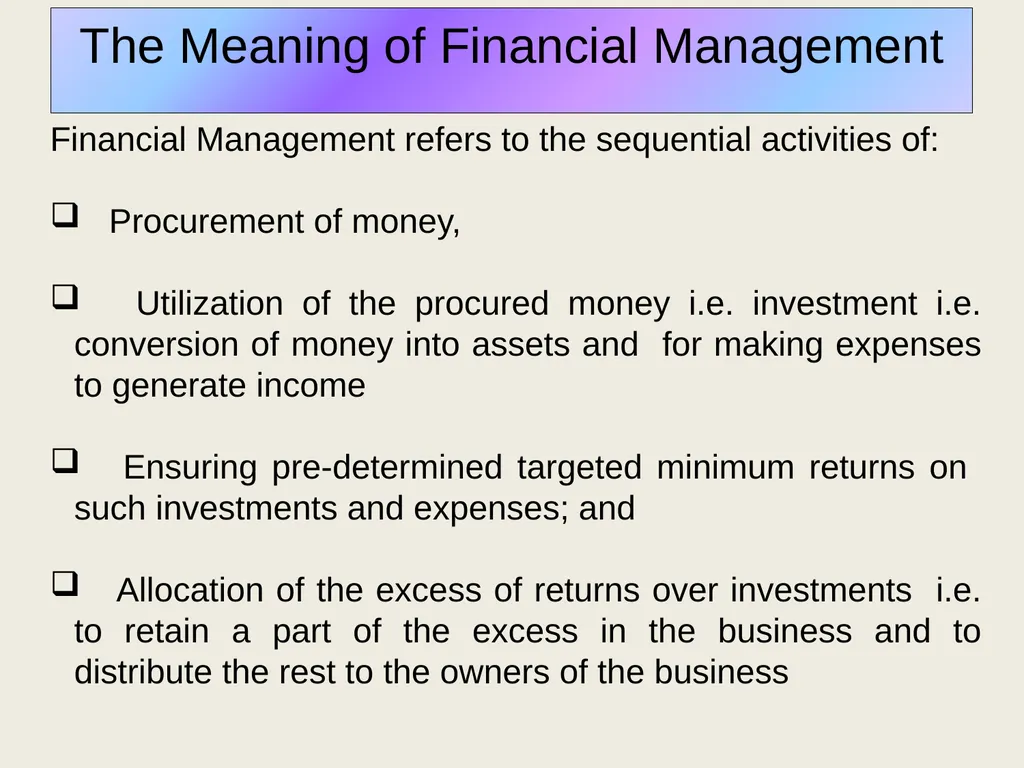
Financial Management refers to the sequential activities of:
Procurement of money,
Utilization of the procured money i.e. investment i.e. conversion of money into assets and for making expenses to generate income
Ensuring pre-determined targeted minimum returns on such investments and expenses; and
Allocation of the excess of returns over investments i.e. to retain a part of the excess in the business and to distribute the rest to the owners of the business The Meaning of Financial Management<br>
05
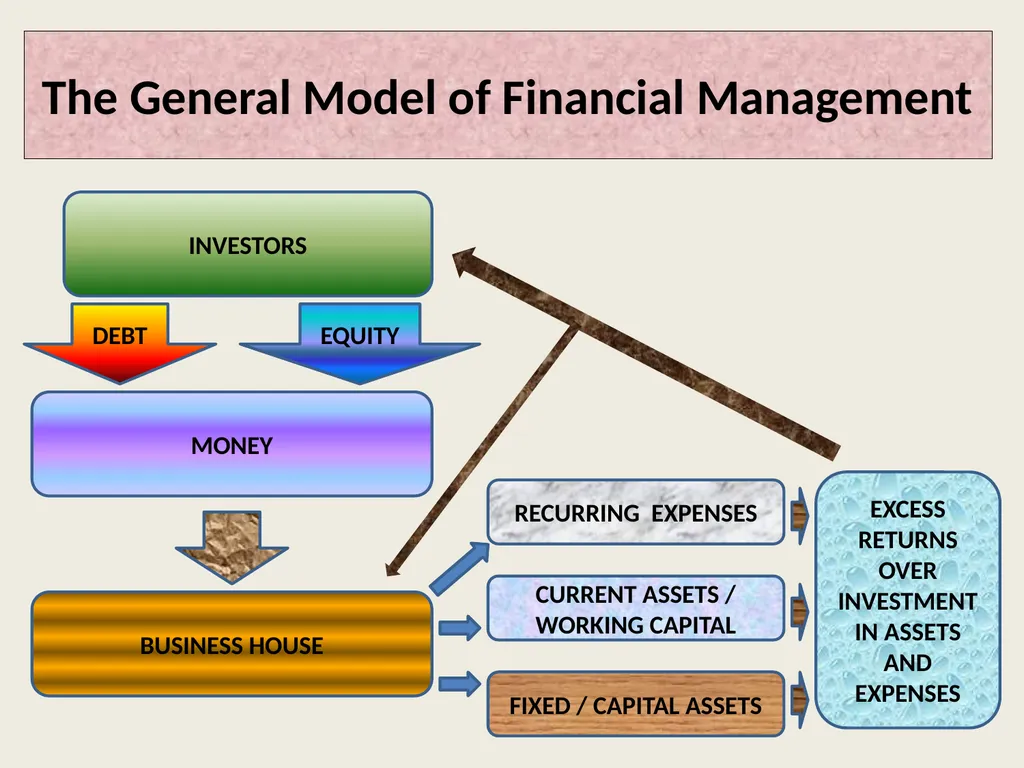
The General Model of Financial Management INVESTORS MONEY BUSINESS HOUSE DEBT EQUITY FIXED / CAPITAL ASSETS CURRENT ASSETS / WORKING CAPITAL RECURRING EXPENSES EXCESS RETURNS OVER INVESTMENT IN ASSETS AND EXPENSES<br>
06
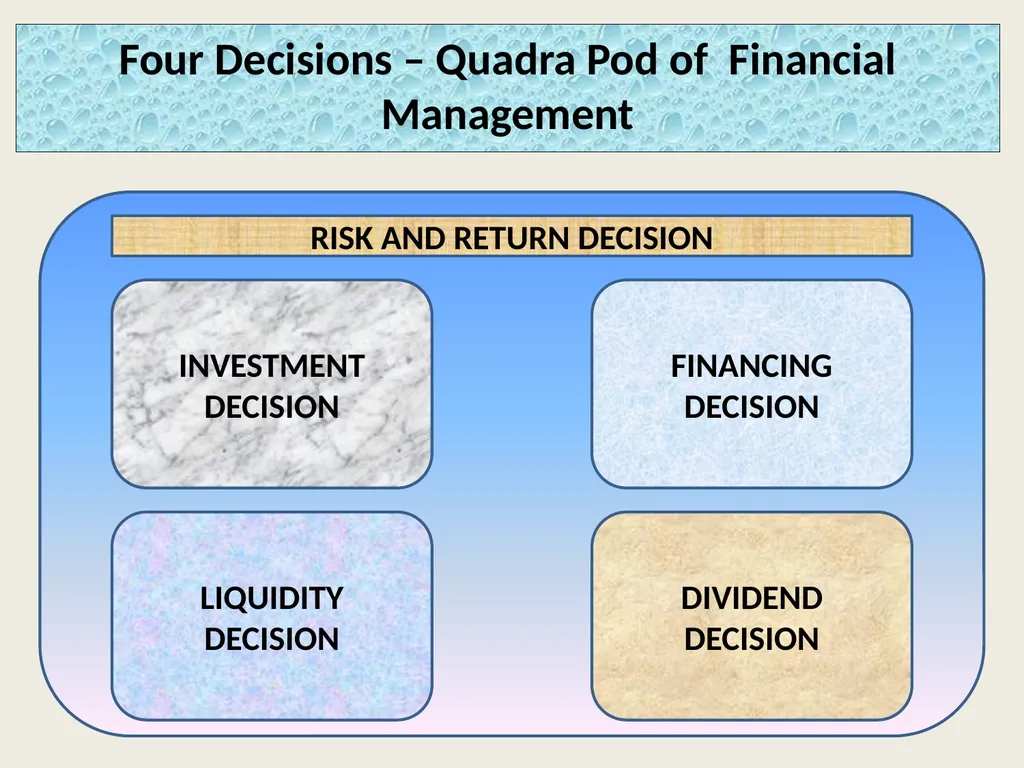
Four Decisions – Quadra Pod of Financial Management INVESTMENT DECISION FINANCING DECISION LIQUIDITY DECISION DIVIDEND DECISION RISK AND RETURN DECISION<br>
07
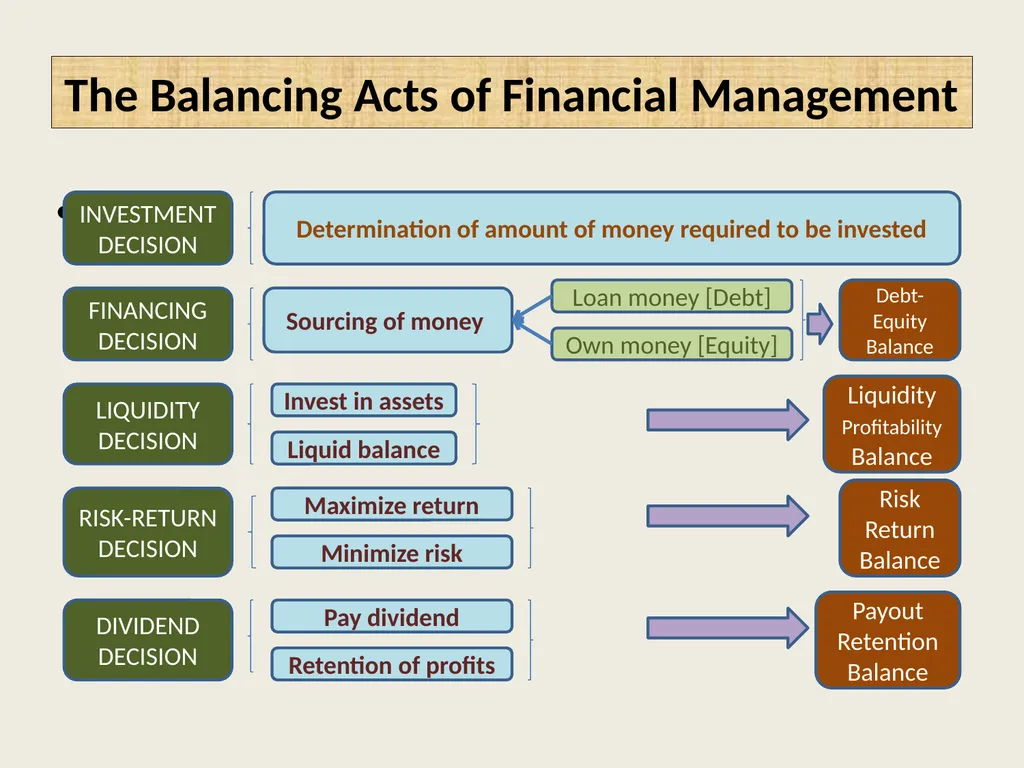
The Balancing Acts of Financial Management INVESTMENT DECISION FINANCING DECISION LIQUIDITY DECISION RISK-RETURN DECISION DIVIDEND DECISION Determination of amount of money required to be invested Sourcing of money Loan money [Debt] Own money [Equity] Invest in assets Liquid balance Maximize return Minimize risk Pay dividend Retention of profits Debt-Equity Balance Liquidity Profitability Balance Risk Return Balance Payout Retention Balance<br>
08
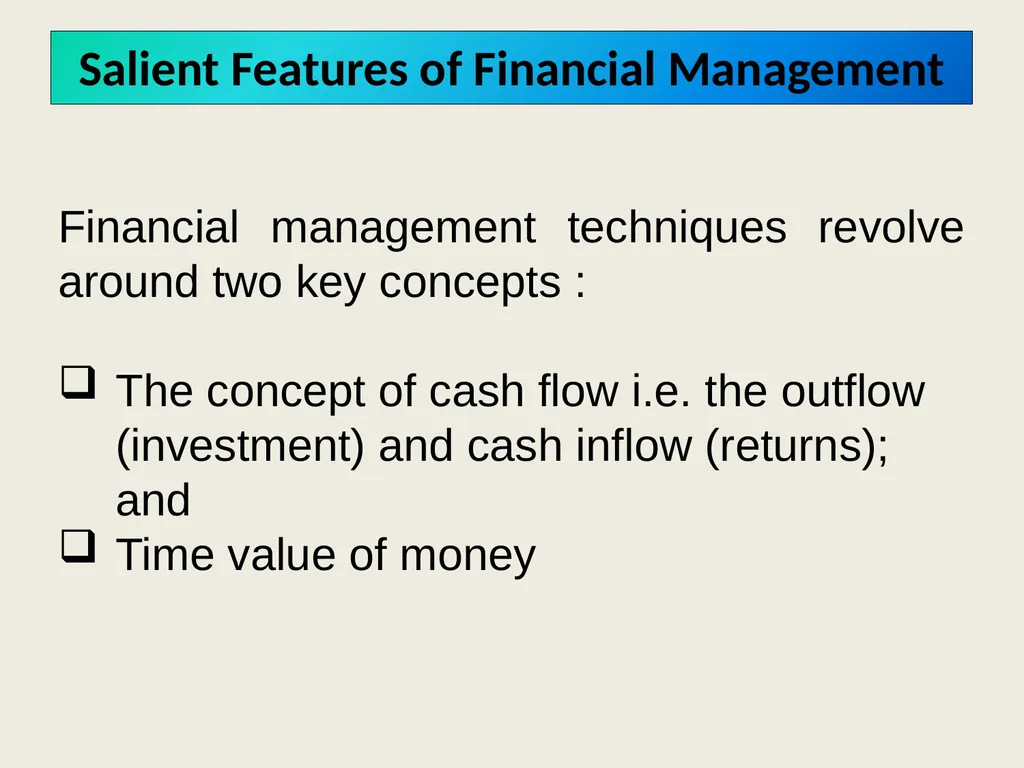
Salient Features of Financial Management Financial management techniques revolve around two key concepts :
The concept of cash flow i.e. the outflow (investment) and cash inflow (returns); and
Time value of money<br>
09
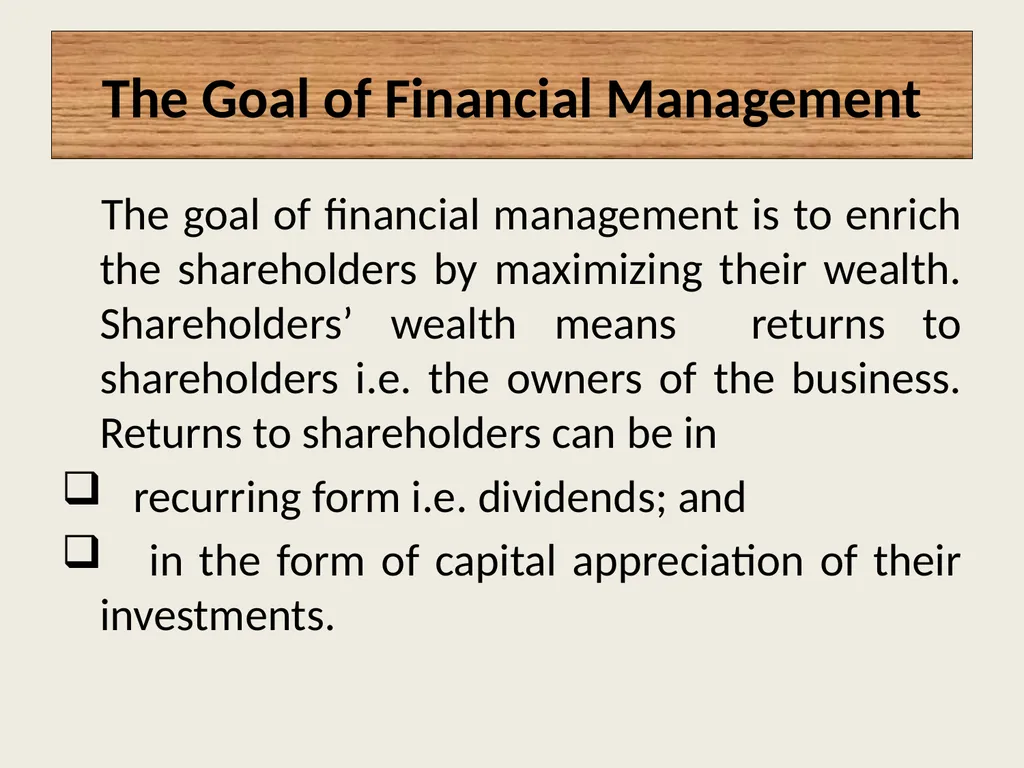
The Goal of Financial Management The goal of financial management is to enrich the shareholders by maximizing their wealth. Shareholders’ wealth means returns to shareholders i.e. the owners of the business. Returns to shareholders can be in
recurring form i.e. dividends; and
in the form of capital appreciation of their investments.<br>
10
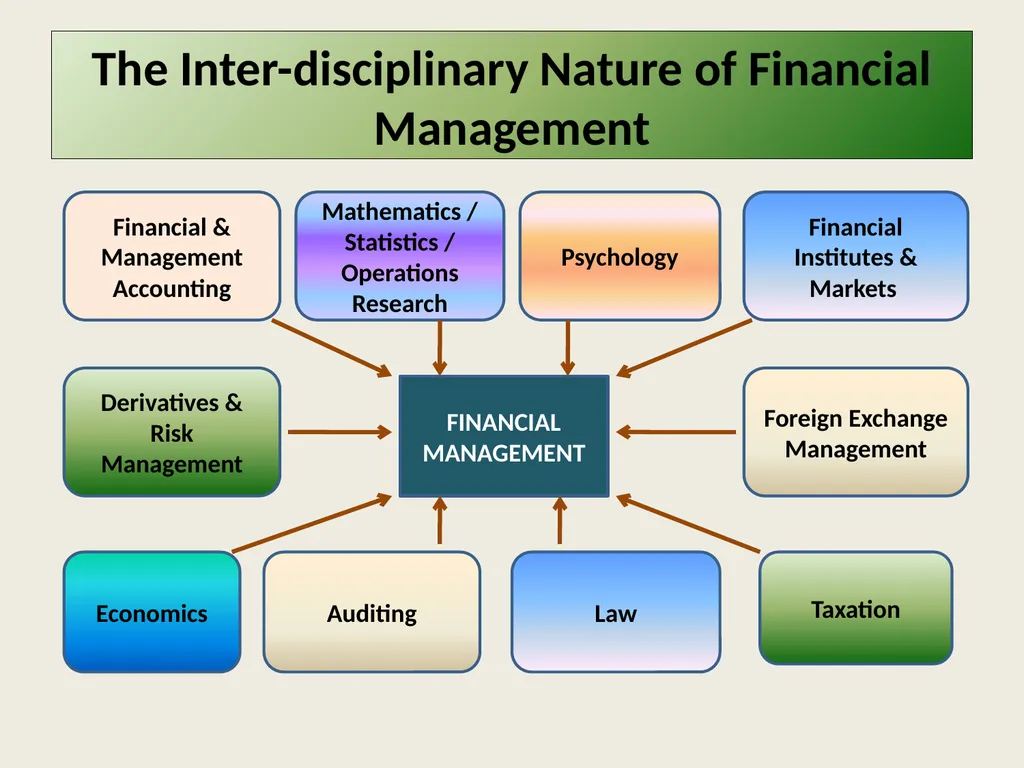
The Inter-disciplinary Nature of Financial Management FINANCIAL MANAGEMENT Financial & Management Accounting Economics Auditing Mathematics / Statistics / Operations Research Psychology Taxation Law Financial Institutes & Markets Derivatives & Risk Management Foreign Exchange Management<br>