
Financial Management Institute Public Sector
DJ
Published · 33 slides · 0 views

1 / 1
Description
Financial Management Institute Public Sector Management Workshop International Federation of Accountants International Public Sector Accounting Standards Board (IPSASB) Stuart Barr (Technical Advisor to Sheila Fraser INTOSAI) INTOSAI -
Related Topics
Share
Embed code
Download this presentation From Below
"Financial Management Institute Public Sector" is the property of its rightful owner. Permission is granted to download and print the materials on this website for personal, non-commercial use only, and to display it on your personal computer provided you do not modify the materials and that you retain all copyright notices contained in the materials. By downloading content from our website, you accept the terms of this agreement.
Presentation Transcript
01
Financial Management Institute Public Sector Management Workshop International Federation of Accountants International Public Sector Accounting Standards Board (IPSASB)
Stuart Barr (Technical Advisor to Sheila Fraser – INTOSAI) INTOSAI - PSC June 2009<br>
Stuart Barr (Technical Advisor to Sheila Fraser – INTOSAI) INTOSAI - PSC June 2009<br>
02
Overview of Session Introduce IFAC and IPSASB
Discuss IPSASB’s mission and strategic themes
Provide an overview of various projects under way and planned
Q & A INTOSAI - PSC June 2009<br>
Discuss IPSASB’s mission and strategic themes
Provide an overview of various projects under way and planned
Q & A INTOSAI - PSC June 2009<br>
03
What is IFAC? Expanding organization – currently, 157 member bodies and associates in 123 countries
Represents over 2.5 million accountants in public practice, education, government service, industry and commerce
Sets standards for auditing & assurance, ethics, education and public sector accounting
Also issues guidance to support professional accountants in business, small and medium practices, and developing nations IFAC INTOSAI - PSC June 2009<br>
Represents over 2.5 million accountants in public practice, education, government service, industry and commerce
Sets standards for auditing & assurance, ethics, education and public sector accounting
Also issues guidance to support professional accountants in business, small and medium practices, and developing nations IFAC INTOSAI - PSC June 2009<br>
04
What is IPSASB? Standing IFAC Board
Consists of 18 volunteer Members from around the world, including two from Canada:
15 Members nominated through IFAC member bodies and 3 members serve as public members
Experience and expertise in public sector financial reporting
Ministries of finance, government audit institutions, public practice and public members – but, they serve as individuals not as representatives of their organization
Issues and promotes benchmark guidance and facilitates the exchange of information among its constituents INTOSAI - PSC June 2009<br>
Consists of 18 volunteer Members from around the world, including two from Canada:
15 Members nominated through IFAC member bodies and 3 members serve as public members
Experience and expertise in public sector financial reporting
Ministries of finance, government audit institutions, public practice and public members – but, they serve as individuals not as representatives of their organization
Issues and promotes benchmark guidance and facilitates the exchange of information among its constituents INTOSAI - PSC June 2009<br>
05
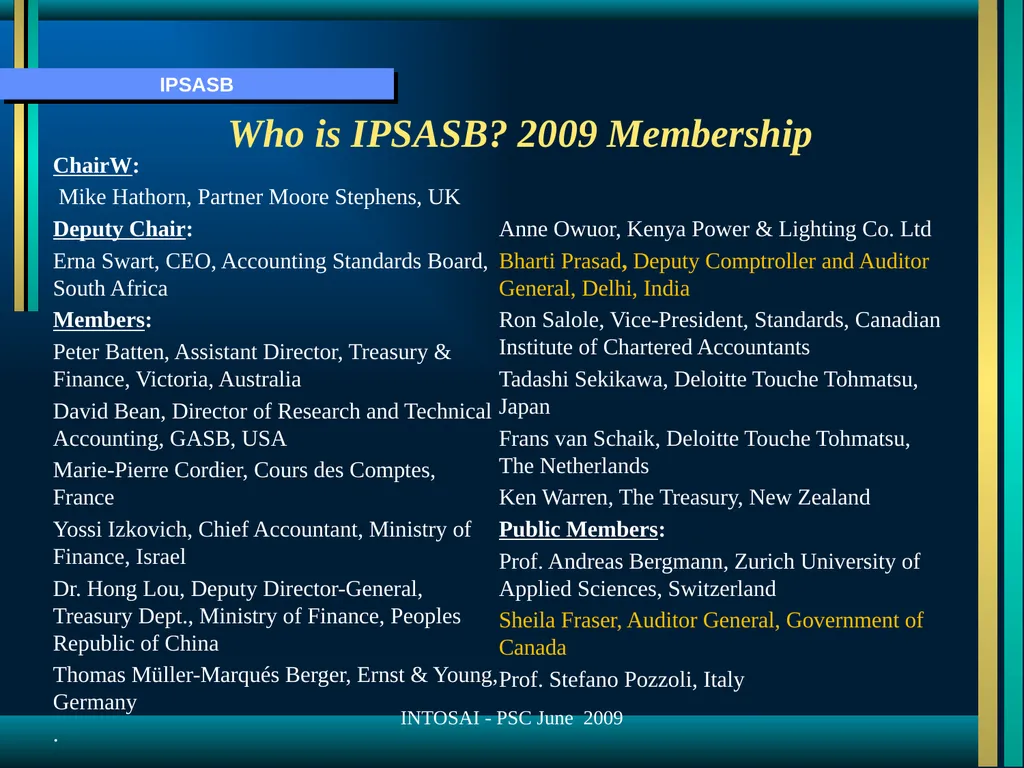
Who is IPSASB? 2009 Membership ChairW:
Mike Hathorn, Partner Moore Stephens, UK
Deputy Chair:
Erna Swart, CEO, Accounting Standards Board, South Africa
Members:
Peter Batten, Assistant Director, Treasury & Finance, Victoria, Australia
David Bean, Director of Research and Technical Accounting, GASB, USA
Marie-Pierre Cordier, Cours des Comptes, France
Yossi Izkovich, Chief Accountant, Ministry of Finance, Israel
Dr. Hong Lou, Deputy Director-General, Treasury Dept., Ministry of Finance, Peoples Republic of China
Thomas Müller-Marqués Berger, Ernst & Young, Germany
.
Anne Owuor, Kenya Power & Lighting Co. Ltd
Bharti Prasad, Deputy Comptroller and Auditor General, Delhi, India
Ron Salole, Vice-President, Standards, Canadian Institute of Chartered Accountants
Tadashi Sekikawa, Deloitte Touche Tohmatsu, Japan
Frans van Schaik, Deloitte Touche Tohmatsu, The Netherlands
Ken Warren, The Treasury, New Zealand
Public Members:
Prof. Andreas Bergmann, Zurich University of Applied Sciences, Switzerland
Sheila Fraser, Auditor General, Government of Canada
Prof. Stefano Pozzoli, Italy INTOSAI - PSC June 2009<br>
Mike Hathorn, Partner Moore Stephens, UK
Deputy Chair:
Erna Swart, CEO, Accounting Standards Board, South Africa
Members:
Peter Batten, Assistant Director, Treasury & Finance, Victoria, Australia
David Bean, Director of Research and Technical Accounting, GASB, USA
Marie-Pierre Cordier, Cours des Comptes, France
Yossi Izkovich, Chief Accountant, Ministry of Finance, Israel
Dr. Hong Lou, Deputy Director-General, Treasury Dept., Ministry of Finance, Peoples Republic of China
Thomas Müller-Marqués Berger, Ernst & Young, Germany
.
Anne Owuor, Kenya Power & Lighting Co. Ltd
Bharti Prasad, Deputy Comptroller and Auditor General, Delhi, India
Ron Salole, Vice-President, Standards, Canadian Institute of Chartered Accountants
Tadashi Sekikawa, Deloitte Touche Tohmatsu, Japan
Frans van Schaik, Deloitte Touche Tohmatsu, The Netherlands
Ken Warren, The Treasury, New Zealand
Public Members:
Prof. Andreas Bergmann, Zurich University of Applied Sciences, Switzerland
Sheila Fraser, Auditor General, Government of Canada
Prof. Stefano Pozzoli, Italy INTOSAI - PSC June 2009<br>
06
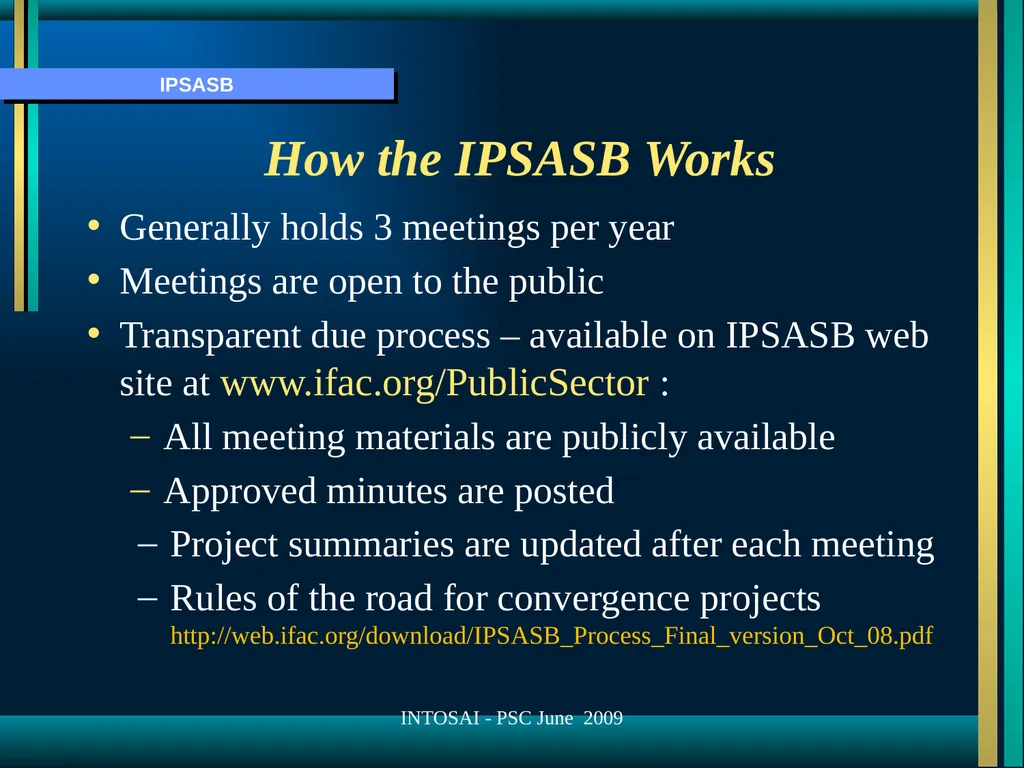
How the IPSASB Works Generally holds 3 meetings per year
Meetings are open to the public
Transparent due process – available on IPSASB web site at www.ifac.org/PublicSector :
All meeting materials are publicly available
Approved minutes are posted
Project summaries are updated after each meeting
Rules of the road for convergence projects http://web.ifac.org/download/IPSASB_Process_Final_version_Oct_08.pdf INTOSAI - PSC June 2009<br>
Meetings are open to the public
Transparent due process – available on IPSASB web site at www.ifac.org/PublicSector :
All meeting materials are publicly available
Approved minutes are posted
Project summaries are updated after each meeting
Rules of the road for convergence projects http://web.ifac.org/download/IPSASB_Process_Final_version_Oct_08.pdf INTOSAI - PSC June 2009<br>
07
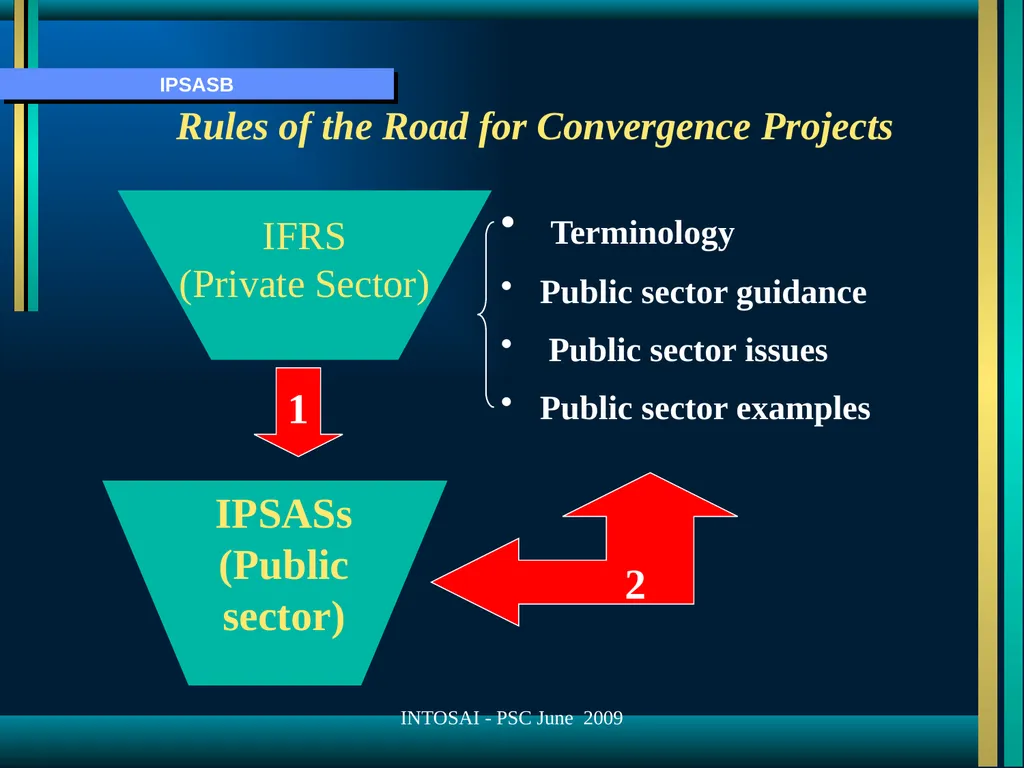
Rules of the Road for Convergence Projects Terminology
Public sector guidance
Public sector issues
Public sector examples 1 2 INTOSAI - PSC June 2009<br>
Public sector guidance
Public sector issues
Public sector examples 1 2 INTOSAI - PSC June 2009<br>
08
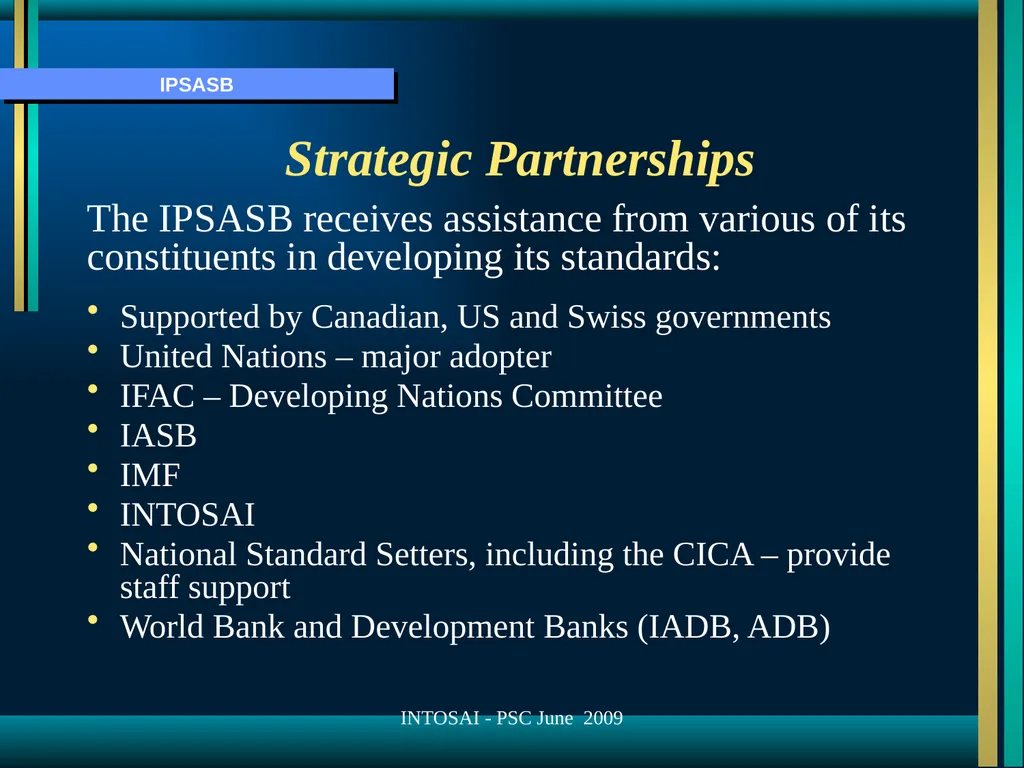
Strategic Partnerships The IPSASB receives assistance from various of its constituents in developing its standards:
Supported by Canadian, US and Swiss governments
United Nations – major adopter
IFAC – Developing Nations Committee
IASB
IMF
INTOSAI
National Standard Setters, including the CICA – provide staff support
World Bank and Development Banks (IADB, ADB) INTOSAI - PSC June 2009<br>
Supported by Canadian, US and Swiss governments
United Nations – major adopter
IFAC – Developing Nations Committee
IASB
IMF
INTOSAI
National Standard Setters, including the CICA – provide staff support
World Bank and Development Banks (IADB, ADB) INTOSAI - PSC June 2009<br>
09
Keep up to date on IPSASB projects IPSASB Project Pages – all IPSASB projects http://www.ifac.org/PublicSector/
IFAC eNews – Free electronic newsletter
Enroll at www.ifac.org INTOSAI - PSC June 2009<br>
IFAC eNews – Free electronic newsletter
Enroll at www.ifac.org INTOSAI - PSC June 2009<br>
10
The IFAC IPSASB Mission To serve the public interest by developing high quality accounting standards for use by public sector entities around the world, including international organisations, in the preparation of general purpose financial statements. INTOSAI - PSC June 2009<br>
11
What the IFAC IPSASB Does The IPSASB achieves its objectives by:
Issuing International Public Sector Accounting Standards (IPSASs)
Publishing other documents which provide guidance on issues and experiences in financial reporting in the public sector
Promoting their acceptance and the international convergence to these standards INTOSAI - PSC June 2009<br>
Issuing International Public Sector Accounting Standards (IPSASs)
Publishing other documents which provide guidance on issues and experiences in financial reporting in the public sector
Promoting their acceptance and the international convergence to these standards INTOSAI - PSC June 2009<br>
12
IPSASB Publications 26 IPSASs for accrual-basis financial statements
Including French and Spanish translations
Cash Basis IPSAS
6 Exposure Drafts (EDs) for comment
1 ED approved at May 2009 meeting (Annual Improvements to IPSASs)
14 Studies
Downloadable free of charge at: http://www.ifac.org/Store/Category.tmpl?Category=Public%20Sector%20Accounting INTOSAI - PSC June 2009<br>
Including French and Spanish translations
Cash Basis IPSAS
6 Exposure Drafts (EDs) for comment
1 ED approved at May 2009 meeting (Annual Improvements to IPSASs)
14 Studies
Downloadable free of charge at: http://www.ifac.org/Store/Category.tmpl?Category=Public%20Sector%20Accounting INTOSAI - PSC June 2009<br>
13
What are the IPSASs? The IPSASs represent international best practice in financial reporting by public sector entities
In many jurisdictions, the application of the requirements of IPSASs will enhance the accountability and transparency of the financial reports prepared by governments and their agencies
High-quality financial reporting and financial management by international organizations and governments worldwide is vital to economic growth and stability for both developed and developing countries - this is particularly important now because of the global economic crisis INTOSAI - PSC June 2009<br>
In many jurisdictions, the application of the requirements of IPSASs will enhance the accountability and transparency of the financial reports prepared by governments and their agencies
High-quality financial reporting and financial management by international organizations and governments worldwide is vital to economic growth and stability for both developed and developing countries - this is particularly important now because of the global economic crisis INTOSAI - PSC June 2009<br>
14
Public Sector Studies 14 studies issued to date
Most recent – Transition to the Accrual Basis of Accounting: Guidance for Governments and Government Entities
This Study is intended to assist governments and government entities wishing to migrate to the accrual basis of accounting in accordance with IPSASs INTOSAI - PSC June 2009<br>
Most recent – Transition to the Accrual Basis of Accounting: Guidance for Governments and Government Entities
This Study is intended to assist governments and government entities wishing to migrate to the accrual basis of accounting in accordance with IPSASs INTOSAI - PSC June 2009<br>
15
Strong Evidence of Progress Adoption of IPSASs to date:
UN System (28 bodies), including UN World Food Program
OECD, NATO (21 bodies), EC, IFAC, INTERPOL
Swiss Government
Government of Israel
Government of South Africa
Over 70 countries have agreed processes or have a project in place to adopt IPSASs or align with IPSASs
BRIC countries committed to adopt INTOSAI - PSC June 2009<br>
UN System (28 bodies), including UN World Food Program
OECD, NATO (21 bodies), EC, IFAC, INTERPOL
Swiss Government
Government of Israel
Government of South Africa
Over 70 countries have agreed processes or have a project in place to adopt IPSASs or align with IPSASs
BRIC countries committed to adopt INTOSAI - PSC June 2009<br>
16
IPSASB Strategic Themes Public sector conceptual framework
IFRS Convergence
Public sector specific projects
Promotion, communications and outreach INTOSAI - PSC June 2009<br>
IFRS Convergence
Public sector specific projects
Promotion, communications and outreach INTOSAI - PSC June 2009<br>
17
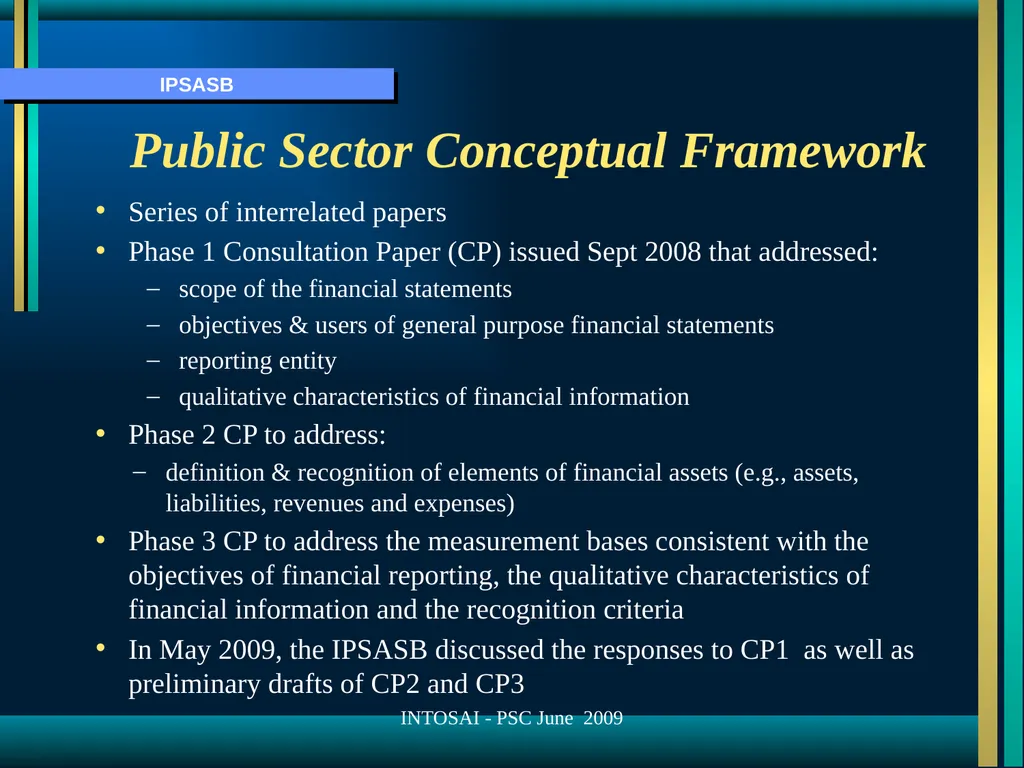
Public Sector Conceptual Framework Series of interrelated papers
Phase 1 Consultation Paper (CP) issued Sept 2008 that addressed:
scope of the financial statements
objectives & users of general purpose financial statements
reporting entity
qualitative characteristics of financial information
Phase 2 CP to address:
definition & recognition of elements of financial assets (e.g., assets, liabilities, revenues and expenses)
Phase 3 CP to address the measurement bases consistent with the objectives of financial reporting, the qualitative characteristics of financial information and the recognition criteria
In May 2009, the IPSASB discussed the responses to CP1 as well as preliminary drafts of CP2 and CP3 INTOSAI - PSC June 2009<br>
Phase 1 Consultation Paper (CP) issued Sept 2008 that addressed:
scope of the financial statements
objectives & users of general purpose financial statements
reporting entity
qualitative characteristics of financial information
Phase 2 CP to address:
definition & recognition of elements of financial assets (e.g., assets, liabilities, revenues and expenses)
Phase 3 CP to address the measurement bases consistent with the objectives of financial reporting, the qualitative characteristics of financial information and the recognition criteria
In May 2009, the IPSASB discussed the responses to CP1 as well as preliminary drafts of CP2 and CP3 INTOSAI - PSC June 2009<br>
18
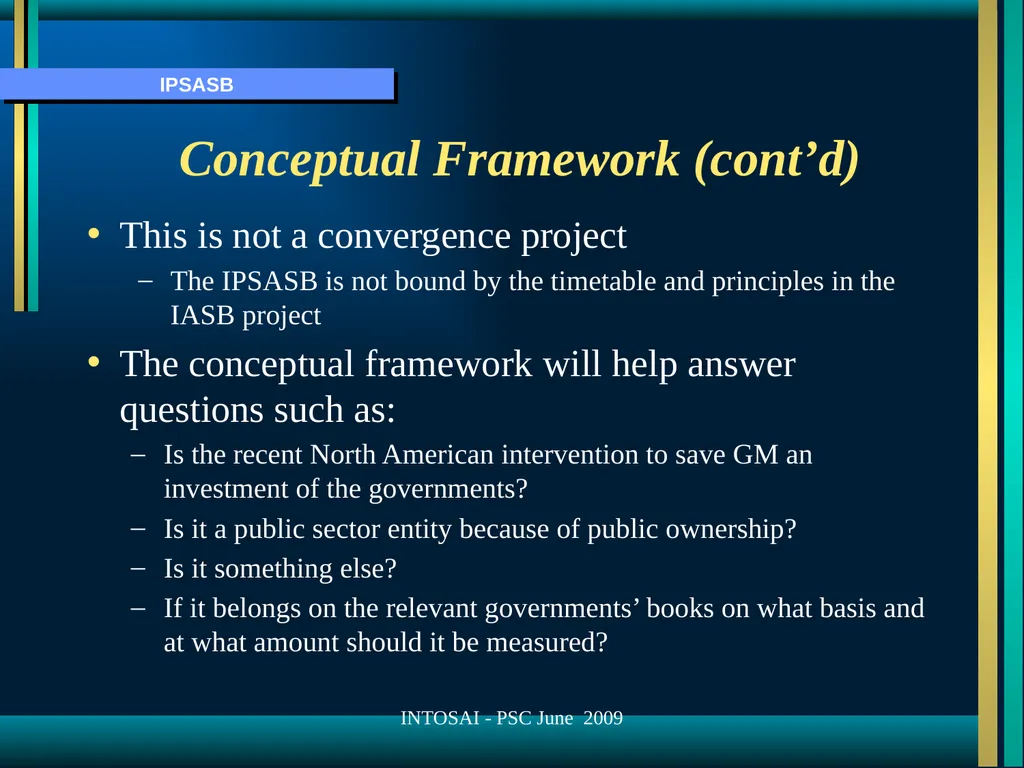
Conceptual Framework (cont’d) This is not a convergence project
The IPSASB is not bound by the timetable and principles in the IASB project
The conceptual framework will help answer questions such as:
Is the recent North American intervention to save GM an investment of the governments?
Is it a public sector entity because of public ownership?
Is it something else?
If it belongs on the relevant governments’ books on what basis and at what amount should it be measured? INTOSAI - PSC June 2009<br>
The IPSASB is not bound by the timetable and principles in the IASB project
The conceptual framework will help answer questions such as:
Is the recent North American intervention to save GM an investment of the governments?
Is it a public sector entity because of public ownership?
Is it something else?
If it belongs on the relevant governments’ books on what basis and at what amount should it be measured? INTOSAI - PSC June 2009<br>
19
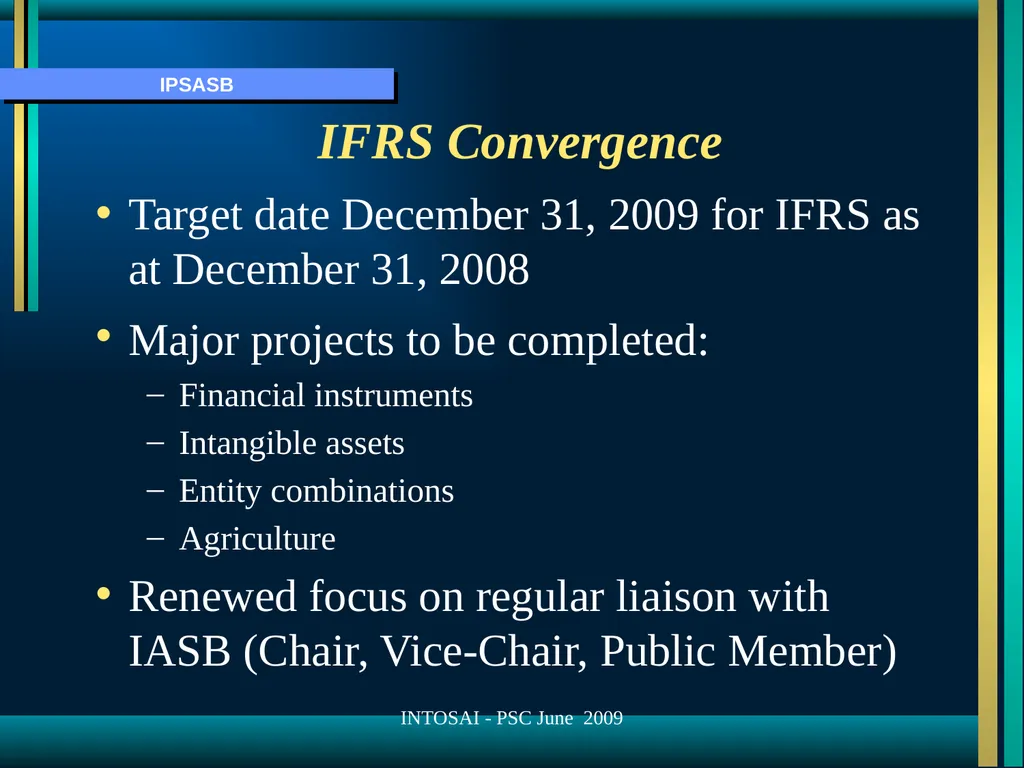
IFRS Convergence Target date December 31, 2009 for IFRS as at December 31, 2008
Major projects to be completed:
Financial instruments
Intangible assets
Entity combinations
Agriculture
Renewed focus on regular liaison with IASB (Chair, Vice-Chair, Public Member) INTOSAI - PSC June 2009<br>
Major projects to be completed:
Financial instruments
Intangible assets
Entity combinations
Agriculture
Renewed focus on regular liaison with IASB (Chair, Vice-Chair, Public Member) INTOSAI - PSC June 2009<br>
20
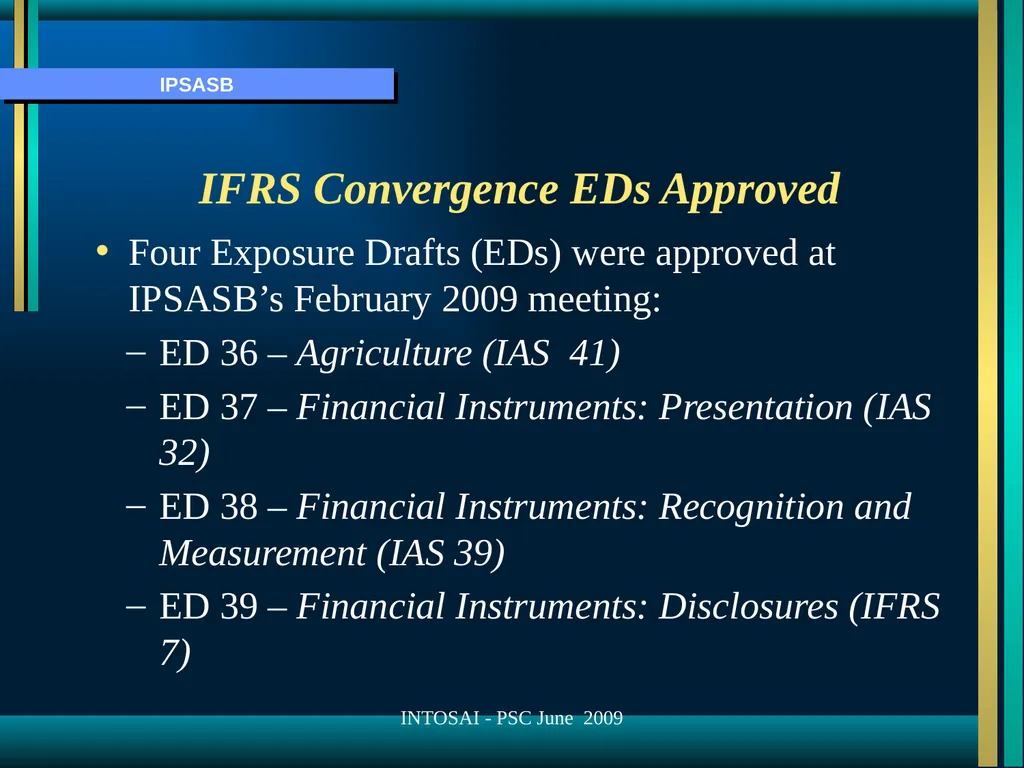
IFRS Convergence EDs Approved Four Exposure Drafts (EDs) were approved at IPSASB’s February 2009 meeting:
ED 36 – Agriculture (IAS 41)
ED 37 – Financial Instruments: Presentation (IAS 32)
ED 38 – Financial Instruments: Recognition and Measurement (IAS 39)
ED 39 – Financial Instruments: Disclosures (IFRS 7) INTOSAI - PSC June 2009<br>
ED 36 – Agriculture (IAS 41)
ED 37 – Financial Instruments: Presentation (IAS 32)
ED 38 – Financial Instruments: Recognition and Measurement (IAS 39)
ED 39 – Financial Instruments: Disclosures (IFRS 7) INTOSAI - PSC June 2009<br>
21
IFRS Convergence EDs Approved (cont’d) Two EDs were approved out-of-session and issued in May:
ED 40 – Intangible Assets (IAS 38)
ED 41 – Entity Combinations from Exchange Transactions (IFRS 3)
All the EDs are available at: http://www.ifac.org/PublicSector/ExposureDrafts.php INTOSAI - PSC June 2009<br>
ED 40 – Intangible Assets (IAS 38)
ED 41 – Entity Combinations from Exchange Transactions (IFRS 3)
All the EDs are available at: http://www.ifac.org/PublicSector/ExposureDrafts.php INTOSAI - PSC June 2009<br>
22
Financial Instruments The IPSASB’s quick response in converging these standards recognizes the important public sector role in addressing the global economic crisis
Convergence with IFRS 7, IAS 32 and IAS 39
Changes made only to address specific public sector issues (e.g., in ED 39, additional disclosures proposed for concessionary loans)
The IPSASB has just issued a press release indicating it will proceed with developing these standards – any changes made by the IASB will be addressed in due course
ED response date: July 31, 2009
Staff contact: johnstanford@ifac.org INTOSAI - PSC June 2009<br>
Convergence with IFRS 7, IAS 32 and IAS 39
Changes made only to address specific public sector issues (e.g., in ED 39, additional disclosures proposed for concessionary loans)
The IPSASB has just issued a press release indicating it will proceed with developing these standards – any changes made by the IASB will be addressed in due course
ED response date: July 31, 2009
Staff contact: johnstanford@ifac.org INTOSAI - PSC June 2009<br>
23
Agriculture IAS 41 convergence
Minor changes in terminology
Inclusion of non-exchange transactions
Scope excludes biological assets held for the supply of services
ED response date: June 30, 2009
Staff contact: johnstanford@ifac.org INTOSAI - PSC June 2009<br>
Minor changes in terminology
Inclusion of non-exchange transactions
Scope excludes biological assets held for the supply of services
ED response date: June 30, 2009
Staff contact: johnstanford@ifac.org INTOSAI - PSC June 2009<br>
24
Intangible Assets IAS 38 convergence
Incorporates SIC-32 guidance for web site costs
Does not address powers to grant rights and to tax
ED response date: August 15, 2009
Staff contact: joykeenan@ifac.org INTOSAI - PSC June 2009<br>
Incorporates SIC-32 guidance for web site costs
Does not address powers to grant rights and to tax
ED response date: August 15, 2009
Staff contact: joykeenan@ifac.org INTOSAI - PSC June 2009<br>
25
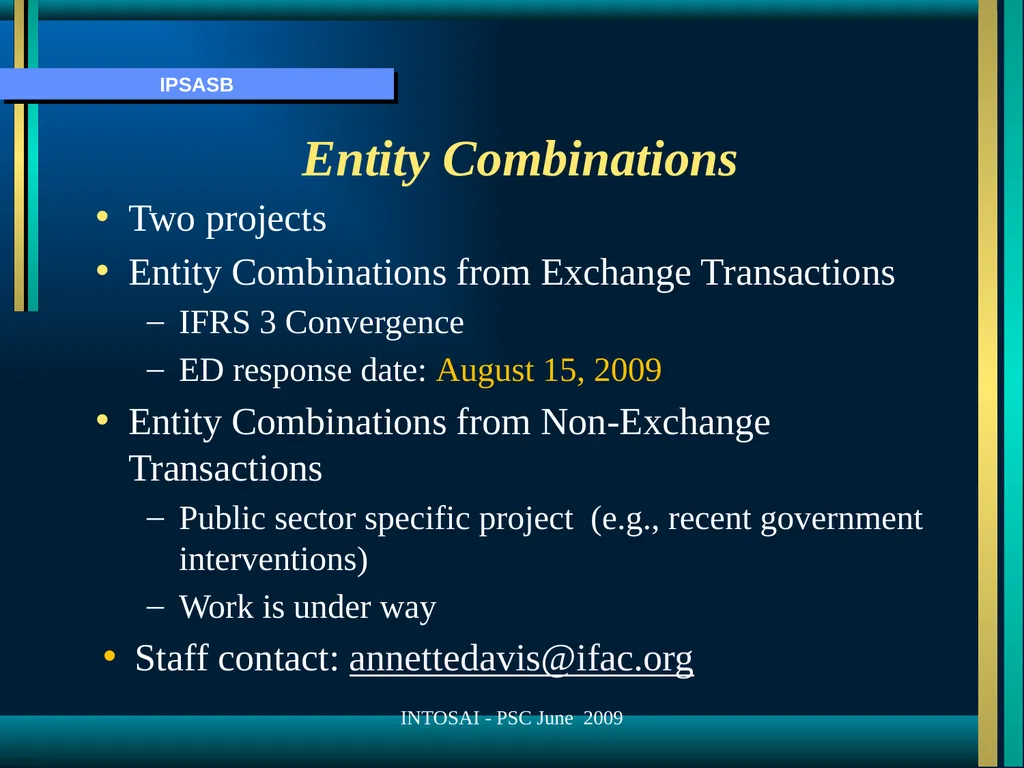
Entity Combinations Two projects
Entity Combinations from Exchange Transactions
IFRS 3 Convergence
ED response date: August 15, 2009
Entity Combinations from Non-Exchange Transactions
Public sector specific project (e.g., recent government interventions)
Work is under way
Staff contact: annettedavis@ifac.org INTOSAI - PSC June 2009<br>
Entity Combinations from Exchange Transactions
IFRS 3 Convergence
ED response date: August 15, 2009
Entity Combinations from Non-Exchange Transactions
Public sector specific project (e.g., recent government interventions)
Work is under way
Staff contact: annettedavis@ifac.org INTOSAI - PSC June 2009<br>
26
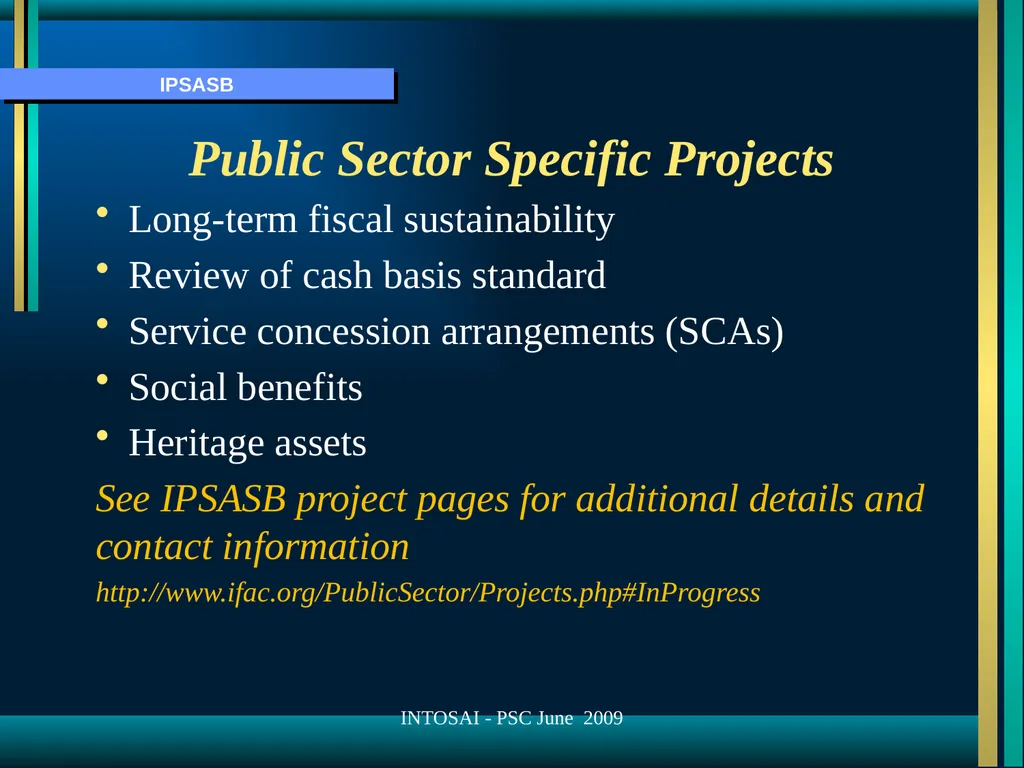
Public Sector Specific Projects Long-term fiscal sustainability
Review of cash basis standard
Service concession arrangements (SCAs)
Social benefits
Heritage assets
See IPSASB project pages for additional details and contact information
http://www.ifac.org/PublicSector/Projects.php#InProgress INTOSAI - PSC June 2009<br>
Review of cash basis standard
Service concession arrangements (SCAs)
Social benefits
Heritage assets
See IPSASB project pages for additional details and contact information
http://www.ifac.org/PublicSector/Projects.php#InProgress INTOSAI - PSC June 2009<br>
27
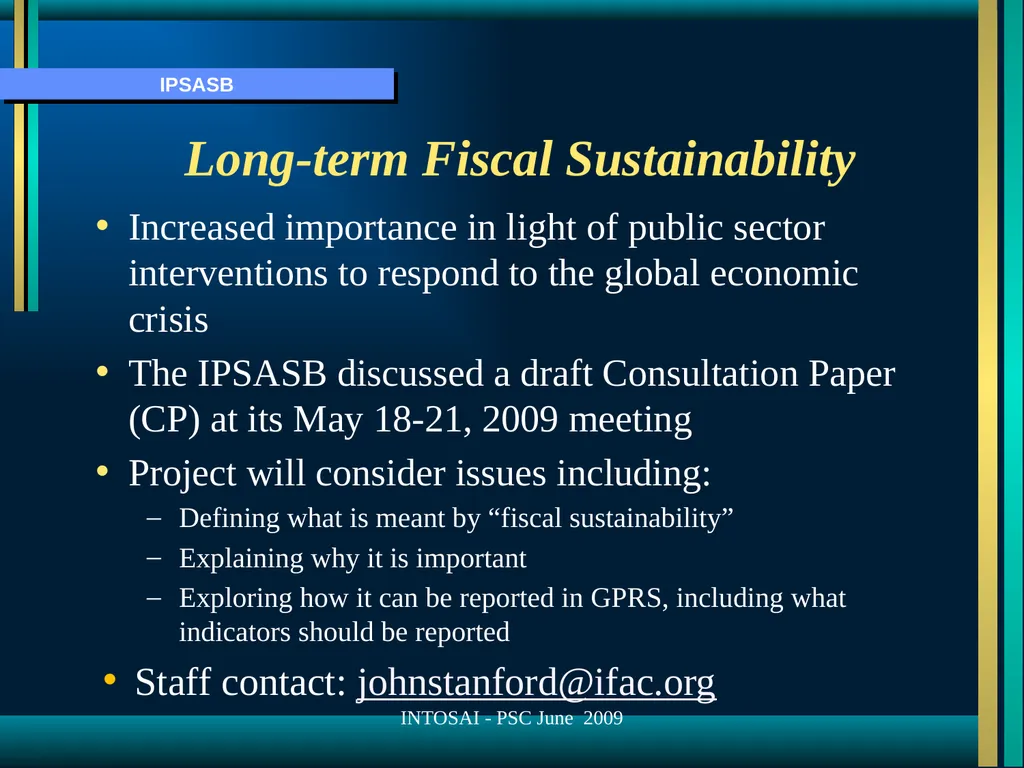
Long-term Fiscal Sustainability Increased importance in light of public sector interventions to respond to the global economic crisis
The IPSASB discussed a draft Consultation Paper (CP) at its May 18-21, 2009 meeting
Project will consider issues including:
Defining what is meant by “fiscal sustainability”
Explaining why it is important
Exploring how it can be reported in GPRS, including what indicators should be reported
Staff contact: johnstanford@ifac.org INTOSAI - PSC June 2009<br>
The IPSASB discussed a draft Consultation Paper (CP) at its May 18-21, 2009 meeting
Project will consider issues including:
Defining what is meant by “fiscal sustainability”
Explaining why it is important
Exploring how it can be reported in GPRS, including what indicators should be reported
Staff contact: johnstanford@ifac.org INTOSAI - PSC June 2009<br>
28
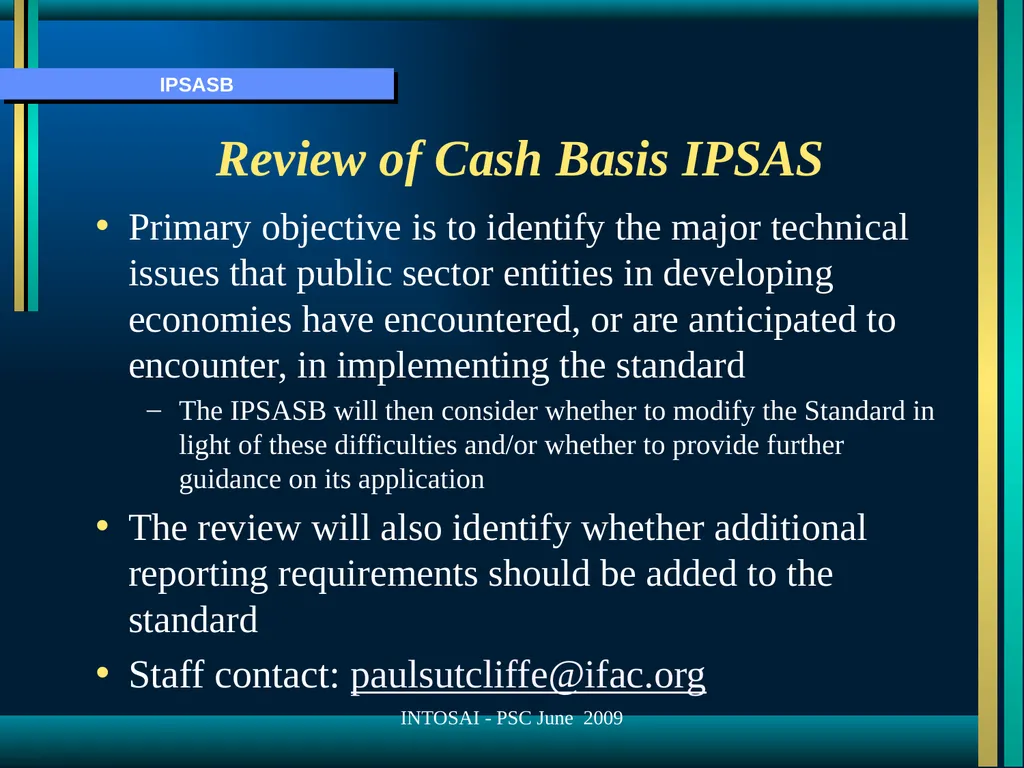
Review of Cash Basis IPSAS Primary objective is to identify the major technical issues that public sector entities in developing economies have encountered, or are anticipated to encounter, in implementing the standard
The IPSASB will then consider whether to modify the Standard in light of these difficulties and/or whether to provide further guidance on its application
The review will also identify whether additional reporting requirements should be added to the standard
Staff contact: paulsutcliffe@ifac.org INTOSAI - PSC June 2009<br>
The IPSASB will then consider whether to modify the Standard in light of these difficulties and/or whether to provide further guidance on its application
The review will also identify whether additional reporting requirements should be added to the standard
Staff contact: paulsutcliffe@ifac.org INTOSAI - PSC June 2009<br>
29
Service Concession Arrangements CP issued in March 2008
Respondents expressed broad support for the proposed views in the CP
Although it uses a control-based approach as IFRIC 12 to determine if the grantor should recognize an asset, it is not a convergence project
Work is under way to develop an ED that will:
Define an SCA
Determine when to report the property as an asset using a control-based approach
Provide accounting and reporting guidance and examples in a variety of scenarios, including when the control criteria are not met
Give guidance on accounting for and reporting guarantees, contingent liabilities and contingent assets related to SCAs
Staff contact: joykeenan@ifac.org INTOSAI - PSC June 2009<br>
Respondents expressed broad support for the proposed views in the CP
Although it uses a control-based approach as IFRIC 12 to determine if the grantor should recognize an asset, it is not a convergence project
Work is under way to develop an ED that will:
Define an SCA
Determine when to report the property as an asset using a control-based approach
Provide accounting and reporting guidance and examples in a variety of scenarios, including when the control criteria are not met
Give guidance on accounting for and reporting guarantees, contingent liabilities and contingent assets related to SCAs
Staff contact: joykeenan@ifac.org INTOSAI - PSC June 2009<br>
30
Promoting Acceptance of the IPSASs Members and staff are involved in ongoing and extensive promotion, communications and outreach activities both within their own jurisdictions and internationally to promote the IPSASs
Widespread adoption is our ultimate goal INTOSAI - PSC June 2009<br>
Widespread adoption is our ultimate goal INTOSAI - PSC June 2009<br>
31
Looking Ahead Completion of convergence initiative and completion of the conceptual framework will allow increased focus on public sector issues
Improve consistency, transparency and accountability in financial reporting among public sector entities
Improve harmonization between statistical and accrual bases of accounting INTOSAI - PSC June 2009<br>
Improve consistency, transparency and accountability in financial reporting among public sector entities
Improve harmonization between statistical and accrual bases of accounting INTOSAI - PSC June 2009<br>
32
Key Challenges for IPSASB Meeting target for IFRS Convergence
Growing demand for standards in light of the global financial crisis
Credibility of IPSASB – Board/staff
Completion of Conceptual Framework
Continuing relevance to public sector INTOSAI - PSC June 2009<br>
Growing demand for standards in light of the global financial crisis
Credibility of IPSASB – Board/staff
Completion of Conceptual Framework
Continuing relevance to public sector INTOSAI - PSC June 2009<br>
33
International Federation of Accountants
www.ifac.org INTOSAI - PSC June 2009<br>
www.ifac.org INTOSAI - PSC June 2009<br>